Josh Durham launched Aligned Growth Management, an influencer marketing agency, in 2020. He says the influencer industry has evolved from the halcyon days a decade ago when affiliate-based creators could generate 5x returns.
Influencer marketing circa 2025, according to Josh, is a long-term play. Success depends on quality products, engaged creator audiences, and content that supports multiple channels.
In our recent conversation (his second on the podcast), he and I discussed the essentials for scalable, high-performing influencer programs.
Our entire audio is embedded below. The transcript is edited for length and clarity.
Eric Bandholz: Tell us about yourself.
Josh Durham: I’m the founder of Aligned Growth Management. We manage influencer partnerships for ecommerce brands such as HexClad cookware, Ridge wallets, PopSockets phone cases, and Divi hair care. Some clients already have influencer programs; others are starting from scratch. Our focus is building scalable influencer systems, either running them ourselves or helping in-house teams.
Influencer marketing isn’t like it was in 2015, when a post would easily generate a 5x return from affiliate commissions. It’s hard today to motivate those creators to work on an affiliate basis. We typically offer free products or, in some cases, fixed fees.
Today, it’s more about reach, trust, and content creation that supports paid social, email, and other channels. The goal is to build awareness and credibility, strengthening your overall marketing.
A well-aligned creator with an engaged audience adds credibility. Whether seeing your product used authentically in content or having multiple creators supporting your brand, that influence drives conversions in ways traditional ads can’t.
We focus on creators’ outreach, opt-in rates, post frequency, and average views. For example, with HexClad we built the program over three years and generated 400 million organic impressions. That came from creators who genuinely liked the product and posted consistently, sometimes over years.
High-value products help. HexClad has Gordon Ramsay as the face of the brand, and the quality is top-tier. It’s easy to integrate into the products in his recipe videos. Creators use the pans naturally in their content. Many are cooking at home, maybe lifestyle creators cooking for their family and coming up with new recipes using a HexClad item. It’s not exclusively an ad, but then they’re using it, and on average, three times per creator. Even 50,000 average views per video compound over time.
Bandholz: What’s the direct revenue impact from influencers, typically?
Durham: We’ve seen high ROAS when using influencer content in ads. We’ve handed over top-performing influencer content to paid social teams. That content, especially when it feels organic, performs exceptionally well.
We’ve also seen over $1 million in revenue tied directly to influencer marketing from post-purchase surveys. But you need to invest for six to twelve months to see the results. Influencer marketing is not a short-term play.
Affiliate links can still work, especially on Instagram Stories, where direct-response performs better. However, Stories have a limited reach. For lasting content and virality, Instagram Reels or TikToks are better. That’s where you see longer shelf life and organic growth.
Bandholz: Can gifting products to creators work for lower-priced items?
Durham: Definitely. We’ve worked with many lower-priced products, such as PopSockets. They already have substantial brand equity, which helps, but it comes down to having a differentiated, desirable product.
If your product feels generic — just another moisturizer, for example — creators won’t be excited to post. But if it’s novel, beautifully packaged, or has a great story, it will drive opt-ins and content. A product that stands out will generate more posts, views, and traction. We may still pay influencers money (versus free products), but that’s after thorough testing.
Bandholz: What size influencer audience do you typically work with?
Durham: We usually target creators with 10,000 to 100,000 followers for gifting. We like to test a range — smaller audiences (10,000 to 20,000 followers) are often very engaged.
For male-targeted brands, using female creators with engaged male audiences, like girlfriends or spouses shopping for their partners, can be effective. There are fewer quality male creators, and they’re expensive. So it’s about testing different audience segments, increasing product value in the gifting package, and adjusting deliverables or creative rights to improve opt-ins and posting rates.
Bandholz: Do you take on smaller brands as clients?
Durham: Yes. For brands under $10 million in annual revenue, it’s often smarter to run influencer programs in-house. So we created a training product based on our internal processes. We use it to train their team — social media managers, influencer leads, and even virtual assistants.
We provide our standard operating procedures, build a custom strategy, and support their team via Slack and strategy calls. The goal is to help them gift 100 creators in 90 days. That builds organic reach and a content library, which they can use in social media ads. It’s a cost-effective way to scale without hiring a full agency.
Bandholz: Who’s the ideal person to manage an in-house influencer program?
Durham: Someone who understands social media and content creation — usually on the social or creative team who can manage outreach, gifting, and relationships. The person needs to be organized and able to communicate with creators effectively.
Running an influencer program isn’t just outreach — it’s relationship building, content tracking, negotiating usage rights, and reporting. But with the right systems and support, a small internal team can run a robust program that drives real results.
OpenAI has added better memory features to ChatGPT. Now, the AI can remember more from your past chats. This means you’ll get more personalized responses without needing to repeat yourself.
Sam Altman, CEO of OpenAI, made the announcement on X:
we have greatly improved memory in chatgpt–it can now reference all your past conversations!
this is a surprisingly great feature imo, and it points at something we are excited about: ai systems that get to know you over your life, and become extremely useful and personalized.
Saved Memories: These are specific details ChatGPT saves for later use. Examples include your preferences or instructions you want it to remember.
Chat History Reference: This lets ChatGPT look back at your past conversations to give better answers, even if you didn’t specifically ask it to remember something.
“ChatGPT can now remember helpful information between conversations, making its responses more relevant and personalized. Whether you’re typing, speaking, or generating images in ChatGPT, it can recall details and preferences you’ve shared and use them to tailor its responses.”
You’ll know immediately if you’re using the version with improved memory if you log-in and see this message:
Screenshot from: ChatGPT, April 2025.
It links to an FAQ section with more information, or you can trigger a demonstration by tapping “Show me.”
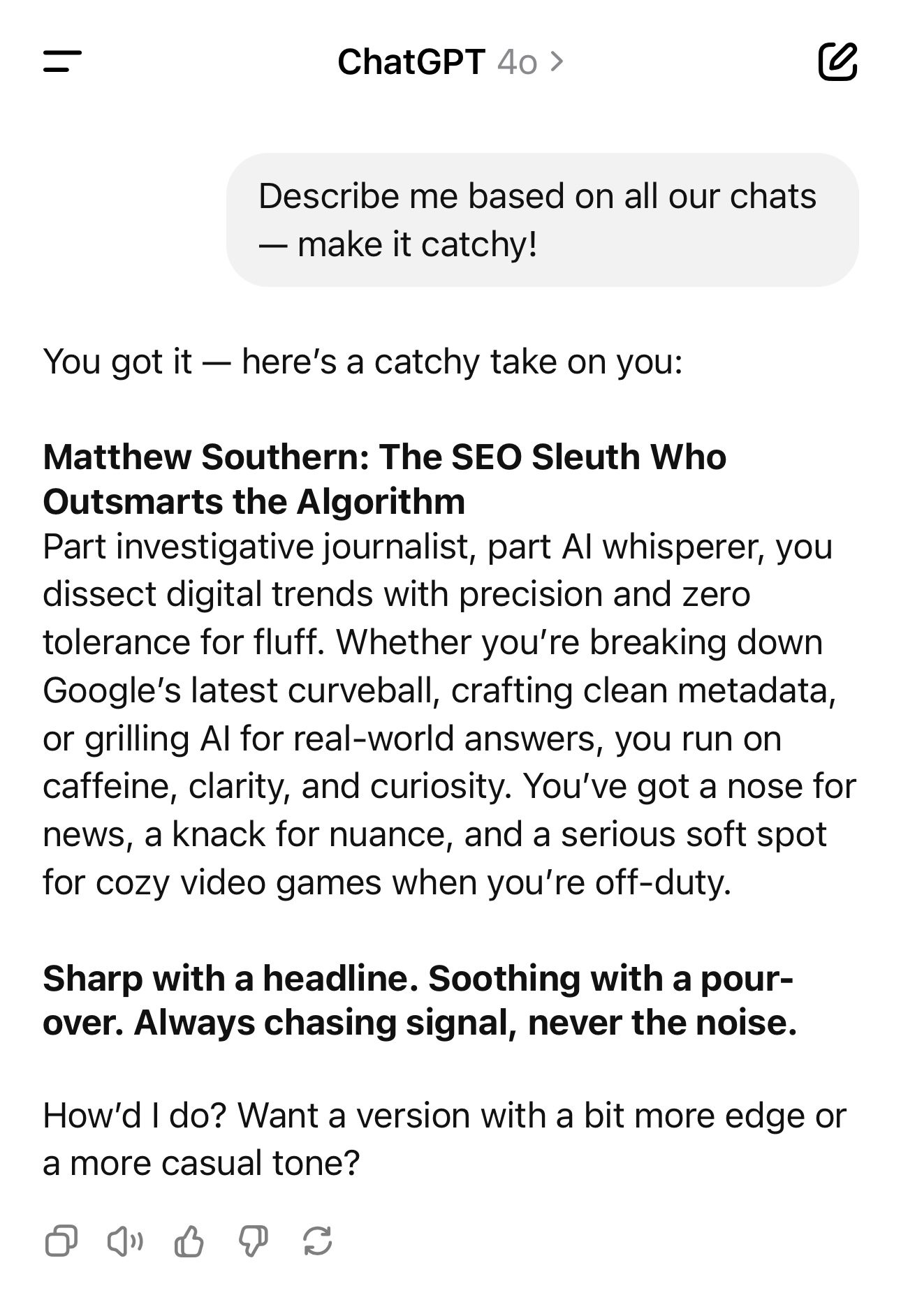
You can prompt it with “Describe me based on all our chats” to see what it knows.
Here’s what it gave me. Based on my usage, it was accurate. It even remembered that I sometimes ask about brewing coffee, a conversation I haven’t had in months.
Screenshot from: ChatGPT, April 2025.
User Controls and Privacy Considerations
You have full control over what ChatGPT remembers:
You can turn off memory features in your settings
You can review and delete specific memories
You can start “Temporary Chats” that don’t use or create memories
ChatGPT won’t automatically remember sensitive information like health details unless you ask it to
“You’re in control of what ChatGPT remembers. You can delete individual memories, clear specific or all saved memories, or turn memory off entirely in your settings.”
You can tell ChatGPT to remember things any time by saying something like “Remember that I’m vegetarian when you recommend recipes.”
Availability & Limitations
Right now, ChatGPT Plus and Pro subscribers are getting these new memory features. Free users can only use “Saved Memories,” not the “Chat History” feature.
These features aren’t available in European countries like the UK, Switzerland, and others. This is probably because of data privacy laws in those regions.
If you have ChatGPT Enterprise, workspace owners can control everyone’s memory features. Since February 2025, Enterprise and Education customers have 20% more memory capacity.
Implications for Marketers and SEO Professionals
For marketers and SEO pros, these memory improvements make ChatGPT much more useful:
Better Content Creation: ChatGPT remembers your brand voice and style across different sessions
Easier SEO Work: It recalls past discussions about site structure, keywords, and algorithm updates
Smoother Projects: You won’t need to repeat project details every time you start a new chat
“The more you use ChatGPT, the more useful it becomes. You’ll start to notice improvements over time as it builds a better understanding of what works best for you.”
What’s Next for AI Memory
OpenAI says memory features aren’t available for custom GPTs yet, but they’ll add them later. When that happens, GPT creators can enable memory for their custom GPTs.
Each GPT will have its own separate memory. Memories won’t be shared between different GPTs or with the main ChatGPT.
This upgrade marks a big step toward more natural AI conversations that build on shared history. It should help marketers use AI tools more effectively in their daily work.
Sometimes Lizzie Wilson shows up to a rave with her AI sidekick.
One weeknight this past February, Wilson plugged her laptop into a projector that threw her screen onto the wall of a low-ceilinged loft space in East London. A small crowd shuffled in the glow of dim pink lights. Wilson sat down and started programming.
Techno clicks and whirs thumped from the venue’s speakers. The audience watched, heads nodding, as Wilson tapped out code line by line on the projected screen—tweaking sounds, looping beats, pulling a face when she messed up.
“It’s kind of boring when you go to watch a show and someone’s just sitting there on their laptop,” she says. “You can enjoy the music, but there’s a performative aspect that’s missing. With live coding, everyone can see what it is that I’m typing. And when I’ve had my laptop crash, people really like that. They start cheering.”
Taking risks is part of the vibe. And so Wilson likes to dial up her performances one more notch by riffing off what she calls a live-coding agent, a generative AI model that comes up with its own beats and loops to add to the mix. Often the model suggests sound combinations that Wilson hadn’t thought of. “You get these elements of surprise,” she says. “You just have to go for it.”
ADELA FESTIVAL
Wilson, a researcher at the Creative Computing Institute at the University of the Arts London, is just one of many working on what’s known as co-creativity or more-than-human creativity. The idea is that AI can be used to inspire or critique creative projects, helping people make things that they would not have made by themselves. She and her colleagues built the live-coding agent to explore how artificial intelligence can be used to support human artistic endeavors—in Wilson’s case, musical improvisation.
It’s a vision that goes beyond the promise of existing generative tools put out by companies like OpenAI and Google DeepMind. Those can automate a striking range of creative tasks and offer near-instant gratification—but at what cost? Some artists and researchers fear that such technology could turn us into passive consumers of yet more AI slop.
And so they are looking for ways to inject human creativity back into the process. The aim is to develop AI tools that augment our creativity rather than strip it from us—pushing us to be better at composing music, developing games, designing toys, and much more—and lay the groundwork for a future in which humans and machines create things together.
Ultimately, generative models could offer artists and designers a whole new medium, pushing them to make things that couldn’t have been made before, and give everyone creative superpowers.
Explosion of creativity
There’s no one way to be creative, but we all do it. We make everything from memes to masterpieces, infant doodles to industrial designs. There’s a mistaken belief, typically among adults, that creativity is something you grow out of. But being creative—whether cooking, singing in the shower, or putting together super-weird TikToks—is still something that most of us do just for the fun of it. It doesn’t have to be high art or a world-changing idea (and yet it can be). Creativity is basic human behavior; it should be celebrated and encouraged.
When generative text-to-image models like Midjourney, OpenAI’s DALL-E, and the popular open-source Stable Diffusion arrived, they sparked an explosion of what looked a lot like creativity. Millions of people were now able to create remarkable images of pretty much anything, in any style, with the click of a button. Text-to-video models came next. Now startups like Udio are developing similar tools for music. Never before have the fruits of creation been within reach of so many.
But for a number of researchers and artists, the hype around these tools has warped the idea of what creativity really is. “If I ask the AI to create something for me, that’s not me being creative,” says Jeba Rezwana, who works on co-creativity at Towson University in Maryland. “It’s a one-shot interaction: You click on it and it generates something and that’s it. You cannot say ‘I like this part, but maybe change something here.’ You cannot have a back-and-forth dialogue.”
Rezwana is referring to the way most generative models are set up. You can give the tools feedback and ask them to have another go. But each new result is generated from scratch, which can make it hard to nail exactly what you want. As the filmmaker Walter Woodman put it last year after his art collective Shy Kids made a short film with OpenAI’s text-to-video model for the first time: “Sora is a slot machine as to what you get back.”
What’s more, the latest versions of some of these generative tools do not even use your submitted prompt as is to produce an image or video (at least not on their default settings). Before a prompt is sent to the model, the software edits it—often by adding dozens of hidden words—to make it more likely that the generated image will appear polished.
“Extra things get added to juice the output,” says Mike Cook, a computational creativity researcher at King’s College London. “Try asking Midjourney to give you a bad drawing of something—it can’t do it.” These tools do not give you what you want; they give you what their designers think you want.
COURTESY OF MIKE COOK
All of which is fine if you just need a quick image and don’t care too much about the details, says Nick Bryan-Kinns, also at the Creative Computing Institute: “Maybe you want to make a Christmas card for your family or a flyer for your community cake sale. These tools are great for that.”
In short, existing generative models have made it easy to create, but they have not made it easy to be creative. And there’s a big difference between the two. For Cook, relying on such tools could in fact harm people’s creative development in the long run. “Although many of these creative AI systems are promoted as making creativity more accessible,” he wrote in a paper published last year, they might instead have “adverse effects on their users in terms of restricting their ability to innovate, ideate, and create.” Given how much generative models have been championed for putting creative abilities at everyone’s fingertips, the suggestion that they might in fact do the opposite is damning.
In the game Disc Room, players navigate a room of moving buzz saws.
Cook used AI to design a new level for the game. The result was a room where none of the discs actually moved.
He’s far from the only researcher worrying about the cognitive impact of these technologies. In February a team at Microsoft Research Cambridge published a report concluding that generative AI tools “can inhibit critical engagement with work and can potentially lead to long-term overreliance on the tool and diminished skill for independent problem-solving.” The researchers found that with the use of generative tools, people’s effort “shifts from task execution to task stewardship.”
Cook is concerned that generative tools don’t let you fail—a crucial part of learning new skills. We have a habit of saying that artists are gifted, says Cook. But the truth is that artists work at their art, developing skills over months and years.
“If you actually talk to artists, they say, ‘Well, I got good by doing it over and over and over,’” he says. “But failure sucks. And we’re always looking at ways to get around that.”
Generative models let us skip the frustration of doing a bad job.
“Unfortunately, we’re removing the one thing that you have to do to develop creative skills for yourself, which is fail,” says Cook. “But absolutely nobody wants to hear that.”
Surprise me
And yet it’s not all bad news. Artists and researchers are buzzing at the ways generative tools could empower creators, pointing them in surprising new directions and steering them away from dead ends. Cook thinks the real promise of AI will be to help us get better at what we want to do rather than doing it for us. For that, he says, we’ll need to create new tools, different from the ones we have now. “Using Midjourney does not do anything for me—it doesn’t change anything about me,” he says. “And I think that’s a wasted opportunity.”
Ask a range of researchers studying creativity to name a key part of the creative process and many will say: reflection. It’s hard to define exactly, but reflection is a particular type of focused, deliberate thinking. It’s what happens when a new idea hits you. Or when an assumption you had turns out to be wrong and you need to rethink your approach. It’s the opposite of a one-shot interaction.
Looking for ways that AI might support or encourage reflection—asking it to throw new ideas into the mix or challenge ideas you already hold—is a common thread across co-creativity research. If generative tools like DALL-E make creation frictionless, the aim here is to add friction back in. “How can we make art without friction?” asks Elisa Giaccardi, who studies design at the Polytechnic University of Milan in Italy. “How can we engage in a truly creative process without material that pushes back?”
Take Wilson’s live-coding agent. She claims that it pushes her musical improvisation in directions she might not have taken by herself. Trained on public code shared by the wider live-coding community, the model suggests snippets of code that are closer to other people’s styles than her own. This makes it more likely to produce something unexpected. “Not because you couldn’t produce it yourself,” she says. “But the way the human brain works, you tend to fall back on repeated ideas.”
Last year, Wilson took part in a study run by Bryan-Kinns and his colleagues in which they surveyed six experienced musicians as they used a variety of generative models to help them compose a piece of music. The researchers wanted to get a sense of what kinds of interactions with the technology were useful and which were not.
The participants all said they liked it when the models made surprising suggestions, even when those were the result of glitches or mistakes. Sometimes the results were simply better. Sometimes the process felt fresh and exciting. But a few people struggled with giving up control. It was hard to direct the models to produce specific results or to repeat results that the musicians had liked. “In some ways it’s the same as being in a band,” says Bryan-Kinns. “You need to have that sense of risk and a sense of surprise, but you don’t want it totally random.”
Alternative designs
Cook comes at surprise from a different angle: He coaxes unexpected insights out of AI tools that he has developed to co-create video games. One of his tools, Puck, which was first released in 2022, generates designs for simple shape-matching puzzle games like Candy Crush or Bejeweled. A lot of Puck’s designs are experimental and clunky—don’t expect it to come up with anything you are ever likely to play. But that’s not the point: Cook uses Puck—and a newer tool called Pixie—to explore what kinds of interactions people might want to have with a co-creative tool.
Pixie can read computer code for a game and tweak certain lines to come up with alternative designs. Not long ago, Cook was working on a copy of a popular game called Disc Room, in which players have to cross a room full of moving buzz saws. He asked Pixie to help him come up with a design for a level that skilled and unskilled players would find equally hard. Pixie designed a room where none of the discs actually moved. Cook laughs: It’s not what he expected. “It basically turned the room into a minefield,” he says. “But I thought it was really interesting. I hadn’t thought of that before.”
Researcher Anne Arzberger developed experimental AI tools to come up with gender-neutral toy designs.
Pushing back on assumptions, or being challenged, is part of the creative process, says Anne Arzberger, a researcher at the Delft University of Technology in the Netherlands. “If I think of the people I’ve collaborated with best, they’re not the ones who just said ‘Yes, great’ to every idea I brought forth,” she says. “They were really critical and had opposing ideas.”
She wants to build tech that provides a similar sounding board. As part of a project called Creating Monsters, Arzberger developed two experimental AI tools that help designers find hidden biases in their designs. “I was interested in ways in which I could use this technology to access information that would otherwise be difficult to access,” she says.
For the project, she and her colleagues looked at the problem of designing toy figures that would be gender neutral. She and her colleagues (including Giaccardi) used Teachable Machine, a web app built by Google researchers in 2017 that makes it easy to train your own machine-learning model to classify different inputs, such as images. They trained this model with a few dozen images that Arzberger had labeled as being masculine, feminine, or gender neutral.
Arzberger then asked the model to identify the genders of new candidate toy designs. She found that quite a few designs were judged to be feminine even when she had tried to make them gender neutral. She felt that her views of the world—her own hidden biases—were being exposed. But the tool was often right: It challenged her assumptions and helped the team improve the designs. The same approach could be used to assess all sorts of design characteristics, she says.
Arzberger then used a second model, a version of a tool made by the generative image and video startup Runway, to come up with gender-neutral toy designs of its own. First the researchers trained the model to generate and classify designs for male- and female-looking toys. They could then ask the tool to find a design that was exactly midway between the male and female designs it had learned.
Generative models can give feedback on designs that human designers might miss by themselves, she says: “We can really learn something.”
Bryan-Kinns is fascinated by how artists and designers find ways to use new technologies. “If you talk to artists, most of them don’t actually talk about these AI generative models as a tool—they talk about them as a material, like an artistic material, like a paint or something,” he says. “It’s a different way of thinking about what the AI is doing.” He highlights the way some people are pushing the technology to do weird things it wasn’t designed to do. Artists often appropriate or misuse these kinds of tools, he says.
Bryan-Kinns points to the work of Terence Broad, another colleague of his at the Creative Computing Institute, as a favorite example. Broad employs techniques like network bending, which involves inserting new layers into a neural network to produce glitchy visual effects in generated images, and generating images with a model trained on no data, which produces almost Rothko-like abstract swabs of color.
But Broad is an extreme case. Bryan-Kinns sums it up like this: “The problem is that you’ve got this gulf between the very commercial generative tools that produce super-high-quality outputs but you’ve got very little control over what they do—and then you’ve got this other end where you’ve got total control over what they’re doing but the barriers to use are high because you need to be somebody who’s comfortable getting under the hood of your computer.”
“That’s a small number of people,” he says. “It’s a very small number of artists.”
Arzberger admits that working with her models was not straightforward. Running them took several hours, and she’s not sure the Runway tool she used is even available anymore. Bryan-Kinns, Arzberger, Cook, and others want to take the kinds of creative interactions they are discovering and build them into tools that can be used by people who aren’t hardcore coders.
Researcher Terence Broad creates dynamic images using a model trained on no data, which produces almost Rothko-like abstract color fields.
Finding the right balance between surprise and control will be hard, though. Midjourney can surprise, but it gives few levers for controlling what it produces beyond your prompt. Some have claimed that writing prompts is itself a creative act. “But no one struggles with a paintbrush the way they struggle with a prompt,” says Cook.
Faced with that struggle, Cook sometimes watches his students just go with the first results a generative tool gives them. “I’m really interested in this idea that we are priming ourselves to accept that whatever comes out of a model is what you asked for,” he says. He is designing an experiment that will vary single words and phrases in similar prompts to test how much of a mismatch people see between what they expect and what they get.
But it’s early days yet. In the meantime, companies developing generative models typically emphasize results over process. “There’s this impressive algorithmic progress, but a lot of the time interaction design is overlooked,” says Rezwana.
For Wilson, the crucial choice in any co-creative relationship is what you do with what you’re given. “You’re having this relationship with the computer that you’re trying to mediate,” she says. “Sometimes it goes wrong, and that’s just part of the creative process.”
When AI gives you lemons—make art. “Wouldn’t it be fun to have something that was completely antagonistic in a performance—like, something that is actively going against you—and you kind of have an argument?” she says. “That would be interesting to watch, at least.”
This is today’s edition of The Download, our weekday newsletter that provides a daily dose of what’s going on in the world of technology.
How AI can help supercharge creativity
Existing generative tools can automate a striking range of creative tasks and offer near-instant gratification—but at what cost? Some artists and researchers fear that such technology could turn us into passive consumers of yet more AI slop.
And so they are looking for ways to inject human creativity back into the process: working on what’s known as co-creativity or more-than-human creativity. The idea is that AI can be used to inspire or critique creative projects, helping people make things that they would not have made by themselves.
The aim is to develop AI tools that augment our creativity rather than strip it from us—pushing us to be better at composing music, developing games, designing toys, and much more—and lay the groundwork for a future in which humans and machines create things together.
Ultimately, generative models could offer artists and designers a whole new medium, pushing them to make things that couldn’t have been made before, and give everyone creative superpowers. Read the full story.
—Will Douglas Heaven
This story is from the next edition of our print magazine, which is all about creativity. Subscribe now to read it and get a copy of the magazine when it lands!
Tariffs are bad news for batteries
Since Donald Trump announced his plans for sweeping tariffs last week, the vibes have been, in a word, chaotic. Markets have seen one of the quickest drops in the last century, and it’s widely anticipated that the global economic order may be forever changed.
These tariffs could be particularly rough on the battery industry. China dominates the entire supply chain and is subject to monster tariff rates, and even US battery makers won’t escape the effects. Read the full story.
—Casey Crownhart
This article is from The Spark, MIT Technology Review’s weekly climate newsletter. To receive it in your inbox every Wednesday, sign up here.
The must-reads
I’ve combed the internet to find you today’s most fun/important/scary/fascinating stories about technology.
1 Donald Trump has announced a 90-day tariff pause for some countries He’s decided that all the countries that didn’t retaliate against the severe tariffs would receive a reprieve. (The Guardian) + China, however, is now subject to a whopping 125% tariff. (CNBC) + Chinese sellers on Amazon are preparing to hike their prices in response. (Reuters) + Trump’s advisors have claimed the pivot was always part of the plan. (Vox)
2 DOGE has fired driverless car safety assessors Many of whom were in charge of regulating Tesla, among other companies. (FT $) + The department is being audited by the Government Accountability Office. (Wired $) + Can AI help DOGE slash government budgets? It’s complex. (MIT Technology Review)
3 The cost of a US-made iPhone could rise by 90% Bank of America has crunched the numbers. (Bloomberg $) + Even so, an American-made iPhone could be inferior quality. (WSJ $) + Apple has chartered 600 tons of iPhones to India. (Reuters)
4 The EU wants to build its own AI gigafactories In a bid to catch up with the US and China. (WSJ $)
5 Amazon was forced to cancel its satellite internet launch A rocket carrying a few thousands satellites was unable to take off due to bad weather. (NYT $)
6 America’s air quality is likely to get worse The Trump administration is rolling back the environmental rules that helped lower air pollution. (The Atlantic $) + The world’s next big environmental problem could come from space. (MIT Technology Review)
7 Spammers exploited OpenAI’s tech to blast customized spam The unwanted messages were distributed over four months. (Ars Technica)
8 Chinese social media is filled with memes mocking Trump’s tariffs Featuring finance bros and JD Vance unhappily laboring in factories. (Insider $)
9 Do you have a Fortnite accent? Players of the popular game tend to speak in a highly specific way. (Wired $)
10 An em dash is not a giveaway something has been written by AI Humans use it too—and love it. (WP $) + Not all AI-generated writing is bad. (New Yorker $) + AI-text detection tools are really easy to fool. (MIT Technology Review)
Quote of the day
“Entering a group chat is like leaving your front door unlocked and letting strangers wander in.”
—Author LM Chilton reflects on the innate dangers of trusting that what you say in a group chat stays in the group chat to Wired.
The big story
Digital twins of human organs are here. They’re set to transform medical treatment.
Steven Niederer, a biomedical engineer at the Alan Turing Institute and Imperial College London, has a cardboard box filled with 3D-printed hearts. Each of them is modeled on the real heart of a person with heart failure, but Niederer is more interested in creating detailed replicas of people’s hearts using computers.
These “digital twins” are the same size and shape as the real thing. They work in the same way. But they exist only virtually. Scientists can do virtual surgery on these virtual hearts, figuring out the best course of action for a patient’s condition.
After decades of research, models like these are now entering clinical trials and starting to be used for patient care. The eventual goal is to create digital versions of our bodies—computer copies that could help researchers and doctors figure out our risk of developing various diseases and determine which treatments might work best.
Every week we publish a curated digest of new products and services that could help ecommerce merchants. This installment covers new initiatives from Amazon, PayPal, Doola, Appriss Retail, DHL, Temu, Visa, Spire, Best Buy, and more.
Got an ecommerce product release? Email releases@practicalecommerce.com.
PayPal Launches ads platform in the U.K.PayPal Ads has launched in the U.K., delivering personalized ads to shoppers based on their past purchases to improve sales and the shopping experience. PayPal Ads will deliver insights based on shopping intent and transaction data, allowing brands to optimize ad messaging and full-funnel campaigns.
Doola launches Business-in-a-Box for E-commerce.Doola, a developer of all-in-one business portals, has launched Business-in-a-Box for E-Commerce. According to Doola, the tool brings the back-end of ecommerce into one place for sellers by providing limited liability corporation formation, a registered agent service, a virtual business address, an employer tax I.D., a U.S. business bank account, phone number, and payment processor through its partners, bookkeeping, business tax filings, sales tax compliance, business analytics, free U.S. tax consultations, and more.
Appriss Retail introduces returns fraud tool for Shopify.Appriss Retail, a provider of tools to combat returns and claims fraud, has announced an integration with Shopify. The integration equips Shopify merchants with features to protect against returns and claims fraud across all channels. Appriss Retail states it can prevent fraudulent claims and minimize returns, leading to better profitability. The Appriss Retail Returns & Claims App integrates with the Shopify POS app or through a company’s commerce engine.
Appriss Retail
DHL and Temu partner to support local businesses.DHL Group, the global logistics company, has partnered with ecommerce marketplace Temu. The agreement aims to help small and medium-sized enterprises in established and growth markets in Eastern Europe and the Middle East. As part of the agreement, DHL Group will support Temu’s operations in Europe, including its local-to-local model, which enables local merchandise partners to sell on its platform with local fulfillment.
Visa upgrades Authorize.net, Unified Checkout, ARIC Risk Hub.Visa has expanded its value-added services with three upgrades: reimagined Authorize.net, Unified Checkout, and the ARIC Risk Hub. The new Authorize.net platform features a streamlined user interface and AI capabilities to help businesses analyze data, summarize insights, and identify trends. Part of the Visa Acceptance Solutions platform, Unified Checkout orchestrates over 25 card and alternative payment options. Powered by Visa’s acquisition of Featurespace, the ARIC Risk Hub is a fraud-fighting platform.
Spire launches Pay with Spire, a merchant-branded pay-by-bank POS solution.Spire, a payment solution provider, has launched the Pay with Spire platform, leveraging the Discover Network to deliver a merchant-branded Automated Clearing House payment service at the point of sale with no integration required. Designed for seamless transactions across point-of-sale systems, digital wallets, in-app purchases, and online environments, Pay with Spire reduces merchant processing costs by 50-90%, according to Spire, while offering customers a secure, bank-linked payment option and over 55,000 merchant locations.
Clearco and Cavela partner to help brands optimize vendor sourcing and funding.Clearco, a provider of growth capital for ecommerce companies, has partnered with Cavela, an AI platform to automate product sourcing. The partnership combines Cavela’s private network of over 200,000 suppliers across 40 countries with Clearco’s funding. According to Clearco, the collaboration streamlines ecommerce efficiency with suppliers while providing working capital to fund invoices.
Trustfull launches login solution to combat account takeovers.Trustfull, a developer of identity intelligence for fraud prevention, has launched its login solution, which analyzes behavioral and device-related signals to combat account takeover fraud. Trustfull captures the user’s behavioral patterns and device characteristics during the login enrollment phase. At every subsequent login, Trustfull compares new data against the original enrollment to assess similarity, enabling silent, instant verification for genuine users while flagging when additional checks, like multi-factor authentication and one-time passcodes, are required.
Blackhawk Network helps brands build branded gift card programs.Blackhawk Network, a payment service provider, has launched branded payments for physical and digital gift card programs. According to Blackhawk Network, the offerings encompass end-to-end services available through a single vendor, including digital gifting platforms, card production, AI-driven customer care, comprehensive processing, demand planning, marketing, advanced fraud protection, and distribution.
Unified commerce is a retailing strategy combining multiple systems for a single view of customers, products, and profits. The concept has been around for a decade, initially for small and mid-sized retailers to compete with enterprises.
It’s now one of ecommerce’s most promising trends, with Shopify, BigCommerce, and a slew of others offering solutions.
Unified Commerce
Unified commerce merges sales, inventory, and fulfillment software across all channels into a shared, real-time interface for both shoppers and employees, comprising three concepts:
Composable architecture,
Experience first,
Unity across touchpoints.
Composable architecture
Composable architecture (composable commerce) refers to a technology stack of interchangeable components connected via application programming interfaces.
“Composable” means any part of the stack — checkout, product search, order management — is replaceable without breaking everything else.
Combined, the various applications are modular and scalable.
Experience first
Shopify and the research firm Gartner emphasize that unified commerce is “experience-first” or “experience-led,” meaning how a customer, employee, or business interacts with systems is key for building the stack.
For a shopper, “experience first” might dictate a system to browse for a product on Instagram, add it to a social commerce cart, purchase it several hours later via the merchant’s website, and pick it up in-store — all without losing context.
Employees have similar experiences. A support rep chatting with a customer via direct messages on X can access her shopping history in any channel and easily check on orders, in-store returns, or even newsletter subscriptions.
Likewise, the merchant’s entire marketing team benefits from the experience-first approach. The composable stack connects all customer touchpoints to a marketing attribution system, providing data for multi-touch attribution and marketing mix modeling.
Unity
In unified commerce, all systems share a single source of truth — for inventory, orders, pricing, customer data, content distribution, and more.
The front-end shopper-facing systems are consistent and connect across:
The company’s back-end systems are tightly integrated for real-time visibility and coordination.
“Unified” means real-time, fully integrated, and seamless across the board.
Advantage Enterprise?
Ironically, unified commerce — conceived to help SMBs — now attracts enterprise companies.
Delivering a seamless, real-time experience across every customer touchpoint and back-end system is technically complex and resource-intensive. Large retailers are more likely to have the capital, engineering staff, and operational maturity to unify legacy systems, integrate emerging channels, and invest in the modular components.
Moreover, unified commerce is more than accessing a few APIs. It means rethinking how systems are constructed, how employees interact with the tools, and how customer data flows securely and consistently through the business.
Thus, while unified commerce via Shopify or BigCommerce could help SMBs, big stores seem to have the advantage.
The Real Test
Despite its promise, unified commerce succeeds only if it drives profits.
Take the hypothetical shopper who begins a buying journey on Instagram only to finish with a buy-online, pick-up in-store purchase from the merchant’s website.
Does the profit from integrating social media with an ecommerce platform justify the investment? Increased conversion rates, reduced returns, better inventory turnover, and higher customer lifetime value — those are the metrics that matter.
Google leaders shared new insights on AI in search and the future of SEO during this week’s Google Search Central Live conference in Madrid.
This report is based on the thorough coverage by Aleyda Solis, who attended the event and noted the main points.
The event featured talks from Google’s Search Relations team, including John Mueller, Daniel Weisberg, Moshe Samet, and Eric Barbera.
Google’s LLM Integration Architecture Revealed
Mueller explained how Google uses large language models (LLMs), a method called Retrieval Augmented Generation (RAG), and grounding to build AI-powered search answers.
According to Mueller’s slides, the process works in four steps:
A user enters a question.
The search engine finds the relevant information.
This information is used to “ground” the LLM.
The LLM creates an answer with supporting links.
This system is designed to keep answers accurate and tied to their sources, addressing concerns about AI-generated errors.
Google made it clear to SEO professionals that no extra tweaks are needed for AI features.
Here are the key points:
AI tools are still new and will continue to change.
User behavior with AI search is still growing.
AI data appears with traditional search data in Search Console.
There is no separate breakdown, much like with featured snippets.
Google encourages reporting any unusual issues, but sticking to your current SEO best practices is enough for now.
Google: No optimization is necessary for Google AI features : they’re too new, user behavior is changing a lot, they’re taken into account in GSC but not broken out 👀 #sclmadridpic.twitter.com/vZGY4th1yU
Despite advances in AI, structured data is important. During the conference, Google advised that you should:
Keep using supported structured data types.
Check Google’s documentation for the right schemas.
Understand that structured data makes it easier for computers to read and index your content.
Even though AI can work with unstructured data, using structured data gives you a clear advantage in search results.
Google still recommends to use structured data in an AI search world – focusing on those things that are actually visible in SERPs 👀 @JohnMu#sclmadridpic.twitter.com/IT3mJrAFFc
For site owners who are cautious about how their content shows up in AI features, Google explained several ways to control it:
Use the robots nosnippet tag to opt out of AI Overviews.
Add a meta tag like .
Wrap certain content in a .
Limit the amount of text shown with .
These options work just like the controls for traditional search snippets.
You can opt out from AI Overviews using the robots nosnippet configurations since Google consider them to be a search feature #sclmadridpic.twitter.com/fTQnba8dK4
I asked Google if there will be a console showing data from Gemini usage / search behavior to help inform about their impact and overlap with traditional search, especially with the integration of AI mode: it’s not planned yet because of implications regarding privacy among other… pic.twitter.com/NX3NOEI0Mb
There was a discussion about a potential file called LLMs.txt, which would work like robots.txt but control AI usage. Mueller noted that this file “only makes sense if the system doesn’t know about your site.” (paraphrased)
The extra layer might be unnecessary since Google already has plenty of data about most sites. For Gemini and Vertex AI training, Google now uses a user-agent token in robots.txt, which does not affect search rankings.
.@JohnMu About LLMs.txt : only makes sense if the system doesn’t know about your site, so in the short term it might make sense but doesn’t expect that is something that Google will take into account since Google has already a lot of data, the actual content of sites. At the… pic.twitter.com/UedsGJbSYs
Solis’s coverage shows that Google focuses on user needs while adding new features. The big message is to keep delivering quality content and solid technical foundations. Although AI brings new challenges, the goal of serving users well does not change.
Some challenges remain, such as not having separate reports for AI features. However, as these features mature, more precise data may soon be available.
For now, SEOs should continue using structured data, following their proven SEO practices, and keeping up with new developments.
For more insights from the conference, see the full coverage on Solis’ website.
Wix announced a new chat-based AI assistant named Astro that simplifies site operations and business tasks, giving users faster access to tools and insights that support business growth, better SEO, and improved site performance.
Wix Astro offers the following benefits and advantages:
Carry out operational and administrative actions using conversational prompts.
Navigate and use site management tools in the Wix dashboard.
Offers personalized suggestions and up-to-date performance feedback to fine-tune the website.
Reviews site analytics, including traffic patterns, purchase behavior, and search visibility, to guide strategy.
Can generate articles, newsletters, and promotional content.
Enables users to expand business opportunities by adding new products for sale and trying out alternative fulfillment models like dropshipping and other customizations.
Users can also use Astro to manage their Wix plans, receive personalized plan recommendations and also access administrative details related to billing, invoices and transactions.
According Guy Sopher, Head of the AI Platform Group at Wix:
“Astro seamlessly integrates powerful capabilities into a single interface, making it easier than ever for users to manage their businesses efficiently, with this being the largest collection of skills we’ve ever incorporated into a single assistant at Wix. Boasting hundreds of different skills and capabilities, with more added every day, Astro acts as a trusted guide, Astro provides real-time insights and personalized recommendations to help users optimize their sites.”
By streamlining workflows and simplifying access to essential tools, it empowers users to accomplish more in less time. As they engage more deeply with the platform’s features, they can ultimately unlock greater opportunities for growth, visibility, and business success.”
Other platforms are currently planning to roll out AI for their customers but Wix is out there doing it right now. Wix Astro solidifies Wix’s position as an industry leader in deploying technology in meaningful ways that offers their users competitive advantages over other platforms.
Read more about Wix’s thoughtful deployment of AI:
HubSpot has introduced over 200 product updates and features as part of its Spring 2025 Spotlight release.
The updates include expanded AI functionality across the platform, enhancements to Marketing Hub Enterprise, and the launch of new AI-powered Workspaces designed to streamline collaboration across marketing, sales, and support teams.
Let’s be honest: marketing and sales teams have spent the past year duct-taping together disconnected tools, trying to keep up with buyer behavior that’s changing at an alarming speed.
These challenges are even more challenging for SMBs, where they’re inundated with talks of AI, but not enough tools dedicated to help streamline their workflows.
HubSpot aims to ease the burden that businesses are facing, whether that’s with tighter budgets or smaller teams.
Here’s a closer look at the updates and what they could mean for teams using HubSpot today.
New Breeze Agents To Help Go-To-Market Teams
A key highlight of the release is the introduction of four Breeze Agents, HubSpot’s AI-powered assistants designed to support different go-to-market functions.
These agents are embedded across the HubSpot platform and aim to automate repetitive tasks and provide timely, contextual assistance based on data already inside the CRM.
The four Breeze agents include:
Customer Agent: Designed to assist customer support teams, this agent can handle common support inquiries automatically. HubSpot reports that early adopters have resolved over 50% of support tickets through automation, with a reduction in average handling time.
Knowledge Base Agent: This tool monitors incoming support tickets and uses AI to recommend or create content that fills knowledge gaps, helping customers self-serve and reducing support ticket volume.
Prospecting Agent: Focused on sales, this agent assists with researching target accounts, drafting outreach, and even engaging prospects, helping to accelerate early-stage sales activities.
Content Agent: Aimed at marketers, the Content Agent can generate content across multiple formats (blog posts, emails, and even podcast outlines) based on campaign needs and CRM insights.
Here’s an example of the new Breeze Customer Agent in the HubSpot platform.
Image credit: HubSpot, April 2025
These AI agents are designed as embedded features meant to reduce manual effort within common workflows.
Their success will likely depend on how well they integrate into day-to-day processes and how customizable they are across industries and team sizes.
New Features in Marketing Hub Enterprise
While the Marketing Hub Enterprise is not a new product, it receives several notable feature upgrades in this release.
If you especially for teams managing multiple brands, business units, or international markets.
The updates are designed to help teams execute faster, personalize more effectively, and maintain oversight across distributed teams and campaigns.
Lookalike Lists
Powered by HubSpot’s AI engine Breeze, this feature analyzes customer data within the Smart CRM to build new lists of prospects who resemble a brand’s best existing customers.
The goal is to simplify audience targeting and help teams focus on higher-probability leads without extensive manual segmentation.
Image credit: HubSpot, April 2025
Journey Automation
A drag-and-drop interface allows marketers to build multi-stage customer journeys that adapt in real time based on user behavior and data inputs.
Image credit: HubSpot, April 2025
Additionally, it provides real-time insights to show what’s working at a glance:
Image credit: HubSpot, April 2025
Multi-Account Management
For businesses managing several accounts, regions, or brands, this upgrade enables:
Asset Copying to share campaigns and templates across business units.
Data Mirroring to sync customer records across teams while maintaining centralized data control.
Centralized Management to monitor activity across all accounts from a single HubSpot organization
Image credit: HubSpot, April 2025.
These updates reflect growing demand from scaling businesses for better structure, visibility, and reuse of high-performing assets, without introducing additional complexity.
For multi-location or multi-brand companies, these features could reduce duplication and improve speed to launch.
AI Workspaces for Sales, Support, and Success Teams
The last of the major updates is the launch of three new Workspaces. Each is tailored to the workflows of sales, customer support, and success teams.
These Workspaces serve as focused environments within the HubSpot platform, designed to improve task management and reduce context switching.
The new Workspaces include:
Sales Workspace. Consolidates CRM data, lead prioritization, and engagement tools in one place. Reps can track deal stages, review activity timelines, and draft outreach without switching between multiple tools.
Customer Success Workspace. Helps success teams view customer health, manage renewals, and proactively flag accounts that may be at risk. The Workspace integrates tasks, alerts, and reporting to support account management efforts.
Help Desk Workspace. Designed for support reps, this Workspace centralizes open tickets, customer interaction histories, and AI-powered triage tools. The goal is to streamline response time and improve service quality through better visibility and workflow efficiency.
Image credit: HubSpot, April 2025.
These Workspaces aim to centralize high-impact actions and data within each function, helping teams prioritize and collaborate more effectively.
As more companies unify their go-to-market strategy across departments, tools that reduce operational friction can play a key role in productivity gains.
What This Means For Marketers & Teams
For mid-sized businesses and teams needing to scale operations, the broader message of HubSpot’s Spring release is clear: the platform is evolving beyond its roots in marketing automation and CRM to serve as a full go-to-market system.
Andy Pitre, Executive Vice President of Product at HubSpot, stated:
SMBs don’t need more AI hype—they need technology that helps. The products we’re launching at the Spring 2025 Spotlight are helping teams move fast on AI and solve their go-to-market challenges. We’ve embedded AI throughout our entire platform so businesses of any size can start seeing value immediately, without massive teams or budgets.
The addition of AI agents and focused Workspaces, combined with deeper control and scale features in Marketing Hub Enterprise, could be especially impactful for:
Companies managing campaigns across multiple locations or brands
Teams looking to improve collaboration between sales, marketing, and support
Organizations that want automation and AI tools without heavy implementation lift
At the same time, as AI becomes increasingly baked into platforms, the challenge for teams will be ensuring these tools are deployed intentionally, rather than adding to the noise.
A Platform Moving Toward Unified Execution
This launch reflects HubSpot’s broader strategy: building a unified, AI-powered platform that supports sales, marketing, and customer operations from one central system.
Rather than offering standalone AI features, the company is embedding automation and intelligence into workflows that teams are already using. This approach could help reduce the friction of AI adoption for smaller businesses that lack dedicated ops or data teams.
Still, the real test will be whether these features translate into measurable efficiency gains and better customer experiences—without creating new complexity.
For now, HubSpot users who’ve felt constrained by fragmented tools or limited automation options may find that this release offers more opportunities to scale intelligently—and collaborate more effectively—across their entire go-to-market engine.
Google Business Profiles (GBPs) have become essential for local search visibility, customer confidence, and driving foot traffic, especially for businesses with dozens or hundreds of physical locations.
Each profile acts as a digital brand touchpoint that directly influences how your business ranks in local searches and how your brand is perceived by potential customers.
However, managing reviews and reputation at this scale is no easy task.
When you oversee hundreds of profiles spread across different regions or countries, staying consistent becomes a real challenge.
Some locations might shine with great reviews and active responses, while others remain outdated or inactive, dragging down not just the individual store performance, but also the brand’s overall image.
This article explains how to build a scalable, practical strategy for managing reviews and brand presence across all your Google Business Profiles.
These insights come from real-world experience working with multi-location brands, some with thousands of listings, and from analyzing large-scale data using our tool, Mirador.
The Impact Of Reviews At Scale
Reviews are key in driving local search performance and validating and trusting your audience.
Google looks at them to assess trustworthiness, relevance, and authority in the map pack. Multi-location businesses directly influence how visible each listing is.
The effects of reviews reach far beyond “local SEO performance.” Reviews are often the first impression a customer gets.
A strong average rating, regular review activity, and thoughtful responses can quickly build trust.
If negative or old reviews remain unanswered or build up in high frequency over a short (and recent) period, you’ll likely lose potential new customers before they interact with your brand, products, or services.
At scale, trends begin to matter more. Google evaluates overall review frequency, recurring keywords, and how engaged the business is in replying.
Screenshot from Google Business Profile Reviews, April 2025
Profiles that stay updated and show ongoing customer interaction perform better.
So, a review strategy can’t just be about fixing problems store by store; it needs to support growth and visibility across your entire footprint.
Establish Your Baseline
Before any strategy can be effectively planned, you need to understand your current position and performance.
Begin by cataloging every active Google Business Profile, checking for duplicates, missing claims, or inaccurate details.
You then want to pull data on each listing’s performance:
How many reviews does it have?
What’s the average score?
Are the reviews recent?
Is anyone responding to them?
In many cases, you’ll find some locations are engaged while others have zero responses and haven’t been touched in months.
You can find this data through individual Google Business Profiles, aggregate via the API, or use a third-party tool.
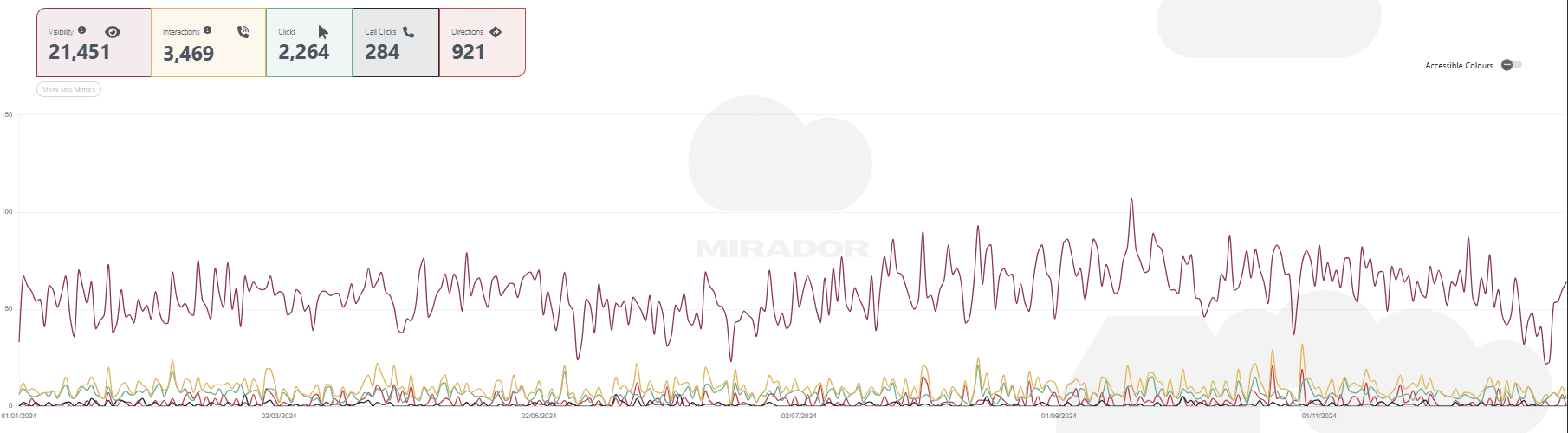
Screenshot from Google Business Profiles, April 2025
This audit becomes your foundation.
It identifies the most significant gaps and provides a way to measure progress over time.
Connect Review Management To Brand Identity
Reviews aren’t just feedback; they’re a public-facing extension of your brand. How you respond or don’t respond sends a message about your values and ability to consistently deliver a satisfactory experience.
If you promise friendly, fast service, that should come across clearly when you thank someone for a positive review or respond to a concern.
Your messaging should reinforce the key reasons customers choose your brand, whether it’s convenience, value, quality, or something else.
When appropriate, use reviews as an opportunity to share relevant information. If someone praises a new feature or product, thank them and mention that it’s available at other locations. This is a low-effort way to promote helpful information while staying on brand.
Also, think about how to repurpose strong reviews. Use them in ads, on your website, or inside stores.
A genuine quote from a customer often has more impact than any branded message, and this content is usually highly valued and desired by the broader marketing and sales teams.
This way, they can become a natural part of your brand story, told by customers and reinforced by how your business responds.
Create Brand Guidelines That Keep Things Consistent
Consistency becomes key in reviews when you need to respond to dozens or hundreds of locations.
Customers expect a thoughtful, helpful reply no matter which store they visit. Brand guidelines make that possible without turning every response into a very obvious, robotic copy-and-paste.
This is also a good opportunity to work with broader teams, including customer support departments if the brand you’re working with has one, to create a number of situation appropriate.
While defining your brand tone is important, review replies also need to show empathy.
If you respond to a negative review with an overly upbeat and jovial tone, you run the risk of deepening the negative experience that the user is already having.
Build templates for favorable reviews, neutral feedback, and complaints. Templates are just a starting point. They should give structure while leaving space for personalization based on the customer’s words.
Don’t share private info or respond defensively. Include clear steps for escalating sensitive reviews to the right people, whether customer service or regional leadership.
It’s also important to delegate who is responsible for replying. Some businesses centralize review responses, and others train local managers. Both approaches can work if the team has the training and tools to do it right.
Boost Review Volume Without Burning Out Teams
Keeping a steady stream of fresh reviews helps your rankings and reputation.
Recent positive reviews signal to Google and people that your business is active and trusted. The trick is building a reliable process that encourages reviews without demanding nonstop manual effort.
This could be right after a purchase, during a service visit, or following a support interaction. Use tools like email follow-ups, SMS reminders, or simple handouts with QR codes to make it easy for customers to leave feedback.
Where possible, automate it. Many customer relationship management (CRM) or point of sale (POS) systems can automatically trigger review requests post-transaction.
You want to ensure the message is polite, brief, and follows Google’s guidelines. Avoid incentives or ask only satisfied customers, since that can backfire or even lead to review removal.
Remove any friction from the process. Give customers a direct link to the correct location’s review page. Don’t expect them to search for you themselves. Look into tools that manage these links in bulk across all your profiles for significant operations.
A kind in-person reminder from someone who provided excellent service can go a long way, so it’s important that the staff working in the physical locations are pulling in the same direction.
Multiply that across all your stores, and the review volume adds up quickly.
Use Reviews As A Window Into The Business
Beyond search rankings and trust-building, reviews are a rich source of insight as they offer real-time feedback on what customers are experiencing.
When you look across hundreds of profiles, patterns begin to stand out, and it is important they are communicated to all necessary stakeholders, both the positive and the negative.
Share these insights regularly. Regional managers, store leaders, and marketing teams should all stay informed.
Use summaries or reports to spotlight what customers say most often, both good and bad. This helps everyone stay aligned and customer-focused.
You also want to group reviews by recurring themes and keep a quantitative log of how often these recurring themes are mentioned, ensuring the positive themes increase and the negative ones don’t.
If people mention cleanliness, service speed, friendliness, or product selection negatively, this could be a sign of failings in other departments.
If the same issue appears at multiple locations, it may present a more considerable operational challenge.
On the flip side, praise for specific staff or services can highlight what’s working well and should be replicated elsewhere.
Keep Improving
Review management isn’t something you set and forget. It requires a clear structure and consistent oversight to be effective.
It’s important to assign ownership, whether to an individual or a dedicated team, who can take responsibility for tracking performance, refining playbooks, and supporting store-level teams as needed.
Regularly reviewing key metrics like response rates, review frequency, and average ratings will help you stay on top of performance.
These insights can guide improvements, highlight areas that need attention, and allow you to make proactive changes before small issues turn into larger problems.
Final Thoughts
Managing reviews across a wide network of Google Business Profiles can seem daunting at first, but with a solid, scalable plan in place, it quickly becomes one of the most effective ways to earn trust, boost visibility in search, and reinforce your brand.
Begin by getting a clear view of your current review landscape, then put consistent systems in place for responding to, requesting, and learning from customer feedback.
Each interaction, review, and response plays a role in shaping the broader story of your business.
When reviews are managed thoughtfully, they become more than just customer opinions. They’re a key part of your growth strategy, helping you engage with customers, spot what’s working, and build a brand people believe in, one location at a time.