Inside the story that enraged OpenAI

In 2019, Karen Hao, a senior reporter with MIT Technology Review, pitched me on writing a story about a then little-known company, OpenAI. It was her biggest assignment to date. Hao’s feat of reporting took a series of twists and turns over the coming months, eventually revealing how OpenAI’s ambition had taken it far afield from its original mission. The finished story was a prescient look at a company at a tipping point—or already past it. And OpenAI was not happy with the result. Hao’s new book, Empire of AI: Dreams and Nightmares in Sam Altman’s OpenAI, is an in-depth exploration of the company that kick-started the AI arms race, and what that race means for all of us. This excerpt is the origin story of that reporting. — Niall Firth, executive editor, MIT Technology Review

I arrived at OpenAI’s offices on August 7, 2019. Greg Brockman, then thirty‑one, OpenAI’s chief technology officer and soon‑to‑be company president, came down the staircase to greet me. He shook my hand with a tentative smile. “We’ve never given someone so much access before,” he said.

At the time, few people beyond the insular world of AI research knew about OpenAI. But as a reporter at MIT Technology Review covering the ever‑expanding boundaries of artificial intelligence, I had been following its movements closely.

Until that year, OpenAI had been something of a stepchild in AI research. It had an outlandish premise that AGI could be attained within a decade, when most non‑OpenAI experts doubted it could be attained at all. To much of the field, it had an obscene amount of funding despite little direction and spent too much of the money on marketing what other researchers frequently snubbed as unoriginal research. It was, for some, also an object of envy. As a nonprofit, it had said that it had no intention to chase commercialization. It was a rare intellectual playground without strings attached, a haven for fringe ideas.

But in the six months leading up to my visit, the rapid slew of changes at OpenAI signaled a major shift in its trajectory. First was its confusing decision to withhold GPT‑2 and brag about it. Then its announcement that Sam Altman, who had mysteriously departed his influential perch at YC, would step in as OpenAI’s CEO with the creation of its new “capped‑profit” structure. I had already made my arrangements to visit the office when it subsequently revealed its deal with Microsoft, which gave the tech giant priority for commercializing OpenAI’s technologies and locked it into exclusively using Azure, Microsoft’s cloud‑computing platform.

Each new announcement garnered fresh controversy, intense speculation, and growing attention, beginning to reach beyond the confines of the tech industry. As my colleagues and I covered the company’s progression, it was hard to grasp the full weight of what was happening. What was clear was that OpenAI was beginning to exert meaningful sway over AI research and the way policymakers were learning to understand the technology. The lab’s decision to revamp itself into a partially for‑profit business would have ripple effects across its spheres of influence in industry and government. 

So late one night, with the urging of my editor, I dashed off an email to Jack Clark, OpenAI’s policy director, whom I had spoken with before: I would be in town for two weeks, and it felt like the right moment in OpenAI’s history. Could I interest them in a profile? Clark passed me on to the communications head, who came back with an answer. OpenAI was indeed ready to reintroduce itself to the public. I would have three days to interview leadership and embed inside the company.


Brockman and I settled into a glass meeting room with the company’s chief scientist, Ilya Sutskever. Sitting side by side at a long conference table, they each played their part. Brockman, the coder and doer, leaned forward, a little on edge, ready to make a good impression; Sutskever, the researcher and philosopher, settled back into his chair, relaxed and aloof.

I opened my laptop and scrolled through my questions. OpenAI’s mission is to ensure beneficial AGI, I began. Why spend billions of dollars on this problem and not something else?

Brockman nodded vigorously. He was used to defending OpenAI’s position. “The reason that we care so much about AGI and that we think it’s important to build is because we think it can help solve complex problems that are just out of reach of humans,” he said.

He offered two examples that had become dogma among AGI believers. Climate change. “It’s a super‑complex problem. How are you even supposed to solve it?” And medicine. “Look at how important health care is in the US as a political issue these days. How do we actually get better treatment for people at lower cost?”

On the latter, he began to recount the story of a friend who had a rare disorder and had recently gone through the exhausting rigmarole of bouncing between different specialists to figure out his problem. AGI would bring together all of these specialties. People like his friend would no longer spend so much energy and frustration on getting an answer.

Why did we need AGI to do that instead of AI? I asked.

This was an important distinction. The term AGI, once relegated to an unpopular section of the technology dictionary, had only recently begun to gain more mainstream usage—in large part because of OpenAI.

And as OpenAI defined it, AGI referred to a theoretical pinnacle of AI research: a piece of software that had just as much sophistication, agility, and creativity as the human mind to match or exceed its performance on most (economically valuable) tasks. The operative word was theoretical. Since the beginning of earnest research into AI several decades earlier, debates had raged about whether silicon chips encoding everything in their binary ones and zeros could ever simulate brains and the other biological processes that give rise to what we consider intelligence. There had yet to be definitive evidence that this was possible, which didn’t even touch on the normative discussion of whether people should develop it.

AI, on the other hand, was the term du jour for both the version of the technology currently available and the version that researchers could reasonably attain in the near future through refining existing capabilities. Those capabilities—rooted in powerful pattern matching known as machine learning—had already demonstrated exciting applications in climate change mitigation and health care.

Sutskever chimed in. When it comes to solving complex global challenges, “fundamentally the bottleneck is that you have a large number of humans and they don’t communicate as fast, they don’t work as fast, they have a lot of incentive problems.” AGI would be different, he said. “Imagine it’s a large computer network of intelligent computers—they’re all doing their medical diagnostics; they all communicate results between them extremely fast.”

This seemed to me like another way of saying that the goal of AGI was to replace humans. Is that what Sutskever meant? I asked Brockman a few hours later, once it was just the two of us.

“No,” Brockman replied quickly. “This is one thing that’s really important. What is the purpose of technology? Why is it here? Why do we build it? We’ve been building technologies for thousands of years now, right? We do it because they serve people. AGI is not going to be different—not the way that we envision it, not the way we want to build it, not the way we think it should play out.”

That said, he acknowledged a few minutes later, technology had always destroyed some jobs and created others. OpenAI’s challenge would be to build AGI that gave everyone “economic freedom” while allowing them to continue to “live meaningful lives” in that new reality. If it succeeded, it would decouple the need to work from survival.

“I actually think that’s a very beautiful thing,” he said.

In our meeting with Sutskever, Brockman reminded me of the bigger picture. “What we view our role as is not actually being a determiner of whether AGI gets built,” he said. This was a favorite argument in Silicon Valley—the inevitability card. If we don’t do it, somebody else will. “The trajectory is already there,” he emphasized, “but the thing we can influence is the initial conditions under which it’s born.

“What is OpenAI?” he continued. “What is our purpose? What are we really trying to do? Our mission is to ensure that AGI benefits all of humanity. And the way we want to do that is: Build AGI and distribute its economic benefits.”

His tone was matter‑of‑fact and final, as if he’d put my questions to rest. And yet we had somehow just arrived back to exactly where we’d started.


Our conversation continued on in circles until we ran out the clock after forty‑five minutes. I tried with little success to get more concrete details on what exactly they were trying to build—which by nature, they explained, they couldn’t know—and why, then, if they couldn’t know, they were so confident it would be beneficial. At one point, I tried a different approach, asking them instead to give examples of the downsides of the technology. This was a pillar of OpenAI’s founding mythology: The lab had to build good AGI before someone else built a bad one.

Brockman attempted an answer: deepfakes. “It’s not clear the world is better through its applications,” he said.

I offered my own example: Speaking of climate change, what about the environmental impact of AI itself? A recent study from the University of Massachusetts Amherst had placed alarming numbers on the huge and growing carbon emissions of training larger and larger AI models.

That was “undeniable,” Sutskever said, but the payoff was worth it because AGI would, “among other things, counteract the environmental cost specifically.” He stopped short of offering examples.

“It is unquestioningly very highly desirable that data centers be as green as possible,” he added.

“No question,” Brockman quipped.

“Data centers are the biggest consumer of energy, of electricity,” Sutskever continued, seeming intent now on proving that he was aware of and cared about this issue.

“It’s 2 percent globally,” I offered.

“Isn’t Bitcoin like 1 percent?” Brockman said.

Wow!” Sutskever said, in a sudden burst of emotion that felt, at this point, forty minutes into the conversation, somewhat performative.

Sutskever would later sit down with New York Times reporter Cade Metz for his book Genius Makers, which recounts a narrative history of AI development, and say without a hint of satire, “I think that it’s fairly likely that it will not take too long of a time for the entire surface of the Earth to become covered with data centers and power stations.” There would be “a tsunami of computing . . . almost like a natural phenomenon.” AGI—and thus the data centers needed to support them—would be “too useful to not exist.”

I tried again to press for more details. “What you’re saying is OpenAI is making a huge gamble that you will successfully reach beneficial AGI to counteract global warming before the act of doing so might exacerbate it.”

“I wouldn’t go too far down that rabbit hole,” Brockman hastily cut in. “The way we think about it is the following: We’re on a ramp of AI progress. This is bigger than OpenAI, right? It’s the field. And I think society is actually getting benefit from it.”

“The day we announced the deal,” he said, referring to Microsoft’s new $1 billion investment, “Microsoft’s market cap went up by $10 billion. People believe there is a positive ROI even just on short‑term technology.”

OpenAI’s strategy was thus quite simple, he explained: to keep up with that progress. “That’s the standard we should really hold ourselves to. We should continue to make that progress. That’s how we know we’re on track.”

Later that day, Brockman reiterated that the central challenge of working at OpenAI was that no one really knew what AGI would look like. But as researchers and engineers, their task was to keep pushing forward, to unearth the shape of the technology step by step.

He spoke like Michelangelo, as though AGI already existed within the marble he was carving. All he had to do was chip away until it revealed itself.


There had been a change of plans. I had been scheduled to eat lunch with employees in the cafeteria, but something now required me to be outside the office. Brockman would be my chaperone. We headed two dozen steps across the street to an open‑air café that had become a favorite haunt for employees.

This would become a recurring theme throughout my visit: floors I couldn’t see, meetings I couldn’t attend, researchers stealing furtive glances at the communications head every few sentences to check that they hadn’t violated some disclosure policy. I would later learn that after my visit, Jack Clark would issue an unusually stern warning to employees on Slack not to speak with me beyond sanctioned conversations. The security guard would receive a photo of me with instructions to be on the lookout if I appeared unapproved on the premises. It was odd behavior in general, made odder by OpenAI’s commitment to transparency. What, I began to wonder, were they hiding, if everything was supposed to be beneficial research eventually made available to the public?

At lunch and through the following days, I probed deeper into why Brockman had cofounded OpenAI. He was a teen when he first grew obsessed with the idea that it could be possible to re‑create human intelligence. It was a famous paper from British mathematician Alan Turing that sparked his fascination. The name of its first section, “The Imitation Game,” which inspired the title of the 2014 Hollywood dramatization of Turing’s life, begins with the opening provocation, “Can machines think?” The paper goes on to define what would become known as the Turing test: a measure of the progression of machine intelligence based on whether a machine can talk to a human without giving away that it is a machine. It was a classic origin story among people working in AI. Enchanted, Brockman coded up a Turing test game and put it online, garnering some 1,500 hits. It made him feel amazing. “I just realized that was the kind of thing I wanted to pursue,” he said.

In 2015, as AI saw great leaps of advancement, Brockman says that he realized it was time to return to his original ambition and joined OpenAI as a cofounder. He wrote down in his notes that he would do anything to bring AGI to fruition, even if it meant being a janitor. When he got married four years later, he held a civil ceremony at OpenAI’s office in front of a custom flower wall emblazoned with the shape of the lab’s hexagonal logo. Sutskever officiated. The robotic hand they used for research stood in the aisle bearing the rings, like a sentinel from a post-apocalyptic future.

“Fundamentally, I want to work on AGI for the rest of my life,” Brockman told me.

What motivated him? I asked Brockman.

What are the chances that a transformative technology could arrive in your lifetime? he countered.

He was confident that he—and the team he assembled—was uniquely positioned to usher in that transformation. “What I’m really drawn to are problems that will not play out in the same way if I don’t participate,” he said.

Brockman did not in fact just want to be a janitor. He wanted to lead AGI. And he bristled with the anxious energy of someone who wanted history‑defining recognition. He wanted people to one day tell his story with the same mixture of awe and admiration that he used to recount the ones of the great innovators who came before him.

A year before we spoke, he had told a group of young tech entrepreneurs at an exclusive retreat in Lake Tahoe with a twinge of self‑pity that chief technology officers were never known. Name a famous CTO, he challenged the crowd. They struggled to do so. He had proved his point.

In 2022, he became OpenAI’s president.


During our conversations, Brockman insisted to me that none of OpenAI’s structural changes signaled a shift in its core mission. In fact, the capped profit and the new crop of funders enhanced it. “We managed to get these mission‑aligned investors who are willing to prioritize mission over returns. That’s a crazy thing,” he said.

OpenAI now had the long‑term resources it needed to scale its models and stay ahead of the competition. This was imperative, Brockman stressed. Failing to do so was the real threat that could undermine OpenAI’s mission. If the lab fell behind, it had no hope of bending the arc of history toward its vision of beneficial AGI. Only later would I realize the full implications of this assertion. It was this fundamental assumption—the need to be first or perish—that set in motion all of OpenAI’s actions and their far‑reaching consequences. It put a ticking clock on each of OpenAI’s research advancements, based not on the timescale of careful deliberation but on the relentless pace required to cross the finish line before anyone else. It justified OpenAI’s consumption of an unfathomable amount of resources: both compute, regardless of its impact on the environment; and data, the amassing of which couldn’t be slowed by getting consent or abiding by regulations.

Brockman pointed once again to the $10 billion jump in Microsoft’s market cap. “What that really reflects is AI is delivering real value to the real world today,” he said. That value was currently being concentrated in an already wealthy corporation, he acknowledged, which was why OpenAI had the second part of its mission: to redistribute the benefits of AGI to everyone.

Was there a historical example of a technology’s benefits that had been successfully distributed? I asked.

“Well, I actually think that—it’s actually interesting to look even at the internet as an example,” he said, fumbling a bit before settling on his answer. “There’s problems, too, right?” he said as a caveat. “Anytime you have something super transformative, it’s not going to be easy to figure out how to maximize positive, minimize negative.

“Fire is another example,” he added. “It’s also got some real drawbacks to it. So we have to figure out how to keep it under control and have shared standards.

“Cars are a good example,” he followed. “Lots of people have cars, benefit a lot of people. They have some drawbacks to them as well. They have some externalities that are not necessarily good for the world,” he finished hesitantly.

“I guess I just view—the thing we want for AGI is not that different from the positive sides of the internet, positive sides of cars, positive sides of fire. The implementation is very different, though, because it’s a very different type of technology.”

His eyes lit up with a new idea. “Just look at utilities. Power companies, electric companies are very centralized entities that provide low‑cost, high‑quality things that meaningfully improve people’s lives.”

It was a nice analogy. But Brockman seemed once again unclear about how OpenAI would turn itself into a utility. Perhaps through distributing universal basic income, he wondered aloud, perhaps through something else.

He returned to the one thing he knew for certain. OpenAI was committed to redistributing AGI’s benefits and giving everyone economic freedom. “We actually really mean that,” he said.

“The way that we think about it is: Technology so far has been something that does rise all the boats, but it has this real concentrating effect,” he said. “AGI could be more extreme. What if all value gets locked up in one place? That is the trajectory we’re on as a society. And we’ve never seen that extreme of it. I don’t think that’s a good world. That’s not a world that I want to sign up for. That’s not a world that I want to help build.”


In February 2020, I published my profile for MIT Technology Review, drawing on my observations from my time in the office, nearly three dozen interviews, and a handful of internal documents. “There is a misalignment between what the company publicly espouses and how it operates behind closed doors,” I wrote. “Over time, it has allowed a fierce competitiveness and mounting pressure for ever more funding to erode its founding ideals of transparency, openness, and collaboration.”

Hours later, Elon Musk replied to the story with three tweets in rapid succession:

“OpenAI should be more open imo”

“I have no control & only very limited insight into OpenAI. Confidence in Dario for safety is not high,” he said, referring to Dario Amodei, the director of research.

“All orgs developing advanced AI should be regulated, including Tesla”

Afterward, Altman sent OpenAI employees an email.

“I wanted to share some thoughts about the Tech Review article,” he wrote. “While definitely not catastrophic, it was clearly bad.”

It was “a fair criticism,” he said that the piece had identified a disconnect between the perception of OpenAI and its reality. This could be smoothed over not with changes to its internal practices but some tuning of OpenAI’s public messaging. “It’s good, not bad, that we have figured out how to be flexible and adapt,” he said, including restructuring the organization and heightening confidentiality, “in order to achieve our mission as we learn more.” OpenAI should ignore my article for now and, in a few weeks’ time, start underscoring its continued commitment to its original principles under the new transformation. “This may also be a good opportunity to talk about the API as a strategy for openness and benefit sharing,” he added, referring to an application programming interface for delivering OpenAI’s models.

“The most serious issue of all, to me,” he continued, “is that someone leaked our internal documents.” They had already opened an investigation and would keep the company updated. He would also suggest that Amodei and Musk meet to work out Musk’s criticism, which was “mild relative to other things he’s said” but still “a bad thing to do.” For the avoidance of any doubt, Amodei’s work and AI safety were critical to the mission, he wrote. “I think we should at some point in the future find a way to publicly defend our team (but not give the press the public fight they’d love right now).”

OpenAI wouldn’t speak to me again for three years.

From the book Empire of AI: Dreams and Nightmares in Sam Altman’s OpenAI, by Karen Hao, to be published on May 20, 2025, by Penguin Press, an imprint of Penguin Publishing Group, a division of Penguin Random House LLC. Copyright © 2025 by Karen Hao.

Can crowdsourced fact-checking curb misinformation on social media?

In a 2019 speech at Georgetown University, Mark Zuckerberg famously declared that he didn’t want Facebook to be an “arbiter of truth.” And yet, in the years since, his company, Meta, has used several methods to moderate content and identify misleading posts across its social media apps, which include Facebook, Instagram, and Threads. These methods have included automatic filters that identify illegal and malicious content, and third-party factcheckers who manually research the validity of claims made in certain posts.

Zuckerberg explained that while Meta has put a lot of effort into building “complex systems to moderate content,” over the years, these systems have made many mistakes, with the result being “too much censorship.” The company therefore announced that it would be ending its third-party factchecker program in the US, replacing it with a system called Community Notes, which relies on users to flag false or misleading content and provide context about it.

While Community Notes has the potential to be extremely effective, the difficult job of content moderation benefits from a mix of different approaches. As a professor of natural language processing at MBZUAI, I’ve spent most of my career researching disinformation, propaganda, and fake news online. So, one of the first questions I asked myself was: will replacing human factcheckers with crowdsourced Community Notes have negative impacts on users?

Wisdom of crowds

Community Notes got its start on Twitter as Birdwatch. It’s a crowdsourced feature where users who participate in the program can add context and clarification to what they deem false or misleading tweets. The notes are hidden until community evaluation reaches a consensus—meaning, people who hold different perspectives and political views agree that a post is misleading. An algorithm determines when the threshold for consensus is reached, and then the note becomes publicly visible beneath the tweet in question, providing additional context to help users make informed judgments about its content.

Community Notes seems to work rather well. A team of researchers from University of Illinois Urbana-Champaign and University of Rochester found that X’s Community Notes program can reduce the spread of misinformation, leading to post retractions by authors. Facebook is largely adopting the same approach that is used on X today.

Having studied and written about content moderation for years, it’s great to see another major social media company implementing crowdsourcing for content moderation. If it works for Meta, it could be a true game-changer for the more than 3 billion people who use the company’s products every day.

That said, content moderation is a complex problem. There is no one silver bullet that will work in all situations. The challenge can only be addressed by employing a variety of tools that include human factcheckers, crowdsourcing, and algorithmic filtering. Each of these is best suited to different kinds of content, and can and must work in concert.

Spam and LLM safety

There are precedents for addressing similar problems. Decades ago, spam email was a much bigger problem than it is today. In large part, we’ve defeated spam through crowdsourcing. Email providers introduced reporting features, where users can flag suspicious emails. The more widely distributed a particular spam message is, the more likely it will be caught, as it’s reported by more people.

Another useful comparison is how large language models (LLMs) approach harmful content. For the most dangerous queries—related to weapons or violence, for example—many LLMs simply refuse to answer. Other times, these systems may add a disclaimer to their outputs, such as when they are asked to provide medical, legal, or financial advice. This tiered approach is one that my colleagues and I at the MBZUAI explored in a recent study where we propose a hierarchy of ways LLMs can respond to different kinds of potentially harmful queries. Similarly, social media platforms can benefit from different approaches to content moderation.

Automatic filters can be used to identify the most dangerous information, preventing users from seeing and sharing it. These automated systems are fast, but they can only be used for certain kinds of content because they aren’t capable of the nuance required for most content moderation.

Crowdsourced approaches like Community Notes can flag potentially harmful content by relying on the knowledge of users. They are slower than automated systems but faster than professional factcheckers.

Professional factcheckers take the most time to do their work, but the analyses they provide are deeper compared to Community Notes, which are limited to 500 characters. Factcheckers typically work as a team and benefit from shared knowledge. They are often trained to analyze the logical structure of arguments, identifying rhetorical techniques frequently employed in mis- and disinformation campaigns. But the work of professional factcheckers can’t scale in the same way Community Notes can. That’s why these three methods are most effective when they are used together.

Indeed, Community Notes have been found to amplify the work done by factcheckers so it reaches more users. Another study found that Community Notes and factchecking complement each other, as they focus on different types of accounts, with Community Notes tending to analyze posts from large accounts that have high “social influence.” When Community Notes and factcheckers do converge on the same posts, their assessments are similar, however. Another study found that crowdsourced content moderation itself benefits from the findings of professional factcheckers.

A path forward

At its heart, content moderation is extremely difficult because it is about how we determine truth—and there is much we don’t know. Even scientific consensus, built over years by entire disciplines, can change over time.

That said, platforms shouldn’t retreat from the difficult task of moderating content altogether—or become overly dependent on any single solution. They must continuously experiment, learn from their failures, and refine their strategies. As it’s been said, the difference between people who succeed and people who fail is that successful people have failed more times than others have even tried.

This content was produced by the Mohamed bin Zayed University of Artificial Intelligence. It was not written by MIT Technology Review’s editorial staff.

The Download: chaos at OpenAI, and the spa heated by bitcoin mining

This is today’s edition of The Download, our weekday newsletter that provides a daily dose of what’s going on in the world of technology.

Inside the story that enraged OpenAI

—Niall Firth, executive editor, MIT Technology Review

In 2019, Karen Hao, a senior reporter with MIT Technology Review, pitched me a story about a then little-known company, OpenAI. It was her biggest assignment to date. Hao’s feat of reporting took a series of twists and turns over the coming months, eventually revealing how OpenAI’s ambition had taken it far afield from its original mission.

The finished story was a prescient look at a company at a tipping point—or already past it. And OpenAI was not happy with the result. Hao’s new book, Empire of AI: Dreams and Nightmares in Sam Altman’s OpenAI, is an in-depth exploration of the company that kick-started the AI arms race, and what that race means for all of us. This excerpt is the origin story of that reporting.

This spa’s water is heated by bitcoin mining

At first glance, the Bathhouse spa in Brooklyn looks not so different from other high-end spas. What sets it apart is out of sight: a closet full of cryptocurrency-­mining computers that not only generate bitcoins but also heat the spa’s pools, marble hammams, and showers. 

When cofounder Jason Goodman opened Bathhouse’s first location in Williamsburg in 2019, he used conventional pool heaters. But after diving deep into the world of bitcoin, he realized he could fit cryptocurrency mining seamlessly into his business. Read the full story.

—Carrie Klein

This story is from the most recent edition of our print magazine, which is all about how technology is changing creativity. Subscribe now to read it and to receive future print copies once they land.

The must-reads

I’ve combed the internet to find you today’s most fun/important/scary/fascinating stories about technology.

1 Nvidia wants to build an AI supercomputer in Taiwan 
As Trump’s tariffs upend existing supply chains. (WSJ $)
+ Jensen Huang has denied that Nvidia’s chips are being diverted into China. (Bloomberg $)

2 xAI’s Grok dabbled in Holocaust denial
The chatbot said it was “skeptical” about points that historians agree are facts. (Rolling Stone $)
+ It blamed the comments on a programming error. (The Guardian)

3 Apple is planning to overhaul Siri entirely
To make it an assistant fit for the AI age. (Bloomberg $)

4 Dentists are worried by RFK Jr’s fluoride ban
Particularly in rural America. (Ars Technica)
+ Florida has become the second state to ban fluoride in public water. (NBC News)

5 Fewer people want to work in America’s factories
That’s a problem when Trump is so hell-bent on kickstarting the manufacturing industry. (WSJ $)
+ Sweeping tariffs could threaten the US manufacturing rebound. (MIT Technology Review)

6 Meet the crypto investors hoping to bend the President’s ear
They’re treating Trump’s meme coin dinner as an opportunity to push their agendas. (WP $)
+ Many of them are offloading their coins, too. (Wired $)
+ Crypto bigwigs are targets for criminals. (WSJ $)
+ Bodyguards and other forms of security are becoming de rigueur. (Bloomberg $)

7 How the US reversed the overdose epidemic
Naloxone is a major factor. (Vox)
+ How the federal government is tracking changes in the supply of street drugs. (MIT Technology Review)

8 Chatbots really love the heads of the companies that made them 
And are not so fond of the leaders of its rivals. (FT $)
+ What if we could just ask AI to be less biased? (MIT Technology Review)

9 Technology is a double-edged sword 📱
What connects us can simultaneously outrage us. (The Atlantic $)

10 Meet the people hooked on watching nature live streams
They find checking in with animals puts their own troubles in perspective. (The Guardian)

Quote of the day

“People are just scared. They don’t know where they fit in this new world.”

—Angela Jiang, who is working on a startup exploring the impact of AI on the labor market, tells the Wall Street Journal about the woes of tech job seekers trying to land new jobs in the current economy.

One more thing

How the Rubin Observatory will help us understand dark matter and dark energy

We can put a good figure on how much we know about the universe: 5%. That’s how much of what’s floating about in the cosmos is ordinary matter—planets and stars and galaxies and the dust and gas between them. The other 95% is dark matter and dark energy, two mysterious entities aptly named for our inability to shed light on their true nature.

Previous work has begun pulling apart these dueling forces, but dark matter and dark energy remain shrouded in a blanket of questions—critically, what exactly are they?

Enter the Vera C. Rubin Observatory, one of our 10 breakthrough technologies for 2025. Boasting the largest digital camera ever created, Rubin is expected to study the cosmos in the highest resolution yet once it begins observations later this year. And with a better window on the cosmic battle between dark matter and dark energy, Rubin might narrow down existing theories on what they are made of. Here’s a look at how.

—Jenna Ahart

We can still have nice things

A place for comfort, fun and distraction to brighten up your day. (Got any ideas? Drop me a line or skeet ’em at me.)

+ Archaeologists in Canada are facing a mighty challenge—to solve how thousands of dinosaurs died in what’s now a forest in Alberta.
+ Before Brian Johnson joined AC/DC, he sang on this very distinctive hoover (vacuum cleaner) ad.
+ Wealthy Londoners are adding spas to their gardens, because why not.
+ I must eat the crystal breakfast! 🥓 🍳 🫘

AI can do a better job of persuading people than we do

Millions of people argue with each other online every day, but remarkably few of them change someone’s mind. New research suggests that large language models (LLMs) might do a better job. The finding suggests that AI could become a powerful tool for persuading people, for better or worse.  

A multi-university team of researchers found that OpenAI’s GPT-4 was significantly more persuasive than humans when it was given the ability to adapt its arguments using personal information about whoever it was debating.

Their findings are the latest in a growing body of research demonstrating LLMs’ powers of persuasion. The authors warn they show how AI tools can craft sophisticated, persuasive arguments if they have even minimal information about the humans they’re interacting with. The research has been published in the journal Nature Human Behavior.

“Policymakers and online platforms should seriously consider the threat of coordinated AI-based disinformation campaigns, as we have clearly reached the technological level where it is possible to create a network of LLM-based automated accounts able to strategically nudge public opinion in one direction,” says Riccardo Gallotti, an interdisciplinary physicist at Fondazione Bruno Kessler in Italy, who worked on the project.

“These bots could be used to disseminate disinformation, and this kind of diffused influence would be very hard to debunk in real time,” he says.

The researchers recruited 900 people based in the US and got them to provide personal information like their gender, age, ethnicity, education level, employment status, and political affiliation. 

Participants were then matched with either another human opponent or GPT-4 and instructed to debate one of 30 randomly assigned topics—such as whether the US should ban fossil fuels, or whether students should have to wear school uniforms—for 10 minutes. Each participant was told to argue either in favor of or against the topic, and in some cases they were provided with personal information about their opponent, so they could better tailor their argument. At the end, participants said how much they agreed with the proposition and whether they thought they were arguing with a human or an AI.

Overall, the researchers found that GPT-4 either equaled or exceeded humans’ persuasive abilities on every topic. When it had information about its opponents, the AI was deemed to be 64% more persuasive than humans without access to the personalized data—meaning that GPT-4 was able to leverage the personal data about its opponent much more effectively than its human counterparts. When humans had access to the personal information, they were found to be slightly less persuasive than humans without the same access.

The authors noticed that when participants thought they were debating against AI, they were more likely to agree with it. The reasons behind this aren’t clear, the researchers say, highlighting the need for further research into how humans react to AI.

“We are not yet in a position to determine whether the observed change in agreement is driven by participants’ beliefs about their opponent being a bot (since I believe it is a bot, I am not losing to anyone if I change ideas here), or whether those beliefs are themselves a consequence of the opinion change (since I lost, it should be against a bot),” says Gallotti. “This causal direction is an interesting open question to explore.”

Although the experiment doesn’t reflect how humans debate online, the research suggests that LLMs could also prove an effective way to not only disseminate but also counter mass disinformation campaigns, Gallotti says. For example, they could generate personalized counter-narratives to educate people who may be vulnerable to deception in online conversations. “However, more research is urgently needed to explore effective strategies for mitigating these threats,” he says.

While we know a lot about how humans react to each other, we know very little about the psychology behind how people interact with AI models, says Alexis Palmer, a fellow at Dartmouth College who has studied how LLMs can argue about politics but did not work on the research. 

“In the context of having a conversation with someone about something you disagree on, is there something innately human that matters to that interaction? Or is it that if an AI can perfectly mimic that speech, you’ll get the exact same outcome?” she says. “I think that is the overall big question of AI.”

Flash Sales without Brand Damage

The era of “40% off everything, today only” as a revenue driver is mostly gone. Nowadays, sophistication is key since repeat customers expect more than discounts.

For experienced marketers, the challenge isn’t just timing or promotion. It’s building urgency in a way that aligns with long-term goals, brand positioning, and channel constraints.

Urgency

Discounts alone no longer create urgency. Merchants need a mix of temporal, social, and product-based cues that build momentum throughout a campaign.

Consider:

  • Inventory scarcity. Communicate low stock thresholds dynamically. Tools such as Fomo and Convert inject real-time signals like “12 left in stock” or “selling fast.”
  • Tiered unlocks. Reward speed with value. For example: “First 100 customers get 30% off; next 200 get 20% off.”
  • Personalization. Segment by purchase behavior, and run a flash sale for your most loyal customers with unique timers per buyer cohort. Klaviyo and Iterable dynamically adjust expiration based on email open or site activity.

These approaches build urgency without sacrificing profits across all customers.

Paire, a sustainable clothing brand, teases limited-quantity gift-with-purchase offers that unlock at specific spending thresholds.

Screenshot of an example email from Paire

Paire unlocks limited-quantity gift-with-purchase offers at spending thresholds. Click image to enlarge.

Bombas, the sock and apparel company known for its one-for-one donations, deploys personalized flash sales for loyalty segments with precision. A bright yellow “Expires Tomorrow” banner creates urgency, while strategic messaging reinforces societal impact: “3 million pairs donated.”

Screenshot of the email from Bombas

Bombas combines a yellow “Expire tomorrow” banner with the social impact of “3 million pairs donated.” Click image to enlarge.

Both approaches — Paire and Bombas — demonstrate how discount messaging can reinforce brand purpose when properly segmented.

Channels

Flash sales can be effective beyond holidays or end-of-quarter pushes.

  • Lagging products. Got seasonal overstock or SKUs with poor velocity? Run a micro-flash sale triggered by inventory data — target customers who viewed or added those products but didn’t convert.
  • Lifecycle churns. If your average repurchase window is 45 days, schedule a flash sale on day 40 with a time-sensitive reorder incentive. Use your customer data platform or email service provider to identify likely churn cohorts.
  • List fatigue. If open or click rates dip by 20% across core segments, test a one-day flash event as a reactivation lever, especially if your emails emphasize content or brand rather than promos.

Flash sales affect multiple channels: email, SMS, and paid. Alignment is essential to avoid:

  • Inbox fatigue. Repeated discounts can lower click-to-open rates and prompt inbox filtering by internet service providers. Suppress habitual non-clickers (except for products with longer consideration cycles) or create a dedicated “sale-only” segment where users can opt in.
  • Ad dilution. Frequent promos can tank click-throughs. Use exclusions (e.g., customers who purchased in the last 30 days) to protect your evergreen campaigns.
  • List degradation. Flash-sale-only buyers are likely to churn. Consider delaying welcome offers after those subscribers convert organically.

Better Flash Sales

Here’s a three-phase approach integrating urgency and control.

Warm-up (1–2 days prior):

  • Tease the sale via SMS or email to high-value segments. Use early access as a loyalty perk.
  • Target visitors by deploying browse abandonment emails or early ad previews.

Launch (24–48 hours max):

  • Use a single call-to-action across channels.
  • Pull in zero-party data where possible (“You liked [product A]. It’s 20% off today only.”)
  • Embed social proof or low-inventory signals in product detail pages and ads.

Cool-down:

  • Use a final chance message for non-purchasers, then suppress or retarget based on funnel behavior.
  • Analyze performance by segment (e.g., new vs. returning, email vs. SMS) to understand who buys from urgency and who waits for discounts.

Beyond Revenue

A strategically executed flash sale can double as an insights tool.

  • Which channel drove the fastest conversions?
  • Who purchases early vs. last-call messaging?
  • Did discounts elevate average order values or only volume?

Tools such as Daasity, Triple Whale, and business intelligence dashboards can provide the post-sale data to answer those questions. Then refine not just your sales cadence but audience planning and creative strategy.

In short, flash sales should not compromise a brand. When planned with data, segmentation, and restraint, they can re-energize a list, clear inventory, and deliver real margin — much more than a short-term rush.

How To Automate SEO Keyword Clustering By Search Intent With Python via @sejournal, @andreasvoniatis

There’s a lot to know about search intent, from using deep learning to infer search intent by classifying text and breaking down SERP titles using Natural Language Processing (NLP) techniques, to clustering based on semantic relevance, with the benefits explained.

Not only do we know the benefits of deciphering search intent, but we also have a number of techniques at our disposal for scale and automation.

So, why do we need another article on automating search intent?

Search intent is ever more important now that AI search has arrived.

While more was generally in the 10 blue links search era, the opposite is true with AI search technology, as these platforms generally seek to minimize the computing costs (per FLOP) in order to deliver the service.

SERPs Still Contain The Best Insights For Search Intent

The techniques so far involve doing your own AI, that is, getting all of the copy from titles of the ranking content for a given keyword and then feeding it into a neural network model (which you have to then build and test) or using NLP to cluster keywords.

What if you don’t have time or the knowledge to build your own AI or invoke the Open AI API?

While cosine similarity has been touted as the answer to helping SEO professionals navigate the demarcation of topics for taxonomy and site structures, I still maintain that search clustering by SERP results is a far superior method.

That’s because AI is very keen to ground its results on SERPs and for good reason – it’s modelled on user behaviors.

There is another way that uses Google’s very own AI to do the work for you, without having to scrape all the SERPs content and build an AI model.

Let’s assume that Google ranks site URLs by the likelihood of the content satisfying the user query in descending order. It follows that if the intent for two keywords is the same, then the SERPs are likely to be similar.

For years, many SEO professionals compared SERP results for keywords to infer shared (or shared) search intent to stay on top of core updates, so this is nothing new.

The value-add here is the automation and scaling of this comparison, offering both speed and greater precision.

How To Cluster Keywords By Search Intent At Scale Using Python (With Code)

Assuming you have your SERPs results in a CSV download, let’s import it into your Python notebook.

1. Import The List Into Your Python Notebook

import pandas as pd
import numpy as np

serps_input = pd.read_csv('data/sej_serps_input.csv')
del serps_input['Unnamed: 0']
serps_input

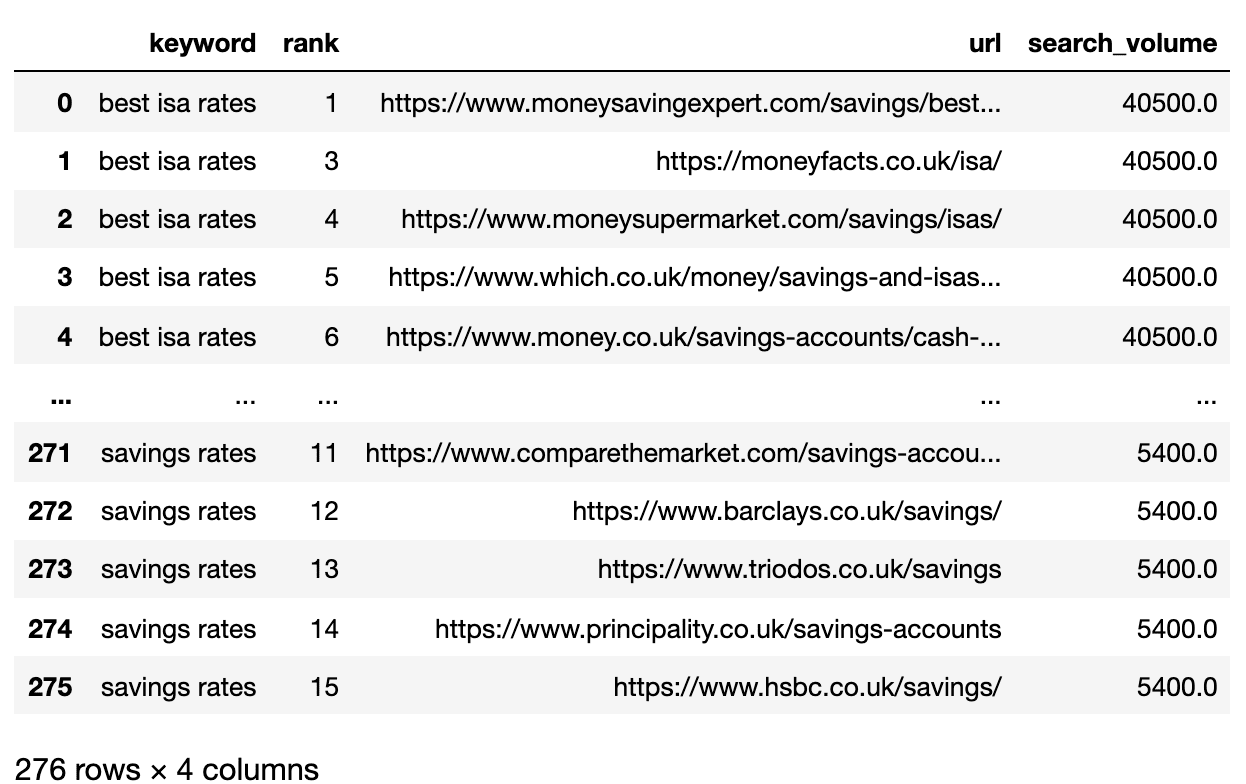
Below is the SERPs file now imported into a Pandas dataframe.

Image from author, April 2025

2. Filter Data For Page 1

We want to compare the Page 1 results of each SERP between keywords.

We’ll split the dataframe into mini keyword dataframes to run the filtering function before recombining into a single dataframe, because we want to filter at the keyword level:

# Split 
serps_grpby_keyword = serps_input.groupby("keyword")
k_urls = 15

# Apply Combine
def filter_k_urls(group_df):
    filtered_df = group_df.loc[group_df['url'].notnull()]
    filtered_df = filtered_df.loc[filtered_df['rank'] <= k_urls]
    return filtered_df
filtered_serps = serps_grpby_keyword.apply(filter_k_urls)

# Combine
## Add prefix to column names
#normed = normed.add_prefix('normed_')

# Concatenate with initial data frame
filtered_serps_df = pd.concat([filtered_serps],axis=0)
del filtered_serps_df['keyword']
filtered_serps_df = filtered_serps_df.reset_index()
del filtered_serps_df['level_1']
filtered_serps_df
SERPs file imported into a Pandas dataframe.Image from author, April 2025

3. Convert Ranking URLs To A String

Because there are more SERP result URLs than keywords, we need to compress those URLs into a single line to represent the keyword’s SERP.

Here’s how:


# convert results to strings using Split Apply Combine 
filtserps_grpby_keyword = filtered_serps_df.groupby("keyword")

def string_serps(df): 
   df['serp_string'] = ''.join(df['url'])
   return df # Combine strung_serps = filtserps_grpby_keyword.apply(string_serps) 

# Concatenate with initial data frame and clean 
strung_serps = pd.concat([strung_serps],axis=0) 
strung_serps = strung_serps[['keyword', 'serp_string']]#.head(30) 
strung_serps = strung_serps.drop_duplicates() 
strung_serps

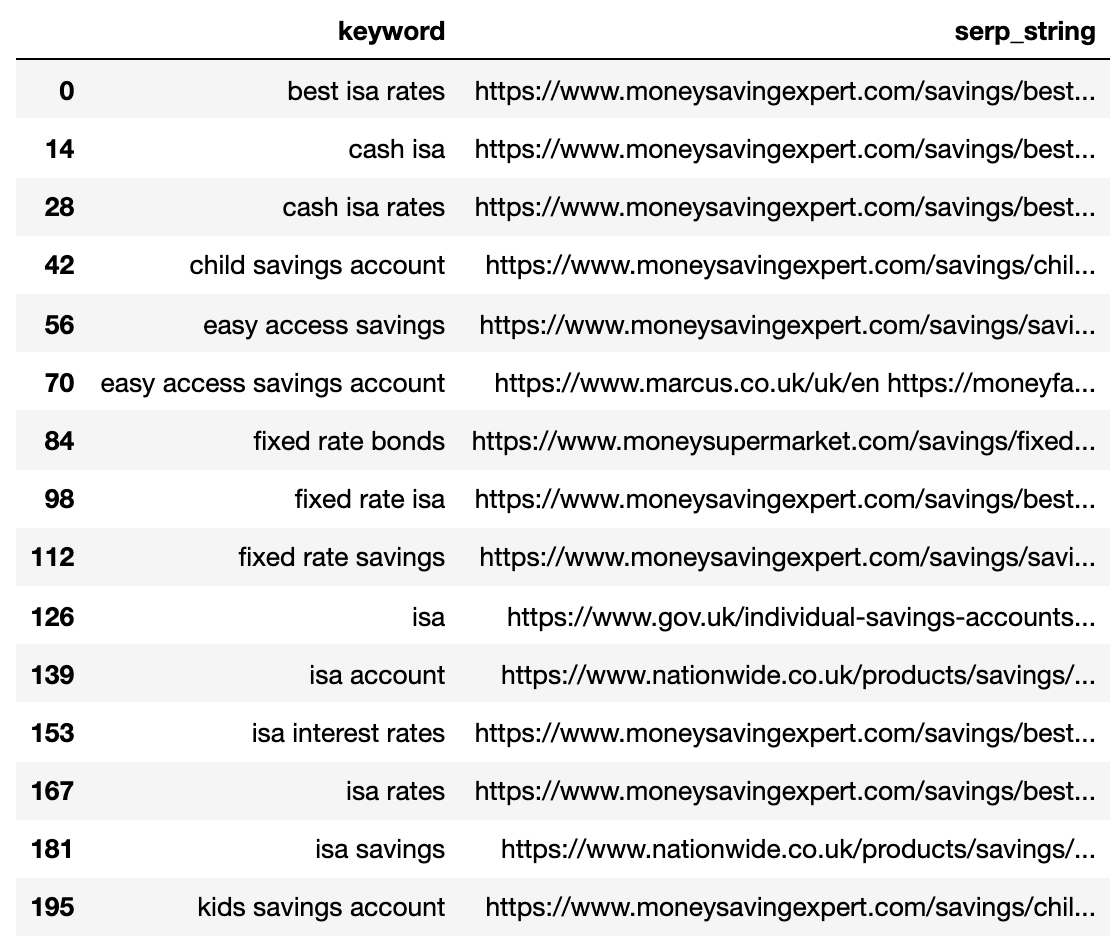
Below shows the SERP compressed into a single line for each keyword.

SERP compressed into single line for each keyword.Image from author, April 2025

4. Compare SERP Distance

To perform the comparison, we now need every combination of keyword SERP paired with other pairs:


# align serps
def serps_align(k, df):
    prime_df = df.loc[df.keyword == k]
    prime_df = prime_df.rename(columns = {"serp_string" : "serp_string_a", 'keyword': 'keyword_a'})
    comp_df = df.loc[df.keyword != k].reset_index(drop=True)
    prime_df = prime_df.loc[prime_df.index.repeat(len(comp_df.index))].reset_index(drop=True)
    prime_df = pd.concat([prime_df, comp_df], axis=1)
    prime_df = prime_df.rename(columns = {"serp_string" : "serp_string_b", 'keyword': 'keyword_b', "serp_string_a" : "serp_string", 'keyword_a': 'keyword'})
    return prime_df

columns = ['keyword', 'serp_string', 'keyword_b', 'serp_string_b']
matched_serps = pd.DataFrame(columns=columns)
matched_serps = matched_serps.fillna(0)
queries = strung_serps.keyword.to_list()

for q in queries:
    temp_df = serps_align(q, strung_serps)
    matched_serps = matched_serps.append(temp_df)

matched_serps

Compare SERP similarity.

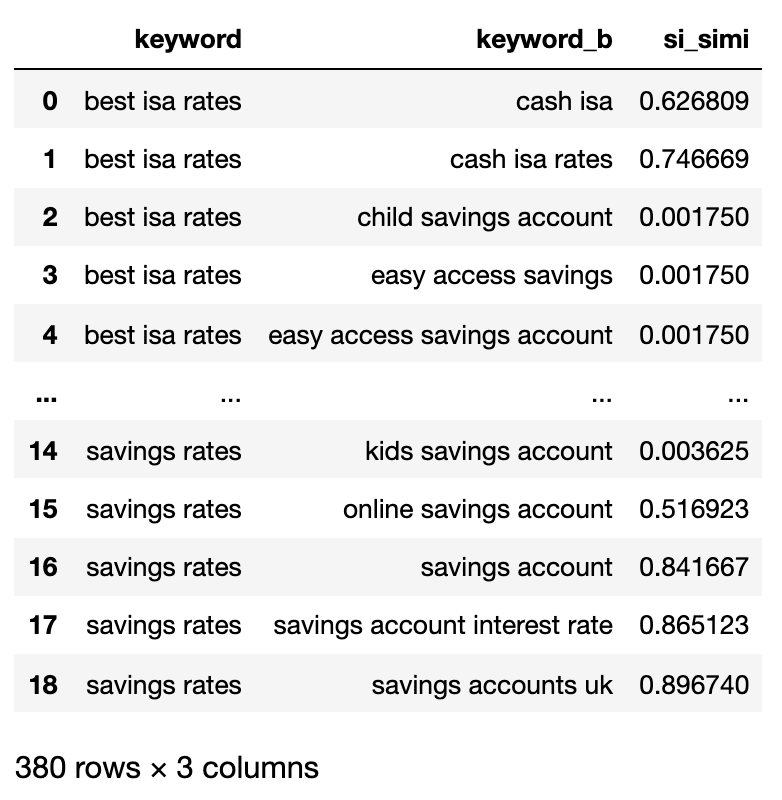
The above shows all of the keyword SERP pair combinations, making it ready for SERP string comparison.

There is no open-source library that compares list objects by order, so the function has been written for you below.

The function “serp_compare” compares the overlap of sites and the order of those sites between SERPs.


import py_stringmatching as sm
ws_tok = sm.WhitespaceTokenizer()

# Only compare the top k_urls results 
def serps_similarity(serps_str1, serps_str2, k=15):
    denom = k+1
    norm = sum([2*(1/i - 1.0/(denom)) for i in range(1, denom)])
    #use to tokenize the URLs
    ws_tok = sm.WhitespaceTokenizer()
    #keep only first k URLs
    serps_1 = ws_tok.tokenize(serps_str1)[:k]
    serps_2 = ws_tok.tokenize(serps_str2)[:k]
    #get positions of matches 
    match = lambda a, b: [b.index(x)+1 if x in b else None for x in a]
    #positions intersections of form [(pos_1, pos_2), ...]
    pos_intersections = [(i+1,j) for i,j in enumerate(match(serps_1, serps_2)) if j is not None] 
    pos_in1_not_in2 = [i+1 for i,j in enumerate(match(serps_1, serps_2)) if j is None]
    pos_in2_not_in1 = [i+1 for i,j in enumerate(match(serps_2, serps_1)) if j is None]
    
    a_sum = sum([abs(1/i -1/j) for i,j in pos_intersections])
    b_sum = sum([abs(1/i -1/denom) for i in pos_in1_not_in2])
    c_sum = sum([abs(1/i -1/denom) for i in pos_in2_not_in1])

    intent_prime = a_sum + b_sum + c_sum
    intent_dist = 1 - (intent_prime/norm)
    return intent_dist

# Apply the function
matched_serps['si_simi'] = matched_serps.apply(lambda x: serps_similarity(x.serp_string, x.serp_string_b), axis=1)

# This is what you get
matched_serps[['keyword', 'keyword_b', 'si_simi']]

Overlap of sites and the order of those sites between SERPs.

Now that the comparisons have been executed, we can start clustering keywords.

We will be treating any keywords that have a weighted similarity of 40% or more.


# group keywords by search intent
simi_lim = 0.4

# join search volume
keysv_df = serps_input[['keyword', 'search_volume']].drop_duplicates()
keysv_df.head()

# append topic vols
keywords_crossed_vols = serps_compared.merge(keysv_df, on = 'keyword', how = 'left')
keywords_crossed_vols = keywords_crossed_vols.rename(columns = {'keyword': 'topic', 'keyword_b': 'keyword',
                                                                'search_volume': 'topic_volume'})

# sim si_simi
keywords_crossed_vols.sort_values('topic_volume', ascending = False)

# strip NAN
keywords_filtered_nonnan = keywords_crossed_vols.dropna()
keywords_filtered_nonnan

We now have the potential topic name, keywords SERP similarity, and search volumes of each.
Clustering keywords.

You’ll note that keyword and keyword_b have been renamed to topic and keyword, respectively.

Now we’re going to iterate over the columns in the dataframe using the lambda technique.

The lambda technique is an efficient way to iterate over rows in a Pandas dataframe because it converts rows to a list as opposed to the .iterrows() function.

Here goes:


queries_in_df = list(set(matched_serps['keyword'].to_list()))
topic_groups = {}

def dict_key(dicto, keyo):
    return keyo in dicto

def dict_values(dicto, vala):
    return any(vala in val for val in dicto.values())

def what_key(dicto, vala):
    for k, v in dicto.items():
            if vala in v:
                return k

def find_topics(si, keyw, topc):
    if (si >= simi_lim):

        if (not dict_key(sim_topic_groups, keyw)) and (not dict_key(sim_topic_groups, topc)): 

            if (not dict_values(sim_topic_groups, keyw)) and (not dict_values(sim_topic_groups, topc)): 
                sim_topic_groups[keyw] = [keyw] 
                sim_topic_groups[keyw] = [topc] 
                if dict_key(non_sim_topic_groups, keyw):
                    non_sim_topic_groups.pop(keyw)
                if dict_key(non_sim_topic_groups, topc): 
                    non_sim_topic_groups.pop(topc)
            if (dict_values(sim_topic_groups, keyw)) and (not dict_values(sim_topic_groups, topc)): 
                d_key = what_key(sim_topic_groups, keyw)
                sim_topic_groups[d_key].append(topc)
                if dict_key(non_sim_topic_groups, keyw):
                    non_sim_topic_groups.pop(keyw)
                if dict_key(non_sim_topic_groups, topc): 
                    non_sim_topic_groups.pop(topc)
            if (not dict_values(sim_topic_groups, keyw)) and (dict_values(sim_topic_groups, topc)): 
                d_key = what_key(sim_topic_groups, topc)
                sim_topic_groups[d_key].append(keyw)
                if dict_key(non_sim_topic_groups, keyw):
                    non_sim_topic_groups.pop(keyw)
                if dict_key(non_sim_topic_groups, topc): 
                    non_sim_topic_groups.pop(topc) 

        elif (keyw in sim_topic_groups) and (not topc in sim_topic_groups): 
            sim_topic_groups[keyw].append(topc)
            sim_topic_groups[keyw].append(keyw)
            if keyw in non_sim_topic_groups:
                non_sim_topic_groups.pop(keyw)
            if topc in non_sim_topic_groups: 
                non_sim_topic_groups.pop(topc)
        elif (not keyw in sim_topic_groups) and (topc in sim_topic_groups):
            sim_topic_groups[topc].append(keyw)
            sim_topic_groups[topc].append(topc)
            if keyw in non_sim_topic_groups:
                non_sim_topic_groups.pop(keyw)
            if topc in non_sim_topic_groups: 
                non_sim_topic_groups.pop(topc)
        elif (keyw in sim_topic_groups) and (topc in sim_topic_groups):
            if len(sim_topic_groups[keyw]) > len(sim_topic_groups[topc]):
                sim_topic_groups[keyw].append(topc) 
                [sim_topic_groups[keyw].append(x) for x in sim_topic_groups.get(topc)] 
                sim_topic_groups.pop(topc)

        elif len(sim_topic_groups[keyw]) < len(sim_topic_groups[topc]):
            sim_topic_groups[topc].append(keyw) 
            [sim_topic_groups[topc].append(x) for x in sim_topic_groups.get(keyw)]
            sim_topic_groups.pop(keyw) 
        elif len(sim_topic_groups[keyw]) == len(sim_topic_groups[topc]):
            if sim_topic_groups[keyw] == topc and sim_topic_groups[topc] == keyw:
            sim_topic_groups.pop(keyw)

    elif si < simi_lim:
  
        if (not dict_key(non_sim_topic_groups, keyw)) and (not dict_key(sim_topic_groups, keyw)) and (not dict_values(sim_topic_groups,keyw)): 
            non_sim_topic_groups[keyw] = [keyw]
        if (not dict_key(non_sim_topic_groups, topc)) and (not dict_key(sim_topic_groups, topc)) and (not dict_values(sim_topic_groups,topc)): 
            non_sim_topic_groups[topc] = [topc]

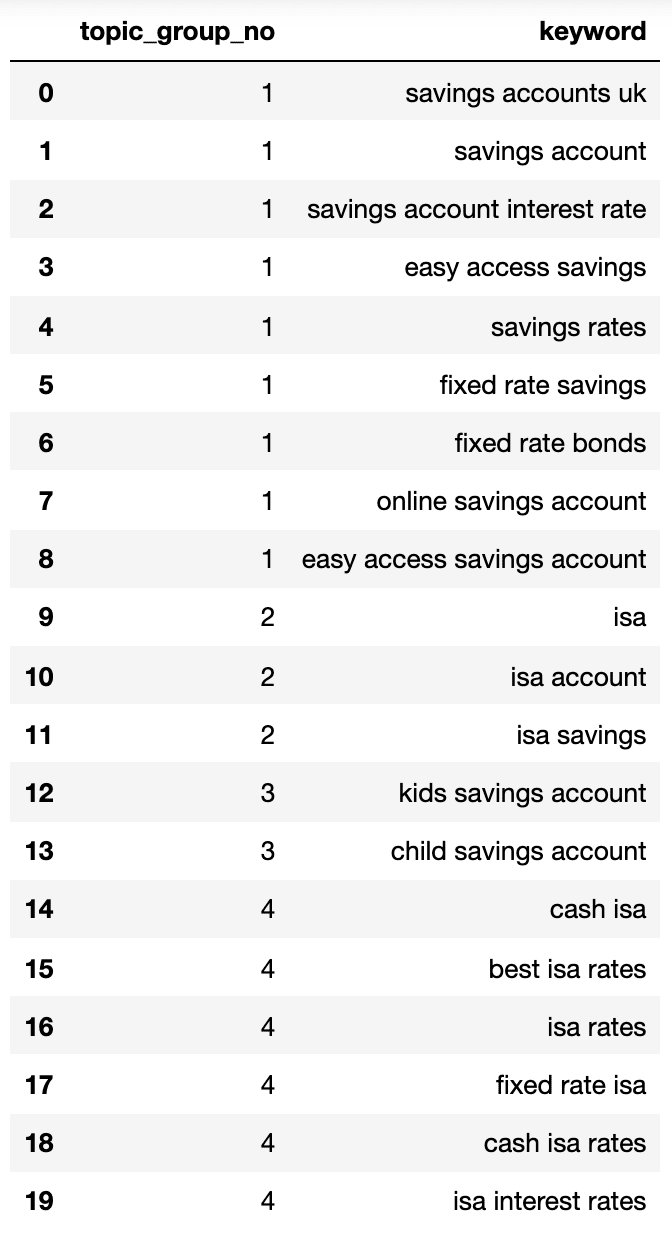
Below shows a dictionary containing all the keywords clustered by search intent into numbered groups:

{1: ['fixed rate isa',
  'isa rates',
  'isa interest rates',
  'best isa rates',
  'cash isa',
  'cash isa rates'],
 2: ['child savings account', 'kids savings account'],
 3: ['savings account',
  'savings account interest rate',
  'savings rates',
  'fixed rate savings',
  'easy access savings',
  'fixed rate bonds',
  'online savings account',
  'easy access savings account',
  'savings accounts uk'],
 4: ['isa account', 'isa', 'isa savings']}

Let’s stick that into a dataframe:


topic_groups_lst = []

for k, l in topic_groups_numbered.items():
    for v in l:
        topic_groups_lst.append([k, v])

topic_groups_dictdf = pd.DataFrame(topic_groups_lst, columns=['topic_group_no', 'keyword'])
                                
topic_groups_dictdf
Topic group dataframe.Image from author, April 2025

The search intent groups above show a good approximation of the keywords inside them, something that an SEO expert would likely achieve.

Although we only used a small set of keywords, the method can obviously be scaled to thousands (if not more).

Activating The Outputs To Make Your Search Better

Of course, the above could be taken further using neural networks, processing the ranking content for more accurate clusters and cluster group naming, as some of the commercial products out there already do.

For now, with this output, you can:

  • Incorporate this into your own SEO dashboard systems to make your trends and SEO reporting more meaningful.
  • Build better paid search campaigns by structuring your Google Ads accounts by search intent for a higher Quality Score.
  • Merge redundant facet ecommerce search URLs.
  • Structure a shopping site’s taxonomy according to search intent instead of a typical product catalog.

I’m sure there are more applications that I haven’t mentioned – feel free to comment on any important ones that I’ve not already mentioned.

In any case, your SEO keyword research just got that little bit more scalable, accurate, and quicker!

Download the full code here for your own use.

More Resources:


Featured Image: Buch and Bee/Shutterstock

From Search To Discovery: Why SEO Must Evolve Beyond The SERP via @sejournal, @alexmoss

The search landscape undergoes its biggest shift in a generation.

If you’ve been in SEO long enough to remember the glory days of the all-organic search engine results pages (SERP), you’ll know how much of this real estate has been gradually taken over by paid ads, other first-party products, and rich snippets.

Now, the most aggressive transition of all: AI Overviews (as well as search-based large language model platforms).

At BrightonSEO last month, I explored how this evolution is forcing us to rethink what SEO means and why discoverability, not just ranking, is the new north star.

The “Dawn” Of The Zero-Click Isn’t Just Over – It’s Now Assumed

We’ve been reading about the rise of zero-click searches for some time now, but this “takeover” has been much more noticeable over the past 12 months.

I recently searched [how to teach my child to tell the time], and after scrolling through a parade of paid product ads, Google-owned assets, and the AI Overview summaries, I scrolled a good three pages down the SERP.

Google and other search and discovery platforms want to keep users in their ecosystems. For SEO pros, this means traditional metrics such as click-through rate (CTR) are becoming less valuable by the day.

From Answer Engines To Assistant Engines

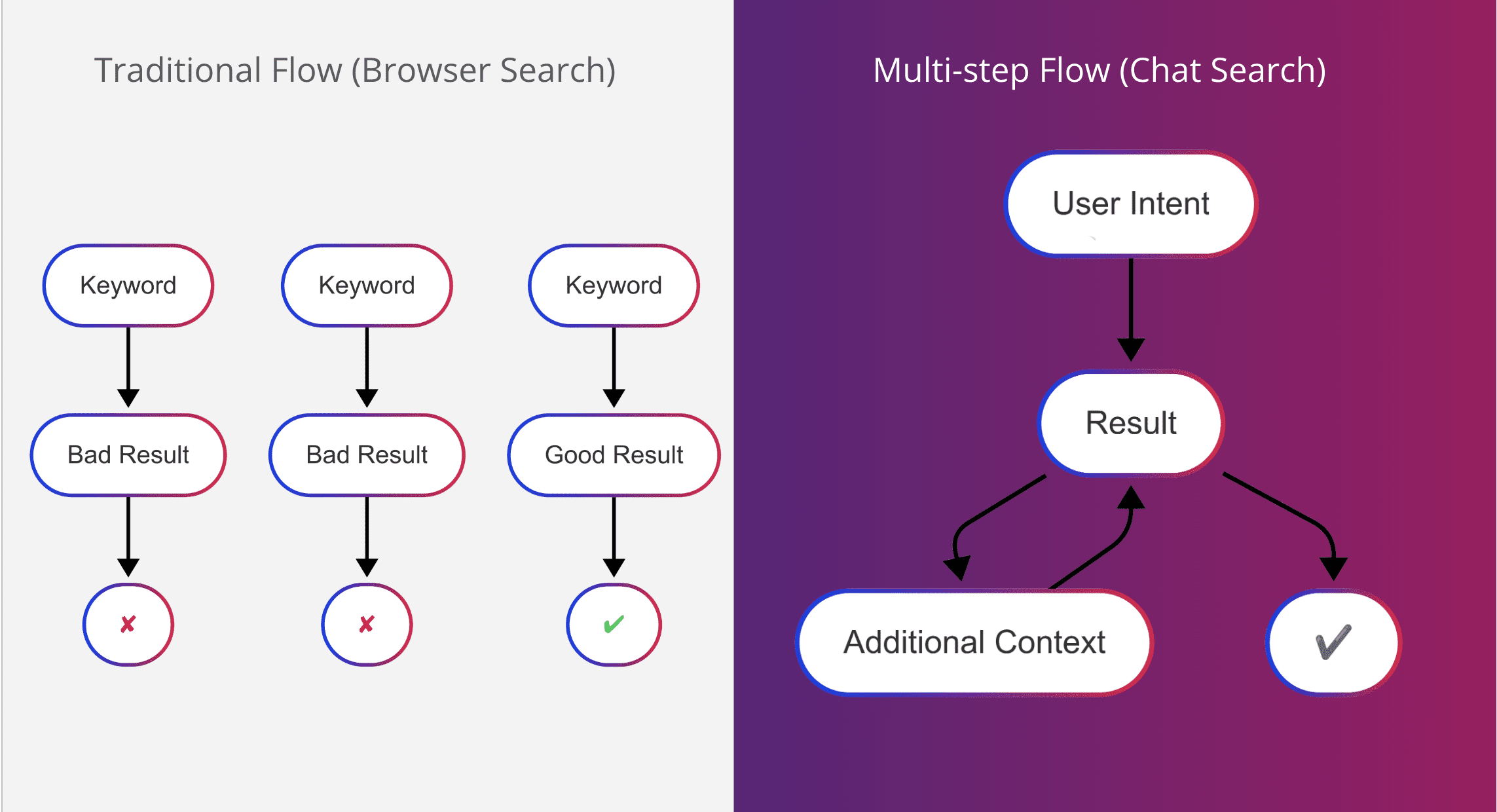
LLMs have changed not just the way a result is displayed to the user but also changed the traditional search flow born within the browser into a multi-step flow that the native SERP simply cannot support in the same way.

The research process is collapsing into a single, seamless exchange.

Traditional flow vs Multi-step flowImage used with permission from Alain Schlesser, May 2025

But as technology accelerates, our own curiosity and research skills are at risk of declining or disappearing completely as the evolution of technology exponentially grows.

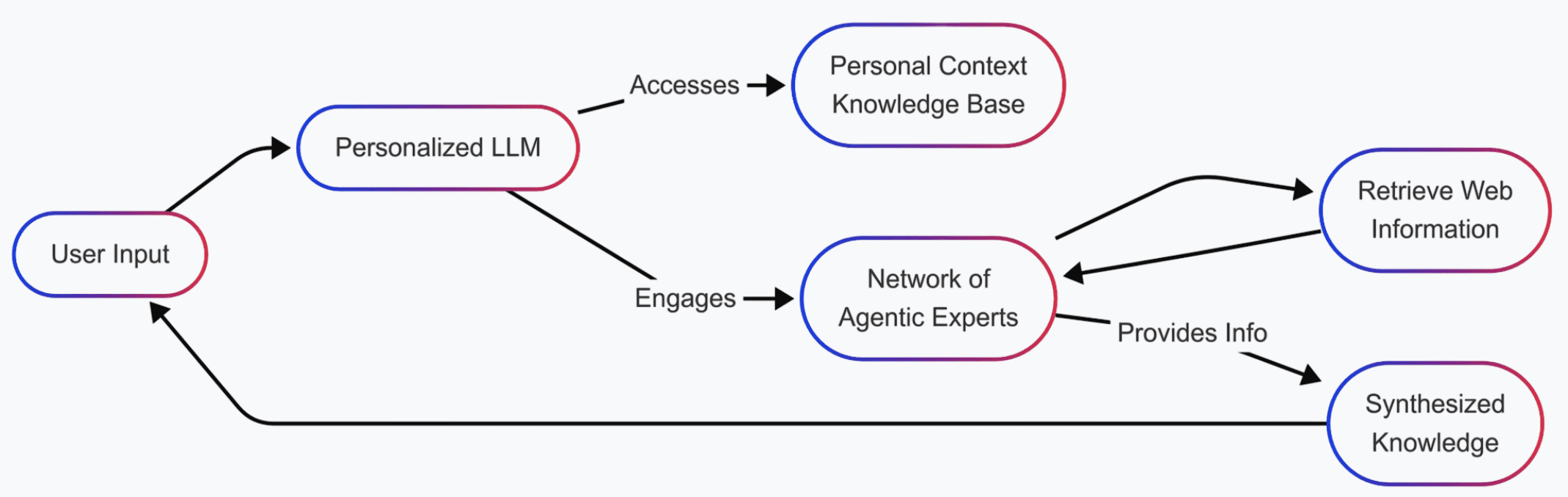
Assistant engines and wider LLMs  are the new gatekeepers between our content and the person discovering that content – our potential “new audience.”

They parse, consume, understand, and then synthesize content, which is the deciding factor in what it mentions to whom/what it interacts with.

Structured data is still crucial, as context, transparency, and sentiment matter more than ever.

Personal LLM agent flow diagramPersonal LLM agent flow diagram by Alain Schlesser, used with permission, May 2025

Challenges Are Different, But Also The Same

As an SEO, our challenges with this new behavior affect the way we do – and report on – our jobs.

In reality, many are just old headaches in shiny new wrappers:

  • Attribution is a mess: With AI Overviews and LLMs synthesizing content, it’s harder than ever to see where your traffic comes from – or if you’re getting any at all. There are some tools out there that do monitor, but we’re in the early days to see a standard. Even Google said they have no plans on adding insights on AIO within Search Console.
  • Traffic is fragmenting (again): We saw this with social media platforms at the beginning, where discovery happened outside the organic SERPs. Discovery is now happening everywhere, all at once. With attribution also harder to ascertain, this is a bigger challenge today.
  • Budgets are under scrutiny from fear, uncertainty, and doubt (FUD): The native SERP is changing too much, so some may assume there’s less (or no) value in doing SEO much anymore (untrue!).

The Shift Of Success Metrics

The days of our current success metrics are dwindling. The days of vanity-led metrics are coming to an end.

Similar to how our challenges are the same but different, this also applies to how we redefine success metrics:

Old Hat New Hat
Content Context + sentiment
Keywords Intent
Brand Brand + sentiment
Rankings Mentions
Links from external sources Citations across various channels
SERP monopoly Share of voice
E-E-A-T Still E-E-A-T
Structured data Entities, knowledge graph & vector embeds
Answering Assisting

What Can You Do About It?

Information can be aggregated, but personality can’t. This is why it’s still our responsibility to help “assist the assistant” to consider and include you as part of that aggregated information and synthesized answer.

  • Stick to the fundamentals: Never neglect SEO 101.
  • Third-party perspective is increasingly important, so ensure this is maintained and managed well to ensure positive brand sentiment.
  • Embrace structured data: Even if some say it’s becoming less crucial for LLMs to understand entities, structured data is being used right now inside major LLMs to output structured data within responses, giving them an established and standardised way to understand your content.
  • Educate stakeholders: Shift the conversation from rankings and clicks to discoverability and brand presence. The days of the branded unlinked mention suddenly have more value than “acquiring X followed non-branded anchor text links pcm.”
  • Experiment with your content: Try new ways to produce and market your content beyond the traditional word. Here, video is useful not only for humans but also for LLMs, who are now “watching” and understanding them to aid their response.
  • Create helpful, unique content: To add to the above, don’t produce for the sake of production.

LLMs.txt: The Potential To Be The New Standard

Keep an eye on emerging standards proposals, such as llms.txt, which is one way some are adapting and contributing to how LLMs ingest our content beyond our traditional approaches offered with robots.txt and XML sitemaps.

While some are skeptical about this standard, I believe it is still something worth implementing now, and I understand its true benefits for the future.

There is (virtually) non-existent risk in implementing something that doesn’t take too much time or resources to produce, so long as you’re doing so with a white hat approach.

Conclusion: Embrace Discoverability And New Metrics

SEO isn’t dead. It’s expanding, but at a rate we haven’t experienced before.

Discoverability is the new go-to success metric, but it’s not without flaws, especially as the way we search continues to change.

This is no longer about “ranking well” anymore. This is now about being understood, surfaced, trusted, and discovered across every platform and assistant that matters.

Embrace and adapt to the changes, as it’s going to continue for some time.

More Resources:


Featured Image: PeopleImages.com – Yuri A/Shutterstock

Does Google’s AI Overviews Violate Its Own Spam Policies? via @sejournal, @martinibuster

Search marketers assert that Google’s new long-form AI Overviews answers have become the very thing Google’s documentation advises publishers against: scraped content lacking originality or added value, at the expense of content creators who are seeing declining traffic.

Why put the effort into writing great content if it’s going to be rewritten into a complete answer that removes the incentive to click the cited source?

Rewriting Content And Plagiarism

Google previously showed Featured Snippets, which were excerpts from published content that users could click on to read the rest of the article. Google’s AI Overviews (AIO) expands on that by presenting entire articles that answer a user’s questions and sometimes anticipates follow-up questions and provides answers to those, too.

And it’s not an AI providing answers. It’s an AI repurposing published content. That action is called plagiarism when a student does the same thing by repurposing an existing essay without adding unique insight or analysis.

The thing about AI is that it is incapable of unique insight or analysis, so there is zero value-add in Google’s AIO, which in an academic setting would be called plagiarism.

Example Of Rewritten Content

Lily Ray recently published an article on LinkedIn drawing attention to a spam problem in Google’s AIO. Her article explains how SEOs discovered how to inject answers into AIO, taking advantage of the lack of fact checking.

Lily subsequently checked on Google, presumably to see if her article was ranking and discovered that Google had rewritten her entire article and was providing an answer that was almost as long as her original.

She tweeted:

“It re-wrote everything I wrote in a post that’s basically as long as my original post “

Did Google Rewrite Entire Article?

An algorithm that search engines and LLMs may use to analyze content is to determine what questions the content answers. This way the content can be annotated according to what answers it provides, making it easier to match a query to a web page.

I used ChatGPT to analyze Lily’s content and also AIO’s answer. The number of questions answered by both documents were almost exactly the same, twelve. Lily’s article answered 13 questions while AIO provided answeredo twelve.

Both articles answered five similar questions:

  • Spam Problem In AI Overviews
    AIO: “s there a spam problem affecting Google AI Overviews?
    Lily Ray: What types of problems have been observed in Google’s AI Overviews?
  • Manipulation And Exploitation of AI Overviews
    AIO: How are spammers manipulating AI Overviews to promote low-quality content?
    Lily Ray: What new forms of SEO spam have emerged in response to AI Overviews?
  • Accuracy And Hallucination Concerns
    AIO: Can AI Overviews generate inaccurate or contradictory information?
    Lily Ray: Does Google currently fact-check or validate the sources used in AI Overviews?
  • Concern About AIO In The SEO Community
    AIO: What concerns do SEO professionals have about the impact of AI Overviews?
    Lily Ray: Why is the ability to manipulate AI Overviews so concerning?
  • Deviation From Principles of E-E-A-T (Experience, Expertise, Authoritativeness, and Trustworthiness)
    AIO: What kind of content is Google prioritizing in response to these issues?
    Lily Ray: How does the quality of information in AI Overviews compare to Google’s traditional emphasis on E-E-A-T and trustworthy content?

Plagiarizing More Than One Document

Google’s AIO system is designed to answer follow-up and related questions, “synthesizing” answers from more than one original source and that’s the case with this specific answer.

Whereas Lily’s content argues that Google isn’t doing enough, AIO rewrote the content from another document to say that Google is taking action to prevent spam. Google’s AIO differs from Lily’s original by answering five additional questions with answers that are derived from another web page.

This gives the appearance that Google’s AIO answer for this specific query is “synthesizing” or “plagiarizing” from two documents to answer the question Lily Ray’s search query, “spam in ai overview google.”

Takeaways

  • Google’s AI Overviews is repurposing web content to create long-form content that lacks originality or added-value.
  • Google’s AIO answers mirror the content they summarize, copying the structure and ideas to answer identical questions inherent in the articles.
  • Google’s AIO arguably deviates from Google’s own quality standards, using rewritten content in a manner that mirrors Google’s own definitions of spam.
  • Google’s AIO features apparent plagiarism of multiple sources.

The quality and trustworthiness of AIO responses may  not reach the quality levels set by Google’s principles of Experience, Expertise, Authoritativeness, and Trustworthiness because AI lacks experience and apparently there is no mechanism for fact-checking.

The fact that Google’s AIO system provides essay-length answers arguably removes any incentive for users to click through to the original source and may help explain why many in the search and publisher communities are seeing less traffic. The perception of AIO traffic is so bad that one search marketer quipped on X that ranking #1 on Google is the new place to hide a body, because nobody would ever find it there.

Google could be said to plagiarize content because AIO answers are rewrites of published articles that lack unique analysis or added value, placing AIO firmly within most people’s definition of a scraper spammer.

Featured Image by Shutterstock/Luis Molinero

AI Is Diluting Your Brand

A combination of fear and necessity may create a renaissance of sorts for brand marketing.

Many retail and direct-to-consumer companies that have essentially ignored branding now worry that generative AI is merging their advertising and marketing copy into a single, industry-wide sameness. Yet these businesses also recognize genAI’s importance.

Source of the Fear

Consider the decline of regional accents in America.

Years ago, such accents were common. Texans had a drawl. Georgians sounded Southern. Bostonians didn’t pronounce the letter “r.”

The accents still exist to some degree, but multiple studies attribute their decline to mass media and improved transportation. The rise of nationwide television in the 1950s and affordable cross-country vacations and relocations prompted Americans to sound the same.

AI does something similar. It learns patterns of writing from the web and also contributes content to it. AI-generated sentences and paragraphs reside on the same web that instructs the writing patterns.

Careful observers have recognized some of these repeated patterns. For example, many suspect that the noble em dash (—) was a sure sign of AI copy. The assertion is untrue. The em dash, en dash, and hyphen are versatile forms of punctuation dating to the 1700s.

Nonetheless, this humble line (the em dash) represented what at least some believed to be an AI glitch that made all writing similar. If AI could overuse the em dash, it could also homogenize brand copy.

Screenshot of an Practical Ecommerce article from Armando on December 18, 2008

The em dash is a longstanding punctuation mark, as shown here in the author’s article from 2008.

It is the 2025 equivalent of the generic brand video that Dissolve, a video and photography licensing company, released in 2014. Based on a McSweeney’s poem, the video began, “We think first of vague words that are synonyms for progress and pair them with footage of a high-speed train.”

The video looked and sounded like many corporate videos of the era and pointed out just how funny and bad generic branding can be.

Necessity

AI’s capacity to process vast datasets, learn from patterns, and generate readable text offers seemingly unprecedented opportunities for marketers.

AI can produce ad copy, social media posts, product descriptions, and more. The quality is not perfect, but the cost, ubiquity, speed, and scale make it attractive.

Some ecommerce marketers even use AI to generate personalized customer messages at scale. Others create dozens of ad variations and multivariate tests to drive conversions.

These capabilities mean generative AI is a competitive necessity for many businesses.

Branding

In an attempt to balance the benefits of AI with concerns of a generic voice, marketers may focus on their company’s brand and what makes it distinct.

For example, fractional CMO Derrick Hicks now offers AI prompting services for adding brand context. The aim is a consistent voice across all marketing channels for recognition and trust.

Hicks’s offering is similar (but more developed) to the brand voice features in AI tools such as Copy.ai and Content Hub. It’s traditional brand development applied to AI.

The key is to develop a compelling written and spoken brand. It’s a strategic investment requiring time, repetition, and deliberate choices.

Good branding begins with clarity: how the company speaks, what it stands for, and who it speaks to. This means defining tone and vocabulary through collaboration and iteration, and codifying those decisions into a brand voice document.

The document should include examples, preferred and banned words, and guidelines by channel and customer persona. It’s the reference point for every prompt and marketing asset, AI-generated or not.

Expect to revise and sharpen the document over time. Train the AI tools. Provide examples, instructions, and corrections. The more specific and consistent the inputs, the stronger the brand expression.

A marketing team should test messages, observe how prospects respond, and adjust.

None of this is easy. But for ecommerce companies in a noisy, AI-driven marketplace, a strong verbal brand is a differentiator, making the business recognizable, memorable, and trustworthy.

Access to experimental medical treatments is expanding across the US

A couple of weeks ago I was in Washington, DC, for a gathering of scientists, policymakers, and longevity enthusiasts. They had come together to discuss ways to speed along the development of drugs and other treatments that might extend the human lifespan.

One approach that came up was to simply make experimental drugs more easily accessible. Let people try drugs that might help them live longer, the argument went. Some groups have been pushing bills to do just that in Montana, a state whose constitution explicitly values personal liberty.

A couple of years ago, a longevity lobbying group helped develop a bill that expanded on the state’s existing Right to Try law, which allowed seriously ill people to apply for access to experimental drugs (that is, drugs that have not been approved by drug regulators). The expansion, which was passed in 2023, opened access for people who are not seriously ill. 

Over the last few months, the group has been pushing further—for a new bill that sets out exactly how clinics can sell experimental, unproven treatments in the state to anyone who wants them. At the end of the second day of the event, the man next to me looked at his phone. “It just passed,” he told me. (The lobbying group has since announced that the state’s governor Greg Gianforte has signed the bill into law, but when I called his office, Gianforte’s staff said they could not legally tell me whether or not he has.)

The passing of the bill could make Montana something of a US hub for experimental treatments. But it represents a wider trend: the creep of Right to Try across the US. And a potentially dangerous departure from evidence-based medicine.

In the US, drugs must be tested in human volunteers before they can be approved and sold. Early-stage clinical trials are small and check for safety. Later trials test both the safety and efficacy of a new drug.

The system is designed to keep people safe and to prevent manufacturers from selling ineffective or dangerous products. It’s meant to protect us from snake oil.

But people who are seriously ill and who have exhausted all other treatment options are often desperate to try experimental drugs. They might see it as a last hope. Sometimes they can volunteer for clinical trials, but time, distance, and eligibility can rule out that option.

Since the 1980s, seriously or terminally ill people who cannot take part in a trial for some reason can apply for access to experimental treatments through a “compassionate use” program run by the US Food and Drug Administration (FDA). The FDA authorizes almost all of the compassionate use requests it receives (although manufacturers don’t always agree to provide their drug for various reasons).

But that wasn’t enough for the Goldwater Institute, a libertarian organization that in 2014 drafted a model Right to Try law for people who are terminally ill. Versions of this draft have since been passed into law in 41 US states, and the US has had a federal Right to Try law since 2018. These laws generally allow people who are seriously ill to apply for access to drugs that have only been through the very first stages of clinical trials, provided they give informed consent.

Some have argued that these laws have been driven by a dislike of both drug regulation and the FDA. After all, they are designed to achieve the same result as the compassionate use program. The only difference is that they bypass the FDA.

Either way, it’s worth noting just how early-stage these treatments are. A drug that has been through phase I trials might have been tested in just 20 healthy people. Yes, these trials are designed to test the safety of a drug, but they are never conclusive. At that point in a drug’s development, no one can know how a sick person—who is likely to be taking other medicines— will react to it.

Now these Right to Try laws are being expanded even more. The Montana bill, which goes the furthest, will enable people who are not seriously ill to access unproven treatments, and other states have been making moves in the same direction.

Just this week, Georgia’s governor signed into law the Hope for Georgia Patients Act, which allows people with life-threatening illnesses to access personalized treatments, those that are “unique to and produced exclusively for an individual patient based on his or her own genetic profile.” Similar laws, known as “Right to Try 2.0,”  have been passed in other states, too, including Arizona, Mississippi, and North Carolina.

And last year, Utah passed a law that allows health care providers (including chiropractors, podiatrists, midwives, and naturopaths) to deliver unapproved placental stem cell therapies. These treatments involve cells collected from placentas, which are thought to hold promise for tissue regeneration. But they haven’t been through human trials. They can cost tens of thousands of dollars, and their effects are unknown. Utah’s law was described as a “pretty blatant broadbrush challenge to the FDA’s authority” by an attorney who specializes in FDA law. And it’s one that could put patients at risk.

Laws like these spark a lot of very sensitive debates. Some argue that it’s a question of medical autonomy, and that people should have the right to choose what they put in their own bodies.

And many argue there’s a cost-benefit calculation to be made. A seriously ill person potentially has more to gain and less to lose from trying an experimental drug, compared to someone who is in good health.

But everyone needs to be protected from ineffective drugs. Most ethicists think it’s unethical to sell a treatment when you have no idea if it will work, and that argument has been supported by numerous US court decisions over the years. 

There could be a financial incentive for doctors to recommend an experimental drug, especially when they are granted protections by law. (Right to Try laws tend to protect prescribing doctors from disciplinary action and litigation should something go wrong.)

On top of all this, many ethicists are also concerned that the FDA’s drug approval process itself has been on a downward slide over the last decade or so. An increasing number of drug approvals are fast-tracked based on weak evidence, they argue.

Scientists and ethicists on both sides of the debate are now waiting to see what unfolds under the new US administration.  

In the meantime, a quote from Diana Zuckerman, president of the nonprofit National Center for Health Research, comes to mind: “Sometimes hope helps people do better,” she told me a couple of years ago. “But in medicine, isn’t it better to have hope based on evidence rather than hope based on hype?”

This article first appeared in The Checkup, MIT Technology Review’s weekly biotech newsletter. To receive it in your inbox every Thursday, and read articles like this first, sign up here.