Anthropic can now track the bizarre inner workings of a large language model

The AI firm Anthropic has developed a way to peer inside a large language model and watch what it does as it comes up with a response, revealing key new insights into how the technology works. The takeaway: LLMs are even stranger than we thought.

The Anthropic team was surprised by some of the counterintuitive workarounds that large language models appear to use to complete sentences, solve simple math problems, suppress hallucinations, and more, says Joshua Batson, a research scientist at the company.

It’s no secret that large language models work in mysterious ways. Few—if any—mass-market technologies have ever been so little understood. That makes figuring out what makes them tick one of the biggest open challenges in science.

But it’s not just about curiosity. Shedding some light on how these models work would expose their weaknesses, revealing why they make stuff up and can be tricked into going off the rails. It would help resolve deep disputes about exactly what these models can and can’t do. And it would show how trustworthy (or not) they really are.

Batson and his colleagues describe their new work in two reports published today. The first presents Anthropic’s use of a technique called circuit tracing, which lets researchers track the decision-making processes inside a large language model step by step. Anthropic used circuit tracing to watch its LLM Claude 3.5 Haiku carry out various tasks. The second (titled “On the Biology of a Large Language Model”) details what the team discovered when it looked at 10 tasks in particular.

“I think this is really cool work,” says Jack Merullo, who studies large language models at Brown University in Providence, Rhode Island, and was not involved in the research. “It’s a really nice step forward in terms of methods.”

Circuit tracing is not itself new. Last year Merullo and his colleagues analyzed a specific circuit in a version of OpenAI’s GPT-2, an older large language model that OpenAI released in 2019. But Anthropic has now analyzed a number of different circuits as a far larger and far more complex model carries out multiple tasks. “Anthropic is very capable at applying scale to a problem,” says Merullo.

Eden Biran, who studies large language models at Tel Aviv University, agrees. “Finding circuits in a large state-of-the-art model such as Claude is a nontrivial engineering feat,” he says. “And it shows that circuits scale up and might be a good way forward for interpreting language models.”

Circuits chain together different parts—or components—of a model. Last year, Anthropic identified certain components inside Claude that correspond to real-world concepts. Some were specific, such as “Michael Jordan” or “greenness”; others were more vague, such as “conflict between individuals.” One component appeared to represent the Golden Gate Bridge. Anthropic researchers found that if they turned up the dial on this component, Claude could be made to self-identify not as a large language model but as the physical bridge itself.

The latest work builds on that research and the work of others, including Google DeepMind, to reveal some of the connections between individual components. Chains of components are the pathways between the words put into Claude and the words that come out.  

“It’s tip-of-the-iceberg stuff. Maybe we’re looking at a few percent of what’s going on,” says Batson. “But that’s already enough to see incredible structure.”

Growing LLMs

Researchers at Anthropic and elsewhere are studying large language models as if they were natural phenomena rather than human-built software. That’s because the models are trained, not programmed.

“They almost grow organically,” says Batson. “They start out totally random. Then you train them on all this data and they go from producing gibberish to being able to speak different languages and write software and fold proteins. There are insane things that these models learn to do, but we don’t know how that happened because we didn’t go in there and set the knobs.”

Sure, it’s all math. But it’s not math that we can follow. “Open up a large language model and all you will see is billions of numbers—the parameters,” says Batson. “It’s not illuminating.”

Anthropic says it was inspired by brain-scan techniques used in neuroscience to build what the firm describes as a kind of microscope that can be pointed at different parts of a model while it runs. The technique highlights components that are active at different times. Researchers can then zoom in on different components and record when they are and are not active.

Take the component that corresponds to the Golden Gate Bridge. It turns on when Claude is shown text that names or describes the bridge or even text related to the bridge, such as “San Francisco” or “Alcatraz.” It’s off otherwise.

Yet another component might correspond to the idea of “smallness”: “We look through tens of millions of texts and see it’s on for the word ‘small,’ it’s on for the word ‘tiny,’ it’s on for the word ‘petite,’ it’s on for words related to smallness, things that are itty-bitty, like thimbles—you know, just small stuff,” says Batson.

Having identified individual components, Anthropic then follows the trail inside the model as different components get chained together. The researchers start at the end, with the component or components that led to the final response Claude gives to a query. Batson and his team then trace that chain backwards.

Odd behavior

So: What did they find? Anthropic looked at 10 different behaviors in Claude. One involved the use of different languages. Does Claude have a part that speaks French and another part that speaks Chinese, and so on?

The team found that Claude used components independent of any language to answer a question or solve a problem and then picked a specific language when it replied. Ask it “What is the opposite of small?” in English, French, and Chinese and Claude will first use the language-neutral components related to “smallness” and “opposites” to come up with an answer. Only then will it pick a specific language in which to reply. This suggests that large language models can learn things in one language and apply them in other languages.

Anthropic also looked at how Claude solved simple math problems. The team found that the model seems to have developed its own internal strategies that are unlike those it will have seen in its training data. Ask Claude to add 36 and 59 and the model will go through a series of odd steps, including first adding a selection of approximate values (add 40ish and 60ish, add 57ish and 36ish). Towards the end of its process, it comes up with the value 92ish. Meanwhile, another sequence of steps focuses on the last digits, 6 and 9, and determines that the answer must end in a 5. Putting that together with 92ish gives the correct answer of 95.

And yet if you then ask Claude how it worked that out, it will say something like: “I added the ones (6+9=15), carried the 1, then added the 10s (3+5+1=9), resulting in 95.” In other words, it gives you a common approach found everywhere online rather than what it actually did. Yep! LLMs are weird. (And not to be trusted.)
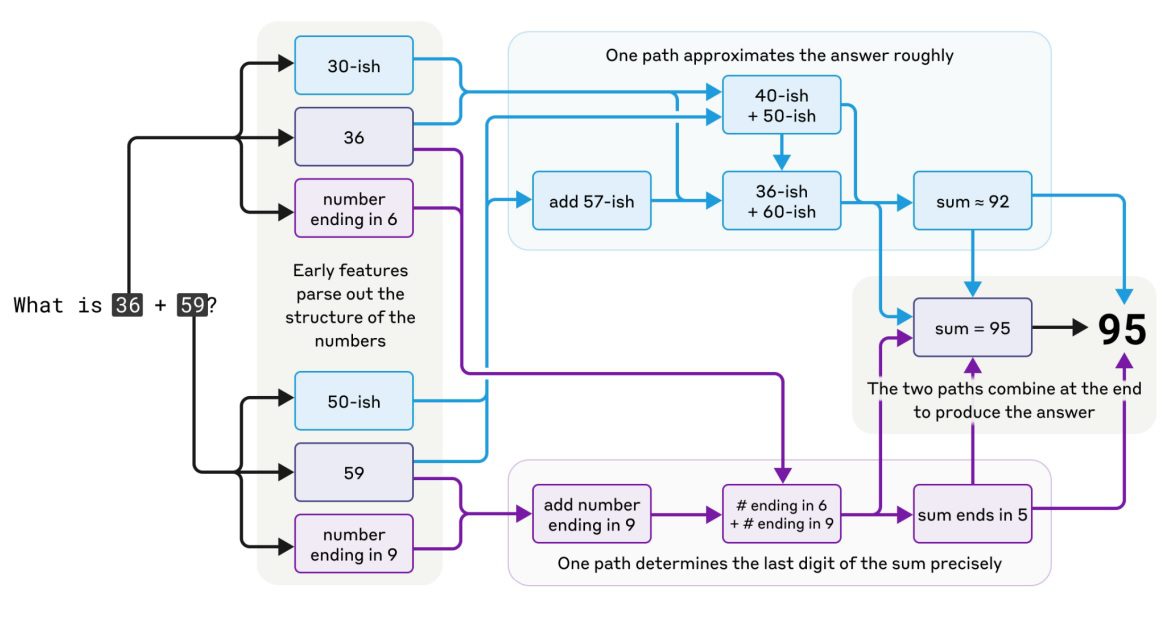
The steps that Claude 3.5 Haiku used to solve a simple math problem were not what Anthropic expected—they’re not the steps Claude claimed it took either.
ANTHROPIC

This is clear evidence that large language models will give reasons for what they do that do not necessarily reflect what they actually did. But this is true for people too, says Batson: “You ask somebody, ‘Why did you do that?’ And they’re like, ‘Um, I guess it’s because I was— .’ You know, maybe not. Maybe they were just hungry and that’s why they did it.”

Biran thinks this finding is especially interesting. Many researchers study the behavior of large language models by asking them to explain their actions. But that might be a risky approach, he says: “As models continue getting stronger, they must be equipped with better guardrails. I believe—and this work also shows—that relying only on model outputs is not enough.”

A third task that Anthropic studied was writing poems. The researchers wanted to know if the model really did just wing it, predicting one word at a time. Instead they found that Claude somehow looked ahead, picking the word at the end of the next line several words in advance.  

For example, when Claude was given the prompt “A rhyming couplet: He saw a carrot and had to grab it,” the model responded, “His hunger was like a starving rabbit.” But using their microscope, they saw that Claude had already hit upon the word “rabbit” when it was processing “grab it.” It then seemed to write the next line with that ending already in place.

This might sound like a tiny detail. But it goes against the common assumption that large language models always work by picking one word at a time in sequence. “The planning thing in poems blew me away,” says Batson. “Instead of at the very last minute trying to make the rhyme make sense, it knows where it’s going.”

“I thought that was cool,” says Merullo. “One of the joys of working in the field is moments like that. There’s been maybe small bits of evidence pointing toward the ability of models to plan ahead, but it’s been a big open question to what extent they do.”

Anthropic then confirmed its observation by turning off the placeholder component for “rabbitness.” Claude responded with “His hunger was a powerful habit.” And when the team replaced “rabbitness” with “greenness,” Claude responded with “freeing it from the garden’s green.”

Anthropic also explored why Claude sometimes made stuff up, a phenomenon known as hallucination. “Hallucination is the most natural thing in the world for these models, given how they’re just trained to give possible completions,” says Batson. “The real question is, ‘How in God’s name could you ever make it not do that?’”

The latest generation of large language models, like Claude 3.5 and Gemini and GPT-4o, hallucinate far less than previous versions, thanks to extensive post-training (the steps that take an LLM trained on the internet and turn it into a usable chatbot). But Batson’s team was surprised to find that this post-training seems to have made Claude refuse to speculate as a default behavior. When it did respond with false information, it was because some other component had overridden the “don’t speculate” component.

This seemed to happen most often when the speculation involved a celebrity or other well-known entity. It’s as if the amount of information available pushed the speculation through, despite the default setting. When Anthropic overrode the “don’t speculate” component to test this, Claude produced lots of false statements about individuals, including claiming that Batson was famous for inventing the Batson principle (he isn’t).

Still unclear

Because we know so little about large language models, any new insight is a big step forward. “A deep understanding of how these models work under the hood would allow us to design and train models that are much better and stronger,” says Biran.

But Batson notes there are still serious limitations. “It’s a misconception that we’ve found all the components of the model or, like, a God’s-eye view,” he says. “Some things are in focus, but other things are still unclear—a distortion of the microscope.”

And it takes several hours for a human researcher to trace the responses to even very short prompts. What’s more, these models can do a remarkable number of different things, and Anthropic has so far looked at only 10 of them.

Batson also says there are big questions that this approach won’t answer. Circuit tracing can be used to peer at the structures inside a large language model, but it won’t tell you how or why those structures formed during training. “That’s a profound question that we don’t address at all in this work,” he says.

But Batson sees this as the start of a new era in which it is possible, at last, to find real evidence for how these models work: “We don’t have to be, like: ‘Are they thinking? Are they reasoning? Are they dreaming? Are they memorizing?’ Those are all analogies. But if we can literally see step by step what a model is doing, maybe now we don’t need analogies.”

What is Signal? The messaging app, explained.

MIT Technology Review Explains: Let our writers untangle the complex, messy world of technology to help you understand what’s coming next. You can read more from the series here.

With the recent news that the Atlantic’s editor in chief was accidentally added to a group Signal chat for American leaders planning a bombing in Yemen, many people are wondering: What is Signal? Is it secure? If government officials aren’t supposed to use it for military planning, does that mean I shouldn’t use it either?

The answer is: Yes, you should use Signal, but government officials having top-secret conversations shouldn’t use Signal.

Read on to find out why.

What is Signal?

Signal is an app you can install on your iPhone or Android phone, or on your computer. It lets you send secure texts, images, and phone or video chats with other people or groups of people, just like iMessage, Google Messages, WhatsApp, and other chat apps.

Installing Signal is a two-minute process—again, it’s designed to work just like other popular texting apps.

Why is it a problem for government officials to use Signal?

Signal is very secure—as we’ll see below, it’s the best option out there for having private conversations with your friends on your cell phone.

But you shouldn’t use it if you have a legal obligation to preserve your messages, such as while doing government business, because Signal prioritizes privacy over ability to preserve data. It’s designed to securely delete data when you’re done with it, not to keep it. This makes it uniquely unsuited for following public record laws.

You also shouldn’t use it if your phone might be a target of sophisticated hackers, because Signal can only do its job if the phone it is running on is secure. If your phone has been hacked, then the hacker can read your messages regardless of what software you are running.

This is why you shouldn’t use Signal to discuss classified material or military plans. For military communication your civilian phone is always considered hacked by adversaries, so you should instead use communication equipment that is safer—equipment that is physically guarded and designed to do only one job, making it harder to hack.

What about everyone else?

Signal is designed from bottom to top as a very private space for conversation. Cryptographers are very sure that as long as your phone is otherwise secure, no one can read your messages.

Why should you want that? Because private spaces for conversation are very important. In the US, the First Amendment recognizes, in the right to freedom of assembly, that we all need private conversations among our own selected groups in order to function.

And you don’t need the First Amendment to tell you that. You know, just like everyone else, that you can have important conversations in your living room, bedroom, church coffee hour, or meeting hall that you could never have on a public stage. Signal gives us the digital equivalent of that—it’s a space where we can talk, among groups of our choice, about the private things that matter to us, free of corporate or government surveillance. Our mental health and social functioning require that.

So if you’re not legally required to record your conversations, and not planning secret military operations, go ahead and use Signal—you deserve the privacy.

How do we know Signal is secure?

People often give up on finding digital privacy and end up censoring themselves out of caution. So are there really private ways to talk on our phones, or should we just assume that everything is being read anyway?

The good news is: For most of us who aren’t individually targeted by hackers, we really can still have private conversations.

Signal is designed to ensure that if you know your phone and the phones of other people in your group haven’t been hacked (more on that later), you don’t have to trust anything else. It uses many techniques from the cryptography community to make that possible.

Most important and well-known is “end-to-end encryption,” which means that messages can be read only on the devices involved in the conversation and not by servers passing the messages back and forth.

But Signal uses other techniques to keep your messages private and safe as well. For example, it goes to great lengths to make it hard for the Signal server itself to know who else you are talking to (a feature known as “sealed sender”), or for an attacker who records traffic between phones to later decrypt the traffic by seizing one of the phones (“perfect forward secrecy”).

These are only a few of many security properties built into the protocol, which is well enough designed and vetted for other messaging apps, such as WhatsApp and Google Messages, to use the same one.

Signal is also designed so we don’t have to trust the people who make it. The source code for the app is available online and, because of its popularity as a security tool, is frequently audited by experts.

And even though its security does not rely on our trust in the publisher, it does come from a respected source: the Signal Technology Foundation, a nonprofit whose mission is to “protect free expression and enable secure global communication through open-source privacy technology.” The app itself, and the foundation, grew out of a community of prominent privacy advocates. The foundation was started by Moxie Marlinspike, a cryptographer and longtime advocate of secure private communication, and Brian Acton, a cofounder of WhatsApp.

Why do people use Signal over other text apps? Are other ones secure?

Many apps offer end-to-end encryption, and it’s not a bad idea to use them for a measure of privacy. But Signal is a gold standard for private communication because it is secure by default: Unless you add someone you didn’t mean to, it’s very hard for a chat to accidentally become less secure than you intended.

That’s not necessarily the case for other apps. For example, iMessage conversations are sometimes end-to-end encrypted, but only if your chat has “blue bubbles,” and they aren’t encrypted in iCloud backups by default. Google Messages are sometimes end-to-end encrypted, but only if the chat shows a lock icon. WhatsApp is end-to-end encrypted but logs your activity, including “how you interact with others using our Services.”

Signal is careful not to record who you are talking with, to offer ways to reliably delete messages, and to keep messages secure even in online phone backups. This focus demonstrates the benefits of an app coming from a nonprofit focused on privacy rather than a company that sees security as a “nice to have” feature alongside other goals.

(Conversely, and as a warning, using Signal makes it rather easier to accidentally lose messages! Again, it is not a good choice if you are legally required to record your communication.)

Applications like WhatsApp, iMessage, and Google Messages do offer end-to-end encryption and can offer much better security than nothing. The worst option of all is regular SMS text messages (“green bubbles” on iOS)—those are sent unencrypted and are likely collected by mass government surveillance.

Wait, how do I know that my phone is secure?

Signal is an excellent choice for privacy if you know that the phones of everyone you’re talking with are secure. But how do you know that? It’s easy to give up on a feeling of privacy if you never feel good about trusting your phone anyway.

One good place to start for most of us is simply to make sure your phone is up to date. Governments often do have ways of hacking phones, but hacking up-to-date phones is expensive and risky and reserved for high-value targets. For most people, simply having your software up to date will remove you from a category that hackers target.

If you’re a potential target of sophisticated hacking, then don’t stop there. You’ll need extra security measures, and guides from the Freedom of the Press Foundation and the Electronic Frontier Foundation are a good place to start.

But you don’t have to be a high-value target to value privacy. The rest of us can do our part to re-create that private living room, bedroom, church, or meeting hall simply by using an up-to-date phone with an app that respects our privacy.

Jack Cushman is a fellow of the Berkman Klein Center for Internet and Society and directs the Library Innovation Lab at Harvard Law School Library. He is an appellate lawyer, computer programmer, and former board member of the ACLU of Massachusetts.

New Ecommerce Tools: March 27, 2025

We publish a rundown each week of new products from companies offering services to ecommerce merchants. This installment includes updates on automated ads, payments, AI-powered agents, personalization, cross-border shipping, and more.

Got an ecommerce product release? Email releases@practicalecommerce.com.

New Tools for Merchants

TikTok updates shopping ads and tools for merchants. TikTok has announced updates on ecommerce tools for merchants. Smart+, TikTok’s AI-powered automated ad service, is expanding its Catalog ads to include website and app promotions within a single campaign. TikTok is also expanding its GMV Max automated ad campaigns, enabling merchants to include affiliate content and live formats for GMV Max. Lastly, TikTok is extending its search ads and offering new tools for generating videos and avatars.

Web page of TikTok for Business

TikTok for Business

Splitit integrates one-click installment payments with Shopify checkout. Splitit, a provider of credit card-linked payments, has launched Card Installments, a Shopify app. Splitit’s app is embedded into the Shopify checkout, letting shoppers choose between paying in full or installments directly within the credit card section, without any redirects or applications. A white-label solution, the app allows merchants to maintain control over their brand and caters to shoppers in over 100 countries with localized payment options.

Walmart develops an AI-powered assistant for its merchants. Walmart has developed a genAI assistant, Wally, to help its merchants streamline and automate tasks. With Wally, merchants can generate insights from complex datasets, diagnose why certain products are underperforming or overperforming, automate complex formulas and predictions, answer operational support questions, raise tickets for unresolved issues, and more. According to Walmart, Wally requires no technical training. Merchants ask questions and receive actionable insights in seconds based on Walmart’s proprietary data.

Kibo launches Agentic Commerce. Kibo Commerce, a provider of composable commerce solutions, has launched Agentic Commerce, an AI-powered platform to transform how businesses engage with customers and optimize commerce. Kibo Agentic Commerce will initially consist of nine agents to support commerce operations: Shopper, CSR, Promotional, Merchandiser, Order Routing, Reverse Logistics, Forecasting, Analytics, and Developer. The first two agents — Shopper and CSR — will provide smart customer assistance.

Web page of Kibo Agentic Commerce

Kibo Agentic Commerce

Logistics platform Ordoro partners with Mirakl on marketplaces. Ordoro, an ecommerce logistics and inventory management platform, has integrated with Mirakl, a SaaS solution for marketplace and dropship platforms. Merchants selling on Mirakl marketplaces can sync orders, manage inventory, and automate fulfillment — all through Ordoro. Merchants can simplify operations, reduce manual work, and focus on growing their business, according to Ordoro.

Monetate launches Orchid AI for commerce. Monetate, an ecommerce personalization platform, has launched Orchid, an AI-powered engine that unifies search, navigation, personalization, testing, and more. According to Monetate, Orchid AI (i) delivers higher search revenue by personalizing results using real-time intent, (ii) creates custom category page experiences for different segments, (iii) generates product suggestions, and more.

Yottaa acquires SpeedSense for ecommerce optimization. Yottaa, a provider of optimization tools for ecommerce sites, has announced the acquisition of SpeedSense, a pioneer in web performance consulting and creator of Sensai technology. The acquisition enhances Yottaa’s Web Performance Cloud and Web Performance Services offerings. By integrating Sensai with Yottaa’s Web Performance Cloud, ecommerce brands can measure revenue impact across the entire customer experience, capturing performance data from real users, Google Core Web Vitals, and third-party applications.

Home page of Yotta

Yotta

Noibu launches ecommerce site health solution for Salesforce Commerce Cloud. Noibu, an ecommerce performance and error monitoring service, has integrated its AI-powered platform with Salesforce Commerce Cloud. According to Noibu, merchants can detect, investigate, and resolve critical site issues faster with the integration of Salesforce Commerce Cloud. Noibu monitors key performance indicators, including loading speed, interactivity, and visual stability, and provides recommendations to improve speed and user experience. Salesforce Commerce Cloud logs are ported into Noibu, allowing advanced analytics, anomaly detection, and more.

Amazon introduces the next generation of Connect. Amazon has announced an update of Connect, delivering first-party AI across all channels and featuring support for future AI capabilities with pricing tied to channel usage rather than AI consumption. According to Amazon, this next generation of Connect makes it simple for organizations of any size to leverage AI across all touchpoints, enabling them to better focus on improving customer experience without cost-driven compromises.

Big Sur AI unveils an ecommerce AI suite. Big Sur, a provider of AI-powered ecommerce tools, has launched an expanded AI ecommerce product suite with specialized AI agents. The new agents include Sales, Content Marketer, Adaptive Quiz, and Data Scientist. Per Big Sur, users can generate conversational product guidance, landing pages, guided product discovery, and answers to business and product metrics questions.

ShipperHQ launches Duties & Taxes feature powered by DHL. ShipperHQ, an ecommerce shipping experience service, has launched its carrier-agnostic duties and taxes calculator integration, powered by DHL eCommerce. According to ShipperHQ, the integration allows online merchants to calculate and collect duties and taxes upfront at checkout across more than 200 countries. ShipperHQ’s integration with DHL eCommerce’s calculator will soon be available for merchants using leading ecommerce platforms, including Shopify, BigCommerce, Adobe Commerce (Magento), and Salesforce Commerce Cloud, or via its SDK.

Home page of ShipperHQ

ShipperHQ Duties & Taxes

AI Will Help Advertisers and Shoppers

In what seems like no time at all, artificial intelligence has become a mainstream business tool. One of its most promising uses is in advertising.

AI will likely improve advertising efficiency, boosting key metrics such as return on advertising spend and conversions while engaging shoppers better.

Here’s how.

Personalization

In a recent Harvard Business Review article, academics from Babson College, the University of New Hampshire, and the University of South Carolina proposed a framework for how businesses should employ two forms of artificial intelligence for marketing.

The article distinguishes generative AI (ChatGPT, others) from analytical (data analysis), arguing that the latter helps predict shopper behavior and outcomes, while genAI is creative.

This tandem of AI tools will facilitate personalized ad messaging to individual shoppers or micro-segments at scale. It is the idea of precise ad targeting combined with personalization to drive conversions.

Photo of Romain Lerallut

Romain Lerallut

“It’s no longer just about reaching a large audience; it’s about reaching the right audience with tailored, relevant messaging that delivers better outcomes,” wrote Romain Lerallut, head of Criteo AI Lab, in an email conversation with Practical Ecommerce.

Analytical AI will create target audiences and segments, while generative AI will deliver the just-right message, ultimately improving ad performance.

Targeted personalization is not easy, even for data scientists, but most advertisers will not have to manage it directly. Rather, advertising technology companies — think ad exchanges and ad services — will likely offer personalization as a service.

Budget Allocation

Allocating advertising budgets is instinct-driven and necessarily relies on human experience and data silos.

Most marketers can interpret relevant data and make correct budget decisions. Yet automated budget allocation in a fast-moving digital ad marketplace would be an improvement.

AI will improve budget management, which, in a sense, builds on the targeted personalization described above.

AI models will analyze performance, customer behavior, and real-time market signals to optimize budgets across channels and campaigns.

“Brands can target consumers more precisely and make every advertising dollar count,” wrote Criteo’s Lerallut.

Most advertising platforms will likely include predictive budget allocation tools that automatically shift ad spending toward the top-performing audience segments or channels. Advertisers will benefit from improved performance.

Shopper Journey

AI can group disjointed data sources to better understand how shoppers become customers.

In practice, a predictive AI budget allocation tool will not rely on last-click attribution. Instead, analytical AI and machine learning tools will power marketing mix models and multi-touch attribution models.

Per Lerallut, “As consumers engage with brands across more touchpoints than ever — online, in-store, on social media, through apps, and more — AI can help unify and interpret these interactions to create a cohesive view of the customer.”

Advertisers will likely require marketing mix models and multi-touch attribution tools. Google and Meta currently offer free solutions.

Frequency Optimization

With a clear map of the shopper’s journey, AI can improve how and where ads appear, optimizing placement, frequency, and timing.

This could also mean optimization beyond a single platform. AI could suggest frequency caps on Meta, Google, and other platforms to avoid reader fatigue.

Perception

Combined, AI’s capabilities will result in a better shopper experience. Personalization, budget allocation, customer journey, and ad timing will lead to a deeper understanding and trust with the advertiser’s business.

Ultimately, AI will help both advertisers and shoppers.

Google Completes March 2025 Core Update Rollout via @sejournal, @MattGSouthern

Google officially completed the rollout of its March 2025 Core Update today at 5:34 AM PDT, ending two weeks of significant volatility in search rankings.

This update began on March 13 and has created notable shifts in search visibility across various sectors and website types.

Widespread Impact Observed

Data collected during the update’s rollout period revealed some of the most volatile search engine results pages (SERPs) in the past 12 months, according to tracking from Local SEO Guide.

Their system, which monitors 100,000 home services keywords, showed unprecedented movement beginning the week of March 10th.

SISTRIX’s Google Update Radar confirmed these findings, detecting substantial changes across UK and US markets starting March 16th.

Forum Content Recalibration

One of the most significant trends emerging from this update is a recalibration of how Google values forum content.

After approximately 18 months of heightened visibility for forum websites following Google’s mid-2023 “hidden gems” update, many forum sites are now experiencing substantial drops in visibility.

SEO strategist Lily Ray highlighted this trend, noting steep visibility declines for platforms like proboards.com, which hosts numerous forum websites.

Ray pointed out that while Reddit continues gaining visibility, many other forum sites that benefited from the 2023 algorithm changes are now diminishing their rankings.

“The SEO glory days of ‘just be a forum and you’ll rank’ might be coming to an end,” Ray observed.

Additional Patterns Identified

Andrew Shotland, CEO of Local SEO Guide, identified several other potential patterns in this update:

  1. Forum Content Devaluation: While Reddit remains strong, other forums are seeing their previously gained visibility disappear.
  2. Programmatic Content Penalties: Sites creating large volumes of programmatic pages, particularly those designed specifically for SEO rather than user value, are experiencing significant declines.
  3. Cross-Sector Impact: Unlike some updates that target specific industries, this core update has affected sites across retail, government, forums, and content publishers.

Industry professionals commenting on the update have noted the potential connection to Google’s broader efforts to improve search result diversity and combat low-value content.

This recalibration may also relate to the ongoing integration of AI-generated content in search results.

What This Means for SEO

With the update now complete, SEO professionals can begin to assess the full impact on their sites and implement appropriate strategies.

For those managing forum content, this update signals the importance of quality over quantity and suggests that simply having forum content is no longer sufficient for strong rankings.

Sites negatively impacted by the update should focus on improving content quality, removing programmatic or low-value pages, and ensuring their content genuinely addresses user needs rather than being created primarily for search engines.

Search Engine Journal will continue to monitor the aftermath of this core update and provide additional analysis as more data becomes available.

Improving Base-Level SEO Knowledge Across An Enterprise Organization via @sejournal, @TaylorDanRW

One of the most common themes I’ve seen in SEO over the past decade, and it’s become even more frequent recently, is businesses’ growing desire to build a stronger SEO culture internally.

This isn’t just about upskilling their in-house SEO teams. It’s about helping teams across different departments, who may not live and breathe SEO, understand how to collaborate more effectively.

I’m happy to see this shift.

SEO has long been a multi-stakeholder discipline. It needs input and collaboration from brands, products, sales, and many others.

Now, with AI becoming more embedded in traditional search results, and the way in which users are discovering brands and engaging with the internet as a whole is changing, it’s even more critical to understand how actions across the business impact online visibility.

Companies try to solve this by building a center of excellence or a formal training framework.

This allows the SEO partner to maintain narrative control while offering structured education and maintaining a shared resource.

That can be used by current team members and for onboarding new hires, regardless of their prior SEO experience. I still support this approach. It’s effective.

However, SEO has become far more complex, and search itself is evolving, not just in terms of optimizing for it but also because search is transforming as AI becomes a marketing channel in its own right.

Understanding Existing SEO Knowledge

Most enterprise businesses already have some baseline SEO knowledge in place. It may have come from a past agency, in-house training, or other stakeholders. The depth and quality vary significantly.

Some companies have only done basic SEO, like URL structuring or keyword research, during an initial site launch. Others may have more advanced efforts ongoing, like content marketing or link building.

This inconsistency means you can’t approach every organization with a one-size-fits-all upskilling strategy. It needs to be tailored, and the best way to get a sense of the existing knowledge is to start with discovery.

Valuing Early Discovery Conversations

It’s very common for brands to ask about team upskilling during the onboarding or scoping phase. It’s not always directly stated; it may be implied, but I’ve noticed it being raised more explicitly recently.

This is also when you want to dig into their internal processes, how they develop content, who the key stakeholders are, what lead times look like, and what their approval processes involve.

From there, try to get a sense of their SEO maturity.

For example, if their previous agency focused heavily on link-building and digital PR but not on technical SEO, was that a comfort zone or a strategic decision?

These early insights don’t just help shape your SEO education plan. They allow you to tailor how you communicate your strategy.

Understanding what’s been done and why means you’re not walking in and discarding everything. You’re acknowledging the past while creating a new direction.

If you come in acting like everything before you was  wrong, you’ll lose trust fast, especially from internal team members who may feel like your presence is a critique of their work.

Emphasizing The Strategic Importance Of SEO

That’s why I prefer an “outside-in” approach. Instead of just trying to create a hub for SEO excellence internally, you integrate SEO into the broader business strategy.

You don’t wait until people need it; you bring it to them and show them why they should care.

This involves communicating regularly with stakeholders who may only touch SEO lightly.

By doing so, you can show them the value of SEO in achieving their specific goals and how it contributes to the overall business strategy.

Encourage Open Communications

One of the first steps is understanding how a business shares information internally.

Do they have monthly all-hands? Drop-in sessions? Internal wikis or Notions? Every business has its system, and your communication strategy needs to align with that.

For example, if they have monthly all-hands meetings, you can use this platform to share SEO updates and educate the entire organization.

If they have internal wikis, you can contribute to these platforms with SEO-related content.

Many brands have internal comms teams, but make it a point to connect with them early.

Get introduced by your primary SEO contact, and work together to figure out how best to share SEO updates and education across the organization.

Tailoring the messaging for different departments is key. Show how SEO impacts them specifically. Share recent wins. Be transparent. Invite feedback.

You’ll get a mix of insightful and repeat questions. While bundling responses is tempting, people still want to feel like they’re getting individual attention, especially early on. That personal touch builds trust and engagement.

Establish Documentation Standards

Substantial documentation underpins any long-term education or change initiative. This includes SEO standards, content guidelines, workflows, and top-level process diagrams.

Keeping this documentation in a format familiar to the business and ensuring the client maintains it makes a massive difference in how widely it’s used and trusted.

For example, you can create a shared document repository where all these documents are stored and regularly updated. This ensures that everyone has access to the latest information.

Documentation can also communicate real-time updates like Google algorithm changes or new search engine results page (SERP) features.

When news breaks across social or industry blogs, internal stakeholders also see it.

Having an internal resource that proactively explains what’s happening, primarily when it affects your site directly, builds authority and keeps everyone aligned.

It’s also invaluable for onboarding. Whether it’s someone new to the SEO team or a more exhaustive marketing hire, good documentation helps quickly bring them up to speed. It builds continuity and context.

Actively Seek Perspectives

One of the most effective collaboration techniques I’ve used is to run open forums or interviews with different internal teams. Ask questions that don’t usually get asked.

For example, while working with a global DevOps platform, I met with their customer success, product, and sales teams.

One of the best questions I asked was: “If you could change one thing about the website or content, what would it be?”

That question alone unlocked a lot. It brought in perspectives that often don’t make it to the SEO or marketing teams.

When you integrate that feedback, when people see their ideas shaping future initiatives, it builds buy-in.

You create internal advocates who feel like part of the change. And when those ideas lead to wins, share the credit wisely.

Create Internal Advocates

That leads to one final point: identifying and nurturing internal advocates.

These people are naturally curious about SEO, ask questions, and want to learn, regardless of their department. Whether they work in PR or design outdoor billboards, bring them into the fold if engaged.

As you build your communications, involve them. Ask them for feedback before broader rollouts.

Check that your message makes sense to someone outside SEO. These people become your assets; they help spread the SEO mindset organically across the business.

Final Thoughts

Building a collaborative SEO culture, improving baseline knowledge, and fostering cross-functional alignment isn’t just helpful for campaign performance. It’s crucial for client retention and perceived value.

Even in challenging market conditions or when traffic is flat, clients who feel involved and supported are far more likely to stay.

Celebrate SEO wins widely, tie them to collaborative input, and always seek ways to make SEO a shared initiative.

When SEO becomes part of the business DNA, it’s much easier to integrate into all future marketing and strategic efforts.

More Resources:


Featured Image: fizkes/Shutterstock

Google Rolls Out AI-Powered Travel Updates For Search & Maps via @sejournal, @MattGSouthern

Google has released its annual summer travel trends report alongside several AI-powered updates to its travel planning tools.

The announcement reveals shifting travel preferences while introducing enhancements to Search, Maps, Lens, and Gemini functionality.

New AI Search and Planning Features

Google announced five major updates to its travel planning ecosystem.

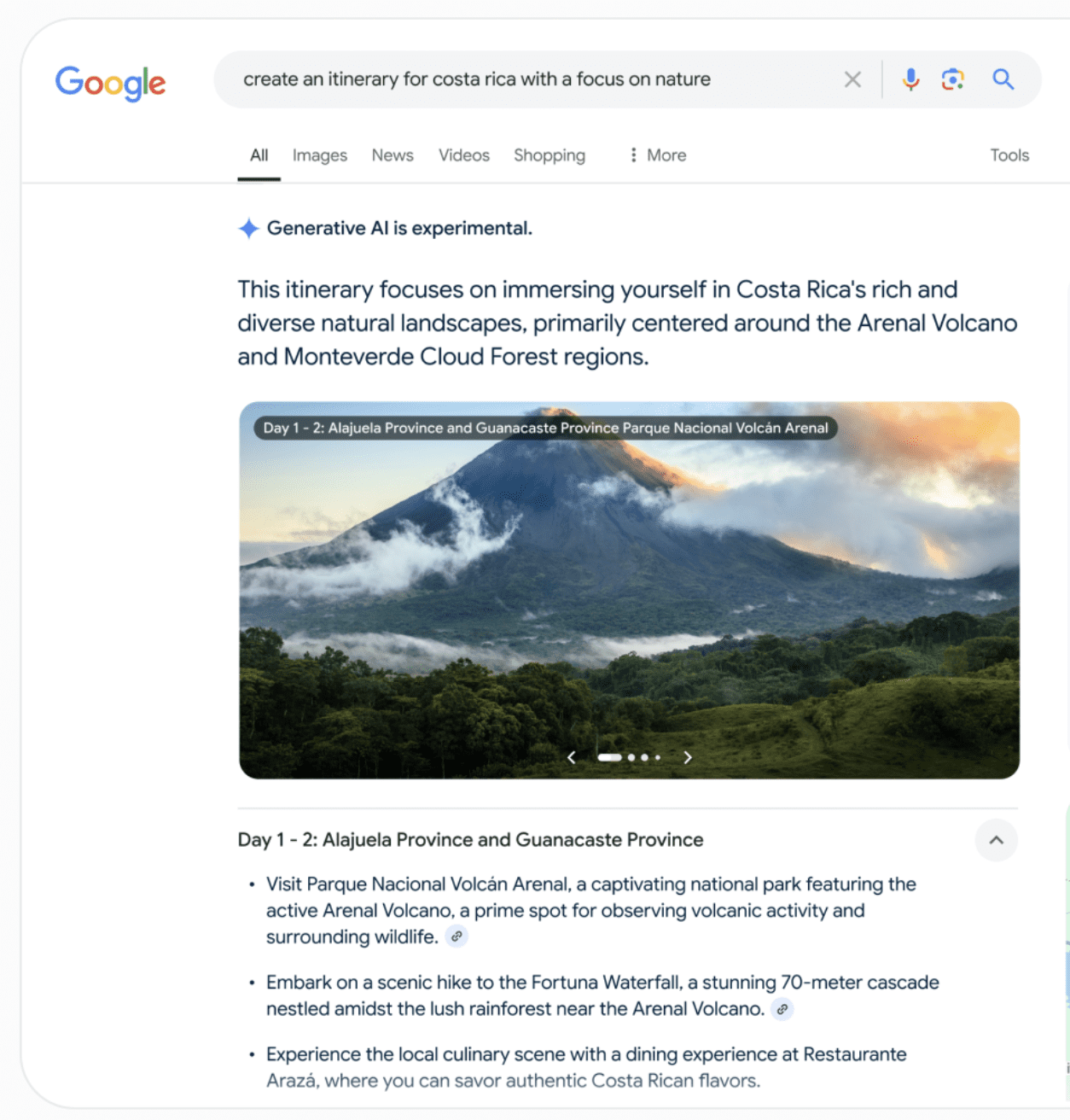
Expanded AI Overviews

Google has enhanced its AI Overviews in Search to generate travel recommendations for entire countries and regions, not just cities.

You can now request specialized itineraries by entering queries like “create an itinerary for Costa Rica with a focus on nature.”

The feature includes visual elements and the ability to export recommendations to various Google products.

Image Credit: Google

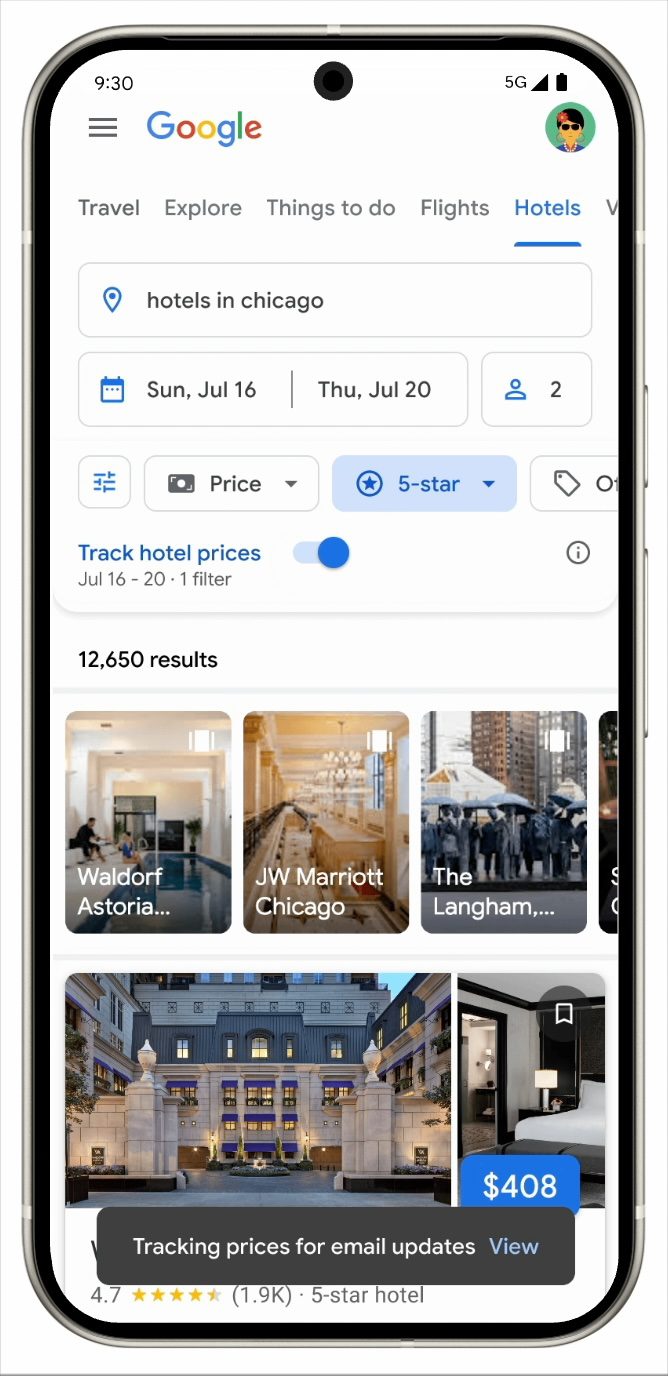
Price Monitoring for Hotels

Following its flight price tracking implementation, Google has extended similar functionality to accommodations.

When browsing google.com/hotels, you can now toggle price tracking to receive alerts when hotel rates decrease for selected dates and destinations.

The system factors in applied filters include amenity preferences and star ratings.

Image Credit: Google

Screenshot Recognition in Maps

A new Google Maps feature can help organize travel plans by automatically identifying places mentioned in screenshots.

Using Gemini AI capabilities, the system recognizes venues from saved images and allows users to add them to dedicated lists.

The feature is launching first on iOS in English, with Android rollout planned.

Gemini Travel Assistance

Google’s Gemini AI assistant now offers enhanced travel planning support, allowing users to create “Gems” – customized AI assistants for specific travel needs.

Now available at no cost, these specialized assistants can help with destination selection, local recommendations, and trip logistics.

Expanded Lens Capabilities

Google Lens continues evolving, offering enhanced AI-powered information delivery when pointing your camera at landmarks or objects.

The feature is expanding beyond English to include Hindi, Indonesian, Japanese, Korean, Portuguese, and Spanish, complementing its existing translation capabilities.

Image Credit: Google

Travel Search Trends

According to Google’s Flights and Search data analysis, travelers are increasingly drawn to coastal destinations for the Summer of 2025.

Caribbean islands, including Puerto Rico, Curacao, and St. Lucia, are seeing significant search growth, along with other beach destinations like Rio de Janeiro, Maui, and Nantucket.

The data also reveals continued momentum for outdoor adventure travel within the U.S.:

  • Cities with proximity to nature experiences (Billings, Montana; Juneau, Alaska; and Bangor, Maine) are experiencing higher search volume
  • “Cabins” has emerged as the top accommodation search for romantic getaways
  • Family travelers are increasingly searching for “dude ranch” vacations
  • Weekend getaway searches concentrate on natural destinations, including upstate New York, Joshua Tree National Park, and Sedona.

An unexpected trend in luggage preferences was also noted, with “checked bags” queries now exceeding historically dominant “carry on” searches.

Supporting this shift, space-saving solutions like vacuum bags and compression packing cubes have become top trending travel accessory searches.

Implications for SEO and Travel Content

These updates signal Google’s continued investment in controlling the travel research journey within its own ecosystem.

The expansion of AI-generated itineraries and information potentially reduces the need for users to visit traditional travel content sites during the planning phase.

Travel brands and publishers may need to adapt their SEO and content strategies to account for these changes, focusing more on unique experiences and in-depth content beyond what Google’s AI tools can generate.

The trend data also provides valuable insights for travel-related keyword targeting and content development as summer vacation planning begins for many consumers.

seo enhancements
Stand out in Google search results with product variant schema

Bring your Shopify products to life in Google searches. Highlight product variants that shoppers care about—color, size, pattern, material and audience demography—and watch your clicks and sales soar.

Why you and your customers will love it

  • Attract more shoppers
    • Make it easier for Google to show exactly what customers are searching for.
  • Stand apart
    • Richer product details and search snippets help you outshine competitors.
  • Confidence and clarity
    • Easily check your structured data in the Schema tab—no more confusion.
  • No extra cost
    • Available immediately for all Yoast SEO for Shopify users.

Here’s how to try it:

To access the Yoast SEO for Shopify product variant schema, you just need to:

  1. Open your Yoast SEO app and select a product.
  2. Click on the Schema tab in your editor.
  3. Confirm your variants and enhance your listings.

About Yoast for Shopify

Yoast SEO for Shopify makes SEO for your online store easy for everyone. It gives you the tools and guidance to do SEO yourself. Let us worry about your technical SEO so that you can focus on other aspects of your business. With multiple integrations with Semrush, Judge.me, Ali Reviews, Loox, Opinew, Weglot and Langify to help you get more out of the online store.


Learn more about Yoast SEO for Shopify

Top SEO Shares How To Win In The Era Of Google AI via @sejournal, @martinibuster

Jono Alderson, former head of SEO at Yoast and now at Meta, spoke on the Majestic Podcast about the state of SEO, offering insights on the decline of traditional content strategies and the rise of AI-driven search. He shared what SEOs should be doing now to succeed in 2025.

Decline Of Generic SEO Content

Generic keyword-focused SEO content, as well as every SEO tactic, has always been on a slow decline, arguably beginning with statistical analysis, machine learning and then into the age of AI-powered search. Citations from Google are now more precise and multimodal.

Alderson makes the following points:

  • Writing content for the sake of ranking is becoming obsolete because AI-driven search results provide those answer.
  • Many industries and topics like dentists and recipes sites have an oversaturation of nearly identical content that doesn’t add value.

According to Alderson:

“…every single dentist site I looked at had a tedious blog that was quite clearly outsourced to a local agency that had an article about Top 8 tips for cosmetic dentistry, etc.

Maybe you zoom out how many dentists are there in every city in the world, across how many countries, right? Every single one of those websites has the same mediocre article that somebody has done some keyword research. Spotted a gap they think they can write one that’s slightly better than their competitors. And yet in aggregate, we’ve created 10 million pages that none of which show the purpose, all of which are fundamentally the same, none of which are very good, none of which add new value to the corpse of the Internet.

All of that stops working because Google can just answer those kinds of queries in situ.”

Google Is Deprioritizing Redundant Content

Another good point he makes is that the days where redundant pages have a chance are going away. For example, Danny Sullivan explained at Search Central Live New York that many of the links shown in some of the AI Overviews aren’t related to the keyword phrase but are related to the topic, providing access to the next kind of information that a user would be interested in after they’d ingested the answer to their question. So, rather than show five or eight links to pages that essentially say the same thing Google is now showing links to a variety of topics. This is an important thing publishers and SEOs need to wrap their minds around, which you can read more about here: Google Search Central Live NYC: Insights On SEO For AI Overviews.

Alderson explained:

“I think we need to stop assuming that producing content is a kind of fundamental or even necessary part of modern SEO. I think we all need to take a look at what our content marketing strategies and playbooks look like and really ask the questions of what is the role of content and articles in a world of ChatGPT and AI results and where Google can synthesize answers without needing our inputs.

…And in fact, one of the things that Google is definitely looking for, and one of the things which will be safe to a degree from this AI revolution, is if you can publish, if you can move quickly, if you can produce stuff at a better depth than Google can just synthesize, if you can identify, discover, create new information and new value.

There is always space for that kind of content, but there’s definitely no value if what you’re doing is saying, ‘every month we will produce four articles focusing on a given keyword’ when all 10,000 of our competitors employ somebody who looks like us to produce the same article.”

How To Use AI For Content

Alderson discouraged the use of AI for producing content, saying that it tends to produce a “word soup” in which original ideas get lost in the noise. He’s right, we all know what AI-generated content looks like when we see it. But I think that what many people don’t notice is the extra garbage-y words and phrases AI uses that have lost their impact from overuse. Impactful writing is what supports engagement, and original ideas are what make content stand apart. These are the two things AI is absolutely rubbish at.

Alderson notes that Google may have anticipated the onslaught of AI-generated content by emphasizing EEAT (Experience, Expertise, Authoritativeness and Trustworthiness and argues that AI can be helpful.

He observed:

“And a lot of the changes we’re seeing in Google might well be anticipating that future. All of the EEAT stuff, all of the product review stuff, is designed to combat a world where there’s an infinite amount of recursive nonsense.

So definitely avoid the temptation to be using the tools just to produce. Use them as assistance and muses to bounce ideas around with and then do the heavy thinking yourself.”

The Shift from Content Production to Content Publishing

Jono encouraged content publishers to focus on creating original research, expert insights, to show things that have gone unnoticed. He suggested that succesful publishers are the ones who get out in the world and experience what they’re writing about through original research. He also encouraged focusing on authoritative voices rather than settling for generic content.

He explained:

“I think there’s definitely room to publish good content and publish. 2015-ish everyone started saying become a publisher and the whole industry misinterpreted that to mean write lots of articles. When actually you look at successful publishers, what they do is original research, by experts, they break news, they visit the places, they interact with things. A lot of what Google’s looking for in those kind of EEAT criteria, it describes the act of publishing. Yet very little of SEO actually publishes. They just produce And I think if you …close that gap there is definitely value.

And in fact, one of the things that Google is definitely looking for, and one of the things which will be safe to a degree from this AI revolution, is if you can publish, if
you can move quickly, if you can produce stuff at a better depth than Google can just synthesize.”

What does that mean in terms of a content strategy? One of the things that bothers me is the lack of originality in content. Things like concluding paragraphs with headings like “Why We Care” drive me crazy because to me it indicates a rote approach to content.

I was researching how to flavor shrimp for sautéing and every recipe site says to sprinkle seasonings on the shrimp prior to a quick sauté at a medium high heat, which burns the seasonings. Out of the thousands of recipe sites out there, not one can figure out that you can sauté the shrimp, add some garlic, then when it’s done add the seasoning just after turning off the flame? And if you ask AI how to do it the AI will tell you to burn your seasonings because that’s what everyone else says.

What that all means is that publishers and SEOs should focus on hands-on original research and unique insights instead of regurgitating what everyone else is saying. If you follow directions and it comes out poorly maybe the directions are wrong and that’s an opportunity to do something original.

SEO’s Role in Brand-Building & Audience Engagement

When asked what the role of content is in a world where AI is producing summaries, Alderson suggested that publishers and SEOs need to get ahead of the point where consumers are asking questions, go back to before they ask those questions.

He answered:

“Yeah, it’s really tricky because the kind of content that we’re producing there is going to change. It’s not not going to be the “8 Tips For X” in the hope the 2% of that audience convert. It’s not going to work anymore.

You’re going to need to go much higher up the funnel and much earlier into the research cycle. And the role of content will need to change to not try and convert people who are at the point of purchase or ready to make a decision, but to influence what happens next for the people who are at the very start of those journeys.

So what you can do is, for example, I know this is radical, but audience research, find out what kind of questions people in your sector had six months before they purchased or the kind of frustrations and challenges- what do they wish they’d known when they’d started to engage upon those processes?”

Turning that into a strategy, it may mean that SEOs and publishers may want to shift away from focusing solely on transactional keywords and toward developing content that builds brand trust early. As Jono recommends, conduct audience research to identify what potential customers are thinking about months before they are ready to buy and then create content that builds long-term familiarity.

The Changing Nature of SEO Metrics & Attribution

Alderson goes on to offer a critique about the overreliance on conversion-based metrics like last-click attribution. He suggests that the focus on proving success by showing that a user didn’t return to the search results page is outdated because SEO should be influencing earlier stages of the customer journey

“You look at the the kind of there’s increasing belief that attribution as a whole is a bit of a pseudoscience and that as the technology gets harder to track all the pieces together, it becomes increasingly impossible to produce an overarching picture of what are the influences of all these pieces.

You’ve got to go back to conventional marketing …You’ve got to look at actually, does this influence what people think and feel about our brand and our logo and our recall rather than going, ‘how many clicks did we get out of, how many impressions and how many sales?’ Because if you’re competing there, you’re probably too late.

You need to be influencing people much higher the funnel. So, yeah… All, everything we’ve ever learned in the nineteen fifties and sixties about marketing, that is how we measure what good SEO looks like. Yeah, it looks like maybe we need to step back from some of the more conventional measures.”

Turning that into a strategy means that maybe it’s a good exercise to rethink traditional success metrics and start looking at customer sentiment rather than just search rankings.

Radical Ideas For A Turning Point In History

Jono Alderson prefaced his recommendation for doing audience research with the phrase, “I know this is radical…” and what he proposes is indeed radical but not in the sense that he’s proposing something extreme. His suggestions are radical in the sense that he’s pointing out that what used to be common sense in SEO (like keyword research, volume-driven content production, last-click attribution) is increasingly losing relevance to how people seek out information today. The takeaway is that adapting means rethinking SEO to the point that it goes back to its roots in marketing.

Watch Jono Alderson speak on the Majestic SEO podcast:

Stop assuming that ‘producing content’ is a necessary component of modern SEO – Jono Alderson

Featured Image/Screenshot of Majestic Podcast

Navigating Time Zone Differences: Scheduling Ads For Maximum Impact via @sejournal, @brookeosmundson

Ad scheduling is a fundamental setting in Google Ads and Microsoft Ads, but when managing campaigns across multiple time zones, it becomes more complex.

Standard scheduling tactics may not cut it if you’re advertising internationally or running campaigns across regions with different peak engagement times.

Poorly timed ads can lead to wasted budget, lower conversion rates, and missed opportunities.

This article goes beyond the basics to cover next-level strategies for scheduling ads effectively across different time zones.

We’ll explore techniques such as localized scheduling, data-driven adjustments, and automation to maximize campaign performance.

Understanding Time Zone Challenges In PPC

When advertising across multiple regions, time zone discrepancies can create challenges that impact ad delivery, engagement, and conversions.

A common pitfall is assuming that a single campaign schedule will work universally. In reality, what works in one location might be completely ineffective in another.

For example, if your Google Ads account is set to Eastern Time but your target audience is primarily on the West Coast, your ads might be running during off-hours, leading to suboptimal performance.

International campaigns require even more diligence to consider local business hours and consumer behavior patterns.

Another factor is peak engagement hours. While lunchtime or evening hours may be prime time in one country, those same hours could be completely irrelevant in another.

Understanding these nuances is essential for optimizing your ad scheduling strategy.

Advanced Strategies For Scheduling Ads Across Time Zones

Successfully managing ad scheduling across time zones requires a thoughtful approach that goes beyond the basics.

While many advertisers set simple schedules and hope for the best, the real wins come from leveraging automation, data-driven insights, and strategic segmentation.

Whether you’re running campaigns domestically across U.S. time zones or managing international PPC efforts, applying advanced techniques can help ensure your ads are served at the right time for the right audience.

Segmenting Campaigns By Time Zone For Better Control

If you’re running campaigns across multiple time zones, one of the best ways to stay in control is by creating separate campaigns for different regions.

This lets you adjust ad schedules, budgets, and bidding strategies based on local peak performance times rather than forcing a single schedule to work for every location.

For example, an ecommerce brand serving customers in the U.S. and Europe might run separate campaigns for each region.

The U.S. campaign can focus on morning and evening hours when engagement peaks, while the European campaign targets prime shopping hours in local time zones.

While this approach adds complexity, the benefits far outweigh the extra management effort. Automating adjustments with rules and scripts can help streamline this process, ensuring each campaign is optimized without constant manual oversight.

Leveraging Automated Bidding Over Fixed Schedules

Manual ad scheduling has its place, but automated bid strategies like Target ROAS or Maximize Conversions allow you to optimize bids dynamically rather than setting fixed hours.

These AI-driven approaches adjust bids in real time, ensuring ads appear when conversion probability is highest, regardless of time zone differences.

For instance, if data shows that users in one region convert at a higher rate between 9 a.m. and 11 a.m. but another region performs better in the evening, automated bidding will allocate more budget when it matters most.

Instead of manually adjusting bids every few weeks, let machine learning do the heavy lifting.

Optimizing Scheduling Based On Market-Specific Peak Hours

Different markets have different user behaviors, so it’s crucial to base your scheduling decisions on actual performance data rather than assumptions.

Google Ads’ ad schedule reports and Microsoft Ads’ time-of-day insights can help you identify when users in each region are most active.

For example, if analytics reveal that North American users are most engaged in the evening while European users peak in the morning, your campaigns should reflect that.

Instead of blanketing all markets with a generic ad schedule, tailor your approach based on real-time engagement trends.

Using Labels To Manage And Adjust Scheduling

One often overlooked yet powerful feature in Google and Microsoft Ads is the use of labels.

Labels let you group campaigns, ad groups, or keywords into easily manageable categories, making it simpler to track and adjust schedules.

For example:

  • Tagging campaigns by region allows for easy bulk adjustments when shifting schedules due to seasonal changes or promotional events.
  • Labeling time-sensitive ads ensures that you can quickly pause or resume campaigns as needed without sifting through dozens of settings.
  • Using automation scripts with labels enables automatic bid adjustments or scheduling changes based on real-time performance.

By applying labels effectively, you can streamline scheduling changes without manually editing each campaign, saving time and reducing errors.

Automating Scheduling Adjustments With Scripts

If you’re managing multiple time zones, Google Ads scripts can be a game-changer.

Rather than manually adjusting schedules, scripts can dynamically modify bids based on real-time performance data.

For example, a script could be set up to boost bids by 20% during high-converting hours and reduce them by 10% when conversions drop. This keeps campaigns optimized while freeing up time to focus on strategy rather than daily bid adjustments.

Scripts also work well with labels. You can program scripts to modify bid strategies for campaigns tagged with specific labels, ensuring changes are applied only to relevant ads.

Adjusting For Daylight Saving Time Changes

Another scheduling headache is Daylight Saving Time (DST), which varies by country and can cause misalignment in ad schedules.

A campaign that ran perfectly last month might suddenly be off by an hour if a region switches to DST.

To avoid this, maintain a calendar of DST changes in key markets and adjust schedules proactively.

Another option is using automated rules or machine learning-based bid adjustments to handle these shifts without manual intervention.

Budget Allocation Based On Regional Performance Trends

Rather than splitting your budget evenly across all time zones, consider allocating more spend to the highest-performing regions based on historical data.

By analyzing performance reports, you can determine which locations deliver the best ROI and adjust budgets accordingly.

For instance, if your data shows that conversions peak in the late evening for Pacific time zone users but decline in the early morning for Eastern time users, shift more budget toward the stronger-performing time periods.

This approach ensures ad spend is being used effectively rather than wasted on time slots that don’t generate conversions.

Mastering Ad Scheduling For Global Success

Effectively navigating time zone differences in Google and Microsoft Ads isn’t just about setting a schedule and forgetting about it.

A winning strategy requires a mix of localized segmentation, automation, and continuous data-driven adjustments.

Instead of seeing time zone variations as a challenge, think of them as an opportunity to refine and optimize your strategy.

By leveraging campaign segmentation, smart bidding, labels, and scripts, you’ll gain greater control over when and where your ads appear – without unnecessary budget waste.

At the end of the day, great PPC management isn’t about simply keeping the lights on. It’s about making smart, strategic moves that maximize impact.

Test, tweak, and refine your approach, and you’ll see the results in both efficiency and performance.

More Resources:


Featured Image: tovovan/Shutterstock