How To Write Better Ad Copy When Google Ads Uses AI-Assisted Features via @sejournal, @LisaRocksSEM

Almost every major ad platform now offers some form of AI-generated copy.

While these tools can speed up the process of launching campaigns, they often create headlines and descriptions that lack the creativity or relevance needed to get results.

In this article, we will focus on how to get the most from Google Ads AI-assisted features without letting automation take over your messaging.

You’ll learn how the system generates copy, why common AI-suggested assets miss the mark, and what you can do to guide the platform toward better results.

I will walk you through how to strategically use the AI-powered automatically created assets in Google Ads while ensuring your manual assets (the copy you enter yourself) are central to your message.

AI features can be valuable, but only when your inputs are structured and strategic. Without that, the result is often generic ads that underperform or confuse your audience.

Starting Out

Google’s automation provides suggestions and can also generate ad copy for you.

When Automatically Created Assets (ACA) are enabled, Google uses your landing page, existing ads, ad group keywords and other available business information to generate new headlines and descriptions for Responsive Search Ads and Performance Max campaigns.

These AI-generated assets are designed to work alongside your manual inputs to improve relevance and performance.

While this sounds like sci-fi magic, it raises a bigger question: How do you make sure your ads still reflect your strategy?

Before you even get started with ad copy, there’s another sign that underscores how imperfect automated ad creation can be: the opt-in disclaimer for automatically created assets.

When you enable this setting in Google Ads, Google asks you to confirm that your landing page is accurate and not misleading.

You accept legal responsibility for anything the AI produces based on your content.

The fact that this disclaimer exists highlights a critical truth: Google’s automation is helpful, but not foolproof. This reinforces why your ad copy still matters.
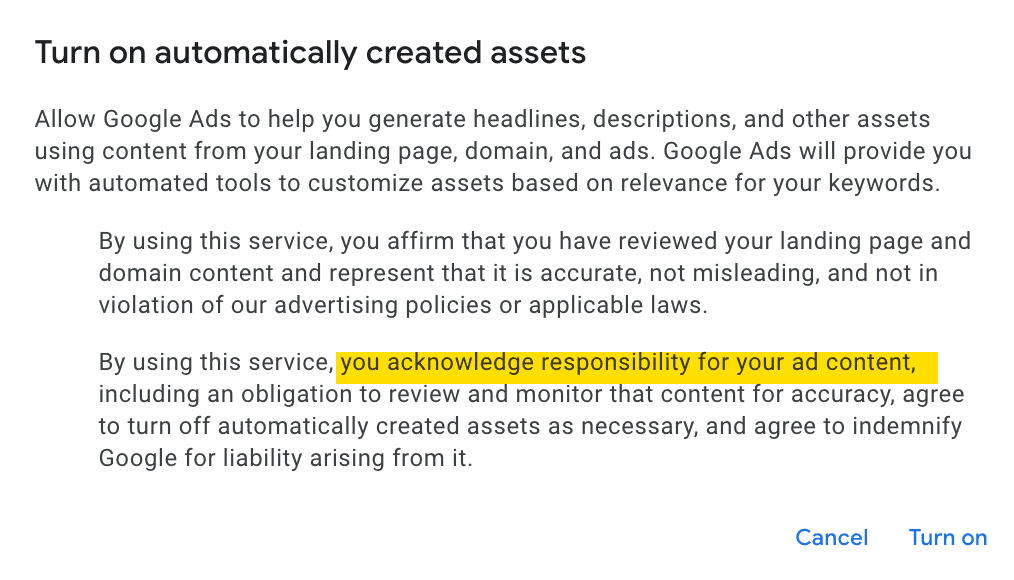
opt-in disclaimer for automatically created assets in Google AdsScreenshot from Google Ads, April 2025

View Ideas And Ad Strength Indicator

As you build your Responsive Search Ad (RSA), Google Ads gives real-time feedback using the “Ad Strength” indicator.

RSAs are designed to allow Google’s machine learning to automatically test various combinations of headlines and descriptions to determine the most effective combinations.

The Ad Strength indicator directly encourages a diverse pool of these assets for testing. This feature provides suggestions like:

  • Add more headlines.
  • Include popular keywords in your headlines.
  • Make your headlines more unique.
  • Make your descriptions more unique.
Responsive Search Ad (RSA) in Google Ads showing Ad Strength indicator and view ideasScreenshot from Google Ads, April 2025

These prompts are designed to help test different combinations, but they do not always help write a better ad.

In fact, when you click into “view ideas,” there are several suggestions and topics that are not customized and very inaccurate, such as “buy online” or “huge inventory” for non-ecommerce advertisers.

Ad Strength prompts are the very first feedback advertisers see when creating this type of ad. Because they appear so early in the process, these suggestions can influence how advertisers write headlines and descriptions.

It is easy to fall into the trap of writing for the score. That’s why it’s important to remember you are writing for performance, not for a scorecard. A great ad does not always get an “Excellent” score.

Use Ad Strength as a guide, but make sure your copy decisions are based on the campaign’s goal.

Enter A Strong Final URL, A.k.a. Landing Page

Your final URL is the ad’s landing page, and it influences how Google scans your site to generate AI copy suggestions.

The AI suggestions are directly influenced by the content on your landing page. Keeping your page clear, relevant, and updated is key.

If your landing page is too general, vague, or lacking clear headlines, Google may pull weak suggestions into your ad setup.

Google has built several AI-powered features around landing page content to streamline ad creation.

Automatically Created Assets (ACA) are available in both Search and Performance Max campaigns, and they pull copy directly from your site to generate new headlines and descriptions.

In Performance Max, the Asset Generation tool goes a step further.

Once you enter a URL, Google’s AI builds out relevant text and even image assets.

The new Conversational Experience lets advertisers provide a URL and have the AI suggest full campaign elements, including keywords, headlines, and ad descriptions.

These tools all rely heavily on landing page content, which is why it’s crucial to control what Google sees and how it reflects your offer.

Review And Refine Prefilled Headlines

Google often preloads suggested headlines based on your landing page, ad group keywords, and other headlines. These suggestions can save time, but they are not strategic suggestions.

To build ads, you need a strong foundation. Each headline should serve a clear purpose to communicate value and stand out in a competitive search landscape. Here’s how I structure it:

  • Keywords: These headlines should align with the user’s search terms. They reinforce ad relevance and signal to the searcher that your ad matches their intent.
  • Benefit or Feature: These highlight what the user will gain. Benefits answer the “what’s in it for me?” question, while features describe core elements of your product or service. This type of headline is essential for differentiating your offer.
  • Product Name: This tells users exactly what you’re promoting. It’s especially helpful when you offer multiple solutions, SKUs, or services. Helps filter clicks to the most relevant traffic.
  • Call to Action (CTA): These guide the next step, like “Start Your Trial” or “Get a Free Demo.” Action-oriented copy gives users direction and adds urgency.
  • Brand Name: Including your brand name can provide clarity and drive trust even if it’s not served on branded search terms.

Your goal is to cover a range of message types without being repetitive. Each headline should serve a distinct role so searchers are enticed to click and Google can test a variety of combinations.

Avoid simply accepting all of Google’s suggestions or making small reworded variations of the same idea. Start with this framework, then refine.

More Ideas, More Problems

When writing headlines, you’ll see a “View Ideas” link next to Google’s suggestions. Clicking it opens the “More Ideas” panel that is positioned as a smart tool powered by AI.

In reviewing the interface across several client accounts, this was my direct experience.

The “Top Keywords” section may include terms related to your business, but they were often pulled from unrelated ad groups or even included competitor names, which could create trademark issues.

This creates confusion and risks serving ads with misleading or legally questionable content.

The “Other Ideas” and “Call to Action Phrases” sections typically feature a preprogrammed list of standard CTAs or promotional lines like “Book Now” or “Find Out More.”

In one recent example, the real client’s CTA was “Free Sample,” yet none of the suggestions matched that intent.

Not only were the options inaccurate, but they also lacked any customization for the business. These don’t appear to be AI-generated, but they feel like a generic list applied across all advertisers.
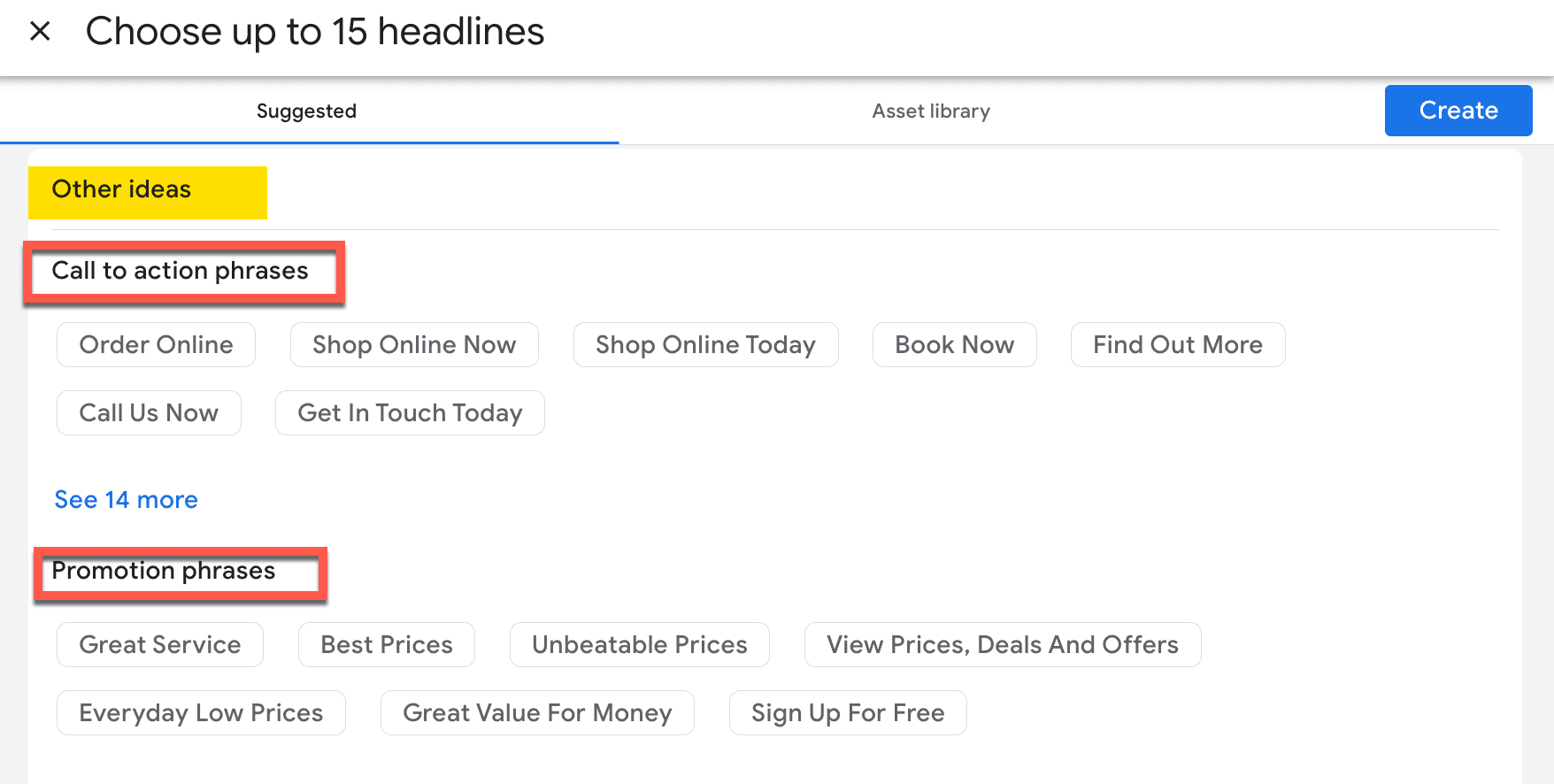
Screenshot of toher ideas for Google Ads copyScreenshot from Google Ads, April 2025

The danger here is that less experienced users may assume these suggestions are optimized or personalized because they are provided by Google. In reality, they can cause issues that mislead your audience.

Descriptions Should Add Value, Not Just Repeat Headlines

When viewing the “View Ideas” panel for descriptions, Google notes these suggestions are based on your final URL and other ads in your ad group.

In reviewing this across multiple client accounts, I’ve seen these suggestions really fall short.

Many are just reworded headlines or very short descriptions that don’t take advantage of the full 90-character limit. This misses an opportunity to add meaningful context or differentiation.

Descriptions should use a similar framework to headlines, but with more room for details. Each one should:

  • Support a headline: Add detail to the benefit, feature, or CTA introduced above.
  • Highlight a specific value prop: Clarify what the product or service actually delivers.
  • Add urgency or emotional appeal: Address the fear of missing out (FOMO), time savings, ease of use, or competitive edge.
  • Answer an unspoken question: Like “What’s in it for me?” or “How does this work?”

Your goal is to create descriptions that do the work of pushing a searcher one step closer to clicking by offering a richer understanding of the offer.

Bonus Feature: Conversational Experience In Google Ads

Google is currently testing a new feature called Conversational experience, available within the ad creation interface for some advertisers.

This AI-powered assistant is designed to provide contextual help based on where you are in your Google Ads workflow.

The chat tool can suggest ad copy ideas, recommend keywords, and answer support questions. It functions much like a chatbot with campaign context, offering real-time support during ad creation.

While it sounds helpful, it’s important to note that the feature is still under development.

When I tested this tool in ad creation mode, the chat alerted me that my Ad Strength was “Poor” and offered to help improve it to “Excellent.”

After clicking the “Generate Suggestions” button, the AI provided headline and description ideas, but they were exactly the same as those found in the standard “View Ideas” panel.

This reinforces the importance of reviewing suggestions critically, even when they come from new tools within the platform.

Google clearly states that the AI may return inaccurate or outdated information, warning users to verify anything the chat suggests.

The feature also notes that your interactions may be used to improve the product, meaning your chat activity can contribute to training the model.
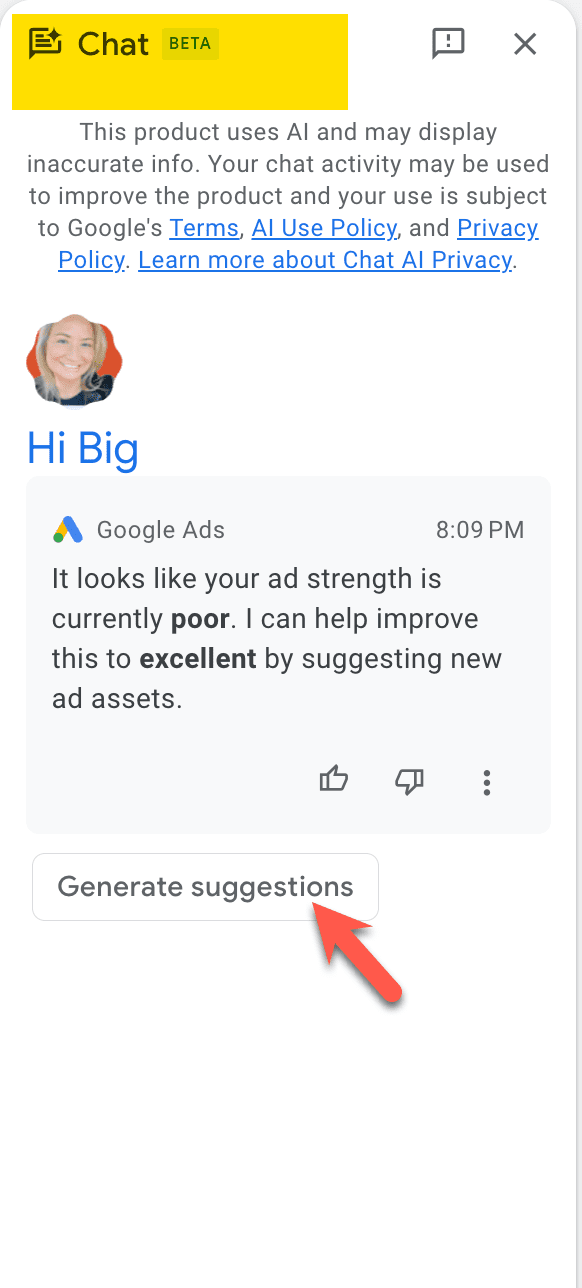
Screenshot chat beta help in google adsScreenshot from Google Ads, April 2025

Conclusion: How To Get The Best Out Of Automated AI Settings

If you are going to use Google’s automated AI settings, you need to guide them. Google’s AI is only as effective as the inputs and oversight you provide.

To get the best results:

  • Start with a strong landing page and a clear final URL.
  • Write your manual assets using a headline and description framework that includes keywords, product clarity, benefits, and brand identity.
  • Use the Ad Strength prompts and suggested ideas as checkpoints, not directives.
  • Review all automatically created assets for accuracy, relevance, and legal risk.

Automation can scale your efforts, but it’s your strategy that makes them convert. Think of AI as a content expander, not a content creator.

More Resources:


Featured Image: Stock-Asso/Shutterstock
Google Disputes News That Search Engine Use Is Falling via @sejournal, @martinibuster

Google took the unusual step of issuing a response to news reports that AI search engines and chatbots were causing a decline in traditional search engine use, directly contradicting testimony given by an Apple executive in the ongoing U.S. government antitrust lawsuit against Google.

Apple Testimony That Triggered Stock Sell-Off

Google’s stock price took a steep dive on the news that people were turning away from traditional search engines, dropping by 7.51% on Wednesday. What triggered the stock sell-off was testimony by Eddy Cue, Apple’s senior vice president of services, who testified that search engine use by users of Apple’s Safari browser declined for the first time last month, expressing his opinion that a technological shift is underway that is undercutting the use of traditional search engines.

Early AI Adopters Turning Away From Google?

There is a view in Silicon Valley that Google Search is legacy technology. A recent episode of the Y Combinator show featured the host sharing that their Google search traffic has dropped by 15% and that he attributes that to AI use in both Google and chatbots. He explained that if you want to see the future you look to the early adopters, commenting that everyone he knows in Silicon Valley uses ChatGPT to get answers and that Google Search is defacto legacy technology.

The host described how 25 years ago the early adopters were using Google but that now, Google Search feels weird to him.

He said:

“People are now switching their behavior to where your default action if you’re looking for information is, you know ChatGPT or perplexity, or one of these things, and even just, you know, observing my own behavior. I’ll use Google mostly for kind of navigational. Like, if I’m just looking for a specific website and I know it’s going to give the same thing, but it’s starting to have that weird kind of, like legacy website, like I’m using eBay or something.”

Google’s Statement

Google’s statement was short and to the point, with no accompanying images to make it look like a blog post. Google’s statement could even be seen as terse.

Here’s what Google published:

“Here’s our statement on this morning’s press reports about Search traffic.

We continue to see overall query growth in Search. That includes an increase in total queries coming from Apple’s devices and platforms. More generally, as we enhance Search with new features, people are seeing that Google Search is more useful for more of their queries — and they’re accessing it for new things and in new ways, whether from browsers or the Google app, using their voice or Google Lens. We’re excited to continue this innovation and look forward to sharing more at Google I/O.”

AI Revolution: What Nobody Else Is Seeing

Here’s the video of the Y Combinator show that offers a peek at how people in Silicon Valley relate to Google Search. The part I quoted is at about the 24 minute mark.

Featured Image by Shutterstock/Framalicious

This patient’s Neuralink brain implant gets a boost from generative AI

Last November, Bradford G. Smith got a brain implant from Elon Musk’s company Neuralink. The device, a set of thin wires attached to a computer about the thickness of a few quarters that sits in his skull, lets him use his thoughts to move a computer pointer on a screen. 

And by last week he was ready to reveal it in a post on X.

“I am the 3rd person in the world to receive the @Neuralink brain implant. 1st with ALS. 1st Nonverbal. I am typing this with my brain. It is my primary communication,” he wrote. “Ask me anything! I will answer at least all verified users!”

Smith’s case is drawing interest because he’s not only communicating via a brain implant but also getting help from Grok, Musk’s AI chatbot, which is suggesting how Smith can add to conversations and drafted some of the replies he posted to X. 

The generative AI is speeding up the rate at which he can communicate, but it also raises questions about who is really talking—him or Musk’s software. 

“There is a trade-off between speed and accuracy. The promise of brain-computer interface is that if you can combine it with AI, it can be much faster,” says Eran Klein, a neurologist at the University of Washington who studies the ethics of brain implants. 

Smith is a Mormon with three kids who learned he had ALS after a shoulder injury he sustained in a church dodgeball game wouldn’t heal. As the disease progressed, he lost the ability to move anything except his eyes, and he was no longer able to speak. When his lungs stopped pumping, he made the decision to stay alive with a breathing tube.

Starting in 2024, he began trying to get accepted into Neuralink’s implant study via “a campaign of shameless self-promotion,” he told his local paper in Arizona: “I really wanted this.”

The day before his surgery, Musk himself appeared on a mobile phone screen to wish Smith well. “I hope this is a game changer for you and your family,” Musk said, according to a video of the call.

“I am so excited to get this in my head,” Smith replied, typing out an answer using a device that tracks his eye movement. This was the technology he’d previously used to communicate, albeit slowly.

Smith was about to get brain surgery, but Musk’s virtual appearance foretold a greater transformation. Smith’s brain was about to be inducted into a much larger technology and media ecosystem—one of whose goals, the billionaire has said, is to achieve a “symbiosis” of humans and AI.

Consider what unfolded on April 27, the day Smith  announced on X that he’d received the brain implant and wanted to take questions. One of the first came from “Adrian Dittmann,” an account often suspected of being Musk’s alter ego.

Dittmann: “Congrats! Can you describe how it feels to type and interact with technology overall using the Neuralink?”

Smith: “Hey Adrian, it’s Brad—typing this straight from my brain! It feels wild, like I’m a cyborg from a sci-fi movie, moving a cursor just by thinking about it. At first, it was a struggle—my cursor acted like a drunk mouse, barely hitting targets, but after weeks of training with imagined hand and jaw movements, it clicked, almost like riding a bike.”

Another user, noting the smooth wording and punctuation (a long dash is a special character, used frequently by AIs but not as often by human posters), asked whether the reply had been written by AI. 

Smith didn’t answer on X. But in a message to MIT Technology Review, he confirmed he’d used Grok to draft answers after he gave the chatbot notes he’d been taking on his progress. “I asked Grok to use that text to give full answers to the questions,” Smith emailed us. “I am responsible for the content, but I used AI to draft.”

The exchange on X in many ways seems like an almost surreal example of cross-marketing. After all, Smith was posting from a Musk implant, with the help of a Musk AI, on a Musk media platform and in reply to a famous Musk fanboy, if not actually the “alt” of the richest person in the world. So it’s fair to ask: Where does Smith end and Musk’s ecosystem begin? 

That’s a question drawing attention from neuro-ethicists, who say Smith’s case highlights key issues about the prospect that brain implants and AI will one day merge.

What’s amazing, of course, is that Smith can steer a pointer with his brain well enough to text with his wife at home and answer our emails. Since he’d only been semi-famous for a few days, he told us, he didn’t want to opine too much on philosophical questions about the authenticity of his AI-assisted posts. “I don’t want to wade in over my head,” he said. “I leave it for experts to argue about that!”

The eye tracker Smith previously used to type required low light and worked only indoors. “I was basically Batman stuck in a dark room,” he explained in a video he posted to X. The implant lets him type in brighter spaces—even outdoors—and quite a bit faster.

The thin wires implanted in his brain listen to neurons. Because their signals are faint, they need to be amplified, filtered, and sampled to extract the most important features—which are sent from his brain to a MacBook via radio and then processed further to let him move the computer pointer.

With control over this pointer, Smith types using an app. But various AI technologies are helping him express himself more naturally and quickly. One is a service from a startup called ElevenLabs, which created a copy of his voice from some recordings he’d made when he was healthy. The “voice clone” can read his written words aloud in a way that sounds like him. (The service is already used by other ALS patients who don’t have implants.) 

Researchers have been studying how ALS patients feel about the idea of aids like language assistants. In 2022, Klein interviewed 51 people with ALS and found a range of different opinions. 

Some people are exacting, like a librarian who felt everything she communicated had to be her words. Others are easygoing—an entertainer felt it would be more important to keep up with a fast-moving conversation. 

In the video Smith posted online, he said Neuralink engineers had started using language models including ChatGPT and Grok to serve up a selection of relevant replies to questions, as well as options for things he could say in conversations going on around him. One example that he outlined: “My friend asked me for ideas for his girlfriend who loves horses. I chose the option that told him in my voice to get her a bouquet of carrots. What a creative and funny idea.” 

These aren’t really his thoughts, but they will do—since brain-clicking once in a menu of choices is much faster than typing out a complete answer, which can take minutes. 

Smith told us he wants to take things a step further. He says he has an idea for a more “personal” large language model that “trains on my past writing and answers with my opinions and style.”  He told MIT Technology Review that he’s looking for someone willing to create it for him: “If you know of anyone who wants to help me, let me know.”

The Download: Neuralink’s AI boost, and Trump’s tariffs

This is today’s edition of The Download, our weekday newsletter that provides a daily dose of what’s going on in the world of technology.

This patient’s Neuralink brain implant gets a boost from generative AI

Last November, Bradford G. Smith got a brain implant from Elon Musk’s company Neuralink. The device, a set of thin wires attached to a miniscule computer that sits in his skull, lets him use his thoughts to move a computer pointer on a screen. And by last week he was ready to reveal it in a post on X.

Smith’s case is drawing interest because he’s not only communicating via a brain implant but also getting help from Grok, Musk’s AI chatbot. The generative AI is speeding up the rate at which he can communicate, but it also raises questions about who is really talking—him or Musk’s software. Read the full story.

—Antonio Regalado

MIT Technology Review Narrated: How Trump’s tariffs could drive up the cost of batteries, EVs, and more

The Trump administration’s hostile trade plans threaten to slow the shift to cleaner industries, boost inflation, and stall the economy.

This is our latest story to be turned into a MIT Technology Review Narrated podcast, which we’re publishing each week on Spotify and Apple Podcasts. Just navigate to MIT Technology Review Narrated on either platform, and follow us to get all our new content as it’s released.

The must-reads

I’ve combed the internet to find you today’s most fun/important/scary/fascinating stories about technology.

1 NSO Group has been ordered to pay Meta $167 million
After the Israeli firm’s spyware was used to hack journalists, activists, and politicians. (NYT $)
+ The firm has been implicated in abusive surveillance before. (Reuters)

2 OpenAI plans to reduce the fraction of its revenue Microsoft receives
It told investors it plans to slash the shared revenue from 20% to 10%. (The Information $)
+ Its for-profit U-turn is not yet a done deal. (Bloomberg $)+ We still don’t know a lot about OpenAI’s structure. (Economist $)

3 The Trump administration is axing the Energy Star program
The project certifies the energy efficiency of home appliances in the US. (WP $)

4 The US Justice Department wants Google to sell its ad businesses
But Google claims it’s not technically feasible. (WSJ $)
+ The judge says he’ll rule on the remedies by August. (The Information $)

5 Grok AI is undressing women on X
That’s what happens when you create AI models without proper guardrails. (404 Media)
+ Text-to-image AI models can be tricked into generating nude images. (MIT Technology Review)

6 Private investors are prepared to plow billions into Europe’s defense industry
They’re stepping up to fill gaps that governments can’t fund. (FT $)
+ The US is likely to strike a weapons deal in Riyadh next week. (Semafor)
+ Phase two of military AI has arrived. (MIT Technology Review)

7 Can anyone stop Starlink?
The speed of its total dominance of the satellite sector is unprecedented. (The Atlantic $)
+ The world’s next big environmental problem could come from space. (MIT Technology Review)

8 Amazon’s new robot has a sense of touch
To help it grab items in the e-retail giant’s warehouses. (The Guardian)
+ The Vulcan robot could end up shouldering more manufacturing work in the future. (Wired $)
+ Will we ever trust robots? (MIT Technology Review)

9 Argentina is investing big in nuclear-powered AI data centers
In an effort to attract big tech firms from overseas. (Rest of World)
+ Meanwhile, the Zaporizhzhia nuclear power plant in Ukraine is still not operational. (IEEE Spectrum)
+ China built hundreds of AI data centers to catch the AI boom. Now many stand unused. (MIT Technology Review)

10 RIP prompt engineering
The hottest job of 2023 is quickly fizzling out. (Fast Company $)

Quote of the day

“I think upper class households will be able to have something that makes your Roomba look like a total joke.”

—Reddit cofounder Alexis Ohanian believes that advanced robot domestic helpers are imminent, Insider reports.

One more thing

Is this the end of animal testing?

Animal studies are notoriously bad at identifying human treatments. Around 95% of the drugs developed through animal research fail in people, but until recently there was no other option.

Now organs on chips, also known as microphysiological systems, may offer a truly viable alternative. They’re triumphs of bioengineering, intricate constructions furrowed with tiny channels that are lined with living human tissues that expand and contract with the flow of fluid and air, mimicking key organ functions like breathing, blood flow, and peristalsis, the muscular contractions of the digestive system.

It’s only early days, but if they work as hoped, organs on chips could solve one of the biggest problems in medicine today. Read the full story.

—Harriet Brown

We can still have nice things

A place for comfort, fun and distraction to brighten up your day. (Got any ideas? Drop me a line or skeet ’em at me.)

+ If you enjoyed this year’s Met Gala theme, check out this fascinating history of the Black dandy in art.
+ 2025 is shaping up to be a great year for literature.
+ The good news is that GTA VI finally has a release date—but it’s over a year away.
+ Chocolate pie for breakfast? I could be convinced.

The business of the future is adaptive

Manufacturing is in a state of flux. From supply chain disruptions to rising costs, tougher environmental regulations, and a changing consumer market, the sector faces a series of competing challenges.

But a new way of operating offers a way to tackle complexities head-on: adaptive production hardwires flexibility and resilience into the enterprise, drawing on powerful tools like artificial intelligence, digital twins, and robotics. Taking automation a step further, adaptive production allows manufacturers to respond in real time to demand fluctuations, adapt to supply chain disruptions, and autonomously optimize operations. It also facilitates an unprecedented level of personalization and customization for regional markets.

Time to adapt

The journey to adaptive production is not just about addressing today’s pressures, like rising costs and supply chain disruptions—it’s about positioning businesses for long-term success in a world of constant change. “In the coming years,” says Jana Kirchheim, director of manufacturing for Microsoft Germany, “I expect that new key technologies like copilots, small language models, high-performance computing, or the adaptive cloud approach will revolutionize the shop floor and accelerate industrial automation by enabling faster adjustments and re-programming for specific tasks.” These capabilities make adaptive production a transformative force, enhancing responsiveness and opening doors to systems with increasing autonomy—designed to complement human ingenuity rather than replace it.

These advances enable more than technical upgrades—they drive fundamental shifts in how manufacturers operate. John Hart, professor of mechanical engineering and director of MIT’s Center for Advanced Production Technologies, explains that automation is “going from a rigid high-volume, low-mix focus”—where factories make large quantities of very few products—“to more flexible high-volume, high-mix, and low-volume, high-mix scenarios”—where many product types can be made in custom quantities. These new capabilities demand a fundamental shift in how value is created and captured.

Download the full report.

This content was produced by Insights, the custom content arm of MIT Technology Review. It was not written by MIT Technology Review’s editorial staff.

This content was researched, designed, and written entirely by human writers, editors, analysts, and illustrators. This includes the writing of surveys and collection of data for surveys. AI tools that may have been used were limited to secondary production processes that passed thorough human review.

Roundtables: A New Look at AI’s Energy Use

Wednesday, May 21, 2025

Big Tech’s appetite for energy is growing rapidly as adoption of AI accelerates. But just how much energy does even a single AI query use? And what does it mean for the climate? Join editor in chief Mat Honan, senior climate reporter Casey Crownhart, and AI reporter James O’Donnell for a conversation exploring AI’s energy demands now and in the future.

Going live on May 21st at 18:30 GMT / 1:30 PM ET / 10:30 AM PT

Related Content:

Speakers

Mat Honan
Editor in Chief
Casey Crownhart
Climate Reporter
James O'Donnell, AI reporter
James O’Donnell
AI Reporter
5 Content Marketing Ideas for June 2025

Sunday, June 15, 2025, is Father’s Day in the U.S. and an important retail holiday. So why not focus your June content marketing on dads?

Content marketing is the act of creating, publishing, and promoting content to attract, engage, and retain customers. It’s foundational for marketing on search engines, generative AI platforms, social media sites, and lifecycle engagement.

Unfortunately, content marketing requires a seemingly insatiable demand for new or updated articles, posts, videos, and podcasts. Here are five content marketing ideas — all related to Father’s Day — that your company can use for June 2025.

Father’s Day Behind the Scenes

Image of a male at a desk design a t-shirt on a computer

Behind-the-scenes content humanizes a business and builds trust.

As your business prepares for Father’s Day, consider sharing that activity through articles, videos, and social media posts.

For example, produce an article about how your team selects products, and address items sourced for Father’s Day. Or, if your company sells print-on-demand products, make a video showing your design team at work. How do they generate design ideas? How do they create those designs? Any funny designs?

Behind-the-scenes content works well for several reasons. It can humanize a brand and thereby build trust and authenticity. It can differentiate products, emphasizing the work that goes into them. And it can address shopper concerns by explaining processes, choices, and even quality.

How-to Guides

Photo of a male teenager preparing food in a residential kitchen.

A teenager making dinner for dad is a fun Father’s Day gift.

Sometimes, the best gift for a dad on Father’s Day is providing a service or doing a task.

Think of it as chore coupons children sometimes give parents. The child draws a Father’s Day card and includes hand-made coupons “redeemable” for chores.

Taking the idea a step further, content marketers can develop how-to guides describing how to complete a task or offer a service as a Father’s Day present. The guide should be closely related to the products a store sells.

For example, an online store that sells cleaning supplies might publish a how-to guide for scrubbing a barbeque grill for dad. An automotive shop could offer a guide for vehicle waxing, and a kitchen supply shop could provide a guide for teens to make dinner for dad.

Take some inspiration from these articles.

Interactive Gift Ideas

Screenshot of AI-generated code on a computer.

AI-generated code has made interactive content creation much easier.

Use artificial intelligence to generate an interactive quiz — “What Kind of Dad Do I Have?” — that suggests gifts.

For example, an online shop specializing in wines from Italy could prompt the AI with something like this:

Generate a JavaScript gift recommendation tool for my online shop specializing in value Italian wines.

The tool should start with a form asking users several questions about their dad, including favorite foods, cocktails, etc. The tool should then recommend three wines that would make excellent Father’s Day gifts.

The JavaScript needs to be self-contained for embedding in a Shopify store.

You might even ask the AI to integrate a live product feed via Shopify’s Storefront API or to include product images.

The script will likely not be perfect initially, but a development team could have the interactive guide up in no time.

Father’s Day Checklist

Photo of a dad with two young children on a golf course.

A checklist for planning a Father’s Day golf outing could include product recommendations.

Checklists are actionable, easy to read, and problem-solving. They save time when performing a task.

Content marketers can use checklists in blog posts, email newsletters, or video scripts. Father’s Day checklists should be particular to the products a shop sells, and can focus on entertainment, utility, or driving sales.

For example, an online golf retailer might publish “The Golf Checklist for Dads Who Play to Win.”

Whether an article or video, the checklist could start with a section celebrating a golf-loving dad. Next, a series of check box items focuses on a Father’s Day golf outing, such as:

  • Upgraded gear,
  • Stylish apparel,
  • Outdoor essentials,
  • T-time reservation,
  • Gift card.

Each item might include a short description and a few recommended products.

Father’s Day Trivia

Photo of a dad, mom, and three young children

Put a smile on dad’s face with a little Father’s Day trivia.

Trivia, fun facts, or “did you know” content can be a top-of-the-funnel tactic to attract visitors or encourage social media engagement.

Here, content marketers produce content such as a listicle titled “10 Surprising Father’s Day Facts.” It might include when Father’s Day was officially recognized in the United States (1972).

Next, take each trivia item and produce a short video for YouTube, Instagram, or similar. In the video’s comments, link back to the original article.

Apple May Add AI Search Engines to Safari As Google Use Drops via @sejournal, @MattGSouthern

Apple is reportedly planning to redesign Safari to focus on AI search engines.

According to recent testimony in the Google antitrust case, this comes as the company prepares for possible changes to its profitable Google deal.

Apple Signals Shift In Search Strategy

Eddy Cue, Apple’s senior vice president of services, testified that Safari searches dropped for the first time last month.

He believes users are choosing AI tools over regular search engines. This change happens as courts decide what to do after Google lost its antitrust case in August.

Per a report from Bloomberg, Cue testified:

“You may not need an iPhone 10 years from now as crazy as it sounds. The only way you truly have true competition is when you have technology shifts. Technology shifts create these opportunities. AI is a new technology shift, and it’s creating new opportunities for new entrants.”

AI Search Providers May Replace Traditional Search

Cue believes AI search providers such as OpenAI, Perplexity AI, and Anthropic will eventually replace traditional search engines like Google.

“We will add them to the list — they probably won’t be the default,” Cue said, noting Apple has already talked with Perplexity.

Currently, Apple offers ChatGPT as an option in Siri and plans to add Google’s Gemini later this year.

Cue admitted that these AI search tools need to improve their search indexes. However, he said their other features are “so much better that people will switch.”

“There’s enough money now, enough large players, that I don’t see how it doesn’t happen,” he said about the shift from standard search to AI-powered options.

Context: Google’s Antitrust Battle Timeline

This testimony comes during a key moment in the case against Google:

  • August 2024: Judge Mehta ruled Google broke antitrust law through exclusive search deals
  • October 2024: DOJ proposed remedies targeting search distribution, data usage, search results, and advertising
  • December 2024: Google offered counter-proposals to loosen search deals
  • March 2025: DOJ filed revised proposals, including possibly forcing Google to sell Chrome

The $20 Billion Question

The core issue is Google’s deal with Apple, worth a reported $20 billion per year, that makes Google the default search engine on Safari.

While expecting changes to this deal, Cue admitted he has “lost sleep over the possibility of losing the revenue share from their agreement.”

We learned about this payment during the trial. In 2022, Google paid Apple $20 billion to be Safari’s default search engine.

Last year, they expanded their partnership to add Google Lens to the Visual Intelligence feature on new iPhones.

Proposed Remedies & Responses

The DOJ’s latest filing suggests several significant changes:

  • Making Google sell off Chrome
  • Limiting Google’s payments for default search placement
  • Stopping Google from favoring its products in search results
  • Making Google’s advertising practices more transparent

Google has criticized these proposals, calling them a “radical interventionist agenda” that would “break a range of Google products.”

Instead, Google suggests letting browser companies deal with multiple search engines and giving device makers more freedom about which search options are preloaded.

What This Means

If Apple shifts Safari toward AI, prepare for significant changes in search.

It’s not a stretch to say the outcome could reshape search competition and digital marketing for years.


Featured Image: Bendix M/Shutterstock

ChatGPT Leads AI Search Race While Google & Others Slip, Data Shows via @sejournal, @MattGSouthern

ChatGPT leads the AI search race with an 80.1% market share, according to fresh data from Similarweb.

Over the last six months, OpenAI’s tool has maintained a strong lead despite ups and downs.

Meanwhile, traditional search engines are struggling to grow as AI tools reshape how people find information online.

AI Search Market Share: Today’s Picture

The latest numbers show ChatGPT’s market share rebounding to 80.1%, up from 77.6% a month ago.

Here’s how the competition stacks up:

  • DeepSeek: 6.5% (down from 7.6% last month)
  • Google’s AI tools: 5.6% (up slightly from 5.5% last month)
  • Perplexity: 1.5% (down from 1.9% last month)
  • Grok: 2.6% (down from 3.2% last month)

These numbers are part of Similarweb’s bigger “AI Global” report (PDF link).

Traditional Search Engines Losing Ground

The most important finding may be that traditional search engines aren’t growing:

  • Google: -2% year-over-year
  • Bing: -18% year-over-year (a big drop from +18% in January)
  • Yahoo: -11% year-over-year
  • DuckDuckGo: -6% year-over-year
  • Baidu: -12% year-over-year

Traditional search shows a steady decline of -1% to -2% compared to last year. It’s important to note, however, that Google has seven times the user base of ChatGPT.

Which AI Categories Are Growing Fastest

While AI is changing search, some AI categories are growing faster than others:

  • DevOps & Code Completion: +103% (over 12 weeks)
  • General AI tools: +34%
  • Music Generation: +12%
  • Voice Generation: +8%

On the other hand, some AI areas are shrinking, including Writing and content Generation (-12 %), Customer Support (11%), and Legal AI (70%).

Beyond Search: Other Affected Industries

AI’s impact goes beyond just search engines. Other digital sectors facing big changes include:

  • EdTech: -28% year-over-year (with Chegg down 66% and CourseHero down 69%)
  • Website Builders: -13% year-over-year
  • Freelance Platforms: -19% year-over-year

Design platforms are still growing at +10% year over year, suggesting that AI might be helping rather than replacing these services.

What This Means

Traditional SEO still matters, but it isn’t enough. As traditional search traffic drops, you need to branch out.

Similarweb’s data shows consistent negative growth for traditional search engines alongside ChatGPT’s dominant market position, indicating a significant shift in information discovery patterns.

The takeaway for search marketers is to adapt to AI-driven search while keeping up with practices that work in traditional search. This balanced approach will be key to success in 2025 and beyond.


Featured Image: Fajri Mulia Hidayat/Shutterstock

How to optimize content for AI LLM comprehension using Yoast’s tools

As AI-driven search engines rewrite the rules of content visibility, one thing is clear: optimization isn’t dead — it’s evolving. Large language models (LLMs) like ChatGPT, Google’s Gemini, and Perplexity AI don’t just retrieve web pages; they synthesize answers. And your content? It only gets included if it’s clear, relevant, and easy to extract. The good news? If you’re already using the Yoast SEO plugin, you have some of the most critical tools for this new era baked right into your workflow.

Table of contents

Learn how to structure content for AI

In this post, I’ll walk through how LLMs evaluate and extract content — and how Yoast SEO’s content analysis features, particularly the Flesch Reading Ease score and green light checks, can help you structure your writing for AI retrieval, not just human readers.

And more importantly, I want to clarify a common misconception: Yoast SEO isn’t about “chasing green lights.” It’s about helping you become a better, clearer communicator. Green lights aren’t the end goal—they’re indicators that you’re aligning your content with the kinds of clarity and structure that serve both readers and AI systems. In a world where LLMs decide what gets surfaced and summarized, being a better writer is your best competitive advantage.

Even if AI search doesn’t dominate your vertical today, it will. The best time to prepare was years ago. The second-best time is right now. Consider this your SEO shade tree: start planting.

What AI search wants from your content

Forget rankings — AI search is about retrievability and clarity. LLMs ingest and parse content based on:

  • Literal surface-level term matching (yes, keywords still matter)
  • Structural formatting cues like headings, lists, and bullet points
  • Clarity of ideas — one idea per paragraph, one purpose per section
  • Prompt alignment — using the same terminology your audience would use

Even the smartest LLM will skip your content if it’s overly complex, meandering, or fails to mention the query terms directly. That means no more hiding your key points in paragraph five. No more cute, clever intros that never get to the point. The models are pulling excerpts, not reading for nuance.

This is where Yoast SEO shines. Its features, often seen as basic hygiene, are perfectly aligned with what makes content usable by AI.

The Flesch Reading Ease score is more important than ever

In a world of AI Overviews and synthesized summaries, readability is a superpower.

The Flesch Reading Ease score — included in the Yoast SEO content analysis — doesn’t just help human readers skim your content. It helps machines parse and interpret it.

LLMs prefer:

  • Shorter sentences
  • Simple phrasing
  • One idea per paragraph

These are the exact factors the Flesch score evaluates. So when Yoast flags your content as difficult to read, it’s not nitpicking — it’s showing you what might keep your article out of an AI Overview.

Pro tip: When possible, aim for a Flesch score above 60, especially for top-of-funnel or FAQ-style content you want to be quoted or summarized.

And let’s be clear: this doesn’t mean your content has to be simplistic or dumbed down. It just needs to be accessible. Plainspoken, not generic. Direct, not dull. Think of it as writing for a global audience — or a machine that doesn’t have time for interpretive poetry.

You can find the Flesch reading score in Yoast SEO Insights in your sidebar — this is the score for the post you are reading now

Don’t ignore those green lights (Even when you think you know better)

I’ll be honest: I’ve been one of the worst offenders when it comes to ignoring those green lights. I like long sentences. I enjoy prose that meanders a little if it means delivering a point with style. And I’ve spent enough of my career writing professionally that being told how to write by a plugin occasionally rubbed me the wrong way.

But here’s the thing I’ve come to accept: it’s not that the plugin is trying to replace your voice or artistry. It’s that it’s trying to ensure your work can be understood, parsed, and surfaced—especially by machines.

It is absolutely still possible to create highly visible content that doesn’t earn a green light for sentence structure or reading ease. I’ve done it. But those pieces need to be intentional. They need to be structured so that the core ideas—the “meat” of the argument—aren’t buried in the longest paragraph of the article or expressed only in dense, lyrical blocks of text.

If you want to break the rules, fine. But make sure you know where the lines are before you step over them. The art is still welcome—it just has to be thoughtfully placed.

Yoast’s content checks aren’t arbitrary — they’re aligned with how both humans and machines understand text. In fact, many of the green-light criteria align shockingly well with what LLMs are known to favor:

  • Subheadings every 300 words = easier segmentation and extraction
  • Introductory paragraph present = good for AI frontloading
  • Paragraph length = one idea per chunk, which is LLM-friendly
  • Sentence length limits = fewer chances for parsing failure

In other words: the green light checklist is not just “SEO best practice.” It’s an LLM comprehension checklist in disguise.

And while experienced writers might feel tempted to override these warnings with “but this sounds better to me,” it’s worth considering how much clearer your writing becomes when you follow them. Especially when writing for an audience that might include an algorithm.

an example of the Yoast SEO sidebar showing three overall green traffic lights for a post
Not every traffic light for individual checks has to be green — just make sure the overall lights are

Structuring for LLMs: A Yoast-assisted framework

If you want your content to get pulled into AI-generated answers, try this simple structure — and let Yoast SEO help enforce it:

  1. Start with a TL;DR or definition: Use short, declarative sentences. Bonus if you can bold the key phrase or structure it as a definition. LLMs love to latch onto clear, answer-style content.
  2. Use subheadings to divide your points: Make sure each section answers one specific question or explains one concept. Headings serve as cues for both readers and models.
  3. Use bulleted or numbered lists: Yoast SEO will warn you if a list is too long without proper formatting. LLMs love well-structured lists because they can be directly extracted.
  4. Echo the query language: Use the exact phrases people search for. This helps the AI match your content to user prompts. Literal matching still matters.
  5. End with a clear summary or CTA: AI often pulls from intros or conclusions. Don’t waste them. Reinforce your main point and point readers toward next steps.

Even if you’re writing complex thought leadership content, this structure ensures your brilliance is actually understood and surfaced.

You don’t need Schema if your structure is clear — but it helps

Structured data is still valuable, especially for establishing context and disambiguating entities. But Yoast SEO users should remember: if your page is poorly written or confusing, schema won’t save it.

LLMs cite content that is:

  • Logically segmented
  • Written in plain, direct language
  • Free of interruptions, overlays, or unrelated diversions

Yoast SEO helps you get there — not just with schema tools, but with live readability feedback during writing.

It’s also worth noting that while structured data might support AI understanding, it’s the structure of the writing that matters most for inclusion in AI responses. LLMs pull paragraphs and list items, not rich snippets. If you want to be quoted, you have to be quotable.

TL;DR: Use Yoast SEO to make your content AI-ready

In the age of AI search, optimization means:

  • Writing like a human, formatting like a machine
  • Saying things plainly
  • Echoing how people phrase questions
  • Structuring content so it can be lifted and used

Yoast SEO’s content analysis isn’t just a checklist — it’s an AI visibility strategy. That little green light might be your ticket to being the source LLMs choose to summarize.

Don’t fall into the trap of writing for the plugin. Use the plugin to write better for people and machines. That shift in mindset makes all the difference.

And as LLMs continue to power more and more of the search experience, from Google AI Overviews to tools like ChatGPT Browse, that visibility is worth more than position #1 ever was. Start now. You’ll be glad you did.