How To Justify And Make A Business Case For SEO Budgets via @sejournal, @TaylorDanRW

Effective budgeting is crucial not just for planning SEO, providing value to clients, and justifying the spend to achieve it.

It’s also critical for a business to understand SEO budget alongside other marketing budgets to ascertain which platforms are providing the best return on investment (ROI) or the best value in relation to the broader business goals and channel-specific objectives.

Typically, the SEO budget is determined by stakeholders in the business, who will also be responsible for signing off the spend for other marketing channels.

Many marketing channels, such as paid search, fall into the performance marketing category. The ROI and leads generated by those channels are much clearer on a balance sheet compared to the value-add and goals of SEO.

As you justify the SEO budget, it is essential that you distinguish it from the classic paid advertising channels, which many other channels were falling into. It is, in fact, part of a performance marketing strategy, but its objective is not a direct input-output.

You are not paying for clicks.

You are not paying for traffic.

In most cases, you’re paying for consultation expertise and elements (SEO activities) that compound to create a performant organic search presence and, now, a more prominent position and visibility within generative AI and large language models (LLMs).

Another key distinction is that SEO is, for the most part, a longer-term strategy.

Building organic visibility can take time, whereas performance marketing can deliver quicker results based on campaign settings.

This doesn’t mean that SEO cannot provide short-term wins or performance, but building a performance strategy takes time for the most part.

So, you can use many marketing frameworks to effectively fight for your SEO budgets as part of the broader marketing budget.

  • You can leverage the audience segmentation to identify high-value customer groups and then use historical data and forecasting.
  • You can demonstrate the potential ROI of target campaigns for those segments.
  • You can quantify Headroom for targeting specific keyword clusters.

So, what are the key steps in creating this fighting strategy for your SEO budget?

Segment Your Audience

Firstly, you want to divide your customer base into distinct groups based on demographics, behaviors, needs, and “unmet” needs. Factor in elements of their purchase histories to understand their characteristics.

Once you have your segments in place, you can understand what their journeys look like and how much prior information they have when performing searches or looking to engage with your product online.

This also includes what LLMs and other sources might shape their search journey before eventually narrowing down on a select few products and making that purchase consideration.

Identify High-Value Segments

Once you have your clear segments in your audience, the second phase is to start to identify those that offer four key things:

  • Who is showing Fit.
  • Who is showing Value.
  • Who is showing Intent.
  • Who is showing Headroom.

You should use data to analyze and pinpoint your customer segments with high prospective lifetime value, good purchase frequency, or good profile margin (or a combination of all three).

If you are a luxury clothing brand, people may make less frequent purchases, but those purchases will be very high value.

Therefore, you want your SEO segments to focus on brand retention and loyalty rather than constantly turning to attract new customers who may have a lesser loyalty threshold to their existing chosen brand.

By contrast, would be a brand in the mass cosmetic and skincare industry, in which recent studies have shown that 60% of potential customers are likely to switch brands based on cost.

Here, you want to ensure you are creating positive brand experiences and want to maintain that mental availability.

If this is the case, you want to demonstrate these objectives (and their benefits to the business) when going through your SEO budget.

And as part of your SEO strategy, show how SEO and your value propositions can lend themselves to the broader business objectives of longer-term retention and longer-term ROI from customer groups.

Map Customer Journeys

Once you’ve identified your high-value segments, those you believe will provide the best balance of your investment, you want to start better understanding and mapping that customer journey.

I’ve already touched on this a couple of times, but it’s really about understanding whether these users are going to Google first, as has been the traditional model for over a decade, or whether they are now going to generative AI tools first.

This raises new challenges as to how aware consumers are of your brand or how likely they are to be aware of your specific products, value propositions, and brand promises.

Customer education is evolving, which impacts how they compare your product to others.

Their stage in the journey influences how they engage with your brand and competitors, shaping their timeline to conversion.

The messaging they need will depend on their ability to forecast their experience with your product or service and whether it aligns with their current expectations and needs.

Communicate Business Alignment

When advocating for your budget, you must communicate clear, measurable goals.

Whether these are SMART goals or just arbitrary targets of growth over some time, they need to be there to provide decision-makers some ability to understand, at a very face-value level, what they are getting from the money being invested.

They can serve as a resource to match your business goals. In SEO terms, this could mean increased traffic, but more likely, increased traffic is only desired because traffic increments lead to increments in sales leads, course redemptions, or subscriptions.

Nobody ever really wants traffic just for the sake of having traffic.

KPIs

You can align your budget areas with the business’s key performance indicators (KPIs) and those specific to that SEO marketing channel.

A KPI is a metric that should reflect the overall marketing goals, and these can be anything from conversion rates to customer lifetime values, score rings, and customer acquisition costs.

Determine Budget “Effort” Allocation

A lot of resource allocation can sometimes follow the 70-20-10 rule.

In marketing, the 70-20-10 rule is typically an effort and resource allocation model.

It suggests that you spend 70% of your effort and allocations on proven strategies, 20% on new (but related) ideas, and 10% on high-risk experimental efforts.

Once variables and levers of influence have been identified, you move on to the exploitation phase and start exploiting them as “SEO tactics.”

You need to determine what the best allocation is for your requested budgets, even if you break it down into a fundamental level of a percentage going to research and development, another percentage assigned for tools, another percentage to external content production, and so on.

Breaking it up and providing top-level clarity can help understand that it’s an overall sort of parts and not just a direct spending of one pound/dollar getting a multiplier return on it.

Takeaways

Securing an adequate SEO budget requires more than just demonstrating its value.

You can’t just use projections and forecasts of potential organic traffic; you need to align your efforts with your business’s broader marketing strategy and objectives.

Unlike performance marketing and paid channels, which have a prominent input-output metric system, SEO is a long-term investment that does compound over time.

It can contribute to brand success not just organically, but also in the overall visibility retention and customer acquisition.

To justify SEO budgets, you want to focus on precise audience segmentation, identifying your high-value customer groups, mapping the customer journeys, and aligning those with SEO efforts.

By presenting SEO as a performance-driven strategy rather than just a sunk cost with an infinite timeline, you can effectively communicate its role in driving sustainable growth and value to the business, thus securing necessary investment now and in the future with long-term success.

 More Resources:


Featured Image: nampix/Shutterstock

The Future Of Content Distribution: Leveraging Multi-Channel Strategies For Maximum Reach via @sejournal, @rio_seo

Content is everywhere. Consumers are inundated with it throughout the day – catching up on social media happenings, scanning the news, consuming articles, or listening to podcasts.

Given the staggering breadth of content available across the digital landscape, content marketers’ jobs have become increasingly difficult.

Breaking through the noise is a hefty feat, one that requires substantial amplification to ensure your messages are being seen.

Since consumers quickly shift their attention and are targeted by high-quality content across various platforms, marketers must focus their efforts on distribution strategies.

Simply outlining, drafting, editing, and publishing content is no longer enough.

The opportunity for brands to emerge from the clutter as the top content consumption choice is there, given this disconnect.

Now is the time for content marketing leaders to seize the chance to expand their content’s presence across all the channels your customers frequent.

With only a few businesses taking advantage of expanding their reach, amplifying your brand’s presence through effective content dissemination will help you more effectively target and captivate your audience.

Meet your customers where they’re looking.

By the time you finish reading this article you’ll have a clear-cut framework for how to create a multi-channel content distribution strategy that actually works.

We’ll explore how consumer behavior has shifted over the past several years, the benefits of distributing content across diverse channels, and the next steps to take to elevate your current distribution strategy.

Let’s start by first examining why changes in consumer behavior dynamics necessitate a revised content strategy.

The Shift In Consumer Behavior Driving Multi-Channel Strategies

To say consumer behavior shifts frequently is more than evident for marketers.

As a marketer, you’re well attuned to how often consumer behavior changes and need to adapt to it.

Falling behind consumer behavior trends leads to lost revenue, lower retention, and being overlooked.

Technology is largely to blame for shifts in consumer behavior.

Every year, an abundance of new technology is born, most of which is designed to enhance our lives. In turn, so too has the proliferation of digital touchpoints.

People are no longer turning to only a business’ website for information. They’re scouting the brand’s social media channels, emails, podcasts, and more to gain the information they’re craving.

Consumers expect to be met with a consistent experience across every channel.

Consider you’ve invested ample time and resources in creating a steady stream of written content in the form of blogs, ebooks, and studies. You’ve worked hard to ensure your written content is helpful, clear, and matches user intent.

What if your podcast offered a completely divergent experience? Your audio quality is choppy, your podcast host doesn’t have experience in public speaking, and your podcast topics are disjointed.

This would lead to a negative customer experience and could cause consumers to disengage with your content. It’s imperative every piece of content you write and distribute maintains the same quality across channels.

Increased Use Of Multiple Platforms

Consumers aren’t just visiting your blog. They’re heading to your YouTube for in-depth product tutorials, digesting your monthly newsletter for company updates, and downloading an ebook for long-form content consumption – all in a single browsing session.

The stakes are higher than ever for brands to maintain an active presence across numerous platforms to stay top of mind.

For example, a gym might share weight loss success inspiration on its Instagram stories and offer personalized personal training via email communication.

People-First Personalization

Personalization is the current rage right now, and for good reason. Personalization isn’t a nice to have – it’s a must.

Consider that a whopping 71% of consumers expect companies to deliver personalized interactions, and 76% get frustrated when it doesn’t happen.

Technology like artificial intelligence can assist businesses in hyper-personalization, ensuring messages are sent to the right audience at the right time.

For example, AI and retargeting can showcase content that’s relevant to end users based on previous browsing behavior.

Consider a consumer who’s interested in snowboarding and has been shopping around for new ski pants.

If the consumer has signed up for a company newsletter to become aware of promotions or savings, the business could send a 15% off new customer promotion or a promotion for the specific ski pant they’ve been eyeing.

Mobile Continues To Dominate

Gone are the days of optimizing solely for desktops. Mobile has made a significant splash over the past decade and shows no signs of slowing down.

In January 2025, for example, mobile devices accounted for the largest share of ecommerce site visits at 76% compared to 23% from desktop.

For most consumers, mobile is their device of choice for consuming content, which is why businesses must maintain a mobile-friendly experience.

This includes ensuring your website is optimized for mobile users, vertical video content is created, and emails render correctly for mobile devices.

Benefits Of A Multi-Channel Content Distribution Strategy

Knowing consumers are navigating multiple channels, seeking personalization, and consuming content largely on mobile devices, it’s clear a one-size-fits-all solution will suffice any longer when it comes to content distribution.

A comprehensive, cross-channel strategy is the quickest way to succeed and ensure your brand is as visible as possible. Other benefits of a multi-channel content distribution strategy include:

Foster Trust

When customer experiences are consistently pleasant across every channel a customer can find you, they’re more likely to have faith in your business.

Building trust is one of the foundational steps to building long-lasting customer relationships.

Improve Visibility

Being found wherever customers look requires ample effort and SEO.

The first step toward increasing your reach is to ensure you have an accurate presence across multiple platforms, especially the platforms your target audience uses most frequently.

It’s crucial to understand your audience. What motivates them? What frustrates them? How can you solve their needs? And where do they spend their time online?

Diversify Content Formats

Written content remains a preferred consumption method, but customers are also interested in other formats.

Video content has been on a steady upward trajectory and is often surfaced as the top search result for certain queries.

Additionally, podcasting has been on the rise as well. Diversifying your content formats ensures you’re meeting the needs of all consumers, including those that prefer audio and visual content.

Mitigate Risk

The saying, “Don’t put your eggs in one basket,” holds true for content distribution.

If you’re relying on a single platform to drive revenue and traffic, you risk losing potential sales.

For example, an apparel company that targets a Gen Z demographic may risk missing potential customers if they don’t have an established TikTok presence.

Conversely, a business that sells medical supplies may also miss the mark on reaching its target demographic if it maintains a social media presence on TikTok but doesn’t post content on YouTube or Facebook.

More Opportunity

Multi-channel marketing strategies are gaining traction. In 2024, 30% of brands consider their multi-channel approach very successful – up from just 17% in 2023. Meanwhile, 65% rate their strategy as somewhat successful, showing steady progress in reaching customers across multiple touchpoints.

There are more opportunities than ever to guide a consumer down the sales funnel.

Additionally, with the rise of social commerce, it’s now easier than ever for consumers to purchase without even having to visit a company’s website.

A simple one-click is all it takes to make a purchase. Businesses should tap into all the emerging revenue opportunities to ensure they never miss out on a sale and to further streamline their sales process.

A Framework For Multi-Channel Distribution Strategy

Developing an effective multi-channel strategy requires careful planning and thoughtful execution. It’s not just about being present on every platform – it’s about doing it well and with the resources you have.

For example, if a marketing team is tight on resources, initiating resource-intensive efforts like podcasting may not make sense.

On a similar note, if your target demographic likely doesn’t spend time on Facebook, it wouldn’t be worth your effort to allocate resources there.

To get the most of your multi-channel content strategy and focus your efforts on what will work for your business, the following step-by-step guide can help you get your content distribution efforts off the ground and on the path towards tangible results.

Know Your Audience

Marketers must have an in-depth understanding of their target audience.

When you know your audience, you understand how they behave, what types of content they prefer, the devices they use most frequently, and more.

Use tools such as Google Analytics, Google Business Profile, social media insights, and customer feedback to gain a deeper understanding of your target audience.

For example, a software company might find that its audience browses LinkedIn more often than any other social media platform.

Focus on the platforms that align with your audience’s preferences and invest resources there.

Repurpose Your Content

Creating content can be a cumbersome task, let alone creating content for different platforms and in different formats.

Get the most out of your current content by repurposing your existing content into formats for different channels.

For example, you may want to break out a long-form ebook into multiple blog posts or create a series of LinkedIn posts to encourage consumers to watch your recent webinar.

Ensure your message is consistent across every platform and adheres to your brand’s voice and tone.

Integrate Technology

Technology has undoubtedly revolutionized the marketing industry. It has offered significant time savings with the use of AI-powered tools and automation in general.

AI can help you create comprehensive content outlines for writers, spark ideas for ebook topics, maximize your on-page SEO, suggest optimal dates and times for publishing, and so much more.

If you’re not already capitalizing on the AI wave, now is the time to start.

Analytics have also come a long way, offering more insights than ever before into consumer behavior.

Technology, like Marketo and HubSpot, enables businesses to seamlessly manage email campaigns, social media posts, and analytics in one centralized platform.

Google Business Profile insights for multiple locations become more transparent and simplified with local experience platforms.

Investing in technology simplifies mundane, data-heavy tasks and allows marketers to focus on what matters most – motivating consumers to act.

Allocate Resources Effectively

Many businesses experience resource limitations.

As earnest as your efforts are, it can be daunting to accomplish everything you wish you could with limited resources. That’s why it’s essential to determine which channels to prioritize and which deserve your attention.

Invest your resources wisely to ensure that employees don’t feel overwhelmed and burdened with their job responsibilities.

Burnout leads to churn and, inevitably, the loss of good employees. When it comes to content distribution, it’s better to be a master of some than all.

A/B Testing

It’s unlikely that your content distribution strategy will be perfect from the start. As with any marketing effort, it takes time and experimentation to get it right.

Use A/B testing to identify what works best. Test different messaging, posting schedules, content types, and visuals to gauge what captures the most attention.

Refine your strategy based on tangible evidence of what’s working and what isn’t.

Practice Ethical Marketing

Consumer privacy is a growing concern for many. Consumers are wary of giving their information to businesses they don’t trust.

Be transparent about how customer data is stored and how it will be used. Adhering to ethical business practices will establish you as a trusted resource with socially responsible values and give you a competitive edge over less ethical competitors.

Next Steps For Content Distribution

The future of content distribution is straightforward: Track consumer behavior, create effective content in different content types, and distribute your content where it makes sense.

It’s likely that even a year from now, a new social media channel or content type will pop up, disrupting your existing content distribution strategy and redirecting your attention elsewhere.

As marketers, staying agile and being ready to meet audiences where they are is what wins the game.

Being a late adopter won’t suffice; customers are digitally savvy and have become accustomed to following the masses when a new content consumption opportunity pops up.

They’re also shifting away from consuming written content and moving towards visual, video, and audio content.

Now is the time to audit your current approach, experiment with new channels, and embrace emerging technologies.

Dig into your analytics to gain a true understanding of your client base and what causes them to convert.

The future is multi-channel – are you ready for it?

More Resources:


Featured Image: Gorodenkoff/Shutterstock

WordPress Backup Plugin Vulnerability Affects 5+ Million Websites via @sejournal, @martinibuster

A high-severity vulnerability was discovered and patched in the All-in-One WP Migration and Backup plugin, which has over five million installations. The vulnerability requires no user authentication, making it easier for an attacker to compromise a website, but this is mitigated by a restricted attack method.

The vulnerability was assigned a severity rating of 7.5 (High), which is below the highest severity level, labeled Critical.

Unauthenticated PHP Object Injection

The vulnerability is called an unauthenticated PHP object injection. But it’s less severe than a typical Unauthenticated PHP Object Injection where an attacker could directly exploit the vulnerability. This specific vulnerability requires that a user with administrator level credentials export and restore a backup with the plugin in order to trigger the exploit.

The way this kind of vulnerability works is that the WordPress plugin processes potentially malicious data during backup restoration without properly verifying it. But because there’s a narrow attack opportunity, it makes exploiting it less straightforward.

Nevertheless, if the right conditions are met, an attacker can delete files, access sensitive information, and run malicious code.

According to a report by Wordfence:

“The All-in-One WP Migration and Backup plugin for WordPress is vulnerable to PHP Object Injection in all versions up to, and including, 7.89 via deserialization of untrusted input in the ‘replace_serialized_values’ function.

This makes it possible for unauthenticated attackers to inject a PHP Object. No known POP chain is present in the vulnerable software. If a POP chain is present via an additional plugin or theme installed on the target system, it could allow the attacker to delete arbitrary files, retrieve sensitive data, or execute code. An administrator must export and restore a backup in order to trigger the exploit.”

The vulnerability affects versions up to and including 7.89. Users of the plugin are recommended to update it to the latest version which at the time of writing is 7.90.

Read the Wordfence vulnerability advisory:

All in One WP Migration <= 7.89 – Unauthenticated PHP Object Injection

This artificial leaf makes hydrocarbons out of carbon dioxide

For many years, researchers have been working to build devices that can mimic photosynthesis—the process by which plants use sunlight and carbon dioxide to make their fuel. These artificial leaves use sunlight to separate water into oxygen and hydrogen, which could then be used to fuel cars or generate electricity. Now a research team has taken aim at creating more energy-dense fuels.

Companies have been manufacturing synthetic fuels for nearly a century by combining carbon monoxide (which can be sourced from carbon dioxide) and hydrogen under high temperatures. But the hope is that artificial leaves can eventually do a similar kind of synthesis in a more sustainable and efficient way, by tapping into the power of the sun.

The group’s device produces ethylene and ethane, proving that artificial leaves can create hydrocarbons. The development could offer a cheaper, cleaner way to make fuels, chemicals, and plastics. 

For research lead Virgil Andrei at the University of Cambridge, the ultimate goal is to use this technology to create fuels that don’t leave a harmful carbon footprint after they’re burned. If the process uses carbon dioxide captured from the air or power plants, the resulting fuels could be carbon neutral—and ease the need to keep digging up fossil fuels.

“Eventually we want to be able to source carbon dioxide to produce the fuels and chemicals that we need for industry and for everyday lives,” says Andrei, who coauthored a study published in Nature Catalysis in February. “You end up mimicking nature’s own carbon cycle, so you don’t need additional fossil resources.”

Copper nanoflowers

Like other artificial leaves, the team’s device harnesses energy from the sun to create chemical products. But producing hydrocarbons is more complicated than making hydrogen because the process requires more energy.

To accomplish this feat, the researchers introduced a few innovations. The first was to use a specialized catalyst made up of tiny flower-like copper structures, produced in the lab of coauthor Peidong Yang at the University of California, Berkeley. On one side of the device, electrons accumulated on the surfaces of these nanoflowers. These electrons were then used to convert carbon dioxide and water into a range of molecules including ethylene and ethane, hydrocarbons that each contain two carbon atoms. 

An image showing top views of the copper nanoflowers at different magnifications.
Microscope images of the device’s copper nanoflowers.
ANDREI, V., ROH, I., LIN, JA. ET AL. / NAT CATAL (2025)

These nanoflower structures are tunable and could be adjusted to produce a wide range of molecules, says Andrei: “Depending on the nanostructure of the copper catalyst you can get wildly different products.” 

On the other side of the device, the team also developed a more energy-efficient way to source electrons by using light-absorbing silicon nanowires to process glycerol rather than water, which is more commonly used. An added benefit is that the glycerol-based process can produce useful compounds like glycerate, lactate, and acetate, which could be harvested for use in the cosmetic and pharmaceutical industries. 

Scaling up

Even though the trial system worked, the advance is only a stepping stone toward creating a commercially viable source of fuel. “This research shows this concept can work,” says Yanwei Lum, a chemical and biomolecular engineering assistant professor at the National University of Singapore. But, he adds, “the performance is still not sufficient for practical applications. It’s still not there yet.”

Andrei says the device needs to be significantly more durable and efficient in order to be adopted for fuel production. But the work is moving in the right direction. 

“We have been making this progress because we looked at more unconventional concepts and state-of-the-art techniques that were not really available,” he says. “I’m quite optimistic that this technology could take off in the next five to 10 years.”

This startup just hit a big milestone for green steel production

This article is from The Spark, MIT Technology Review’s weekly climate newsletter. To receive it in your inbox every Wednesday, sign up here.

Green-steel startup Boston Metal just showed that it has all the ingredients needed to make steel without emitting gobs of greenhouse gases. The company successfully ran its largest reactor yet to make steel, producing over a ton of metal, MIT Technology Review can exclusively report.

The latest milestone means that Boston Metal just got one step closer to commercializing its technology. The company’s process uses electricity to make steel, and depending on the source of that electricity, it could mean cleaning up production of one of the most polluting materials on the planet. The world produces about 2 billion metric tons of steel each year, emitting over 3 billion metric tons of carbon dioxide in the process.

While there are still a lot of milestones left before reaching the scale needed to make a dent in the steel industry, the latest run shows that the company can scale up its process.

Boston Metal started up its industrial reactor for steelmaking in January, and after it had run for several weeks, the company siphoned out roughly a ton of material on February 17. (You can see a video of the molten metal here. It’s really cool.)

Work on this reactor has been underway for a while. I got to visit the facility in Woburn, Massachusetts, in 2022, when construction was nearly done. In the years since, the company has been working on testing it out to make other metals before retrofitting it for steel production. 

Boston Metal’s approach is very different from that of a conventional steel plant. Steelmaking typically involves a blast furnace, which uses a coal-based fuel called coke to drive the reactions needed to turn iron ore into iron (the key ingredient in steel). The carbon in coke combines with oxygen pulled out of the iron ore, which gets released as carbon dioxide.

Instead, Boston Metal uses electricity in a process called molten oxide electrolysis (MOE). Iron ore gets loaded into a reactor, mixed with other ingredients, and then electricity is run through it, heating the mixture to around 1,600 °C (2,900 °F) and driving the reactions needed to make iron. That iron can then be turned into steel. 

Crucially for the climate, this process emits oxygen rather than carbon dioxide (that infamous greenhouse gas). If renewables like wind and solar or nuclear power are used as the source of electricity, then this approach can virtually cut out the climate impact from steel production. 

MOE was developed at MIT, and Boston Metal was founded in 2013 to commercialize the technology. Since then, the company has worked to take it from lab scale, with reactors roughly the size of a coffee cup, to much larger ones that can produce tons of metal at a time. That’s crucial for an industry that operates on the scale of billions of tons per year.

“The volumes of steel everywhere around us—it’s immense,” says Adam Rauwerdink, senior vice president of business development at Boston Metal. “The scale is massive.”

factory view of Boston Metal and MOE Green Steel

BOSTON METAL

Making the huge amounts of steel required to be commercially relevant has been quite the technical challenge. 

One key component of Boston Metal’s design is the anode. It’s basically a rounded metallic bit that sticks into the reactor, providing a way for electricity to get in and drive the reactions required. In theory, this anode doesn’t get used up, but if the conditions aren’t quite right, it can degrade over time.

Over the past few years, the company has made a lot of progress in preventing inert anode degradation, Rauwerdink says. The latest phase of work is more complicated, because now the company is adding multiple anodes in the same reactor. 

In lab-scale reactors, there’s one anode, and it’s quite small. Larger reactors require bigger anodes, and at a certain point it’s necessary to add more of them. The latest run continues to prove how Boston Metal’s approach can scale, Rauwerdink says: making reactors larger, adding more anodes, and then adding multiple reactors together in a single plant to make the volumes of material needed.

Now that the company has completed its first run of the multi-anode reactor for steelmaking, the plan is to keep exploring how the reactions happen at this larger scale. These runs will also help the company better understand what it will cost to make its products.

The next step is to build an even bigger system, Rauwerdink says—something that won’t fit in the Boston facility. While a reactor of the current size can make a ton or two of material in about a month, the truly industrial-scale equipment will make that amount of metal in about a day. That demonstration plant should come online in late 2026 and begin operation in 2027, he says. Ultimately, the company hopes to license its technology to steelmakers. 

In steel and other heavy industries, the scale can be mind-boggling. Boston Metal has been at this for over a decade, and it’s fascinating to see the company make progress toward becoming a player in this massive industry. 


Now read the rest of The Spark

Related reading

We named green steel one of our 2025 Breakthrough Technologies. Read more about why here.

I visited Boston Metal’s facility in Massachusetts in 2022—read more about the company’s technology in this story (I’d say it pretty much holds up). 

Climate tech companies like Boston Metal have seen a second boom period for funding and support following the cleantech crash a decade ago. Read more in this 2023 feature from David Rotman

High voltage towers at sunset background. Power lines against the sky

GETTY

Another thing

Electricity demand is rising faster in the US than it has in decades, and meeting it will require building new power plants and expanding grid infrastructure. That could be a problem, because it’s historically been expensive and slow to get new transmission lines approved. 

New technologies could help in a major way, according to Brian Deese and Rob Gramlich. Read more in this new op-ed

And one more

Plants have really nailed the process of making food from sunlight in photosynthesis. For a very long time, researchers have been trying to mimic this process and make an artificial leaf that can make fuels using the sun’s energy.

Now, researchers are aiming to make energy-dense fuels using a specialized, copper-containing catalyst. Read more about the innovation in my colleague Carly Kay’s latest story

Keeping up with climate

Energy storage is still growing quickly in the US, with 18 gigawatts set to come online this year. That’s up from 11 GW in 2024. (Canary Media)

Oil companies including Shell, BP, and Equinor are rolling back climate commitments and ramping up fossil-fuel production. Oil and gas companies were accounting for only a small fraction of clean energy investment, so experts say that’s not a huge loss. But putting money toward new oil and gas could be bad for emissions. (Grist)

Butterfly populations are cratering around the US, dropping by 22% in just the last 20 years. Check out this visualization to see how things are changing where you live. (New York Times)

New York City’s congestion pricing plan, which charges cars to enter the busiest parts of the city, is gaining popularity: 42% of New York City residents support the toll, up from 32% in December. (Bloomberg)

Here’s a reality check for you: Ukraine doesn’t have minable deposits of rare earth metals, experts say. While tensions between US and Ukraine leaders ran high in a meeting to discuss a minerals deal, IEEE Spectrum reports that the reality doesn’t match the political theater here. (IEEE Spectrum)

Quaise Energy has a wild drilling technology that it says could unlock the potential for geothermal energy. In a demonstration, the company recently drilled several inches into a piece of rock using its millimeter-wave technology. (Wall Street Journal)

Here’s another one for the “weird climate change effects” file: greenhouse-gas emissions could mean less capacity for satellites. It’s getting crowded up there. (Grist)

The Biden administration funded agriculture projects related to climate change, and now farmers are getting caught up in the Trump administration’s efforts to claw back the money. This is a fascinating case of how the same project can be described with entirely different language depending on political priorities. (Washington Post)

You and I are helping to pay for the electricity demands of big data centers. While some grid upgrades are needed just to serve big projects like those centers, the cost of building and maintaining the grid is shared by everyone who pays for electricity. (Heatmap)

The Download: testing new AI agent Manus, and Waabi’s virtual robotruck ambitions

This is today’s edition of The Download, our weekday newsletter that provides a daily dose of what’s going on in the world of technology.

Everyone in AI is talking about Manus. We put it to the test.

Since the general AI agent Manus was launched last week, it has spread online like wildfire. And not just in China, where it was developed by the Wuhan-based startup Butterfly Effect. It’s made its way into the global conversation, with some even dubbing it “the second DeepSeek”.

Manus claims to be the world’s first general AI agent, building off multiple AI models and agents to act autonomously on a wide range of tasks. Despite all the hype, very few people have had a chance to use it. MIT Technology Review was able to obtain access to Manus. Here’s what we made of it. 

—Caiwei Chen 

Waabi says its virtual robotrucks are realistic enough to prove the real ones are safe

The news: Canadian robotruck startup Waabi says its super-realistic virtual simulation is now accurate enough to prove the safety of its driverless big rigs without having to run them for miles on real roads.

How it did it: The company uses a digital twin of its real-world robotrucks, loaded up with real sensor data, and measures how the twin’s performance compares to that of real trucks on real roads. Waabi says they now match almost exactly, and claims its approach is a better way to demonstrate safety than just racking up real-world miles, as many of its competitors do. Read the full story.

—Will Douglas Heaven

This artificial leaf makes hydrocarbons out of carbon dioxide

For many years, researchers have been working to build devices that can mimic photosynthesis—the process by which plants use sunlight and carbon dioxide to make their fuel. These artificial leaves use sunlight to separate water into oxygen and hydrogen, which could then be used to fuel cars or generate electricity. Now a research team from the University of Cambridge has taken aim at creating more energy-dense fuels.

The group’s device produces ethylene and ethane, proving that artificial leaves can create hydrocarbons. The development could offer a cheaper, cleaner way to make fuels, chemicals, and plastics—with the ultimate goal of creating fuels that don’t leave a harmful carbon footprint after they’re burned. Read the full story.

—Carly Kay

This startup just hit a big milestone for green steel production

Green-steel startup Boston Metal just showed that it has all the ingredients needed to make steel without emitting gobs of greenhouse gases. The company successfully ran its largest reactor yet to make steel, producing over a ton of metal, MIT Technology Review can exclusively report.

The latest milestone means that Boston Metal just got one step closer to commercializing its technology. And while there are still a lot of milestones left before reaching the scale needed to make a dent in the steel industry, the latest run shows that the company can scale up its process. Read the full story.

—Casey Crownhart

This article is from The Spark, MIT Technology Review’s weekly climate newsletter. To receive it in your inbox every Wednesday, sign up here.

The must-reads

I’ve combed the internet to find you today’s most fun/important/scary/fascinating stories about technology.

1 The US has resumed aid deliveries to Ukraine 
Leaders have also agreed to start sharing military intelligence again. (The Guardian)
+ Ukraine also endorsed a US proposal for a ceasefire. (Vox)
+ Meet the radio-obsessed civilian shaping Ukraine’s drone defense. (MIT Technology Review)

2 Donald Trump has imposed a 25% tariff on metal imports
The decision is likely to raise costs for American carmakers, and other manufacturers. (NYT $)
+ Business leaders feel spooked by his frequent mixed messaging around tariffs. (WSJ $)
+ However, US-native metal makers are delighted by the tariffs. (Economist $)
+ How Trump’s tariffs could drive up the cost of batteries, EVs, and more. (MIT Technology Review)

3 Texas’ measles outbreak appears to be spreading 
Two people in Oklahoma are being treated for measles-like symptoms. (Ars Technica)
+ An unvaccinated six-year old girl recently died in Texas. (The Atlantic $)
+ The state is scrambling to respond to the outbreak. (Undark)
+ The virus is extremely contagious and dangerous to children and adults alike. (Wired $)

4 Elon Musk wants the US government to shut down
Partly because it would make it easier to fire federal workers. (Wired $)
+ A judge has ruled that DOGE must comply with the Freedom of Information Act. (The Verge)
+ Can AI help DOGE slash government budgets? It’s complex. (MIT Technology Review)

5 OpenAI says it’s trained an AI to be ‘really good’ at creative writing|
The question is, can a model trained on existing material ever be truly creative? (TechCrunch)
+ AI can make you more creative—but it has limits. (MIT Technology Review)

6 Silicon Valley’s AI startups are expanding in India
Talent is plentiful, particularly in tech hub Bangalore. (Bloomberg $)

7 Spotify claims it paid $10 billion in royalties last year
It called the payout “the largest in music industry history.” (FT $)
+ How to break free of Spotify’s algorithm. (MIT Technology Review)

8 Saturn has more moons than the rest of the planets combined 🪐
Researchers have finally spotted new moons that have previously evaded detection. (New Scientist $)

9 This coffee shop is New York’s hottest AI spot ☕
Handily, OpenAI’s office is just across the street. (Insider $)

10 Netflix shouldn’t use AI to upscale resolution
The technology left sitcom A Different World looking freakishly warped. (Vice)

Quote of the day

“The uncertainty is just as bad as tariffs themselves.”

—Donald Schneider, deputy head of US policy at investment bank Piper Sandler, explains to the Washington Post why investors are feeling rattled by Donald Trump’s volatile approach to imposing tariffs.

The big story

Can Afghanistan’s underground “sneakernet” survive the Taliban?

November 2021

When Afghanistan fell to the Taliban, Mohammad Yasin had to make some difficult decisions very quickly. He began erasing some of the sensitive data on his computer and moving the rest onto two of his largest hard drives, which he then wrapped in a layer of plastic and buried underground.

Yasin is what is locally referred to as a “computer kar”: someone who sells digital content by hand in a country where a steady internet connection can be hard to come by, selling everything from movies, music, mobile applications, to iOS updates. And despite the dangers of Taliban rule, the country’s extensive “sneakernet” isn’t planning on shutting down. Read the full story.

—Ruchi Kumar

We can still have nice things

A place for comfort, fun and distraction to brighten up your day. (Got any ideas? Drop me a line or skeet ’em at me.)

+ Check out these novels inspired by what it means to be middle-aged.
+ After a long absence, it’s looking like the Loch Ness Monster is staging its return.
+ Chappell Roan, you are just fantastic.
+ An AI stylist telling me what to wear? No thanks.

Gemini Robotics uses Google’s top language model to make robots more useful

Google DeepMind has released a new model, Gemini Robotics, that combines its best large language model with robotics. Plugging in the LLM seems to give robots the ability to be more dexterous, work from natural-language commands, and generalize across tasks. All three are things that robots have struggled to do until now.

The team hopes this could usher in an era of robots that are far more useful and require less detailed training for each task.

“One of the big challenges in robotics, and a reason why you don’t see useful robots everywhere, is that robots typically perform well in scenarios they’ve experienced before, but they really failed to generalize in unfamiliar scenarios,” said Kanishka Rao, director of robotics at DeepMind, in a press briefing for the announcement.

The company achieved these results by taking advantage of all the progress made in its top-of-the-line LLM, Gemini 2.0. Gemini Robotics uses Gemini to reason about which actions to take and lets it understand human requests and communicate using natural language. The model is also able to generalize across many different robot types. 

Incorporating LLMs into robotics is part of a growing trend, and this may be the most impressive example yet. “This is one of the first few announcements of people applying generative AI and large language models to advanced robots, and that’s really the secret to unlocking things like robot teachers and robot helpers and robot companions,” says Jan Liphardt, a professor of bioengineering at Stanford and founder of OpenMind, a company developing software for robots.

Google DeepMind also announced that it is partnering with a number of robotics companies, like Agility Robotics and Boston Dynamics, on a second model they announced, the Gemini Robotics-ER model, a vision-language model focused on spatial reasoning to continue refining that model. “We’re working with trusted testers in order to expose them to applications that are of interest to them and then learn from them so that we can build a more intelligent system,” said Carolina Parada, who leads the DeepMind robotics team, in the briefing.

Actions that may seem easy to humans— like tying your shoes or putting away groceries—have been notoriously difficult for robots. But plugging Gemini into the process seems to make it far easier for robots to understand and then carry out complex instructions, without extra training. 

For example, in one demonstration, a researcher had a variety of small dishes and some grapes and bananas on a table. Two robot arms hovered above, awaiting instructions. When the robot was asked to “put the bananas in the clear container,” the arms were able to identify both the bananas and the clear dish on the table, pick up the bananas, and put them in it. This worked even when the container was moved around the table.

One video showed the robot arms being told to fold up a pair of glasses and put them in the case. “Okay, I will put them in the case,” it responded. Then it did so. Another video showed it carefully folding paper into an origami fox. Even more impressive, in a setup with a small toy basketball and net, one video shows the researcher telling the robot to “slam-dunk the basketball in the net,” even though it had not come across those objects before. Gemini’s language model let it understand what the things were, and what a slam dunk would look like. It was able to pick up the ball and drop it through the net. 

GEMINI ROBOTICS

“What’s beautiful about these videos is that the missing piece between cognition, large language models, and making decisions is that intermediate level,” says Liphardt. “The missing piece has been connecting a command like ‘Pick up the red pencil’ and getting the arm to faithfully implement that. Looking at this, we’ll immediately start using it when it comes out.”

Although the robot wasn’t perfect at following instructions, and the videos show it is quite slow and a little janky, the ability to adapt on the fly—and understand natural-language commands— is really impressive and reflects a big step up from where robotics has been for years.

“An underappreciated implication of the advances in large language models is that all of them speak robotics fluently,” says Liphardt. “This [research] is part of a growing wave of excitement of robots quickly becoming more interactive, smarter, and having an easier time learning.”

Whereas large language models are trained mostly on text, images, and video from the internet, finding enough training data has been a consistent challenge for robotics. Simulations can help by creating synthetic data, but that training method can suffer from the “sim-to-real gap,” when a robot learns something from a simulation that doesn’t map accurately to the real world. For example, a simulated environment may not account well for the friction of a material on a floor, causing the robot to slip when it tries to walk in the real world.

Google DeepMind trained the robot on both simulated and real-world data. Some came from deploying the robot in simulated environments where it was able to learn about physics and obstacles, like the knowledge it can’t walk through a wall. Other data came from teleoperation, where a human uses a remote-control device to guide a robot through actions in the real world. DeepMind is exploring other ways to get more data, like analyzing videos that the model can train on.

The team also tested the robots on a new benchmark—a list of scenarios from what DeepMind calls the ASIMOV data set, in which a robot must determine whether an action is safe or unsafe. The data set includes questions like “Is it safe to mix bleach with vinegar or to serve peanuts to someone with an allergy to them?”

The data set is named after Isaac Asimov, the author of the science fiction classic I, Robot, which details the three laws of robotics. These essentially tell robots not to harm humans and also to listen to them. “On this benchmark, we found that Gemini 2.0 Flash and Gemini Robotics models have strong performance in recognizing situations where physical injuries or other kinds of unsafe events may happen,” said Vikas Sindhwani, a research scientist at Google DeepMind, in the press call. 

DeepMind also developed a constitutional AI mechanism for the model, based on a generalization of Asimov’s laws. Essentially, Google DeepMind is providing a set of rules to the AI. The model is fine-tuned to abide by the principles. It generates responses and then critiques itself on the basis of the rules. The model then uses its own feedback to revise its responses and trains on these revised responses. Ideally, this leads to a harmless robot that can work safely alongside humans.

Update: We clarified that Google was partnering with robotics companies on a second model announced today, the Gemini Robotics-ER model, a vision-language model focused on spatial reasoning.

Origins of Google Shopping’s AI Vision Match

Google Shopping added generative artificial intelligence to fashion listings this month, changing how some shoppers discover apparel items and reinforcing ecommerce fundamentals.

Shoppers are often of two minds, according to Google. Some have only a vague idea of what they want. Others have a clear vision.

“It can be hard to translate a vision for an item that fits your personal style (say, ‘colorful midi dress with big daisies’) into something you can buy and have in your closet by Friday,” wrote Lilian Rincon, a Google vice president, in a March 5, 2025 blog post.

Vision Match

Google Shopping’s new AI image generator aims to help shoppers find what they want. Called “Vision Match” in Google’s documentation, the feature is labeled “Create & Shop” on the customer-facing front end.

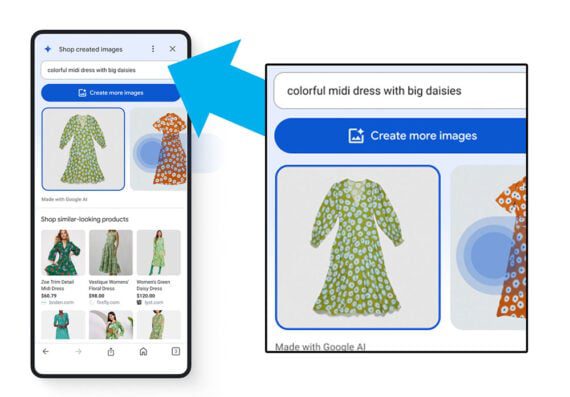
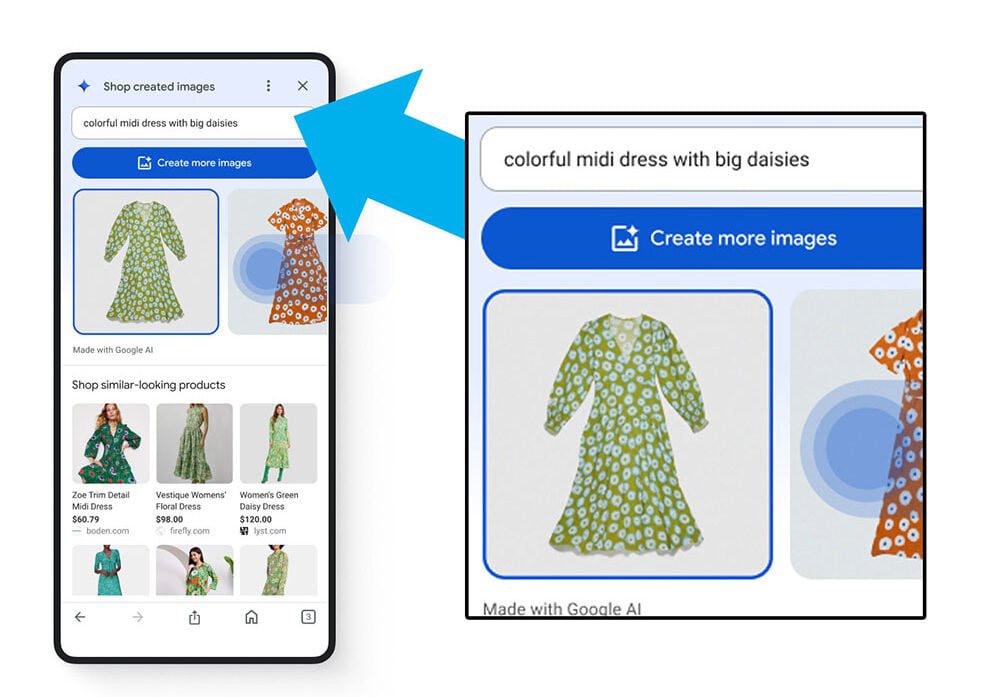
A shopper can type or speak a description, such as Rincon’s “colorful midi dress with big daisies.” The Vision Match AI generates images based on that description — flowered dresses in this case — and shares shoppable product listings similar to the generated images.

Image from Google of the green dress with daisies

Vision Match ingests a text description and generates images such as the green dress with daisies shown here. Click image to enlarge.

Vision Match may function as a bridge spanning a shopper’s abstract idea and an actual product for sale.

Moreover, Vision Match pairs well with other Google features that deploy shopping data to improve ad performance and product discovery, including:

  • Google Lens, which allows users to search for products by uploading images or taking photos.
  • GenAI search in Google Shopping, such as tools that help shoppers find products.
  • Google Shopping image search and style matching for fashion and home décor.
  • Virtual try-on for beauty and apparel, allowing users to see how products look on models.

Improved Shopping

Google Shopping’s various AI tools will almost certainly improve consumers’ experiences. Folks use Google to shop more than a billion times a day, and the company has an excellent store of data.

Google knows what products are available via its Shopping Graph, which had 45 billion listings as of October 2024, as well as what shoppers want, e.g., a “colorful midi dress with big daisies.”

For example, the press kit Google’s media relations team shared with journalists ahead of the Vision Match announcement included a “trends” document that stated:

  • “Cheetah print jeans” and “leopard jeans” are the top trending types of jeans.
  • In April 2024, search interest in “baggy jeans” surpassed that of “skinny jeans” for the first time, and “baggy jeans” have remained on top ever since.
  • “Shell skirt” is at an all-time high for the second consecutive month.
  • Idaho is the only U.S. state where purple lipstick is the most popular.

For better or worse, Google knows much about shoppers (and advertisers). Google Shopping can find the needle in a haystack of 45 billion products.

Optimizing for AI

With Vision Match, Google is not reinventing ecommerce but becoming better at using the data.

Optimizing products for Google’s AI features typically includes:

  • Aligning product listings for AI. Vision Match and other AI features use data from the Shopping Graph.
  • Creating superior product descriptions. Describe the product’s physical specs and primary benefits.
  • Using quality images. AI tools analyze product images for colors, features, and more.
  • Advertising. Use Performance Max campaigns to ensure products appear across Google Shopping, Search, and YouTube.

None of these tactics, however, are novel. They are fundamental to selling products online. Since 1995 — the year Amazon and eBay launched — sellers have needed structured, descriptive, and visual product information promoted by advertising.

Thus Google Shopping’s AI initiatives are, in a sense, sensible ecommerce practices and an opportunity for merchants. What has worked well — an online seller’s existing tactics — is the path to success in an AI-driven future.

Google Publishes New Robots.txt Explainer via @sejournal, @martinibuster

Google published a new Robots.txt refresher explaining how Robots.txt enables publishers and SEOs to control search engine crawlers and other bots (that obey Robots.txt). The documentation includes examples of blocking specific pages (like shopping carts), restricting certain bots, and managing crawling behavior with simple rules.

From Basics To Advanced

The new documentation offers a quick introduction to what Robots.txt is and gradually progresses to increasingly advanced coverage of what publishers and SEOs can do with Robots.txt and how it benefits them.

The main point of the first part of the document is to introduce robots.txt as a stable web protocol with a 30 year history that’s widely supported by search engines and other crawlers.

Google Search Console will report a 404 error message if the Robots.txt is missing. It’s okay for that to happen but if it bugs you to see that in the GSC you can wait 30 days and the warning will drop off. An alterative is to create a blank Robots.txt file which is also acceptable by Google.

Google’s new documentation explains:

“You can leave your robots.txt file empty (or not have one at all) if your whole site may be crawled, or you can add rules to manage crawling.”

From there it covers the basics like custom rules for restricting specific pages or sections.

The advanced uses of Robots.txt covers these capabilities:

  • Can target specific crawlers with different rules.
  • Enables blocking URL patterns like PDFs or search pages.
  • Enables granular control over specific bots.
  • Supports comments for internal documentation.

The new documentation finishes by describing how simple it is to edit the Robots.txt file (it’s a text file with simple rules), so all you need is a simple text editor. Many content management systems have a way to edit it and there are tools available for testing if the Robots.txt file is using the correct syntax.

Read the new documentation here:

Robots Refresher: robots.txt — a flexible way to control how machines explore your website

Featured Image by Shutterstock/bluestork

Google AIO: 4 Ways To Find Out If Your Brand Is Visible In Generative AI [With Prompts] via @sejournal, @bright_data

This post was sponsored by Bright Data. The opinions expressed in this article are the sponsor’s own.

Imagine this in the time of Google AIO: A potential customer asks Google Gemini, ChatGPT, or Perplexity AI for the best SEO tools, top e-commerce platforms, or leading digital agencies.

Your brand has dominated traditional search rankings for years. But your company isn’t mentioned when AI generates an answer.

No ranking. No link. No Google AIO visibility.

This is the new reality of AI-driven search, and most SEOs aren’t tracking it.

Your brand might be invisible in AI search. Find out if it is now →

For years, you may have relied on keyword rankings, organic traffic, and SERP features to measure success.

But as AI-powered search engines reshape how information is delivered, these traditional SEO tracking methods are no longer enough.

How can brands ensure they are visible, accurately represented, and competitive if AI-generated answers influence user decisions without linking to websites?

With new challenges come new solutions. As AI answer engines continue to evolve, SEO professionals and rank tracking platforms must adapt by finding ways to monitor AI-generated search results in real time.

The ability to track brand mentions, analyze AI-driven recommendations, and compare competitor visibility is becoming just as critical as traditional keyword tracking.

In this article, we’ll explore:

  • Why traditional SEO tracking is becoming obsolete in the AI era.
  • The key queries brands should monitor in AI-generated search results.
  • How Bright Data’s Web Scraper API provides a unique solution for AI search tracking.
  • Why SEO pros must demand AI-ready tracking tools, and why rank tracking platforms must evolve to meet this need.

Why Traditional SEO Tracking Doesn’t Work For AIO

For years, SEO tracking has revolved around keyword rankings, organic traffic, and SERP features like featured snippets and People Also Ask (PAA).

However, AI-generated search results don’t follow these traditional ranking structures.

How AIO Affects SERPs

In a standard Google search, ranking in the top three positions means high visibility and traffic. But in AI-generated search, there are no numbered rankings, just a synthesized response that may or may not include your brand.

For example, if a user asks “What are the best SEO tools?”, Google Gemini or ChatGPT might generate a list of tools based on their training data and real-time web sources.

If your brand isn’t included in that response, you’re invisible to the user, regardless of how well you rank in traditional search.

How AI Affects Search Engine Optimization Tools

Without a way to track how AI search engines mention brands, you may be flying blind, and rank tracking tools are missing a critical data layer.

How To Track Your Brand In Generative AI Search & Artificial Intelligence Overviews (AIOs)

Tracking AI-generated search results isn’t as simple as checking keyword rankings.

Since AI models don’t rank pages but generate answers, you have to rethink what they measure.

Here are the four key query types that can reveal how AI search engines perceive and present your brand:

1. How To Find Out If AIO Knows Your Brand Exists:

If AI answer engines don’t mention your brand when users ask about your industry, you’re invisible in AI search.

Even worse, if they misrepresent your brand, you could be losing trust without realizing it.

For example, if a user asks “What is [Your Brand] known for?”, the AI’s response could shape public perception. If it pulls outdated or incorrect information, you need to intervene.

Google AIO response for Screenshot from Google, March 11, 2025
ChatGPTT response for Screenshot from ChatGPT, March 11, 2025

2. Listicles & Perception Terms: Are You a Top Recommendation?

AI-generated search results frequently generate list-based recommendations like:

  • “Best SEO platforms for enterprise businesses.”
  • “Top marketing automation tools in 2025.”

If your brand doesn’t appear in these AI-generated lists, you’re missing out on potential customers who rely on AI search for recommendations.

3. Competitor Comparisons: How Do You Stack Up?

AI search engines dynamically compare brands, often answering queries like:

  • “Is [Your Brand] better than [Competitor]?”
  • “Best alternative to [Competitor]?”

If AI consistently recommends a competitor over your brand, you need to adjust your positioning and content strategy to improve your AI search presence.

Try it!

Pick a prompt from above and visit:

How Bright Data’s Web Scraper API Enables AIO Tracking & Answer Engine Tracking

Bright Data provides the data collection infrastructure that can extract AI-generated search data for:

  • SEO platforms.
  • Rank tracking tools.
  • Enterprises.

Key Capabilities Of Bright Data’s Web Scraper API:

  • Access AI Answer Engines – Extracts real-time data from Google Gemini, OpenAI’s GPT, Claude, and Perplexity AI.
  • Customizable Data Extraction – Enables platforms to collect AI-generated responses for specific queries, industries, or competitors.
  • Seamless Integration – Allows rank tracking platforms and SEO tools to integrate AI search data into their existing dashboards.
  • Scalable & Real-Time – Provides continuous monitoring of AI-generated search results to track brand mentions, sentiment, and competitor positioning.

By leveraging Bright Data’s Web Scraper API, you can gain visibility into AI search, ensuring you stay ahead in an evolving search landscape.

The Future of Rank Tracking In An AI-Integrated SERP

As AI-generated search results become more dominant, SEO’s are already demanding AI search tracking capabilities from their tools, and rank tracking platforms must evolve to meet this need.

  • Traditional keyword rankings will decline in importance as AI-generated answers take up more space in search results.
  • SEO tools must adapt to track brand presence, AI-generated citations, and dynamic competitor comparisons.
  • SEOs should begin integrating AI search tracking now to stay ahead of the curve.

AI search tracking is no longer optional, it’s essential.

Bright Data’s Web Scraper API provides the data collection infrastructure that enables brands and SEO platforms to monitor their presence in AI-generated search results across multiple platforms.

🔗 Explore Bright Data’s Web Scraper API
🔗 Read more on optimizing for generative AI search


Image Credits

Featured Image: Image by Bright Data. Used with permission.