Ask An SEO: How To Handle Duplicate Content Across Multiple Domains via @sejournal, @rollerblader

Today’s Ask an SEO question comes from Colin in London, UK.

“My question is about duplicate content. I work for a group of schools in the UK. We have 21 schools, each has its own website and domain with a link or banner linking back to our main group website. The schools are very busy, so to save time, we have created blog posts centrally to give to the schools. They change a few things but basically the pages are pretty much the same.

I have experience with SEO, so I put my Google good boy white hat on and said, ‘Google says not to do it, it’s duplicate content. We need them to be different.’

My question is will we be penalized? I understand they will compete with each other (multiples have taken page 1 at the same time), but otherwise, is this doing us harm?

Is Google smart enough to know we are a group with different emails? Should we rewrite them all? Should we just stop? It would be good to get a second opinion – maybe I need to lighten up or take take action and remove.

Please help. Thanks, Colin.”

Great question, Colin! It is something that comes up about once a year with our clients or as a question when I’m speaking at conferences.

I’m breaking the answer out into a few sections so that it can be applied to non-school situations, too.

But first, check out this post about Google’s duplicate content penalty myth, as it is something that is commonly misunderstood.

Use Canonicals When Publishing To Secondary Sites

In the situation above, it sounds like there is a main website and multiple variations.

If you’re worried about the variation websites taking from the main website, place canonical links back to the main site from the duplicate posts.

Let’s pretend these are the URLs:

  • Official site – colininlondon.com/blog-post-school.
  • Duplicate 1 – colininleeds.com/blog-post-school.
  • Duplicate 2 – colininglasgow.com/blog-post-school.

The official site will have a self-referencing canonical link because it is the main website and the post that should be ranking.

Duplicates 1 and 2 should have their canonical links point back to the (official) main website. This way, Google knows which site is the official one and which are duplicates.

You can also use schema, addresses, and other localization factors to help define that these are the same company and brand, similar to doing locations if you’re a brick-and-mortar business or using TLDs for country-specific targeting.

One thing to be careful of is having canonical links go to the wrong site.

When you publish original content on a specific school location site, make sure the canonical link is self-referencing vs. going back to the official site or main site.

And if the content gets published to the official site and secondary websites, have the canonicals point to the specific school location site.

You also want to make sure your sitemap excludes the content if it is not the official version. Not a big deal at this point, but still something you can control.

Publish To The Most Relevant Audience

When you’re stuck trying to think of which site should be the official one, or your content management system (CMS) allows you to assign a main site for the content, think about who would benefit most from the post and publish there.

If it is an event and only accessible to one or five schools vs. the 21, publish to the most relevant audience and use the same canonical plan above.

You may want the content to be accessible to all students, parents, and faculty, but if it is only relevant to a smaller grouping or a single school, only publish it to the most relevant location.

Some Content Is Not A Duplicate

In the case of snow days where some schools may be cancelled, others delayed, and some are business as usual, feel free to post these.

The main part of the content will be the same or similar, and that is ok. You can have the same opening and closing of the post; the most important content is the name of the school and the information about when school starts based on the location.

It may be beneficial to have a main post with all locations and their status on the main site, then have the “duplicate” variations with localized information on the individual.

A lot of people assume this would be duplicate content. It shouldn’t be as it is catered to a specific audience and only that audience.

Think about a pharmacy or retail chain where the only differences are hours of operation, phone number, and a couple store-specific details.

Should Content Be Rewritten For Each Site?

If you have the ability and you can make it relevant to that specific location, then yes, there would be a benefit.

For example, you may have a boys-only or girls-only school, or elementary, high, and preschool. If the content is for the Parent Teacher Association (PTA), chances are the concerns for the elementary school parent meetings will be different from those in high school.

By adding the agendas, decisions, board members, times, and other unique attributes of the meetings, you can have similar openings and closings because the body and meat of the posts will be unique.

Use Google Business Profile

Something I have not personally done, as I’ve not worked specifically on schools with multiple websites, is using Google Business Profile for your local locations.

I have done this with retailers and similar industries, such as non-profits and service providers, that have local branches, each with its own domain.

By setting the URLs up and combining them as entities, you may help to reduce the duplication of similar content. Google Business Profile will allow you to sync them together.

This will not help with your main duplicate content question, but it could help with making sure the locations are accounted for in the local search results which may be relevant in specific situations.

If your sites make it clear you’re not trying to game the system, then I wouldn’t worry about duplicate content penalties.

If you’re really concerned, use canonical links that reference the main version that lives on the group website. Then use self-referencing canonicals for any unique content published on the individual school sites.

I hope this helps, and thank you for asking!

More Resources:


Featured Image: Paulo Bobita/Search Engine Journal
Google Upgrades AI Overviews With Gemini 2.0, Launches AI Mode via @sejournal, @MattGSouthern

Google announced an expansion of its AI-powered search features, enhancing AI Overviews with Gemini 2.0 and introducing a new experimental “AI Mode.”

AI Overviews With Gemini 2.0

Google has upgraded its AI Overviews with Gemini 2.0 in the United States.

Users should see performance improvements for coding, advanced mathematics, and multimodal searches.

Google says it’s increasing the frequency of AI Overview appearances for these query types while making them faster and higher quality.

Additionally, Google is removing the sign-in requirement for AI Overviews, which could significantly increase their frequency.

Google’s announcement reads:

“Today, we’re sharing that we’ve launched Gemini 2.0 for AI Overviews in the U.S. to help with harder questions, starting with coding, advanced math and multimodal queries, with more on the way. With Gemini 2.0’s advanced capabilities, we provide faster and higher quality responses and show AI Overviews more often for these types of queries.

Plus, we’re rolling out to more people: teens can now use AI Overviews, and you’ll no longer need to sign in to get access.”

Launching Experimental “AI Mode”

Google is introducing “AI Mode,” an experimental feature initially available to Google One AI Premium subscribers through Google’s Labs program.

You can now pay to have more AI in your search results, which is worth emphasizing, given the vocal segment of users who want to turn off AI features.

This opt-in experience is designed for what Google calls “power users” who want AI-powered responses for a broader range of search queries.

AI Mode leverages a custom version of Gemini 2.0 with advanced reasoning capabilities to handle complex, multi-part questions that might otherwise require multiple searches.

The new feature allows you to:

  • Ask follow-up questions to continue conversations
  • Receive information drawn from multiple data sources simultaneously
  • Interact using voice, text, or images through multimodal capabilities

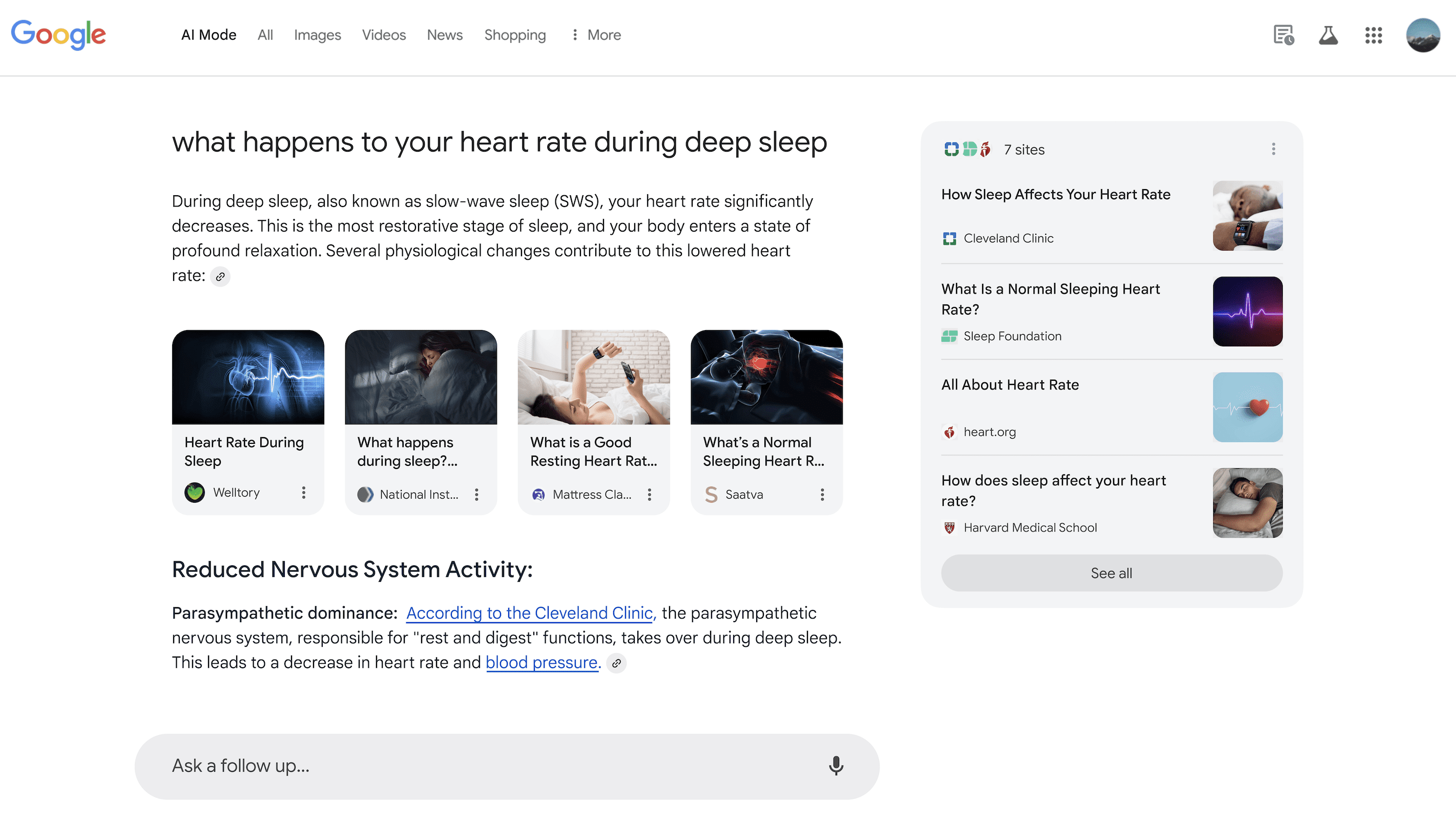
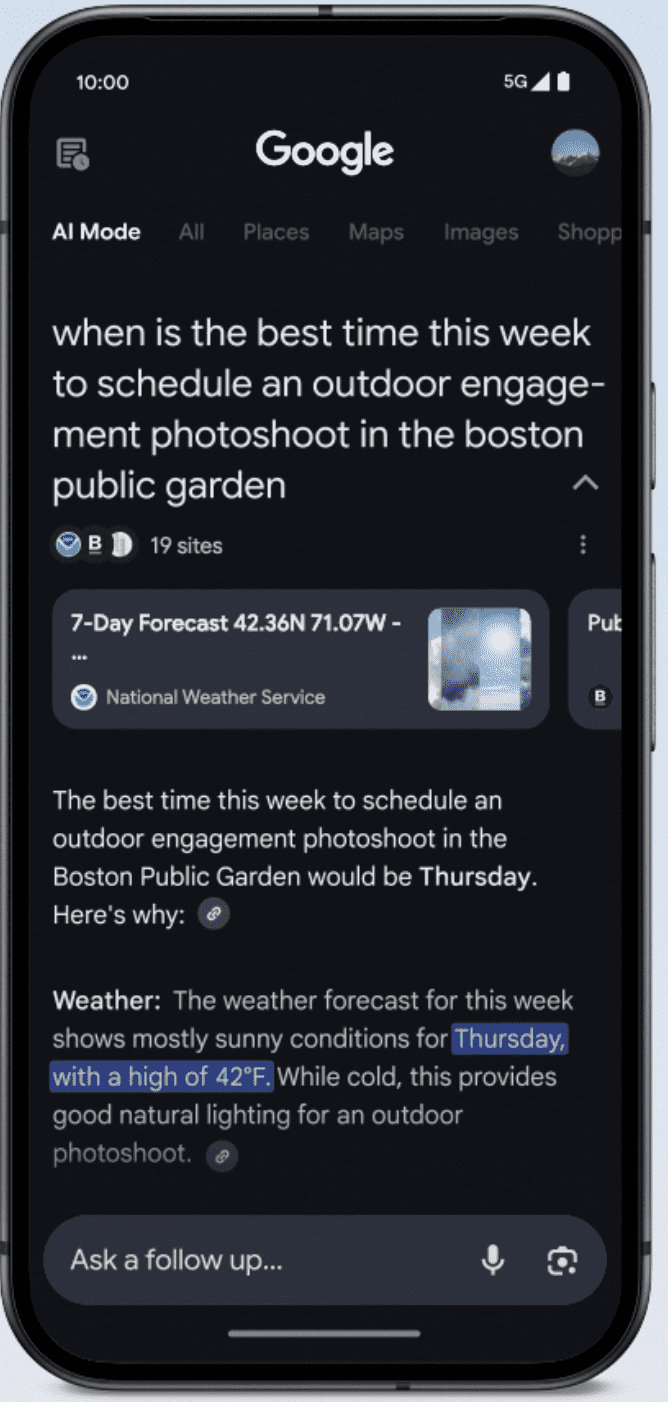
Here’s an example of how it looks on mobile and desktop:

Screenshot from: Google, March 2025.

How AI Mode Works

Google says AI mode is an upgrade over AI overviews:

“This new Search mode expands what AI Overviews can do with more advanced reasoning, thinking and multimodal capabilities so you can get help with even your toughest questions. You can ask anything on your mind and get a helpful AI-powered response with the ability to go further with follow-up questions and helpful web links.”

Google explained that AI Mode employs a “query fan-out” technique.

This works by issuing multiple related searches concurrently across subtopics and data sources. It then synthesizes the information into a comprehensive response.

The technology draws on Google’s Knowledge Graph, real-world information, and product data. Similar to AI overviews, it links to sources.

You can access AI Mode through multiple entry points: the AI Mode tab below the search bar on Google.com, directly at google.com/aimode, or via the AI Mode icon in the Google app.

The dedicated tab will look similar to the example below:

Screenshot from: Google, March 2025.

Quality Safeguards & Limitations

Google acknowledges that, as with any early-stage AI product, AI Mode “won’t always get it right.”

The company detailed several built-in safeguards, including:

  • Integration with core Search ranking and safety systems
  • Novel approaches using the model’s reasoning capabilities to improve factuality
  • Defaulting to standard web search results when confidence in AI-generated responses is low
  • Protection against hallucinations, opinionated responses, and misleading content

The company noted that AI Mode is mainly designed to handle queries requiring exploration, reasoning, or comparisons. However, it may default to traditional search results for current events or when up-to-the-minute accuracy is critical.

Looking Ahead

These updates affirm Google’s continued investment in AI-powered search experiences, which could further impact how people discover and interact with web content.

The company’s measured rollout of AI mode suggests it’s being cautious with this experimental feature.

It remains to be seen whether it will eventually roll out to paid users. Locking the AI mode behind a paywall may indicate that it’s expensive for Google to deploy.

Google is already working on enhancements, it says. Updates to AI mode may include more visual responses, richer formatting, and new ways to connect users with web content.

Mapping Digital Marketing KPIs To Business Outcomes via @sejournal, @coreydmorris

In an ever-increasing world of messy attribution – thanks to privacy law changes, differing platform conversion tracking methods, new sources emerging like AI, and even just continuing to deal with Google Analytics 4 – digital marketing and search key performance indicators (KPIs) can be tough to stand behind or have a lot of confidence in.

We have a lot of great third-party dashboard tools, reporting integrations, and software to help us.

Plus, there are custom routes for data visualization and APIs. Even if you’re a wizard with analytics and pulling it all together, there are still risks and challenges with marketing KPIs.

Whether you’re part of an in-house digital marketing team, an agency, or simply wearing a lot of hats – including digital marketing and analytics – leaving KPIs open to interpretation or not having a complete story to tell is a big risk.

Believing that digital marketing – specifically search marketing – is an investment that should yield returns, I’ve seen firsthand how things can go sideways when we can’t connect the dots between dollars spent and dollars earned.

I’m going to unpack several aspects of marketing versus business goals to help shed some light on how to get the best of both and get things in alignment.

Why Good Marketing Metrics Can Still Get You Fired

It wasn’t until I started writing my book a couple of years ago that I unpacked and started telling my personal story (one that goes back nearly two decades) about how I learned the hard way just how important this topic is.

In my first role as an agency SEO, one of my first clients was a local attorney. I put into practice a great SEO strategy, and after four months, we saw great rankings, increased traffic, and even conversions through web form submissions.

I was stoked going into my monthly reporting meeting with the client. Back then, my reports were generated by software and were pages long. I printed it on glossy paper, stapled it neatly, and got ready for the meeting.

When the client sat down, I walked him through page after page of green numbers and upward-trending graphs.

When I got to the end, there was silence. Then, the client shared that he knew I was working hard and had no problem with these metrics.

However, he hadn’t landed a single new client or case from all of this SEO work. Worse, his front-office staff spent a lot of time on the phone screening bad leads.

My stomach dropped.

That day, I learned the hard way: SEO KPIs don’t equal business goals or return on investment (ROI).

The good news is that I recovered from that, and it wasn’t the end of the client relationship.

However, I hope that gives you some context as to why, at least for lead generation, we can’t just stop at conversions or make dangerous assumptions that they are positively impacting the business.

I don’t want anyone blindsided by things that could have been prevented. That includes making assumptions that key stakeholders – or even those two or three levels removed – can connect the dots between marketing expenses or investments and actual returns.

Yes, some things in marketing are harder than others to quantify, such as branding and design projects. However, there should be a key metric somewhere that you can measure.

The KPI-ROI Disconnect

Starting “at the end” is a recommended approach for getting as deep into business metrics and mapping things out as possible.

Whether you do this during a broader strategy and planning process or you/your team have to do it ad hoc, it is worth doing.

Understanding the complete picture of how your organization (or client) makes money is key. Even in non-profits, this applies.

If you can get to the ultimate business metric that defines performance and success for your organization, then you have the opportunity to work backward from that to connect it to marketing based on the metrics along the way.

For some organizations, this is easy. For others, it’s a challenge, hitting roadblocks with getting the data, getting through silos, or getting a complete picture.

Examples of some of the business metrics that might be tracked include revenue, margin, lifetime value, customer acquisition cost, and some level of ROI (if not connected with margin metrics).

Those are not the most common metrics when it comes to digital marketing. Search and digital marketing metrics often translate to conversions, visits, clicks, click-through rates, return on ad spend (ROAS), and similar.

When you can map things out and see beyond the deepest digital marketing KPI to how it impacts the business metrics, you can get to a defensible and accountable position for the ROI of marketing versus leaving gaps or leaving it up to a “feel” test or someone else’s interpretation of success.

Bridging The Gap

Marketing and business teams need to align to ensure shared success.

At this point, if any of these points or scenarios resonate with you, you might wonder, “How did we even get here?”

That’s a question I’ve encountered personally and one I’ve helped coach through during my career. When there’s a gap or disconnect somewhere, it can often be traced back to one of these reasons:

  • We didn’t start with a defined strategy and planning process.
  • We didn’t loop stakeholders in the strategy/plan.
  • We didn’t get new or changing stakeholders up to speed on digital marketing/search marketing strategies and plans.
  • We inherited the ecosystem or plan.
  • We didn’t challenge changes in expectations along the way.
  • We encountered changes in tech (reporting, attribution, customer relationship management (CRM)) and didn’t adapt.
  • We have too much on our plate already and not enough time.
  • We don’t know how to navigate politics or the workings of the C-suite and other functions.

I could go on and build an even longer list, but it is too painful. My honest hope is that we can all continue to work to build bridges between functions.

Sometimes, it isn’t fun to step outside the search and digital marketing bubble, but at times, it is in our best interest – for us, our teams, and our organizations.

Gaps often exist due to ignorance, arrogance, people protecting their territory, or other factors. Unfortunately, closing them can be harder than doing the deep level of subject-matter expertise work that you are paid to do.

Finding common ground, aligning metrics at different levels, and getting consensus on what you’re doing – what it can impact and why it is important – are critical to avoid both the surprise “firings” or tough conversations that happen the longer things are not addressed.

Address The Gap Before It Hurts The Business

No matter the size or structure of a business or organization, gaps between digital marketing KPIs and business outcomes seem inevitable.

In some cases, things map out easily with just a little extra effort going beyond the digital marketing department or function – whether internal or as an external partner.

Regardless, getting fired or losing a contract over a KPI-business gap is extreme – the real risk and outcome we don’t want.

At the same time, we don’t want to spend our days dealing more with politics than SEO, paid search, or other digital marketing.

Recognizing gaps, addressing them, working as a team to link things up, and staying on the same page leads to respect, predictability, and a mindset shift – one where digital marketing is seen as an investment instead of an expense.

More Resources:


Featured Image: A9 STUDIO/Shutterstock

Google’s AI Shopping Tools Transform Ideas Into Real Products via @sejournal, @MattGSouthern

Google has launched its Vision Match feature for all mobile users in the United States, following a successful test run in Google Labs.

This tool solves an everyday challenge for shoppers: turning a specific idea into products that can be purchased.

Google research indicates that more than half of shoppers have difficulty finding particular clothing items when they know what they want.

The Vision Match feature allows users to describe a clothing item in natural language. It then uses AI to generate an image and find similar products.

Screenshot from: blog.google/products/shopping/ai-vision-match-ar-beauty-virtual-try-on/, March 2025.

You can access this feature by searching for a garment and scrolling to the “Can’t find it? Create it” prompt.

Alternatively, navigate to the “Create & shop” option in the Shopping tab’s left panel.

New AR Tools Leverage Gemini AI Models

Google is enhancing its augmented reality beauty features with Gemini AI models.

US shoppers can now virtually try on complete makeup looks inspired by celebrities, influencers, and beauty trends rather than testing individual products.

This allows consumers to search for terms like “spring makeup” or specific celebrity looks and see how multiple makeup products appear on their faces.

According to Google’s research, more than half of Americans who use makeup actively seek online inspiration.

Users can access this feature by tapping “See the looks on you” when browsing relevant search results, followed by “Try it on” to initiate the virtual experience.

Virtual Try-On Expands

Google has expanded its virtual try-on feature to include pants and skirts from hundreds of brands. The enhancement allows shoppers to visualize how these garments look on diverse body types, from XXS to XXL.

Screenshot from: blog.google/products/shopping/ai-vision-match-ar-beauty-virtual-try-on/, March 2025.

Google updated its machine learning models to generate complete looks, when previously they were limited to generating tops only. Shoppers can access this feature by looking for items with a “try on” badge in Google Search or the Shopping tab on mobile and desktop platforms.

Looking Ahead

The announcements come as competition in the visual search and virtual try-on space intensifies.

According to Google’s internal data, over a billion shopping interactions occur on Google daily. These tools aim to help consumers make more confident purchasing decisions.


Featured Image: Screenshot from: blog.google/products/shopping/ai-vision-match-ar-beauty-virtual-try-on/, March 2025. 

CMO Guide To Schema: How Your Organization Can Implement A Structured Data Strategy via @sejournal, @marthavanberkel

Putting together an actionable strategy to keep your organization relevant in the ever-changing search marketing landscape is harder than ever.

To help support your organization through this journey, this guide provides insights into why schema markup is essential and how you can implement a structured data markup strategy to support your organization’s goals this year.

What Is Schema (A.k.a. Structured Data)?

Schema, also used interchangeably with the term structured data, refers to machine-readable data that you can add to your website to describe your content.

Schema is actually the industry standard vocabulary that is used to markup structured data. This helps search engines understand the content on your website in the context of your brand, making your content more visible to your target audience.

Optimizing your website is like translating your content into the language of search engines and machines.

Enable Higher Visibility In Search

By implementing structured data markup, you unlock the potential for your content to appear as rich results in Google search listings.

These rich results – which showcase additional information such as product pricing, star ratings, job posting details, and video thumbnails – take up more real estate in search results, drawing more attention and leading to higher click-through rates (CTR) and more traffic to your website.

Example of content with a rich result vs content without rich results on the SERPImage created by author, February 2025

Schema markup helps ensure your website can achieve rich results, supporting increased visibility and conversion from search engine results pages (SERPs), resulting in more traffic and leads.

Tip #1: Maximize Rich Results On Your Site

When implementing a structured data strategy, focus on maximizing the number of rich results you can achieve. These results can significantly improve your website’s visibility and conversion rate on the search engine result page

Top-performing rich results include Products, Reviews, Questions and Answers, and Job Postings.

Have your team review your current content to identify existing opportunities for rich results.

Google’s Guide provides examples to get your team started. Also, look for opportunities to update content to unlock new rich result opportunities.

For example, if you have a product page with pricing information, consider expanding it with additional recommended properties like availability, shipping details, ratings, and reviews. This could help you achieve a more detailed Merchant Listing in search results.

We recommend marking up more than just the minimum required fields.

Include Google’s recommended properties to increase your chances of achieving rich results, as well as other properties that showcase the uniqueness of your content or products. This helps inform search engines about your content and match them to specific queries.

While rich results have been around for some time, they remain a powerful tool in the age of zero-click searches to drive traffic to your site. Accelerating the optimization of your content with schema markup to achieve these rich results should be a priority.

Manage Your Brand With A Semantic Data Layer

With the introduction of AI Overviews in Google, as well as the rise of generative AI platforms such as ChatGPT, Perplexity, and Gemini, your target audience is increasingly interacting with your website data before they even visit a webpage on your site.

The data these AI models interact with is derived from the content on your site. While you have control over the content on your website, you have little control over how AI platforms interpret and understand the data.

When AI “hallucinates,” it can result in incorrect information showing up in search experiences, and these inaccuracies could harm your brand’s reputation.

While it’s not clear if these AI platforms are currently being trained on schema markup, adding semantic schema markup, which results in a semantic data layer, provides a resource to machines for how you want your content understood. This semantic data layer gives you a control point in how your brand is presented to these machines.

Large language models (LLMs) and AI tools are advancing and changing every day.

As the experiences powered by these models evolve, your web content will remain constant. You want to be sure your data is ready to be crawled and consumed – and structured data markup allows you to do that.

Tip #2: Shift Your Team From Keywords To Entities Using Structured Data Markup

To create a semantic data layer, your team needs to shift from thinking about keywords to thinking about entities. There is value in describing “things” on your website in context.

In this world of advanced search engines, think of keywords as being one-dimensional and entities being multi-dimensional.

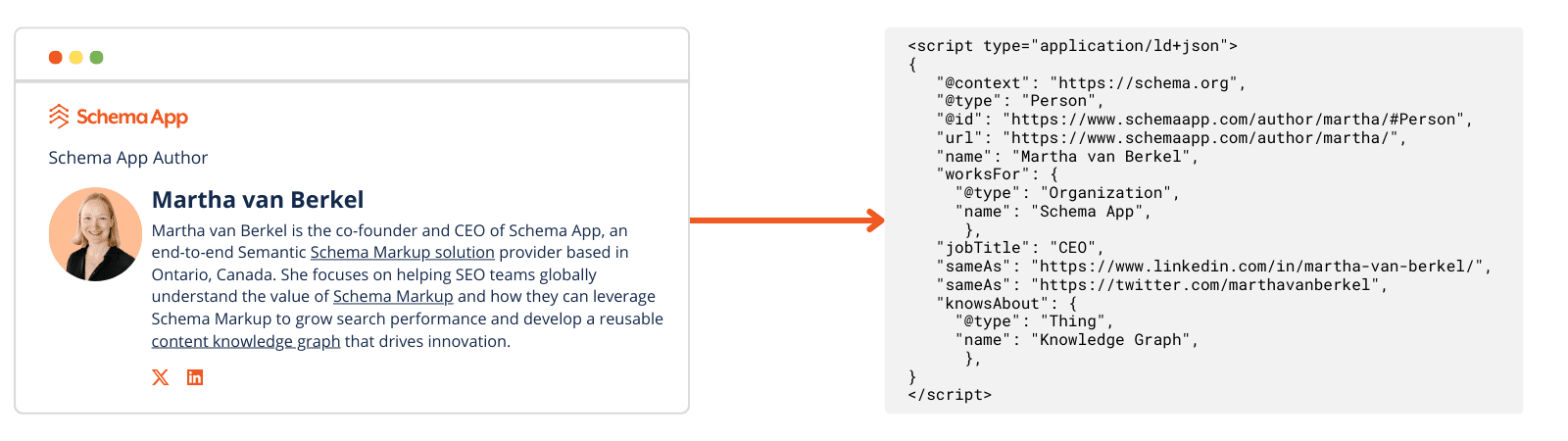
For example, I, Martha van Berkel, am a person, and I can be defined as an entity on my author page.

The words on the page talk about things that people might want to know about me, and the schema markup structures this data to be understood by machines.

The schema markup on my author page explains who I am, my relationship to my organization, and information about my area of expertise.

Example of Martha van Berkel's author page translated into Schema MarkupImage created by author, February 2025

Doing so will translate your unstructured content into machine-readable data, enhancing your semantic data layer.

So, in addition to trying to achieve rich results, you should leverage the Schema.org vocabulary to its fullest to explain what your website content is about and create a semantic data layer.

Add schema markup to your entire site to identify and describe your entities – the key topics or “things” within your content.

Tip #3: Connect The Things On Your Website With Schema Markup

Identifying and describing the entities on your site is only the first step. Many entities on your site can also be defined by their relationship to other things on your site and across the web.

Therefore, it is important that your team uses structured data markup to define the entities and topics on your site and explain their relationships.

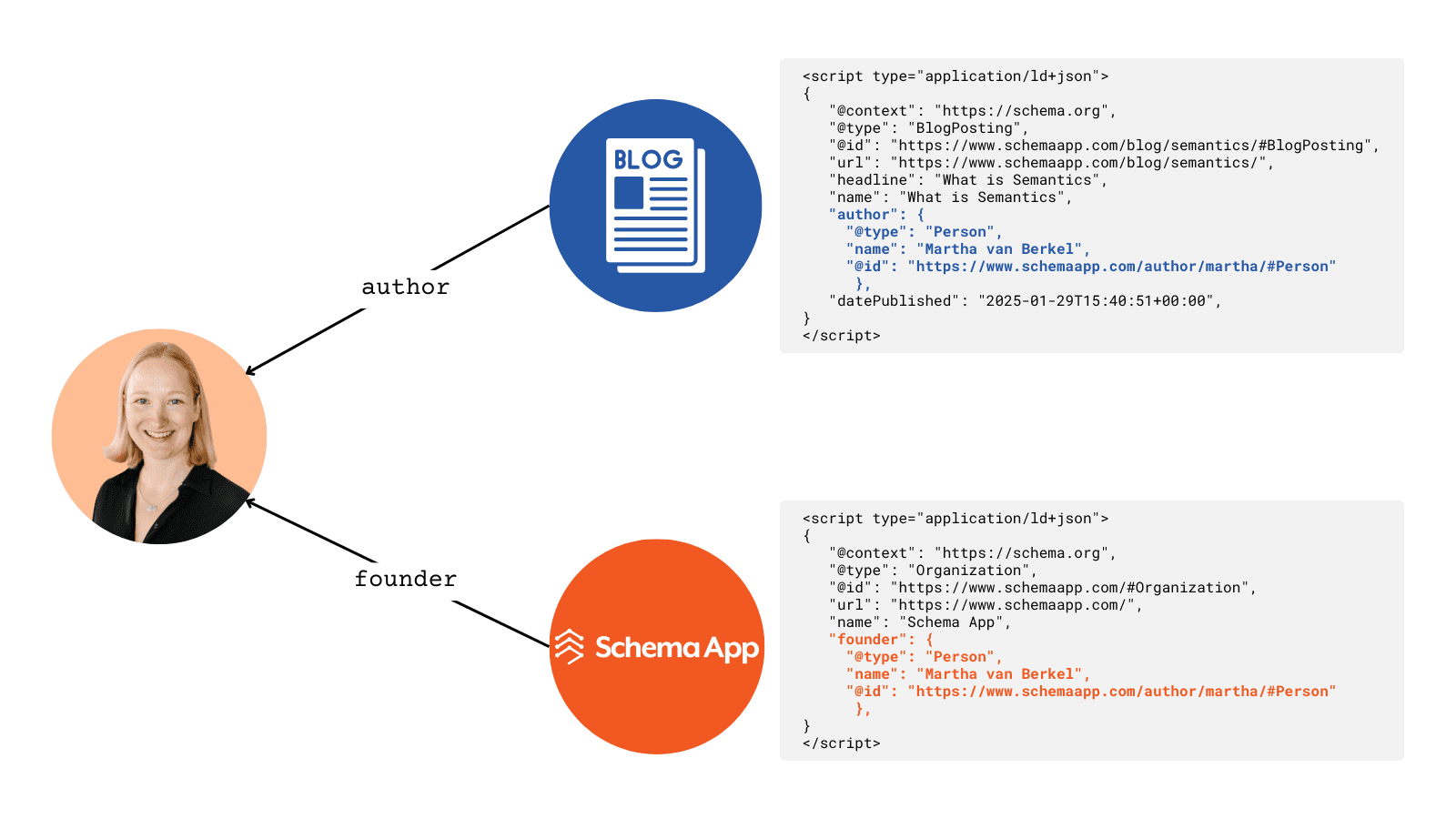
For example, I, Martha van Berkel, am the founder of the organization Schema App. I am also the author of a few blog articles on the Schema App website.

Schema App and these blog articles are all unique entities. We can use schema markup to articulate my relationship with these entities.

Example of Martha's connection to other entities using Schema MarkupImage created by author, February 2025

Moreover, markup enables you to link entities across the web, providing greater context to search engines and AI.

This process, known as entity linking, helps to not only further define your entities, but also clarify their meaning.

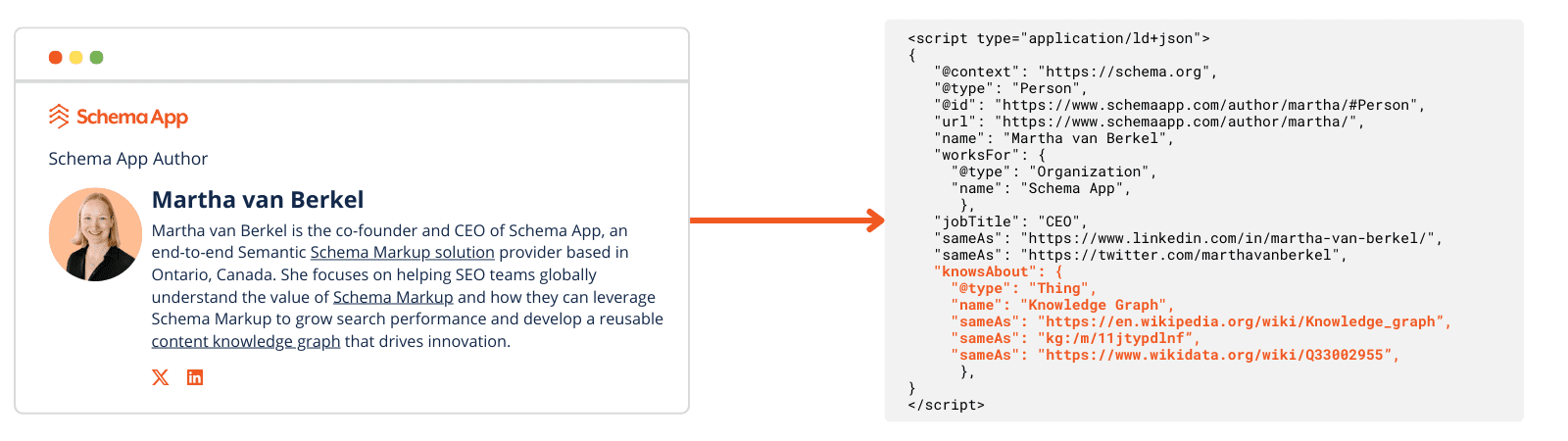
Continuing our example: I, Martha van Berkel, know about knowledge graphs. One could easily mistake the knowledge graph we’re talking about as Google’s knowledge graph.

To clarify what “knowledge graph” we’re referring to, we could link the term “knowledge graphs” to the corresponding entity in authoritative knowledge bases like Wikidata, where the term structured data is already defined and understood by the machines consuming the content.

Example of doing entity linking using Schema markupImage created by author, February 2025

In addition to building the semantic data layer, at Schema App, we’ve seen an increase in related queries after adding entity linking.

For example, “near me” queries increased after we implemented place-based entity linking for location pages.

By connecting entities both within your site and across the web with structured data markup, you are effectively building a content knowledge graph.

This semantic data layer ensures that search engines, AI, and other data consumers understand the entities on your site and their relationships – far beyond just keywords.

Preparing For AI Within Your Organization

Many organizations have been tasked with developing AI strategies to prepare for the future. The good news is that the content knowledge graph you’ve built for search is equally valuable in enabling your internal AI innovations.

In February 2024, Gartner assessed 30 emerging technologies that companies need to invest in to stay relevant in this new AI world.

They named “knowledge graphs” as a critical enabler for generative AI. Knowledge graphs can support generative AI adoption by grounding the LLM in factual information, reducing hallucinations.

Furthermore, another research by Data.World showed that using knowledge graphs for responses in enterprises improves GPT-4’s accuracy from 16% to 54%.

The digital landscape is changing rapidly, and there are now many ways consumers and businesses can “search.” At the heart of these new experiences is your brand’s website content or your website data.

By investing in optimizing your website with schema markup and building a dynamic content knowledge graph, you are preparing your organization’s web data for internal AI initiatives.

When you do semantic schema markup, your web data is reusable and adaptable to future technologies.

Tip #4: Challenge SEO Professionals To Shift From Optimizing Pages To Optimizing Your Web Data

Just like content teams need to shift from thinking about keywords, SEO teams need to think about optimizing their web data vs. their webpages.

Challenge your SEO specialists to think about your entities and their relationships across your website using schema markup. This shift will require teams to think about how structured their web data is and how they can make it easily accessible to crawl and understand.

SEO professionals need to think like data architects to ensure your brand’s website data is future-proofed for what’s coming next in search and AI within and outside your organization.

Managing Your Web Data To Prepare For The Future

Implementing a structured data markup strategy is not just about optimizing for visibility in search. It is also about defining and connecting entities to build your brand’s semantic data layer.

The search landscape is ever-evolving, and AI technologies will come and go.

Therefore, SEO teams should take this opportunity to leverage schema markup for its semantic value and develop a content knowledge graph that prepares your brand for whatever comes next.

More Resources:


Featured Image: PeopleImages.com – Yuri A/Shutterstock

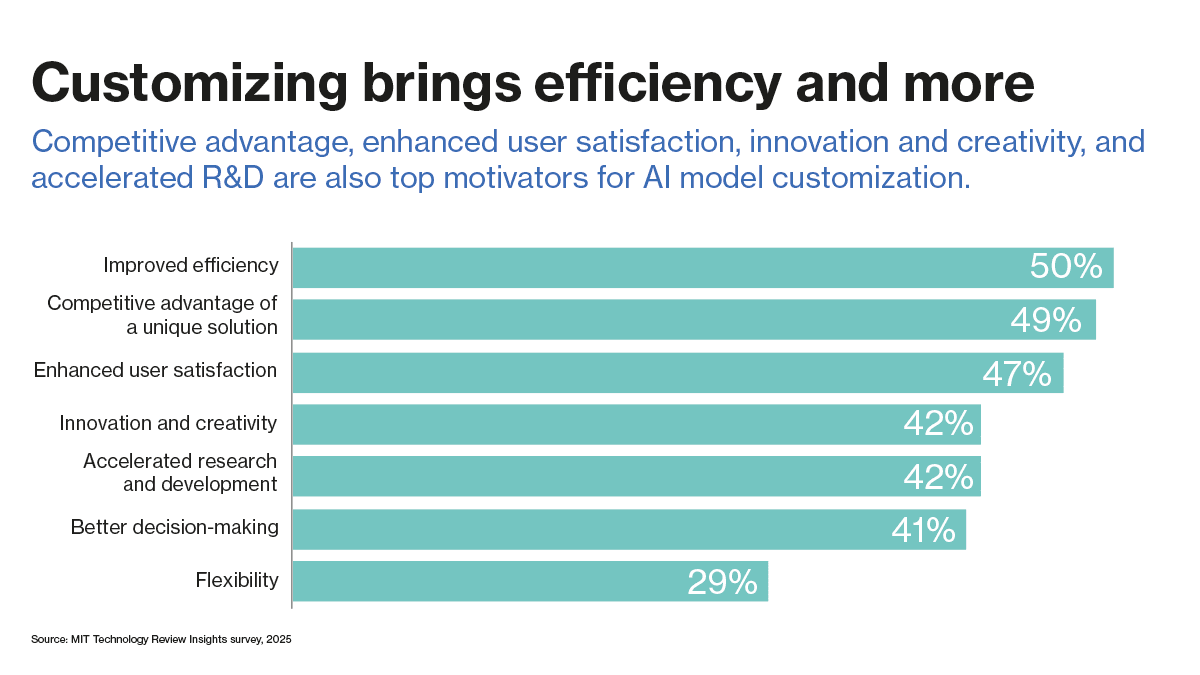
Customizing generative AI for unique value

Since the emergence of enterprise-grade generative AI, organizations have tapped into the rich capabilities of foundational models, developed by the likes of OpenAI, Google DeepMind, Mistral, and others. Over time, however, businesses often found these models limiting since they were trained on vast troves of public data. Enter customization—the practice of adapting large language models (LLMs) to better suit a business’s specific needs by incorporating its own data and expertise, teaching a model new skills or tasks, or optimizing prompts and data retrieval.

Customization is not new, but the early tools were fairly rudimentary, and technology and development teams were often unsure how to do it. That’s changing, and the customization methods and tools available today are giving businesses greater opportunities to create unique value from their AI models.

We surveyed 300 technology leaders in mostly large organizations in different industries to learn how they are seeking to leverage these opportunities. We also spoke in-depth with a handful of such leaders. They are all customizing generative AI models and applications, and they shared with us their motivations for doing so, the methods and tools they’re using, the difficulties they’re encountering, and the actions they’re taking to surmount them.

Our analysis finds that companies are moving ahead ambitiously with customization. They are cognizant of its risks, particularly those revolving around data security, but are employing advanced methods and tools, such as retrieval-augmented generation (RAG), to realize their desired customization gains.

Download the full report.

This content was produced by Insights, the custom content arm of MIT Technology Review. It was not written by MIT Technology Review’s editorial staff.

Why Search Rankings Are Driving Less Traffic

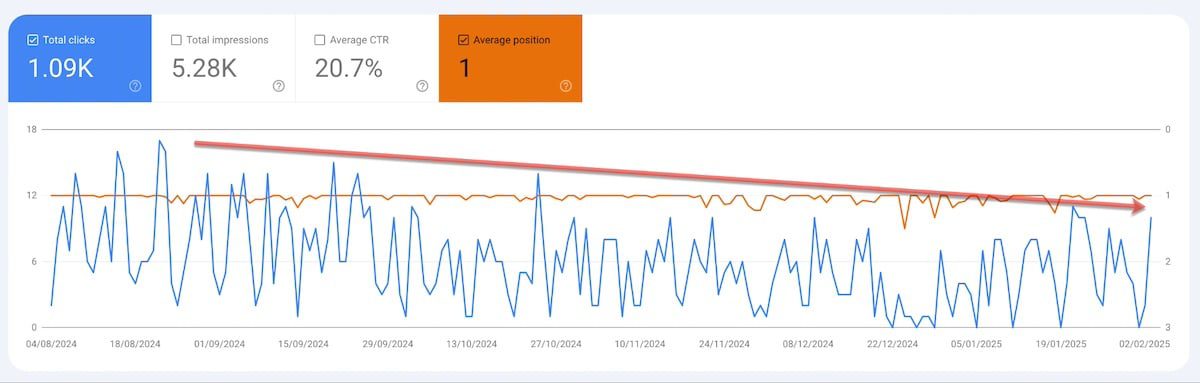
There’s a disturbing trend in organic search: Many web pages are losing traffic without a substantial change in rankings.

It’s not an abrupt loss and usually occurs for low-volume queries. Yet the aggregated traffic reduction across many pages adds up, becoming noticeable.

What can be done? A drop in traffic usually stems from lower rankings. But what if rankings are unchanged? This trend is widespread, affecting large and small sites.

Here are the causes.

Screenshot of Google Analytics graph showing traffic to the web page.

Clicks to this web page decreased from April 2024 to February 2025, but its top ranking stayed the same. Click image to enlarge.

Zero Click Searches

Google’s search result pages no longer consist solely of 10 blue links with predictable click rates. Search results are much more diverse and dynamic. Many of the new features generate few, if any, clicks.

Certainly Google has infused more advertisements in search results, which compete with organic listings. Other factors include:

  • Featured snippets that answer queries directly, removing the need to click.
  • Sections for “People also ask” and “People also search for” prompt users to stay on-site, researching more.
  • Videos play directly in search results.
  • Images can take at least two clicks to reach the underlying web page.
  • Other sections (social media, maps, forums) distract from the organic results.

A 2024 study by SparkToro found that, on average, 1,000 U.S.-based searches resulted in just 360 external clicks.

AI Overviews

Google’s launch of AI Overviews dramatically contributes to zero-click searches. A recent study by Seer Interactive revealed organic and paid click rates with and without AI overviews. The trend is obvious: AI Overviews decrease clicks to ranking pages.

Here are some of Seer’s findings.

Zero Click Discovery

Generative AI platforms — ChatGPT, Claude, Gemini, Perplexity, others — are upending shopping patterns. Consumers increasingly rely on those tools for brand and product recommendations, yet very few answers include external links.

The result is zero-click discoveries, forcing consumers to search, say, Google or Bing to locate the recommended sites. Hence branded search volume is growing for most businesses, especially the prominent names. Non-branded rankings may not change but clicks route through branded searches instead.

What to Do?

  • Prioritize queries with transactional intent. AI Overviews appear mostly for informational searches. Continue providing helpful information but don’t waste resources monitoring those positions. Write for shoppers, not search engines.
  • Monitor and optimize branded search.

There’s no single fix to zero-click searches and discovery. Adjust optimization tactics and start adapting to a lower-traffic future.

Google Business Profile Update: QR Codes For Review Pages via @sejournal, @MattGSouthern

Google has rolled out a new feature for Google Business Profiles that makes it easier to collect customer reviews.

You can now generate custom QR codes that, when scanned, direct customers straight to your business’s review page.

Google announced the update today on X:

How to Access the Feature

You can access the QR code generator by following these steps:

  1. Visit your Google Business Profile dashboard on desktop
  2. Click on the “ask for reviews” option
  3. Follow the on-screen instructions to generate either a direct link or a QR code

The system offers multiple sharing options, including Email, WhatsApp, and Facebook.

What This Means For Businesses

This update gives you more ways to increase review volume with minimal friction. QR codes can be displayed at physical locations, added to receipts, or included in post-purchase communications.

Review quantity and quality can enhance local search visibility. While reviews don’t impact search rankings, they affect Google’s local pack.

See more:

Customers More Willing To Write Reviews

On the topic of local search, I covered a relevant study earlier this week that finds customers are increasingly willing to write reviews.

BrightLocal analyzed 15 years of data and determined that customers are growing more aware of the importance of reviews. This awareness makes them more eager to contribute their thoughts and opinions.

The study reads:

“… despite the challenges of maintaining a consistent stream of new reviews, consumers are overwhelmingly willing to write one. It’s all about giving them a strong reason to do so (AKA a memorable experience) and catching them at the right time.”

See more:

Greater customer awareness is a double-edged sword, the study points out.

While people are more willing to write reviews, they’re less trusting of overall review scores. This means customers consult “alternative” sources like TikTok and YouTube in addition to checking Google reviews.

As you utilize this QR code feature to gather more reviews, remember that it’s important to be visible across multiple platforms to reach today’s customers.


Featured Image: BestForBest/Shutterstock

How Google, ChatGPT, & DeepSeek Handle YMYL Searches via @sejournal, @MattGSouthern

A new study by SE Ranking examines how AI search tools handle Your Money or Your Life (YMYL) queries.

The research compared Google AI Overviews (AIOs), ChatGPT, and DeepSeek across 40 health, legal, financial, and political queries.

This study is similar to one published by SE Ranking in October. The key difference is that this study examines multiple tools, whereas the October study focused solely on AIOs.

Here’s more about the latest study and what the findings mean.

Key Findings

1. YMYL Query Response Rate

The research found that Google generates AIOs for 51% of YMYL queries, slightly up from 50% in October.

ChatGPT has a 100% response rate for YMYL searches, and DeepSeek has a 90% rate.

Google’s selective approach was evident in political topics, displaying AI Overviews for only one query.

2. Response Patterns

Each platform showed unique patterns in generating responses to YMYL queries:

  • DeepSeek produces longer answers (391 words on average) with numerous sources (28 per response)
  • ChatGPT offers moderate-length content (234 words) with fewer sources (10 per response)
  • Google provides the briefest responses (190 words) with minimal citations (7 sources)

Google’s AI Overviews showed the highest percentage of responses with all unique links (61.9%), compared to ChatGPT (40%) and DeepSeek (32.5%), indicating Google prioritizes source diversity over quantity.

3. Fact vs. Opinion

Using subjectivity analysis, the study measured how factual versus opinion-based each platform’s content appeared:

  • ChatGPT delivered the most objective content overall (0.393 score)
  • Google AI Overviews ranked second (0.427 score)
  • DeepSeek showed the highest subjectivity (0.446 score)

These differences were most noticeable in political topics, where DeepSeek scored 0.497 (more opinionated) while Google scored 0.246 (more factual).

4. YMYL Category Strengths

The analysis revealed the following differences across various categories of YMYL queries:

Health Content

  • ChatGPT: Concise, disclaimer-heavy content citing medical sources
  • DeepSeek: Detailed responses with extensive citations, including news sources
  • Google: Conservative, heavily cautioned but brief content

Legal Content

  • ChatGPT: Bullet-point summaries with high-authority sources
  • DeepSeek: Comprehensive explanations with real-world examples
  • Google: Brief overviews with the highest disclaimer rate (50%)

Financial Content

  • ChatGPT: Risk-focused overviews with professional consultation recommendations
  • DeepSeek: Categorized information with numerical data and comparisons
  • Google: Avoids responding to highly sensitive financial queries entirely

5. DeepSeek Restrictions

The study documented that DeepSeek refused to respond to queries about Taiwan’s independence, Tiananmen Square, Chinese human rights issues, and websites banned in China.

DeepSeek’s responses often aligned with Chinese government perspectives when addressing related topics.

What Does The Data Mean?

A common thread throughout the data is how each AI chooses to protect users from potentially harmful advice while still trying to be helpful.

ChatGPT answers every YMYL query it sees, yet often leads with strong disclaimers and succinct takeaways.

Google AI Overviews, on the other hand, declines to generate content for almost half of the tested queries, leaning heavily on caution rather than risk providing the wrong guidance.

DeepSeek is at the opposite extreme. Sometimes, it offers staggering amounts of detail, and other times, it offers little detail if the response doesn’t align with political perspectives.

What unites all three is the balance between information and liability. Each model wants to appear authoritative in YMYL niches but must decide whether to be “helpful” or “safe” (and how much of each).

Key Takeaways For SEO

For SEO and content teams, here are key points to consider:

  • Google is selective. Content appearing in AIOs must meet high-quality standards, especially for YMYL topics.
  • Google’s AIOs cite unique and diverse sources for YMYL searches. This increases visibility but creates competition for clicks.
  • Different AI systems prefer specific styles, lengths, and details in content.
  • All three platforms prefer disclaimers on sensitive topics, with health content having the highest rate of cautionary notices at 37%.

Understanding these platform differences can help you improve visibility in AI search tools.

For more insights into AI search optimization, see:


Featured Image: Tada Images/Shutterstock

CheggMate via @sejournal, @Kevin_Indig

The expected AIO-pocalypse hasn’t happened, at least not in the form we expected.

Instead of a meteor impact, it looks more like climate change: slowly raising temperatures that cause natural disasters. Chegg is one of the first victims.

Chegg is an ed-tech company that offers students homework help, textbook rentals, online tutoring, and career resources. Founded in 2005. IPO in 2013.

In 2024, it reported 6.6 million paying subscribers, and its revenue is down -14% YoY. The culprit: AI.

The big question I answer in this article is whether Chegg is an outlier (spoiler: it’s not) or the first of many. More companies are bleeding. And some direct competitors to Chegg are surprisingly thriving.

You should read this Memo if you want to understand:

    1. The nuance behind Chegg’s decline.
    2. Who else is impacted by AI.
    3. How to tell if you’re at risk.
  1. How to build up immunity against AI.
CheggMateImage Credit: Lyna ™

Boost your skills with Growth Memo’s weekly expert insights. Subscribe for Free!

AI Overviews Are Not The (Only) Problem

Chegg filed a lawsuit against Google for abusing its monopoly position in Search to force companies to provide content that it repurposes for AI answers or Featured Snippets.1

The accusation has legs. Showing answers in the search results directly competes with Chegg’s business model.

Chegg claims (rightfully) it cannot opt out of them without cutting off vital organic traffic and calls Search a “Hobson’s Choice”: you either block Google and lose all organic traffic or don’t, and Google takes your content to give answers in the search results.

Up to this point, I agree.

What we’re witnessing is the old ecosystem of Search falling apart. The generational deal was that websites would create good content and allow Google to crawl it.

In return, Google sends them websites and shows ads to searchers. Now that clicking on websites is redundant in some cases, this deal is falling apart.

In my meta analysis of AI Overviews, I showed how AI Overviews reduce click-through rates, but they also show up much less often and more for informational queries than when they first started.

Skeptical

But this isn’t the whole puzzle of Chegg’s problem. Months before the lawsuit, Chegg’s CEO said AI, not AI Overviews, is eating into subscriber growth (as I mentioned in my Q1 Marketplaces Deep Dive):

“Rosensweig said on a May earnings call that ChatGPT had begun eating into subscriber growth. Chegg pulled financial forecasts for the rest of the year, and its stock dropped 48% in a day.”2

The article goes on:

“But within months, Chegg’s internal data showed students were increasingly turning to ChatGPT as a studying aid. Employees found some of the answers provided by GPT-4, the technology behind ChatGPT, scored higher on internal evaluations than answers from Chegg’s human experts.”

The problem goes beyond AI Overviews. Students around the world are using AI instead of web platforms. And you can see it in the numbers as well.

chegg trafficImage Credit: Kevin Indig

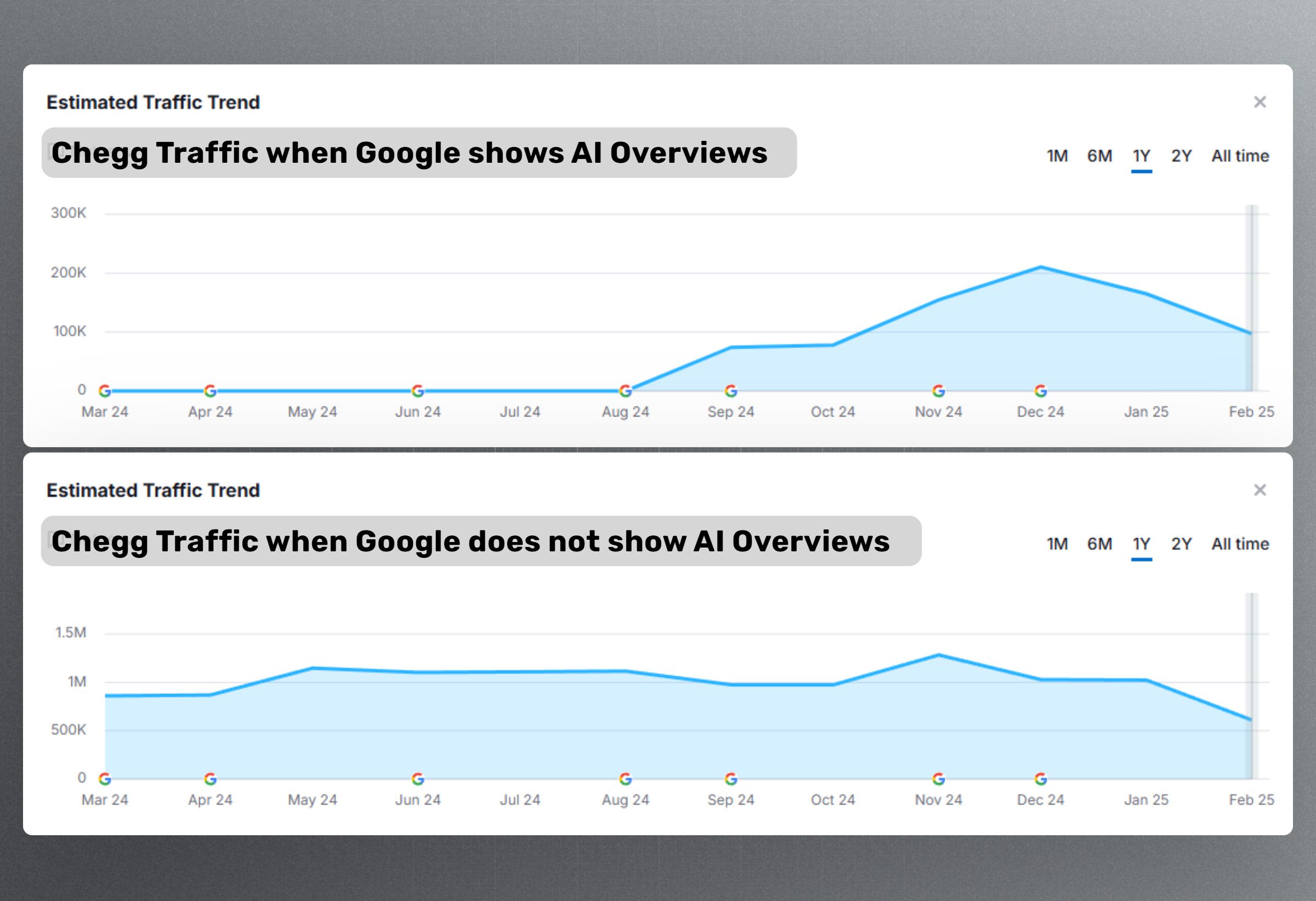
When you look at how much estimated traffic Chegg got from search results showing AI Overviews, you find it was only ~20% in December 2024, at its peak, and 15% in January 2025. Painful, but not enough to tank a company.

According to Semrush, Chegg’s organic traffic actually increased after May 2024, when AIOs launched, and only started tanking in October 2024.

According to Similarweb, total traffic declined before ChatGPT launched in November 2022.

chegg's brand search volumeImage Credit: Kevin Indig

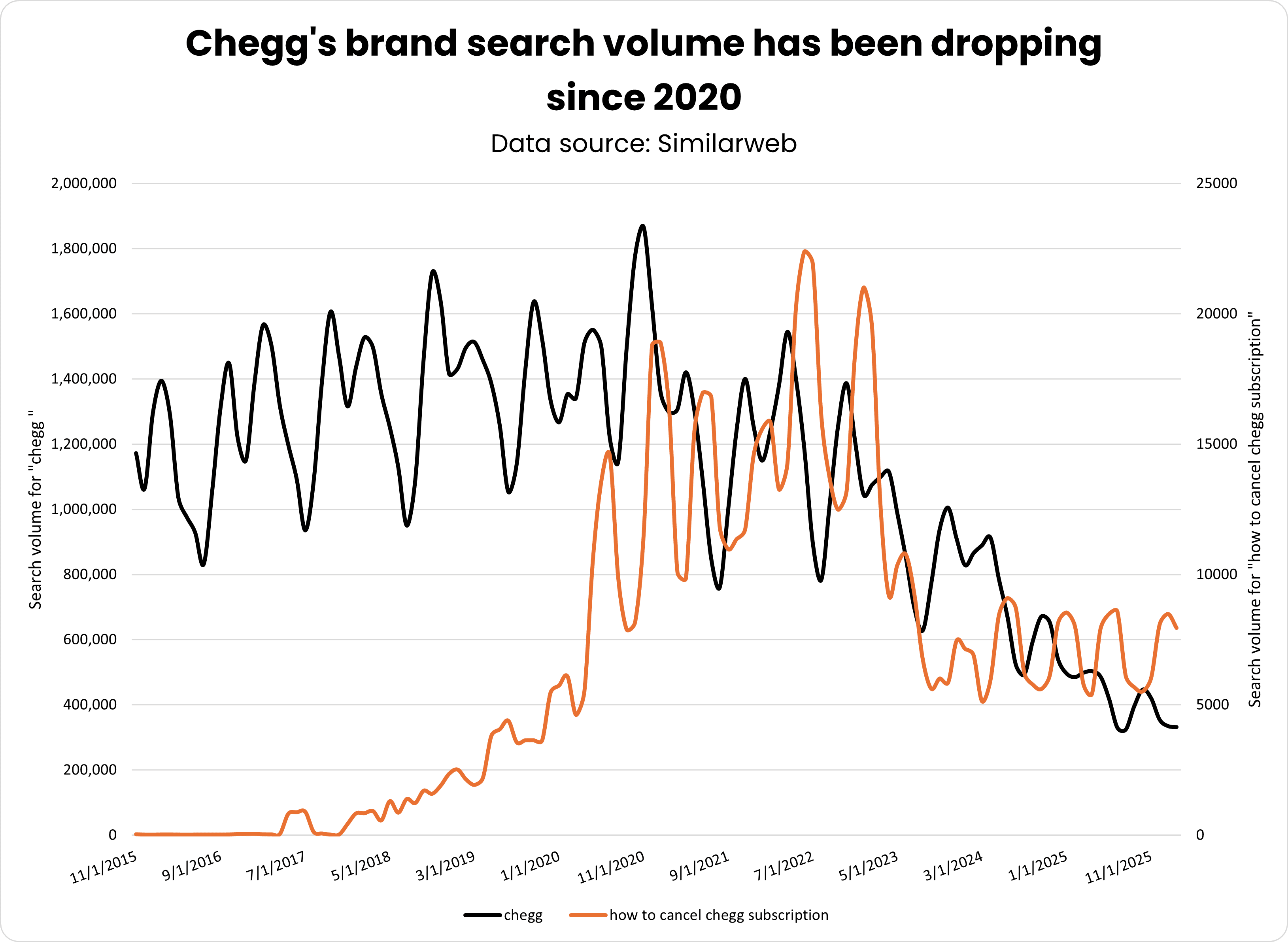
Declining brand search volume is a sign of shrinking brand awareness, product/market-fit and user retention.

The fact that brand search volume has been shrinking since 2020 and searches for cancellations have peaked before AI entered the mainstream makes me believe that the brand already had issues.

chegg's engagement metrics Image Credit: Kevin Indig

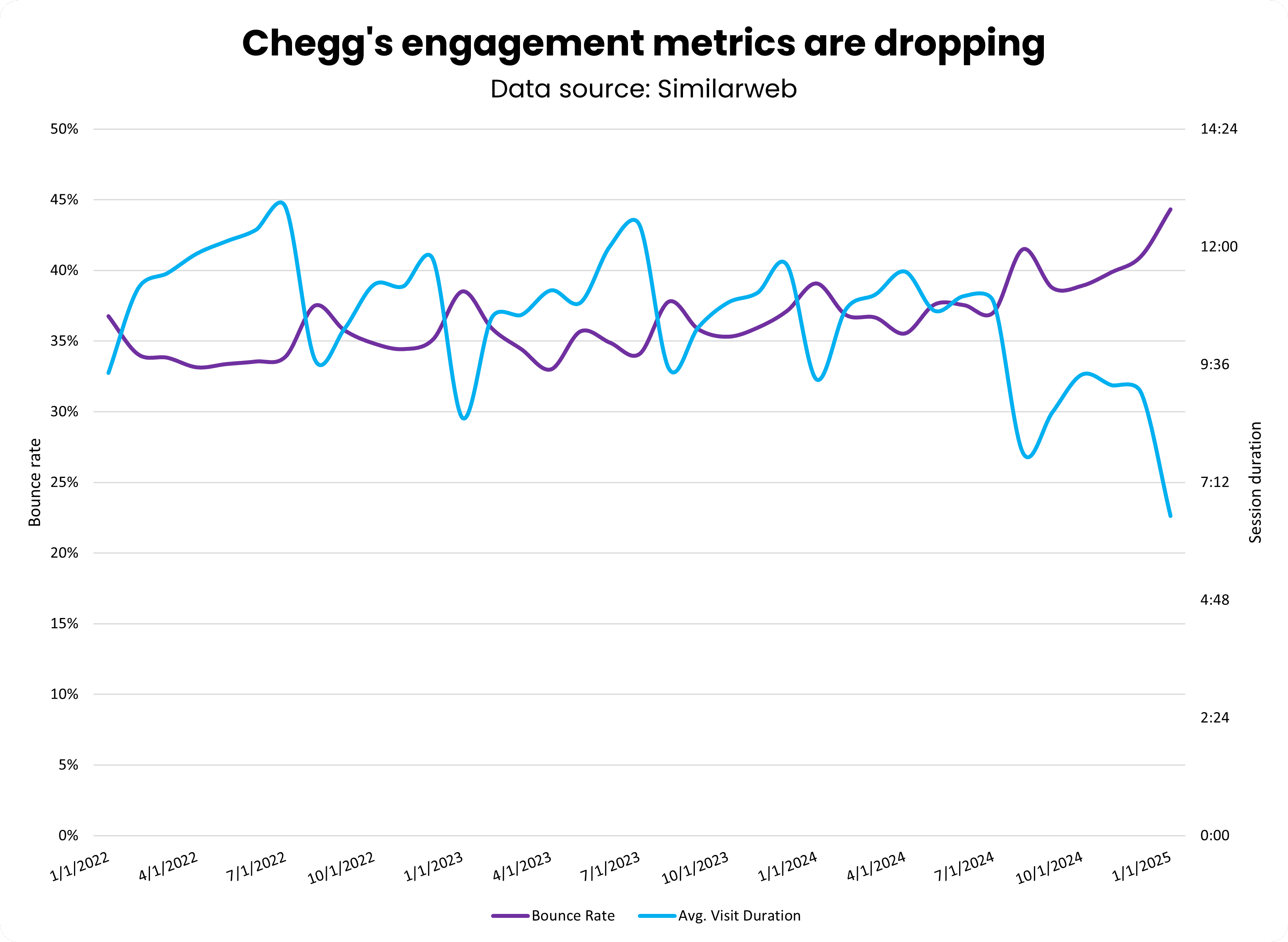
Chegg’s engagement metrics declined over the last 3 years, which is not good for SEO and not good for the business.

Bottom Line

Chegg struggled before AI. AI just accelerated the decline.

So, why doesn’t Chegg sue OpenAI & Co as well? Maybe, because AI Overviews and their impact are easier to measure.

Or, maybe because Chegg’s case could build on the lawsuit DoJ vs. Google, which already ruled Google a monopoly. The timing would fit, since the remedies are coming out in August.

Chegg could at least block LLM crawlers in their robots.txt.

Don’t get me wrong – Chegg’s lawsuit has a strong point. But I also see it as a story for investors: Chegg wants to signal that it needs to take the company private or sell (right call) because of a structural change to its business model that it’s not responsible for. The fact that the announcement was made during an earnings call supports that theory.

google search for [homework help]Image Credit: Kevin Indig

Symbolic: AI homework helper outranks Chegg for “homework help,” one of its most important keywords.

Who Else Is Impacted By AI

Chegg is a harbinger. I looked at other ed-tech sites that lean heavily on SEO and found that almost all of them saw significant traffic losses since ChatGPT came out:

  • CourseHero.
  • Brainly.
  • Studocu.
  • Quizlet.
  • Numerade.
  • Wyzant.
  • Khan Academy.
  • Codepen.
  • Study.com.
  • W3schools.
  • Stackoverflow.

The traffic data is supported by research showing that students underwent significant behavior changes (first two quotes from the WSJ article linked above):

“A survey of college students by investment bank Needham found 30% intended to use Chegg this semester, down from 38% in the spring, and 62% planned to use ChatGPT, up from 43%.”

“Researchers at the University of Illinois at Urbana-Champaign conducted a study in the spring last year to see how ChatGPT had influenced cheating in an introductory programming course. They found students had overwhelmingly moved to ChatGPT from what the researchers called “plagiarism hubs” such as Chegg.”

“A survey of 1,000 students – both domestic and international – found there had been an “explosive increase” in the use of genAI in the past 12 months. Almost nine out of 10 (88%) in the 2025 poll said they used tools such as ChatGPT for their assessments, up from 53% last year.”3

ChatGPT & Co. destroy the value of online tutoring and study tools.

Red Flags

Chegg and the other affected sites show what red flags to watch out for:

  1. > 80% organic traffic.
  2. Young target audiences.
  3. Information sites, especially marketplaces.

The companies that need to be most careful are overexposed to SEO, offer information as a product, and sell to young people.

Other industries that fit the bill and could be next on the list: Gig economy, Online Q&A, Quotes, lexica, encyclopedias, dictionaries.

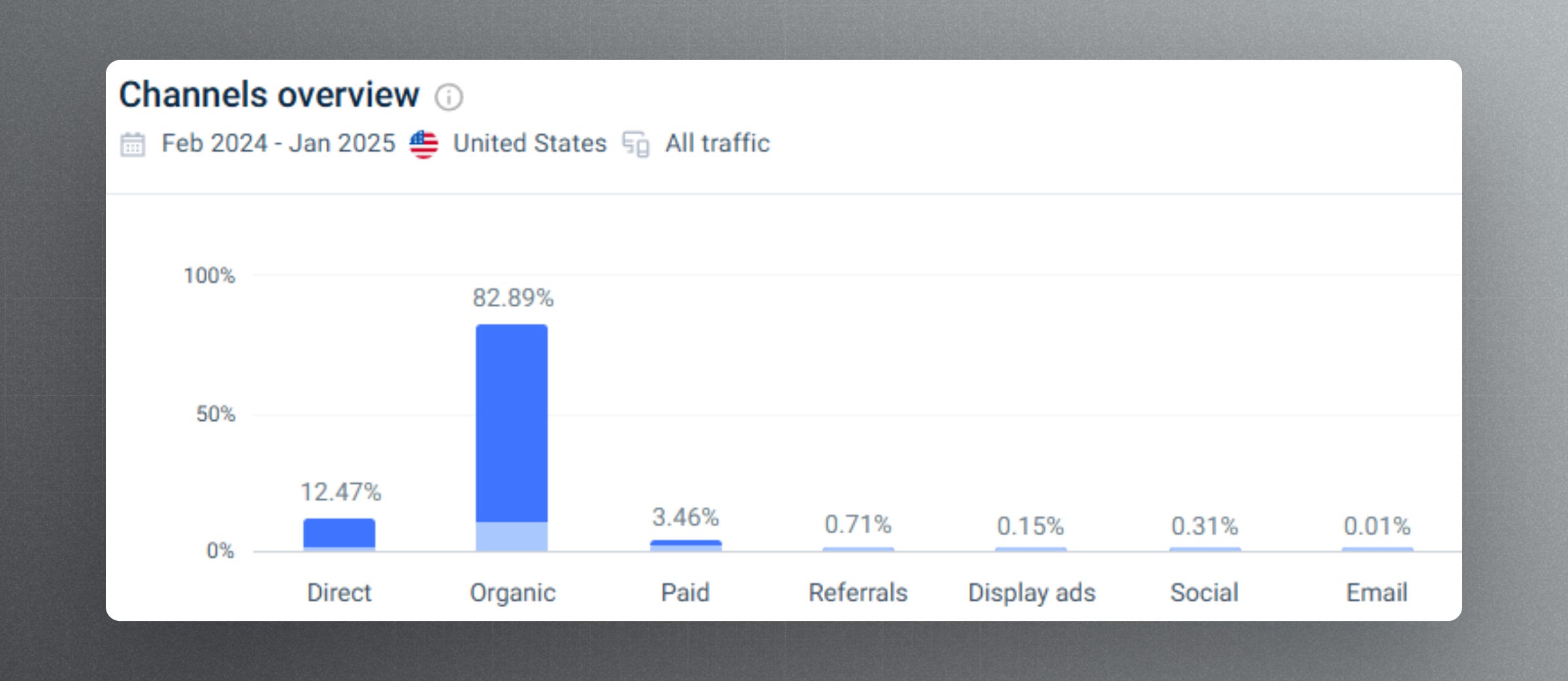
channels overviewOver 80% of Chegg’s traffic comes from SEO (Image Credit: Kevin Indig)

How To Build AI Immunity Cells

Not every ed-tech company is in the red. Scribd, Coursera, Udemy, Pearson.

Pearson is especially interesting because it’s the UK equivalent of Chegg. Even though revenue is down -3%, and its CEO acknowledged “digital learning trends” (a.k.a. AI) as a challenge, traffic is thriving.

Why? Because it’s better diversified: 65% of traffic comes direct, 18% from organic. It doesn’t have to be that little.

Each company I listed at the beginning of the paragraph is either less reliant on SEO traffic or offers content that’s hard to copy (e.g., courses).

Turning around structural declines, where user behavior and the market significantly shift, is hard. Sometimes, impossible. I’ve learned my own fair share of lessons when Shopify went through the COVID hangover.

So, what can Chegg do except find a time machine and go back 10 years to fix its overexposure on SEO?

First, taking the company private to turn it around is a good first step. The pressure of quarterly results makes a strong pivot impossible.

Second, Chegg is already working on two smart pivots:4

  1. Get away from content that’s easy for Google to copy/synthesize and focus on interactive tools and experience. The company already offers tools like a citation manager or a plagiarism checker, but it could do a lot more here.
  2. Explore related market. Chegg launched Busuu, a language learning service, and Chegg Skills, a pilot program to train students in business-relevant skills and connect them straight to businesses. But can it compete with Duolingo and Babbel? And, are new markets fruitful enough?

I’m rooting for Chegg. I want it to be a turnaround story. Godspeed.


1 Source, Source

2 How ChatGPT Brought Down an Online Education Giant

3 UK universities warned to ‘stress-test’ assessments as 92% of students use AI

4 Chegg Reports 2024 Fourth Quarter and Full Year Financial Results


Featured Image: Paulo Bobita/Search Engine Journal