Generative AI search, one of MIT Technology Review’s 10 Breakthrough Technologies of 2025, is ushering a new era of the internet. Despite fewer clicks, copyright fights, and sometimes iffy answers, AI could unlock new ways to summon all the world’s knowledge. Hear from MIT Technology Review editor in chief Mat Honan and executive editor Niall Firth as they explore how AI will alter search.
Cascading Style Sheets bring life to a website. CSS controls the appearance of HTML elements such as colors, fonts, layouts, and animations. But CSS can quickly become a tangled web of bloated and outdated styles and redundant rules. The result is often slower load times and complicated troubleshooting.
Optimizing CSS files avoids those snafus.
Verifying CSS
Start by verifying the state of your CSS files.
Browser tools. Open a website in Chrome or Firefox, right-click anywhere on the page, and select “Inspect.” Under the “Network” tab, filter by “CSS” to see each stylesheet’s size and load time.
PageSpeed Insights identifies speed optimizations such as this example for unused CSS.
Other tools can simplify the cleanup process.
UnusedCSS is a user-friendly tool that scans your website, identifies unused CSS, and generates a streamlined version. Enter your URL and let the tool do the heavy lifting.
CleanCSS offers an online CSS minifier and optimizer. It strips out unnecessary spaces and comments and removes redundant code, resulting in a leaner stylesheet.
CSS Lint doesn’t directly remove unused CSS; it highlights inefficiencies and potential errors. Use it to pinpoint areas where your CSS can be streamlined and improved.
For example, these unused styles for an old banner should be removed:
Once you’ve removed the unused code, the next step is optimizing what remains. Here are my go-to tactics.
Minification removes unnecessary characters (e.g., spaces and comments) from your CSS, reducing file size without affecting functionality. Minifier.org is my top tool.
Combine multiple CSS files into one. Fewer HTTP requests mean faster load times. However, if critical CSS is needed immediately and non-critical CSS can be loaded later, consider splitting them strategically.
Adopt a naming convention. Structured naming such as BEM helps avoid conflicts and redundancy and makes your CSS more readable and easier to optimize.
Leaner CSS
Comment strategically. Comments are useful for clarity, but excessive or outdated comments can clutter your files. Keep them relevant and update them as your code evolves.
/* This is a comment */
Responsive design. CSS media queries adapt the content to the users’ device resolution (size). However, instead of writing multiple similar queries, consider a mobile-first approach where you define the base styles and then add modifications for larger screens.
/* Base styles for mobile devices */
.container {
padding: 10px;
font-size: 16px;
background-color: #f0f0f0;
}

/* Styles for tablets and larger screens */
@media (min-width: 768px) {
.container {
padding: 20px;
font-size: 18px;
background-color: #e0e0e0;
}
}

/* Styles for desktops */
@media (min-width: 769px) {
.container {
padding: 30px;
font-size: 20px;
background-color: #d0d0d0;
}
}
Accessing CSS Files
Merchants can usually access CSS files in ecommerce platforms via the control panel or an FTP client.
Shopify. Modify CSS by logging into the admin panel, navigating to Online Store > Themes, and clicking Actions > Editcode on your active theme. In the code editor, find the CSS files in the “Assets” folder (e.g., component-discount.css,theme.css). Edit the files and save your changes to see them applied on your storefront.
PrestaShop themes typically store CSS files in the theme directory (often under /themes/your_theme/assets/css). Access and modify these files using an FTP client or via the built-in theme editor in the PrestaShop back office (if accessible). After making changes, remember to clear the cache so updates are reflected on the live site.
Magento 2. CSS is part of your theme’s structure and is usually found in the directory app/design/frontend/[Vendor]/[theme]/web/css (or as .less files under web/css/source) in modules. It’s best to create a child theme or override the default theme’s CSS files rather than editing core files directly. Once you’ve made your changes, run the static content deployment command (bin/magento setup:static-content:deploy) and flush the cache to apply the updates. Note that the static content deploy will temporarily put the website in maintenance mode.
NetSuite SuiteCommerce typically stores CSS files in the theme’s assets folder. Modify these through your local development environment or the NetSuite File Cabinet. If you’re using Sass or another preprocessor, make changes to the source files, compile them, and deploy the updated assets to your site.
WooCommerce’s CSS files typically reside in the active WordPress theme. Edit your theme’s style.css file directly or, preferably, create a child theme to override the default styles without affecting future updates. Alternatively, add custom CSS via the WordPress Customizer under Appearance > Customize > Additional CSS.
For other platforms, head to the documentation and search for “css asset management” or something similar. In my experience, every platform provides guidance on implementing or changing CSS.
A recent LinkedIn report reveals that 72% of B2B marketers feel overwhelmed by the speed at which AI is reshaping their roles.
LinkedIn Chief Economist Karin Kimbrough shared the study, exploring marketers’ current concerns and opportunities.
Overview Of LinkedIn B2B Marketing Report
AI In B2B Marketing
Approximately two-thirds (66%) of B2B marketing leaders surveyed report integrating generative AI into their marketing campaigns.
Key applications include:
Content creation: 45% leverage AI for short-form copy, 33% for blog posts.
Efficiency gains: 40% report faster workflows, while 39% use AI to scale personalized campaigns.
However, challenges persist:
43% cite insufficient AI skills on their teams.
34% express data privacy concerns, and 40% worry AI-generated content lacks a “human touch.”
Plagiarism risks (34%) and inaccuracies (32%) remain hurdles.
Despite this, 55% of organizations now offer AI training, signaling a push to close skills gaps.
LinkedIn’s data indicates that AI isn’t replacing jobs; it’s making daily tasks more efficient.
By current projections, half of today’s skills will require significant adjustments within the next five years. AI is accelerating changes to as much as 70%.
More than half (53%) of marketing professionals worry about being left behind if they don’t stay current with AI.
Short-Form Video Drives Highest ROI
According to LinkedIn’s report, video content dominates marketing strategies, with 55% of marketers citing short-form social videos as their top ROI driver.
LinkedIn data reveals:
75% use social media as their primary channel, followed by email (53%) and blogs (44%).
61% attribute increased brand engagement to bold creative campaigns.
Immersive tech is also rising:
35% use AR/VR for interactive demos and virtual events.
34% plan to adopt AR/VR this year
55% will expand connected TV (CTV) advertising investments.
Budgets Rebound
68% of marketers saw budget increases last year, and 72% expect further growth.
Priorities include:
Lead generation: 37% rank pipeline quality as their top goal.
Brand investment: 67% boosted spending on brand-building, with 88% of CMOs advocating for “riskier” creative campaigns.
CMOs Gain Influence
Marketing leaders are securing bigger seats at the table:
69% of CMOs say their role has grown in strategic importance.
77% report stronger collaboration with CFOs, emphasizing marketing’s financial impact.
84% of CMOs now actively shape company-wide budgeting and strategy.
What This Means For B2B Marketers
LinkedIn research suggests that B2B marketers who blend AI capabilities with human communication will be best positioned for success.
Marketing leaders are seeing the strongest results when they:
Use AI to handle routine tasks
Invest in visual content, especially short-form social videos
Focus on social media while maintaining active blogs and email lists.
Build stronger relationships across departments, especially with sales and finance
Demonstrate clear ROI to the C-suite
While B2B marketing is changing, opportunities exist for those who adapt their skill sets.
The research combines data from LinkedIn with survey responses from 2,001 B2B marketing leaders across eight countries.
We have been testing Google’s newest “Ask For Me” Search Lab test.
It is quick, easy, and impressive technology to request local quotes, but it is not at all clear that it is good for small businesses.
At the end of January, Rose Yao, a product lead at Google, announced a new Search Lab test (“Ask for Me”) that uses Google Duplex to automate calls to local businesses “to find out what they charge for a service and when it’s available.”
It’s testing in two categories to start: automotive service/repair and nail salons. And we just got access.
When your search query falls within one of the two test categories (e.g., oil change), the Ask for Me module appears under the Local Pack with a large call to action that encourages users to “Get started.”
Ask for Me Module, CTA (Screenshot from search, Google, February 2025)
The Ask For Me Experience
It then asked what service I needed and gave me a list of 20, from factory-scheduled maintenance to vehicle leaks. I chose “oil change” and provided complete details about my car’s make, model, year, and mileage.
I indicated my desired scheduling and preferred communication method (email or SMS) – and we were off to the races.
It took me 96 seconds, but I wasn’t clear on all of the choices. In practice, it takes less than one minute once you are familiar with the process.
What Happened After Submitting A Form?
From the time I submitted the form, it took 17 minutes to receive a response.
I was given a summary of prices and availability from the three businesses that answered the phone. Additionally, I was notified that five businesses couldn’t be reached.
Screenshot from search, Google, February 2025
Google called eight of the top nine listings in the Local Finder. The one not called was Walmart.
The businesses that responded were ranked second, third, and seventh on the Finder list.
In a second test, requesting a tire purchase and installation, Google called 11 businesses.
Six of those answered and provided information. Five of the calls went unanswered. Exactly how many locations Google will call is still TBD.
If you call after hours, Google will send back an email indicating that it will call once the businesses are open.
Screenshot of author’s email, February 2025
How This Could Be A Problem For SMBs
Google Duplex was launched in 2018, using AI “for conducting natural conversations to carry out “real world” tasks over the phone.”
That year, Google implemented a similar solution for restaurant reservations, allowing users to click a reservation button and let Google handle the process. That system is beneficial for both the user and the restaurant.
However, “Ask for Me” is different. It functions more like a Request for Proposal (RFP), letting users quickly contact multiple repair shops with minimal effort.
Even worse, it effectively pits one shop against another, which, if it were to become widely adopted, could drive auto repair shop profits down.
The product also creates additional work for local businesses.
Until auto repair shops adopt automation and bots to handle these calls, staff will be burdened with calls that take just as long as regular ones – but with less direct customer interaction and a lower chance of closing a sale.
In a nutshell, here’s what’s wrong from a business point of view (POV):
Businesses learn nothing about the potential customer.
Callers learn nothing but price and availability about the business.
Local services become further commodified.
There are obvious spam implications: local black hats using Ask for Me calling to waste a competitor’s time.
In addition, this puts pressure on local merchants to “low ball” when Google calls and potentially do a “bait and switch” when the customer actually appears.
Only A Test
As I noted in our most recent podcast, the Ask for Me test is dramatically more limited than most Google tests.
Normally, Google releases its early work on some percentage of searchers (e.g., 1%). Then, if successful, it will show the test to 10%, and so on, until a full rollout.
In this case, the user has to opt in via Search Labs, which will significantly limit the test’s scope. Unless this is a PR ploy, it would appear that Ask for Me is not ready for even a 1% rollout.
How To Opt Out From Ask For Me Duplex Calls
Businesses can opt out of receiving these calls, but the process is somewhat complicated and requires a verified profile.
To opt out of Google Duplex calls for your business, you can:
Go to your Business Profile. Select the three-dot menu.
Select Business Profile settings.
Select Advanced settings.
Under “Google Assistant calls,” turn off “Bookings from customers” or “Automated calls.”
Screenshot from Google Business Profile, February 2025
While those obsessed with efficiency may see the appeal, I’m not convinced this will actually be efficient in practice.
It looks more like a battle of attrition, with Google generating more calls and businesses wasting time quoting prices – only to lose sales to the lowest bidder.
In the process, a lot of time is wasted.
More Resources:
Featured Image: PeopleImages.com – Yuri A/Shutterstock
In this edition of Ask An SEO, we’re addressing a question about the impact of AI Overviews on search engine results pages, particularly for ecommerce store owners looking to stay competitive:
“Do you think that AI Overviews or AI will disrupt SERPs with Google PLAs? And, as someone with a small ecommerce store selling clothing, what can I do to keep ahead with the introduction of gen AI apps?”
That’s a great question! It’s an issue many ecommerce site owners have been grappling with since AI Overviews started rolling out last May.
The big concern is that Google’s generative AI summaries – which appear right at the top of the SERPs – will eat into your traffic.
If people can get answers to their questions without visiting your website, this could lead to a steep decline in customers.
However, while this new trend might at first seem worrying, I don’t think the level of disruption will be as big as it first appears, particularly for ecommerce stores. AI Overviews might also present opportunities to climb up the rankings, too.
Do note that the picture is a bit less clear with the likes of ChatGPT or Microsoft’s Copilot – these apps don’t yet provide links to sources in their answers, but they also aren’t used for search anywhere near as much as Google.
Will AI Disrupt SERPs With Google PLAs?
Generative AI is clearly one of the most disruptive technologies to emerge in years, and there are almost daily breakthroughs.
So, I’ve tried to answer the questions raised, but there’s obviously a big caveat: Things are changing fast, and we can’t make any predictions with certainty.
But to respond to the first part of the question about whether AI will disrupt SERPs, my instinct would be: “Not that much (probably!).”
First things first, research from BrightEdge (as reported in Search Engine Journal in November) found that AI Overviews are becoming more stable and aligning more closely with organic search results.
The citation links that appear alongside AI Overviews increasingly show links to websites that also appear in the top 10 results.
For example, if you were searching [how long to bake a loaf of bread], AI Overviews would typically synthesize answers from baking websites that already appear on page one.
As well as listing the websites in the SERP, AI Overviews will provide links to those pages in the “citation” area, too.
Screenshot from search for [how long to bake a loaf of bread], Google, February 2025
The appearance of AI Overviews at the top of the page has altered the look and feel of the search experience. But since Google still provides links to relevant pages in its answers, the underlying principles of ranking haven’t actually changed.
The effect of AI Overviews on Product Listing Ads (PLAs) was also asked. For the first few months after AI Overviews came out, this was a bit unclear. However, as of last October, we now have a better idea of how it’ll work.
Google announced it would begin injecting ads into AI Overviews (typically as a carousel below the text). At the time of writing, this doesn’t seem to have been fully rolled out.
But the example Google gave was of a searcher asking, [how do I get a grass stain out of jeans?]. Below the AI Overview, a carousel shows a number of related grass stain removal products.
Screenshot from blog.google, February 2025
Screenshot from blog.google, February 2025
If you pay for PLAs, then it’s likely that they will start to appear in these kinds of responses.
AI Overviews Aren’t ‘Competing’ With Ecommerce Stores
The inquirer also mentioned they run a small ecommerce store selling clothing. They may well be concerned about what AI Overviews mean for their existing ads and product pages.
Well, research from Ahrefs suggests the kind of content they likely have on their website probably isn’t competing with AI Overviews.
Ahrefs studied hundreds of thousands of searches that produced an AI Overview.
The vast majority of searches that returned an overview were informational searches (who, where, when, why, etc.) – less than 6% were commercial in nature, and less than 5% were transactional.
This suggests that a limited proportion of search intent that gets answered by AI Overviews is related to the kinds of things sold on the site.
Basically, AI Overviews answers longer tail questions like [how to style a bucket hat].
But if someone just searches [bucket hat], they’ll be shown PLAs and organic SERP results – not a generative AI response.
AI Overviews Could Help You Leapfrog Competitors
As I mentioned above, AI Overviews provide citation links to websites that also rank in the top 10 organic results.
However, an analysis from Surfer SEO suggests this only happens 52% of the time. For the other 48% of sources, websites further down the rankings (some of which may be quite obscure) can get a link right at the top of the SERPs if their content helps inform Google’s AI.
This means that, even if your website doesn’t currently rank on page one, you could still get page one levels of traffic if your content is referred to by Google.
What Can You Do To Stay Ahead As AI Becomes More Widespread?
With the same caveats mentioned above regarding the pace of change in this field, I think there are a handful of things you can do to keep getting traffic to an ecommerce store.
My first tip is simply to keep following the best practices. Sorry, I know it’s not very exciting! But the fact is, creating useful, original, accurate, and reliable content – in line with Google’s Helpful Content Update – is still the way to go.
Given that over half of the sources cited in AI Overviews also appear organically in the top 10 results of SERPs, this tells us that producing quality content remains the best way of ranking.
I’m guessing the inquirer has a fashion niche. If so, providing personalized styling ideas, seasonal fashion tips, guides to choosing the right hat/jacket/dress/jeans, etc., will all help increase the chances of winning traffic.
Another unexciting (but still reliable) tip is to follow good ecommerce “hygiene.”
Keep the product schema up to date and accurate, and provide detailed attribute tables that tell Google and other search engines what the site is about. I know, it’s hardly groundbreaking stuff. But it will help feed the algorithm and make the website more likely to appear in searches.
For product detail pages (PDPs), I’d also recommend focusing on unique product descriptions (like highlighting things about the design, the fabric, or how to style it). These are things that AI can’t figure out yet, and which the competitors may not have written about.
On that note, I’d also strongly recommend human curation when writing content.
As impressive as ChatGPT and others are, they can only regurgitate information that already exists.
To describe new products, features, or styles, you need a human to do it. Of course, generative AI can certainly help get the ball rolling if you’re staring at a blank page, but it needs your expert touch, too.
I hope this helped. Clearly, search is going through a period of massive change.
But ultimately, by following the best practices and focusing on quality, helpful content, you’ll continue to give yourself the best chances of attracting traffic and converting customers.
More Resources:
Featured Image: Paulo Bobita/Search Engine Journal
A recent discussion in a Facebook SEO group highlighted how Google’s structured data testing tool can produce misleading results, making Schema.org structured data difficult to debug. This is why the tool falls short and why Schema.org provides a better solution.
This article doesn’t link to the private Facebook group discussion but it does provide screenshots from debugging the site that was discussed.
WordPress Plugin For Structured Data
The person who started the discussion said they were using a WordPress plugin to output their structured data. Someone pointed their finger at the SEO plugin, saying that the Schema.org structured data output by plugins isn’t good enough but that answer turned out to be incorrect. It may have been an issue with the structured data selected by the user, not the plugin itself.
Structured data plugins are useful for outputting structured data because:
1. It automates the tedious task of generating a Schema.org JSON-LD structured data script.
2. It automatically outputs structured data that is required by Google.
3. Plugins will automatically update all structured data when Google changes its requirements.
The only downside, as may have been the case in this situation, is if the user chooses a structured data that’s not appropriate for their content. This can happen, for example, if the correct version is LocalBusiness, but it requires a paid version of the plugin and the user selects another type of structured data, like AggregateRating.
Google Rich Results Tool Error
The person should have been using the LocalBusiness structured data but the code on the page was for AggregateRating. But when the person checked it on Google’s structured data testing tool it incorrectly showed that they were using the LocalBusiness structured data.
Screenshot Of Misleading Google Rich Results Test
The weird part is that Google’s tool enables users to view the structured data that’s in the HTML and it accurately shows that the web page was using AggregateRating, not LocalBusiness, Schema.org structured data.
Screenshot: Google’s Tool Detects Wrong Structured Data
The tool detects LocalBusiness structured data but that is actually something that’s nested within the AggregateRating structured data, which is not detected. What the tool is showing is related to rich results, but the label on the tool confusingly says it’s showing detected structured data.
Schema.org Structured Data Validator
The more accurate Schema.org structured data validation tool is the one provided by Schema.org, not Google.
Here’s the structured data that the official Schema.org tool detected:
Why Did Google’s Tool Fail?
What happened is that the website was using the AggregateRating structured data to review their local business. Google’s Rich Results Test tool mistakenly identified the LocalBusiness structured data and ignored that the script was really about AggregateRating.
The official Schema.org validator accurately identified the structured data.
This doesn’t mean that Google’s tool is broken though. I think what’s happening is that Google’s tool has a functionality that may be limited to testing for whether a website’s structured data qualifies the page for rich results, which is why it’s called the Rich Results Tester. It maybe doesn’t validate the structured data so if you want to accurately debug your code then it’s probably a good idea to give the official Schema.org tool a spin.
If you’re having trouble debugging structured data and reading HTML isn’t a part of your skill set you may want to give the official Schema.org structured data tool a try, it may help you better understand what’s wrong with your structured data.
Many artists worry about the encroachment of artificial intelligence on artistic creation. But Sougwen Chung, a nonbinary Canadian-Chinese artist, instead sees AI as an opportunity for artists to embrace uncertainty and challenge people to think about technology and creativity in unexpected ways.
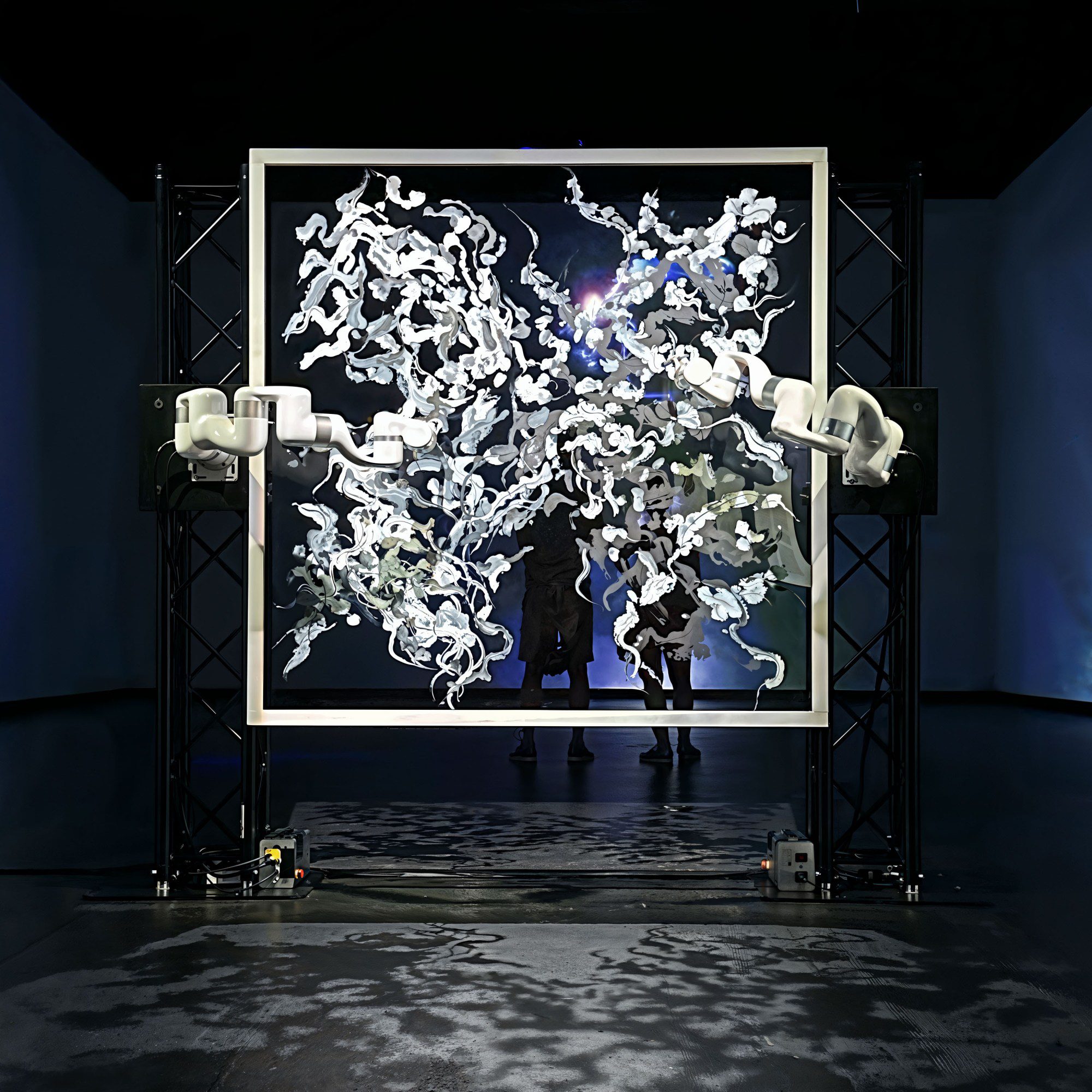
Chung’s exhibitions are driven by technology; they’re also live and kinetic, with the artwork emerging in real time. Audiences watch as the artist works alongside or surrounded by one or more robots, human and machine drawing simultaneously. These works are at the frontier of what it means to make art in an age of fast-accelerating artificial intelligence and robotics. “I consistently question the idea of technology as just a utilitarian instrument,” says Chung.
“[Chung] comes from drawing, and then they start to work with AI, but not like we’ve seen in this generative AI movement where it’s all about generating images on screen,” says Sofian Audry, an artist and scholar at the University of Quebec in Montreal, who studies the relationships that artists establish with machines in their work. “[Chung is] really into this idea of performance. So they’re turning their drawing approach into a performative approach where things happen live.”
Audiences watch as Chung works alongside or surrounded by robots, human and machine drawing simultaneously.
The artwork, Chung says, emerges not just in the finished piece but in all the messy in-betweens. “My goal,” they explain, “isn’t to replace traditional methods but to deepen and expand them, allowing art to arise from a genuine meeting of human and machine perspectives.” Such a meeting took place in January 2025 at the World Economic Forum in Davos, Switzerland, where Chung presented Spectral, a performative art installation featuring painting by robotic arms whose motions are guided by AI that combines data from earlier works with real-time input from an electroencephalogram.
“My alpha state drives the robot’s behavior, translating an internal experience into tangible, spatial gestures,” says Chung, referring to brain activity associated with being quiet and relaxed. Works like Spectral, they say, show how AI can move beyond being just an artistic tool—or threat—to become a collaborator.
Spectral, a performative art installation presented in January, featured robotic arms whose drawing motions were guided by real-time input from an EEG worn by the artist.
COURTESY OF THE ARTIST
Through AI, says Chung, robots can perform in unexpected ways. Creating art in real time allows these surprises to become part of the process: “Live performance is a crucial component of my work. It creates a real-time relationship between me, the machine, and an audience, allowing everyone to witness the system’s unpredictabilities and creative possibilities.”
Chung grew up in Canada, the child of immigrants from Hong Kong. Their father was a trained opera singer, their mom a computer programmer. Growing up, Chung played multiple musical instruments, and the family was among the first on the block to have a computer. “I was raised speaking both the language of music and the language of code,” they say. The internet offered unlimited possibilities: “I was captivated by what I saw as a nascent, optimistic frontier.”
Their early works, mostly ink drawings on paper, tended to be sprawling, abstract explosions of form and line. But increasingly, Chung began to embrace performance. Then in 2015, at 29, after studying visual and interactive art in college and graduate school, they joined the MIT Media Lab as a research fellow. “I was inspired by … the idea that the robotic form could be anything—a sculptural embodied interaction,” they say.
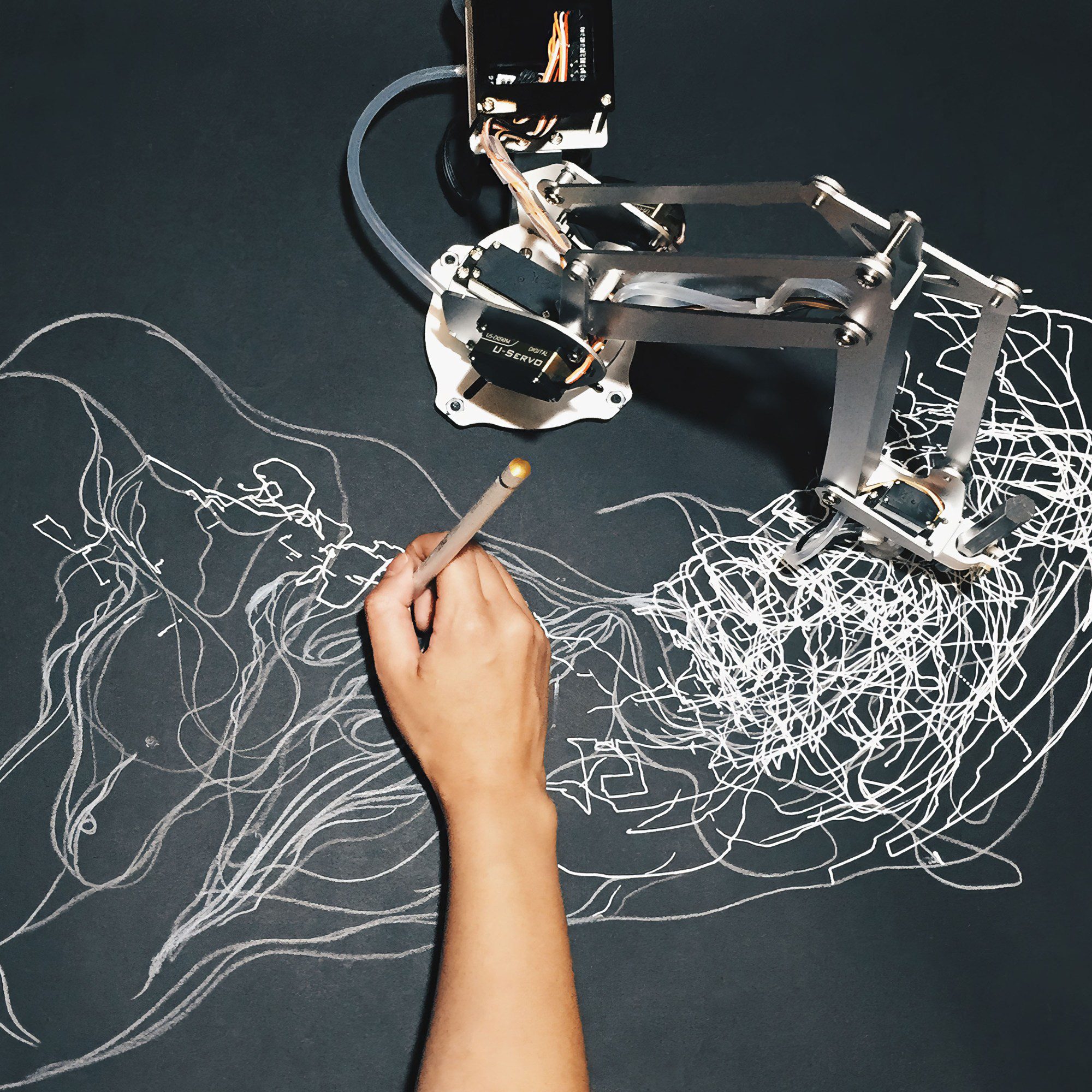
Drawing Operations Unit: Generation 1 (DOUG 1) was the first of Chung’s collaborative robots.
COURTESY OF THE ARTIST
Chung found open-source plans online and assembled a robotic arm that could hold its own pencil or paintbrush. They added an overhead camera and computer vision software that could analyze the video stream of Chung drawing and then tell the arm where to make its marks to copy Chung’s work. The robot was named Drawing Operations Unit: Generation 1, or DOUG 1.
The goal was mimicry: As the artist drew, the arm copied. Except it didn’t work out that way. The arm, unpredictably, made small errant movements, creating sketches that were similar to Chung’s—but not identical. These “mistakes” became part of the creative process. “One of the most transformative lessons I’ve learned is to ‘poeticize error,’” Chung says. “That mindset has given me a real sense of resilience, because I’m no longer afraid of failing; I trust that the failures themselves can be generative.”
DOUG 3
COURTESY OF THE ARTIST
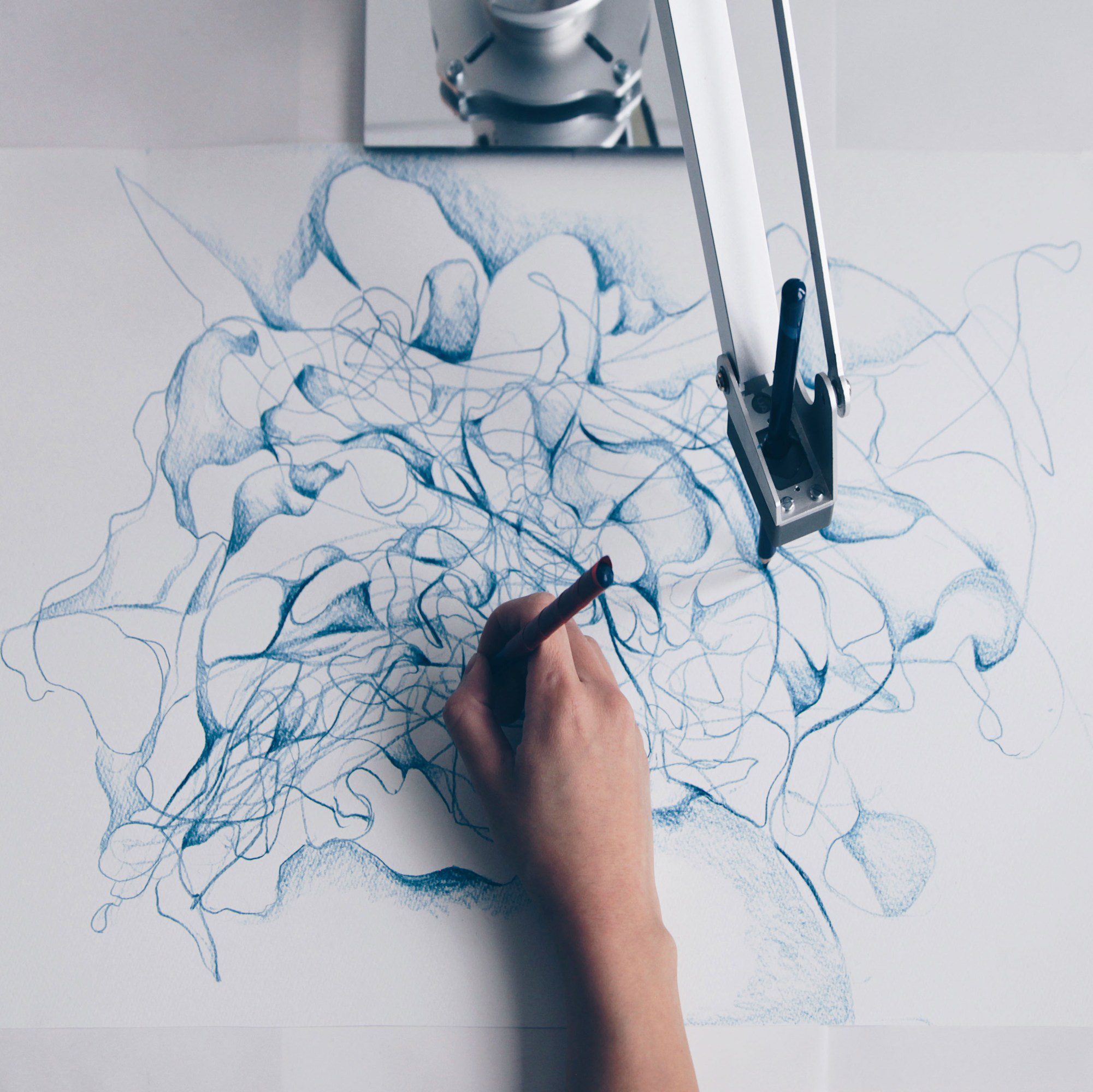
For the next iteration of the robot, DOUG 2, which launched in 2017, Chung spent weeks training a recurrent neural network using their earlier work as the training data. The resulting robot used a mechanical arm to generate new drawings during live performances. The Victoria and Albert Museum in London acquired the DOUG 2 model as part of a sculptural exhibit of Chung’s work in 2022.
DOUG 2
DOUG 4
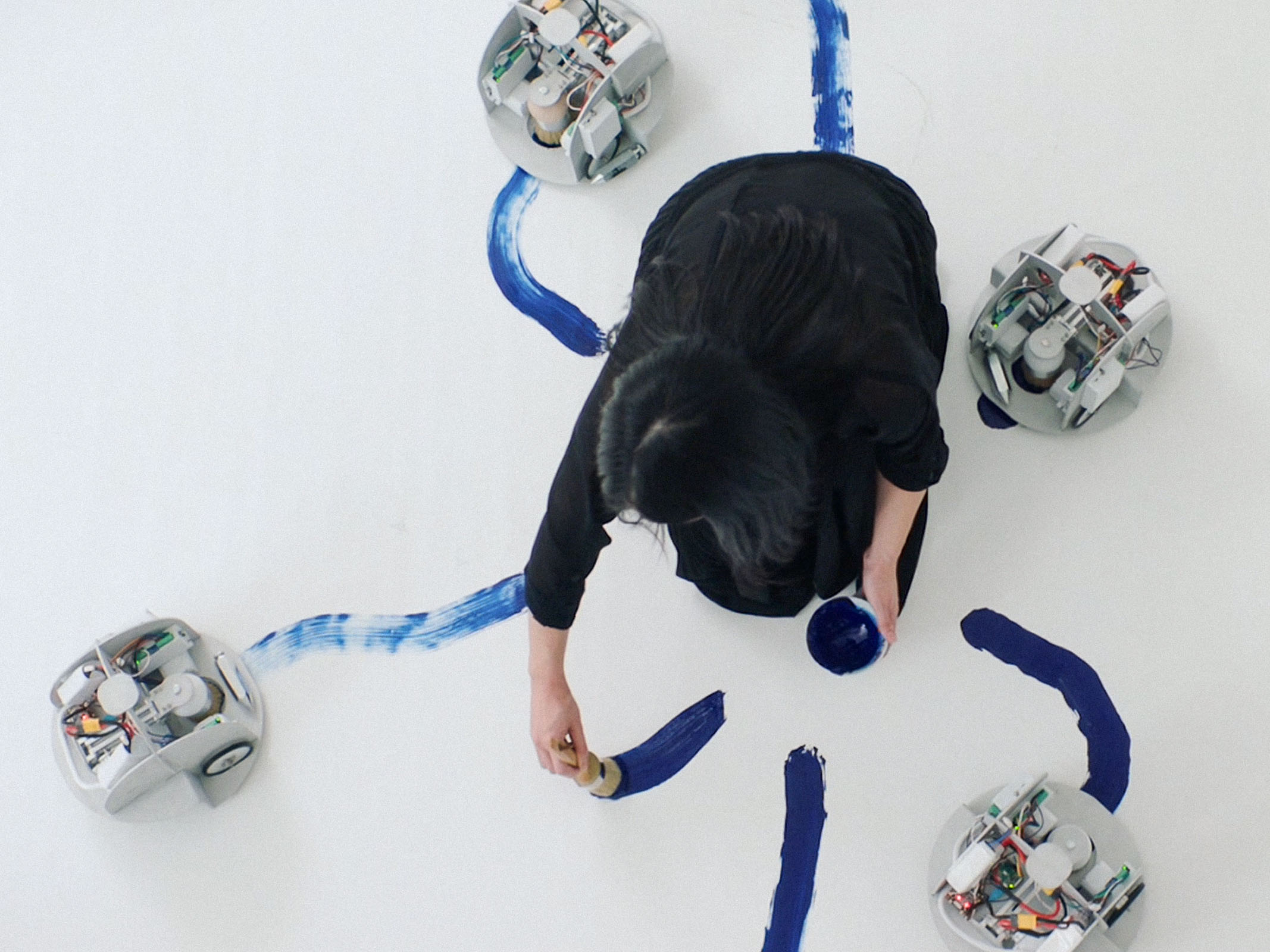
For a third iteration of DOUG, Chung assembled a small swarm of painting robots, their movements dictated by data streaming into the studio from surveillance cameras that tracked people and cars on the streets of New York City. The robots’ paths around the canvas followed the city’s flow. DOUG 4, the version behind Spectral, connects to an EEG headset that transmits electrical signal data from Chung’s brain to the robotic arms, which then generate drawings based on those signals. “The spatiality of performance and the tactility of instruments—robotics, painting, paintbrushes, sculpture—has a grounding effect for me,” Chung says.
Artistic practices like drawing, painting, performance, and sculpture have their own creative language, Chung adds. So too does technology. “I find it fascinating to [study the] material histories of all these mediums and [find] my place within it, and without it,” they say. “It feels like contributing to something that is my own and somehow much larger than myself.”
The rise of faster, better AI models has brought a flood of concern about creativity, especially given that generative technology is trained on existing art. “I think there’s a huge problem with some of the generative AI technologies, and there’s a big threat to creativity,” says Audry, who worries that people may be tempted to disengage from creating new kinds of art. “If people get their work stolen by the system and get nothing out of it, why would they go and do it in the first place?”
Chung agrees that the rights and work of artists should be celebrated and protected, not poached to fuel generative models, but firmly believes that AI can empower creative pursuits. “Training your own models and exploring how your own data work within the feedback loop of an AI system can offer a creative catalyst for art-making,” they say.
And they are not alone in thinking that the technology threatening creative art also presents extraordinary opportunities. “There’s this expansion and mixing of disciplines, and people are breaking lines and creating mixes,” says Audry, who is “thrilled” with the approaches taken by artists like Chung. “Deep learning is supporting that because it’s so powerful, and robotics, too, is supporting that. So that’s great.”
Zihao Zhang, an architect at the City College of New York who has studied the ways that humans and machines influence each other’s actions and behaviors, sees Chung’s work as offering a different story about human-machine interactions. “We’re still kind of trapped in this idea of AI versus human, and which one’s better,” he says. AI is often characterized in the media and movies as antagonistic to humanity—something that can replace our workers or, even worse, go rogue and become destructive. He believes Chung challenges such simplistic ideas: “It’s no longer about competition, but about co-production.”
Though people have valid reasons to worry, Zhang says, in that many developers and large companies are indeed racing to create technologies that may supplant human workers, works like Chung’s subvert the idea of either-or.
Chung believes that “artificial” intelligence is still human at its core. “It relies on human data, shaped by human biases, and it impacts human experiences in turn,” they say. “These technologies don’t emerge in a vacuum—there’s real human effort and material extraction behind them. For me, art remains a space to explore and affirm human agency.”
Stephen Ornes is a science writer based in Nashville.
Eske Willerslev was on a tour of Montreal’s Redpath Museum, a Victorian-era natural history collection of 700,000 objects, many displayed in wood and glass cabinets. The collection—“very, very eclectic,” a curator explained—reflects the taste in souvenirs of 19th-century travelers and geology buffs. A visitor can see a leg bone from an extinct Steller’s sea cow, a suit of samurai armor, a stuffed cougar, and two human mummies.
Willerslev, a well-known specialist in obtaining DNA from old bones and objects, saw potential biological samples throughout this hodgepodge of artifacts. Glancing at a small Egyptian cooking pot, he asked the tour leader, “Do you ever find any grain in these?” After studying a dinosaur skeleton that proved to be a cast, not actual bone, he said: “Too bad. There can be proteins on the teeth.”
“I am always thinking, ‘Is there something interesting to take DNA from?’” he said, glancing at the curators. “But they don’t like it, because …” Willerslev, who until recently traveled with a small power saw, made a back-and-forth slicing motion with his hand.
Willerslev was visiting Montreal to receive a science prize from the World Cultural Council—one previously given to the string theorist Edward Witten and the astrophysicist Margaret Burbidge, for her work on quasars. Willerslev won it for “numerous breakthroughs in evolutionary genetics.” These include recovering the first more or less complete genome of an ancient man, in 2010, and setting a record for the oldest genetic material ever retrieved: 2.4-million-year-old genes from a frozen mound in Greenland, which revealed that the Arctic desert was once a forest, complete with poplar, birch, and roaming mastodons.
These findings are only part of a wave of discoveries from what’s being called an “ancient-DNA revolution,” in which the same high-speed equipment used to study the DNA of living things is being turned on specimens from the past. At the Globe Institute, part of the University of Copenhagen, where Willerslev works, there’s a freezer full of human molars and ear bones cut from skeletons previously unearthed by archaeologists. Another holds sediment cores drilled from lake bottoms, in which his group is finding traces of entire ecosystems that no longer exist.
“We’re literally walking on DNA, both from the present and from the past.”
Eske Willerslev
Thanks to a few well-funded labs like the one in Copenhagen, the gene time machine has never been so busy. There are genetic maps of saber-toothed cats, cave bears, and thousands of ancient humans, including Vikings, Polynesian navigators, and numerous Neanderthals. The total number of ancient humans studied is more than 10,000 and rising fast, according to a December 2024 tally that appeared in Nature. The sources of DNA are increasing too. Researchers managed to retrieve an Ice Age woman’s genome from a carved reindeer tooth, whose surface had absorbed her DNA. Others are digging at cave floors and coming up with records of people and animals that lived there.
“We’re literally walking on DNA, both from the present and from the past,” Willerslev says.
Eske Willerslev leads one of a handful of laboratories pioneering the extraction and sequencing of ancient DNA from humans, animals, and the environment. His group’s main competition is at Harvard University and at the Max Planck Institute for Evolutionary Anthropology in Leipzig, Germany.
JONAS PRYNER ANDERSEN
The old genes have already revealed remarkable stories of human migrations around the globe. But researchers are hoping ancient DNA will be more than a telescope on the past—they hope it will have concrete practical use in the present. Some have already started mining the DNA of our ancestors for clues to the origin of modern diseases, like diabetes and autoimmune conditions. Others aspire to use the old genetic data to modify organisms that exist today.
At Willerslev’s center, for example, a grant of 500 million kroner ($69 million) from the foundation that owns the Danish drug company Novo Nordisk is underwriting a project whose aims include incorporating DNA variation from plants that lived in ancient climates into the genomes of food crops like barley, wheat, and rice. The plan is to redesign crops and even entire ecosystems to resist rising temperatures or unpredictable weather, and it is already underway—last year, barley shoots bearing genetic information from plants that lived in Greenland 2 million years ago, when temperatures there were far higher than today, started springing up in experimental greenhouses.
Willerslev, who started out looking for genetic material in ice cores, is leaning into this possibility as the next frontier of ancient-DNA research, a way to turn it from historical curiosity to potential planet-saver. If nothing is done to help food crops adapt to climate change, “people will starve,” he says. “But if we go back into the past in different climate regimes around the world, then we should be able to find genetic adaptations that are useful. It’s nature’s own response to a climate event. And can we get that? Yes, I believe we can.”
Shreds and traces
In 1993, just a day before the release of the blockbuster Steven Spielberg film Jurassic Park, scientists claimed in a paper that they had extracted DNA from a 120-million-year-old weevil preserved in amber. The discovery seemed to bring the film’s premise of a cloned T. rex closer to reality. “Sooner or later,” a scientist said at the time, “we’re going to find amber containing some biting insect that filled its stomach with blood from a dinosaur.”
But those results turned out to be false—likely the result of contamination by modern DNA. The problem is that modern DNA is much more abundant than what’s left in an old tooth or sample of dirt. That’s because the genetic molecule is constantly chomped on by microbes and broken up by water and radiation. Over time, the fragments get smaller and smaller, until most are so short that no one can tell whether they belonged to a person or a saber-toothed cat.
“Imagine an ancient genome as a big old book, and that all the pages have been torn out, put through a shredder, and tossed into the air to be lost with the wind. Only a few shreds of paper remain. Even worse, they are mixed with shreds of paper from other books, old and new,” says Elizabeth Jones, a science historian. Her 2022 book, Ancient DNA: The Making of a Celebrity Science, details researchers’ overwhelming fear of contamination—both literal, from modern DNA, and of the more figurative sort that can occur when scientists are so tempted by the prospect of fame and being first that they risk spinning sparse data into far-fetched stories.
“When I entered the field, my supervisor said this is a very, very dodgy path to take,” says Willerslev.
But the problem of mixed-up and fragmented old genes was largely solved beginning in 2005, when US companies first introduced ultra-fast next-generation machinery for analyzing genomes. These machines, meant for medical research, required short fragments for fast performance. And ancient-DNA researchers found they could use them to brute-force their way through even poorly preserved samples. Almost immediately, they started recovering large parts of the genomes of cave bears and woolly mammoths.
Ancient humans were not far behind. Willerslev, who was not yet famous, didn’t have access to human bones, and definitely not the bones of Neanderthals (the best ones had been corralled by the scientist Svante Pääbo, who was already analyzing them with next-gen sequencers in Germany). But Willerslev did learn about a six-inch-long tuft of hair collected from a 4,000-year-old midden, or trash heap, on Greenland’s coast. The hair had been stored in a plastic bag in Denmark’s National Museum for years. When he asked about it, curators told him they thought it was human but couldn’t be sure.
“Well, I mean, do you know any other animal in Greenland with straight black hair?” he says. “Not really, right?”
The hair turned out to contain well-preserved DNA, and in 2010, Willerslev published a paper in Nature describing the genome of “an extinct Paleo-Eskimo.” It was the first more or less complete human genome from the deep past. What it showed was a man with type A+ blood, probably brown eyes and thick dark hair, and—most tellingly—no descendants. His DNA code had unique patterns not found in the Inuit who occupy Greenland today.
“Give the archaeologists credit … because they have the hypothesis. But we can nail it and say, ‘Yes, this is what happened.’”
Lasse Vinner
The hair had come from a site once occupied by a group called the Saqqaq, who first reached Greenland around 4,500 years ago. Archaeologists already knew that the Saqqaq’s particular style of making bird darts and spears had vanished suddenly, but perhaps that was because they’d merged with another group or moved away. Now the man’s genome, with specific features pointing to a genetic dead end, suggested they really had died out, very possibly because extreme isolation, and inbreeding, had left them vulnerable. Maybe there was a bad year when the migrating reindeer did not appear.
“Give the archaeologists credit … because they have the hypothesis. But we can nail it and say, ‘Yes, this is what happened,’” says Lasse Vinner, who oversees daily operations at the Copenhagen ancient-DNA lab. “We’ve substantiated or falsified a number of archaeological hypotheses.”
In November, Vinner, zipped into head-to-toe white coveralls, led a tour through the Copenhagen labs, located in the basement of the city’s Natural History Museum. Samples are processed there in a series of cleanrooms under positive air pressure. In one, the floors were still wet with bleach—just one of the elaborate measures taken to prevent modern DNA from getting in, whether from a researcher’s shoes or from floating pollen. It’s partly because of the costly technologies, cleanrooms, and analytical expertise required for the work that research on ancient human DNA is dominated by a few powerful labs—in Copenhagen, at Harvard University, and in Leipzig, Germany—that engage in fierce competition for valuable samples and discoveries. A 2019 New York Times Magazine investigation described the field as an “oligopoly,” rife with perverse incentives and a smash-and-grab culture—in other words, artifact chasing straight out of Raiders of the Lost Ark.
To get his share, Willerslev has relied on his growing celebrity, projecting the image of a modern-day explorer who is always ready to trade his tweeds for muck boots and venture to some frozen landscape or Native American cave. Add to that a tale of redemption. Willerslev often recounts his struggles in school and as a would-be mink hunter in Siberia (“I’m not only a bad student—I’m also a tremendously bad trapper,” he says) before his luck changed once he found science.
This narrative has made him a favorite on television programs like Nova and secured lavish funding from Danish corporations. His first autobiography was titled From Fur Hunter to Professor. A more recent one is called simply It’s a Fucking Adventure.
Peering into the past
The scramble for old bones has produced a parade of headlines about the peopling of the planet, and especially of western Eurasia—from Iceland to Tehran, roughly. That’s where most ancient DNA samples originate, thanks to colder weather, centuries of archaeology, and active research programs. At the National Museum in Copenhagen, some skeletons on display to the public have missing teeth—teeth that ended up in the Globe Institute’s ancient-DNA lab as part of a project to analyze 5,000 sets of remains from Eurasia, touted as the largest single trove of old genomes yet.
What ancient DNA uncovered in Europe is a broad-brush story of three population waves of modern humans. First to come out of Africa were hunter-gatherers who dispersed around the continent, followed by farmers who spread out of Anatolia starting 11,000 years ago. That wave saw the establishment of agriculture and ceramics and brought new stone tools. Last came a sweeping incursion of people (and genes) from the plains of modern Ukraine and Russia—animal herders known as the Yamnaya, who surged into Western Europe spreading the roots of the Indo-European languages now spoken from Dublin to Bombay.
Mixed history
The DNA in ancient human skeletons reveals prehistoric migrations.
The genetic background of Europeans was shaped by three major migrations starting about 45,000 years ago. First came hunter-gatherers. Next came farmers from Anatolia, bringing crops and new ways of living. Lastly, mobile herders called the Yamnaya spread from the steppes of modern Russia and Ukraine. The DNA in ancient skeletons holds a record of these dramatic population changes.
Adapted from “100 ancient genomes show repeated population turnovers in Neolithic Denmark,” Nature, January 10, 2024, and “Tracing the peopling of the world through genomics,” Nature, January 18, 2017
Archaeologists had already pieced together an outline of this history through material culture, examining shifts in pottery styles and burial methods, the switch from stone axes to metal ones. Some attributed those changes to cultural transmission of knowledge rather than population movements, a view encapsulated in the phrase “pots, not people.” However, ancient DNA showed that much of the change was, in fact, the result of large-scale migration, not all of which looks peaceful. Indeed, in Denmark, the hunter-gatherer DNA signature all but vanishes within just two generations after the arrival of farmers during the late Stone Age. To Willerslev, the rapid population replacement “looks like some kind of genocide, to be honest.” It’s a guess, of course, but how else to explain the “limited genetic contribution” to subsequent generations of the blue-eyed, dark-haired locals who’d fished and hunted around Denmark’s islands for nearly 5,000 years? Certainly, the bodies in Copenhagen’s museums suggest violence—some have head injuries, and one still has arrows in it.
In other cases, it’s obvious that populations met and mixed; the average ethnic European today shares some genetic contribution from all three founding groups—hunter, farmer, and herder—and a little bit from Neanderthals, too.“We had the idea that people stay put, and if things change, it’s because people learned to do something new, through movements of ideas,” says Willerslev. “Ancient DNA showed that is not the case—that the transitions from hunter-gatherers to farming, from bronze to iron, from iron to Viking, [are] actually due to people coming and going, mixing up and bringing new knowledge.” It means the world that we observe today, with Poles in Poland and Greeks in Greece, “is very, very young.”
With an increasing number of old bodies giving up their DNA secrets, researchers have started to search for evidence of genetic adaptation that has occurred in humans since the last ice age (which ended about 12,000 years ago), a period that the Copenhagen group noted, in a January 2024 report, “involved some of the most dramatic changes in diet, health, and social organization experienced during recent human evolution.”
Every human gene typically comes in a few different possible versions, and by studying old bodies, it’s possible to see which of these versions became more common or less so with time—potentially an indicator that they’re “under selection,” meaning they influenced the odds that a person stayed alive to reproduce. These pressures are often closely tied to the environment. One clear signal that pops out of ancient European genes is a trend toward lighter skin—which makes it easier to produce vitamin D in the face of diminished sunlight and a diet based on grains.
DNA from ancient human skeletons could help us understand the origins of modern diseases, like multiple sclerosis.
MIKAL SCHLOSSER/UNIVERSITY OF COPENHAGEN
New technology and changing lifestyles—like agriculture and living in proximity to herd animals (and their diseases)—were also potent forces. Last fall, when Harvard University scientists scanned DNA from skeletons, they said they’d detected “rampant” evidence of evolutionary action. The shifts appeared especially in immune system genes and in a definite trend toward less body fat, the genetic markers of which they found had decreased significantly “over ten millennia.” That finding, they said, was consistent with the “thrifty gene” hypothesis, a feast-or-famine theory developed in the 1960s, which states that before the development of farming, people needed to store up more food energy, but doing so became less of an advantage as food became more abundant.
Many of the same genes that put people at risk for multiple sclerosis today almost certainly had some benefit in the past.
Such discoveries could start to explain some modern disease mysteries, such as why multiple sclerosis is unusually common in Nordic countries, a pattern that has perplexed doctors.
The condition seems to be a “latitudinal disease,” becoming more prevalent the farther north you go; theories have pointed to factors including the relative lack of sunlight. In January of last year, the Copenhagen team, along with colleagues, claimed that ancient DNA had solved the riddle, saying the increased risk could be explained in part by the very high amount of Yamnaya ancestry among people in Sweden, Norway, and Denmark.
When they looked at modern people, they found that mutations known to increase the risk of multiple sclerosis were far more likely to occur in stretches of DNA people had inherited from these Yamnaya ancestors than in parts of their genomes originating elsewhere.
There’s a twist to the story: Many of the same genes that put people at risk for multiple sclerosis today almost certainly had some benefit in the past. In fact, there’s a clear signal these gene versions were once strongly favored and on the increase. Will Barrie, a postdoc at Cambridge University who collaborated on the research, says the benefit could have been related to germs and infections that these pastoralists were getting from animals. But if modern people don’t face the same exposures, their immune system might still try to box at shadows, resulting in autoimmune disease. That aligns with evidence that children who aren’t exposed to enough pathogens may be more likely to develop allergies and other problems later in life.
“I think the whole sort of lesson of this work is, like, we are living with immune systems that we have inherited from our past,” says Barrie. “And we’ve plunged it into a completely new, modern environment, which is often, you know, sanitary.”
Telling stories about human evolution often involves substantial guesswork—findings are frequently reversed. But the researchers in Copenhagen say they will be trying to more systematically scan the past for health clues. In addition to the DNA of ancient peoples, they’re adding genetic information on what pathogens these people were infected with (germs based on DNA, like plague bacteria, can also get picked up by the sequencers), as well as environmental data, such as average temperatures at points in the past, or the amount of tree cover, which can give an idea of how much animal herding was going on. The resulting “panels”—of people, pathogens, and environments—could help scientists reach stronger conclusions about cause and effect.
Some see in this research the promise of a new kind of “evolutionary medicine”—drugs tailored to your ancestry. However, the research is not far enough along to propose a solution for multiple sclerosis.
For now, it’s just interesting. Barrie says several multiple sclerosis patients have written him and said they were comforted to think their affliction had an explanation. “We know that [the genetic variants] were helpful in the past. They’re there for a reason, a good reason—they really did help your ancestors survive,” he says. “I hope that’s helpful to people in some sense.”
Bringing things back
In Jurassic Park, which was the highest-grossing movie of all time until Titanic came out in 1997, scientists don’t just get hold of old DNA. They also use it to bring dinosaurs back to life, a development that leads to action-packed and deadly consequences.
The idea seemed like fantasy when the film debuted. But Jurassic Park presaged current ambitions to bring past genes into the present. Some of these efforts are small in scale. In 2021, for instance, researchers added a Neanderthal gene to human cells and turned those into brain organoids, which they reported were smaller and lumpier than expected. Others are aiming for living animals. Texas-based Colossal Biosciences, which calls itself the “first de-extinction company,” says it will be trying to use a combination of gene editing, cloning, and artificial wombs to re-create extinct species such as mammoths and the Tasmanian tiger, or thylacine.
Colossal recently recruited a well-known paleogenomics expert, Beth Shapiro, to be its chief scientist. In 2022, Shapiro, previously an advisor to the company, said that she had sequenced the genome of an extinct dodo bird from a skull kept in a museum. “The past, by its nature, is different from anything that exists today,” says Shapiro, explaining that Colossal is “reaching into the past to discover evolutionary innovations that we might use to help species and ecosystems thrive today and into the future.”
The idea of bringing extinct animals back to life seemed like fantasy when Jurassic Park debuted. But the film presaged current ambitions to bring past genes into the present.
It’s not yet clear how realistic the company’s plan to reintroduce missing species and restore nature’s balance really is, although the public would likely buy tickets to see even a poor copy of an extinct animal. Some similar practical questions surround the large grant Willerslev won last year from the philanthropic foundation of Novo Nordisk, whose anti-obesity drugs have turned it into Denmark’s most valuable company.
The project’s concept is to read the blueprints of long-gone ecosystems and look for genetic information that might help major food crops succeed in shorter or hotter growing seasons. Willerslev says he’s concerned that climate change will be unpredictable—it’s hard to say if it will be too wet in any particular area or too dry. But the past could offer a data bank of plausible solutions, which he thinks needs to be prepared now.
The prototype project is already underway using unusual mutations in plant DNA found in the 2-million-year-old dirt samples from Greenland. Some of these have been introduced into modern barley plants by the Carlsberg Group, a brewer that is among the world’s largest beer companies and operates an extensive crop lab in Copenhagen.
Eske Willerslev collects samples in the Canadian Arctic during a summer 2024 field trip. DNA preserved in soil could help determine how megafauna, like the woolly mammoth, went extinct.
RYAN WILKES/UNIVERSITY OF COPENHAGEN
One gene being studied is for a blue-light receptor, a protein that helps plants decide when to flower—a trait also of interest to modern breeders. Two and a half million years ago, the world was warm, and parts of Greenland particularly so—more than 10 °C hotter than today. That is why vegetation could grow there. But Greenland hasn’t moved, so the plants must have also been specially adapted to the stress of a months-long dusk followed by weeks of 24-hour sunlight. Willerslev says barley plants with the mutation are already being grown under different artificial light conditions, to see the effects.
“Our hypothesis is that you could use ancient DNA to identify new traits and as a blueprint for modern crop breeding,” says Birgitte Skadhauge, who leads the Carlsberg Research Laboratory. The immediate question is whether barley can grow in the high north—say, in Greenland or upper Norway, something that could be important on a warming planet. The research is considered exploratory and separate from Carlsberg’s usual commercial efforts to discover useful traits that cut costs—of interest since it brews 10 billion liters of beer a year, or enough to fill the Empire State Building nine times.
Scientists often try hit-or-miss strategies to change plant traits. But Skadhauge says plants from unusual environments, like a warm Greenland during the Pleistocene era, will have incorporated the DNA changes that are important already. “Nature, you know, actually adapted the plants,” she says. “It already picked the mutation that was useful to it. And if nature has adapted to climate change over so many thousands of years, why not reuse some of that genetic information?”
Many of the lake cores being tapped by the Copenhagen researchers cover more recent times, only 3,000 to 10,000 years ago. But the researchers can also use those to search for ideas—say, by tracing the genetic changes humans imposed on barley as they bred it to become one of humanity’s “founder crops.” Among the earliest changes people chose were those leading to “naked” seeds, since seeds with a sticky husk, while good for making beer, tend to be less edible. Skadhauge says the team may be able to reconstruct barley’s domestication, step by step.
There isn’t much precedent for causing genetic information to time-travel forward. To avoid any Jurassic Park–type mishaps, Willerslev says, he’s building a substantial ethics team “for dealing with questions about what does it mean if you’re introducing ancient traits into the world.” The team will have to think about the possibility that those plants could outcompete today’s varieties, or that the benefits would be unevenly distributed—helping northern countries, for example, and not those closer to the equator.
Willerslev says his lab’s evolution away from human bones toward much older DNA is intentional. He strongly hints that the team has already beat its own record for the oldest genes, going back even more than 2.4 million years. And as the first to look further back in time, he’s certain to make big discoveries—and more headlines. “It’s a blue ocean,” he says—one that no one has ever seen.
A new adventure, he says, is practically guaranteed.
This is today’s edition of The Download, our weekday newsletter that provides a daily dose of what’s going on in the world of technology.
Adventures in the genetic time machine
An ancient-DNA revolution is turning the high-speed equipment used to study the DNA of living things on to specimens from the past.
The technology is being used to create genetic maps of saber-toothed cats, cave bears, and thousands of ancient humans, including Vikings, Polynesian navigators, and numerous Neanderthals. The total number of ancient humans studied is more than 10,000 and rising fast.
The old genes have already revealed remarkable stories of human migrations around the globe.
But researchers are hoping ancient DNA will be more than a telescope on the past—they hope it will have concrete practical use in the present. Read the full story.
—Antonio Regalado
This artist collaborates with AI and robots
Many artists worry about the encroachment of artificial intelligence on artistic creation. But Sougwen Chung, a nonbinary Canadian-Chinese artist, instead sees AI as an opportunity for artists to embrace uncertainty and challenge people to think about technology and creativity in unexpected ways.
Chung’s exhibitions are driven by technology; they’re also live and kinetic, with the artwork emerging in real time. Audiences watch as the artist works alongside or surrounded by one or more robots, human and machine drawing simultaneously. These works are at the frontier of what it means to make art in an age of fast-accelerating artificial intelligence and robotics. Here’s what they have to say about their work, and AI in art generally.
—Stephen Ornes
Both of the subscriber-only stories above are from the next edition of our print magazine, which is all about relationships. Subscribe now to get a copy when it lands on February 26!
The must-reads
I’ve combed the internet to find you today’s most fun/important/scary/fascinating stories about technology.
1 US disease monitoring capabilities are disappearing DOGE just fired half of a critical ‘disease detective’ team at the Centers of Disease Control and Prevention. (CBS) + A measles outbreak in Texas is spreading rapidly. (NBC) + Louisiana said it’ll stop promoting mass vaccination programs, on the same day RFK Jr was sworn in as health secretary. (NYT $) + Why childhood vaccines are a public health success story. (MIT Technology Review)
2 Who is Elon Musk accountable to? When you’re the world’s richest man, it seems the answer is: no one. (WSJ $) + Musk is using X to spread misinformation about DOGE’s targets. (WP $) + A Musk-linked group offered $5 million for proof of voter fraud. It couldn’t find any. (The Guardian)
3 South Korea removed DeepSeek from app stores Quite a few countries have done this now, citing privacy concerns. (BBC) + Baidu and OpenAI are responding to DeepSeek with new launches. (CNN) + E-scooter brands are among many companies in China racing to integrate DeepSeek AI. (South China Morning Post $) + Four Chinese AI startups to watch beyond DeepSeek. (MIT Technology Review)
4 Inside the US’s fragile nuclear renaissance Tech companies are betting that it can help meet AI’s energy demands. But huge challenges lay ahead. (The Information $) + Why Microsoft made a deal to help restart Three Mile Island. (MIT Technology Review)
5 OpenAI’s board rejected Elon Musk’s offer to buy it for $97.4 billion Unanimously. (WSJ $) + Musk did it to try to chuck a grenade into OpenAI’s process of transitioning from a research lab to a for-profit company. (Vox $)
6 A new system can clone your voice from just five seconds of audio And the end result is scarily good. (The Register) + Motor neuron diseases took their voices. AI is bringing them back. (MIT Technology Review)
7 People who lost money on crypto are furious with Argentina’s President He’s facing impeachment calls over allegations he promoted a classic ‘pump and dump’ scam over the weekend. (CNN)
8 How musicians are using AI tools AI makes it easy to do traditionally tricky engineering tasks like isolating and extracting sounds. (The Next Web) + A Disney director tried—and failed—to use an AI Hans Zimmer to create a soundtrack. (MIT Technology Review)
9Meta is working on humanoid robots It’s hoping it can combine its experience in both hardware and AI to win in this increasingly crowded category. (Bloomberg $) + China’s EV giants are betting big on humanoid robots. (MIT Technology Review)
10 How Diablo hackers uncovered a speedrunning scandal This makes me wonder just how endemic cheating could be in the gaming community. (Ars Technica)
Quote of the day
“He seems to have ghosted his own company.”
—Investor Nell Minow, vice chair of ValueEdge Advisors, tells the Washington Post that Elon Musk’s inattention is starting to do real harm to Tesla.
The big story
Three-parent baby technique could create babies at risk of severe disease
March 2023
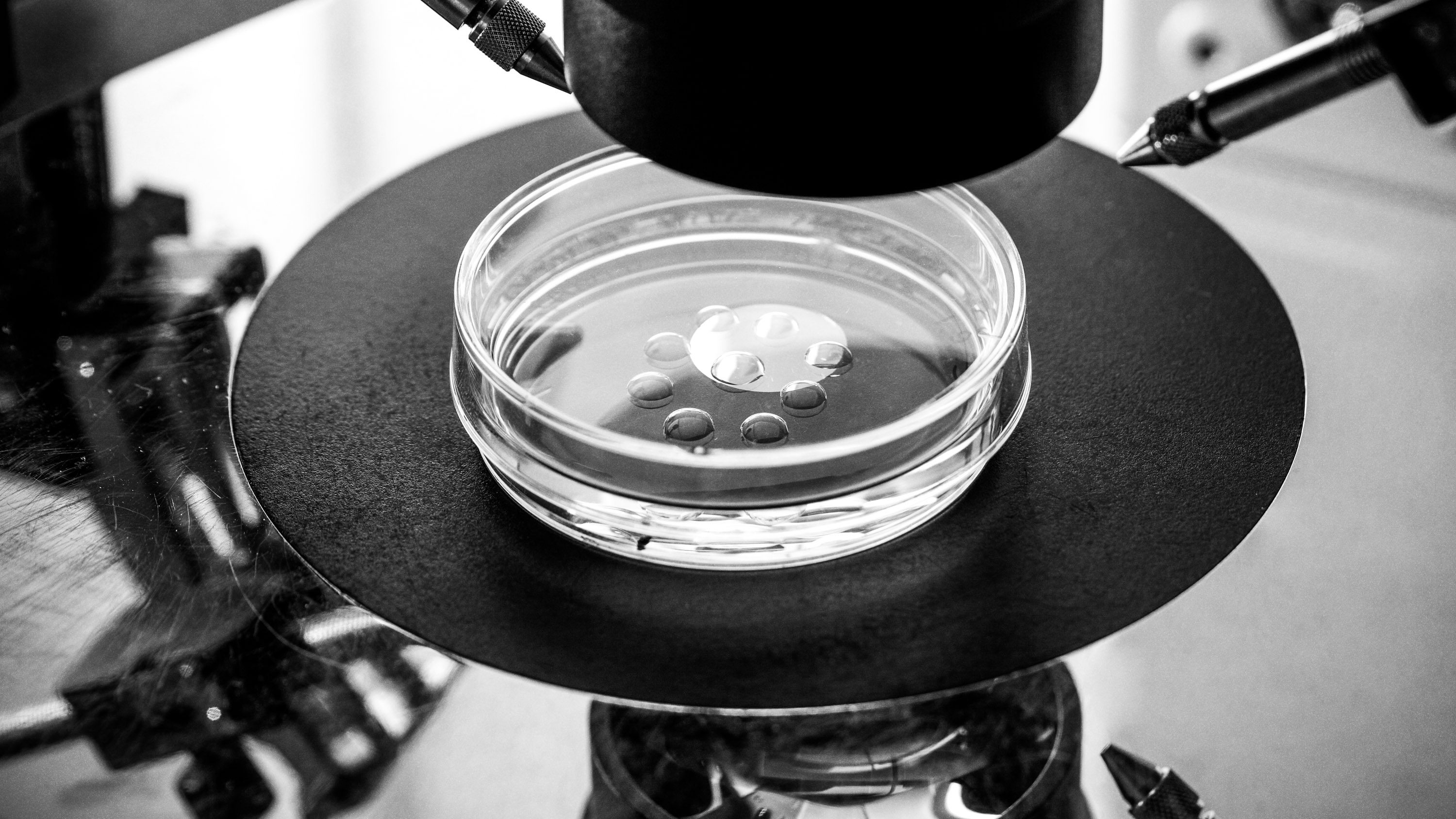
When the first baby born using a controversial procedure that meant he had three genetic parents was born back in 2016, it made headlines. The baby boy inherited most of his DNA from his mother and father, but he also had a tiny amount from a third person.
The idea was to avoid having the baby inherit a fatal illness, and it seemed to work. But new evidence now suggests this technique might not work as hoped, due to a phenomenon scientists call “reversion.” Read the full story.
—Jessica Hamzelou
We can still have nice things
A place for comfort, fun and distraction to brighten up your day. (Got any ideas? Drop me a line or skeet ’em at me.)
+ Willing to bet your weekend wasn’t as eventful as this guy’s was. + Stop overthinking. Start ‘satisficing’. + Well, that’s one thing AI definitely can’t do. + If you’ve only got the time or energy for one stretch, make it this one.