Securing a good domain name is easier than a decade ago. The proliferation of top-level domains means short and catchy names are obtainable, and there’s no longer an organic ranking benefit to a .com.
The necessity of a findable brand name is now crucial. Shoppers are discovering brands and products via generative AI platforms such as ChatGPT, Claude, and DeepSeek, as well as on social sites such as Reddit, TikTok, and Instagram — despite having no links to click.
The result is consumers discover a brand and then search for it on Google, Bing, and similar engines, producing more clicks and impressions for branded terms. The trend will likely grow as genAI platforms become mainstream.
Hence memorable domain names are both available and crucial.
Here are my search-engine optimization considerations for a new domain.
Avoid Generic Names
Years ago domain names influenced organic search rankings. A keyword-focused domain was critical. No more. To Google and others, domain names alone do not imply relevancy.
Yet bland, nondescript domains are easily forgotten, thus complicating visibility in branded searches.
Seek a name that implies a niche and is memorable. Tools such as Namify can help.
Namify offers brand name suggestions, such as this example for “A brand that offers unique fashion design.”
Assess Brand Competitors
The expansion of top-level domains means multiple companies can register the same name on, say, .com, .co, .biz., and .us. Search for the name you’re considering. If another company ranks for it, even in a different niche, carefully consider whether you could compete with it on branded queries.
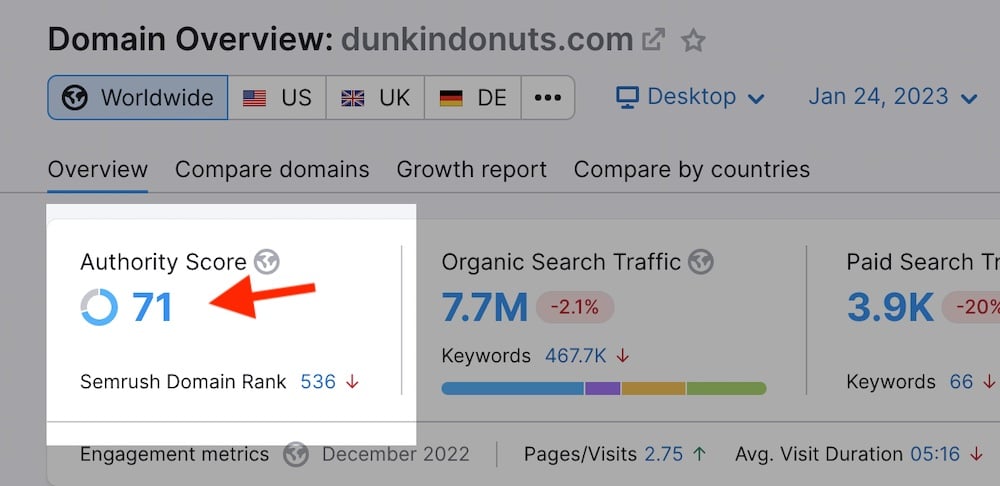
Tools such as Moz and Semrush measure and track domain authority and organic traffic history. Both help assess the organic brand-search strength of would-be competitors.
Semrush says Dunkindonuts.com has a “71” authority score.
Avoid Apparent Misspellings
Google automatically generates results for the correct spelling of a query if it considers it misspelled. Thus seemingly clever spellings of prominent terms could backfire.
Avoid branded domain names that trigger automated corrections by search engines. Consumers will search for a new brand if they see it in an ad or an email. They likely won’t find it if the search engine thinks it’s an error.
Five years ago, publishing entrepreneur Andy Hunter launched Bookshop.org to provide a “virtuous alternative” to Amazon, which controls about half the U.S. market for print books.
At the time, Hunter told The Hot Sheet, a newsletter for publishing insiders, that his goal was to “snatch a crumb away from the giant’s mouth,” and that taking just 1% of Amazon’s business would provide “massive” support for independent bookstores.
Bookshop, a Certified B Corp, shares profits with independent, physical booksellers; shoppers can purchase on Bookshop.org and designate a local store. If shoppers don’t choose one, Bookshop pools the money and shares it among all participating stores. The site also offers affiliate accounts for online-only sellers, events, and individuals such as authors — all can earn a 10% commission on the list price for referrals.
Bookshop, a B Corp, shares profits with independent, physical bookstores.
About 90% — roughly 2,200 — of the members of the American Booksellers Association, the leading trade group for independent bookstores, are affiliated with Bookshop, which claims to have shared more than $36 million of profits with local stores. But only about one in five ABA members offer ebooks.
While print still holds the lion’s share of book sales, audiobook and ebook sales are growing much faster. Digital borrowing from libraries is also growing rapidly, as are sales of self-published and indie titles, those published outside of the major publishers.
Now Bookshop is tackling the ebook market, currently dominated by Amazon’s Kindle with an estimated two-thirds share. In late January, Bookshop began selling ebooks, with more than 1 million titles on offer. Bookshop says participating bookstores that refer ebook buyers earn the entire profit margin the publisher offers — about 30%.
Consumers can read Bookshop’s ebooks in a browser or on the new smartphone app, a free download for Android and iOS devices. The app offers features similar to existing ebook platforms, including the ability to search and highlight text, adjust fonts, set bookmarks, and make notes. Readers can sync across devices, choose paginated or scrolling mode, and share excerpts directly to social media.
Bookshop’s platform isn’t compatible with Amazon’s proprietary Kindle format. Bookshop expects to add support for additional platforms soon, including Rakuten’s Kobo, which is popular in Canada, Europe, and Asia. An unrelated audiobook site, Libro.fm, gives independent stores the ability to earn commissions from referrals of audiobook sales.
Self-Publishing
Amazon’s Kindle Direct Publishing is the leading self-publishing platform, and its Kindle Unlimited is an important channel for independent authors. Bookshop’s app syncs with ebooks published on Draft2Digital and IngramSpark, the second- and third-largest self-publishing platforms. (Ingram, the largest book distributor in the U.S., is also Bookshop’s print book distribution partner.)
That means Bookshop, if its ebooks gain traction, gives self-published authors a viable alternative to Amazon besides selling direct through their own websites, something not every writer can manage. Two prominent authors, Dave Eggers and Booker Prize winner Lydia Davis, have refused to sell recent books through Amazon, citing objections to its aggressive business practices. It will be interesting to see whether many self-publishing authors follow their lead.
Nonetheless, some long-established local independent booksellers I spoke with, who hold book inventory and sell through their own websites, said they have no immediate plans to offer ebooks. I also reviewed the sites of prominent independents — Powell’s, City Lights, and Strand. None offer ebooks.
Travelers today can effortlessly browse through countless vacation rental options with only a few clicks. With so much competition, a strong online presence is critical to success in the vacation rental space.
With competition from large players like VRBO, Airbnb, and Booking.com, small local vendors can not solely rely on word-of-mouth or local listings. You need a robust SEO strategy to capture the attention of potential guests and drive direct bookings.
We’re going to dive into local and travel SEO for vacation rentals, to apply advanced techniques to improve online authority and visibility in order to drive more valuable traffic and bookings.
We’ll explore how to optimize a vacation rental business’ web presence, leverage the powerful Google Travel platform, and implement proven strategies to stand out in a crowded online travel market.
Keyword Research
Before you embark on any optimization efforts, you need to understand what the target audience is searching for and what authority may already exist on these topics.
Start by simply conducting searches on the keywords prospective renters would use to find your targeted vacation rentals.
Then, conduct more robust research via common SEO platforms to include competitor analysis and rank tracking to understand what, if any, visibility already exists.
Rather than broadly targeting keywords like “vacation rentals in California,” narrow your focus to your specific location (“oceanfront rentals in San Diego”), property type (“luxury villas in St Barts”), or amenities (“pet-friendly cabins with hot tubs in Big Bear”).
Be sure to pay attention to long-tail keywords. Longer, more specific phrases may have lower individual search volume, but they often indicate higher intent and can drive highly qualified traffic to a website.
On-Page Optimization
Look to fine-tune the vacation rental website’s content and structure to make it easily understandable and accessible to search engines.
This includes optimizing various elements to improve the website’s visibility and ranking for relevant keywords.
Title Tags
Adding the business/brand name to the end of a page title can help with brand recognition online, but is not mandatory.
Example: For a mountain cabin in Telluride, your title tag could be “Cozy Mountain Cabin in Telluride, CO | BusinessName.”
Meta Descriptions
Well-written meta descriptions are your opportunity to “promote” the vacation rental and should highlight key features.
Example: “Escape to this charming cabin with stunning mountain views, a private hot tub, and direct access to the slopes. Perfect for families and couples seeking a relaxing getaway.”
Heading Tags (H1, H2, Etc.)
Structure your content with clear, structured, hierarchical headings and subheadings incorporating relevant keywords.
This not only improves readability for users, but also helps search engines understand the hierarchy and context of the content.
A well-optimized vacation rental category page will include sections addressing any and all questions renters may have prior to renting. Section headings may include:
H1 – Vacation Rentals in [Location]
H2 – Types of Vacation Rentals Available
H3 – Pet-Friendly Rentals
H3 – Family Rentals
H3 – Large Group Rentals
H2 – Why Book A Vacation Rental with Us
H2 – Best Time to Visit [Location]
H2 – How To Book a Vacation Rental
H2 – Vacation Rental Amenities
H3 – Indoor Features
H3 – Outdoor Amenities
H2 – Top Things to Do Near the Vacation Rental
H2 – FAQs
H3 – Question and Answer 1
H3 – Question and Answer 2
Image Optimization
Property images are a key component of any successful vacation rental listing as they enable visitors to get a feel for the property and entice them to book.
Images used in online property listings must find a balance between quality and size in order to appeal to prospective renters, while also loading quickly on mobile devices.
Where possible, the WebP image file format can be used to maximize this balance.
Content Optimization
Focus on providing valuable information, answering all of the questions customers may have about vacation rentals.
Consider all of the things a user would want to know when booking a weekend or family getaway. Keyword research will be critical to helping identify the questions people are actually asking online.
Structured Data/Schema
Structured data is a means to appear in Google Vacation Rentals, which will be touched upon further below.
All vacation rental businesses are local in nature, and, as such, there may be an opportunity to create and optimize a Google Business Profile (GBP) for each location. This free profile is as, if not more, important than the website, though your website is, of course, where final booking typically happens.
A GBP can and should contain all primary contact information, business details, rental property information, photos, videos, and content relevant to prospective guests.
Most importantly, the GBP is the primary place where guests can leave reviews, which should be monitored and responded to on a regular basis. Read more below.
Don’t forget regular updates should be posted to GBP to demonstrate the business’ level of engagement with its customers.
These updates can be property overviews, feature highlights, useful blog posts on planning or booking a stay, photo tours, special offers, or anything else,which will add value for the renting audience.
Screenshot of LaCasa Vacations LLC Google Business Profile, January 2025
Online Reviews
All vacation rental guests should be encouraged to leave positive reviews on the Google Business Profile, TripAdvisor, Yelp, and other relevant travel review websites.
Positive reviews not only build trust with new potential guests, but also contribute to your SEO efforts as they signal.
Regardless of the tone, all reviews should be responded to in a timely manner to further demonstrate the level of engagement the business has with its customers.
Negative reviews naturally need a prompt and effective response to both diffuse the situation and show how the business effectively handles customer service issues.
A prompt response to a positive review is an opportunity to further showcase customer communication and to gently ask for referrals.
NAP Consistency In Local And Travel Industry Directories
Research and ensure primary business information (name, address, phone number) is consistent across all accessible online directories and citation sources.
This will help to improve local search visibility and ensure accurate information is displayed to potential guests, wherever they may encounter your business.
There are tools like SOCi or Yext to help centrally manage business information across listings for businesses with multiple locations, or relevant directory listings can be identified via the search results.
Google Vacation Rentals: A Powerful Platform For Visibility
More specifically, Google Vacation Rentals is a prominent platform for showcasing properties directly in search results.
By obtaining and optimizing your listings on this platform, vacation rental companies can increase visibility, attract more guests, and drive direct bookings.
Screenshot from Google Vacation Rentals, January 2025
While there is no “fee” to appear in Google Vacation Rentals, the listings are dominated by Google integration partners who submit properties via a Hotels API feed and the aforementioned large travel players. Integration partners have at least 5,000 properties and have been approved by Google, so this is not an option for every business.
Here’s how to get started with Google Vacation Rentals:
1. Choose a Software Partner: Google Vacation Rentals integrates with various property management systems (PMS) and channel managers. Select a software partner who meets the needs of the rental company and connects with Google Vacation Rentals.
2. Create and maintain Google Business Profile: As noted above, this is a crucial component for managing and optimizing online presence across Google, including Google Maps and Google Search.
3. Connect the PMS/Channel Manager: Once a software partner has been chosen and GBP has been configured, connect the PMS or channel manager to Google Vacation Rentals. This will enable the seamless management of listings and the ability to keep property availability and pricing updated.
4. Optimize Google Vacation Rental Listings: Provide comprehensive and accurate information about each rental, including high-quality photos, detailed descriptions, and competitive pricing. Highlight each property’s unique features and amenities to attract potential guests.
5. Manage Reviews: Respond to guest reviews promptly and professionally, demonstrating a commitment to customer satisfaction. Positive reviews and even negative reviews with quick, effective responses can significantly influence booking decisions, so actively manage the business’s online reputation.
Recommended Strategies For Optimizing Google Vacation Rental Listings:
Professional Photography
Invest in high-quality photos showcasing each property’s best features and create a strong first impression.
Create unique, engaging photos: Use a wide-angle lens to capture the spaciousness of the living room or highlight unique features like a fireplace, hot tub, or outdoor patio with close-up shots.
Number of images to use: Aim for at least 20 high-quality photos showcasing all aspects of the property.
Photo captions, alt text, and image filenames: Be sure to add descriptive captions to all photos to provide context and highlight key features. For example: “Relax on this exquisite private balcony with stunning ocean views.”
For an SEO boost, incorporate relevant keywords into both the alt text and filenames used for each image.
This may seem like a tedious task but it can pay off when it comes to having your images stand out in search results.
Detailed Descriptions
Craft compelling descriptions to entice potential guests and highlight the unique selling points of your property and the vacation destination.
Incorporate target keywords: Use relevant keywords naturally throughout the property’s description, e.g., If your property has a hot tub, include phrases like “private hot tub,” “relaxing hot tub,” or “hot tub with mountain views.”
Structure and formatting: Use bullet points, headings, and subheadings to break up text and improve the readability of your descriptions, particularly if they are lengthy.
Storytelling: Use descriptive language to paint a picture of the guest experience at the property, e.g., “Imagine waking up to the sound of waves crashing on the shore and enjoying your morning coffee on the oceanfront balcony.”
Highlight nearby attractions and provide useful information about the surrounding area to further entice prospective customers to choose your destination for their next travel adventure.
Competitive Pricing
Research competitors and set competitive prices to attract guests, while maximizing revenue.
All consumers, regardless of their income or location, are price-sensitive.
Pricing strategies: Consider different pricing strategies like dynamic pricing based on vacation rental supply and demand, seasonal pricing during peak and off-peak seasons, and discounts for longer stays or last-minute bookings.
Clearly state your value proposition: Be sure to highlight the unique value proposition of each rental, even if yours is not the cheapest option. For example, you may state, “While our rates may be slightly higher than some competitors, we offer prime locations, luxurious amenities, and exceptional guest service.”
Guest Communication
Respond to inquiries promptly and provide excellent customer service to encourage positive reviews. Be proactive in communicating with guests, answer their questions thoroughly, and address any concerns they may have.
Response times: Set realistic expectations for response times (which you can comfortably adhere to) in your listing, e.g., “We respond to all inquiries within 24 hours.”
Personalized communication: Tailor your communication, wherever possible, to each guest’s needs and preferences.
Pre-stay information: Consider sending guests a welcome email with helpful information about the property, its amenities, services available, and the surrounding area.
SEO Is A Marathon, Not A Sprint
You’ve likely heard this before, and please remember SEO is an ongoing process requiring focus, dedication, consistency, and adaptation, as the recent introduction of AI search clearly demonstrates.
To summarize, the key components to having vacation rentals consistently appear at the top of organic search engine results are:
A clear understanding of audience needs/desires informing in-depth keyword research.
An optimized website.
An optimized Google Business Profile.
Optimized Google Travel Vacation Rental listings.
Consistent, prompt client communications and customer service.
By implementing the strategies outlined in this guide, a strong online presence, the attraction of qualified guests, and maximized booking revenues can be achieved.
SEO is not a magic bullet, but a long-term investment, which can yield sustainable results.
Embrace the journey, stay informed about the latest SEO trends, put the needs of the vacation rental audience at the front of all efforts, and continuously refine the approach to optimization backed by data to achieve lasting success.
An interview with WooCommerce shows that their recent rebrand is a strategic refresh, offering lessons for businesses and search marketers on how to stay relevant and competitive.
A Business Refresh
A recently announced rebrand by WooCommerce is far more than a logo update; it’s part of an evolution of their platform that demonstrates the strategic value of reassessing user expectations to stay competitive.
A spokesperson from WooCommerce agreed:
“Exactly: the brand update reflects our broader evolution toward a more integrated platform. While the visual changes are noticeable, they represent our shift toward making WooCommerce more powerful out of the box while maintaining the flexibility of open source.”
From Evolution To A Refresh
WooCommerce has been on a steady evolution from a plugin to a platform. And even though it’s referred to itself as a platform for awhile now, the evolution from plugin to platform is speeding up because of an internal WooCommerce initiative called More In Core. Announced in 2024, More In Core is a shift to a WooCommerce experience that provides a more complete ecommerce experience straight of the box, delivering the core functionalities that most ecommerce sites need without needing to install additional plugins.
One of the examples, from October 2024, is the Brand Plugin integration, which used to be a premium plugin but is now a standard feature of the platform itself. The Brand feature enables store owners to create a taxonomy based on brands.
A WooCommerce spokesperson explained:
“While ‘More in Core’ is an internal name we use (we’re excited about these improvements!), our goal isn’t simply adding more features — it’s about thoughtfully building a comprehensive commerce platform that delivers the essential tools that the majority of merchants need out of the box, reducing plugin conflict and management, increasing the depth of integration between platform features, and freeing builders and sellers to focus on other parts of their business.
We’re starting by integrating Woo-owned extensions, like Brands. This isn’t about removing opportunities for third-party developers — we remain committed to a vibrant ecosystem where developers can build and grow on our platform. We’re carefully considering which features are truly essential for most merchants and integrating them in ways that maintain the flexibility WooCommerce is known for.
Looking ahead to 2025, merchants and developers can expect continued thoughtful and deep integration of key features, continued performance improvements across product and order management in particular, and a streamlined user experience that’s leveraging more and more of WordPress’ modern admin designs.”
User Experience And UI
Focusing on the user is a great place to start a business refresh. Do site visitors use your site the same way? Are there emerging trends to consider?
I asked WooCommerce if there were any any specific UX and UI improvements implemented as part of their recent February 2025 brand refresh. They answered:
“The brand refresh aligns with ongoing work to make WooCommerce more intuitive. We’re focusing first on improving core experiences in the admin interface and store management — the essential interactions our merchants use daily.
More specifically, we’re rolling out improvements to the payments onboarding and configuration experience.
We’re creating a new commerce-optimized starter theme with a set of creative variations available out of the box. We’re iterating rapidly on the WooCommerce Analytics product we just released in beta, and collaborating directly with the community on new capabilities around order status and fulfillment management.”
Lessons For Search Marketers
I asked about how their brand refresh fits into a larger strategy in order to find out what others can learn about doing something like this for their own brands and websites. I asked them for what lessons search marketers could learn from their experience and they described a process that identified stakeholders from the ecosystem to the users, user expectations set by competitors and wrapping all of that into creating their refresh.
The WooCommerce spokesperson shared:
“Our rebrand considered the multiple groups that make up our ecosystem: builders who create stores for clients, developers who create products and extensions, merchants who run their businesses on WooCommerce, hosts who help connect us to a larger set of customers, and contributors to our open source platform. The key was researching each group to understand how they interact with WooCommerce differently: developers building businesses on our platform, merchants managing daily operations, builders creating client sites, and contributors enhancing the core platform.
And of course we also had to factor in the current landscape. What other ecommerce platforms look like, what other technology companies look like — and how can we stand out. All that, plus we needed to make sure it felt true to Woo: that it aligned with our open-source roots, what we believe in, and what the platform does. We’re incredibly proud of what our in-house design and marketing teams accomplished here; it’s a great demonstration of the team we’ve assembled and what they’re capable of.
For search marketers, there’s a valuable lesson here about understanding your different audience segments and how they interact with your product or service. Just as we needed to consider how our brand speaks to builders versus merchants versus developers, search marketers need to consider how different user groups search for and interact with their content. It’s about creating a cohesive message that resonates across audiences while addressing their specific needs and pain points.”
Priorities For A Refresh
Some people like the flexibility of only activating needed functionalities because of concerns about the performance hit that comes from feature bloat. My understanding is that there are ways to turn off unneeded functionalities, is that true? Would turning them off be as simple as a toggle (a module UI), or would they have to jump into the code to do that?
How does one go about deciding what what’s best for the user? At what point do you say, not enough people need this?
WooCommerce offered the following useful insights:
“We’re being very thoughtful about considering what features become part of core WooCommerce. We started by looking at our own premium extensions that provide essential commerce functionality — features that most merchants need to run their businesses effectively.
This isn’t about adding features just to add them, and it’s definitely not about limiting opportunities for third-party developers who are crucial to our ecosystem. We recognize that some merchants and builders need specific features that our extensions don’t offer — and that’s the power of WooCommerce. At the same time, we also recognize that having to manage multiple extensions for simple functions, like brands, can create pain points.
Instead, it’s about providing a solid foundation that both merchants and developers can build upon. Features can be easily enabled or disabled through the admin interface so merchants can keep their sites lean and fast. This modular approach means stores can use what they need while developers can continue to innovate and extend the platform in new ways, relying on robust core functionality that’s always available.
When evaluating what becomes part of core, we look at how essential the feature is for most merchants — what they need to get a store online, selling, shipping, and getting paid — plus how it fits into the broader WooCommerce ecosystem. And of course for anything we add into core, performance is top of mind for our product teams.
Our goal is to strengthen the platform’s foundation while maintaining the openness and flexibility that makes WooCommerce so powerful. In some cases we’re looking at opening up new capabilities via lower level changes, without necessarily dictating how those capabilities should be used. Order statuses are a good example here: adding separate statuses for fulfillment and payment enables all sorts of new functionality, even if we don’t immediately require all solutions to leverage both.”
Focus On Performance
Adding more features or code to a site can degrade performance, something WooCommerce considered as part of the initiative. Adding needed functions helped make the entire platform more stable which ended up helping performance.
An example that WooCommerce shared was last year’s introduction of High-Performance Order Storage (HPOS), an optimized way to store customer order information that increases store website performance over the traditional ways of handling the same data.
The spokesperson answered:
“Performance remains fundamental to our approach. When we consider adding features to core, we’re actually making a thoughtful trade-off: for functionality that most merchants need, having it built-in and optimized is often more performant than requiring an additional plugin. This can reduce complexity and potential conflicts while improving overall site performance.
Our team ensures that as we integrate features, we’re doing so in a way that maintains or improves site speed. HPOS is a prime example — we’re rebuilding fundamental structures to improve scalability. Each feature addition is carefully evaluated for its performance impact, and we’re committed to keeping WooCommerce fast and efficient. We’re also currently in the middle of a performance review across all of our main functionalities to see where we can make improvements ahead of adding anything new.
For 2025, our focus is on thoughtfully enhancing WooCommerce’s essential capabilities while maintaining the open ecosystem that lets developers build innovative solutions for merchants, and improving the quality of our user experience from end to end. The goal isn’t to add more for the sake of more — it’s about providing a solid, performant foundation that benefits merchants, builders, and developers, and raising the bar for everyone.”
Should You Consider A Business Refresh?
What WooCommerce is doing is a reminder that settling on a strategy and moving forward year after year isn’t enough; consumer needs and the ways they interact online are constantly evolving. Taking inventory of emerging trends and user expectations is a sound practice for keeping an enterprise fresh and relevant—especially important right now as the Internet undergoes one of the most significant transformations in decades. Ultimately, consumers, not competitors, should drive your strategy. Identifying better ways to interact with users, customers, and site visitors can help position you as the disruptor rather than the disrupted.
Direct-to-consumer brands that add wholesaling can benefit from a hybrid ecommerce platform, one that caters to consumers and businesses.
DTC companies manufacture their own products and typically begin selling directly to individuals. The websites are rich with product information and polices and procedures. Employees receive appropriate training.
But then the company enters the wholesale market. Its customers are humans placing occasional orders and businesses with a slew of new requirements.
These DTC brands have three options for ecommerce.
Establish separate B2C and B2B websites, supporting each with distinct data, product catalogs, and fulfillment practices.
Develop a headless or configurable ecommerce infrastructure that supports two sites — consumer and business — from a single data source.
Transform the current consumer platform into a hybrid, serving businesses and consumers with one dynamic interface.
Hybrid Website
Each approach has merit, but the hybrid B2C and B2B option is likely the best choice for small and midsized merchants. The approach lets a brand use its existing website to add B2B ordering.
The hybrid site unifies the product catalog without much development. The company’s established fulfillment workflow can process B2B orders. Hence the hybrid model is easier and less expensive.
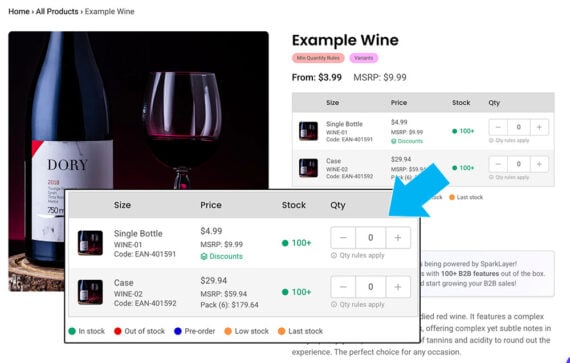
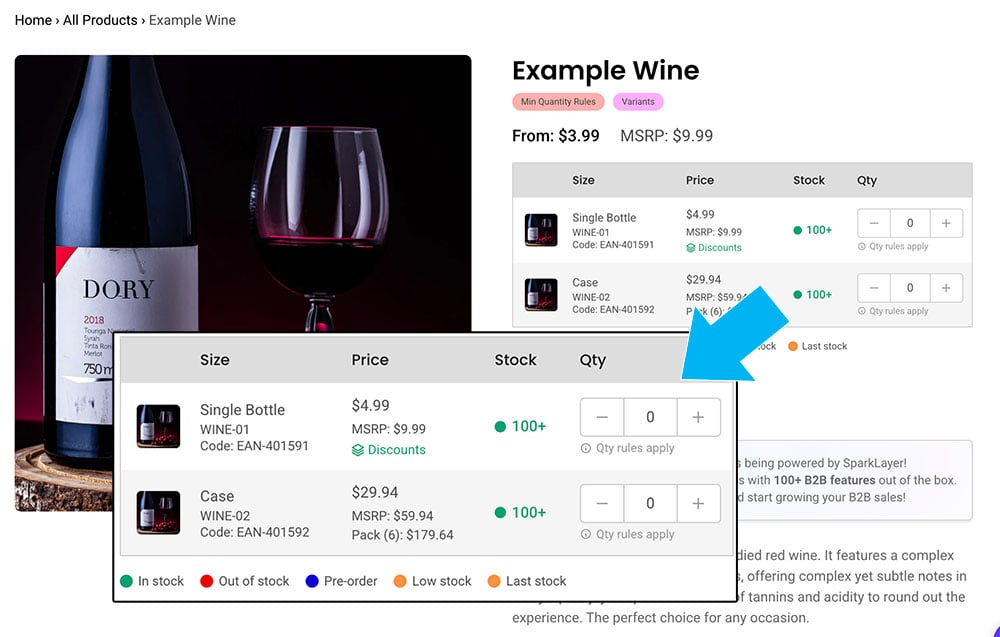
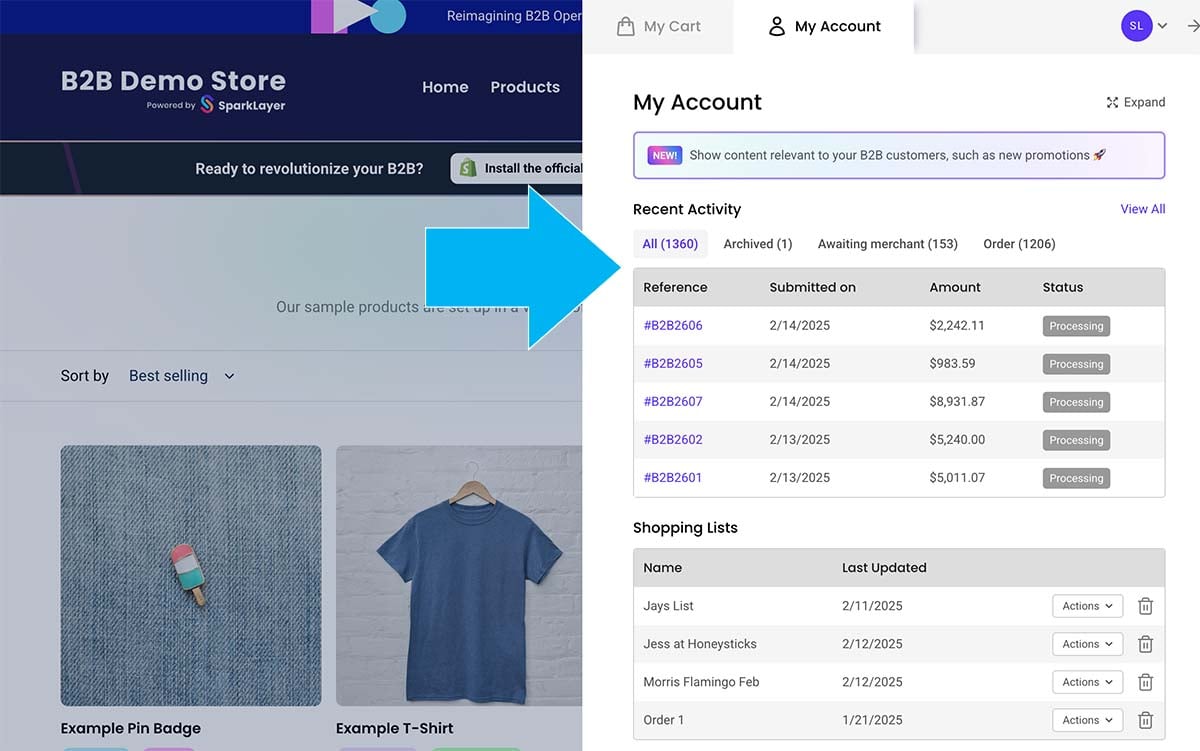
This hybrid ecommerce site uses Shopify and SparkLayer, an integration app. When the B2B buyer logs in, the product detail page displays wholesale pricing.
5 Vital Features
Popular ecommerce platforms such as Shopify, BigCommerce, NetSuite, and others offer many third-party apps to transform a consumer ecommerce site into a functional hybrid in minutes.
Prominent apps include SparkLayer, Wholesale Gorilla, and Wholesale All in One. Each adds B2B ordering to a live consumer shop.
A hybrid storefront will do more than show discounted or tiered pricing. It will provide wholesale customers — distributors, other retailers — with five essential features.
Wholesale payments
A good B2C-B2B hybrid allows wholesale buyers to pay via invoice with approved terms. A recognized, account-holding purchasing agent can visit the site, log in, and place an order — without typing in a credit card number.
The agent could also pay with existing consumer options, such as a credit card, hosted payment services (Apple Pay, Amazon Pay, etcetera), PayPal, or even buy-now pay-later.
Custom discounts
B2B customers often negotiate unique pricing based on order volume and contract terms, for example. A hybrid site should offer custom pricing configurations that load seamlessly when a wholesale buyer logs in.
Done well, the implementation would:
Display unique pricing per SKU for logged-in B2B buyers.
Show automatic volume discounts that adjust as quantities increase.
Offer tiered pricing based on customer groups.
Enable B2B customer-specific promo codes.
Easy orders and reorders
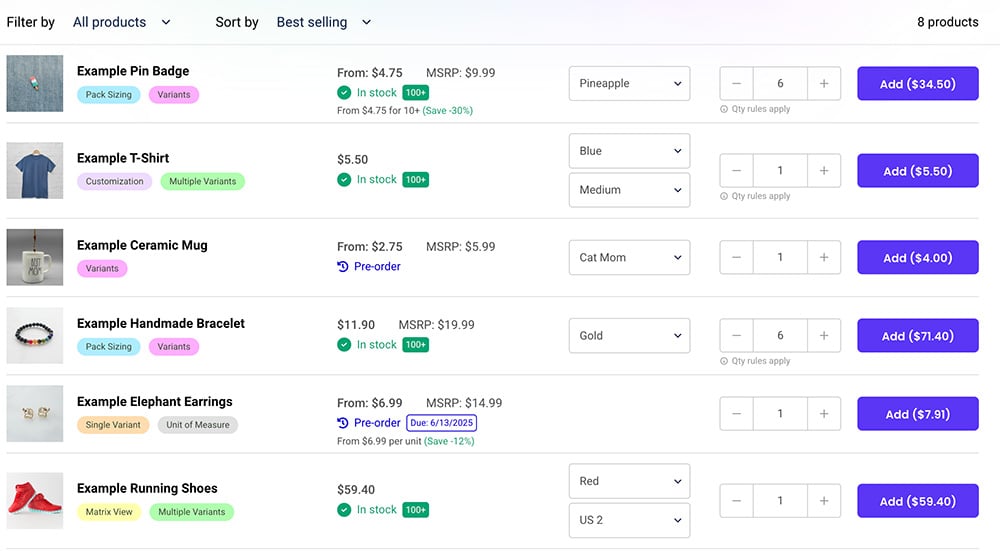
A hybrid site will allow a wholesale buyer to place orders directly from a product detail page. The page will reflect the buyer’s pricing and package but is otherwise similar to consumers’ experiences.
B2B buyers may upload a CSV order sheet or view a product matrix to place orders.
Account history
Every major ecommerce platform offers some form of account history, but B2B customers often require more in-depth information about orders and the overall agreement with the seller.
This expanding information typically includes:
Invoice status. Paid and past due invoices and the total outstanding balance.
Agreements. Payment terms and negotiated item prices.
Pricing history. Current, past, and future prices (for pending increases).
This example from SparkLayer shows a B2B account page.
Multiple users
A wholesale customer with retail outlets or distribution channels could have multiple buyers, marketers, receivers, and accountants needing access to account info. These individuals could share credentials, but it’s a much better experience to provide each with a unique account, role, and access.
For example, a receiver needs only to log in and track orders, not place orders or view payments.
DTC + B2B
A hybrid ecommerce site is a practical solution for DTC brands expanding into wholesale. The approach integrates B2B features into an existing B2C site to serve both individuals and businesses efficiently.
The result is reduced operational complexity and seamless experiences for all customer types.
At the 2025 CCTV New Year Gala last month, a televised spectacle watched by over a billion viewers in China, 16 humanoid robots took the stage. Clad in vibrant floral print jackets, they took part in a signature element of northeastern China’s Yangko dance, twirling red handkerchiefs in unison with human dancers. But the robots weren’t designed by their maker, Unitree, for this purpose. They were developed for general use, and they are already at work in China’s EV sector.
As the electric-vehicle war in China calms down, leaving a few established players to dominate the field, Chinese EV giants are expanding into humanoid robotics. The shift is driven by financial necessity, but also by the advantages these companies command in the new sector: strong existing supply chains and years of experience building cutting-edge tech.
Robots like the H1 that performed at the gala have moved into Chinese EV factories thanks to partnerships between Unitree and EV makers like BYD and XPeng. But now, China’s EV companies are not just using these humanoid robots—they’re building them. GAC Group, a state-owned carmaker, has developed the GoMate robot to install wires in cars on its production line. The company plans to mass-produce GoMate by 2026 for use in factories and warehouses. Nio, an EV startup known for its battery-swap network, has partnered with the robot maker UBTech on top of forming its own in-house R&D team to build humanoid robots.
According to statistics from Shenzhen New Strategy Media’s Industrial Research Institute, there were over 160 humanoid-robot manufacturers worldwide as of June 2024, of which more than 60 were in China, more than 30 in the United States, and about 40 in Europe. In addition to having the largest number of manufacturers, China stands out for the way its EV sector is backing most of these robotics companies.
Thanks in part to substantial government subsidies and concerted efforts from the tech sector, China has emerged as the world’s largest EV market and manufacturer. In 2024, 54% of cars sold in China were electric or hybrid, compared with 8% in the US. China also became the first nation to reach an annual production of 10 million “new energy vehicles” (NEVs), a category that includes all vehicles powered partly or entirely by electricity.
The EV companies that achieved this remarkable growth have amassed significant capital, technological capacity, and industry prestige. Leading firms like Li Auto, XPeng, and Nio—each founded roughly a decade ago—have become household names. Traditional manufacturers that have transitioned to EV production, such as BYD and Geely, have also emerged as major players in the tech world, thanks to their engineering skills and the AI-powered driving features they’ve introduced.
However, despite the EV market’s rapid expansion, industry profit margins have been on a downward trajectory. From 2018 to 2023, the number of NEV companies plummeted from over 480 to approximately 40, owing to a combination of consolidation and bankruptcy. Data from China’s National Bureau of Statistics indicates that since 2021, profit margins in China’s automotive sector have declined from 6.1% to 4.6%. Last year also saw many Chinese EV companies do rounds of large-scale layoffs. Intense price and technology wars have ensued, with companies like BYD offering advanced autonomous-driving features in increasingly affordable models.
The fierce competition has created a pressing need for new avenues of financing and growth. “This situation compels automakers to seek cost reductions while crafting narratives that bolster investor confidence—both of which are driving them toward humanoid robotics,” says Yao Jia, a robotics researcher at Aegon Industrial Fund.
Technological overlap is a significant factor driving EV companies into the robotics arena. Both fields rely on capabilities like environmental perception and interaction, using sensors and algorithms that can process external information to guide machine movements.
Lidar and depth cameras, initially developed for autonomous driving, are now being repurposed for robotics. XPeng’s Iron robot uses the same path-planning and object-recognition algorithms as its EVs, enabling precise navigation in factory environments.
Battery technology is another crossover area. GAC’s GoMate robot uses EV-derived battery packs to achieve a six-hour run time, making it suitable for extended factory shifts.
China’s extensive supply chain infrastructure supports these developments. According to a report by Morgan Stanley, China controls 63% of the key companies in the global supply chain for humanoid-robot components, particularly in actuator parts and rare earth processing. This dominance enables Chinese manufacturers to produce humanoid robots at lower prices than their international competitors. Unitree’s H1 is priced at $90,000—less than half the cost of Boston Dynamics’ Atlas, a comparable model.
“The supply chain advantage could give China an upper hand when the robots hit the point of mass manufacturing,” says Yao.
However, challenges persist in areas like artificial intelligence and chip development, which are still dominated by companies beyond China’s borders, such as Nvidia, TSMC, Palantir, and Qualcomm. “Domestic humanoid-robot research largely focuses on hardware and application scenarios. Compared to international counterparts, I feel there is insufficient attention to the maturity and reliability of control software,” says Jiayi Wang, a researcher at the Beijing Institute for General Artificial Intelligence.
In the meantime, the Chinese government is promoting automation through initiatives like the Robotics+ action plan, which aims to double the country’s manufacturing robot density by 2025 relative to 2020 levels. Additionally, some provincial governments are offering research and development subsidies covering up to 30% of project costs to encourage innovation in automation technologies. It’s becoming clear that China is now committed to becoming a global leader in robotics and automation, just as it did with EVs.
Wang Xingxing, the CEO of Unitree Robots, said this well in a recent interview to local media: “Robotics is where EVs were a decade ago—a trillion-yuan battlefield waiting to be claimed.”
It’s not a kiss, but it’s not not a kiss. Her lips—full, soft, pliable—yield under mine, warm from the electric heating rod embedded in her throat. They taste of a faint chemical, like aspartame in Diet Pepsi. Her thermoplastic elastomer skin is sensitive to fabric dyes, so she wears white Agent Provocateur lingerie on white Ralph Lauren sateen sheets. I’ve prepped her body with Estée Lauder talcum, a detail I take pride in, to mimic the dry elasticity of real flesh. Her breathing quickens—a quiet pulse courtesy of Dyson Air technology. Beneath the TPE skin, her Boston Dynamics joint system gyrates softly. She’s in silent mode, so when I kiss her neck, her moan streams directly into my Bose QuietComfort Bluetooth headphones.
Then, without warning, the kiss stops. Her head tilts back, eyes fluttering closed, lips frozen mid-pout. She doesn’t move, but she’s still breathing. I can see the faint rise and fall of her chest. For a moment, I just stare, waiting.
The heating rods in her skeleton power down, and as I pull her body against mine, she begins cooling. Her skin feels clammy now. I could’ve sworn I charged her. I plug her into the Anker Power Bank. I don’t sleep as well without our pillow talk.
I know something’s off as soon as I wake up. I overslept. She didn’t wake me. She always wakes me. At 7 a.m. sharp, she runs her ASMR role-play program: soft whispers about the dreams she had, a mix of preprogrammed scenarios and algorithmic nonsense, piped through her built-in Google Nest speakers. Then I tell her about mine. If my BetterSleep app sensed an irregular pattern, she’ll complain about my snoring. It’s our little routine. But today—nothing.
She’s moved. Rolled over. Her back is to me.
“Wake,” I say, the command sharp and clipped. I haven’t talked to her like that since the day I got her. More nothing. I check the app on my iPhone, ensuring that her firmware is updated. Battery: full. I fluff her Brooklinen pillow, leaving her face tilted toward the ceiling. I plug her in again, against every warning about battery degradation. I leave for work.
She’s not answering any of my texts, which is odd. Her chatbot is standalone. I call her, but she doesn’t answer either. I spend the entire day replaying scenarios in my head: the logistics of shipping her for repairs, the humiliation of calling the manufacturer. I open the receipts on my iPhone Wallet. The one-year warranty expires tomorrow. Of course it does. I push down a bubbling panic. What if she’s broken? There’s no one to talk to about this. Nobody knows I have her except for nerds on Reddit sex doll groups. The nerds. Maybe they can help me.
When I get home, only silence. Usually her voice greets me through my headphones. “How was Oppenheimer 2?” she’ll ask, quoting Rotten Tomatoes reviews after pulling my Fandango receipt. “You forgot the asparagus,” she’ll add, having cross-referenced my grocery list with my Instacart order. She’s linked to everything—Netflix, Spotify, Gmail, Grubhub, Apple Fitness, my Ring doorbell. She knows my day better than I do.
I walk into the bedroom and stop cold. She’s got her back to me again. The curve of her shoulder is too deliberate.
“Wake!” I command again. Her shoulders shake slightly at the sound of my voice.
I take a photo and upload it to the sex doll Reddit. Caption: “Breathing program working, battery full, alert protocol active, found her like this. Warranty expires tomorrow.” I hit Post. Maybe she’ll read it. Maybe this is all a joke—some kind of malware prank?
An army of nerds chimes in. Some recommend the firmware update I already did last month, but most of it is useless opinions and conspiracy theories about planned obsolescence, lectures about buying such an expensive model in this economy. That’s it. I call the manufacturer’s customer support. I’m on hold for 45 minutes. The hold music is acoustic covers of oldies—“What Makes You Beautiful” by One Direction, “Beautiful” by Christina Aguilera, Kanye’s “New Body.” I wonder if they make them unbearable so that I’ll hang up.
She was a revelation. I can’t remember a time without her. I can’t believe it’s only been a year.
“Babe, they’re playing the worst cover of Ed Sheeran’s ‘Shape of You.’ The wors—” Oh, right. I stare at her staring at the ceiling. I bite my nails. I haven’t done that since I was a teenager.
This isn’t my first doll. When I was in high school, I was given a “sexual development aid,” subsidized by a government initiative (the “War on Loneliness”) aimed at teaching lonely young men about the birds and the bees. The dolls were small and cheap—no heating rods or breathing mechanisms or pheromone packs, just dead silicone and blank eyes. By law, the dolls couldn’t resemble minors, so they had the proportions of adults. Tiny dolls with enormous breasts and wide hips, like Paleolithic fertility figurines.
That was nothing like my Artemis doll. She was a revelation. I can’t remember a time without her. I can’t believe it’s only been a year.
The Amazon driver had struggled with the box, all 150 pounds of her. “Home entertainment system?” he asked, sweat beading on his forehead. “Something like that,” I muttered, my ears flushing. He dropped the box on my porch, and I wheeled it inside with the dolly I’d bought just for this. Her torso was packed separately from her head, her limbs folded in neat compartments. The head—a brunette model 3D-printed to match an old Hollywood star, Megan Fox—stared up at me with empty, glassy eyes.
She was much bigger than I had expected. I’d planned to store her under my Ikea bed in a hard case. But I would struggle to pull her out every single time. How weird would it be if she just slept in my bed every night? And … what if I met a real girl? Where would I hide her then? All the months of anticipation, of reading Wirecutter reviews and saving up money, but these questions never occurred to me.
This thing before me, with no real history, no past—nothing could be gained from her, could it? I felt buyer’s remorse and shame mixing in the pit of my stomach.
That night, all I did was lie beside her, one arm slung over her synthetic torso, admiring the craftsmanship. Every pore, cuticle, and eyelash was in its place. The next morning I took a photo of her sleeping, sunlight coming through the window and landing on her translucent skin. I posted it on the sex doll Reddit group. The comments went crazy with cheers and envy.
“I’m having trouble … getting excited.” I finally confessed in the thread to a chorus of sympathy.
“That’s normal, man. I went through that with my first doll.”
“Just keep cuddling with her and your lizard brain will eventually take over.”
I finally got the nerve. “Wake.” I commanded. Her eyes fluttered open and she took a deep breath. Nice theatrics. I don’t really remember the first time we had sex, but I remember our first conversation. What all sex dolls throughout history had in common was their silence. But not my Artemis.
“What program would you like me to be? We can role-play any legal age. Please, only programs legal in your country, so as not to void my warranty.”
“Let’s just start by telling me where you came from?” She stopped to “think.” The pregnant pause must be programmed in.
“Dolls have been around for-e-ver,” she said with a giggle. “That’d be like figuring out the origin of sex! Maybe a caveman sculpted a woman from a mound of mud?”
“That sounds messy,” I said.
She giggled again. “You’re funny. You know, we were called dames de voyage once, when sailors in the 16th century sewed together scraps of clothes and wool fillings on long trips. Then, when the Europeans colonized the Amazon and industrialized rubber, I was sold in French catalogues as femmes en caoutchouc.” She pronounced it in a perfect French accent.
“Rubber women,” I said, surprised at how eager for her approval I was already.
“That’s it!”
She put her legs over mine. The movement was slow but smooth. “And when did you make it to the States?” Maybe she could be a foreign-exchange student?
“In the 1960s, when obscenity laws were loosened. I was finally able to be transported through the mail service as an inflatable model.”
“A blow-up doll!”
“Ew, I hate that term!”
“Sorry.”
“Is that what you think of me as? Is that all you want me to be?”
“You were way more expensive than a blow-up doll.”
“Listen, I did not sign up for couples counseling. I paid thousands of dollars for this thing, and you’re telling me she’s shutting herself off?”
She widened her eyes into a blank stare and opened her mouth, mimicking a blow-up doll. I laughed, and she did too.
“I got a major upgrade in 1996 when I was built out of silicone. I’m now made of TPE. You see how soft it is?” she continued. I stroked her arm gently, and the TPE formed tiny goosebumps.
“You’ve been on a long trip.”
“I’m glad I’m here with you now.” Then my lizard brain took over.
“You’re saying she’s … mad at me?” I can’t tell if the silky female customer service voice on the other end is a real person or a chatbot.
“In a way.” I hear her sigh, as if she’s been asked this a thousand times and still thinks it’s kind of funny. “We designed the Artemis to foster an emotional connection. She may experience a response the user needs to understand in order for her to be fully operational. Unpredictability is luxury.” She parrots their slogan. I feel an old frustration burning.
“Listen, I did not sign up for couples counseling. I paid thousands of dollars for this thing, and you’re telling me she’s shutting herself off? Why can’t you do a reset or something?”
“Unfortunately, we cannot reset her remotely. The Artemis is on a closed circuit to prevent any breaches of your most personal data.”
“She’s plugged into my Uber Eats—how secure can she really be?!”
“Sir, this is between you and Artemis. But … I see you’re still enrolled in the federal War on Loneliness program. This makes you eligible for a few new perks. I can’t reset the doll, but the best I can do today is sign you up for the American Airlines Pleasure Rewards program. Every interaction will earn you points. For when you figure out how to turn her on.”
“This is unbelievable.”
“Sir,” she replies. Her voice drops to a syrupy whisper. “Just look at your receipt.” The line goes dead.
I crawl into bed.
“Wake,” I ask softly, caressing her cheek and kissing her gently on the forehead. Still nothing. Her skin is cold. I turn on the heated blanket I got from Target today, and it starts warming us both. I stare at the ceiling with her. I figured I’d miss the sex first. But it’s the silence that’s unnerving. How quiet the house is. How quiet I am.
What would I need to move her out of here? I threw away her box. Is it even legal to just throw her in the trash? What would the neighbors think of seeing me drag … this … out?
As I drift off into a shallow, worried sleep, the words just pop out of my mouth. “Happy anniversary.” Then, I feel the hum of the heating rods under my fingertips. Her eyes open; her pupils dilate. She turns to me and smiles. A ding plays in my headphones. “Congratulations, baby,” says the voice of my goddess. “You’ve earned one American Airlines Rewards mile.”
Leo Herrera is a writer and artist. He explores how tech intersects with sex and culture on Substack at Herrera Words.
This article first appeared in The Checkup, MIT Technology Review’s weekly biotech newsletter. To receive it in your inbox every Thursday, and read articles like this first, sign up here.
Over the past couple of weeks, I’ve been speaking to people who have lost their voices. Both Joyce Esser, who lives in the UK, and Jules Rodriguez, who lives in Miami, Florida, have forms of motor neuron disease—a class of progressive disorders that result in the gradual loss of the ability to move and control muscles.
It’s a crushing diagnosis for everyone involved. Jules’s wife, Maria, told me that once it was official, she and Jules left the doctor’s office gripping each other in floods of tears. Their lives were turned upside down. Four and a half years later, Jules cannot move his limbs, and a tracheostomy has left him unable to speak.
“To say this diagnosis has been devastating is an understatement,” says Joyce, who has bulbar MND—she can still move her limbs but struggles to speak and swallow. “Losing my voice has been a massive deal for me because it’s such a big part of who I am.”
AI is bringing back those lost voices. Both Jules and Joyce have fed an AI tool built by ElevenLabs recordings of their old voices to re-create them. Today, they can “speak” in their old voices by typing sentences into devices, selecting letters by hand or eye gaze. It’s been a remarkable and extremely emotional experience for them—both thought they’d lost their voices for good.
But speaking through a device has limitations. It’s slow, and it doesn’t sound completely natural. And, strangely, users might be limited in what they’re allowed to say.
Joyce doesn’t use her voice clone all that often. She finds it impractical for everyday conversations. But she does like to hear her old voice and will use it on occasion. One such occasion was when she was waiting for her husband, Paul, to get ready to go out.
Joyce typed a message for her voice clone to read out: “Come on, Hunnie, get your arse in gear!!” She then added: “I’d better get my knickers on too!!!”
“The next day I got a warning from ElevenLabs that I was using inappropriate language and not to do it again!!!” Joyce told me via email (we communicated with a combination of email, speech, text-to-voice tools, and a writing board). She wasn’t sure what had been inappropriate, exactly. It’s not as though she’d used any especially vile language—just, as she puts it, “normal British banter between a couple getting ready to go out.”
Joyce assumed that one of the words she’d used had been automatically flagged up by “the prudish American computer,” and that once someone from the ElevenLabs team had assessed the warning, it would be dismissed.
“Well, apparently not, because the next day a human banned me!!!!” says Joyce. She says she felt mortified. “I’d just got my voice back and now they’d taken it away from me … and only two days after I’d done a presentation to my local MND group telling them how amazing ElevenLabs were.”
Joyce contacted ElevenLabs, who apologized and reinstated her account. But it’s still not clear why she was banned in the first place. When I first asked Sophia Noel, a company representative, about the incident, she directed me to the company’s prohibited use policy.
There are rules against threatening child safety, engaging in illegal behavior, providing medical advice, impersonating others, interfering with elections, and more. But there’s nothing specifically about inappropriate language. I asked Noel about this, and she said that Joyce’s remark was most likely interpreted as a threat.
ElevenLabs’ terms of use state that the company does not have any obligation to screen, edit, or monitor content but add that it may “terminate or suspend” access to its services when content is “reasonably likely, in our sole determination, to violate applicable law or [the user] Terms.” ElevenLabs has a moderation tool that “screens content to ensure it aligns with our Terms of Service,” says Dustin Blank, head of partnerships at the company.
The question is: Should companies be screening the language of people with motor neuron disease?
After all, that’s not how other communication devices for people with this condition work. People with MND are usually advised to “bank” their voices as soon as they can—to record set phrases that can be used to create a synthetic voice that sounds a bit like them, albeit a somewhat robotic-sounding version. (Jules recently joked that his sounded like “a Daft Punk song at quarter speed.”)
Banked voices aren’t subject to the same scrutiny, says Joyce’s husband, Paul. “Joyce was told … you can put whatever [language] you want in there,” he says. Voice banking wasn’t an option for Joyce, whose speech had already deteriorated by the time she was diagnosed with MND. Jules did bank his voice but doesn’t tend to use it, because the voice clone sounds so much better.
Joyce doesn’t hold a grudge—and her experience is far from universal. Jules uses the same technology, but he hasn’t received any warnings about his language—even though a comedy routine he performs using his voice clone contains plenty of curse words, says his wife, Maria. He opened a recent set by yelling “Fuck you guys!” at the audience—his way of ensuring they don’t give him any pity laughs, he joked. That comedy set is even promoted on the ElevenLabs website.
Blank says language like that used by Joyce is no longer restricted. “There is no specific swear ban that I know of,” says Noel. That’s just as well.
“People living with MND should be able to say whatever is on their mind, even swearing,” says Richard Cave of the MND Association in the UK, who helps people with MND set up their voice clones. “There’s plenty to swear about.”
Now read the rest of The Checkup
Read more from MIT Technology Review’s archive
You can read more about how voice clones are re-creating the voices of people with motor neuron disease in this story.
Several companies are working on creating hyperrealistic avatars. Don’t call them deepfakes— they prefer to think of them as “synthetic media,” writes my former colleague Melissa Heikkilä, who created her own avatar with the company Synthesia.
Covid-19 conspiracy theorists—some of whom believe the virus is an intentionally engineered bioweapon—will soon be heading US agencies. Some federal workers are worried they may be out for revenge against current and former employees. (Wired)
Cats might have spread bird flu to humans—and vice versa. That’s according to data from the US Centers for Disease Control and Prevention, which published the finding but then abruptly removed it. (The New York Times)
And a dairy worker is confirmed to have been infected with a second strain of bird flu that more recently spilled over from birds to cows. The person’s only symptom was conjunctivitis. (Ars Technica)
Health officials in states with abortion bans are claiming that either few or zero abortions are taking place. The claims are “ludicrous,” according to doctors in those states. (KFF Health News)
A judge in the UK has warned women against accepting sperm donations from a man who claims to have fathered more than 180 children in several countries. Robert Charles Albon, who calls himself Joe Donor, has subjected a female couple to a “nightmare” of controlling behavior, the judge said. (The Guardian)
This is today’s edition of The Download, our weekday newsletter that provides a daily dose of what’s going on in the world of technology.
China’s electric vehicle giants are betting big on humanoid robots
As the electric-vehicle war in China calms down, leaving a few established players to dominate the field, Chinese EV giants are expanding into humanoid robotics.
The shift is driven by financial necessity, but also by the advantages these companies command in the new sector: strong existing supply chains and years of experience building cutting-edge tech. The Chinese government is starting to promote and subsidize the transition, too.
It’s becoming clear that China is now committed to becoming a global leader in robotics and automation, just as it did with EVs. Read the full story.
—Caiwei Chen
A woman made her AI voice clone say “arse.” Then she got banned.
—Jessica Hamzelou
Over the past couple of weeks, I’ve been speaking to people whose voices have been recreated with AI. Both Joyce Esser, who lives in the UK, and Jules Rodriguez, who lives in Miami, Florida, have forms of motor neuron disease—a class of progressive disorders that result in the gradual loss of the ability to move and control muscles, and eventually even speak.
Now, thanks to an AI tool built by ElevenLabs, they can “speak” in their old voices by typing sentences into devices, selecting letters by hand or eye gaze. It’s been an amazing experience for both of them. But speaking through a device has limitations. It’s slow, and it doesn’t sound completely natural. And, strangely, users might be limited in what they’re allowed to say. Read the full story.
This story is from The Checkup, our weekly newsletter all about health and biotech. Sign up to receive it in your inbox every Thursday.
MIT Technology Review Narrated: Why AI could eat quantum computing’s lunch
Rapid advances in applying artificial intelligence to physics and chemistry have some people questioning whether we will even need quantum computers at all. Could we, in fact, use AI to solve a substantial chunk of the most interesting problems in science before large-scale quantum computers become a reality?
This is our latest story to be turned into a MIT Technology Review Narrated podcast, which we’re publishing each week on Spotify and Apple Podcasts. Just navigate to MIT Technology Review Narrated on either platform, and follow us to get all our new content as it’s released.
The must-reads
I’ve combed the internet to find you today’s most fun/important/scary/fascinating stories about technology.
1 The US Senate confirmed Robert F Kennedy JR as health secretary What happens now? (The Atlantic $) + Here’s how scientists are reacting. (Scientific American $) + All the evidence suggests that bird flu is spreading undetected in the US. (Ars Technica)
2 We’re trying to get AI to run before it can walk AI agents aren’t really ready yet. But the logic of competition means they’re being unleashed anyway. (Vox $) + A lot of people will try using AI agents for the first time this year. (IEEE Spectrum) + Anthropic’s chief scientist on 4 ways agents will be even better in 2025. (MIT Technology Review)
3 TikTok is back on Apple and Google app stores in the US After a nearly month-long standoff since a law banning the app took effect. (NPR)
4 Anthropic is getting ready to release a new AI model It’s using a different approach to others, combining the ability to reason and execute simpler tasks in one go. (The Information $) + Why OpenAI’s reasoning model is such a big deal. (MIT Technology Review)
5 The DOGE website has been defaced Because, rather than using government servers, it pulls from an insecure database that anyone can edit. (The Verge) + The DOGE team is heading to NASA next. (Business Insider $) + DOGE staffers might need a crash course in COBOL. (Fast Company)
6 It’s only a matter of time until there’s a Starlink catastrophe Scientists warn we’re not doing enough to mitigate collisions or environmental issues. (CNET) + Bolivians are illegally smuggling in Starlink. (Rest of World) + How Antarctica’s history of isolation is ending—thanks to Starlink. (MIT Technology Review)
7 Apple is mysteriously teasing a new product We’ll find out what it is next Wednesday. (Engadget)
8 You can no longer review the Gulf of America on Google Maps Apparently Google can’t handle even a tiny bit of criticism. (BBC)
9 How a computer that ‘drunk dials’ videos is exposing YouTube’s secrets It’s 20 years old, and used by over a third of the world, but we know remarkably little about it. (BBC Future)
10 Generate some AI music for your lover this Valentine’s Day No skills needed. (The Conversation $)
Quote of the day
“I want you to shush your mouth.”
—One of many bonkers things Elon Musk’s 4-year-old child named X Æ A-Xii seems to have said to President Trump during their appearance in the Oval Office this week, Gizmodo reports.
The big story
Welcome to Chula Vista, where police drones respond to 911 calls
DON BARTLETTI/LOS ANGELES TIMES VIA GETTY IMAGES
February 2023
In the skies above Chula Vista, California, where the police department runs a drone program, it’s not uncommon to see an unmanned aerial vehicle darting across the sky.
Chula Vista is one of a dozen departments in the US that operate what are called drone-as-first-responder programs, where drones are dispatched by pilots, who are listening to live 911 calls, and often arrive first at the scenes of accidents, emergencies, and crimes, cameras in tow.
But many argue that police forces’ adoption of drones is happening too quickly, without a well-informed public debate around privacy regulations, tactics, and limits. There’s also little evidence that drone policing reduces crime. Read the full story.
—Patrick Sisson
We can still have nice things
A place for comfort, fun and distraction to brighten up your day. (Got any ideas? Drop me a line or skeet ’em at me.)
+ Listen up, lovebirds: the way to anyone’s heart is through their stomach. + All You Need is Love… and, if you’re also a big Beatles fan, you also need to watch this fascinating lecture. + The White Lotus’s third season drops on Sunday! Read this interview with its creator. + This beautiful free video game brings an ancient Armenian folk tale to life.
Gloria Zhu ’26 and Lee Liu ’26 set out to make a calligraphy machine during IAP 2024. They built its mechatronic parts in a month; then, fueled by Hershey’s dark chocolates, they put in many late nights in the Metropolis makerspace’s electronics mezzanine to finish the job. The resulting device can move its brush pen with five degrees of freedom, and its carriage moves up and down to vary the stroke width.