It’s a stormy holiday weekend, and you’ve just received the last notification you want in the busiest travel week of the year: The first leg of your flight is significantly delayed.
You might expect this means you’ll be sitting on hold with airline customer service for half an hour. But this time, the process looks a little different: You have a brief text exchange with the airline’s AI chatbot, which quickly assesses your situation and places you in a priority queue. Shortly after, a human agent takes over, confirms the details, and gets you rebooked on an earlier flight so you can make your connection. You’ll be home in time to enjoy mom’s pot roast.
Generative AI is becoming a key component of business operations and customer service interactions today. According to Salesforce research, three out of five workers (61%) either currently use or plan to use generative AI in their roles. A full 68% of these employees are confident that the technology—which can churn out text, video, image, and audio content almost instantaneously—will enable them to provide more enriching customer experiences.
But the technology isn’t a complete solution—or a replacement for human workers. Sixty percent of the surveyed employees believe that human oversight is indispensable for effective and trustworthy generative AI.
Generative AI enables people and increases efficiencies in business operations, but using it to empower employees will make all the difference. Its full business value will only be achieved when it is used thoughtfully to blend with human empathy, ingenuity, and emotional intelligence.
Generative AI pilots across industries
Though the technology is still nascent, many generative AI use cases are starting to emerge.
In sales and marketing, generative AI can assist with creating targeted ad content, identifying leads, upselling, cross-selling, and providing real-time sales analytics. When used for internal functions like IT, HR, and finance, generative AI can improve help-desk services, simplify recruitment processes, generate job descriptions, assist with onboarding and exit processes, and even write code.
A live agent spends hours each week manually documenting routine interactions. Another combs through multiple knowledge bases to find the right solution, scrambling to piece it together while the customer waits on hold. A third types out the same response they’ve written dozens of times before.
These repetitive tasks can be draining, leaving less time for meaningful customer interactions—but generative AI is changing this reality. By automating routine workflows, AI augments the efforts of live agents, freeing them to do what they do best: solving complex problems and applying human understanding and empathy to help customers during critical situations.
“Enterprises are trying to rush to figure out how to implement or incorporate generative AI into their business to gain efficiencies,” says Will Fritcher, deputy chief client officer at TP. “But instead of viewing AI as a way to reduce expenses, they should really be looking at it through the lens of enhancing the customer experience and driving value.”
Doing this requires solving two intertwined challenges: empowering live agents by automating routine tasks and ensuring AI outputs remain accurate, reliable, and precise. And the key to both these goals? Striking the right balance between technological innovation and human judgment.
A key role in customer support
Generative AI’s potential impact on customer support is twofold: Customers stand to benefit from faster, more consistent service for simple requests, while also receiving undivided human attention for complex, emotionally charged situations. For employees, eliminating repetitive tasks boosts job satisfaction and reduces burnout.The tech can also be used to streamline customer support workflows and enhance service quality in various ways, including:
Automated routine inquiries: AI systems handle straightforward customer requests, like resetting passwords or checking account balances.
Real-time assistance: During interactions, AI pulls up contextually relevant resources, suggests responses, and guides live agents to solutions faster.
Fritcher notes that TP is relying on many of these capabilities in its customer support solutions. For instance, AI-powered coaching marries AI-driven metrics with human expertise to provide feedback on 100% of customer interactions, rather than the traditional 2% to 4% that was monitored pre-generative AI.
Call summaries: By automatically documenting customer interactions, AI saves live agents valuable time that can be reinvested in customer care.
Roman Zrazhevskiy is a survivalist of a sort. His company, Mira Safety, sells protective gear for seemingly existential events such as nuclear attacks or chemical warfare. He calls the threat of such events “red alerts,” when geopolitical crises prompt fear into consumers.
Zrazhevskiy first appeared on this podcast in 2021. In our recent conversation, he shared the evolution of Mira Safety, staffing strategies, growth plans, and more.
Our entire audio is embedded below. The transcript is edited for clarity and length.
Eric Bandholz: Give us a rundown of your business.
Roman Zrazhevskiy: I own Mira Safety. We focus on protection from chemical, biological, radiological, and nuclear attacks. We sell directly to consumers through ecommerce, offering products like gas masks and hazmat suits. We also sell to government agencies and wholesale customers.
We launched Mira Safety in 2018, but I’ve been in the industry since 2013 with Ready to Go Survival, selling respirators without a lot of initial success. Then the Ebola scare happened in 2015. We call such events “red alerts,” geopolitical issues that lead people to buy emergency equipment. Another example was in 2017 when tensions arose between Donald Trump and Kim Jong Un of North Korea. That led to a surge of $50,000 in sales in just one week.
A red alert creates a massive uptick in demand. More recently, the Ukraine war in 2022 was our biggest red alert. Many thought the conflict might expand beyond Ukraine, possibly leading to a large-scale war between the East and West. Thankfully, that didn’t happen, but it sparked a wave of purchases.
Interestingly, as these events happen, people become a little more jaded. There’s a sense that each red alert doesn’t quite provoke the same fear as before. But if something catastrophic happened, like Russia attacking Poland, we’d likely see another massive spike in demand.
Bandholz: Your business thrives when the world is in crisis. How do you cope with that?
Zrazhevskiy: I don’t wrestle with it. We provide life-saving products. Our mission is to protect people, not hurt them. We’re more like an insurance provider. It’s a necessary service. We’re helping people prepare for the unimaginable, and I’m proud of that.
Bandholz: How do you manage between red alerts?
Zrazhevskiy: We keep things lean, avoid excessive spending, and keep reserves in case of a downturn. My rule is to set aside at least one year’s operating funds. Even if sales drop or a red alert doesn’t occur for a while, we can still run the business without making drastic cuts.
I’m conservative when it comes to debt. We don’t like borrowing money and take risks only with inventory and product launches. Our only significant debt is the mortgage on our headquarters building, and we plan to pay it off early.
Excess leverage can destroy a business, so I avoid it. I’ve seen many entrepreneurs go under because they borrowed too much and couldn’t recover when things didn’t go as planned. I prefer slow, steady, bootstrapped growth.
Bandholz: You’ve invested heavily into your physical workplace.
Zrazhevskiy: A strong company culture is important to us. We want people to work in the same building. Remote work has its advantages, but we’ve had issues with it. So, we decided to have most of our team in one location. The amenities, like saunas and red light therapy, are part of our wellness philosophy.
When employees feel good, they perform better. If our team is happy, healthy, and enjoys being here, they’ll likely be more productive and stay longer. Plus, I enjoy these things, and I want to share that with my team.
Bandholz: What are your long-term goals for the business?
Zrazhevskiy: Our mission is to protect people from the worst threats. That’s what drives us. We’re releasing more products, especially for children. There’s a lack of protective equipment for them. We’re one of a few companies offering children’s respirators. We provide protection for everyday families.
We’re also bringing a respirator assembly to the U.S. That’s our next big move. We’ve already ordered the machines, and once we start assembling here, we’ll apply for the certification from the National Institute for Occupational Safety and Health. That will open doors to more government contracts and allow us to sell to private companies that require NIOSH-rated products.
Planning for five years is hard, especially in a business like this. I’m also still learning, especially about manufacturing and leadership. There’s always room for improvement.
It’s fairly commonplace for Google Updates to prompt SEOs to raise concerns about the Helpful Content Update (HCU). A careful consideration of known facts reveals that it may be possible to determine whether a site is truly impacted by HCU-related signals.
Black Box Systems
Black box systems are something that all SEOs should consider understanding because it helps prevent misunderstandings about the consequences of a Google Update, both the core and spam updates.
A black box is a system where someone observing from the outside knows what goes in (the input) and can see what comes out (the output). What the observer cannot do is infer what is happening inside the box based on the input or the output of the black box.
There are literally thousands of processes going on inside Google’s black box algorithm which makes it impossible to isolate the impact of a single factor. Identifying the ranking effect of the HCU is even more impossible because Google removed it as a standalone system and integrated into the core algorithm.
On a side note, the black-box nature of Google’s ranking algorithms is why SEO ranking factor research based on millions of search results (the output) is unreliable. Those studies make good clickbait and will continue to be created as long as SEOs remain unaware of the principle of the black box.
Helpful Content Update (HCU)
The helpful content system (commonly referred to as the HCU) was integrated into Google’s core algorithm in March 2024 and the system no longer exists. It now exists as a component of the ranking algorithm among other ranking-related algorithms.
What that means is that it’s not a standalone system that impacts sites a couple times a year. It’s now integrated into the ranking systems that run all the time.
Previously, when Google updated the Helpful Content System, a site’s rankings drop could reasonably be attributed to the system. That’s no longer the case, as it’s now a part of the ranking algorithm that runs continuously.
When Google announces an update they no longer mention if the former HCU was updated because it’s not a system anymore, it’s just a bunch of signals in the ranking algorithm that runs all the time.
This is how Google explained it:
“Announced in 2022 as the “Helpful Content Update”, this was a system designed to better ensure people see original, helpful content written by people, for people, in search results, rather than content made primarily to gain search engine traffic. In March 2024, it evolved and became part of our core ranking systems, as our systems use a variety of signals and systems to present helpful results to users.”
Here’s the exception to that rule:
If Google’s update announcement mentions they are improving the signals for identifying “people-first” content then it’s fairly reasonable to assume that some component of the former HCU was updated.
What Needs To Be Understood About The HCU
It needs to be understood that there is literally no way to claim with 100% certainty that the HCU is the reason why any given site lost rankings during a core algorithm update. There is no way to isolate the effects of the HCU signals from the hundreds or thousands of other signals.
Except for when Google’s update announcement specifically mentions one of the components, but even then it’s important to identify the effects on the site instead of shrugging and declaring it’s the HCU. That’s an excuse, not a diagnosis.
How To Diagnose Effects Of HCU
Google recommends reading their documentation about all the signals for helpful “people-first” content in order to understand the effects of HCU related issues. People-first means content that is not search-engine first.
“Google’s automated ranking systems are designed to present helpful, reliable information that’s primarily created to benefit people, not to gain search engine rankings, in the top Search results. This page is designed to help creators evaluate if they’re producing such content.”
Google’s documentation on people-first content recommends the following topics for debugging ranking issues:
Content and quality
Expertise
Page experience
People-first content
Search engine-first content
Google’s documentation goes on to say that after identifying relevant web pages, other signals are applied to check if the content exhibit “aspects” of experience, expertise, authoritativeness, and trustworthiness (EEAT).
“After identifying relevant content, our systems aim to prioritize those that seem most helpful. To do this, they identify a mix of factors that can help determine which content demonstrates aspects of experience, expertise, authoritativeness, and trustworthiness, or what we call E-E-A-T.
Of these aspects, trust is most important. The others contribute to trust, but content doesn’t necessarily have to demonstrate all of them. For example, some content might be helpful based on the experience it demonstrates, while other content might be helpful because of the expertise it shares.”
Takeaway
The takeaway from Google’s documentation about people-first content is that there are multiple components to what HCU is. People-first content is super important, especially because it’s the standard SEO practice to create search-engine first content by starting with top ranked keywords, organizing site architecture around keywords, and generally optimizing for keywords and not for people. For more on that topic read: A Candid Assessment Of AI Search & SEO
Matt Mullenweg recently paused multiple WordPress.org services for a holiday break but unintended effects started almost immediately, affecting the attendance of future WordPress conferences taking place around the world. Joost de Valk requested a fix on GitHub.
Mullenweg’s Pause In Services
Mullenweg’s unexpected pause in WordPress services affected new account registrations on WordPress.org, new plugin, theme and photo directory submissions and reviews of new plugins. Mullenweg did not set a time for the return of those services, only saying that they’ll return once he has the “time, energy, and money” sometime in 2025. So the pause in WordPress.org services is for an indeterminate amount of time.
Unintended Consequences Of WordPress Pause
Joost de Valk filed a GitHub ticket calling attention to a serious issue affecting WordCamp registration for new community members. The GitHub ticket foregrounds the problem inherent in Mullenweg’s unilateral decision to pause certain WordPress.org services.
Mullenweg’s dramatic pause in services had the unintended consequence of diminishing the growth, energy and momentum of the WordPress community itself.
Joost’s GitHub ticket explains why Mullenweg’s holiday break is disruptive:
“Recently, a change was made to require people to have a WordPress.org account to buy a ticket for a WordCamp. Because of that change, the new Holiday Break imposed by Matt causes issues. Because of that imposed holiday break, people can no longer sign up for a WordPress.org account and thus can no longer do that before buying a WordCamp ticket.
There are several, large and small, WordCamps that might be affected by this, as can be seen from the list on Central, and probably including WordCamp Asia 2025.”
Members of the WordPress community agreed. These are a sample of the comments representative of WordPress community members’ concerns:
MakarandMane shared:
“Following 2 weeks there are two Wordcamp Kolhapur & Kolkata.. After 2 weeks another WordCamp in pune. Kolhapur is new community which focus totally on new attendee who don’t have an account. This will affect our tickets sales and contributor day.”
A concern about WordCamp EU was also raised:
“And WCEU has just opened their ticket sales… In the WordCamp rules, we have to be inclusive…. refusing to sell a WordCamp ticket is not really…. welcoming to new community members”
Solution Found
A solution was proposed to fix the issue caused by Mullenweg’s pause in services.
WordPress community member dd32 posted:
“It’s been agreed to re-open the registration for WordCamp purposes, that’s been done in https://meta.trac.wordpress.org/changeset/14325”
Community members were grateful for the fix although some reported that they were still blocked from registering a new account for WordPress but that was a glitch in their browser, fixed by switching to a new browser or a new IP address.
Concern Raised About Solution
Not everyone agreed that the solution was ideal. One WordPress community member posted their concern and received four likes from other members, indicating that others agreed with them.
decodekult wrote:
“I would suggest reconsidering this solution. It addresses the urgent thing here (people could not buy ticket!) but it ignores the primary petition: remove wordpress.org login requirement for buying WordCamp tickets.
The change that closed this ticket does not do that: it guesses where you came from, and if it contains the magic words, then you are lucky enough as to create an account on wordpress.org.
Given that the primary reason for requiring a wordpress.org account that the owner can log into for buying WordCamp tickets was precisely preventing specific people from buying WordCamp tickets, because they could not log into their accounts due to their relationship with a specific company, and given that this ban was legally lifted by a court decision, I raise my hand here and request, as this ticket did from its own title, that the wordpress.org login requirement be removed for buying WordCamp tickets.”
What Happens When Decisions Are Imposed
The importance of what happened is not just about the inability of new community members to register for local WordCamps. The issue is one of decisions and control. One person, Matt Mullenweg, appears to have made the unilateral decision to pause WordPress.org services. Joost de Valk himself uses the word “imposed” to characterize the pause, writing:
“…the new Holiday Break imposed by Matt causes issues. Because of that imposed holiday break, people can no longer sign up for a WordPress.org account…”
The word “imposed” in this context means a unilateral decision made by one person without consultation or choice from community members. Imposed is a strong (and appropriate) word because it conveys that the holiday break was not optional or voluntary but mandated by Matt Mullenweg.
Although this issue was solved by the WordPress community, it would never had happened if the decision had been made with input from stakeholders across the entire WordPress community, from developers, core contributors to WordCamp organizers. This is what happens when decision-making lacks community input and accountability.
Setting yourself and your organization up for successful marketing means understanding the interesting dates, holidays, and events throughout the year that you can leverage for your brand.
Pulling that information together takes time and effort, so we’ve done the legwork for you.
You can customize this easily referenceable table and pull out the relevant dates for your business to create your own 2025 marketing calendar.
For planning content and social media campaigns, using a marketing calendar gives you insights and opportunities to tie your content into well-known events in engaging ways.
These range from big sporting events to awareness months that you can plan content around to public holidays so you can leverage them for engagement.
Free Marketing Calendar And Template For 2025
Below, we have listed some of the major holiday highlights for 2025. We have also compiled a free spreadsheet that lists many obscure awareness days to help you plan content in any niche.
The full marketing calendar and template are available at the end of the article, with a breakdown of each month.
This calendar focuses mainly on the U.S. and Canada, with some major international and religious holidays included.
Your 2025 Holiday Marketing Calendar
January
January is a time of resolutions and fresh starts, with many picking a goal for the year or looking to make a change.
It can be a slow start, given that many people are still recovering from the end of last year, but that gives you time to plan your calendar and ease into a new year of content.
There are plenty of broad activities to lean into, like Veganuary and National Hobby Month, to connect with audience lifestyles.
Events in January always have all eyes on them, too, like the Golden Globes and Winter X Games, so content around them can kickstart your 2025 engagement.
Monthly Observances
International Creativity Month
National Blood Donor Month
National Braille Literacy Month
National Hobby Month
Dry January
Veganuary
Weekly Observances
January 1-7 – New Year’s Resolutions Week
January 1-7 – Celebration of Life Week
January 12-18 – National Pizza Week
January 12-18 – Home Office and Security Week
Days
January 1 – New Year’s Day
January 1 – Global Family Day
January 2 – National Science Fiction Day
January 4 – World Braille Day
January 5 – National Screenwriters Day
January 5 – 82nd Annual Golden Globes Awards
January 6 – Epiphany
January 7 – Orthodox Christmas Day
January 11 – International Thank You Day
January 13 – Korean American Day
January 13 – Stephen Foster Memorial Day
January 14 – Orthodox New Year
January 14 – Ratification Day
January 17 – Ditch New Year’s Resolutions Day
January 17 – Benjamin Franklin Day
January 20 – Martin Luther King Jr. Day
January 20 – Inauguration Day
January 21 – National Hug Day
January 23 – National Pie Day
January 23-25 – Winter X Games
January 23 (to February 2) – Sundance Film Festival
January 24 – International Day of Education
January 27 – International Holocaust Remembrance Day
January 28 – Data Privacy Day
January 29 – Lunar New Year
Popular Hashtags For January
#NewYearsDay
#ScienceFictionDay
#NationalTriviaDay
#NationalBirdDay
#NationalStickerDay
#GetToKnowYourCustomersDay
#CheeseLoversDay
#MLKDay
#NationalHuggingDay
#PieDay
#NationalComplimentDay
#PrivacyAware
February
Despite being the shortest month, February is full of interesting events you can leverage for your marketing campaigns.
The colder days can leave people looking for things to get involved with from the comfort of their homes. So, make sure your content is working in line with popular days to attract people to your organization’s content.
February may be short, but it offers plenty of opportunities to tap into the heart of the season and connect with your audience.
Monthly Observances
Black History Month
American Heart Month
National Heart Month
National Weddings Month
National Cancer Prevention Month
National Library Lovers Month
Celebration of Chocolate Month
Weekly Observances
February 6-11 – New York Fashion Week
February 7-13 – African Heritage and Health Week
February 9-15 – Freelance Writers Appreciation Week
February 9-15 – International Flirting Week
February 14-20 – Random Acts of Kindness Week
February 16-22 – Engineers’ Week
February 17-23 – National Pancake Week
February 24-March 2 – National Eating Disorders Awareness Week
Days
February 1 – First Day of Black History Month
February 1 – National Freedom Day
February 1 – National Change Your Password Day
February 2 – Groundhog Day
February 2 – 67th Annual Grammy Awards
February 4 – World Cancer Day
February 5 – National Girls and Women in Sports Day
February 9 – National Pizza Day
February 9 – Super Bowl LIX
February 11 – International Day of Women and Girls in Science
February 12 – Abraham Lincoln’s Birthday
February 12 – Red Hand Day
February 12 – Georgia Day
February 12 – Darwin Day
February 13 – World Radio Day
February 14 – Valentine’s Day
February 15 – Susan B. Anthony’s Birthday
February 16 – NBA All-Stars
February 17 – Presidents’ Day
February 22 – George Washington’s Birthday
February 28 – Ramadan starts
Popular Hashtags For February
#GroundhogDay
#WorldCancerDay
#NationalWeatherpersonsDay
#SendACardToAFriendDay
#BoyScoutsDay
#NationalPizzaDay
#ValentinesDay
#RandomActsOfKindnessDay
#PresidentsDay
#LoveYourPetDay
March
March marks the beginning of spring, and the days start to get longer. Whether March Madness turns up the heat or Pi Day inspires a little fun, there are plenty of exciting events to get your content involved with.
Some of the monthly observances, such as Women’s History Month or The Great American Cleanup, can serve as great causes for regular engagement this month.
Monthly Observances
Women’s History Month
Nutrition Month
Music in Our Schools Month
Craft Month
American Red Cross Month
The Great American Cleanup
Ramadan ends on March 29
Weekly Observances
March 9-15 – Girl Scout Week
March 9-15 – National Sleep Awareness Week
March 18-24 – National Agriculture Week
March 23-29 – National Cleaning Week
Days
March 1 – Zero Discrimination Day
March 2 – 97th Academy Awards Ceremony
March 3 – World Wildlife Day
March 3 – National Anthem Day
March 4 – International HPV Awareness Day
March 4 – Mardi Gras
March 7 – Employee Appreciation Day
March 7 – Global Unplugging Day
March 8 – International Women’s Day
March 9 – Daylight Savings
March 13 – Purim
March 14 – Pi Day
March 14 – World Sleep Day
March 15 – The Ides of March
March 17 – St. Patrick’s Day
March 18 – NCAA March Madness
March 18 – Global Recycling Day
March 20 – Nowruz
March 20 – Spring Equinox
March 22 – World Water Day
March 26 – Epilepsy Awareness Day
March 27 – World Theatre Day
March 27 – MLB Opening Day
March 29 – Ramadan ends
March 30-31 – Eid-Al-Fitr
Popular Hashtags for March
#PeanutButterLoversDay
#EmployeeAppreciationDay
#ReadAcrossAmerica
#DrSeuss
#WorldWildlifeDay
#NationalGrammarDay
#BeBoldForChange
#DaylightSavings
#PiDay
#StPatricksDay
#FirstDayofSpring
#WorldWaterDay
#NationalPuppyDay
#PurpleDay
#NationalDoctorsDay
#EarthHour
April
April is probably best known for April Fools’ Day, and a chance to get creative with parody and spoof content for your calendar that can make your customers smile.
Earth Month also means you can make more eco-friendly posts about your organization’s commitment to reducing its impact on the planet.
You also might want to get your cape out of storage on April 28 for National Superhero Day.
Monthly Observances
Earth Month
National Autism Awareness Month
Parkinson’s Awareness Month
Celebrate Diversity Month
Stress Awareness Month
Weekly Observances
April 20-26 – National Volunteer Week
April 20-26 – Administrative Professionals Week
April 21-25 – Every Kid Healthy Week
April 21-27 – Animal Cruelty/Human Violence Awareness Week
Days
April 1 – April Fool’s Day
April 2 – World Autism Awareness Day
April 2 – International Children’s Book Day
April 2 – National Walking Day
April 7 – National Beer Day
April 7 – World Health Day
April 7-13 – Masters Tournament PGA
April 11 – National Pet Day
April 11-13/18-20 – Coachella Music Festival
April 12 – Passover starts
April 13 – Thomas Jefferson’s Birthday
April 13 – Palm Sunday
April 13-15 – Songkran
April 15 – American Sign Language Day
April 15 – Tax Day
April 16 – Emancipation Day
April 17 – Maundy Thursday
April 18 – Good Friday
April 19 – Holy Saturday
April 19 – Patriots’ Day
April 20 – Easter Sunday
April 20 – Passover ends
April 21 – Easter Monday
April 21 – Boston Marathon
April 21 – World Creativity and Innovation Day
April 22 – Earth Day
April 23 – Yom HaShoah
April 25 – Arbor Day
April 27 – World Design Day
April 28 – National Superhero Day
April 30 – National Honesty Day
April 30 – Yom Ha’atzmaut
Popular Hashtags For April:
#AprilFools
#WAAD
#FindARainbowDay
#NationalWalkingDay
#LetsTalk
#EqualPayDay
#TaxDay
#NH5D
#NationalLookAlikeDay
#AdministrativeProfessionalsDay
#DenimDay
#EndMalariaForGood
#COUNTONME
#ArborDay
#NationalHonestyDay
#AdoptAShelterPetDay
May
May brings a lot of variety with it as there are plenty of good causes to raise awareness for, plus major sporting events and unique celebrations you can join in with.
Cinco de Mayo, the Kentucky Derby, and Memorial Day are just a few examples of events that will have lots of people paying attention and can make for great marketing themes.
Monthly Observances
ALS Awareness
Asthma Awareness Month
Asian Pacific American Heritage Month
Jewish American Heritage Month
National Celiac Disease Awareness Month
National Clean Air Month
Better Sleep Month
Lupus Awareness Month
Weekly Observances
May 4-10 – National Pet Week
May 4-10 – National Travel & Tourism Week
May 4-10 – Drinking Water Week
May 6-12 – National Nurses Week
May 11-17 – Food Allergy Awareness Week
Days
May 1 – May Day
May 1 – Law Day
May 1 – Lei Day
May 1 – World Password Day
May 3 – Kentucky Derby
May 4 – Star Wars Day
May 4 – International Firefighters Day
May 5 – Cinco De Mayo
May 6 – National Nurses Day
May 8 – World Red Cross and Red Crescent Day
May 10 – World Lupus Day
May 10 – World Fair Trade Day
May 11 – Mother’s Day
May 15-18 – PGA Championship
May 15 – International Day of Families
May 16 – Malcolm X Day
May 17 – Internet Day
May 18 – National HIV Vaccine Awareness Day
May 19 – Victoria Day (Canada)
May 20 – World Bee Day
May 21 – World Meditation Day
May 25 – Geek Pride Day
May 25-June 8 – French Open
May 25 – Indianapolis 500
May 26 – Memorial Day
May 28 – World Hunger Day
May 31 – Chinese Dragon Boat Festival
Popular Hashtags For May:
#RedNoseDay
#MayDay
#WorldPasswordDay
#StarWarsDay & #Maythe4thBeWithYou
#InternationalFirefightersDay
#CincoDeMayo
#MothersDay
#BTWD
#MemorialDay & #MDW
June
Once June has arrived, it’s finally starting to feel like summer. Everyone wants to make the most of the sunshine, and the positive energies are flowing.
Given that June also marks Great Outdoors Month, this is a great opportunity to make your brand a must-have companion for planning a beachside vacation or hosting a cookout.
You can also show your support for LGBTQ+ Pride, Flag Day, and Father’s Day, along with all the other events listed here.
Monthly Observances
LGBTQ Pride Month
Caribbean-American Heritage Month
Great Outdoors Month
Men’s Health Month
National Safety Month
National Zoo and Aquarium Month
Weekly Observances
June 1-7 – National Garden Week
June 1-7 – National Headache Awareness Week
June 9-15 – National Men’s Health Week
June 15-21 – National Roller Coaster Week
Days
June 1 – Global Parents Day
June 11 – Shavuot
June 5 – Hot Air Balloon Day
June 5 – World Environment Day
June 6 – D-Day
June 7 – Belmont Stakes
June 8 – World Oceans Day
June 8 – National Best Friends Day
June 8 – Tony Awards
June 9 – Donald Duck Day
June 11 – Kamehameha Day
June 12-15 – Bonnaroo Music Festival
June 12-15 – U.S. Open PGA
June 14 – National Flag Day
June 15 – Trinity Sunday
June 15 – Father’s Day
June 19 – Juneteenth
June 21 – Summer Solstice
June 23 – International Widows Day
June 30 – International Asteroid Day
June 30-July 13 – Wimbledon
Popular Hashtags For June:
#NationalDonutDay
#FathersDay
#NationalSelfieDay
#TakeYourDogToWorkDay
#HandshakeDay
#SMDay
July
July presents lots of opportunities for savvy marketers, from the 4th of July to the International Day of Friendship.
As we enter the summer slow-down period, there’s lots to celebrate that can help to feed your social media content to keep customers engaged.
So celebrate your independence, indulge in a little ice cream, and bring people together with one of the many events in July.
Monthly Observances
Family Golf Month
Ice Cream Month
National Parks and Recreation Month
National Picnic Month
National Independent Retailer Month
National Blueberry Month
Weekly Observances
July 14-20 – Capture the Sunset Week
Days
July 1 – International Joke Day
July 2 – World UFO Day
July 4 – Independence Day
July 5-6 – Ashura
July 5-July 27 – Tour de France
July 6 – International Kissing Day
July 7 – World Chocolate Day
July 8 – National Video Games Day
July 11 – World Population Day
July 12 – Pecan Pie Day
July 15 – MLB All-Star Game
July 16 – Moon Landing Anniversary
July 17 – World Emoji Day
July 18 – Nelson Mandela International Day
July 20 – International Chess Day
July 20 – National Moon Day
July 21 – National Junk Food Day
July 24 – Amelia Earhart Day
July 26 – Aunt and Uncle Day
July 27 – Parents’ Day
July 28 – World Hepatitis Day
July 30 – International Day of Friendship
July 31 – World Ranger Day
Popular Hashtags For July:
#NationalPostalWorkerDay
#WorldUFODay
#WorldEmojiDay
#DayOfFriendship
August
We’ve hit the hottest days by August as back-to-school looms, and we welcome the return of football.
While many are topping up their tans and making the most of the final Summer days, August still provides lots of opportunities to align your content with wider events.
Make sure you’re using your marketing calendar to the fullest extent to post any sunny seasonal content promptly before fall arrives.
Monthly Observances
Back to School Month
National Breastfeeding Month
Family Fun Month
National Peach Month
Weekly Observances
August 1-7 – International Clown Week
August 3-9 – National Farmers’ Market Week
August 25-31 – Be Kind to Humankind Week
Days
August 1 – National Girlfriends Day
August 1 – International Beer Day
August 2 – NFL Hall of Fame Game & Pre-season
August 3 – National Friendship Day
August 7 – Purple Heart Day
August 8 – International Cat Day
August 9 – Book Lover’s Day
August 9 – Raksha Bandhan
August 11 – National Son and Daughter Day
August 11 – Victory Day
August 13 – Left Handers Day
August 15 – Assumption of Mary
August 16 – National Honey Bee Day
August 19 – World Humanitarian Day
August 20 – National Radio Day
August 21 – Senior Citizens Day
August 26 – Women’s Equality Day
August 30 – Frankenstein Day
August 30 – National Beach Day
Popular Hashtags For August:
#InternationalCatDay
#NationalBookLoversDay
#WorldElephantDay
#LefthandersDay
#WorldPhotoDay
#WorldHumanitarianDay
#NationalLemonadeDay
#NationalDogDay
#WomensEqualityDay
September
As fall begins, some of the bigger events happening in September are Hispanic Heritage Month, Grandparents Day, and, of course, Labor Day.
There are also plenty of other events to inspire you, from Oktoberfest to National Yoga Month. Plus, a National Coffee Day for those who struggle to start their day without a caffeine fix.
Monthly Observances
Wilderness Month
National Food Safety Education Month
National Yoga Month
Whole Grains Month
Hispanic Heritage Month (September 15 – October 15)
Weekly Observances
September 7-13 – National Suicide Prevention Week
September 14-20 – National Indoor Plant Week
September 15-21 – Pollution Prevention Week
September 21-27 – National Dog Week
Days
September 1 – Labor Day
September 2 – VJ Day
September 4 – National Wildlife Day
September 5 – International Day of Charity
September 6 – National Fight Procrastination Day
September 7 – National Grandparents Day
September 8 – Pardon Day
September 11 – 9/11
September 11 – Patriot Day
September 12 – Video Games Day
September 13 – Uncle Sam Day
September 15 – Greenpeace Day
September 17 – Constitution Day
September 20 – Oktoberfest begins
September 21 – International Day of Peace
September 22 – World Car-Free Day
September 23 – September Equinox
September 24 – World Bollywood Day
September 26 – Native American Day
September 27 – World Tourism Day
September 29 – National Coffee Day (US)
September 29 – Confucius Day
September 29 – World Heart Day
Popular Hashtags For September:
#LaborDay
#NationalWildlifeDay
#CharityDay
#ReadABookDay
#911Day
#NationalVideoGamesDay
#TalkLikeAPirateDay
#PeaceDay
#CarFreeDay
#WorldRabiesDay
#GoodNeighborDay
#InternationalPodcastDay
October
It’s that time of year when pumpkin spice lattes roll around again.
While October is known as the spooky season to many, there’s much more to this month than just Halloween – there’s Teacher’s Day, World Mental Health Day, and Spirit Day, to name a few, around which your organization can look to create content.
Monthly Observances
Breast Cancer Awareness Month
Bully Prevention Month
Halloween Safety Month
Financial Planning Month
National Pizza Month
Weekly Observances
October 5-11 – Fire Prevention Week
October 13-19 – Earth Science Week
October 19-25 – National Business Women’s Week
Days
October 1 – International Coffee Day
October 1 – World Vegetarian Day
October 1 – Yom Kippur
October 3 – National Techies Day
October 5 – World Teacher’s Day
October 5 – Oktoberfest ends
October 6 – Child Health Day
October 10 – World Mental Health Day
October 11 – National Coming Out Day
October 13 – Indigenous Peoples’ Day
October 13 – Columbus Day
October 13 – Thanksgiving Day (Canada)
October 16 – World Food Day
October 16 – Spirit Day (Anti-bullying)
October 18 – Sweetest Day
October 24 – United Nations Day
October 25 – Make a Difference Day
October 30 – Mischief Night
October 31 – Halloween
Popular Hashtags For October:
#InternationalCoffeeDay
#TechiesDay
#NationalTacoDay
#WorldSmileDay
#WorldTeachersDay
#WorldHabitatDay
#WorldMentalHealthDay
#BossesDay
#UNDay
#ChecklistDay
#Halloween
November
During the month in which we all give thanks, there is also a wide range of causes you can help out with or raise awareness for, like Movember and America Recycles Day.
You should also mark your marketing calendar for arguably the biggest sales events of the year – Black Friday and Cyber Monday (December 1) – which are sure to be on everyone’s radar.
Monthly Observances
Native American Heritage Month
Movember
World Vegan Month
Novel Writing Month
National Gratitude Month
Weekly Observances
November 16-22 – American Education Week
November 24-30 – Game and Puzzle Week
Days
November 1 – Day of the Dead/Día de los Muertos
November 1 – All Saints’ Day
November 1 – World Vegan Day
November 2 – Daylight Savings Time ends
November 4 – Melbourne Cup Day
November 8 – STEM Day
November 9 – World Freedom Day
November 10 – Marine Corps Birthday
November 11 – Veterans Day
November 13 – World Kindness Day
November 14 – World Diabetes Day
November 18 – National Entrepreneurs Day
November 24 – Evolution Day
November 27 – Thanksgiving Day
November 28 – Native American Heritage Day
November 28 – Black Friday
Popular Hashtags For November:
#WorldVeganDay
#NationalSandwichDay
#DaylightSavings
#CappuccinoDay
#STEMDay
#VeteransDay
#WKD
#WDD
#BeRecycled
#EntrepreneursDay
#Thanksgiving
#ShopSmall
December
December is here, and the end of the year is in sight.
Although 2026 is right around the corner, and you might want to start planning your content calendar for next year, don’t neglect your content in the run-up to the holidays.
Send your year off in style with marketing campaigns dedicated to events like Nobel Prize Day, Rosa Parks Day, Green Monday, and more.
You can even do a content wrap-up of your best moments from the year – and make sure to get your 2026 marketing calendar sorted early before the post-Christmas wind-down.
Monthly Observances
Human Rights Month
Operation Santa Paws
Safe Toys and Gifts Month
World Food Service Safety Month
Weekly Observances
December 14-22 – Hanukkah (Chanukah)
December 26-January 1 – Kwanzaa
Days
December 1 – World AIDS Day
December 1 – Rosa Parks Day
December 1 – Cyber Monday
December 3 – International Day of Persons with Disabilities
December 6 – St. Nicholas Day
December 7 – Pearl Harbor Remembrance Day
December 7 – National Letter Writing Day
December 8 – Feast of the Immaculate Conception
December 8 – Green Monday
December 10 – Nobel Prize Day
December 10 – Human Rights Day
December 11 – UNICEF Anniversary
December 15 – Bill of Rights Day
December 18 – National Twin Day
December 21 – Winter Solstice
December 22 – Forefathers Day
December 23 – Festivus
December 24 – Christmas Eve
December 25 – Christmas Day
December 25 – Hanukkah
December 26 – Kwanzaa
December 26 – Boxing Day
December 31 – New Year’s Eve
Popular Hashtags For December:
#IDPWD
#NationalCookieDay
#NobelPrize
#WinterSolstice
#NYE
The Complete Marketing Calendar And Template To Plan 2025
By having a content plan set out months in advance, you can rest assured that you’ll have great ideas to work with throughout the year.
And just because you have a plan doesn’t mean you can’t adapt if something interesting happens later in the year.
Simply rearrange your calendar and work your trending content around key dates.
Keep track of what ideas work throughout the year and use them to help guide your marketing calendar for 2025, so you can double down on successful content ideas.
Featured Image: Paulo Bobita/Search Engine Journal
WordPress and Squarespace both provide tools to create professional, visually appealing websites suited to ecommerce, article publishing, and corporate and non-profit needs.
What should you consider when choosing between them? Let’s identify the key differences between these platforms to help you determine which one best fits your goals.
Here are seven factors to consider when choosing between WordPress and Squarespace for building a professional website:
Evaluation of WordPress and Squarespace for non-coders.
Comparison of design options between both platforms.
SEO features.
Real-world website performance comparison.
Support for blogging and article publishing.
Suitability for ecommerce and business websites.
Limitations and strengths of WordPress and Squarespace.
Functionality
Key Features
Squarespace
WordPress
SEO Features
Easy to use integrated SEO tools and functionality; good for small businesses and individuals.
Advanced SEO options via plugins; greater flexibility for complex websites.
Performance
Strong Core Web Vitals performance.
Performance is entirely up to users. Plugins and themes can degrade performance.
Customization
Templates are user-friendly for beginners. It can be customized with custom code.
Virtually unlimited customization via plugins, themes, and code modifications.
Usability
Key Features
Squarespace
WordPress
Ease of Use
Simple drag-and-drop interface; ideal for non-coders.
Requires learning individual themes, plugins, and hosting.
WordPress is designed to be easy to install and set up a basic website.
Its “Decisions, not options” software design philosophy means that users are not required to choose technical options and configurations. All features within the core WordPress installation must be useful to at least 80% of users.
WordPress sites can be designed using the native Gutenberg blocks system, which allows non-coders to create websites from scratch without any coding knowledge.
Users can select from pre-made block patterns (page layouts) to create their website designs. It sounds simple, but a user needs to “read the manual” to understand how to navigate to the different parts of their WordPress installation to make all that happen.
Some web hosts integrate a step-by-step page-building experience that makes building a website as easy as answering questions.
Squarespace is a point-and-click solution for creating a website with zero coding knowledge.
The advantage of Squarespace is that it’s “out of the box” and easy to make a website without having to research plugins or web hosts.
Squarespace offers templates that serve as starting points for creating a website and a Build With AI feature that helps users customize their site.
Creating a WordPress website from scratch with zero coding knowledge takes a minimal amount of research about plugins, themes, and web hosting.
The benefit is full ownership of the developed website and control over the associated costs.
But if all you want to do is create a professional website and get going, then Squarespace is an obvious choice.
Both WordPress and Squarespace excel as platforms for creating professional websites.
Squarespace offers non-coders options for easily creating websites. Customers who require a more unique web presence can hire Squarespace experts – independent design professionals vetted by Squarespace – who can apply custom code and extend what is possible with the templates alone.
WordPress offers thousands of templates, plugins, and themes that publishers at all skill levels can use to create literally any kind of website. The design options offered through the WordPress ecosystem are unparalleled by any other platform.
Squarespace provides tools and templates for easy customization to beginners with no coding abilities. Users with advanced needs can choose vetted Squarespace experts for custom coding or customize it themselves.
WordPress provides a vast ecosystem of plugins, themes, and templates, supporting users at all skill levels to create any type of website with virtually unlimited design options.
For example, there are website builders like Elementor that provide a drag-and-drop site creation interface where page elements are simply placed on a page.
Other page builders like Blocksy make it easy to design high-performance websites using WordPress’s native Gutenberg block design system.
SEO Features
WordPress contains all the fundamentals of optimization for search engines without the need for SEO plugins in its original configuration.
It ships with the ability to make XML sitemaps, configure title tags and meta descriptions, generate clean URLs with permalinks, and rewrite URLs automatically when they change.
Its SEO functionality can be extended with plugins that automate technical tasks that make the site more easily discoverable and crawled.
For example, SEO plugins add Bing’s IndexNow technology, add structured data, embed Google Search Console data with the admin panel, add local search optimizations, image optimization, keyword tracking, and more.
Squarespace offers similar SEO functionalities that are integrated with every website.
If there’s a difference between WordPress and Squarespace, it’s that Squarespace offers virtually everything necessary to handle SEO within one unified interface.
Whereas in WordPress, SEO can be split between what’s in the core, built into a theme, provided by an SEO, and plugins.
Squarespace is an SEO winner because of its ease of use and simple implementation.
It offers a unified and organized approach to SEO that’s helpful for small businesses and individuals with limited coding experience. It’s also useful for agencies that manage clients on Squarespace.
WordPress offers more choices and greater freedom to extend a site and is capable of optimizing the most complex web presences.
How Each Platform Handles Structured Data
Lastly, adding Schema.org structured data to webpages makes them eligible for rich results in Google, which prominently highlight websites and draw extra attention to ranked pages.
WordPress doesn’t natively support Schema.org structured data within the core CMS installation. However, it is widely available through third parties as a standalone plugin and a feature of SEO plugins.
Most publishers who are concerned about SEO will install an SEO plugin and benefit from the built-in Schema.org structured data support.
According to the HTTPArchive Web Almanac, 41% of websites now use JSON-LD structured data, and 60% of pages use RDFa and Open Graph.
That relatively low usage percentage falls short of the 80% usage threshold required for WordPress to add a feature, which may explain why Schema.org structured data is not a built-in CMS feature.
Squarespace generates six kinds of structured data:
Blog post.
Event.
Local business.
Organization.
Product.
Website.
While the above structured data cannot be edited or removed, any other structured data not provided can also be manually inserted by page or on a sitewide basis if applicable. For example, recipe bloggers can manually add Recipe structured data.
Squarespace users with more complex needs can take advantage of the ability to leverage “coding blocks” to directly add HTML to the webpage.
Structured data deployment on WordPress is more flexible and comprehensive than Squarespace, and it has significantly more SEO options because of third-party plugins and themes.
Website Performance
Website performance influences the user experience, which, in time, can result in signals of satisfaction, helpfulness, and popularity that search engines look for as part of their ranking algorithms.
The WordPress CMS core is coded to high-performance standards and improves with virtually every new version release.
The WordPress Core Performance Team monitors and works with different developer teams to ensure that best practices are followed, resulting in faster-performing websites.
While the WordPress core is fast and high-performing, advertising scripts, tracking apps, and third-party themes and plugins can degrade core web vital scores.
Squarespace is a closed platform with code that is tightly controlled, more so than WordPress.
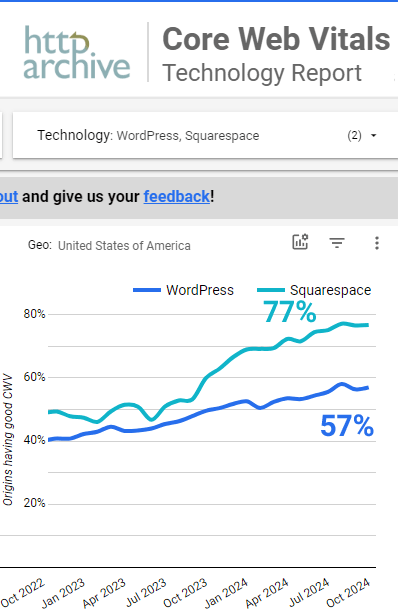
As a consequence, a higher percentage of sites created with Squarespace tend to have good core web vitals scores than sites created with WordPress, according to real-world data collected by HTTPArchive through the Chrome User Experience.
Squarespace, however, takes the crown when it comes to website performance for both global and USA-based origins.
The latest real-world data from HTTPArchive data shows that globally, 42% of WordPress sites had good core web vitals compared to 60% of Squarespace sites with good CWV scores.
The performance data for websites based in the United States shows WordPress scores rise to 57% of sites with good CWV, while 77% of Squarespace sites scored passing marks.
Screenshot of CWV Scores WordPress Vs. Squarespace from HTTPArchive, November 2024
While WordPress has more SEO options, Squarespace is the clear winner in terms of website speed metrics, as measured by core web vitals.
What’s Best For Blogging And Article Publishing
Blogging and publishing articles on Squarespace is simple.
Squarespace supports adding videos, images, galleries, and custom code within articles. Social sharing, post scheduling, article excerpt summaries, tags, and categories are fully built-in, no special configuration is necessary.
Publishing articles is a core functionality of WordPress. Millions of websites worldwide have successfully used it for blogging and article publishing.
Third-party themes and plugins extend WordPress with seemingly limitless options. While options specialized to recipe, news, or travel-related sites are not built-in to WordPress, the available options far exceed what’s available on Squarespace.
User Opinions About WordPress
I asked Adam J. Humphreys, a WordPress developer and search marketer, about his opinion of WordPress as a platform for ecommerce sites.
Adam shared:
“Yes, it’s easy to create an online store presence with WordPress. You can deploy WordPress instantly from most hosts in a few minutes with no technical knowhow. Some web hosts offer WooCommerce pre-built, enabling users to launch prebuilt stores seamlessly.
Third-party website builders greatly improve the ability to launch an online store. Blocksy Pro allows you to build custom polished ecommerce sites quickly using WooCommerce. Astra has prebuilt designs for those who don’t have the technical know how.
I prefer Blocksy Pro because custom and intentional design specific to your online customers always converts best. When you use prebuilt templates you spend as much time removing what you don’t want as you would to just do it quickly from scratch.
Fortunately, these systems like Blocksy Pro come with simple sections and easily connect with popular website builders like Elementor.
Using a managed WordPress host is useful because they supply critical updates automatically, which helps keep ecommerce stores secure and running trouble-free.
That said, there are some WordPress themes and website builders create complex code that results in slower performance, reduced sales from a poor user experience, and often lower rankings.”
User Opinions About Squarespace
A recent discussion on Reddit highlighted five reasons why many people, including web developers, prefer WordPress over Squarespace:
Requires no maintenance effort.
Launching a website is fast and effortless.
All-in-one cost is economical.
More secure than WordPress.
Squarespace is scalable (to a point).
These are the opinions of actual Squarespace users and Redditors in the discussion:
“I know both platforms. Squarespace is the Apple of website builders. WordPress is the PC. WordPress has more powerful abilities with plugins, but maintaining the updates and security is nerd-level and a constant treadmill of tasks. Squarespace ‘just works’ – with limitations on what you can do.”
“I think if you’re not prepared to manage or pay for someone to manage WordPress then having an all in one solution like Squarespace is a good way to go. It’s very hands off as they take care of all the security in the back end. There are extensions you can add for certain things but not needed to keep your website going.”
“I recently built my own website, and chose Squarespace so that I could get it done quickly and launched. The cost is very low, and I can get things done quickly and easily. I integrated my website with Google Analytics and GTM in 30 minutes.”
“I dropped WordPress for the same reason – various plugins kept getting hacked. I’ve really enjoyed Squarespace and it’s been easy to use.”
“Unpopular opinion here, Squarespace IS scalable. I spent 10 years building on WP and refuse to work with it anymore. Consists of nothing but nightmares lol. And I’m a web developer.”
While Squarespace can scale to handle high traffic, sites requiring complex functionality, such as server-side scripting, should consider alternatives like WordPress.
Squarespace wins on ease of use for blogging and article publishing, while WordPress scores higher for customization for every kind of site.
Ecommerce Solution
Squarespace is not just a website platform; it’s also an ecommerce platform specifically designed to make it easy to set up and run an online store.
Squarespace makes it easy to design an ecommerce website with a shopping cart and checkout. It also includes the ability to allow customers to leave reviews.
Shipping options, tax payment calculations, easy checkout options for customers, and order management are all handled within a unified Squarespace user interface.
As with everything else about WordPress, flexibility and the availability of third-party plugins and themes can both simplify creating an online shopping store and scale with a more complex ecommerce store.
Both platforms deliver a professional ecommerce experience, and both can be easily deployed, with a slight edge toward simplicity going to Squarespace because everything is integrated into one interface.
However, deploying a WordPress ecommerce store with a managed WordPress host simplifies the process of getting an online store up and running. The best part is that the WordPress platform enables it to be ready to grow with the business.
Final Takeaway: Limitations And Strengths Of WordPress And Squarespace
Squarespace is appealing because it’s an easy-to-use platform for creating websites that can also be extended with custom code.
It’s suitable for a wide range of sites that publish articles or sell services and products. Its templates can be extensively modified with custom CSS. Plus, the Squarespace Blueprint AI allows for the creation of unique professional websites.
A weakness of closed-source solutions is that they aren’t as flexible and customizable as websites built on the WordPress platform.
The convenience of Squarespace comes with a cost that can’t be mitigated by switching to a different web host. It’s a compromise between cost and convenience.
Meanwhile, WordPress isn’t generally as easy or convenient as Squarespace.
Getting the best experience with WordPress takes research to choose the right web hosting platform and the best and most trustworthy template and plugins that serve your needs.
Some web hosts make it easier to get online with WordPress, and page builders greatly improve the ease of creating beautiful websites.
Both platforms are top choices for building an online presence.
Choosing which one is the best depends on how much time you’re willing to put into researching options and how important flexibility and controlling costs are.
Squarespace is an excellent choice for those who want to focus on their business without worrying about technology or site security.
WordPress is a perfect solution for those who enjoy the freedom, scalability, and cost efficiency that comes with using an open-source solution.
The most emotionally engaging ad of the 2024 holiday season is a Teleflora ad featuring a hospitalized boy and a magical snowman.
According to research by DAIVID, the ad inspired the highest levels of positivity among viewers.
The Power of Wishes ad was created by The Wonderful Agency and encourages donations to help grant transformative wishes for children with critical illnesses.
Alongside Teleflora are nine other brands that also elicited the most positive emotions to create emotionally engaging ads.
1. The Power Of Wishes By Teleflora
As the video’s description says, “Believe in the power of wishes. This holiday season, Teleflora is proud to partner with @MakeAWish. Learn how you can show your support on Teleflora.com/wish and watch our new film.”
DAIVID’s analysis found that 57.1% of viewers experienced an intense positive reaction to the campaign, securing its top spot on the platform’s holiday ad rankings.
2. Your Spark Can Light Up The World By Erste Group
In second place is Erste Group’s ad “Your spark can light up the world,” which celebrates the origin story of the Christmas carol “Silent Night.”
As the video’s description says, “Get inspired by Silent Night and let your spark light up the world.”
And 56.4% of viewers were likely to feel intense positive emotions.
3. The Gifting Hour By John Lewis
“The Gifting Hour,” a John Lewis Christmas ad, is the final chapter in a trilogy by Saatchi & Saatchi. It came in third place with its touching tale of two sisters on a magical gift-finding quest.
It’s worth noting that the video’s description is more than 800 words long – and reads like a screenplay.
And, with 56.4% of viewers likely to feel intense positive emotions, this makes “The Gifting Hour” one of the most emotionally engaging Christmas ad by John Lewis in six years.
4. The Journey By Marks & Spencer
“The Journey” by UK retailer Marks & Spencer (M&S) took fourth place.
In the ad, comedian Dawn French reprised her role as the Christmas Fairy, reluctantly hosting a holiday party for her neighbors.
It generated intense positive feelings in 55.4% of viewers.
5. Amazon Midnight Opus By Amazon
“Amazon Midnight Opus – Holiday 2024” took fifth place with a description that says, “Make dreams happen this season, with a little holiday magic from Amazon.”
The 90-second version of the ad generated intense positive feelings in 55.2% of viewers.
I’ve also seen the 30-second version of the commercial on TV, and it loses much of its emotional impact. The longer version is much better.
6. The Sanctuary By Chevrolet
“The Sanctuary,” a 2024 holiday commercial by Chevrolet, is in sixth place.
The video’s description says, “This holiday season, remember none of us can get where we want to go without the support of another, especially from those we cherished most.
Watch as a father and son come together on the bench of their family’s 1978 Chevy Silverado C10 to look back on their shared past and how it continues to drive them forward.”
The ad generated intense positive feelings in 54.9% of viewers.
7. Una Historia De Navidad By Suchard
Suchard’s “Una historia de Navidad” is in seventh place as “A story that shows that Christmas comes anywhere.”
This ad generated intense positive feelings in 54.7% of viewers.
8. Waldo Anthom By Etsy
The Etsy holiday commercial “Waldo Anthem” is in eighth place. The video’s description merely discloses an enigmatic Where’s Waldo?
Nevertheless, 54.6% of viewers were likely to feel intense positive emotions.
9. 40 Years Of Christmas On The Nations’s Network By Vodafone UK
Vodafone UK is in ninth place with their 40 years of Christmas. And shows the journey from the first mobile phone in 1984 and a nostalgic view of technology through 40 years.
The video’s description says: “Our advert for 2024 shows how technology has changed, but the feeling of connecting with loved ones at Christmas remains the same. ”
The ad generated intense positive feelings in 54.5% of viewers.
10. A Magical Christmas By Lidl
And finally, “Lidl Presents: A Magical Christmas” is in 10th place and encourages viewers to gift a toy to Lidl’s Toy Bank and “share the magic.”
And 53.7% of viewers were likely to feel intense positive emotions.
The Christmas Big Emotions
Now that you’ve seen the most emotionally engaging Christmas ads for this year, what do you notice? What do you wonder?
For festive ads, the common themes that resonate with audiences will always be the staple emotions: warmth, joy, and excitement.
And this year, the big winner – nostalgia.
According to the CEO of DAIVID. Around 85% of ads tested this year scored above average for that emotion.
Nostalgia
In alignment with the data, I noticed that 9 out of the 10 ads above tapped into nostalgia, ranking it as one of their top 5 emotions.
Reminding people about the ghosts of Christmas past will always be a winner. It’s an easy way for brands to access a lot of emotions in a very short time, making it very powerful.
But brands that sprinkle other emotions into the mix tend to do better. This is why Teleflora’s “The Power of Wishes,” which is almost five times sadder than the average ad, outperformed other emotional ads at Christmas.
Now, there was a time when “Sadvertising” was a huge trend at Christmas, but not so much this year. I wonder if brands are trying to cheer us up after such a horrible year.
It’s worth noting that only 12 of the 125 ads that DAIVID tested scored higher than the norm for sadness.
Don’t get me wrong – there were brands that made us cry.
For example, the ad that made us cry the most was World of Our Own from Shelter. The ad generated intense sadness among 31% of viewers, well ahead of any other ad this year and more than five times sadder than the industry average.
Others that made us tear up include “PETA’s Christmas Ad.” As the video’s description warns us, “PETA’s 2024 Christmas advert is here – and this cow’s story will break your heart.”
And then there’s #FeedYourChristmasSpirit from Tesco. But the ad’s attempt to be bittersweet comes off as weird.
Amusement
Making people laugh has also been a key theme this year. Again, I think brands and their agencies are trying to cheer us up.
A notable example of this in the top 10 is “The Journey” from M&S. Dawn French is a UK national treasure – and much loved.
However, the funniest Holiday ads this year did not quite make the top 10.
The ad most likely to make people laugh is “A Watt Holiday Classic” from DICK’s Sporting Goods.
It features former NFL player J.J. Watt, who recreates scenes from iconic festive films after being trapped in a Dick’s store after closing. The ad made 37% of viewers laugh, which is well above the industry norm.
Another festive ad to make us laugh this year is a spot from a British supermarket chain called “Sweet Suspicion: A Waitrose Mystery” by Waitrose. This ad made 34.1% of viewers laugh out loud.
Sprinkle Some Magic
A lot of magic was used this year. This was a very common theme throughout the chart. Do you think people are trying to forget what the world is like right now?
But there was a lack of celebs. I think there is only one (Dawn French) in the top 10. That makes festive advertising very different than Super Bowl ads. But that’s a topic for another day.
Methodology
A total of 125 holiday advertisements from across the globe were analyzed in the study. The ads were evaluated based on the percentage of viewers expected to experience strong positive emotions in response to the content. As noted, DAIVID measures 39 distinct emotions, with their intensity rated on a scale from 1 to 10. Scores between 8 and 10 are classified as “intense.” The data for the chart was collected at 7:00 AM on December 3, 2024.
Matt Mullenweg accused Inc Magazine of distorting an interview with him, publishing verifiably fake facts and quoting people who lacked credibility. Mullenweg posted compelling examples of how the Inc magazine misrepresented his quotes and presented false fact, citing the selection of unflattering photos as evidence of a conscious effort to negatively slant their interview of him.
Mullenweg explains why he agreed to the interview:
“When Inc Magazine reached out to have David H. Freedman (website powered by WordPress) write a feature piece I was excited because though Inc wasn’t a magazine I have read much since I was a teenager, David seemed like a legit journalist who usually writes for better publications like The Atlantic. I opened up to David with a number of vulnerable stories, and allowed the photo shoot in my home in Houston.”
The article begins with an unflattering portrait of Mullenweg as a control freak that is fussy about the kind of toilet paper and soap is provided at Automattic’s offices. Mullenweg writes that he had shared an anecdote with the writer of the time he visited Google’s headquarters in 2004 and was surprised by what he felt was “cheap toilet” paper. Years later when he had his own offices he made the decision to spend extra on good soap and toilet paper to benefit his employee’s experience at work. In other words, the choice to do that came from altruism and a concern for others, not a desire to control every detail.
But that’s not how Inc magazine portrayed it.
They write:
“Stooping to fling open a storage cabinet built into the bathroom wall, he points to a neat stack of wrapped toilet paper rolls. “The best toilet paper you can buy,” he assures me. “How much extra does really nice toilet paper cost? A buck or two?” The handsome bottles of soap by the sinks are premium, too, he adds.
I ask him who at Automattic, the estimated $710-million company of which Mullenweg is CEO, is responsible for toilet paper and soap quality control?
“Me,” he says, beaming.
Of course, Mullenweg’s control of Automattic extends well beyond the bathroom walls.”
Grim Images In Photographs
The author of the article described Mullenweg as a young looking forty year old with a “near-constant grin” which contradicted the photographs Inc chose to publish, neither of which showed him smiling. Of the two photographs from the interview they chose to publish, one captures Mullenweg mid-blink, resulting in an absurd image of him typing with his eyes closed.
There are two other photographs from the past nine and twelve years ago which do show him smiling. Mullenweg’s smile is not an affectation; it’s an authentic expression. Videos of him participating in interviews or speaking publicly consistently show him smiling. Mullenweg is correct to point out that Inc magazine made a deliberate choice to not publish an image of him smiling, which is his characteristic expression, as noted in the article itself.
Poorly Researched Article
Mullenweg’s critique of the article zeroes in on a series of false statements that are indicative of poor research, including a consistent misrepresentation of a company’s earnings with its valuation.
One of the false facts wrongfully asserts that Mullenweg coded WordPress in three “obsessive days” when the actual time period was four months. This might seem minor but it’s not because it’s evidence of what Mullenweg points out is poor research that could have been easily verified on Wikipedia.
His critique is thoroughly convincing and shows how he agreed to the interview with openness and the expectation of balanced reporting. His dismay at the results is palpably communicated in his blog post about it.
Nevertheless he goes on to say that he supports journalism and puts the blame on the editor of the article.
He writes:
“I know a lot of entrepreneurs follow me and I don’t want your takeaway to be “don’t talk to journalists” or “don’t engage with mainstream media.”
…this is a good example of where a decent journalist can’t overcome a crappy editor and quality control. I probably wouldn’t be excited to work with Inc Magazine again while Mike Hofman is in charge as editor-in-chief, he’s clearly overseeing a declining brand. But I will continue to engage with other media, and blog, and tweet, and tell my story directly.
When an editor wants to make you look good, they can! If they decide they want to drag you, they can too. Everything in my interactions with David and Inc made it seem this would be a positive piece, so be careful.
We’ll see if Inc Magazine has any journalistic integrity by their updates to the article.”
Rightfully Disappointed
Mullenweg researched the interviewer and verified that they were a competent and respectable writer. From Mullenweg’s point of view the Inc magazine article was poorly researched and heavily slanted against him, what he termed a hit piece.
Matt Mullenweg announced the abrupt pause in services offered by WordPress.org, affecting plugin submissions, reviews, theme submissions, and additions to the photo directory. He offers to keep providing these services to WP Engine, citing the recent court order against him and Automattic that compels him to offer “free labor and services.”
Pause For The Holidays
Mullenweg published a post on the official WordPress blog to announce a pause in free services offered by WordPress.org to give the “many tired volunteers around WordPress.org a break for the holidays.”
The pause affects:
New account registrations on WordPress.org
New plugin directory submissions
New plugin reviews
New theme directory submissions
New photo directory submissions
The pause doesn’t affect the ability to install new instances of WordPress sites or accounts, which sounds contradictory.
Here’s what he wrote in his list of what services are paused:
“New account registrations on WordPress.org (clarifying so press doesn’t confuse this: people can still make their own WordPress installs and accounts)”
Mullenweg makes a point to note that the pause doesn’t affect WP Engine, stating that he’s legally required to keep providing free labor and services” services to WP Engine, writing that if WP Engine requires those services they can have their “high-priced attorneys” speak to his “high-priced attorneys” to gain access.
He then shared a cryptic message that implied there was a chance that WordPress may not resume those services in 2025, saying that it hinged on his being able to find the “time, energy, and money” to undo the pause in 2025, which he writes is being expended defending against WP Engine’s lawsuit against him and Automattic.
Mullenweg wrote:
“Right now much of the time I would spend making WordPress better is being taken up defending against WP Engine’s legal attacks. Their attacks are against Automattic, but also me individually as the owner of WordPress.org, which means if they win I can be personally liable for millions of dollars of damages.”
He signs off inviting those who’d like to fund those attacks on him to sign up for WP Engine and that those who don’t can sign up for other web hosts, linking to both WP Engine and a WordPress.org page that offers promotions to induce WP Engine clients to switch away.