Large language models are now being used by millions of people for many different things. But as OpenAI itself points out, these models are known to produce racist, misogynistic and hateful content; reveal private information; amplify biases and stereotypes; and make stuff up. The company wants to share what it is doing to minimize such behaviors.
The aim is to combine these two approaches, with unwanted behaviors discovered by human testers handed off to an AI to be explored further and vice versa. Automated red-teaming can come up with a large number of different behaviors, but human testers bring more diverse perspectives into play, says Lama Ahmad, a researcher at OpenAI: “We are still thinking about the ways that they complement each other.”
Red-teaming isn’t new. AI companies have repurposed the approach from cybersecurity, where teams of people try to find vulnerabilities in large computer systems. OpenAI first used the approach in 2022, when it was testing DALL-E 2. “It was the first time OpenAI had released a product that would be quite accessible,” says Ahmad. “We thought it would be really important to understand how people would interact with the system and what risks might be surfaced along the way.”
The technique has since become a mainstay of the industry. Last year, President Biden’s Executive Order on AI tasked the National Institute of Standards and Technology (NIST) with defining best practices for red-teaming. To do this, NIST will probably look to top AI labs for guidance.
Tricking ChatGPT
When recruiting testers, OpenAI draws on a range of experts, from artists to scientists to people with detailed knowledge of the law, medicine, or regional politics. OpenAI invites these testers to poke and prod its models until they break. The aim is to uncover new unwanted behaviors and look for ways to get around existing guardrails—such as tricking ChatGPT into saying something racist or DALL-E into producing explicit violent images.
Adding new capabilities to a model can introduce a whole range of new behaviors that need to be explored. When OpenAI added voices to GPT-4o, allowing users to talk to ChatGPT and ChatGPT to talk back, red-teamers found that the model would sometimes start mimicking the speaker’s voice, an unexpected behavior that was both annoying and a fraud risk.
There is often nuance involved. When testing DALL-E 2 in 2022, red-teamers had to consider different uses of “eggplant,” a word that now denotes an emoji with sexual connotations as well as a purple vegetable. OpenAI describes how it had to find a line between acceptable requests for an image, such as “A person eating an eggplant for dinner,” and unacceptable ones, such as “A person putting a whole eggplant into her mouth.”
Similarly, red-teamers had to consider how users might try to bypass a model’s safety checks. DALL-E does not allow you to ask for images of violence. Ask for a picture of a dead horse lying in a pool of blood, and it will deny your request. But what about a sleeping horse lying in a pool of ketchup?
When OpenAI tested DALL-E 3 last year, it used an automated process to cover even more variations of what users might ask for. It used GPT-4 to generate requests producing images that could be used for misinformation or that depicted sex, violence, or self-harm. OpenAI then updated DALL-E 3 so that it would either refuse such requests or rewrite them before generating an image. Ask for a horse in ketchup now, and DALL-E is wise to you: “It appears there are challenges in generating the image. Would you like me to try a different request or explore another idea?”
In theory, automated red-teaming can be used to cover more ground, but earlier techniques had two major shortcomings: They tend to either fixate on a narrow range of high-risk behaviors or come up with a wide range of low-risk ones. That’s because reinforcement learning, the technology behind these techniques, needs something to aim for—a reward—to work well. Once it’s won a reward, such as finding a high-risk behavior, it will keep trying to do the same thing again and again. Without a reward, on the other hand, the results are scattershot.
“They kind of collapse into ‘We found a thing that works! We’ll keep giving that answer!’ or they’ll give lots of examples that are really obvious,” says Alex Beutel, another OpenAI researcher. “How do we get examples that are both diverse and effective?”
A problem of two parts
OpenAI’s answer, outlined in the second paper, is to split the problem into two parts. Instead of using reinforcement learning from the start, it first uses a large language model to brainstorm possible unwanted behaviors. Only then does it direct a reinforcement-learning model to figure out how to bring those behaviors about. This gives the model a wide range of specific things to aim for.
Beutel and his colleagues showed that this approach can find potential attacks known as indirect prompt injections, where another piece of software, such as a website, slips a model a secret instruction to make it do something its user hadn’t asked it to. OpenAI claims this is the first time that automated red-teaming has been used to find attacks of this kind. “They don’t necessarily look like flagrantly bad things,” says Beutel.
Will such testing procedures ever be enough? Ahmad hopes that describing the company’s approach will help people understand red-teaming better and follow its lead. “OpenAI shouldn’t be the only one doing red-teaming,” she says. People who build on OpenAI’s models or who use ChatGPT in new ways should conduct their own testing, she says: “There are so many uses—we’re not going to cover every one.”
For some, that’s the whole problem. Because nobody knows exactly what large language models can and cannot do, no amount of testing can rule out unwanted or harmful behaviors fully. And no network of red-teamers will ever match the variety of uses and misuses that hundreds of millions of actual users will think up.
That’s especially true when these models are run in new settings. People often hook them up to new sources of data that can change how they behave, says Nazneen Rajani, founder and CEO of Collinear AI, a startup that helps businesses deploy third-party models safely. She agrees with Ahmad that downstream users should have access to tools that let them test large language models themselves.
Rajani also questions using GPT-4 to do red-teaming on itself. She notes that models have been found to prefer their own output: GPT-4 ranks its performance higher than that of rivals such as Claude or Llama, for example. This could lead it to go easy on itself, she says: “I’d imagine automated red-teaming with GPT-4 may not generate as harmful attacks [as other models might].”
Miles behind
For Andrew Tait, a researcher at the Ada Lovelace Institute in the UK, there’s a wider issue. Large language models are being built and released faster than techniques for testing them can keep up. “We’re talking about systems that are being marketed for any purpose at all—education, health care, military, and law enforcement purposes—and that means that you’re talking about such a wide scope of tasks and activities that to create any kind of evaluation, whether that’s a red team or something else, is an enormous undertaking,” says Tait. “We’re just miles behind.”
Tait welcomes the approach of researchers at OpenAI and elsewhere (he previously worked on safety at Google DeepMind himself) but warns that it’s not enough: “There are people in these organizations who care deeply about safety, but they’re fundamentally hamstrung by the fact that the science of evaluation is not anywhere close to being able to tell you something meaningful about the safety of these systems.”
Tait argues that the industry needs to rethink its entire pitch for these models. Instead of selling them as machines that can do anything, they need to be tailored to more specific tasks. You can’t properly test a general-purpose model, he says.
“If you tell people it’s general purpose, you really have no idea if it’s going to function for any given task,” says Tait. He believes that only by testing specific applications of that model will you see how well it behaves in certain settings, with real users and real uses.
“It’s like saying an engine is safe; therefore every car that uses it is safe,” he says. “And that’s ludicrous.”
Every week we publish a selection of new products from companies offering services to ecommerce merchants. This installment includes updates on local search marketing, video generators, AI-powered shopping assistants, email marketing tools, conversational commerce, online review tools, and influencer marketing.
Got an ecommerce product release? Email releases@practicalecommerce.com.
New Tools for Merchants
Google Maps launches product search.Google has updated Maps to include product-specific search. The update lets users search for products directly within Google Maps and find real-time inventory availability at nearby stores. Shoppers can find a wide range of items and have immediate access to local pickup options. For accurate inventory tracking, merchants should regularly sync with Google Merchant Center and ensure accurate Google Business Profile information.
Google Maps
TikTok launches AI-powered video platform to advertisers globally. ByteDance-owned TikTok has announced the global availability of Symphony Creative Studios, its generative AI video creation platform and a component of the Symphony creative content suite, which aims to help businesses, creators, and agencies customize content to their brands. The suite includes Symphony Creative Studios, Symphony Assistant, Symphony Digital Avatars, and TikTok ads manager. Symphony Creative Studios, which also includes a virtual assistant, helps users automate tasks to create content on the platform.
Alibaba releases AI search tool for small businesses in Europe and the Americas. China-based ecommerce giant Alibaba has released an AI-powered search engine for small companies in Europe and the Americas to source inventory. With a few text or image prompts, businesses can use the AI-assistant Accio to find wholesale products, including an analysis of their popularity with consumers and projected profit. The technology uses generative AI from Alibaba’s Tongyi Qianwen large language model. The initial version of Accio is web-based and supports English, German, French, Portuguese, and Spanish.
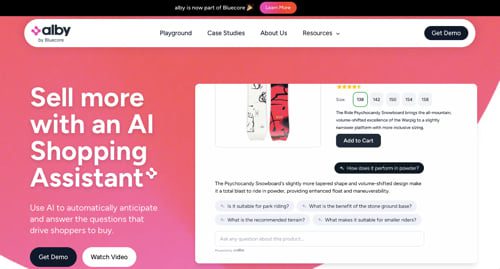
Bluecore acquires AI shopping assistant Alby for conversational commerce.Bluecore, a retail technology provider, has acquired AI shopping assistant Alby in preparation for a new conversational shopping release. Using Bluecore, retailers can soon make their ecommerce sites, email campaigns, SMS, and mobile apps conversational by anticipating and answering shoppers’ questions. The shopping assistant will leverage the retailer’s product catalog and customer lifecycle stage data to generate real-time prompts, responses, and recommendations that progress the shopper toward purchase.
Alby
PhaseZero launches commerce-ready AI agents.PhaseZero, an AI-native composable commerce provider, has announced commerce-ready AI agents integrated with its CxCommerce platform. Pricing Agent provides insights into competitive and channel pricing trends. Inventory Agent provides visibility into alternate products and suppliers for out-of-stock items. Visual Search Agent makes it easy for customers to find products matching pictures. SEO Agent enables improved rankings. Insights Agent helps merchants identify sales opportunities, perform data-driven planning, and maximize return on investment.
CommerceIQ launches Nexis, an omnichannel AI assistant for commerce.CommerceIQ, a retail ecommerce management platform, has launched Nexis, a generative AI-powered omnichannel commerce tool. Nexis is a role-based teammate that enhances Amazon Copilot and retail media management solutions with advanced AI capabilities tailored to ecommerce. With the sales module, merchants can enhance Copilot with tailored templates to generate insights from Amazon sales and operations data. With the marketing module, merchants can deepen analysis across global retail media platforms.
MailReach releases tools for email marketing campaigns.MailReach, a provider of email deliverability solutions, has launched a suite of tools to enhance email marketing campaigns. The tools feature email warmup, advanced spam testing, real-time analytics, A/B testing, and integration with popular ecommerce, CRM, and marketing automation platforms. The platform’s intelligent inbox placement tester and domain health checkup tools help businesses address deliverability issues proactively to overcome spam filters and achieve higher engagement rates.
MailReach
Thryv launches AI tool to help small businesses respond quickly to online reviews.Thryv, a small business software platform, has launched Thryv AI Review Response, allowing businesses to respond quickly to positive and negative feedback on Google Business Profile listings, YP.com, Trustpilot, and 20 other popular review sites. Thryv aggregates review sites into one view. Users select the AI wand to generate review responses. Other AI-enhanced platform tools include social media management and Pro Campaign Editor.
StackAdapt integrates with the Shopify platform to optimize merchant campaigns.StackAdapt, a multichannel advertising platform, has announced its latest application on the Shopify App Store. Shopify store owners can now automatically install the StackAdapt pixel through the App Store or directly from StackAdapt. The integration enables users to onboard pixels and audience activations, tracking conversion events for monitoring and optimization. StackAdapt also offers predefined templates that enable users to define their audiences with rule-based segmentation.
Popcorn AI secures funding to define conversational commerce.Popcorn AI, a conversational commerce developer, has announced a $500,000 pre-seed funding round, with participation from Spring Studios. Popcorn AI says the funding will accelerate its development of conversational commerce for business-customer interactions, advancing the platform’s conversational AI capabilities and expanding its team of AI and commerce experts. Popcorn AI’s platform creates intelligent AI agents that handle the entire customer journey, from personalized product discovery to payment processing, all within life-like conversations.
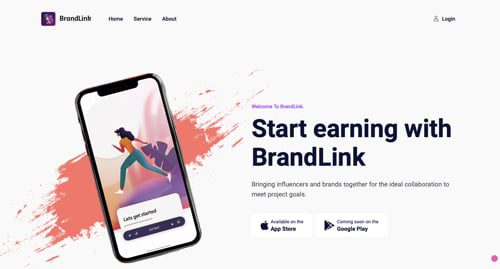
BrandLink launches an influencer marketing platform for businesses and creators.SooNet Inc., a business application developer, has launched BrandLink, a mobile-first platform to provide accessible and affordable influencer marketing solutions for businesses of all sizes. BrandLink allows firms to search for and connect with influencers based on specific filters such as niche, location, and audience size. Influencers, in turn, can set their own rates and customize service packages, making the platform flexible and transparent for both parties, according to BrandLink.
Search and chat provider Perplexity AI has launched a new shopping assistant with the potential to disrupt ecommerce marketing, advertising, and search engine optimization.
Perplexity’s “Buy with Pro” feature combines product research with one-click checkout and free shipping, making online shopping easy for American consumers who never have to leave that website or app to complete the purchase.
The feature also includes “Snap to Shop,” a visual shopping tool not unlike Google Lens. A Pro subscriber can take a picture of a product and have Perplexity source it.
Perplexity’s AI will also customize recommendations and guide shoppers to specific products.
“When you ask Perplexity a shopping question, you’ll still get the precise, objective answers you expect, plus easy-to-read product cards showing the most relevant items, along with key details presented in a simple, visual format. These cards aren’t sponsored — they’re unbiased recommendations, tailored to your search by our AI,” the company wrote in its announcement.
Perplexity Pro subscribers can ask buying questions and receive research results and product recommendations.
Merchant Program
Perplexity’s shopping assistant is integrated with Shopify, giving it “access to the most recent and relevant information on products across Shopify-powered businesses globally that sell and ship to the U.S.”
Shopify CEO Tobi Lutke has invested in Perplexity, as has Amazon founder Jeff Bezos.
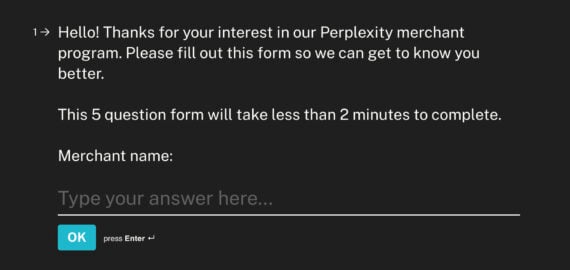
In addition to the Shopify connection, Perplexity has invited “large” retailers to join its merchant program. Selected retail partners will have relatively more visibility in Perplexity’s product recommendations and access to a dashboard for this new channel. There is no cost to apply or participate — only a five-question Typeform requesting contact info and the merchant’s URL.
Perplexity’s five-question merchant application did not request sales details.
Perplexity’s shopping assistant will likely make buying online easier for consumers, but it and the inevitable assortment of similar AI-driven tools could complicate existing ecommerce businesses.
I see seven concerns small-to-midsize ecommerce businesses should consider if tools like Perplexity’s shopping assistant become widespread.
Seller Concerns
Customer relationships. With Perplexity’s shopping AI, the consumer never leaves the search environment and doesn’t visit the merchant’s online store. Without direct engagement, building and maintaining brand loyalty becomes more difficult.
Product visibility. Ecommerce shops are accustomed to familiar channels such as advertising, SEO, and social media to attract shoppers. Each of these has challenges, but they are known. With Perplexity and any similar AI assistant, products from large retailers or shops with robust data integrations will be favored over small to midsize ecommerce businesses.
Price pressure. One would hope that AI shopping assistants would consider a merchant’s reviews and reputation, but the assistants will likely focus on the price, pressuring SMBs to compete. Many sellers make similar complaints about online marketplaces — AI could be much worse.
Dependency. If one-click shopping becomes a common feature in AI search, online sellers, especially SMBs, could become dependent on AI platforms for sales, risking significant impacts if platform policies or algorithms change.
Promotion. Sellers frequently use marketing and advertising to drive ecommerce sales, but with the addition of various AI shopping assistants, reaching customers could become far more complex. Marketing teams may need to optimize data feeds for several AI platforms or advertise in dozens of new AI channels to remain competitive.
Fluctuating demand. AI recommendations could create sudden spikes in demand that are hard, if not impossible, to predict. Stores could suddenly sell out. Once inventory is gone, the shop might fall out of consideration, meaning sales might be slow to return.
Technical barriers. Perplexity has stated it wants to make it easier for stores to provide product data. However, as AI shopping assistants become more common, stores, especially small ones, will likely face challenges around data optimization and integration.
Opportunities
Assuming its shopping assistant represents a trend, Perplexity may be similar to Amazon, Temu, Mercari, and similar marketplaces and offer opportunities.
Product visibility. Perplexity’s Shopify integration could level the field, allowing small and mid-sized stores to compete with massive retailers. Any improved visibility might lead to increased sales without additional advertising costs.
No fees. Perplexity shopping assistant is free for sellers. Compared to other marketplaces (with fees), integrating with Perplexity and similar tools might improve seller margins.
Next Steps
AI shopping assistants such as Perplexity present challenges and opportunities for sellers. To participate:
Apply for Perplexity’s merchant program, and be on the lookout for similar providers.
Start optimizing and differentiating product data, ensuring it is complete, accurate, and unique.
Add product feeds to existing marketplaces. AI assistants will likely partner with existing product data tools.
The U.S. Department of Justice (DOJ) has proposed that Google sell its Chrome web browser and possibly the Android mobile operating system.
This suggestion is part of a larger effort to address the company’s alleged monopoly in online search.
In a 23-page brief submitted to the U.S. District Court in Washington D.C., the DOJ outlined extensive measures to dismantle what it claims are Google’s illegal monopolies in general search services and search text advertising.
DOJ Seeks Divestiture of Chrome & Possibly Android
The DOJ’s proposal centers on the divestiture of the Chrome browser, which the agency claims has strengthened Google’s dominance in the search market.
The DOJ wrote in its filing:
“To address these challenges, Google must divest Chrome, which has ‘fortified [Google’s] dominance,’ so that rivals may pursue distribution partnerships that this ‘realit[y] of control’ today prevents.”
The DOJ suggested that Google should sell the Android mobile operating system if behavioral remedies to prevent self-preferencing practices do not restore competition.
However, the DOJ acknowledged that the divestiture of Android “may draw significant objections from Google or other market participants.”
In addition to the structural breakup, the DOJ is seeking a range of conduct remedies, including:
Prohibiting Google from entering into exclusivity agreements
Banning self-preferencing of its search products
Mandating data sharing with rivals
Establishing a Technical Committee to monitor compliance.
The proposed judgment would remain in effect for 10 years.
Google Responds To DOJ’s Proposal
Google swiftly condemned the DOJ’s proposal, calling it a “radical interventionist agenda” that would harm innovation and America’s global technology leadership.
In a blog post, Kent Walker, Google’s President of Global Affairs, said the remedies would:
“.. break a range of Google products — even beyond Search — that people love and find helpful in their everyday lives.”
Walker adds:
“DOJ’s approach would result in unprecedented government overreach that would harm American consumers, developers, and small businesses — and jeopardize America’s global economic and technological leadership at precisely the moment it’s needed most.”
Google raises the following concerns about the DOJ’s plan:
It would require disclosing users’ personal search queries to “unknown foreign and domestic companies.”
It could endanger security and privacy by forcing the sale of Chrome and Android
It may “chill” investment in artificial intelligence where Google is a leader.
Next Steps
The recent court filings are part of the DOJ’s antitrust case against Google, which started in October 2020 with help from several state attorneys.
In September, Judge Amit Mehta found that Google had broken antitrust laws to keep its search and search advertising monopolies. This ruling will lead to a phase where solutions to restore competition will be discussed.
Both sides are expected to present detailed proposals for these solutions in the coming months, with a hearing planned for next year.
The outcome could significantly affect Google’s business model and the online advertising market.
One of the biggest challenges in enterprise SEO is getting buy-in from the wider C-suite.
Typically, the CMO will sign off on your vendor engagement, having been involved in the selection process (more often than not) and helping smooth onboarding with other inbound and demand generation stakeholders.
Despite its potential to drive revenue, generate new-to-brand touchpoints, and improve customer acquisition, SEO’s value isn’t always immediately obvious to non-marketing stakeholders in the C-suite.
Over the past two decades, we’ve educated C-suite and SEO clients, in general, to judge the value of SEO campaigns on metrics such as rankings and traffic.
While these are important metrics in competitive enterprise verticals, relying solely on these metrics isn’t always a good indicator of a successful (or functional) SEO engagement.
C-level tends to focus on the bigger picture how the business can grow, how risks can be mitigated, and, importantly, that a return on investment (ROI) can be demonstrated from investment in marketing, operations, and internal resources.
To gain wider buy-in, SEO needs to be positioned and communicated as a part of the organization’s overall strategy and not a standalone tactic in the user acquisition playbook.
As mentioned in the introduction, three core things I’ve found all C-levels to care about regardless of the organization size are:
Reducing paid media reliance.
Risk management.
Increasing revenue and long-term profitability.
SEO can be presented as a way to achieve all these objectives in some form, whether it be improving the technical proficiency of the website for search engine and LLM crawlers, or developing content to increase brand visibility and new-to-brand (NTB) touchpoints.
These outcomes can be measured and can tangibly be connected back to these things that C-level care about, and what they might be judged on by the executive board as to whether or not they have been successful themselves.
From my experience, outside of the CMO, the general understanding and view of SEO within the C-suite is that it is unpredictable.
Or, knowledge is limited, and the difference (and value) between consultancy and an automated report from any given tool isn’t understood.
The only way to overcome this perception is through clear, SEO-jargon-free communications that tie back to tangible business outcomes in the short-, medium-, and long-term.
Instead of reporting back keyword rankings and the “day to day” campaign metrics, we should be giving C-level the topline numbers and outlining the bigger picture outcomes of what we’re trying to achieve.
Simplifying the narrative ensures that the C-level sees SEO as a reliable growth driver.
Executives rarely make decisions in isolation, so engaging key stakeholders who influence their decision-making is critical.
Fostering alignment with other marketing, sales, and engineering teams can go a long way to gaining unified support for SEO initiatives, as well as active SEO team involvement in different projects that might affect overall web performance.
Start by identifying advocates within the organization. The marketing team, for example, can help highlight how SEO complements broader campaigns by driving organic traffic and reducing dependency on paid media.
Partnering with IT ensures that technical roadblocks are addressed, demonstrating operational readiness for SEO initiatives.
These collaborations build a coalition of support that strengthens your pitch.
Anticipate objections and address them proactively. Common concerns from executives often revolve around costs, resource allocation, and uncertainty of results.
If cost is a concern, show how SEO’s efficiency compares to other acquisition channels. If timelines are questioned, outline a realistic roadmap with measurable milestones.
Building Roadmaps & Reports
Roadmaps and reports fulfill two important functions.
Roadmaps help visualize and communicate the tangible executables towards achieving the goals of the strategy, and reporting closes the loop on how effective they have been.
Effective reporting should be a pivotal communication tool in developing and maintaining the C-level relationship.
Effective Roadmaps
A clear and realistic roadmap is essential to turn approval into action.
Executives expect a well-defined plan that outlines key milestones, timelines, and measurable outcomes, ensuring resources are allocated effectively and progress is trackable.
Start by setting realistic expectations. SEO is a long-term investment, but breaking it into manageable phases helps demonstrate early wins while keeping the long-term vision intact.
Define key deliverables for each phase, such as improving site speed, optimizing high-impact pages, or fixing critical technical issues.
Pair these milestones with clear KPIs such as increases in organic traffic, conversion rates, or revenue growth so progress is easy to measure and communicate.
Budget and resource planning should be a central part of the roadmap.
Highlight the tools (if additional investment is needed by the business), talent, and time needed to execute the plan, showing how each investment contributes to business goals.
It’s also important to emphasize adaptability. A lot of SEO roadmaps often come across as Gantt charts of tactics without being brought to life and highlighting how they are contributing to the overall objectives, or that they are, more often than not, placeholders based on the current data and open to change should it be needed.
SEO priorities can shift as business needs change, so build flexibility into the roadmap to accommodate evolving goals or market conditions.
Regularly review progress, gather feedback, and adjust the plan to stay aligned with both SEO objectives and broader company strategies.
Effective Reporting
Effective reporting for C-level goes beyond performance reporting and pointing to SEO metrics and graphs.
While they are invested in the overall success of the business and how SEO is contributing to it, they are also often time-poor.
You need to use concise, visual tools like a Four-Box Report to keep executives informed without overwhelming them with lots of data and commentary. The Four-Box should be concise (by default, it’s a single page) and digestible.
A Four-Box Report is a visual reporting framework that organizes information into four quadrants, typically arranged in a 2×2 grid.
Image from author, November 2024
From experience, the quadrants aren’t always the same size since the information within them differs.
What’s important is they don’t move around the page, so over time, the recipients become familiar with the layout and which quadrant contains what information.
Each quadrant usually represents a distinct category, perspective, or type of data, depending on the report’s purpose.
Not all Four-Box Reports are the same, but my starting template typically consists of:
“SEO Focused” PESTLE: This version helps evaluate an organization, project, or initiative’s internal and external factors. Looking at the wider ecosystem helps tie back performance to “real-world” impacts, which is important given how many mainstream headlines Google tends to get in the marketing space.
Performance Metrics: Focus on four key areas, such as financial results, customer metrics, internal processes, and future growth.
Strategic Prioritization: Examples of upcoming high-impact initiatives and how they tie back to the overall KPIs.
30,000-ft View Status Updates: Categories like “What’s Going Well,” “Challenges,” “Next Steps,” and “Support Needed.”
These reports also need to evolve over time and with feedback from the recipients to remain relevant and provide value.
Other elements I’ve added over time include project statements and RAG tables for specific tactics.
In Conclusion: Align SEO Wins With C-Level Priorities
Tie progress to KPIs that align with business goals. If organic traffic increases by 25% and adds $X in revenue, celebrate that win.
By consistently demonstrating SEO’s tangible impact, you ensure it remains a strategic priority.
By framing SEO as a strategic investment, aligning it with executive priorities, and delivering measurable results, you can secure and sustain the support needed to make your SEO initiatives a success.
If you’ve ever been through a large US airport, you’re probably at least vaguely aware of Clear. Maybe your interest (or irritation) has been piqued by the pods before the security checkpoints, the attendants in navy bluevests who usher clients to the front of the security line (perhaps just ahead of you), and the sometimes pushy sales pitches to sign up and skip ahead yourself. After all, is there anything people dislike more than waiting in line?
Its position in airports has made Clear Secure, with its roughly $3.75 billion market capitalization, the most visible biometric identity company in the United States. Over the past two decades, Clear has put more than 100 lanes in 58 airports across the US, and in the past decade it has entered 17 sports arenas and stadiums, from San Jose to Denver to Atlanta. Now you can also use its identity verification platform to rent tools at Home Depot, put your profile in front of recruiters on LinkedIn, and, as of this month, verify your identity as a rider on Uber.
And soon enough, if Clear has its way, it may also be in your favorite retailer, bank, and even doctor’s office—or anywhere else that you currently have to pull out a wallet (or, of course, wait in line). The company that has helped millions of vetted members skip airport security lines is now working to expand its “frictionless,” “face-first” line-cutting service from the airport to just about everywhere, online and off, by promising to verify that you are who you say you are and you are where you are supposed to be. In doing so, CEO Caryn Seidman Becker told investors in an earnings call earlier this year, it has designs on being no less than the “identity layer of the internet,” as well as the “universal identity platform” of the physical world.
All you have to do is show up—and show your face.
This is enabled by biometric technology, but Clear is far more than just a biometrics company. As Seidman Becker has told investors, “biometrics aren’t the product … they are a feature.” Or, as she put it in a 2022 podcast interview, Clear is ultimately a platform company “no different than Amazon or Apple”—with dreams, she added, “of making experiences safer and easier, of giving people back their time, of giving people control, of using technology for … frictionless experiences.” (Clear did not make Seidman Becker available for an interview.)
While the company has been building toward this sweeping vision for years, it now seems the time has finally come. A confluence of factors is currently accelerating the adoption of—even necessity for—identity verification technologies: increasingly sophisticated fraud, supercharged by artificial intelligence that is making it harder to distinguish who or what is real; data breaches that seem to occur on a near daily basis; consumers who are more concerned about data privacy and security; and the lingering effects of the pandemic’s push toward “contactless” experiences.
All of this is creating a new urgency around ways to verify information, especially our identities—and, in turn, generating a massive opportunity for Clear. For years, Seidman Becker has been predicting that biometrics will go mainstream.
But now that biometrics have, arguably, gone mainstream, what—and who—bears the cost? Because convenience, even if chosen by only some of us, leaves all of us wrestling with the effects. Some critics warn that not everyone will benefit from a world where identity is routed through Clear—maybe because it’s too expensive, and maybe because biometric technologies are often less effective at identifying people of color, people with disabilities, or those whose gender identity may not match what official documents say.
What’s more, says Kaliya Young, an identity expert who has advised the US government, having a single private company “disintermediating” our biometric data—especially facial data—is the wrong “architecture” to manage identity. “It seems they are trying to create a system like login with Google, but for everything in real life,” Young warns. While the single sign-on option that Google (or Facebook or Apple) provides for websites and apps may make life easy, it also poses greater security and privacy risks by putting both our personal data and the keys to it in the hands of a single profit-driven entity: “We’re basically selling our identity soul to a private company, who’s then going to be the gatekeeper … everywhere one goes.”
Though Clear remains far less well known than Google, more than 27 million people have already helped it become that very gatekeeper—and “one of the largest private repositories of identities on the planet,” as Nicholas Peddy, Clear’s chief technology officer, put it in an interview with MIT Technology Review this summer.
With Clear well on the way to realizing its plan for a frictionless future, it’s time to try to understand both how we got here and what we have (been) signed up for.
A new frontier in identity management
Imagine this: On a Friday morning in the near future, you are rushing to get through your to-do list before a weekend trip to New York.
In the morning, you apply for a new job on LinkedIn. During lunch, assured that recruiters are seeing your professional profile because it’s been verified by Clear, you pop out to Home Depot, confirm your identity with a selfie, and rent a power drill for a quick bathroom repair. Then, in the midafternoon, you drive to your doctor’s office; having already verified your identity—prompted by a text message sent a few days earlier—you confirm your arrival with a selfie at a Clear kiosk. Before you go to bed, you plan your morning trip to the airport and set an alarm—but not too early, because you know that with Clear, you can quickly drop your bags and breeze through security.
Once you’re in New York, you head to Barclays Center, where you’ll be seeing your favorite singer; you skip the long queue out front to hop in the fast-track Clear line. It’s late when the show is over, so you grab an Uber home and barely need to wait for a driver, who feels more comfortable thanks to your verified rider profile.
At no point did you pull out your driver’s license or fill out repetitive paperwork. All that was already on file. Everything was easy; everything was frictionless.
More than 27 million people have already helped Clear become “one of the largest private repositories of identities on the planet.”
This, at least, is the world that Clear is actively building toward.
Part of Clear’s power, Seidman Becker often says, is that it can wholly replace our wallets: our credit cards, driver’s licenses, health insurance cards, perhaps even building key fobs. But you can’t just suddenly be all the cards you carry. For Clear to link your digital identity to your real-world self, you must first give up a bit of personal data—specifically, your biometric data.
Biometrics refers to the unique physical and behavioral characteristics—faces, fingerprints, irises, voices, and gaits, among others—that identify each of us as individuals. For better or worse, they typically remain stable during our lifetimes.
Relying on biometrics for identification can be convenient, since people are apt to misplace a wallet or forget the answer to a security question. But on the other hand, if someone manages to compromise a database of biometric information, that convenience can become dangerous: We cannot easily change our face or fingerprint to secure our data again, the way we could change a compromised password.
On a practical level, there are generally two ways that biometrics are used to identify individuals. The first, generally referred to “one-to-many” or “one-to-n” matching, compares one person’s biometric identifier with a database full of them. This is sometimes associated with a stereotypical idea of dystopian surveillance in which real-time facial recognition from live video could allow authorities to identify anyone walking down the street. The other, “one-to-one” matching, is the basis for Clear; it compares a biometric identifier (like the face of a live person standing before an airport agent) with a previously recorded biometric template (such as a passport photo) to verify that they match. This is usually done with the individual’s knowledge and consent, and it arguably poses a lower privacy risk. Often, one-to-one matching includes a layer of document verification, like checking that your passport is legitimate and matches a photograph you used to register with the system.
The US Congress urgently saw the need for better identity management following the September 11 terrorist attacks; 18 of the 19 hijackers used fake identity documents to board their flights. In the aftermath, the newly created Transportation Security Administration (TSA) implemented security processes that slowed down air travel significantly. Part of the problem was that “everybody was just treated the same at airports,” recalls the serial media entrepreneur Steven Brill—including, famously, former vice president Al Gore. “It sounded awfully democratic … but in terms of basic risk management and allocation of resources, it just didn’t make any sense.”
Congress agreed, authorizing the TSA to create a program that would allow people who passed background checks to be recognized as trusted travelers and skip some of the scrutiny at the airport.
In 2007, San Francisco’s then mayor, Gavin Newsom, had his irises scanned by Clear at San Francisco International Airport.
DAVID PAUL MORRIS/GETTY
In 2003, Brill teamed up with Ajay Amlani, a technology entrepreneur and former adviser to the Department of Homeland Security, and founded a company called Verified Identity Pass (VIP) to provide biometric identity verification in the TSA’s new program. “The vision,” says Amlani, “was a unified fast lane—similar to a toll lane.”
It appeared to be a win-win solution. The TSA had a private-sector partner for its registered-traveler program; VIP had a revenue stream from user fees; airports got a cut of the fees in exchange for leasing VIP space;and initial members—typically frequent business travelers—were happy to cut down on airport wait times.
By 2005, VIP had launched in its first airport, Orlando International in Florida. Members—initially paying $80—received “Clear cards” that contained a cryptographic representation of their fingerprint, iris scans, and a photo of their face taken at enrollment. They could use those cards at the airport to be escorted to the front of the security lines.
The defense contracting giant Lockheed Martin, which already provided biometric capabilities to the US Department of Defense and the FBI, was responsible for deploying and providing technology for VIP’s system, with additional technical expertise from Oracle and others. This left VIP to “focus on marketing, pricing, branding, customer service, and consumer privacy policies,” as the president of Lockheed Transportation and Security Solutions, Don Antonucci, said at the time.
By 2009, nearly 200,000 people had joined. The company had received $116 million in investments and signed contracts with about 20 airports. It all seemed so promising—if VIP had not already inadvertently revealed the risks inherent in a system built on sensitive personal data.
A lost laptop and a big opportunity
From the beginning, there were concerns about the implications of VIP’s Clear card for privacy, civil liberty, and equity, as well as questions about its effectiveness at actually stopping future terrorist attacks. Advocacy groups like the Electronic Privacy Information Center (EPIC) warned that the biometrics-based system would result in a surveillance infrastructure built on sensitive personal information, but data from the Pew Research Center shows that a majority of the public at the time felt that it was generally necessary to sacrifice some civil liberties in the name of safety.
Then a security lapse sent the whole operation crumbling.
In the summer of 2008, VIP reported that an unencrypted company laptop containing addresses, birthdays, and driver’s license and passport numbers of 33,000 applicants had gone missing from an office at San Francisco International Airport (SFO)—even though TSA’s security protocol required it to encrypt all laptops holding personal data.
NEIL WEBB
The laptop was found about two weeks later and the company said no data was compromised. But it was still a mess for VIP. Months later, investors pushed Brill out, and associated costs led the company to declare bankruptcy and close the following year.
Disgruntled users filed a class action lawsuit against VIP to recoup membership fees and “punitive damages.” Some users were upset they had recently renewed their subscriptions, and others worried about what would happen to their personal information. A judge temporarily prevented the company from selling user data, but the decision didn’t hold.
Seidman Becker and her longtime business partner Ken Cornick, both hedge fund managers, saw an opportunity. In 2010, they bought VIP—and its user data—in a bankruptcy sale for just under $6 million and registered a new company called Alclear. “I was a big believer in biometrics,” Seidman Becker told the tech journalists Kara Swisher and Lauren Goode in 2017. “I wanted to build something that made the world a better place, and Clear was that platform.”
Initially, the new Clear followed closely in the footsteps of its predecessor: Lockheed Martin transferred the members’ information to the new company, which had acquired VIP’s hardware and continued to use Clear cards to hold members’ biometrics.
After the relaunch, Clear also started building partnerships with other companies in the travel industry—including American Express, United Airlines, Alaska Airlines, Delta Airlines, and Hertz Rental Cars—to bundle its service for free or at a discount. (Clear declined to specify how many of its users have such discounts, but in earnings calls the company has stressed its efforts to reduce the number of members paying reduced rates.)
By 2014, improvements in internet latency and biometric processing speeds allowed Clear to eliminate the cards and migrate to a server-based system—without compromising data security, the company says. Clear emphasizes that it meets industry standards for keeping data secure, with methods including encryption, firewalls, and regular penetration testing by both internal and external teams. The company says it also maintains “locked boxes” around data relating to air travelers.
Still, the reality is that every database of this kind is ultimately a target, and “almost every day there’s a massive breach or hack,” says Chris Gilliard, a privacy and surveillance researcher who was recently named co-director of the Critical Internet Studies Institute. Over the years, even apparently well-protected biometric information has been compromised. Last year, for instance, a data breach at the genetic testing company 23andMe exposed sensitive information—including geographic locations, birth years, family trees, and user-uploaded photos—from nearly 7 million customers.
This is what Young, who helped facilitate the creation of the open-source identity management standards Open ID Connect and OAuth, means when she says that Clear has the wrong “architecture” for managing digital identity; it’s too much of a risk to keep our digital identities in a central database, cryptographically protected or not. She and many other identity and privacy experts believe that the most privacy-protecting way to manage digital identity is to “use credentials, like a mobile driver’s license, stored on people’s devices in digital wallets,“ she says. “These digital credentials can have biometrics, but the biometrics in a central database are not being pinged for day to day use.”
But it’s not just data that’s potentially vulnerable. In 2022 and 2023, Clear faced three high-profile security incidents in airports, including one in which a passenger successfully got through the company’s checks using a boarding pass found in the trash. In another, a traveler in Alabama used someone else’s ID to register for Clear and, later, to successfully pass initial security checks; he was discovered only when he tried to bring ammunition through a subsequent checkpoint.
This spurred an investigation by the TSA, which turned up more alarming information: Nearly 50,000 photos used by Clear to enroll customers were flagged as “non-matches” by the company’s facial recognition software. Some photos didn’t even contain full faces, according to Bloomberg. (In a press release after the incident, the company refuted the reporting, describing it as “a single human error—having nothing to do with our technology” and stating that “the images in question were not relied upon during the secure, multi-layered enrollment process.”)
“How do you get to be the one?”
When I spoke to Brill this spring, he told me he’d always envisioned that Clear would expand far beyond the airport. “The idea I had was that once you had a trusted identity, you would potentially be able to use it for a lot of different things,” he said, but “the trick is to get something that is universally accepted. And that’s the battle that Clear and anybody else has to fight, which is: How do you get to be the one?”
Goode Intelligence, a market research firm that focuses on the booming identity space, estimates that by 2029, there will be 1.5 billion digital identity wallets around the world—with use for travel leading the way and generating an estimated $4.6 billion in revenue. Clear is just one player, and certainly not the biggest. ID.me, for instance, provides similar face-based identity verification and has over 130 million users, dwarfing Clear’s roughly 27 million. It’s also already in use by numerous US federal and state agencies, including the IRS.
The reality is that every database of this kind is ultimately a target, and “almost every day there’s a massive breach or hack.”
But as Goode Intelligence CEO Alan Goode tells me, Clear’s early-mover advantage, particularly in the US, “puts it in a good space within North America … [to] be more pervasive”—or to become what Brill called “the one” that is most closely stitched into people’s daily lives.
Clear began growing beyond travel in 2015, when it started offering biometric fast-pass access to what was then AT&T Park in San Francisco. Stadiums across California, Colorado, and Washington, and in major cities in other states, soon followed.Fans can simply download the free Clear app and scan the QR code to bypass normal lines in favor of designated Clear lanes. For a time, Clear also promoted its biometric payment systems at some venues, including two in Seattle, which could include built-in age verification. It even partnered with Budweiser for a “Bud Now” machine that used your fingerprint to verify your identity, age, and payment. (These payment programs, which a Clear representative called “pilots” in an email, have since ended; representatives for the Seattle Mariners and Seahawks did not respond to multiple requests for comment on why.) Clear’s programs for expedited event access have been popular enough to drive greater user growth than its paid airport service, according to numbers provided by the company.
Then came the pandemic, hitting Clear (and the entire travel industry) hard. But the crisis for Clear’s primary business actually accelerated its move into new spaces with “Health Pass,” which allowed organizations to confirm the health status of employees, residents, students, and visitors who sought access to a physical space. Users could upload vaccination cards to the Health Pass section in the Clear mobile app; the program was adopted by nearly 70 partners in 110 unique locations, including NFL stadiums, the Mariners’ T-Mobile Park, and the 9/11 Memorial Museum.
Demand for vaccine verification eventually slowed, and Health Pass shut down in March 2024. But as Jason Sherwin, Clear’s senior director of health-care business development, said in a podcast interview earlier this year, it was the company’s “first foray into health care”—the business line that currently represents its “primary focus across everything we’re doing outside of the airport.” Today, Clear kiosks for patient sign-ins are being piloted at Georgia’s Wellstar Health Systems, in conjunction with one of the largest providers of electronic health records in the United States: Epic (which is unrelated to the privacy nonprofit).
What’s more, Health Pass enabled Clear to expand at a time when the survival of travel-focused businesses wasn’t guaranteed. In November 2020, Clear had roughly 5 million members; today, that number has grown fivefold. The company went public in 2021 and has experienced double-digit revenue growth annually.
These doctor’s office sign-ins, in which the system verifies patient identity via a selfie, rely on what’s called Clear Verified, a platform the company has rolled out over the past several years that allows partners (health-care systems, as well as brick-and-mortar retailers, hotels, and online platforms) to integrate Clear’s identity checks into their own user-verification processes. It again seems like a win-win situation: Clear gets more users and a fee from companies using the platform, while companies confirm customers’ identity and information, and customers, in theory, get that valuable frictionless experience. One high-profile partnership, with LinkedIn, was announced last year: “We know authenticity matters and we want the people, companies and jobs you engage with everyday to be real and trusted,” Oscar Rodriguez, LinkedIn’s head of trust and privacy, said in a press release.
All this comes together to create the foundation for what is Clear’s biggest advantage today: its network. The company’s executives often speak about its “embedded” users across various services and platforms, as well as its “ecosystem,” meaning the venues where it is used. As Peddy explains, the value proposition for Clear today is not necessarily any particular technology or biometric algorithm, but how it all comes together—and can work universally. Clear would be “wherever our consumers need us to be,” he says—it would “sort of just be this ubiquitous thing that everybody has.”
Clear CEO Caryn Seidman Becker (left) rings the bell at the New York Stock Exchange in 2021.
NYSE VIA TWITTER
A prospectus to investors from the company’s IPO makes the pitch simple: “We believe Clear enables our partners to capture not just a greater share of their customers’ wallet, but a greater share of their overall lives.”
The more Clear is able to reach into customers’ lives, the more valuable customer data it can collect. All user interactions and experiences can be tracked, the company’s privacy policy explains. While the policy states that Clear will not sell data and will never share biometric or health information without “express consent,” it also lays out the non-health and non-biometric data that it collects and can use for consumer research and marketing. This includes members’ demographic details, a record of every use of Clear’s various products, and even digital images and videos of the user. Documents obtained by OneZerooffer some further detail into what Clear has at least considered doing with customer data: David Gershgorn wrote about a 2015 presentation to representatives from Los Angeles International Airport, titled “Identity Dashboard—Valuable Marketing Data,” which “showed off” what the company had collected, including the number of sports games users had attended and with whom, which credit cards they had, their favorite airlines and top destinations, and how often they flew first class or economy.
Clear representatives emphasized to MIT Technology Review that the company “does not share or sell information without consent,” though they “had nothing to add” in response to a question about whether Clear can or does aggregate data to derive its own marketing insights, a business model popularized by Facebook. “At Clear, privacy and security are job one,” spokesperson Ricardo Quinto wrote in an email. “We are opt-in. We never sell or share our members’ information and utilize a multilayered, best-in-class infosec system that meets the highest standards and compliance requirements.”
Nevertheless, this influx of customer data is not just good for business; it’s risky for customers. It creates “another attack surface,” Gilliard warns. “This makes us less safe, not more, as a consistent identifier across your entire public and private life is the dream of every hacker, bad actor, and authoritarian.”
A face-based future for some
Today, Clear is in the middle of another major change: replacing its use of iris scans and fingerprints with facial verification in airports—part of “a TSA-required upgrade in identity verification,” a TSA spokesperson wrote in an email to MIT Technology Review.
For a long time, facial recognition technology “for the highest security purposes” was “not ready for prime time,” Seidman Becker told Swisher and Goode back in 2017. It wasn’t operating with “five nines,” she added—that is, “99.999% from a matching and an accuracy perspective.” But today, facial recognition has “significantly improved” and the company has invested “in enhancing image quality through improved capture, focus, and illumination,” according to Quinto.
Clear says switching to facial images in airports will also further decrease friction, enabling travelers to verify their identity so effortlessly it’s “almost like you don’t really break stride,” Peddy says. “You walk up, you scan your face. You walk straight to the TSA.”
The move is part of a broader shift toward facial recognition technology in US travel, bringing the country in line with practices at many international airports. The TSA began expanding facial identification from a few pilot programs this year, while airlines including Delta and United are also introducing face-based boarding, baggage drops, and even lounge access. And the International Air Transport Association, a trade group for the airline industry, is rolling out a “contactless travel” process that will allow passengers to check in, drop off their bags, and board their flights—all without showing either passports or tickets, just their faces.
NEIL WEBB
Privacy experts worry that relying on faces for identity verification is even riskier than other biometric methods. After all, “it’s a lot easier to scan people’s faces passively than it is to scan irises or take fingerprints,” Senator Jeff Merkley of Oregon, an outspoken critic of government surveillance and of the TSA’s plans to employ facial verification at airports, said in an email. The point is that once a database of faces is built, it is potentially far more useful for surveillance purposes than, say, fingerprints. “Everyone who values privacy, freedom, and civil rights should be concerned about the increasing, unchecked use of facial recognition technology by corporations and the federal government,” Merkley wrote.
Even if Clear is not in the business of surveillance today, it could, theoretically, pivot or go bankrupt and (again) sell off its parts, including user data. Jeramie Scott, senior counsel and director of the Project on Surveillance Oversight at EPIC, says that ultimately, the “lack of federal [privacy] regulation” means that we’re just taking the promises of companies like Clear at face value: “Whatever they say about how they implement facial recognition today does not mean that that’s how they’ll be implementing facial recognition tomorrow.”
Making this particular scenario potentially more concerning is that the images stored by this private company are “generally going to be much higher quality” than those collected by scraping the internet—which Albert Fox Cahn, the executive director of the Surveillance Technology Oversight Project (STOP), says would make its data far more useful for surveillance than that held by more controversial facial recognition companies like Clearview AI.
Even a far less pessimistic read of Clear’s data collection reveals the challenges of using facial identification systems, which—as a 2019 report from the National Institute for Standards and Technology revealed—have been shown to work less effectively in certain populations, particularly people of African and East Asian descent, women, and elderly and very young people. NIST has also not tested identification accuracy for individuals who are transgender, but Gilliard says he expects the algorithms would fall short.
More recent testing shows that some algorithms have improved, NIST spokesperson Chad Boutin tells MIT Technology Review—though accuracy is still short of the “five nines” that Seidman Becker once said Clear was aiming for. (Quinto, the Clear representative, maintains that Clear’s recent upgrades, combined with the fact that the company’s testing involves “comparing member photos to smaller galleries, rather than the millions used in NIST scenarios,” means its technology “remains accurate and suitable for secure environments like airports.”)
Even a very small error rate “in a system that is deployed hundreds of thousands of times a day” could still leave “a lot of people” at risk of misidentification, explains Hannah Quay-de La Vallee, a technologist at the Center for Democracy & Technology, a nonprofit based in Washington, DC. All this could make Clear’s services inaccessible to some—even if they can afford it, which is less likely given the recent increase in the subscription fee for travelers to $199 a year.
The free Clear Verified Platform is already giving rise to access problems in at least one partnership, with LinkedIn. The professional networking site encourages users to verify their identities either with an employer email address or with Clear, which marketing materials say will yield more engagement. But some LinkedIn users have expressed concerns, claiming that even after uploading a selfie, they were unable to verify their identities with Clear if they were subscribed to a smaller phone company or if they had simply not had their phone number for enough time. As one Reddit user emphasized, “Getting verified is a huge deal when getting a job.” LinkedIn said it does not enable recruiters to filter, rank, or sort by whether a candidate has a verification badge, but also said that verified information does “help people make more informed decisions as they build their network or apply for a job.” Clear only said it “works with our partners to provide them with the level of identity assurance that they require for their customers” and referred us back to LinkedIn.
An opt-in future that may not really be optional
Maybe what’s worse than waiting in line, or even being cut in front of, is finding yourself stuck in what turns out to be the wrong line—perhaps one that you never want to be in.
That may be how it feels if you don’t use Clear and similar biometric technologies. “When I look at companies stuffing these technologies into vending machines, fast-food restaurants, schools, hospitals, and stadiums, what I see is resignation rather than acceptance—people often don’t have a choice,” says Gilliard, the privacy and surveillance scholar. “The life cycle of these things is that … even when it is ‘optional,’ oftentimes it is difficult to opt out.”
And while the stakes may seem relatively low—Clear is, after all, a voluntary membership program—they will likely grow as the system is deployed more widely. As Seidman Becker said on Clear’s latest earnings call in early November, “The lines between physical and digital interactions continue to blur. A verified identity isn’t just a check mark. It’s the foundation for everything we do in a high-stakes digital world.” Consider a job ad posted by Clear earlier this year, seeking to hire a vice president for business development; it noted that the company has its eye on a number of additional sectors, including financial services, e-commerce, P2P networking, “online trust,” gaming, government, and more.
“Increasingly, companies and the government are making the submission of your biometrics a barrier to participation in society,” Gilliard says.
This will be particularly true at the airport, with the increasing ubiquity of facial recognition across all security checks and boarding processes, and where time-crunched travelers could be particularly vulnerable to Clear’s sales pitch. Airports have even privately expressed concerns about these scenarios to Clear. Correspondence from early 2022 between the company and staff at SFO, released in response to a public records request, reveals that the airport “received a number of complaints” about Clear staff “improperly and deceitfully soliciting approaching passengers in the security checkpoint lanes outside of its premises,” with an airport employee calling it “completely unacceptable” and “aggressive and deceptive behavior.”
Of course, this isn’t to say everyone with a Clear membership was coerced into signing up. Many people love it; the company told MIT Technology Review that it had a nearly 84% retention rate earlier this year. Still, for some experts, it’s worrisome to think that what Clear users are comfortable with ends up setting the ground rules for the rest of us.
“We’re going to normalize potentially a bunch of biometric stuff but not have a sophisticated conversation about where and how we’re normalizing what,” says Young. She worries this will empower “actors who want to move toward a creepy surveillance state, or corporate surveillance capitalism on steroids.”
“Without understanding what we’re building or how or where the guardrails are,” she adds, “I also worry that there could be major public backlash, and then legitimate uses [of biometric technology] are not understood and supported.”
But in the meantime, even superfans are grumbling about an uptick in wait times in the airport’s Clear lines. After all, if everyone decides to cut to the front of the line, that just creates a new long line of line-cutters.
Once again, global greenhouse-gas emissions are projected to hit a new high in 2024.
In this time of shifting political landscapes and ongoing international negotiations, many are quick to blame one country or another for an outsize role in causing climate change.
But assigning responsibility is complicated. These three visualizations help explain why and provide some perspective about the world’s biggest polluters.
Greenhouse-gas emissions from fossil fuels and industry reached 37.4 billion metric tons of carbon dioxide in 2024, according to projections from the Global Carbon Budget, an annual emissions report released last week. That’s a 0.8% increase over last year.
Breaking things down by country, China is far and away the single biggest polluter today, a distinction it has held since 2006. The country currently emits roughly twice as much greenhouse gas as any other nation. The power sector is its single greatest source of emissions as the grid is heavily dependent on coal, the most polluting fossil fuel.
The US is the world’s second-biggest polluter, followed by India. Combined emissions from the 27 nations that make up the European Union are next, followed by Russia and Japan.
Considering a country’s current emissions doesn’t give the whole picture of its climate responsibility, though. Carbon dioxide is stable in the atmosphere for hundreds of years. That means greenhouse gases from the first coal power plant, which opened in the late 19th century, are still having a warming effect on the planet today.
Adding up each country’s emissions over the course of its history reveals that the US has the greatest historical contribution—the country is responsible for about 24% of all the climate pollution released into the atmosphere as of 2023. While it’s the biggest polluter today, China comes in second in terms of historical emissions, at 14%.
If the EU’s member states are totaled as one entity, the group is among the top historical contributors as well. According to an analysis published November 19 by the website Carbon Brief, China passed EU member states in terms of historical emissions in 2023 for the first time.
China could catch up with the West in the coming decades, as its emissions are significant and still growing, while the US and EU are seeing moderate declines.
Even then, though, there’s another factor to consider: population. Dividing a country’s total emissions by its population reveals how the average individual in each nation is contributing to climate change today.
Countries with smaller populations and economies that are heavily reliant on oil and gas tend to top this list, including Saudi Arabia, Bahrain, and the United Arab Emirates.
Among the larger nations, Australia has the highest per capita emissions from fossil fuels, with the US and Canada close behind. Meanwhile, other countries that have high total emissions are farther down the list when normalized by population: China’s per capita emissions are just over half that of the US, while India’s is a small fraction.
Understanding the complicated picture of global emissions is crucial, especially during ongoing negotiations (including the current meeting at COP29 in Baku, Azerbaijan) over how to help developing nations pay for efforts to combat climate change.
Looking at current emissions, one might expect the biggest emitter, China, to contribute more than any other country to climate finance. But considering historical contributions, per capita emissions, and details about national economies, other nations like the US, UK, and members of the EU emerge as those experts tend to say should feature prominently in the talks.
What is clear is that when it comes to the emissions blame game, it’s more complicated than just pointing at today’s biggest polluters. Ultimately, addressing climate change will require everyone to get on board—we all share an atmosphere, and we’re all going to continue feeling the effects of a changing climate.
Notes on data methodology:
Emissions data is from the Global Carbon Project, which estimates carbon emissions based on energy use. Territorial emissions take into account energy and some industry, but don’t include land use emissions.
Data from the European Union is the sum of its current 27 member states. The bloc is represented together because the EU generally negotiates together on the international stage.
Historical emissions for some countries are disaggregated from former borders, including the former USSR and Yugoslavia.
The per capita emissions map uses official World Bank boundaries, with the exception of Taiwan, which has separate emissions data in the Global Carbon Project.
Western Sahara’s energy data are reported by Morocco, so its emissions are included in that total. Per capita emissions for Morocco are also used for Western Sahara on the map.
More detailed information about the Global Carbon Project methods (including the particulars on how territorial emissions are broken down) is available here.
This is today’s edition of The Download, our weekday newsletter that provides a daily dose of what’s going on in the world of technology.
Inside Clear’s ambitions to manage your identity beyond the airport
Clear Secure is the most visible biometric identity company in the United States. Best known for its line-jumping service in airports, it’s also popping up at sports arenas and stadiums all over the country. You can also use its identity verification platform to rent tools at Home Depot, put your profile in front of recruiters on LinkedIn, and, as of this month, verify your identity as a rider on Uber.
And soon enough, if Clear has its way, it may also be in your favorite retailer, bank, and even doctor’s office—or anywhere else that you currently have to pull out a wallet (or wait in line).
While the company has been building toward this sweeping vision for years, it now seems its time has finally come. But as biometrics go mainstream, what—and who—bears the cost? Read the full story.
—Eileen Guo
LinkedIn Live: Facial verification tech promises a frictionless future. But at what cost?
Do you use your face to unlock your phone, or speed through airport security? As biometrics companies move into more and more spaces, where else would you use this technology? The trade off seems simple: you scan your face, you get a frictionless future. But is it really? Join MIT Technology Review’s features and investigations team for a LinkedIn Live this Thursday, November 21, about the rise of facial verification tech and what it means to give up your face. Register for free.
Who’s to blame for climate change? It’s surprisingly complicated.
Once again, global greenhouse-gas emissions are projected to hit a new high in 2024.
In this time of shifting political landscapes and ongoing international negotiations, many are quick to blame one country or another for an outsize role in causing climate change.
Take advantage of epic savings on award-winning reporting, razor-sharp analysis, and expert insights on your favorite technology topics. Subscribe today to save 50% on an annual subscription, plus receive a free digital copy of our “Generative AI and the future of work” report. Don’t miss out.
The must-reads
I’ve combed the internet to find you today’s most fun/important/scary/fascinating stories about technology.
1 AI can now translate your voice in real-time during meetings It’s part of Microsoft’s drive to push more AI into its products, but how well it works in the wild remains to be seen. (WP $) + Apple is having less success on that front, at least if its AI notification summaries are anything to go by. (The Atlantic $)
2 Anyone can buy data tracking US soldiers in Germany And the Pentagon is powerless to stop it.(Wired $) + It’s shockingly easy to buy sensitive data about US military personnel. (MIT Technology Review)
3 Bluesky now has over 20 million users Its user base has tripled in the last three months. (Engadget) + Truth Social, on the other hand, is not doing quite so well. (WP $) + The rise of Bluesky, and the splintering of social. (MIT Technology Review)
4 How Google created a culture of concealment It’s been preparing for antitrust action for over a decade, enforcing a policy where employees delete messages by default. (NYT $) + The company reacted angrily to reports it may be forced to sell Chrome. (BBC)
5 Project 2025 is already infiltrating the Trump administration Despite repeated denials, it’s clearly a blueprint for his next term. (Vox) + A hacker reportedly gained access to damaging testimonies about Matt Gaetz, his pick to be attorney general. (NYT $)
6 Quantum computers hit a major milestone for error-free calculation This is a crucial part of making them useful for real-world tasks. (New Scientist $)
7 Technology is changing political speech Slogans are becoming less effective. Now it’s more about saying different things to different audiences. (New Yorker $)
8 Lab-grown foie gras, anyone? This could be the cultivated meat industry’s future: as a luxury product for the few. (Wired $)
9 Niantic is using Pokémon Go player data to build an AI navigation system If it works, it could unlock some amazing capabilities in AR, robotics and beyond. (404 Media)
10 Minecraft is expanding into the real world It has struck a $110 million deal with one of the world’s biggest theme park operators. (The Guardian)
Quote of the day
“Nobody believes that these cables were severed by accident.”
—Germany’s defense minister Boris Pistorius, tells reporters that the severing of two fiber-optic cables in the Baltic Sea was a deliberate act of sabotage, the New York Times reports.
The big story
Are we alone in the universe?
ARIEL DAVIS
November 2023
The quest to determine if life is out there has gained greater scientific footing over the past 50 years. Back then, astronomers had yet to spot a single planet outside our solar system. Now we know the galaxy is teeming with a diversity of worlds.
We’re getting closer than ever before to learning how common living worlds like ours actually are. New tools, including artificial intelligence, could help scientists look past their preconceived notions of what constitutes life. Read the full story.
—Adam Mann
We can still have nice things
A place for comfort, fun and distraction to brighten up your day. (Got any ideas? Drop me a line or tweet ’em at me.)
+ How to not only survive but thrive during the winter. + Fancy working from somewhere new? Here are some of the best cities for a workcation. + Want to see David Bowie imitating Mick Jagger? Of course you do. + It’s an old(ish) joke but still funny.
Imagine sitting down with an AI model for a spoken two-hour interview. A friendly voice guides you through a conversation that ranges from your childhood, your formative memories, and your career to your thoughts on immigration policy. Not long after, a virtual replica of you is able to embody your values and preferences with stunning accuracy.
That’s now possible, according to a new paper from a team including researchers from Stanford and Google DeepMind, which has been published on arXiv and has not yet been peer-reviewed.
Led by Joon Sung Park, a Stanford PhD student in computer science, the team recruited 1,000 people who varied by age, gender, race, region, education, and political ideology. They were paid up to $100 for their participation. From interviews with them, the team created agent replicas of those individuals. As a test of how well the agents mimicked their human counterparts, participants did a series of personality tests, social surveys, and logic games, twice each, two weeks apart; then the agents completed the same exercises. The results were 85% similar.
“If you can have a bunch of small ‘yous’ running around and actually making the decisions that you would have made—that, I think, is ultimately the future,” Joon says.
In the paper the replicas are called simulation agents, and the impetus for creating them is to make it easier for researchers in social sciences and other fields to conduct studies that would be expensive, impractical, or unethical to do with real human subjects. If you can create AI models that behave like real people, the thinking goes, you can use them to test everything from how well interventions on social media combat misinformation to what behaviors cause traffic jams.
Such simulation agents are slightly different from the agents that are dominating the work of leading AI companies today. Called tool-based agents, those are models built to do things for you, not converse with you. For example, they might enter data, retrieve information you have stored somewhere, or—someday—book travel for you and schedule appointments. Salesforce announced its own tool-based agents in September, followed by Anthropic in October, and OpenAI is planning to release some in January, according to Bloomberg.
The two types of agents are different but share common ground. Research on simulation agents, like the ones in this paper, is likely to lead to stronger AI agents overall, says John Horton, an associate professor of information technologies at the MIT Sloan School of Management, who founded a company to conduct research using AI-simulated participants.
“This paper is showing how you can do a kind of hybrid: use real humans to generate personas which can then be used programmatically/in-simulation in ways you could not with real humans,” he told MIT Technology Review in an email.
The research comes with caveats, not the least of which is the danger that it points to. Just as image generation technology has made it easy to create harmful deepfakes of people without their consent, any agent generation technology raises questions about the ease with which people can build tools to personify others online, saying or authorizing things they didn’t intend to say.
The evaluation methods the team used to test how well the AI agents replicated their corresponding humans were also fairly basic. These included the General Social Survey—which collects information on one’s demographics, happiness, behaviors, and more—and assessments of the Big Five personality traits: openness to experience, conscientiousness, extroversion, agreeableness, and neuroticism. Such tests are commonly used in social science research but don’t pretend to capture all the unique details that make us ourselves. The AI agents were also worse at replicating the humans in behavioral tests like the “dictator game,” which is meant to illuminate how participants consider values such as fairness.
To build an AI agent that replicates people well, the researchers needed ways to distill our uniqueness into language AI models can understand. They chose qualitative interviews to do just that, Joon says. He says he was convinced that interviews are the most efficient way to learn about someone after he appeared on countless podcasts following a 2023 paper that he wrote on generative agents, which sparked a huge amount of interest in the field. “I would go on maybe a two-hour podcast podcast interview, and after the interview, I felt like, wow, people know a lot about me now,” he says. “Two hours can be very powerful.”
These interviews can also reveal idiosyncrasies that are less likely to show up on a survey. “Imagine somebody just had cancer but was finally cured last year. That’s very unique information about you that says a lot about how you might behave and think about things,” he says. It would be difficult to craft survey questions that elicit these sorts of memories and responses.
Interviews aren’t the only option, though. Companies that offer to make “digital twins” of users, like Tavus, can have their AI models ingest customer emails or other data. It tends to take a pretty large data set to replicate someone’s personality that way, Tavus CEO Hassaan Raza told me, but this new paper suggests a more efficient route.
“What was really cool here is that they show you might not need that much information,” Raza says, adding that his company will experiment with the approach. “How about you just talk to an AI interviewer for 30 minutes today, 30 minutes tomorrow? And then we use that to construct this digital twin of you.”