Report: Gen AI to Transform Operations, Revenue

Generative artificial intelligence has the potential to transform businesses in two key ways: automating operations and growing revenue.

While much of the focus in 2024 remains on operational improvements, the next generation of AI tools promises to enhance revenue and open new profit opportunities.

Automate Operations

In 2023, McKinsey & Company released a report titled “The economic potential of generative AI,” which estimated that globally, “generative AI could add the equivalent of $2.6 trillion to $4.4 trillion in value annually across the 63 use cases” that the firm analyzed.

In retail, the expected “value” — i.e., cost savings — could eventually reach $240 to $390 billion annually.

Cover of the McKinsey PDF report

The economic potential of generative AI

Generative AI’s workflow and automation capabilities can streamline processes within an organization. For example, retailers now use generative AI to produce product descriptions, marketing materials, interactive chatbots, and even product search features.

Generative AI tools can convert long-form videos into shorts for YouTube, Reels, TikTok, and X — and repurpose into text-based blog and social media posts.

“Current generative AI and other technologies have the potential to automate work activities that absorb 60 to 70 percent of employees’ time today,” wrote the authors of the McKinsey report.

The result is elevated employee productivity, allowing a focus on relatively more critical or complex tasks that artificial intelligence cannot or should not manage.

Automating operations, however, is only the first step.

Grow Revenue

Generative AI can also grow revenue. The McKinsey report cites examples.

  • Better search engine optimization. Gen AI can help marketers achieve higher conversions from organic search via superior page titles, image tags, and URLs.
  • Increase the probability of a sale by creating comprehensive consumer profiles from structured and unstructured data and suggesting actions to improve engagement from client preferences.
  • Improve lead development by syncing product info with customer profiles and creating discussion scripts to facilitate sales conversations, follow-ups, and lead nurturing.
  • Enhanced use of data by interpreting multiple sources, such as customer feedback and behavior, to inform marketing strategies.
  • Enhanced design by selecting and using better materials and optimizing designs for manufacturing, aesthetics, and market appeal.
  • Improved product testing and quality. Generative AI can reduce testing periods and accelerate trial phases, improving a product’s time-to-market.

In short, generative AI offers companies immediate operational efficiencies and the promise of revenue gains. Merchants that optimize both areas will reduce costs and unlock sales growth, putting them ahead in a rapidly changing market.

This octopus-inspired adhesive can stick to just about anything

A new adhesive technology pays homage to one of nature’s strongest sources of suction: an octopus tentacle. Researchers replicated an octopus’s strong grip and controlled release to create a tool that manipulates a wide array of objects. It could help improve underwater construction methods or find application in everyday devices like an assistive glove. 

Each sucker along an octopus arm features a funnel-shaped, malleable tissue formation called an infundibulum. The unique, soft curvature allows the sucker to quickly attach and detach from a large range of surfaces, including curved, rough, and underwater objects. 

Researchers at Virginia Tech set out to re-create this behavior in the lab by pairing a curved rubber stalk with a silicone-based adhesive membrane controlled by increasing or decreasing the pressure of gas inside the stalk—much like pumping air in and out of a balloon. As the stalk deflates, the membrane sucks in to grip and lift an object. It then releases with the stalk’s controlled inhale. “The combination of a curved stalk allows us to create contact on challenging surfaces,” says Michael Bartlett, a soft materials engineer at Virginia Tech who led the lab that did this research, published in Advanced Science. “The membrane, which we use to turn the suction on and off, now allows us to manipulate a very diverse range of objects.”

Bartlett and his colleagues tested the suction on rough, complex objects like shells and rocks. The adhesive’s combination of versatility and precision allowed researchers to assemble underwater stone towers called cairns—a task often achievable only by hand. Experiments also included suspending a rock for a week before releasing it on demand, to prove the suction’s stability. 

“Switchable adhesives are the holy grail of adhesion technologies,” says Andrew Croll, a physicist at North Dakota State University who specializes in polymer physics. Some existing adhesives will hold underwater, but not with the same direct control—for example, adhesive film has to be manually stuck on and peeled off. Other tools offer the same catch-and-release approach as the new suction, but they work only on smooth, flat surfaces. 

“These tests required high-capacity precision of release, and the ability to do that again and again was what we were after,” Bartlett says. 

COURTESY OF BARTLETT ET AL

He and his team see their project becoming especially useful in ocean environments. An underwater welder might use the suction to avoid floating away while repairing a ship. But the tool is just as useful out of water. A doctor might use the suction to temporarily hold tissue in place during surgery. Or it could be incorporated into assistive devices, allowing someone to manipulate just about any household object without worrying about moisture or how the object is shaped. 

“We’re quite excited to think more about the future of how this might help people, especially if they need assistance with different everyday tasks,” Bartlett says. 

The team’s suction technology might not be ready for everyday implementation quite yet. According to Croll, it would probably be more useful if it were slimmer and more durable. But with an improved design, the new adhesive could well become the household tool drawer’s new staple. 

The weeds are winning

On a languid, damp July morning, I meet weed scientist Aaron Hager outside the old Agronomy Seed House at the University of Illinois’ South Farm. In the distance are round barns built in the early 1900s, designed to withstand Midwestern windstorms. The sky is a formless white. It’s the day after a storm system hundreds of miles wide rolled through, churning out 80-mile-per-hour gusts and prompting dozens of tornado watches and sirens reminiscent of a Cold War bomb drill.

On about 23 million acres, or roughly two-thirds of the state, farmers grow corn and soybeans, with a smattering of wheat. They generally spray virtually every acre with herbicides, says Hager, who was raised on a farm in Illinois. But these chemicals, which allow one plant species to live unbothered across inconceivably vast spaces, are no longer stopping all the weeds from growing.

Since the 1980s, more and more plants have evolved to become immune to the biochemical mechanisms that herbicides leverage to kill them. This herbicidal resistance threatens to decrease yields—out-of-control weeds can reduce them by 50% or more, and extreme cases can wipe out whole fields. 

At worst, it can even drive farmers out of business. It’s the agricultural equivalent of antibiotic resistance, and it keeps getting worse.

As we drive east from the campus in Champaign-Urbana, the twin cities where I grew up, we spot a soybean field overgrown with dark-green, spiky plants that rise to chest height. 

“So here’s the problem,” Hager says. “That’s all water hemp right there. My guess is it’s been sprayed at least once, if not more than once.”

“With these herbicide-resistant weeds, it’s only going to get worse. It’s going to blow up.”

Water hemp (Amaranthus tuberculatus), which can infest just about any kind of crop field, grows an inch or more a day, and females of the species can easily produce hundreds of thousands of seeds. Native to the Midwest, it has burst forth in much greater abundance over the last few years, because it has become resistant to seven different classes of herbicides. Season-long competition from water hemp can reduce soybean yields by 44% and corn yields by 15%, according to Purdue University Extension.

Most farmers are still making do. Two different groups of herbicides still usually work against water hemp. But cases of resistance to both are cropping up more and more.

“We’re starting to see failures,” says Kevin Bradley, a plant scientist at the University of Missouri who studies weed management. “We could be in a dangerous situation, for sure.”

Elsewhere, the situation is even more grim.

“We really need a fundamental change in weed control, and we need it quick, ’cause the weeds have caught up to us,” says Larry Steckel, a professor of plant sciences at the University of Tennessee. “It’s come to a pretty critical point.” 

On the rise

According to Ian Heap, a weed scientist who runs the International Herbicide-Resistant Weed Database, there have been well over 500 unique cases of the phenomenon in 273 weed species and counting. Weeds have evolved resistance to 168 different herbicides and 21 of the 31 known “modes of action,” which means the specific biochemical target or pathway a chemical is designed to disrupt. Some modes of action are shared by many herbicides.

One of the most wicked weeds in the South, one that plagues Steckel and his colleagues, is a rhubarb-red-stemmed cousin to water hemp known as Palmer amaranth (Amaranthus palmeri). Populations of the weeds have been found that are impervious to nine different classes of herbicides. The plant can grow more than two inches a day to reach eight feet in height and dominate entire fields. Originally from the desert Southwest, it boasts a sturdy root system and can withstand droughts. If rainy weather or your daughter’s wedding prevents you from spraying it for a couple of days, you’ve probably missed your chance to control it chemically.  

Palmer amaranth “will zero your yield out,” Hager says.

Several other weeds, including Italian ryegrass and a tumbleweed called kochia, are inflicting real pain on the farmers in the South and the West, particularly in wheat and sugar beet fields.   

Chemical birth 

Before World War II, farmers generally used cultivators such as plows and harrows to remove weeds and break up the ground. Or they did it by hand—like my mother, who remembers hoeing weeds in cornfields as a kid growing up on an Indiana farm.

That changed with the advent of synthetic pesticides and herbicides, which farmers started using in the 1950s. By the 1970s, some of the first examples of resistance appeared. By the early 1980s, Heap and his colleague Stephen Powles had discovered populations of ryegrass (Lolium rigidum) that were resistant to the most commonly used herbicides, known as ACCase inhibitors, spreading throughout southern Australia. Within a few years, this species had become resistant to yet another class, called ALS-inhibiting herbicides.  

The problem had just begun. It was about to get much worse.

In the mid to late 1990s, the agricultural giant Monsanto—now a part of Bayer Crop Science—began marketing genetically engineered crops including corn and soybeans that were resistant to the commercial weed killer Roundup, the active ingredient of which is called glyphosate. Monsanto portrayed these “Roundup-ready” crops, and the ability to spray whole fields with glyphosate, as a virtual silver bullet for weed control.

Glyphosate quickly became one of the most widely used agricultural chemicals, and it remains so today. It was so successful, in fact, that research and development on other new herbicides withered: No major commercial herbicide appears likely to hit the market anytime soon that could help address herbicide resistance on a grand scale. 

Monsanto claimed it was “highly unlikely” that glyphosate-resistant weeds would become a problem. There were, of course, those who correctly predicted that such a thing was inevitable—among them Jonathan Gressel, a professor emeritus at the Weizmann Institute of Science in Rehovot, Israel, who has been studying herbicides since the 1960s.

Stanley Culpepper, a weed scientist at the University of Georgia, confirmed the first case of Roundup resistance in Palmer amaranth in 2004. Resistance rapidly spread. Both Palmer amaranth and water hemp produce male and female plants, the former of which produce pollen that can blow long distances on the wind to pollinate the latter. This also gives the plant a lot of genetic diversity, which allows it to evolve faster—all the better for herbicide resistance to develop and spread. These super-weeds sowed chaos throughout the state.

“It devastated us,” Culpepper says, recalling the period from 2008 to 2012 as particularly difficult. “We were mowing fields down.”  

Staying alive

Herbicide resistance is a predictable ­outcome of evolution, explains Patrick Tranel, a leader in the field of molecular weed science at the University of Illinois, whose lab is a few miles from the South Farm. 

“When you try to kill something, what does it do? It tries to not be killed,” Tranel says. 

Weeds have developed surprising ways to get around chemical control. One 2009 study published in the Proceedings of the National Academy of Sciences showed that a mutation in the Palmer amaranth genome allowed the plant to make more than 150 copies of the gene that glyphosate targets. That kind of gene amplification had never been reported in plants before, says Franck Dayan, a weed scientist at Colorado State University.

Another bizarre way resistance can arise in that species is via structures called extrachromosomal circular DNA, strands of genetic material including the gene target for glyphosate that exist outside of nuclear chromosomes. This gene can be transferred via wind-blown pollen from plants with this adaptation. 

But scientists are increasingly finding metabolic resistance in weeds, where plants have evolved mechanisms to break down just about any foreign substance—including a range of herbicides. 

Let’s say a given herbicide worked on a population of water hemp one year. If any plants “escape,” or survive, and make seeds, their offspring could possess metabolic resistance to the herbicides used. 

“When you try to kill something, what does it do? It tries to not be killed.”

Patrick Tranel, University of Illinois

There’s evidence of resistance developing to both of the chemical groups that have replaced or been mixed with Roundup to kill this weed: an herbicide called glufosinate and a pair of substances known as 2,4-D and dicamba. These two would normally kill many crops, too, but there are now millions of acres of corn and soy genetically modified to be impervious. So essentially the response has been to throw more chemicals at the problem.

“If it worked last year, if you have metabolic resistance there’s no guarantee it’s going to work this year,” Hager says. 

Many of these herbicides can harm the environment and have the potential to harm human health, says Nathan Donley, the environmental health science director at the Center for Biological Diversity, which is based in Tucson, Arizona. Paraquat, for example, is a neurotoxic chemical banned in more than 60 countries (it’s been linked to conditions like Parkinson’s), Donley says, but it’s being used more and more in the United States. 2,4-D, one of the active ingredients in Agent Orange, is a potential endocrine disruptor, and exposure to it is correlated with increased risk of various cancers. Glyphosate is listed as a probable human carcinogen by an agency within the World Health Organization and has been the subject of tens of thousands of lawsuits worth tens of billions. Atrazine can stick around in groundwater for years and can shrink testicles and reduce sperm count in certain fish, amphibians, reptiles, and mammals.

Replacing glyphosate with herbicides like 2,4-D and dicamba, which are generally more toxic, “is definitely a step in the wrong direction,” Donley says. 

Looking for solutions

It’s not just chemicals. Weeds can become resistant to any type of control method. In a classic example from China, a weed called barnyard grass evolved over centuries to resemble rice and thus evade hand weeding.

Because weeds can evolve relatively quickly, researchers recommend a wide diversity of control tactics. Mixing two herbicides with different modes of action can sometimes work, though that’s not the best for the environment or the farmer’s wallet, Tranel says. Rotating the plants that are grown helps, as does installing winter cover crops and, above all, not using the same herbicide in the same way every year. 

Fundamentally, the solution is to “not focus solely on herbicides for weed management,” says Micheal Owen, a weed scientist and emeritus professor at Iowa State University. And that presents a “major, major issue for the farmer” and the current state of American farms, he adds. 

weeds

BELL HUTLEY

Farms have ballooned in size over the last couple of decades, as a result of rural flight, labor costs, and the advent of chemicals and genetically modified crops that allowed farmers to quickly apply herbicides over massive areas to control weeds. This has led to a kind of sinister simplification in terms of crop diversity, weed control practices, and the like. And the weeds have adjusted. 

On the one hand, it’s understandable that farmers often do the cheapest thing they can to control weeds, to get them through the year. But resistance is a medium- to long-term problem running up against a system of short-term thinking and incentives, says Katie Dentzman, a rural sociologist also at Iowa State University.

Her studies have shown that farmers are generally informed and worried about herbicide resistance but are constrained by a variety of factors that prevent them from really heading it off. The farm is too big to economically control weeds without spraying in a single shot, some farmers say, while others lack the labor, financing, or time. 

Agriculture needs to embrace a diversity of weed control practices, Owen says. But that’s much easier said than done. 

“We’re too narrow-visioned, focusing on herbicides as the solution,” says Steven Fennimore, a weed scientist with the University of California, Davis, based in Salinas, California.

Fennimore specializes in vegetables, for which there are few herbicide options, and there are fewer still for organic growers. So innovation is necessary. He developed a prototype that injects steam into the ground, killing weeds within several inches of the entry point. This has proved around 90% effective, and he’s used it in fields growing lettuce, carrots, and onions. But it is not exactly quick: It takes two or three days to treat a 10-acre block.

Many other nonchemical means of control are gaining traction in vegetables and other high-value crops. Eventually, if the economics and logistics work out, these could catch on in row crops, those planted in rows that can be tilled by machinery. 

A company called Carbon Robotics, for example, produces an AI-driven system called the LaserWeeder that, as the name implies, uses lasers to kill weeds. It is designed to pilot itself up and down crop rows, recognizing unwanted plants and vaporizing them with one of its 30 lasers. LaserWeeders are now active in at least 17 states, according to the company.  

You can also shock weeds by using electricity, and several apparatuses designed to do so are commercially available in the United States and Europe. A typical design involves the use of a height-adjustable copper boom that zaps weeds it touches. The most obvious downside with this method is that the weeds usually have to be taller than the crop. By the time the weeds have grown that high, they’ve probably already caused a decline in yield. 

Weed seed destructors are another promising option. These devices, commonly used in Australia and catching on a bit in places like the Pacific Northwest, grind up and kill the seeds of weeds as wheat is harvested.

An Israeli company called WeedOut hatched a system to irradiate and sterilize the pollen of Palmer amaranth plants and then release it into fields. This way, female plants receive the sterile pollen and fail to produce viable seeds. 

“I’m very excited about this [as] a long-term way to reduce the seed bank and to manage these weeds without having to spray an herbicide,” Owen says. 

WeedOut is currently testing its approach in corn, soybean, and sugar beet fields in the US and working to get EPA approval. It recently secured $8 million in funding to scale up. 

In general, AI-driven rigs and precision spraying are very likely to eventually reduce herbicide use, says Stephen Duke, who studies herbicides at the University of Mississippi: “Eventually I expect we’ll see robotic weeding and AI-driven spray rigs taking over.” But he expects that to take a while on crops like soybeans and corn, since it is economically difficult to invest a lot of money in tending such “low-value” agronomic crops planted across such vast areas.

A handful of startups are pursuing new types of herbicides, based on natural products found in fungi or used by plants to compete with one another. But none of these promise to be ready for market anytime soon.

Field day 

Some of the most successful tools for preventing resistance are not exactly high-tech. That much is clear from the presentations at the Aurora Farm Field Day, organized by Cornell University just north of its campus in Ithaca, New York. 

For example, one of the most important things farmers can do to prevent the spread of weed seeds is to clean out their combines after harvest, especially if they’re buying or using equipment from another state, says Lynn Sosnoskie, an assistant professor and weed scientist at Cornell. 

Combines are believed to have already introduced Palmer amaranth into the state, she says—there are now at least five populations in New York. 

Another classic approach is crop rotation—switching between crops with different life cycles, management practices, and growth patterns is a mainstay of agriculture, and it helps prevent weeds from becoming accustomed to one cropping system. Yet another option is to put in a winter cover crop that helps prevent weeds from getting established. 

“We’re not going to solve weed problems with chemicals alone,” Sosnoskie says. That means we have to start pursuing these kinds of straightforward practices.

It’s an especially important point to hammer home in places like New York state, where the problem isn’t yet top of mind. That’s in part because the state isn’t dominated by monocultures the way the Midwest is, and it has a more diverse patchwork of land use. 

But it’s not immune to the issue. Resistance has arrived and threatens to “blow up,” says Vipan Kumar, also a weed expert at Cornell.

“We have to do everything we can to prevent this,” Kumar says. “My role is to educate people that this is coming, and we have to be ready.”

Douglas Main is a journalist and former senior editor and writer at National Geographic.

Everything comes back to climate tech. Here’s what to watch for next.

This article is from The Spark, MIT Technology Review’s weekly climate newsletter. To receive it in your inbox every Wednesday, sign up here.

We get to celebrate a very special birthday today—The Spark just turned two! 

Over the past couple of years, I’ve been bringing you all the news you need to know in climate tech and digging into some of the most fascinating and thorny topics from energy and transportation to agriculture and policy. 

In light of this milestone, I’ve been looking back at some of the most popular editions of this newsletter, as well as some of my personal favorites—and it’s all got me thinking about where climate tech will go next. So let’s look back together, and I’ll also share what I’m going to be watching out for as we go forward.

It’s prime time for batteries

It will probably be a surprise to absolutely nobody that the past two years have been filled with battery news. (In case you’re new and need a quick intro to my feelings on the topic, you can read the love letter to batteries I wrote this year for Valentine’s Day.) 

We’ve covered how abundant materials could help unlock cheaper, better batteries, and how new designs could help boost charging speeds. I’ve dug into the data to share how quickly batteries are taking over the world, and how much faster we’ll need to go to hit our climate goals.

The next few years are going to be make-or-break for a lot of the alternative batteries we’ve covered here, from sodium-ion to iron-air and even solid-state. We could see companies either fold or make it to the next stage of commercialization. I’m watching to see which technologies will win—there are many different options that could break out and succeed. 

A nuclear renaissance 

One topic I’ve been covering closely, especially in the past year, is nuclear energy. We need zero-emissions options that are able to generate electricity 24-7. Nuclear fits that bill. 

Over the past two years, we’ve seen some major ups and downs in the industry. Two new reactors have come online in the US, though they were years late and billions over budget. Germany completed its move away from nuclear energy, opting instead to go all in on intermittent renewables like solar and wind (and keep its coal plants open). 

Looking ahead, though, there are signs that we could see a nuclear energy resurgence. I’ve written about interest in keeping older reactors online for longer and opening up plants that have previously shut down. And companies are aiming to deploy new advanced reactor designs, too. 

I’m watching to see how creative the industry can get with squeezing everything it can out of existing assets. But I’m especially interested to see whether new technologies keep making progress on getting regulatory approval, and whether the new designs can actually get built. 

Material world forever

I’ll never stop talking about materials—from what we need to build all the technologies that are crucial for addressing climate change to how we can more smartly use the waste after those products reach the end of their lifetime. 

Recently, I wrote a feature story (and, of course, a related newsletter bringing you behind the scenes of my reporting) about how one rare earth metal gives us a look at some of the challenges we’ll face with sourcing and recycling materials over the next century and beyond. 

It’s fitting that the very first edition of The Spark was about my trip inside a battery recycling factory. Over the past two years, the world of climate tech has become much more tuned in to topics like mining, recycling, and critical minerals. I’m interested to see how companies continue finding new, creative ways to get what they need to build everything they’re trying to deploy. 

Milestones … and deadlines

Overall, the last couple of years have been some of the most exciting and crucial in the race to address climate change, and it’s only going to ramp up from here. 

Next year marks 10 years since the Paris Agreement, a landmark climate treaty that’s guided most of the world’s ambitions to limit warming to less than 2 °C (3.7 °F) above preindustrial levels. In the US, 2027 will mark five years since the Inflation Reduction Act was passed, ushering in a new era of climate spending for the world’s largest economy. 

The last two years have been a whirlwind of new ideas, research, and technologies, all aimed at limiting the most damaging effects of our changing climate. I’m looking forward to following all the progress of the years to come with you as well. 


Now read the rest of The Spark

Another thing

If you’re reading this, I’m willing to bet that you probably eat food. So you should join us for the latest edition of our subscriber-only Roundtables virtual event series, where I’ll be speaking with my colleague James Temple about creating climate-friendly food. 

Joining us are experts from Pivot Bio and Rumin8, two of our 2024 Climate Tech Companies to Watch. It’s going to be a fascinating discussion—subscribers, register to join us here

And one more 

The growing energy demands of artificial intelligence represent a challenge for the grid. But the technology also offers an opportunity for energy tech, according to the authors of a new op-ed out this week. Check it out for more on why they say that AI and clean energy need each other

Keeping up with climate  

Hurricane Milton reached wind speeds of over 160 miles per hour, making it a Category 5 storm. It’s hitting the gulf coast of Florida in the coming days. See its projected path and the rainfall forecast. (Washington Post
→ Tampa Bay has seen destructive hurricanes, but there hasn’t been a direct hit in decades. The metro area is home to over 3 million people. (Axios)

Other regions are still reeling from Hurricane Helene, which dumped rainfall in western North Carolina in particular. The storm upends ideas of what a climate haven is. (Scientific American)
→ Two studies suggest that climate change significantly boosted rainfall from the storm. (NBC News)

If you have an EV, it’s best to keep it out of flood zones during hurricanes when possible. Batteries submerged in salt water can catch fire, though experts say it’s relatively rare. (New York Times)

The risk of winter blackouts in Great Britain is at the lowest in years, even though the country has shut down its last coal plant. The grid is expected to have plenty of energy, in part because of investment in renewables. (The Guardian)

Voters in Kazakhstan have approved a plan to build the country’s first nuclear power plant. The country has a complicated relationship with nuclear technology, since it was a testing ground for Soviet nuclear weapons. (Power

Revoy wants to bring battery swapping to heavy-duty trucks. The company’s batteries can reduce the amount of diesel fuel a conventional truck needs to drive a route. (Heatmap)
→ I wrote earlier this year about another company building batteries into trailers in an effort to clean up distance trucking. (MIT Technology Review)

These are the best ways to measure your body fat

This article first appeared in The Checkup, MIT Technology Review’s weekly biotech newsletter. To receive it in your inbox every Thursday, and read articles like this first, sign up here.

This week, an office conversation turned to body weight. We all know that being overweight is not great for your health—it’s linked to metabolic diseases like diabetes and cardiovascular problems. But weighing yourself won’t tell you all you need to know about your disease risk.

A friend of mine is a super-fit marathon runner. She’s all lean muscle. And yet according to her body mass index (BMI), which is a measure of weight relative to height, she’s overweight. Which is frankly ridiculous.

I, on the other hand, have never been all that muscular. I like to think I’m a healthy weight—but nurses in the past have advised me, on the basis of my BMI, to eat more butter and doughnuts. This is advice I never expected to receive from a health professional. (I should add here that my friend and I are roughly the same height and wear the same size in clothes.)

The BMI is flawed. So what should we be using instead? There are several high-tech alternatives, but a simple measure that involves lying on your back could also tell you about how your body size might influence your health.

First, let’s talk about fat—the most demonized of all body components. Fat is stored in adipose tissue, which has some really important functions. It stores energy, keeps us warm, and provides protective cushioning for our organs. It also produces a whole host of important substances, from hormones that control our appetite to chemicals that influence the way our immune systems work.

Not all fat is equal, either. Our bodies contain white fat, brown fat, and beige fat. While white fat stores energy, brown fat helps burn calories. Beige fat tissue contains a mixture of the two. And white fat can also be broken down into two additional categories: the type under your skin is different from that which covers your internal organs.

It’s the visceral fat—the type surrounding your organs—that is thought to be more harmful to your health, if there’s too much of it. Having more visceral fat has been linked to an increased risk of diabetes and cardiovascular disease. (That relationship isn’t straightforward either, though; studies have shown that removing this “excess” fat doesn’t improve metabolic health.)

Either way, having a good idea of how much fat is in your body, and where it is, would be valuable. It might at least give us some idea of our risk of metabolic disorders. There are quite a few different ways of measuring this.

BMI is the most widely adopted. It’s the official measure the World Health Organization uses to define overweight and obesity. On the plus side, it’s very easy to calculate your BMI. Unfortunately, it doesn’t tell you very much about the fat in your body or how it corresponds to your health. After all, your body weight includes your bones, muscles, blood, and everything else, not just your fat. (And as we’ve seen, it can lead well-meaning health practitioners to recommend weight loss or weight gain when it’s really not appropriate.)

Scanners that can specifically measure fat are more useful here. Typically, doctors can use a DEXA scan, which relies on x-rays, to give an idea of where and how much body fat a person has. CT scanners (which also makes use of x-rays) and MRI scanners (which use magnets) can give similar information. The problem is that these are not all that convenient—they’re expensive and require a hospital visit. Not only that, but standard equipment can’t accommodate people with severe obesity, and people with some medical implants can’t use MRI scanners. We need simpler and easier measures, too.

Measuring the circumference of a person’s waist seems to yield more useful information than BMI. Both waist-to-hip and waist-to-height ratios can give a better idea of a person’s risk of developing diseases associated with excess weight. But this isn’t all that easy either—measuring tapes can stretch or slip, and it can be difficult to measure the exact same part of a person’s waist multiple times. And the measure seems to be a better indicator of health in men than in women.

Instead, Emma Börgeson, who studies cardiometabolic disease at Aarhus University in Denmark, and her colleagues recommend the SAD measure. SAD stands for sagittal abdominal diameter, and it’s a measure of the size of a person’s belly from back to front.

To measure your SAD, you need to lie on your back. Bend your knees at a 90-degree angle to make sure your back is not arching and is flush with the floor. Then measure how much your belly protrudes from the ground when you exhale. (The best way to do this is with a sliding-beam caliper.)

In this position, the fat under the skin will slide to the sides of your body, while the visceral fat will be held in place. Because of this, the SAD can give you a good idea of how much of the more “dangerous” kind of fat you have. The fat can be trimmed down with diet and exercise.

This measure was first proposed in the 1980s but never took off. That needs to change, Börgeson and her colleagues argue in a paper published in Nature Reviews Endocrinology a few months ago. “SAD is simple, affordable, and easier to implement than waist-to-hip based measurements,” the team writes. “We would argue for its extended use.”


Now read the rest of The Checkup

Read more from MIT Technology Review‘s archive

Weight-loss drugs like Ozempic, Wegovy, and Mounjaro are wildly popular and effective; they were named one of MIT Technology Review’s 10 Breakthrough Technologies of 2024. Abdullahi Tsanni explored what we know—and don’t know—about their long-term effects.

Over the last couple of years, those weight-loss drugs have taken over the internet, with users sharing stories of their miraculous results on social media. But the day-to-day reality of weight-loss injections isn’t always pleasant—and some side effects are particularly nasty, Amelia Tait reported last year.

A future alternative could be vibrating pills that trick you into feeling full. For now, it seems to work in pigs, as Cassandra Willyard reported last year.

When you lose weight, where does it go? It kind of depends on your metabolism, as Bonnie Tsui explains.

We don’t fully understand how weight-loss drugs like Ozempic work. That’s partly because we don’t fully understand how hunger works. Adam Piore reported on the painstaking hunt for the neurons that control the primitive urge to eat.

From around the web

Hospitals in the US are facing shortages of IV fluids in the wake of Hurricane Helene. Some are having patients drink Gatorade instead. (STAT

Marcella Townsend’s face became unrecognizable after a propane explosion left her with second- and third-degree burns over most of her body. In an attempt to help her recover, surgeons applied a thin layer of donated placenta to her face. It was “the best thing they could have done, ever,” says Townsend, who says her face now “looks exactly like it did before.” (The New York Times)

Intermittent fasting can help mice live longer—but genes have a bigger effect on lifespan than diet does. (Nature)

This one-millimeter-long, doughnut-shaped robot can swim through snot. (Popular Science)

Job title of the future: Digital forest ranger

When Martin Roth began his career as a forest ranger in the 1980s, his job was to care for the forest in a way that would ensure continuity for decades, even centuries. Now, with climate change, it’s more about planning for an uncertain future. “It’s turned into disaster management,” says Roth, for whom the 3,000 acres of forest along the northeastern shore of Lake Constance in Germany double as testing ground for high-tech solutions, earning him the moniker “digital forest ranger” (Digitalförster) in the German forestry community.

Speed and efficiency: After a catastrophic storm, the clock starts ticking: Damaged trees need to be removed before the arrival of bark beetles, which breed in dead trees and can go on to devastate entire forests. While it used to take Roth two and a half hours to cover an acre of forest on foot, drones now let him survey the entire 3,000 acres in a matter of days, so he can quickly locate damaged trees, identify and inform the owners of affected plots, and send information to workers on the ground.

It takes forest soil decades to recover after being compacted by heavy logging equipment. That’s why Roth has digitally mapped all the logging trails and equipped tree harvesters with high-precision satellite antennas so the machines can precisely follow the same route for decades and easily find them in the chaotic aftermath of a storm. GPS data is used to record how much timber was extracted from which location—a crucial upgrade in a forest with many different owners.

A digital reality: Since most of his work can now be done on a mobile device, Roth is spending more time outdoors: “I take the digital steps outside on site, against the backdrop of reality.” 

His most recent project is combining body camera footage with AI. “[Usually] you mark the trees, they’re felled, and you have no idea how much timber you’ll end up with—how many cubic meters, what quality, which tree species,” he explains. Now AI, “looking” through his body camera, automatically recognizes the tree species he has marked and estimates the amount of timber it will produce, sending the information to his phone in real time. 

Preparing for the future: Up to half of European tree species are unsuited to rising temperatures and extended drought periods, so Roth has begun experimenting with new species, planting them in small batches and keeping track of them in his system. With a forest in flux, there are dozens of areas that need interventions at different times, and there are not enough employees to keep it all straight, he says: “Either I know it, or the computer knows it, or no one knows it and it’s lost.” 

Roth’s expertise in tackling the challenges of modern forestry with technology is increasingly sought after—colleagues reach out for advice, and he lectures on digitalization in forestry at the Rottenburg University of Applied Forest Sciences. But he warns that technology can never replace a ramble through the forest: “I should never believe that the digital twin is reality. I always have to do a reality check.”

The Download: direct-air-capture plants, and measuring body fat

This is today’s edition of The Download, our weekday newsletter that provides a daily dose of what’s going on in the world of technology.

These are the best ways to measure your body fat

—Jessica Hamzelou

We all know that being overweight is not great for your health—it’s linked to metabolic diseases like diabetes and cardiovascular problems. But weighing yourself won’t tell you all you need to know about your disease risk.

A friend of mine is a super-fit marathon runner. She’s all lean muscle. And yet according to her body mass index (BMI), which is a measure of weight relative to height, she’s overweight. Which is frankly ridiculous.

I, on the other hand, have never been all that muscular. I like to think I’m a healthy weight—but nurses in the past have advised me to eat more butter and doughnuts based on my BMI. This is advice I never expected to receive from a health professional. (I should add here that my friend and I are roughly the same height and wear the same size in clothes.)

The BMI is flawed. Luckily, there are several high-tech alternatives, but a simple measure that involves lying on your back could also tell you about how your body size might influence your health. Read the full story.

This story is from The Checkup, our weekly newsletter giving you the inside track on all things biotech and health. Sign up to receive it in your inbox every Thursday.

The US must do more to boost demand for carbon removal, observers warn

In 2022, the US made a massive bet on the carbon removal industry, committing $3.5 billion to build four major regional hubs in an effort to scale up the sector. But industry observers fear that market demand isn’t building fast enough to support it.

Some are now calling for the Department of Energy to redirect a portion of the money earmarked to build direct-air-capture (DAC) plants toward purchases of greenhouse-gas removal instead. 

Breakthrough Energy, the Bill Gates–backed climate and clean energy organization, has released a commentary calling for more government support for demand to ensure that the industry doesn’t stall out in its infancy. Read more about what they have to say.

—James Temple

The must-reads

I’ve combed the internet to find you today’s most fun/important/scary/fascinating stories about technology.

1 Tesla has unveiled its Cybercab robotaxi
Elon Musk optimistically anticipates they’ll be available “before 2027.” (Tech Crunch
+ He has a long history of overpromising and undelivering. (WP $)
+ Musk was vague on details, but claimed it would cost less than $30,000. (FT $)

2 Hurricane Milton has left millions of Florida residents without power
Thousands of people have been rescued from flooded areas. (WSJ $)
+ Luckily, satellite-connected smartphones can keep them connected. (WP $)
+ Meteorologists are receiving death threats amid storm misinformation. (Rolling Stone $)

3 The US and UK will work together to protect children online
The two countries are forming a working group to tackle sexual abuse and harassment. (BBC)
+ Popular gaming platform Roblox is failing to protect young users, a report claims. (FT $)
+ How to protect your child’s photos online. (The Guardian)
+ Child online safety laws will actually hurt kids, critics say. (MIT Technology Review)

4 China is spreading antisemitic claims ahead of the US election
Fake accounts are spreading dangerous conspiracy theories about politicians. (WP $)
+ US authorities fear Russia, China, Iran and Cuba will sow doubts about the results. (Reuters)

5 Big Pharma is fighting back against compounded weight loss drugs
Unbranded versions proliferated during a shortage of big-name drugs. Now, the largest companies want them gone. (Wired $)

6 Uber and Lyft exploited a legal loophole to avoid paying NY drivers
Drivers have reported being locked out of the app almost every hour. (Bloomberg $)
+ Uber’s facial recognition is locking Indian drivers out of their accounts. (MIT Technology Review)

7 Viral debate videos are inescapable online
The more competitive, theatrical, and unbalanced, the better. (Vox)

8 How Wikipedia editors are tackling the influx of AI trash content
They’re trying to defend the site from misleading, garbled AI articles. (404 Media)
+ AI trained on AI garbage spits out AI garbage. (MIT Technology Review)

9 How to make the ocean quieter
Thanks to flexible propellers and noise-dampening metamaterials. (Economist $)

10 This social app allows Gen Z to filter out tell-tale red Solo cups
To maintain a squeaky clean online image. (TechCrunch)

Quote of the day

“As usual, Elon Musk is trying to compete in the Tour de France on a tricycle.”

—Dan O’Dowd, billionaire co-founder of Green Hills Software and founder of the software safety Dawn Project group, was left unimpressed by Tesla’s cybercab event, he tells Rolling Stone

The big story

People are worried that AI will take everyone’s jobs. We’ve been here before.

January 2024

It was 1938, and the pain of the Great Depression was still very real. Unemployment in the US was around 20%. New machinery was transforming factories and farms, and everyone was worried about jobs.

Were the impressive technological achievements that were making life easier for many also destroying jobs and wreaking havoc on the economy? To make sense of it all, Karl T. Compton, the president of MIT from 1930 to 1948 and one of the leading scientists of the day, wrote in the December 1938 issue of this publication about the “Bogey of Technological Unemployment.”

His essay concisely framed the debate over jobs and technical progress in a way that remains relevant, especially given today’s fears over the impact of artificial intelligence. It’s a worthwhile reminder that worries over the future of jobs are not new and are best addressed by applying an understanding of economics, rather than conjuring up genies and monsters. Read the full story.

—David Rotman

We can still have nice things

A place for comfort, fun and distraction to brighten up your day. (Got any ideas? Drop me a line or tweet ’em at me.)

+ Marty the robot is a Boston icon, rolling up and down Stop & Shop’s aisles without complaining.
+ Punctuation really matters—a simple comma cost these companies millions!
+ Cool: these pumpkins are thriving in Bangladesh sandbars.
+ For all our Warhammer heads out there: there’s only one shade of green that matters.

Lessons from Changing 3PLs

Scaling down a business is not as fun as scaling up. The issues might be similar, but the process is different.

The last two years have been tough for Beardbrand, my D2C men’s grooming company. I’ve described our challenges repeatedly in this podcast in the hopes of helping other merchants. I’ve covered our just concluded ADA lawsuit, persevering amid declining sales, resetting the business, and more.

In this week’s episode, I address Beardbrand’s recent experience of changing 3PLs — third-party logistics providers. I review it in full in the embedded audio below. The transcript is edited for clarity and length.

Less Volume

Our fulfillment partner was a good fit when we supplied Target. But we no longer work with Target and its large wholesale demands. We needed a smaller, less costly partner.

Switching warehouses was a necessary hassle. We had excess inventory that wasn’t moving. Much of it was unsalable. Unlike scaling up, where there’s a clear path forward, scaling down means figuring out what’s left over. We had hundreds of pallets of products we didn’t want to liquidate through discount stores because of their shelf life. I wanted to control the customer experience and ensure they only got the best products, even as we looked to offload inventory. Ultimately, it wasn’t feasible to keep storing these items, so we destroyed a significant portion of it — around $200,000 in 2024 alone and about $500,000 last year.

Our next step was finding a new fulfillment partner. After evaluating several options, we eventually settled on a warehouse in Milwaukee. It had more space and quoted reasonable prices. It looked like a good fit, and they offered to cover some of our shipping costs for the transition from Texas. We followed our standard practice of sending half of our inventory to the new warehouse while continuing to fulfill orders from the old one.

A New 3PL

However, things quickly went south with the new 3PL. Initially, everything seemed great, but problems cropped up when they began shipping. Customers complained about delayed deliveries, which was unusual for us. Then came the invoice. We had expected to reduce our average shipping cost per order to around $10 based on the quote. We had been paying $13; we thought moving would save a few dollars. Instead, the cost jumped to $14.50. We investigated the details and found that our 3PL had started charging extra fees and marked-up shipping rates. They also used oversized boxes, which inflated shipping costs for smaller items.

We addressed the packaging issues, but the invoice didn’t match the initial quote. We discovered that the 3PL had edited the Google Sheet quote without telling us. Thankfully, my operations manager had printed the original quote, and comparing it to the updated one made it clear there had been changes. The warehouse staff disregarded our concerns, leading us to seek another option.

Back to Texas

Moving warehouses again wasn’t ideal, but we had no choice. Luckily, a friend with a warehouse in Texas accommodated us. That allowed us to return closer to our manufacturer and work with someone who understands our brand. We transitioned in phases again, with half of the inventory moved to Texas while the rest stayed in Wisconsin until we could complete the switch. However, the issues persisted with the Wisconsin partner, who continued mishandling orders and shipping.

The final shipment from Wisconsin was a mess, showing little care in the packaging. We’ve learned from the experience, and now our operations manager frequently visits the Texas warehouse to oversee the setup and work with the staff on how we package and ship. We’re a few weeks into the partnership, and things are running more smoothly. Our costs are now below the initial $10 estimate, and the customer feedback has been positive.

The new Texas setup is going well. We have regained control over the shipping experience, packaging, and customer satisfaction. My operations manager has been invaluable, ensuring we provide a high-quality experience while managing costs. This transition back to Texas could finally put us on the path to profitability, turning Beardbrand from a business that was breaking even to one now sustainable.

Lessons Learned

The experience with the Wisconsin 3PL taught me valuable lessons about vetting new partners and being hands-on during onboarding. I should have spent more time on-site during the transition to catch potential issues early on. I can’t expect a fulfillment partner to care about Beardbrand as much as I do. I must set clear standards and ensure they’re met.

I learned that moving to a new warehouse is more than saving money — it’s about finding a partner that aligns with our values. Beardbrand emphasizes freedom, hunger, and trust. Our new Texas provider shares that ethos in a way our previous one didn’t.

My bookkeeper and I agree that this shift in operations could secure our future. The cost-cutting and improvements in customer experience allow us to make more than we spend. There will always be unexpected challenges — damaged products, for example — but we now have a path to profitability and growth.

Nothing is permanent in business. Stay present and take one day at a time. The Wisconsin chapter was rough, but we’re moving forward. We all have the power to implement changes. If something isn’t working, take the steps to fix it. Learn as you go and become a stronger business.

Google Shows 3 Ways To Boost Digital Marketing With Google Trends via @sejournal, @martinibuster

Google’s Daniel Waisberg and Omri Weisman share three tips for improving both online and offline marketing strategies. They explain how to leverage Google Trends search data to make better decisions about products, optimize strategies, understand consumer behavior, and focus marketing efforts for a higher ROI.

Google offers three tips:

  1. How To Benchmark Against Competitors
  2. Analyzing Brand Awareness
  3. Forecasting Product Demand

How To Benchmark Against Competitors

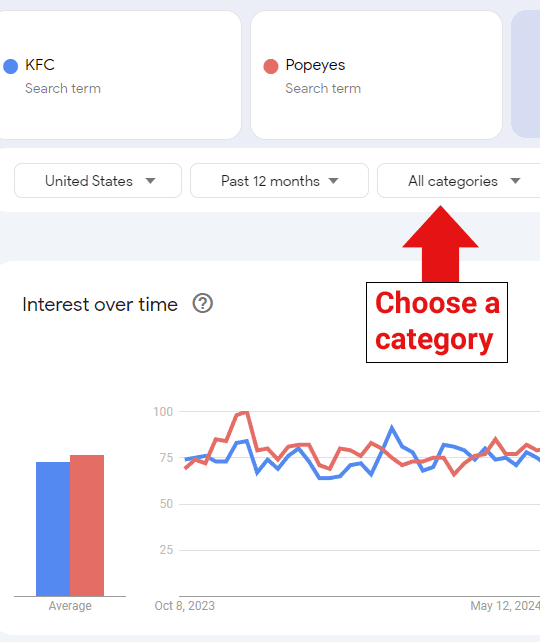
Google’s Daniel Waisberg showed that one way to research competitors is to do a head-to-head comparison of search terms for your company versus competitors by entering your company name or domain name in one panel of the Google Trends and your competitor’s in the second one. He suggests selecting a topic from the “categories” drop down menu which will allow for more specific user intent segmentation, where a user is looking for results in a specific niche or topic. Waisberg comments that it’s okay to not choose a category if one doesn’t exist.

Although he doesn’t mention it, there’s an additional way to segment users by the type of search (web search, image search, Google shopping, and YouTube search). This is an option that’s available that can help see how people are searching (images, videos, etc.) in comparison to competitors.

Step 1: Choose A Category

Google Trends shows a trend line indicating how often users are searching for both company names. The trend line shows if a company is trending up over time, if it’s experiencing a downward trajectory or if customer demand is on a steady level. Spikes can be evidence of seasonality but sharp spikes could be a sign of a marketing effort or promotion paying off.

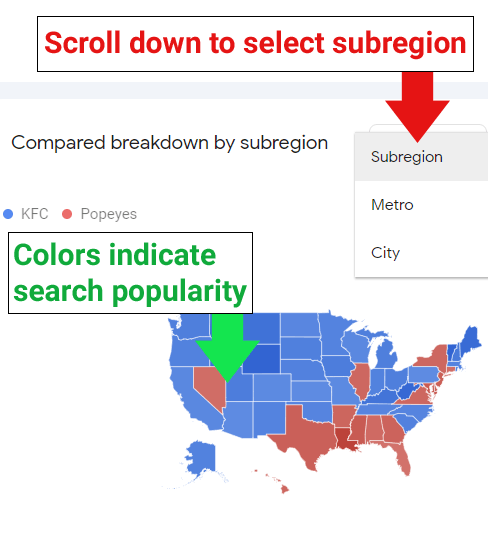
Waisberg encourages users to scroll down to inspect search trends by subregion, metro areas and cities. While Waisberg suggests it’s a way to determine demand for opening a store, the way I use the information is for determining geographical areas where demand is higher and focus online marketing effort there to maximize ROI. This can be done for link building, PPC, email, whatever you’re method is.

Step 2: Analyze Subregions

Daniel Waisberg begins his explanation at the 03:11 minute mark:

“Looking at the results, you can see how well your competitor is doing in comparison to you over time. …when you scroll down, you can compare how strong you are for each of the subregions, metro areas and cities available, and these could help you gather data when deciding where to open a new store.”

2. Analyzing Brand Awareness

Waisberg explains that Google Trends can be used to track brand awareness by filtering results over time to identify what people are saying about the brand. He recommends setting the time range for the past 30 or 90 days.

Related search terms that are rising or are top terms offer insights into how consumers are perceiving your brand, including what they’re associating the brand with. This same method can be applied to analyze YouTube search trends related to brand by selecting YouTube Search from the Categories drop down menu at the top of the Google Trends page.

Google’s Omri Weisman explains from the 4:37 minute mark:

“To monitor what people are saying about you, you should check your brand name using Google Trends… Scroll down the page to see the related search terms card. Go through both the rising and the top terms on the list and make sure to paginate using the arrows below the table. This will give you a good idea of the terms people are using in connection with your brand.”

3. Forecasting Product Demand

An easy way to predict product demand with Google Trends is identify which products are searched for the most and then zero in on how demand changes with time. It’s suggested to pay attention to seasonal trends and adjust product inventory accordingly.

Waisberg explains how to do it at about the 6:44 minute mark by researching cheese. In his example he notes the seasonality but then takes the analysis another step forward by scrolling down and exploring related terms that can suggest related products with higher search demand that you may want to begin selling or reviewing.

He explains:

“If you Scroll down, you’ll find the related topics and the related queries cards. Here you can check the top topics to find ideas on what has already gathered a lot of interest and also the rising topics to get a sense on what is getting more attention lately. Don’t forget to look further through the pagination.

Notice how charcuterie appears on both lists. Add this term to your analysis. You’ll see that it has significantly more interest than cheese platters. Maybe you should consider analyzing this term further and potentially diversifying.”

Google Trends For Successful Online Marketing

Google’s Daniel Waisberg and Omri Weisman demonstrated how to use Google Trends to improve online marketing, competitor research, brand research, and better understanding customer preference and behavior. It can also be used to identify which products to focus on and at what times of year. These tips are useful for both online and offline marketing strategies.

Watch the Google Search Central video:

Google Trends for Marketing & Sales

Featured Image by Shutterstock/MR Gao

Reddit Makes Game-Changing Updates to Keyword Targeting via @sejournal, @brookeosmundson

In a big move for digital advertisers, Reddit has just introduced a new Keyword Targeting feature, changing the game for how marketers reach their target audiences.

This addition brings fresh potential for PPC marketers looking to tap into Reddit’s highly engaged user base.

With millions of communities and conversations happening every day, Reddit is now offering advertisers a more precise way to get in front of users at the perfect moment.

The best part? They’re leveraging AI to make the process even more powerful.

Let’s break down why this is such an exciting development for digital advertisers.

Keyword Targeting for Conversation and Feed Placements

Reddit has always been about its vibrant communities, or “subreddits,” where users connect over shared interests and discuss a wide range of topics.

Until now, keyword targeting has only been available on conversation placements. Starting today, advertisers can use keyword targeting in both feed and conversation placements.

The targeting update allows advertisers to place ads directly within these conversations, ensuring they reach people when they’re actively engaged with content that’s related to their products or services.

For PPC marketers, this level of targeting means a higher chance of delivering ads to users who are in the right mindset.

Instead of serving ads to users scrolling passively through a general feed, Reddit is giving you the tools to place your ads into specific conversations, where users are already discussing topics related to your industry.

According to Reddit, advertisers who use keyword targeting have seen a 30% increase in conversion volumes. This is a significant lift for marketers focused on performance metrics, such as conversion rates and cost per acquisition.

Scaling Performance with AI-Powered Optimization

While precision is key, Reddit knows that advertisers also need scale.

Reddit mentioned two AI-powered solutions to help balance keyword targeting and scalability within the platform:

  • Dynamic Audience Expansion
  • Placement Expansion

Dynamic Audience Expansion

This feature works in tandem with keyword targeting to help advertisers broaden their reach, without sacrificing relevance.

Reddit’s AI does the heavy lifting by analyzing signals like user behavior and ad creative performance to identify additional users who are likely to engage with your ad. In essence, it’s expanding your audience in a smart, data-driven way.

For PPC marketers, this means more exposure without having to rely solely on manually selecting every keyword or interest.

You set the initial parameters, and Reddit’s AI expands from there. This not only saves time but also ensures that your ads reach a broader audience that’s still relevant to your goals.

Reddit claims campaigns using Dynamic Audience Expansion have seen a 30% reduction in cost per action (CPA), making it a must-have for marketers focused on efficiency and budget optimization.

Placement Expansion

Another standout feature is Reddit’s multi-placement optimization. This feature uses machine learning to determine the most effective places to show your ads, whether in the feed or within specific conversation threads.

This multi-placement strategy ensures your ads are delivered in the right context to maximize user engagement and conversions.

For PPC marketers, ad placement is a critical factor in campaign success. With Reddit’s AI optimizing these placements, you can trust that your ads will appear where they have the highest likelihood of driving action—whether that’s getting users to click, convert, or engage.

Introducing AI Keyword Suggestions

Reddit’s new AI Keyword Suggestions tool helps with this by analyzing Reddit’s vast conversation data to recommend keywords you might not have thought of.

It allows you to discover new, high-performing keywords related to your campaign, expanding your reach to conversations you might not have considered. And because it’s powered by AI, the suggestions are always based on real-time data and trends happening within Reddit’s communities.

This can be particularly helpful for marketers trying to stay ahead of trending topics or those who want to ensure they’re tapping into conversations with high engagement potential.

As conversations on Reddit shift, so do the keywords that drive those discussions. Reddit’s AI Keyword Suggestions help keep your targeting fresh and relevant, ensuring you don’t miss out on key opportunities.

New Streamlined Campaign Management

Reddit has also made strides in simplifying the campaign setup and management process. They’ve introduced a unified flow that allows advertisers to combine multiple targeting options within a single ad group.

You can now mix keywords, communities, and interests in one campaign, expanding your reach without overcomplicating your structure.

From a PPC perspective, this is huge. Simplifying campaign structure means you can test more variations, optimize faster, and reduce time spent on manual adjustments.

In addition, Reddit has enhanced its reporting capabilities with keyword-level insights, allowing you to drill down into what’s working and what’s not, giving you more control over your campaigns.

The Takeaway for PPC Marketers

For marketers working with Google Ads, Facebook, or Microsoft Advertising, this new update from Reddit should be on your radar.

The combination of keyword targeting, AI-driven audience expansion, and multi-placement optimization makes Reddit a serious contender in the digital advertising space.

If you’re looking to diversify your PPC campaigns, drive higher conversions, and optimize costs, Reddit’s new offerings provide a unique opportunity.

You can read the full announcement from Reddit here.