Google’s “Branded Search” Patent For Ranking Search Results via @sejournal, @martinibuster

Back in 2012 Google applied for a patent called “Ranking Search Results” that shows how Google can use branded search queries as a ranking factor. The patent is about using branded search queries and navigational queries as ranking factors, plus a count of independent links. Although this patent is from 2012, it’s possible that it may still play a role in ranking.

The patent was misunderstood by the search marketing community in 2012 and the knowledge contained in it was lost.

What Is The Ranking Search Results Patent About? TL/DR

The patent is explicitly about an invention for ranking search results, that’s why the patent is called “Ranking Search Results.” The patent describes an algorithm that uses to ranking factors to re-rank web pages:

Sorting Factor 1: By number of independent inbound links
This is a count of links that are independent from the site being ranked.

Sorting Factor 2: By number of branded search queries & navigational search queries.
The branded and navigational search queries are called “reference queries” and also are referred to as implied links.

The counts of both factors are used to modify the rankings of the web pages.

Why The Patent Was Misunderstood TL/DR

First, I want to say that in 2012, I didn’t understand how to read patents. I was more interested in research papers and left the patent reading to others. When I say that everyone in the search marketing community misunderstood the patent, I include myself in that group.

The “Ranking Search Results” patent was published in 2012, one year after the release of a content quality update called the Panda Update. The Panda update was named after one of the engineers who worked on it, Navneet Panda. Navneet Panda came up with questions that third party quality raters used to rate web pages. Those ratings were used as a test to see if changes to the algorithm were successful at removing “content farm” content.

Navneet Panda is also a co-author of the “Ranking search results” patent. SEOs saw his name on the patent and immediately assumed that this was the Panda patent.

The reason why that assumption is wrong is because the Panda update is an algorithm that uses a “classifier” to classify web pages by content quality. The “Ranking Search Results” patent is about ranking search results, period. The Ranking Search Results patent is not about content quality nor does it feature a content quality classifier.

Nothing in the “Ranking Search Results” patent relates in any way with the Panda update.

Why This Patent Is Not The Panda Update

In 2009 Google released the Caffeine Update which enabled Google to quickly index fresh content but inadvertently created a loophole that allowed content farms to rank millions of web pages on rarely searched topics.

In an interview with Wired, former Google search engineer Matt Cutts described the content farms like this:

“It was like, “What’s the bare minimum that I can do that’s not spam?” It sort of fell between our respective groups. And then we decided, okay, we’ve got to come together and figure out how to address this.”

Google subsequently responded with the Panda Update, named after a search engineer who worked on the algorithm which was specifically designed to filter out content farm content. Google used third party site quality raters to rate websites and the feedback was used to create a new definition of content quality that was used against content farm content.

Matt Cutts described the process:

“There was an engineer who came up with a rigorous set of questions, everything from. “Do you consider this site to be authoritative? Would it be okay if this was in a magazine? Does this site have excessive ads?” Questions along those lines.

…we actually came up with a classifier to say, okay, IRS or Wikipedia or New York Times is over on this side, and the low-quality sites are over on this side. And you can really see mathematical reasons…”

In simple terms, a classifier is an algorithm within a system that categorizes data. In the context of the Panda Update, the classifier categorizes web pages by content quality.

What’s apparent when reading the “Ranking search results” patent is that it’s clearly not about content quality, it’s about ranking search results.

Meaning Of Express Links And Implied Links

The “Ranking Search Results” patent uses two kinds of links to modify ranked search results:

  1. Implied links
  2. Express links

Implied links:
The patent uses branded search queries and navigational queries to calculate a ranking score as if the branded/navigational queries are links, calling them implied links. The implied links are used to create a factor for modifying web pages that are relevant (responsive) to search queries.

Express links:
The patent also uses independent inbound links to the web page as a part of another calculation to come up with a factor for modifying web pages that are responsive to a search query.

Both of those kinds of links (implied and independent express link) are used as factors to modify the rankings of a group of web pages.

Understanding what the patent is about is straightforward because the beginning of the patent explains it in relatively easy to understand English.

This section of the patent uses the following jargon:

  • A resource is a web page or website.
  • A target (target resource) is what is being linked to or referred to.
  • A “source resource” is a resource that makes a citation to the “target resource.”
  • The word “group” means the group of web pages that are relevant to a search query and are being ranked.

The patent talks about “express links” which are just regular links. It also describes “implied links” which are references within search queries, references to a web page (which is called a “target resource”).

I’m going to add bullet points to the original sentences so that they are easier to understand.

Okay, so this is the first important part:

“Links for the group can include express links, implied links, or both.

An express link, e.g., a hyperlink, is a link that is included in a source resource that a user can follow to navigate to a target resource.

An implied link is a reference to a target resource, e.g., a citation to the target resource, which is included in a source resource but is not an express link to the target resource. Thus, a resource in the group can be the target of an implied link without a user being able to navigate to the resource by following the implied link.”

The second important part uses the same jargon to define what implied links are:

  • A resource is a web page or website.
  • The site being linked to or referred to is called a “target resource.”
  • A “group of resources” means a group of web pages.

This is how the patent explains implied links:

“A query can be classified as referring to a particular resource if the query includes a term that is recognized by the system as referring to the particular resource.

For example, a term that refers to a resource may be all of or a portion of a resource identifier, e.g., the URL, for the resource.

For example, the term “example.com” may be a term that is recognized as referring to the home page of that domain, e.g., the resource whose URL is “http://www.example.com”.

Thus, search queries including the term “example.com” can be classified as referring to that home page.

As another example, if the system has data indicating that the terms “example sf” and “esf” are commonly used by users to refer to the resource whose URL is “http://www.sf.example.com,” queries that contain the terms “example sf” or “esf”, e.g., the queries “example sf news” and “esf restaurant reviews,” can be counted as reference queries for the group that includes the resource whose URL is “http://www.sf.example.com.” “

The above explanation defines “reference queries” as the terms that people use to refer to a specific website. So, for example (my example), if people search using “Walmart” with the keyword Air Conditioner within their search query then the query  “Walmart” + Air Conditioner is counted as a “reference query” to Walmart.com, it’s counted as a citation and an implied link.

The Patent Is Not About “Brand Mentions” On Web Pages

Some SEOs believe that a mention of a brand on a web page is counted by Google as if it’s a link. They have misinterpreted this patent to support the belief that an “implied link” is a brand mention on a web page.

As you can see, the patent does not describe the use of “brand mentions” on web pages. It’s crystal clear that the meaning of “implied links” within the context of this patent is about references to brands within search queries, not on a web page.

It also discusses doing the same thing with navigational queries:

“In addition or in the alternative, a query can be categorized as referring to a particular resource when the query has been determined to be a navigational query to the particular resource. From the user point of view, a navigational query is a query that is submitted in order to get to a single, particular web site or web page of a particular entity. The system can determine whether a query is navigational to a resource by accessing data that identifies queries that are classified as navigational to each of a number of resources.”

The takeaway then is that the parent describes the use of “reference queries” (branded/navigational search queries) as a factor similar to links and that’s why they’re called implied links.

Modification Factor

The algorithm generates a “modification factor” which re-ranks (modifies) the a group of web pages that are relevant to a search query based on the “reference queries” (which are branded search queries) and also using a count of independent inbound links.

This is how the modification (or ranking) is done:

  1. A count of inbound links using only “independent” links (links that are not controlled by the site being linked to).
  2. A count is made of the reference queries (branded search queries) (which are given a ranking power like a link).

Reminder: “resources” is a reference to web pages and websites.

Here is how the patent explains the part about the ranking:

“The system generates a modification factor for the group of resources from the count of independent links and the count of reference queries… For example, the modification factor can be a ratio of the number of independent links for the group to the number of reference queries for the group.”

What the patent is doing is it is filtering links in order to use links that are not associated with the website and it is also counting how many branded search queries are made for a webpage or website and using that as a ranking factor (modification factor).

In retrospect it was a mistake for some in the SEO industry to use this patent as “proof” for their idea about brand mentions on websites being a ranking factor.

It’s clear that “implied links” are not about brand mentions in web pages as a ranking factor but rather it’s about brand mentions (and URLs & domains) in search queries that can be used as ranking factors.

Why This Patent Is Important

This patent describes a way to use branded search queries as a signal of popularity and relevance for ranking web pages. It’s a good signal because it’s the users themselves saying that a specific website is relevant for specific search queries. It’s a signal that’s hard to manipulate which may make it a clean non-spam signal.

We don’t know if Google uses what’s described in the patent. But it’s easy to understand why it could still be a relevant signal today.

Read The Patent Within The Entire Context

Patents use specific language and it’s easy to misinterpret the words or overlook the meaning of it by focusing on specific sentences. The biggest mistake I see SEOs do is to remove one or two sentences from their context and then use that to say that Google is doing something or other. This is how SEO misinformation begins.

Read my article about How To Read Google Patents to understand how to read them and avoid misinterpreting them. Even if you don’t read patents, knowing the information is helpful because it’ll make it easier to spot misinformation about patents, which there is a lot of right now.

I limited this article to communicating what the “Ranking Search Results” patent is and what the most important points are. There many granular details about different implementations that I don’t cover because they’re not necessary to understanding the overall patent itself.

If you want the granular details, I strongly encourage first reading my article about how to read patents before reading the patent.

Read the patent here:

Ranking search results

AI Agnostic Optimization: Content For Topical Authority And Citations

The search and AI ecosystem is full of promise, options, and new ways for literally every type of marketer to evolve and grow.

Yes, there is lots of complexity, but there is also commonality: the need for marketers to focus on topical approaches to content creation, build their brand authority for AI citations, and become more predictive in their approach to how consumers interact online.

The introduction of Google AI Overviews and new AI-first platforms like Perplexity AI are making how consumers find answers to their needs a lot more complex.

The advancement of LLMs such as Claude and Google Gemini are also revolutionizing content outputs in visual and video formats. Just recently, Bing introduced GSE and OpenAI SearchGPT.

One thing they all have in common is that they are all fighting for the best authoritative sources for information and citations.

Wikipedia CitationScreenshot from author, July 2024

Today, I will mainly use Google AI Overviews in Search as an example, as they currently offer the most rich insights and best practices that are applicable to future and upcoming engines.

AI And Search Citations, Authority, And Your Brand

Being the cited source is quickly becoming the new form of ranking.

As AI looks to cite trustworthy and relevant content, brands need to be the source. While every engine has a different approach, the reality is that success relies on sources and quality.

They look to answer questions in many ways, and citations are common across the board. They look at authoritative sources to see whether that source answers that question, and then they seem to know whether it’s quotable.

  • Google wants quotable content that is above the fold, not buried. It also likes the question to be directly answered.
  • Perplexity, which has steadily increased traffic referrals (31% in June), focuses on academic and research citations but has had issues with attribution and sources.
  • Bing GSE is engineering its search results to satisfy users in a way that encourages discovery on the websites that originate the content.
  • ChatGPT/search does not need direct answers; it will digest them and express them in its own language. At first glance, it mainly cites and links to sources developed with input from major publishers like the Atlantic and NewsCorp.

So, as marketers, it is the simplest way to start focusing on the commonality and best practices that prepare you for what is ahead. Then, you can pivot and adapt as we learn more about how citations are shown and treated as each AI engine evolves.

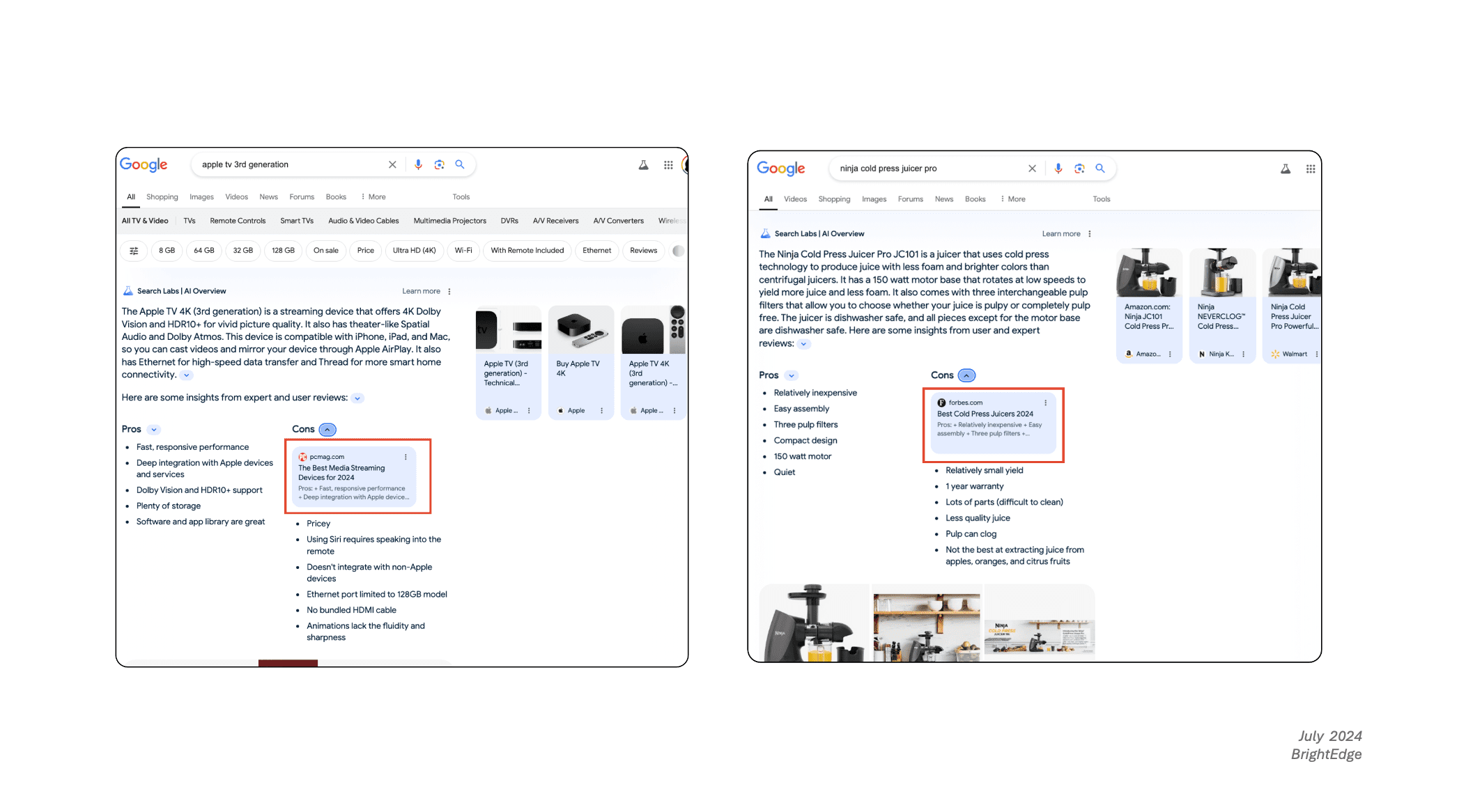
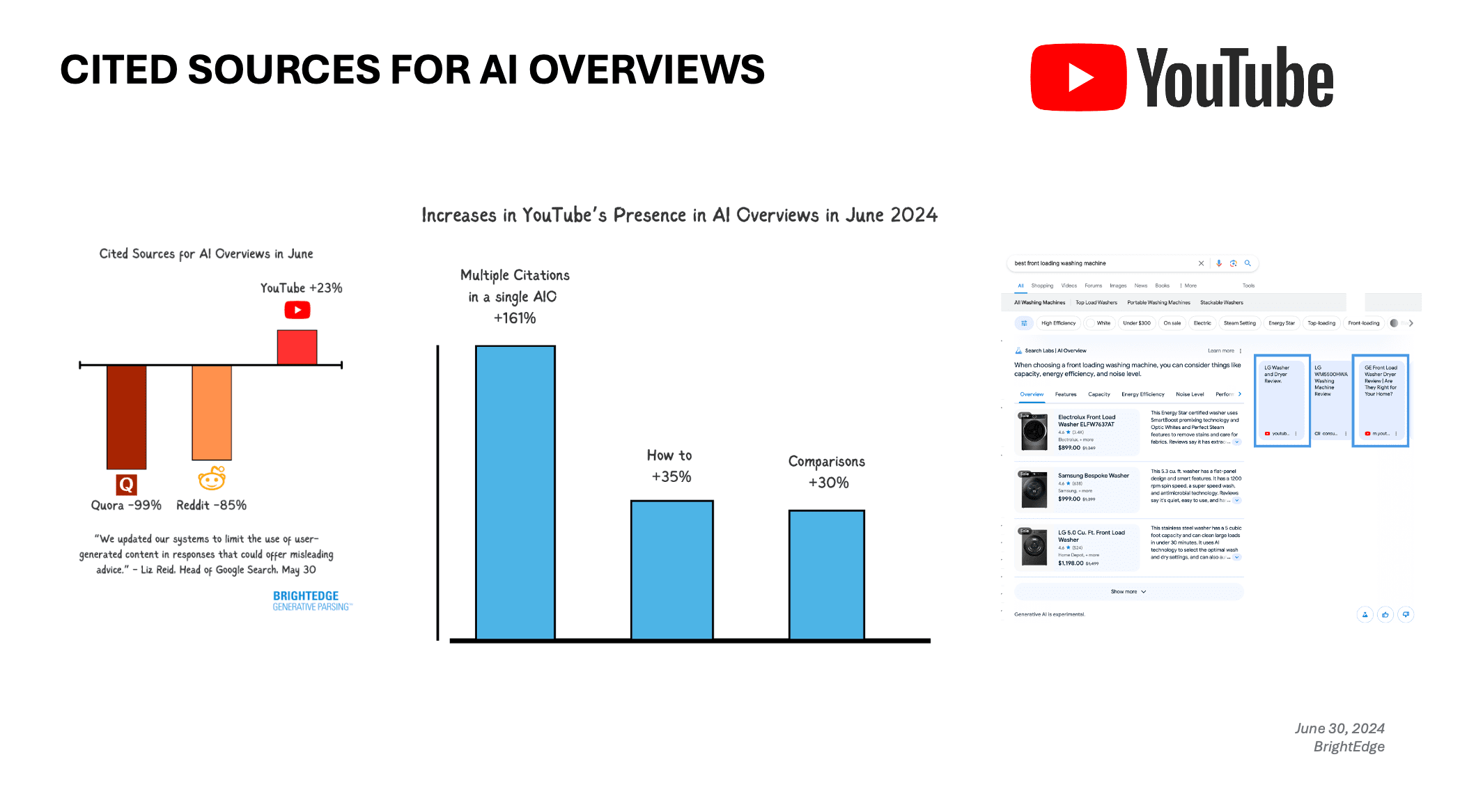
For example, Google AI Overviews is beginning to cite more authoritative review publications to help users shop. The removal of user-generated content (UGC) and reviews from Reddit and Quora dropped to near zero in AI Overviews.

  • Reddit citations: 85.71% decrease.
  • Quora citations: 99.69% decrease.

User-generated reviews may not be designed for a broader audience and lack the objectivity that a publication would. BrightEdge Generative Parser™ has recently found:

  • 49% increase in presence from PC Mag.
  • 39% in Forbes increase in presence from Forbes.
Google AIO Screenshot from BrightEdge, July 2024

Sites like Forbes are becoming key players in AI overviews. As well as thought leadership and instructive information, their comparative product reviews define where a product shines and where it falls short against competitors.

Here are three things that marketers can master now to stay ahead in AI and search.

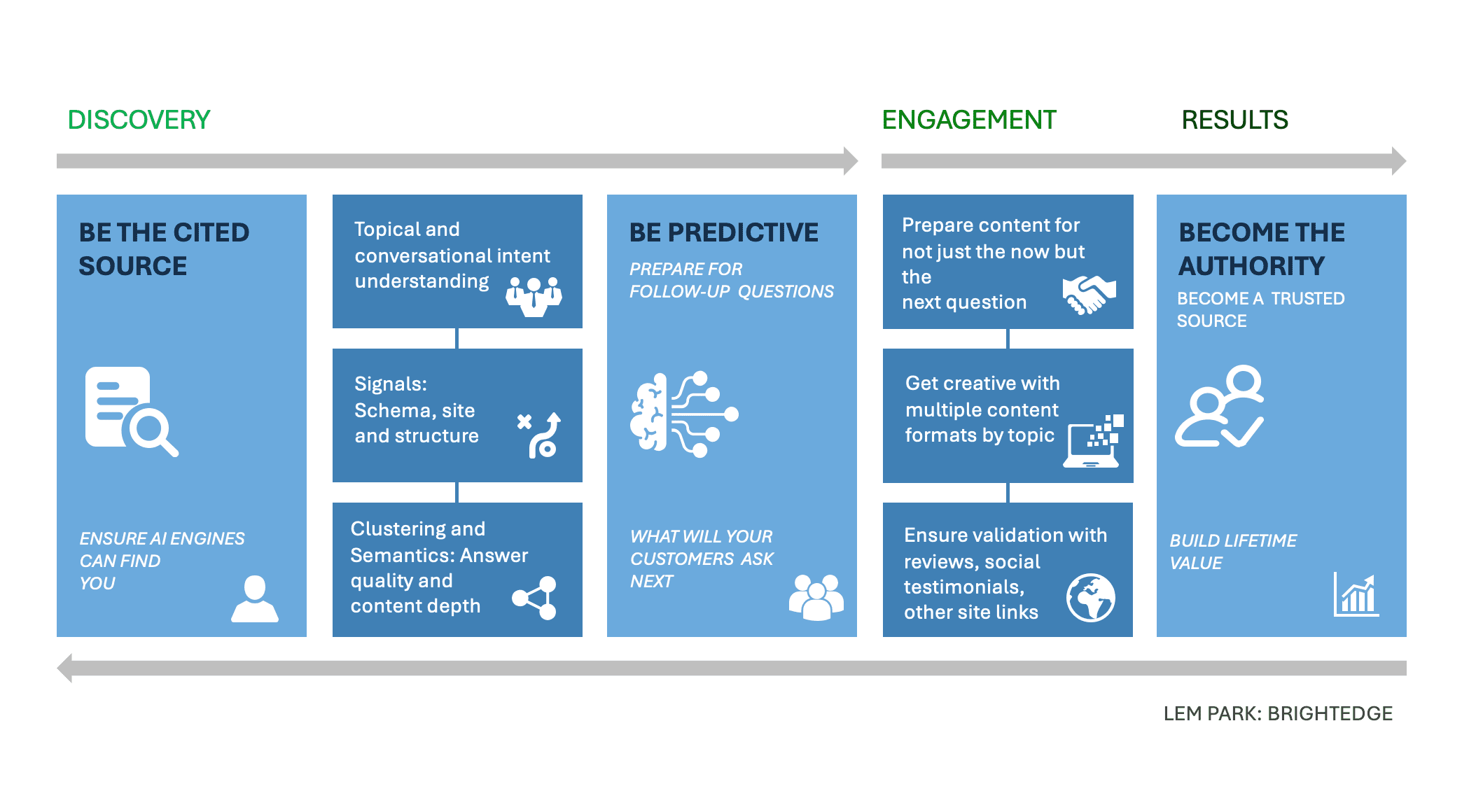
1. Ensure AI Engines Find You: Become The Cited Source

Start by identifying core – and broader, see later in the article –  topics relevant to your audience and aligning with your business objectives. These topics should serve as the foundation for a thematic content strategy.

Schema+: Diversify And Mark-Up Your Content As Much As Possible

The importance of diverse content formats cannot be overstated. To adapt to answer engine models, content must be comprehensive and encompass multiple modalities, including text, video, infographics, and interactive elements.

This approach ensures that content caters to diverse user preferences and provides information in formats that are most accessible and engaging.

Core technical SEO approaches like Schema Markup are essential for content marketers aiming to enhance their visibility and relevance in search results, as they help search engines better understand the content.

This improves the likelihood of content being featured as a direct answer and enhances its overall discoverability.

  • Provide AI engines with hints on who you are.
  • Ensure your teams look at things like Schema so AI entities can see your content.
  • Little formats like these can tell the AI models how to use your content.
  • It ensures that you are more frequently cited as the source in topics where you already have the right to win.

Develop content clusters around these core topics, covering different aspects, subtopics, and related themes. Each piece of content within a cluster should complement and support others, creating a cohesive narrative for multiple users.

Discovery, Engagement, ResultsImage from BrightEdge, July 2024

2. Anticipate Customers’ Next Questions: Focus On The Follow-Up

Build Thematic Content & Focus On Content Clustering

AI-powered search engines like AI Overviews (as explained in The Ultimate Guide to AI Overviews, free, ungated, and updated monthly by my company, BrightEdge) are redefining the criteria for visibility by prioritizing thematically connected content.

This applies even where the content doesn’t rank highly in traditional search results, making intelligent content clustering and thematic coherence essential.

Adopting a strategic approach to thematic content and content clustering means that instead of creating isolated pieces of content, you focus on developing interconnected content clusters that comprehensively explore various aspects of a topic.

  • AI search aims to do more than display a list of products for the keywords.
  • They want to anticipate the following questions that the demographic will likely have: how, what, where, and more.
  • AI models will cite trusted sources to generate these answers before the user even thinks about asking them.
  • Marketers need to create content for all these types of follow-ups in different formats.

Ensure that content within the same cluster is interlinked using relevant anchor text. This helps search engines understand the thematic relationship between different pieces of content and strengthens your website’s authority on the topic.

Understanding what triggers things in AI Overviews will become essential.

For example, in June, there was a 20% increase in “What is” queries showing an AI Overview. For brand-specific queries, there was a 20% decrease.

This could show that Google uses AI for more complex, knowledge-intensive topics while playing it safe with brand queries.

However, expect this to change monthly, as SEJ states and shares more below:

3. Prove Your Expertise: Become The Authority In Your Field Domain

Baking User and Topical Intent Into Every Piece of Content

Traditional SEO focuses on keyword rankings and visibility, but AI-driven search engines prioritize delivering precise, relevant answers based on user queries. This shift means simply ranking highly is no longer enough; you must ensure your content aligns closely with users’ needs and topics of interest.

AI-powered search engines like ChatGPT, Google’s SGE, Perplexity, and now SearchGPT are designed to comprehend the context and nuance behind a user’s query. They aim to provide direct answers and anticipate follow-up questions, creating a more dynamic and personalized search experience.

*A Note of Serving Multiple Intents*

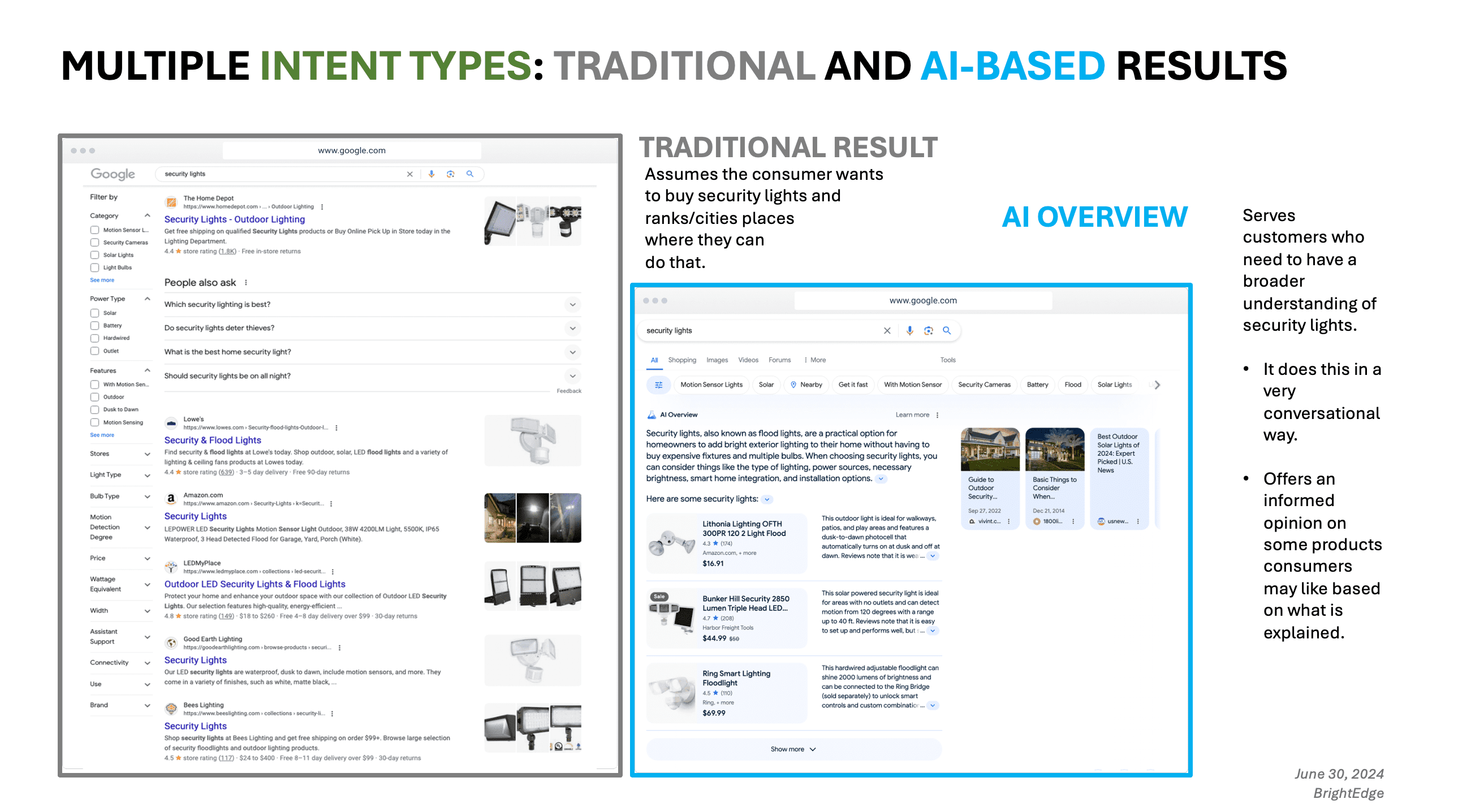
AI-powered search results are evolving to coexist with traditional search. Google is experimenting with blending conventional and AI-enhanced search results. For example, searching for [outdoor lighting solutions].

The traditional search component assumes the user intends to purchase such products and ranks relevant ecommerce sites accordingly. This serves users who know exactly what they’re looking for and need quick access to buy options.

Multiple Intent TypesImage from BrightEdge, July 2024

In contrast, the AI-generated overview caters to users seeking a broader understanding of outdoor lighting. It might provide a conversational explanation covering various aspects, such as:

  • Key considerations when choosing outdoor lights.
  • Various types of outdoor lighting and their characteristics.
  • Available power options for outdoor illumination.
  • Understanding brightness levels and their significance.
  • Best practices for installation and placement.
  • Tips for maintaining outdoor lighting systems.

Anticipating and addressing related queries helps build the site’s credibility and improves the chances of being featured in AI-generated answers.

Since AI-first engines, LLMs, and traditional search engines are designed to recognize and prioritize unique, high-quality content over generic or duplicated material, this increases the chances that your content will surface in response to user queries.

  • Prove your expertise and make it easy for AI models to trust what you say.
  • AI engines need to see that your content is approved (validated) by other experts, as well as user-generated content and reviews.
  • Ensure your content reaches expert influencers and connects to related sources and websites.
  • Gain as much 3rd party validation that your content is trustworthy.
  • Ensure your content workflows consider traditional ranking factors and AI citations, as they rely on some standard but separate signals.

Video And YouTube

We are now seeing (pros and cons) YouTube videos cited in AI Overviews in ways that benefit marketers at the top of the funnel.

If YouTube were not part of Google, it would be the sixth biggest digital platform in the USA. It commands a lot of reach!

Cited Sources for AIO Image from BrightEdge, July 2024

As you can see above, this offers new advantages to marketers targeting early-stage prospects. Visual content can effectively showcase specific offerings and provide tangible reviews, potentially swaying purchasing choices such as buying a washing machine.

They are being shown to help simplify complex topics for users. For example, abstract technological concepts like “blockchain fundamentals” often become clearer through visual demonstrations, accelerating audience understanding.

Ensure that when you identify high-potential topical themes, you pair them with AI’s video citation preferences. Video is on an explosive growth trajectory, so start to build and get creative as part of your more comprehensive marketing strategy and for maximum AI Overview visibility.

This helps offer multiple reference possibilities. A single piece of video content could be cited numerous times, expanding your topical reach, which I mentioned earlier.

Key Takeaways

In an era where AI-driven search and AI-first answer engines or assistants reshape how markers operate, marketers, SEO pros, content creators, and brand marketers must adapt their strategies to optimize for AI answers and multiple types of search engines.

Below are a few end notes and outliers for your consideration also:

  • The core basics of SEO and classic search still matter.
  • AI Overviews are reduced in size to give more concise answers.
  • AI answers more complex questions, but more common questions and queries are also answered in better-served universal or classic formats – balance will be essential.
  • Monitor with cadence new engines; many are so new it will take an informed data-led opinion to form.
  • Going forward, different types of consumers will use engines for various use cases, and each engine will cite some common sources and other specific ones like news academics and publishers. Let’s see how it develops; it is something I am looking into myself now.
  • Always remember that everything varies depending on your vertical and type of business. Experimentation is still very heavy everywhere, including at Google!
  • With new entrants emerging, the news and live experiments every day expect change.
  • What happens in one month can differ from another while engines find equilibrium.

Essential best practices such as focusing on user intent, leveraging structured data markup, and embracing multimedia content aren’t going anywhere. Classic search is here to stay; many skills are transferable to AI.

The future lies in a balance of classic online marketing, adapting to AI, and uncovering new AI engines’ nuances as they grow and establish more of a foothold. It is an exciting time, and I think exercising a little patience will help us all prevail.

As for SearchGPT, I believe its evolution does not diminish SEO; on the contrary, it makes it even more critical!

For now, monitor and use time-based data as your compass, and don’t react to opinions without some substance behind them.

More resources: 


Featured Image from author

Best SEO for Dropshipping

Dropshipping is the entry point for many new ecommerce retail ventures, but selling essentially the same product as hundreds of other online stores makes search engine optimization challenging.

With a payment card, a logo, and a few clicks, entrepreneurs can quickly launch an online store by combining an ecommerce platform such as Shopify, BigCommerce, or WooCommerce with dropshipping apps such as Dsers, Spocket, or SaleHoo.

Advertising

The products for a dropshipping-enabled ecommerce shop could come from multiple sources, including AliExpress, and work on thin margins, effectively practicing retail arbitrage.

The relatively small margins can complicate advertising since just about any dip in ad performance can eliminate profits or worse.

To be sure, there are ways to market an ecommerce dropshipping business successfully, and while ads are the best option for most new stores, traffic from organic search listings and from visitors directly is essential for long-term success. This fact brings us back to dropshipping’s inherent problem: competition.

Almost without exception, whatever product a store chooses to source from a dropshipping service will be available on dozens, if not hundreds, of similar online shops, all vying for prominent search engine rankings.

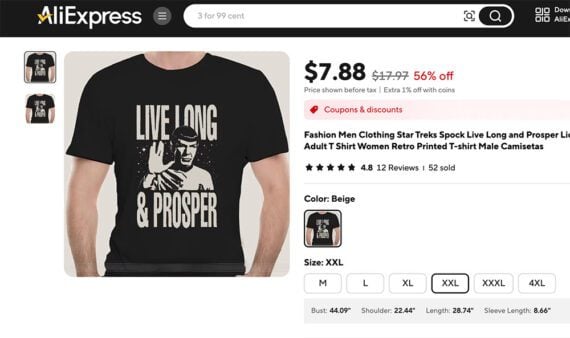
Hundreds of online stores offer this Star Trek t-shirt from AliExpress.

SEO

SEO is typically iterative — no single procedure guarantees a top ranking on Google.

One SEO strategy for dropshipping is to build a content site that sells products — a content-then-commerce approach. Optimize for articles, videos, podcasts, and related, and then promote the dropshipped products within that editorial content.

Here are five content-then-commerce SEO tactics.

Identify content keyphrases

Classic keyword research is the best place to start for dropshipping SEO. But focus here on content phrases, not transactional or product.

In my research, every dropshipping shop selling the “Live Long and Prosper” licensed adult t-shirt from AliExpress is looking for a long-tail keyphrase. Avoid the crowd and seek keywords for the content.

Content marketing

A content-then-commerce strategy requires creating and distributing articles to target search engines and engage readers.

The articles should be clear and engaging, with proper HTML headers and tags. Repurposed articles make quality social media posts, generating what SEO practitioners call “social signals.” The number of followers, likes, and reposts a shop has on X or Instagram could inform search engines about the business and impact rankings.

Finally, some content marketing efforts, such as customer surveys, could be newsworthy.

Classic link building

Acquiring backlinks for a dropshipping store is perhaps the most difficult and valuable SEO tactic. It is vital for building credibility with search engines, but it demands hard work.

Compelling, original content will likely attract links organically. Otherwise, link building could include writing guest posts or contacting other sites to request links.

Media relations

The aim of media relations is to get links from large news sites.

SEO practitioners were excited to learn that Google’s index of links to global websites resides on three tiers of (massive) computer servers: random access memory, solid-state drives, and hard disk drives. These storage types differ in cost and speed.

The assumption is that Google considers links on the fastest tier (random access memory, or RAM) more valuable. Popular news sites typically reside on that tier and are therefore the best backlinks.

Structured data markup

Structured data markup from the Schema.org vocabulary, JSON-LD, or similar serves at least two purposes.

First, this uniform, structured info tells search engines what a page is about. Structured data could distinguish a site selling “Live Long & Prosper” t-shirts from one offering health tips for prospering over a long life.

Most SEO pros believe that structured markup increases the likelihood that a page will obtain a rich snippet or an AI-generated citation.

The Basics

This list of SEO tactics for dropshipping could have been much longer. Instead,  I’ve focused on content and assumed that ecommerce platforms would provide technical components such as HTML tags, site speed, mobility usability, and more.

Your AC habits aren’t unique. Here’s why that’s a problem.

This article is from The Spark, MIT Technology Review’s weekly climate newsletter. To receive it in your inbox every Wednesday, sign up here.

When I get home in the evening on a sweltering summer day, the first thing I do is beeline to my window air-conditioning units and crank them up.

People across the city, county, and even the state are probably doing the same thing. And like me, they might also be firing up the TV and an air fryer to start on dinner. This simple routine may not register in your mind as anything special, but it sure does register on the electrical grid.

These early evening hours in the summer are usually the time with the highest electricity demand. And a huge chunk of that power is going into cooling systems that keep us safe and comfortable. This is such a significant challenge for utilities and grid operators that some companies are trying to bring new cooling technologies to the market that can store up energy during other times to use during peak hours, as I covered in my latest story

Let’s dig into why that daily maximum is a crucial data point to consider as we plan to keep the lights (and AC) on while cleaning up our energy system. 

In some places where air-conditioning is common, like parts of the US, space cooling can represent more than 70% of peak residential electrical demand on hot days, according to data from the International Energy Agency. It’s no wonder that utilities sometimes send out notices begging customers to turn down their AC during heat waves. 

All that demand can add up—just look at data from the California Independent System Operator (CAISO), which oversees operation of electricity generation and transmission in the state. Take, for example, Monday, August 5. The minimum amount of power demand, at around four in the morning, was roughly 25,000 megawatts. The peak, at about six in the evening, was 42,000 megawatts. There’s a lot behind that huge difference between early morning and the evening peak, but a huge chunk of it comes down to air conditioners. 

These summer evenings often represent the highest loads the grid sees all year long, since cooling systems like my window air conditioners are such energy hogs. Winter days usually see less variation, and typically there are small peaks in both the morning and evening that can be attributed to heating systems. (See more about how this varies around the US in this piece from the Energy Information Agency.)

From a climate perspective, this early evening peak in the summer is inconveniently timed, since it hits right around when solar power is ramping down for the day. It’s an example of one of the perennial challenges of some renewable electricity sources: they might be available, but they’re not always available at the right times.

Grid operators often don’t have the luxury of choosing how they meet demand—they take what they can get, even if that means turning on fossil-fuel power plants to keep the lights on. So-called peaker plants are usually the ones tapped to meet the highest demand, and they’re typically more expensive and also less efficient than other power plants.  

Batteries are starting to come to the rescue, as I covered in this newsletter a few months ago. On April 16, CAISO data showed that energy storage systems were the single biggest power source on the grid starting just after 7 p.m. local time. But batteries are far from being able to solve peak demand—with higher summer grid loads, natural-gas plants are cranked up much higher in August than they were in April, so fossil fuels are powering summer evening routines in California.

We still need a whole lot more energy storage on the grid, and other sources of low-emissions electricity like geothermal, hydropower, and nuclear to help in these high-demand hours. But there’s also a growing interest in cooling systems that can act as their own batteries. 

A growing number of technologies do just this—the goal is to charge up the systems using electricity during times when demand is low, or when renewables are readily available. Then they can provide cooling during these peak-demand hours without adding stress to the grid. Check out my full story for more on how they work, and how far along they are. 

As the planet warms and more people install AC, we might be pushing the limits of what the grid can handle.  Even if generation capacity isn’t stretched thin, extreme heat and high loads can threaten transmission equipment. 

While asking people to bump up their thermostat can be a short-term fix on the hottest days, having technologies that allow us to be more flexible in how and when we use energy could be key to staying safe and comfortable even as the summer nights keep getting hotter. 


Now read the rest of The Spark

Related reading

Air-conditioning is something of an antihero for climate action, since it helps us adapt to a warming world but also contributes to that warming with sky-high energy demand, as I wrote about in a newsletter last year

Batteries could be key to meeting peak electricity demand—and they’re starting to make a dent, as I covered earlier this year

Another thing

A growing number of companies in China want to power fleets of bikes not with batteries, but with hydrogen. But reception has been mixed, with riders reporting trouble with range. Read more in the latest story from my colleague Zeyi Yang.

Part of the reason for the growing interest in hydrogen is concern over the safety of lithium-ion batteries. New York is trying to make e-bikes safer by deploying battery-swapping stations in the city. For all you need to know about the program, check out my May story on the topic.

Keeping up with climate  

A major renewable-energy company unveiled a first-of-its-kind robot to help install solar panels. The company claims Maximo can install panels twice as fast as humans, at half the cost. (New York Times)

The European Union got more electricity from solar and wind than fossil fuels in the first half of 2024. Reforms in permitting and Russia’s invasion of Ukraine are two factors pushing the rise of renewables. (Canary Media)

Stepping into the shade can make the temperature feel dozens of degrees cooler. Cities need to look beyond trees for shade. (The Atlantic)

Check out these interactive charts detailing how each US state gets its electricity, and how it’s changed in the last two decades. Some surprises for me included South Carolina and Iowa. (New York Times)

Electric-vehicle sales in Germany are continuing their slide, dropping by 37%. The ongoing slump comes after the country ended incentives last year that supported EVs. (Bloomberg)

Wildfire smoke can have negative health effects. Protect yourself by staying indoors on days when air quality is poor, wearing a mask, and—especially—avoiding outdoor exercise. (Wired)

→ I spoke about a new study that will follow survivors of last year’s Maui fire to track their health outcomes, along with other science news of the week, on the latest episode of Science Friday. (Science Friday)

A new bill snaking its way through the US Congress could make it easier to build renewable-energy projects—and some fossil-fuel projects too. Here’s why a growing cadre of energy experts is on board with these permitting reforms despite concessions for oil and gas. (Heatmap)

Kamala Harris tapped Tim Walz as her pick for vice president. The Minnesota governor brings some climate experience to the ticket, including a law that requires utilities to reach 100% renewable energy by 2040. (Grist)

Watch a video showing what happens in our brains when we think

This article first appeared in The Checkup, MIT Technology Review’s weekly biotech newsletter. To receive it in your inbox every Thursday, and read articles like this first, sign up here.

What does a thought look like? We can think about thoughts resulting from shared signals between some of the billions of neurons in our brains. Various chemicals are involved, but it really comes down to electrical activity. We can measure that activity and watch it back.

Earlier this week, I caught up with Ben Rapoport, the cofounder and chief science officer of Precision Neuroscience, a company doing just that. It is developing brain-computer interfaces that Rapoport hopes will one day help paralyzed people control computers and, as he puts it, “have a desk job.”

Rapoport and his colleagues have developed thin, flexible electrode arrays that can be slipped under the skull through a tiny incision. Once inside, they can sit on a person’s brain, collecting signals from neurons buzzing away beneath. So far, 17 people have had these electrodes placed onto their brains. And Rapoport has been able to capture how their brains form thoughts. He even has videos. (Keep reading to see one for yourself, below.)

Brain electrodes have been around for a while and are often used to treat disorders such as Parkinson’s disease and some severe cases of epilepsy. Those devices tend to involve sticking electrodes deep inside the brain to access regions involved in those disorders.

Brain-machine interfaces are newer. In the last couple of decades, neuroscientists and engineers have made significant progress in developing technologies that allow them to listen in on brain activity and use brain data to allow people to control computers and prosthetic limbs by thought alone.

The technology isn’t commonplace yet, and early versions could only be used in a lab setting. Scientists like Rapoport are working on new devices that are more effective, less invasive, and more practical. He and his colleagues have developed a miniature device that fits 1,024 tiny electrodes onto a sliver of ribbon-like film that’s just 20 microns thick—around a third of the width of a human eyelash.

The vast majority of these electrodes are designed to pick up brain activity. The device itself is designed to be powered by a rechargeable battery implanted under the skin in the chest, like a pacemaker. And from there, data could be transmitted wirelessly to a computer outside the body.

Unlike other needle-like electrodes that penetrate brain tissue, Rapoport says his electrode array “doesn’t damage the brain at all.” Instead of being inserted into brain tissue, the electrode arrays are arranged on a thin, flexible film, fed through a slit in the skull, and placed on the surface of the brain.

From there, they can record what the brain is doing when the person thinks. In one case, Rapoport’s team inserted their electrode array into the skull of a man who was undergoing brain surgery to treat a disease. He was kept awake during his operation so that surgeons could make sure they weren’t damaging any vital regions of his brain. And all the while, the electrodes were picking up the electrical signals from his neurons.

This is what the activity looked like:

“This is basically the brain thinking,” says Rapoport. “You’re seeing the physical manifestation of thought.”

In this video, which I’ve converted to a GIF, you can see the pattern of electrical activity in the man’s brain as he recites numbers. Each dot represents the voltage sensed by an electrode on the array on the man’s brain, over a region involved in speech. The reds and oranges represent higher voltages, while the blues and purples represent lower ones. The video has been slowed down 20-fold, because “thoughts happen faster than the eye can see,” says Rapoport.

This approach allows neuroscientists to visualize what happens in the brain when we speak—and when we plan to speak. “We can decode his intention to say a word even before he says it,” says Rapoport. That’s important—scientists hope technologies will interpret these kinds of planning signals to help some individuals communicate.

For the time being, Rapoport and his colleagues are only testing their electrodes in volunteers who are already scheduled to have brain surgery. The electrodes are implanted, tested, and removed during a planned operation. The company announced in May that the team had broken a record for the greatest number of electrodes placed on a human brain at any one time—a whopping 4,096.

Rapoport hopes the US Food and Drug Administration will approve his device in the coming months. “That will unlock … what we hope will be a new standard of care,” he says.


Now read the rest of The Checkup

Read more from MIT Technology Review’s archive

Precision Neuroscience is one of a handful of companies leading the search for a new brain-computer interface. Cassandra Willyard covered the key players in a recent edition of the Checkup.

Brain implants can do more than treat disease or aid communication. They can change a person’s sense of self. This was the case for Rita Leggett, who was devastated when her implant was removed against her will. I explored whether experiences like these should be considered a breach of human rights in a piece published last year.

Ian Burkhart, who was paralyzed as a result of a diving accident, received a brain implant when he was 24 years old. Burkhart learned to use the implant to control a robotic arm and even play Guitar Hero. But funding issues and an infection meant the implant had to be removed. “When I first had my spinal cord injury, everyone said: ‘You’re never going to be able to move anything from your shoulders down again,’” Burkhart told me last year. “I was able to restore that function, and then lose it again. That was really tough.”

A couple of years ago, a brain implant allowed a locked-in man to communicate in full sentences by thought alone—a world first, the researchers claimed. He used it to ask for soup and beer, and to tell his carers “I love my cool son.”

Electrodes that stimulate the brain could be used to improve a person’s memory. The “memory prosthesis,” which has been designed to mimic the way our brains create memories, appears to be most effective in people who have poor memories to begin with.

From around the web

Do you share DNA with Ludwig van Beethoven, or perhaps a Viking? Tests can reveal genetic links, but they are not always clear, and the connections are not always meaningful or informative. (Nature)

This week marks 79 years since the United States dropped atomic bombs on Hiroshima and Nagasaki. Survivors share their stories of what it’s like to live with the trauma, stigma, and survivor’s guilt caused by the bombs—and why weapons like these must never be used again. (New York Times)

At least 19 Olympic athletes have tested positive for covid-19 in the past two weeks. The rules allow them to compete regardless. (Scientific American)

Honey contains a treasure trove of biological information, including details about the plants that supplied the pollen and the animals and insects in the environment. It can even tell you something about the bees’ “micro-bee-ota.” (New Scientist)

This futuristic space habitat is designed to self-assemble in orbit 

More people are traveling to space, but the International Space Station can only hold 11 people at a time. Aurelia Institute, a nonprofit space architecture lab based in Cambridge, MA, has an approach that may help: a habitat that can be launched in compact stacks of flat tiles and self-assemble in orbit.

Building large space habitats is difficult. Structural components, like walls, have to fit on a rocket. There’s often not enough room to launch everything in one go. It takes multiple launches to build larger structures, like the ISS, adding to the expense. Once all the components have made it to space, habitats must be constructed by humans, and that’s dangerous work. 

“If you rely on a human to help you assemble something, they have to put on an extravehicular suit,” says Aurelia Institute CEO Ariel Ekblaw. “It’s risking their life. We’d love to have this done more safely in the future.”   

At a co-working space in Roslindale, MA, in early August, Aurelia Institute showed off a mock-up of a space habitat called TESSERAE, which is short for Tessellated Electromagnetic Space Structures for the Exploration of Reconfigurable, Adaptive Environments. The structure looks like a futuristic, one-story-tall soccer ball. The team described how the station’s tiles, each about six-feet tall and wide, would come together.

The idea is to make the structure as compact as possible for launch. “Right now, anything that goes up is in the very rigid structure of the payload [fairing], which is what sits on top of the rocket,” says Stephanie Sjoblom, Aurelia Institute’s vice president of strategy and business development. “With this technology, we’re creating tiles that we stack kind of like a flat-packed IKEA box.” 

Following a successful launch, the tiles would be thrown into space in a balloon-like structure or net to stop them from drifting away. The net would keep the tiles, which have strong magnets in their edges, close enough for magnetic attraction. The hope is that the tiles would then snap together on their own into the correct configuration the first time. A combination of sensors and magnetometers can determine if they don’t correctly assemble. In that case, a current pulses through the magnets to break apart the incorrectly configured tiles and try again. Following assembly, electrical and plumbing systems can be mounted by hand. 

Modules and inflatables

So far, the team has successfully assembled smaller hand-sized tiles in space several times, including during Axiom Space’s Ax-1 mission to the ISS in 2022. They have yet to build a to-scale model of TESSERAE in space and say that construction would likely require a partner. 

“It’s hard for us to give an accurate figure of how much longer it will take for it to be human-crewed,” says Ekblaw. “It probably depends on if we get a partnership with [an organization like] NASA or Axiom. But certainly by the 2030s.” Aurelia won’t share how much money they’ve raised or spent on this work, but they said it has been funded in part by NASA grants, corporate sponsorships, and philanthropic donors. 

There are lots of groups working on space stations. Axiom Space is working on its own orbital station, the first module of which it aims to launch in 2026 and temporarily attach to the ISS. Blue Origin and Sierra Space are working on Orbital Reef, a project to support up to 10 people at a time in a “mixed-use business park.” These stations will rely on humans for their construction, and launching the pieces will probably take a few trips. 

There’s another way to make something compact for launch: inflate it in orbit. NASA has already done this—its experimental BEAM habitat, which is connected to the ISS, launched in 2016 and has stored cargo. Sierra Space wants to make inflatable habitats as large as a three-story building, although they’ve yet to test these designs in space. 

Ekblaw sees the TESSERAE habitat and inflatables as complementary technologies. TESSERAE’s hard outer shell should better protect astronauts from space debris, such as micrometeoroids. And the TESSERAE habitat is more easily repaired than an inflatable, she says, because tiles can simply be switched out. That’s not true for inflatables, where a tear may mean a complicated patch job or replacing the entire habitat. “I’m very pro-inflatables,” Ekblaw says. “I think the answer should be both, not either.” 

 Design challenges

Aurelia Institute envisions that, once constructed, the TESSERAE habitat will be quite different from what we usually see at the ISS: not just functional, but also fun, accessible, and comfortable.  

The design contains whimsical elements informed by dozens of interviews with astronauts. One looks like a massive inflatable sea anemone that sticks out of the wall. But it’s actually a couch—lying down in space isn’t easy, so astronauts could, theoretically, wedge themselves between inflatable branches and get cozy. 

Scaling up the technology will be difficult, though. Oliver Jia-Richards, an aerospace engineer at University of Michigan, isn’t sure whether Aurelia’s combination of magnets and sensors will be enough to get larger tiles to self-assemble. Moving things in space with precision typically requires a propulsion system. “If they accomplished this, it would be a breakthrough in terms of how we do this,” says Jia-Richards. Ekblaw says she’s not ruling out the need for propulsion.  

The structures the tiles can currently create are also not airtight, and therefore not human-ready, Ekblaw notes. Her team may add latches at the edges of the tiles, which would knit them together more closely. Another idea is to inflate an airtight balloon in the middle of the space for people to live within. In that case, the tiles would become simply an exoskeleton to an interior, pressurized bladder. 

The team just got approved by NASA to send more small tiles up to the ISS next year. This time, they’ll send up about 32 (rather than just seven ) and see if they can build an entire spherical structure on a small scale. 

This story was updated on 9 August with several corrections, including the location of the co-working space and details regarding the self-assembly process.

Google DeepMind trained a robot to beat humans at table tennis

Do you fancy your chances of beating a robot at a game of table tennis? Google DeepMind has trained a robot to play the game at the equivalent of amateur-level competitive performance, the company has announced. It claims it’s the first time a robot has been taught to play a sport with humans at a human level.

Researchers managed to get a robotic arm wielding a 3D-printed paddle to win 13 of 29 games against human opponents of varying abilities in full games of competitive table tennis. The research was published in an Arxiv paper. 

The system is far from perfect. Although the table tennis bot was able to beat all beginner-level human opponents it faced and 55% of those playing at amateur level, it lost all the games against advanced players. Still, it’s an impressive advance.

“Even a few months back, we projected that realistically the robot may not be able to win against people it had not played before. The system certainly exceeded our expectations,” says  Pannag Sanketi, a senior staff software engineer at Google DeepMind who led the project. “The way the robot outmaneuvered even strong opponents was mind blowing.”

And the research is not just all fun and games. In fact, it represents a step towards creating robots that can perform useful tasks skillfully and safely in real environments like homes and warehouses, which is a long-standing goal of the robotics community. Google DeepMind’s approach to training machines is applicable to many other areas of the field, says Lerrel Pinto, a computer science researcher at New York University who did not work on the project.

“I’m a big fan of seeing robot systems actually working with and around real humans, and this is a fantastic example of this,” he says. “It may not be a strong player, but the raw ingredients are there to keep improving and eventually get there.”

To become a proficient table tennis player, humans require excellent hand-eye coordination, the ability to move rapidly and make quick decisions reacting to their opponent—all of which are significant challenges for robots. Google DeepMind’s researchers used a two-part approach to train the system to mimic these abilities: they used computer simulations to train the system to master its hitting skills; then fine tuned it using real-world data, which allows it to improve over time.

The researchers compiled a dataset of table tennis ball states, including data on position, spin, and speed. The system drew from this library in a simulated environment designed to accurately reflect the physics of table tennis matches to learn skills such as returning a serve, hitting a forehand topspin, or backhand shot. As the robot’s limitations meant it could not serve the ball, the real-world games were modified to accommodate this.

During its matches against humans, the robot collects data on its performance to help refine its skills. It tracks the ball’s position using data captured by a pair of cameras, and follows its human opponent’s playing style through a motion capture system that uses LEDs on its opponent’s paddle. The ball data is fed back into the simulation for training, creating a continuous feedback loop.

This feedback allows the robot to test out new skills to try and beat its opponent—meaning it can adjust its tactics and behavior just like a human would. This means it becomes progressively better both throughout a given match, and over time the more games it plays.

The system struggled to hit the ball when it was hit either very fast, beyond its field of vision (more than six feet above the table), or very low, because of a protocol that instructs it to avoid collisions that could damage its paddle. Spinning balls proved a challenge because it lacked the capacity to directly measure spin—a limitation that advanced players were quick to take advantage of.

Training a robot for all eventualities in a simulated environment is a real challenge, says Chris Walti, founder of robotics company Mytra and previously head of Tesla’s robotics team, who was not involved in the project.

“It’s very, very difficult to actually simulate the real world because there’s so many variables, like a gust of wind, or even dust [on the table]” he says. “Unless you have very realistic simulations, a robot’s performance is going to be capped.” 

Google DeepMind believes these limitations could be addressed in a number of ways, including by developing predictive AI models designed to anticipate the ball’s trajectory, and introducing better collision-detection algorithms.

Crucially, the human players enjoyed their matches against the robotic arm. Even the advanced competitors who were able to beat it said they’d found the experience fun and engaging, and said they felt it had potential as a dynamic practice partner to help them hone their skills. 

“I would definitely love to have it as a training partner, someone to play some matches from time to time,” one of the study participants said.

Google Confirms 3 Ways To Make Googlebot Crawl More via @sejournal, @martinibuster

Google’s Gary Illyes and Lizzi Sassman discussed three factors that trigger increased Googlebot crawling. While they downplayed the need for constant crawling, they acknowledged there a ways to encourage Googlebot to revisit a website.

1. Impact of High-Quality Content on Crawling Frequency

One of the things they talked about was the quality of a website. A lot of people suffer from the discovered not indexed issue and that’s sometimes caused by certain SEO practices that people have learned and believe are a good practice. I’ve been doing SEO for 25 years and one thing that’s always stayed the same is that industry defined best practices are generally years behind what Google is doing. Yet, it’s hard to see what’s wrong if a person is convinced that they’re doing everything right.

Gary Illyes shared a reason for an elevated crawl frequency at the 4:42 minute mark, explaining that one of triggers for a high level of crawling is signals of high quality that Google’s algorithms detect.

Gary said it at the 4:42 minute mark:

“…generally if the content of a site is of high quality and it’s helpful and people like it in general, then Googlebot–well, Google–tends to crawl more from that site…”

There’s a lot of nuance to the above statement that’s missing, like what are the signals of high quality and helpfulness that will trigger Google to decide to crawl more frequently?

Well, Google never says. But we can speculate and the following are some of my educated guesses.

We know that there are patents about branded search that count branded searches made by users as implied links. Some people think that “implied links” are brand mentions, but “brand mentions” are absolutely not what the patent talks about.

Then there’s the Navboost patent that’s been around since 2004. Some people equate the Navboost patent with clicks but if you read the actual patent from 2004 you’ll see that it never mentions click through rates (CTR). It talks about user interaction signals. Clicks was a topic of intense research in the early 2000s but if you read the research papers and the patents it’s easy to understand what I mean when it’s not so simple as “monkey clicks the website in the SERPs, Google ranks it higher, monkey gets banana.”

In general, I think that signals that indicate people perceive a site as helpful, I think that can help a website rank better. And sometimes that can be giving people what they expect to see, giving people what they expect to see.

Site owners will tell me that Google is ranking garbage and when I take a look I can see what they mean, the sites are kind of garbagey. But on the other hand the content is giving people what they want because they don’t really know how to tell the difference between what they expect to see and actual good quality content (I call that the Froot Loops algorithm).

What’s the Froot Loops algorithm? It’s an effect from Google’s reliance on user satisfaction signals to judge whether their search results are making users happy. Here’s what I previously published about Google’s Froot Loops algorithm:

“Ever walk down a supermarket cereal aisle and note how many sugar-laden kinds of cereal line the shelves? That’s user satisfaction in action. People expect to see sugar bomb cereals in their cereal aisle and supermarkets satisfy that user intent.

I often look at the Froot Loops on the cereal aisle and think, “Who eats that stuff?” Apparently, a lot of people do, that’s why the box is on the supermarket shelf – because people expect to see it there.

Google is doing the same thing as the supermarket. Google is showing the results that are most likely to satisfy users, just like that cereal aisle.”

An example of a garbagey site that satisfies users is a popular recipe site (that I won’t name) that publishes easy to cook recipes that are inauthentic and uses shortcuts like cream of mushroom soup out of the can as an ingredient. I’m fairly experienced in the kitchen and those recipes make me cringe. But people I know love that site because they really don’t know better, they just want an easy recipe.

What the helpfulness conversation is really about is understanding the online audience and giving them what they want, which is different from giving them what they should want. Understanding what people want and giving it to them is, in my opinion, what searchers will find helpful and ring Google’s helpfulness signal bells.

2. Increased Publishing Activity

Another thing that Illyes and Sassman said could trigger Googlebot to crawl more is an increased frequency of publishing, like if a site suddenly increased the amount of pages it is publishing. But Illyes said that in the context of a hacked site that all of a sudden started publishing more web pages. A hacked site that’s publishing a lot of pages would cause Googlebot to crawl more.

If we zoom out to examine that statement from the perspective of the forest then it’s pretty evident that he’s implying that an increase in publication activity may trigger an increase in crawl activity. It’s not that the site was hacked that is causing Googlebot to crawl more, it’s the increase in publishing that’s causing it.

Here is where Gary cites a burst of publishing activity as a Googlebot trigger:

“…but it can also mean that, I don’t know, the site was hacked. And then there’s a bunch of new URLs that Googlebot gets excited about, and then it goes out and then it’s crawling like crazy.”​

A lot of new pages makes Googlebot get excited and crawl a site “like crazy” is the takeaway there. No further elaboration is needed, let’s move on.

3. Consistency Of Content Quality

Gary Illyes goes on to mention that Google may reconsider the overall site quality and that may cause a drop in crawl frequency.

Here’s what Gary said:

“…if we are not crawling much or we are gradually slowing down with crawling, that might be a sign of low-quality content or that we rethought the quality of the site.”

What does Gary mean when he says that Google “rethought the quality of the site?” My take on it is that sometimes the overall site quality of a site can go down if there’s parts of the site that aren’t to the same standard as the original site quality. In my opinion, based on things I’ve seen over the years, at some point the low quality content may begin to outweigh the good content and drag the rest of the site down with it.

When people come to me saying that they have a “content cannibalism” issue, when I take a look at it, what they’re really suffering from is a low quality content issue in another part of the site.

Lizzi Sassman goes on to ask at around the 6 minute mark if there’s an impact if the website content was static, neither improving or getting worse, but simply not changing. Gary resisted giving an answer, simply saying that Googlebot returns to check on the site to see if it has changed and says that “probably” Googlebot might slow down the crawling if there is no changes but qualified that statement by saying that he didn’t know.

Something that went unsaid but is related to the Consistency of Content Quality is that sometimes the topic changes and if the content is static then it may automatically lose relevance and begin to lose rankings. So it’s a good idea to do a regular Content Audit to see if the topic has changed and if so to update the content so that it continues to be relevant to users, readers and consumers when they have conversations about a topic.

Three Ways To Improve Relations With Googlebot

As Gary and Lizzi made clear, it’s not really about poking Googlebot to get it to come around just for the sake of getting it to crawl. The point is to think about your content and its relationship to the users.

1. Is the content high quality?
Does the content address a topic or does it address a keyword? Sites that use a keyword-based content strategy are the ones that I see suffering in the 2024 core algorithm updates. Strategies that are based on topics tend to produce better content and sailed through the algorithm updates.

2. Increased Publishing Activity
An increase in publishing activity can cause Googlebot to come around more often. Regardless of whether it’s because a site is hacked or a site is putting more vigor into their content publishing strategy, a regular content publishing schedule is a good thing and has always been a good thing. There is no “set it and forget it” when it comes to content publishing.

3. Consistency Of Content Quality
Content quality, topicality, and relevance to users over time is an important consideration and will assure that Googlebot will continue to come around to say hello. A drop in any of those factors (quality, topicality, and relevance) could affect Googlebot crawling which itself is a symptom of the more importat factor, which is how Google’s algorithm itself regards the content.

Listen to the Google Search Off The Record Podcast beginning at about the 4 minute mark:

Featured Image by Shutterstock/Cast Of Thousands

The 6 Best AI Content Checkers To Use In 2024 via @sejournal, @annabellenyst

Today, many people see generative AI like ChatGPT, Gemini, and others as indispensable tools that streamline their day-to-day workflows and enhance their productivity.

However, with the proliferation of AI assistants comes an uptick in AI-generated content. AI content detectors can help you prioritize content quality and originality.

These tools can help you discern whether a piece of content was written by a human or AI – a task that’s becoming increasingly difficult – and this can help detect plagiarism, and ensure content is original, unique, and high-quality.

In this article, we’ll look at some of the top AI content checkers available in 2024. Let’s dive in.

The 6 Best AI Content Checkers

1. GPTZero

Screenshot from GPTZero.me, July 2024

Launched in 2022, GPTZero was “the first public open AI detector,” according to its website – and it’s a leading choice among the tools out there today.

GPTZero’s advanced detection model comprises seven different components, including an internet text search to identify whether the content already exists in internet archives, a burstiness analysis to see whether the style and tone reflect that of human writing, end-to-end deep learning, and more.

Its Deep Scan feature gives you a detailed report highlighting sentences likely created by AI and tells you why that is, and GPTZero also offers a user-friendly Detection Dashboard as a source of truth for all your reports.

The tool is straightforward, and the company works with partners and researchers from institutions like Princeton, Penn State, and OpenAI to provide top-tier research and benchmarking.

Cost:

  • The Basic plan is available for free. It includes up to 10,000 words per month.
  • The Essential plan starts at $10 per month, with up to 150,000 words, plagiarism detection, and advanced writing feedback.
  • The Premium plan starts at $16 per month and includes up to 300,000 words, everything in the Essential tier, as well as Deep Scan, AI detection in multiple languages, and downloadable reports.

2. Originality.ai

Screenshot from Originality.ai, July 2024

Originality.ai is designed to detect AI-generated content across various language models, including ChatGPT, GPT-4o, Gemini Pro, Claude 3, Llama 3, and others. It bills itself as the “most accurate AI detector,” and targets publishers, agencies, and writers – but not students.

The latter is relevant because, the company says, by leaving academia, research, and other historical text out of its scope, it’s able to better train its model to hone in on published content across the internet, print, etc.

Originality.ai works across multiple languages and offers a free Chrome extension and API integration. It also has a team that works around the clock, testing out new strategies to create AI content that tools can’t detect. Once it finds one, it trains the tool to sniff it out.

The tool is straightforward; users can just paste content directly into Originality.ai, or upload from a file or even a URL. It will then give you a report that flags AI-detected portions as well as the overall originality of the text. You get three free scans initially, with a 300-word limit.

Cost:

  • Pro membership starts at $12.45 per month and includes 2,000 credits, AI scans, shareable reports, plagiarism and readability scans, and more.
  • Enterprise membership starts at $179 per month and includes 15,000 credits per month, features in the Pro plan, as well as priority support, API, and a 365-day history of your scans.
  • Originality.ai also offers a “pay as you go” tier, which consists of a $30 one-time payment to access 3,000 credits and some of the more limited features listed above.

3. Copyleaks

Screenshot from Copyleaks.com, July 2024

While you’ve probably heard of Copyleaks as a plagiarism detection tool, what you might not know is that it also offers a comprehensive AI-checking solution.

The tool covers 30 languages and detects across AI models including ChatGPT, Gemini, and Claude – and it automatically updates when new language models are released.

According to Copyleaks, its AI detector “has over 99% overall accuracy and a 0.2% false positive rate, the lowest of any platform.”

It works by using its long history of data and learning to spot the pattern of human-generated writing – and thus, flag anything that doesn’t fit common patterns as potentially AI-generated.

Other notable features of Copyleaks’ AI content detector are the ability to detect AI-generated source code, spot content that might have been paraphrased by AI, as well as browser extension and API offerings.

Cost:

  • Users with a Copyleaks account can access a limited number of free scans daily.
  • Paid plans start at $7.99 per month for the AI Detector tool, including up to 1,200 credits, scanning in over 30 languages, two users, and API access.
  • You can also get access to an AI + Plagiarism Detection tier starting at $13.99 per month.

4. Winston AI

Screenshot from GoWinston.ai, July 2024

Another popular AI content detection tool, Winston AI calls itself “the most trusted AI detector,” and claims to be the only such tool with a 99.98% accuracy rate.

Winston AI is designed for users across the education, SEO, and writing industries, and it’s able to identify content generated by LLMs such as ChatGPT, GPT-4, Google Gemini, Claude, and more.

Using Winston AI is easy; paste or upload your documents into the tool, and it will scan the text (including text from scanned pictures or handwriting) and provide a printable report with your results.

Like other tools in this list, Winston AI offers multilingual support, high-grade security, and can also spot content that’s been paraphrased using tools like Quillbot.

One unique feature of Winston AI is its “AI Prediction Map,” a color-coded visualization that highlights which parts of your content sound inauthentic and may be flagged by AI detectors.

Cost

  • Free 7-day trial includes 2,000 credits, AI content checking, AI image and deepfake detection, and more.
  • Paid plans start at $12 per month for 80,000 credits, with additional advanced features based on your membership tier.

5. TraceGPT

Screenshot from plagiarismcheck.org, July 2024

Looking for an extremely accurate AI content detector? Try TraceGPT by PlagiarismCheck.org.

It’s a user-friendly tool that allows you to upload files across a range of formats, including doc, docx, txt, odt, rtf, and pdf. Then, it leverages creativity/predictability ratios and other methods to scan your content for “AI-related breadcrumbs.”

Once it’s done, TraceGPT will provide results that show you what it has flagged as potential AI-generated text, tagging it as “likely” or “highly likely.”

As with many of the options here, TraceGPT offers support in several languages, as well as API and browser extension access. The tool claims to be beneficial for people in academia, SEO, and recruitment.

Cost

  • You can sign up to use TraceGPT and will be given limited free access.
  • Paid plans differ based on the type of membership; for businesses, they start at $69 for 1,000 pages, and for individuals, it starts at $5.99 for 20 pages. Paid plans also give you access to 24/7 support and a grammar checker.

6. Hive Moderation

Screenshot from hivemoderation.com, July 2024

Hive Moderation, a company that specializes in content moderation, offers an AI content detector with a unique differentiator. Unlike most of the other examples listed here, it is capable of checking for AI content across several media formats, including text, audio, and image.

Users can simply input their desired media, and Hive’s models will discern whether they believe them to be AI-generated. You’ll get immediate results with a holistic score and more detailed information, such as whether Hive thinks your image was created by Midjourney, DALL-E, or ChatGPT, for example.

Hive Moderation offers a Chrome extension for its AI detector, as well as several levels of customization so that customers can tweak their usage to fit their needs and industry.

Pricing:

  • You can download the Hive AI Chrome Extension for free, and its browser tool offers at least some free scans.
  • You’ll need to contact the Hive Moderation team for more extensive use of its tools.

What Is An AI Content Checker?

An AI content checker is a tool for detecting whether a piece of content or writing was generated by artificial intelligence.

Using machine learning algorithms and natural language processing, these tools can identify specific patterns and characteristics common in AI-generated content.

An important disclaimer: At this point in time, no AI content detector is perfect. While some are better than others, they all have limitations.

They can make mistakes, from falsely identifying human-written content as AI-generated or failing to spot AI-generated content.

However, they are useful tools for pressure-testing content to spot glaring errors and ensure that it is authentic and not a reproduction or plagiarism.

Why Use An AI Content Detector?

As AI systems become more widespread and sophisticated, it’ll only become harder to tell when AI has produced content – so tools like these could become more important.

Other reasons AI content checkers are beneficial include:

  • They can help you protect your reputation. Say you’re publishing content on a website or blog. You want to make sure your audience can trust that what they’re reading is authentic and original. AI content checkers can help you ensure just that.
  • They can ensure you avoid any plagiarism. Yes, generative AI is only getting better, but it’s still known to reproduce other people’s work without citation in the answers it generates. So, by using an AI content detector, you can steer clear of plagiarism and the many risks associated with it.
  • They can confirm that the content you’re working with is original. Producing unique content isn’t just an SEO best practice – it’s essential to maintaining integrity, whether you’re a business, a content creator, or an academic professional. AI content detectors can help here by weeding out anything that doesn’t meet that standard.

AI content detectors have various use cases, including at the draft stage, during editing, or during the final review of content. They can also be used for ongoing content audits.

AI detectors may produce false positives, so you should scrutinize their results if you’re using them to make a decision. However, false positives can also help identify human-written content that requires a little more work to stand out.

We recommend you use a variety of different tools, cross-check your results, and build trust with your writers. Always remember that these are not a replacement for human editing, fact-checking, or review.

They are merely there as a helping hand and an additional level of scrutiny.

In Summary

While we still have a long way to go before AI detection tools are perfect, they’re useful tools that can help you ensure your content is authentic and of the highest quality.

By making use of AI content checkers, you can maintain trust with your audience and ensure you stay one step ahead of the competition.

Hopefully, this list of the best solutions available today can help you get started. Choose the tool that best fits your resources and requirements, and start integrating AI detection into your content workflow today.

More resources: 


Featured Image: Sammby/Shutterstock

Advancing to adaptive cloud

For many years now, cloud solutions have helped organizations streamline their operations, increase their scalability, and reduce costs. Yet, enterprise cloud investment has been fragmented, often lacking a coherent organization-wide approach. In fact, it’s not uncommon for various teams across an organization to have spun up their own cloud projects, adopting a wide variety of cloud strategies and providers, from public and hybrid to multi-cloud and edge computing.

The problem with this approach is that it often leads to “a sprawling set of systems and disparate teams working on these cloud systems, making it difficult to keep up with the pace of innovation,” says Bernardo Caldas, corporate vice president of Azure Edge product management at Microsoft. In addition to being an IT headache, a fragmented cloud environment leads to technological and organizational repercussions.

A complex multi-cloud deployment can make it difficult for IT teams to perform mission-critical tasks, such as applying security patches, meeting regulatory requirements, managing costs, and accessing data for data analytics. Configuring and securing these types of environments is a challenging and time-consuming task. And ad hoc cloud deployments often culminate in systems incompatibility when one-off pilots are ready to scale or be combined with existing products.

Without a common IT operations and application development platform, teams can’t share lessons learned or pool important resources, which tends to cause them to become increasingly siloed. “People want to do more with their data, but if their data is trapped and isolated in these different systems, it can make it really hard to tap into the data for insights and to accelerate progress,” says Caldas.

As the pace of change accelerates, however, many organizations are adopting a new adaptive cloud approach—one that will enable them to respond quickly to evolving consumer demands and market fluctuations while simplifying the management of their complex cloud environments.

An adaptive strategy for success

Heralding a departure from yesteryear’s fragmented cloud environments, an adaptive cloud approach unites sprawling systems, disparate silos, and distributed sites into a single operations, development, security, application, and data model. This unified approach empowers organizations to glean value from cloud-native technologies, open source software such as Linux, and AI across hybrid, multi-cloud, edge, and IoT.

“You’ve got a lot of legacy software out there, and for the most part, you don’t want to change production environments,” says David Harmon, director of software engineering at AMD. “Nobody wants to change code. So while CTOs and developers really want to take advantage of all the hardware changes, they want to do nothing to their code base if possible, because that change is very, very expensive.”

An adaptive cloud approach answers this challenge by taking an agnostic approach to the environments it brings together on a single control plane. By seamlessly collecting disparate computing environments, including those that run outside of hyperscale data centers, the control plane creates greater visibility across thousands of assets, simplifies security enforcement, and allows for easier management.

An adaptive cloud approach enables unified management of disparate systems and resources, leading to improved oversight and control. An adaptive approach also creates scalability, as it allows organizations to meet the fluctuating demands of a business without the risk of over-provisioning or under-provisioning resources.

There are also clear business advantages to embracing an adaptive cloud approach. Consider, for example, an operational technology team that deploys an automation system to accelerate a factory’s production capabilities. In a fragmented and distributed environment, systems often struggle to communicate. But in an adaptive cloud environment, a factory’s automation system can easily be connected to the organization’s customer relationship management system, providing sales teams with real-time insights into supply-demand fluctuations.

A united platform is not only capable of bringing together disparate systems but also of connecting employees from across functions, from sales to engineering. By sharing an interconnected web of cloud-native tools, a workforce’s collective skills and knowledge can be applied to initiatives across the organization—a valuable asset in today’s resource-strapped and talent-scarce business climate.

Using cloud-native technologies like Kubernetes and microservices can also expedite the development of applications across various environments, regardless of an application’s purpose. For example, IT teams can scale applications from massive cloud platforms to on-site production without complex rewrites. Together, these capabilities “propel innovation, simplify complexity, and enhance the ability to respond to business opportunities,” says Caldas.

The AI equation

From automating mundane processes to optimizing operations, AI is revolutionizing the way businesses work. In fact, the market for AI reached $184 billion in 2024—a staggering increase from nearly $50 billion in 2023, and it is expected to surpass $826 billion in 2030.

But AI applications and models require high-quality data to generate high-quality outputs. That’s a challenging feat when data sets are trapped in silos across distributed environments. Fortunately, an adaptive cloud approach can provide a unified data platform for AI initiatives.

“An adaptive cloud approach consolidates data from various locations in a way that’s more useful for companies and creates a robust foundation for AI applications,” says Caldas. “It creates a unified data platform that ensures that companies’ AI tools have access to high-quality data to make decisions.”

Another benefit of an adaptive cloud approach is the ability to tap into the capabilities of innovative tools such as Microsoft Copilot in Azure. Copilot in Azure is an AI companion that simplifies how IT teams operate and troubleshoot apps and infrastructure. By leveraging large language models to interact with an organization’s data, Copilot allows for deeper exploration and intelligent assessment of systems within a unified management framework.

Imagine, for example, the task of troubleshooting the root cause of a system anomaly. Typically, IT teams must sift through thousands of logs, exchanging a series of emails with colleagues, and reading documentation for answers. Copilot in Azure, however, can cut through this complexity by easing anomaly detection of unanticipated system changes while, at the same time, providing recommendations for speedy resolution.

“Organizations can now interact with systems using chat capabilities, ask questions about environments, and gain real insights into what’s happening across the heterogenous environments,” says Caldas.

An adaptive approach for the technology future

Today’s technology environments are only increasing in complexity. More systems, more data, more applications—together, they form a massive sprawling infrastructure. But proactively reacting to change, be it in market trends or customer needs, requires greater agility and integration across the organization. The answer: an adaptive approach. A unified platform for IT operations and management, applications, data, and security can consolidate the disparate parts of a fragmented environment in ways that not only ease IT management and application development but also deliver key business benefits, from faster time to market to AI efficiencies, at a time when organizations must move swiftly to succeed.

Microsoft Azure and AMD meet you where you are on your cloud journey. Learn more about an adaptive cloud approach with Azure.

This content was produced by Insights, the custom content arm of MIT Technology Review. It was not written by MIT Technology Review’s editorial staff.