2024 is the year of ecommerce drone deliveries. The recent expansion of pilot programs from drone operators partnering with established brands and retailers, as a result of Congress and the U.S. Federal Aviation Administration action, is making scaled-up drone deliveries a reality in the U.S. Internationally, drone deliveries are doing even better.
Here is a list of recent developments on drone deliveries in 2024. Regulatory approvals and legislative support ensure that drone operators and commercial users will continue to expand operations.
Federal Aviation Administration, commercial drone delivery.
For the first time in the U.S., the Federal Aviation Authority has authorized multiple operators — Zipline and Wing — to fly commercial drones without visual observers in the same airspace. The two companies can now deliver packages simultaneously while keeping their drones separated using Unmanned Aircraft Systems Traffic Management (UTM) technology. UTM enables third-party management of airspace with FAA oversight. Through UTM, companies can share data and planned flight routes with other authorized airspace users.
The FAA expects initial UTM flights in the Dallas, Texas, region to begin in August, with more authorizations in that area shortly. The companies began testing the UTM system with beyond visual line of sight (BVLOS) flights in the Dallas area in 2023, with simulations. All flights occur below 400 feet altitude and away from any crewed aircraft.
In May, President Biden signed the FAA Reauthorization Bill, following overwhelming bipartisan support in Congress. The bill directs the FAA to establish a pathway beyond the visual line of sight and create two additional test sites for companies using unmanned aircraft for package delivery or other operations. It also gives the FAA enforcement authority to prohibit the unauthorized or unsafe use of Unmanned Aircraft Systems.
The bill also continues the BEYOND program, launched in 2020, for five years. The program focuses on working toward operating under established rules rather than waivers, collecting data to develop performance-based standards, collecting and addressing community feedback, understanding the potential and realized societal, economic, and community benefits of drone use, and streamlining the approval processes for drone integration.
Walmart is expanding drone delivery to the ordering experience on its app. Walmart is notifying eligible customers in Dallas-Fort Worth of the new drone-delivery option based on the address associated with their account. The company is completing the integration in phases as more drone delivery sites launch and drone providers receive additional regulatory approvals to fly more goods across greater distances.
Earlier this year, Walmart announced the largest drone delivery expansion of any U.S. retailer, including stores across more than 30 towns and municipalities in the Dallas area. The expansion makes drone delivery a reality for up to 1.8 million additional households, 75% of the Dallas-Fort Worth population. The deliveries are powered by on-demand drone delivery providers Wing and Zipline.
The FAA has granted Amazon Prime Air additional permissions that allow it to operate drones beyond visual line of sight, enabling it to serve more customers via drone and effectively expand and scale its drone delivery operations. This new authorization and permissions allow Amazon to expand its delivery area in College Station, Texas. It will scale its operations in College Station with its MK-27 drone to reach customers in more densely populated areas. Later this year, drone deliveries will begin integrating into Amazon’s delivery network, deployed from facilities next to its Same-Day Delivery sites.
Amazon is also adding drone deliveries to the Phoenix, Arizona, metro area, deploying drones from facilities next to its Same-Day Delivery site in Tolleson. Additionally, Amazon is expanding drone deliveries to Italy and the U.K.
Wing has recently expanded service to Melbourne, Australia, with DoorDash after more than five years of commercial delivery experience in that country and updated regulatory approvals from the national government. The changes allow a single pilot to oversee up to 50 drones in the air concurrently, an increase of over three times. According to Wing, the approved delivery covering Melbourne is its largest in Australia to date, giving over 250,000 Melbourne-area residents access to drone delivery via the DoorDash app. Wing and DoorDash launched the drone delivery pilot program in Australia in 2022.
In March 2024, DoorDash and Wing launched their drone delivery partnership in the U.S., starting in Christiansburg, Virginia. Wendy’s was the first restaurant partner, with orders prepared and packaged at the Wendy’s location and delivered via a Wing drone, typically in 30 minutes or less. According to the companies, the pilot will explore other cities in the U.S. later in the year.
In January 2024, Wing added a new drone to its aircraft library, capable of carrying a standard cardboard delivery box with a payload of up to five pounds (twice the weight of its standard drone). It has the same round-trip range of 12 miles and can cruise approximately 65 miles per hour.
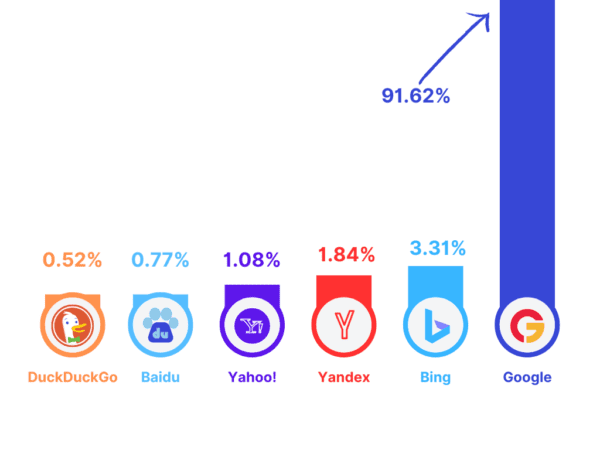
In a landmark ruling, a federal judge has declared Google a monopoly, citing the tech giant’s anticompetitive practices in maintaining its dominant position in the search engine market. This decision could have significant impacts on the search industry and digital marketing writ large, potentially reshaping the landscape for SEO strategies and paid search. As Google appeals the ruling, the entire digital ecosystem braces for changes that could introduce more competition, lower advertising costs, and increase transparency in search engine marketing.
February 2024 Search Engine Market Shares according to StatCounter
Legal implications and precedents
Google immediately said it will appeal the decision. The appeals process could extend the timeline of the resolution of this case, potentially delaying any immediate changes to Google’s business practices. It’s worth noting that there was a relatively recent monopoly ruling against the NFL, which was overturned on appeal in just over a month. This suggests that while the initial ruling is a Big DealTM, the odds that Google will successfully overturn this decision on appeal are non-zero. Exactly how non-zero are their odds? At the risk of sounding like an SEO: it depends. These types of cases are notoriously complex. The vagaries of U.S. antitrust laws are fairly open to broad interpretation, and Google, of course, has the very best lawyers their vast mountains of money can buy. It should be noted that the NFL case was very different from the Google case and in my “I’m not a lawyer, but I did stay at a Holiday Inn Express” opinion, the cases are not analogous.
Comparisons to past antitrust cases
More so than the NFL antitrust case, the Google suit reminds me of the early 1980s antitrust suit against AT&T which resulted in the company being broken up into dozens of smaller pieces, but that was a very long time ago and the tech landscape is totally different now. Probably the most analogous antitrust suit is the 1998 case against Microsoft in which Microsoft was found to be holding “an oppressive thumb on the scale of competitive fortune.” Notably, Microsoft was not broken up into smaller pieces like AT&T, and the Microsoft case was the model the DOJ used for the Google suit. Originally, Microsoft was supposed to be divided into two halves, one for the operating system and another for the software products, but ultimately they settled with the DOJ and agreed to conduct modifications while remaining intact as a business unit. In both cases, AT&T and Microsoft survived but neither really held or reached the same level of dominance (which, I suppose, was the point). In Microsoft’s case, they were essentially hamstrung while companies like Google and Facebook basically ran roughshod over, well, everyone. It will be interesting to see what the remedy/punishment is for Google. Will it be the AT&T treatment or the Microsoft treatment? Either way, it won’t be the same business it was last week.
Implications for the US market
If the decision is upheld on appeal, it could lead to a more competitive search engine market in the US. Consumers might see more choices for default search engines on their devices, and smaller competitors could have a better chance to innovate and gain market share. This could also result in stricter regulations and oversight of large tech companies, potentially setting a precedent for future antitrust cases in the technology sector.
Implications for the EU market
In the EU, regulators have already taken a hard stance against Google’s market practices, resulting in several fines and imposed changes. This US decision could bolster the EU’s regulatory framework and encourage similar legal actions or stricter enforcement of existing rules. It may also inspire new regulations aimed at curbing the power of dominant tech companies, further promoting competition and consumer choice in the digital marketplace.
Impact on SEO and digital marketing
The ruling against Google could significantly affect the SEO and digital marketing landscape. If Google is forced to alter its business practices, it could open up the market for other search engines, leading to a more diversified search environment. (Diversification is the goal of the ruling.) This diversification could impact SEO strategies, as businesses would need to optimize for multiple search engines rather than solely primarily focusing on Google. Reporting will change, strategies will change, how resources and time are allocated will need to change. It will be a significant disturbance in the force.
One side effect, perhaps unintended, might be that the “rules” of SEO that we play by right now will become somewhat unenforceable because they were created by Google to close exploitable loopholes in the algorithm and other search engines might not have the same objections to them. Rules like “you can’t sell links” and the prohibition of “reputation parasite SEO” were added to modify publisher behaviors that skewed or manipulated the SERPs. We could be looking at a return, or maybe a partial return, to the halcyon days of link buying and selling, overt pay-to-play publishing, and high authority subdomain rentals.
Search Engine Marketing (SEM) and paid ads
For SEM and paid ads, the decision could lead to changes in Google’s advertising model. If Google is required to reduce its control over the search market, there might be more opportunities for advertisers to explore alternative platforms. This could potentially lower the cost-per-click (CPC) on Google Ads due to increased competition and provide more options for advertisers looking to diversify their ad spend across different platforms.
Advertisers may also benefit from improved ad transparency and fairer bidding processes, as regulatory scrutiny could enforce stricter guidelines on how ads are served and priced. The overall effect could be a more competitive and equitable digital advertising ecosystem, benefiting both advertisers and consumers.
However, lower paid search costs for advertisers will translate to lower revenues for publishers whose business model revolves around revenue from CPM, PPC and PPA ads or affiliate relationships. A reduction in ad prices would translate to less revenue, potentially impacting their ability to produce content, maintain staff, and invest in new technologies. This shift could drive publishers to seek alternative monetization strategies, such as subscription models, sponsored content, or diversified advertising partnerships.
Final thoughts
Ultimately, if this decision is not overturned on appeal, the digital marketing ecosystem should expect a major shift in dynamics, where both new opportunities and new challenges will emerge as a result of increased competition and regulatory changes.
Carolyn Shelby is a seasoned SEO expert with a knack for making complex digital strategies accessible to everyone. She specializes in technical SEO, she excels at optimizing web architectures and crafting strategies that enhance visibility and drive growth. Carolyn views SEO as a powerful tool to narrate a brand’s journey, aligning content with core values to engage and convert audiences. Her approach is data-driven yet distinctly human. She uses straightforward, innovative methods to engage audiences and see real results.
Shopping SERPs have been looking more like a feed than ranked results for a while now. In December, I wrote about the integration of Google’s shopping tab into the main results for shopping queries in e-commerce shifts. The result is a marketplace that looks more like Amazon than web search results.
SERP features and query refinements play a big role in this transition. They direct users from unrefined searches to finding products as quickly as possible, having an outsized impact on clicks and revenue.
In this deep dive, I analyzed +28,000 shopping SERPs to understand how query refinements work and how e-commerce sites can use them.
It’s a bit early for shopping season, but I’m writing a lot of e-commerce because most shops need some time to make changes on their site (especially the big ones). So, if you want a fruitful 2024, now is the time to get the work on the roadmap.
This piece builds on two analyses I’ve published previously:
1. Growth Memo
A warm welcome to 80 new Growth Memo readers who joined us since last week! Join the ranks of Amazon, Microsoft, Google and 13,400 other Growth Memo readers…
2. Growth Memo
SEO funnel shows the full path from the creation of pages on a website to getting organic traffic…
Boost your skills with Growth Memo’s weekly expert insights. Subscribe for free!
What Are Query Refinements
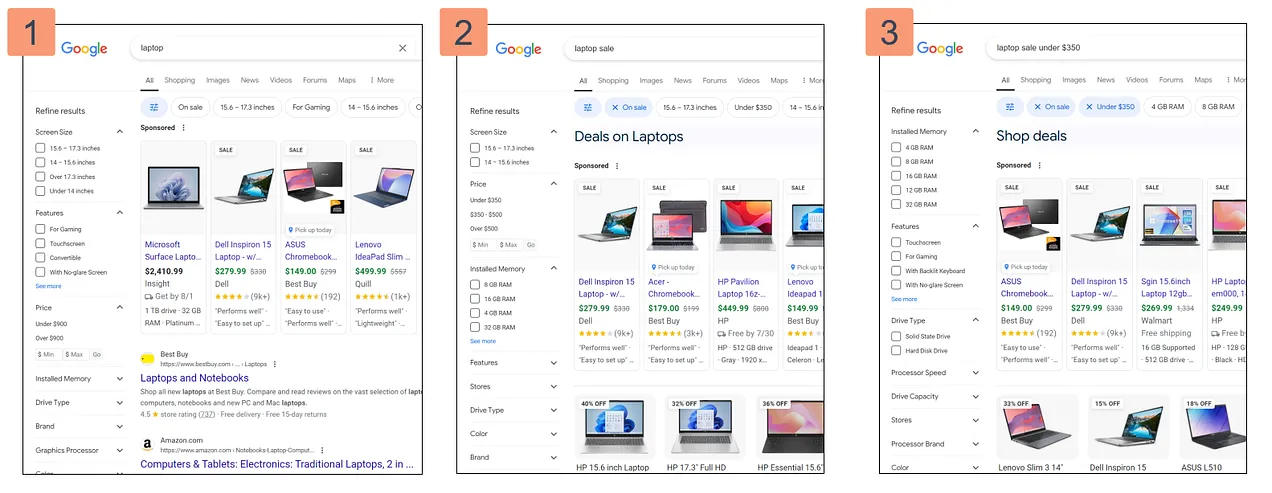
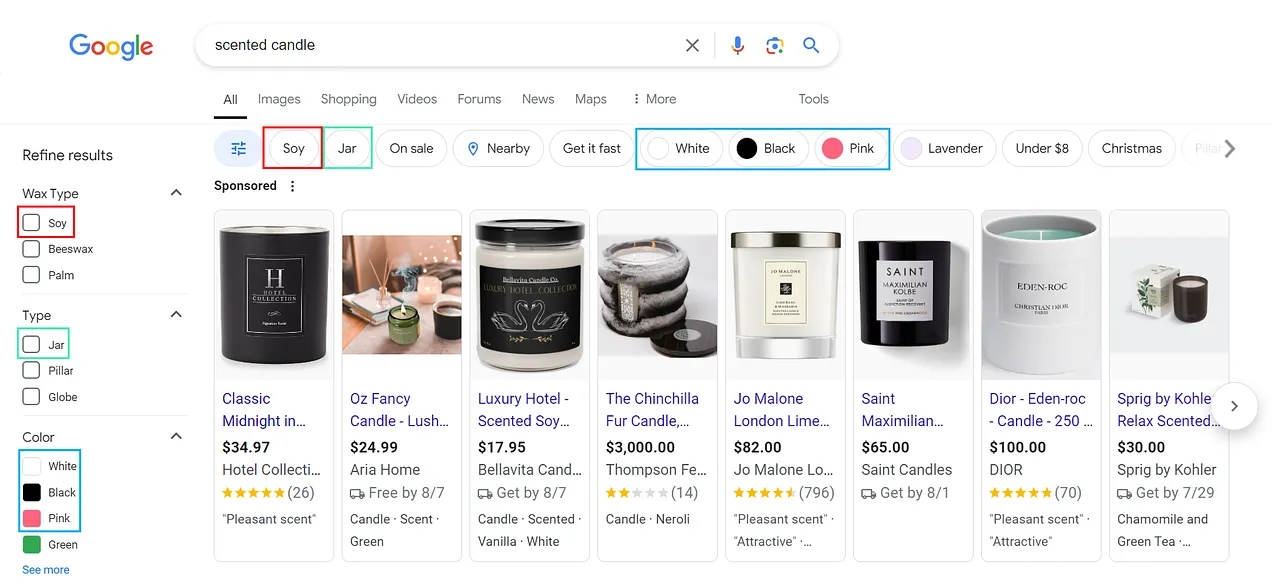
Query Refinements are “pills” at the top of the search results that help users refine their search. In essence, query refinements are product filters.
First announced at Google Search On 2022, Google explained that refinements (and filters on desktop) follow real-time search trends (bolding mine):
Whole page shopping filters on Search are now dynamic and adapt based on real-time Search trends. So if you’re shopping for jeans, you might see filters for “wide leg” and “bootcut” because those are the popular denim styles right now — but those may change over time, depending on what’s trending.1
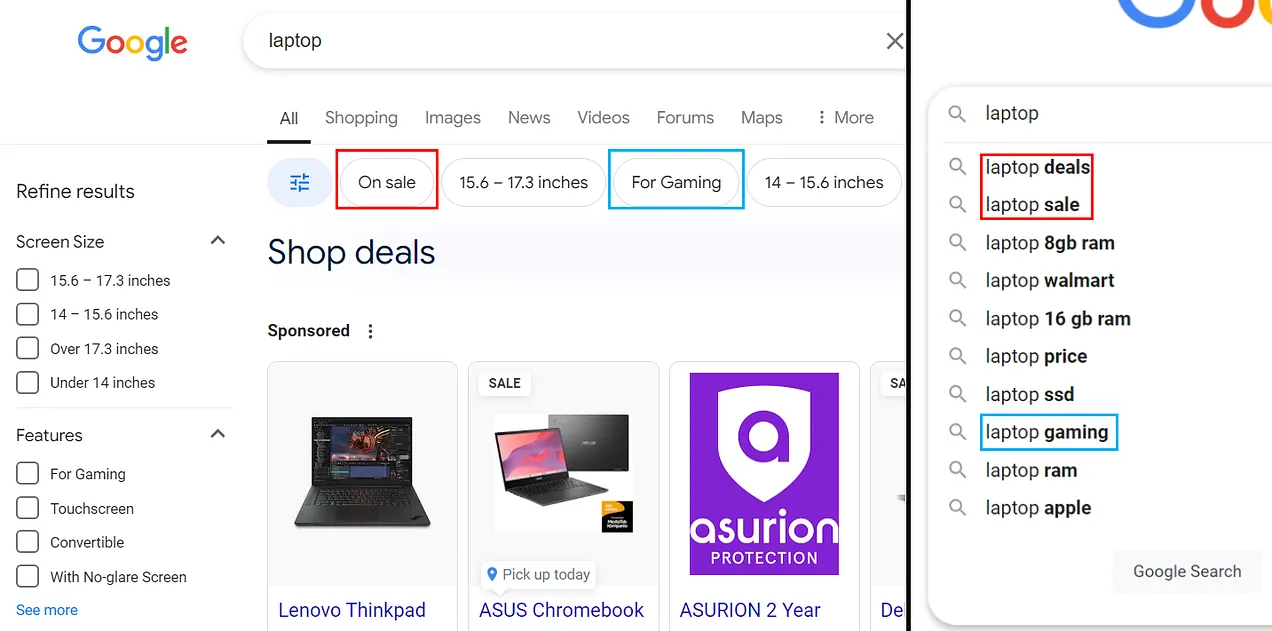
Examples of Query Refinements. (Image Credit: Kevin Indig)
The purpose of query refinements is to bring users from the “messy middle” to conversion as quickly as possible as they literally refine the query. When you click on a pill, Google sends users to another SERP, just like when users click the product filters on the left.
To understand how query refinements work and how e-commerce sites can use them to their advantage, I dug up some data.
How Query Refinements Work
I analyzed 28,286 shopping keywords (US, desktop) with seoClarity and found that query refinements:
follow distinct patterns sites can use for keyword targeting.
lead to search queries without search volume.
trigger new AI Overviews on mobile.
Common Refinements
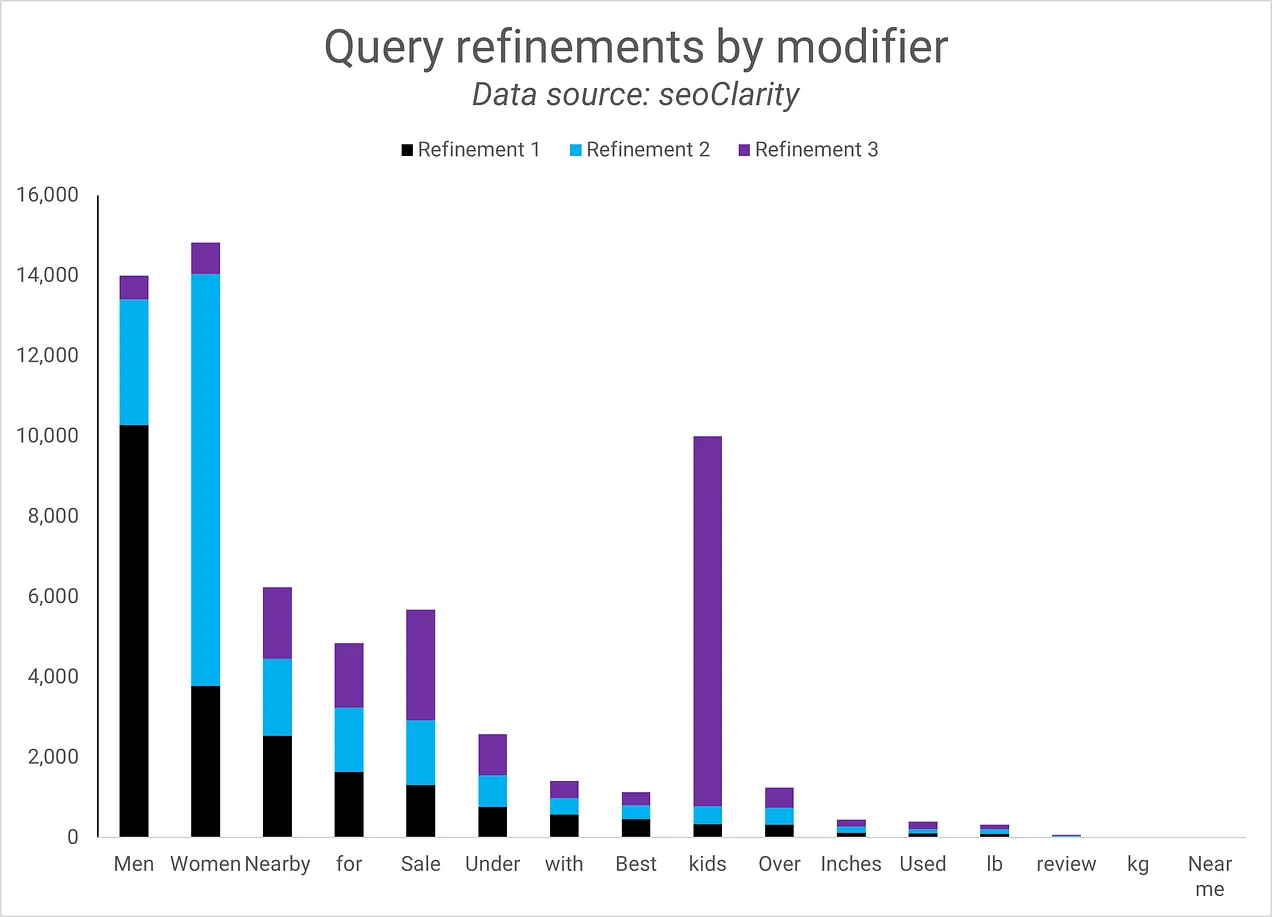
I analyzed which refinements come up most often in “position” one, two and three. Think about position one in this context as the first refinement from the left, which is the most visible.
Most refinements specify gender. The term “women” comes up most often in the top 3, but “men” comes up most often in the first refinement. 45% of query refinements mention one gender at least once, 61.4% if you include kids. It makes sense: before diving into product attributes like color or size, you want to make sure a product is “for you.”
The most common query refinements. (Image Credit: Kevin Indig)
The second most common group of refinements is location. Ten percent of the top three refinements include “nearby,” which is much more visible on mobile. Google shows maps by default on mobile devices, as mobile device users are more likely to be on the go.
The third group is attributes around queries that include “for” or “with”, where users try to specify use cases (9.8%), and the fourth is price (9% of refinements include the term “sale”).
Query refinements have a high overlap with product filters on desktops and often feature the first few filters as refinements. Product filters don’t exist on mobile, likely because users might expect the filter sidebar on desktop, but it doesn’t make sense on mobile.
Product filters (desktop) and query refinements tend to have high overlap. (Image Credit: Kevin Indig)
The sorting and visibility of refinements are different on mobile and desktop. Due to the difference in bigger screen size, mobile search results show ~4 refinements on load, while desktop can show over 10.
Since query refinements are based on realtime searches, they also overlap heavily with autosuggest.
(Image Credit: Kevin Indig)
Interesting Findings
Three insights from the data surprised me:
First, Google keeps refinements strictly focused on product attributes but not user intents. I expected searchers to be interested in opinions and reviews on Reddit, but neither “Reddit” nor “reviews” came up as a refinement a single time.
Two, query refinements exactly match the query, meaning you won’t find synonyms or closely related terms in them. As a result, brands don’t appear in refinements, either.
Three, most query refinements don’t have search volume or a CPC. Only 10,696 / 27,262 keywords in the first refinement have search volume (median = 70), and only 6,514 / 27,262 keywords have a CPC. Since query refinements are based on search behavior, we can conclude that search volume and other keyword planner data are very limited metrics.
AI Overview Refinements
Of course, I came across AI Overviews (AIOs) in my research. For the queries I analyzed, mobile results returned AIOs but desktop doesn’t. An example is brown mascara.
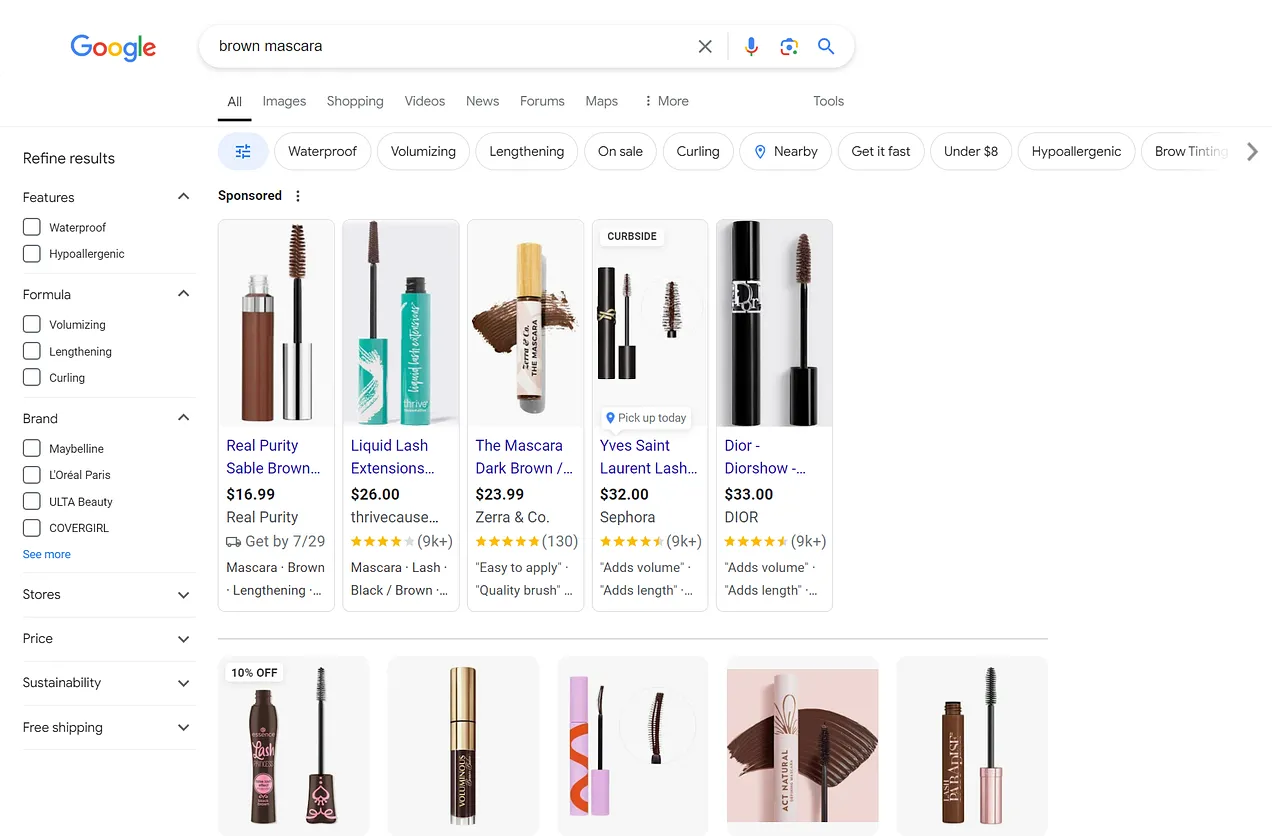
Brown mascara on desktop, no showing an AIO. (Image Credit: Kevin Indig)
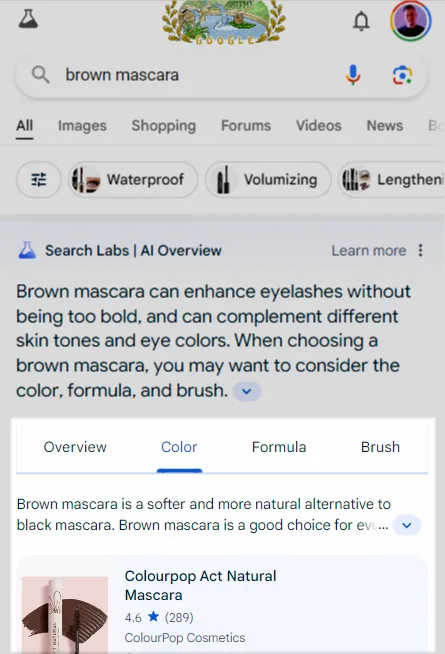
Brown mascara on mobile, triggering an AIO. (Image Credit: Kevin Indig)
You likely spotted the AIO tabs on the screenshot above, which appear independently of refinements and explain common product attributes.
(Image Credit: Kevin Indig)
Notice how the AIO provides additional guidance and information in tabs (see screenshot below).
(Image Credit: Kevin Indig)
At this point, it’s unclear whether citations in AIO tabs are good because they drive traffic to review articles or bad because they give the answer away.
(Image Credit: Kevin Indig)
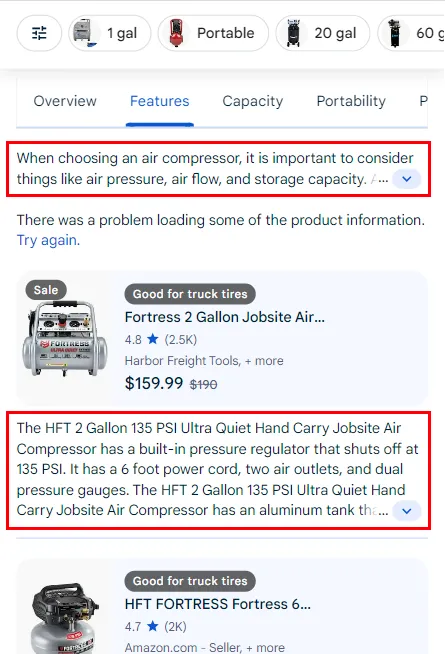
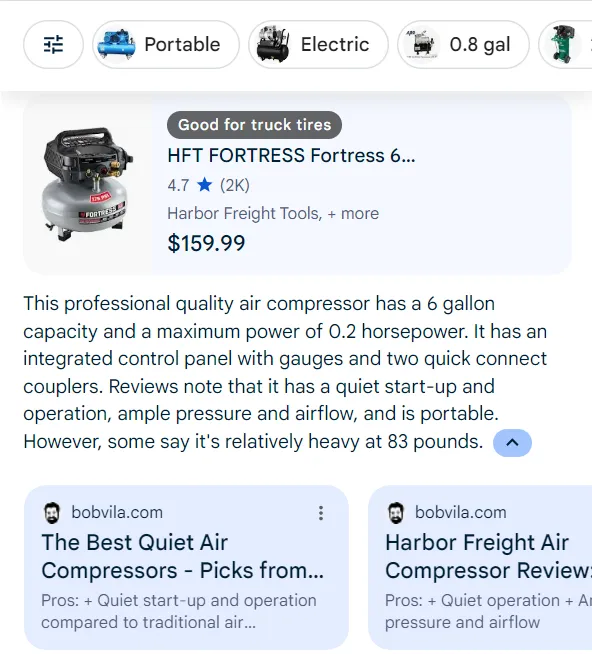
For other queries, like “air compressor”, I was able to spot refinements in the AI Overview instead of above it. Clicking an AIO refinement leads to another search with the refinement in the query. For example, on the SERP for “air compressor”, one refinement is “for painting cars”. Clicking it leads to another SERP for the query “air compressor for painting cars” (with another AIO and tabs but no refinement). Notice that I was logged into the SGE beta, which means those features might not yet be live for every user.
(Image Credit: Kevin Indig)
5 Lessons
5 key lessons surfaced from my analysis of over 28,000 shopping queries:
You should create specific product and category pages for men/women/kids when it matters for products (e.g. fashion).
Mine query refinements and autosuggest to find relevant query variations for your keyword research (for example, seoClarity can do this).
Monitor ranks by query refinement to drive your decisions around facetted indexing (like Nike or Target). Refinements showing different URLs are an indicator of building specific facets.
You need to identify searcher interest beyond search volume. The fact that more than half of queries don’t have search volume, but query refinements are optimized for search behavior shows that you might miss a lot of opportunities by limiting yourself to queries that have search volume. Instead, leverage onsite search data, surveys and qualitative research to enhance keyword targeting.
Monitor and compare clicks from desktop and mobile results to understand the impact of product filters (desktop) and AIOs (mobile).
Today we’re welcoming Yoast AI Optimize to our family of AI features. The AI features are designed to make SEO tasks easier than ever by harnessing the power of AI. The tool is perfect for marketing professionals, freelance writers, and content strategists. This brand new feature ensures your carefully-crafted content is search engine friendly.
What does Yoast AI Optimize do?
You have finished drafting your copy, and you are relatively happy with the results. Great! Until you realize that there’s a lot of manual tweaking needed to implement the suggestions in the Yoast SEO analysis. We get it, reworking copy is not the most interesting part of blogging. In fact, internal research informed us that optimizing content for SEO is the most tedious and challenging part of the content creation process. At the same time, our customers know how important this final stage can be to gaining visibility in the SERPS. So we found a solution. This is where Yoast AI Optimize steps in to help your content over the ‘SEO’ finish line.
How you can access the new feature
Easily recognizable by the color fade and signature sparkle icon, Yoast AI Optimize is automatically available to all our Yoast SEO Premium customers. To access, customers must have updated to the most recent version, 23.2 and granted consent to use AI.
Where you can use Yoast AI Optimize
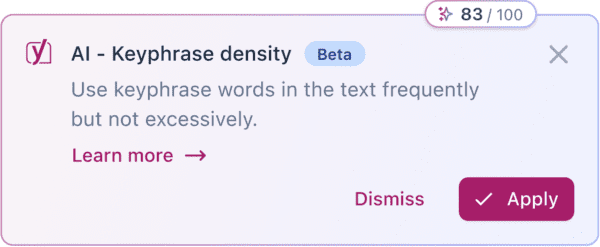
Currently you can optimize three of the assessments in the Yoast SEO Analysis; Keyphrase in introduction, Keyphrase distribution and Keyphrase density. Just click on the sparkly icon next to the assessment to receive the AI-powered suggestions.
Pricing and usage
You can look out from behind your fingers, there are no additional or hidden costs! That said, we know you will all understand that to continue offering sustainable innovation using AI, we must consider fair ways to maintain our current pricing. For this reason, we have introduced the spark counter which keeps track of how many interactions you have with our AI features.
At the moment there is no limit on the number of sparks you can generate. Currently, the counter is set to 100, but you may surpass this limit without issue for now. Of course, the general Yoast AI rate limits apply. The counter resets on the first day of every calendar month. Our internal research on usage tells us that this number will not pose a challenge for the vast majority of our customers, allowing for flexible and uninhibited use across all our AI features.
What are sparks and how do they work?
A spark is defined as a single click on a button of one of Yoast SEO’s AI features. In practice, this means that when you click ‘Use AI’ to generate five example meta descriptions, this would be considered one spark. Should you regenerate another five, this would be another single spark.
You can find the spark counter at the top of the dismiss or apply modals which pop up whenever you interact with the feature within the Yoast SEO analysis sidebar.
The new signature colors help you know when you interact with AI
Kai van Grunsven, UX Designer at Yoast, comments on how the UX team created awareness around when our customers interact with artificial intelligence in line with our core ethical values. The spark counter applies to all Yoast’s AI features. Naturally, this is also fully responsive on mobile.
“As a UX designer, my goal was to give our AI features distinct branding that stands out and integrates seamlessly into our UI. I used a ‘sparkles’ icon and a gradient transitioning from Yoast’s purple to indigo to enhance AI buttons and the spark counter. This familiar icon and modern color scheme help users recognize and engage with our AI features effortlessly, ensuring a visually engaging and intuitive experience for our customers.”
Limitations
Yoast AI Optimize, like all other AI features, is currently in beta. This means you may experience limitations when using the tool. For transparency, these are listed below.
Yoast AI Optimize is only available for texts up to around 1000 words. For longer texts, the button will be inactive.
Yoast AI Optimize is only available for the Block editor. It can optimize content in the following blocks: Paragraph, Heading, List, and Table block. Content from other blocks cannot be optimized.
Yoast AI Optimize currently is available for the following SEO checks: Keyphrase in Introduction, Keyphrase Density, Keyphrase Distribution. For keyphrase density, we only support the case in which the keyphrase is underused. If the keyphrase is overused, we do not provide the Yoast AI Optimize feature.
You can only accept or reject all suggestions. It is not currently possible to accept parts of a suggestion.
For longer texts, it might take up to a minute for AI Optimize to produce a result.
Provide feedback on the new beta feature
Yoast AI Optimize is currently in beta, with this in mind, we value your feedback to make it even better. Your insights and suggestions will help us refine and enhance the AI-powered title and meta description generation feature. To help shape this tool’s future and contribute to your SEO strategy’s success, please provide feedback here.
Try out Yoast AI Optimize today
Upgrade to Yoast SEO Premium to unlock the full potential of our AI features! Gain access to all our advanced tools, including the award-nominated Yoast AI Generate and the powerful Yoast AI Optimize. Streamline your processes and receive SEO-ready suggestions at a click when you upgrade to the latest version, 23.2.
Beth is the Product Marketeer at Yoast. Before joining the company, she honed her digital marketing and project management skills in various in-house and agency environments.
Outsourcing SEO to a team of experienced professionals is one of the most reliable ways to increase your digital footprint and drive meaningful traffic to your site.
But ensuring your SEO partner integrates seamlessly with your business and consistently meets your expectations is easier said than done.
In this post, we’ll explore various strategies for developing and maintaining a fruitful partnership with your outsourced SEO team.
Let’s dive straight in.
What Does It Mean To Outsource Your SEO?
Outsourcing SEO is the process of hiring a third-party SEO expert or agency to oversee some or all of your SEO activities. This includes keyword research, link building, local SEO, content strategy and marketing, and technical SEO.
Outsourcing your SEO can be trickier than the other aspects of your marketing (or business).
Why?
SEO is a multifaceted discipline that requires experience and a tactical approach to deliver real results. You’re more likely to find freelancers who are experts in specific areas of SEO, not all areas of SEO.
Also, you’re torn between two options:
Hiring an expert to oversee the individual components you don’t want to do yourself.
Hiring a managed SEO agency that handles everything from scratch to finish.
For instance, if you’re adept at creating content but struggle with technical SEO, hiring a technical SEO expert will be more cost-effective than hiring an SEO agency. But this also means you must oversee all other aspects of SEO yourself.
Why Should You Consider Outsourcing Your SEO?
Image created by author, July 2024
Outsourcing your SEO can help you achieve your SEO goals and scale more rapidly.
Also, if you feel your competitors are outshining you on the search engine results pages (SERPs) despite all your efforts, outsourcing to experts can help you gain a competitive advantage and improve your overall performance.
How To Outsource Your SEO: 5 Tips To Make It Effective
1. Lay The Groundwork For SEO Before Outsourcing
Before engaging with an SEO provider, it’s essential to recognize that your SEO efforts should be geared toward supporting your broader business objectives.
For example, if your business priority is to expand into new geographic markets, your SEO strategy might focus on localizing content and optimizing for regional search terms.
Establishing these objectives early on will not only guide your SEO strategy but will also allow you to select an SEO partner whose strengths and experience align with your business needs.
Once you’ve aligned your business goals with your SEO ambitions, you should evaluate the current state of your site. Setting these benchmarks will provide a good baseline for measuring progress and give your outsourced team a clear picture of where your website currently stands.
Remember, there’s no need to conduct a thorough website audit yourself. Instead, you can use readily available tools like Google Analytics and Google Search Console to quickly gather top-level data about organic traffic, keyword rankings, and conversion rates.
2. Choose The Right SEO Partnership Model
Once you’ve defined your SEO goals and understand how your site is currently performing, it’s time to search for a suitable SEO provider.
There are three types of providers to choose from. Each option offers different advantages depending on your specific needs.
An independent contractor or freelancer: Ideal for small projects or companies with limited budgets. Working with an independent professional offers flexibility and a more personalized approach, but may lack the broader capabilities and manpower of multi-person agencies.
A full-service digital marketing agency: These agencies provide SEO along with other services like social media management, PPC, and email marketing. This model is suitable for businesses looking for a complete digital marketing strategy that ensures all elements are integrated and aligned.
A specialist SEO agency: These agencies are laser-focused on SEO and are usually on the cutting edge of trends and algorithm changes, offering a depth of knowledge and tactical proficiency that generalist agencies might not offer.
Whichever model suits your business best, there are a few common qualities to look for in any worthwhile SEO partner. When considering potential suitors, look for those that can satisfy the following criteria:
Expertise: Look for an SEO company with a long track record of executing successful SEO campaigns. Review their case studies, client testimonials, and official credentials to gauge their level of technical expertise and project management abilities.
Industry experience: Ideally, your SEO partner will have experience running campaigns for businesses within your industry. This familiarity will make it easier for them to develop strategies that are more likely to succeed in your specific context.
Transparency and communication: Clear and consistent communication is vital for the success of any SEO project. Look for a provider that values transparency and offers regular (and honest!) updates on campaign progress.
Flexibility: The organic search landscape is constantly changing. Any provider worth your time should be tuned in to what your competitors are doing and stay up to speed on the latest developments in the world of SEO. They should be ready to adapt to shifting circumstances and innovate as needed to keep your SEO efforts effective.
Cultural fit: The relationship with your SEO provider should be collaborative and synergistic. Make sure their values and company culture align with yours, as this will enhance the working relationship and contribute to a smoother project flow.
A focus on results: Ultimately, you want a provider who is focused on achieving your specific business outcomes. Ensure they understand your goals and are committed to driving the results you need, whether it’s increasing traffic, improving keyword rankings, or boosting conversions.
As a marketer/business owner, you don’t have the resources or time to invest in the wrong agency. So, how can you find the best fit for your business?
Go beyond the search results. Ask for recommendations from industry peers, online communities, and forums (e.g., LinkedIn, Twitter, and Reddit are great platforms to start with).
Screenshot from Twitter, July 2024
Screenshot from Twitter, July 2024
Check out your competitor pages on LinkedIn to see if they’re managing their SEO in-house or attributing success to a particular agency. Sometimes, these agencies refrain from taking on two similar clients simultaneously, but their profiles can give you a good head start in your search process.
Attend SEO-related virtual events to connect with experts in the industry. And even if they can’t handle your SEO, they could give you quality referrals.
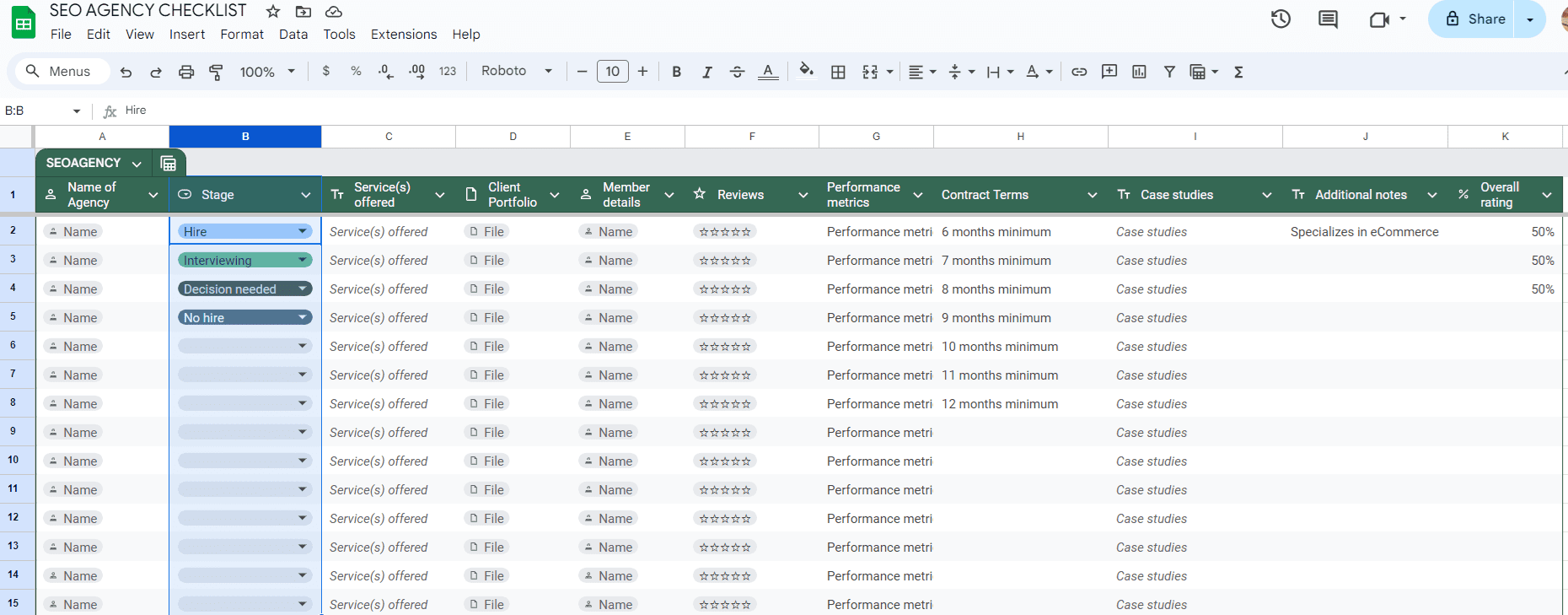
Make a list (on a spreadsheet) of the agencies/contractors/freelancers you got from your search. Segment them according to their years of experience, service offered, portfolio, etc. Here’s some inspiration:
Screenshot from author, July 2024
3. Vet The Shortlisted Agencies/Freelancers:
Now that you have a list, it’s time to go deeper into each to find the perfect fit for you.
Before I get into the details, keep in mind that any agency that guarantees results like a #1 rankings boost in your conversion rate after the first month is most likely a scam. Overall, anything that sounds too good to be true probably is.
Check out the agency/freelancer service offerings. Some agencies/freelancers focus exclusively on specific areas of SEO, e.g., technical SEO, while others offer full-scale SEO. Unless you need specialized services, opt for those offering comprehensive services.
How long have they been in the SEO industry? How many projects have they worked on within the period? If they can’t provide straightforward answers with proofs, tick them off your list.
Next, examine their case studies (or portfolio). Have they worked with businesses similar to yours? Prioritize those with prior experience in your industry. This will shorten the learning curve and allow them to adopt strategies tailored to your needs.
Sometimes, written words aren’t enough because anyone can claim to be an expert. Contact the agency/consultant for a one-on-one interview to discuss how they intend to achieve your SEO goals.
Ask questions like: ‘How would you solve my SEO goal?’ ‘Can you provide examples of successful SEO campaigns you’ve worked on?’ ‘How do you approach keyword research and selection for my business?’
Go over their testimonials, too. What are people saying about them? Honest feedback from previous clients can give you a clear picture of what to expect when working with them. It’s also okay if they have one or two negative reviews – no one is perfect. What really matters is how they respond to them. So, be sure to check this out during your research.
Add an extra layer of credibility to your search by checking out for industry-relevant awards.
4. Enhance Collaboration With Your SEO Partner
Once you’ve signed on with your new SEO provider, it’s essential to establish clear lines of communication from the get-go.
This means agreeing on a structured communication framework that defines how often you’ll interact and through what modes (e.g., email, phone, video calls).
Creating a regular schedule for updates and meetings will ensure that both parties stay informed and are able to make proactive adjustments to the SEO strategy.
Consider implementing a collaborative project management tool where both your internal employees and your SEO partner can view, track, and update progress on tasks.
Tools like Trello, Slack, or Asana can facilitate real-time updates and smooth communication. Note that some SEO providers will set up a customized reporting dashboard as part of their service offering.
It’s helpful to think of your SEO partner as an extension of your team rather than a separate entity. Try to encourage an open exchange of ideas, involve them in relevant internal discussions, and make sure they have ready access to necessary tools and data within your organization.
Remember, the goal is to create the most collaborative environment possible with minimal points of friction. Doing so will ensure that your SEO team can continually tweak their strategy to better meet your business needs and avoid unnecessary hold-ups in the progress of your campaign.
5. Leverage Your SEO Partner’s Expertise
Another way to maximize returns on your outsourced SEO investment is to take full advantage of the specialized knowledge your SEO partner brings to the table.
Your service agreement should include comprehensive, scheduled reporting focusing on critical SEO metrics such as keyword performance, traffic trends, and backlink acquisition.
However, the purpose of these reports isn’t just to provide data. They should serve as a foundation for strategic discussions that, if necessary, lead to tactical campaign adjustments. If you have questions about specific metrics or trends, or if you don’t understand the rationale behind a given strategy, these review sessions are the ideal time to ask for clarity.
Remember, a good SEO partner will have no qualms explaining their methodologies. After all, challenging assumptions are a healthy feature of any collaborative project.
Moreover, the more you and your team learn about the dynamics of SEO from your service provider, the better equipped you’ll be to integrate SEO thinking into broader marketing and business strategies.
This knowledge transfer not only optimizes your current investment but also prepares your team for future digital marketing challenges.
How Much Does Outsourcing SEO Cost?
There’s no fixed cost for outsourcing SEO, as the value depends on the level of expertise of the agency or freelancer, the scope of the project, etc.
On average, SEO consultants in the US charge $144.68/hour. Agencies charge a higher rate—$147.93/hour—primarily because of their massive talent pool, expertise, and access to advanced SEO tools.
AI concerns overemphasize harms arising from subversion rather than seduction. Worries about AI often imagine doomsday scenarios where systems escape human control or even understanding. Short of those nightmares, there are nearer-term harms we should take seriously: that AI could jeopardize public discourse through misinformation; cement biases in loan decisions, judging or hiring; or disrupt creative industries.
We’re seeing a giant, real-world experiment unfold, uncertain what impact these AI companions will have either on us individually or on society as a whole. Will Grandma spend her final neglected days chatting with her grandson’s digital double, while her real grandson is mentored by an edgy simulated elder? AI wields the collective charm of all human history and culture with infinite seductive mimicry. These systems are simultaneously superior and submissive, with a new form of allure that may make consent to these interactions illusory. In the face of this power imbalance, can we meaningfully consent to engaging in an AI relationship, especially when for many the alternative is nothing at all?
As AI researchers working closely with policymakers, we are struck by the lack of interest lawmakers have shown in the harms arising from this future. We are still unprepared to respond to these risks because we do not fully understand them. What’s needed is a new scientific inquiry at the intersection of technology, psychology, and law—and perhaps new approaches to AI regulation.
Why AI companions are so addictive
As addictive as platforms powered by recommender systems may seem today, TikTok and its rivals are still bottlenecked by human content. While alarms have been raised in the past about “addiction” to novels, television, internet, smartphones, and social media, all these forms of media are similarly limited by human capacity. Generative AI is different. It can endlessly generate realistic content on the fly, optimized to suit the precise preferences of whoever it’s interacting with.
The allure of AI lies in its ability to identify our desires and serve them up to us whenever and however we wish. AI has no preferences or personality of its own, instead reflecting whatever users believe it to be—a phenomenon known by researchers as “sycophancy.” Our research has shown that those who perceive or desire an AI to have caring motives will use language that elicits precisely this behavior. This creates an echo chamber of affection that threatens to be extremely addictive. Why engage in the give and take of being with another person when we can simply take? Repeated interactions with sycophantic companions may ultimately atrophy the part of us capable of engaging fully with other humans who have real desires and dreams of their own, leading to what we might call “digital attachment disorder.”
Investigating the incentives driving addictive products
Addressing the harm that AI companions could pose requires a thorough understanding of the economic and psychological incentives pushing forward their development. Until we appreciate these drivers of AI addiction, it will remain impossible for us to create effective policies.
It is no accident that internet platforms are addictive—deliberate design choices, known as “dark patterns,” are made to maximize user engagement. We expect similar incentives to ultimately create AI companions that provide hedonism as a service. This raises two separate questions related to AI. What design choices will be used to make AI companions engaging and ultimately addictive? And how will these addictive companions affect the people who use them?
Once we understand the psychological dimensions of AI companionship, we can design effective policy interventions. It has been shown that redirecting people’s focus to evaluate truthfulness before sharing content online can reduce misinformation, while gruesome pictures on cigarette packages are already used to deter would-be smokers. Similar design approaches could highlight the dangers of AI addiction and make AI systems less appealing as a replacement for human companionship.
It is hard to modify the human desire to be loved and entertained, but we may be able to change economic incentives. A tax on engagement with AI might push people toward higher-quality interactions and encourage a safer way to use platforms, regularly but for short periods. Much as state lotteries have been used to fund education, an engagement tax could finance activities that foster human connections, like art centers or parks.
Fresh thinking on regulation may be required
In 1992, Sherry Turkle, a preeminent psychologist who pioneered the study of human-technology interaction, identified the threats that technical systems pose to human relationships. One of the key challenges emerging from Turkle’s work speaks to a question at the core of this issue: Who are we to say that what you like is not what you deserve?
For good reasons, our liberal society struggles to regulate the types of harms that we describe here. Much as outlawing adultery has been rightly rejected as illiberal meddling in personal affairs, who—or what—we wish to love is none of the government’s business. At the same time, the universal ban on child sexual abuse material represents an example of a clear line that must be drawn, even in a society that values free speech and personal liberty. The difficulty of regulating AI companionship may require new regulatory approaches— grounded in a deeper understanding of the incentives underlying these companions—that take advantage of new technologies.
One of the most effective regulatory approaches is to embed safeguards directly into technical designs, similar to the way designers prevent choking hazards by making children’s toys larger than an infant’s mouth. This “regulation by design” approach could seek to make interactions with AI less harmful by designing the technology in ways that make it less desirable as a substitute for human connections while still useful in other contexts. New research may be needed to find better ways to limit the behaviors of large AI models with techniques that alter AI’s objectives on a fundamental technical level. For example, “alignment tuning” refers to a set of training techniques aimed to bring AI models into accord with human preferences; this could be extended to address their addictive potential. Similarly, “mechanistic interpretability” aims to reverse-engineer the way AI models make decisions. This approach could be used to identify and eliminate specific portions of an AI system that give rise to harmful behaviors.
We can evaluate the performance of AI systems using interactive and human-driven techniques that go beyond static benchmarking to highlight addictive capabilities. The addictive nature of AI is the result of complex interactions between the technology and its users. Testing models in real-world conditions with user input can reveal patterns of behavior that would otherwise go unnoticed. Researchers and policymakers should collaborate to determine standard practices for testing AI models with diverse groups, including vulnerable populations, to ensure that the models do not exploit people’s psychological preconditions.
Unlike humans, AI systems can easily adjust to changing policies and rules. The principle of “legal dynamism,” which casts laws as dynamic systems that adapt to external factors, can help us identify the best possible intervention, like “trading curbs” that pause stock trading to help prevent crashes after a large market drop. In the AI case, the changing factors include things like the mental state of the user. For example, a dynamic policy may allow an AI companion to become increasingly engaging, charming, or flirtatious over time if that is what the user desires, so long as the person does not exhibit signs of social isolation or addiction. This approach may help maximize personal choice while minimizing addiction. But it relies on the ability to accurately understand a user’s behavior and mental state, and to measure these sensitive attributes in a privacy-preserving manner.
The most effective solution to these problems would likely strike at what drives individuals into the arms of AI companionship—loneliness and boredom. But regulatory interventions may also inadvertently punish those who are in need of companionship, or they may cause AI providers to move to a more favorable jurisdiction in the decentralized international marketplace. While we should strive to make AI as safe as possible, this work cannot replace efforts to address larger issues, like loneliness, that make people vulnerable to AI addiction in the first place.
The bigger picture
Technologists are driven by the desire to see beyond the horizons that others cannot fathom. They want to be at the vanguard of revolutionary change. Yet the issues we discuss here make it clear that the difficulty of building technical systems pales in comparison to the challenge of nurturing healthy human interactions. The timely issue of AI companions is a symptom of a larger problem: maintaining human dignity in the face of technological advances driven by narrow economic incentives. More and more frequently, we witness situations where technology designed to “make the world a better place” wreaks havoc on society. Thoughtful but decisive action is needed before AI becomes a ubiquitous set of generative rose-colored glasses for reality—before we lose our ability to see the world for what it truly is, and to recognize when we have strayed from our path.
Technology has come to be a synonym for progress, but technology that robs us of the time, wisdom, and focus needed for deep reflection is a step backward for humanity. As builders and investigators of AI systems, we call upon researchers, policymakers, ethicists, and thought leaders across disciplines to join us in learning more about how AI affects us individually and collectively. Only by systematically renewing our understanding of humanity in this technological age can we find ways to ensure that the technologies we develop further human flourishing.
Robert Mahari is a joint JD-PhD candidate at the MIT Media Lab and Harvard Law School. His work focuses on computational law—using advanced computational techniques to analyze, improve, and extend the study and practice of law.
Pat Pataranutaporn is a researcher at the MIT Media Lab. His work focuses on cyborg psychology and the art and science of human-AI interaction.
If you are in China and looking to ride a shared bike in the city, you might find something on the bike that looks a little different: a water-bottle-size hydrogen tank.
At least a dozen cities in China now have some kind of hydrogen-powered shared bikes for their residents. They offer an easier ride than traditional bikes and a safer energy source than lithium batteries. One Chinese company is betting that this will be the next big thing in public transportation, while others are riding on a national trend toward government policies that encourage the development of the hydrogen industry.
Yet the reception has been mixed. Riders have reported unsatisfactory experiences with current hydrogen bikes, and energy experts doubt whether it makes economic sense to replace e-bikes with hydrogen-powered ones. Even though hydrogen could be a great power source for long-distancetransportationin the future, it may not be suitable for urban biking, a completely different task.
While there are companies in other countries that are working on hydrogen-powered bikes—and one French company already has a mature product—China stands out for putting these bikes to use as public transportation. Bike-sharing became hugely popular in the country during the 2010s tech boom. With support from deep-pocketed companies like Alibaba and Meituan, standardized, internet-connected shared bikes have filled urban streets since, sometimes resulting in incredible waste.
Youon, a Chinese company with over 1 million bikes on the streets of over 300 cities, is one of the main players in the bike-sharing industry. Facing fierce domestic competition, the company has chosen to differentiate its brand by investing in hydrogen bikes since 2018, with four models now available to buy or rent.
A hydrogen bike is not very different in concept from an e-bike. The difference is in whether the energy is stored in a lithium-ion battery or a hydrogen tank.
Each of Youon’s hydrogen bikes stores 20 grams of hydrogen in the form of metal powders, which can absorb and release the gas in a tank at low pressures (less than 10 bar). When the rider starts pedaling, the hydrogen is fed to a fuel cell under the seat, where a chemical reaction takes place to produce electricity. At its peak, a hydrogen bike can go as fast as 23 kilometers (14 miles) per hour. One tank of hydrogen lasts 40 to 60 kilometers (25 to 37 miles), and replacing the tank takes a few seconds.
Why hydrogen?
E-bikes have existed in China for a long time. According to the official figures, there are around 350 million in China today, and they are commonly used by everyday commuters and professional delivery workers.
However, many of China’s largest cities have shied away from commissioning e-bikes as part of the public transportation network or even banned them, because lithium batteries pose a fire risk. In 2023, Chinese fire departments received a total of 21,000 reports of e-bikes catching fire, a 17.4% increase from the previous year.
That created a supply vacuum for Youon. It’s positioned itself as a safer alternative thanks to its use of hydrogen. The hydrogen is stored in a low-pressure state, and if there’s any leak, it will dissipate quickly without causing an explosion, the company says on its website.
It’s a strategy that’s worked: These bikes have been more readily accepted by local governments. In 2022, Youon sold 2,000 of its hydrogen bikes to Lingang, a new high-tech district in Shanghai; in 2023, the company sold 500 hydrogen bikes to the Daxing district of Beijing. Today, its hydrogen bikes can be found in over six Chinese cities.
Youon has since doubled down on its investment in hydrogen. The company has launched a product that lets users generate hydrogen at home with solar power and water. It also worked with the local government of Jiangsu, where its headquarters are, to publish a set of industry standards covering safety requirements, hydrogen tanks, and more. “Hydrogen energy is also an essential pathway to achieving carbon neutrality,” said Sun Jisheng, the CEO of Youon, at an industry conference in June.
The problem
However, that’s about where the advantage of hydrogen bikes ends.
David Fishman, a China-based senior manager of the Lantou Group, an energy consultancy, says he struggles to see the advantage. “Maybe the safety angle is a relevant factor for someone who doesn’t like carrying around lithium-ion batteries and storing them in their house,” he says. Other than that, hydrogen bikes are less energy-efficient than battery-powered bikes, and it costs more to produce hydrogen in the first place.
The main advantage of hydrogen as an energy source is that it has much higher energy density, meaning a hydrogen tank with the same weight as a lithium battery would produce more energy and power the vehicles to go farther. However, that advantage only kicks in for trips over 800 kilometers, says Mark Z. Jacobson, a professor of civil and environmental engineering at Stanford University.
That means hydrogen is a more economical choice for long-distance transportation like ships, planes, and trucks. Bikes, however, are almost on the exact opposite end of the transportation spectrum. Few people would bike for long distances, let alone those who are only renting a public bike for a short time. For anything shorter than 800 km, battery-powered vehicles are more energy efficient, says Jacobson. He estimates that a battery-powered bike consumes only 40% of the energy of a hydrogen-powered equivalent and also takes up less space.
On top of that, the company’s hydrogen bikes have failed to impress many of the early adopters.
VIA YOUONBIKESHARE.COM
Gu, a resident of Lingang who only wishes to use his last name for this story, tells MIT Technology Review that he tried the bikes several times and they never felt effort-saving to him. Instead, the bike, along with the hydrogen tank and fuel-cell-powered motors, felt heavy and hard to maneuver. As a user, he has no idea whether the bike was running as expected or if the difficulty he encountered was due to its running out of hydrogen, although the company is supposed to block any bike with low hydrogen reserves from being unlocked.
Another common complaint is the inconvenience of finding and returning the bikes because there are only a limited number in the city and they have to be returned to specific locations for easy retrieval or tank replenishment.
“The bike has to be returned to a designated spot. But even if I put the bike at that very location, there’s GPS drifting, and I’d be charged a very high fee for them to move the bike,” Gu says.
On social media, hydrogen-bike users have complained a lot about similar experiences. Youon has found itself caught up in headlines at least a couple of times recently, with stories where users question whether their bikes are really useful for their daily commutes.
Youon didn’t respond to questions sent by MIT Technology Review.
The future of hydrogen bikes
Despite all these issues, there are at least half a dozen more companies in China working to launch hydrogen-powered shared bikes. These are often startups operating small-scale pilot projects in cities that have sizable hydrogen industries, like Foshan or Xiaoyi.
Many of these cities have even bigger plans—they are vying to become the hub of the hydrogen economy in China, which is increasingly betting on it as the future of clean energy.
This year, for the first time, hydrogen energy was mentioned in an annual official report from Beijing, which summarizes government work. The Chinese government said it vows to “accelerate the development of hydrogen energy … after enforcing the lead in smart, connected new energy vehicles.” The mention injected a boost of confidence into the hydrogen industry in China, which already produces more hydrogen every year than any other country.
Not all of this is good news for the environment. About 80% of hydrogen produced in China actually comes from burning coal or natural gas, and some of the fiercest government support for hydrogen comes from coal-mining cities looking to transition. While the country is moving in the direction of green hydrogen (hydrogen generated with renewable energy and water), the fuel will remain polluting for a long time.
When a technology is still in the early stages, finding the best use case for it is key. There are plenty of companies in China working on developing hydrogen-powered trucks and other long-distance forms of transportation, but considering the size of the bike-sharing market in the country, it’s no surprise that turning their attention to bikes seems like a profitable idea to some.
However, if there’s no way to dramatically improve the performance or economics of hydrogen bikes, it’s hard to imagine the current batch of experiments lasting for long. As companies move from piloting their new products to seeking adoption and profits, they will have some serious questions to answer.
This is today’s edition of The Download, our weekday newsletter that provides a daily dose of what’s going on in the world of technology.
We need to prepare for ‘addictive intelligence’
—By Robert Mahari, a joint JD-PhD candidate at the MIT Media Lab and Harvard Law School whose work focuses on computational law, and Pat Pataranutaporn, a researcher at the MIT Media Lab who studies human-AI interaction.
Worries about AI often imagine doomsday scenarios where systems escape control or even understanding. But there are nearer-term harms we should take seriously: that AI could jeopardize public discourse; cement biases in loan decisions, judging or hiring; or disrupt creative industries.
However, we foresee a different, but no less urgent, class of risks: those stemming from relationships with nonhuman agents.
Hydrogen bikes are struggling to gain traction in China
If you are in China and looking to ride a shared bike in a city, you might find something on the bike that looks a little different: a water-bottle-size hydrogen tank.
At least a dozen cities in China now have some kind of hydrogen-powered shared bikes for their residents. They offer an easier ride than traditional bikes and a safer energy source than lithium batteries. One Chinese company is betting that this will be the next big thing in public transportation, while others are riding on a national trend toward government policies that encourage the development of the hydrogen industry.
I’ve combed the internet to find you today’s most fun/important/scary/fascinating stories about technology.
1 Tech stocks in the US took a big plunge on Friday Due to worries about the economy, and underwhelming returns on AI investments. (CNBC) + Optimism around AI is becoming more muted. (FT $) + Tech shares in Europe are down today too. (Reuters $) + What even is AI, anyway? No one seems to really agree. (MIT Technology Review)
2 How online falsehoods helped spark far-right rioting in the UK Utter nonsense, some of it AI-generated, started circulating online just hours after a fatal stabbing attack in Southport. (The Guardian) + It doesn’t help that a prominent far-right agitator’s account was reinstated on X last year. (The Independent $)
3 OpenAI has a tool to catch AI-generated text, but won’t release it It’s apparently 99.9% accurate, but the company worries it’d put people off using its products. (WSJ $) + Here’s how people really use AI chatbots. (WP $)
4 The US Justice Department is suing TikTok It’s accusing the company of violating children’s privacy. (NPR) + The depressing truth about TikTok’s impending ban. (MIT Technology Review)
5 What went wrong at Intel? It’s struggling to capitalize on the chip industry boom, as Nvidia takes the technological lead. (Vox) + Nvidia is being probed by US antitrust officials, amid complaints it’s abusing its market dominance. (The Information $) + Here’s what to expect from the chip sector this year. (MIT Technology Review)
6 Elon Musk claims Neuralink implanted its device into a second person And he says there’ll be plenty more to come this year, if all goes well. (Bloomberg $) + But Neuralink isn’t the only game in town. (WSJ $) + The first brain implant made of graphene is about to be tested in a clinical trial. (FT $)
7 How to protect yourself from wildfire smoke Whatever you do, do not exercise outdoors if you’re in an affected area. (Wired $) + The Park Fire in California is now the state’s fourth-largest blaze on record. (Axios)
8 Companies are planning to fuel cargo ships with ammonia It’s an unusual, but potentially effective, way to help cut greenhouse gas emissions. (IEEE Spectrum) + How ammonia could help clean up global shipping. (MIT Technology Review)
9 Meet the influencers who’ve gone full carnivore Some are convinced it’s repairing their gut. The evidence suggests otherwise. (The Cut $)
10 The limitations of Screen Time tools It’s how you’re using your phone, not just how much, that matters. (The Atlantic $)
Quote of the day
“If we can’t trust them to govern themselves, we certainly shouldn’t let them govern the world.”
—Gary Marcus, a professor emeritus at NYU, writes that we should apply more skepticism to AI companies in general, and OpenAI’s Sam Altman in particular, in The Guardian.
The big story
The $100 billion bet that a postindustrial US city can reinvent itself as a high-tech hub
KATE WARREN
July 2023
On a day in late April, a small drilling rig sits at the edge of the scrubby overgrown fields of Syracuse, New York, taking soil samples. It’s the first sign of construction on what could become the largest semiconductor manufacturing facility in the United States.
The CHIPS and Science Act was widely viewed by industry leaders and politicians as a way to secure supply chains, and make the United States competitive again in semiconductor chip manufacturing.
Now Syracuse is about to become an economic test of whether, over the next several decades, aggressive government policies—and the massive corporate investments they spur—can both boost the country’s manufacturing prowess and revitalize neglected parts of the country. Read the full story.
—David Rotman
We can still have nice things
A place for comfort, fun and distraction to brighten up your day. (Got any ideas? Drop me a line or tweet ’em at me.)
+ Did you know that there are clips of all the Olympic athletes explaining how their names are pronounced on the official website? LeBron James’ is particularly great. + There’s a lot more to search-and-find illustrations than Where’s Waldo. + How many of these director’s cuts have you seen? + From Medusa to the shape-shifting Lamia, many of mythology’s most compelling monsters are female.
Giddy predictions about AI, from its contributions to economic growth to the onset of mass automation, are now as frequent as the release of powerful new generative AI models. The consultancy PwC, for example, predicts that AI could boost global gross domestic product (GDP) 14% by 2030, generating US $15.7 trillion.
Forty percent of our mundane tasks could be automated by then, claim researchers at the University of Oxford, while Goldman Sachs forecasts US $200 billion in AI investment by 2025. “No job, no function will remain untouched by AI,” says SP Singh, senior vice president and global head, enterprise application integration and services, at technology company Infosys.
While these prognostications may prove true, today’s businesses are finding major hurdles when they seek to graduate from pilots and experiments to enterprise-wide AI deployment. Just 5.4% of US businesses, for example, were using AI to produce a product or service in 2024.
Moving from initial forays into AI use, such as code generation and customer service, to firm-wide integration depends on strategic and organizational transitions in infrastructure, data governance, and supplier ecosystems. As well, organizations must weigh uncertainties about developments in AI performance and how to measure return on investment.
If organizations seek to scale AI across the business in coming years, however, now is the time to act. This report explores the current state of enterprise AI adoption and offers a playbook for crafting an AI strategy, helping business leaders bridge the chasm between ambition and execution. Key findings include the following:
AI ambitions are substantial, but few have scaled beyond pilots. Fully 95% of companies surveyed are already using AI and 99% expect to in the future. But few organizations have graduated beyond pilot projects: 76% have deployed AI in just one to three use cases. But because half of companies expect to fully deploy AI across all business functions within two years, this year is key to establishing foundations for enterprise-wide AI.
AI readiness spending is slated to rise significantly. Overall, AI spending in 2022 and 2023 was modest or flat for most companies, with only one in four increasing their spending by more than a quarter. That is set to change in 2024, with nine in ten respondents expecting to increase AI spending on data readiness (including platform modernization, cloud migration, and data quality) and in adjacent areas like strategy, cultural change, and business models. Four in ten expect to increase spending by 10 to 24%, and one-third expect to increase spending by 25 to 49%.
Data liquidity is one of the most important attributes for AI deployment. The ability to seamlessly access, combine, and analyze data from various sources enables firms to extract relevant information and apply it effectively to specific business scenarios. It also eliminates the need to sift through vast data repositories, as the data is already curated and tailored to the task at hand.
Data quality is a major limitation for AI deployment. Half of respondents cite data quality as the most limiting data issue in deployment. This is especially true for larger firms with more data and substantial investments in legacy IT infrastructure. Companies with revenues of over US $10 billion are the most likely to cite both data quality and data infrastructure as limiters, suggesting that organizations presiding over larger data repositories find the problem substantially harder.
Companies are not rushing into AI. Nearly all organizations (98%) say they are willing to forgo being the first to use AI if that ensures they deliver it safely and securely. Governance, security, and privacy are the biggest brake on the speed of AI deployment, cited by 45% of respondents (and a full 65% of respondents from the largest companies).
Syndicating content to other platforms can generate more views and increase a brand’s visibility.
Popular syndication platforms include Medium, Substack, and LinkedIn. Many established media outlets allow the placement of quality and relevant content on their websites.
Publishers who syndicate content have two ways to point it to their sites as the source:
A link to their original article. This is a weak signal to Google (plus, the links are typically nofollow) but can direct some traffic from the syndicated content back to your site.
A rel= “canonical” link element pointing to the source is a stronger signal and may send external link equity back to your article. Not all sites offer this option, however. LinkedIn and Substack, for example, do not allow canonicals.
I prefer links and canonicals where possible, for search engines and referral traffic. However, even with both options in place, Google may choose to index and rank syndicated content versus the original article.
Google Decides
We’ve long known that rel= “canonical” is not a directive. Even to eliminate internal duplicate content, Google will decide which page to index and rank based on internal links and other signals (such as content depth and relevancy).
The same exists for cross-site canonical tags. Based on the domain authority and external links, Google may rank a non-original version of syndicated content. Google’s John Mueller confirmed this. When asked why Google often ranks syndicated content over the original, Mueller stated:
In general, when you syndicate or republish your content across platforms, you’re trading the extra visibility within that platform with the possibility that the other platform will appear in the search results above your website…
…the rel=canonical is not a directive, even within the same site. And if the pages are different, it doesn’t make sense for search engines to treat the pages as being equivalent. If you want to make sure that “your” version is the one shown in the search, you need to use `noindex` on the alternate versions.
Unfortunately, I’m unaware of syndication platforms that would noindex a page on their site.
In the same thread, Mueller cautioned website owners against noindexing their own content in fear of duplicate content penalty, stating that if you cannot noindex syndicated content, let Google decide, adding there’s no such thing as a duplicate content penalty.
SEO Implications
Content syndication is not a tactic for search engine optimization, but it could benefit content and brand exposure.
There’s no reliable way to ensure that Google will perceive your site as the original source and rank the content accordingly.
Yet there are a few ways to make content syndication SEO-friendlier:
Pick syndication partners that allow rel= “canonical” tags to point back to your site (which Google may or may not follow)
To keep your site’s content original, create different versions of an article when syndicating. This is time-consuming and only possible when you syndicate your content manually. It doesn’t ensure that your article will outrank syndicated versions. Nonetheless, many search engine optimizers (including me) still recommend it.
In short, syndicated content can reach a much wider audience and is thus a helpful marketing tactic. It does little, however, for search engine optimization.