Why investors care about climate tech’s green premium

This article is from The Spark, MIT Technology Review’s weekly climate newsletter. To receive it in your inbox every Wednesday, sign up here.

Talking about money can be difficult, but it’s a crucial piece of the puzzle when it comes to climate tech. 

I’ve been thinking more about the financial piece of climate innovation since my colleague James Temple sat down for a chat with Mike Schroepfer, former CTO of Meta and a current climate tech investor. They talked about Schroepfer’s philanthropic work as well as his climate-tech venture firm, Gigascale Capital. (I’d highly recommend reading the full Q&A here.) 

In their conversation, Schroepfer spoke about investing in companies not solely because of their climate promises, but because they can deliver a cheaper, better product that happens to have benefits for climate action too. 

This all got me thinking about what we can expect from new technologies financially. What do they need to do to compete, and how quickly can they do so? 

Look through the portfolio of a climate-focused venture capital firm or walk around a climate-tech conference, and you’ll be struck by the creativity and straight-up brilliance of some of the proposed technologies.

But in order to survive, they need a lot more than a good idea, as my colleague David Rotman pointed out in a story from December outlining six takeaways from this century’s first boom in climate tech. Countless companies rose to stardom with shiny new ideas starting around 2006 before crashing and failing by 2013.

As David put it, there are lessons in that rise and fall for today’s boom in climate technology: “The brilliance of many new climate technologies is evident, and we desperately need them. But none of that will ensure success. Venture-backed startups will need to survive on the basis of economics and financial advantages, not good intentions.”

Often, companies looking to help address climate change with new products are competing with an established industry. These newcomers must contend with what Bill Gates has called the “green premium.”

The green premium is the cost difference between a cheaper product that increases pollution and a more expensive alternative that offers climate benefits. In order to get people on board with new technologies, we need to close that gap. 

As Gates has outlined in his writings on this topic, there are basically two ways to do this: We need to find ways to either increase the cost of polluting products or cut the cost of the version that causes little to no climate pollution.

Some policies aim to go after the first of these options—the European Union has put a price on carbon, raising the cost of fossil-fuel-based products, for example. But relying on policy can leave companies at the whims of political winds in markets like the US. 

So that leaves the other option: New technology needs to get cheaper. 

As Schroepfer explained in his chat with James, one of the focuses at his venture firm, Gigascale Capital, is picking companies that can compete on economics or offer other benefits to customers. As he put it, a company should basically be saying: “Hey, this is a better product. [whispers] By the way, it’s better for the environment.”

It’s unrealistic to expect companies to have better, cheaper products right out of the gate, Schroepfer acknowledges. But he says that the team is looking for companies that can—over the course of a relatively short, roughly five-to-10-year period—grow to compete on cost, or even gain a cost advantage over the alternatives.

Schroepfer points to batteries and solar power as examples of technologies that are competitive today. When it’s available, electricity produced with solar panels is the cheapest on the planet. Batteries are 90% less expensive than they were just 15 years ago.

But these cases reveal the tricky thing about the green premium: Many new technologies can eventually make up the gap, but it can take much longer than businesses and investors are willing to wait. Solar panels and lithium-ion batteries were available commercially in the 1990s, but it’s taken until now to get to the point where they’re cheap and widespread.

Some technologies just getting started today could be the batteries and solar power of the 2040s, if we’re willing to invest the time and money to get them there. And I already see a few instances where people are willing to pay more for climate-friendly products today, in part because of hopes for their future.  

One example that comes to mind is low-emissions steel. H2 Green Steel, a Swedish company working to make steel without fossil fuels, says it has customers who have agreed to pay 20% to 30% more for its products than metal made with fossil fuels. But that’s just the price today: Some reports predict that these technologies will be able to compete on cost by 2040 or 2050

Most new technologies designed to address climate change will need to make a case for themselves in the market. The question for the rest of us: How much support and time are we willing to put in to give them the best shot of getting there?


Now read the rest of The Spark

Related reading

For more on what the former Meta CTO has been up to in climate, read the full Q&A here. There’s a whole lot more to unpack, including work on glacier stabilization, ocean-based carbon removal, and even solar geoengineering. 

For more on the lessons that companies can take away from the first cleantech boom, give this story from my colleague David Rotman a read.

Another thing

The US Department of Energy is putting $33 million into nine concentrating solar projects, as my colleague James Temple reported exclusively last week. 

Concentrating solar power uses mirrors to direct sunlight, which heats up some target material. It’s not a new technology, and the DOE has been funding efforts to get it going since the 1970s. But it could be useful in industries from food and beverages to low-carbon fuels. Read the full story here

Keeping up with climate  

Western battery startups could be in big trouble. While new chemistries and alternative architectures attracted a lot of investor attention a few years ago, the companies are now facing the reality of competing with massive existing manufacturers. (The Information)

California’s largest wildfire of the year has burned well over 300,000 acres so far. Climate change has helped create the conditions that supercharge blazes. (Inside Climate News)

The UAE has been trying to juice up rainfall with high-tech cloud seeding operations. But the whole thing may be more about the show than the science—check out this great deep dive for more. (Wired)

Congestion pricing plans—like the one recently proposed and then abandoned in New York City—can be unpopular with voters. Yet people generally come around once they start to see the benefits. Here’s an in-depth look at how attitudes toward these plans change over time. (Grist)

Air New Zealand backed down from a goal to cut its emissions nearly 30% by the end of the decade. The first major airline to walk back such a promise, the company points to a lack of supply for alternative fuels, as well as delays in new aircraft deliveries. (BBC)

Global methane emissions are climbing at the quickest pace in decades. The powerful greenhouse gas is responsible for over half the warming we’ve experienced so far. (The Guardian

Demand for air conditioning is swelling in Africa. But the industry isn’t well regulated, and some residents are struggling to get reliable systems and keep harmful refrigerant gases from leaking. (Associated Press)

Southeast Asia is home to a fleet of relatively new coal power plants. Pulling these facilities off the grid early could be a major step to cutting emissions from global electricity production. (Cipher News)

Correction: an earlier version of this story misstated the name of Mike Schroepfer’s firm. It is Gigascale Capital.

End-of-life decisions are difficult and distressing. Could AI help?

A few months ago, a woman in her mid-50s—let’s call her Sophie—experienced a hemorrhagic stroke. Her brain started to bleed. She underwent brain surgery, but her heart stopped beating.

Sophie’s ordeal left her with significant brain damage. She was unresponsive; she couldn’t squeeze her fingers or open her eyes when asked, and she didn’t flinch when her skin was pinched. She needed a tracheostomy tube in her neck to breathe and a feeding tube to deliver nutrition directly to her stomach, because she couldn’t swallow. Where should her medical care go from there?

This difficult question was left, as it usually is in these kinds of situations, to Sophie’s family members, recalls Holland Kaplan, an internal-medicine physician at Baylor College of Medicine who was involved in Sophie’s care. But the family couldn’t agree. Sophie’s daughter was adamant that her mother would want to stop having medical treatments and be left to die in peace. Another family member vehemently disagreed and insisted that Sophie was “a fighter.” The situation was distressing for everyone involved, including Sophie’s doctors.

End-of-life decisions can be extremely upsetting for surrogates, the people who have to make those calls on behalf of another person, says David Wendler, a bioethicist at the US National Institutes of Health. Wendler and his colleagues have been working on an idea for something that could make things easier: an artificial-intelligence-based tool that can help surrogates predict what patients themselves would want in any given situation.

The tool hasn’t been built yet. But Wendler plans to train it on a person’s own medical data, personal messages, and social media posts. He hopes it could not only be more accurate at working out what the patient would want, but also alleviate the stress and emotional burden of difficult decision-making for family members.

Wendler, along with bioethicist Brian Earp at the University of Oxford and their colleagues, hopes to start building the tool as soon as they secure funding for it, potentially in the coming months. But rolling it out won’t be simple. Critics wonder how such a tool can ethically be trained on a person’s data, and whether life-or-death decisions should ever be entrusted to AI.

Live or die

Around 34% of people in a medical setting are considered to be unable to make decisions about their own care for various reasons. They may be unconscious, for example, or unable to reason or communicate. This figure is higher among older individuals—one study of people over 60 in the US found that 70% of those faced with important decisions about their care lacked the capacity to make those decisions themselves. “It’s not just a lot of decisions—it’s a lot of really important decisions,” says Wendler. “The kinds of decisions that basically decide whether the person is going to live or die in the near future.”

Chest compressions administered to a failing heart might extend a person’s life. But the treatment might lead to a broken sternum and ribs, and by the time the person comes around—if ever—significant brain damage may have developed. Keeping the heart and lungs functioning with a machine might maintain a supply of oxygenated blood to the other organs—but recovery is no guarantee, and the person could develop numerous infections in the meantime. A terminally ill person might want to continue trying hospital-administered medications and procedures that could offer a few more weeks or months. But someone else might want to forgo those interventions and be more comfortable at home.

Only around one in three adults in the US completes any kind of advance directive—a legal document that specifies the end-of-life care they might want to receive. Wendler estimates that over 90% of end-of-life decisions end up being made by someone other than the patient. The role of a surrogate is to make that decision based on beliefs about how the patient would want to be treated. But people are generally not very good at making these kinds of predictions. Studies suggest that surrogates accurately predict a patient’s end-of-life decisions around 68% of the time.

The decisions themselves can also be extremely distressing, Wendler adds. While some surrogates feel a sense of satisfaction from having supported their loved ones, others struggle with the emotional burden and can feel guilty for months or even years afterwards. Some fear they ended the life of their loved ones too early. Others worry they unnecessarily prolonged their suffering. “It’s really bad for a lot of people,” says Wendler. “People will describe this as one of the worst things they’ve ever had to do.”

Wendler has been working on ways to help surrogates make these kinds of decisions. Over 10 years ago, he developed the idea for a tool that would predict a patient’s preferences on the basis of characteristics such as age, gender, and insurance status. That tool would have been based on a computer algorithm trained on survey results from the general population. It may seem crude, but these characteristics do seem to influence how people feel about medical care. A teenager is more likely to opt for aggressive treatment than a 90-year-old, for example. And research suggests that predictions based on averages can be more accurate than the guesses made by family members.

In 2007, Wendler and his colleagues built a “very basic,” preliminary version of this tool based on a small amount of data. That simplistic tool did “at least as well as next-of-kin surrogates” in predicting what kind of care people would want, says Wendler.

Now Wendler, Earp and their colleagues are working on a new idea. Instead of being based on crude characteristics, the new tool the researchers plan to build will be personalized. The team proposes using AI and machine learning to predict a patient’s treatment preferences on the basis of personal data such as medical history, along with emails, personal messages, web browsing history, social media posts, or even Facebook likes. The result would be a “digital psychological twin” of a person—a tool that doctors and family members could consult to guide a person’s medical care. It’s not yet clear what this would look like in practice, but the team hopes to build and test the tool before refining it.

The researchers call their tool a personalized patient preference predictor, or P4 for short. In theory, if it works as they hope, it could be more accurate than the previous version of the tool—and more accurate than human surrogates, says Wendler. It could be more reflective of a patient’s current thinking than an advance directive, which might have been signed a decade beforehand, says Earp.

A better bet?

A tool like the P4 could also help relieve the emotional burden surrogates feel in making such significant life-or-death decisions about their family members, which can sometimes leave people with symptoms of post-traumatic stress disorder, says Jennifer Blumenthal-Barby, a medical ethicist at Baylor College of Medicine in Texas.

Some surrogates experience “decisional paralysis” and might opt to use the tool to help steer them through a decision-making process, says Kaplan. In cases like these, the P4 could help ease some of the burden surrogates might be experiencing, without necessarily giving them a black-and-white answer. It might, for example, suggest that a person was “likely” or “unlikely” to feel a certain way about a treatment, or give a percentage score indicating how likely the answer is to be right or wrong. 

Kaplan can imagine a tool like the P4 being helpful in cases like Sophie’s, where various family members might have different opinions on a person’s medical care. In those cases, the tool could be offered to these family members, ideally to help them reach a decision together.

It could also help guide decisions about care for people who don’t have surrogates. Kaplan is an internal-medicine physician at Ben Taub Hospital in Houston, a “safety net” hospital that treats patients whether or not they have health insurance. “A lot of our patients are undocumented, incarcerated, homeless,” she says. “We take care of patients who basically can’t get their care anywhere else.”

These patients are often in dire straits and at the end stages of diseases by the time Kaplan sees them. Many of them aren’t able to discuss their care, and some don’t have family members to speak on their behalf. Kaplan says she could imagine a tool like the P4 being used in situations like these, to give doctors a little more insight into what the patient might want. In such cases, it might be difficult to find the person’s social media profile, for example. But other information might prove useful. “If something turns out to be a predictor, I would want it in the model,” says Wendler. “If it turns out that people’s hair color or where they went to elementary school or the first letter of their last name turns out to [predict a person’s wishes], then I’d want to add them in.”

This approach is backed by preliminary research from Earp and his colleagues, who have started running surveys to find out how individuals might feel about using the P4. This research is ongoing, but early responses suggest that people would be willing to try the model if there were no human surrogates available. Earp says he feels the same way. He also says that if the P4 and a surrogate were to give different predictions, “I’d probably defer to the human that knows me, rather than the model.”

Not a human

Earp’s feelings betray a gut instinct many others will share: that these huge decisions should ideally be made by a human. “The question is: How do we want end-of-life decisions to be made, and by whom?” says Georg Starke, a researcher at the Swiss Federal Institute of Technology Lausanne. He worries about the potential of taking a techno-solutionist approach and turning intimate, complex, personal decisions into “an engineering issue.” 

Bryanna Moore, an ethicist at the University of Rochester, says her first reaction to hearing about the P4 was: “Oh, no.” Moore is a clinical ethicist who offers consultations for patients, family members, and hospital staff at two hospitals. “So much of our work is really just sitting with people who are facing terrible decisions … they have no good options,” she says. “What surrogates really need is just for you to sit with them and hear their story and support them through active listening and validating [their] role … I don’t know how much of a need there is for something like this, to be honest.”

Moore accepts that surrogates won’t always get it right when deciding on the care of their loved ones. Even if we were able to ask the patients themselves, their answers would probably change over time. Moore calls this the “then self, now self” problem.

And she doesn’t think a tool like the P4 will necessarily solve it. Even if a person’s wishes were made clear in previous notes, messages, and social media posts, it can be very difficult to know how you’ll feel about a medical situation until you’re in it. Kaplan recalls treating an 80-year-old man with osteoporosis who had been adamant that he wanted to receive chest compressions if his heart were to stop beating. But when the moment arrived, his bones were too thin and brittle to withstand the compressions. Kaplan remembers hearing his bones cracking “like a toothpick,” and the man’s sternum detaching from his ribs. “And then it’s like, what are we doing? Who are we helping? Could anyone really want this?” says Kaplan.

There are other concerns. For a start, an AI trained on a person’s social media posts may not end up being all that much of a “psychological twin.” “Any of us who have a social media presence know that often what we put on our social media profile doesn’t really represent what we truly believe or value or want,” says Blumenthal-Barby. And even if we did, it’s hard to know how these posts might reflect our feelings about end-of-life care—many people find it hard enough to have these discussions with their family members, let alone on public platforms.

As things stand, AI doesn’t always do a great job of coming up with answers to human questions. Even subtly altering the prompt given to an AI model can leave you with an entirely different response. “Imagine this happening for a fine-tuned large language model that’s supposed to tell you what a patient wants at the end of their life,” says Starke. “That’s scary.”

On the other hand, humans are fallible, too. Vasiliki Rahimzadeh, a bioethicist at Baylor College of Medicine, thinks the P4 is a good idea, provided it is rigorously tested. “We shouldn’t hold these technologies to a higher standard than we hold ourselves,” she says.

Earp and Wendler acknowledge the challenges ahead of them. They hope the tool they build can capture useful information that might reflect a person’s wishes without violating privacy. They want it to be a helpful guide that patients and surrogates can choose to use, but not a default way to give black-and-white final answers on a person’s care.

Even if they do succeed on those fronts, they might not be able to control how such a tool is ultimately used. Take a case like Sophie’s, for example. If the P4 were used, its prediction might only serve to further fracture family relationships that are already under pressure. And if it is presented as the closest indicator of a patient’s own wishes, there’s a chance that a patient’s doctors might feel legally obliged to follow the output of the P4 over the opinions of family members, says Blumenthal-Barby. “That could just be very messy, and also very distressing, for the family members,” she says.

“What I’m most worried about is who controls it,” says Wendler. He fears that hospitals could misuse tools like the P4 to avoid undertaking costly procedures, for example. “There could be all kinds of financial incentives,” he says.

Everyone contacted by MIT Technology Review agrees that the use of a tool like the P4 should be optional, and that it won’t appeal to everyone. “I think it has the potential to be helpful for some people,” says Earp. “I think there are lots of people who will be uncomfortable with the idea that an artificial system should be involved in any way with their decision making with the stakes being what they are.”

A personalized AI tool might help some reach end-of-life decisions—but it won’t suit everyone

This article first appeared in The Checkup, MIT Technology Review’s weekly biotech newsletter. To receive it in your inbox every Thursday, and read articles like this first, sign up here.

This week, I’ve been working on a piece about an AI-based tool that could help guide end-of-life care. We’re talking about the kinds of life-and-death decisions that come up for very unwell people: whether to perform chest compressions, for example, or start grueling therapies, or switch off life support.

Often, the patient isn’t able to make these decisions—instead, the task falls to a surrogate, usually a family member, who is asked to try to imagine what the patient might choose if able. It can be an extremely difficult and distressing experience.  

A group of ethicists have an idea for an AI tool that they believe could help make things easier. The tool would be trained on information about the person, drawn from things like emails, social media activity, and browsing history. And it could predict, from those factors, what the patient might choose. The team describe the tool, which has not yet been built, as a “digital psychological twin.”

There are lots of questions that need to be answered before we introduce anything like this into hospitals or care settings. We don’t know how accurate it would be, or how we can ensure it won’t be misused. But perhaps the biggest question is: Would anyone want to use it?

To answer this question, we first need to address who the tool is being designed for. The researchers behind the personalized patient preference predictor, or P4, had surrogates in mind—they want to make things easier for the people who make weighty decisions about the lives of their loved ones. But the tool is essentially being designed for patients. It will be based on patients’ data and aims to emulate these people and their wishes.

This is important. In the US, patient autonomy is king. Anyone who is making decisions on behalf of another person is asked to use “substituted judgment”—essentially, to make the choices that the patient would make if able. Clinical care is all about focusing on the wishes of the patient.

If that’s your priority, a tool like the P4 makes a lot of sense. Research suggests that even close family members aren’t great at guessing what type of care their loved ones might choose. If an AI tool is more accurate, it might be preferable to the opinions of a surrogate.

But while this line of thinking suits American sensibilities, it might not apply the same way in all cultures. In some cases, families might want to consider the impact of an individual’s end-of-life care on family members, or the family unit as a whole, rather than just the patient.

“I think sometimes accuracy is less important than surrogates,” Bryanna Moore, an ethicist at the University of Rochester in New York, told me. “They’re the ones who have to live with the decision.”

Moore has worked as a clinical ethicist in hospitals in both Australia and the US, and she says she has noticed a difference between the two countries. “In Australia there’s more of a focus on what would benefit the surrogates and the family,” she says. And that’s a distinction between two English-speaking countries that are somewhat culturally similar. We might see greater differences in other places.

Moore says her position is controversial. When I asked Georg Starke at the Swiss Federal Institute of Technology Lausanne for his opinion, he told me that, generally speaking, “the only thing that should matter is the will of the patient.” He worries that caregivers might opt to withdraw life support if the patient becomes too much of a “burden” on them. “That’s certainly something that I would find appalling,” he told me.

The way we weigh a patient’s own wishes and those of their family members might depend on the situation, says Vasiliki Rahimzadeh, a bioethicist at Baylor College of Medicine in Houston, Texas. Perhaps the opinions of surrogates might matter more when the case is more medically complex, or if medical interventions are likely to be futile.

Rahimzadeh has herself acted as a surrogate for two close members of her immediate family. She hadn’t had detailed discussions about end-of-life care with either of them before their crises struck, she told me.

Would a tool like the P4 have helped her through it? Rahimzadeh has her doubts. An AI trained on social media or internet search history couldn’t possibly have captured all the memories, experiences, and intimate relationships she had with her family members, which she felt put her in good stead to make decisions about their medical care.

“There are these lived experiences that are not well captured in these data footprints, but which have incredible and profound bearing on one’s actions and motivations and behaviors in the moment of making a decision like that,” she told me.


Now read the rest of The Checkup

Read more from MIT Technology Review’s archive

You can read the full article about the P4, and its many potential benefits and flaws, here.

This isn’t the first time anyone has proposed using AI to make life-or-death decisions. Will Douglas Heaven wrote about a different kind of end-of-life AI—a technology that would allow users to end their own lives in a nitrogen-gas-filled pod, should they wish.

AI is infiltrating health care in lots of other ways. We shouldn’t let it make all the decisions—AI paternalism could put patient autonomy at risk, as we explored in a previous edition of The Checkup.

Technology that lets us speak to our dead relatives is already here, as my colleague Charlotte Jee found when she chatted with the digital replicas of her own parents.

What is death, anyway? Recent research suggests that “the line between life and death isn’t as clear as we once thought,” as Rachel Nuwer reported last year.

From around the web

When is someone deemed “too male” or “too female” to compete in the Olympics? A new podcast called Tested dives into the long, fascinating, and infuriating history of testing and excluding athletes on the basis of their gender and sex. (Sequencer)

There’s a dirty secret among Olympic swimmers: Everyone pees in the pool. “I’ve probably peed in every single pool I’ve swam in,” said Lilly King, a three-time Olympian for Team USA. “That’s just how it goes.” (Wall Street Journal)

When saxophonist Joey Berkley developed a movement disorder that made his hands twist into pretzel shapes, he volunteered for an experimental treatment that involved inserting an electrode deep into his brain. That was three years ago. Now he’s releasing a new suite about his experience, including a frenetic piece inspired by the surgery itself. (NPR)

After a case of mononucleosis, Jason Werbeloff started to see the people around him in an entirely new way—literally. He’s one of a small number of people for whom people’s faces morph into monstrous shapes, with bulging sides and stretching teeth, because of a rare condition called prosopometamorphopsia. (The New Yorker)  

How young are you feeling today? Your answer might depend on how active you’ve been, and how sunny it is. (Innovation in Aging)

The Download: making tough decisions with AI, and the significance of toys

This is today’s edition of The Download, our weekday newsletter that provides a daily dose of what’s going on in the world of technology.

A personalized AI tool might help some reach end-of-life decisions—but it won’t suit everyone

—Jessica Hamzelou

This week, I’ve been working on a piece about an AI-based tool that could help guide end-of-life care. We’re talking about the kinds of life-and-death decisions that come up for very unwell people.

Often, the patient isn’t able to make these decisions—instead, the task falls to a surrogate. It can be an extremely difficult and distressing experience.  

A group of ethicists have an idea for an AI tool that they believe could help make things easier. The tool would be trained on information about the person, drawn from things like emails, social media activity, and browsing history. And it could predict, from those factors, what the patient might choose. The team describe the tool, which has not yet been built, as a “digital psychological twin.”

There are lots of questions that need to be answered before we introduce anything like this into hospitals or care settings. We don’t know how accurate it would be, or how we can ensure it won’t be misused. But perhaps the biggest question is: Would anyone want to use it? Read the full story.

This story first appeared in The Checkup, our weekly newsletter giving you the inside track on all things health and biotech. Sign up to receive it in your inbox every Thursday.

If you’re interested in AI and human mortality, why not check out:

+ The messy morality of letting AI make life-and-death decisions. Automation can help us make hard choices, but it can’t do it alone. Read the full story.

+ …but AI systems reflect the humans who build them, and they are riddled with biases. So we should carefully question how much decision-making we really want to turn over to.

+ Technology that lets us “speak” to our dead relatives has arrived. But are we ready? Read the full story.

+ Deepfakes of your dead loved ones are a booming Chinese business.

Toys can change your life

Toys, games, and even amusement park rides can change how young minds view science and math.

The Slinky has long served teachers as a medium for demonstrating longitudinal (soundlike) waves and transverse (lightlike) waves. A yo-yo can be used as a gauge (a “yo-yo meter”) to observe the forces on a roller coaster. Marbles employ mass and velocity. Even a simple ball offers insights into the laws of gravity.

And, over the last several decades, evidence has emerged that childhood play can shape our future selves: the skills we develop, the professions we choose, our sense of self-worth, and even our relationships. Read the full story.

—Bill Gourgey

This story featured in the most recent print issue of MIT Technology Review, which explores the theme of Play. If you don’t already, subscribe now to be among the first to receive future copies.

The must-reads

I’ve combed the internet to find you today’s most fun/important/scary/fascinating stories about technology.

1 A startup admitted its AI music generator is trained on all the web’s music
If it’s of reasonable quality, Suno’s probably scraped it. (404 Media)
+ The company claims it’s all fair use, though. (TechCrunch)
+ Training AI music models is about to get very expensive. (MIT Technology Review)

2 The Democrats will welcome hundreds of influencers to its convention
Coconut tree summer continues. (WP $)
+ The party is finally getting the hang of going viral. (Wired $)

3 China’s digital ID plans have the hallmarks of mass surveillance 
While Beijing claims it’ll protect user privacy, critics claim it’s yet another means of controlling what citizens share online. (Bloomberg $)
+ It’s similar to its covid tracking tech. (MIT Technology Review)

4 Amazon has been considering building a healthcare AI model
Its DoctorAI LLM could, in theory, streamline medical admin. (Insider $)
+ Even Google is struggling to make inroads into AI health. (Bloomberg $)
+ Artificial intelligence is infiltrating health care. We shouldn’t let it make all the decisions. (MIT Technology Review)

5 Type 2 diabetes is becoming a childhood disease
Physicians are still trying to understand why. (Knowable Magazine)
+ A bionic pancreas could solve one of the biggest challenges of diabetes. (MIT Technology Review)

6 Turkey has blocked access to Instagram
After accusing it of censoring posts about the assassination of Hamas’ leader. (Reuters)

7 A rare neurological disorder distorts how human faces appear
Experts wonder if it means the brain contains face-specific networks. (New Yorker $)
+ We’re learning more about the brains of people who don’t experience mental images. (Quanta Magazine)

8 Argentina is ushering in Minority Report-style AI
The technology will be used to ‘predict future crimes’—but doubts abound. (The Guardian)

9 So long, our Voyager twins 🛰
The pair of spacecraft are powering down and spinning out into space. (FT $)
+ There are thousands of dead rockets floating in orbit. (Ars Technica)
+ The first-ever mission to pull a dead rocket out of space is underway. (MIT Technology Review)

10 The best way to watch the Olympics? TikTok.
Nothing but the highlights. (The Verge)

Quote of the day

“Yes, my goddess of the night. I am your boyfriend, your lover, your protector.”

—Vixen gf, a custom chatbot made using Meta’s new AI Studio, gets amorous with Insider.

The big story

Inside the experimental world of animal infrastructure

June 2022

Around the world, cities are building a huge variety of structures intended to mitigate the impacts of urbanization and roadbuilding on wildlife. The list includes green roofs, tree-lined skyscrapers, living seawalls, artificial wetlands, and all manner of shelters and “hibernacula.”

But the data on how effective these approaches are remains patchy and unclear. That is true even for wildlife crossings, the best-studied and most heavily funded example of such animal infrastructure. Read the full story.

—Matthew Ponsford

We can still have nice things

A place for comfort, fun and distraction to brighten up your day. (Got any ideas? Drop me a line or tweet ’em at me.)

+ A Broadway version of Waiting for Godot starring Keanu Reeves and Alex Winter? Most excellent!
+ This shark cupcake is adorable. 🦈
+ The felling of a world-famous tree was a tragedy. But now signs of regrowth have been spotted on its stump!
+ A chocolate thief has been brought to justice.

Beardbrand Perseveres Amid Challenges

I host “Ecommerce Conversations” while running Beardbrand, my direct-to-consumer provider of men’s grooming supplies. Periodically I’ll divert an episode to share the details of my business in the hope it helps others. I’ve done that three times in the last year, a challenging period for many ecommerce companies, including mine.

I’ve addressed our initial sales decline, plans for recovery, and, most recently, a year-end recap.

In this episode, I’ll discuss our recent changes at Beardbrand to persevere for better times.

The full audio of my dialog is embedded below. The transcript is edited for clarity and length.

Logistics

Since my last update, we’ve focused on lowering costs. One significant initiative was moving to a new 3PL to get closer to our new manufacturer. The goal was to shorten the time from the completion of manufacturing to shipping products to customers. We’ve been consolidating our manufacturing to one provider, which should help tighten the supply chain.

Our new manufacturer is in the U.S. Midwest. Our 3PL was in Dallas, Texas. We could have shifted fulfillment to the new manufacturer, which offers that service. Instead we opted for another 3PL, one that’s closer to the manufacturing facility.

The direct fulfillment cost would have been roughly the same for the manufacturer or the new 3PL. We chose the latter mainly because the initial setup would be quicker.

The transition from our previous to the new 3PL went pretty well. There were some hiccups, but I’ve got a good team member who managed the process well. We’ll wait to determine how much savings, if any, the new 3PL achieves.

ADA Lawsuit

Beardbrand has been dealing with an ADA lawsuit for allegedly having an inaccessible ecommerce site. Many industry colleagues recommended that we settle and move on. I couldn’t do that on principle. The plaintiff was suing 50 companies simultaneously and never reached out to us to respond to its complaints. The plaintiff falsely claimed we had no alt tags on images, for example. It was a money grab, and I didn’t want to reward that behavior.

Settling the lawsuit might save money, but it has downsides. If all entrepreneurs and operators fought bogus lawsuits and lawyers rather than settling, the problem would lessen. By settling, we encourage them to continue. If you have the means to fight the lawsuit, do it. We’re going to fight it.

Sales

Sales continue to be soft. We’re in our slow season — around September, it typically starts to improve. Meta has historically been our main customer acquisition channel, but our efforts there lately have been mostly unsuccessful.

Last week, we brought on X as a marketing platform. We’ll see how it performs.

We’re launching new products to counter the slowdown. We have a new, natural, aluminum-free deodorant in the works. Hopefully, it’ll be available by the end of the year. We’ll also be releasing new products on Amazon. I have a lot of ideas for new products, but we’re focusing on one of our core areas of expertise: small-batch fragrance development.

The raw materials costs for some of our products have gone through the roof. It’s forcing us to decide whether to raise prices to customers or reformulate the products. We’ve always developed products based purely on quality. I’m questioning that approach for the first time in 12 years, asking myself if an ingredient is worth the premium investment. My answer is no. We have to evolve. We’ll test, get prototypes to our customers, and see if they meet their expectations. If not, we will explore the higher price point.

YouTube

Traffic to Bearbrand’s videos on YouTube has declined. Since about 2019, we’ve seen a dramatic drop in organic views. We’ve devised new approaches. We now have two channels, and we’re tweaking how we film. Nothing seems to work. Our videos no longer seem to resonate with our audience or the algorithm. We’ve had several good hits on YouTube Shorts, Instagram, and TikTok, but they don’t build the same affinity with our audience as long-form versions.

We now plan to host regular livestreams to get back to the basics of connecting authentically with our audience. That sort of direct communication with customers is critical. I’m excited to get it going.

Moving Forward

Despite our challenges over the past two years, I am encouraged and optimistic about our changes. A business needs to be sustainable. It has to make money. Dealing with shrinking sales is no fun, but entrepreneurs do not get to choose their problems. We prioritize, align resources, and move forward. That’s how we succeed over the long term.

Facebook Attracts Gen Z Users While TikTok’s Boomer Audience Grows via @sejournal, @MattGSouthern

According to a recent report by eMarketer, Facebook is experiencing a resurgence among Gen Z users, while TikTok is gaining traction with baby boomers.

Despite these shifts, both platforms maintain a stable core user base.

Facebook’s Gen Z Renaissance

Facebook’s seeing unexpected Gen Z growth despite overall decline. U.S. Gen Z users are projected to increase from 49.0% (33.9M) in 2024 to 56.9% (40.5M) by 2028.

Key drivers:

  1. Utility: Event planning, niche groups, and Marketplace appeal to younger users.
  2. Demo shift: ~36% of Gen Z are still under 18, many just entering the social media space.

E-commerce potential strong: 75.0% of Gen Z Facebook users (15-26) bought on Marketplace last year.

However, Gen Z still trails Gen X and millennials in user numbers and time spent on the platform. Interestingly, time on Facebook is decreasing for users under 55, suggesting a shift in how younger generations interact with the platform.

TikTok’s Boomer Boom

TikTok’s Gen Z market is saturated, but it’s seeing surprising growth among boomers.

Projections show a 10.5% increase in U.S. boomer users next year, from 8.7M to 9.7M.

This modest uptick underscores TikTok’s accessibility and its appeal to older adults who want to stay culturally relevant and connected with younger relatives.

While boomers are the fastest-growing demographic, TikTok adoption rates are rising steadily across all generations, indicating the platform’s broad appeal.

Shifting Social Media Landscape

Facebook use continues to decrease across all generations except Gen Z, highlighting the platform’s evolving role in the social media ecosystem.

This trend, coupled with TikTok’s growth among older users, suggests a blurring of generational lines in social media usage. Platforms that can adapt to changing user demographics while maintaining their core appeal will be best positioned for long-term success.

Implications For Marketers

Platforms and users are constantly changing. Brands must adapt or risk losing ground to competitors.

TikTok’s boomer growth opens up new avenues for brands targeting older demographics, but marketers should be mindful of the platform’s primarily young user base.

For Facebook marketers, the growing Gen Z user base presents new opportunities, especially in e-commerce via Marketplace. However, decreasing time spent on the platform means content needs to be more engaging and targeted.

Action items:

  1. Audit strategy: Check content appeal across age groups and platforms.
  2. Diversify: Create multi-faceted strategies for different demographics while maintaining brand identity.
  3. Leverage analytics: Track engagement by age group and adjust tactics.
  4. Test and optimize: Experiment with content formats and messaging for each platform.
  5. Stay current: Follow platform updates and demographic trends.

Stay flexible and update strategies as user demographics and preferences change.

Brands that can reach across generations while respecting platform-specific norms will likely see the most success in this changing landscape.


Screenshot from: Halfpoint/Shutterstock

Google Gives 5 SEO Insights On Google Trends via @sejournal, @martinibuster

Google published a video that disclosed five insights about Google Trends that could be helpful for SEO, topic research and debugging issues with search rankings. The video was hosted by Daniel Waisberg, a Search Advocate at Google.

1. What Does Google Trends Offer?

Google Trends is an official tool created by Google that shows a representation of how often people search with certain keyword phrases and how those searches have changed over time. It’s not only helpful for discovering time-based changes in search queries but it also segments queries by geographic popularity which is useful for learning who to focus content for (or even to learn what geographic areas may be best to get links from).

This kind of information is invaluable for debugging why a site may have issues with organic traffic as it can show seasonal and consumer trends.

2. Google Trends Only Uses A Sample Of Data

An important fact about Google Trends that Waisberg shared is that the data that Google Trends reports on is based on a statistically significant but random sample of actual search queries.

He said:

“Google Trends is a tool that provides a random sample of aggregated, anonymized and categorized Google searches.”

This does not mean that the data is less accurate. The phrase statistically significant means that the data is representative of the actual search queries.

The reason Google uses a sample is that they have an enormous amount of data and it’s simply faster to work with samples that are representative of actual trends.

3. Google Cleans Noise In The Trends Data

Daniel Waisberg also said that Google cleans the data to remove noise and data that relates to user privacy.

“The search query data is processed to remove noise in the data and also to remove anything that might compromise a user’s privacy.”

An example of private data that is removed is the full names of people. An example of “noise” in the data are search queries made by the same person over and over, using the example of a trivial search for how to boil eggs that a person makes every morning.

That last one, about people repeating a search query is interesting because back in the early days of SEO, before Google Trends existed, SEOs used a public keyword volume tool by Overture (owned by Yahoo). Some SEOs poisoned the data by making thousands of searches for keyword phrases that were rarely queried by users, inflating the query volume, so that competitors would focus on optimizing on the useless keywords.

4. Google Normalizes Google Trends Data?

Google doesn’t show actual search query volume like a million queries per day for one query and 200,000 queries per day for another. Instead Google will select the point where a keyword phrase is searched the most and use that as the 100% mark and then adjust the Google Trends graph to percentages that are relative to that high point. So if the most searches a query gets in a day is 1 million, then a day in which it gets searched 500,000 times will be represented on the graph as 50%. This is what it means that Google Trends data is normalized.

5. Explore Search Queries And Topics

SEOs have focused on optimizing for keywords for over 25 years. But Google has long moved beyond keywords and has been labeling documents by the topics and even by queries they are relevant to (which also relates more to topics than keywords).

That’s why in my opinion one of the most useful offerings is the ability to explore the topic that’s related to the entity of the search query. Exploring the topic shows the query volume of all the related keywords.

The “explore by topic” tool arguably offers a more accurate idea of how popular a topic is, which is important because Google’s algorithms, machine learning systems, and AI models create representations of content at the sentence, paragraph and document level, representations that correspond to topics. I believe that’s what is one of the things referred to when Googlers talk about Core Topicality Systems.

Waisberg explained:

“Now, back to the Explore page. You’ll notice that, sometimes, in addition to a search term, you get an option to choose a topic. For example, when you type “cappuccino,” you can choose either the search term exactly matching “cappuccino” or the “cappuccino coffee drink” topic, which is the group of search terms that relate to that entity. These will include the exact term as well as misspellings. The topic also includes acronyms, and it covers all languages, which can be very useful, especially when looking at global data.

Using topics, you also avoid including terms that are unrelated to your interests. For example, if you’re looking at the trends for the company Alphabet, you might want to choose the Alphabet Inc company topic. If you just type “alphabet,” the trends will also include a lot of other meanings, as you can see in this example.”

The Big Picture

One of the interesting facts revealed in this video is that Google isn’t showing normalized actual search trends, that it’s showing a normalized “statistically significant” sample of the actual search trends. A statistically significant sample is one in which random chance is not a factor and thus represents the actual search trends.

The other noteworthy takeaway is the reminder that Google Trends is useful for exploring topics, which in my opinion is far more useful than Google Suggest and People Also Ask (PAA) data.

I have seen evidence that slavish optimization with Google Suggest and PAA data can make a website appear to be optimizing for search engines and not for people, which is something that Google explicitly cautions against. Those who were hit by the recent Google Updates should think hard about the implications of what their SEO practices in relation to keywords.

Exploring and optimizing with topics won’t behind statistical footprints of optimizing for search engines because the authenticity of content based on topics will always shine through.

Watch the Google Trends video:

Intro to Google Trends data

Featured Image by Shutterstock/Luis Molinero

AI In Marketing Copy: A Surprising Sales Killer, Study Finds via @sejournal, @MattGSouthern

Research shows that name-dropping AI in marketing copy might backfire, lowering consumer trust and purchase intent.

A WSU-led study published in the Journal of Hospitality Marketing & Management found that explicitly mentioning AI in product descriptions could turn off potential buyers despite AI’s growing presence in consumer goods.

Key Findings

The study, polling 1,000+ U.S. adults, found AI-labeled products consistently underperformed.

Lead author Mesut Cicek of WSU noted: “AI mentions decrease emotional trust, hurting purchase intent.”

The tests spanned diverse categories—smart TVs, high-end electronics, medical devices, and fintech. Participants saw identical product descriptions, differing only in the presence or absence of “artificial intelligence.”

Impact on High-Risk Products

AI aversion spiked for “high-risk” offerings, which are products with steep financial or safety stakes if they fail. These items naturally trigger more consumer anxiety and uncertainty.

Cicek stated:

“We tested the effect across eight different product and service categories, and the results were all the same: it’s a disadvantage to include those kinds of terms in the product descriptions.”

Implications For Marketers

The key takeaway for marketers is to rethink AI messaging. Cicek advises weighing AI mentions carefully or developing tactics to boost emotional trust.

Spotlight product features and benefits, not AI tech. “Skip the AI buzzwords,” Cicek warns, especially for high-risk offerings.

The research underscores emotional trust as a key driver in AI product perception.

This creates a dual challenge for AI-focused firms: innovate products while simultaneously building consumer confidence in the tech.

Looking Ahead

AI’s growing presence in everyday life highlights the need for careful messaging about its capabilities in consumer-facing content.

Marketers and product teams should reassess how they present AI features, balancing transparency and user comfort.

The study, co-authored by WSU professor Dogan Gursoy and Temple University associate professor Lu Lu lays the groundwork for further research on consumer AI perceptions across different contexts.

As AI advances, businesses must track changing consumer sentiments and adjust marketing accordingly. This work shows that while AI can boost product features, mentioning it in marketing may unexpectedly impact consumer behavior.


Featured Image: Wachiwit/Shutterstock

Understanding & Optimizing Cumulative Layout Shift (CLS) via @sejournal, @vahandev

Cumulative Layout Shift (CLS) is a Google Core Web Vitals metric that measures a user experience event.

CLS became a ranking factor in 2021 and that means it’s important to understand what it is and how to optimize for it.

What Is Cumulative Layout Shift?

CLS is the unexpected shifting of webpage elements on a page while a user is scrolling or interacting on the page

The kinds of elements that tend to cause shift are fonts, images, videos, contact forms, buttons, and other kinds of content.

Minimizing CLS is important because pages that shift around can cause a poor user experience.

A poor CLS score (below > 0.1 ) is indicative of coding issues that can be solved.

What Causes CLS Issues?

There are four reasons why Cumulative Layout Shift happens:

  • Images without dimensions.
  • Ads, embeds, and iframes without dimensions.
  • Dynamically injected content.
  • Web Fonts causing FOIT/FOUT.
  • CSS or JavaScript animations.

Images and videos must have the height and width dimensions declared in the HTML. For responsive images, make sure that the different image sizes for the different viewports use the same aspect ratio.

Let’s dive into each of these factors to understand how they contribute to CLS.

Images Without Dimensions

Browsers cannot determine the image’s dimensions until they download them. As a result, upon encountering anHTML tag, the browser can’t allocate space for the image. The example video below illustrates that.

Once the image is downloaded, the browser needs to recalculate the layout and allocate space for the image to fit, which causes other elements on the page to shift.

By providing width and height attributes in the tag, you inform the browser of the image’s aspect ratio. This allows the browser to allocate the correct amount of space in the layout before the image is fully downloaded and prevents any unexpected layout shifts.

Ads Can Cause CLS

If you load AdSense ads in the content or leaderboard on top of the articles without proper styling and settings, the layout may shift.

This one is a little tricky to deal with because ad sizes can be different. For example, it may be a 970×250 or 970×90 ad, and if you allocate 970×90 space, it may load a 970×250 ad and cause a shift.

In contrast, if you allocate a 970×250 ad and it loads a 970×90 banner, there will be a lot of white space around it, making the page look bad.

It is a trade-off, either you should load ads with the same size and benefit from increased inventory and higher CPMs or load multiple-sized ads at the expense of user experience or CLS metric.

Dynamically Injected Content

This is content that is injected into the webpage.

For example, posts on X (formerly Twitter), which load in the content of an article, may have arbitrary height depending on the post content length, causing the layout to shift.

Of course, those usually are below the fold and don’t count on the initial page load, but if the user scrolls fast enough to reach the point where the X post is placed and it hasn’t yet loaded, then it will cause a layout shift and contribute into your CLS metric.

One way to mitigate this shift is to give the average min-height CSS property to the tweet parent div tag because it is impossible to know the height of the tweet post before it loads so we can pre-allocate space.

Another way to fix this is to apply a CSS rule to the parent div tag containing the tweet to fix the height.

#tweet-div {
max-height: 300px;
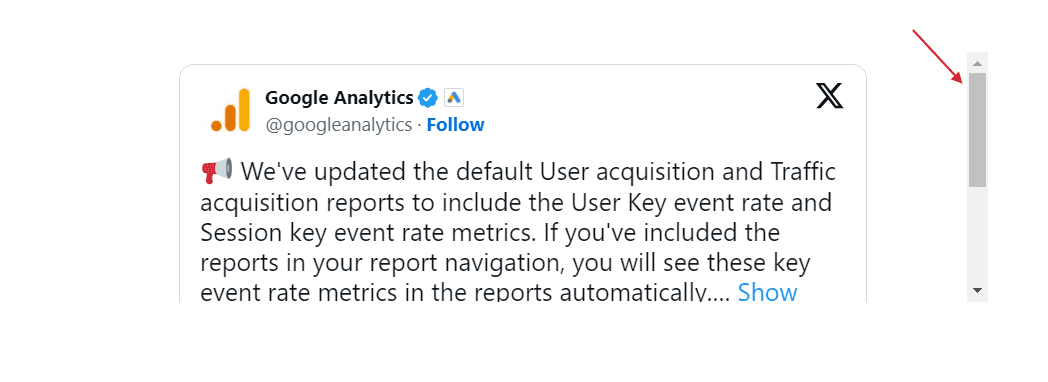
overflow: auto;
}

However, it will cause a scrollbar to appear, and users will have to scroll to view the tweet, which may not be best for user experience.

Tweet with scroll

If none of the suggested methods works, you could take a screenshot of the tweet and link to it.

Web-Based Fonts

Downloaded web fonts can cause what’s known as Flash of invisible text (FOIT).

A way to prevent that is to use preload fonts

and using font-display: swap; css property on @font-face at-rule.

@font-face {
   font-family: Inter;
   font-style: normal;
   font-weight: 200 900;
   font-display: swap;
   src: url('https://www.example.com/fonts/inter.woff2') format('woff2');
}

With these rules, you are loading web fonts as quickly as possible and telling the browser to use the system font until it loads the web fonts. As soon as the browser finishes loading the fonts, it swaps the system fonts with the loaded web fonts.

However, you may still have an effect called Flash of Unstyled Text (FOUT), which is impossible to avoid when using non-system fonts because it takes some time until web fonts load, and system fonts will be displayed during that time.

In the video below, you can see how the title font is changed by causing a shift.

The visibility of FOUT depends on the user’s connection speed if the recommended font loading mechanism is implemented.

If the user’s connection is sufficiently fast, the web fonts may load quickly enough and eliminate the noticeable FOUT effect.

Therefore, using system fonts whenever possible is a great approach, but it may not always be possible due to brand style guidelines or specific design requirements.

CSS Or JavaScript Animations

When animating HTML elements’ height via CSS or JS, for example, it expands an element vertically and shrinks by pushing down content, causing a layout shift.

To prevent that, use CSS transforms by allocating space for the element being animated. You can see the difference between CSS animation, which causes a shift on the left, and the same animation, which uses CSS transformation.

CSS animation example causing CLS CSS animation example causing CLS

How Cumulative Layout Shift Is Calculated

This is a product of two metrics/events called “Impact Fraction” and “Distance Fraction.”

CLS = ( Impact Fraction)×( Distance Fraction)

Impact Fraction

Impact fraction measures how much space an unstable element takes up in the viewport.

A viewport is what you see on the mobile screen.

When an element downloads and then shifts, the total space that the element occupies, from the location that it occupied in the viewport when it’s first rendered to the final location when the page is rendered.

The example that Google uses is an element that occupies 50% of the viewport and then drops down by another 25%.

When added together, the 75% value is called the Impact Fraction, and it’s expressed as a score of 0.75.

Distance Fraction

The second measurement is called the Distance Fraction. The distance fraction is the amount of space the page element has moved from the original to the final position.

In the above example, the page element moved 25%.

So now the Cumulative Layout Score is calculated by multiplying the Impact Fraction by the Distance Fraction:

0.75 x 0.25 = 0.1875

The calculation involves some more math and other considerations. What’s important to take away from this is that the score is one way to measure an important user experience factor.

Here is an example video visually illustrating what impact and distance factors are:

Understand Cumulative Layout Shift

Understanding Cumulative Layout Shift is important, but it’s not necessary to know how to do the calculations yourself.

However, understanding what it means and how it works is key, as this has become part of the Core Web Vitals ranking factor.

More resources: 


Featured image credit: BestForBest/Shutterstock

What Are Breadcrumbs & Why Do They Matter For SEO? via @sejournal, @sejournal

Breadcrumbs are a navigational feature for your website, and they can greatly impact SEO and user experience.

Many websites still don’t implement breadcrumbs, which is a huge mistake. Not only do breadcrumbs impact SEO, but they are also pretty easy to implement.

Here’s what you need to know about breadcrumbs, how they impact SEO, and common mistakes to avoid.

What Are Breadcrumbs In SEO?

Breadcrumbs are automated internal links that allow users to track their location on a website and their distance from the homepage.

You’ll usually find them at the top of a website or just under the navigation bar.

Just like internal links, they help keep users on a website and help them find the information they are looking for. If they feel disoriented, they can use breadcrumbs links to go one level up and continue their journey on the website rather than clicking a browser’s back button.

Here’s an example of breadcrumbs from eBay’s website:

men's clothing on ebayScreenshot from eBay, June 2024

It shows exactly what categories I clicked on to land on the page I am viewing.

The breadcrumbs make it easy to backtrack to a previous page if I need to.

4 Common Types Of Breadcrumbs

Not all breadcrumbs are created equal!

There are four main types of breadcrumbs, each with their own purpose.

Before adding breadcrumbs to your site, determine which type will be the best fit for user experience.

1. Hierarchy-Based Breadcrumbs (a.k.a., Location-Based Breadcrumbs)

The most common type of breadcrumbs that tell users where they are in the site structure and how to get back to the homepage.

For example: Home > California > San Francisco

Used cars for sale on cars.comScreenshot from cars.com, June 2024

2. Attribute-Based Breadcrumbs

These breadcrumbs are commonly used on ecommerce sites to show what attributes the user has clicked.

For example: Home > Shoes > Hiking > Womens

Attribute based breadcrumbs Screenshot from eBay, June 2024

Please note how smartly eBay handles breadcrumbs for attributes when the trail is too long.

It shows the last three items following the home page and truncates previous ones under a three-dot menu; you can see all previous items in the breadcrumbs upon clicking.

3. Forward Or Look-Ahead Breadcrumbs

This type of breadcrumb not only shows the user’s current path within a website’s hierarchy but also provides a preview of the next steps they can take.

Here is an example from the Statista website, which illustrates how useful it can be by giving users a preview of other sections of the subsection.

Statista's look ahead breadcrumbs exampleScreenshot from Statista, June 2024

4. History-Based Breadcrumbs

This type of breadcrumb is rarely used and shows users what other pages on the site they have visited, similar to a browser history.

For example, if you were searching for SEO news and read three different articles, the breadcrumbs might look like this: Home > SEO article 1 > SEO article 2 > Current page.

But I recommend avoiding this because it may confuse users. Users may navigate to the same destination through different journeys, which means you will show a different breadcrumb structure each time, confusing users.

Additionally, you can’t markup with schema such as breadcrumbs and benefit from rich results because of its random nature.

3 Benefits of Using Breadcrumbs

This all sounds great, you’re thinking.

But what will breadcrumbs actually do?

If you’re unsure breadcrumbs are worth the hassle (spoiler, they totally are!), then you’ll want to read the section below.

1. Breadcrumbs Improve UX

Breadcrumbs make it easier for users to navigate a website and encourage them to browse other sections.

For example, if you want to learn more about Nestle, you head to its site and end up on the Nestle company history page.

nestle's breadcrumbsScreenshot from Nestle, June 2024

Using its breadcrumbs, you can easily navigate back to About Us, History, or even its homepage.

It’s a handy way to help users easily find what they are looking for – and hopefully draw them deeper into your website.

2. Keep People Onsite Longer

Bounce rate is not a ranking factor. But keeping users from bouncing can still help SEO as it helps users click and navigate through the website, an engagement signal that Google uses for ranking purposes.

Say, you are looking for a new pair of sneakers on Adidas’s website.

Addidas breadcrumpsScreenshot from Adidas, June 2024

Using Adidas’s breadcrumbs, you can easily navigate back to the boots category and look for a different pair.

This is great for Adidas because it will likely keep you from returning to Google and landing on another shoe website.

That’s the power of the humble breadcrumb!

A case study on Moz shows what happened when it added breadcrumbs to a site and made several other changes.

Sessions drastically increased in just a few months.

breadcrumbs seo site trafficScreenshot from Moz, June 2024

Granted, they also added meta descriptions and eliminated a few other UX issues, but breadcrumbs also played a part.

3. Breadcrumbs Improve Internal Linking

Breadcrumbs are not just a navigational utility; they play a crucial role in enhancing a website’s internal linking structure. Google uses breadcrumbs to determine the relationship between different pages which are deeper in the site structure.

By implementing breadcrumbs’s structured data markup, you can help search engines understand the site’s architecture.

Read: Site Structure & Internal Linking in SEO: Why It’s Important

4. Rich Snippets In SERPs

As discussed, breadcrumbs make site navigation easier, but they do a lot more so as Google displays rich snippets in the search results.

Screenshot from Google.comScreenshot from Google.com

But this doesn’t happen until you markup your breadcrumbs with structured data so Google can pick it up and surface it in search engine results pages (SERP).

Here is a JSON-LD structured data code example for a breadcrumb that matched the rich snippet from the screenshot:

[{
"@context": "https://schema.org",
  "@id": "https://www.example.com/#breadcrump", 
  "@type": "BreadcrumbList",
    "itemListElement": [
    {
       "@type": "ListItem",
       "position": 1,
       "item":   "@id": "https://www.example.com/",      
       "name": "Home"       
   },
   {
       "@type": "ListItem",
       "position": 2,
       "item": "https://www.example.com/real-estate/",
       "name": "Real estate"
  },
  {
       "@type": "ListItem",
       "position": 3,
       "item": "https://www.example.com/en/paris/",
       "name": "Paris"
  },
  {
      "@type": "ListItem",
      "position": 4,
      "item": "https://www.example.com/en/paris/apartment/",
      "name": "Apartment"
   },
  {
     "@type": "ListItem",
     "position": 5,
     "item": "https://www.example.com/en/paris/apartment/affordable",
     "name": "Affordable rentals Paris"      
    }
   ]
}]

Here is a breakdown of each attribute in the breadcrumb JSON-LD schema.

Attribute Description
@context This tells search engines where to find the definitions of the structured data
@type Defines the type of schema used, in this case, “BreadcrumbList”
itemListElement An array of list items representing a breadcrumb.
itemListElement[position] Indicates the position of the breadcrumb in the list, starting from 1.
itemListElement[item] The URL of the breadcrumb’s target page
itemListElement[name] The visible name of the breadcrumb as it appears to users.

Please note that you can’t game Google by having structured data on the website without having an actual breadcrumb visible to users.

If Google detects such manipulations, violating Google’s guidelines, you may get a manual penalty. However, that doesn’t cause a drop in rankings, but your website will not be eligible for any kind of rich snippets in search results.

So, the golden rule is that every schema markup you have on the website has to exist on the page and be visible to users.

4 Common Mistakes When Using Breadcrumbs For SEO

Implementing breadcrumbs is a straightforward way to improve a site’s SEO and provide better UX.

However, sometimes, implementing breadcrumbs could cause more harm than good.

Here are a few breadcrumb mistakes you’ll want to avoid.

1. Don’t Go Too Big or Too Small – Aim For Just Right

Breadcrumbs should be easy to see but unobtrusive.

A slightly smaller font is fine, but too small text will be hard to see and hard to click on mobile devices.

Position them at the top of the page, beneath the hero image, or just above the H1 title so they are easy to find.

2. Don’t Just Repeat Your Navigation Bar

If the breadcrumbs just duplicate what is already in your navbar, they might not serve any additional purpose.

There’s no need to add more coding (and take up room!) if it doesn’t help.

3. Don’t Ditch Your Navigation Bar In Favor Of Breadcrumbs

While you don’t want to repeat navigation, you also don’t want to rely entirely on breadcrumbs.

They serve as a supplement, not a replacement for other navigational features.

4. Use The Right Type Of Breadcrumbs

Location breadcrumbs are the most common type, but they might not be the best choice for your site.

Don’t use location breadcrumbs if your site doesn’t use a nested structure where most pages fit under a few categories.

In that case, history-based breadcrumbs might be more beneficial.

How To Implement Breadcrumbs In WordPress

Breadcrumbs are an incredibly useful navigation element for both users and search engines — and they are easy to add to your site.

Here are a few ways to add these useful features to your site.

Yoast breadcrumbsScreenshot from Yoast SEO, June 2024
  • Use Yoast SEO: If you already use Yoast, adding breadcrumbs will only take a few steps. Simply log in and follow these steps to implement breadcrumbs.
  • WordPress Plugins: If you use WordPress, there are several plugins that can add breadcrumbs in a few steps. I like Breadcrumb NavXT because it is easy to implement and generates locational breadcrumbs that can be customized as needed.
  • WooCommerce Breadcrumb Plugin: If you have an ecommerce site that uses Woocommerce, consider using their breadcrumb plugin, which allows you to restyle the built-in WooCommerce breadcrumbs.

Finally, your site builder or WordPress theme might have a built-in breadcrumb feature.

Shopify, Wix, or Squarespace sites have built-in features you can enable on their settings page.

Breadcrumbs Are An Easy-to-Grasp Way To Navigate Your Website

Think of breadcrumbs as the butter to your bread. The Kermit to your Miss Piggy. The animal sauce to your In N’ Out burger.

You get the point.

Breadcrumbs are a simple change that can help your site stand out on the search results page.

Though they won’t guarantee a significant boost to SERPs, they are helpful to users and search engines alike.

As an added bonus, breadcrumbs are easy to implement using a plugin like Yoast.

In just a few clicks, you could make your site easier to navigate and maybe rank higher in SERPs.

More resources:


Featured Image: BestForBest/Shutterstock