Organic Vs. Paid Search And Social Media: A Guide For Local Business Owners via @sejournal, @JRiddall

Local business owners consistently face a familiar digital marketing conundrum.

With a myriad of options available and seemingly growing daily, including the recent introductions of AI into the mix, how do you determine the best and most effective approach for your business?

To begin, most local businesses have two (or technically four) primary paths to consider: Organic and paid strategies for both search and social media.

In this guide, we’ll explore the nuances of each option, weigh the pros and cons, and offer actionable insights to help make informed decisions on where to invest your valuable time, resources, and funds.

Understanding Organic And Paid Strategies

Let’s start by defining the fundamental difference between organic and paid strategies:

  • Organic: Focuses on building long-term brand awareness, trust, and authority via the creation and distribution of consistent, high-quality, optimized content and community engagement. This strategy requires the careful cultivation of a loyal customer base, which naturally takes time and effort.
  • Paid: Involves investing in often online advertising campaigns to achieve immediate visibility and reach a broader audience quickly. A paid strategy offers a shortcut but requires balancing cost vs. lead volume and quality.

And so, with both search and social media, local business owners are faced with organic and paid options, each of which has unique time, resource, and cost considerations in terms of initial implementation and results.

Below, we’ll review the best practices required for success, along with the pros and cons of each strategy.

While not listed as a best practice, assume all strategies require ongoing monitoring and optimization based on desired outcomes and results – a must for all digital marketing efforts.

Search Engine Marketing (SEM)

The term search engine marketing is sometimes equated with paid strategies only, but it should really be considered the umbrella for both organic search (local SEO) and paid search (PPC).

Organic Local SEO

The goal of local SEO is for your business to appear prominently in the Local Map Pack and/or organic search results when your customers are looking for services or products you offer.

Google Local Map Pack and Organic Results screenshotScreenshot from search for [barrie plumbers], Google, May 2024

Local SEO is much like traditional SEO but requires a few additional steps to be taken.

Best Practices

  • Keyword research: Identify keywords tied to your business’s services/products, location and competition, which potential customers will be searching for.
  • Website/on-page optimization: Build a mobile-friendly, responsive, locally-focused website. Optimize your website’s title tags, headings, internal/external links, meta descriptions, and content with relevant keywords.
  • Local listings: Create a comprehensive and active Google Business Profile (GBP) and ensure your NAP (Name, Address, Phone Number) is consistent across online directories.
  • Reviews: Positive, authentic customer reviews, particularly those on GBP, which have been responded to quickly, will go a long way towards establishing local dominance.
  • Backlinks: Identify relevant local and industry-specific sources to obtain inbound links from to boost authority.
  • Content marketing: Consistently produce and share high-quality, locally relevant content that answers your audience’s questions and provides consistent value.

Pros

  • Cost-effective: While SEO requires time and effort to conduct research, identify opportunities or gaps, implement best practice solutions, and monitor results, the overall cost (depending on several factors) tends to be lower than paid search.
  • Credibility: Organic search results are generally perceived as more trustworthy by users.
  • Long-term benefits: A well-optimized web presence (e.g., an optimized website, Google Business Profile, high-quality shared content, and relevant backlinks) can consistently attract organic traffic over time.

Cons

  • Delayed results: As noted, establishing authority and trust is a long-term game. It can take several months to see significant results from SEO activities.
  • Algorithmic and AI dependency: Search engine algorithms and now LLMs feeding AI-generated results (see Google AI overviews) are constantly evolving, which necessitates ongoing optimization.
  • Competitive: Establishing authority and visibility for popular keywords can be quite challenging, especially for local businesses in highly populated areas.

Some, including yours truly, will argue that establishing local authority and visibility is very much tied to running a solid business, delivering exceptional services, and engaging with your community.

Well-run local businesses are effectively engaged in local SEO and have an opportunity to be found by their customers via organic search.

Local Paid Search (PPC)

Paid search involves creating and distributing engaging text, image, or video (YouTube) ads on Google or Bing’s search or display networks linked to conversion-focused standalone or website landing pages.

At a local level, service businesses have the option of purchasing Google Local Services Ads, which require qualified businesses to go through a verification process.
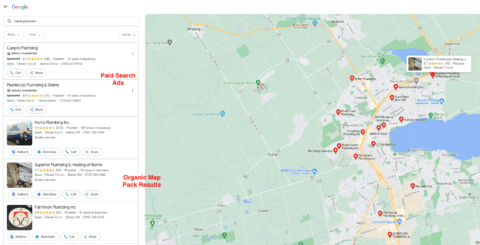
Google Local Map PackScreenshot from search for [barrie plumbers], Google Maps, May 2024

Best Practices

  • Keyword bidding: Choose relevant keywords with relatively high search volumes and low competition.
  • Ad copy optimization: Write compelling ad copy highlighting your unique value proposition.
  • Landing page optimization: Create landing pages aligned with your ad copy and encourage conversions.
  • Remarketing: Target users who previously visited your website with ads tailored to products or services they may have interacted with.

Pros

  • Immediate visibility: Ads tied to keyword searches appear near the top of search results immediately.
  • Targeted reach: Ads can be precisely targeted to specific demographics and locations.
  • Easily measured results: Track impressions, clicks, and conversions to analyze campaign performance and adjust ad spend accordingly.

Cons

  • Costly: PPC advertising can be expensive, especially for competitive keywords, such as “plumbers in New York.” A Wordstream study found the average CTR across all industries in Google Ads is 1.91% on the search network and 0.35% on the display network. This means you need to pay for a lot of impressions in order to get clicks.
  • Quantity over quality: Lots of PPC traffic does not typically translate into lots of conversions.
  • Click fraud: Many clicks may come from bots or your competitions, thereby wasting a portion of your allotted budget.
  • Temporary results: Once you stop paying, your ads and traffic will disappear.

Social Media Marketing (SMM)

I don’t need to tell you about social media’s pervasiveness in our modern world. However, many local businesses still aren’t quite sure how or if it fits into their marketing mix.

The answers to these questions often lie in the nature of your business and the behaviors and preferences of your audience. In other words, do you have or can you create content that lends itself to social media channels like Facebook, Instagram, or TikTok?

Do you expect your audience will go to these channels or other social channels in search of this content?

Most local businesses certainly can benefit from a social media strategy as it’s effectively an extension of their community online.

Organic Social Media

Organic social refers to posting text, images, audio, video, and/or links to any social media channel.

In order for this content to be seen and engaged with, it’s necessary to build and nurture a social following (which is sometimes a missed step in the social media marketing process.)
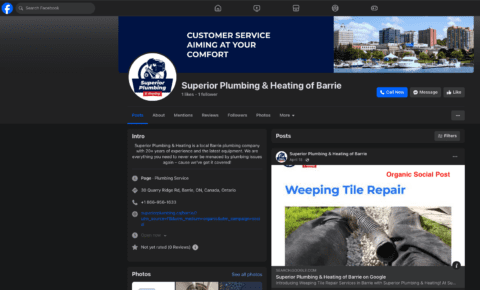
Facebook page screenshotScreenshot of Superior Plumbing & Heating of Barrie Facebook page/post, May 2024

Best Practices

  • Visually engaging content: Use high-quality images and videos to capture your consumer’s attention.
  • Content calendar: Plan and schedule your social media posts in advance.
  • Hashtags: Use relevant, keyword-rich hashtags to reach a wider audience who use them as a social search mechanism.
  • Calls to action: Encourage viewers to click, visit or buy!
  • Audience building: Follow, like, and share content from other relevant local businesses and content creators.
  • Community engagement: Respond to all comments, messages, and mentions promptly.

Pros

  • Cost-effective: Most social media platforms are generally free to use.
  • Brand building: Foster customer relationships, build community, and showcase your brand’s personality.
  • Customer engagement: Interact directly with customers, answer questions, and address their concerns.

Cons

  • Limited reach: Even if you establish a following, which takes time, organic reach on social media is declining, making it harder to reach a significant audience.
  • Social network dependency: Social media algorithms control the prioritization and display of content in user feeds, also limiting potential reach.
  • Time-consuming: Creating engaging content and managing multiple social media accounts takes time.

Paid Social Media

Paid social, much like paid search, offers the options of text, image, or video ads distributed via the social network where you expect your audience to be engaged.

Facebook ad screenshotScreenshot of mobile Meta/Facebook Ad, May 2024

Best Practices

  • Audience targeting: Create and target custom hyper-local audiences based on demographics, interests, and behaviors tracked and stored by the social networks.
  • Ad format: Choose the right ad format for your campaign objectives (e.g. image ads, video ads, carousel ads).
  • Ad copy: Write compelling ad copy highlighting your unique value proposition.
  • Landing page optimization: Create landing pages aligned with your ad copy and encourage conversions.

Pros

  • Targeted reach: The ability to reach very specific demographics, interests, and behaviors
  • Increased visibility: The opportunity to boost your popular organic posts to reach a larger audience.
  • Measurable results: Track clicks, impressions, and conversions to analyze and optimize campaign performance.

Cons

  • Costly: As with PPC, paid social media advertising can be expensive, especially when competing in competitive industries or highly populated locations.
  • Ad fatigue: Consumers may become annoyed or simply blind to excessive/intrusive advertising.
  • Algorithm dependency: Social media algorithms also prioritize paid content, making it difficult for posts to gain traction.

Local Challenges

Regardless of the tactic chosen, there are some challenges local business owners need to acknowledge and address.

  • Limited budgets: Local businesses often have smaller marketing budgets, making it difficult to compete with larger companies on paid search and social media platforms. Be strategic in your spending and focus on targeting the right audience with the right message.
  • Local competition: Local businesses face stiff competition from other businesses in their area, both online and off. Standing out from the crowd can be challenging, especially in saturated markets. Look for opportunities to differentiate your business through unique value propositions, exceptional customer service, and targeted campaigns.
  • Limited resources: Many local businesses have limited staff and digital marketing expertise. You may simply not have the time or knowledge to manage complex paid search and social media campaigns effectively. Consider outsourcing to a digital marketing agency or consultant, but do your homework and ask to see what results they have produced for other local businesses.
  • Keeping up with trends: It can be overwhelming for local businesses to keep up with the latest trends and best practices. Partnering with a digital marketing expert can help them stay ahead of the curve.

Choosing The Right Strategy For Your Local Business

The most effective approach for your local business will depend on your specific goals, budget, and target audience. In assessing your options, consider the following factors:

  • Goals: What are you trying to achieve? Increase brand awareness, drive traffic to your website, generate leads, or increase sales?
  • Budget: How much are you willing to spend on marketing? Monthly, quarterly, or seasonally?
  • Target audience: Who are the people you are trying to reach? What keywords do you think they are using when searching for your services or products? What social media platforms do they use?
  • Timeframe: How quickly do you need to see results for a particular service or product offering?

A well-rounded digital marketing strategy often involves a combination of organic and paid tactics – not organic vs. paid, but organic and paid.

A common and effective approach is to identify organic keywords or topics on which your business has some level of authority and/or visibility, from which you are already receiving traffic and upon which you can build.

Perhaps this represents a unique product or service you offer or one that your customers particularly favor. This is where you focus your local SEO attention.

Concurrently, you may also identify high-value, low-competition keywords you are willing to pay for either via PPC or paid social ads, provided they deliver quick, meaningful results.

Another strategy involves using paid search or social as a test to understand which keywords or topics resonate with your audience and on which channels before you devote time and effort to building and rolling out a full organic content strategy.

If you do have the budget for a comprehensive approach, consider integrating both paid search and paid social into your digital marketing strategy.

Use paid search to capture high-intent users actively searching for your products or services and paid social to build brand awareness, nurture leads, and reach a wider audience.

A Few Words On Analytics

One reason digital marketing has gained so much prominence, besides increasing consumer demand for immediate gratification, is the power of data underlying all online interactions.

While sometimes overwhelming, all digital marketing can be tracked, analyzed, and optimized based on what’s working and what isn’t.

Website interactions and inbound channel traffic can be tracked via Google Analytics, PPC ads offer detailed impressions, click and conversion tracking via Google Adwords and Bing Ads, and virtually all paid social platforms include detailed tracking options.

For small businesses, this may be as simple as understanding how many leads or paying customers are being generated from online sources.

However, the more detailed information you can get about the channels responsible for delivering actual customers to your online or physical door, the better.

The Holy Grail is to be able to understand the return you are getting on your investment in each channel, but at least getting close will help validate your strategic decisions.

The Decisions Are Yours

Ultimately, which strategies fit your specific needs will be up to you and will certainly require some fine-tuning over time.

By understanding the true costs, pros, and cons of each approach, you can develop a balanced approach which will deliver tangible results.

More resources: 


Featured Image: chainarong06/Shutterstock

How fish-safe hydropower technology could keep more renewables on the grid

Hydropower is the world’s leading source of renewable electricity, generating more power in 2022 than all other renewables combined. But while hydropower is helping clean up our electrical grid, it’s not always a positive force for fish.

Dams that create reservoirs on rivers can change habitats. And for some species, especially those that migrate long distances, hydropower facilities can create dangerous or insurmountable barriers. In some parts of the world, including the US, Canada, and Europe, governments have put protections in place to protect ecosystems from hydropower’s potential harms.

New environmental regulations can leave older facilities facing costly renovations or force them to shutter entirely. That’s a big problem, because pulling hydropower plants off the grid eliminates a flexible, low-emissions power source that can contribute to progress in fighting climate change. New technologies, including fish-safe turbines, could help utilities and regulators come closer to striking a balance between the health of river ecosystems and global climate goals. 

That’s where companies like Natel Energy come in. The company started with two big goals: high performance and fish survival, says Gia Schneider, Natel’s cofounder and chief commercial officer.

The company is making new designs for the turbines that generate electricity in hydropower plants as water rushes through equipment and moves their blades. Conventional turbine blades can move as fast as 30 meters per second, or about 60 to 70 miles per hour, Schneider says. When straight, thin edges are moving that quickly and striking fish, “it’s fairly obvious why that’s not a good outcome,” she says.

Natel’s turbine design focuses on preventing fast-moving equipment from making fatal contact with fish. The blades have a thicker leading edge that pushes water out in front of it, creating a stagnation zone, or “basically an airbag for fish,” Schneider says. The blades are also curved, so even if fish are struck, they don’t take a direct hit.

The company has tested its turbines with a range of species, including American eels, alewife, and rainbow trout. In the case of one recent study with American eels, scientists found that over 99% of eels survived after 48 hours of passing through Natel’s equipment. In comparison, one 2010 study found that just 40% of tagged European eels were able to pass through the turbines of a hydropower plant, though survival depended a lot on the size of both the eel and equipment in question.  

Changing turbine designs won’t help fish survive all power plants: at some of the biggest plants with the tallest dams, rapid changes in water pressure can kill fish. But Schneider says that the company’s technology could be slotted into up to half of the existing US hydropower fleet to make plants more fish-safe.

Hydropower is one of the world’s older renewable energy sources. By 2030, more than 20% of the global fleet’s generating units will be more than 55 years old, according to the International Energy Agency. The average age of a hydropower plant in the US today is roughly 65 years.  

In the US, privately held hydropower plants are licensed by an agency called the Federal Energy Regulatory Commission for a term of up to 50 years. Roughly 17 gigawatts’ worth of hydropower facilities (enough to power 13 million homes) are up for relicensing by 2035, according to the National Hydropower Association.

Since many of those facilities were started up, there have been significant changes to environmental requirements, and some plants may face high costs and difficult engineering work as they try to adhere to new rules and stay in operation. Adding screens to basically filter fish out of the intake for hydropower plants is one potential solution in some cases, but both installation and maintenance of such a system can add significant cost. In these facilities, Natel’s technology represents an alternative, Schneider says.

Natel has installed several projects in Maine, Oregon, and Austria. They all involve relatively small turbines, but the company is on the way to undertaking bigger projects and recently won a bid process with a manufacturing partner to supply a larger turbine that’s three meters in diameter to an existing plant, Schnieder says. The company is also licensing its fish-safe turbine designs to existing manufacturers.

Whether utilities move to adopt fish-safe design could depend on how it affects efficiency, or the amount of energy that can be captured by a given water flow. Natel’s turbine designs will, in some cases, be slightly less efficient than today’s conventional ones, Schneider says, though the difference is marginal, and they likely still represent an improvement over older designs. 

While there’s sometimes a trade-off between fish-safe design and efficiency, that’s not the case with all novel turbines in all cases. A 2019 study from the US Army Corps of Engineers found that one new design improved fish safety while also producing more power.

Slotting new turbines into hydropower plants won’t solve all the environmental challenges associated with the technology, though. For example, the new equipment would only be relevant for downstream migration, like when eels move from freshwater rivers out into the ocean to reproduce. Other solutions would still be needed to allow a path for upstream migration.

Ideally, the best solution for many plants would likely be natural bypasses or ramps, which allow free passage of many species in both directions, says Ana T. Silva, a senior research scientist at the Norwegian Institute for Nature Research. However, because of space requirements, these can’t always be installed or used. 

Natel CTO Abe Schneider holds a large trout used in fish passage testing at the Monroe Hydro Plant in Madras, Oregon.
NATEL

People have been trying to improve fish passage for a long time, says Michael Milstein, a senior public affairs officer at NOAA Fisheries, part of the US National Oceanic and Atmospheric Administration. The solutions in place today include fish ladders, where fish swim or hop up into successively taller pools to pass dams. Other dams are too tall for that, and fish are captured and loaded onto trucks to go around them.

The challenge, Milstein says, is that “every river is different, and every dam is different.” Solutions need to be adapted to each individual situation, he adds; fish-safe turbines would be most important when there’s no bypass and going through a facility is the only option fish have.

The issue of protecting ecosystems and providing safe passage for fish has sparked fierce debates over existing hydropower projects across the western US and around the world. 

Even with the current state-of-the-art technology, “it’s not always possible to provide sufficient passage,” Milstein says. Several dams are currently being removed from the Klamath River in Oregon and Northern California because of the effects on local ecosystems.  The dams drastically changed the river, wiping out habitat for local salmon, steelhead, and lamprey and creating ideal conditions for parasites to decimate fish populations. 

But while hydropower facilities can have negative environmental impacts, climate change can also be extremely harmful to wildlife, Natel’s Schneider points out. If too many hydropower plants are shut down, it could leave a gap that keeps more fossil fuels on the grid, hampering efforts to address climate change.  

Reducing hydropower plants’ impact on local environments could help ensure that more of them can stay online, generating renewable electricity that plays an important role in our electrical grid. “Fish-safe turbines won’t solve everything—there are many, many problems in our rivers,” Schneider says. “But we need to start tackling all of them, so this is one tool.”

The Download: fish-safe hydropower, and fixing space debris

This is today’s edition of The Download, our weekday newsletter that provides a daily dose of what’s going on in the world of technology.

How fish-safe hydropower technology could keep more renewables on the grid

Hydropower is the world’s leading source of renewable electricity, generating more power in 2022 than all other renewables combined. But while hydropower is helping clean up electrical grids, it’s not always great for fish. Dams can change their habitats. And for migratory species, hydropower facilities can create dangerous or insurmountable barriers. 

That’s why, in some parts of the world, governments have put protections in place to protect ecosystems from hydropower’s potential harms. These can sometimes force older facilities to close, and that’s a big problem: pulling hydropower plants off the grid eliminates a flexible, low-emissions power source that can contribute to progress in fighting climate change.

But there’s some good news: new technologies, including fish-safe turbines, could help utilities and regulators come closer to striking a balance between the health of river ecosystems and global climate goals. Read the full story

—Casey Crownhart

What it’s like to be a space debris engineer 

Although significant attention has been devoted to launching spacecraft into space, the idea of what to do with their remains has been largely ignored until recently. Satellites have simply been left in orbit at the ends of their lives, creating debris that must be monitored and, if possible, maneuvered around to avoid a collision.

But there are people working on cleaning Earth’s orbit up. Meet Stijn Lemmens. He’s a senior space debris mitigation analyst at the European Space Agency. Lemmens works on counteracting space pollution by collaborating with spacecraft designers and the wider industry to create missions less likely to clutter the orbital environment. Read all about him and his work

—Elna Schütz

This story is from the latest issue of MIT Technology Review. Subscribe to read the whole thing, if you don’t already!

The must-reads

I’ve combed the internet to find you today’s most fun/important/scary/fascinating stories about technology.

1 Apple is planning to bring AI features to the Vision Pro
It must be hoping that this could boost sales of the device, which have been disappointing so far. (Bloomberg $)
The Vision Pro is now on sale outside the US. (Ars Technica)

2 Detroit is changing how its police use facial recognition
It’s making the rules much stricter, after bad matches led to three wrongful arrests. (NYT $)
The movement to limit face recognition tech might finally get a win. (MIT Technology Review)

3 What is AI search good for?
Given the errors, it’s best to think of its answers as a starting point rather than the final word. (Vox)
Here’s why chatbots make things up—and why it’s such a deep-rooted problem. (MIT Technology Review)
OpenAI has built an AI tool that it says can spot hallucinations. (IEEE Spectrum)

4 Amazon plans to spend over $100 billion on data centers over the next decade
And yep, you guessed it: it’s all about meeting demand for AI tools. (WSJ $)
Amazon is copying Shein and Temu’s playbook, prioritizing cheapness over speed. (The Atlantic $)

5 Brazil’s Pantanal fire season is already breaking records
And it isn’t even meant to have started yet. (ABC)
+ How NASA is using AI and drones to tackle wildfires. (CNET)
Meet the scientists trying to understand the world’s worst wildfires. (MIT Technology Review)

6 Combined covid-flu vaccines are coming
Moderna has just completed successful phase III trials for the drug. (Nature)
The next generation of mRNA vaccines is on its way. (MIT Technology Review)

7 These parents are campaigning for a phone-free childhood
They’re trying to do the right thing—but the odds are painfully stacked against them. (The Guardian)
New York City plans to ban phones from schools. (NPR)

8 There’s a big problem with electric vehicles: buggy software
When you add more complexity, you add more points of failure. (The Verge)
How did China come to dominate the world of electric cars? (MIT Technology Review)

9 Hot AI Jesus is all over Facebook
And he appears to be astonishingly popular engagement bait. (The Atlantic $)

10 Tennis hopes to use video games to win over new fans
After all, it’s worked well as a strategy for soccer. (FT $)

Quote of the day

“I think we’re starting to increasingly lose touch with what an unedited face looks like.”

—Dr Kerry McInerney, a research associate at the University of Cambridge, tells CNN that AI is turbo-charging already-unrealistic beauty standards online.

The big story

A brief, weird history of brainwashing

puppet person silhouette on a red network with an eye, an angry dog, the hammer and sickle, and a gun

SHIRLEY CHONG

April 2024

On a spring day in 1959, war correspondent Edward Hunter testified before a US Senate subcommittee investigating “the effect of Red China Communes on the United States.”

Hunter discussed a new concept to the American public: a supposedly scientific system for changing people’s minds, even making them love things they once hated.

Much of it was baseless, but Hunter’s sensational tales still became an important part of the disinformation and pseudoscience that fueled a “mind-control race” during the Cold War. US officials prepared themselves for a psychic war with the Soviet Union and China by spending millions of dollars on research into manipulating the human brain.

But while the science never exactly panned out, residual beliefs fostered by this bizarre conflict continue to play a role in ideological and scientific debates to this day. Read the full story.

—Annalee Newitz

We can still have nice things

A place for comfort, fun and distraction to brighten up your day. (Got any ideas? Drop me a line or tweet ’em at me.)

+ Get me on one of these beaches, stat.
+ Seems like sound parenting advice to me. 
+ When it’s hot, there are few things nicer than a cold noodle salad.
+ Boston’s trains are getting googly eyes.

People can move this bionic leg just by thinking about it

When someone loses part of a leg, a prosthetic can make it easier to get around. But most prosthetics are static, cumbersome, and hard to move. A new neural interface connects a bionic limb to nerve endings in the thigh, allowing the limb to be controlled by the brain. The new device, which is described today in Nature Medicine, could help people with lower-leg amputations feel as if their prosthesis is part of them.

“When you ask a patient ‘What is your body?’ They don’t include the prosthesis,” says MIT biophysicist Hugh Herr, one of the lead authors on the study. The work is personal for him: he lost both his lower legs in a climbing accident when he was 17. He says linking the brain to the prosthesis can make it feel more like part of someone’s anatomy, which can have a positive emotional impact. 

Getting the neural interface hooked up to a prosthetic takes two steps. First, patients undergo surgery. Following a lower leg amputation, portions of shin and calf muscle still remain. The operation connects shin muscle, which contracts to make the ankle flex upward, to calf muscle, which counteracts this movement. The prosthetic can also be fitted at this point. Reattaching the remnants of these muscles can enable the prosthetic to move more dynamically. It can also reduce phantom limb pain, and patients are less likely to trip and fall. 

“The surgery stands on its own,” says Amy Pietrafitta, a para-athlete who received it in 2018. “I feel like I have my leg back.” But natural movements are still limited when the prosthetic isn’t connected to the nervous system. 

In step two, surface electrodes measure nerve activity from the brain to the calf and shin muscles, indicating an intention to move the lower leg. A small computer in the bionic leg decodes those nerve signals and moves the leg accordingly, allowing the patient to move the limb more naturally. 

“If you have intact biological limbs, you can walk up and down steps, for example, and not even think about it. It’s involuntary,” says Herr. “That’s the case with our patients, but their limb is made of titanium and silicone.” 

The authors compared the mobility of seven patients using a neural interface with that of patients who had not received the surgery. Patients using the neural interface could walk 41% faster and climb sloped surfaces and steps. They could also dodge obstacles more nimbly and had better balance. And they described feeling that the prosthetic was truly a part of their body rather than just a tool that they used to get around. 

“It’s a very forward-thinking approach,” says Hamid Charkhkar, a biomedical engineer at Case Western Reserve University, who was not involved in the study. “Our limbs are not like shoes. They’re not worn over our bodies. They are integrally attached to our bodies via bones, muscles, and nerves.” 

There are limitations. The surgery can be done during amputation or several years later, but it won’t work equally well for every patient. If it’s done later, for example, some people’s upper thigh muscles could have atrophied too severely for them to receive the full benefits. 

The surgery connecting the shin and calf muscles has become the standard of care at Brigham and Women’s Hospital in Boston. But the surface electrodes that give patients full neural control of their limbs are a few years away from being clinically implemented. Plus, the neural interfaces have only been used in laboratory settings, and it will be important to know how they hold up in the real world. 

Herr and his team at MIT hope to provide users with even greater control over their prosthetic limbs. In the future, their efforts will likely involve replacing the surface electrodes with magnetic spheres, which can more accurately track muscle dynamics. 

“The goal that we have is to really reconstruct bodies, to rebuild bodies,” says Herr. And to fully achieve that ambition, he says, “neural integration and embodiment is our long-term goal.” 

Tracking AI Overviews Queries, Links

Optimizing for organic search now requires knowing which queries trigger AI Overviews and the URLs those summaries reference. Neither metric — queries or citations — is easily identified because Overviews appear only for logged-in users, and Search Console does not include separate Overviews reporting.

We have only third-party sources. Here are three tools for AI Overviews tracking and analysis.

ZipTie

ZipTie is a standalone AI Overviews tracker that monitors users’ important queries weekly and sends alerts when opportunities are missed.

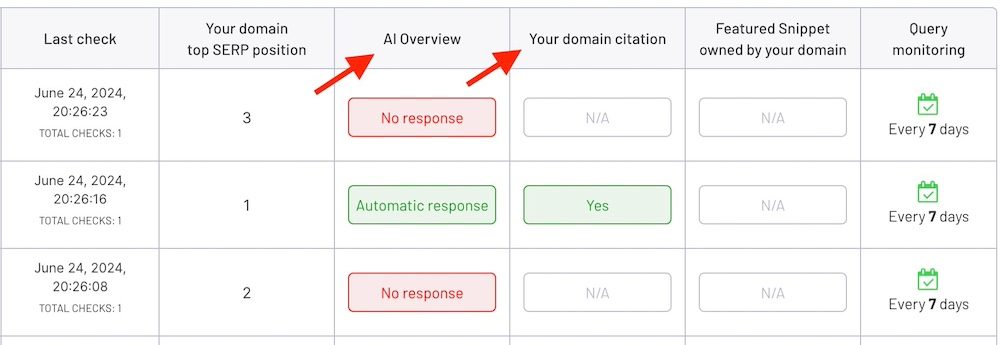
To start, import your queries — I used Search Console‘s list. ZipTie will then generate a report containing:

  • Your page rankings for each query.
  • Whether your page is featured.
  • Whether your query triggered an AI Overview and if your page was referenced.
Screenshot of the ZipTie report.

ZipTie reports users’ queries that produce Overviews and whether users’ domains were cited. Click image to enlarge.

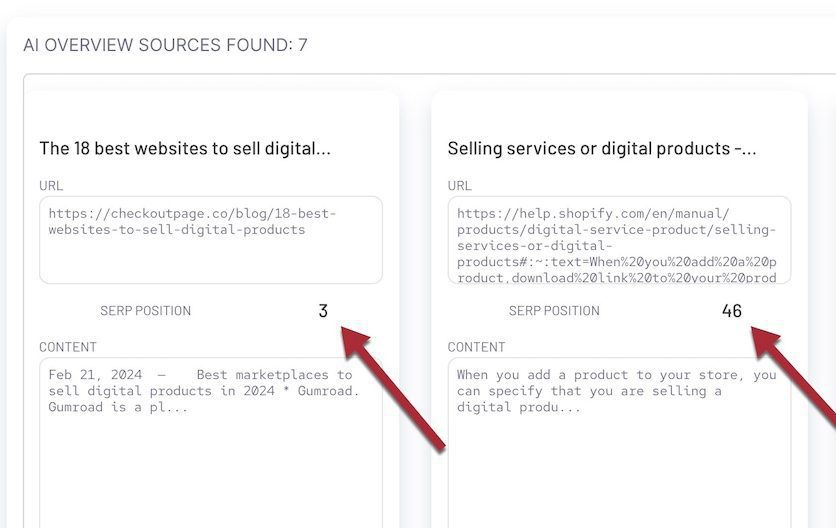
Click any query in the report to see which URLs are included in the AI Overview and where they rank organically. This is helpful insight I could not find elsewhere.

Screeshot of the report showing the SERP position.

Click any query to see which URLs are included in the AI Overview and where they rank organically. Click image to enlarge.

Early tests confirm that Search Console’s Performance tab includes clicks from AI Overviews. And ZipTie’s “Standard” tier at $89 per month integrates with Search Console. Thus combining ZipTie with Search Console will show clicks to your links in Overviews.

Otherwise, ZipTie.dev offers a free 14-day trial with a credit card. Paid plans start at $29 per month for “Basic.”

Semrush

Semrush includes AI Overviews in its Position Tracking section. To see whether your site was included in Overviews, create a project in Position Tracking with your website URL and list of keywords.

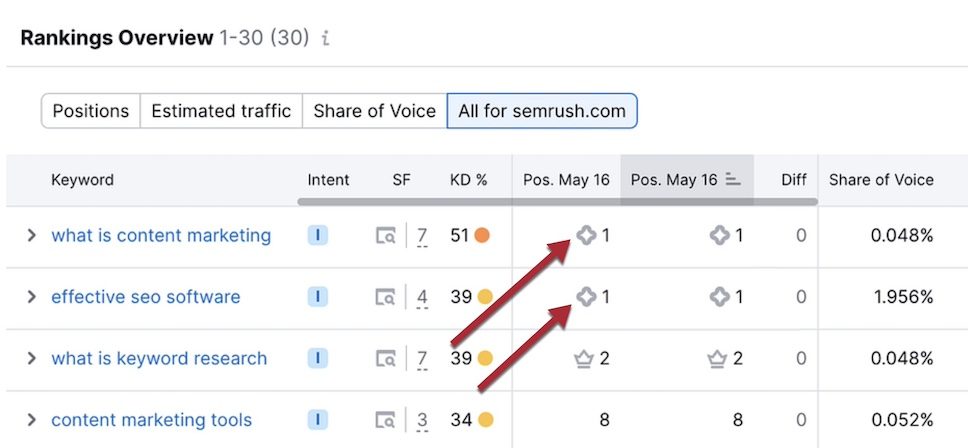
Once the project is running, go to the Overview tab and use the “SERP features” filter to limit your report to queries that trigger AI Overviews. If your site is referenced in any AI Overview, an icon will appear next to your organic position.

Screenshot of Semrush's report showing existence of AI Overviews

If any AI Overview references your site, an icon will appear next to the organic position. Click image to enlarge.

In my testing, ZipTie.dev provided more accurate results as I couldn’t replicate some of Semrush’s reported AI Overviews.

Semrush offers no free trial. Paid plans start at $129 per month to track 500 keywords.

Google AI Overview Impact Analysis

Google AI Overview Impact Analysis is a free Chrome extension that analyzes Overviews for multiple queries.

Install the extension and then type your comma-separated queries into its sidebar. The extension will run each search, identify AI Overviews, and report which Overview includes your URL.

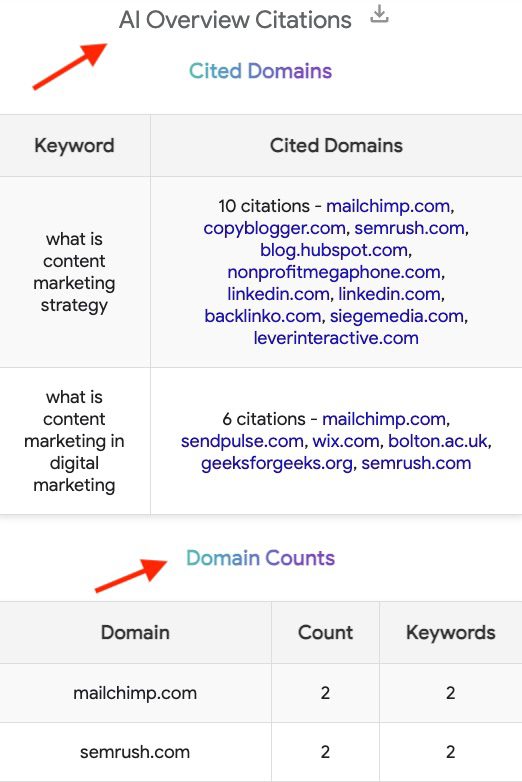
The “AI Overview Citations” report includes all the URLs referenced in each Overview and how often each domain appeared for all queries. This feature was handy for identifying domains referenced from multiple Overviews for my important queries. The report is downloadable as an Excel file.

Screenshot of AI Overview Citations report.

The “AI Overview Citations” report includes all the URLs referenced in each Overview and how often each domain appeared for all queries. Click image to enlarge.

10 New Ecommerce Books for Summer 2024

School’s out, summer’s here, and with it, new books for ecommerce pros. Here’s our quarterly rundown — a selection of recent and forthcoming titles that present fresh takes on economics and finance, AI, startups, marketing strategy, Amazon, and more.

Ecommerce Books: Summer 2024

Your AI Survival Guide: Scraped Knees, Bruised Elbows, and Lessons Learned from Real-World AI Deployments by Sol Rashidi

AI Survival Guide

Rashidi, who helped launch AI implementations, including IBM’s Watson, demystifies AI deployment with hype-free, real-world examples and practical advice.

The Everything War: Amazon’s Ruthless Quest to Own the World and Remake Corporate Power by Dana Mattioli

The Everything War

This detailed exposé of Amazon’s no-holds-barred competitive tactics by an award-winning Wall Street Journal reporter is hailed by reviewers as “blistering,” “riveting,” “explosive,” and “masterful.”

Cash Is King: Maintain Liquidity, Build Capital, and Prepare Your Business for Every Opportunity by Peter W. Kingma

Cash Is King

Kingma, a corporate consultant, argues that cash position is just as important as sales, costs, and service, providing case studies and tips on ensuring your company always has cash when needed.

Reignition: Transforming Stuck Startups into Breakout Winners by Dave Hersh

Reignition

Entrepreneur and investor Hersh aims to help entrepreneurs get unstuck — or better yet, avoid getting stuck in the first place.

Think Like a Brand. Act Like a Startup. Drive Growth and Innovation by Balancing Stability and Agility by Lauren Perkins

Think Like a Brand

Drawing on her experience working with companies of all sizes, Lauren Perkins shows entrepreneurs how to combine the best aspects of established brands and innovative startups for growth and stability.

Plastic Capitalism: Banks, Credit Cards, and the End of Financial Control by Sean H. Vanatta

Plastic Capitalism

Ecommerce as we know it wouldn’t be possible without credit cards. Vanatta’s accessible financial history explains how plastic came to dominate the consumer economy.

Simple Marketing for Smart People by Billy Broas, Tiago Forte, and Ali Abdaal

Simple Marketing for Smart People

With so much advice on marketing strategies and tactics, it can be easy to get lost in the weeds. This book aims to cut through the clutter to focus on the basics for maximum effectiveness.

The 10-Second Customer Journey: The CXO’s Playbook for Growing and Retaining Customers in a Digital World by Todd Unger

10-Second Customer Journey

A 30-year digital marketing veteran offers a step-by-step guide to becoming your own “Chief Friction-Reduction Officer.”

Shocks, Crises, and False Alarms: How to Assess True Macroeconomic Risk by Philipp Carlsson-Szlezak and Paul Swartz

Shocks, Crises, False Alarms

How might global events — pandemics, wars, inflation, recession — affect your business? Two seasoned economists show how to get past frightening headlines to assess the potential risks.

Never Enough: From Barista to Billionaire by Andrew Wilkinson

Never Enough

What’s it like to make a lot of money? Wilkinson shares his journey from starting a business in high school to becoming a billionaire — and beyond — with some surprising lessons learned.

The New Rules of Marketing & PR: How to Use Content Marketing,
AI, Social Media, Podcasting, Video, and Newsjacking to Reach Buyers Directly, 9th Edition
by David Meerman Scott

New Rules of Marketing & PR

And finally, a new version of an international bestseller. The updated ninth edition of this perennially popular classic is set to publish in August.

WordPress Takes Bite Out Of Plugin Attacks via @sejournal, @martinibuster

WordPress announced over the weekend that they were pausing plugin updates and initiating a force reset on plugin author passwords in order to prevent additional website compromises due to the ongoing Supply Chain Attack on WordPress plugins.

Supply Chain Attack

Hackers have been attacking plugins directly at the source using password credentials exposed in previous data breaches (unrelated to WordPress itself). The hackers are looking for compromised credentials used by plugin authors who use the same passwords across multiple websites (including passwords exposed in a previous data breach).

WordPress Takes Action To Block Attacks

Some plugins have been compromised by the WordPress community has rallied to clamp down on further plugin compromises by instituting a forced password reset and encouraging plugin authors to use 2 factor authentication.

WordPress also temporarily blocked all new plugin updates at the source unless they received team approval in order to make sure that a plugin is not being updated with malicious backdoors. By Monday WordPress updated their post to confirm that plugin releases are no longer paused.

The WordPress announcement on the forced password reset:

“We have begun to force reset passwords for all plugin authors, as well as other users whose information was found by security researchers in data breaches. This will affect some users’ ability to interact with WordPress.org or perform commits until their password is reset.

You will receive an email from the Plugin Directory when it is time for you to reset your password. There is no need to take action before you’re notified.”

A discussion in the comments section between a WordPress community member and the author of the announcement revealed that WordPress did not directly contact plugin authors who were identified as using “recycled” passwords because there was evidence that the list of users found in the data breach list whose credentials were in fact safe (false positives). WordPress also discovered that some accounts that were assumed to be safe were in fact compromised (false negatives). That is what led to to the current action of forcing password resets.

Francisco Torres of WordPress answered:

“You’re right that specifically reaching out to those individuals mentioning that their data has been found in data breaches will make them even more sensitive, but unfortunately as I’ve already mentioned that might be inaccurate for some users and there will be others that are missing. What we’ve done since the beginning of this issue is to individually notify those users that we’re certain have been compromised.”

Read the official WordPress announcement:

Password Reset Required for Plugin Authors

Featured Image by Shutterstock/Aleutie

Google Discusses Core Topicality Systems via @sejournal, @martinibuster

Google’s latest Search Off the Record shared a wealth of insights on how Google Search actually works. Google’s John Mueller and Lizzi Sassman spoke with Elizabeth Tucker, Director, Product Management at Google, who shared insights into the many systems that work together to rank web pages, including a mention of a topicality system.

Google And Topicality

The word “topicality” means how something is relevant in the present moment. But when used in search the word “topicality” is about matching the topic of a search query with the content on a web page. Machine learning models play a strong role in helping Google understand what users mean.

An example that Elizabeth Tucker mentions is BERT (Bidirectional Encoder Representations from Transformers) which is a language model that helps Google understand a word within the context of the words that come before and after it (it’s more, that’s a thumbnail explanation).

Elizabeth explains the importance of matching topically relevant content to a search query within the context of user satisfaction.

Googler Lizzi Sassman asked about user satisfaction and Tucker mentioned that there are many dimensions to search, with many systems, using as an example the importance of the concept of topical relevance.

Lizzi asked (at about the 4:20 minute mark):

“In terms of the satisfaction bit that you mentioned, are there more granular ways that we’re looking at? What does it mean to be satisfied when you come away from a search?”

Elizabeth answered:

“Absolutely, Lizzi. Inside Search Quality, we think about so many important dimensions of search. We have so many systems. Obviously we want to show content that’s topically relevant to your search. In the early days of Google Search, that was sometimes a challenge.

Our systems have gotten much better, but that is still sometimes, for especially really difficult searches, we can struggle with. People search in so many ways: Everything from, of course, typing in keywords, to speaking to Google and using normal everyday language. I’ve seen amazing searches. “Hey Google, who is that person who, years ago, did this thing, and I don’t remember what it was called.” You know, these long queries that are very vague. And it’s amazing now that we have systems that can even answer some of those.”

Takeaway:

An important takeaway from that exchange is that there are many systems working together, with topicality being just one of them. Many in the search marketing community tend to focus on the importance of one thing like Authority or Helpfulness but in reality there are many “dimensions” to search and it’s counterproductive to reduce the factors that go into search to one, two or three concepts.

Biases In Search

Google’s John Mueller asked Elizabeth about biases in search and if that’s something that Google thinks about and she answered that there are many kinds of biases that Google watches out for and tries to catch. Tucker explains the different kinds of search results that may be topically relevant (such as evergreen and fresh) and then explains how it’s a balance that Google focuses on getting correctly.

John asked (at the 05:24 minute mark):

“When you look at the data, I assume biases come up. Is that a topic that we think about as well?”

Elizabeth answered:

“Absolutely. There are all sorts of biases that we worry about when you’re looking for information. Are we disproportionately showing certain types of sites, are we showing more, I don’t know, encyclopedias and evergreen results or are we showing more fresh results with up-to-date information, are we showing results from large institutional sites, are we showing results from small blogs, are we showing results from social media platforms where we have everyday voices?

We want to make sure we have an appropriate mix that we can surface the best of the web in any shape or size, modest goals.”

Core Topicality Systems (And Many Others)

Elizabeth next reiterated that she works with many kinds of systems in search. This is something to keep in mind because the search community only knows about a few systems when in fact there are many, many more systems.

That means it’s important to not focus on just one, two or three systems when trying to debug a ranking problem but instead to keep an open mind that it might be something else entirely, not just helpfulness or EEAT or some other reasons.

John Mueller asked whether Google Search responds by demoting a site when users complain about certain search results.

She speaks about multiple things, including that most of the systems she works on don’t have anything to do with demoting sites. I want to underline how she mentions that she works with many systems and many signals (not just the handful of signals that the search marketing community tends to focus on).

One of those systems she mentions is the core topicality systems. What does that mean? She explains that it’s about matching the topic of the search query. She says “core topicality systems” so I that probably means multiple systems and algorithms.

John asked (at the 11:20 minute mark):

“When people speak up loudly, is the initial step to do some kind of a demotion where you say “Well, this was clearly a bad site that we showed, therefore we should show less of it”? Or how do you balance the positive side of things that maybe we should show more of versus the content we should show less of?”

Elizabeth answered:

“Yeah, that’s a great question. So I work on many different systems. It’s a fun part of my job in Search Quality. We have many signals, many systems, that all need to work together to produce a great search result page.

Some of the systems are by their nature demotative, and webspam would be a great example of this. If we have a problem with, say, malicious download sites, that’s something we would probably want to fix by trying to find out which sites are behaving badly and try to make sure users don’t encounter those sites.

Most of the systems I work with, though, actually are trying to find the good. An example of this: I’ve worked with some of our core topicality systems, so systems that try to match the topic of the query.

This is not so hard if you have a keyword query, but language is difficult overall. We’ve had wonderful breakthroughs in natural language understanding in recent years with ML
models, and so we want to leverage a lot of this technology to really make sure we understand people’s searches so that we can find content that matches that. This is a surprisingly hard problem.

And one of the interesting things we found in working on, what we might call, topicality, kind of a nerdy word, is that the better we’re able to do this, the more interesting and difficult searches people will do.”

How Google Is Focused On Topics In Search

Elizabeth returns to discussing Topicality, this time referring to it as the “topicality space” and how much effort Google has expended on getting this right. Of particular importance she highlights how Google  used to be very focused on keywords, with the clear implication that they’re not as focused on it any more, explaining the importance of topicality.

She discusses it at the 13:16 minute mark:

“So Google used to be very keyword focused. If you just put together some words with prepositions, we were likely to go wrong. Prepositions are very difficult or used to be for our systems. I mean, looking back at this, this is laughable, right?

But, in the old days, people would type in one, two, three keywords. When I started at Google, if a search had more than four words, we considered it long. I mean, nowadays I routinely see long searches that can be 10-20 words or more. When we have those longer searches, understanding what words are important becomes challenging.

For example, this was now years and years ago, maybe close to ten years ago, but we used to be challenged by searches that were questions. A classic example is “how tall is Barack Obama?” Because we wanted pages that would provide the answer, not just match the words how tall, right?

And, in fact, when our featured snippets first came about, it was motivated by this kind of problem. How can we match the answer, not just keyword match on the words in the question? Over the years, we’ve done a lot of work in, what we might call, the topicality space. This is a space that we continue to work in even now.”

The Importance Of Topics And Topicality

There are a lot to understand in Tucker’s answer, including that it may be helpful that, when thinking about Google’s search ranking algorithms, to also consider the core topicality systems which help Google understand search query topics and match those to web page content because it underlines the importance of thinking in terms of topics instead of focusing hard on ranking for keywords.

A common mistake I see is in what people who are struggling with ranking is they are strongly focused on keywords.  I’ve been encouraging an alternate approach for the past many years that stresses the importance of thinking in terms of Topics. That’s a multidimensional way to think of SEO. Optimizing for keywords is one dimensional. Optimizing for a topic is multidimensional and aligns with how Google Search is ranking web pages in that topicality is an important part of ranking.

Listen to the Search Off The Record podcast starting at about the 4:20 minute mark and then fast forward to the 11:20 minute mark:

Featured Image by Shutterstock/dekazigzag

Top 10 Digital Marketing Trends For 2024 via @sejournal, @gregjarboe

It’s been a year of considerable disruptions in digital marketing so far.

Right now, the industry is dealing with the integration of generative AI and the impact this is going to have on user behaviour and how people search. Alongside the relentless updates that Google keeps throwing at us.

SEO is changing and the industry is trying to adapt whilst accepting the uncertainty.

But, it’s not all catastrophic, there is a lot of opportunity ahead for those that can evolve to embrace the new.

To help marketers and brands thrive amidst uncertainty, I’ve outlined trends to focus on, guided by strategic insights and Yogi Berra’s timeless wisdom,

“Predictions are hard, especially about the future.” – Yogi Berra

Digital marketers can no doubt relate to Yogi’s sentiment, acknowledging the challenge of what lies ahead.

These, then, are the top 10 digital marketing trends for 2024:

1. Strategy: “If You Don’t Know Where You Are Going, You Might Wind Up Someplace Else.”

Why is “strategy” this year’s top trend instead of the latest technology?

Well, as Yogi once observed, “If you don’t know where you are going, you might wind up someplace else.”

According to Spencer Stuart’s 2024 CMO Tenure Study, the average tenure of chief marketing officers (CMOs) at Fortune 500 companies in 2023 was 4.2 years.

The study also found the average tenure of CMOs at B2B companies was 4.5 years. It was 4.0 years for CMOs at B2C companies. And it was just 3.1 years at the consumer-heavy top 100 advertisers.

So, developing a digital marketing strategy that will generate above-average results within a couple of years is the key to keeping your job as the CMO of a big brand.

And if you don’t master the art and science of creating a digital marketing strategy that generates business outcomes, then you won’t land one of the CMO jobs that turn over each year.

In other words, learning to use the latest technology is necessary, but it won’t get digital marketing leaders and executives where they want to go.

2. Generative AI: “Predictions Are Hard, Especially About The Future.”

Yogi also said, “Predictions are hard, especially about the future.” So, it’s tempting to ask generative AI tools to predict their own future.

OpenAI’s ChatGPT 3.5 says:

“AI and machine learning have been transforming digital marketing for years, but 2024 is poised to see these technologies become even more integral. From chatbots and predictive analytics to personalized content and ad targeting, AI will enhance customer experiences and drive efficiency. Brands leveraging AI can expect to see improved ROI and deeper customer insights.”

Google’s Gemini (formerly Bard) says:

“It ain’t science fiction anymore. Artificial intelligence (AI) is taking center stage, from crafting personalized chatbots that convert like crazy to optimizing campaigns with laser precision. Don’t fear the robot takeover, embrace it!”

And Anthropic’s Claude 3 says:

“Artificial intelligence writing assistants like Claude have been making waves, and in 2024 we’ll see these tools become ubiquitous in content marketing. They’ll help scale content creation while maintaining quality.”

But AI can’t see the big picture for your organization. It can’t empathize with people. And it can’t be creative like you. So, AI needs you in the driver’s seat to make it work effectively.

3. SEO: “It Ain’t Over Till It’s Over.”

Some pundits think SEO is dead. But as Yogi declared, “It ain’t over till it’s over.”

That’s because SEO pros have the remarkable ability to adapt to constant change or new information. Often, this means adjusting to the latest Google algorithm updates. But this also includes rethinking strategies based on the recent Google API “leak.”

Now, Rand Fishkin and Mike King were the first to report on the leaked documents. Although Google has officially acknowledged that these internal documents are authentic, it has also cautioned against jumping to conclusions based on the leaked files alone.

What should savvy SEO pros do?

Well, I’ve known Fishkin for more than 20 years. And he has the experience, expertise, authoritativeness, and trustworthiness (E-E-A-T) you’ve heard about.

So, I’m going to follow Fishkin’s recommendations, including:

  • Hire writers with established reputational authority that Google already associates with quality content.
  • Supplement link-building with public relations to increase branded search demand. (I’ll say more on this below.)
  • “Think about SEO as being more geographically specific than you think it is even for web search results.”
  • Move beyond parsing Google’s public statements and embrace experimentation and testing to uncover what produces results.

4. Link Building: “Always Go To Other People’s Funerals; Otherwise, They Won’t Go To Yours.”

I spotted this trend a long time ago, and I spoke about it at SES London 2009 in a session titled, “Beyond Linkbait: Getting Authoritative Mentions Online.”

Back then, I said link bait tactics can be effective “if you focus on the underlying quality as well as ingenuity needed to get other websites to link to you.”

I also provided a couple of case studies that showed British SEO professionals how to “approach journalists, bloggers, and other authoritative sources to enhance your company’s online reputation, whether or not you get links.”

But getting authoritative mentions without links didn’t translate. People on the other side of the pond thought I was saying something unintentionally funny like, “Always go to other people’s funerals; otherwise, they won’t go to yours.”

Hopefully, Fishkin’s recommendation will enable a lot more SEO pros to finally understand the underlying wisdom of supplementing link building with public relations.

As he clearly explained at MozCon, “If you get a whole bunch of links in one day and nothing else, guess what? You manipulated the link graph. If you’re really a big brand, people should be talking about you.”

5. Paid Media: “It’s Déjà Vu All Over Again.”

Everyone knows that Google, Meta, and other paid media are adding AI to their advertising platforms faster than the speed of sound. So, this might be mistaken as background noise.

But I’ve spotted the signal in the noise. Today’s frenzy to provide AI solutions is remarkably like the frenzy to provide programmatic solutions a decade ago. As Yogi said, “It’s déjà vu all over again.”

This means that digital marketers – and their agencies – can quickly refresh their “programmatic” workflow and turn it into “AI” best practices.

For example, Google touted a five-step programmatic workflow five years ago.

It consisted of:

  • Organize audience insights.
  • Design compelling creative.
  • Execute with integrated technology.
  • Reach audiences across screens.
  • Measure the impact.

Why is today’s process of buying and selling digital media in an automated fashion so similar? Because AI is just fulfilling the early promise of programmatic to engage with consumers in the moments that matter most.

But there’s one significant difference between then and now.

As you’ll read below, it’s the improved ability to integrate your advertising platforms with your analytics platform to measure the impact of campaigns on brand awareness and lead generation.

6. Analytics: “You Can Observe A Lot By Watching.”

Performance marketers integrated their advertising platforms with their analytics platform more than a decade ago to measure the impact of their campaigns on “conversions.”

But brand marketers rarely focused on their analytics data because “brand awareness” was something they measured when consumers initially saw their display ads or watched their video ads.

A funny thing happened after Google Analytics 4 rolled out last summer. A “Business objectives” collection replaced the “Life cycle” collection of reports and one business objective you can now track is “Raise brand awareness.”

For example, brand marketers can now use traffic acquisition, demographic details, user acquisition, as well as which pages and screens users visit to measure brand awareness in places that are less vulnerable to ad fraud.

Another business objective you can now track is “Generate leads.”

So, digital marketers can measure any user action that’s valuable to their organization, including:

  • Scrolling to 90% or more of their blog post.
  • Downloading a whitepaper.
  • Subscribing to their newsletter.
  • Playing at least 50% of a product video.
  • Completing a tutorial.
  • Submitting a registration form.

And as Yogi noted, “You can observe a lot by watching.”

7. Content Marketing: “When You Come To A Fork In The Road, Take It.”

In the summer of 2020, the Content Marketing Institute and MarketingProfs fielded their annual survey and found that “Content marketers are resilient. Most have met the challenges of the pandemic head-on.”

In response to the pandemic, B2B and B2C marketers:

  • Increased time spent talking with customers.
  • Revisited their customer/buyer personas.
  • Re-examined the customer journey.
  • Changed their targeting/messaging strategy.
  • Changed their distribution strategy.
  • Adjusted their editorial calendar.
  • Put more resources toward social media/online communities.
  • Changed their website.
  • Changed their products/services.
  • Adjusted their key performance indicators (KPIs).
  • Changed their content marketing metrics (e.g., set up new analytics/dashboards).

In other words, many content marketers totally overhauled their process for creating a content marketing plan from stem to stern.

For some, 2020 was the year of quickly adapting their content marketing strategy. For others, it was the year to finally develop one.

According to BrightEdge, content marketers are now “preparing for a Searchquake,” a tectonic shift in the content marketing landscape triggered by Google’s Search Generative Experiences (SGE).

But content marketers now know exactly what to do. As Yogi directed, “When you come to a fork in the road, take it.”

8. Video Creation: “If You Can’t Imitate Him, Don’t Copy Him.”

I teach an online class at the New Media Academy in Dubai on “Influencer Marketing and AI.” This may seem like an odd combination of topics, but they’re related to another class I teach on “Engaging Audiences through Content.”

I tell my students that creating great content is hard. That’s why marketers start using influencers or AI to create video content that their audience will find valuable and engaging. Then, they learn that there’s more to learn.

For example, AI can create realistic and imaginative scenes from text instructions. But AI can’t be creative like humans. So, the heart of every great video is still innovative, surprising, human-led creativity.

I show them “OpenAI Sora’s first short film – ‘Air Head,’ created by shy kids,” a Toronto-based production company.

Then, I ask them to apply what they have learned by using Synthesia, Runway, or invideo AI to generate a short video for their capstone project.

Invariably, they report that AI video generators can create realistic and imaginative scenes from text instructions but aren’t creative like shy kids.

Or, as Yogi put it, “If you can’t imitate him, don’t copy him.”

9. Influencer Marketing: “Nobody Goes There Anymore. It’s Too Crowded.”

The Influencer Marketing Hub says, “Most marketers believe that finding and selecting the best, most relevant influencers to be the most difficult part of influencer marketing.”

That’s ironic because HypeAuditor offers an influencer discovery platform that enables marketers to search through a database of 137.5 million influencers on Instagram, YouTube, TikTok, X (formerly Twitter), and Twitch.

It also enables marketers to apply filters to discover the perfect partners for their brand.

This apparent contradiction reminds me of Yogi’s comment, “Nobody goes there anymore. It’s too crowded.”

But it also indicates that most marketers are looking at influencer identification through the wrong end of the telescope. What should they do instead?

Well, I show the students in my “Influencer Marketing and AI” class how to use SparkToro to get a free report on the audience that searches for “Dubai.”

Infographic showcasing digital marketing trends for 2024 with monthly searches and demographics for Dubai. Image from SparkToro, June 2024

SparkToro estimates that 446,000 to 654,000 people search for “Dubai” monthly. And it uncovers the websites they visit, the keywords they search for, and their gender demographics.

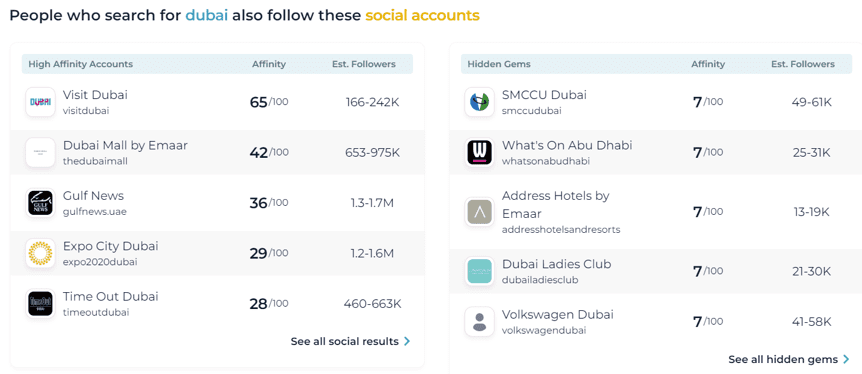
Screenshot of a list showing accounts related to Dubai, their affinity scoresImage from SparkToro, June 2024

SparkToro also identifies the sources of influence for this audience, including high-affinity accounts and hidden gems, so marketers can invest in the right ones.

10. Social Media: “The Future Ain’t What It Used To Be.”

I’m a big believer in “the rule of three.”

So, I wasn’t startled when I received an email from Jennifer Radke inviting me to attend “an exciting webinar focused on a high-level look into using ChatGPT for social media!”

But I was shocked when Katie Delahaye Paine shared a link to new research by Asana’s Work Innovation Lab and Meltwater, which found that “only 28% of marketing professionals have received training on how to use AI tools effectively.”

I was also horrified when I read a column by Mark Ritson in MarketingWeek that argued, “AI’s strength is automating high-volume, short-term marketing activity, which means social media could become a cesspool of synthetic content.”

Hey, I was having lunch with Chris Shipley in 2004 when she coined the term “social media.” So, I remember when social media still had a promising future.

But, as Yogi once declared, “The future ain’t what it used to be.”

So, social media marketing has three options:

  • They can get upskilled to use AI tools more effectively.
  • They can get reskilled to identify the right influencers.
  • They can update their resumes and look for new jobs.

Picking Digital Marketing Trends Is Like Playing Moneyball

Some skeptics may question this counter-intuitive lineup of the top 10 digital marketing trends for 2024. Some of my selections seem to throw out conventional wisdom.

I recently watched the movie Moneyball (2011) for a second time. I was reminded that the Oakland Athletics baseball team’s general manager, Billy Beane (Brad Pitt), and assistant general manager, Peter Brand (Jonah Hill), used sabermetrics to analyze players.

This produced an epiphany: Picking digital marketing trends is like playing Moneyball. If you want to win against competitors with bigger budgets, then you need to find strategic insights, critical data, tactical advice, and digital marketing trends that conventional wisdom has overlooked.

And where did I come up with the whimsical idea of matching each trend with one of Yogi’s memorable quotes? Was it inspiration or hallucination?

I recently watched the documentary It Ain’t Over (2022) for the first time. It’s about New York Yankee Hall of Fame catcher Yogi Berra. And it supported Yogi’s claim, “I really didn’t say everything I said.”

But sportswriters kept attributing these Yogi-isms to the catcher because these “distilled bits of wisdom … like good country songs … get to the truth in a hurry,” as Allan Barra, the author of a book on Yogi, has explained.

And that strategic insight produced this year’s update – by a human – as opposed to last year’s top 10 digital marketing trends by ChatGPT.

More resources:


Featured Image: SuPatMaN/Shutterstock

5 Content Marketing Ideas for August 2024

Content marketers seeking article or video ideas in August 2024 can commemorate the National Basketball Association and Alfred Hitchcock or recognize parents, celebrants, and challenge seekers.

Content marketing is the act of creating, publishing, and promoting content to attract, engage, and retain customers. It works because articles, videos, or podcasts are a low-risk way for shoppers to engage with a business and, in turn, create a sense of reciprocity that leads them to purchase.

The only trouble is that marketers require a steady stream of topics. Fortunately, what follows are five content marketing ideas your company can use in August 2024.

NBA Turns 75

Photo of an NBA game in a huge arena.

The NBA is celebrating its 75th anniversary in August 2024.

The National Basketball Association turns 75 on August 3, 2024, creating an opportunity for content marketers to connect one of America’s most popular sports to their brands and products.

Invented in 1891 at Springfield College in Massachusetts, basketball quickly gained popularity, so much so that by 1946 two rival leagues had emerged: the National Basketball League and the Basketball Association of America.

After a few teams — including the forerunner to the Lakers — left the NBL for the BAA in 1948, merger talks began. The result was the NBA, launched in August 1949 by combining the 17 teams from the two leagues.

Content marketers at ecommerce shops, physical-store chains, and direct-to-consumer brands could write about the history of the NBA, basketball as a sport, or “hoops” culture.

For example, the DTC brand TruHeight makes nutritional gummies and capsules, protein shakes, sleep aids, and other products aimed at healthy growth and development in teens and children. The brand could extend its mission by publishing a series of articles about basketball’s fitness benefits.

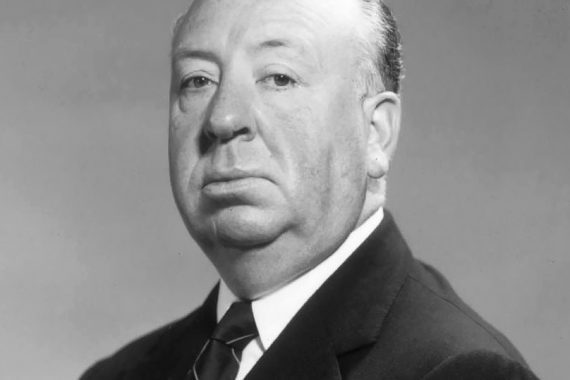
Happy Birthday, Alfred Hitchcock

Photo of Alfred Hitchcock

Master director Alfred Hitchcock was born in August 1899.

Born on August 13, 1899, in London, England, Alfred Hitchcock would become one of the film industry’s most celebrated directors. The “Master of Suspense” was best known for the “Rear Window” (1954), “Vertigo” (1958), and “Psycho” (1960).

Celebrating Hitchcock’s birthday via content marketing could help stores with products related to the film or entertainment industry. But other online merchants might benefit, too.

An apparel brand could focus on fashion in Hitchcock’s movies. A home decor shop could address their set designs, and a pet supply company could release a modern critique of “The Birds” (1963).

Parent-focused Back-to-school

Photo of a middle-aged female in front of a school bus.

How about a back-to-school sale for parents?

The back-to-school shopping season is among the retail industry’s high holidays. Parents buy everything from pencils and pants to computers and cars for their kindergarten to college-aged students.

Unfortunately for merchants, most of those purchases will come at discounted prices. According to the National Retail Federation, roughly 68% of back-to-school shoppers in 2024 will purchase on-sale items.

An alternative approach could be to target “back-to-school” content at parents. Here are some example article titles.

  • Sporting goods store: “Fitness Routines for Parents with School-aged Kids”
  • Shop selling organizers: “25 Decluttering Tips while the Kids Are in School”
  • Kitchen gadget shop: “Meal Prep Hacks for Busy Parents”

Labor Day Planning Guides

Williams-Sonoma uses recipes to promote Labor Day.

Content marketing is especially effective when it is useful or helpful. A business builds connections with shoppers when it helps them learn a skill or overcome a problem.

Labor Day falls on Monday — September 2 in 2024. Many consumers will enjoy the long weekend by camping, taking a road trip, or hosting a party.

Marketers can offer helpful content that improves, simplifies, or organizes those experiences — while connecting with products available for purchase.

For example, Williams-Sonoma published a recipe set called “A Labor Day Cookout to Remember.” The recipes describe a three-course meal with bruschetta, grilled chicken, and blueberry-lavender cheesecake for dessert.

Most of the individual recipes recommend William-Sonoma products, such as a food thermometer for grilling and a set of stackable bowls.

Issue a Challenge

Photo of a gym-like setting with someone walking on a treadmill

Take a play from the fitness industry’s book and issue a challenge in August.

In 2019, entrepreneur and podcaster Andy Frisella challenged his audience to participate in a “transformative mental toughness program” called the “Hard 75 Challenge.”

Over 75 days, participants obey a set of rules without exceptions or compromises. This includes a daily regimen of two 45-minute workouts, a strict diet, drinking a gallon of water, and reading at least 10 pages of a motivational book.

In August 2024, content marketers can borrow Frisella’s idea and challenge customers on topics related to businesses’ products or services. Here are some example challenges.

  • Sustainable living for retailers selling recycled products or eco-friendly items.
  • Backyard makeover for shops focused on plants, gardening supplies, power tools, and outdoor furniture.
  • Healthy cooking for stores offering kitchen equipment or food box subscriptions.

The challenges could be contests, too, with participants generating social media posts for additional exposure.