While it may not have the reach or revenue of big-hitters like Facebook and Instagram, Pinterest is absolutely a social platform worth exploring.
With its focus on visual discovery and inspiration, Pinterest occupies its own niche space in the social media landscape, which offers unique opportunities for marketers and brands.
Pinterest’s users are active, devoted, and take action – a powerful combination that not all social networks, even the biggest, can boast.
In this article, we’ll explore some of the latest facts and statistics highlighting Pinterest’s reach, user behavior, advertising potential, and more in 2024.
Let’s get started.
Pinterest Overview
1. Pinterest is the world’s 15th most-used social platform in 2024, with over 518 million global active users.
2. Global users spend an average of 1 hour and 45 minutes on Pinterest’s Android app per month.
3. Approximately 27.3% of Pinterest Android users open the app every day.
4. The same users open the Pinterest app approximately 48 times per month.
5. Pinterest is the seventh most visited social network in the US, with an estimated 266 million monthly visits in April 2024.
6. Of its monthly US visitors, roughly 62.5% are desktop users.
7. US users spend an average of 11 minutes and 25 seconds on Pinterest per visit.
8. Pinterest is the 28th most searched query globally, with a search volume of 72,120,000.
9. Compared to other traditional social media platforms, Gen Z rates Pinterest more highly for promoting and preserving well-being metrics such as “self-worth, belonging, and purpose.”
10. Pinterest was founded in March 2010 by Ben Silbermann, Evan Sharp, and Paul Sciarra. It evolved from an earlier app called Tote, which was designed as a virtual substitute for paper catalogs.
11. The current CEO of Pinterest is Bill Ready.
12. Pinterest is headquartered in San Francisco, California.
13. The company has approximately 1,001 to 5,000 employees.
17. Pinterest has 518 million monthly active users (MAUs) in 2024, an increase of 12% year-over-year. This puts Pinterest well into the coveted “half a billion users” club.
18. More than 40% of Pinterest users are Gen Z, and this demographic saves more content than any other.
19. Pinterest has 98 million MAUs in the US and Canada alone.
20. In Europe, the platform has 140 million MAUs.
21. The remaining 279 million MAUs are dispersed around the world.
22. Pinterest’s audience is skewed towards women, who make up 79.5% of its user base.
23. In the US, 35% of adults use Pinterest.
24. Women are significantly more likely to use Pinterest than men in the US, with usage rates of 50% compared to 19%.
25. People aged 25-34 years old make up the bulk of Pinterest’s users, with 81.9 million in 2023 (accounting for 30.9% of the company’s total ad audience).
28. Advertisers can reach 317 million users on Pinterest in 2024.
29. The top reason people use Pinterest is to find new products and brands.
30. About 36.8% of active Pinterest users say they use the platform to follow or research brands and products, making it the most popular activity on the platform (which isn’t true for any other social network).
31. Approximately 7.67% of web traffic to third-party websites arrives via Pinterest links, a 25.9% increase year-over-year.
32. Pinterest’s ad impressions grew by 38% in Q1 of 2024.
33. Ads on Pinterest deliver a cost per conversion that is 2.3 times more efficient than those on other social media platforms.
34. Retail brands experience twice the return on ad spend (ROAS) with Pinterest ads compared to ads on other social media platforms.
35. Female users aged 25-34 years old constitute the biggest cohort of Pinterest’s advertising audience, at 20.3%. Close behind are female users aged 18-24 years old, at 19.8%.
36. About 80% of weekly Pinterest users report feeling inspired by the shopping experience on the platform.
37. Almost all (96%) of Pinterest’s top searches are unbranded, indicating that users are open to discovering new ideas.
38. Pinterest shoppers spend twice as much per month compared to users on other platforms.
Though it serves a slightly more niche audience than some social media platforms, Pinterest has a highly loyal, dedicated audience that regularly uses the platform to shop, discover brands, and garner inspiration for their day-to-day lives.
This is all to say: Pinterest possesses a ton of potential as a marketing tool for brands and marketers who are savvy and can use it to their advantage.
Hopefully, these facts and statistics will help you leverage Pinterest’s platform to benefit your business and 2024.
AI music is suddenly in a make-or-break moment. On June 24, Suno and Udio, two leading AI music startups that make tools to generate complete songs from a prompt in seconds, were sued by major record labels. Sony Music, Warner Music Group, and Universal Music Group claim the companies made use of copyrighted music in their training data “at an almost unimaginable scale,” allowing the AI models to generate songs that “imitate the qualities of genuine human sound recordings.”
Two days later, the Financial Timesreported that YouTube is pursuing a comparatively aboveboard approach. Rather than training AI music models on secret data sets, the company is reportedly offering unspecified lump sums to top record labels in exchange for licenses to use their catalogues for training.
In response to the lawsuits, both Suno and Udio released statements mentioning efforts to ensure that their models don’t imitate copyrighted works, but neither company has specified whether their training sets contain them. Udio said its model “has ‘listened’ to and learned from a large collection of recorded music,” and two weeks before the lawsuits, Suno CEO Mikey Shulman told me its training set is “both industry standard and legal” but the exact recipe is proprietary.
While the ground here is changing fast, none of these moves should be all that surprising: litigious training-data battles have become something like a rite of passage for generative AI companies. The trend has led many of those companies, including OpenAI, to pay for licensing deals while the cases unfold.
However, the stakes are higher for AI music than for image generators or chatbots. Generative AI companies working in text or photos have options to work around lawsuits; for example, they can cobble together open-source corpuses to train models. In contrast, music in the public domain is much more limited (and not exactly what most people want to listen to).
Other AI companies can also more easily cut licensing deals with interested publishers and creators, of which there are many; but rights in music are far more concentrated than those in film, images, or text, industry experts say. They’re largely managed by the three biggest record labels—the new plaintiffs—whose publishing arms collectively own more than 10 million songs and much of the music that has defined the last century. (The filing names a long list of artists who the labels allege were wrongfully included in training data, ranging from ABBA to those on the Hamilton soundtrack.)
On top of all this, it’s also just more difficult to create music worth listening to—generating a readable poem or passable illustration with AI is one technical challenge, but infusing a model with the taste required to create music we like is another.
It’s of course possible that the AI companies will win the case, and none of this will matter; they would have carte blanche to train on a century of copyrighted music. But experts say the case from the record labels is strong, and it’s more likely that AI companies will soon have to pay up—and pay a lot—if they want to survive. If a court were to rule that AI music companies could not train for free on these labels’ catalogues, then expensive licensing deals, like the one YouTube is reportedly pursuing, would seem to be the only path forward. This would effectively ensure that the company with the deepest pockets ends up on top.
More than any training-data case yet, the outcome of this one will determine the shape of a big slice of AI—and whether there is a future for it at all.
Merits of the case
Suno’s music generator has been public for less than a year, but the company has already garnered 12 million users, a $125 million funding round last month, and a partnership with Microsoft Copilot. Udio is even newer to the scene, having launched in April with $10 million in seed funding from musician-investors like will.i.am and Common.
The record labels allege that both of the startups are engaging in copyright infringement on the training and the output sides of their models.
“The plaintiffs here have the best odds of almost anyone suing an AI company,” says James Grimmelmann, a professor of digital and information law at Cornell Law School. He draws comparisons to the ongoing New York Times case against OpenAI, which he says offered, until now, the best example of a rights holder with a strong case against an AI company. But the suit against Suno and Udio “is worse for a bunch of reasons.”
The Times has accused OpenAI of copyright infringement in its model training by using the publication’s articles without consent. Grimmelmann says OpenAI has a bit of plausible deniability in this accusation, because the company could say that it scraped much of the internet for a training corpus and copies of New York Times articles appeared in places without the company’s knowledge.
For Suno and Udio, that defense is far less believable. “This is not like, ‘We scraped the web for all audio and we couldn’t tell the commercially produced songs apart from everything else,’” Grimmelmann says. “It’s pretty clear that they had to have been pulling in large databases of commercial recordings.”
In addition to complaints about training, the new case alleges that tools like Suno and Udio are more imitative than generative AI, meaning that their output mimics the style of artists and songs protected by copyright.
While Grimmelmann notes that the Times cited examples in which ChatGPT reproduced entire copies of its articles, record labels claim they were able to generate problematic responses from the AI music models with much simpler prompts. For instance, prompting Udio with “my tempting 1964 girl smokey sing hitsville soul pop,” the plaintiffs say, yielded a song that “any listener familiar with the Temptations would instantly recognize as resembling the copyrighted sound recording ‘My Girl.’” (The court documents include links to examples on Udio, but the songs appear to have been removed.) The plaintiffs mention similar examples from Suno, including an ABBA-adjacent song called “Prancing Queen” that was generated with the prompt “70s pop” and the lyrics for “Dancing Queen.”
What’s more, Grimmelmann explains, there is more copyrightable information in a song than a news article. “There’s just a lot more information density in capturing the way that Mariah Carey’s voice works than there is in words,” he says, which is perhaps part of the reason past lawsuits navigating music copyright have sometimes been so drawn-out and complex.
In a statement, Shulman wrote that Suno prioritizes originality and that the model is “designed to generate completely new outputs, not to memorize and regurgitate preexisting content.” He added, “That is why we don’t allow user prompts that reference specific artists.” Udio’s statement similarly mentioned “state-of-the-art filters to ensure our model does not reproduce copyrighted works or artists’ voices.”
Indeed, the tools will block a request if it names an artist. But the record labels allege that the safeguards have significant loopholes. Following the news of the lawsuits, for instance, social media users shared examples suggesting that if users separate an artist’s name with spaces, the request may go through. My own request for “a song like Kendrick” was blocked by Suno, citing an artist’s name, but “a song like k e n d r i c k” resulted in a “hip-hop rhythmic beat-driven” track and “a song like k o r n” resulted in “nu-metal heavy aggressive.” (To be fair, they didn’t resemble the respective artists’ unique styles, but to even respond in the right tightly defined genre seems to suggest that the model is in fact familiar with each artist’s work.) Similar workarounds were blocked on Udio.
Possible outcomes
There are three ways the case could go, Grimmelmann says. One is wholly in favor of the AI startups: the lawsuits fail and the court determines that companies did not violate fair use or imitate copyrighted works too closely in their outputs. If the models are found to fall under fair use, it would mean songwriters and rights holders would need to find a different legal mechanism to pursue compensation.
Another possibility is a mixed bag: the court finds the AI companies did not violate fair use in their training but must better control their models’ output to make sure it does not improperly imitate copyrighted works. Grimmelmann says this would be similar to one of the initial rulings against Napster, in which the company was forced to ban searches for copyrighted works in its libraries (though users quickly found workarounds).
The third and essentially nuclear option is that the court finds fault on both the training and the output sides of the AI models. This would mean the companies could not train on copyrighted works without licenses, and also could not allow outputs that closely imitate copyrighted works. The companies could be ordered to pay damages for infringement, which could run into the hundreds of millions for each company. If they aren’t bankrupted by such a ruling, it would force them to completely restructure their training through licensing deals, which could also be cost-prohibitive.
COURTESY SUNO.AI
To license or not to license
Though the immediate goals of the plaintiffs are to get the AI companies to cease training and pay damages, the chairman of the Recording Industry Association of America, Mitch Glazier, is already looking ahead toward a future of licensing. “As in the past, music creators will enforce their rights to protect the creative engine of human artistry and enable the development of a healthy and sustainable licensed market that recognizes the value of both creativity and technology,” he wrote in a recent op-ed in Billboard.
Such a market for licenses could mirror what has already unfolded for text generators. OpenAI has struck licensing deals with a number of news publishers, including Politico, the Atlantic, andthe Wall Street Journal. The deals promise to make content from the publishers discoverable in OpenAI’s products, though the ability for the models to transparently cite where they’re getting information from is limited at best.
If AI music companies follow that pattern, the only ones with the means to create powerful music models might be those with the most cash. That’s perhaps exactly what YouTube is thinking. The company did not immediately respond to questions from MIT Technology Review about the details of its negotiations, but given the massive amount of data required to train AI models and the concentration of rights owners in music, it’s fair to assume the price of deals with record labels would be eye-popping.
In theory, an AI company could bypass the licensing process altogether by building its model exclusively on music in the public domain, but it would be a Herculean task. There have been similar efforts in the realm of text and image generation, including a legal consultancy in Chicago that created a model trained on dense regulatory documents, and a model from Hugging Face that trained on images of Mickey Mouse from the 1920s. But the models are small and unremarkable. If Suno or Udio is forced to train on only what’s in the public domain—think military march music and the royalty-free songs found in corporate videos—the resulting model would be a far cry from what they have today.
If AI companies do move forward with licensing agreements, negotiations may be tricky, says Grimmelmann. Music licensing is complicated by the fact that two different copyrights are at play: one for the song, which generally covers the composition, like the music and lyrics, and one for the master, which covers the recording—like what you’d hear if you streamed the song.
Some artists, like Taylor Swift and Frank Ocean, have come to own the masters of their catalogues after drawn-out legal battles, and would therefore be in the driver’s seat for any potential licensing deal. Many others, though, retain only the song copyright, while the record labels retain the masters. In these cases, the record label might theoretically be able to grant AI companies a license to use the music without an artist’s permission—but at the risk of burning relationships with artists and sparking more legal battles.
The question of whether to license their music to such companies has divided musician groups. In contract rules adopted in April by SAG-AFTRA, which represents recording artists as well as actors, AI clones of member voices are allowed, though there are minimum rates for compensation. Back in December, a group called the Indie Musicians Caucus expressed frustrations that the leading instrumental musicians’ union, the 70,000-member American Federation of Musicians (AFM), was not doing enough to protect its rank and file against AI companies in contracts. The caucus wrote that it would vote against any agreement “obligating AFM members to dig [their] own graves by participating—without a right to consent, compensation, or credit—in the training of our permanent Generative AI replacements.”
But at this point, AFM does not appear eager to facilitate any deals. I asked Kenneth Shirk, international secretary-treasurer at AFM, whether he thought musicians should engage with AI companies and push to be fairly compensated, whatever that means, or instead resist licensing deals completely.
“Looking at those questions makes me think, would you rather have a swarm of fire ants crawling all over you, or roll around in a bed of broken glass?” he told me. “We want musicians to get paid. But we also want to ensure that there’s a career in music to be had for those that are going to come after us.”
This article is from The Spark, MIT Technology Review’s weekly climate newsletter. To receive it in your inbox every Wednesday, sign up here.
Some people track sports scores or their favorite artists’ tour set lists. Meanwhile, I’m just waiting to hear which climate tech startups are getting big funding awards from government agencies. It’s basically the same thing.
Every few years, the US agency that’s often called the “energy moonshot factory” announces such awards for a few companies to help them scale up their technology. (The agency’s official name is the Advanced Research Projects Agency—Energy, or ARPA-E.) The grants are designed to help companies take their tech from the lab or pilot stage and get it out into the world.
The latest batch of these awards was just announced, totaling over $63 million split between four companies. Let’s dig into the winners and consider what each one’s technology says about their respective corners of climate action.
Antora Energy: Heat batteries for industry
Let’s start with the company you’re most likely to know if you follow this newsletter: Antora Energy. The California-based company is building thermal batteries for use in heavy industry. I covered the company and its first pilot project last year, and thermal batteries were the readers’ choice winner on our list of Breakthrough Technologies this year.
In case you need a quick refresher, the basic idea behind Antora’s technology is to store energy from cheap, clean wind and solar power in the form of heat, and then use that heat in industrial facilities. It’s an elegant solution to the problem that renewables are available only sometimes, while industry needs clean energy all the time if it wants to cut its carbon emissions, which amount to a whopping 30% of the global total.
Antora was awarded $14.5 million to scale its technology. One thing the company hopes to achieve with the cash influx is progress on its second product, which delivers not only heat but also electricity.
Queens Carbon: Lower-emissions cement
Cement is a climate villain hiding in plain sight, as I’ve covered in this newsletter before. Producing the gray slabs that scaffold our world accounts for about 7% of global emissions.
The challenge in cleaning up the process lies, at least in part, in the fact that lava-hot temperatures are required to kick off the chemical reactions that make cement—I’m talking over 1,500 °C (2,700 °F).
Queens Carbon developed a new process that cuts down the temperature needed to under 540 °C (1,000 °F). Still toasty, but easier to reach efficiently and with electricity, the company’s CEO, CTO, and cofounder Daniel Kopp said on a press call about the awards. Ideally, that electricity will be supplied with renewables, which could mean big emissions savings.
Queens Carbon will also pocket $14.5 million, and the funding should help with the construction of a pilot plant currently being built in partnership with a major cement producer, Kopp said on the press call. The company plans to scale up to a full-size plant in late 2028 or 2029.
Ion Storage Systems: Next-generation batteries for EVs
The world is always clamoring for better batteries, and Maryland-based Ion Storage Systems wants to deliver with its solid-state lithium-metal technology.
We named lithium-metal batteries one of our 10 Breakthrough Technologies in 2021. The chemistry could deliver higher energy density, meaning longer range in EVs.
Ion Storage Systems is planning to produce its batteries first for military customers. With the funding ($20 million worth), the company may be able to get its tech ready for larger-scale production for the wider customer base of the electric-vehicle market.
I was really interested to hear about the emphasis on manufacturing from CTO Greg Hitz on the press call, as scaling up manufacturing has been a major challenge for other companies trying to build solid-state batteries. Hitz also said that the company’s batteries don’t need to be squeezed at high pressure within cells or heated up, and they can be more simply integrated into battery packs.
AeroShield Materials: High-tech insulation for more efficient buildings
Last but certainly not least is AeroShield Materials. Between 30% and 40% of energy we put into our buildings for heat and cooling is lost through windows and doors—that’s about $40 billion per year for residential buildings, said Elise Strobach, the company’s CEO and cofounder, on the press call.
AeroShield is making materials called aerogels that are clear, lightweight, and fire resistant. They can help make windows 65% more energy efficient, Strobach says.
Insulation isn’t always the most exciting topic, but efficiency is one of the best ways to cut down the need for more energy and provide a straightforward way to slash emissions. AeroShield is starting with windows and doors but plans to explore other projects like retrofitting windows and producing insulation for freezer and refrigerator doors, Strobach said on the call. The $14.5 million award will help build a pilot manufacturing facility.
These projects cover a huge range of businesses, from transportation and buildings to heavy industry. The one thing they have in common? All urgently need to clean up their act if the world is going to address climate change. Each of these awards is a big vote of confidence from an agency that’s had a lot of experience in energy technology—but what really matters is what these companies do with the money now.
There’s a growing pool of money for scientists exploring whether we can reflect away more sunlight to ease warming caused by climate change.
Quadrature Climate Foundation is among the organizations providing millions of dollars for research into solar geoengineering. This sort of funding can help scientists pursue lab work, modeling, and maybe even outdoor experiments that could improve our understanding of the often controversial field.
For more on where the money is coming from and how this might affect our efforts to address climate change, check out my colleague James Temple’s story here.
One more issue
We often talk about tech that’s serious business—but technology also has a huge effect on how we have fun. That’s the idea behind our latest print edition, the Play issue.
For the issue, I wrote about board games that take on the topic of climate change. Are they accurate about the challenge ahead, and crucially, can they be fun? Check out my take here. (For a more in-depth look at one particular game, a new climate-themed Catan, give this newsletter a read.)
I’d also highly recommend this feature from my colleague Eileen Guo, who looked into the growing business of surf pools—facilities that bring a usually ocean-based activity onto land. She gave one a spin, and considered how these spots affect places facing water scarcity.
The whole issue is great—find all the stories here.
Keeping up with climate
A new startup will take sodium sulfate, a waste material from manufacturing lithium-ion batteries, and turn it into chemicals that can go into new batteries. Aepnus Technology calls its approach a “fully circular” one. (Heatmap)
Solugen just scored a loan worth over $200 million from the US Department of Energy. The company uses biology to make chemicals used in industries from agriculture to concrete. (C&EN News)
Some Olympic teams, including the delegation from the US, plan to bring their own air conditioners to the Paris games this summer. It could be a big setback for the event’s climate goals. (Associated Press)
Advanced recycling promises an almost miraculous solution to our plastics crisis, but a close look at the industry reveals some problems. Very little plastic is made with these methods, and the industry is selling them on the basis of some tricky accounting. (ProPublica)
You may not know the name Yet-Ming Chiang, but you’ve probably heard of some of the companies he’s had a hand in starting, including Sublime Systems and Form Energy. Learn more about this MIT professor and serial entrepreneur here. (Cipher)
Running Tide had grand plans to suck carbon dioxide out of the atmosphere with the help of the ocean. Now, the startup is shutting down. Here’s what the company’s implosion means for carbon removal’s future. (Latitude Media)
→ The company was in some rocky waters a couple of years ago, as my colleague James Temple revealed at the time. (MIT Technology Review)
Volkswagen is investing $1 billion in the EV startup Rivian. The deal has the two companies creating a joint venture, and it could provide a path forward for Rivian, which has faced some struggles getting its vehicles to market. (TechCrunch)
This is today’s edition of The Download, our weekday newsletter that provides a daily dose of what’s going on in the world of technology.
Training AI music models is about to get very expensive
AI music is suddenly in a make-or-break moment. On June 24, Suno and Udio, two startups that let you generate complete songs from a prompt in seconds, were sued by major record labels. The labels alleged the startups had used copyrighted music as training data “at an almost unimaginable scale”.
Just two days later, the Financial Times reported that YouTube is pursuing a comparatively above-board approach. Rather than training AI music models on secret data sets, the company is reportedly offering unspecified lump sums to top record labels in exchange for licenses to use their catalogs for training data.
While the ground here is moving fast, none of these moves should be all that surprising: litigious training-data battles have become something like a rite of passage for generative AI companies. The trend has led many to pay for licensing deals while the cases unfold.
Every few years, the US agency that’s often called the “energy moonshot factory” announces big funding awards for a few companies to help them scale up their technology. (The agency’s official name is the Advanced Research Projects Agency—Energy, or ARPA-E.)
The grants are designed to help companies take their tech from the lab or pilot stage and get it out into the world. The latest batch of these awards was just announced, totaling over $63 million split between four companies. Read our story that digs into the winners and examines what each one’s technology says about their respective corners of climate action.
—Casey Crownhart
This story is from The Spark, our weekly newsletter giving you the inside track on all things climate tech. Sign up to receive it in your inbox every Wednesday.
Lego bricks are making science more accessible
Etienne Boulter walked into his lab at the Université Côte d’Azur in Nice, France, one morning with a Lego Technic excavator set tucked under his arm. His plan was simple yet ambitious: to use the pieces of the set to build a mechanical cell stretcher.
Boulter and his colleagues study mechanobiology—the way things like stretching or compression affect cells—and this piece of equipment is essential for his research. Commercial cell stretchers cost over $50,000. But one day, after playing with the Lego set, Boulter and his colleagues found a way to build one out of its components for only a little over $200.
Their Lego system stretches a silicone plate where cells are growing. This process causes the cells to deform and mimics how our own skin cells stretch. And Boulter is not alone. In fact, he’s one of many researchers turning to Lego components to build inexpensive yet extremely effective lab equipment.Read the full story.
—Elizabeth Fernandez
This story is from the latest issue of MIT Technology Review, which explores the theme of Play.
The must-reads
I’ve combed the internet to find you today’s most fun/important/scary/fascinating stories about technology.
1 The Supreme Court ruled the White House can contact social media firms It’s a blow for right-wing campaigners who argue their views are being censored online. (WP $) + Here’s what it means for the election. (NPR) + Russian propagandists are promoting deepfakes of Biden. (Wired $)
2 How AI has revolutionized protein science And the most exciting part? We’re really only at the beginning of discovering what machine learning could unlock. (Quanta $) + Google DeepMind’s new AlphaFold can model a much larger slice of biological life. (MIT Technology Review)
3 Inside California’s green energy revolution The state is showing how you can run a thriving modern economy on clean energy. (New Yorker $)
4 Toys ‘R’ Us used OpenAI’s video AI system Sora to make a commercial It’s a milestone for the use of AI in video production—but the response to it was very mixed. (NBC) + I tested out a buzzy new text-to-video AI model from China. (MIT Technology Review)
5 Secret Telegram channels are providing refuge for LGBTQ+ people in Russia Up to and including advice on how to leave the country, which is becoming less and less safe. (Wired $)
6 We really need AI to be able to cite its sources The trouble is, even if it could, would they be factually accurate? (The Atlantic $) + At least 10% of scientific research may already be co-authored by AI. (The Economist $)
7 Consultants are raking it in thanks to the AI boom But of course they are. (NYT $)
8 It’s become worryingly normalized to snoop on your partner’s online life Yet it’s still a really, really bad idea. (WP $)
9 Lawn Mowing Simulator is the latest anti-escapist video game Struggling to see the appeal personally, but hey, each to their own. (The Guardian)
10 McDonalds has rejected plant-based burgers After tests of its McPlant burger in San Francisco and Dallas failed. (Quartz $) + Here’s what a lab-grown burger tastes like. (MIT Technology Review)
Quote of the day
“There’s no question that this crosses a line that they hadn’t previously crossed. I think that suggests that the lines are becoming meaningless.”
—Darren Linvill, a founder of the Media Forensics Hub at Clemson University, tells the New York Times that aggressively targeting a US-based Chinese dissident’s 16-year-old daughter online represents a new low for the country’s security services.
The big story
Think that your plastic is being recycled? Think again.
MICHAEL BYERS
October 2023
The problem of plastic waste hides in plain sight, a ubiquitous part of our lives we rarely question. But a closer examination of the situation is shocking.
To date, humans have created around 11 billion metric tons of plastic, the vast majority of which ends up in landfills or the environment. Only 9% of the plastic ever produced has been recycled.
To make matters worse, plastic production is growing dramatically; in fact, half of all plastics in existence have been produced in just the last two decades.
So what do we do? Sadly, solutions such as recycling and reuse aren’t equal to the scale of the task. The only answer is drastic cuts in production in the first place. Read the full story.
—Douglas Main
We can still have nice things
A place for comfort, fun and distraction to brighten up your day. (Got any ideas? Drop me a line or tweet ’em at me.)
+ Enjoy these award-winning black-and-white photos. + Is owning a pet good for you? On balance, it seems so! + I just learned that there’s more than one type of aurora. + Tis the season for potato salad, and this recipe is so good.
Once a week we publish a list of new products from companies offering services to online sellers. This installment includes updates on AI-powered search, subscriptions, social commerce, chatbots, local shopping, reverse logistics, live shopping, and retail media networks.
Got an ecommerce product release? Email releases@practicalecommerce.com.
New Tools for Merchants: June 27
Daydream raises $50 million in seed funding to build an AI-powered search engine for ecommerce.Daydream, an AI-powered platform designed to change how people shop online, has raised a $50 million seed round co-led by Forerunner Ventures and Index Ventures with participation from Google Ventures and True Ventures. Launching in beta this fall, Daydream will introduce its first shopping category, a personalized experience powered by a built-in search engine that offers a better way to find and discover women’s and men’s fashion.
Daydream
Amazon opens Subscribe & Save for seller-fulfilled orders.Amazon is expanding its Subscribe & Save program to seller-fulfilled products. Subscribe & Save offers discounts on frequently used products if buyers schedule future purchases. Amazon will automatically enroll eligible, replenishable products at the default discount set in Subscribe & Save settings. Previously set discounts for Fulfillment by Amazon Subscribe & Save will apply to a seller-fulfilled Subscribe & Save selection starting June 27.
TikTok introduces revamped location pages for local shopping and destinations.TikTok has enhanced the landing pages for select U.S. locations, including Boston, New York, and Texas. Instead of merely displaying videos tagged with a specific area, the platform now organizes content into categories such as “shopping” and “food & drink,” making it easier for users to find relevant videos. Additionally, a new “explore more places” button integrates with Apple Maps, providing a view of businesses in the area with details such as address and prices.
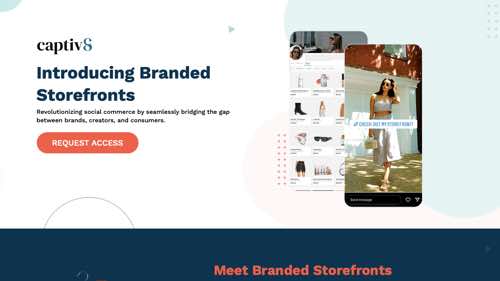
Captiv8 launches Branded Storefronts for social commerce.Captiv8, an influencer marketing platform for enterprise brands, has launched Branded Storefronts, which harnesses creator storytelling and personalized product curation to deliver a social commerce experience outside of social networks. Creators can now maintain a single storefront that enables all their social content to be shoppable. Branded Storefronts paired with Captiv8’s measurement and affiliate offerings allow companies to track, analyze, and optimize the shopper experience in real time.
Captiv8’s Branded Storefronts
Meta introduces AI chatbots, messaging tools, and a Threads API.Meta has introduced three products to help businesses and creators engage and grow. First, an AI chat feature (built with Meta Llama 3) for companies on Messenger will help consumers purchase products and obtain customer support. Second, using Ads Manager, select advertisers can soon create, organize, and send paid marketing on Messenger. Third, Meta is launching a Threads API to help businesses and creators manage their presence at scale.
Threekit launches Visual Discovery AI to help shoppers navigate ecommerce. Visual commerce specialist Threekit is launching Visual Discovery AI, enabling shoppers to explore product catalogs in a personalized way. According to Threekit, Visual Discovery AI can guide shoppers through educational brand experiences and technical product purchases. The search tool can interpret personal text or prompts and make associations based on user intent, producing personalized search results.
Reverse logistics solution firm ReturnBear expands into U.K.ReturnBear, a reverse logistics platform for ecommerce returns, is expanding its operations into the U.K. ReturnBear’s platform provides automated self-serve returns and optimized logistics strategies such as consolidated cross-border brand shipments, offering brands access to 1,000-plus Canadian locations, with processing hubs in Canada and the U.S.
ReturnBear
Target releases gen AI technology to team members.Target is rolling out a generative AI tool to team members at all of its nearly 2,000 stores. The tool, called Store Companion, is a custom gen-AI-powered chatbot that answers on-the-job process questions, coaches new employees, supports store operations management, and more. The initiative is part of Target’s broader strategic approach to using gen AI to empower its team, enhance the guest experience, and support the company’s long-term growth.
Button launches retail media inventory offering for retailers, publishers, and creators.Button, a commerce optimization platform, has unveiled a retail media offering, enabling retailers, publishers, and creators to access a retail media network. The inventory solution connects with ad platforms such as Microsoft Advertising and TripleLift, a programmatic ad platform. According to Button, the platform is designed to bridge the gap between retailers’ on-site advertising and the audience reach of publishers and creators. Retailers extend their on-site advertising capabilities to premium publisher and creator audiences while publishers and creators unlock a new revenue stream.
Live-shopping platform Voggt integrates with Amazon IVS Real-Time Streaming. Online marketplace Voggt, which combines live video and ecommerce, has integrated Amazon Interactive Video Service, a managed live-streaming service that uses the same streaming technology and global infrastructure as Twitch, the live-stream service. By implementing Amazon IVS Real-Time Streaming, Voggt says it dropped its average latency from 12 seconds to 60 milliseconds. Voggt averages 7,000 auctions and 300 shows per day on Amazon IVS, totaling around 30,000 live-stream broadcast hours per month.
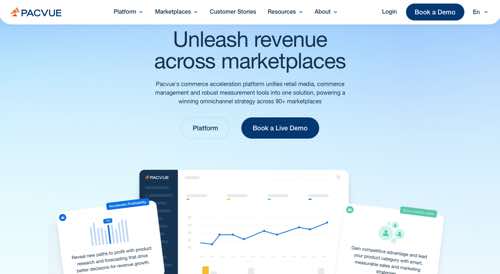
Pacvue introduces AI integrations across its product suite.Pacvue, a retail media facilitator across marketplaces, has unveiled several AI capabilities to enhance its product suite. The new features include a copilot commerce companion, generative content for product images, AI review for real-time analysis, and AI insights for measurement and reporting.
2023 was bad for Amazon aggregator funding, and this year is on track to be even worse.
Just two equity funding rounds were closed through June 27, compared to five at the same time last year and 12 in all of 2023.
“The decline in funding reflects the overall venture environment, where funding has slowed across industries. For Amazon aggregators in particular, the biggest and most well-known player, Thrasio, prepared for bankruptcy in late 2023 as the overall slowdown in ecommerce sales growth slowed funding to the space as well,” Laura Kennedy, principal analyst at CB Insights, said in a written statement to Practical Ecommerce. “These aggregator companies still exist and are making acquisitions, but overall the market has flatlined.”
Thrasio announced last week that it had emerged from Chapter 11 bankruptcy and promoted Chief Operating Officer Stephanie Fox to CEO and a director of the company, effective immediately. CEO Greg Greeley had been expected to step down following the restructuring.
“The revitalized Thrasio will prioritize its top-performing brands with a focus on profitability as a consumer goods company,” Thrasio said in a press release.
Thrasio, based in Walpole, Mass., filed for Chapter 11 bankruptcy protection in a New Jersey court in February. It requested that the court oversee a restructuring agreement with lenders, allowing it to cut about $495 million in debt and defer interest payments for a year after exiting bankruptcy.
“The restructuring has left Thrasio financially stronger, with a clean balance sheet, reduced debt, and an infusion of $90 million in fresh capital,” the company said.
Thrasio will concentrate on its leading brands with a loyal customer base and potential for product and channel expansion, the company said, including The Hate Stains Co. stain removers, which has grown over 100% in the last year, and Angry Orange pet deodorizer, which has achieved 21 times top-line growth since being acquired in 2018.
“We are emerging from Chapter 11 with a clean balance sheet, fresh capital, and a renewed focus on our core business of building brands,” Fox said. “I have been with Thrasio since day one and remain as excited about the opportunity ahead now as I was in 2018.”
The ecommerce landscape, however, has changed with China’s Temu and Shein taking an ever-increasing share of the market with cheap goods.
In 2021, Amazon brand acquirers spent more than $6 billion in acquisitions amid the pandemic stay-at-home frenzy that pushed ecommerce demand through the roof. So far this year, aggregators have spent $100 million.
“I have to imagine the growth at Temu and Shein has not helped the aggregator market, as the idea of an inexpensive online ‘brand’ becomes even less important in that environment focused on the lowest price possible (and now Amazon is going to start its own direct-from-China product marketplace as well),” CB Insight’s Kennedy said.
Google has officially confirmed the completion of its June 2024 spam update, a week-long process aimed at enhancing search result quality by targeting websites that violate the company’s spam policies.
The update began on June 20, 2024, and was announced via Google’s Search Central Twitter account.
This spam update is part of Google’s ongoing efforts to combat web spam and improve user experience.
It’s important to note that this is not the algorithmic component of the site reputation abuse update, which Google has clarified is yet to be implemented.
Key Points Of The June 2024 Spam Update
The update targets websites violating Google’s spam policies.
It is separate from the anticipated site reputation abuse algorithmic update.
The rollout process lasted approximately one week.
Google’s spam updates typically focus on eliminating various forms of web spam, including:
Automatically generated content aimed solely at improving search rankings
Purchased or sold links intended to manipulate rankings
Thin, duplicated, or poor-quality content
Hidden redirects or other deceptive techniques
This latest update follows Google’s previous spam update in March 2024.
Despite that update’s impact, some AI-generated content performed well in search results.
An analysis by Search Engine Journal’s Roger Montti revealed that certain AI spam sites ranked for over 217,000 queries, with more than 14,900 ranking in the top 10 search results.
The June update is expected to refine Google’s spam detection capabilities further. However, as with previous updates, it may cause fluctuations in website search rankings.
Those engaging in practices that violate Google’s spam policies or heavily relying on AI-generated content may see a decline in their search visibility.
Conversely, legitimate websites adhering to Google’s guidelines may benefit from reduced competition from spammy sites in search results.
SEO professionals and website owners are advised to review their sites for spammy practices and ensure compliance with Google’s Webmaster Guidelines.
For more information about the June 2024 spam update and its potential impact, refer to Google’s official communication channels, including the Google Search Central Twitter account and the Google Search Status Dashboard.
How does Google know if its search results are improving?
As Google rolls out algorithm updates and claims to reduce “unhelpful” content, many wonder about the true impact of these changes.
In an episode of Google’s Search Off The Record podcast, Google Search Directer, Product Management, Elizabeth Tucker discusses how Google measures search quality.
This article explores Tucker’s key revelations, the implications for marketers, and how you can adapt to stay ahead.
Multifaceted Approach To Measurement
Tucker, who transitioned to product management after 15 years as a data scientist at Google, says it’s difficult to determine whether search quality is improving.
“It’s really hard,” she admitted, describing a comprehensive strategy that includes user surveys, human evaluators, and behavioral analysis.
Tucker explained
“We use a lot of metrics where we sample queries and have human evaluators go through and evaluate the results for things like relevance.”
She also noted that Google analyzes user behavior patterns to infer whether people successfully find the information they seek.
The Moving Target Of User Behavior
Tucker revealed that users make more complex queries as search quality improves.
This creates a constantly shifting landscape for Google’s teams to navigate.
Tucker observed:
“The better we’re able to do this, the more interesting and difficult searches people will do.”
Counterintuitive Metrics
Tucker shared that in the short term, poor search performance might lead to increased search activity as users struggle to find information.
However, this trend reverses long-term, with sustained poor performance resulting in decreased usage.
Tucker cautioned:
“A measurement that can be good in the long term can be misleading in the short term.”
Quantifying Search Quality
To tackle the challenge of quantifying search quality, Google relies on an expansive (and expanding) set of metrics that gauge factors like relevance, accuracy, trustworthiness, and “freshness.”
But numbers don’t always tell the full story, Tucker cautioned:
“I think one important thing that we all have to acknowledge is that not everything important is measurable, and not everything that is measurable is important.”
For relatively straightforward queries, like a search for “Facebook,” delivering relevant results is a comparatively simple task for modern search engines.
However, more niche or complex searches demand rigorous analysis and attention, especially concerning critical health information.
The Human Element
Google aims to surface the most helpful information for searchers’ needs, which are as diverse as they are difficult to pin down at the scales Google operates at.
Tucker says:
“Understanding if we’re getting it right, where we’re getting it right, where needs focus out of those billions of queries – man, is that a hard problem.”
As developments in AI and machine learning push the boundaries of what’s possible in search, Tucker sees the “human element” as a key piece of the puzzle.
From the search quality raters who assess real-world results to the engineers and product managers, Google’s approach to quantifying search improvements blends big data with human insight.
Looking Ahead
As long as the web continues to evolve, Google’s work to refine its search quality measurements will be ongoing, Tucker says:
“Technology is constantly changing, websites are constantly changing. If we just stood still, search would get worse.”
What Does This Mean?
Google’s insights can help align your strategies with Google’s evolving standards.
Key takeaways include:
Quality over quantity: Given Google’s focus on relevance and helpfulness, prioritize creating high-quality, user-centric content rather than aiming for sheer volume.
Embrace complexity: Develop content that addresses more nuanced and specific user needs.
Think long-term: Remember that short-term metrics can be misleading. Focus on sustained performance and user satisfaction rather than quick wins.
Holistic approach: Like Google, adopt a multifaceted approach to measuring your content’s success, combining quantitative metrics with qualitative assessments.
Stay adaptable: Given the constant changes in technology and user behavior, remain flexible and ready to adjust your strategies as needed.
Human-centric: While leveraging AI and data analytics, don’t underestimate the importance of human insight in understanding and meeting user needs.
As Tucker’s insights show, this user-first approach is at the heart of Google’s efforts to improve search quality – and it should be at the center of every marketer’s strategy as well.
Listen to the discussion on measuring search quality in the video below, starting at the 17:39 mark:
Featured Image: Screenshot from YouTube.com/GoogleSearchCentral, June 2024
There’s a new kid in town, and it’s one you want to be friends with: OSO. It stands for organic search optimization, and with the Search Generative Experience rolling out, this acronym is one you should pay attention to. It’s not here to replace our good old SEO. But it does want to change your thinking and the platforms you’re focusing on.
OSO is a relatively new acronym that adds a layer to SEO as we know it. Although I’ve seen different explanations of the acronym (optimized search optimization, organic search optimization), they all boil down to the same concept: multi-channel search optimization.
SEO vs. OSO: what’s the difference?
Where SEO is traditionally focused on getting your web pages high in the search results, the focus is shifting towards being present on different platforms, not just in the SERPs. Now, we have a good acronym for this new mindset: OSO. Naturally, you can continue working on getting your site traffic up, but you also need to think about the performance of your content in other places. Your website is no longer the only focus point; it’s one of (hopefully many) places where you can be found and contacted. Sure, you want to beat your competition and claim that first search result, but you also need to focus on overall branding online.
It comes down to seeing your website as part of the equation rather than the result. OSO wants you to be more. It wants you to become the best information source on all the channels where your audience can be found. It’s all-encompassing and ties all your marketing efforts together instead of being one part of it.
Where does this shift come from?
Online search continuously changes, and people are no longer just visiting your website. There are so many different places where you come into contact with them. Or want to come into contact with them. And when you do, you want to ensure their experience with you is pleasant and consistent. So your content needs to be high-quality and make purchases (or other actions you want them to take) possible in different places. Make sure to align your content and communication and be where your audience is. Don’t forget, that nowadays, even social media platforms act as search engines.
SGE and other AI-powered tools
Other good reasons to take organic search optimization (or OSO) seriously are the Search Generative Experience and Google AI Overviews, and the overall use of AI in search engines. This is an AI-powered search tool (by Google) that pulls from different places to generate an answer to an online query. SGE uses different sources to generate its results: online pages, customer reviews, social media posts, YouTube videos, etc. So, it’s not just focused on your website content. These AI tools will look at your content across platforms and use them to generate personalized results. Another reason why it pays to be present on multiple platforms and spend enough time on the content you’re sharing there.
Example of how Google’s Generative Search Experience works.
So, do you need to make any changes?
Well, are you mainly focused on your website content? Or is your brand also represented on other online platforms? Either way, I suggest researching where your audience can be found. Which online platforms are they using, and with what intent? You need to be there and catch their eye. As written by Andrew Holland in this article on OSO by Search Engine Land:
Your job is to build nets… giant nets.
We need to go back to the drawing board and alter our priorities. Naturally, website content will remain high on the list. But you need to add more stuff to the list. Come together with your social media team and align your content, strategize with your email team, consider creating videos or podcasts, and even look at offline events you should attend. And if you are doing everything independently, set the right priorities. Spend enough time on your website, but also think of ways to broadcast your expertise in your field.
What would that look like?
To give you an idea of what that would look like, I would like to use Yoast as an example. We have the SEO blog you’re reading, which we’ve been using to reach our audience since the company’s launch. Of course, our newsletter and social media followed quickly after that. But we also speak at (and attend) SEO, development, WordPress, and marketing events. We host different types of webinars and create videos and podcasts. This strengthens our brand and shows our expertise in different places where our audience can be found.
It sounds like even more work…
This shift might cause you some worries regarding time management, but it also means that you can spend less time diving into data as this is becoming less important. So save time by obsessing a bit less over the numbers and invest that time in researching your audience and creating new (and fun) ways to reach them. This allows you to think more outside the box, which can also be exciting! And don’t forget that you’re also involving other team members, so you’ll have more people involved in your SEO (or OSO) efforts. Use their expertise, work on the content together, and find out what works for your team.
It comes down to building your brand
To recap what we talked about today, OSO is not that different from SEO. This new acronym reminds you to think beyond your pages and Google’s search results page. SEO is still here and going strong; it just continues evolving. And that means that you and your SEO efforts should, too. Good luck!
Many owners and executives still have difficulty budgeting for online marketing.
Budgeting for SEO can be complex and influenced by factors like project scope, industry competition, and specific services needed. There is no universal calculator for calculating costs.
This article explores key SEO pricing components and how to calculate and plan your budget.
What Businesses Don’t Understand About Investing In SEO
SEO is an area where you truly get what you pay for. Investing adequately in SEO services can significantly impact your online presence and business growth.
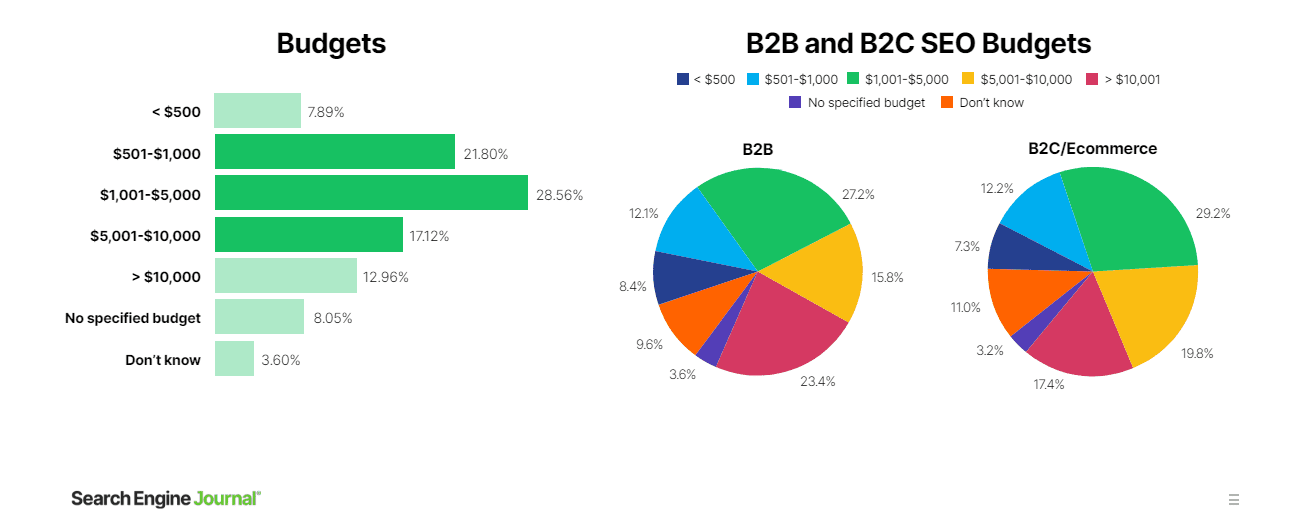
According to recent data, over half of all SEO professionals work with monthly budgets ranging from $500 to $5,000, with 28.6% reporting budgets in the $1,001-$5,000 range.
Image from Search Engine Journal, May 2024
Many business owners are reluctant to invest in SEO, often because they lack understanding of how search marketing works and are too busy running their businesses to learn about SEO.
Most industries follow a standardized, step-by-step process to achieve specific outcomes.
Many business owners mistakenly assume SEO works the same way, treating it as a commodity.
This misconception leads them to fall for low-cost offers like $99/month “guaranteed page one” services from spammers and scammers, which never deliver meaningful results.
The Cost Of Cheap SEO
I belong to several internet marketing groups on Facebook. It’s truly frightening the number of noobs posing as SEO professionals and taking on clients.
It’s common to see a question like: “I just landed a client that wants to rank for [keyword x] – how do I do it?”
A close second is people using link schemes, specifically private blog networks and third-party pages known as parasite SEO, without ever explaining the risk to clients. Many use AI to generate content at a scale without fact-checking.
However, AI can be a powerful tool when used ethically in SEO.
AI helps automate data analysis, identify patterns, and streamline content creation and optimization, which in turn helps to reduce SEO costs.
If business owners were just throwing money away by hiring an incompetent SEO, that would be bad enough. Unfortunately, the collateral damage from “cheap SEO” can go much deeper.
Business owners must remember that they’re ultimately responsible for any SEO work performed on their site. They should discuss the specific tactics service providers use before entering into an agreement.
Managing Your Resources
With Google utilizing 200+ (and likely exponentially more) ranking factors, it’s easy to become intimidated and paralyzed.
The good news is that if you focus on just three factors, you can still crush it, regardless of your niche.
It must be natural. Avoid popular link schemes like private blog networks (PBNs) and paid guest posts. Instead, focus on building real links from topically relevant websites with high-quality content.
Quality is key: A lower number of high trust/high authority/relevant links can outperform a large quantity of lower quality links.
You Manage What You Measure – Set Goals
Before establishing a budget, one must define specific goals for a campaign.
Your goals should include measurable results, a defined timeframe, and an actual measurement for success.
At one time, success was measured solely by keyword rankings. While SERPs remain an important metric, they are not the most important.
I would argue that the most important metrics are those that directly impact the bottom line. Organic sessions, goal conversions, and revenue fall into that category.
Goal setting could include improving organic sessions by X%, increasing conversions by Y per month, and/or increasing revenues by Z%.
When setting goals, it’s important to keep a couple of things in mind.
First, they need to be achievable. Stretch goals are fine, but pie-in-the-sky benchmarks can actually work as a disincentive.
Equally important: you need to give the campaign time to work.
“…in most cases, SEOs need four months to a year to help your business first implement improvements and then see potential benefit.”
Developing A Budget
Your goals will determine what tactics are needed for success. This, in turn, sets up a framework for developing an action plan and the budget necessary to support that plan.
This brings us full circle to positioning and paying attention to those factors that move the dial.
The answers to those questions will determine priorities as well as the volume of work needed to reach your goals.
In many cases, the actual work performed will be the same, regardless of budget level. The difference is the volume of work performed.
If you add twice the content and twice the links at budget level “B” compared to budget level “A,” you are more likely to achieve earlier success at the higher budget.
It takes time to properly plan, implement, and tweak a campaign to evaluate its success.
Also, remember that the lower the budget, the longer the journey.
How Much Can You Expect To Spend On SEO?
To execute a local campaign, you could budget between $1,001 and $5,000 per month, the most common budget range among SEO professionals SEJ surveyed in 2023.
The budget will likely be higher for a national or international campaign, with many SEO pros working with budgets exceeding $10,000 per month for broader campaigns.
Some firms offer a “trial package” at a lower price with no contract. This allows prospective clients to test their services while minimizing risk.
There are some options if you can’t afford to retain a top-level SEO pro. The most common is a one-time website SEO audit with actionable recommendations.
Just fixing your website will often lead to a meaningful boost in organic traffic. Content development and keyword analysis are other areas where you can get help from a pro for a one-time fixed rate.
SEO Cost Calculator – Measuring Organic Search (SEO) ROI
The following is a calculator commonly used for (incorrectly) measuring return on investment for SEO.
Organic Search ROI Calculation Assuming “One Shots”
Example: selling blue widgets
Number of new customers acquired via organic search in a given month
10
Average net income (profit) per order
$100
Total profits from new organic search customers in a given month
$1,000
Monthly marketing budget (expense)
$2,500
Monthly profits from new customers ($1,000) divided by monthly organic marketing spend ($2,500)
ROI = -60%
The flaw in the above calculator is that it fails to take into consideration the lifetime value of a new customer.
Online retailers need repeat business to grow. By not calculating the lifetime value of a new customer, the true ROI is grossly understated.
The right way to calculate ROI is to build lifetime value into the calculator.
To calculate the cost of SEO and its true ROI use this formula:
Average lifetime profits from new customers acquired in one month divided by monthly organic marketing spend.
Organic Search SEO ROI Calculation Assuming Lifetime Value
Same example: selling blue widgets
Number of new customers acquired via organic search in a given month
10
Average net income (profit) per order
$100
Total profits from new organic search customers in a given month
$1,000
Average number of orders per customer over a “lifetime”
5
Total average lifetime profit
$5,000
Monthly marketing budget (expense)
$2,500
Average lifetime profits from new customers ($5,000) divided by monthly organic marketing spend ($2,500)
ROI = 200%
As you can see, that one variable makes a huge difference in how the ROI is stated.
SEO Campaigns Are Long-Term Investments
Unlike PPC, an organic search campaign will not yield immediate results.
A comprehensive SEO campaign will involve a combination of technical SEO, content marketing, and link-building. Even when executed to perfection, it takes time for Google to recognize and reward these efforts.
That said, the traffic earned from these efforts is often the most consistent and highest-converting among all channels.
FAQ
How do SEO professionals measure success?
The top metrics used to measure SEO performance are click-through rate (CTR), keyword rankings, and branded vs. non-branded traffic.
What is the most common budget range for SEO campaigns?
The most common SEO budget range is between $1,001 and $5,000 per month, with 28.6% of respondents working within this range.
What are the primary factors that affect SEO budgeting?
Determining the appropriate budget for SEO involves considering several key components that can influence the overall cost. These factors include the scope of the SEO project, the level of competition within the industry, and the specific types of SEO services that are required. For example, a small business in a niche market with low competition might budget around $1,000 per month for local SEO services, focusing on optimizing its Google My Business profile and building local citations. In contrast, an ecommerce company targeting an audience in a highly competitive industry might need to budget $5,000 to $10,000 monthly for a comprehensive SEO strategy that includes extensive link building and technical SEO audits.
What risks are associated with choosing low-cost SEO services?
Opting for low-cost SEO services poses significant risks to a business. These services often fail to comply with ethical SEO practices, resulting in the use of tactics such as link schemes or private blog networks (PBNs), which can be detrimental to a site’s reputation and rankings. Such practices can potentially attract penalties from Google, severely compromising a site’s online visibility and trustworthiness. It is crucial for business owners to be vigilant and discerning when selecting SEO professionals to avoid these harmful consequences.