Was OpenAI GPT-4o Hype A Troll On Google? via @sejournal, @martinibuster
OpenAI managed to steal the attention away from Google in the weeks leading up to Google’s biggest event of the year (Google I/O). When the big announcement arrived there all they had to show was a language model that was slightly better than the previous one with the “magic” part not even in Alpha testing stage.

OpenAI may have left users feeling like a mom receiving a vacuum cleaner for Mothers Day but it surely succeeded in minimizing press attention for Google’s important event.

The Letter O

The first hint that there’s at least a little trolling going on is the name of the new GPT model, 4 “o” with the letter “o” as in the name of Google’s event,  I/O.

OpenAI says that the letter O stands for Omni, which means everything, but it sure seems like there’s a subtext to that choice.

GPT-4o Oversold As Magic

Sam Altman in a tweet the Friday before the announcement promised “new stuff” that felt like “magic” to him:

“not gpt-5, not a search engine, but we’ve been hard at work on some new stuff we think people will love! feels like magic to me.”

OpenAI co-founder Greg Brockman tweeted:

“Introducing GPT-4o, our new model which can reason across text, audio, and video in real time.

It’s extremely versatile, fun to play with, and is a step towards a much more natural form of human-computer interaction (and even human-computer-computer interaction):”

The announcement itself explained that previous versions of ChatGPT used three models to process audio input. One model to turn audio input into text. Another model to complete the task and output the text version of it and a third model to turn the text output into audio. The breakthrough for GPT-4o is that it can now process the audio input and output within a single model and output it all in the same amount of time that it takes a human to listen and respond to a question.

But the problem is that the audio part isn’t online yet. They’re still working on getting the guardrails working and it will take weeks before an Alpha version is released to a few users for testing. Alpha versions are expected to possibly have bugs while the Beta versions are generally closer to the final products.

This is how OpenAI explained the disappointing delay:

“We recognize that GPT-4o’s audio modalities present a variety of novel risks. Today we are publicly releasing text and image inputs and text outputs. Over the upcoming weeks and months, we’ll be working on the technical infrastructure, usability via post-training, and safety necessary to release the other modalities.

The most important part of GPT-4o, the audio input and output, is finished but the safety level is not yet ready for public release.

Some Users Disappointed

It’s inevitable that an incomplete and oversold product would generate some negative sentiment on social media.

AI engineer Maziyar Panahi (LinkedIn profile) tweeted his disappointment:

“I’ve been testing the new GPT-4o (Omni) in ChatGPT. I am not impressed! Not even a little! Faster, cheaper, multimodal, these are not for me.
Code interpreter, that’s all I care and it’s as lazy as it was before!”

He followed up with:

“I understand for startups and businesses the cheaper, faster, audio, etc. are very attractive. But I only use the Chat, and in there it feels pretty much the same. At least for Data Analytics assistant.

Also, I don’t believe I get anything more for my $20. Not today!”

There are others across Facebook and X that expressed similar sentiments although many others were happy with what they felt was an improvement in speed and cost for the API usage.

Did OpenAI Oversell GPT-4o?

Given that the GPT-4o is in an unfinished state it’s hard not to miss the impression that the release was timed to coincide with and detract from Google I/O. Releasing it on the eve of Google’s big day with a half-finished product may have inadvertently created the impression that GPT-4o in the current state is a minor iterative improvement.

In the current state it’s not a revolutionary step forward but once the audio portion of the model exits Alpha testing stage and makes it through the Beta testing stage then we can start talking about revolutions in large language model. But by the time that happens Google and Anthropic may already have staked a flag on that mountain.

OpenAI’s announcement paints a lackluster image of the new model, promoting the performance as on the same level as GPT-4 Turbo. The only bright spots is the significant improvements in languages other than English and for API users.

OpenAI explains:

  • “It matches GPT-4 Turbo performance on text in English and code, with significant improvement on text in non-English languages, while also being much faster and 50% cheaper in the API.”

Here are the ratings across six benchmarks that shows GPT-4o barely squeaking past GPT-4T in most tests but falling behind GPT-4T in an important benchmark for reading comprehension.

Here are the scores:

  • MMLU (Massive Multitask Language Understanding)
    This is a benchmark for multitasking accuracy and problem solving in over fifty topics like math, science, history and law. GPT-4o (scoring 88.7) is slightly ahead of GPT4 Turbo (86.9).
  • GPQA (Graduate-Level Google-Proof Q&A Benchmark)
    This is 448 multiple-choice questions written by human experts in various fields like biology, chemistry, and physics. GPT-4o scored 53.6, slightly outscoring GPT-4T (48.0).
  • Math
    GPT 4o (76.6) outscores GPT-4T by four points (72.6).
  • HumanEval
    This is the coding benchmark. GPT-4o (90.2) slightly outperforms GPT-4T (87.1) by about three points.
  • MGSM (Multilingual Grade School Math Benchmark)
    This tests LLM grade-school level math skills across ten different languages. GPT-4o scores 90.5 versus 88.5 for GPT-4T.
  • DROP (Discrete Reasoning Over Paragraphs)
    This is a benchmark comprised of 96k questions that tests language model comprehension over the contents of paragraphs. GPT-4o (83.4) scores nearly three points lower than GPT-4T (86.0).

Did OpenAI Troll Google With GPT-4o?

Given the provocatively named model with the letter o, it’s hard to not consider that OpenAI is trying to steal media attention in the lead-up to Google’s important I/O conference. Whether that was the intention or not OpenAI wildly succeeded in minimizing attention given to Google’s upcoming search conference.

Does a language model that barely outperforms its predecessor worth all the hype and media attention it received? The pending announcement dominated news coverage over Google’s big event so for OpenAI the answer is clearly yes, it was worth the hype.

Featured Image by Shutterstock/BeataGFX

seo enhancements
What is off-page SEO?

SEO can be explained as any effort you make to improve your website. But did you know there’s an important distinction between on-page and off-page SEO? Optimizing your website is called on-page SEO and includes things like site structure, content and speed optimization. Off-page SEO entails, among other things, link building, social media, and local SEO. In other words, generating traffic to your site and making your business appear like the real deal it is. In this post, we answer the question: What is off-page SEO?

Exposure, trust and brand awareness

When focusing on on-page SEO, you’re doing everything in your power to create a good website. You write great content, build a solid site structure, make your website mobile-friendly and work on improving page speed. All is well in the world and you’ve done all you can. Right? Well, there’s another part we can’t forget: off-page SEO. This helps you to bring in those hordes of visitors and potential customers. Both are important pieces of the puzzle.

By writing quality content you can rank in search engines, but by getting a few great, relevant sites to link to that content, you’re increasing the chance that you’ll end up ranking a lot higher. The same goes for building your brand and creating trust. This doesn’t just happen on your site, but mostly off-site. Take reviews, for instance, these can make or break your company. You need them, but they most often appear on external sites. These are all factors that contribute to your rankings.

It’s not only important to rank high for your search term, but also to create trust and a sense of authority. You must appear to be the best search result, not just in a technical and content sense, but also in reality. Popularity, quality, and relevance are everything. Especially now that E-E-A-T (which stands for Experience, Expertise, Authoritativeness and Trustworthiness) has become a core concept in how Google rates your online content.

Links are the threads that keep our web together. Search engines use links to determine how valuable a piece of content or a particular site is. Getting quality links will always be a great tactic if you’re serious about SEO. And who isn’t? In the past, there have been debates on the relevance of links. We firmly believe in the importance of links. That being said, you need the good ones. Don’t buy stuff, and keep a close eye on where and how you’re being linked to. We’ve written several guides on how to get quality links for your site and what you shouldn’t do when link building.

By itself, social media is not essential for ranking well in search engines. It is however growing in popularity, and more and more people are using these platforms for their online searches as well. It’s also a great way to reach more people and grow your brand as a whole.

At the end of the day, SEO is about being found online. By being active on social media, you will be deemed more trustworthy, be more easily found and have a great way to showcase your brand more. People will probably expect to find you there and you don’t want them to end up empty-handed or stumble across your competition. It also gives you a great opportunity to interact with your audience in a fun and approachable way. So make sure to invest in social media to reach your audience.

Local SEO is also off-page SEO

Local SEO is essential if your business is locally oriented. But what is it? Where normally, you would focus your efforts on reaching as many people as possible, wherever they are, local SEO focuses on reaching people in a certain area. So, for example, when you’re a bike repair shop or real estate agent.

For local businesses, part of the off-page SEO is in-person SEO. Word-of-mouth marketing plays a big role in getting people to your business. Not just that, happy customers can leave reviews online that Google – and other potential customers – can use to see how well you are doing. The experiences that people have with your business, should be similar and positive, whether they’re offline or online.

Don’t forget to showcase yourself

Coming back to the importance of showing your expertise or authority on a topic, you need to make sure this isn’t just being said on your website. Make appearances to talk about your field or expertise or service/product with others. By blogging for another website in your field, doing interviews, being a guest on podcasts, or going to events to do a talk or workshop. Share your knowledge and be active to let people know that you’re the go-to person (or website) when it comes to that specific topic.

Off-page SEO is an integral part of your SEO strategy

As we’ve shown, off-page SEO supplements on-page SEO. They go hand in hand. You need to focus on what’s going on outside your website as well. Work on proper link building, branding and your social media efforts to make the most of your SEO. You can optimize your site all you want, but if it isn’t perceived as a quality destination for people, it will be difficult to get people to your website at all.

Read more: The ultimate guide to content SEO »

Coming up next!

SGE Is Here. Google Rolls Out AI-Powered Overviews To US Search Results via @sejournal, @MattGSouthern

At its annual I/O developer conference, Google unveiled plans to incorporate generative AI directly into Google Search.

Additionally, Google announced an expansion to Search Generative Experience (SGE), designed to reinvent how people discover and consume information.

Upcoming upgrades include:

  • Adjustable overviews to simplify language or provide more detail
  • Multi-step reasoning to handle complex queries with nuances
  • Built-in planning capabilities for tasks like meal prep and vacations
  • AI-organized search result pages to explore ideas and inspiration
  • Visual search querying through uploaded videos and images

Liz Reid, Head of Google Search, states in an announcement:

“Now, with generative AI, Search can do more than you ever imagined. So you can ask whatever’s on your mind or whatever you need to get done — from researching to planning to brainstorming — and Google will take care of the legwork.”

What’s New In Google Search & SGE

New Gemini Model

A customized Gemini language model is central to Google’s AI-powered Search revamp.

Google’s announcement states:

“This is all made possible by a new Gemini model customized for Google Search. It brings together Gemini’s advanced capabilities — including multi-step reasoning, planning and multimodality — with our best-in-class Search systems.”

AI overviews generate quick answers to their queries, piecing together information from multiple sources.

Google reports that people have already used AI Overviews billions of times through Search Labs.

AI Overviews In US Search Results

Google is bringing AI overviews from Search Labs into its general search results pages.

That means hundreds of millions of US searchers will gain access to AI overviews this week and over 1 billion by year’s end.

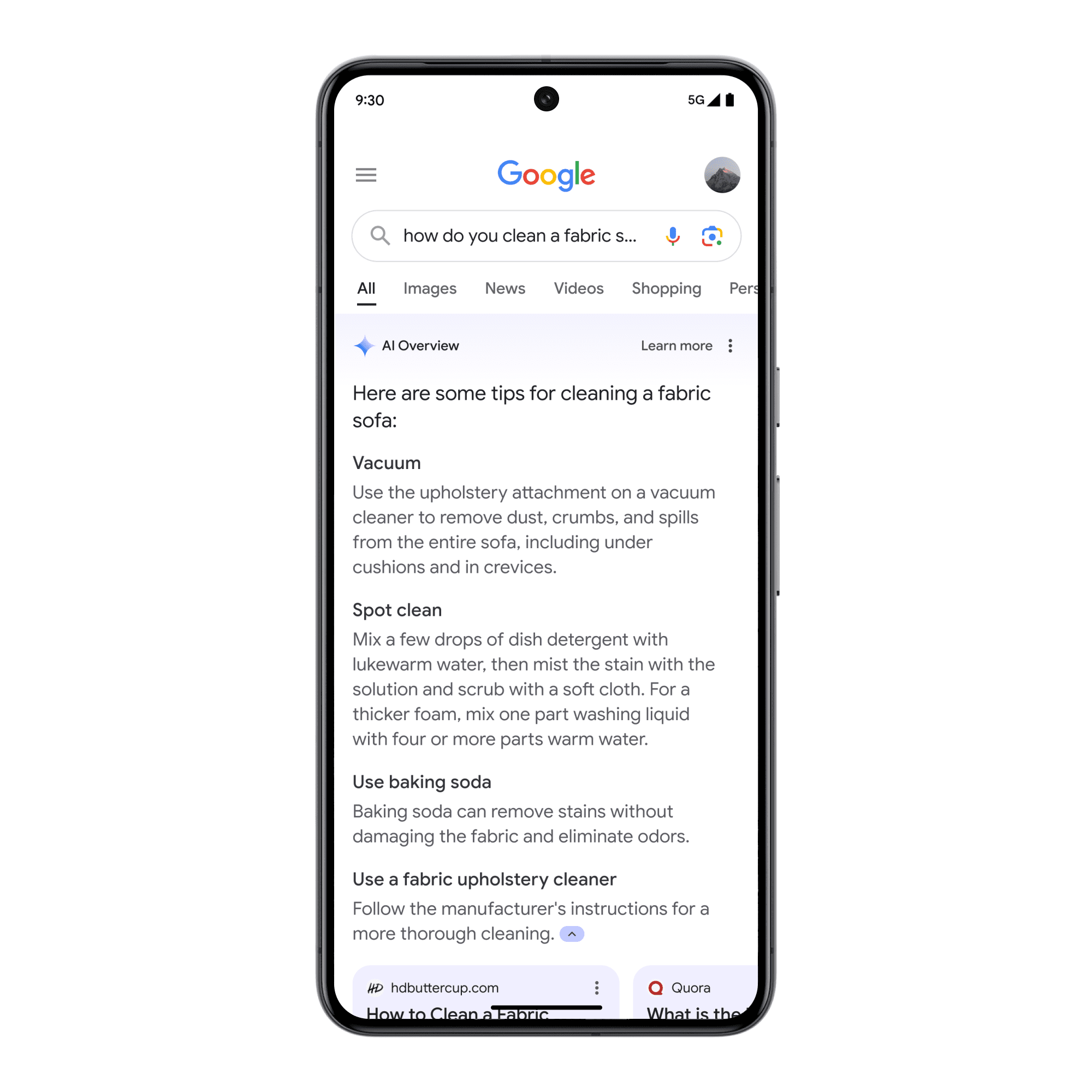
Image Credit: blog.google/products/search/generative-ai-google-search-may-2024/, May 2024.

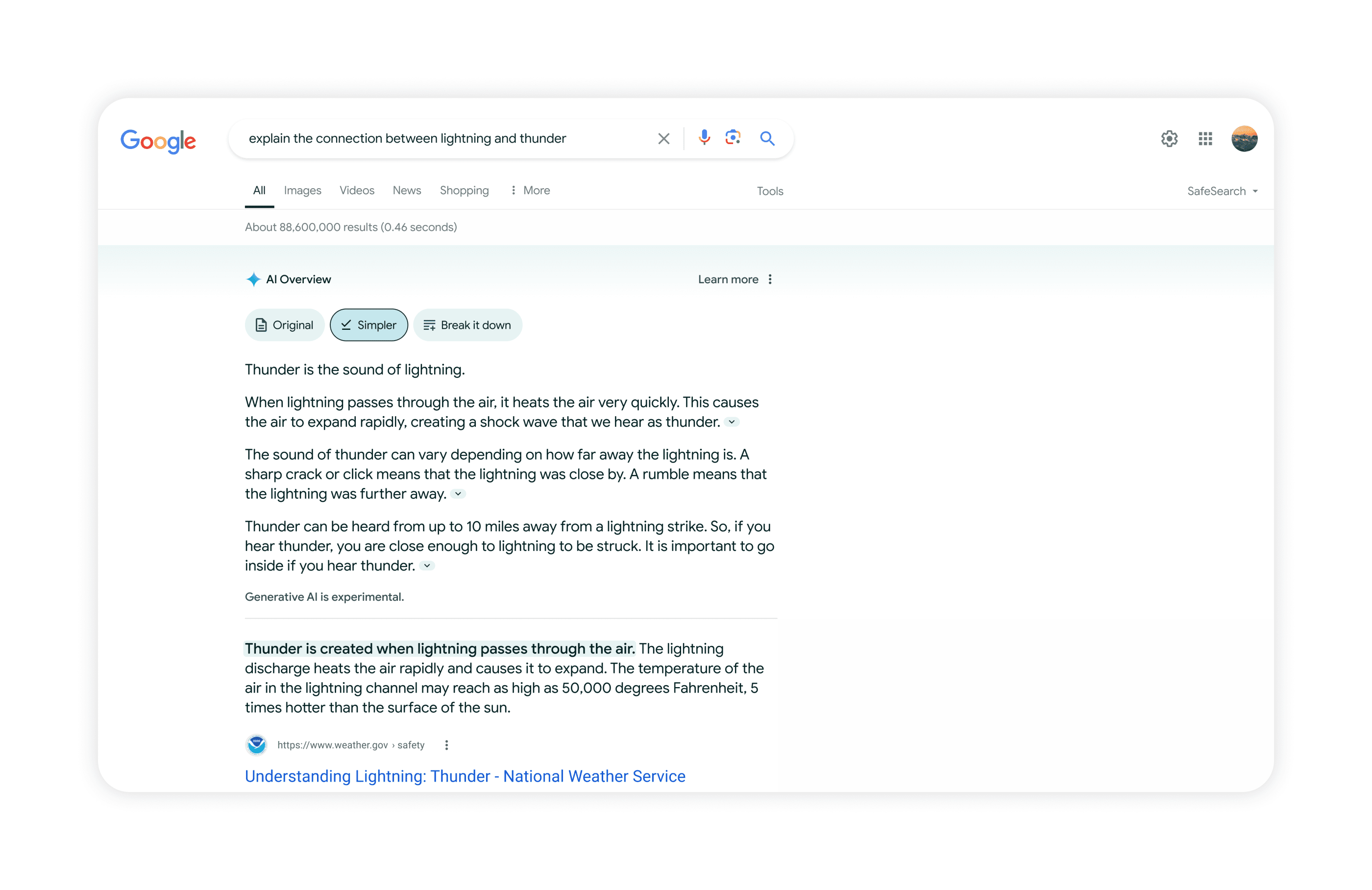
Searchers will soon be able to adjust the language and level of detail in AI overviews to suit their needs and understanding of the topic.

Image Credit: blog.google/products/search/generative-ai-google-search-may-2024/, May 2024.

Complex Questions & Planning Capabilities

SGE’s multi-step reasoning capabilities will allow you to ask complex questions and receive detailed answers.

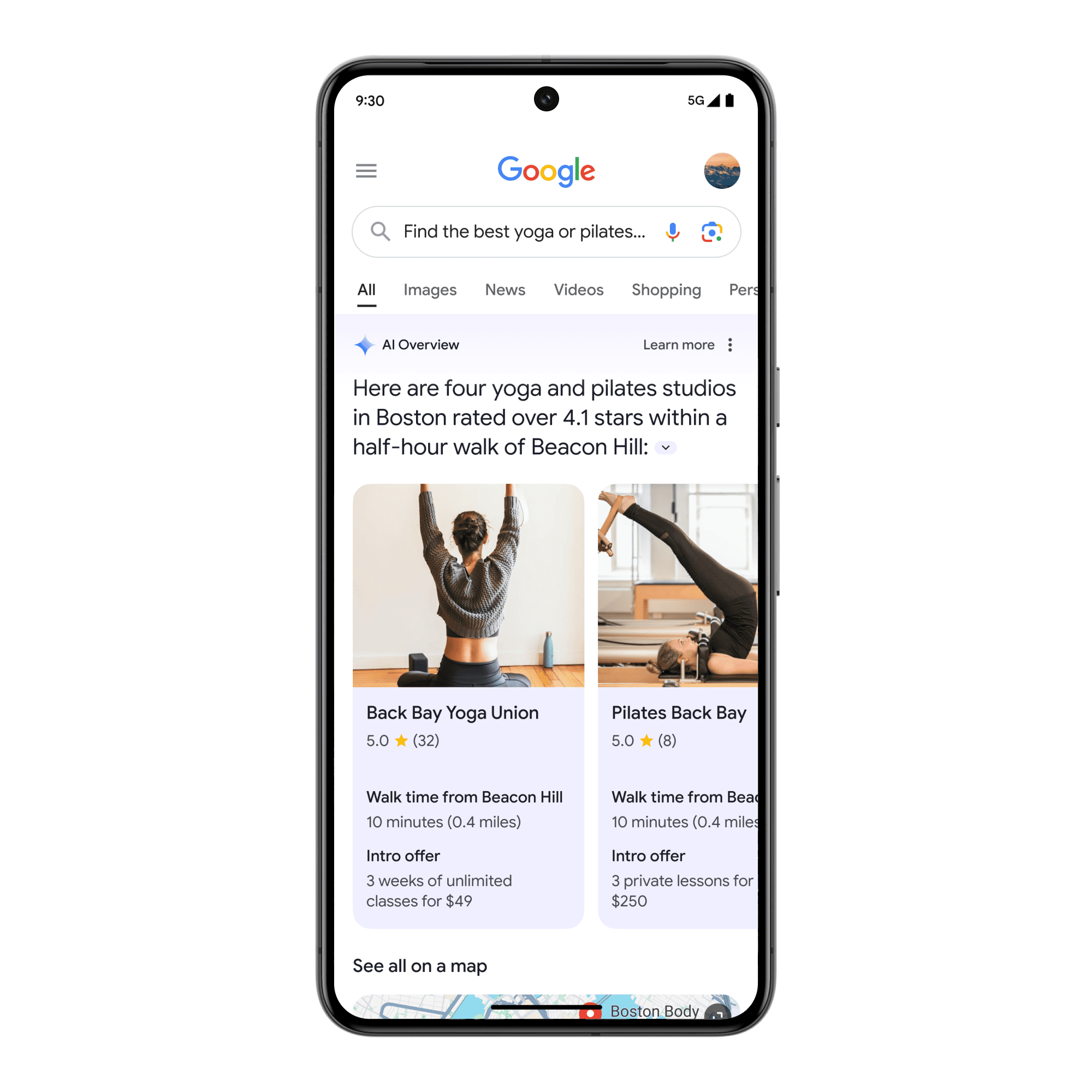
For example, you could ask, “Find the best yoga or pilates studios in Boston and show details on their intro offers and walking time from Beacon Hill,” and receive a comprehensive response.

Image Credit: blog.google/products/search/generative-ai-google-search-may-2024/, May 2024.

In addition to answering complex queries, SGE will offer planning assistance for various aspects of life, such as meal planning and vacations.

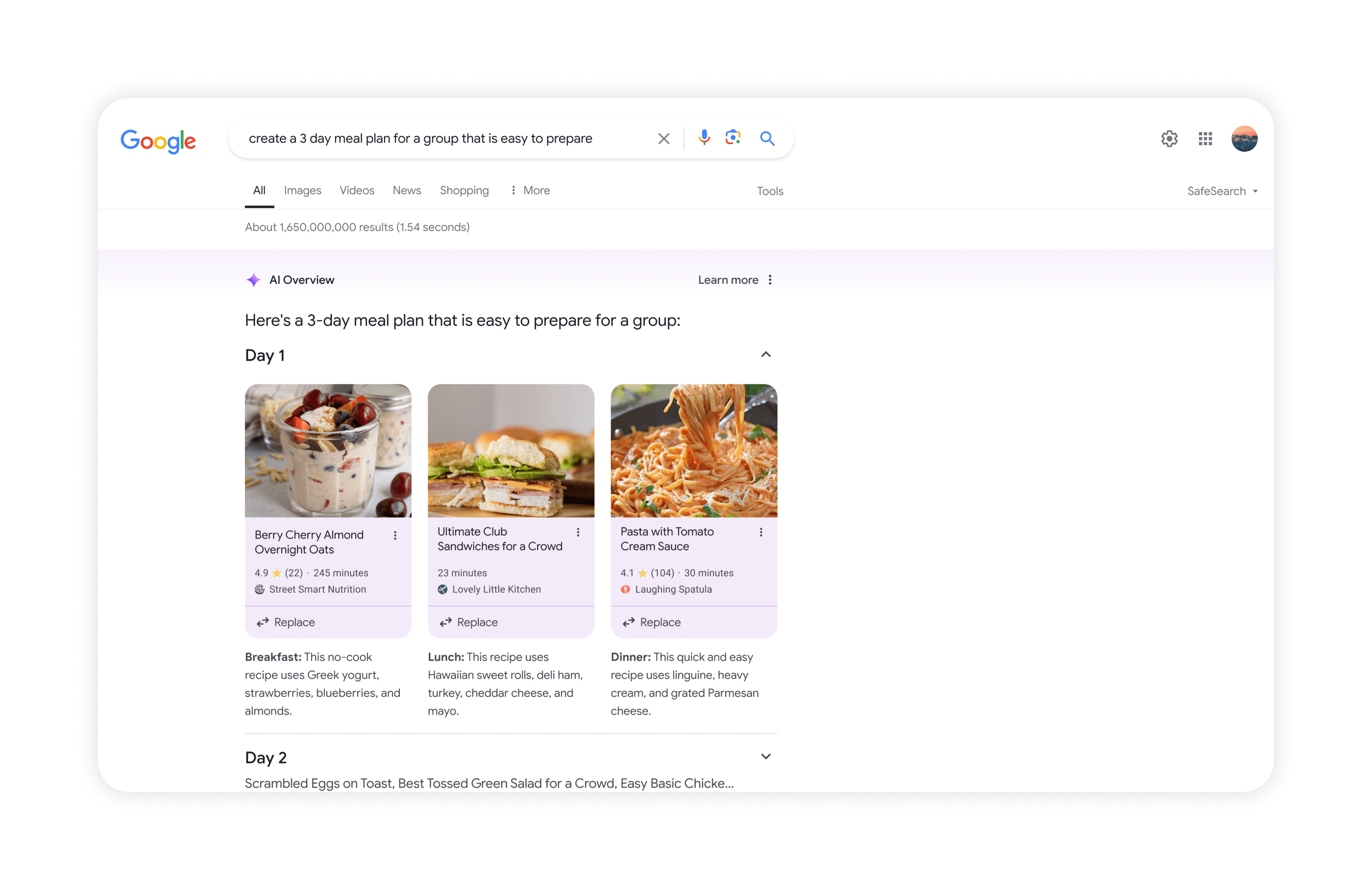
You can request a customized meal plan by searching for something like “create a 3-day meal plan for a group that’s easy to prepare.” You will receive a tailored plan with recipes from across the web.

AI-Organized Results & Visual Search

Google is introducing AI-organized results pages that categorize helpful results under unique, AI-generated headlines, presenting diverse perspectives and content types.

This feature will initially be available for dining and recipes, with plans to expand to movies, music, books, hotels, shopping, and more.

SGE will also enable users to ask questions using video content. This visual search capability can save you time describing issues or typing queries, as you can record a video instead.

Image Credit: blog.google/products/search/generative-ai-google-search-may-2024/, May 2024.

What Does This Mean For Businesses?

While Google touts SGE as a way to enhance search quality, the prominence of AI-generated content could impact businesses and publishers who rely on Google Search traffic.

AI overviews occupy extensive screen real estate and could bury traditional “blue link” web results, significantly limiting clickthrough rates.

Data from ZipTie and Search Engine Journal contributor Bart Goralewicz indicate that SGE displays cover over 80% of search queries across most verticals.

Additionally, under SGE’s unique ranking system, only 47% of the top 10 traditional web results appear as sources powering AI overview generation.

Bart Goralewicz, Founder of Onely, states:

“SGE operates on a completely different level compared to traditional search. If you aim to be featured in Google SGE, you’ll need to develop a distinct strategy tailored to this new environment. It’s a whole new game.”

Tomasz Rudzki of ZipTie cautions:

“Google SGE is the most controversial and anxiety-provoking change in search,” commented. With so much changing week by week, businesses relying on organic search must carefully monitor SGE’s evolution.”

How To Optimize Your Site for SGE

As AI search accelerates, SEO professionals and content creators face new challenges in optimizing for discoverability.

Consider implementing these tactics for a potential increase in visibility in search results.

Structure content explicitly as questions and direct answers.
With AI overviews answering queries directly, optimizing content in a question-and-answer format may increase the likelihood of having it surfaced by Google’s AI models.

Create topic overview pages spanning initial research to final decisions.
Google’s AI search can handle complex, multi-step queries. Creating comprehensive overview content that covers the entire journey—from initial research to final purchasing decisions—could position those pages as prime sources for Google’s AI.

Pursue featured status on high-authority Q&A and information sites.
Studies found sites like Quora and Reddit are frequently cited in Google’s AI overviews. Having authoritative, industry-expert-level content featured prominently on these high-profile Q&A platforms could increase visibility within AI search results.

Maximize technical SEO for improved crawling of on-page content.
Like traditional search-leveraged web crawlers, Google’s AI models still rely on crawling a site’s content. Ensuring optimal technical SEO for crawlers to access and adequately render all on-page content is crucial for it to surface in AI overviews.

Tracking search volume for queries exhibiting AI overviews.
Identifying queries that currently trigger AI overviews can reveal content gaps and optimization opportunities. Tracking search volume for these queries enables prioritizing efforts around high-value terms and topics Google already enhances with AI results.

Looking Ahead

As Google moves forward with its AI-centric search vision, disruptions could reshape digital economies and information ecosystems.

Companies must acclimate their strategies for an AI-powered search landscape.

We will be following these developments closely at Search Engine Journal with an aim to provide strategies to help make your content discoverable in SGE.

David Vs. Goliath: Does Google Give Big Sites An Unfair SEO Advantage? via @sejournal, @Kevin_Indig

Boost your skills with Growth Memo’s weekly expert insights. Subscribe for free!

The voices criticizing Google for killing small sites are shouting louder.

Cases like HouseFresh or Retro Dodo garnered a lot of attention and made compelling cases. Hardcore updates and the growing rift between SEOs, publishers, and Google add kerosene to the fire.

The most volatile market in the world is not Brazil, Russia, or China. It’s Google search. No platform has as many changes of requirements. Over the last 3 years, Google launched 8 Core, 19 major and 75-150 minor updates. The company mentions thousands of improvements every year.

The common argumentation is that Google is breaking apart under the weight of the web’s commercialization. Or Google is cutting off middlemen like affiliates and publishers and sending traffic directly to software vendors and ecommerce brands.

But does the data support those claims?

As the saying goes, “In God we trust, all others must bring data.”

An illustration of two warriors in combat.Image Credit: Lyna ™

Does Google Give Big Sites An Unfair SEO Advantage?

I thoroughly analyzed sites that lost and gained the most SEO traffic over the last 12 months to answer the question of whether big sites get an unfair SEO advantage.

TL;DR: Google does indeed seem to grow large sites faster, but likely due to secondary factors instead of the amount of traffic they get.

Method

  • I pulled the top 1,000 sites that gained and lost the most visibility over the last 12 months, each from Sistrix. I picked relative change over absolute to normalize for size of the site. For the list of winner sites, I set a minimum SEO visibility of one to filter out spam and noise.
  • Then, I cross-referenced the sites with backlinks and traffic data from Ahrefs to run correlations against factors like site traffic or backlinks.

Results

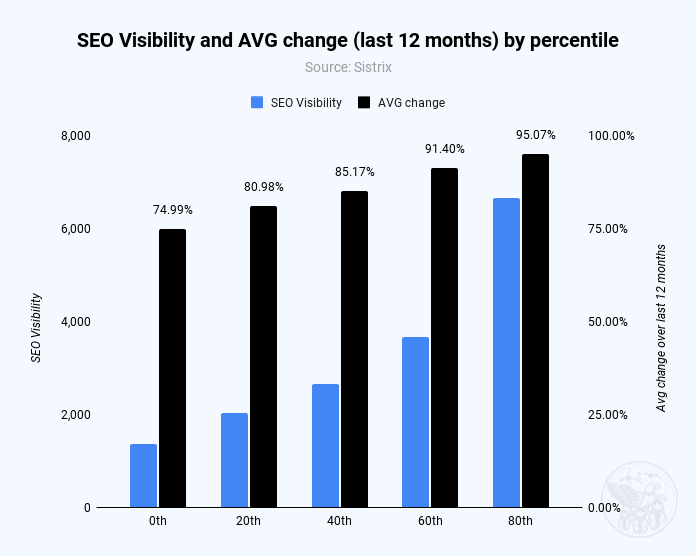
Sites in higher visibility percentiles have a strong relationship with SEO visibility growth over the last 12 months.

Sites that lost visibility have no relationship between the size of their loss and SEO visibility. We can, therefore, say bigger sites are more likely to be successful in SEO.

Bar chart showing SEO Advantage and Average Change percentiles over the last 12 months.Sites in higher percentiles (= more SEO visibility) see stronger growth (Image Credit: Kevin Indig)

However, let’s not forget one thing: Newcomer sites can still get big. It’s harder than it was five or ten years ago, but it’s possible.

There are two reasons why big sites tend to gain more organic traffic.

One reason is how Google weighs ranking signals. Bigger sites tend to have more authority, which allows them to rank for more terms and grow their visibility if they’re able to avoid scale issues, keep content quality high, and continue to satisfy users by solving their problems.

Authority, based on our understanding, is the result of backlinks, content quality, and brand strength.

Google seems to be aware and taking action.

The correlation between SEO visibility and the number of linking domains is strong but was higher in May 2023 (.81) than in May 2024 (0.62). Sites that lost organic traffic showed lower correlations (0.39 in May 2023 and 0.41 in May 2024).

Even though sites that gained organic visibility have more backlinks, the signal seems to have come down significantly over the last 12 months. Backlink volume is still important, but its impact is shrinking. Mind you, volume and quality are two different pairs of sneakers.

The second reason big sites are gaining more organic traffic is Google’s Hidden Gem update, which gives preferential treatment to online communities. The impact is quite visible in the data.

High at the top of the winner list, you find online communities like:

  • Reddit.
  • Quora.
  • Steam Community.
  • Stack Exchange.
  • Ask Ubuntu.

Anecdotally, I noticed strong growth in popular SaaS vendor communities like HubSpot, Shopify, and Zapier. Surely, there are online communities that don’t have the same visibility as the big ones, but still grew significantly over the last 12 months.

The list of losers concentrates on publishers and ecommerce. A surprising number of big publishers lost organic traffic from classic blue links, equal to smaller publishers.

Examples of big publishers:

  • nypost.com (-62.3%).
  • bbc.com (-58.6%).
  • nytimes.com (-40.3%).
  • cnn.com (-40.1%).
  • theguardian.co.uk (-32.8%).

Examples of small publishers:

  • makeuseof.com (-79%).
  • everydayhealth.com (-70.6%).
  • thespruce.com (-58.5%).
  • goodhousekeeping.com (-46.5%).
  • verywellfamily.com (-38.4%).

Keep in mind that publishers rely a lot more on traffic from Top Stories, Google News, and Google Discover, which are not reflected in the data.

Popular Parasite SEO targets like chron.com or timesofindia.com lost significant SEO traffic, as did sites that are not on the list, like medium.com or linkedin.com/pulse. How much effort Google puts into cleaning the search engine results pages (SERPs) is unclear.

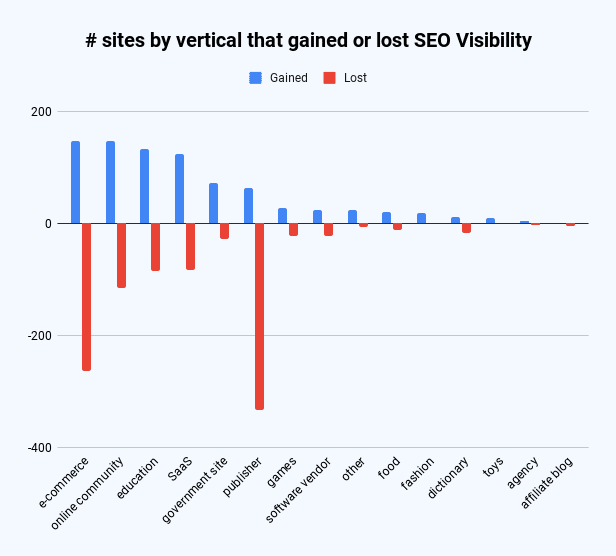
Two-thirds of sites on the list of winners were either SaaS companies, ecommerce companies, education companies, or online communities, with gains between 63% and 83%.

Over 50% of sites on the loser list were publishers or ecommerce sites, with losses between -45% and -53% SEO visibility.

It’s a lot harder to succeed in ecommerce and publisher SEO as almost twice as many ecommerce and five times as many publishers lost SEO visibility than gained.

Bar chart illustrating the number of big sites by vertical that gained or lost SEO visibility. Image Credit: Kevin Indig

The top 5 loser sites with the highest SEO visibility in May 2023 are:

  1. target.com (-35.5%).
  2. wiktionary.org (-61.5%).
  3. etsy.com (-43.6%).
  4. nytimes.com (-40.3%).
  5. thesaurus.com (-59.7%).

I found no discernible pattern for country code top-level domains (ccTLDs): 75% of sites on the winner list had .com ccTLDs. Only 65 were .edu, 39 were .gov, and 94 were .org.

Limitations

  • Of course, the biggest limitation of the analysis is that sites could have gained or lost traffic due to SEO campaigns, technical issues, or domain migrations.
  • The second limitation is the small sample set of 2,000 sites. Even though the analysis looks at the peak of the iceberg, the web might hold millions of sites.

Open Questions

There is a lot of room for interpretation when we talk about the word “big” in big sites. Are we talking about a certain amount of traffic, being owned by a big company, or making a lot of money when calling a big site big?

I focused on organic traffic in this analysis, but it would be interesting to see how some of the biggest companies fare in SEO. One reference point could be Glen Allsopp’s analysis of the big publishing houses dominating the SERPs.

Another question is when Google rewards big sites. During algorithm updates? Continuously over time? An answer would help us understand better how Google works.

I’ll leave you with this: In my interpretation of the data, what made big sites successful is often what keeps their growth going. When a site figures out the right quality for content or a good user experience, it’s more likely to grow continuously than sites that have plateaued or declined in traffic.

Personally, I doubt that people at Google deliberately decide to “go after a niche” or “kill small sites,” but rather that algorithmic decisions lead to those outcomes.

That is not to say Google doesn’t carry a certain responsibility.


Featured Image: Paulo Bobita/Search Engine Journal

Should You Include FAQs On Product Or Category Pages? via @sejournal, @rollerblader

This week’s Ask An SEO question comes from Aleksandar, who asks:

“Is there a role for product Q&A for a fashion brand, which only sells its own branded products, besides the obvious question on the sales/delivery/return process?”

Yes, there is absolutely a role for product Q&A, and for FAQs on collections or categories.

This applies to all niches and industries and is especially relevant in fashion, even more so when the company retails its own products.

But it isn’t SEO-focused; it is about the user experience.

Don’t limit yourself to FAQs alone, descriptions, and answering common questions in the copy works, too. This is something we do a lot in conversion rate optimization (CRO).

A positive impact, when done correctly, is a reduction in customer returns and wait times due to poor website experiences with customer support. I share some examples by page type below.

Proper Q&A on relevant pages answers visitors’ questions so they know the product or service will meet their needs. When you build the consumer’s confidence, they may be more inclined to click add to cart, schedule a meeting, or fill out a form.

Don’t be afraid to say the product or accessory won’t work either, this lets you have an internal link to the product or service while leading them to a working solution.

The first place we look for questions are live chat transcripts and customer service emails – and then we go to the web.

If you look at popular review sites, forums, and communities, you’re going to find questions that your own customers and your competitor’s customers are asking.

Here are a few examples by page type that I either researched or really want to try if the opportunity arises. I’ll start with product pages, then do categories, and finally, a homepage and FAQ.

Product Pages

If the query is about the product in particular and it doesn’t apply to other products you sell, place the content on the specific product page.

I normally do the catch-all vs. the variants like size or color. If you have your canonical links set correctly, you can include them on variants. I’ll use fashion here as the example since that was in your question.

Answer product questions like how the fit of the garment feels, or maybe whether it is meant for pear body shapes or diamonds. You can also compare the sizing of your products to popular brands, like how your company’s medium size fits like the XYZ size at AB, a popular retail store with the same customer demographics.

Do you sell hair care products? Mention the hair types as well as thickness and lengths it is best for, or if it is not good for hair that is dry or chemically treated.

This applies to shoes, too, where you’ll want to talk about them being good for play or comfort, road running or trail hiking, and whether the person pronates or not.

Putting this information in the copy above the call to action (CTA) can help the user make a decision, and there is no harm in placing them in FAQs on the page since they are product-specific. I’ve done this with electronics, fashion, toys, tools, and plenty of other niches.

Collections And Categories

If you work in Shopify, you’ll know this as collections; for most other platforms, they’re called categories. It is a grouping of similar products or services that meet a consumer’s needs.

It could be split by sizes, colors, variations, etc., and adding in questions and answers works just like the product pages above.

In the copy above and below the product grid, don’t keyword stuff for SEO. Instead, answer the questions consumers are asking while focusing on brand talking points and benefits.

You’ll be displaying why the person should shop from the selection of options on the page, have opportunities for natural internal links, and be able to build confidence that the consumer is in the right place.

Instead of a retail experience, I’ll use cruise ships for this one.

I’ve never worked with a cruise company before, but I’ve had this idea for about 10 or so years and have never seen it done. I was researching which cruise to take and saw cabin bathroom questions for a person of size often come up in forums.

I have about 20 more ideas for cruise lines, airlines, and hotels that are similar. Hint hint: If you work in this space, submit an Ask An SEO question so I can get them into writing and out into the world.

Cruise ships are notorious for maximizing limited space. That means they may not be friendly for all types of consumers based on size and physical abilities. You could use text and written language, which is normally smart, and you can use visuals.

My idea here is to have eight or so “tour guides” that can walk the person through the experience as themselves. At least one model should be over 6 foot 5, one should be plus size, and one in a wheelchair.

Not all showers in all cabin types will be able to accommodate someone who is larger, for example. By having a model that resonates with the cruise shopper, they can find out if the cabin type is a match, and the tour guide can walk them through which cabin experience may be better and alternatives like a locker room shower.

Locker room showers on the ships tend to be large and spacious, and the water pressure is normally fantastic. This appeared in multiple comments when I was doing the research and true on the ship we were on.

Tall people may want to see what it’s like to walk through the ship, try the games and amenities like waterslides, and see if there are activities they may not be able to participate in.

The same goes for someone in a wheelchair or who has mobility issues.

If they can have a tour guide that shows the distance from specific rooms to elevators and the fastest routes possible to dining areas and entertainment, they will know if the ship or cabin they’re looking at is right or if they should select a different one.

Home And FAQ Pages

Your homepage and FAQ pages are more similar than you think. The homepage is the perfect space to answer questions about your brand, service, and product lines, as well as things customers want to know. Do this in paragraph form.

You’ll be building natural mentions of collection or category pages for keyword rich internal links that guide the user to the correct experience while you build consumer confidence.

On your FAQs, list out brand and company questions that do not apply to a specific category or product. This could include hours of operation, return policies, where you ship to, and the costs, as well as funny questions to hide an “easter egg” for consumers and fans of your brand to find.

Before you begin adding FAQs to any page, make sure the FAQ applies to that page and not to others. You don’t want to add content for the sake of adding content.

Questions and answers on a collection page should be about the collection, not a specific product. And product questions shouldn’t be about company policies, they should be about the product on that page.

I hope you found this answer helpful. It is one of the tools we use to help save on logistics and overhead expenses and to increase conversions. Great question, and thank you for asking it!

More resources: 


Featured Image: Visual Generation/Shutterstock

OpenAI’s new GPT-4o lets people interact using voice or video in the same model

OpenAI just debuted GPT-4o, a new kind of AI model that you can communicate with in real time via live voice conversation, video streams from your phone, and text. The model is rolling out over the next few weeks and will be free for all users through both the GPT app and the web interface, according to the company. Users who subscribe to OpenAI’s paid tiers, which start at $20 per month, will be able to make more requests. 

OpenAI CTO Mira Murati led the live demonstration of the new release one day before Google is expected to unveil its own AI advancements at its flagship I/O conference on Tuesday, May 14. 

GPT-4 offered similar capabilities, giving users multiple ways to interact with OpenAI’s AI offerings. But it siloed them in separate models, leading to longer response times and presumably higher computing costs. GPT-4o has now merged those capabilities into a single model, which Murati called an “omnimodel.” That means faster responses and smoother transitions between tasks, she said.

The result, the company’s demonstration suggests, is a conversational assistant much in the vein of Siri or Alexa but capable of fielding much more complex prompts.

“We’re looking at the future of interaction between ourselves and the machines,” Murati said of the demo. “We think that GPT-4o is really shifting that paradigm into the future of collaboration, where this interaction becomes much more natural.”

Barret Zoph and Mark Chen, both researchers at OpenAI, walked through a number of applications for the new model. Most impressive was its facility with live conversation. You could interrupt the model during its responses, and it would stop, listen, and adjust course. 

OpenAI showed off the ability to change the model’s tone, too. Chen asked the model to read a bedtime story “about robots and love,” quickly jumping in to demand a more dramatic voice. The model got progressively more theatrical until Murati demanded that it pivot quickly to a convincing robot voice (which it excelled at). While there were predictably some short pauses during the conversation while the model reasoned through what to say next, it stood out as a remarkably naturally paced AI conversation. 

The model can reason through visual problems in real time as well. Using his phone, Zoph filmed himself writing an algebra equation (3x + 1 = 4) on a sheet of paper, having GPT-4o follow along. He instructed it not to provide answers, but instead to guide him much as a teacher would.

“The first step is to get all the terms with x on one side,” the model said in a friendly tone. “So, what do you think we should do with that plus one?”

GPT-4o will store records of users’ interactions with it, meaning the model “now has a sense of continuity across all your conversations,” according to Murati. Other highlights include live translation, the ability to search through your conversations with the model, and the power to look up information in real time. 

As is the nature of a live demo, there were hiccups and glitches. GPT-4o’s voice might jump in awkwardly during the conversation. It appeared to comment on one of the presenters’ outfits even though it wasn’t asked to. But it recovered well when the demonstrators told the model it had erred. It seems to be able to respond quickly and helpfully across several mediums that other models have not yet merged as effectively. 

Previously, many of OpenAI’s most powerful features, like reasoning through image and video, were behind a paywall. GPT-4o marks the first time they’ll be opened up to the wider public, though it’s not yet clear how many interactions you’ll be able to have with the model before being charged. OpenAI says paying subscribers will “continue to have up to five times the capacity limits of our free users.” 

Additional reporting by Will Douglas Heaven.

Robots Are Coming to Ecommerce SMBs

Small to midsize ecommerce companies often struggle with order fulfillment. Given the costs of running a warehouse and fulfillment center, many SMBs outsource those tasks, but that could change as robots become viable for even smaller companies.

Warehouse Automation

Warehouse automation has existed for years and continues to expand. According to a February 2024 Gartner report titled “Avoid These Pitfalls in Large-Scale Warehouse Automations,” the industry will generate about $21.8 billion in worldwide revenue in 2024 and reach an estimated $71.0 billion by 2032.

Much of the industry’s revenue and growth comes from large retailers and logistics businesses. This focus on huge companies has generally put warehouse automation out of reach for SMBs for at least two reasons.

First, warehouse systems — particularly robotic ones — are too large and complex for non-enterprise companies. A business that doesn’t completely understand the nuance of pick-and-pack software, technology infrastructure, robots, and services can easily waste truckloads of money on systems that prove inadequate or overblown.

Second, an automated, robotic pick-and-pack warehouse solution is expensive. Think millions or tens of millions of dollars. Investing in the automation doesn’t make sense until a business has scale and volume.

Hence ecommerce SMBs typically run small, manual shipping operations or scale with the help of a fulfillment service and its warehouse automation and shipping facilities. The fulfillment vendor invests in the technology, and its many customers benefit.

The choice boils down to a business calculation: pay the fulfillment service or incur the cost of doing it in-house.

Affordable Robots?

There could soon be another option for SMBs — or at least mid-sized merchants.

Warehouse automation companies such as BionicHive, Dexterity Inc., Prime Robotics, and Pio have started to aim products and services at ecommerce SMBs in an apparent effort to reach emerging sellers.

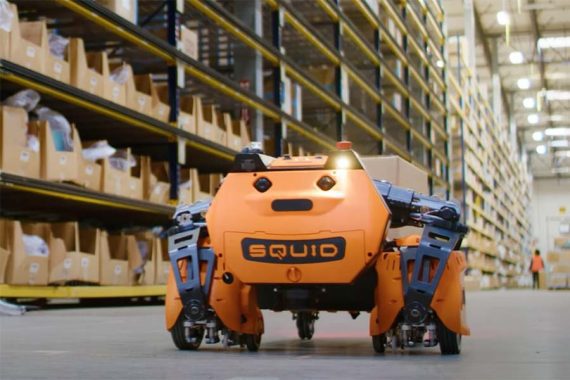
For example, BionicHive makes a two-foot-wide, 100-pound robot that runs through aisles and along existing warehouse shelves, picking orders unaided. The robot, called sqUID, is suitable for large and, potentially, mid-sized merchants.

The sqUID is primarily a tool for large warehouses and, potentially, mid-market sellers.

Meanwhile, Pio’s P100 cube — “essentially a high-speed vending machine” that stores and picks products efficiently — starts at $101,999 as of May 2024 for a 14-foot, 620-bin setup with two picking robots plus a $2,997 monthly fee. Upgrade to three robots, and the monthly subscription is $3,996.

Each of the Pio robots can pick about 120 items per hour. The system is “plug-and-play,” meaning merchants don’t need a separate warehouse management system. It will work alongside existing manual fulfillment operations, occupying as little as 500 square feet.

As seen in this rendering, the Pio P100 is a compact cube filled with storage bins, each capable of holding, for example, about 120 t-shirts.

Potential Benefit

The warehouse automation industry remains focused on massive companies, but the nascent trend toward ecommerce SMBs could offer growing brands more fulfillment options.

The question will be whether small-scale warehouse automation systems and robotics save ecommerce companies money and otherwise offer a competitive advantage.

Pio, which is based on large-scale warehouse technology from AutoStore, had five cube-and-robot installations at the time of writing: Privada Cigar Club, Sunday Swagger (apparel), Souko (fulfillment), Barnes 4WD (auto parts), and AI Stone (apparel).

The performance of these brands could foretell ecommerce fulfillment in general.

Lessons from Building a People-first Culture

Entrepreneurs can struggle to achieve sustainable revenue and profit. Many factors contribute, such as pricing, product or market fit, sales strategy, and user experience.

But after 20 years of starting and growing multiple businesses with annual sales in the millions, I have reached one conclusion: successful, growth-oriented companies are all about people and culture.

Here are my four pillars for building a thriving company.

Hire Right

My entrepreneurial journey began 20 years ago after a painful layoff when I launched a web analytics consultancy in Silicon Valley. The first couple of years were bleak, but my partner and I gradually mastered sales and built a steady revenue stream. We realized, however, that we had to increase capacity to grow.

That’s when we hired our first employees.

Bad hires can derail a business faster than any other issue. They can drag down performance and erode the culture, creating a vicious downward cycle — the opposite of why they were hired.

I now follow three hiring rules:

Hire top performers, whom I call “A” employees. “A” people hire other “A” people, and “B” people hire “C” people. No “A” performer would want to work with mediocrity or, conversely, hire underperformers.

Hire for attitude before skill. In one form or another, this is what Herb Kelleher, founder of Southwest Airlines, and many other icons urge. In his book “Good to Great,” author Jim Collins phrased it as getting “the right people on the bus.” Regardless of the description, it’s imperative. Look for hunger to learn and the unique combination of competitiveness and selflessness that supports a rigorous yet supportive culture.

Learn, do, and then seek. I acquired this rule the hard way. Before you hire, develop a solid understanding of what you’re hiring for. Early on, I knew very little about selling to large enterprises. My partner and I rushed to hire a “seasoned” salesperson who brought in no qualified leads nor closed a single deal. We had to let him go after three months of wasted salary when we were cash-strapped.

Avoid this painful and costly mistake. Ask professional colleagues to recommend candidates, or enlist a subject matter expert to sit in on interviews. Don’t hire on your own for a professional skill you don’t understand.

Behavior Modeling

Hiring a team creates a company culture by default or intention. And the owner is responsible for setting the tone and leading by example.

For instance, an owner who requires quick responses to customers must lead by example. Lecturing a team won’t suffice; the owner must model the behavior she seeks.

Continuous Learning

In our modern, tech-driven economy, knowledge is a primary — perhaps the only — competitive advantage. So owners who want their team to continually learn should demonstrate that behavior themselves, such as by sharing key takeaways from a conference or a book. Establish a system for learning. Set a budget for staff to take courses and attend trade shows. The owner’s actions guide the way.

Foster Ownership

Entrepreneurs frequently tell me they want employees to have a high sense of ownership. My response is to treat employees like owners.

Early in our business, when we had fewer than 10 people, I included our team in all major decisions. Everyone felt vested in the process and advocated energetically for what they felt was best for the company.

I also shared our monthly financials with the entire staff to show where we stood on planned versus actual revenue and profit. My partner and I committed to offering more benefits once we met or exceeded our profit targets, and we delivered on that commitment. Ownership in the financial sense was tangible, and so was our continued growth.

A people-first business committed to learning, collaboration, excellence, and shared rewards can break through barriers, work through slumps, and expand. A healthy culture can’t guarantee success, but in my experience, it’s a prerequisite for sustained growth.

Why Google Can’t Tell You About Every Ranking Drop via @sejournal, @MattGSouthern

In a recent Twitter exchange, Google’s Search Liaison, Danny Sullivan, provided insight into how the search engine handles algorithmic spam actions and ranking drops.

The discussion was sparked by a website owner’s complaint about a significant traffic loss and the inability to request a manual review.

Sullivan clarified that a site could be affected by an algorithmic spam action or simply not ranking well due to other factors.

He emphasized that many sites experiencing ranking drops mistakenly attribute it to an algorithmic spam action when that may not be the case.

“I’ve looked at many sites where people have complained about losing rankings and decide they have a algorithmic spam action against them, but they don’t. “

Sullivan’s full statement will help you understand Google’s transparency challenges.

Additionally, he explains why the desire for manual review to override automated rankings may be misguided.

Challenges In Transparency & Manual Intervention

Sullivan acknowledged the idea of providing more transparency in Search Console, potentially notifying site owners of algorithmic actions similar to manual actions.

However, he highlighted two key challenges:

  1. Revealing algorithmic spam indicators could allow bad actors to game the system.
  2. Algorithmic actions are not site-specific and cannot be manually lifted.

Sullivan expressed sympathy for the frustration of not knowing the cause of a traffic drop and the inability to communicate with someone about it.

However, he cautioned against the desire for a manual intervention to override the automated systems’ rankings.

Sullivan states:

“…you don’t really want to think “Oh, I just wish I had a manual action, that would be so much easier.” You really don’t want your individual site coming the attention of our spam analysts. First, it’s not like manual actions are somehow instantly processed. Second, it’s just something we know about a site going forward, especially if it says it has change but hasn’t really.”

Determining Content Helpfulness & Reliability

Moving beyond spam, Sullivan discussed various systems that assess the helpfulness, usefulness, and reliability of individual content and sites.

He acknowledged that these systems are imperfect and some high-quality sites may not be recognized as well as they should be.

“Some of them ranking really well. But they’ve moved down a bit in small positions enough that the traffic drop is notable. They assume they have fundamental issues but don’t, really — which is why we added a whole section about this to our debugging traffic drops page.”

Sullivan revealed ongoing discussions about providing more indicators in Search Console to help creators understand their content’s performance.

“Another thing I’ve been discussing, and I’m not alone in this, is could we do more in Search Console to show some of these indicators. This is all challenging similar to all the stuff I said about spam, about how not wanting to let the systems get gamed, and also how there’s then no button we would push that’s like “actually more useful than our automated systems think — rank it better!” But maybe there’s a way we can find to share more, in a way that helps everyone and coupled with better guidance, would help creators.”

Advocacy For Small Publishers & Positive Progress

In response to a suggestion from Brandon Saltalamacchia, founder of RetroDodo, about manually reviewing “good” sites and providing guidance, Sullivan shared his thoughts on potential solutions.

He mentioned exploring ideas such as self-declaration through structured data for small publishers and learning from that information to make positive changes.

“I have some thoughts I’ve been exploring and proposing on what we might do with small publishers and self-declaring with structured data and how we might learn from that and use that in various ways. Which is getting way ahead of myself and the usual no promises but yes, I think and hope for ways to move ahead more positively.”

Sullivan said he can’t make promises or implement changes overnight, but he expressed hope for finding ways to move forward positively.


Featured Image: Tero Vesalainen/Shutterstock

Content Decay: A Rotten Name For A Real SEO Issue via @sejournal, @martinibuster

Google’s Lizzi Sassman and John Mueller answered a question about Content Decay, expressing confusion over the phrase because they’d never heard of it. Turns out there’s a good reason: Content Decay is a just a new name created to make an old problem look like a new one.

Googlers Never Heard Of Content Decay

Google tech writer Lizzi Sassman began a Google Search Off The Record podcast by stating that they are talking about Content Decay because someone submitted that topic and then remarked that she had never heard of Content Decay.

She said:

“…I saw this come up, I think, in your feedback form for topics for Search Off the Record podcast that someone thought that we should talk about content decay, and I did not know what that was, and so I thought I should look into it, and then maybe we could talk about it.”

Google’s John Mueller responded:

“Well, it’s good that someone knows what it is. …When I looked at it, it sounded like this was a known term, and I felt inadequate when I realized I had no idea what it actually meant, and I had to interpret what it probably means from the name.”

Then Lizzi pointed out that the name Content Decay sounds like it’s referring to something that’s wrong with the content:

“Like it sounds a little bit negative. A bit negative, yeah. Like, yeah. Like something’s probably wrong with the content. Probably it’s rotting or something has happened to it over time.”

It’s not just Googlers who don’t know what the term Content Decay means, experienced SEOs with over 25 years of experience had never heard of it either, including myself. I reached out to several experienced SEOs and nobody had heard of the term Content Decay.

Like Lizzi, anyone who hears the term Content Decay will reasonably assume that this name refers to something that’s wrong with the content. But that is incorrect. As Lizzi and John Mueller figured out, content decay is not really about content, it’s just a name that someone gave to a natural phenomenon that’s been happening for thousands of years.

If you feel out of the loop because you too have never heard of Content Decay, don’t. Content Decay is one of those inept labels someone coined to put a fresh name on a problem that is so old it predates not just the Internet but the invention of writing itself.

What Is Content Decay?

What people mean when they talk about Content Decay is a slow drop in search traffic. But a slow drop in traffic is not a definition, it’s just a symptom of the actual problem which is declining user interest. Declining user interest in a topic, product, service or virtually any entity is something that that is normal and expected that can sneak up affect organic search trends, even for evergreen topics. Content Decay is an inept name for an actual SEO issue to deal with. Just don’t call it Content Decay.

How Does User Interest Dwindle?

Dwindling interest is a longstanding phenomenon that is older than the Internet. Fashion, musical styles and topics come and go in the physical and the Internet planes.

A classic example of dwindling interest is how search queries for digital cameras collapsed after the introduction of the iPhone because most people no longer needed a separate camera device.

Similarly, the problem with dwindling traffic is not necessarily the content. It’s search trends. If search trends are the reason for declining traffic then that’s probably declining user interest and the problem to solve is figuring out why interest in a topic is changing.

Typical reasons for declining user interest:

  • Perceptions of the topic changed
  • Seasonality
  • A technological disruption
  • The way words are used has changed
  • Popularity of the topic has waned

When diagnosing a drop in traffic always keep an open mind to all possibilities because sometimes there’s nothing wrong with the content or the SEO. The problem is with user interest, trends and other factors that have nothing to do with the content itself.

There Are Many Reasons For A Drop In Traffic

The problem with inept SEO catch-all phrases is that because they do not describe anything specific the meaning of the catch-all phrase tends to morph and pretty much the catch-all begins describing things beyond what it initially ineptly described.

Here are other reasons for why traffic could decline (both slow and precipitously):

  1. The decay is happening to user interest in a topic (declining user interest is a better description).
  2. Traffic slows down because Google introduces a new navigational feature (like people also ask.
  3. Traffic slows because Google introduces a new rich result (video results, shopping results, featured snippets)
  4. The slow decline in search traffic could be a side effect of personalized search causes the site to rank less often and only for specific people/areas (personalized search)
  5. The drop in search traffic is because relevance changed (Algorithm Relevance Change)
  6. A drop in organic search traffic is due to improved competition (Competition)

Catchall Phrases Are Not Useful

Content Decay is one of many SEO labels put on problems or strategies in order to make old problems and methods appear to be new. Too often those labels are inept and cause confusion because they don’t describe the problem.

Putting a name to the cause of the problem is a good practice. So rather than use fake names like Content Decay maybe make a conscious effort to use the actual name of what the problem or solution is. In the case of Content Decay it’s best to identify the problem (declining user interest) and refer to the problem by that name.

Featured Image by Shutterstock/Blueastro