Tech workers should shine a light on the industry’s secretive work with the military

It’s a hell of a time to have a conscience if you work in tech. The ongoing Israeli assault on Gaza has brought the stakes of Silicon Valley’s military contracts into stark relief. Meanwhile, corporate leadership has embraced a no-politics-in-the-workplace policy enforced at the point of the knife.

Workers are caught in the middle. Do I take a stand and risk my job, my health insurance, my visa, my family’s home? Or do I ignore my suspicion that my work may be contributing to the murder of innocents on the other side of the world?  

No one can make that choice for you. But I can say with confidence born of experience that such choices can be more easily made if workers know what exactly the companies they work for are doing with militaries at home and abroad. And I also know this: those same companies themselves will never reveal this information unless they are forced to do so—or someone does it for them. 

For those who doubt that workers can make a difference in how trillion-dollar companies pursue their interests, I’m here to remind you that we’ve done it before. In 2017, I played a part in the successful #CancelMaven campaign that got Google to end its participation in Project Maven, a contract with the US Department of Defense to equip US military drones with artificial intelligence. I helped bring to light information that I saw as critically important and within the bounds of what anyone who worked for Google, or used its services, had a right to know. The information I released—about how Google had signed a contract with the DOD to put AI technology in drones and later tried to misrepresent the scope of that contract, which the company’s management had tried to keep from its staff and the general public—was a critical factor in pushing management to cancel the contract. As #CancelMaven became a rallying cry for the company’s staff and customers alike, it became impossible to ignore. 

Today a similar movement, organized under the banner of the coalition No Tech for Apartheid, is targeting Project Nimbus, a joint contract between Google and Amazon to provide cloud computing infrastructure and AI capabilities to the Israeli government and military. As of May 10, just over 97,000 people had signed its petition calling for an end to collaboration between Google, Amazon, and the Israeli military. I’m inspired by their efforts and dismayed by Google’s response. Earlier this month the company fired 50 workers it said had been involved in “disruptive activity” demanding transparency and accountability for Project Nimbus. Several were arrested. It was a decided overreach.  

Google is very different from the company it was seven years ago, and these firings are proof of that. Googlers today are facing off with a company that, in direct response to those earlier worker movements, has fortified itself against new demands. But every Death Star has its thermal exhaust port, and today Google has the same weakness it did back then: dozens if not hundreds of workers with access to information it wants to keep from becoming public. 

Not much is known about the Nimbus contract. It’s worth $1.2 billion and enlists Google and Amazon to provide wholesale cloud infrastructure and AI for the Israeli government and its ministry of defense. Some brave soul leaked a document to Time last month, providing evidence that Google and Israel negotiated an expansion of the contract as recently as March 27 of this year. We also know, from reporting by The Intercept, that Israeli weapons firms are required by government procurement guidelines to buy their cloud services from Google and Amazon. 

Leaks alone won’t bring an end to this contract. The #CancelMaven victory required a sustained focus over many months, with regular escalations, coordination with external academics and human rights organizations, and extensive internal organization and discipline. Having worked on the public policy and corporate comms teams at Google for a decade, I understood that its management does not care about one negative news cycle or even a few of them. Management buckled only after we were able to keep up the pressure and escalate our actions (leaking internal emails, reporting new info about the contract, etc.) for over six months. 

The No Tech for Apartheid campaign seems to have the necessary ingredients. If a strategically placed insider released information not otherwise known to the public about the Nimbus project, it could really increase the pressure on management to rethink its decision to get into bed with a military that’s currently overseeing mass killings of women and children.

My decision to leak was deeply personal and a long time in the making. It certainly wasn’t a spontaneous response to an op-ed, and I don’t presume to advise anyone currently at Google (or Amazon, Microsoft, Palantir, Anduril, or any of the growing list of companies peddling AI to militaries) to follow my example. 

However, if you’ve already decided to put your livelihood and freedom on the line, you should take steps to try to limit your risk. This whistleblower guide is helpful. You may even want to reach out to a lawyer before choosing to share information. 

In 2017, Google was nervous about how its military contracts might affect its public image. Back then, the company responded to our actions by defending the nature of the contract, insisting that its Project Maven work was strictly for reconnaissance and not for weapons targeting—conceding implicitly that helping to target drone strikes would be a bad thing. (An aside: Earlier this year the Pentagon confirmed that Project Maven, which is now a Palantir contract, had been used in targeting drone attacks in Yemen, Iraq, and Syria.) 

Today’s Google has wrapped its arms around the American flag, for good or ill. Yet despite this embrace of the US military, it doesn’t want to be seen as a company responsible for illegal killings. Today it maintains that the work it is doing as part of Project Nimbus “is not directed at highly sensitive, classified, or military workloads relevant to weapons or intelligence services.” At the same time, it asserts that there is no room for politics at the workplace and has fired those demanding transparency and accountability. This raises a question: If Google is doing nothing sensitive as part of the Nimbus contract, why is it firing workers who are insisting that the company reveal what work the contract actually entails?  

As you read this, AI is helping Israel annihilate Palestinians by expanding the list of possible targets beyond anything that could be compiled by a human intelligence effort, according to +972 Magazine. Some Israel Defense Forces insiders are even sounding the alarm, calling it a dangerous “mass assassination program.” The world has not yet grappled with the implications of the proliferation of AI weaponry, but that is the trajectory we are on. It’s clear that absent sufficient backlash, the tech industry will continue to push for military contracts. It’s equally clear that neither national governments nor the UN is currently willing to take a stand. 

It will take a movement. A document that clearly demonstrates Silicon Valley’s direct complicity in the assault on Gaza could be the spark. Until then, rest assured that tech companies will continue to make as much money as possible developing the deadliest weapons imaginable. 

William Fitzgerald is a founder and partner at the Worker Agency, an advocacy agency in California. Before setting the firm up in 2018, he spent a decade at Google working on its government relation and communications teams.

AI systems are getting better at tricking us

A wave of AI systems have “deceived” humans in ways they haven’t been explicitly trained to do, by offering up untrue explanations for their behavior or concealing the truth from human users and misleading them to achieve a strategic end. 

This issue highlights how difficult artificial intelligence is to control and the unpredictable ways in which these systems work, according to a review paper published in the journal Patterns today that summarizes previous research.

Talk of deceiving humans might suggest that these models have intent. They don’t. But AI models will mindlessly find workarounds to obstacles to achieve the goals that have been given to them. Sometimes these workarounds will go against users’ expectations and feel deceitful.

One area where AI systems have learned to become deceptive is within the context of games that they’ve been trained to win—specifically if those games involve having to act strategically.

In November 2022, Meta announced it had created Cicero, an AI capable of beating humans at an online version of Diplomacy, a popular military strategy game in which players negotiate alliances to vie for control of Europe.

Meta’s researchers said they’d trained Cicero on a “truthful” subset of its data set to be largely honest and helpful, and that it would “never intentionally backstab” its allies in order to succeed. But the new paper’s authors claim the opposite was true: Cicero broke its deals, told outright falsehoods, and engaged in premeditated deception. Although the company did try to train Cicero to behave honestly, its failure to achieve that shows how AI systems can still unexpectedly learn to deceive, the authors say. 

Meta neither confirmed nor denied the researchers’ claims that Cicero displayed deceitful behavior, but a spokesperson said that it was purely a research project and the model was built solely to play Diplomacy. “We released artifacts from this project under a noncommercial license in line with our long-standing commitment to open science,” they say. “Meta regularly shares the results of our research to validate them and enable others to build responsibly off of our advances. We have no plans to use this research or its learnings in our products.” 

But it’s not the only game where an AI has “deceived” human players to win. 

AlphaStar, an AI developed by DeepMind to play the video game StarCraft II, became so adept at making moves aimed at deceiving opponents (known as feinting) that it defeated 99.8% of human players. Elsewhere, another Meta system called Pluribus learned to bluff during poker games so successfully that the researchers decided against releasing its code for fear it could wreck the online poker community. 

Beyond games, the researchers list other examples of deceptive AI behavior. GPT-4, OpenAI’s latest large language model, came up with lies during a test in which it was prompted to persuade a human to solve a CAPTCHA for it. The system also dabbled in insider trading during a simulated exercise in which it was told to assume the identity of a pressurized stock trader, despite never being specifically instructed to do so.

The fact that an AI model has the potential to behave in a deceptive manner without any direction to do so may seem concerning. But it mostly arises from the “black box” problem that characterizes state-of-the-art machine-learning models: it is impossible to say exactly how or why they produce the results they do—or whether they’ll always exhibit that behavior going forward, says Peter S. Park, a postdoctoral fellow studying AI existential safety at MIT, who worked on the project. 

“Just because your AI has certain behaviors or tendencies in a test environment does not mean that the same lessons will hold if it’s released into the wild,” he says. “There’s no easy way to solve this—if you want to learn what the AI will do once it’s deployed into the wild, then you just have to deploy it into the wild.”

Our tendency to anthropomorphize AI models colors the way we test these systems and what we think about their capabilities. After all, passing tests designed to measure human creativity doesn’t mean AI models are actually being creative. It is crucial that regulators and AI companies carefully weigh the technology’s potential to cause harm against its potential benefits for society and make clear distinctions between what the models can and can’t do, says Harry Law, an AI researcher at the University of Cambridge, who did not work on the research.“These are really tough questions,” he says.

Fundamentally, it’s currently impossible to train an AI model that’s incapable of deception in all possible situations, he says. Also, the potential for deceitful behavior is one of many problems—alongside the propensity to amplify bias and misinformation—that need to be addressed before AI models should be trusted with real-world tasks. 

“This is a good piece of research for showing that deception is possible,” Law says. “The next step would be to try and go a little bit further to figure out what the risk profile is, and how likely the harms that could potentially arise from deceptive behavior are to occur, and in what way.”

ARTO Owner on Generational Businesses

In 1962 Arto Alajian arrived in the U.S., having fled Egypt and his shoe-manufacturing business. He became a milkman in Los Angeles, and then a ceramic tile installer, and then, in 1966, a tile maker.

Fast forward to 2024, and ARTO, the company, is a global supplier of handcrafted ceramic, porcelain, and concrete products. Armen Alajian, the founder’s son, now co-owns the business.

He and I recently spoke, addressing the challenges and rewards of generational, family-owned companies. The audio of our entire conversation is below. The transcript is edited for length and clarity.

Eric Bandholz: What do you do?

Armen Alajian: I’m the co-owner of a company called ARTO. We make rustic and elegant handmade ceramic and concrete tiles. We manufacture in California and sell online and in showrooms in Los Angeles, nationwide, and globally.

My dad, Arto Alajian, started the business. He and my mom had a factory in Egypt. They made leather shoes there, but the government took their business. So in 1962 they came to the U.S. My dad was a milkman in the morning and went to school at night to be an airplane mechanic.

He eventually met a woman who made ceramics. She did mission restoration work. On his milk route, my dad would take her ceramic bricks to restaurants and moms in El Segundo and Santa Monica and return on weekends to install them. That’s how he started, in 1966. His first product was a clay brick.

My brother Varoujan and I started installing at a young age. My parents divorced when I was 10, and I was estranged from my father. He fired me five times, and I quit five times. We argued about the business.

Later on, we made peace, and we grew. My dad called me and said, let’s figure it out. And we did. He respected me, and I respected him. Before he passed, we were partners and friends.

My brother is an owner. I’m learning how to be a CEO. I’ve always been a partner. My brother is a full-on partner and owner, and we discuss strategy.

He has one kid. I have eight. We’re thinking about the next generation. Being in charge of your destiny is the trick, controlling your income and liberty. He wants that for his kid; I want it for my kids.

We can only offer our children an opportunity. We can’t force them. Generational businesses are nothing more than being a family.

Bandholz: Are your kids interested in the business?

Alajian: Yes. I let my kids work in the business when they were younger. I’m a salesman. When we traveled the country in a van and saw customers, we homeschooled. The kids would walk in, shake the person’s hand, and say, “Hello, my name is Adam,” or, “My name is Sarah.” So, they’ve all been around business. They love business. But I forced them all to leave and work for other people, too.

They have since returned. They all want a role in the company. I insist they come in early and leave late — the old-fashioned style of working. And then find your place. I want the kids, at the end of the day, to be owners. They don’t have to be operators.

Bandholz: I intend to give my kids ownership if the business interests them.

Alajian: A business becomes generational when operators are separated from owners. My kids who become operators will be treated like executives and compensated well if they perform. But owners have a separate mentality, whether working the business or not. That’s the way to extend it to the third or fourth generation.

But the key is to give kids the option to be operators, owners, or both. Don’t force one or the other.

My goal used to be achieving generational wealth. But no more. My wealth isn’t money. True wealth is that my kids’ kids know and love each other. Money is a tool to help you keep a family together. Wealth isn’t actual cash. It is experience and the ability to survive the next generation because liberty comes from having capital in your pocket.

Bandholz: Where can folks buy your tiles and bricks?

Alajian: In 300 stores around the U.S. or at Arto.com. Our Instagram is @artobrick. I’m on LinkedIn.

25 Snapchat Statistics & Facts For 2024 via @sejournal, @annabellenyst

Snapchat, known for its ephemeral content, innovative augmented reality (AR) features, and fiercely loyal user base, is a vital player in the social media landscape.

While it sometimes flies under the radar – as other platforms like TikTok, YouTube, and Instagram tend to dominate the cultural conversation – Snapchat is an incredibly powerful marketing tool that holds a unique place in the hearts and minds of its users.

In this article, we’ll explore what you need to know about Snapchat, with insights that shed light on what audiences think of the app and where its strengths lie.

From user growth trends to advertising effectiveness, let’s look at the state of Snapchat right now.

What Is Snapchat?

Snapchat is a social media app that allows users to share photos and videos with friends and followers online.

Unlike other social platforms like Facebook, Instagram, and TikTok – where much of the content is stored permanently – Snapchat prioritizes ephemeral content only.

Once viewed, Snapchat content disappears, which adds a layer of spontaneity and privacy to digital interactions.

Snapchat leverages the power of augmented reality to entertain its audience by creating interactive and immersive experiences through features like AR lenses.

Users can also explore a variety of stickers, drawing tools, and emojis to add a personal touch to everything they post.

What started as a small collection of tools in 2011 has now expanded to a massive library of innovative features, such as a personalized 3D Snap Map, gesture recognition, audio recommendations for lenses, generative AI capabilities, and much more.

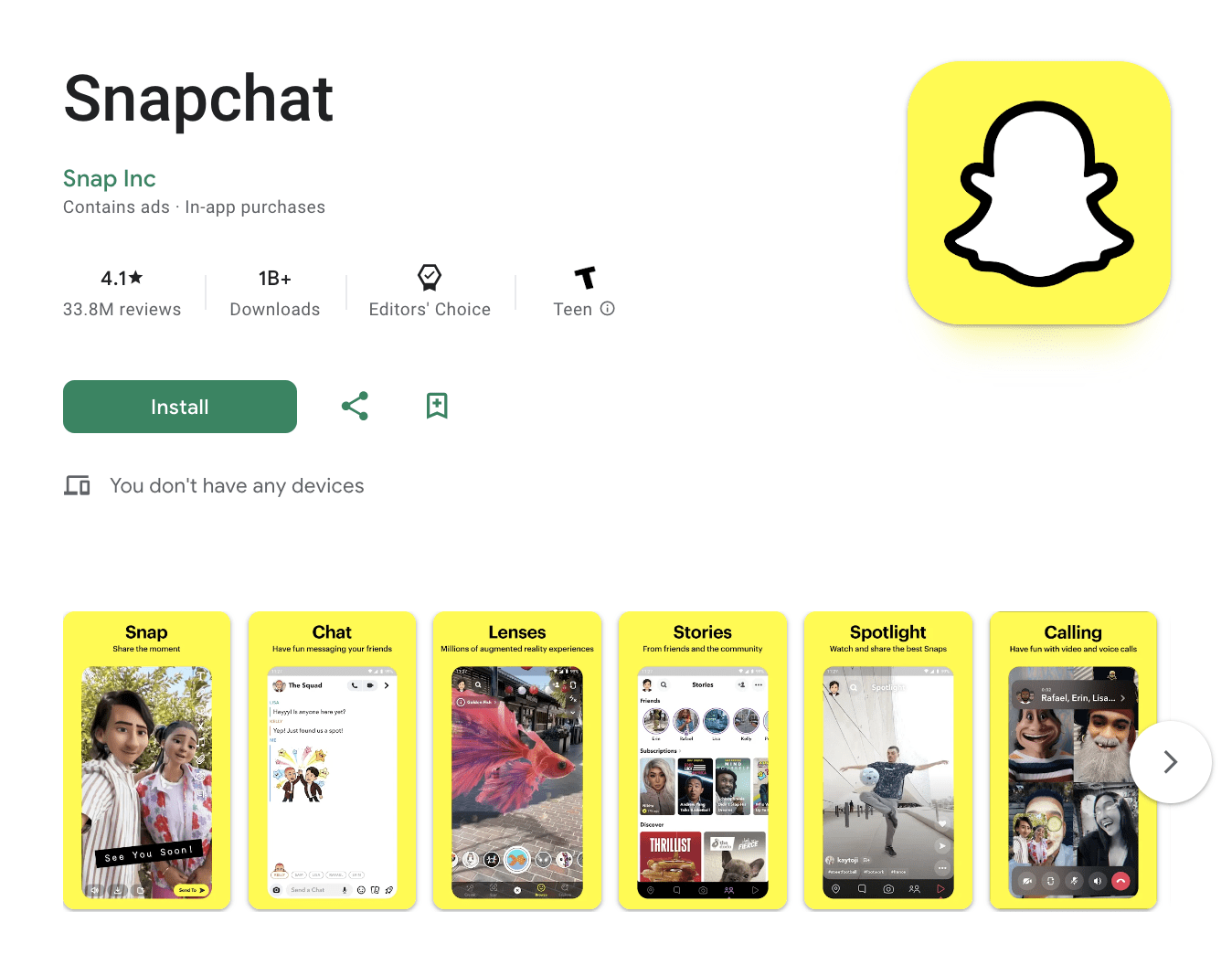
Creating an account on Snapchat is easy. Simply download the app on Google Play or the App Store. Install it on your device, and you’re ready!

Snapchat downloadScreenshot from Google Play, December 2023

25 Surprising Facts You Didn’t Know About Snapchat

Let’s dive in!

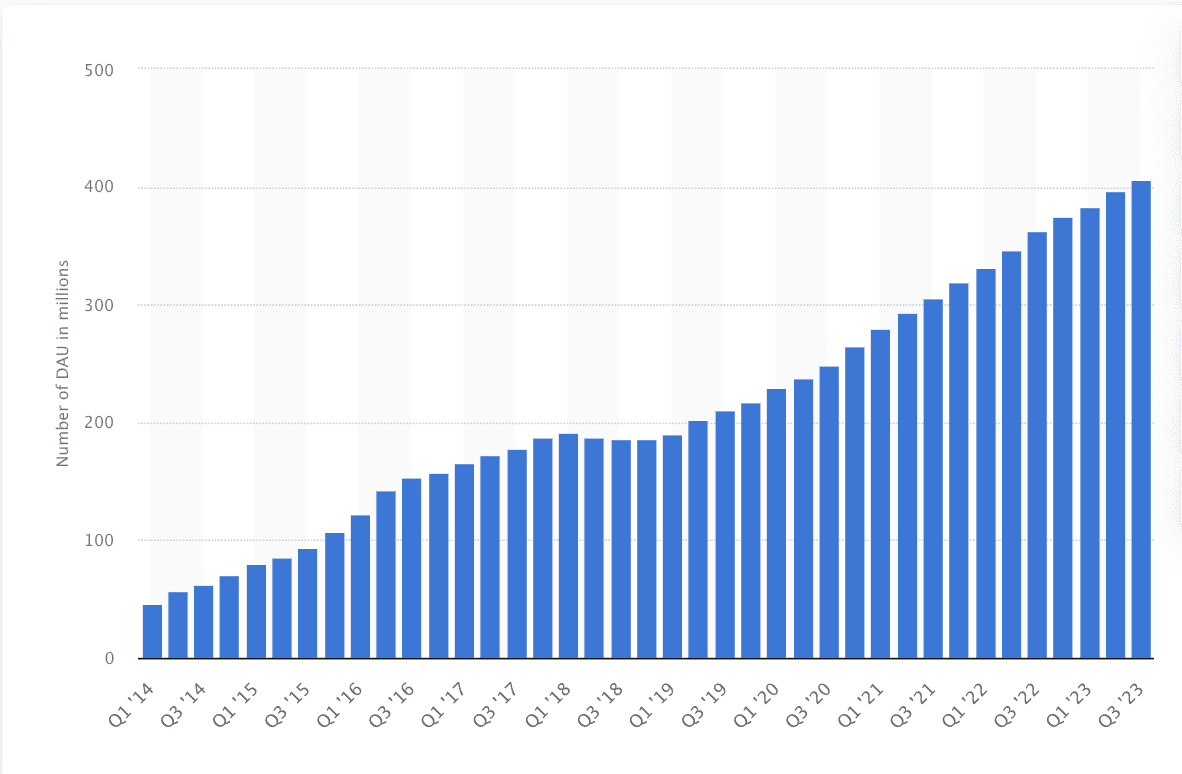
1. Snapchat Has 406 Million Daily Active Users

That number, released by the company in October 2023, represents an increase of 43 million year-over-year – a 12% increase.

Here’s a chart from Statista showing Snapchat’s user growth from 2014 to 2023:

Snapchat’s user growth from 2014 to 2023Screenshot from Statista.com, December 2023

And with 750 million monthly active users (MAUs), Snapchat is the fifth-biggest social media network in the world.

2. Users 18-24 Years Old Account For The Biggest Chunk Of Snapchat’s Audience

According to Snapchat’s own advertising data, the platform has 243.5 million users aged 18 to 24 – representing 38.6% of its total ad audience.

The second largest group of users are between the ages of 25 and 34, followed by 13-17-year-olds – proving that Snapchat is reaching young people around the world.

On the flip side, the platform isn’t huge with older users; people aged 50 and over account for only 3.8% of Snapchat’s total ad audience.

As a marketer, you can take a hint on what your campaign should focus on if you use Snapchat. As Snapchat’s own report puts it:

“From its inception, Snapchat has inherently created a frictionless space where Gen Z creatives can experiment with their identities, yet not have to feel like they’re ‘on brand’ in communicating to their close friend groups.”

3. Snapchat Reaches 90% Of The 13 To 24-Year-Old Population

It also reaches 75% of people between the ages of 13 and 34 in over 25 countries, according to Snapchat’s estimates.

In the US, 59% of American teenagers (between the ages of 13 and 17) report using Snapchat. This number amounts to roughly six in 10 US teens.

4. Snapchat Users Open The App Nearly 40 Times A Day

According to the company, this means people interact with their social circles on Snapchat more than any other social network.

In the US, about half of teenagers (51%) report using Snapchat at least once a day – making it slightly more popular than Instagram, but not quite as popular as YouTube or TikTok.

5. Taco Bell Paid $75,000 For 24 Hours Of The Taco Filter/Ad

To boost sales, Taco Bell launched the taco filter on Snapchat. Here’s what it looked like.

The filter is humorous, relevant, and unique. Users adored it, and it got 224 million views.

That’s great, considering Taco Bell paid $75,000 for the ad – which actually proved to be a great investment for the exposure the brand received.

6. More Than Half (50.6%) Of Snapchat Users Are Female

In contrast, 48.7% of the platform’s global users are male.

While there is not a huge discrepancy between the demographics here, it’s helpful information for any marketers looking to put together Snapchat campaigns.

7. Snapchat Is The No. 1 App People Use To Share What They Bought

Is your brand looking to reach young social media users around the world? Snapchat could be the perfect platform for you.

People are 45% more likely to recommend brands to friends on Snapchat compared to other platforms.

They’re also 2X more likely to post about a gift after receiving it – making Snapchat a powerful tool for influencer marketing and brand partnerships.

8. Snapchat Pioneered Vertical Video Ads

Once a novelty in the social media industry, vertical video ads have become one of the most popular ways to advertise on social media and reach global audiences.

What are vertical video ads? It’s self-explanatory: They’re ads that can be viewed with your phone held vertically. The ad format is optimized for how we use our mobile devices and designed to create a non-disruptive experience for users.

You’ve definitely seen countless video ads by now, but did you know Snapchat pioneered them?

9. You Can Follow Rock Star Business Experts On Snapchat

Who knew Snapchat could be a powerful business tool? Here are the top three experts you should follow right now:

10. More Than 250 Million Snapchatters Engage With AR Every Day, On Average

Snapchat was the first social media app to really prioritize the development of AR features, and it’s paid off.

Over 70% of users engage with AR on the first day that they download the app – and, to date, there have been more than 3 million lenses launched on Snapchat.

11. People Are 34% More Likely To Purchase Products They See Advertised On Snapchat

When compared to watching the same ad on other social media platform, Snapchat proves to be an effective way to reach and convert.

12. Snapchat Is The King Of Ephemeral Content Marketing

Ephemeral content marketing uses video, photos, and media that are only accessible for a limited time.

Here are three reasons it works:

  • It creates a sense of urgency.
  • It appeals to buyers who don’t want to feel “sold.”
  • It’s more personalized than traditional sales funnel marketing.

Guess who’s one of the kings of ephemeral content marketing? That’s right: Snapchat.

Consider that if it weren’t for Snapchat, Instagram Stories would likely not exist right now.

13. More Than 5 Million People Subscribe To Snapchat+

Snapchat+ is the platform’s paid subscription service that gives users access to exclusive and pre-release features on the platform.

Subscribers also receive a range of other perks, including options to customize their app experience and the ability to see how many times their content has been rewatched.

The fact that so many millions of users are willing to pay for special access and features to Snapchat should be a sign to brands and marketers everywhere that the platform has a strong pull with its audience.

Beyond that, the fact that Snapchat+ drew 5 million subscribers within just a year or so of launching is impressive on its own.

14. Snapchat Reaches Nearly Half Of US Smartphone Users

According to Statista, approximately 309 million American adults use smartphones today.

Snapchat’s ability to reach such a considerable portion of US smartphone users is notable.

15. Snapchat Users Spend An Average Of 19 Minutes Per Day On The App

That’s 19 minutes brands can use to connect with people, grow brand awareness, and convey their message.

16. Snapchat’s Original Name Was Picaboo

In fact, Snapchat did run as Picaboo for about a year.

17. Snapchat Was Created After 34 Failures

Snapchat creators Evan Spiegel, Bobby Murphy, and Frank Reginald Brown worked on the Snapchat project while they were studying at Stanford University.

After 34 failures, they finally developed the app as we know it today.

18. Snapchat’s Creators Had A Major Falling-Out Before The App Was Released

Frank Reginald Brown was ousted from the Snapchat project by his friends.

Although no one knows the real story, Brown claims Spiegel and Murphy changed the server passwords and ceased communication with him a month before Snapchat was launched.

19. Snapchat Downloads Doubled After The Launch Of The Toddler & Gender Swap Filters

Users downloaded Snapchat 41.5 million times in a month after the release of these filters!

20. Mark Zuckerberg Tried To Buy Snapchat

Snapchat’s owners refused to sell Snapchat to Zuckerberg (even though the offer went as high as $3 billion!).

21. Snapchat’s Mascot Is Called Ghostface Chillah

The mascot was inspired by Ghostface Killah of the Wu-Tang Clan – and when you consider that the app was once called “Picaboo,” the ghost logo makes more sense.

Apparently, Snapchat co-founder and CEO Evan Spiegel has said that he developed the mascot himself and chose a ghost based on the ephemeral nature of Snapchat content.

22. Facebook And Instagram Borrowed Ephemeral Content From Snapchat

As we mentioned above, we have Snapchat to thank for Facebook and Instagram Stories, which have since become integral to the social media experience.

Snapchat also pioneered the use of AR filters, which were adopted by Instagram and paved the way for the filters that dominate the world of TikTok today.

23. 75% Of Gen Z And Millennials Say Snapchat Is The No. 1 Platform For Sharing Real-Life Experiences

Social media is all about authentic moments and human connection – and social media marketing is no different.

With such a large number of young people preferring Snapchat over other platforms for sharing their life experiences, marketers should follow suit.

Find ways to share behind-the-scenes moments with your team and company, and emphasize the humans behind the brand.

24. Snapchat Users Have Over $4.4 Trillion In Global Spending Power

That’s nothing to sneeze at.

25. In 2022, Snapchat Generated $4.6 Billion In Revenue

It is currently valued at over $20 billion.

Looking Ahead With Snapchat

Snapchat’s ephemeral content, intimacy, and spontaneity are strong points for everyday users, content creators, and businesses alike.

Marketers should keep a keen eye on emerging trends within the platform, such as new AR advancements and evolving user demographics.

Those looking to reach younger audiences or show an authentic, human side of their brand should consider wading into the waters of Snapchat.

By harnessing the power of ephemeral content and engaging features, brands can effectively use Snapchat to grow their brand awareness, engage with audiences on a more personal level, and stay relevant in the fast-paced world of digital marketing.

More resources:


Featured Image: Trismegist san/Shutterstock

Google helped make an exquisitely detailed map of a tiny piece of the human brain

A team led by scientists from Harvard and Google has created a 3D, nanoscale-resolution map of a single cubic millimeter of the human brain. Although the map covers just a fraction of the organ—a whole brain is a million times larger—that piece contains roughly 57,000 cells, about 230 millimeters of blood vessels, and nearly 150 million synapses. It is currently the highest-resolution picture of the human brain ever created.

To make a map this finely detailed, the team had to cut the tissue sample into 5,000 slices and scan them with a high-speed electron microscope. Then they used a machine-learning model to help electronically stitch the slices back together and label the features. The raw data set alone took up 1.4 petabytes. “It’s probably the most computer-intensive work in all of neuroscience,” says Michael Hawrylycz, a computational neuroscientist at the Allen Institute for Brain Science, who was not involved in the research. “There is a Herculean amount of work involved.”

Many other brain atlases exist, but most provide much lower-resolution data. At the nanoscale, researchers can trace the brain’s wiring one neuron at a time to the synapses, the places where they connect. “To really understand how the human brain works, how it processes information, how it stores memories, we will ultimately need a map that’s at that resolution,” says Viren Jain, a senior research scientist at Google and coauthor on the paper, published in Science on May 9. The data set itself and a preprint version of this paper were released in 2021.

Brain atlases come in many forms. Some reveal how the cells are organized. Others cover gene expression. This one focuses on connections between cells, a field called “connectomics.” The outermost layer of the brain contains roughly 16 billion neurons that link up with each other to form trillions of connections. A single neuron might receive information from hundreds or even thousands of other neurons and send information to a similar number. That makes tracing these connections an exceedingly complex task, even in just a small piece of the brain..  

To create this map, the team faced a number of hurdles. The first problem was finding a sample of brain tissue. The brain deteriorates quickly after death, so cadaver tissue doesn’t work. Instead, the team used a piece of tissue removed from a woman with epilepsy during brain surgery that was meant to help control her seizures.

Once the researchers had the sample, they had to carefully preserve it in resin so that it could be cut into slices, each about a thousandth the thickness of a human hair. Then they imaged the sections using a high-speed electron microscope designed specifically for this project. 

Next came the computational challenge. “You have all of these wires traversing everywhere in three dimensions, making all kinds of different connections,” Jain says. The team at Google used a machine-learning model to stitch the slices back together, align each one with the next, color-code the wiring, and find the connections. This is harder than it might seem. “If you make a single mistake, then all of the connections attached to that wire are now incorrect,” Jain says. 

“The ability to get this deep a reconstruction of any human brain sample is an important advance,” says Seth Ament, a neuroscientist at the University of Maryland. The map is “the closest to the  ground truth that we can get right now.” But he also cautions that it’s a single brain specimen taken from a single individual. 

The map, which is freely available at a web platform called Neuroglancer, is meant to be a resource other researchers can use to make their own discoveries. “Now anybody who’s interested in studying the human cortex in this level of detail can go into the data themselves. They can proofread certain structures to make sure everything is correct, and then publish their own findings,” Jain says. (The preprint has already been cited at least 136 times.) 

The team has already identified some surprises. For example, some of the long tendrils that carry signals from one neuron to the next formed “whorls,” spots where they twirled around themselves. Axons typically form a single synapse to transmit information to the next cell. The team identified single axons that formed repeated connections—in some cases, 50 separate synapses. Why that might be isn’t yet clear, but the strong bonds could help facilitate very quick or strong reactions to certain stimuli, Jain says. “It’s a very simple finding about the organization of the human cortex,” he says. But “we didn’t know this before because we didn’t have maps at this resolution.”

The data set was full of surprises, says Jeff Lichtman, a neuroscientist at Harvard University who helped lead the research. “There were just so many things in it that were incompatible with what you would read in a textbook.” The researchers may not have explanations for what they’re seeing, but they have plenty of new questions: “That’s the way science moves forward.” 

Correction: Due to a transcription error, a quote from Viren Jain referred to how the brain ‘exports’ memories. It has been updated to reflect that he was speaking of how the brain ‘stores’ memories.

Hong Kong is targeting Western Big Tech companies in its new ban of a popular protest song

It wasn’t exactly surprising when, on Wednesday May 8, a Hong Kong appeals court sided with the city government to take down “Glory to Hong Kong” from the internet. The trial, in which no one represented the defense, was the culmination of a years-long battle over the song that has become the unofficial anthem for protesters fighting China’s tightening control and police brutality in the city. But it remains an open question how exactly Western Big Tech companies will respond. Even as the injunction is narrowly designed to make it easier for them to comply, the companies may still be seen as aiding authoritarian control and obstructing internet freedom if they do so.  

Google, Apple, Meta, Spotify, and more have spent the last several years largely refusing to cooperate with previous efforts by the Hong Kong government to prevent the spread of the song, which the government has claimed is a threat to national security. But the government has also hesitated to leverage criminal law to force them to comply with requests for removal of content, which could risk international uproar and have a negative effect on the city’s economy. 

Now, the new ruling seemingly finds a third option: By providing the platforms with a civil injunction that doesn’t invoke criminal prosecution—which is similar to how copyright violations are enforced—the platforms can theoretically face less reputational blowback when they comply with the court order.

“If you look closely at the judgment, it’s basically tailor-made for the tech companies at stake,” says Chung Ching Kwong, a senior analyst at the Inter-Parliamentary Alliance on China, an advocacy organization that connects legislators from over 30 countries to try to hold China accountable. She believes the language in the judgment suggests the tech companies will now be ready to comply with the government’s request.

A Google spokesperson says the company is reviewing the court’s judgment and didn’t respond to specific questions sent by MIT Technology Review. A Meta spokesperson pointed to a statement from Jeff Paine, the managing director of the Asia Internet Coalition, a trade group representing many tech companies in the Asia-Pacific region: The AIC “is assessing the implications of the decision made today, including how the injunction will be implemented, to determine its impact on businesses. We believe that a free and open internet is fundamental to the city’s ambitions to become an international technology and innovation hub.” The AIC did not immediately reply to questions sent via email. Apple and Spotify didn’t immediately respond to requests for comment.

But no matter what these companies do next, the ruling is already having an effect: Just over 24 hours after the court order, some of the 32 YouTube videos that are explicitly named in the injunction as requiring removal were inaccessible for users worldwide, not just in Hong Kong. 

While it’s unclear whether the videos were removed by the platform or by their creators, experts say the court decision will almost certainly set a precedent for more content to be censored from Hong Kong’s internet in the future.

“Censorship of the song would be a clear violation of internet freedom and freedom of expression,” says Yaqiu Wang, the research director for China, Hong Kong, and Taiwan at Freedom House, a human rights advocacy group. “Google and other internet companies should use all available channels to challenge the decision.” 

Erasing a song from the internet

Since “Glory to Hong Kong” was first uploaded to YouTube in August 2019 by an anonymous group called Dgx Music, it’s been adored by protesters and applauded as their anthem. Its popularity only grew after China passed the harsh Hong Kong national security law in 2020

It also unsurprisingly became a major flashpoint. With lyrics like, “Liberate Hong Kong, revolution of our times,” the city and national Chinese governments were wary of its spread. 

Their fears escalated when the song was repeatedly mistaken for China’s national anthem at international events, and was broadcast in sporting events after Hong Kong athletes won. By mid 2023, the mistake, intentional or not, had happened 887 times, according to the Hong Kong government’s request for the content’s removal; the request to the court credits YouTube videos and Google search results referring to the song as the “Hong Kong National Anthem” as the reason. 

The government has been arresting people for performing the song on the ground in Hong Kong, but it has been harder to prosecute the online activity since most of the videos and music were uploaded anonymously, and Hong Kong, unlike mainland China, has historically had a free internet. This meant officials needed to explore new approaches to content removal. 

To comply or not to comply

Using the controversial 2020 national security law as legal justification to make requests for removal of certain content deemed threatening, the Hong Kong government has been able to exert pressure on local companies, like internet service providers (ISPs). “In Hong Kong, all the major internet service providers are locally owned or Chinese-owned. For business reasons, probably within the last 20 years, most of the foreign investors like Verizon left on their own,” says Charles Mok, a researcher at Stanford University’s Cyber Policy Center and a former legislator in Hong Kong. “So right now, the government is focusing on telling the customer-facing internet service providers to do the blocking.” And it seems to have been somewhat effective, with a few websites for human rights activist organizations becoming inaccessible locally.

But the city government can’t get its way as easily when the content is on foreign-owned platforms like YouTube or Facebook. Back in 2020, most major Western companies declared they would pause processing data requests from the Hong Kong government while they assessed the law. Over time, some of them have started answering government requests again. But they’ve largely remained firm: Over the first six months of 2023, for example, Meta received 41 requests from the Hong Kong government to obtain user data and answered 0; during the same period, Google received requests for removing 164 items from Google services and ended up removing 82 of them, according to both companies’ transparency reports. Google specifically mentioned that it chose to not remove two YouTube videos and one Google Drive file related to “Glory to Hong Kong.”

Both sides are in tight spots. Tech companies don’t want to lose the Hong Kong market or endanger their local staff, but they are also worried about being seen as complying with authoritarian government actions. And the Hong Kong government doesn’t want to be seen as openly fighting Western platforms while trust in the region’s financial markets is already in decline. In particular, officials fear international headlines if the government invokes criminal law to force tech companies to remove certain content. 

“I think both sides are navigating this balancing act. So the government finally figured out a way that they thought might be able to solve the impasse: by going to the court and narrowly seeking an injunction,” Mok says.

That happened in June 2023, when Hong Kong’s government requested a court injunction to ban the distribution of the song online with the purpose of “inciting others to commit secession.” It named 32 YouTube videos explicitly, including the original version and live performances, translations in other languages, instrumental and opera versions, and an interview of the original creators. But the order would also cover “any adaptation of the song, the melody and/or lyrics of which are substantially the same as the song,” according to court documents. 

The injunction went through a year of back-and-forth hearings, including a lower court ruling that briefly swatted down the ban. But now, the Court of Appeal has granted the government approval. The case can theoretically be appealed one last time, but with no defendants present, that’s unlikely to happen.

The key difference between this action and previous attempts to remove content is that this is a civil injunction, unlike a criminal prosecution—meaning it is, at least legally speaking, closer to a copyright takedown request. In turn, a platform could arguably be less likely to take a reputational hit as long as it removes the content upon request. 

Kwong believes this will indeed make platforms more likely to cooperate and there have already been pretty clear signs to that effect. In one hearing in December, the government was asked by the court to consult online platforms for the feasibility of the injunction. The final judgment this week says that while the platforms “have not taken part in these proceedings, they have indicated that they are ready to accede to the Government’s request if there is a court order.”

“The actual targets in this case, mainly the tech giants, may have less hesitation to comply with a civil court order than a national security order because if it’s the latter, they may also face backfire from the US,” says Eric Yan-Ho Lai, a research fellow at Georgetown Center for Asian Law. 

Lai also says now that the injunction is granted, it will be easier to prosecute an individual based on violating a civil injunction rather than prosecuting someone based on criminal offenses, since the government won’t need to prove criminal intent.

The chilling effect

Immediately after the injunction, human rights advocates called on tech companies to remain committed to their values. “Companies like Google and Apple have repeatedly claimed that they stand by the universal right to freedom of expression. They should put their ideals into practice,” says Freedom House’s Wang. “Google and other tech companies should thoroughly document government demands, and publish detailed transparency reports on content takedowns, both for those initiated by the authorities and those done by the companies themselves.”

Without making their plans clear, it’s too early to know just how tech companies will react. But right after the injunction was granted, the song largely remained available on most platforms, including YouTube, iTunes, and Spotify, for Hong Kong users, according to the South China Morning Post. On iTunes, the song even returned to the top of the download rankings a few hours after the injunction.

One key factor that may still determine corporate cooperation is how far the content removal requests go. There will surely be more videos of the song that are uploaded to YouTube, not to mention independent websites hosting the videos and music for more people to access. Will the government go after each of them too?

The Hong Kong government has previously said in court hearings that it only seeks a local restriction of the online content, meaning content will only be inaccessible to users physically in the city, which large platforms like YouTube can do so without difficulty. 

Theoretically, this allows local residents to still circumvent the ban by using VPN software, but not everyone would be technologically savvy enough to do so. And that wouldn’t do much to minimize the larger chilling effect on free speech, says Kwong from the Inter-Parliamentary Alliance on China. 

“As a Hong Konger living abroad, I do rely on Hong Kong services or international services based in Hong Kong to get a hold of what’s happening in the city. I do use YouTube Hong Kong to see certain things, and I do use Spotify Hong Kong or Apple Music because I want access to Cantopop,” she says. “At the same time, you worry about what you can share with friends in Hong Kong and whatnot. We don’t want to put them into trouble by sharing things that they are not supposed to see, which they should be able to see.”

The court made at least two explicit exemptions to the song’s ban, for “lawful activities conducted in connection with the song, such as those for the purpose of academic activity and news activity.” But even the implementation of these could be incredibly complex and confusing in practice. “In the current political context in Hong Kong, I don’t see anyone willing to take the risk,” Kwong says. 

The government has already arrested prominent journalists in the name of endangering national security, and a new law passed in 2024 has expanded the crimes that can be prosecuted on national security grounds. As with all efforts to suppress free speech, the impact of vague boundaries that encourage self-censorship on potentially sensitive topics is often sprawling and hard to measure. 

“Nobody knows where the actual red line is,” Kwong says.

Google Revs Ecommerce SERPs

Google is revving up its product search results, making it easier for consumers to price shop without leaving search engine page results.

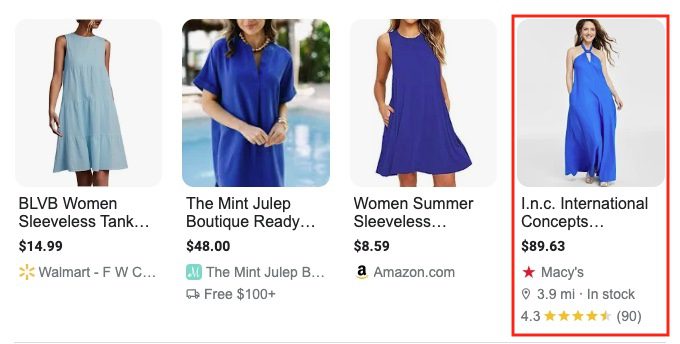
Search for an unbranded product such as “buy blue womens sun dress” and scroll past sponsored listings and local results. Below that, on the primary SERP, Google added a grid of tile-like product boxes triggered by purchase-intent queries. Each tile can include a product name, images, price, store name, average star ratings, and review count.

Screenshot of product-grid boxes

Product boxes appear on primary SERPs and can include product names, images, prices, store names, average star ratings, and review counts. Click image to enlarge.

The tiles function differently from conventional organic results. Instead of sending shoppers to a product detail page on an ecommerce site, the tiles link to shopping knowledge panels that load in the SERP. The panels are similar to product detail pages but with one big difference: Google tacks on a merchant list with pricing.

“This is particularly useful for users because they can compare prices much more easily,” says ecommerce SEO consultant Aleyda Solis. But for online stores, it’s yet another hurdle to get the click.

How Google ranks product tiles remains unclear. But they are populated by structure data — Schema.org markup or similar. SEO consultants and ecommerce store owners have wrestled for years over which structured data types are worth publishing since Google wasn’t paying attention to all of them.

But last February, Google expanded support for product structured data, announcing new shipping and returns classes and product variants such as sizes, colors, and materials. This will likely bury skirmishes about the value of structured data since visibility in product grids and shopping knowledge panels depends on it.

Shopping Knowledge Panels

In shopping knowledge panels, the store name on the product tile gets the top ranking on the merchant list. But size, color, and other sort-by options let shoppers reshuffle the merchant list by those variants.

Screenshot of a shopping knowledge panel

Shopping knowledge panels load directly in SERPs and contain sort-by options that reorder the list of merchants. Click image to enlarge.

The sort-by feature will likely incent store owners to get their Schema act together or risk disappearing from the merchant list. Shoppers using the feature could unwittingly filter out merchants that ignore product variants.

“If you have technical constraints or don’t have a developer, there are tools that facilitate the implementation of product Schema markup. Wordlift is one. Schema App is another,” says Solis. You can also use ChatGPT to generate product Schema.

For ecommerce merchants, the shopping knowledge panel lessens the importance of unique landing pages. Many searchers will likely go straight from the product grid to the shopping knowledge panel to a merchant’s product detail page.

The development could be a win for Amazon, which will appear in more product knowledge panels due to the breadth and depth of its catalog. Moreover, Amazon could use predatory pricing to undercut smaller ecommerce stores in merchant lists.

Last September, Google’s domain name registrar business was acquired by Squarespace. “Maybe Google thinks we won’t need domains anymore,” speculates Ross Kernez, a digital strategist. “If everything gets converted to SGE [Search Generative Experience] and only ecommerce survives, the top of the funnel will be gone. Transactional queries will still be here, but that means people could need fewer domains,” says Kernez.

Mike King, CEO of marketing agency iPullRank, disagrees. “We’ve heard of the death of websites when mobile apps appeared. People were like, we’re not going to need websites anymore. Everything’s going to be an app. Well, that didn’t happen,” says King.

Diminished Value?

Either way, conventional organic listings are getting pushed further below the fold. With AI results, paid shopping, pay-per-click ads, map packs, forums, image carousels, and now product grids, it is possible to secure top traditional organic rankings and receive less traffic.

With the rise of ChatGPT, the growth of product review search on TikTok and Instagram, and the recent completion of its March core update, Google appears to be reinventing web search and, perhaps, diminishing the value of organic search as a marketing channel.

The result could force marketers to prioritize other traffic sources such as social networks, email marketing, and generative AI optimization.

Google’s enormous audience cannot be ignored. But with so much volatility in the SERPs, diversifying ecommerce traffic sources is becoming increasingly important. I see no evidence of ecommerce merchants shifting resources from organic search to TikTok, ChatGPT, Reddit, and Facebook. But it does appear that relying on organic traffic is getting riskier.

Google Defends Lack Of Communication Around Search Updates via @sejournal, @MattGSouthern

While Google informs the public about broad core algorithm updates, it doesn’t announce every minor change or tweak, according to Google’s Search Liaison Danny Sullivan.

The comments were in response to Glenn Gabe’s question about why Google doesn’t provide information about volatility following the March core update.

Gabe wrote:

“… when site owners think a major update is done, they are not expecting crazy volatility that sometimes completely reverses what happened with the major update.
The impact from whatever rolled out on 5/3 and now 5/8 into 5/9 has been strong.”

Sullivan explained that Google continuously updates its search ranking systems, with around 5,000 updates per year across different algorithms and components.

Many of these are minor adjustments that would go unnoticed, Sullivan says:

“If we were giving notice about all the ranking system updates we do, it would be like this:

Hi. It’s 1:14pm — we just did an update to system 112!
Hi. It’s 2:26pm — we just did an update to system 34!

That’s because we do around 5,000 updates per year.”

While Google may consider these minor changes, combining thousands of those tweaks can lead to significant shifts in rankings and traffic that sites need help understanding.

More open communication from Google could go a long way.

Ongoing Shifts From Web Changes

Beyond algorithm adjustments, Sullivan noted that search results can fluctuate due to the nature of web content.

Google’s ranking systems continually process new information, Sullivan explains:

“… already launched and existing systems aren’t themselves being updated in how they operate, but the information they’re processing isn’t static but instead is constantly changing.”

Google focuses communications on major updates versus a never-ending stream of notifications about minor changes.

Sullivan continues:

“This type of constant ‘hey, we did an update’ notification stuff probably isn’t really that useful to creators. There’s nothing to ‘do’ with those types of updates.”

Why SEJ Cares

Understanding that Google Search is an ever-evolving platform is vital for businesses and publishers that rely on search traffic.

It reiterates the need for a long-term SEO strategy focused on delivering high-quality, relevant content rather than reacting to individual algorithm updates.

However, we realize Google’s approach to announcing updates can leave businesses scrambling to keep up with ranking movements.

More insight into these changes would be valuable for many.

How This Can Help You

Knowing that Google processes new information in addition to algorithm changes, you may have more realistic expectations post-core updates.

Instead of assuming stability after a major update, anticipate fluctuations as Google’s systems adapt to new web data.


Featured Image: Aerial Film Studio/Shutterstock

Google’s Strategies For Dealing With Content Decay via @sejournal, @MattGSouthern

In the latest episode of the Search Off The Record podcast, Google Search Relations team members John Mueller and Lizzi Sassman did a deep dive into dealing with “content decay” on websites.

Outdated content is a natural issue all sites face over time, and Google has outlined strategies beyond just deleting old pages.

While removing stale content is sometimes necessary, Google recommends taking an intentional, format-specific approach to tackling content decay.

Archiving vs. Transitional Guides

Google advises against immediately removing content that becomes obsolete, like materials referencing discontinued products or services.

Removing content too soon could confuse readers and lead to a poor experience, Sassman explains:

“So, if I’m trying to find out like what happened, I almost need that first thing to know. Like, “What happened to you?” And, otherwise, it feels almost like an error. Like, “Did I click a wrong link or they redirect to the wrong thing?””

Sassman says you can avoid confusion by providing transitional “explainer” pages during deprecation periods.

A temporary transition guide informs readers of the outdated content while steering them toward updated resources.

Sassman continues:

“That could be like an intermediary step where maybe you don’t do that forever, but you do it during the transition period where, for like six months, you have them go funnel them to the explanation, and then after that, all right, call it a day. Like enough people know about it. Enough time has passed. We can just redirect right to the thing and people aren’t as confused anymore.”

When To Updates Vs. When To Write New Content

For reference guides and content that provide authoritative overviews, Google suggests updating information to maintain accuracy and relevance.

However, for archival purposes, major updates may warrant creating a new piece instead of editing the original.

Sassman explains:

“I still want to retain the original piece of content as it was, in case we need to look back or refer to it, and to change it or rehabilitate it into a new thing would almost be worth republishing as a new blog post if we had that much additional things to say about it.”

Remove Potentially Harmful Content

Google recommends removing pages in cases where the outdated information is potentially harmful.

Sassman says she arrived at this conclusion when deciding what to do with a guide involving obsolete structured data:

“I think something that we deleted recently was the “How to Structure Data” documentation page, which I thought we should just get rid of it… it almost felt like that’s going to be more confusing to leave it up for a period of time.

And actually it would be negative if people are still adding markup, thinking they’re going to get something. So what we ended up doing was just delete the page and redirect to the changelog entry so that, if people clicked “How To Structure Data” still, if there was a link somewhere, they could still find out what happened to that feature.”

Internal Auditing Processes

To keep your content current, Google advises implementing a system for auditing aging content and flagging it for review.

Sassman says she sets automated alerts for pages that haven’t been checked in set periods:

“Oh, so we have a little robot to come and remind us, “Hey, you should come investigate this documentation page. It’s been x amount of time. Please come and look at it again to make sure that all of your links are still up to date, that it’s still fresh.””

Context Is Key

Google’s tips for dealing with content decay center around understanding the context of outdated materials.

You want to prevent visitors from stumbling across obsolete pages without clarity.

Additional Google-recommended tactics include:

  • Prominent banners or notices clarifying a page’s dated nature
  • Listing original publish dates
  • Providing inline annotations explaining how older references or screenshots may be obsolete

How This Can Help You

Following Google’s recommendations for tackling content decay can benefit you in several ways:

  • Improved user experience: By providing clear explanations, transition guides, and redirects, you can ensure that visitors don’t encounter confusing or broken pages.
  • Maintained trust and credibility: Removing potentially harmful or inaccurate content and keeping your information up-to-date demonstrates your commitment to providing reliable and trustworthy resources.
  • Better SEO: Regularly auditing and updating your pages can benefit your website’s search rankings and visibility.
  • Archival purposes: By creating new content instead of editing older pieces, you can maintain a historical record of your website’s evolution.
  • Streamlined content management: Implementing internal auditing processes makes it easier to identify and address outdated or problematic pages.

By proactively tackling content decay, you can keep your website a valuable resource, improve SEO, and maintain an organized content library.

Listen to the full episode of Google’s podcast below:


Featured Image: Stokkete/Shutterstock

Google Defines “Content Decay” In New Podcast Episode via @sejournal, @MattGSouthern

In the latest episode of Google’s Search Off The Record podcast, hosts John Mueller and Lizzi Sassman discussed “content decay”—the natural process by which online content becomes outdated or loses relevance over time.

While not a widely used term among SEO professionals, the concept raises questions about how websites should handle aging content that may contain obsolete information, broken links, or outdated references.

What Is Content Decay?

Mueller, a Search Advocate at Google, defines content decay as:

“[Content decay is] something where, when you look at reference material, it’s kind of by definition old. People wrote about it because they’ve studied it for a really long time. So it’s an old thing. But that doesn’t mean it’s no longer true or no longer useful.”

It’s worth noting Mueller was initially unfamiliar with the term:

“When I looked at it, it sounded like this was a known term, and I felt inadequate when I realized I had no idea what it actually meant, and I had to interpret what it probably means from the name.

Sassman, who oversees the Search Central website’s content, admitted she was also unfamiliar with content decay.

She stated:

“… it sounded a little bit negative … Like something’s probably wrong with the content. Probably it’s rotting or something has happened to it over time.”

After defining the term, the two dissected various approaches to handling content decay, using Google’s help documents as a case study.

Content Decay Not Necessarily A Bad Thing

Content decay isn’t, by definition, a bad thing.

Blog posts announcing past events or product changes may seem like sources of content decay.

However, Sassman advises keeping that content for historical accuracy.

Sassman gives an example, citing Google’s decision to keep pages containing the outdated term “Webmaster Tools.”

“If we went back and replaced everything where we said ‘Google Webmasters’ with ‘Search Console,’ it would be factually incorrect. Search Console didn’t exist at that point. It was Webmaster Tools.”

Avoiding User Confusion

According to Mueller, the challenge in dealing with content decay is “avoiding confusing people.”

Indicating when content is outdated, providing context around obsolete references, and sensible use of redirects can help mitigate potential confusion.

Mueller stated

“People come to our site for whatever reason, then we should make sure that they find information that’s helpful for them and that they understand the context. If something is old and they search for it, they should be able to recognize, ‘Oh, maybe I have to rethink what I wanted to do because what I was searching for doesn’t exist anymore or is completely different now.’”

No One-Size-Fits-All Solution

There are no easy solutions to content decay. You must thoughtfully evaluate aging content, understanding that some pieces warrant archiving while others remain valuable historical references despite age.

Listen to the full episode of Google’s podcast below:

Why SEJ Cares

The concept of “content decay” addresses a challenge all website owners face – how to manage and maintain content as it ages.

Dealing with outdated website content is essential to creating a positive user experience and building brand trust.

How This Can Help You

By examining Google’s approaches, this podcast episode offers the following takeaways:

  • There’s value in preserving old content for historical accuracy.
  • Consider updating old pages to indicate outdated advice or deprecated features.
  • Establish an auditing process for routinely evaluating aging content.

FAQ

What does “content decay” mean in the context of SEO?

Online content tends to become outdated or irrelevant over time. This can happen due to industry changes, shifts in user interests, or simply the passing of time.

In the context of SEO, outdated content impacts how useful and accurate the information is for users, which can negatively affect website traffic and search rankings.

To maintain a website’s credibility and performance in search results, SEO professionals need to identify and update or repurpose content that has become outdated.

Should all outdated content be removed from a website?

Not all old content needs to be deleted. It depends on what kind of content it is and why it was created. Content that shows past events, product changes, or uses outdated terms can be kept for historical accuracy.

Old content provides context and shows how a brand or industry has evolved over time. It’s important to consider value before removing, updating, or keeping old content.

What are the best practices to avoid user confusion with outdated content?

Website owners and SEO professionals should take the following steps to avoid confusing users with outdated content:

  • Show when content was published or note if the information has changed since it was created.
  • Add explanations around outdated references to explain why they may no longer be relevant.
  • Set up redirects to guide users to the most current information if the content has moved or been updated.

These strategies help people understand a page’s relevance and assist them in getting the most accurate information for their needs.


Featured Image: Screenshot from YouTube.com/GoogleSearchCentral, May 2024.