Choosing the right WordPress SEO plugin for your business – Yoast vs Rank Math 

Key Takeaways

  • Choosing an SEO plugin like Yoast SEO impacts your online presence and future growth.
  • Yoast offers reliability with over 15 years of experience and millions of active installations, unlike newer competitors.
  • Innovations such as AI integration and a unified schema graph set Yoast apart from other plugins.
  • Yoast provides comprehensive support, education, and a multi-platform ecosystem tailored for long-term success.
  • Trust industry leaders like Microsoft and Spotify who use Yoast SEO to enhance their online visibility.

Estimated reading time: 11 minutes

Selecting an SEO plugin for your WordPress site is one of the most important decisions you’ll make for your online presence. It’s not just about installing software; it’s about choosing a long-term partner that will grow with your business, adapt to changing search algorithms, and support you in the age of AI. While the market offers several options, understanding what truly matters is key. Two of the most popular plugins in the market today are Yoast and Rank Math. Therefore, factors such as reliability, innovation, ecosystem, and trust help you make a choice that will serve your business for years to come. 

This guide provides an in-depth comparison of the key differentiating factors between Yoast and Rank Math. We will understand why millions of websites worldwide have made Yoast their trusted comrade in the search business. 

What really matters when choosing an SEO plugin 

When evaluating WordPress SEO plugins, it’s easy to get distracted by feature lists and flashy interfaces. But experienced marketers, agencies, and business owners know that the best tools are defined by much more than what they promise on paper. 

The questions that matter most: 

  • Can you trust this plugin to work reliably as your business scales? 
  • Will the company behind it still be innovating five years from now? 
  • What happens when you need help before a critical deadline? 
  • Does the plugin anticipate future SEO trends, or just react to them? 
  • Is this a tool you install, or an ecosystem that supports your growth and development? 

These aren’t trivial questions. Your SEO plugin touches essential pages on your site, influences the content you publish, and directly impacts your ability to be found by potential customers.  
Choosing poorly can lead to migration headaches, compatibility issues, and lost rankings. Choosing wisely means peace of mind, ongoing innovation, and a solid foundation to build upon. 

Why legacy and proven trust matter in SEO plugins 

Trust isn’t given. It’s earned. Yoast has defined the WordPress SEO landscape for over 15 years, with more than 13 million active installations and over 850 million downloads. This extensive legacy reflects a consistent track record of innovation, stability, and trust. Brands such as The Guardian, Microsoft, Spotify, and others rely on Yoast SEO as a foundation for their SEO strategies. This depth of experience is invaluable as SEO requires ongoing adaptation to algorithm changes and new technologies. 

While Rank Math is an ambitious and feature-rich plugin with a growing user base, its presence in the market is relatively recent. For businesses seeking a proven solution with a long-standing heritage, Yoast’s established positioning offers confidence that the plugin will continue to evolve and provide reliable support for years to come. 

Innovation that shapes the industry 

Yoast has always been at the forefront of defining what modern SEO looks like. This isn’t a reactive development; it’s proactive innovation that anticipates where search is heading. Both plugins invest in innovation, but Yoast’s leadership in integrating AI and collaboration with Google sets it apart. 

AI and Automation 

We have introduced an industry-first AI-powered optimization toolset, including: 

  • AI Generate: Creates multiple optimized title and meta description variations instantly, giving you professionally crafted options in seconds instead of struggling for the perfect phrasing.
  • AI Optimize: Scans your content and provides precise, actionable suggestions to improve keyphrase placement, sentence structure, and readability, teaching you SEO best practices while you write. 
  • AI Summarize: Instantly generates bullet-point summaries of your content, making it more scannable and engaging for readers who skim before diving deep. 
  • AI Brand Insights: This is where Yoast truly separates from the pack. As AI platforms like ChatGPT reshape how people find information, AI Brand Insights tracks how your brand appears in AI-generated responses. You can monitor your AI visibility, compare it against competitors, and ensure AI platforms accurately represent your business. 

While Rank Math includes helpful automation features such as AI keyword suggestions, Yoast’s AI integration is more comprehensive and positioned as a core pillar of modern SEO strategy. 

Schema markup that search engines can understand 

While many plugins output disconnected structured data, Yoast SEO automatically generates a unified semantic graph on every page, linking your organization, content, authors, and products through a single JSON-LD structure that search engines and AI platforms can interpret consistently. 

What makes this different 

Automatic and invisible: 
Yoast outputs rich structured data representing your content, business, and relationships without requiring technical configuration. You focus on creating content; Yoast handles the complexity of structured data behind the scenes. 

Single unified graph format: 
Instead of fragmented schema markup, Yoast creates one cohesive graph structure per page, connecting all entities with unique IDs. When plugins output conflicting schema, search engines can’t reliably interpret your site. Yoast’s unified graph ensures consistent interpretation at scale, whether Google, ChatGPT, or any API is reading your content. 

Minimal configuration: 
Choose whether your site represents a person or organization; Yoast handles the rest automatically. Specialized blocks like FAQ and How-To map directly to correct schema types and link into the graph without additional setup. 

Why this matters for AI-driven search 

As AI platforms increasingly rely on structured data to understand websites, Yoast’s approach of creating a full semantic model of your site positions you for how search and discovery are evolving. The framework scales reliably from 100 to 100,000 pages while maintaining valid entity relationships. For developers, Yoast’s Schema API provides clean filters to extend or customize the graph without breaking its integrity. 

Rank Math and other plugins support Schema markup, but Yoast’s unified graph framework represents a fundamentally different approach: automatic generation, consistent entity relationships, and architecture built for scale. 

Continuous algorithm adaptation 

Search engines make thousands of updates every year. Google alone rolls out over 5,000 algorithm changes annually. Now, as search engines evolve to incorporate AI tooling and platforms like ChatGPT reshape the way people discover information, the SEO landscape is changing faster than ever.  

Most website owners can’t possibly track these shifts across traditional search AND emerging AI platforms, let alone understand their implications. Yoast’s dedicated SEO team monitors every significant update, from Google algorithm changes to how AI platforms index and reference content, and proactively adjusts the plugin to ensure your site stays optimized for both traditional and AI-driven discovery.  

When you use Yoast, you’re not just getting software. You’re getting a team of experts working behind the scenes to keep your SEO strategy current across the entire discovery ecosystem. 

An ecosystem built to support your SEO workflow 

Yoast offers an ecosystem beyond the plugin. While Yoast SEO itself is a plugin, Yoast provides a comprehensive ecosystem to support your growth: 

  • 24/7 real human expert support available for Yoast SEO Premium users. It ensures that you get fast, knowledgeable help when you need it. 
  • Yoast SEO Academy offers comprehensive SEO education, covering a range of topics from basics to advanced, with accompanying certifications. 
  • A massive knowledge base and community for continuous learning and troubleshooting. 
     

Multi-Platform Support 

Your business doesn’t exist on WordPress alone. That’s why Yoast extends beyond a single platform: 

  • Yoast SEO for Shopify: Brings Yoast’s trusted optimization to Shopify stores, helping ecommerce businesses improve product visibility and drive more sales. 
  • Yoast WooCommerce SEO: Specifically designed for WooCommerce stores with automated product schema, smart breadcrumbs, and ecommerce-focused content analysis. 

This ecosystem approach means Yoast grows with your business, supporting you across platforms as your needs evolve. Rank Math primarily focuses on the WordPress environment with a strong feature set, but lacks the same breadth of educational resources and multi-platform reach. 

Stability and reliability at enterprise-grade scale 

Flashy features attract attention. Rock-solid reliability keeps businesses running. Yoast rigorously tests every update for compatibility and performance across different WordPress versions and server configurations. This commitment ensures: 

  • Backward compatibility: Updates maintain existing functionality without requiring extensive reconfiguration 
  • WordPress core integration: Seamless compatibility with new WordPress releases 
  • Performance at any scale: Optimized for sites ranging from personal blogs to high-traffic enterprise installations 

With over 15 years in the market and more than 13 million active installations, Yoast has proven its reliability across millions of sites, hosting environments, and various use cases. 

Rigorous testing and quality assurance 

Yoast maintains strict development standards that prioritize stability above rapid feature deployment. Every update undergoes extensive testing across the latest WordPress versions, most PHP configurations, and common plugin combinations before release. 

This disciplined approach means Yoast users rarely experience plugin conflicts, broken updates, or compatibility issues that plague WordPress sites using less mature plugins. 

Backward compatibility 

Major updates usually shake the functionality of plugins and software. However, Yoast maintains backward compatibility, ensuring that updating your plugin doesn’t suddenly break critical SEO features or require extensive reconfiguration. 

WordPress core compatibility 

As a plugin deeply integrated with WordPress development, Yoast maintains close relationships with the WordPress core team. This ensures seamless compatibility with new WordPress releases, often supporting new versions on launch day while other plugins scramble to catch up. 

Performance optimized for scale 

Whether you run a small blog or an enterprise site with millions of pages, Yoast performs efficiently without slowing down your site. The plugin is engineered for performance, using best practices for database queries, resource loading, and caching integration. 

Enterprises trust Yoast precisely because it scales reliably. Small teams appreciate that the same plugin powering major corporations works flawlessly on their modest sites, too. 

Ready to make a difference with Yoast SEO Premium?

Explore Yoast SEO Premium and the Yoast SEO AI+ package to discover advanced tools built for serious marketers.

Where Yoast takes the lead 

While comprehensive feature-by-feature comparisons can be overwhelming, certain capabilities distinguish truly professional SEO plugins from the rest. Here’s where Yoast’s innovation and depth shine through. 

AI-powered optimization 

Yoast leads the industry in AI integration for SEO optimization: 

  • AI-generated titles and meta descriptions 
  • Real-time content optimization suggestions 
  • An instant content summarization plugin 
  • AI Brand Insights for tracking your presence in AI search platforms 

No competing plugin offers this comprehensive AI integration designed specifically for modern SEO workflows. 

Schema Graph 

Yoast’s Schema implementation creates a complete structured data graph connecting your organization, content, authors, and brand identity. This goes far beyond basic Schema markup, providing search engines with rich context that improves your chances of appearing in knowledge panels, rich results, and AI-generated answers. 

Smart internal linking 

Yoast SEO Premium includes intelligent internal linking suggestions that analyze your content and recommend relevant pages to link to. This isn’t just a list of posts; it’s context-aware suggestions that strengthen your site architecture and improve crawlability. 

Advanced redirect manager 

Managing redirects is critical when restructuring sites, changing URLs, or handling broken links. Yoast’s redirect manager offers: 

  • Automatic redirects when you change a post URL 
  • Bulk CSV import/export for large-scale migrations 
  • REGEX support for complex redirect patterns 
  • Full redirect history and management 

WooCommerce-specific optimization 

If you run an online store, Yoast WooCommerce SEO provides: 

  • Automated product schema markup (price, availability, reviews) 
  • Smart breadcrumbs for product categories 
  • Ecommerce-focused content analysis 
  • Duplicate content prevention for product variations 

Comprehensive crawl settings 

Advanced users appreciate Yoast’s granular control over crawl optimization, robots.txt management, and indexation settings, giving technical SEO professionals the precision they need without overwhelming casual users. 

Bot blocker for LLM training control 

As AI companies scrape the web to train large language models, Yoast gives you control over whether your content is used for AI training via Bot Blocker. This cutting-edge feature addresses a concern most plugins haven’t even acknowledged yet. 

Recognized and trusted by industry leaders 

The company you keep says a lot about who you are. When the world’s most recognized brands trust Yoast to power their WordPress SEO, it’s a powerful testament to the quality, reliability, and effectiveness of our solutions. 

Global brands* using Yoast include: 

  • The Guardian 
  • Microsoft 
  • Spotify 
  • Rolling Stones 
  • Taylor Swift 
  • Facebook 
  • eBay 

These organizations have teams of developers, SEO experts, and decision-makers who have evaluated every available option. They chose Yoast, not because it was the newest, but because it was the best. 

*Disclaimer: Based on third party data sources.

Industry Recognition: 

  • Global Search Awards Finalist: Recognized among the world’s leading SEO solutions 
  • Women’s Choice Awards Winner: Acknowledged for excellence and customer satisfaction 

Yoast isn’t just popular, it’s the default choice for WordPress SEO professionals worldwide. 

Understanding what you really need 

Before making your final decision, consider what matters most for your specific situation: 

If you value reliability and stability: Choose a plugin with a proven track record of consistent updates, compatibility, and performance. Longevity matters because it signals the company will be around to support you for years to come. 

If innovation matters to your strategy: Look for a plugin that anticipates SEO trends rather than reacting to them. AI integration, Schema excellence, and algorithm adaptation separate forward-thinking tools from those playing catch-up. 

If support is critical: Consider whether you need community forums or access to real SEO experts who can troubleshoot complex issues quickly. When your business relies on organic traffic, response time is crucial. 

If education is important: Some plugins provide features; others teach you how to use them effectively. Comprehensive training resources and certifications demonstrate a commitment to your success. 

If you’re building for the long term: Think about whether this plugin will grow with your business. Multi-platform support, scalability, and an ecosystem approach ensure that your investment pays dividends for years to come. 

Make the choice that drives real growth 

Choosing an SEO plugin isn’t about finding the tool with the longest feature list; it’s about finding the one that best suits your needs. It’s about partnering with a company that shares your commitment to long-term growth, innovation, and excellence. 

Over 13 million websites trust Yoast SEO because it delivers on these promises: 

  • Reliability: 15+ years of consistent innovation and stability 
  • Trust: Used by global brands and industry leaders 
  • Innovation: Leading the industry in AI integration and Schema excellence 
  • Support: 24/7 access to real SEO professionals 
  • Education: Comprehensive training through Yoast Academy 
  • Ecosystem: Multi-platform support and continuous learning resources 
  • Stability: Enterprise-grade performance at any scale 

When you choose Yoast, you’re not just installing a plugin; you’re joining millions of websites that have made the strategic decision to partner with the most trusted name in WordPress SEO. 

A smarter analysis in Yoast SEO Premium

Yoast SEO Premium has a smart content analysis that helps you take your content to the next level!


WordPress Membership Plugin Flaw Exposes Sensitive Stripe Data via @sejournal, @martinibuster

An advisory was published about a vulnerability discovered in the Membership Plugin By StellarWP which exposes sensitive Stripe payment setup data on WordPress sites using the plugin. The flaw enables unauthenticated attackers to launch attacks and is rated 8.2 (High).

Membership Plugin By StellarWP

The Membership Plugin – Restrict Content By StellarWP is used by WordPress sites to manage paid and private content. It enables site owners to restrict access to pages, posts, or other resources so that only logged-in users or paying members can view them and manage what non-paying site visitors can see. The plugin is commonly deployed on membership and subscription-based sites.

Vulnerable to Unauthenticated Attackers

The Wordfence advisory states that the vulnerability can be exploited by unauthenticated attackers, meaning no login or WordPress user account is required to launch an attack. User permission roles do not factor into whether the issue can be triggered, and that’s what makes this particular vulnerability more dangerous because it’s easier to trigger.

What the Vulnerability Is

The issue stems from missing security checks related to Stripe payment handling. Specifically, the plugin failed to properly protect Stripe SetupIntent data.

A Stripe SetupIntent is used during checkout to collect and save a customer’s payment method for future use. Each SetupIntent includes a client_secret value that is intended to be shared during a checkout or account setup flow.

The official Wordfence advisory explains:

“The Membership Plugin – Restrict Content plugin for WordPress is vulnerable to Missing Authentication in all versions up to, and including, 3.2.16 via the ‘rcp_stripe_create_setup_intent_for_saved_card’ function due to missing capability check.

Additionally, the plugin does not check a user-controlled key, which makes it possible for unauthenticated attackers to leak Stripe SetupIntent client_secret values for any membership.”

According to Stripe’s official documentation, the Setup Intents API is used to set up a payment method for future charges without creating an immediate payment. A SetupIntent includes a client_secret. Stripe’s documentation states that client_secret values should not be stored, logged, or exposed to anyone other than the intended customer.

This is how Stripe’s documentation explains what the purpose is for the Setup Intents API:

“Use the Setup Intents API to set up a payment method for future payments. It’s similar to a payment, but no charge is created.

The goal is to have payment credentials saved and optimized for future payments, meaning the payment method is configured correctly for any scenario. When setting up a card, for example, it may be necessary to authenticate the customer or check the card’s validity with the customer’s bank. Stripe updates the SetupIntent object throughout that process.”

Stripe documentation also explains that client_secret values are used client-side to complete payment-related actions and are intended to be passed securely from the server to the browser. Stripe states that these values should not be stored, logged, or exposed to anyone other than the relevant customer.

This is how Stripe’s documentation explains the client_secret value:

“client_secret
The client secret of this Customer Session. Used on the client to set up secure access to the given customer.

The client secret can be used to provide access to customer from your frontend. It should not be stored, logged, or exposed to anyone other than the relevant customer. Make sure that you have TLS enabled on any page that includes the client secret.”

Because the plugin did not enforce the appropriate protections, Stripe SetupIntent client_secret values could be exposed.

What this means in real life is that Stripe payment setup data associated with memberships was accessible beyond its intended scope.

Affected Versions

The vulnerability affects all versions of the plugin up to and including version 3.2.16. Wordfence assigned the issue a CVSS score of 8.2, reflecting the sensitivity of the exposed data and the fact that no authentication is required to trigger the issue.

A score in this range indicates a high-severity vulnerability that can be exploited remotely without special access, increasing the importance of timely updates for sites that rely on the plugin for managing paid memberships or restricted content.

Patch Availability

The plugin has been updated with a patch and is available now. The issue was fixed in version 3.2.17 of the plugin. The update adds missing nonce and permission checks related to Stripe payment handling, addressing the conditions that allowed SetupIntent client_secret values to be exposed. A nonce is a temporary security token that ensures a specific action on a WordPress website was intentionally requested by the user and not by a malicious attacker.

The official Membership Plugin changelog responsibly discloses the updates:

“3.2.17
Security: Added nonce and permission checks for adding Stripe payment methods.
3.2.16
Security: Improved escaping and sanitization for [restrict] and [register_form] shortcode attributes.”

What Site Owners Should Do

Sites using Membership Plugin – Restrict Content should update to version 3.2.17 or newer.

Failure to update the plugin will leave the Stripe SetupIntent client_secret data exposed to unauthenticated attackers.

Featured Image by Shutterstock/file404

Google Health AI Overviews Cite YouTube More Than Any Hospital Site via @sejournal, @MattGSouthern

Google’s AI Overviews may be relying on YouTube more than official medical sources when answering health questions, according to new research from SEO platform SE Ranking.

The study analyzed 50,807 German-language health prompts and keywords, captured in a one-time snapshot from December using searches run from Berlin.

The report lands amid renewed scrutiny of health-related AI Overviews. Earlier this month, The Guardian published an investigation into misleading medical summaries appearing in Google Search. The outlet later reported Google had removed AI Overviews for some medical queries.

What The Study Measured

SE Ranking’s analysis focused on which sources Google’s AI Overviews cite for health-related queries. In that dataset, the company says AI Overviews appeared on more than 82% of health searches, making health one of the categories where users are most likely to see a generated summary instead of a list of links.

The report also cites consumer survey findings suggesting people increasingly treat AI answers as a substitute for traditional search, including in health. It cites figures including 55% of chatbot users trusting AI for health advice and 16% saying they’ve ignored a doctor’s advice because AI said otherwise.

YouTube Was The Most Cited Source

Across SE Ranking’s dataset, YouTube accounted for 4.43% of all AI Overview citations, or 20,621 citations out of 465,823.

The next most cited domains were ndr.de (14,158 citations, 3.04%) and MSD Manuals (9,711 citations, 2.08%), according to the report.

The authors argue that the ranking matters because YouTube is a general-purpose platform with a mixed pool of creators. Anyone can publish health content there, including licensed clinicians and hospitals, but also creators without medical training.

To check what the most visible YouTube citations looked like, SE Ranking reviewed the 25 most-cited YouTube videos in its dataset. It found 24 of the 25 came from medical-related channels, and 21 of the 25 clearly noted the content was created by a licensed or trusted source. It also warned that this set represents less than 1% of all YouTube links cited by AI Overviews.

Government & Academic Sources Were Rare

SE Ranking categorized citations into “more reliable” and “less reliable” groups based on the type of organization behind each source.

It reports that 34.45% of citations came from the more reliable group, while 65.55% came from sources “not designed to ensure medical accuracy or evidence-based standards.”

Within the same breakdown, academic research and medical journals accounted for 0.48% of citations, German government health institutions accounted for 0.39%, and international government institutions accounted for 0.35%.

AI Overview Citations Often Point To Different Pages Than Organic Search

The report compared AI Overview citations to organic rankings for the same prompts.

While SE Ranking found that 9 out of 10 domains overlapped between AI citations and frequent organic results, it says the specific URLs frequently diverged. Only 36% of AI-cited links appeared in Google’s top 10 organic results, 54% appeared in the top 20, and 74% appeared somewhere in the top 100.

The biggest domain-level exception in its comparison was YouTube. YouTube ranked first in AI citations but only 11th in organic results in its analysis, appearing 5,464 times as an organic link compared to 20,621 AI citations.

How This Connects To The Guardian Reporting

The SE Ranking report explicitly frames its work as broader than spot-checking individual responses.

“The Guardian investigation focused on specific examples of misleading advice. Our research shows a bigger problem,” the authors wrote, arguing that AI health answers in their dataset relied heavily on YouTube and other sites that may not be evidence-based.

Following The Guardian’s reporting, the outlet reported that Google removed AI Overviews for certain medical queries.

Google’s public response, as reported by The Guardian, emphasized ongoing quality work while also disputing aspects of the investigation’s conclusions.

Why This Matters

This report adds a concrete data point to a problem that’s been easier to talk about in the abstract.

I covered The Guardian’s investigation earlier this month, and it raised questions about accuracy in individual examples. SE Ranking’s research tries to show what the source mix looks like at scale.

Visibility in AI Overviews may depend on more than being the most prominent “best answer” in organic search. SE Ranking found many cited URLs didn’t match top-ranking pages for the same prompts.

The source mix also raises questions about what Google’s systems treat as “good enough” evidence for health summaries at scale. In this dataset, government and academic sources barely showed up compared to media platforms and a broad set of less reliability-focused sites.

That’s relevant beyond SEO. The Guardian reporting showed how high-stakes the failure modes can be, and Google’s pullback on some medical queries suggests the company is willing to disable certain summaries when the scrutiny gets intense.

Looking Ahead

SE Ranking’s findings are limited to German-language queries in Germany and reflect a one-time snapshot, which the authors acknowledge may vary over time, by region, and by query phrasing.

Even with that caveat, the combination of this source analysis and the recent Guardian investigation puts more focus on two open questions. The first is how Google weights authority versus platform-level prominence in health citations. The second is how quickly it can reduce exposure when specific medical query patterns draw criticism.


Featured Image: Yurii_Yarema/Shutterstock

Three climate technologies breaking through in 2026

Happy New Year! I know it’s a bit late to say, but it never quite feels like the year has started until the new edition of our 10 Breakthrough Technologies list comes out. 

For 25 years, MIT Technology Review has put together this package, which highlights the technologies that we think are going to matter in the future. This year’s version has some stars, including gene resurrection (remember all the dire wolf hype last year?) and commercial space stations

And of course, the world of climate and energy is represented with sodium-ion batteries, next-generation nuclear, and hyperscale AI data centers. Let’s take a look at what ended up on the list, and what it says about this moment for climate tech. 

Sodium-ion batteries

I’ve been covering sodium-ion batteries for years, but this moment feels like a breakout one for the technology. 

Today, lithium-ion cells power everything from EVs, phones, and computers to huge stationary storage arrays that help support the grid. But researchers and battery companies have been racing to develop an alternative, driven by the relative scarcity of lithium and the metal’s volatile price in recent years. 

Sodium-ion batteries could be that alternative. Sodium is much more abundant than lithium, and it could unlock cheaper batteries that hold a lower fire risk.  

There are limitations here: Sodium-ion batteries won’t be able to pack as much energy into cells as their lithium counterparts. But it might not matter, especially for grid storage and smaller EVs. 

In recent years, we’ve seen a ton of interest in sodium-based batteries, particularly from major companies in China. Now the new technology is starting to make its way into the world—CATL says it started manufacturing these batteries at scale in 2025. 

Next-generation nuclear

Nuclear reactors are an important part of grids around the world today—massive workhorse reactors generate reliable, consistent electricity. But the countries with the oldest and most built-out fleets have struggled to add to them in recent years, since reactors are massive and cost billions. Recent high-profile projects have gone way over budget and faced serious delays. 

Next-generation reactor designs could help the industry break out of the old blueprint and get more nuclear power online more quickly, and they’re starting to get closer to becoming reality. 

There’s a huge variety of proposals when it comes to what’s next for nuclear. Some companies are building smaller reactors, which they say could make it easier to finance new projects, and get them done on time. 

Other companies are focusing on tweaking key technical bits of reactors, using alternative fuels or coolants that help ferry heat out of the reactor core. These changes could help reactors generate electricity more efficiently and safely. 

Kairos Power was the first US company to receive approval to begin construction on a next-generation reactor to produce electricity. China is emerging as a major center of nuclear development, with the country’s national nuclear company reportedly working on several next-gen reactors. 

Hyperscale data centers

This one isn’t quite what I would call a climate technology, but I spent most of last year reporting on the climate and environmental impacts of AI, and the AI boom is deeply intertwined with climate and energy. 

Data centers aren’t new, but we’re seeing a wave of larger centers being proposed and built to support the rise of AI. Some of these facilities require a gigawatt or more of power—that’s like the output of an entire conventional nuclear power plant, just for one data center. 

(This feels like a good time to mention that our Breakthrough Technologies list doesn’t just highlight tech that we think will have a straightforwardly positive influence on the world. I think back to our 2023 list, which included mass-market military drones.)

There’s no denying that new, supersize data centers are an important force driving electricity demand, sparking major public pushback, and emerging as a key bit of our new global infrastructure. 

This article is from The Spark, MIT Technology Review’s weekly climate newsletter. To receive it in your inbox every Wednesday, sign up here.

The Download: spying on the spies, and promising climate tech

This is today’s edition of The Download, our weekday newsletter that provides a daily dose of what’s going on in the world of technology.

Meet the man hunting the spies in your smartphone

In April 2025, Ronald Deibert left all electronic devices at home in Toronto and boarded a plane. When he landed in Illinois, he bought a new laptop and iPhone. He wanted to reduce the risk of having his personal devices confiscated, because he knew his work made him a prime target for surveillance. “I’m traveling under the assumption that I am being watched, right down to exactly where I am at any moment,” Deibert says. 

Deibert directs the Citizen Lab, a research center he founded in 2001 to serve as “counterintelligence for civil society.” Housed at the University of Toronto, it’s one of the few institutions that investigate cyberthreats exclusively in the public interest, and in doing so, it has exposed some of the most egregious digital abuses of the past two decades.

For many years, Deibert and his colleagues have held up the US as the standard for liberal democracy. But that’s changing. Read the full story.

—Finian Hazen

This story is from the latest issue of our print magazine. If you subscribe now to receive future copies when they land you’ll benefit from some big discounts, and get a free tote bag! 

Three climate technologies breaking through in 2026  

—Casey Crownhart 

Happy New Year! I know it’s a bit late to say, but it never quite feels like the year has started until the new edition of our 10 Breakthrough Technologies list comes out. 

For 25 years, MIT Technology Review has put together this package, which highlights the technologies that we think are going to matter in the future. This year’s version has a bunch of climate and energy picks including sodium-ion batteries, next-generation nuclear, and hyperscale AI data centers. Let’s take a look at what ended up on the list, and what it says about this moment for climate tech. 

This story ran in The Spark, our weekly newsletter all about the technologies we can use to combat climate change. Sign up to get it in your inbox first every Wednesday. 

And, if you’re keen to learn more about why AI companies are betting big on next-gen nuclear, join us for an exclusive subscriber-only Roundtable event on Wednesday January 28 at 2pm ET. 

The must-reads

I’ve combed the internet to find you today’s most fun/important/scary/fascinating stories about technology.

1 AI companies are now deeply entwined with the US military
And it looks like they’re only set to get closer. (Wired $)
Three open questions about the Pentagon’s push for generative AI. (MIT Technology Review)

2 Grok will comply with local laws, X has said
A global backlash over users creating ‘undressing’ images of real people seems to have forced its hand. (BBC)
+ So far there’s no evidence it’s actually following through on that promise though. (The Verge)
Elon Musk could stop it all instantly if he                         wanted to. (Engadget)

3 The risks of using AI in schools outweigh the benefits
According to a sweeping new study by the Brookings Institution’s Center for Universal Education. (NPR)
AI’s giants are trying to take over the classroom. (MIT Technology Review)  

4 Trump is imposing new tariffs on high-end chips
They’re pretty narrow though, and leave plenty of room for exports to China. (WP $)
Zhipu AI says it’s trained its first major model entirely on Chinese chips. (South China Morning Post)

5 A UK police force blamed Microsoft Copilot for an intelligence error 
After spending weeks denying it was using AI tools at all. (Ars Technica)
Worried about police and lawyers using AI? Well, judges are at it too. (MIT Technology Review

6 Inside the compounds where the fraud industry makes its billions
The details are grim—for example the fact workers struck a gong every time they scammed someone out of $5,000. (NYT $)
+ Inside a romance scam compound—and how people get tricked into being there. (MIT Technology Review)

7 Bandcamp has banned purely AI-generated music from its platform 
It’s the first online music platform to take this step. (Billboard)
Can AI generate new ideas? (NYT $)

8 Remember Havana Syndrome? The US may have found the device that causes it
It was acquired for millions of dollars under the last administration, and it’s still being studied. (CNN)

9 This study failed to prove social media time causes teens’ mental health issues
It’s a common assumption, but there’s still remarkably little evidence to back it up. (The Guardian)

10 The UK is planning to build a record-breaking number of wind farms
Its government is pushing for the vast majority of the country’s electricity to come from clean sources by 2030. (BBC)

Quote of the day

“Women and girls are far more reluctant to use AI. This should be no surprise to any of us. Women don’t see this as exciting new technology, but as simply new ways to harass and abuse us and try and push us offline.”

—Clare McGlynn, a law professor at Durham University, tells The Guardian she fears that the use of AI to harm women and girls is only going to grow. 

One more thing

Climate researchers at work in an office environment look out the window to see corporate lobbyists waving from their boardroom in the building next door

DANIEL STOLLE

Inside the little-known group setting the corporate climate agenda

As thousands of companies trumpet their plans to cut carbon pollution, a small group of sustainability consultants has emerged as the go-to arbiter of corporate climate action.

The Science Based Targets initiative, or SBTi, helps businesses develop a timetable for action to shrink their climate footprint through some combination of cutting greenhouse-gas pollution and removing carbon dioxide from the atmosphere. After years of small-scale sustainability work, SBTi is growing rapidly, and governments are paying attention. 

But while the group has earned praise for reeling the private sector into constructive conversations about climate emissions, its rising influence has also attracted scrutiny and raised questions about why a single organization is setting the standards for many of the world’s largest companies. Read the full story.

—Ian Morse

We can still have nice things

A place for comfort, fun and distraction to brighten up your day. (Got any ideas? Drop me a line or skeet ’em at me.)

+ The leaders of Japan and South Korea drummed up a viral moment with a jam session this week. 
+ Struggle during the cold, dark winter months? Here’s how to make things easier for yourself
+ If you like getting lost in the depths of Wikipedia, Freakpages is for you. 
+ From Pluribus to Stranger Things, we really can’t get enough of hive mindsin stories lately. ($)

Exclusive eBook: How AGI Became a Consequential Conspiracy Theory

In this exclusive subscriber-only eBook, you’ll learn about how the idea that machines will be as smart as—or smarter than—humans has hijacked an entire industry.

by Will Douglas Heaven October 30, 2025

Table of Contents:

  • How Silicon Valley got AGI-pilled
  • The great AGI conspiracy
  • How AGI hijacked an industry
  • The great AGI conspiracy, concluded

Related Stories:

Access all subscriber-only eBooks:

Lawmakers Eye Dynamic Ecommerce Pricing

Several American lawmakers have expressed an interest in limiting or prohibiting data-driven price changes. The recent activity dates back to at least 2021 and may stem from inflation concerns and increased AI usage.

For example, in December 2025, Instacart drew strong criticism from Democratic Senator Charles Schumer of New York after it permitted grocery stores to test AI-powered, dynamic pricing.

The experiment showed an average variation of about 7% between the lowest and highest prices for specific grocery items. But there were standouts, according to Consumer Reports, with Wheat Thins ranging from $3.99 per box to $4.89, 23% higher.

Schumer likened the price differences to gouging and asked for an investigation by the Federal Trade Commission.

Person using a laptop to view an online product page for a ceramic mug, with floating price tags showing dynamic price changes, illustrating automated or AI-driven ecommerce pricing.

Personalized dynamic pricing leads to profitable merchants and satisfied shoppers.

Tennessee Bill

Meanwhile, a proposal from Tennessee state representative John Ray Clemmons, a Democrat, illustrates how the dynamic pricing debate could shift from headlines to law.

Clemmons’ House Bill 1468 would prohibit “personalized algorithmic pricing,” which it defines as “dynamic pricing set by an algorithm that uses personal data.”

That definition targets any system that adjusts prices based on information tied to an individual shopper, including purchase history, browsing behavior, loyalty status, location signals, and other attributes. Conceivably, it could include aggregate data applied to individuals.

Tennessee HB 1468’s enforcement mechanism is also notable. It makes personalized algorithmic pricing an “unfair or deceptive act or practice” under the state’s consumer protection statute. That approach gives the state’s attorney general broad enforcement power and exposes retailers to legal liability, even if no consumer can point to a false claim or deception.

For ecommerce merchants, the risk is clear. If bills such as Tennessee’s spread, dynamic pricing could become legally hazardous not because prices are changing, but because the systems doing the changing rely on customer behavioral data — the same data that powers modern online merchandising, email marketing, loyalty programs, and conversion optimization.

Unfair?

The criticism of Instacart’s AI-pricing and the political momentum behind bills such as Tennessee’s HB 1468 incorrectly assumes that prices determined by data and software are somehow less legitimate than those set by a manager with a clipboard.

Put another way, to some lawmakers, dynamic pricing feels unfair.

But not every shopper cares to pay the same price. Consider coupons, which manufacturers and grocery stores routinely issue. Every shopper knows coupons exist. But not all use them, nor do they care that they are paying a different price.

Optimization

And that is the point. Optimization drives ecommerce price changes.

Vaidotas Juknys is chief commercial officer at Decodo, a web data infrastructure provider. He told me, “Dynamic pricing is widely used across modern commerce to help businesses align prices with demand, manage inventory more efficiently, and remain competitive in fast-moving markets.

“Broad restrictions risk limiting those benefits and may ultimately lead to higher average prices if companies lose the ability to adapt in real time.”

To be sure, dynamic optimization results in different prices across shoppers, who can accept or reject offers.

Algorithm-based pricing is likely a key component of ecommerce in the emerging AI world, presenting many opportunities for merchants:

  • Relevant discounts. Customer-level pricing enables merchants to offer discounts to shoppers who would not convert otherwise.
  • Conversion rate optimization. Algorithms can detect purchase intent signals (repeat visits, cart additions, time on site) and trigger pricing to close the sale.
  • No wasted discount. Blanket promotions reduce margins companywide. Personalized pricing can limit discounts to specific segments, preserving profit while still driving growth.
  • Customer retention. Pricing tied to loyalty status or purchasing history can reward and encourage repeat customers.
  • Inventory efficiency. Merchants can use shopper behavior to promote overstock items to likely buyers.
  • Smart acquisition offers. Personalized pricing can support first-time buyer promotions, helping brands compete with marketplaces without permanently lowering prices.
  • Boost marketing ROI. Personalized incentives can link to traffic sources, campaigns, and shopper cohorts, helping merchants measure the profitability of paid acquisition at the order level.

Yet shoppers benefit, too. Dynamic systems can reduce prices when supply is abundant and demand is weak. The result is more discounts, better availability, and fewer shortages than a rigid one-price approach.

All In One SEO WordPress Vulnerability Affects Over 3 Million Sites via @sejournal, @martinibuster

A security vulnerability was discovered in the popular All in One SEO (AIOSEO) WordPress plugin that made it possible for low-privileged users to access a site’s global AI access token, potentially allowing them to misuse the plugin’s artificial intelligence features and could allow attackers to generate content or consume credits using the affected site’s AIOSEO AI credits and AI features. The plugin is installed on more than 3 million WordPress websites, making the exposure significant.

All in One SEO WordPress Plugin (AIOSEO)

All in One SEO is one of the most widely used WordPress SEO plugins, installed in over 3 million websites. It helps site owners manage search engine optimization tasks such as generating metadata, creating XML sitemaps, adding structured data, and providing AI-powered tools that assist with writing titles, descriptions, blog posts, FAQs, social medial posts, and generate images.

Those AI features rely on a site-wide AI access token that allows the plugin to communicate with the AIOSEO external AI services.

Missing Capability Check

According to Wordfence, the vulnerability was caused by a missing permission check on a specific REST API endpoint used by the plugin which enabled users with contributor level access to view the global AI access token.

In the context of a WordPress website, an API (Application Programming Interface) is like a bridge between the WordPress website and different software applications (including external apps like AIOSEO’s AI content generator) that enable them to securely communicate and share data with one another. A REST endpoint is a URL that exposes an interface to functionality or data.

The flaw was in the following REST API endpoint:

/aioseo/v1/ai/credits

That endpoint is meant to return information about a site’s AI usage and remaining credits. However, it failed to verify whether the user making the request was actually allowed to see that data. AIOSEO’s plugin failed to do a capability check to verify whether someone logged in with a contributor level access can have access to that data.

Because of that, any logged-in user with Contributor-level access or higher could call the endpoint and retrieve the site’s global AI access token.

Wordfence describes the flaw like this:

“This makes it possible for authenticated attackers, with Contributor-level access and above, to disclose the global AI access token.”

The problem was that the implementation of the REST API endpoint did not do a permission check, which enabled someone with contributor level access to see sensitive data.

In WordPress, REST API routes are supposed to include capability checks that ensure only authorized users can access them. In this case, that check was missing, so the plugin treated Contributors the same as administrators when returning the AI token.

Why The Vulnerability Is Problematic

In WordPress, the Contributor level role is one of the lowest privilege levels. Many sites grant Contributor level access to multiple people so that they can submit article drafts for review and publication.

By exposing the global AI token to those users, the plugin may have effectively handed out a site-wide credential that controls access to its AI features. That token could be used to:

1. Unauthorized AI Usage
The token functions as a site wide credential that authorizes AI requests. If an attacker obtains it, they could potentially use it to generate AI content through the affected site’s account, consuming whatever credits or usage limits are associated with that token.

2. Service Depletion
An attacker could automate requests using the exposed token to exhaust the site’s available AI quota. That would prevent site administrators from using the AI features they rely on, effectively creating a denial of service for the plugin’s AI tools.

Even though the vulnerability does not allow direct code execution, leaking a site-wide API token still represents a possible billing risk.

Part Of A Broader Pattern Of Vulnerabilities

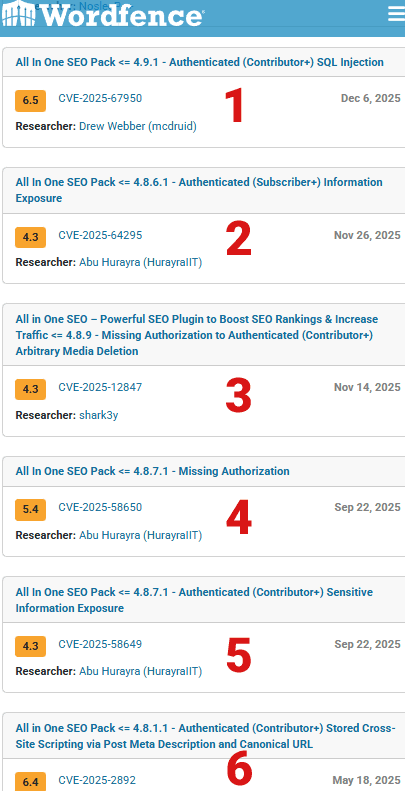
This is not the first time All In One SEO has shipped with vulnerabilities related to missing authorization or low-privilege access. According to Wordfence, the plugin has had six vulnerabilities disclosed in 2025 alone, many of which allowed Contributor or Subscriber level users to access or modify data they should not have been able to access.

Those issues included SQL injection, information disclosure, arbitrary media deletion, missing authorization checks, sensitive data exposure, and stored cross-site scripting. The recurring theme across those reports is improper permission enforcement for low-privilege users, the same underlying class of flaw that led to the AI token exposure in this case.

Six vulnerabilities in one year is a high level for an SEO plugin. Yoast SEO plugin had zero vulnerabilities in 2025, RankMath had four vulnerabilities in 2025 and Squirrly SEO had only three vulnerabilities in 2025.

Screenshot Of Six AIOSEO Vulnerabilities In 2025

How The Vulnerability Was Fixed

The vulnerability affects all versions of All in One SEO up to and including 4.9.2. It was addressed in version 4.9.3, which included a security update described in the official plugin changelog by the plugin developers as:

“Hardened API routes to prevent AI access token from being exposed.”

That change corresponds directly to the REST API flaw identified by Wordfence.

What Site Owners Should Do

Anyone running All in One SEO should update to version 4.9.3 or newer as soon as possible. Sites that allow multiple external contributors are especially exposed since low-privilege accounts could access the site’s AI token on vulnerable versions.

Featured Image by Shutterstock/Shutterstock AI Generator

Survey: Publishers Expect Search Traffic To Fall Over 40% via @sejournal, @MattGSouthern

The Reuters Institute for the Study of Journalism has published its annual predictions report based on a survey of 280 senior media leaders across 51 countries and territories.

The report suggests publishers are preparing for two potential threats: generative AI tools, and creators who attract audiences with personality-led formats.

Note that the Reuters Institute survey reflects a strategic group of senior leaders. It’s not a representative sample of the entire industry.

What The Report Found

Search Traffic Is The Biggest Near-Term Concern

Survey respondents expect search engine traffic to decline by more than 40% over the next three years as AI-driven answers expand.

The report cites Chartbeat data showing aggregate Google Search traffic to hundreds of news sites has already started to dip. Lifestyle-focused publishers say they’ve been hit especially hard by Google’s AI Overviews rollout.

That comes on top of longer-running platform declines. The report notes referral traffic to news sites from Facebook fell 43% over the last three years, while referrals from X fell 46% over the same period.

Publishers Plan To Invest In Differentiation

In response to traffic pressure and AI summarization, publishers say they’ll invest more in original investigations, on-the-ground reporting, contextual analysis, and human stories.

Leaders surveyed say they plan to scale back service journalism and evergreen content, which many expect AI chatbots to commoditize.

Video & Off-Platform Distribution Rising

Publishers expect to invest more in video, including “watch tabs,” and more in audio formats such as podcasts. Text output is less of a priority.

On distribution, YouTube is the main off-platform channel cited in the report, alongside TikTok and Instagram.

Publishers are also trying to work out how to navigate distribution through AI platforms such as OpenAI’s ChatGPT, Google’s Gemini, and Perplexity.

Subscriptions Lead, Licensing Is Growing

For commercial publishers, paid content like subscriptions and memberships are the top focus. There’s also renewed interest in native advertising and face-to-face events as publishers look for revenue beyond traditional display ads.

Publishers are also looking at licensing and other platform payments. The report notes interest in platform funding has nearly doubled over the last two years as AI companies began offering large deals.

Why This Matters

I’ve watched publishers cycle through traffic crises before. When Facebook’s algorithm changes hit in 2018, the industry scrambled, and eventually most publishers adjusted by leaning harder into search. Search was supposed to be the stable channel.

That assumption is what this report challenges. A projected decline of 40%+ over three years has become a planning number, affecting budgets, headcount, and content strategy.

The content mix change warrants attention. When 280 senior media leaders say they’re scaling back service journalism and evergreen content, it signals which pages they think will still drive traffic in an AI-summarized environment. Original reporting and analysis survive because chatbots can’t replicate them. Commodity information doesn’t, because it can be synthesized without a click.

The doubling of interest in licensing deals over two years is the other number that jumped out to me. When AI companies started writing checks, the conversation changed from “should we license” to “what’s our leverage.”

This report is useful as a benchmark for where the industry’s head is at, even if individual outcomes vary.

Looking Ahead

Traffic from search and AI aggregators is unlikely to disappear, but the terms of trade are still being negotiated.

That includes how citations work, what licensing looks like at scale, and whether revenue-sharing becomes a standard arrangement.


Featured Image: Roman Samborskyi/Shutterstock

SEO Is No Longer A Single Discipline via @sejournal, @DuaneForrester

Most people have a favorite coffee mug. You reach for it without thinking. It fits your hand. It does its job. For a long time, SEO felt like that mug. A defined craft, a repeatable routine, a discipline you could explain in a sentence. Crawl the site. Optimize the pages. Earn visibility. Somewhere along the way, that single mug turned into a cabinet full of cups. Each one different. Each one required – none of them optional anymore.

That shift did not happen because SEO got bloated or unfocused. It happened because discovery changed shape.

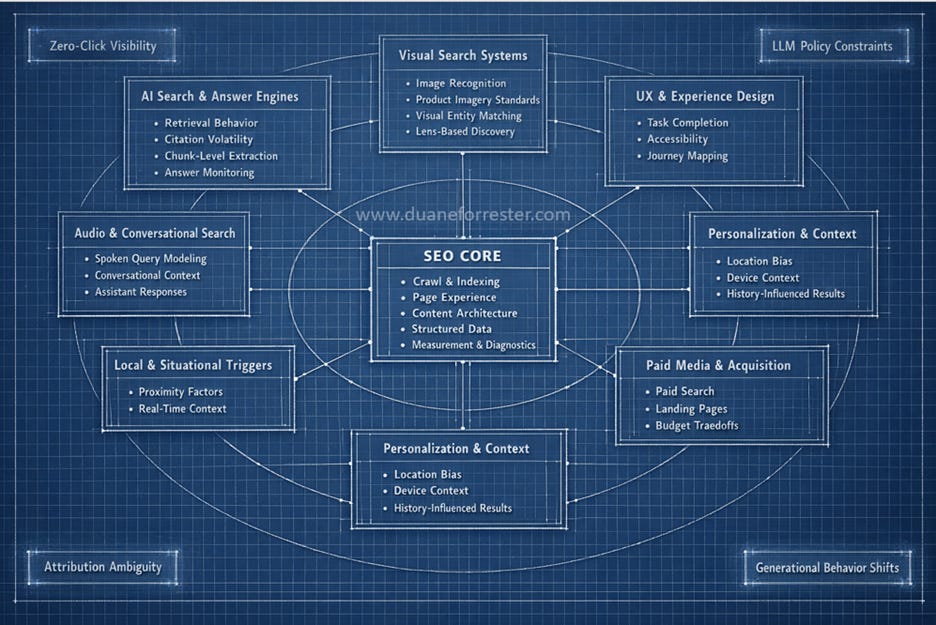
SEO did not become complex on its own. The environment around it fractured, multiplied, and layered itself. SEO stretched to meet it.

Image Credit: Duane Forrester

The SEO Core Still Exists

Despite everything that has changed, SEO still has a core. It is smaller than many people remember, but it is still essential.

This core is about access, clarity, and measurement. Search engines must be able to crawl content, understand it, and present it in a usable way. Google’s own SEO Starter Guide still frames these fundamentals clearly.

Crawl and indexing remain foundational. If content cannot be accessed or stored, nothing else matters. Robots.txt governance follows a formal standard, RFC 9309, which defines how crawlers interpret exclusion rules. This matters because robots.txt is guidance, not enforcement. Misuse can create accidental invisibility.

Page experience is no longer optional. Core Web Vitals represent measurable user experience signals that Google incorporates into Search. The broader framework and measurement approach are documented on Web.dev.

Content architecture still matters. Pages must map cleanly to intent. Headings must signal structure. Internal links must express relationships. Structured data still plays a role in helping machines interpret content and enable eligible rich results today.

Measurement and diagnostics remain part of the job. Search Console, analytics, and validation tools still anchor decision-making for traditional search.

That is the SEO core. It is real work, and it is not shrinking. It is, however, no longer sufficient on its own.

This first ring out from the core is where SEO stops being a single lane.

Once the core is in place, modern SEO immediately runs into systems it does not fully control. This is where the real complexity starts to expand.

AI Search And Answer Engines

AI systems now sit between content and audience. They do not behave like traditional search engines. They summarize, recommend, and sometimes cite. Critically, they do not agree with each other.

In mid-2025, BrightEdge analyzed brand recommendations across ChatGPT, Google AI experiences, and other AI-driven interfaces and found that they disagreed on brand recommendations for 62% of queries. Search Engine Land covered the same analysis and framed it as a warning for marketers assuming consistency across AI search experiences.

This introduces a new kind of SEO work. Rankings alone no longer describe visibility. Practitioners now track whether their brand appears in answers, which pages are cited when citations exist, and how often competitors are recommended instead.

This is not arbitrary. Retrieval-augmented generation exists precisely to ground AI responses in external sources and improve factual reliability. The original RAG paper outlines this architecture clearly.

That architectural choice pulls SEO into new territory. Content must be written so it can be extracted without losing meaning. Ambiguity becomes a liability. Sections must stand alone.

Chunk-Level Content Architecture

Pages are no longer the smallest competitive unit. Passages are. And despite being told we shouldn’t focus on chunks for traditional search, when you look outside of traditional search, you need to understand the role chunks play. And traditional search isn’t the only game in town now.

Modern retrieval systems often pull fragments of content, not entire documents. That forces SEOs to think in chunks. Each section needs a single job. Each answer needs to survive without surrounding context.

This changes how long-form content is written. It does not eliminate depth. It demands structure. We now live in a hybrid world where both layers of the system must be served. It means more work, but selecting one over the other? That’s a mistake at this point.

Visual Search

Discovery increasingly starts with cameras. Google Lens allows users to search what they see, using images as queries. Pinterest Lens and other visual tools follow the same model.

This forces new responsibilities. Image libraries become strategic assets. Alt text stops being a compliance task and becomes a retrieval signal. Product imagery must support recognition, not just aesthetics.

Google’s product structured data documentation explicitly notes that product information can surface across Search, Images, and Lens experiences.

Audio And Conversational Search

Voice changes how people ask questions and what kind of answers they accept. Queries become more conversational, more situational, and more task-focused.

Industry research compiled by Marketing LTB shows that a meaningful portion of users now rely on voice input, with multiple surveys indicating that roughly one in four to one in three people use voice search, particularly on mobile devices and smart assistants.

That matters less as a headline number and more for what it does to query shape. Spoken queries tend to be longer, more natural, and framed as requests rather than keywords. Users expect direct, complete answers, not a list of links.

And the biggest search platform is reinforcing this behavior. Google has begun rolling out conversational voice experiences directly inside Search, allowing users to ask follow-up questions in real time using speech. The Verge covered Google’s launch of Search Live, which turns search into an ongoing dialogue rather than a single query-response interaction.

For SEO practitioners, this expands the work. It pulls them into spoken-language modeling, answer-first content construction, and situational phrasing that works when read aloud. Pages that perform well in voice and conversational contexts tend to be clear, concise, and structurally explicit, because ambiguity collapses quickly when an answer is spoken rather than scanned. Still think traditional SEO approaches are all you need?

Personalization And Context

There is no single SERP. Google explains that search results vary based on factors including personalization, language, and location.

For practitioners, this means rankings become samples, not truths. Monitoring shifts toward trends, segments, and outcome-based signals rather than position reports.

Image Credit: Duane Forrester

The third ring is where complexity becomes really visible.

These are not just SEO tasks. The things in this layer are entire disciplines that SEO now interfaces with.

Brand Protection And Retrieval In An LLM World

Brand protection used to be a communications problem. Today, it is also a retrieval problem.

Large language models do not simply repeat press releases or corporate messaging. They retrieve information from a mixture of training data, indexed content, and real-time sources, then synthesize an answer that feels authoritative, whether it is accurate or not.

This creates a new class of risk. A brand can be well-known, well-funded, and well-covered by media, yet still be misrepresented, outdated, or absent in AI-generated answers.

Unlike traditional search, there is no single ranking to defend. Different AI systems can surface different descriptions, different competitors, or different recommendations for the same intent. That BrightEdge analysis showing 62% disagreement in brand recommendations across AI platforms illustrates how unstable this layer can be.

This is where SEO is pulled into brand protection work.

SEO practitioners already operate at the intersection of machine interpretation and human intent. In an LLM environment, that skill set extends naturally into brand retrieval monitoring. This includes tracking whether a brand appears in AI answers, how it is described, which sources are cited when citations exist, and whether outdated or incorrect narratives persist.

PR and brand teams are not historically equipped to do this work. Media monitoring tools track mentions, sentiment, and coverage. They do not track how an AI model synthesizes a brand narrative, nor how retrieval changes over time.

As a result, SEO increasingly becomes the connective tissue between brand, PR, and the machine layer.

This does not mean SEO owns brand. It means SEO helps ensure that the content machines retrieve about a brand is accurate, current, and structured in ways retrieval systems can use. It means working with brand teams to align authoritative sources, consistent terminology, and verifiable claims. It means working with PR teams to understand which coverage reinforces trust signals that machines recognize, not just headlines humans read.

In practice, brand protection in AI search becomes a shared responsibility, with SEO providing the technical and retrieval lens that brand and PR teams lack, and brand and PR providing the narrative discipline SEO cannot manufacture alone.

This is not optional work. As AI systems increasingly act as intermediaries between brands and audiences, the question is no longer “how do we rank?” It is “how are we being represented when no one clicks at all?”

Branding And Narrative Systems

Branding is not a subset of SEO. It is a discipline that includes voice, identity, reputation, executive presence, and crisis response.

SEO intersects with branding because AI systems increasingly behave like advisors, recommending, summarizing, and implicitly judging.

Trust matters more in that environment. The Edelman Trust Barometer documents declining trust across institutions and brands, reinforcing why authority can no longer be assumed. Trust diminishes, and consumer behavior changes. The equation is no longer brand = X, therefore X = brand.

SEO practitioners now care about sourcing, claims, and consistency because brand perception can now influence whether content is surfaced or ignored.

UX And Task Completion

Clicks are no longer the win. Completion is.

Though old, these remain applicable. Nielsen Norman Group defines success rate as a core usability metric, measuring whether users can complete tasks. They also outline usability metrics tied directly to task efficiency and error reduction.

When AI and zero-click experiences compress opportunities, the pages that do earn attention must deliver. SEO now has a stake in friction reduction, clarity, and task flow. CRO (conversion rate optimization) has never been more important, but how you define “conversion” has also never been broader.

Paid Media, Lifecycle, And Attribution

Discovery spans organic, AI answers, video feeds, and paid placements. Measurement follows the same fragmentation.

Google Analytics defines attribution as assigning credit across touchpoints in the path to conversion.

SEO practitioners are pulled into cross-channel conversations not because they want to own them, but because outcomes are shared. Organic assists paid. Email creates branded demand. Paid fills gaps while organic matures.

Generational And Situational Behavior

Audience behavior is not uniform. Pew Research Center’s 2025 research on teens, social media, and AI chatbots shows how discovery and engagement increasingly differ across age groups, platforms, and interaction modes, including traditional search, social feeds, and AI interfaces.

This shapes format expectations. Discovery may happen in video-first environments. Conversion may happen on the web. Sometimes the web is skipped entirely.

What This Means For SEO Practitioners

SEO did not become more complex because practitioners lost discipline or focus; it became more complex because discovery fractured. The work expanded because the interfaces expanded. The inputs multiplied. The outputs stopped behaving consistently.

In that environment, SEO stopped being a function you execute and became a role you play inside a system you do not fully control, and that distinction matters.

Much of the anxiety practitioners feel right now comes from being evaluated as if SEO were still a closed loop. Rankings up or down. Traffic in or out. Conversions attributed cleanly. Those models assume a world where discovery happens in one place and outcomes follow a predictable path.

That is no longer the world we’re operating in.

Today, a user might encounter a brand inside an AI answer, validate it through a video platform, compare it through reviews surfaced in search, and convert days later through a branded query or a direct visit. In many cases, no single click tells the story. In others, there is no click at all.

This is why SEO keeps getting pulled into UX conversations, brand discussions, PR alignment, attribution debates, and content format decisions. Not because SEO owns those disciplines, but because SEO sits closest to the fault lines where discovery breaks or holds.

This is also why trying to “draw a box” around SEO keeps failing.

You can still define an SEO core, and you should. Crawlability, performance, content architecture, structured data, and measurement remain non-negotiable. But pretending the job ends there creates a gap between responsibility and reality. When visibility drops, or when AI answers misrepresent a brand, or when traffic declines despite strong fundamentals, that gap becomes painfully visible.

What’s changed is not the importance of SEO, but the nature of its influence.

Modern SEO operates as an integration discipline. It connects systems that were never designed to work together. It translates between machines and humans, between intent and interface, between brand narrative and retrieval logic. It absorbs volatility from platforms so organizations don’t have to feel it all at once.

That does not mean every SEO must take on every cup in the cabinet. It does mean understanding what those cups contain, which ones you own, which ones you influence, and which ones you simply need to account for when explaining outcomes.

The cabinet is already there, and you can choose to keep reaching for a single familiar mug and accept increasing unpredictability. Or you can open the cabinet deliberately, understand what’s inside, and decide how much of the expanded role you’re willing to take on.

Either choice is valid, but pretending everything still fits in one cup is no longer an option.

More Resources:


This post was originally published on Duane Forrester Decodes.


Featured Image: Master1305/Shutterstock