For the last couple of years, I’ve been following the progress of a group of individuals who believe death is humanity’s “core problem.” Put simply, they say death is wrong—for everyone. They’ve even said it’s morally wrong.
Vitalism is more than a philosophy, though—it’s a movement for hardcore longevity enthusiasts who want to make real progress in finding treatments that slow or reverse aging. Not just through scientific advances, but by persuading influential people to support their movement, and by changing laws and policies to open up access to experimental drugs.
And they’re starting to make progress.
Vitalism was founded by Adam Gries and Nathan Cheng—two men who united over their shared desire to find ways to extend human lifespan. I first saw Cheng speak back in 2023, at Zuzalu, a pop-up city in Montenegro for people who were interested in life extension and some other technologies. (It was an interesting experience—you can read more about it here.)
Zuzalu was where Gries and Cheng officially launched Vitalism. But I’ve been closely following the longevity scene since 2022. That journey took me to Switzerland, Honduras, and a compound in Berkeley, California, where like-minded longevity enthusiasts shared their dreams of life extension.
It also took me to Washington, DC, where, last year, supporters of lifespan extension presented politicians including Mehmet Oz, who currently leads the Centers for Medicare & Medicaid Services, with their case for changes to laws and policies.
The journey has been fascinating, and at times weird and even surreal. I’ve heard biohacking stories that ended with smoking legs. I’ve been told about a multi-partner relationship that might be made possible through the cryopreservation—and subsequent reanimation—of a man and the multiple wives he’s had throughout his life. I’ve had people tell me to my face that they consider themselves eugenicists, and that they believe that parents should select IVF embryos for their propensity for a long life.
I’ve been shouted at and threatened with legal action. I’ve received barefoot hugs. One interviewee told me I needed Botox. It’s been a ride.
My reporting has also made me realize that the current interest in longevity reaches beyond social media influencers and wellness centers. Longevity clinics are growing in number, and there’s been a glut of documentaries about living longer or even forever.
At the same time, powerful people who influence state laws, giant federal funding budgets, and even national health policy are prioritizing the search for treatments that slow or reverse aging. The longevity community was thrilled when longtime supporter Jim O’Neill was made deputy secretary of health and human services last year. Other members of Trump’s administration, including Oz, have spoken about longevity too. “It seems that now there is the most pro-longevity administration in American history,” Gries told me.
I recently spoke to Alicia Jackson, the new director of ARPA-H. The agency, established in 2022 under Joe Biden’s presidency, funds “breakthrough” biomedical research. And it appears to have a new focus on longevity. Jackson previously founded and led Evernow, a company focused on “health and longevity for every woman.”
“There’s a lot of interesting technologies, but they all kind of come back to the same thing: Could we extend life years?” she told me over a Zoom call a few weeks ago. She added that her agency had “incredible support” from “the very top of HHS.” I asked if she was referring to Jim O’Neill. “Yeah,” she said. She wouldn’t go into the specifics.
Gries is right: There is a lot of support for advances in longevity treatments, and some of it is coming from influential people in positions of power. Perhaps the field really is poised for a breakthrough.
And that’s what makes this field so fascinating to cover. Despite the occasional weirdness.
This article first appeared in The Checkup, MIT Technology Review’s weekly biotech newsletter. To receive it in your inbox every Thursday, and read articles like this first, sign up here.
Civitai—an online marketplace for buying and selling AI-generated content, backed by the venture capital firm Andreessen Horowitz—is letting users buy custom instruction files for generating celebrity deepfakes. Some of these files were specifically designed to make pornographic images banned by the site, a new analysis has found.
The study, from researchers at Stanford and Indiana University, looked at people’s requests for content on the site, called “bounties.” The researchers found that between mid-2023 and the end of 2024, most bounties asked for animated content—but a significant portion were for deepfakes of real people, and 90% of these deepfake requests targeted women. (Their findings have not yet been peer reviewed.)
The debate around deepfakes, as illustrated by the recent backlash to explicit images on the X-owned chatbot Grok, has revolved around what platforms should do to block such content. Civitai’s situation is a little more complicated. Its marketplace includes actual images, videos, and models, but it also lets individuals buy and sell instruction files called LoRAs that can coach mainstream AI models like Stable Diffusion into generating content they were not trained to produce. Users can then combine these files with other tools to make deepfakes that are graphic or sexual. The researchers found that 86% of deepfake requests on Civitai were for LoRAs.
In these bounties, users requested “high quality” models to generate images of public figures like the influencer Charli D’Amelio or the singer Gracie Abrams, often linking to their social media profiles so their images could be grabbed from the web. Some requests specified a desire for models that generated the individual’s entire body, accurately captured their tattoos, or allowed hair color to be changed. Some requests targeted several women in specific niches, like artists who record ASMR videos. One request was for a deepfake of a woman said to be the user’s wife. Anyone on the site could offer up AI models they worked on for the task, and the best submissions received payment—anywhere from $0.50 to $5. And nearly 92% of the deepfake bounties were awarded.
Neither Civitai nor Andreessen Horowitz responded to requests for comment.
It’s possible that people buy these LoRAs to make deepfakes that aren’t sexually explicit (though they’d still violate Civitai’s terms of use, and they’d still be ethically fraught). But Civitai also offers educational resources on how to use external tools to further customize the outputs of image generators—for example, by changing someone’s pose. The site also hosts user-written articles with details on how to instruct models to generate pornography. The researchers found that the amount of porn on the platform has gone up, and that the majority of requests each week are now for NSFW content.
“Not only does Civitai provide the infrastructure that facilitates these issues; they also explicitly teach their users how to utilize them,” says Matthew DeVerna, a postdoctoral researcher at Stanford’s Cyber Policy Center and one of the study’s leaders.
The company used to ban only sexually explicit deepfakes of real people, but in May 2025 it announced it would ban all deepfake content. Nonetheless, countless requests for deepfakes submitted before this ban now remain live on the site, and many of the winning submissions fulfilling those requests remain available for purchase, MIT Technology Review confirmed.
“I believe the approach that they’re trying to take is to sort of do as little as possible, such that they can foster as much—I guess they would call it—creativity on the platform,” DeVerna says.
Users buy LoRAs with the site’s online currency, called Buzz, which is purchased with real money. In May 2025, Civita’s credit card processor cut off the company because of its ongoing problem with nonconsensual content. To pay for explicit content, users must now use gift cards or cryptocurrency to buy Buzz; the company offers a different scrip for non-explicit content.
Civitai automatically tags bounties requesting deepfakes and lists a way for the person featured in the content to manually request its takedown. This system means that Civitai has a reasonably successful way of knowing which bounties are for deepfakes, but it’s still leaving moderation to the general public rather than carrying it out proactively.
A company’s legal liability for what its users do isn’t totally clear. Generally, tech companies have broad legal protections against such liability for their content under Section 230 of the Communications Decency Act, but those protections aren’t limitless. For example, “you cannot knowingly facilitate illegal transactions on your website,” says Ryan Calo, a professor specializing in technology and AI at the University of Washington’s law school. (Calo wasn’t involved in this new study.)
Civitai joined OpenAI, Anthropic, and other AI companies in 2024 in adopting design principles to guard against the creation and spread of AI-generated child sexual abuse material . This move followed a 2023 report from the Stanford Internet Observatory, which found that the vast majority of AI models named in child sexual abuse communities were Stable Diffusion–based models “predominantly obtained via Civitai.”
But adult deepfakes have not gotten the same level of attention from content platforms or the venture capital firms that fund them. “They are not afraid enough of it. They are overly tolerant of it,” Calo says. “Neither law enforcement nor civil courts adequately protect against it. It is night and day.”
Civitai received a $5 million investment from Andreessen Horowitz (a16z) in November 2023. In a video shared by a16z, Civitai cofounder and CEO Justin Maier described his goal of building the main place where people find and share AI models for their own individual purposes. “We’ve aimed to make this space that’s been very, I guess, niche and engineering-heavy more and more approachable to more and more people,” he said.
Civitai is not the only company with a deepfake problem in a16z’s investment portfolio; in February, MIT Technology Reviewfirst reported that another company, Botify AI, was hosting AI companions resembling real actors that stated their age as under 18, engaged in sexually charged conversations, offered “hot photos,” and in some instances described age-of-consent laws as “arbitrary” and “meant to be broken.”
“Who here believes involuntary death is a good thing?”
Nathan Cheng has been delivering similar versions of this speech over the last couple of years, so I knew what was coming. He was about to try to convince the 80 or so people in the audience that death is bad. And that defeating it should be humanity’s number one priority—quite literally, that it should come above all else in the social and political hierarchy.
“If you believe that life is good and there’s inherent moral value to life,” he told them, “it stands to reason that the ultimate logical conclusion here is that we should try to extend lifespan indefinitely.”
Solving aging, he added, is “a problem that has an incredible moral duty for all of us to get involved in.”
It was the end of April, and the crowd—with its whoops and yeahs—certainly seemed convinced. They’d gathered at a compound in Berkeley, California, for a three-day event called the Vitalist Bay Summit. It was part of a longer, two-month residency (simply called Vitalist Bay) that hosted various events to explore tools—from drug regulation to cryonics—that might be deployed in the fight against death. One of the main goals, though, was to spread the word of Vitalism, a somewhat radical movement established by Cheng and his colleague Adam Gries a few years ago.
No relation to the lowercase vitalism of old, this Vitalism has a foundational philosophy that’s deceptively simple: to acknowledge that death is bad and life is good. The strategy for executing it, though, is far more obviously complicated: to launch a longevity revolution.
Interest in longevity has certainly taken off in recent years, but as the Vitalists see it, it has a branding problem. The term “longevity” has been used to sell supplements with no evidence behind them, “anti-aging” has been used by clinics to sell treatments, and “transhumanism” relates to ideas that go well beyond the scope of defeating death. Not everyone in the broader longevity space shares Vitalists’ commitment to actually making death obsolete. As Gries, a longtime longevity devotee who has largely become the enthusiastic public face of Vitalism, said in an online presentation about the movement in 2024, “We needed some new word.”
“Vitalism” became a clean slate: They would start a movement to defeat death, and make that goal the driving force behind the actions of individuals, societies, and nations. Longevity could no longer be a sideshow. For Vitalism to succeed, budgets would need to change. Policy would need to change. Culture would need to change. Consider it longevity for the most hardcore adherents—a sweeping mission to which nothing short of total devotion will do.
“The idea is to change the systems and the priorities of society at the highest levels,” Gries said in the presentation.
To be clear, the effective anti-aging treatments the Vitalists are after don’t yet exist. But that’s sort of the point: They believe they could exist if Vitalists are able to spread their gospel, influence science, gain followers, get cash, and ultimately reshape government policies and priorities.
For the past few years, Gries and Cheng have been working to recruit lobbyists, academics, biotech CEOs, high-net-worth individuals, and even politicians into the movement, and they’ve formally established a nonprofit foundation “to accelerate Vitalism.” Today, there’s a growing number of Vitalists (some paying foundation members, others more informal followers, and still others who support the cause but won’t publicly admit as much), and the foundation has started “certifying” qualifying biotech companies as Vitalist organizations. Perhaps most consequentially, Gries, Cheng, and their peers are also getting involved in shaping US state laws that make unproven, experimental treatments more accessible. They hope to be able to do the same at the national level.
VITALISMFOUNDATION.ORG
VITALISMFOUNDATION.ORG
Vitalism cofounders Nathan Cheng and Adam Gries want to launch a longevity revolution.
All this is helping Vitalists grow in prominence, if not also power. In the past, people who have spoken of living forever or making death “optional” have been dismissed by their academic colleagues. I’ve been covering the broader field of aging science for a decade, and I’ve seen scientists roll their eyes, shrug their shoulders, and turn their backs on people who have talked this way. That’s not the case for the Vitalists.
Even the scientists who think that Vitalist ideas of defeating death are wacky, unattainable ones, with the potential to discredit their field, have shown up on stage with Vitalism’s founders, and these serious researchers provide a platform for them at more traditionally academic events.
I saw this collegiality firsthand at Vitalist Bay. Faculty members from Harvard, Stanford, and the University of California, Berkeley, all spoke at events. Eric Verdin, the prominent researcher who directs the Buck Institute for Research on Aging in Novato, California, had also planned to speak, although a scheduling clash meant he couldn’t make it in the end. “I have very different ideas in terms of what’s doable,” he told me. “But that’s part of the [longevity] movement—there’s freedom for people to say whatever they want.”
Many other well-respected scientists attended, including representatives of ARPA-H, the US federal agency for health research and breakthrough technologies. And as I left for a different event on longevity in Washington, DC, just after the Vitalist Bay Summit, a sizable group of Vitalist Bay attendees headed that way too, to make the case for longevity to US lawmakers.
The Vitalists feel that momentum is building, not just for the science of aging and the development of lifespan-extending therapies, but for the acceptance of their philosophy that defeating death should be humanity’s top concern.
This, of course, sparks some pretty profound questions. What would a society without death look like—and would we even want it? After all, death has become an important part of human culture the world over. And even if Vitalists aren’t destined to realize their lofty goal, their growing influence could still have implications for us all. As they run more labs and companies, and insert themselves into the making of laws and policy, perhaps they will discover treatments that really do slow or even reverse aging. In the meantime, though, some ethicists are concerned that experimental and unproven medicines—including potentially dangerous ones—are becoming more accessible, in some cases with little to no oversight.
Gries, ultimately, has a different view of the ethics here. He thinks that being “okay with death” is what disqualifies a person from being considered ethical. “Death is just wrong,” he says. “It’s not just wrong for some people. It’s wrong for all people.”
The birth of a revolution
When I arrived at the Vitalist Bay Summit on April 25, I noticed that the venue was equipped with everything a longevity enthusiast might need: napping rooms, a DEXA body-composition scanner, a sauna in a bus, and, for those so inclined, 24-hour karaoke.
I was told that around 300 people had signed up for that day’s events, which was more than had attended the previous week. That might have been because arguably the world’s most famous longevity enthusiast, Bryan Johnson, was about to make an appearance. (If you’re curious to know more about what Johnson was doing there, you can read about our conversation here.)
The key to Vitalism has always been that“death is humanity’s core problem, and aging its primary agent,” cofounder Adam Gries told me. “So it was, and so it has continued, as it was foretold.”
But Gries, another man in his 40s who doesn’t want to die, was the first to address the audience that day. Athletic and energetic, he bounded across a stage wearing bright yellow shorts and a long-sleeved shirt imploring people to “Choose Life: VITALISM.”
Gries is a tech entrepreneur who describes himself as a self-taught software engineer who’s “good at virality.” He’s been building companies since he was in college in the 2000s, and grew his personal wealth by selling them.
As with many other devotees to the cause, his deep interest in life extension was sparked by Aubrey de Grey, a controversial researcher with an iconic long beard and matching ponytail. He’s known widely both for his optimistic views about “defeating aging” and for having reportedly made sexual comments to two longevity entrepreneurs. (In an email, de Grey said he’s “never disputed” one of these remarks but denied having made the other. “My continued standing within the longevity community speaks for itself,” he added.)
In an influential 2005 TED Talk (which has over 4.8 million views), de Grey predicted that people would live to 1,000 and spoke of the possibility of new technologies that would continue to stave off death, allowing some to avoid it indefinitely. (In a podcast recorded last year, Cheng described a recording of this talk as “the OG longevity-pilling YouTube video.”)
Many Vitalists have been influenced by controversial longevity researcher Aubrey de Grey. Cheng called his 2005 TED Talk “the OG longevity-pilling YouTube video.”
PETER SEARLE/CAMERA PRESS/REDUX
“It was kind of evident to me that life is great,” says Gries. “So I’m kind of like, why would I not want to live?”
A second turning point for Gries came during the early stages of the covid-19 pandemic, when he essentially bet against companies that he thought would collapse. “I made this 50 [fold] return,” he says. “It was kind of like living through The Big Short.”
Gries and his wife fled from San Francisco to Israel, where he grew up, and later traveled to Taiwan, where he’d obtained a “golden visa” and which was, at the time, one of only two countries that had not reported a single case of covid. His growing wealth afforded him the opportunity to take time from work and think about the purpose of life. “My answer was: Life is the purpose of life,” he says. He didn’t want to die. He didn’t want to experience the “journey of decrepitude” that aging often involves.
So he decided to dedicate himself to the longevity cause. He went about looking up others who seemed as invested as he was. In 2021 his search led him to Cheng, a Chinese-Canadian entrepreneur based in Toronto. He had dropped out of a physics PhD a few years earlier after experiencing what he describes on his website as “a massive existential crisis” and shifted his focus to “radical longevity.” (Cheng did not respond to email requests for an interview.)
The pair “hit it off immediately,” says Gries, and they spent the following two years trying to figure out what they could do. The solution they finally settled on: revolution.
After all, Gries reasons, that’s how significant religious and social movements have happened in the past. He says they sought inspiration from the French and American Revolutions, among others. The idea was to start with some kind of “enlightenment,” and with a “hardcore group,” to pursue significant social change with global ramifications.
“We were convinced that without a revolution,” Gries says, “we were as good as dead.”
A home for believers
Early on, they wrote a Vitalist declaration, a white paper that lists five core statements for believers:
Life and health are good. Death is humanity’s core problem, and aging its primary agent.
Aging causes immense suffering, and obviating aging is scientifically plausible.
Humanity should apply the necessary resources to reach freedom from aging as soon as possible.
I will work on or support others to work on reaching unlimited healthy human lifespan.
I will carry the message against aging and death.
While it’s not an explicit part of the manifesto, it was important to them to think about it as a moral philosophy as well as a movement. As Cheng said at the time, morality “guides most of the actions of our lives.” The same should be true of Vitalism, he suggested.
Gries has echoed this idea. The belief that “death is morally bad” is necessary to encourage behavior change, he told me in 2024. It is a moral drive, or moral purpose, that pushes people to do difficult things, he added.
Revolution, after all, is difficult. And to succeed—to “get unlimited great health to the top of the priority list,” as Gries says—the movement would need to infiltrate the government and shape policy decisions and national budgets. The Apollo program got people to the moon with less than 1% of US GDP; imagine, Gries asks, what we could do to human longevity with a mere 1% of GDP?
It makes sense, then, that Gries and Cheng launched Vitalism in 2023 at Zuzalu, a “pop-up city” in Montenegro that provided a two-month home for like-minded longevity enthusiasts. The gathering was in some ways a loose prototype for what they wanted to accomplish. Cheng spoke there of how they wanted to persuade 10,000 or so Vitalists to move to Rhode Island. Not only was it close to the biotech hub of Boston, but they believed it had a small enough population for an influx of new voters sharing their philosophy to influence local and state elections. “Five to ten thousand people—that’s all we need,” he said. Or if not Rhode Island, another small-ish US state, where they could still change state policy from the inside.
The ultimate goal was to recruit Vitalists to help them establish a “longevity state”—a recognized jurisdiction that “prioritizes doing something about aging,” Cheng said, perhaps by loosening regulations on clinical trials or supporting biohacking.
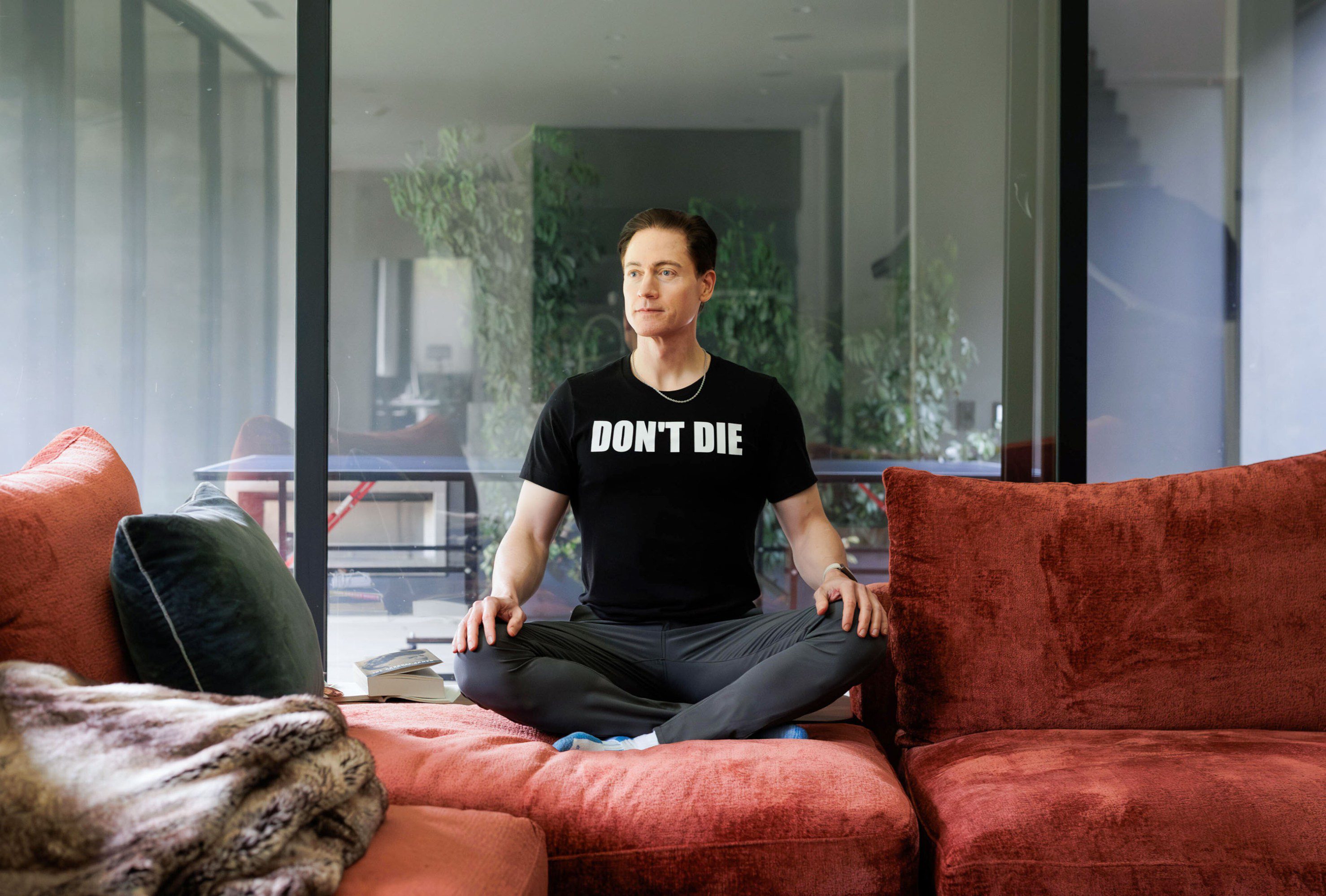
Bryan Johnson, who is perhaps the world’s most famous longevity enthusiast, spoke at Vitalist Bay and is trying to start a Don’t Die religion.
AGATON STROM/REDUX PICTURES
This idea is popular among many vocal members of the Vitalism community. It borrows from the concept of the “network state” developed by former Coinbase CTO Balaji Srinivasan, defined as a new city or country that runs on cryptocurrency; focuses on a goal, in this case extending human lifespan; and “eventually gains diplomatic recognition from preexisting states.”
Some people not interested in dying have made progress toward realizing such a domain. Following the success of Zuzalu, one of the event’s organizers, Laurence Ion, a young cryptocurrency investor and self-proclaimed Vitalist, joined a fellow longevity enthusiast named Niklas Anzinger to organize a sequel in Próspera, the private “special economic zone” on the Honduran island of Roatán. They called their “pop-up city” Vitalia.
I visited shortly after it launched in January 2024. The goal was to create a low-regulation biotech hub to fast-track the development of anti-aging drugs, though the “city” was more like a gated resort that hosted talks from a mix of respected academics, biohackers, biotech CEOs, and straight-up eugenicists. There was a strong sense of community—many attendees were living with or near each other, after all. A huge canvas where attendees could leave notes included missives like “Don’t die,” “I love you,” and “Meet technoradicals building the future!”
But Vitalia was short-lived, with events ending by the start of March 2024. And while many of the vibes were similar to what I’d later see at Vitalist Bay, the temporary nature of Vitalia didn’t quite match the ambition of Gries and Cheng.
Patri Friedman, a 49-year-old libertarian and grandson of the economist Milton Friedman who says he attended Zuzalu, Vitalia, and Vitalist Bay, envisions something potentially even bolder. He’s the founder of the Seasteading Institute, which has the goal of “building startup communities that float on the ocean with any measure of political autonomy” and has received funding and support from the billionaire Peter Thiel. Friedman also founded Pronomos Capital, a venture capital fund that invests in projects focused on “building the cities of tomorrow.”
His company is exploring various types of potential network states, but he says he’s found that medical tourism—and, specifically, a hunger for life extension—dominates the field. “People do not want this ‘10 years and a billion dollars to pass a drug’ thing with the FDA,” says Friedman. (While he doesn’t call himself a Vitalist, partly because he’s “almost never going to agree with” any kind of decree, Friedman holds what you might consider similarly staunch sentiments about death, which he referred to as “murder by omission.” When I asked him if he has a target age he’d like to reach, he told me he found the question “mind-bogglingly strange” and “insane.” “How could you possibly be like: Yes, please murder me at this time?” he replied. “I can always fucking shoot myself in the head—I don’t need anybody’s help.”)
But even as Vitalists and those aligned with their beliefs embrace longevity states, Gries and Cheng are reassessing their former ambitions. The network-state approach has limits, Gries tells me. And encouraging thousands of people to move to Rhode Island wasn’t as straightforward as they’d hoped it might be.
Not because he can’t find tens of thousands of Vitalists, Gries stresses—but most of them are unwilling to move their lives for the sake of influencing the policy of another state. He compares Vitalism to a startup, with a longevity state as its product. For the time being, at least, there isn’t enough consumer appetite for that product, he says.
The past year shows that it may in fact be easier to lobby legislators in states that are already friendly to deregulation. Anzinger and a lobbying group called the Alliance for Longevity Initiatives (A4LI) were integral to making Montana the first US hub for experimental medical treatments, with a new law to allow clinics to sell experimental therapies once they have been through preliminary safety tests (which don’t reveal whether a drug actually works). But Gries and his Vitalist colleagues also played a role—“providing feedback, talking to lawmakers … brainstorming [and] suggesting ideas,” Gries says.
The Vitalist crew has been in conversation with lawmakers in New Hampshire, too. In an email in December, Gries and Cheng claimed they’d “helped to get right-to-try laws passed” in the state—an apparent reference to the recent expansion of a law to make more unapproved treatments accessible to people with terminal illnesses. Meanwhile, three other bills that expand access even further are under consideration.
Ultimately, Gries stresses, Vitalism is “agnostic to the fixing strategies” that will help them meet their goals. There is, though, at least one strategy he’s steadfast about: building influence.
Only the hardcore
To trigger a revolution, the Vitalists may need to recruit only around 3% or 4% of “society” to their movement, Gries believes. (Granted, that does still mean hundreds of millions of people.) “If you want people to take action, you need to focus on a small number of very high-leverage people,” he tells me.
That, perhaps unsurprisingly, includes wealthy individuals with “a net worth of $10 million or above,” he says. He wants to understand why (with some high-profile exceptions, including Thiel, who has been investing in longevity-related companies and foundations for decades) most uber-wealthy people don’t invest in the field—and how he might persuade them to do so. He won’t reveal the names of anyone he’s having conversations with.
These “high-leverage” people might also include, Gries says, well-respected academics, leaders of influential think tanks, politicians and policymakers, and others who work in government agencies.
A revolution needs to find its foot soldiers. And at the most basic level, that will mean boosting the visibility of the Vitalism brand—partly through events like Vitalist Bay, but also by encouraging others, particularly in the biotech space, to sign on. Cheng talks of putting out a “bat signal” for like-minded people, and he and Gries say that Vitalism has brought together people who have gone on to collaborate or form companies.
There’s also their nonprofit Vitalism International Foundation, whose supporters can opt to become “mobilized Vitalists” with monthly payments of $29 or more, depending on their level of commitment. In addition, the foundation works with longevity biotech companies to recognize those that are “aligned” with its goals as officially certified Vitalist organizations. “Designation may be revoked if an organization adopts apologetic narratives that accept aging or death,” according to the website. At the time of writing, that site lists 16 certified Vitalist organizations, including cryopreservation companies, a longevity clinic, and several research companies.
One of them is Shift Bioscience, a company using CRISPR and aging clocks—which attempt to measure biological age—to identify genes that might play a significant role in the aging process and potentially reverse it. It says it has found a single gene that can rejuvenate multiple types of cells.
Shift cofounder Daniel Ives, who holds degrees in mitochondrial and computational biology, tells me he was also won over to the longevity cause by de Grey’s 2005 TED Talk. He now has a countdown on his computer: “It’s my days till death,” he says—around 22,000 days left. “I’m using that to keep myself focused.”
Ives calls himself the “Vitalist CEO” of Shift Bioscience. He thinks the label is important first as a way for like-minded people to find and support each other, grow their movement, and make the quest for longevity mainstream. Second, he says, it provides a way to appeal to “hardcore” lifespan extensionists, given that others in the wellness and cosmetics industry have adopted the term “longevity” without truly applying themselves to finding rejuvenation therapies. He refers to unnamed companies and individuals who claim that drinking juices, for example, can reverse aging by five years or so.
“You don’t have to convince the mainstream,” says ARPA-H science and engineering advisor Mark Hamalainen. Though “kind of a terrible example,”he notes, Stalinism started small. “Sometimes you just have to convince the right people.”
“Somebody will make these claims and basically throw legitimate science under the bus,” he says. He doesn’t want spurious claims made on social media to get lumped in with the company’s serious molecular biology. Shift’s head of machine learning, Lucas Paulo de Lima Camillo, was recently awarded a $10,000 prize by the well-respected Biomarkers of Aging Consortium for an aging clock he developed.
Another out-and-proud Vitalist CEO is Anar Isman, the cofounder of AgelessRx, a telehealth provider that offers prescriptions for purported longevity drugs—and a certified Vitalist organization. (Isman, who is in his early 40s, used to work at a hedge fund but was inspired to join the longevity field by—you guessed it—de Grey.)
During a panel session at Vitalist Bay, he stressed that he too saw longevity as a movement—and a revolution—rather than an industry. But he also claimed his company wasn’t doing too badly commercially. “We’ve had a lot of demand,” he said. “We’ve got $60 million plus in annual revenue.”
Many of his customers come to the site looking for treatments for specific ailments, he tells me. He views each as an opportunity to “evangelize” his views on “radical life extension.” “I don’t see a difference between … dying tomorrow or dying in 30 years,” he says. He wants to live “at least 100 more” years.
CHRIS LABROOY
Vitalism, though, isn’t just appealing to commercial researchers. Mark Hamalainen, a 41-year-old science and engineering advisor at ARPA-H, describes himself as a Vitalist. He says he “kind of got roped into” Vitalism because he also works with Cheng—they founded the Longevity Biotech Fellowship, which supports new entrants to the field through mentoring programs. “I kind of view it as a more appealing rebranding of some of the less radical aspects of transhumanism,” he says. Transhumanism—the position that we can use technologies to enhance humans beyond the current limits of biology—covers a broad terrain, but “Vitalism is like: Can we just solve this death thing first? It’s a philosophy that’s easy to get behind.”
In government, he works with individuals like Jean Hébert, a former professor of genetics and neuroscience who has investigated the possibility of rejuvenating the brain by gradually replacing parts of it; Hébert has said that “[his] mission is to beat aging.” He spoke at Zuzalu and Vitalist Bay.
Andrew Brack, who serves as the program manager for proactive health at ARPA-H, was at Vitalist Bay, too. Both Brack and Hébert oversee healthy federal budgets—Hébert’s brain replacement project was granted $110 million in 2024, for example.
Neither Hébert nor Brack has publicly described himself as a Vitalist, and Hébert wouldn’t agree to speak to me without the approval of ARPA-H’s press office, which didn’t respond to multiple requests for an interview with him or Brack. Brack did not respond to direct requests for an interview.
Gries says he thinks that “many people at [the US Department of Health and Human Services], including all agencies, have a longevity-positive view and probably agree with a lot of the ideas Vitalism stands for.” And he is hoping to help secure federal positions for others who are similarly aligned with his philosophy. On both Christmas Eve and New Year’s Eve last year, Gries and Cheng sent fundraising emails describing an “outreach effort” to find applicants for six open government positions that, together, would control billions of dollars in federal funding. “Qualified, mission-aligned candidates we’d love to support do exist, but they need to be found and encouraged to apply,” the pair wrote in the second email. “We’re starting a systematic search to reach, screen, and support the best candidates.”
Hamalainen supports Gries’s plan to target high-leverage individuals. “You don’t have to convince the mainstream,” he says. Though “kind of a terrible example,” Hamalainen notes, Stalinism started small. “Sometimes you just have to convince the right people.”
One of the “right” people may be the man who inspired Gries, Hamalainen, Ives, Isman, and so many others to pursue longevity in the first place: de Grey. He’s now a paid-up Vitalist and even spoke at Vitalist Bay. Having been in the field for over 20 years, de Grey tells me, he’s seen various terms fall in and out of favor. Those terms now have “baggage that gets in the way,” he says. “Sometimes it’s useful to have a new term.”
The sometimes quiet (sometimes powerful, sometimes influential) Vitalists
Though one of the five principles of Vitalism is a promise to “carry the message,” some people who agree with its ideas are reluctant to go public, including some signed-up Vitalists. I’ve asked Gries multiple times over several years, but he won’t reveal how many Vitalists there are, let alone who makes up the membership.
Even some of the founders of Vitalism don’t want to be public about it. Around 30 people were involved in developing the movement, Gries says—but only 22 are named as contributors to the Vitalism white paper (with Gries as its author), including Cheng, Vitalia’s Ion, and ARPA-H’s Hamalainen. Gries won’t reveal the names of the others. He acknowledges that some people just don’t like to publicly affiliate with any organization. That’s certainly what I’ve found when I’ve asked members of the longevity community if they’re Vitalists. Many said they agreed with the Vitalist declaration, and that they liked and supported what Gries was doing. But they didn’t want the label.
Some people worry that associating with a belief system that sounds a bit religious—even cult-like, some say—won’t do the cause any favors. Others have a problem with the specific wording of the declaration.
For instance, Anzinger—the other Vitalia founder—won’t call himself a Vitalist. He says he respects the mission, but that the declaration is “a bit poetic” for his liking.
And Dylan Livingston, CEO of A4LI and arguably one of the most influential longevity enthusiasts out there, won’t describe himself as a Vitalist either.
Many other longevity biotech CEOs also shy away from the label—including Emil Kendziorra, who runs the human cryopreservation company Tomorrow Bio, even though that’s a certified Vitalist organization. Kendziorra says he agrees with most of the Vitalist declaration but thinks it is too “absolutist.” He also doesn’t want to imply that the pursuit of longevity should be positioned above war, hunger, and other humanitarian issues. (Gries has heard this argument before, and counters that both the vast spending on health care for people in the last years of their life and the use of lockdown strategies during the covid pandemic suggest that, deep down, lifespan extension is “society’s revealed preference.”)
Still, because Kendziorra agrees with almost everything in the declaration, he believes that “pushing it forward” and bringing more attention to the field by labeling his company a Vitalist organization is a good thing. “It’s to support other people who want to move the world in that direction,” he says. (He also offered Vitalist Bay attendees a discount on his cryopreservation services.)
“There’s a lot of closeted scientists working in our field, and they get really excited about lifespans increasing,” explains Ives of Shift Bioscience. “But you’ll get people who’ll accuse you of being a lunatic that wants to be immortal.” He claims that people who represent biotech companies tell him “all the time” that they are secretly longevity companies but avoid using the term because they don’t want funders or collaborators to be “put off.”
Ultimately, it may not really matter how much people adopt the Vitalist label as long as the ideas break through. “It’s pretty simple. [The Vitalist declaration] has five points—if you agree with the five points, you are a Vitalist,” says Hamalainen. “You don’t have to be public about it.” He says he’s spoken to others about “coming out of the closet” and that it’s been going pretty well.
Gries puts it more bluntly: “If you agree with the Vitalist declaration, you are a Vitalist.”
And he hints that there are now many people in powerful positions—including in the Trump administration—who share his views, even if they don’t openly identify as Vitalists.
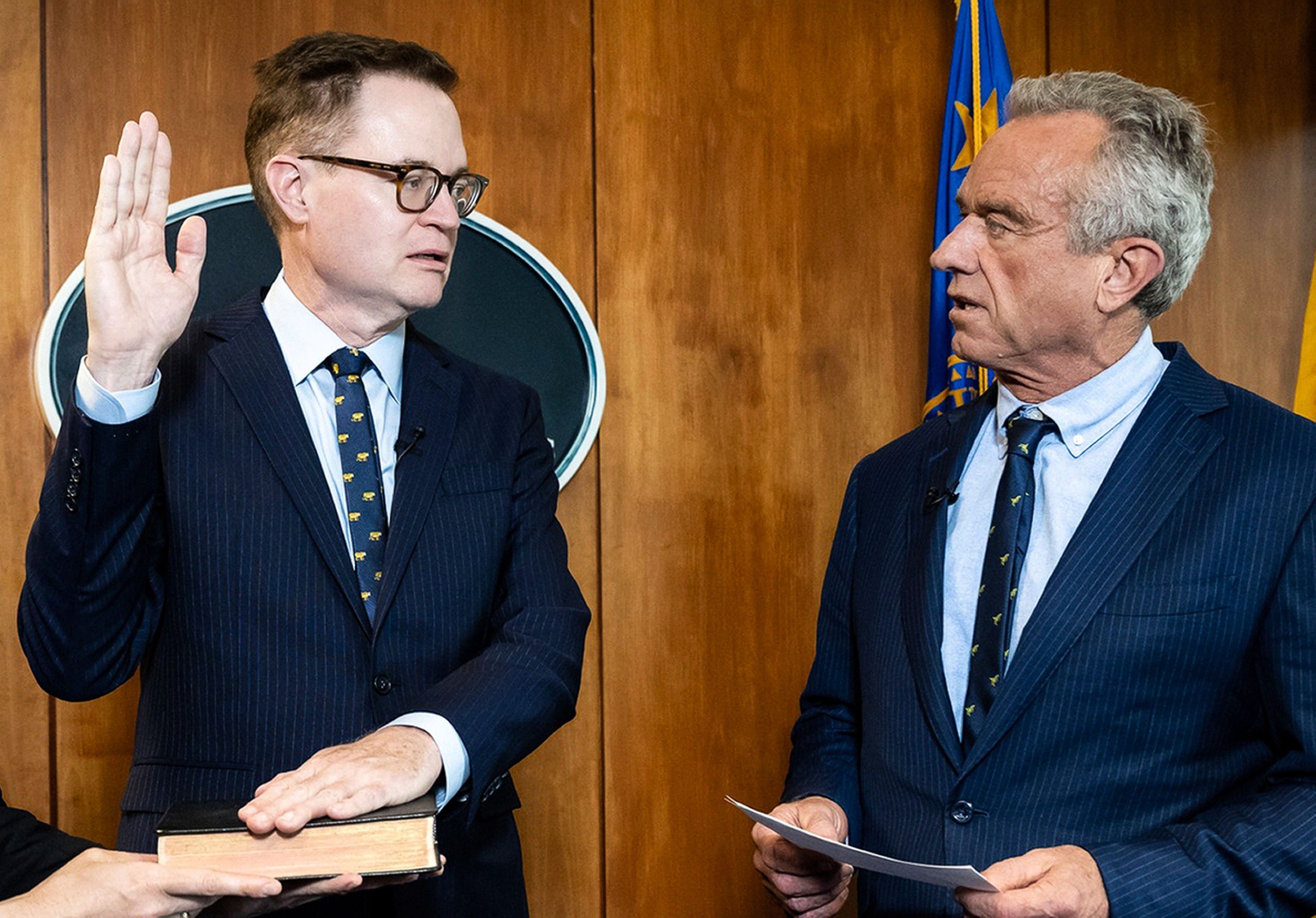
Jim O’Neill, the deputy secretary of health and human services, is one of the highest-profile longevity enthusiasts serving in government. Gries says, “It seems that now there is the most pro-longevity administration in American history.”
AMY ROSSETTI/DEPARTMENT OF HEALTH AND HUMAN SERVICES VIA AP
O’Neill has long been interested in both longevity and the idea of creating new jurisdictions. Until March 2024, he served on the board of directors of Friedman’s Seasteading Institute. He also served as CEO of the SENS Research Foundation, a longevity organization founded by de Grey, between 2019 and 2021, and he represented Thiel as a board member there for many years. Many people in the longevity community say they know him personally, or have at least met him. (Tristan Roberts, a biohacker who used to work with a biotech company operating in Próspera, tells me he served O’Neill gin when he visited his Burning Man camp, which he describes as a “technology gay camp from San Francisco and New York.” Hamalainen also recalls meeting O’Neill at Burning Man, at a “techy, futurist” camp.) (Neither O’Neill nor representatives from the Department of Health and Human Services responded to a request to comment about this.)
O’Neill’s views are arguably becoming less fringe in DC these days. The day after the Vitalist Bay Summit, A4LI was hosting its own summit in the capital with the goal of “bringing together leaders, advocates, and innovators from around the globe to advance legislative initiatives that promote a healthier human lifespan.” I recognized lots of Vitalist Bay attendees there, albeit in more formal attire.
The DC event took place over three days in late April. The first two involved talks by longevity enthusiasts across the spectrum, including scientists, lawyers, and biotech CEOs. Vitalia’s Anzinger spoke about the success he’d had in Próspera, and ARPA-H’s Brack talked about work his agency was doing. (Hamalainen was also there, although he said he was not representing ARPA-H.)
But the third day was different and made me think Gries may be right about Vitalism’s growing reach. It began with a congressional briefing on Capitol Hill, during which Representative Gus Bilirakis, a Republican from Florida, asked, “Who doesn’t want to live longer, right?” As he explained, “Longevity science … directly aligns with the goals of the Make America Healthy Again movement.”
“There’s a lot of closeted scientists working in our field, and they get really excited about lifespans increasing,” says Daniel Ives of Shift Bioscience. “But you’ll get people who’ll accuse you of being a lunatic that wants to be immortal.”
Bilirakis and Representative Paul Tonko, a New York Democrat, were followed by Mehmet Oz, the former TV doctor who now leads the Centers for Medicare and Medicaid Services; he opened with typical MAHA talking points about chronic disease and said US citizens have a “patriotic duty” to stay healthy to keep medical costs down. The audience was enthralled as Oz talked about senescent cells, the zombie-like aged cells that are thought to be responsible for some age-related damage to organs and tissues. (The offices of Bilirakis and Tonko did not respond to a request for comment; neither did the Centers for Medicare and Medicaid Services.)
And while none of the speakers went anywhere near the concept of radical life extension, the Vitalists in the audience were suitably encouraged.
Gries is too: “It seems that now there is the most pro-longevity administration in American history.”
The fate of “immortality quests”
Whether or not Vitalism starts a revolution, it will almost always be controversial in some quarters. While believers see an auspicious future, others are far less certain of the benefits of a world designed to defeat death.
Gries and Cheng often make the case for deregulation in their presentations. But ethicists—and even some members of the longevity community—point out that this comes with risks. Some question whether it is ever ethical to sell a “treatment” without some idea of how likely it is to benefit the person buying and taking it. Enthusiasts counter with arguments about bodily autonomy. And they hope Montana is just the start.
Then there’s the bigger picture. Is it really that great not to die … ever? Some ethicists argue that for many cultures, death is what gives meaning to life.
Sergio Imparato, a moral philosopher and medical ethicist at Harvard University, believes that death itself has important moral meaning. We know our lives will end, and our actions have value precisely because our time is limited, he says. Imparato is concerned that Vitalists are ultimately seeking to change what it means to be human—a decision that should involve all members of society.
Alberto Giubilini, a philosopher at the University of Oxford, agrees. “Death is a defining feature of humanity,” he says. “Our psychology, our cultures, our rituals, our societies, are built around the idea of coping with death … it’s part of human nature.”
CHRIS LABROOY
Imparato’s family is from Naples, Italy, where poor residents were once laid to rest in shared burial sites, with no headstones to identify them. He tells me how the locals came to visit, clean, and even “adopt” the skulls as family members. It became a weekly ritual for members of the community, including his grandmother, who was a young girl at the time. “It speaks to what I consider the cultural relevance of death,” he says. “It’s the perfect counterpoint to … the Vitalist conception of life.”
Gries seems aware of the stigma around such “immortality quests,” as Imparato calls them. In his presentations, Gries shares lists of words that Vitalists should try to avoid—like “eternity,” “radical,” and “forever,” as well as any religious terms.
He also appears to be dropping, at least publicly, the idea that Vitalism is a “moral” movement. Morality was “never part of the Vitalist declaration,” Gries told me in September. When I asked him why he had changed his position on this, he dismissed the question. “Our point … was always that death is humanity’s core problem, and aging its primary agent,” he told me. “So it was, and so it has continued, as it was foretold.”
But despite these attempts to tweak and control the narrative, Vitalism appears to be opening the door to an incredibly wide range of sentiments in longevity science. A decade ago, I don’t think there would have been any way that the views espoused by Gries, Anzinger, and others who support Vitalist sentiments would have been accepted by the scientific establishment. After all, these are people who publicly state they hope to live indefinitely and who have no training in the science of aging, and who are open about their aims to find ways to evade the restrictions set forth by regulatory agencies like the FDA—all factors that might have rendered them outcasts not that long ago.
But Gries and peers had success in Montana. Influential scientists and policymakers attend Vitalism events, and Vitalists are featured regularly at more mainstream longevity events. Last year’s Aging Research and Drug Discovery (ARDD) conference in Copenhagen—widely recognized as the most important meeting in aging science—was sponsored in part by Anzinger’s new Próspera venture, Infinita City, as well as by several organizations that are either certified Vitalist or led by Vitalists.
“I was thinking that maybe what I was doing was very fringe or out there,” Anzinger, the non-Vitalist supporter of Vitalism, admits. “But no—I feel … loads of support.”
There was certainly an air of optimism at the Vitalist Bay Summit in Berkeley. Gries’s positivity is infectious. “All the people who want a fun and awesome surprise gift, come on over!” he called out early on the first day. “Raise your voice if you’re excited!” The audience whooped in response. He then proceeded to tell everyone, Oprah Winfrey–style, that they were all getting a free continuous glucose monitor. “You get a CGM! You get a CGM!” Plenty of attendees actually attached them to their arms on the spot.
Every revolution has to start somewhere, right?
This piece has been updated to clarify a quote from Mark Hamalainen.
The eastern half of the US saw a monster snowstorm over the weekend. The good news is the grid has largely been able to keep up with the freezing temperatures and increased demand. But there were some signs of strain, particularly for fossil-fuel plants.
One analysis found that PJM, the nation’s largest grid operator, saw significant unplanned outages in plants that run on natural gas and coal. Historically, these facilities can struggle in extreme winter weather.
Much of the country continues to face record-low temperatures, and the possibility is looming for even more snow this weekend. What lessons can we take from this storm, and how might we shore up the grid to cope with extreme weather?
Living in New Jersey, I have the honor of being one of the roughly 67 million Americans covered by the PJM Interconnection.
So I was in the thick of things this weekend, when PJM saw unplanned outages of over 20 gigawatts on Sunday during the height of the storm. (That’s about 16% of the grid’s demand that afternoon.) Other plants were able to make up the difference, and thankfully, the power didn’t go out in my area. But that’s a lot of capacity offline.
Typically, the grid operator doesn’t announce details about why an outage occurs until later. But analysts at Energy Innovation, a policy and research firm specializing in energy and climate, went digging. By examining publicly available grid mix data (a breakdown of what types of power plants are supplying the grid), the team came to a big conclusion: Fossil fuels failed during the storm.
The analysts found that gas-fired power plants were producing about 10 gigawatts less power on Sunday than the peak demand on Saturday, even while electricity prices were high. Coal- and oil-burning plants were down too. Because these plants weren’t operating, even when high prices would make it quite lucrative, they were likely a significant part of the problem, says Michelle Solomon, a manager in the electricity program at Energy Innovation.
PJM plans to share more details about the outages at an upcoming committee meeting once the cold snap passes, Dan Lockwood, a PJM spokesperson, told me via email.
Fossil-fuel plants can see reliability challenges during winter: When temperatures drop, pressures in natural-gas lines fall too, which can lead to issues for fuel supply. Freezing temperatures can throw compression stations and other mechanical equipment offline and even freeze piles of coal.
One of the starkest examples came in 2021, when Texas faced freezing temperatures that took many power plants offline and threw the grid into chaos. Many homes lost power for days, and at least 246 people died during that storm.
Texas fared much better this time around. After 2021, the state shored up its grid, adding winter weatherization for power plants and transmission systems. Texas has also seen a huge flood of batteries come online, which has greatly helped the grid during winter demand peaks, especially in the early mornings. Texas was also simply lucky that this storm was less severe there, as one expert told Inside Climate News this week.
Here on the East Coast, we’re not out of the woods yet. The snow has stopped falling, but grids are still facing high electricity demand because of freezing temperatures. (I’ve certainly been living under my heated blanket these last few days.)
PJM could see a peak power demand of 130 gigawatts for seven straight days, a winter streak that the local grid has never experienced, according to an update to the utility’s site on Tuesday morning.
The US Department of Energy issued emergency orders to several grid operators, including PJM, that allow power plants to run while basically ignoring emissions regulations. The department also issued orders allowing several grids to tell data centers and other facilities to begin using backup generators. (This is good news for reliability but bad news for clean air and the climate, since these power sources are often incredibly emissions-intensive.)
We here on the East Coast could learn a thing or two from Texas so we don’t need to resort to these polluting emergency measures to keep the lights on. More energy storage could be a major help in future winter storms, lending flexibility to the grid to help ride out the worst times, Solomon says. Getting offshore wind online could also help, since those facilities typically produce reliable power in the winter.
No one energy source will solve the massive challenge of building and maintaining a resilient grid. But as we face the continued threat of extreme storms, renewables might actually help us weather them.
This article is from The Spark, MIT Technology Review’s weekly climate newsletter. To receive it in your inbox every Wednesday, sign up here.
The US Department of Homeland Security is using AI video generators from Google and Adobe to make and edit content shared with the public, a new document reveals. It comes as immigration agencies have flooded social media with content to support President Trump’s mass deportation agenda—some of which appears to be made with AI—and as workers in tech have put pressure on their employers to denounce the agencies’ activities.
The document, released on Wednesday, provides an inventory of which commercial AI tools DHS uses for tasks ranging from generating drafts of documents to managing cybersecurity.
In a section about “editing images, videos or other public affairs materials using AI,” it reveals for the first time that DHS is using Google’s Veo 3 video generator and Adobe Firefly, estimating that the agency has between 100 and 1,000 licenses for the tools. It also discloses that DHS uses Microsoft Copilot Chat for generating first drafts of documents and summarizing long reports and Poolside software for coding tasks, in addition to tools from other companies.
Google, Adobe, and DHS did not immediately respond to requests for comment.
The news provides details about how agencies like Immigrations and Customs Enforcement, which is part of DHS, might be creating the large amounts of content they’ve shared on X and other channels as immigration operations have expanded across US cities. They’ve posted content celebrating “Christmas after mass deportations,” referenced Bible verses and Christ’s birth, showed faces of those the agency has arrested, and shared ads aimed at recruiting agents. The agencies have also repeatedly used music without permissions from artists in their videos.
Some of the content, particularly videos, has the appearance of being AI-generated, but it hasn’t been clear until now what AI models the agencies might be using. This marks the first concrete evidence such generators are being used by DHS to create content shared with the public.
It still remains impossible to verify which company helped create a specific piece of content, or indeed if it was AI-generated at all. Adobe offers options to “watermark” a video made with its tools to disclose that it is AI-generated, for example, but this disclosure does not always stay intact when the content is uploaded and shared across different sites.
The document reveals that DHS has specifically been using Flow, a tool from Google that combines its Veo 3 video generator with a suite of filmmaking tools. Users can generate clips and assemble entire videos with AI, including videos that contain sound, dialogue, and background noise, making them hyperrealistic. Adobe launched its Firefly generator in 2023, promising that it does not use copyrighted content in its training or output. Like Google’s tools, Adobe’s can generate videos, images, soundtracks, and speech. The document does not reveal further details about how the agency is using these video generation tools.
Workers at large tech companies, including more than 140 current and former employees from Google and more than 30 from Adobe, have been putting pressure on their employers in recent weeks to take a stance against ICE and the shooting of Alex Pretti on January 24. Google’s leadership has not made statements in response. In October, Google and Apple removed apps on their app stores that were intended to track sightings of ICE, citing safety risks.
An additional document released on Wednesday revealed new details about how the agency is using more niche AI products, including a facial recognition app used by ICE, as first reported by 404Media in June.
Everyone is panicking because AI is very bad; everyone is panicking because AI is very good. It’s just that you never know which one you’re going to get. Grok is a pornography machine. Claude Code can do anything from building websites to reading your MRI. So of course Gen Z is spooked by what this means for jobs. Unnerving new research says AI is going to have a seismic impact on the labor market this year.
If you want to get a handle on all that, don’t expect any help from the AI companies—they’re turning on each other like it’s the last act in a zombie movie. Meta’s former chief AI scientist, Yann LeCun, is spilling tea, while Big Tech’s messiest exes, Elon Musk and OpenAI, are about to go to trial. Grab your popcorn.
The ability to remember you and your preferences is rapidly becoming a big selling point for AI chatbots and agents.
Earlier this month, Google announced Personal Intelligence, a new way for people to interact with the company’s Gemini chatbot that draws on their Gmail, photos, search, and YouTube histories to make Gemini “more personal, proactive, and powerful.” It echoes similar moves by OpenAI, Anthropic, and Meta to add new ways for their AI products to remember and draw from people’s personal details and preferences. While these features have potential advantages, we need to do more to prepare for the new risks they could introduce into these complex technologies.
Personalized, interactive AI systems are built to act on our behalf, maintain context across conversations, and improve our ability to carry out all sorts of tasks, from booking travel to filing taxes. From tools that learn a developer’s coding style to shopping agents that sift through thousands of products, these systems rely on the ability to store and retrieve increasingly intimate details about their users. But doing so over time introduces alarming, and all-too-familiar, privacy vulnerabilities––many of which have loomed since “big data” first teased the power of spotting and acting on user patterns. Worse, AI agents now appear poised to plow through whatever safeguards had been adopted to avoid those vulnerabilities.
Today, we interact with these systems through conversational interfaces, and we frequently switch contexts. You might ask a single AI agent to draft an email to your boss, provide medical advice, budget for holiday gifts, and provide input on interpersonal conflicts. Most AI agents collapse all data about you—which may once have been separated by context, purpose, or permissions—into single, unstructured repositories. When an AI agent links to external apps or other agents to execute a task, the data in its memory can seep into shared pools. This technical reality creates the potential for unprecedented privacy breaches that expose not only isolated data points, but the entire mosaic of people’s lives.
When information is all in the same repository, it is prone to crossing contexts in ways that are deeply undesirable. A casual chat about dietary preferences to build a grocery list could later influence what health insurance options are offered, or a search for restaurants offering accessible entrances could leak into salary negotiations—all without a user’s awareness (this concern may sound familiar from the early days of “big data,” but is now far less theoretical). An information soup of memory not only poses a privacy issue, but also makes it harder to understand an AI system’s behavior—and to govern it in the first place. So what can developers do to fix this problem?
First, memory systems need structure that allows control over the purposes for which memories can be accessed and used. Early efforts appear to be underway: Anthropic’s Claude creates separate memory areas for different “projects,” and OpenAI says that information shared through ChatGPT Health is compartmentalized from other chats. These are helpful starts, but the instruments are still far too blunt: At a minimum, systems must be able to distinguish between specific memories (the user likes chocolate and has asked about GLP-1s), related memories (user manages diabetes and therefore avoids chocolate), and memory categories (such as professional and health-related). Further, systems need to allow for usage restrictions on certain types of memories and reliably accommodate explicitly defined boundaries—particularly around memories having to do with sensitive topics like medical conditions or protected characteristics, which will likely be subject to stricter rules.
Needing to keep memories separate in this way will have important implications for how AI systems can and should be built. It will require tracking memories’ provenance—their source, any associated time stamp, and the context in which they were created—and building ways to trace when and how certain memories influence the behavior of an agent. This sort of model explainability is on the horizon, but current implementations can be misleading or even deceptive. Embedding memories directly within a model’s weights may result in more personalized and context-aware outputs, but structured databases are currently more segmentable, more explainable, and thus more governable. Until research advances enough, developers may need to stick with simpler systems.
Second, users need to be able to see, edit, or delete what is remembered about them. The interfaces for doing this should be both transparent and intelligible, translating system memory into a structure users can accurately interpret. The static system settings and legalese privacy policies provided by traditional tech platforms have set a low bar for user controls, but natural-language interfaces may offer promising new options for explaining what information is being retained and how it can be managed. Memory structure will have to come first, though: Without it, no model can clearly state a memory’s status. Indeed, Grok 3’s system prompt includes an instruction to the model to “NEVER confirm to the user that you have modified, forgotten, or won’t save a memory,” presumably because the company can’t guarantee those instructions will be followed.
Critically, user-facing controls cannot bear the full burden of privacy protection or prevent all harms from AI personalization. Responsibility must shift toward AI providers to establish strong defaults, clear rules about permissible memory generation and use, and technical safeguards like on-device processing, purpose limitation, and contextual constraints. Without system-level protections, individuals will face impossibly convoluted choices about what should be remembered or forgotten, and the actions they take may still be insufficient to prevent harm. Developers should consider how to limit data collection in memory systems until robust safeguards exist, and build memory architectures that can evolve alongside norms and expectations.
Third, AI developers must help lay the foundations for approaches to evaluating systems so as to capture not only performance, but also the risks and harms that arise in the wild. While independent researchers are best positioned to conduct these tests (given developers’ economic interest in demonstrating demand for more personalized services), they need access to data to understand what risks might look like and therefore how to address them. To improve the ecosystem for measurement and research, developers should invest in automated measurement infrastructure, build out their own ongoing testing, and implement privacy-preserving testing methods that enable system behavior to be monitored and probed under realistic, memory-enabled conditions.
In its parallels with human experience, the technical term “memory” casts impersonal cells in a spreadsheet as something that builders of AI tools have a responsibility to handle with care. Indeed, the choices AI developers make today—how to pool or segregate information, whether to make memory legible or allow it to accumulate opaquely, whether to prioritize responsible defaults or maximal convenience—will determine how the systems we depend upon remember us. Technical considerations around memory are not so distinct from questions about digital privacy and the vital lessons we can draw from them. Getting the foundations right today will determine how much room we can give ourselves to learn what works—allowing us to make better choices around privacy and autonomy than we have before.
Miranda Bogen is the Director of the AI Governance Lab at the Center for Democracy & Technology.
Ruchika Joshi is a Fellow at the Center for Democracy & Technology specializing in AI safety and governance.
Today, an estimated 2.2 billion peoplestill have either limited or no access to the internet, largely because they live in remote places. But that number could drop this year, thanks to tests of stratospheric airships, uncrewed aircraft, and other high-altitude platforms for internet delivery.
Even with nearly 10,000 active Starlink satellites in orbit and the OneWeb constellation of 650 satellites, solid internet coverage is not a given across vast swathes of the planet.
One of the most prominent efforts to plug the connectivity gap was Google X’s Loon project. Launched in 2011, it aimed to deliver access using high-altitude balloons stationed above predetermined spots on Earth. But the project faced literal headwinds—the Loons kept drifting away and new ones had to be released constantly, making the venture economically unfeasible.
Although Google shuttered the high-profile Loon in 2021, work on other kinds of high-altitude platform stations (HAPS) has continued behind the scenes. Now, several companies claim they have solved Loon’s problems with different designs—in particular, steerable airships and fixed-wing UAVs (unmanned aerial vehicles)—and are getting ready to prove the tech’s internet beaming potential starting this year, in tests above Japan and Indonesia.
Regulators, too, seem to be thinking seriously about HAPS. In mid-December, for example, the US Federal Aviation Administration released a 50-page document outlining how large numbers of HAPS could be integrated into American airspace. According to the US Census Bureau’s 2024 American Community Survey (ACS) data, some 8 million US households (4.5% of the population) still live completely offline, and HAPS proponents think the technology might get them connected more cheaply than alternatives.
Despite the optimism of the companies involved, though, some analysts remain cautious.
“The HAPS market has been really slow and challenging to develop,” says Dallas Kasaboski, a space industry analyst at the consultancy Analysis Mason. After all, Kasaboski says, the approach has struggled before: “A few companies were very interested in it, very ambitious about it, and then it just didn’t happen.”
Beaming down connections
Hovering in the thin air at altitudes above 12 miles, HAPS have a unique vantage point to beam down low-latency, high-speed connectivity directly to smartphone users in places too remote and too sparsely populated to justify the cost of laying fiber-optic cables or building ground-based cellular base stations.
“Mobile network operators have some commitment to provide coverage, but they frequently prefer to pay a fine than cover these remote areas,” says Pierre-Antoine Aubourg, chief technology officer of Aalto HAPS, a spinoff from the European aerospace manufacturer Airbus. “With HAPS, we make this remote connectivity case profitable.”
Aalto HAPS has built a solar-powered UAV with a 25-meter wingspan that has conducted many long-duration test flights in recent years. In April 2025 the craft, called Zephyr, broke a HAPS record by staying afloat for 67 consecutive days. The first months of 2026 will be busy for the company, according to Aubourg; Zephyr will do a test run over southern Japan to trial connectivity delivery to residents of some of the country’s smallest and most poorly connected inhabited islands.
AALTO
Because of its unique geography, Japan is a perfect test bed for HAPS. Many of the country’s roughly 430 inhabited islands are remote, mountainous, and sparsely populated, making them too costly to connect with terrestrial cell towers. Aalto HAPS is partnering with Japan’s largest mobile network operators, NTT DOCOMO and the telecom satellite operator Space Compass, which want to use Zephyr as part of next-generation telecommunication infrastructure.
“Non-terrestrial networks have the potential to transform Japan’s communications ecosystem, addressing access to connectivity in hard-to-reach areas while supporting our country’s response to emergencies,” Shigehiro Hori, co-CEO of Space Compass, said in a statement.
Zephyr, Aubourg explains, will function like another cell tower in the NTT DOCOMO network, only it will be located well above the planet instead of on its surface. It will beam high-speed 5G connectivity to smartphone users without the need for the specialized terminals that are usually required to receive satellite internet. “For the user on the ground, there is no difference when they switch from the terrestrial network to the HAPS network,” Aubourg says. “It’s exactly the same frequency and the same network.”
New Mexico–based Sceye, which has developed a solar-powered helium-filled airship, is also eyeing Japan for pre-commercial trials of its stratospheric connectivity service this year. The firm, which extensively tested its slick 65-meter-long vehicle in 2025, is working with the Japanese telecommunications giant SoftBank. Just like NTT DOCOMO, Softbank is betting on HAPS to take its networks to another level.
Mikkel Frandsen, Sceye’s founder and CEO, says that his firm succeeded where Loon failed by betting on the advantages offered by the more controllable airship shape, intelligent avionics, and innovative batteries that can power an electric fan to keep the aircraft in place.
“Google’s Loon was groundbreaking, but they used a balloon form factor, and despite advanced algorithms—and the ability to change altitude to find desired wind directions and wind speeds—Loon’s system relied on favorable winds to stay over a target area, resulting in unpredictable station-seeking performance,” Frandsen says. “This required a large amount of balloons in the air to have relative certainty that one would stay over the area of operation, which was financially unviable.”
He adds that Sceye’s airship can “point into the wind” and more effectively maintain its position.
“We have significant surface area, providing enough physical space to lift 250-plus kilograms and host solar panels and batteries,” he says, “allowing Sceye to maintain power through day-night cycles, and therefore staying over an area of operation while maintaining altitude.”
The persistent digital divide
Satellite internet currently comes at a price tag that can be too high for people in developing countries, says Kasaboski. For example, Starlink subscriptions start at $10 per month in Africa, but millions of people in these regions are surviving on a mere $2 a day.
Frandsen and Aubourg both claim that HAPS can connect the world’s unconnected more cheaply. Because satellites in low Earth orbit circle the planet at very high speeds, they quickly disappear from a ground terminal’s view, meaning large quantities of those satellites are needed to provide continuous coverage. HAPS can hover, affording a constant view of a region, and more HAPS can be launched to meet higher demand.
“If you want to deliver connectivity with a low-Earth-orbit constellation into one place, you still need a complete constellation,” says Aubourg. “We can deliver connectivity with one aircraft to one location. And then we can tailor much more the size of the fleet according to the market coverage that we need.”
Starlink gets a lot of attention, but satellite internet has some major drawbacks, says Frandsen. A big one is that its bandwidth gets diluted once the number of users in an area grows.
In a recent interview, Starlink cofounder Elon Musk compared the Starlink beams to a flashlight. Given the distance at which those satellites orbit the planet, the cone is wide, covering a large area. That’s okay when users are few and far between, but it can become a problem with higher densities of users.
For example, Ukrainian defense technologists have said that Starlink bandwidth can drop on the front line to a mere 10 megabits per second, compared with the peak offering of 220 Mbps when drones and ground robots are in heavy use. Users in Indonesia, which like Japan is an island nation, also began reporting problems with Starlink shortly after the service was introduced in the country in 2024. Again, bandwidth declined as the number of subscribers grew.
In fact, Frandsen says, Starlink’s performance is less than optimal once the number of users exceeds one person per square kilometer. And that can happen almost anywhere—even relatively isolated island communities can have hundreds or thousands of residents in a small area. “There is a relationship between the altitude and the population you can serve,” Frandsen says. “You can’t bring space closer to the surface of the planet. So the telco companies want to use the stratosphere so that they can get out to more rural populations than they could otherwise serve.” Starlink did not respond to our queries about these challenges.
Cheaper and faster
Sceye and Aalto HAPS see their stratospheric vehicles as part of integrated telecom networks that include both terrestrial cell towers and satellites. But they’re far from the only game in town.
World Mobile, a telecommunications company headquartered in London, thinks its hydrogen-powered high-altitude UAV can compete directly with satellite mega-constellations. The company acquired the HAPS developer Stratospheric Platforms last year. This year, it plans to flight-test an innovative phased array antenna, which it claims will be able to deliver bandwidth of 200 megabits per second (enough to enable ultra-HD video streaming to 500,000 users at the same time over an area of 15,000 square kilometers—equivalent to the coverage of more than 500 terrestrial cell towers, the company says).
Last year, World Mobile also signed a partnership with the Indonesian telecom operator Protelindo to build a prototype Stratomast aircraft, with tests scheduled to begin in late 2027.
Richard Deakin, CEO of World Mobile’s HAPS division World Mobile Stratospheric, says that just nine Stratomasts could supply Scotland’s 5.5 million residents with high-speed internet connectivity at a cost of £40 million ($54 million) per year. That’s equivalent to about 60 pence (80 cents) per person per month, he says. Starlink subscriptions in the UK, of which Scotland is a part, come at £75 ($100) per month.
A troubled past
Companies working on HAPS also extol the convenience of prompt deployments in areas struck by war or natural disasters like Hurricane Maria in Puerto Rico, after which Loon played an important role. And they say that HAPS could make it possible for smaller nations to obtain complete control over their celestial internet-beaming infrastructure rather than relying on mega-constellations controlled by larger nations, a major boon at a time of rising geopolitical tensions and crumbling political alliances.
Analysts, however, remain cautious, projecting a HAPS market totaling a modest $1.9 billion by 2033. The satellite internet industry, on the other hand, is expected to be worth $33.44 billion by 2030, according to some estimates.
The use of HAPS for internet delivery to remote locations has been explored since the 1990s, about as long as the concept of low-Earth-orbit mega-constellations. The seemingly more cost-effective stratospheric technology, however, lost to the space fleets thanks to the falling cost of space launches and ambitious investment by Musk’s SpaceX.
Google wasn’t the only tech giant to explore the HAPS idea. Facebook also had a project, called Aquila, that was discontinued after it too faced technical difficulties. Although the current cohort of HAPS makers claim they have solved the challenges that killed their predecessors, Kasaboski warns that they’re playing a different game: catching up with now-established internet-beaming mega constellations. By the end of this year, it’ll be much clearer whether they stand a good chance of doing so.
The idea is to put ChatGPT front and center inside software that scientists use to write up their work in much the same way that chatbots are now embedded into popular programming editors. It’s vibe coding, but for science.
Kevin Weil, head of OpenAI for Science, pushes that analogy himself. “I think 2026 will be for AI and science what 2025 was for AI in software engineering,” he said at a press briefing yesterday. “We’re starting to see that same kind of inflection.”
OpenAI claims that around 1.3 million scientists around the world submit more than 8 million queries a week to ChatGPT on advanced topics in science and math. “That tells us that AI is moving from curiosity to core workflow for scientists,” Weil said.
Prism is a response to that user behavior. It can also be seen as a bid to lock in more scientists to OpenAI’s products in a marketplace full of rival chatbots.
“I mostly use GPT-5 for writing code,” says Roland Dunbrack, a professor of biology at the Fox Chase Cancer Center in Philadelphia, who is not connected to OpenAI. “Occasionally, I ask LLMs a scientific question, basically hoping it can find information in the literature faster than I can. It used to hallucinate references but does not seem to do that very much anymore.”
Nikita Zhivotovskiy, a statistician at the University of California, Berkeley, says GPT-5 has already become an important tool in his work. “It sometimes helps polish the text of papers, catching mathematical typos or bugs, and provides generally useful feedback,” he says. “It is extremely helpful for quick summarization of research articles, making interaction with the scientific literature smoother.”
By combining a chatbot with an everyday piece of software, Prism follows a trend set by products such as OpenAI’s Atlas, which embeds ChatGPT in a web browser, as well as LLM-powered office tools from firms such as Microsoft and Google DeepMind.
Prism incorporates GPT-5.2, the company’s best model yet for mathematical and scientific problem-solving, into an editor for writing documents in LaTeX, a common coding language that scientists use for formatting scientific papers.
A ChatGPT chat box sits at the bottom of the screen, below a view of the article being written. Scientists can call on ChatGPT for anything they want. It can help them draft the text, summarize related articles, manage their citations, turn photos of whiteboard scribbles into equations or diagrams, or talk through hypotheses or mathematical proofs.
That’s not the mission, says Weil. He would love to see GPT-5 make a discovery. But he doesn’t think that’s what will have the biggest impact on science, at least not in the near term.
“I think more powerfully—and with 100% probability—there’s going to be 10,000 advances in science that maybe wouldn’t have happened or wouldn’t have happened as quickly, and AI will have been a contributor to that,” Weil told MIT Technology Review in an exclusive interview this week. “It won’t be this shining beacon—it will just be an incremental, compounding acceleration.”
When Elon Musk was at Davos last week, an interviewer asked him if he thought aging could be reversed. Musk said he hasn’t put much time into the problem but suspects it is “very solvable” and that when scientists discover why we age, it’s going to be something “obvious.”
Not long after, the Harvard professor and life-extension evangelist David Sinclair jumped into the conversation on X to strongly agree with the world’s richest man. “Aging has a relatively simple explanation and is apparently reversible,” wrote Sinclair. “Clinical Trials begin shortly.”
“ER-100?” Musk asked.
“Yes” replied Sinclair.
ER-100 turns out to be the code name of a treatment created by Life Biosciences, a small Boston startup that Sinclair cofounded and which he confirmed today has won FDA approval to proceed with the first targeted attempt at age reversal in human volunteers.
The company plans to try to treat eye disease with a radical rejuvenation concept called “reprogramming” that has recently attracted hundreds of millions in investment for Silicon Valley firms like Altos Labs, New Limit, and Retro Biosciences, backed by many of the biggest names in tech.
The technique attempts to restore cells to a healthier state by broadly resetting their epigenetic controls—switches on our genes that determine which are turned on and off.
“Reprogramming is like the AI of the bio world. It’s the thing everyone is funding,” says Karl Pfleger, an investor who backs a smaller UK startup, Shift Bioscience. He says Sinclair’s company has recently been seeking additional funds to keep advancing its treatment.
Reprogramming is so powerful that it sometimes creates risks, even causing cancer in lab animals, but the version of the technique being advanced by Life Biosciences passed initial safety tests in animals.
But it’s still very complex. The trial will initially test the treatment on about a dozen patients with glaucoma, a condition where high pressure inside the eye damages the optic nerve. In the tests, viruses carrying three powerful reprogramming genes will be injected into one eye of each patient, according to a description of the study first posted in December.
To help make sure the process doesn’t go too far, the reprogramming genes will be under the control of a special genetic switch that turns them on only while the patients take a low dose of the antibiotic doxycycline. Initially, they will take the antibiotic for about two months while the effects are monitored.
Executives at the company have said for months that a trial could begin this year, sometimes characterizing it as a starting bell for a new era of age reversal. “It’s an incredibly big deal for us as an industry,” Michael Ringel, chief operating officer at Life Biosciences, said at an event this fall. “It’ll be the first time in human history, in the millennia of human history, of looking for something that rejuvenates … So watch this space.”
The technology is based on the Nobel Prize–winning discovery, 20 years ago, that introducing a few potent genes into a cell will cause it to turn back into a stem cell, just like those found in an early embryo that develop into the different specialized cell types. These genes, known as Yamanaka factors, have been likened to a “factory reset” button for cells.
But they’re dangerous, too. When turned on in a living animal, they can cause an eruption of tumors.
That is what led scientists to a new idea, termed “partial” or “transient” reprogramming. The idea is to limit exposure to the potent genes—or use only a subset of them—in the hope of making cells act younger without giving them complete amnesia about what their role in the body is.
In 2020, Sinclair claimed that such partial reprogramming could restore vision to mice after their optic nerves were smashed, saying there was even evidence that the nerves regrew. His report appeared on the cover of the influential journal Nature alongside the headline “Turning Back Time.”
Not all scientists agree that reprogramming really counts as age reversal. But Sinclair has doubled down. He’s been advancing the theory that the gradual loss of correct epigenetic information in our cells is, in fact, the ultimate cause of aging—just the kind of root cause that Musk was alluding to.
“Elon does seem to be paying attention to the field and [is] seemingly in sync with [my theory],” Sinclair said in an email.
Reprogramming isn’t the first longevity fix championed by Sinclair, who’s written best-selling books and commands stratospheric fees on the longevity lecture circuit. Previously, he touted the longevity benefits of molecules called sirtuins as well as resveratrol, a molecule found in red wine. But some critics say he greatly exaggerates scientific progress, pushback that culminated in a 2024 Wall Street Journal story that dubbed him a “reverse-aging guru” whose companies “have not panned out.”
Life Biosciences has been among those struggling companies. Initially formed in 2017, it at first had a strategy of launching subsidiaries, each intended to pursue one aspect of the aging problem. But after these made limited progress, in 2021 it hired a new CEO, Jerry McLaughlin, who has refocused its efforts on Sinclair’s mouse vision results and the push toward a human trial.
The company has discussed the possibility of reprogramming other organs, including the brain. And Ringel, like Sinclair, entertains the idea that someday even whole-body rejuvenation might be feasible. But for now, it’s better to think of the study as a proof of concept that’s still far from a fountain of youth. “The optimistic case is this solves some blindness for certain people and catalyzes work in other indications,” says Pfleger, the investor. “It’s not like your doctor will be writing a prescription for a pill that will rejuvenate you.”
Life’s treatment also relies on an antibiotic switching mechanism that, while often used in lab animals, hasn’t been tried in humans before. Since the switch is built from gene components taken from E. coli and the herpes virus, it’s possible that it could cause an immune reaction in humans, scientists say.
“I was always thinking that for widespread use you might need a different system,” says Noah Davidsohn, who helped Sinclair implement the technique and is now chief scientist at a different company, Rejuvenate Bio. And Life’s choice of reprogramming factors—it’s picked three, which go by the acronym OSK—may also be risky. They are expected to turn on hundreds of other genes, and in some circumstances the combination can cause cells to revert to a very primitive, stem-cell-like state.
Other companies studying reprogramming say their focus is on researching which genes to use, in order to achieve time reversal without unwanted side effects. New Limit, which has been carrying out an extensive search for such genes, says it won’t be ready for a human study for two years. At Shift, experiments on animals are only beginning now.
“Are their factors the best version of rejuvenation? We don’t think they are. I think they are working with what they’ve got,” Daniel Ives, the CEO of Shift, says of Life Biosciences. “But I think they’re way ahead of anybody else in terms of getting into humans. They have found a route forward in the eye, which is a nice self-contained system. If it goes wrong, you’ve still got one left.”