Struggling to earn links from journalists and the press?
Digital PR for SEO has quickly become an alternative to traditional link building. However, earning links from the press can be a challenge creatively.
That’s where we come in.
Watch our on-demand webinar, as we explore how to scale the very time-consuming and complicated process of earning links from digital PR, with proven case studies showing how you can earn hundreds of links in 30 days.
You’ll learn:
The process and tools to earn press links in just 30 days.
A scalable process to gather data to enhance journalist storylines.
How to combine data and expert commentary for the press.
Kevin Rowe, Founder and Head of Strategy at PureLinq, will give away the process his firm has used to secure hundreds of meaningful links and mentions on top-tier domains using data-driven digital PR, with proven examples.
Kevin’s firm has systematized a scalable process for data-driven digital PR for SEO, and now he wants to share it with you.
This post was sponsored by CallTrackingMetrics. The opinions expressed in this article are the sponsor’s own.
If you’ve been enjoying having random conversations with ChatGPT, or trying your hand at tricking a car dealership chatbot into giving you a new car for $1, just wait until you start using safe AI professionally.
Marketers are finding lots of ways to use generative AI for things like SEO research, copywriting, and summarizing survey results.
Once you have this setup configured, you can drastically speed up your first-party data collection.
To get more specific, prompts have two main parts. The question you want answered, and how you want AI to answer it. As an example:
The question: What prompted the Caller to reach out?
The prompt [how should AI answer]: You are a helpful Sales agent responsible for identifying what marketing channel prompted the contact to call. If the contact did not identify what prompted their call please only respond with “None”.
Below are some example responses on what a contact might say:
Podcast ad.
Social post.
Friend or family recommendation.
Stopped by event booth.
Read reviews online.
1 – 18. How To Use AI To Update Customer Contact Fields
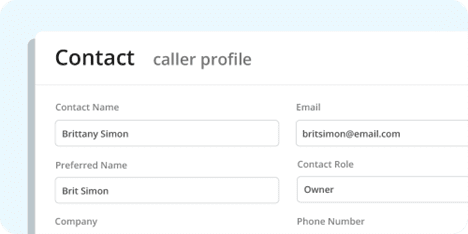
Starting off boring, but powerful: Generative AI can take your customer conversations and automate data entry tasks, such as updating caller profiles to keep them relevant and qualified.
Image created by CallTrackingMetrics, March 2024
Impressive? No.
But the time savings add up quickly, and let your team work on the things they like (that make the company money) instead of manually filling out wrap-up panels after a call.
What Contact Information Can AI Automatically Update?
Name – You’re going to get a name from caller ID which is a great start, but is it the name your caller prefers? Is it up to date or is it still the name of a former customer who left their company to chase their dreams? With a quick AI prompt, you can make sure you’re greeting the right person when they call back.
Email Address – It might be a default value for form submissions, but getting an email address from a caller can take a lot of back and forth. AI isn’t going to ask for that last part again, or require you to read it back to them to verify. It’s just going to do it.
Company Name – You might be using a sales intelligence tool like ZoomInfo to pull this kind of thing from a database. Still, you might also enjoy the accuracy of extracting directly from the words of your prospect.
Buyer Role – Maybe not a basic field, but one AI can fill out nonetheless (much like other custom fields below!). Give your AI a list to choose from like a researcher, influencer, or decision maker. Sure would be nice to know how much influence they actually have without having to ask directly.
Can AI Automatically Tag Conversations In My CRM?
Of course!
In CRMs and sales enablement tools, tags are used to categorize and segment your conversations for further analysis or follow-up.
Some popular tags for call tracking are marking someone a new or returning caller.
You can set a tag manually. You can set a tag using an if/then trigger. And because of what this whole thing is about, you can update tags using AI.
Image created by CallTrackingMetrics, March 2024
Use AI to automatically add tags to your prospect’s profile, based on their actual calls.
Spam – Sure, you can mark something spam yourself, but why not let AI do it for you so you can move on to real work?
Product Tags – What was the caller asking about? Add product tags to calls for further analysis, or to jump right into the sales pitch when they call back.
Lifecycle Tags – Have AI examine what kinds of questions your prospect is asking and qualify them along a scale of just learning to ready to buy. Or even, mark them as an existing customer.
Target Account – Did the caller mention their company size? Maybe you asked them about revenue or tech stack. If you let AI know what your ideal customer looks like, it’ll help you quickly identify them when you’re talking to one.
Can Generative AI Score Leads In My CRM?
Yes! However, if 100% of your calls end in sales, skip this part.
For the rest of us, phone, text, and chat leads range from “never going to buy anything” to “ready to give you my credit card info.”
For call scoring, this often looks like a score of 1 to 5.
So, here are a few examples of how AI can automatically score your leads from transcripts and chat logs.
Readiness to Buy – The most classic approach to scoring is asking, “How likely is this lead to buy?” A score of 1 is unqualified, and a score of 5 is they’re already paying us.
Ideal Customer Fit – Just like adding a target account tag above, train your AI on what a good customer looks like, and it can also give you a score. How closely does this caller fit your ideal profile?
Coaching – Not everything has to be about the lead. Sometimes we want to grade our own team. How well did your sales team stick to the script? Were they friendly? Let AI roll it up into a score for you.
Follow-up Priority – Aggregate readiness to buy, customer fit, and other inputs to decide on how aggressively to follow up with your leads.
Can Generative AI Capture & Update Custom Fields From Phone Calls & Chat Logs?
Your company is likely not the same as every other company using call tracking to get customer insights.
You’ll want some flexibility to determine what’s important to you, not what your call-tracking provider has determined to be important.
With custom fields, you get to put your creativity and strategy together with AI’s scalability to automate pretty much anything.
Image created by CallTrackingMetrics, March 2024
AI can accurately assess and notate:
Product Familiarity – You’ve tagged a call with a product name, but how much time do you need to spend educating the prospect vs. selling them?
Related Products – What else could you be selling this person?
Appointments – If your team runs on appointments or demos, having an AI add a calendar date to a custom field opens up a world of automated possibilities.
Next Steps – Follow up with an email, a call, or an appointment confirmation text. Have AI pull the best next step from your conversation.
19 – 21. How To Use Generative AI To Take Action On Automatically Updated Sales Contacts
Ok, so there are some time-savings when you use call tracking and AI to update fields.
If that’s not quite exciting enough, let’s see what you can actually do with those automated fields.
Image created by CallTrackingMetrics, March 2024
19. Automate Advertising Optimization
Use conversion data to inform your decisions.
Throw AI into the mix, and you go from A to optimized without lifting a finger.
How?
The tags and fields your AI just updated become qualifiers to send only the signals that matter to your business over to platforms like Google Ads where their machine learning will go wild to find more of the same. Where you might have been stuck sending a simple conversion (like any call with talk time over 90 seconds) now you can send those conversions with a three or better score for readiness to buy, and a product tag.
20. Better Personalization In Your CRM
To kick things off, your AI automatically scraped the conversation for an email address, so now you can add a new contact to an email-centric tool like HubSpot immediately at the end of the conversation. H
ave you updated product tags? Use that as a great trigger to enroll them in a highly relevant email drip.
Feed your call scores and product tags into your CRM’s lead scoring system and add complexity to a usually surface-level approach. Or do something as easy as sync their company name to their record so you can personalize outreach.
21. Following Up & Closing Deals
You’re not having AI fill out custom fields for fun, you’re doing it to make your job easier.
And one of your primary jobs is following up after a conversation to get someone closer to purchasing.
Agreed on a time for your next meeting? Send that date field to your favorite scheduling tool and get a calendar invite in their inbox. Or maybe you had a softer “call me next week” agreement? Use that to send the caller to an outbound dialer that’s set to call as soon as you log in the next week.
How To Use AI For Analyzing Calls
Moving beyond data entry, when you give AI a call transcription to work with, it can pull out insights to help your team get better.
In the time it would take you to read through one eight-minute phone conversation, AI has analyzed your whole day’s worth of calls and is off taking whatever the robot equivalent of a coffee break is.
What can AI do to upgrade your conversation intelligence? Unfortunately, after 16 use cases, we’re bumping up against our word count and we’ll have to save that for part two: Another Ton of AI Use Cases for Call Tracking.
Image Credits
Featured Image: Image by CallTrackingMetrics Used with permission.
Revenue operations (RevOps) is an organizational approach that aligns teams, workflows, and strategies through a unified revenue lens with goals and metrics focused on revenue growth.
In past years of economic uncertainty, the need to prove return on investment (ROI) has led many businesses to adopt RevOps as a cross-organizational strategy.
However, its definition and execution vary across companies, influenced by factors such as infrastructure and the strategies that are in place to drive long-term demand.
In this guide, I present the RevOps strategy we implemented at INFUSE and recommend for 2024, which is aligned with go-to-market (GTM) motions and demand generation best practices to fuel predictable and lasting organizational growth.
GTM And Demand: Frameworks To Enable RevOps
The robust and granular nature of go-to-market (GTM) and demand generation frameworks makes both particularly well-suited for steering RevOps initiatives.
Combining both allows revenue teams to craft iterative strategies that prioritize brand awareness and buyer engagement.
Adopting a blended approach with both frameworks for your RevOps strategy is an effective way to guide product/service activation initiatives, as well as sustain demand for these offerings to meet performance goals.
GTM Frameworks For RevOps
Numerous GTM frameworks exist, with the majority emphasizing specific approaches to facilitate growth.
For example, product-led growth (PLG) is a GTM model centered on driving revenue with a specific (often freemium) product motion.
Meanwhile, an inbound growth model is led by driving traffic and lead generation through an inbound channel mix.
Today, full-funnel approaches to GTM are especially effective, given their focus on supporting buyers at every stage of their journey.
Therefore, rather than focusing on a product or channel mix, the priority is to build seamless experiences for buyers that offer a level of precision that is necessary to establish trust.
Demand Frameworks For RevOps
Demand generation serves as a supportive approach to achieving the objectives of a GTM strategy.
Essentially, it acts as a conduit to sustain brand awareness and cultivate a pipeline of sales opportunities for the organization.
In periods of sluggish economic growth, demand generation is crucial for preventing pipeline deceleration and retaining lead interest.
Lead nurturing is a key element of demand strategies as it develops and maintains brand interest among prospects until they are ready to buy.
Therefore, it helps develop growth and conversion forecasts, as well as drive brand referrals through content marketing and thought leadership.
How To Launch A RevOps Strategy In 5 Easy Steps
Below is a five-step process for driving a RevOps strategy that is fit for the market challenges of 2024:
1. Establish RevOps At Your Organization Across Teams
A core element of RevOps is establishing structures to align your team members and anchor the focus of your organization on the activities necessary for revenue growth.
To achieve this, you will first require a well-defined north star (or unified goal), which can be set by following these steps:
Clarify your Unique Value Proposition (UVP): Revisit the unique value you offer to clients as a brand in terms of what drives revenue. This will allow you to focus your offerings on what drives organizational growth while also addressing the unique challenges of your target market.
Identify organizational obstacles: Evaluate what issues in your organizational culture, tech stack, and staff are currently hindering the full alignment of processes required for RevOps. The goal here is to identify the most common bottlenecks that impede your teams’ agility.
Define your purpose and goal: Define your key revenue goal to help plan the steps required to achieve it. This shared vision will sustain all teams’ activities and future strategies. If, for example, the goal is to increase market share by 30%, all business activities should be guided by that end goal.
Functional Vs. Departmental RevOps:
Molding RevOps teams and processes can either be guided by a functional (staff roles) or departmental perspective. Each approach comes with its own set of advantages and disadvantages, underscoring the importance of a careful evaluation to determine which one aligns best with the unique needs of your business:
Functional: This approach establishes tasks for team members to fulfill based on their skill set. For example, a person well-versed in project management would be responsible for developing RevOps systems.
Departmental: This approach assigns RevOps duties for each department of the organization based on their expertise and availability. It is simpler to implement compared to the functional approach, yet presents more risk of creating data silos (therefore, establishing data flows across departments is a must).
2. Adopt The Recurring Revenue Bowtie Model
Developed by Winning By Design, the Recurring Revenue Bowtie Model envisions the buyer’s journey as a closed loop to focus efforts in equal measure on interactions before and after a sale.
This full-funnel approach helps emphasize the importance of onboarding and expanding business with existing clients through upsells, cross-sells, and renewals.
Screenshot from Winning By Design, December 2023
The Bowtie Model is well suited for RevOps since it focuses on both sides of the buyer’s journey: the path toward conversions, as well as the nurturing that is necessary to expand client relationships and encourage post-sale growth.
Given the forecast of slow growth for 2024 (Reuters, 2023), this model is particularly well suited to the challenges ahead—namely, the emphasis on increasing client lifetime value (CLTV) and reducing churn to boost ROI.
3. Align Data And AI For RevOps
At the essence of RevOps lies the concept of actionability, underscoring the critical need to prioritize buyer data that can be leveraged to shape strategies that boost conversions.
Enhancing your buyer data with actionable, real-time data points empowers you to adapt campaigns as needed and acquire insights about your audience, guiding future iterations.
Buyer intent data is perhaps the most useful data for RevOps, as it demonstrates when and how buyers interact with your brand.
It can also shape future touchpoints (via lead nurturing or sales teams) to encourage further engagement.
By aggregating buyer intent data and utilizing AI-enriched platforms such as a client relationship management (CRM) system, it becomes feasible to glean insights from RevOps strategies as a whole.
This empowers your revenue teams to make informed decisions for optimizing ROI, which prioritizes prospects demonstrating buyer intent at the right time.
Since this data is timely, it also allows teams to craft content that garners the highest audience interest due to its relevance.
This unusual climate is prompting decision-makers to adopt a defensive stance, as well as exercise heightened scrutiny over the risks associated with their purchasing decisions.
Marketers embracing a RevOps strategy in 2024 must formulate comprehensive buyer journeys that address common objections and build trust right from the outset.
Below are three tactics to enable and engage defensive buyers in 2024:
Companies should consider developing buyer journeys that allow prospects to discover pricing, watch a demo, or even download a free trial at their own pace – without the need for a salesperson.
Already commonplace in SaaS, this trend is likely to expand to other B2B industries, placing a significant emphasis on the importance of providing digital buying experiences that enable buyers to investigate and finalize purchases.
After all, 75% of B2B buyers prefer a sales experience without sales representatives.
Leverage ABX And Engage All Buying Group Members
Account based experience (ABX) is an approach that adopts client and user experience (CX and UX) best practices to inform account targeting strategies.
At INFUSE, it is the approach we adopt for account based marketing (ABM) due to its ability to enrich buyer experiences with personalized touchpoints.
ABX also helps inform a holistic view of target accounts, developing an outreach strategy that considers all buying group members and the needs of different departments and professionals for approving a purchase.
Thus, ABX proves to be an ideal approach for crafting a buyer’s journey that seamlessly aligns with the preferences of cautious buyers.
This stems from its emphasis on meticulously tailored lead nurturing touchpoints, ensuring a precise level of personalization that directly addresses individual buyer challenges.
Revisit Your Lead Data And Tech Stack
As noted earlier, building efficient data flows is a critical first step in RevOps. Therefore, it becomes imperative to carry out a thorough audit of your tech stack and lead database to ensure a solid foundation for success.
This audit should focus on detecting inconsistencies and incorrect information on buyers, as well as eliminating any redundant tools and bottlenecks.
Since alignment is key for RevOps to truly function, ensure all data and tools are seamlessly integrated and available for all team members to glean insights and inform their strategies.
5. Nurture With A RevOps And GTM Focus
Enable your lead nurturing for revenue growth by benchmarking it against RevOps key performance indicators (KPIs), such as client lifetime value (CLTV) and client acquisition cost (CAC).
These metrics help inform lead nurturing efforts toward revenue generation, which helps teams plan campaigns that will result in continued buyer engagement and a predictable pipeline of sales opportunities.
Five tips for nurturing with a revenue focus:
Design touchpoints with revenue KPIs in mind: Guiding lead nurturing efforts through a revenue lens facilitates the development of content and outreach that has been created to maximize returns.
Develop nurturing tracks for different pain points and buyer personas: By establishing a lead nurturing cadence for each buyer persona (which addresses a unique set of pain points with solutions best suited for that buying group), you will be more successful in encouraging conversions.
Benchmark quarterly growth against nurturing efforts: Measuring organizational growth (such as net new growth) enables the routine tracking of your lead nurturing performance. Keep in mind, however, that lead nurturing is highly dependent on the average length of your sales cycle. So, for organizations with long sales cycles, performance will be difficult to glean quickly. Even so, consistent and early measurement indicators help glean insights to update future lead nurturing campaigns and ensure continued buyer interest.
Survey clients of key target audiences: Collect direct feedback from clients within different audiences that you are targeting for a timely overview of their brand perception, as well as market challenges and expectations for 2024. This will help personalize your messaging to better address the concerns of your target buying groups.
Analyze conversations with prospects: Record and assess conversations with prospects to determine the success of different approaches, as well as the objections and reactions of buyers toward certain topics. This will help determine which topics and messaging points are most successful in driving conversions.
Key Takeaways
Keep these takeaways in mind when planning your RevOps strategy to ensure the best outcomes:
Develop A Rich Buyer Experience
By leveraging the best practices of ABX, the post-sales enablement of the Bowtie Model, and a personalized touch to your lead nurturing, you can build a rich buyer experience that supports revenue growth.
In other words, to drive revenue, you must align team efforts in a manner that capitalizes on developing a relevant buyer’s journey, which will maintain your brand top of mind throughout the buying group’s potentially lengthy and scrutinous decision-making process.
Align Your Datasets, AI, And Tech Stack For RevOps
Make sure to audit your existing data and technology through a revenue-first lens by eliminating redundancies and unnecessary data that will impede the insights required for driving growth.
Consider your revenue metrics when analyzing this wealth of data and how your tools should function to make sure you are tracking revenue attribution from marketing and sales efforts.
Nurture Leads For Long-Term Revenue Growth
Develop comprehensive and relevant lead nurturing cadences that are custom-tailored to each buyer persona to engage buying groups as a whole.
This will enable future sales opportunities for when buyers are in-market for your solutions.

![21 AI Use Cases For Turning Inbound Calls Into Marketing Data [+Prompts]](https://ecommerceedu.com/wp-content/uploads/2024/03/Picture2.png)
![21 AI Use Cases For Turning Inbound Calls Into Marketing Data [+Prompts]](https://ecommerceedu.com/wp-content/uploads/2024/03/Picture3.png)
![21 AI Use Cases For Turning Inbound Calls Into Marketing Data [+Prompts]](https://ecommerceedu.com/wp-content/uploads/2024/03/Picture4.png)
![21 AI Use Cases For Turning Inbound Calls Into Marketing Data [+Prompts]](https://ecommerceedu.com/wp-content/uploads/2024/03/Picture5.png)