Topic-First SEO: The Smarter Way To Scale Authority via @sejournal, @Kevin_Indig

Over the past few months, I’ve deeply analyzed how Google’s AI Overviews handle long-tail queries, dug into what makes brands visible in large language models (LLMs), and worked with brands trying to future-proof their SEO strategies.

Today’s Memo is the first in a two-part series where I’m covering a tactical deep dive into one of the most overlooked mindset shifts in SEO: optimizing for topics (not just keywords).

In this issue, I’m breaking down:

  • Why keyword-first SEO creates surface-level content and cannibalization.
  • What the actual differences are. (Isn’t this just a pillar-cluster approach? Nope.)
  • Thoughts from other pros across the web.
  • How to talk through these issues with your stakeholders, i.e., clients, the C-suite, and your teams (for premium subscribers).

And next week, I’ll cover how to build a topic map, and operationalize a topic-first approach to SEO across your team.

If you’ve ever struggled to convince stakeholders to think beyond search volume or wondered how to grow authority, this memo’s for you.

Boost your skills with Growth Memo’s weekly expert insights. Subscribe for free!

At some point over the last year, it’s likely you’ve heard the guidance that keywords are out and topics are in.

The SEO pendulum has swung. If you haven’t already been optimizing for topics instead of keywords (and you really should have), now’s the time to finally start.

But what does that actually mean? How do we do it?

And how are we supposed to monitor topical performance?

With all this talk about LLM visibility, AI Overviews, AI Mode, query fan-out, entities, and semantics, when we optimize for topics, are we optimizing for humans, algorithms, or language models?

Personally, I think we’re making this more difficult than it has to be. I’ll walk you through how to optimize for (and measure/monitor) topics vs. keywords.

Why Optimizing For Topics > Keywords In 2025 (And Beyond)

If your team is still focused on keywords over topics, it’s time to explain the importance of this concept to the group.

Let’s start here: The traditional keyword-first approach worked when Google primarily ranked pages based on string matching. But in today’s search landscape, keywords are no longer the atomic unit of SEO.

But topics are.

In fact, we’re living through what you (and Kevin) might call the death of the keyword.

Think of it like this:

  • Topics are the foundation and framing of your site’s organic authority and visibility, like the blueprint and structure of a house.
  • Individual keywords are the bricks and nails that help build it, but optimizing for individual queries on their own without optimizing for the topics to anchor them, well, they don’t pull much weight.

If you focus only on keywords, it’s like obsessing over picking the right brick color without realizing the blueprint is incomplete.

But when you plan around (and optimize for) topics, you’re designing a structure that’s built to last – one that search engines and LLMs can understand as authoritative and comprehensive.

Google no longer sees a good search result as a direct match between a user’s query and a keyword on your page. That is some old SEO thinking that we all need to let go of completely.

Instead, search engines interpret intent and context, and then use language models to expand that single query into dozens of variations, a.k.a. query fan-out.

That’s why a piecemeal approach to targeting SEO keywords based on search volume, stage of the search journey, or even bottom-of-funnel (BOF) or pain-point intent can be wasted time.

And don’t get me wrong: Targeting queries that are BOF and solve core painpoints of your audience is a wise approach – and you should be doing it.

But own the topics, and you can see your brand’s organic visibility outlast big algorithm changes.

Keyword-Only Thinking Limits Growth

And after all that, if it’s still a challenge convincing your stakeholders, clients, or team to pivot to topic-forward thinking, explain how it limits growth.

Teams stuck in keyword-first mode often run into three problems:

  1. Surface-level content: Articles become thin, narrowly scoped, and easy to outcompete.
  2. Cannibalization: Content overlap happens often; articles compete with each other (and lose).
  3. Blind spots: You miss related subtopics, tailoring content to personas, or exploring problems within the topic that your audience actually cares about.

On the other hand, a topic-first approach allows you to build deeper, more useful content ecosystems.

Your goal is not to just answer one query well; it’s to become a go-to resource for the entire subject area.

Understanding The Topic Maturity Path: Old Way Vs. New Way

Let’s take a closer look at how these two approaches are different from one another.
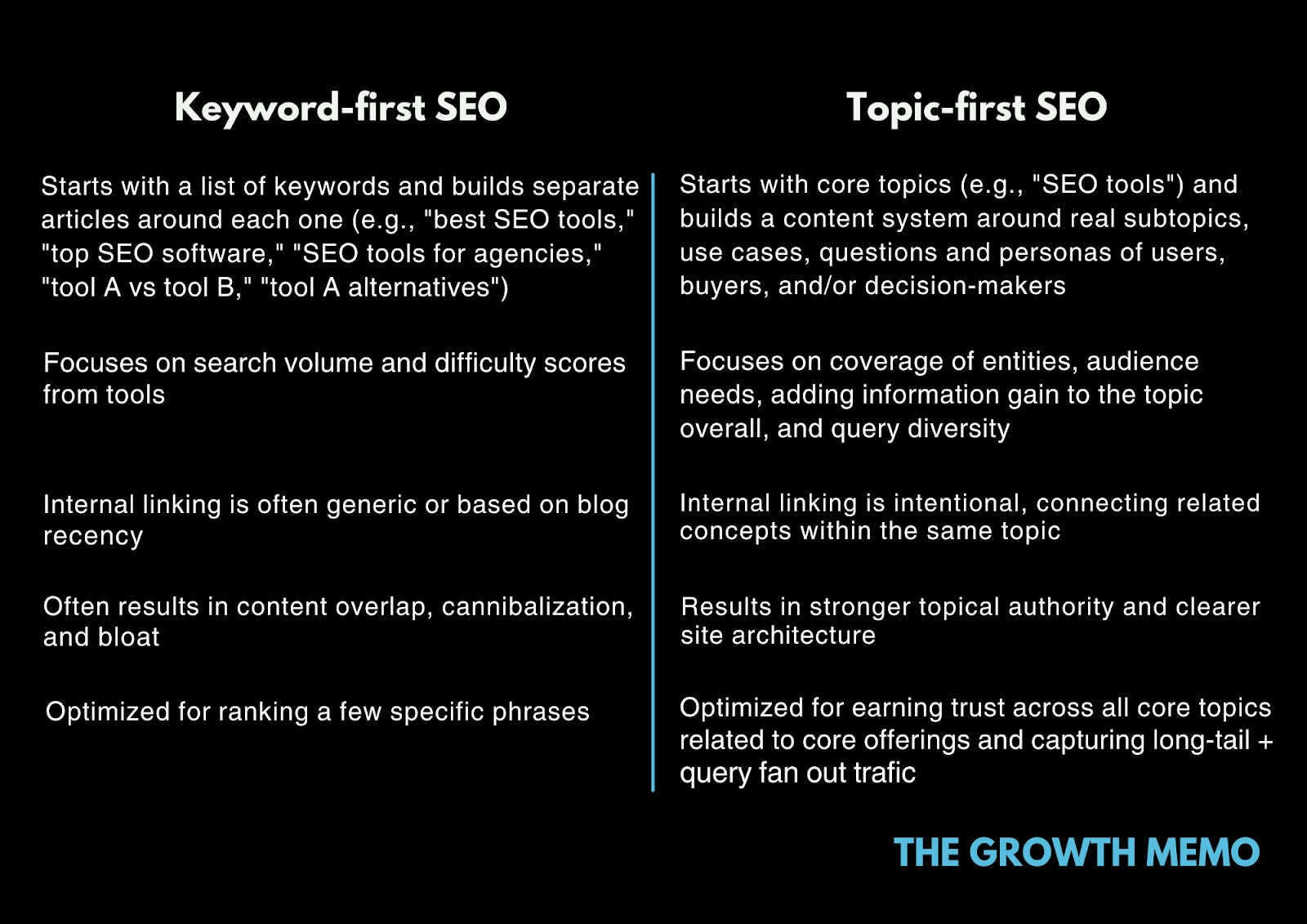
Image Credit: Kevin Indig

Old Way: Keyword-First SEO

The classic approach to SEO centered around picking individual keywords, assigning each one a page, and publishing content that aimed to rank for that phrase.

This model worked well when Google’s ranking signals were more literal (think string matching, backlink anchor text, and on-page optimization carrying most of the weight).

But in 2025 and beyond, this approach is showing its age.

Keyword-first SEO often looks like this:

  • Minimal internal cohesion across pages; articles aren’t working together to build topic depth or reinforce semantic signals.
  • Content decisions are often driven by average monthly search and tool-based keyword difficulty scores, rather than intent or persona-specific needs.
  • A high-effort, low-durability content-first SEO strategy; posts may rank initially and hold for a while, but they rarely stick or scale.
  • Monitoring performance is often focused on traffic projections and done by page type, SEO-tool-informed intent type, query rankings, and (yes) even sometimes topic groups.

But even when teams adopt a topic cluster-first model (like grouping related keywords into topic clusters or deploying a topic-focused pillar + cluster strategy), they often stay tethered to outdated keyword logic.

The result? Surface-level coverage for single keywords, frequent content cannibalization, and a site structure that might seem organized but still lacks strategic topic optimization.

Without persona insights, or a clear content hierarchy built around core topics, you’re building with bricks, but no real authority blueprint.

Wait a second. Is optimizing for topics any different from the classic pillar + topic cluster approach?

Yes and no.

A pillar + cluster model (a.k.a. hub and spoke) is a framework that can organize a topical approach.

But strategists should shift from matching pages to exact keywords → covering concepts deeply instead.

This classic framework can support topic optimization, but only if it’s implemented with a topic-first mindset.

Here are the primary differences:

  • Keyword-driven pillar + cluster model: Pillar = covers seed keyword target(s); clusters = cover long-tail variations of seed keywords.
  • Topic-driven pillar + cluster model:Pillar = offers a comprehensive guide to the topic; clusters = provide in-depth support for key concepts, different personas, related problems, and unique angles.

Simply selecting high-volume keywords to optimize for in your pillar + cluster strategy plan doesn’t work like it used to.

So, a pillar + cluster plan can help you organize your approach, but you’ll need to cover your core topics with depth and from a variety of perspectives, and for each persona in your target audience.

New Way: Topic-First SEO

Your future-proof SEO strategy doesn’t start with a focus on keywords; it starts with focusing on your target people, their problems, and the topics they care about.

Topic-first SEO approaches content through the lens of the real-world solutions your brand provides through your products and services.

You build authority by exploring a topic (one that you can directly speak to with authority) from all relevant angles: different personas, intent types, pain points, industry sectors, and contexts of use.

But keep in mind: Topic-first SEO is not exactly a page volume game, although the breadth and depth of your topic coverage are crucial.

Topic-first SEO involves:

  • Covering your core, targeted topics across personas.
  • Investing in “zero-volume” content based on actual questions and needs your target audience has.
  • Producing content within your topic that offers different perspectives and hot takes.
  • Building authority with information gain: i.e., new, fresh data that offers unique insights within your core targeted topics.

And guess what? This approach aligns with how Google now understands and ranks content:

  1. Entities > keywords: Google doesn’t just match “search strings” anymore. It understands concepts and audiences (and how they’re related) through the knowledge graph.
  2. Content built around people, problems, and questions: You’re not answering one query when you optimize for a topic as a whole; you’re solving layered, real-world challenges for your audience.
  3. Content journeys, not isolated posts: Topic-first strategies map content to different user types and their stage in the journey (from learning to buying to advocating).
  4. More durable visibility + stronger links: When your site deeply reflects a topic and tackles it from all angles, it attracts both organic queries and natural backlinks from people referencing real insight and utility.
  5. That E-E-A-T we’re all supposed to focus on: Kevin discusses this a bit more when he digs into Google Quality Rater Guidelines in building and measuring brand authority. But this is an absolute no-brainer: Taking a topic-first approach actively works toward establishing Experience, Expertise, Authoritativeness, and Trustworthiness.

I wanted to know how others are doing this, so over on LinkedIn, I asked for your thoughts and questions.

Here are some that stuck out to me that I think we can all benefit from considering:

Lily Grozeva asks: “Is covering a topic and establishing a brand as an authority on it still a volume game?”

My answer: No. I think Backlinko is a good example. The site built incredible visibility with just a few, but very deep guides.
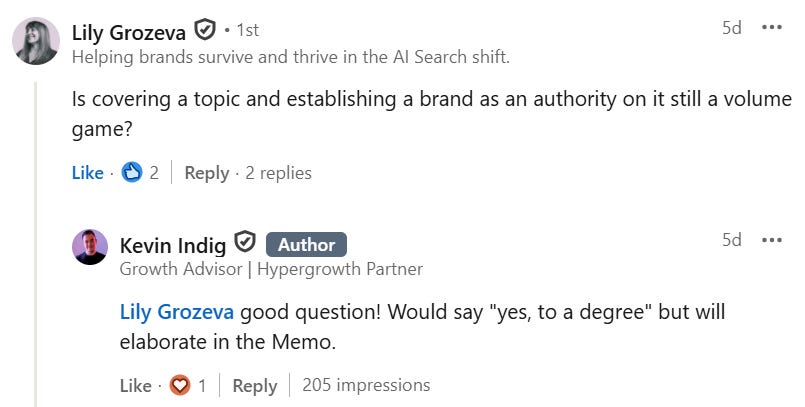
Image Credit: Kevin Indig

Diego Gallo asks: “Any tips on how to decide if a question should belong to a page or be its own page?”

My answer: “In my experience, one way to determine that is cosine similarity between the (tokenized, embedded) question and the main topics / intents of the pages that you can pick from.”

Diego also left a good tip for covering all relevant intents: Build an “intent template” for each page (e.g., product landing page, blog article, etc.). Base the template on what works well on Google.
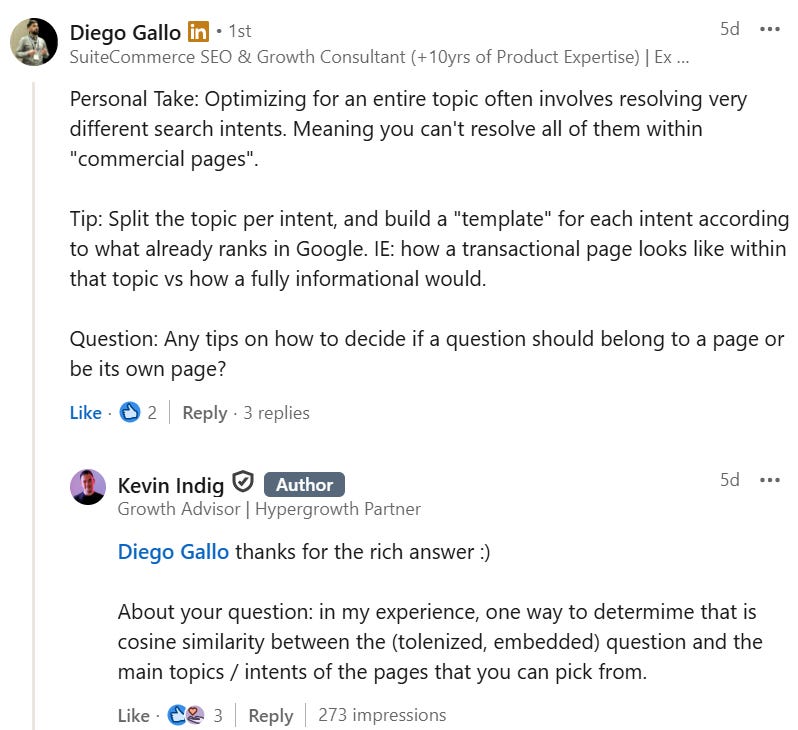
Image Credit: Kevin Indig

Matthew Mellinger called out that you can use Google’s People Also Asked questions to get clarity on which questions to answer on a page.
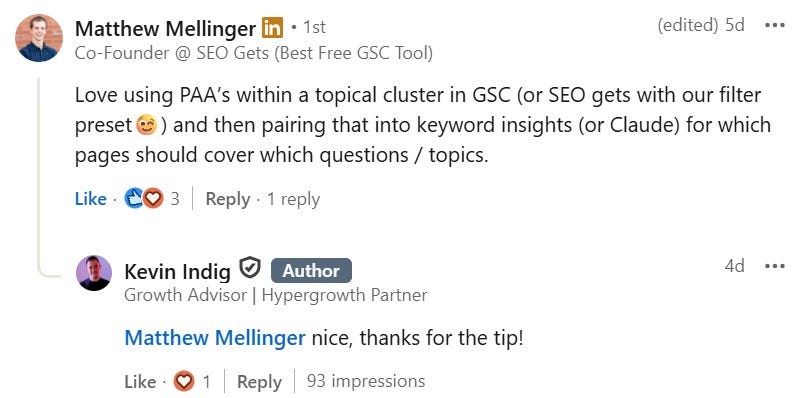
Image Credit: Kevin Indig

By the way, you can also use the intent classifier I built for premium subscribers for this task!

Gianluca Fiorelli put a cool analogy on the table:
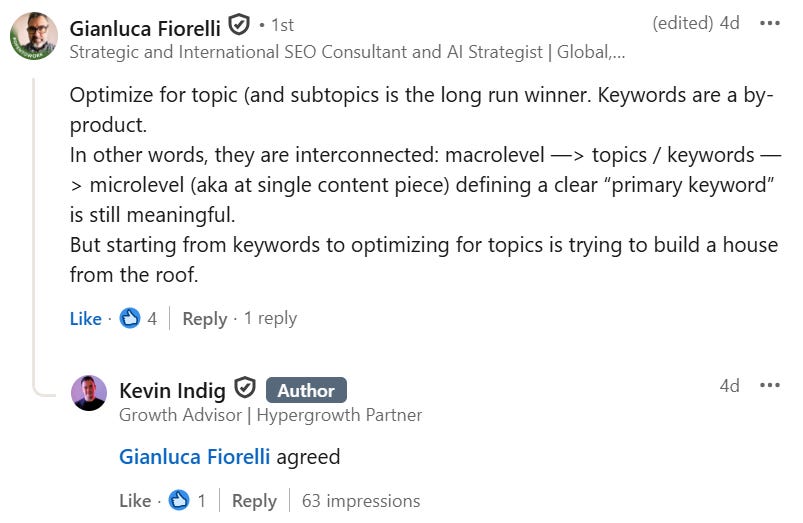
Image Credit: Kevin Indig

Not Strategizing With A Topic-First Mindset? You’re Outdated

Next week, we’re going to take a deep look at operationalizing a topic-first SEO strategy, but here are some final thoughts.

While there are so many unknowns in the current search landscape, there are a few truths we can ground ourselves in, whether optimizing for search engines or LLMs:

1. Your brand can still own a topic in the AI era.

As shown in the data via the UX study of AIOs, brand/authority is now the first gate users walk through when considering a click off the SERP, search intent relevance the second; snippet wording only matters once trust is secured.

If people are going to click, they’re going to click on the familiar and authoritative. Be the topical authority in your areas of expertise and offerings.

Have your brand show up again, and again, and again in search results across the topic. It’s simple, but it’s hard work.

2. I don’t think focusing on a topic-first mindset could backfire in any way (in 2025 or beyond).

Demonstrating to your core ICPs – whether they find you via paid ads, organic search, LLM chats, socials, or word-of-mouth – through authoritative, branded website content that you understand the topics they care about, questions they have, and provide the solutions for their needs specifically only builds trust … no matter how your brand is found.

3. Build topic systems, not just articles or pages.

Integrators need to take a page out of the aggregator’s product-led SEO playbook: Create a comprehensive system (similar to TripAdvisor’s millions of programmatic pages supported by user-generated content (UGC) reviews, but you don’t need millions 😅) built around your topics of expertise that tackle perspectives, solutions, and questions around each persona type for each sector you serve.

Build the organizational structure within your site that makes these topics and personas easy to navigate for users (and easy to crawl and understand for bots/agents).

4. Persona or ICP-based content is more useful, less generic, and built for the next era of personalized search results.

‘Nuff said. If you strategize topic optimization through the lens of personas (even to the point of including real interviews, surveys, comments, and tips from these persona types), you’re adding to the conversation with depth and unique data.

If you’re not building audience-first content, does optimizing for LLMs and search bots even matter? You’ll gain visibility, but will you gain trust once you finally earn that click?


Featured Image: Paulo Bobita/Search Engine Journal

Google Says AI Won’t Replace The Need For SEO via @sejournal, @martinibuster

Google’s John Mueller and Martin Splitt discussed the question of whether AI will replace the need for SEO. Mueller expressed a common-sense opinion about the reality of the web ecosystem and AI chatbots as they exist today.

Context Of Discussion

The context of the discussion was about SEO basics that a business needs to know. Mueller then mentioned that businesses might want to consider hiring an SEO who can help navigate the site through its SEO journey.

Mueller observed:

“…you also need someone like an SEO as a partner to give you updates along the way and say, ‘Okay, we did all of these things,’ and they can list them out and tell you exactly what they did, ‘These things are going to take a while, and I can show you when Google crawls, we can follow along to see like what is happening there.’”

Is There Value In Learning SEO?

It was at this point that Martin Splitt asked if generative AI will make having to learn SEO obsolete or whether entering a prompt will give all the answers a business person needs to know. Mueller’s answer was tethered to how things are right now and avoided speculating about how things will change in a year or more.

Splitt asked:

“Okay, I think that’s pretty good. Last but not least, with generative AI and chatbot AI things happening. Do you think there’s still a value in learning these kind of things? Or can I just enter a prompt and it’ll figure things out for me?”

Mueller affirmed that knowing SEO will still be needed as long as there are websites because search engines and chat bots need the information that exists on websites. He offered examples of local businesses and ecommerce sites that still need to be found, regardless of whether that’s through an AI chatbot or search.

He answered:

“Absolutely value in learning these things and in making a good website. I think there are lots of things that all of these chatbots and other ways to get information, they don’t replace a website, especially for local search and ecommerce.

So, especially if you’re a local business, maybe it’s fine if a chatbot mentions your business name and tells people how to get there. Maybe that’s perfectly fine, but oftentimes, they do that based on web content that they found.

Having a website is the basis for being visible in all of these systems, and for a lot of other things where you offer a service or something, some other kind of functionality on a website where you have products to sell, where you have subscriptions or anything, a chat response can’t replace that.

If you want a t shirt, you don’t want a description of how to make your own t-shirt. You want a link to a store where it’s like, ‘Oh, here’s t-shirt designs,’ maybe t-shirt designs in that specific style that you like, but you go to this website and buy those t-shirts there.”

Martin acknowledged the common sense of that answer and they joked around a bit about Mueller hoping that an AI will be able to do his job once he retires.

That’s the context for this part of their conversation:

“Okay. That’s very fair. Yeah, that makes sense. Okay, so you think AI is not going to take it all away from us?”

And Mueller answers with the comment about AI replacing him after he retires:

“Well, we’ll see. I can’t make any promises. I think, at some point, I would like to retire, and then maybe AI takes over my work then. But, like, there’s lots of stuff to be done until then. There are lots of things that I imagine AI is not going to just replace.”

What About CMS Platforms With AI?

Something that wasn’t discussed is the trend of AI within content management systems. Many web hosts and WordPress plugins are already integrating AI into the workflow of creating and optimizing websites. Wix has already integrated AI into their workflow and it won’t be much longer until AI makes a stronger presence within WordPress, which is what the new WordPress AI team is working on.

Screenshot Of ChatGPT Choosing Number 27

Will AI ever replace the need for SEO? Many easy things that can be scaled are already automated. However, many of the best ideas for marketing and communicating with humans are still best handled by humans, not AI. The nature of generative AI, which is to generate the most likely answer or series of words in a sentence, precludes it from ever having an original idea. AI is so locked into being average that if you ask it to pick a number between one and fifty, it will choose the number 27 because the AI training binds it to picking the likeliest number, even when instructed to randomize the choice.

Listen to Search Off The Record at about the 24 minute mark:

Featured Image by Shutterstock/Roman Samborskyi

Keywords Don’t Work for AI SEO

The search engine industry is changing quickly, upended by AI platforms that have altered queries and informational journeys.

Consumers increasingly type extended prompts into AI platforms versus single keywords or phrases in traditional search engines. Prompts are much longer and are often voice-activated with follow-up questions.

Moreover, prompts are typically much more descriptive and thus harder to predict.

Nonetheless, knowing shoppers’ prompts is essential for understanding their needs. Unfortunately, third-party “question” tools are typically keyword-driven, unsuited for prompts.

Prompt analytics tools

New prompt-analysis tools are coming.

For example, Similarweb’s new “AI Traffic Intelligence” reveals the prompts driving traffic to any web page. The tool is an add-on to the company’s “Web Intelligence” platform, which starts at $1,500 per year. Similarweb has not published pricing for the AI addition. There is no free trial.

Aiso is another tool to see actual prompts based on topic, brand, or keywords. Users describe their business, products, and services. Aiso then shows actual, related prompts from ChatGPT and other AI platforms. Pricing starts at $75 per month, with a free trial.

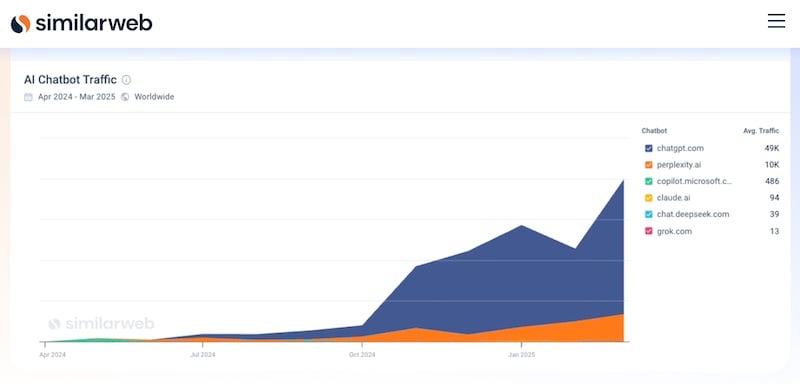
New tools such as Similarweb’s “AI Traffic Intelligence” help understand shopper prompts.

Prompt optimization

Knowing the prompts of shoppers is useful only for understanding their needs and journeys. I know of no way to optimize a site for prompts because AI platforms don’t match content to queries, unlike search engines. Both rely on intent, but AI prompts must interpret entire sentences, paragraphs, and follow-ups.

For example, most brick-and-mortar businesses don’t use “local” in their description.

A prompt from a hair-salon owner might resemble this:

I own a hair salon and need more people in my area to be aware of my business. Which kind of marketing agency or expert do I need (with my small budget)?

An AI platform would understand that local search is a good option. Here’s the response from Google’s AI Mode to the above prompt:

Here’s a breakdown of the types of marketing expertise to consider for your hair salon, particularly with a limited budget…:

SEO experts or consultants

What they do: SEO specialists help your website rank higher in search engine results for relevant keywords, making it easier for potential clients in your area to find your salon when they search online for services like “hair salon in [Your City]”.

Why it’s good for you: A strong online presence is crucial for attracting new clients. A well-optimized website, along with a claimed and optimized Google Business Profile, will significantly boost your salon’s visibility in local searches.

Things to consider: Look for those specializing in local SEO or SEO for the beauty industry. [Here, AI Mode recommended actual local SEO agencies specializing in the beauty industry.] Ask for case studies or testimonials showcasing their success in ranking local businesses.

The biggest ecommerce change from AI platforms is the impact on shopping journeys. Consumers’ prompts go beyond keywords, such as “hair salons in my town,” to include, say, prices, driving distance, specializations, and more.

Hence, optimizing for AI focuses on problem-solving and positioning a business as a solution provider.

Aligning landing pages to keywords remains viable for traditional search engines, where keywords are still predictable, but AI optimization means answering all kinds of relevant (unpredictable) questions.

Thus merchants looking for AI visibility should create problem-solving content. Researching keywords and prompts can help understand those problems, but attempting to match content is fruitless.

Google’s New Graph Foundation Model Catches Spam Up To 40x Better via @sejournal, @martinibuster

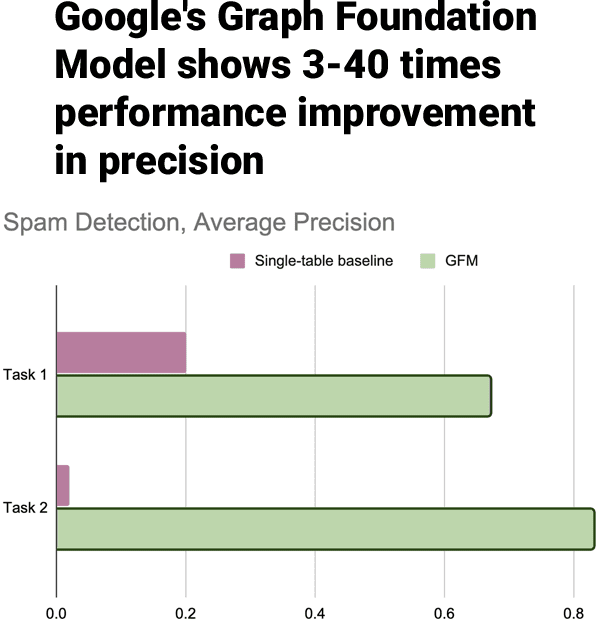
Google published details of a new kind of AI based on graphs called a Graph Foundation Model (GFM) that generalizes to previously unseen graphs and delivers a three to forty times boost in precision over previous methods, with successful testing in scaled applications such as spam detection in ads.

The announcement of this new technology is referred to as expanding the boundaries of what has been possible up to today:

“Today, we explore the possibility of designing a single model that can excel on interconnected relational tables and at the same time generalize to any arbitrary set of tables, features, and tasks without additional training. We are excited to share our recent progress on developing such graph foundation models (GFM) that push the frontiers of graph learning and tabular ML well beyond standard baselines.”

Google's Graph Foundation Model shows 3-40 times performance improvement in precision

Graph Neural Networks Vs. Graph Foundation Models

Graphs are representations of data that are related to each other. The connections between the objects are called edges and the objects themselves are called nodes. In SEO, the most familiar type of graph could be said to be the Link Graph, which is a map of the entire web by the links that connect one web page to another.

Current technology uses Graph Neural Networks (GNNs) to represent data like web page content and can be used to identify the topic of a web page.

A Google Research blog post about GNNs explains their importance:

“Graph neural networks, or GNNs for short, have emerged as a powerful technique to leverage both the graph’s connectivity (as in the older algorithms DeepWalk and Node2Vec) and the input features on the various nodes and edges. GNNs can make predictions for graphs as a whole (Does this molecule react in a certain way?), for individual nodes (What’s the topic of this document, given its citations?)…

Apart from making predictions about graphs, GNNs are a powerful tool used to bridge the chasm to more typical neural network use cases. They encode a graph’s discrete, relational information in a continuous way so that it can be included naturally in another deep learning system.”

The downside to GNNs is that they are tethered to the graph on which they were trained and can’t be used on a different kind of graph. To use it on a different graph, Google has to train another model specifically for that other graph.

To make an analogy, it’s like having to train a new generative AI model on French language documents just to get it to work in another language, but that’s not the case because LLMs can generalize to other languages, which is not the case for models that work with graphs. This is the problem that the invention solves, to create a model that generalizes to other graphs without having to be trained on them first.

The breakthrough that Google announced is that with the new Graph Foundation Models, Google can now train a model that can generalize across new graphs that it hasn’t been trained on and understand patterns and connections within those graphs. And it can do it three to forty times more precisely.

Announcement But No Research Paper

Google’s announcement does not link to a research paper. It’s been variously reported that Google has decided to publish less research papers and this is a big example of that policy change. Is it because this innovation is so big they want to keep this as a competitive advantage?

How Graph Foundation Models Work

In a conventional graph, let’s say a graph of the Internet, web pages are the nodes. The links between the nodes (web pages) are called the edges. In that kind of graph, you can see similarities between pages because the pages about a specific topic tend to link to other pages about the same specific topic.

In very simple terms, a Graph Foundation Model turns every row in every table into a node and connects related nodes based on the relationships in the tables. The result is a single large graph that the model uses to learn from existing data and make predictions (like identifying spam) on new data.

Screenshot Of Five Tables

Image by Google

Transforming Tables Into A Single Graph

The research paper says this about the following images which illustrate the process:

“Data preparation consists of transforming tables into a single graph, where each row of a table becomes a node of the respective node type, and foreign key columns become edges between the nodes. Connections between five tables shown become edges in the resulting graph.”

Screenshot Of Tables Converted To Edges

Image by Google

What makes this new model exceptional is that the process of creating it is “straightforward” and it scales. The part about scaling is important because it means that the invention is able to work across Google’s massive infrastructure.

“We argue that leveraging the connectivity structure between tables is key for effective ML algorithms and better downstream performance, even when tabular feature data (e.g., price, size, category) is sparse or noisy. To this end, the only data preparation step consists of transforming a collection of tables into a single heterogeneous graph.

The process is rather straightforward and can be executed at scale: each table becomes a unique node type and each row in a table becomes a node. For each row in a table, its foreign key relations become typed edges to respective nodes from other tables while the rest of the columns are treated as node features (typically, with numerical or categorical values). Optionally, we can also keep temporal information as node or edge features.”

Tests Are Successful

Google’s announcement says that they tested it in identifying spam in Google Ads, which was difficult because it’s a system that uses dozens of large graphs. Current systems are unable to make connections between unrelated graphs and miss important context.

Google’s new Graph Foundation Model was able to make the connections between all the graphs and improved performance.

The announcement described the achievement:

“We observe a significant performance boost compared to the best tuned single-table baselines. Depending on the downstream task, GFM brings 3x – 40x gains in average precision, which indicates that the graph structure in relational tables provides a crucial signal to be leveraged by ML models.”

Is Google Using This System?

It’s notable that Google successfully tested the system with Google Ads for spam detection and reported upsides and no downsides. This means that it can be used in a live environment for a variety of real-world tasks. They used it for Google Ads spam detection and because it’s a flexible model that means it can be used for other tasks for which multiple graphs are used, from identifying content topics to identifying link spam.

Normally, when something falls short the research papers and announcement say that it points the way for future but that’s not how this new invention is presented. It’s presented as a success and it ends with a statement saying that these results can be further improved, meaning it can get even better than these already spectacular results.

“These results can be further improved by additional scaling and diverse training data collection together with a deeper theoretical understanding of generalization.”

Read Google’s announcement:

Graph foundation models for relational data

Featured Image by Shutterstock/SidorArt

The AI Desktop/Mobile Divide: 90% Of AI Search Traffic Ignores Mobile Strategy

The AI search revolution has arrived with fanfare, transforming how users discover information across platforms like ChatGPT, Perplexity, and Google’s AI Overviews.

Yet, beneath the headlines lies a counterintuitive reality that’s reshaping how we approach the age-old debate and strategies on desktop vs. mobile: Over 90% of AI-powered search referrals originate from desktop devices.

While mobile accounts for more than half of global web traffic, AI search engines are making their biggest impact on desktop – a complete reversal of typical user behavior patterns that creates both challenges and more mobile opportunities for marketers.

Currently, some of the findings I share below contradict conventional wisdom.

Recent analysis of referral traffic across leading AI search platforms in the U.S. and Europe shows a striking disconnect between where users consume content and where AI engines drive meaningful traffic.

This gap represents one of the most significant untapped opportunities in the current search landscape.

AI Desktop Vs. Mobile Referral Numbers Tell A Surprising Story

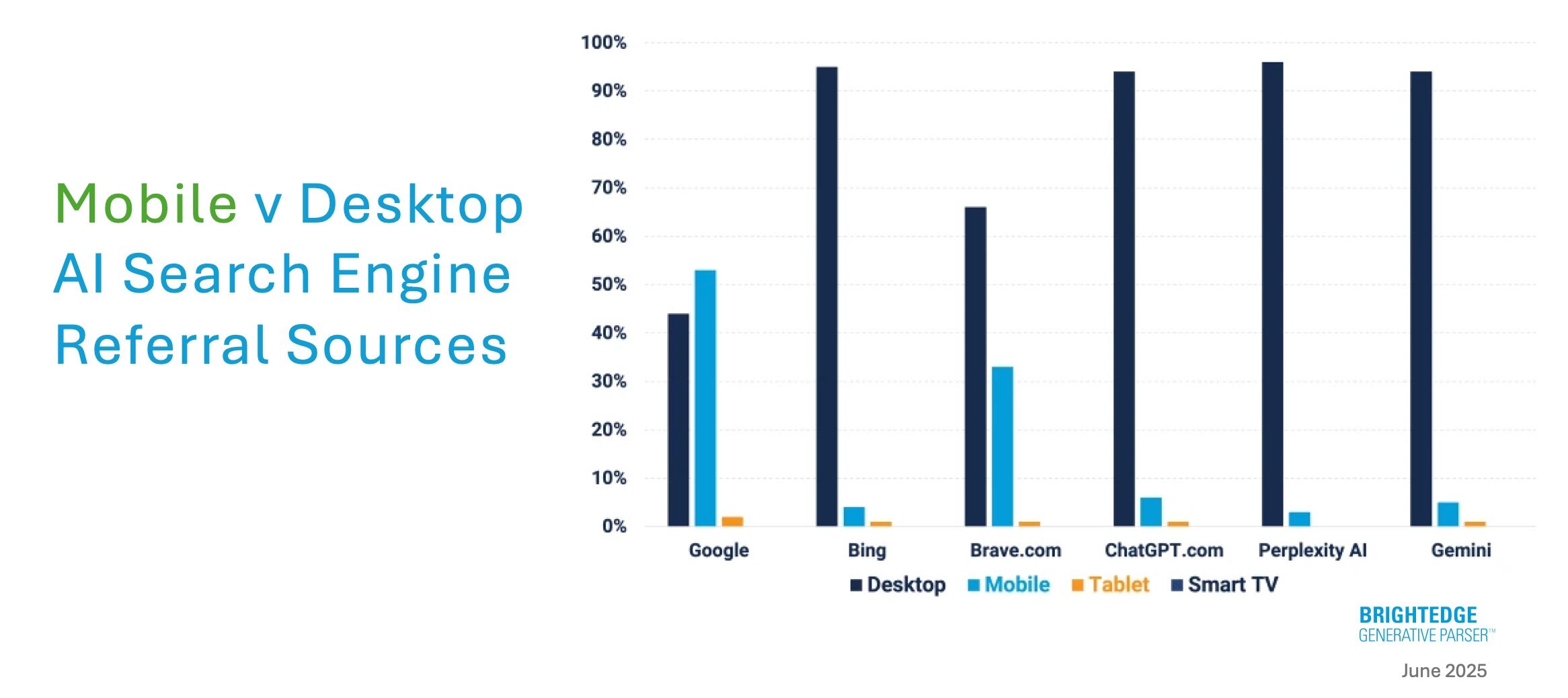
The data from BrightEdge Generative Parser (my employer for disclosure) paints a clear picture of desktop dominance across virtually every AI-powered search platform.

  • ChatGPT leads the desktop concentration, with 94% of referral traffic coming from desktop devices, leaving just 6% for mobile users. This massive skew occurs despite ChatGPT’s widespread mobile app adoption.
  • Perplexity pushes desktop dominance even further, with 96.5% of referrals originating from desktop and mobile barely registering at 3.4%. For a platform positioning itself as a research-focused AI engine, this pattern suggests that users prefer desktop environments for gathering in-depth information.
  • Microsoft’s Bing maintains similar patterns, with 95% of desktop referrals vs. 4% mobile, despite integration across Microsoft’s ecosystem and the introduction of Copilot features.
  • Google Gemini follows suit, with 91% of traffic coming from desktop and 5% from mobile, indicating that even Google’s AI offerings struggle to capture mobile referral momentum.

The lone exception? Google Search itself maintains the mobile majority at 53% mobile vs. 44% desktop, but this reflects its entrenched position as the default search engine across mobile browsers, particularly Safari on iPhones.

Source: BrightEdge The Open Frontier of Mobile AI Search, June 2025

Why Mobile AI Search Isn’t Converting To Referrals

The disparity isn’t about user engagement; AI search activity on mobile is likely booming.

Instead, it’s about architectural design choices that fundamentally alter user flows and referral patterns.

The In-App Preview Problem

Mobile AI platforms often intercept the first click on citations, showing content previews within their own interfaces.

This creates a multi-step process where users must click again to reach external websites, significantly reducing referral traffic compared to desktop experiences, where first clicks typically lead directly to source sites.

ChatGPT exemplifies this pattern. On desktop, citation clicks immediately redirect users to source websites. On mobile, the app frequently displays in-app content previews, requiring users to take additional action to generate actual referrals.

The Discovery Vs. Research Divide

Desktop and mobile AI searches serve fundamentally different user intents.

Mobile users often engage in discovery-oriented searches, seeking quick answers, product comparisons, and immediate problem-solving.

Desktop users tend to gravitate toward comprehensive research, detailed analysis, and tasks that require sustained attention.

This behavioral split suggests AI platforms are evolving into distinct experiences rather than responsive versions of the same product.

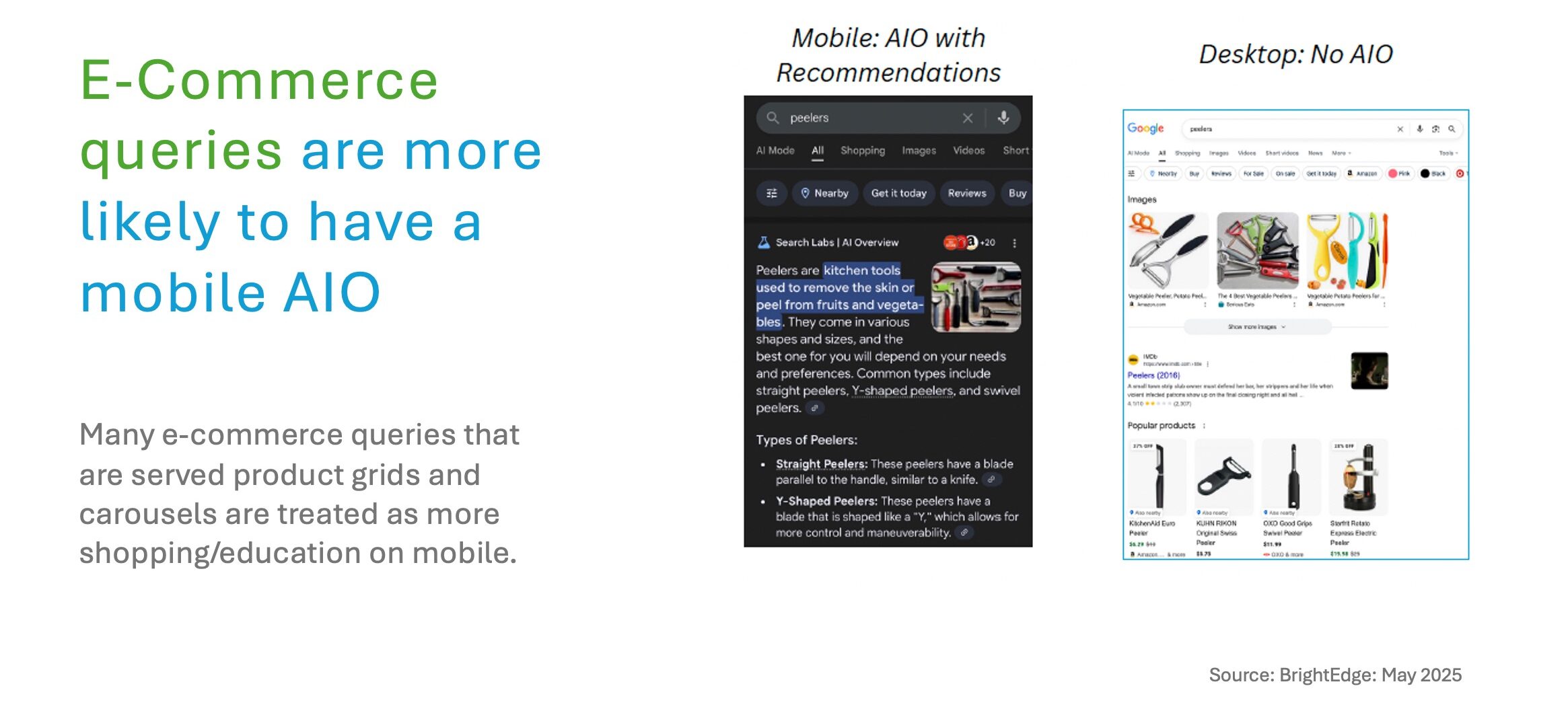
Google’s AI Overviews demonstrate this evolution clearly: Ecommerce queries are three times more likely to trigger mobile AI Overviews (13.5% vs. 4.5% on desktop), treating shopping searches as educational discovery rather than direct product promotion.

Meanwhile, desktop AI Overviews command 80% more screen real estate (1110 px vs. 617 px) and appear for 39% more keywords than mobile devices, but show more consistent day-to-day patterns.

This suggests Google is actively experimenting with mobile AI formats while maintaining predictable desktop experiences.

The Apple Factor: Mobile’s Hidden Gatekeeper

Apple’s role as mobile web gatekeeper cannot be understated.

With Safari as the default browser on nearly a billion devices, Apple controls mobile search behavior in ways that could reshape the entire landscape overnight.

Current data shows that 58% of Google’s mobile search traffic to brand websites originates from iPhones, making Apple’s browser defaults critically important for AI search adoption.

Unlike Google, which has integrated AI features across its mobile search experience, Apple has not yet embedded AI-powered search into its mobile web stack.

This creates a massive structural opportunity. A single change in Safari’s default search provider or the introduction of native AI search features could trigger a significant redistribution of AI-powered traffic across the mobile ecosystem.

Three Strategic Imperatives For Marketers

1. Develop Device-Specific AI Content Strategies

Traditional SEO focuses on keywords and rankings, but AI search requires understanding device context and user intent patterns.

Mobile AI users prioritize quick discovery and shopping-oriented queries, while desktop users seek comprehensive information and detailed analysis.

Desktop-Comprehensive Approach

  • Develop in-depth, research-oriented content that supports detailed analysis.
  • Create comprehensive guides and comparative resources that leverage the 80% larger screen space available in desktop AI Overviews.
  • Build authority through detailed explanations and expert insights.
  • Design content clusters that support extended research sessions and take advantage of desktop’s 39% higher keyword coverage.

Mobile-First AI Optimization

  • Create concise, discovery-focused content that answers immediate questions.
  • Optimize for product comparison and shopping-related queries.
  • Design content that works well in in-app preview formats.
  • Focus on local and immediate-need content themes.

2. Prepare For Mobile AI Search When The Market Heats Up

The current desktop dominance in AI referrals represents a temporary market condition rather than a permanent state.

As mobile AI platforms mature and address current referral limitations, early movers will capture significant advantages.

Build Mobile AI Foundations Today

Responsive design excellence becomes critical when AI engines start citing mobile content more frequently.

Ensure your site adapts seamlessly across various screen sizes, orientations, and device modes to maximize citation potential regardless of how AI platforms display your content.

Optimize for speed and accessibility with fast page load times and mobile-friendly content that includes appropriately sized text, images, and interactive elements.

We are seeing AI engines increasingly factor user experience signals into their citation decisions. Schema markup is recommended so AI engines can interpret the structured data on your mobile pages and present users with content that they need and want.

Improve Core Web Vitals as these metrics become crucial for mobile AI performance. Core Web Vitals measure webpage quality beyond loading speed, correlating directly with user experience.

For mobile AI optimization, every millisecond matters – small improvements can have a significant impact on citation likelihood.

Track Desktop Vs. Mobile AI Performance

Monitor AI Overview differences using keyword reporting tools that switch between desktop and mobile AI Overviews.

This enables you to observe performance gaps and identify platform-specific opportunities.

The data reveals striking differences:

  • Desktop AI Overviews claim 80% more screen real estate (1110 px vs. 617 px), allowing for more detailed explanations and citation opportunities.
  • Desktop shows 39% more keyword coverage than mobile devices, but this gap represents a future mobile opportunity.
  • Ecommerce queries are three times more likely to trigger mobile AI Overviews, as platforms treat shopping searches as educational discovery on mobile.
Source: BrightEdge, May 2025

Have Different Content Strategies For Both Desktop And Mobile

Create mobile-first educational content and product guides rather than traditional product pages.

Mobile AI engines favor discovery-oriented content that helps users understand products and make informed decisions.

Ensure dual-platform accessibility by configuring your site’s crawling capabilities for both mobile and desktop views. Your content must be prepared for AI citation regardless of screen size or platform interface.

Watch Apple and Google industry moves: With Apple’s potential entry into AI search, content strategies should account for possible Safari integration changes that could dramatically shift mobile search behavior overnight.

3. Leveraging The Current Desktop Opportunity

While mobile AI search matures, desktop presents immediate opportunities for brands ready to optimize for AI-powered referrals.

  • Desktop AI citation optimization: Focus on creating quotable, authoritative content that AI engines can easily cite and reference. This includes structured data markup, clear section headers, and direct answers to common questions.
  • Comprehensive content development: Desktop AI users engage with longer-form, detailed content. Invest in comprehensive guides, thorough analysis, and expert commentary that support extended research sessions.
  • Multi-modal content integration: Desktop environments support richer media experiences. Combine text, video, infographics, and interactive elements to increase citation potential across different AI platforms.

More Mobile AI Disruption Is Coming

The current 90% desktop dominance in AI referrals represents a temporary market imbalance rather than a permanent shift away from mobile. Several factors suggest significant mobile AI search growth ahead.

Platform incentives align toward mobile expansion. AI search companies understand that capturing mobile market share is essential for long-term growth, and current referral limitations likely drive the active development of mobile-optimized solutions.

User behavior patterns favor mobile AI adoption. Once technical barriers to mobile AI referrals are addressed, user preferences for mobile-first interactions should drive rapid adoption.

Apple’s AI integration timeline creates a sense of urgency. With Apple controlling mobile browser defaults and reportedly developing AI search capabilities, the mobile AI landscape could transform rapidly.

Key Takeaways

The AI search revolution is creating two distinct experiences: desktop-focused referral traffic and mobile-focused engagement that don’t yet translate to website visits. This divide presents both immediate opportunities and strategic imperatives for marketers:

Immediate opportunities exist in desktop AI optimization. With 90% of AI referrals coming from desktops, brands can capture significant traffic by optimizing for desktop AI search patterns and citation preferences.

Mobile AI strategy requires different thinking. Mobile AI optimization isn’t about responsive design. It’s about understanding discovery-focused user intent and preparing for different referral mechanisms as more AI search engines hit the market.

Apple remains the wild card. Any changes to Safari’s default search behavior or introduction of native AI features could reshape mobile search overnight, making preparation essential.

The brands that recognize this desktop-mobile divide and develop device-specific AI strategies will gain significant competitive advantages as the AI search ecosystem matures.

The question isn’t whether mobile AI search will grow. It’s whether your plan will be ready when it does.

The future of AI search lies not in choosing between desktop and mobile but in mastering both experiences as distinct opportunities to serve different user needs and capture referral traffic across the entire search journey.

Unless otherwise indicated, any data mentioned above was taken from this BrightEdge study. The data was for May 2025 and is based on thousands of actual website referrals for medium to large brands across the world.

More Resources:


Featured Image: Collagery/Shutterstock

Google Explains How To Approach Content For SEO via @sejournal, @martinibuster

Google’s John Mueller and Martin Splitt discussed the problem of how to approach content for achieving business goals, the wisdom of setting expectations, and observed that it may not matter whether a site is optimized if the content is already achieving its intended results.

Getting The Content Right

Anyone can write, but it’s hard to communicate in a way that meets the audience’s needs. One thing SEOs often get wrong is content, which remains the most important ranking factor in modern search engines.

A common mistake is publishing entire sentences that waste time. I think that happens when writers are trying to meet an arbitrary word count and providing context for the high volume keywords they want to rank for.

Martin Splitt started the discussion by asking how to go about writing content and shared his own experience writing content and getting it wrong because he was writing for himself and not for what the audience needs to read.

Splitt shared:

“…how would I know how to go about content? Because now I know who I want to address and probably also roughly what I want to do. But, I mean, that’s a whole different skillset, right? That’s like copywriting and probably some researching and maybe some lettering and editing, and wow. That’s a lot. I love to write. I love to write.

…But I love having a technical writer on the team. Lizzi is a tremendous help with anything that is writing. I honestly thought I’m a good, reasonably good writer. And then Lizzi came and asked three questions on a piece of documentation that I thought was almost perfect.

I basically started questioning the foundations of the universe because I was like, “Okay, no, this document doesn’t even make sense. I haven’t answered the fundamental questions that I need to answer before I can even start writing. I’ve written like three pages.

Holy moly, that is a skill that is an amazingly tricky skill to acquire, I think. How do I start writing? Just write what I think I should be writing, I guess.”

Writing is easy to do, but difficult to do well. I’ve seen many sites that have the SEO fundamentals in place, but are undermined by the content. Splitt’s experience highlights the value in getting a second opinion on content.

Site Visitors Are Your Inspiration

Mueller and Splitt next move on to the topic of what publishers and SEOs should write about it and their answer is to focus on what users want, encouraging to do something as simple as asking their readers or customers.

Mueller observed:

“I think, if you have absolutely no inspiration, one approach could be to ask your existing customers and just ask them like:

  • How did you find me?
  • What were you looking for?
  • Where were you looking?
  • Were you just looking on a map? What is it that brought you here?

This is something that you can ask anyone, especially if you have a physical business.

..It’s pretty easy to just ask this randomly without scaring people away. That’s kind of one aspect I would do and try to build up this collection of ‘these are different searches that people have done in different places, maybe on different systems, and I want to make sure I’m kind of visible there.’”

Set Reasonable Expectations

John Mueller and Martin Splitt next provide a reality check on the keyword phrases that publishers and SEOs choose to optimize for. It’s not always about the difficulty of the phrases; it’s also about how relevant they are to the website.

Mueller commented about what to do with the keyword phrases that are chosen for targeting:

“And then I would take those and just try them out and see what comes up, and think about how reasonable it would be for one of your pages, perhaps to show up there and how reasonable it can be, I think is something where you have to be brutally honest with yourself, because it’s sometimes tempting to say, “Well, I would like to appear first for the search bookstore on the internet.” Probably that’s not going to happen. I mean, who knows? But there’s a lot of competition for some of these terms.

But, if you’re talking about someone searching for bookstores or bookstores in Zurich or bookstores on Maps or something like that, then that’s a lot more well defined and a lot easier for you to look at and see, what are other people doing there? Maybe my pages are already there. And, based on that, you can try to build out, what is it that I need to at least mention on my pages.”

Mueller followed up by downplaying whether a site is search optimized or not, saying that what’s important is if the site is performing as well as intended. Whether or not it’s properly optimized doesn’t matter if it’s already doing well as it is. Some may argue that the site could be doing better, but that’s outside of the context of what Mueller was commenting on. Mueller’s context was a business owner who was satisfied with the performance of the site.

Mueller observed:

“I mean, it all depends on how serious you take your goal, right? If you’re like a small local business you’re saying, ‘Well, I have a website and I hear I should make it SEO, but I don’t really care.’ Then it’s like do whatever you want kind of thing. If you have enough business and you’re happy. There’s no one to judge you to say, “Your website is not SEO optimized.”

Listen to Episode 95 of the Search Off The Record at about the ten minute mark:

Featured Image by Shutterstock/Krakenimages.com

Google’s Advice On Hiring An SEO And Red Flags To Watch For via @sejournal, @martinibuster

Google’s Search Off The Record podcast discussed when a business should hire an SEO consultant and what metrics of success should look like. They also talked about a red flag to watch for when considering a search marketer.

Hire An SEO When It Becomes Time Consuming

Martin Splitt started the conversation off by asking at what point a business should hire an SEO:

“…I know people are hiring agencies and SEO experts. When is the point where you think an expert or an agency should come in? What’s the bits and pieces that are not as easy to do while I do my business that I should have an expert for?”

John replied that there is no one criteria or line to cross at which point a business should hire a consultant. He did however point out that there comes a certain point where doing SEO is time consuming and takes a business person away from the tasks that are directly related to running their business. That’s a point at which hiring an SEO consultant makes sense.

He said:

“Yeah, I don’t know if there’s a one-size-fits-all answer there because it’s a bit like asking, when should I get help for marketing, especially for a small business.

You do everything yourself. At some point, you’re like, ‘Oh, I really hate bookkeeping. I’m going to hire a bookkeeper.’ At that point where you’re like, ‘Well, I don’t appreciate doing all of this work or I don’t have time for it, but I know it has to be done.’ That’s probably the point where you say, ‘Well, okay, I will hire someone for this.’ “

SEO Should Have Measurable Results?

The next factor they discussed is the measurability of results. Over more than twenty-five years of working in SEO, one of the ways that low-quality SEOs have consistently measured their results is by the number of queries a client site is ranking for. Low-quality SEOs charge a monthly retainer and generate a report of all queries the site has ranked for in the previous months, including garbage nonsense queries.

A common metric SEOs use to gauge success is ranking positions and traffic. Those metrics are a little better, and most SEOs agree that they make sense as solid metrics.

But those metrics don’t capture the true success of SEO because those ranking positions could be for low-quality search queries that don’t result in the kind of traffic that converts to leads, sales, affiliate earnings or ad clicks.

Arguably, the most important metric any business should use to gauge the effect of what was done for SEO is how much more revenue is being generated. Keyword rankings and traffic are important metrics to measure, but the most important metric is ultimately the business goal.

Google’s John Mueller appears to agree, as he cites revenue and the business result as key measures of whether the SEO is working.

He explained:

“I think, for in SEO, it kind of makes sense when you realize there’s concrete value in working on SEO for your website, where there’s some business result that comes out of it where you can actually measurably say, ‘When I started doing SEO for my website, I made so much more money’ or whatever it is that goal is that you care about, and ‘I’m happy to invest a portion of that into hiring someone to do SEO.’

That’s one way I would look at it, where if you can measure in one way or another the effects of the SEO work, then it’s easier to say, ‘Well, I will invest this much into having someone else do that for me.’”

There is a bit of a problem with measuring the effects of SEO. The effects on sales or leads from organic SEO cannot always be directly attributed. People who are obsessed with data-driven decisions will be disappointed because it’s not always possible to directly attribute a lead from an organic search. For one thing, Google hides referral data from the search results. Unlike PPC, where you can track a lead from an ad click to the sale, you can’t do that with organic search.

So if you’re using increased sales or leads as a metric, you’ll have to be able to at least separate attributable paid search from earnings, then guesstimate the rest. Not everything can be data-driven.

Hire Someone With Experience

Another thing Mueller and Splitt recommended was to hire someone who has actual experience with SEO. There are many qualifying factors that can be added, including experience monetizing their own websites, ability to interpret HTML code (which is helpful for identifying technical reasons for ranking problems), endorsements and testimonials. A red flag, in my opinion, is hiring someone from a cold call.

John Mueller observed:

“Someone else, ideally, would be someone who has more experience doing SEO. Because, as a small business owner, you have like 500 hats to wear, and you probably can figure out a little bit about each of these things, but understanding all of the details, that’s sometimes challenging.”

Martin agreed:

“Okay. So there’s no one-size-fits-all answer for this one, but you have to find that spot for yourself whenever it makes sense. All right okay. Fair.”

Red Flag About Some SEOs

Up to this point, both Mueller and Splitt avoided cautioning about red flags to watch for when hiring an SEO. Here, they segued into the topic of what to avoid, advising caution about search marketers who guarantee results.

The reason to avoid these kinds of search marketers is that search rankings depend on a wide range of factors that are not under an SEO’s control. The most an SEO can do is align a site to best practices and promote the site. After that, there are external factors, such as competitors, that cannot be influenced. Most importantly, Google is a black box system: you can see what goes in, you can observe what comes out (the search results), but what happens in between is hidden. All search ranking factors, like external signals of trustworthiness, have an unclear influence on the search results.

Here’s what Mueller said:

“One of the things I would watch out for is, if an SEO makes any promises with regards to ranking or traffic from Search, that’s usually a red flag, because a lot of things around SEO you can’t promise ahead of time. And, if someone says, “I’m an expert. I promise you will rank first for these five words.” They can’t do that. They can’t manually go into Google’s systems and tweak the dials and change the rankings.”

Listen to Google’s Search Off The Record podcast here:

Featured Image by Shutterstock/Peshkova

Google Explains How Long It Takes For SEO To Work via @sejournal, @martinibuster

Google’s martin Splitt and John Mueller discussed how long it takes for SEO to have an effect. Google’s John Mueller explained that there are different levels of optimization and that some have a more immediate effect than other more complex changes.

Visible Changes From SEO

Some SEOs like to make blanket statements that SEO is all about links. Others boast that their SEO work can have dramatic effect in relatively little time. And it turns out that those kinds of statements really depend on the actual work that was done.

Google’s John Mueller said that a site starting out from virtually zero optimization to some basic optimization may see near immediate ranking changes in Google.

John Mueller started this part of the conversation:

“I guess another question that I sometimes hear with regards to hiring an SEO is, how long does it take for them to make visible changes?”

Martin Splitt responded:

“Yeah. How long does it take? I’m pretty sure it’s not instant. If you say it takes like a week or a couple of weeks to pick things up, is that the reasonable time horizon or is it longer?”

John answered with the really old “it depends” line which is kind of overdone. But in this case it really does depend on multiple factors related to the scale of the work being done which in turn influences how long it will take for Google to index and then recalculate rankings. He said if it’s something simple then it won’t take Google much time. But if it’s a lot of changes then it may take significantly longer.

John’s explanation:

“I think, to speak in SEO lingo, it depends. Some changes are easy to pick up quickly, like simple text changes on a page. They just have to be recrawled and reprocessed and that happens fairly quickly.

But, if you make bigger, more strategic changes on a website, then sometimes that just takes a long time.”

Next Stage Of SEO: Monitor Progress

Mueller then says that a good SEO should monitor how the changes they made are affecting the rankings. This can be a little tricky because some changes will cause an immediate ranking boost that will last for a few days and then drop. My opinion, from my experience, is that an unshakeable top ranking is generally possible if there’s strong word of mouth and other external signals that tell Google that the content is trustworthy and high quality.

Here’s what John Mueller said:

“I think that’s something where a good SEO should be able to help monitor the progress along there. So it shouldn’t be that they go off and make changes and say, ‘Okay, now you have to keep paying me for the next year until we wait what happens.’ They should be able to tell you what is happening, what the progress is, give you some input on the different things that they’re doing regularly. But it is something that is more of a longer term thing.”

Mueller doesn’t go into details about what the hypothetical SEO is “doing regularly” but in my opinion it’s always helpful to be doing basic promotion that boils down to telling people that this content is out there, measuring how people respond to it, getting feedback about it and then making changes or improvement based on those changes.

For content sites, a great way to get immediate user feedback is to enable a moderated comment section in which only comments that are approved can show up. I have received a lot of positive feedback from readers on some of my content sites from what’s in the comments. It’s also useful to make it easy for users to contact the publisher from any page of the site, whether it’s an ecommerce site or an informational blog. User feedback is absolute gold.

Mueller continued his answer:

“I think if you have a website that has never done anything with SEO, probably you’ll see a nice big jump in the beginning as you ramp up and do whatever the best practices are. At some point, it’ll kind of be slow and regular more from there on.”

Martin Splitt expressed how this part about waiting and monitoring requires patience and Mueller agreed, saying:

“I think being patient is good. But you also need someone like an SEO as a partner to give you updates along the way and say, ‘Okay, we did all of these things,’ and they can list them out and tell you exactly what they did. ‘These things are going to take a while, and I can show you when Google crawls, we can follow along to see like what is happening there. Based on that, we can give you some idea of when to expect changes.’”

Takeaways:

SEO Timelines Vary By Scale Of Change

  • Simple on-page edits may result in quick ranking changes.
  • Larger structural or strategic SEO efforts take significantly longer to be reflected in Google rankings.

SEO Results Are Not Instant

  • Indexing and ranking recalculations take time, even for smaller changes.

Monitoring And Feedback Are Necessary

  • Good SEOs track progress and explain what is happening over time.
  • Ongoing feedback from users can help guide further optimization.

Transparency And Communication

  • Effective SEOs regularly report on their actions and expected timeframes for results.

Google’s John Mueller explained that the time it takes for search optimizations to show results depends on the complexity of changes made, with simple updates being processed faster and large-scale changes requiring more time. He emphasized that good SEO isn’t just about making changes because it also involves tracking how those changes affect rankings, communicating progress clearly, and continuous work.

I suggested that user response to content is an important form of feedback because it helps site owners understand what is resonating well with users and where the site is falling short. User feedback, in my opinion, should be a part of the SEO process because Google tracks user behavior signals that indicate a site is trustworthy and relevant to users.

Listen to Search Off The Record Episode 95

Featured Image by Shutterstock/Khosro

OpenAI Quietly Adds Shopify As A Shopping Search Partner via @sejournal, @martinibuster

OpenAI has quietly added Shopify as a third-party search partner to help power their shopping search, which shows shopping-rich results. The addition of Shopify was not formally announced, but quietly tucked into OpenAI ChatGPT search documentation.

Shopify Is An OpenAI Search Partner

Aleyda Solís (LinkedIn profile) recently noticed that OpenAI had updated their Search documentation to add Shopify to the list of third party search providers.

She posted:

“Ecommerce sites: I’ve found that Shopify is listed along with Bing as a ChatGPT third-party search provider! OpenAI added Shopify along with Bing as a third-party search provider in their ChatGPT Search documentation on May 15, 2025; a couple of weeks after their enhanced shopping experience was announced on April 28.”

OpenAI Is Showing Merchants From Multiple Platforms

OpenAI shopping search is returning results from a variety of platforms. For example, a search for hunting dog supplies returns sites hosted on Shopify but also Turbify (formerly Yahoo Stores)

Screenshot Showing Origin Of OpenAI Shopping Rich Results

The rich results with images were sourced from Shopify and Amazon merchants for this specific query.

At least one of the shopping results listed in the Recommended Sellers is a merchant hosted on the Turbify ecommerce platform:

Screenshot Of OpenAI Recommended Retailers With Gun Dog Supply, Hosted On Turbify Platform

OpenAI Shopping Features

OpenAI recently rolled out shopping features for ChatGPT Search. Products are listed like search results and sometimes as rich results with images and other shopping related information like review stars.

ChatGPT Search uses images and structured metadata related to prices and product description, presumably Schema structured data although it’s not explicitly stated. ChatGPT may generate product titles, descriptions, and reviews based on the data received from third-party websites and sometimes may generate summarized reviews.

Merchants are ranked according to how the merchant data is received from third-party data providers, which at this point includes Bing and Shopify.

Ecommerce stores that aren’t on Shopify can apply to have their products included in OpenAI’s shopping results. Stores that want to opt in must not be opted out of OpenAI’s web crawler, OAI-SearchBot .

Featured Image by Shutterstock/kung_tom

Is Your SEO Strategy Built for the AI Era? [Webinar] via @sejournal, @hethr_campbell

The old rules no longer apply. It’s time for a smarter, AI-ready playbook.

AI-driven search is changing the landscape fast. Organic traffic is dropping, visibility is shrinking, and traditional SEO tactics are losing their edge. If you’re still following yesterday’s strategy, you’re already behind.

Join Siteimprove on July 23, 2025 for an exclusive webinar with Zoe Hawkins and Jeff Coyle. Learn how to evolve your SEO approach and content planning to thrive in a world where AI now plays a central role in search.

Here’s what you’ll walk away with:

  • A breakdown of how AI is changing enterprise SEO.
  • Why trust and authority now matter more than keyword volume.
  • How to adapt to high-intent, low-volume traffic behavior.
  • Practical ways to optimize your content for AI search without losing authenticity.
  • The latest tools and frameworks for predictive content planning.

Why this session is a must:

We can no longer rely on the same tactics that worked before. This session gives you an inside look at how SEO must evolve to stay effective in the AI-first future.

Register now to stay ahead of the curve. Can’t attend live? Sign up anyway and get the full replay delivered to your inbox.