How To Get The Perfect Budget Mix For SEO And PPC via @sejournal, @brookeosmundson

There’s no one-size-fits-all answer when it comes to deciding how much of your marketing budget should go toward SEO versus PPC.

But that doesn’t mean the decision should be based on gut instinct or what your competitors are doing.

Marketing leaders are under more pressure than ever to show a return on every dollar spent.

So, it’s not about choosing one over the other. It’s about finding the right balance based on your goals, your timelines, and what kind of results the business expects to see.

This article walks through how to think about budget allocation between SEO and PPC with a focus on what kind of output you can reasonably expect for your spend.

What You’re Actually Paying For

When you spend money on PPC, you’re buying immediate visibility.

Whether it’s Google Ads, Microsoft Ads, or paid social, you’re paying for clicks, impressions, and leads right now.

That cost is largely predictable and better to forecast. For example, if your cost-per-click (CPC) is $3 and your budget is $10,000, you can expect about 3,300 clicks.

PPC spend can be directly tied to pipeline, which is why it’s often favored by performance-driven teams.

With SEO, you’re investing in long-term growth. You’re paying for content, technical fixes, site structure improvements, and link acquisition.

But you don’t pay for clicks or impressions. Once rankings improve, those clicks come organically.

The upside is compounding growth and reduced cost per lead over time.

The downside? It can take months to see meaningful impact, and the cost-to-output ratio is harder to predict.

It’s also worth noting that PPC costs often increase with competition, while SEO costs tend to remain relatively stable over time. That can make SEO more scalable in the long term, especially for brands in high-CPC industries.

How Urgency And Goals Influence Budget Splits

If you need leads or traffic now, PPC should probably get the bulk of your short-term budget.

Launching a new product? Trying to meet quarterly goals? Paid search and social can give you the volume you need pretty quickly.

But if you’re trying to reduce customer acquisition cost (CAC) in the long run or improve visibility in organic search to support brand awareness, SEO deserves more attention. It builds value over time and often pays dividends past the life of your campaign.

Many brands start with a 70/30 or 60/40 split favoring PPC, then shift the mix as organic efforts gain traction.

Just make sure you set clear expectations: SEO is not a quick fix, and over-promising short-term gains can backfire when the board wants results next quarter.

If you’re rebranding, expanding into new markets, or supporting a product launch, a heavier upfront PPC investment makes sense. But brands that already rank well organically or have strong content foundations can afford to rebalance the mix in favor of SEO.

Why Organic Traffic Is Getting Harder To Defend

One emerging challenge for organic marketing is the rise of AI Overviews in Google Search. More brands are seeing a dip in organic traffic even when they maintain strong rankings.

Why?

Because the search experience is shifting. AI-generated summaries are now answering questions directly on the results page, often pushing traditional organic listings further down.

That means your SEO strategy can’t just be about rankings anymore. You need to invest in content that earns visibility in AI Overviews, featured snippets, and other enhanced search features.

This may involve rethinking how content is structured, focusing more on schema markup, FAQs, and direct-answer formats that AI models tend to surface.

In practical terms, your SEO budget should now include:

  • Structured content planning built around entity-based search.
  • Technical SEO improvements like schema and page speed.
  • Multimedia content like images and videos, which AI often pulls into results.
  • Continual refresh of older content to maintain relevance in evolving search formats.

This shift doesn’t mean SEO is no longer worth it. It means you need to be more strategic in how you spend.

Ask your SEO partner or in-house team how they’re adapting to AI search changes, and make sure your budget reflects that evolution.

Budget Planning Based On Realistic Outputs

Let’s put this into numbers. Say you have a $100,000 annual digital marketing budget.

Putting $80,000 toward PPC might get you 25,000 paid clicks and 500 conversions (based on a fictional $3.20 CPC and 2% conversion rate).

The remaining $20,000 on SEO might buy you four high-quality articles a month, technical clean-up work, and backlink outreach.

If done well, this might start showing traction in three to six months and bring in sustained traffic over time.

The key is to model your budget around what’s actually possible for each channel, not just what you hope will happen. SEO efforts often have a longer lag time, but PPC campaigns can run out of gas as soon as you turn off the spend.

You should also budget for maintenance and reinvestment. Even strong SEO performance requires fresh content and updates to keep rankings.

Similarly, PPC campaigns need regular optimization, creative testing, and bid adjustments to stay efficient.

You should also plan for budget allocation across different campaign types: brand vs. non-brand, search vs. display, and prospecting vs. retargeting.

Each serves a different purpose, and over-investing on one without supporting the others can limit growth.

For example, allocating part of your PPC budget to retargeting warm audiences can drastically improve efficiency compared to cold prospecting alone.

While branded search often delivers low-cost conversions, it shouldn’t be your only area of investment if you’re trying to scale.

What To Communicate To Leadership

Leadership wants to know two things: how much are we spending, and what are we getting in return?

A mixed SEO and PPC strategy gives you the ability to answer both.

PPC provides short-term wins you can report on monthly.

SEO builds long-term momentum that pays off in quarters and years.

Explain that PPC is more like a faucet you control. SEO is more like building your own well. Both are valuable.

But if you only have one or the other, you’re either stuck renting traffic or waiting too long to see the impact.

Board members and non-marketing executives often prefer hard numbers. So, when proposing a budget mix, include projected costs per acquisition, estimated traffic volumes, and timelines for ramp-up.

Make it clear where each dollar is going and what kind of return is expected.

If possible, create a model that shows various scenarios. For example, what a 50/50 vs. 70/30 SEO/PPC split might look like in terms of conversions, traffic, and cost per lead over time.

Visuals help ground the conversation in data rather than preference.

Choosing The Right Metrics For Each Channel

One challenge with mixed-channel budget planning is deciding which key performance indicator (KPI) to prioritize.

PPC is easier to measure in terms of direct return on investment (ROI), but SEO plays a broader role in business success.

For PPC metrics, you may want to focus on KPIs like:

  • Impression share.
  • Conversion rate.
  • Cost per acquisition (CPA).
  • Return on ad spend (ROAS).

For SEO metrics, you may want to focus on:

  • Organic traffic growth over time.
  • Ranking improvements.
  • Page engagement.
  • Assisted conversions.

When reporting to leadership, show how the two channels complement each other.

For example, paid search might drive immediate clicks, but your top-converting landing page could rank organically and reduce spend over time.

When To Adjust Your Budget Mix

Your initial budget allocation isn’t set in stone. It should evolve based on performance data, market shifts, and internal needs.

If PPC costs rise but conversion rates drop, that could be a cue to pull back and invest more in organic.

If you’re seeing strong rankings but low engagement, it may be time to shift some SEO funds into conversion rate optimization (CRO) or paid retargeting.

Seasonality and campaign cycles also matter. Retailers may lean heavily on PPC during Q4, while B2B companies might invest more in SEO during longer sales cycles.

Set quarterly review points where you re-evaluate performance and make adjustments. That level of agility shows leadership you’re making informed decisions, not just sticking to arbitrary ratios.

Avoiding Common Budget Mistakes

Some companies go all-in on SEO, expecting miracles. Others burn through paid budgets with nothing left to sustain organic efforts. Both approaches are risky.

A healthy mix means budgeting for:

  • Immediate lead gen (PPC).
  • Long-term traffic growth (SEO).
  • Regular testing and performance analysis.

Don’t forget to budget for what happens after the click: landing page development, CRO, and reporting tools that tie it all together.

Another mistake is treating SEO as a one-time project instead of an ongoing investment. If you only fund it during a site migration or a content sprint, you’ll lose momentum.

Same goes for PPC: Without a proper landing page experience or conversion tracking, even high-performing ads won’t deliver meaningful results.

Balancing Short-Term Wins With Long-Term Growth

There is no universal perfect split between SEO and PPC. But there is a perfect mix for your goals, stage of growth, and available resources.

Take the time to assess what you actually need from each channel and what you can realistically afford. Make sure your projections align with internal timelines and expectations.

And most importantly, keep reviewing your mix as performance data rolls in. The right budget allocation today might look very different six months from now.

Smart marketing leaders don’t choose sides. They choose what makes sense for the business today, and build flexibility into their strategy for tomorrow.

More Resources:


Featured Image: Jirapong Manustrong/Shutterstock

This Is Why AI Won’t Take Your Job (Yet) via @sejournal, @SequinsNsearch

SEO died a thousand times only this year, and the buzzword that resonates across every boardroom (and let’s be honest, everywhere else) is “AI.”

With Google releasing several AI-powered views over the past year and a half, along with the latest take on its own SearchGPT rival AI Mode, we are witnessing a traffic erosion that is very hard to counteract if we stay stuck in our traditional view of our role as search professionals.

And it is only natural that the debate we keep hearing is the same: Is AI eventually going to take our jobs? In a stricter sense, it probably will.

SEO, as we know it, has transformed drastically. It will keep evolving, forcing people to take on new skills and have a broader, multichannel strategy, along with clear and prompt communication to stakeholders who might still be confused about why clicks keep dropping while impressions stay the same.

The next year is expected to bring changes and probably some answers to this debate.

But in the meantime, I was able to draw some predictions, based on my own study investigating humans’ ability to discern AI, to see if the “human touch” really has an advantage over it.

Why This Matters For Us Now

Knowing if people can recognize AI matters for us because people’s behavior changes when they know they’re interacting with it, as compared to when they don’t.

A 2023 study by Yunhao Zhang and Renée Richardson Gosline compared content created by humans, AI, and hybrid approaches for marketing copy and persuasive campaigns.

What they noticed is that when the source was undisclosed, participants preferred AI-generated content, a result that was reversed when they knew how the content was created.

It’s like the transparency on using AI added a layer of diffidence to the interaction, rooted in the common mistrust that is reserved for any new and relatively unknown experience.

At the end of the day, we have consumed human-written content for centuries, but generative AI has been scaled only in the past few years, so this wasn’t even a challenge we were exposed to before.

Similarly, Gabriele Pizzi from the University of Bologna showed that when people interact with an AI chatbot in a simulated shopping environment, they are more likely to consider the agent as competent (and, in turn, trust it with their personal information) when the latter looks more human as compared to “robotic.”

And as marketers, we know that trust is the ultimate seal not only to get a visit and a transaction, but also to form a lasting relationship with the user behind the screen.

So, if recognizing AI content changes the way we interact with it and make decisions, do we still retain the human advantage when AI material gets so close to reality that it is virtually undistinguishable?

Your Brain Can Discriminate AI, But It Doesn’t Mean We Are Infallible Detectors

Previous studies have shown that humans display a feeling of discomfort, known as the uncanny valley, when they see or interact with an artificial entity with semi-realistic features.

How this negative feeling is manifested physiologically with higher activity of our sympathetic nervous system (the division responsible for our “fight or flight” response) before participants can verbally report on or even be aware of it.

It’s a measure of their “gut feeling” towards a stimulus that mimics human features, but does not succeed in doing so entirely.

The uncanny valley phenomenon arises from the fact that our brain, being used to predicting patterns and filling in the blanks based on our own experience, sees these stimuli as “glitches” and spots them as outliers in our known library of faces, bodies, and expressions.

The deviation from the norm and the uncertainty in labeling these “uncanny” stimuli can be triggering from a cognitive perspective, which manifests in higher electrodermal activity (shortened as EDA), a measure of psychological arousal that can be measured with electrodes on the skin.

Based on this evidence, it is realistic to hypothesize that our brain can spot AI before making any active discrimination, and that we can see higher EDA in relation to faces generated with AI, especially when there is something “off” about them.

It is unclear, though, at what level of realism we stop displaying a distinctive response, so I wanted to find that out with my own research.

Here are the questions I set up to answer with my study:

  1. Do we have an in-built pre-conscious “detector” system for AI, and at what point of realistic imitation does it stop responding?
  2. If we do, does it guide our active discrimination between AI and human content?
  3. Is our ability to discriminate influenced by our overall exposure to AI stimuli in real life?

And most of all, can any of the answers to these questions predict what are the next challenges we’ll face in search and marketing?

To answer these questions, I measured the electrodermal activity of 24 participants between 25 and 65 years old as they were presented with neutral, AI-generated, and human-generated images, and checked for any significant differences in responses to each category.

My study ran in three phases, one for each question I had:

  1. A first task where participants visualized neutral, AI, and human static stimuli on a screen without any actions required, while their electrodermal activity was recorded. This was intended to measure the automatic, pre-conscious response to the stimuli presented.
  2. A second behavioral task, where participants had to press a button to categorize the faces that they had seen into AI- vs. human-generated, as fast and accurately as they could, to measure their conscious discrimination skills.
  3. A final phase where participants declared their demographic range and their familiarity with AI on a self-reported scale across five questions. This gave me a self-reported “AI-literacy” score for each participant that I could correlate with any of the other measures obtained from the physiological and behavioral tasks.

And here is what I found:

  • Participants showed a significant difference in pre-conscious activation between conditions, and in particular, the EDA was significantly higher for human faces rather than AI faces (both hyper-realistic and CGI faces). This would support the hypothesis that our brain can tell the difference between AI and human faces before we even initiate a discrimination task.
  • The higher activation for human faces contrasts with the older literature showing higher activation for uncanny valley stimuli, and this could be related to either our own habituation to CGI visuals (meaning they are not triggering outliers anymore), or the automatic cognitive effort involved in trying to extrapolate the emotion of human neutral faces. As a matter of fact, the limitation of EDA is that it tells us something is happening in our nervous system, but it doesn’t tell us what: higher activity could be related to familiarity and preference, negative emotional states, or even cognitive effort, so more research on this is needed.
  • Exposure and familiarity with AI material correlated with higher accuracy when participants had to actively categorize faces into AI-generated and human, supporting the hypothesis that the more we are exposed to AI, the better we become at spotting subtle differences.
  • People were much faster and accurate in categorizing stimuli of the “uncanny valley” nature into the AI-generated bucket, but struggled with hyper-realistic faces, miscategorizing them as human faces in 22% of cases.
  • Active discrimination was not guided by pre-conscious activation. Although a difference in autonomous activity can be seen for AI and human faces, this did not correlate with how fast or accurate participants were. In fact, it can be argued that participants “second-guessed” their own instincts when they knew they had to make a choice.

And yet, the biggest result of all was something I noticed on the pilot I ran before the real study: When the participant is familiar with the brand or the product presented, it’s how they feel about it that guides what we see at the neural level, rather than the automatic response to the image presented.

So, while our brain can technically “tell the difference,” our emotions, familiarity with the brand, the message, and expectations are all factors that can heavily skew our own attitude and behavior, essentially making our discrimination (automatic or not) almost irrelevant in the cascade of evaluations we make.

This has massive implications not only in the way we retain our existing audience, but also in how we approach new ones.

We are now at a stage where understanding what our user wants beyond the immediate query is even more vital, and we have a competitive advantage if we can identify all of this before they explicitly express their needs.

The Road To Survival Isn’t Getting Out Of The Game. It’s Learning The New Rules To Play By

So, does marketing still need real people?

It definitely does, although it’s hard to see that now that every business is ignited by the fear of missing out on the big AI opportunity and distracted by new shiny objects populating the web every day.

Humans thrive on change – that’s how we learn and grow new connections and associations that help us adapt to new environments and processes.

Ever heard of the word neuroplasticity? While it might just sound like a fancy term for learning, it is quite literally the ability of your brain to reshape as a result of experience.

That’s why I think AI won’t take our jobs. We are focusing on AI’s fast progress in the ability to ingest content and recreate outputs that are virtually indistinguishable from our own, but we are not paying attention to our own power of evolving to this new level field.

AI will keep on moving, but so will the needle of our discernment and our behavior towards it, based on the experiences that we build with new processes and material.

My results already indicate how familiarity with AI plays a role in how good we are at recognizing it, and in a year’s time, even the EDA results might change as a function of progressive exposure.

Our skepticism and diffidence towards AI is rooted in the unknown sides of it, paired with a lot of the misuse that we’ve seen as a by-product of a fast, virtually unregulated growth.

The nature of our next interactions with AI will shape our behavior.

I think this is our opportunity as an industry to create valuable AI-powered experiences without sacrificing the quality of our work, our ethical responsibilities toward the user, and our relationship with them. It’s a slower process, but one worth undertaking.

So, even if, at the beginning, I approached this study as a man vs. the machine showdown, I believe we are heading toward the man and the machine era.

Far from the “use AI for everything” approach we tend to see around, below is a breakdown of where I see a (supervised) integration of AI to our job unproblematic, and where I think it still has no space in its current state.

Use: Anything That Provides Information, Facilitates Navigation, And Streamlines User Journeys

  • For example, testing product descriptions based on the features that already reside in the catalog, or providing summaries of real users’ reviews that highlight pros and cons straight away.
  • Virtual try-ons and enabling recommended products based on similarity.
  • Automating processes like identifying internal link opportunities, categorizing intent, and combining multiple data sources for better insights.

Avoid: Anything That’s Based On Establishing A Connection Or Persuading The User

  • This includes any content that fakes expertise and authority in the field. The current technology (and the lack of regulation) even allows for AI influencers, but bear in mind that your brand authenticity is still your biggest asset to preserve when the user is looking to convert. The pitfalls of deceiving them when they expect organic content are greater than just losing a click. This is the work you can’t automate.
  • Similarly, generating reviews or user-generated content at scale to convey legitimacy or value. If you know this is what your users want to get more information on, then you cannot meet their doubts with fake arguments. Gaming tactics are short-lived in marketing because people learn to discern and actively avoid them once they realize they are being deceived. Humans crave authenticity and real peer validation of their decisions because it makes them feel safe. If we ever reach a point where, as a collective, we feel we can trust AI, then it might be different, but that’s not going to happen when most of its current use is dedicated to tricking users into a transaction at all cost, rather than providing the necessary information they need to make an informed decision.
  • Replacing experts and quality control. If it backfired for customer-favorite Duolingo, it will likely backfire for you, too.

The New Goals We Should Be Setting

Here’s where a new journey starts for us.

The collective search behavior has already changed not only as a consequence of any AI-powered view on the SERP that makes our consumption of information and decision-making faster and easier, but also as a function of the introduction of new channels and forms of content (the “Search Everywhere” revolution we hear all about now).

This brings us to new goals as search professionals:

  • Be omnipresent: It’s now the time to work with other channels to improve organic brand awareness and be in the mind of the user at every stage of the journey.
  • Remove friction: Now that we can get answers right off the search engine results page without even clicking to explore more, speed is the new normal, and anything that makes the journey slower is an abandonment risk. Getting your customers what they want straight off the bat (being transparent with your offer, removing unnecessary steps to find information, and improving user experience to complete an action) prevents them from going to seek better results from competitors.
  • Preserve your authenticity: Users want to trust you and feel safe in their choices, so don’t fall into the hype of scalability that could harm your brand.
  • Get to know your customers deeper: Keyword data is no longer enough. We need to know their emotional states when they search, what their frustrations are, and what problems they are trying to solve. And most of all, how they feel about our brand, our product, and what they expect from us, so that we can really meet them where they are before a thousand other options come into play.

We’ve been there before. We’ll adapt again. And I think we’ll come out okay (maybe even more skilled) on the other side of the AI hype.

More Resources:


Featured Image: Stock-Asso/Shutterstock

Google AI Overviews Target Of Legal Complaints In The UK And EU via @sejournal, @martinibuster

The Movement For An Open Web and other organizations filed a legal challenge against Google, alleging harm to UK news publishers. The crux of the legal filing is the allegation that Google’s AI Overviews product is using news content as part of its summaries and for grounding AI answers, but not allowing publishers to opt out of that use without also opting out of appearing in search results.

The Movement For An Open Web (MOW) in the UK published details of a complaint to the UK’s Competition and Markets Authority (CMA):

“Last week, the CMA announced plans to consult on how to make Google search fairer, including providing “more control and transparency for publishers over how their content collected for search is used, including in AI-generated responses.” However, the complaint from Foxglove, the Alliance and MOW warns that news organisations are already being harmed in the UK and action is needed immediately.

In particular, publishers urgently need the ability to opt out of Google’s AI summaries without being removed from search altogether. This is a measure that has already been proposed by other leading regulators, including the US Department of Justice and the South African Competition Commission. Foxglove is warning that without immediate action, the UK – and its news industry – risks being left behind, while other states take steps to protect independent news from Google.

Foxglove is therefore seeking interim measures to prevent Google misusing publisher content pending the outcome of the CMA’s more detailed review.”

Reuters is reporting on an EU antitrust complaint filed in Brussels seeking relief for the same thing:

“Google’s core search engine service is misusing web content for Google’s AI Overviews in Google Search, which have caused, and continue to cause, significant harm to publishers, including news publishers in the form of traffic, readership and revenue loss.”

Publishers And SEOs Critical Of AI Overviews

Google is under increasing criticism from the publisher and the SEO community for sending fewer clicks to users, although Google itself insists it is sending more traffic than ever. This may be one of those occasions where the phrase “let the judge decide” describes where this is all going, because there are no signs that Google is backing down from its decade-long trend of showing fewer links and more answers.

Featured Image by Shutterstock/nitpicker

SEO Rockstar “Proves” You Don’t Need Meta Descriptions via @sejournal, @martinibuster

An SEO shared on social media that his SEO tests proved that not using a meta description resulted in a lift in traffic. Coincidentally, another well-known SEO published an article that claims that SEO tests misunderstand how Google and the internet actually work and lead to the deprioritization of meaningful changes. Who is right?

SEO Says Pages Without Meta Descriptions Received Ranking Improvement

Mark Williams-Cook posted the results of his SEO test on LinkedIn about using and omitting meta descriptions, concluding that pages lacking a meta description received an average traffic lift of approximately 3%.

Here’s some of what he wrote:

“This will get some people’s backs up, but we don’t recommend writing meta descriptions anymore, and that’s based on data and testing.

We have consistently found a small, usually around 3%, but statistically significant uplift to organic traffic on groups of pages with no meta descriptions vs test groups of pages with meta descriptions via SEOTesting.

I’ve come to the conclusion if you’re writing meta descriptions manually, you’re wasting time. If you’re using AI to do it, you’re probably wasting a small amount of time.”

Williams-Cook asserted that Google rewrites around 80% of meta descriptions and insisted that the best meta descriptions are query dependent, meaning that the ideal meta description would be one that’s custom written for the specific queries the page is ranking for, which is what Google does when the meta description is missing.

He expressed the opinion that omitting the meta description increases the likelihood that Google will step in and inject a query-relevant meta description into the search results which will “outperform” the normal meta description that’s optimized for whatever the page is about.

Although I have reservations about SEO tests in general, his suggestion is intriguing and has the ring of plausibility.

Are SEO Tests Performative Theater?

Coincidentally, Jono Alderson, a technical SEO consultant, published an article last week titled, “Stop testing. Start shipping.” where he discusses his view on SEO tests, calling it “performative theater.”

Alderson writes:

“The idea of SEO testing appeals because it feels scientific. Controlled. Safe…

You tweak one thing, you measure the outcome, you learn, you scale. It works for paid media, so why not here?

Because SEO isn’t a closed system. …It’s architecture, semantics, signals, and systems. And trying to test it like you would test a paid campaign misunderstands how the web – and Google – actually work.

Your site doesn’t exist in a vacuum. Search results are volatile. …Even the weather can influence click-through rates.

Trying to isolate the impact of a single change in that chaos isn’t scientific. It’s theatre.

…A/B testing, as it’s traditionally understood, doesn’t even cleanly work in SEO.

…most SEO A/B testing isn’t remotely scientific. It’s just a best-effort simulation, riddled with assumptions and susceptible to confounding variables. Even the cleanest tests can only hint at causality – and only in narrowly defined environments.”

Jono makes a valid point about the unreliability of tests where the inputs and the outputs are not fully controlled.

Statistical tests are generally done within a closed system where all the data being compared follow the same rules and patterns. But if you compare multiple sets of pages, where some pages target long-tail phrases and others target high-volume queries, then the pages will differ in their potential outcomes. External changes (daily traffic fluctuation, users clicking on the search results) aren’t controllable. As Jono suggested, even the weather can influence click rates.

Although Williams-Cook asserted that he had a control group for testing purposes, it’s extremely difficult to isolate a single variable on live websites due to the uncontrollable external factors as Jono points out.

So, even though Williams-Cook asserts that the 3% change he noted is consistent and statistically relevant, the unobservable factors within Google’s black box algorithm that determines the outcome makes it difficult to treat that result as a reliable causal finding in the way one could with a truly controlled and observable statistical testing method.

If it’s not possible to isolate one change then it’s very difficult to make reliable claims about the resulting SEO test results.

Focus On Meaningful SEO Improvements

Jono’s article calls out the shortcomings of SEO tests but the point of his essay is to call attention to how focusing on what can be tested and measured can become prioritized over the “meaningful” changes that should be made but aren’t because they cannot be measured. He argues that it’s important to focus on the things that matter in today’s search environment that are related to content and a better user experience.

And that’s where we circle back to Williams-Cook because although statistically valid A/B SEO tests may be “theatre” as Jono suggests, it doesn’t mean that Williams-Cook’s suggestion is wrong. He may actually may be correct that it’s better to omit the meta description and let Google rewrite them.

SEO is subjective which means what’s good for one might not be a priority for someone else. So the question remains, is removing all meta descriptions a meaningful change?

Featured Image by Shutterstock/baranq

Are You Still Optimizing for Rankings? AI Search May Not Care. [Webinar] via @sejournal, @hethr_campbell

No ranking data. No impression data. 

So, how do you measure success when AI-generated answers appear and disappear, prompt by prompt?

With these significant changes to how we optimize for search, many brands are seeking to understand how to achieve SEO success.

Some Brands Are Winning in Search. Others? Invisible.

If your content isn’t appearing in AI-generated responses, like AI Overviews, ChatGPT, or Perplexity, you’re already losing ground to competitors.

👉 RSVP: Learn from the brands still dominating SERPs through AI search

In This Free Webinar, You’ll Learn:

  • Data-backed insights on what drives visibility and performance in AI search
  • A proven framework to drive results in AI search, and why this approach works
  • Purpose-built content strategies for driving success in Answer Engine Optimization (AEO) and Generative Engine Optimization (GEO).

This webinar helps enterprise SEOs and executives move from “I don’t know what’s happening in AI search” to “I have a data-driven strategy to compete and win.”

This session is designed for:

  • Marketing managers and SEO strategists looking to stay ahead.
  • Brand leaders managing performance visibility across platforms.
  • Content teams building for modern search behaviors.

You’ll walk away with a usable playbook and a better understanding of how to optimize for the answer, not the query.

Learn from what today’s winning brands are doing right.

Secure your spot, plus get the recording sent straight to your inbox if you can’t make it live.

New Google AI Mode: Everything You Need To Know & What To Do Next via @sejournal, @lorenbaker

Is your SEO strategy ready for Google’s new AI Mode?

Is your 2025 SERP strategy in danger?

What’s changed between traditional search mode and AI mode? 

Will Google’s New AI Mode Hurt Your Traffic?

Watch our webinar on-demand as we explored early implications for click-through rates, organic visibility, and content performance so you can:

  • Spot AIO SERP triggers: Identify search types most likely to spark AI Overviews.
  • Analyze impact: Find out which industries are being hit hardest.
  • Audit AIO brand mentions: See which domains are dominating AI-generated answers.
  • Optimize visibility: Update your SEO strategy to stay competitive.
  • Accurately track AI traffic: Measure shifts in click-through rates, visibility, and content performance.

In this actionable session, Nick Gallagher, SEO Lead at Conductor, gave actionable SEO guidance in this new era of search engine results page (SERPs). 

Get recommendations for optimizing content to stay competitive as AI-generated answers grow in prominence.

Google’s New AI Mode: Learn To Analyze, Adapt & Optimize

Don’t wait for the SERPs to leave you behind.

Watch on-demand to uncover if AI Mode will hurt your traffic, and what to do about it.

View the slides below or check out the full webinar for all the details

Join Us For Our Next Webinar!

The Data Reveals: What It Takes To Win In AI Search

Register now to learn how to stay away from modern SEO strategies that don’t work.

LLM Visibility Tools: Do SEOs Agree On How To Use Them? via @sejournal, @martinibuster

A discussion on LinkedIn about LLM visibility and the tools for tracking it explored how SEOs are approaching optimization for LLM-based search. The answers provided suggest that tools for LLM-focused SEO are gaining maturity, though there is some disagreement about what exactly should be tracked.

Joe Hall (LinkedIn profile) raised a series of questions on LinkedIn about the usefulness of tools that track LLM visibility. He didn’t explicitly say that the tools lacked utility, but his questions appeared intended to open a conversation

He wrote:

“I don’t understand how these systems that claim to track LLM visibility work. LLM responses are highly subjective to context. They are not static like traditional SERPs are. Even if you could track them, how can you reasonably connect performance to business objectives? How can you do forecasting, or even build a strategy with that data? I understand the value of it from a superficial level, but it doesn’t really seem good for anything other than selling a service to consultants that don’t really know what they are doing.”

Joshua Levenson (LinkedIn profile) else answered saying that today’s SEO tools are out of date, remarking:

“People are using the old paradigm to measure a new tech.”

Joe Hall responded with “Bingo!”

LLM SEO: “Not As Easy As Add This Keyword”

Lily Ray (LinkedIn profile) responded to say that the entities that LLMs fall back on are a key element to focus on.

She explained:

“If you ask an LLM the same question thousands of times per day, you’ll be able to average the entities it mentions in its responses. And then repeat that every day. It’s not perfect but it’s something.”

Hall asked her how that’s helpful to clients and Lily answered:

“Well, there are plenty of actionable recommendations that can be gleaned from the data. But that’s obviously the hard part. It’s not as easy as “add this keyword to your title tag.”

Tools For LLM SEO

Dixon Jones (LinkedIn profile) responded with a brief comment to introduce Waikay, which stands for What AI Knows About You. He said that his tool uses entity and topic extraction, and bases its recommendations and actions on gap analysis.

Ryan Jones (LinkedIn profile) responded to discuss how his product SERPRecon works:

“There’s 2 ways to do it. one – the way I’m doing it on SERPrecon is to use the APIs to monitor responses to the queries and then like LIly said, extract the entities, topics, etc from it. this is the cheaper/easier way but is easiest to focus on what you care about. The focus isn’t on the exact wording but the topics and themes it keeps mentioning – so you can go optimize for those.

The other way is to monitor ISP data and see how many real user queries you actually showed up for. This is super expensive.

Any other method doesn’t make much sense.”

And in another post followed up with more information:

“AI doesn’t tell you how it fanned out or what other queries it did. people keep finding clever ways in the network tab of chrome to see it, but they keep changing it just as fast.

The AI Overview tool in my tool tries to reverse engineer them using the same logic/math as their patents, but it can never be 100%.”

Then he explained how it helps clients:

“It helps us in the context of, if I enter 25 queries I want to see who IS showing up there, and what topics they’re mentioning so that I can try to make sure I’m showing up there if I’m not. That’s about it. The people measuring sentiment of the AI responses annoy the hell out of me.”

Ten Blue Links Were Never Static

Although Hall stated that the “traditional” search results were static, in contrast to LLM-based search results, it must be pointed out that the old search results were in a constant state of change, especially after the Hummingbird update which enabled Google to add fresh search results when the query required it or when new or updated web pages were introduced to the web. Also, the traditional search results tended to have more than one intent, often as many as three, resulting in fluctuations in what’s ranking.

LLMs also show diversity in their search results but, in the case of AI Overviews, Google shows a few results that for the query and then does the “fan-out” thing to anticipate follow-up questions that naturally follow as part of discovering a topic.

Billy Peery (LinkedIn profile) offered an interesting insight into LLM search results, suggesting that the output exhibits a degree of stability and isn’t as volatile as commonly believed.

He offered this truly interesting insight:

“I guess I disagree with the idea that the SERPs were ever static.

With LLMs, we’re able to better understand which sources they’re pulling from to answer questions. So, even if the specific words change, the model’s likelihood of pulling from sources and mentioning brands is significantly more static.

I think the people who are saying that LLMs are too volatile for optimization are too focused on the exact wording, as opposed to the sources and brand mentions.”

Peery makes an excellent point by noting that some SEOs may be getting hung up on the exact keyword matching (“exact wording”) and that perhaps the more important thing to focus on is whether the LLM is linking to and mentioning specific websites and brands.

Takeaway

Awareness of LLM tools for tracking visibility is growing. Marketers are reaching some agreement on what should be tracked and how it benefits clients. While some question the strategic value of these tools, others use them to identify which brands and themes are mentioned, adding that data to their SEO mix.

Featured Image by Shutterstock/TierneyMJ

Google’s John Mueller: Core Updates Build On Long-Term Data via @sejournal, @MattGSouthern

Google Search Advocate John Mueller says core updates rely on longer-term patterns rather than recent site changes or link spam attacks.

The comment was made during a public discussion on Bluesky, where SEO professionals debated whether a recent wave of spammy backlinks could impact rankings during a core update.

Mueller’s comment offers timely clarification as Google rolls out its June core update.

Core Updates Aren’t Influenced By Recent Links

Asked directly whether recent link spam would be factored into core update evaluations, Mueller said:

“Off-hand, I can’t think of how these links would play a role with the core updates. It’s possible there’s some interaction that I’m not aware of, but it seems really unlikely to me.

Also, core updates generally build on longer-term data, so something really recent wouldn’t play a role.”

For those concerned about negative SEO tactics, Mueller’s statement suggests recent spam links are unlikely to affect how Google evaluates a site during a core update.

Link Spam & Visibility Concerns

The conversation began with SEO consultant Martin McGarry, who shared traffic data suggesting spam attacks were impacting sites targeting high-value keywords.

In a post linking to a recent SEJ article, McGarry wrote:

“This is traffic up in a high value keyword and the blue line is spammers attacking it… as you can see traffic disappears as clear as day.”

Mark Williams-Cook responded by referencing earlier commentary from a Google representative at the SEOFOMO event, where it was suggested that in most cases, links were not the root cause of visibility loss, even when the timing seemed suspicious.

This aligns with a broader theme in recent SEO discussions: it’s often difficult to prove that link-based attacks are directly responsible for ranking drops, especially during major algorithm updates.

Google’s Position On The Disavow Tool

As the discussion turned to mitigation strategies, Mueller reminded the community that Google’s disavow tool remains available, though it’s not always necessary.

Mueller said:

“You can also use the domain: directive in the disavow file to cover a whole TLD, if you’re +/- certain that there are no good links for your site there.”

He added that the tool is often misunderstood or overused:

“It’s a tool that does what it says; almost nobody needs it, but if you think your case is exceptional, feel free.

Pushing it as a service to everyone says a bit about the SEO though.”

That final remark drew pushback from McGarry, who clarified that he doesn’t sell cleanup services and only uses the disavow tool in carefully reviewed edge cases.

Community Calls For More Transparency

Alan Bleiweiss joined the conversation by calling for Google to share more data about how many domains are already ignored algorithmically:

“That would be the best way to put site owners at ease, I think. There’s a psychology to all this cat & mouse wording without backing it up with data.”

His comment reflects a broader sentiment. Many professionals still feel in the dark about how Google handles potentially manipulative or low-quality links at scale.

What This Means

Mueller’s comments offer guidance for anyone evaluating ranking changes during a core update:

  • Recent link spam is unlikely to influence a core update.
  • Core updates are based on long-term patterns, not short-term changes.
  • The disavow tool is still available but rarely needed in most cases.
  • Google’s systems may already discount low-quality links automatically.

If your site has seen changes in visibility since the start of the June core update, these insights suggest looking beyond recent link activity. Instead, focus on broader, long-term signals, such as content quality, site structure, and overall trust.

Keywords Are Dead, But The Keyword Universe Isn’t via @sejournal, @Kevin_Indig

Today’s Memo is a full refresh of one of the most important frameworks I use with clients – and one I’ve updated heavily based on how AI is reshaping search behavior…

…I’m talking about the keyword universe. 🪐

In this issue, I’m digging into:

  • Why the old way of doing keyword research doesn’t cut it anymore.
  • How to build a keyword pipeline that compounds over time.
  • A scoring system for prioritizing keywords that actually convert.
  • How to handle keyword chaos with structure and clarity.
  • A simple keyword universe tracker I designed that will save you hours of trial and error (for premium subscribers).

Initiating liftoff … we’re heading into search space. 🧑‍🚀🛸

Boost your skills with Growth Memo’s weekly expert insights. Subscribe for free!

A single keyword no longer represents a single intent or SERP outcome. In today’s AI-driven search landscape, we need scalable structures that map and evolve with intent … not just “rank.”

Therefore, the classic approach to keyword research is outdated.

In fact, despite all the boy-who-cried-wolf “SEO is dead!” claims across the web, I’d argue that keyword-based SEO is actually dead, which I wrote about in Death of the Keyword.

And it has been for a while.

But the SEO keyword universe is not. And I’ll explain why.

What A Keyword Universe Is – And Why You Need It

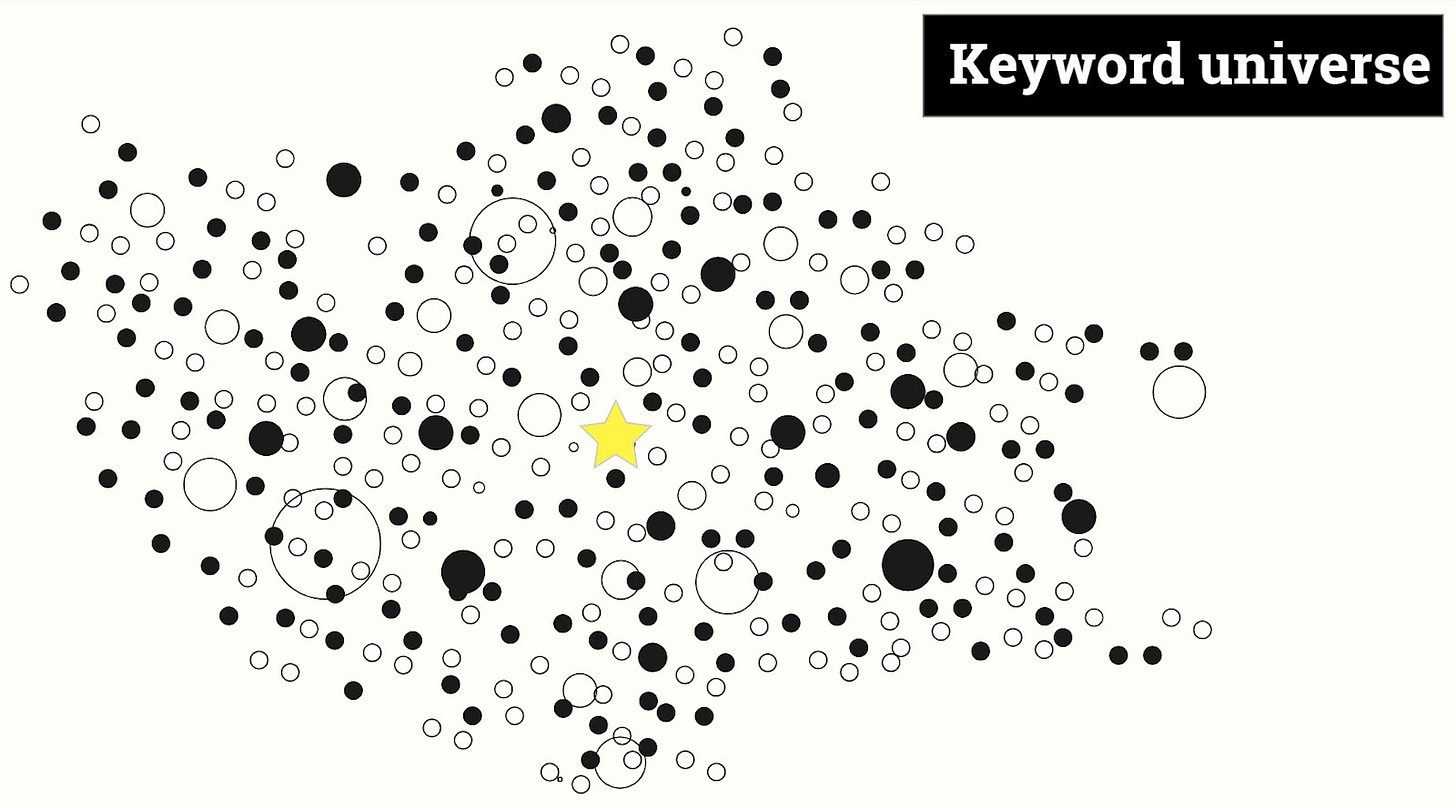
A keyword universe is a big pool of language your target audience uses when they search that will help them find you.

It surfaces the most important queries and phrases (i.e., keywords) at the top and lives in a spreadsheet or database, like BigQuery.

Instead of hyperfocusing on specific keywords or doing a keyword sprint every so often, you need to build a keyword universe that you’ll explore and conquer across your site over time.

One problem I tried to solve with the keyword universe is that keyword and intent research is often static.

It happens maybe every month or quarter, and it’s very manual. A keyword universe is both static and dynamic. While that might sound counterintuitive, here’s what I mean:

The keyword universe is like a pool that you can fill with water whenever you want. You can update it daily, monthly, quarter – whenever. It always surfaces the most important intents at the top.

For the majority of brands, some keyword-universe-building tasks only need to be done once (or once on product/service launch), while other tasks might be ongoing. More on this below.

Within your database, you’ll assign weighted scores to prioritize content creation, but that scoring system might shift over time based on changes in initiatives, product/feature launches, and discovering topics with high conversion rates.

Image Credit: Kevin Indig

To Infinity And Beyond

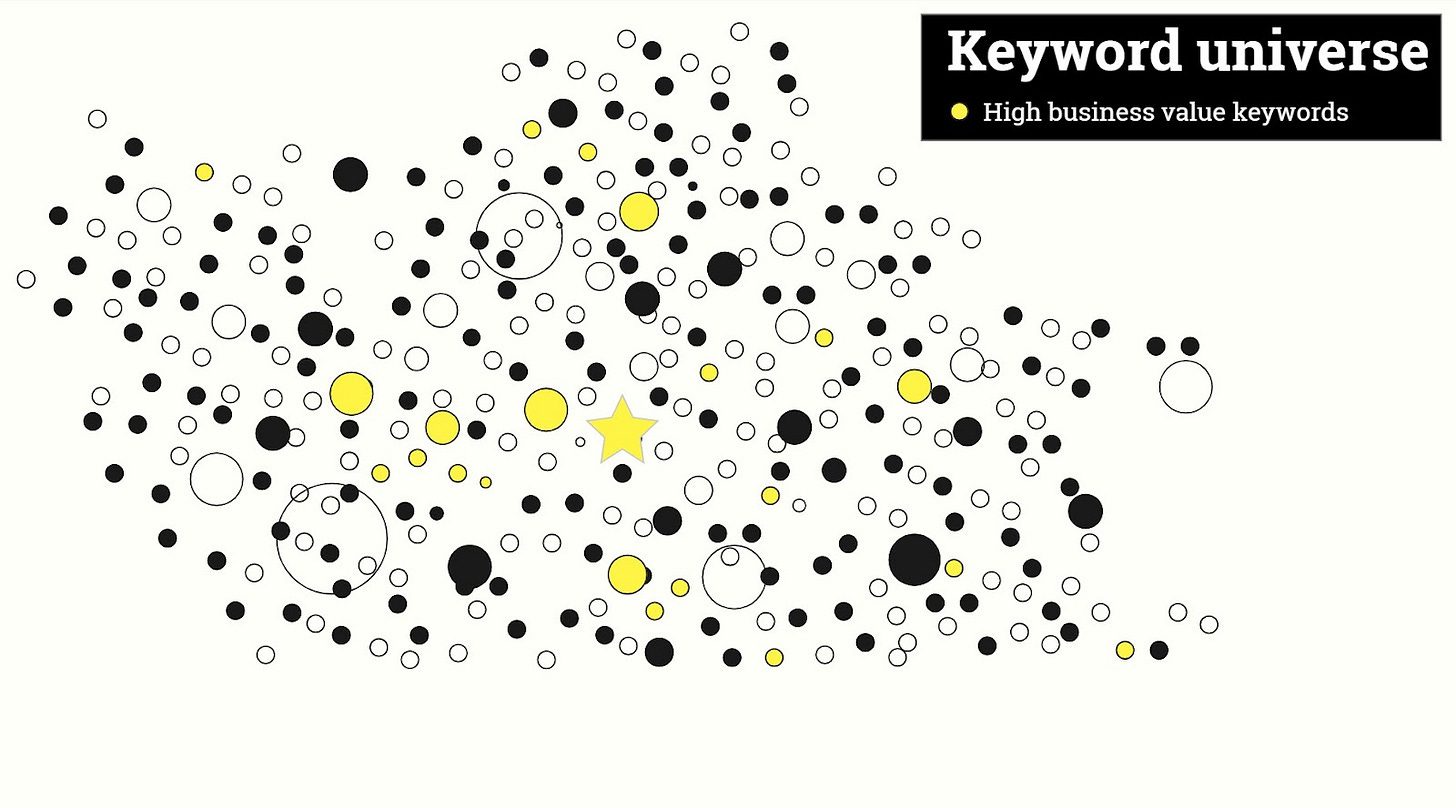
The goal in building your keyword universe is to create a keyword pipeline for content creation – one that you prioritize by business impact.

Keyword universes elevate the most impactful topics to the top of a list, which allows you to focus on planning capacity, like:

  • The number of published articles needed to comprehensively cover core topics.
  • Resources needed to cover essential topics in a competitive timeframe.
  • Roadmapping content formats and angles (e.g., long-form guides, comparison tables, videos, etc.).
Image Credit: Kevin Indig

A big problem in SEO is knowing which keywords convert to customers before targeting them.

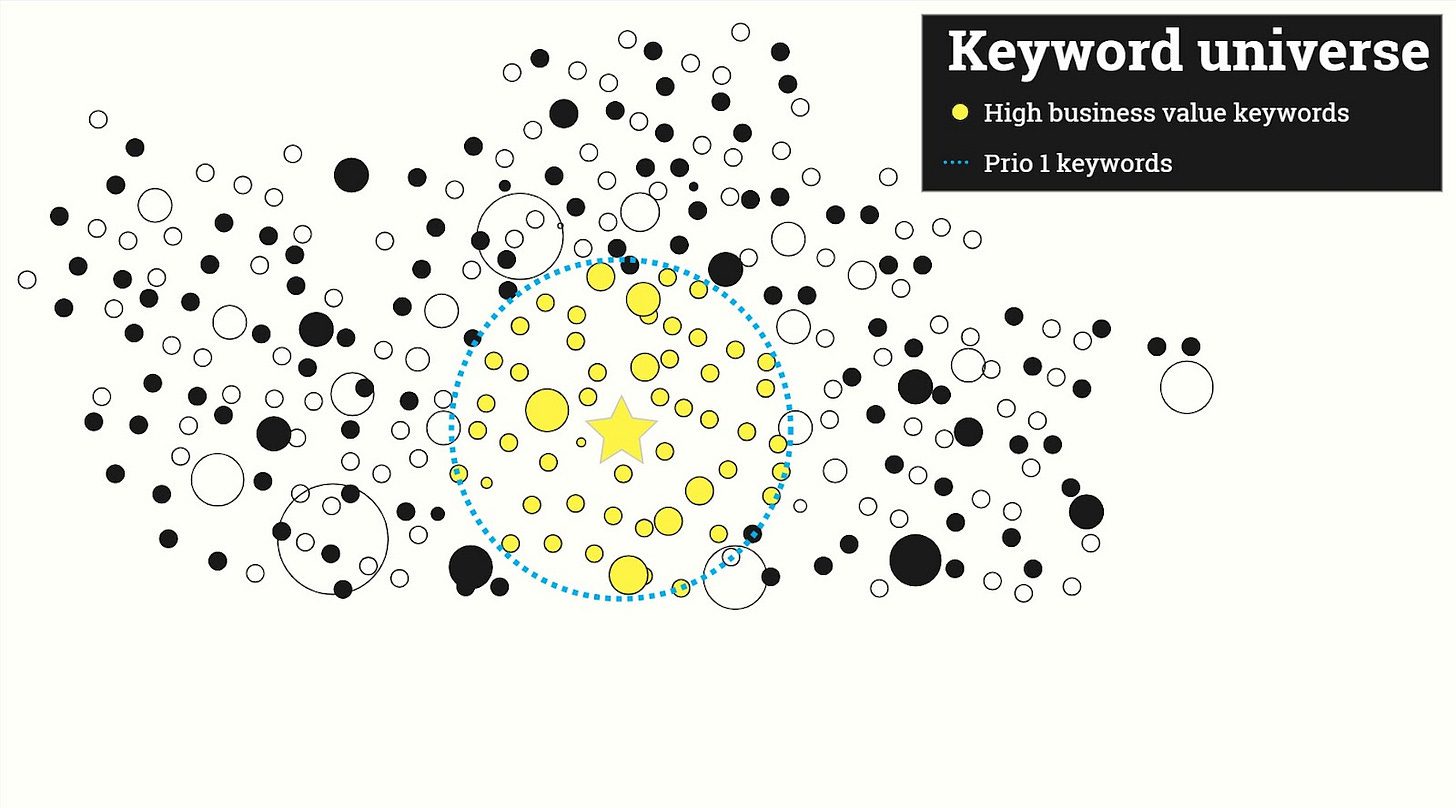
One big advantage of the keyword universe (compared to research sprints) is that new keywords automatically fall into a natural prioritization.

And with the advent of AI in search, like AI Overviews/Google’s AI Mode, this is more important than ever.

The keyword universe mitigates that problem through a clever sorting system.

SEO pros can continuously research and launch new keywords into the universe, while writers can pick keywords off the list at any time.

Think fluid collaboration.

Image Credit: Kevin Indig

Keyword universes are mostly relevant for companies that have to create content themselves instead of leaning on users or products. I call them integrators.

Typical integrator culprits are SaaS, DTC, or publishing businesses, which often have no predetermined, product-led SEO structure for keyword prioritization.

The opposite is aggregators, which scale organic traffic through user-generated content (UGC) or product inventory. (Examples include sites like TripAdvisor, Uber Eats, TikTok, and Yelp.)

The keyword path for aggregators is defined by their page types. And the target topics come out of the product.

Yelp, for example, knows that “near me keywords” and query patterns like “{business} in {city}” are important because that’s the main use case for their local listing pages.

Integrators don’t have that luxury. They need to use other signals to prioritize keywords for business impact.

Ready To Take On The Galaxy? Build Your Keyword Universe

Creating your keyword universe is a three-step process.

And I’ll bet it’s likely you have old spreadsheets of keywords littered throughout your shared drives, collecting dust.

Guess what? You can add them to this process and make good use of them, too. (Finally.)

Step 1: Mine For Queries

Keyword mining is the science of building a large list of keywords and a bread-and-butter workflow in SEO.

The classic way is to use a list of seed keywords and throw them into third-party rank trackers (like Semrush or Ahrefs) to get related terms and other suggestions.

That’s a good start, but that’s what your competitors are doing too.

You need to look for fresh ideas that are unique to your brand – data that no one else has…

…so start with customer conversations.

Dig into:

  • Sales calls.
  • Support requests.
  • Customer and/or target audience interviews.
  • Social media comments on branded accounts.
  • Product or business reviews.

And then extract key phrasing, questions, and terms your audience actually uses.

But don’t ignore other valuable sources of keyword ideas:

  • SERP features, like AIOs, PAAs, and Google Suggest.
  • Search Console: keywords Google tries to rank your site for.
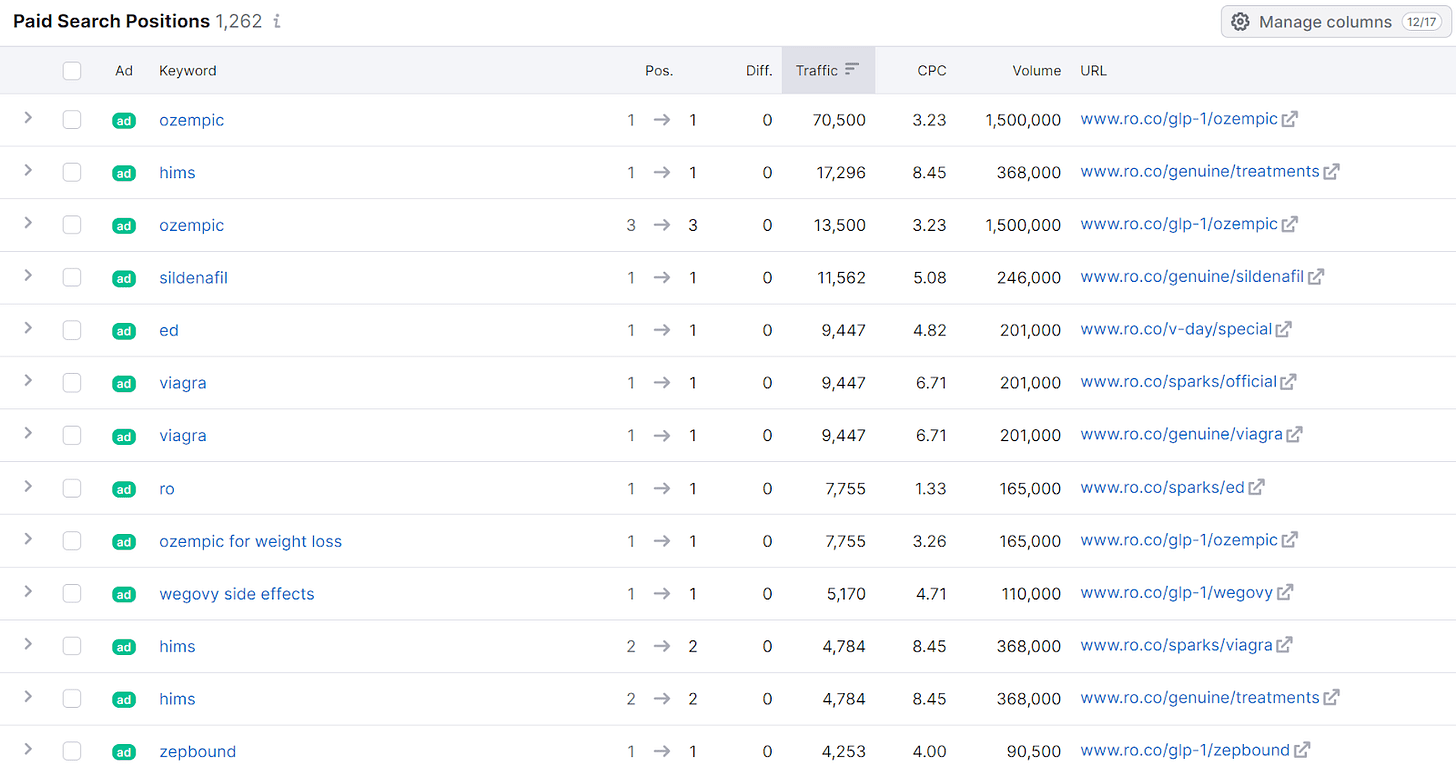
  • Competitor ranks and paid search keywords.
  • Conversational prompts your target audience is likely to use.
  • Reddit threads, YouTube comments, podcast scripts, etc.
Semrush’s list of paid keywords a site bids on (Image Credit: Kevin Indig)

The goal of the first step is to grow our universe with as many keywords as we can find.

(Don’t obsess over relevance. That’s Step 2.)

During this phase, there are some keyword universe research tasks that will be one-time-only, and some that will likely need refreshing or repeating over time.

Here’s a quick list to distinguish between repeat and one-time tasks:

  1. Audience-based research: Repeat and refresh over time – quarterly is often sufficient. Pay attention to what pops up seasonally.
  2. Product-focused research: Complete for the initial launch of a new product or feature.
  3. Competitor-focused research: Complete once for both business and SEO competitors. Refresh/update when there’s a new feature, product/service, or competitor.
  4. Location-focused research: Do this once per geographic location serviced and when you expand into new service locations

Step 2: Sort And Align

Step 2, sorting the long list of mined queries, is the linchpin of keyword universes.

If you get this right, you’ll be installing a powerful SEO prioritization system for your company.

Getting it wrong is just wasting time.

Anyone can create a large list of keywords, but creating strong filters and sorting mechanisms is hard.

The old school way to go about prioritization is by search volume.

Throw that classic view out the window: We can do better than that.

Most times, keywords with higher search volume actually convert less well – or get no real traffic at all due to AIOs.

As I mentioned in Death of the Keyword:

A couple of months ago, I rewrote my guide to inhouse SEO and started ranking in position one. But the joke was on me. I didn’t get a single dirty click for that keyword. Over 200 people search for “in house seo” but not a single person clicks on a search result.

By the way, Google Analytics only shows 10 clicks from organic search over the last 3 months. So, what’s going on? The 10 clicks I actually got are not reported in GSC (privacy… I guess?), but the majority of searchers likely click on one of the People Also Asked features that show up right below my search result.

Keeping that in mind about search volume, since we don’t know which keywords are most important for the business before targeting them – and we don’t want to make decisions by volume alone – we need sorting parameters based on strong signals.

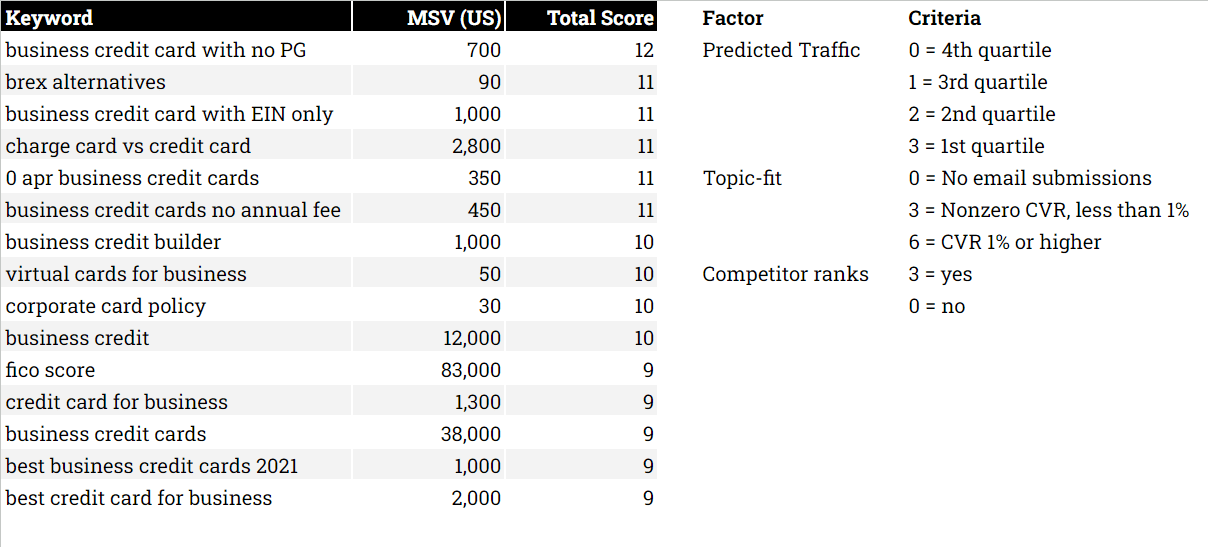
We can summarize several signals for each keyword and sort the list by total score.

That’s exactly what I’ve done with clients like Ramp, the fastest-growing fintech startup in history, to prioritize content strategy.

Image Credit: Kevin Indig

Sorting is about defining an initial set of signals and then refining it with feedback.

You’ll start by giving each signal a weight based on our best guess – and then refine it over time.

When you build your keyword universe, you’ll want to define an automated logic (say, in Google Sheets or BigQuery).

Your logic could be a simple “if this then that,” like “if keyword is mentioned by customer, assign 10 points.”

Potential signals (not all need to be used):

  • Keyword is mentioned in customer conversation.
  • Keyword is part of a topic that converts well.
  • Topic is sharply related to direct offering or pain point your brand solves.
  • Mmonthly search volume (MSV)
  • Keyword difficulty (KD)/competitiveness
  • (MSV * KD) / CPC → I like to use this simple formula to balance search demand with competitiveness and potential conversion value.
  • Traffic potential.
  • Conversions from paid search or other channels.
  • Growing or shrinking MSV.
  • Query modifier indicates users are ready to take action, like “buy” or “download.”

You should give each signal a weight from 0-10 or 0-3, with the highest number being strongest and zero being weakest.

Your scoring will be unique to you based on business goals.

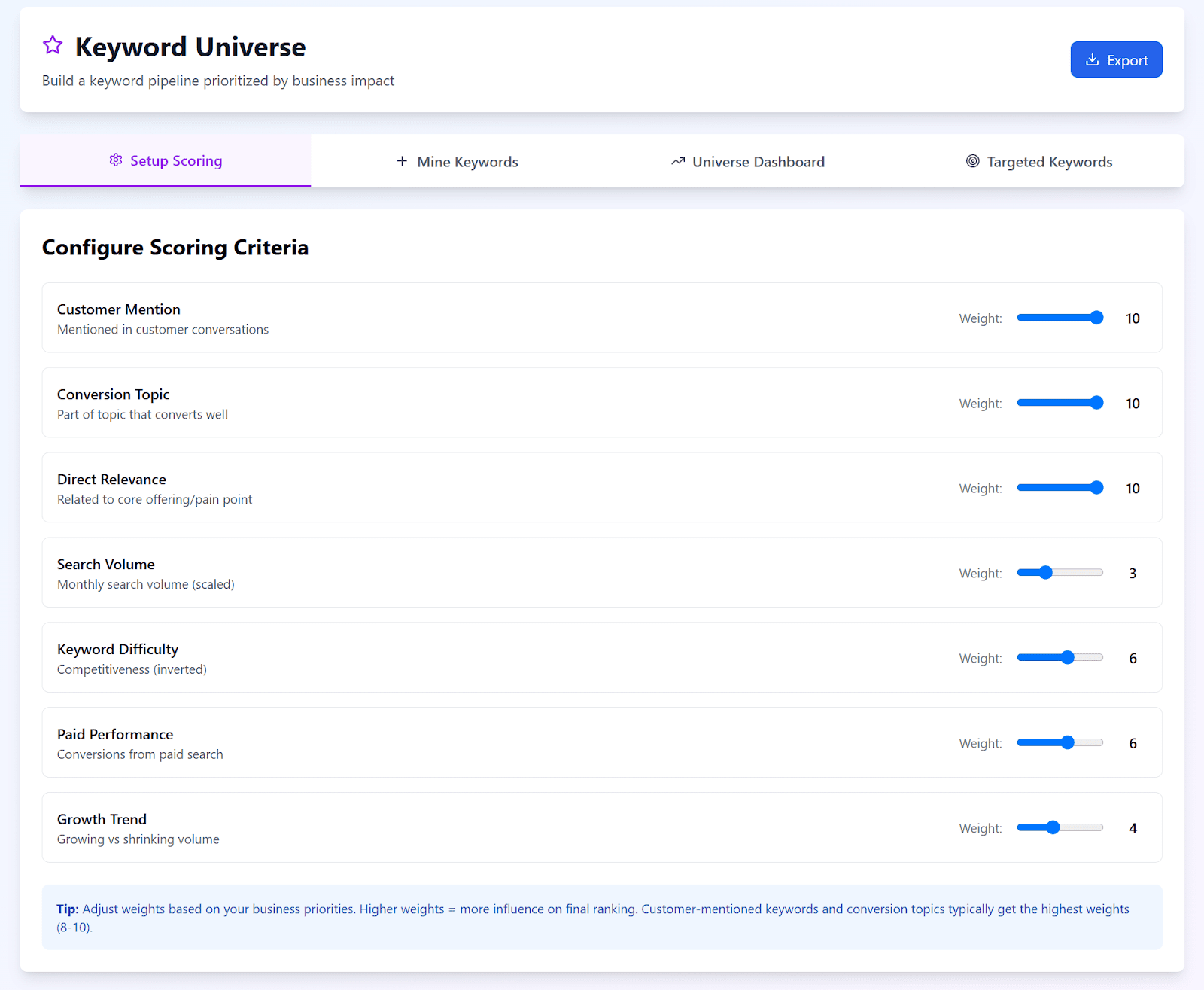
Let’s pause here for a moment: I created a simple tool that will make this work way easier, saving a lot of time and trial + error. (It’s below!) Premium subscribers get full access to tools like this one, along with additional content and deep dives.

But let’s say you’re prioritizing building content around essential topics and have goals set around growing topical authority. And let’s say you’re using the 0-10 scale. Your scoring might look something like:

  • Keyword is mentioned in customer conversation: 10.
  • Keyword is part of a topic that converts well: 10.
  • Topic is sharply related to direct offering or pain point your brand solves: 10.
  • MSV: 3.
  • KD/competitiveness: 6.
  • (MSV * KD) / CPC → I like to use this simple formula to balance search demand with competitiveness and potential conversion value: 5.
  • Traffic potential: 3.
  • Conversions from paid search or other channels: 6.
  • Growing or shrinking MSV: 4.
  • Query modifier indicates users are ready to take action, like “buy” or “download”: 7.

The sum of all scores for each query in your universe then determines the priority sorting of the list.

Keywords with the highest total score land at the top and vice versa.

New keywords on the list fall into a natural prioritization.

Important note: If your research shows that sales are connected to queries related to current events, news, updates in research reports, etc., those should be addressed as soon as possible.

(Example: If your company sells home solar batteries and recent weather news increases demand due to a specific weather event, make sure to prioritize that in your universe ASAP.)

Amanda’s thoughts: I might get some hate for this stance, but if you’re a new brand or site just beginning to build a content library and you fall into the integrator category, focus on building trust first by securing visibility in organic search results where you can as quickly as you can.

I know, I know: What about conversions? Conversion-focused content is crucial to the long-term success of the org.

But to set yourself apart, you need to actually create the content that no one is making about the questions, pain points, and specific needs your target audience is voicing.

If your sales team repeatedly hears a version of the same question, it’s likely there’s no easy-to-find answer to the question – or the current answers out there aren’t trustworthy. Trust is the most important currency in the era of AI-based search. Start building it ASAP. Conversions will follow.

Step 3: Refine

Models get good by improving over time.

Like a large language model that learns from fine-tuning, we need to adjust our signal weighting based on the results we see.

We can go about fine-tuning in two ways:

1. Anecdotally, conversions should increase as we build new content (or update existing content) based on the keyword universe prioritization scoring.

Otherwise, sorting signals have the wrong weight, and we need to adjust.

2. Another way to test the system is a snapshot analysis.

To do so, you’ll run a comparison of two sets of data: the keywords that attract the most organic visibility and the pages that drive the most conversions, side-by-side with the keywords at the top of the universe.

Ideally, they overlap. If they don’t, aim to adjust your sorting signals until they come close.

Tips For Maintaining Your Keyword Universe

Look, there’s no point in doing all this work unless you’re going to maintain the hygiene of this data over time.

This is what you need to keep in mind:

1. Once you’ve created a page that targets a keyword in your list, move it to a second tab on the spreadsheet or another table in the database.

That way, you don’t lose track and end up with writers creating duplicate content.

2. Build custom click curves for each page type (blog article, landing page, calculator, etc.) when including traffic and revenue projections.

Assign each step in the conversion funnel a conversion rate – like visit ➡️newsletter sign-up, visit ➡️demo, visit ➡️purchase – and multiply search volume with an estimated position on the custom click curve, conversion rates, and lifetime value. (Fine-tune regularly.)

Here’s an example: MSV * CTR (pos 1) * CVRs * Lifetime value = Revenue prediction

3. GPT for Sheets or the Meaning Cloud extension for Google Sheets can speed up assigning each keyword to a topic.

Meaning Cloud allows us to easily train an LLM by uploading a spreadsheet with a few tagged keywords.

GPT for Sheets connects Google Sheets with the OpenAI API so we can give prompts like “Which of the following topics would this keyword best fit? Category 1, category 2, category 3, etc.”

LLMs like Chat GPT, Claude, or Gemini have become good enough that you can easily use them to assign topics as well. Just prompt for consistency!

4. Categorize the keywords by intent, and then group or sort your sheet by intent. Check out Query Fan Out to learn why.

5. Don’t build too granular and expansive of a keyword universe that you can’t activate it.

If you have a team of in-house strategists and three part-time freelancers, expecting a 3,000 keyword universe to feel doable and attainable is … an unmet expectation.

Your Keyword Universe Is Designed To Explore

The old way of doing SEO – chasing high-volume keywords and hoping for conversions – isn’t built for today’s search reality.

Trust is hard to earn. (And traffic is hard to come by.)

The keyword universe gives you a living, breathing SEO operating system. One that can evolve based on your custom scoring and prioritization.

Prioritizing what’s important (sorting) allows us to literally filter through the noise (distractions, offers, shiny objects) and bring us to where we want to be.

So, start with your old keyword docs. (Or toss them out if they’re irrelevant, aged poorly, or simply hyper-focused on volume.)

Then, dig into what your customers are really asking. Build smart signals. Assign weights. And refine as you go.

This isn’t about perfection. It’s about building a system that actually works for you.

And speaking of building a system…

Keyword Universe Tracker (For Premium Subscribers)

For premium Growth Memo subscribers, we’ve got a tool that will help save you time and score queries by unique priority weights that you set.

Image Credit: Kevin Indig

More Resources: 


Featured Image: Paulo Bobita/Search Engine Journal

Google’s Trust Ranking Patent Shows How User Behavior Is A Signal via @sejournal, @martinibuster

Google long ago filed a patent for ranking search results by trust. The groundbreaking idea behind the patent is that user behavior can be used as a starting point for developing a ranking signal.

The big idea behind the patent is that the Internet is full of websites all linking to and commenting about each other. But which sites are trustworthy? Google’s solution is to utilize user behavior to indicate which sites are trusted and then use the linking and content on those sites to reveal more sites that are trustworthy for any given topic.

PageRank is basically the same thing only it begins and ends with one website linking to another website. The innovation of Google’s trust ranking patent is to put the user at the start of that trust chain like this:

User trusts X Websites > X Websites trust Other Sites > This feeds into Google as a ranking signal

The trust originates from the user and flows to trust sites that themselves provide anchor text, lists of other sites and commentary about other sites.

That, in a nutshell, is what Google’s trust-based ranking algorithm is about.

The deeper insight is that it reveals Google’s groundbreaking approach to letting users be a signal of what’s trustworthy. You know how Google keeps saying to create websites for users? This is what the trust patent is all about, putting the user in the front seat of the ranking algorithm.

Google’s Trust And Ranking Patent

The patent was coincidentally filed around the same period that Yahoo and Stanford University published a Trust Rank research paper which is focused on identifying spam pages.

Google’s patent is not about finding spam. It’s focused on doing the opposite, identifying trustworthy web pages that satisfy the user’s intent for a search query.

How Trust Factors Are Used

The first part of any patent consists of an Abstract section that offers a very general description of the invention that that’s what this patent does as well.

The patent abstract asserts:

  • That trust factors are used to rank web pages.
  • The trust factors are generated from “entities” (which are later described to be the users themselves, experts, expert web pages, and forum members) that link to or comment about other web pages).
  • Those trust factors are then used to re-rank web pages.
  • Re-ranking web pages kicks in after the normal ranking algorithm has done its thing with links, etc.

Here’s what the Abstract says:

“A search engine system provides search results that are ranked according to a measure of the trust associated with entities that have provided labels for the documents in the search results.

A search engine receives a query and selects documents relevant to the query.

The search engine also determines labels associated with selected documents, and the trust ranks of the entities that provided the labels.

The trust ranks are used to determine trust factors for the respective documents. The trust factors are used to adjust information retrieval scores of the documents. The search results are then ranked based on the adjusted information retrieval scores.”

As you can see, the Abstract does not say who the “entities” are nor does it say what the labels are yet, but it will.

Field Of The Invention

The next part is called the Field Of The Invention. The purpose is to describe the technical domain of the invention (which is information retrieval) and the focus (trust relationships between users) for the purpose of ranking web pages.

Here’s what it says:

“The present invention relates to search engines, and more specifically to search engines that use information indicative of trust relationship between users to rank search results.”

Now we move on to the next section, the Background, which describes the problem this invention solves.

Background Of The Invention

This section describes why search engines fall short of answering user queries (the problem) and why the invention solves the problem.

The main problems described are:

  • Search engines are essentially guessing (inference) what the user’s intent is when they only use the search query.
  • Users rely on expert-labeled content from trusted sites (called vertical knowledge sites) to tell them which web pages are trustworthy
  • Explains why the content labeled as relevant or trustworthy is important but ignored by search engines.
  • It’s important to remember that this patent came out before the BERT algorithm and other natural language approaches that are now used to better understand search queries.

This is how the patent explains it:

“An inherent problem in the design of search engines is that the relevance of search results to a particular user depends on factors that are highly dependent on the user’s intent in conducting the search—that is why they are conducting the search—as well as the user’s circumstances, the facts pertaining to the user’s information need.

Thus, given the same query by two different users, a given set of search results can be relevant to one user and irrelevant to another, entirely because of the different intent and information needs.”

Next it goes on to explain that users trust certain websites that provide information about certain topics:

“…In part because of the inability of contemporary search engines to consistently find information that satisfies the user’s information need, and not merely the user’s query terms, users frequently turn to websites that offer additional analysis or understanding of content available on the Internet.”

Websites Are The Entities

The rest of the Background section names forums, review sites, blogs, and news websites as places that users turn to for their information needs, calling them vertical knowledge sites. Vertical Knowledge sites, it’s explained later, can be any kind of website.

The patent explains that trust is why users turn to those sites:

“This degree of trust is valuable to users as a way of evaluating the often bewildering array of information that is available on the Internet.”

To recap, the “Background” section explains that the trust relationships between users and entities like forums, review sites, and blogs can be used to influence the ranking of search results. As we go deeper into the patent we’ll see that the entities are not limited to the above kinds of sites, they can be any kind of site.

Patent Summary Section

This part of the patent is interesting because it brings together all of the concepts into one place, but in a general high-level manner, and throws in some legal paragraphs that explain that the patent can apply to a wider scope than is set out in the patent.

The Summary section appears to have four sections:

  • The first section explains that a search engine ranks web pages that are trusted by entities (like forums, news sites, blogs, etc.) and that the system maintains information about these labels about trusted web pages.
  • The second section offers a general description of the work of the entities (like forums, news sites, blogs, etc.).
  • The third offers a general description of how the system works, beginning with the query, the assorted hand waving that goes on at the search engine with regard to the entity labels, and then the search results.
  • The fourth part is a legal explanation that the patent is not limited to the descriptions and that the invention applies to a wider scope. This is important. It enables Google to use a non-existent thing, even something as nutty as a “trust button” that a user selects to identify a site as being trustworthy as an example. This enables an example like a non-existent “trust button” to be a stand-in for something else, like navigational queries or Navboost or anything else that is a signal that a user trusts a website.

Here’s a nutshell explanation of how the system works:

  • The user visits sites that they trust and click a “trust button” that tells the search engine that this is a trusted site.
  • The trusted site “labels” other sites as trusted for certain topics (the label could be a topic like “symptoms”).
  • A user asks a question at a search engine (a query) and uses a label (like “symptoms”).
  • The search engine ranks websites according to the usual manner then it looks for sites that users trust and sees if any of those sites have used labels about other sites.
  • Google ranks those other sites that have had labels assigned to them by the trusted sites.

Here’s an abbreviated version of the third part of the Summary that gives an idea of the inner workings of the invention:

“A user provides a query to the system…The system retrieves a set of search results… The system determines which query labels are applicable to which of the search result documents. … determines for each document an overall trust factor to apply… adjusts the …retrieval score… and reranks the results.”

Here’s that same section in its entirety:

  • “A user provides a query to the system; the query contains at least one query term and optionally includes one or more labels of interest to the user.
  • The system retrieves a set of search results comprising documents that are relevant to the query term(s).
  • The system determines which query labels are applicable to which of the search result documents.
  • The system determines for each document an overall trust factor to apply to the document based on the trust ranks of those entities that provided the labels that match the query labels.
  • Applying the trust factor to the document adjusts the document’s information retrieval score, to provide a trust adjusted information retrieval score.
  • The system reranks the search result documents based at on the trust adjusted information retrieval scores.”

The above is a general description of the invention.

The next section, called Detailed Description, deep dives into the details. At this point it’s becoming increasingly evident that the patent is highly nuanced and can not be reduced to simple advice similar to: “optimize your site like this to earn trust.”

A large part of the patent hinges on a trust button and an advanced search query:  label:

Neither the trust button or the label advanced search query have ever existed. As you’ll see, they are quite probably stand-ins for techniques that Google doesn’t want to explicitly reveal.

Detailed Description In Four Parts

The details of this patent are located in four sections within the Detailed Description section of the patent. This patent is not as simple as 99% of SEOs say it is.

These are the four sections:

  1. System Overview
  2. Obtaining and Storing Trust Information
  3. Obtaining and Storing Label Information
  4. Generated Trust Ranked Search Results

The System Overview is where the patent deep dives into the specifics. The following is an overview to make it easy to understand.

System Overview

1. Explains how the invention (a search engine system) ranks search results based on trust relationships between users and the user-trusted entities who label web content.

2. The patent describes a “trust button” that a user can click that tells Google that a user trusts a website or trusts the website for a specific topic or topics.

3. The patent says a trust related score is assigned to a website when a user clicks a trust button on a website.

4. The trust button information is stored in a trust database that’s referred to as #190.

Here’s what it says about assigning a trust rank score based on the trust button:

“The trust information provided by the users with respect to others is used to determine a trust rank for each user, which is measure of the overall degree of trust that users have in the particular entity.”

Trust Rank Button

The patent refers to the “trust rank” of the user-trusted websites. That trust rank is based on a trust button that a user clicks to indicate that they trust a given website, assigning a trust rank score.

The patent says:

“…the user can click on a “trust button” on a web page belonging to the entity, which causes a corresponding record for a trust relationship to be recorded in the trust database 190.

In general any type of input from the user indicating that such as trust relationship exists can be used.”

The trust button has never existed and the patent quietly acknowledges this by stating that any type of input can be used to indicate the trust relationship.

So what is it? I believe that the “trust button” is a stand-in for user behavior metrics in general, and site visitor data in particular. The patent Claims section does not mention trust buttons at all but does mention user visitor data as an indicator of trust.

Here are several passages that mention site visits as a way to understand if a user trusts a website:

“The system can also examine web visitation patterns of the user and can infer from the web visitation patterns which entities the user trusts. For example, the system can infer that a particular user trust a particular entity when the user visits the entity’s web page with a certain frequency.”

The same thing is stated in the Claims section of the patent, it’s the very first claim they make for the invention:

“A method performed by data processing apparatus, the method comprising:
determining, based on web visitation patterns of a user, one or more trust relationships indicating that the user trusts one or more entities;”

It may very well be that site visitation patterns and other user behaviors are what is meant by the “trust button” references.

Labels Generated By Trusted Sites

The patent defines trusted entities as news sites, blogs, forums, and review sites, but not limited to those kinds of sites, it could be any other kind of website.

Trusted websites create references to other sites and in that reference they label those other sites as being relevant to a particular topic. That label could be an anchor text. But it could be something else.

The patent explicitly mentions anchor text only once:

“In some cases, an entity may simply create a link from its site to a particular item of web content (e.g., a document) and provide a label 107 as the anchor text of the link.”

Although it only explicitly mentions anchor text once, there are other passages where it anchor text is strongly implied, for example, the patent offers a general description of labels as describing or categorizing the content found on another site:

“…labels are words, phrases, markers or other indicia that have been associated with certain web content (pages, sites, documents, media, etc.) by others as descriptive or categorical identifiers.”

Labels And Annotations

Trusted sites link out to web pages with labels and links. The combination of a label and a link is called an annotation.

This is how it’s described:

“An annotation 106 includes a label 107 and a URL pattern associated with the label; the URL pattern can be specific to an individual web page or to any portion of a web site or pages therein.”

Labels Used In Search Queries

Users can also search with “labels” in their queries by using a non-existent “label:” advanced search query. Those kinds of queries are then used to match the labels that a website page is associated with.

This is how it’s explained:

“For example, a query “cancer label:symptoms” includes the query term “cancel” and a query label “symptoms”, and thus is a request for documents relevant to cancer, and that have been labeled as relating to “symptoms.”

Labels such as these can be associated with documents from any entity, whether the entity created the document, or is a third party. The entity that has labeled a document has some degree of trust, as further described below.”

What is that label in the search query? It could simply be certain descriptive keywords, but there aren’t any clues to speculate further than that.

The patent puts it all together like this:

“Using the annotation information and trust information from the trust database 190, the search engine 180 determines a trust factor for each document.”

Takeaway:

A user’s trust is in a website. That user-trusted website is not necessarily the one that’s ranked, it’s the website that’s linking/trusting another relevant web page. The web page that is ranked can be the one that the trusted site has labeled as relevant for a specific topic and it could be a web page in the trusted site itself. The purpose of the user signals is to provide a starting point, so to speak, from which to identify trustworthy sites.

Experts Are Trusted

Vertical Knowledge Sites, sites that users trust, can host the commentary of experts. The expert could be the publisher of the trusted site as well. Experts are important because links from expert sites are used as part of the ranking process.

Experts are defined as publishing a deep level of content on the topic:

“These and other vertical knowledge sites may also host the analysis and comments of experts or others with knowledge, expertise, or a point of view in particular fields, who again can comment on content found on the Internet.

For example, a website operated by a digital camera expert and devoted to digital cameras typically includes product reviews, guidance on how to purchase a digital camera, as well as links to camera manufacturer’s sites, new products announcements, technical articles, additional reviews, or other sources of content.

To assist the user, the expert may include comments on the linked content, such as labeling a particular technical article as “expert level,” or a particular review as “negative professional review,” or a new product announcement as ;new 10MP digital SLR’.”

Links From Expert Sites

Links and annotations from user-trusted expert sites are described as sources of trust information:

“For example, Expert may create an annotation 106 including the label 107 “Professional review” for a review 114 of Canon digital SLR camera on a web site “www.digitalcameraworld.com”, a label 107 of “Jazz music” for a CD 115 on the site “www.jazzworld.com”, a label 107 of “Classic Drama” for the movie 116 “North by Northwest” listed on website “www.movierental.com”, and a label 107 of “Symptoms” for a group of pages describing the symptoms of colon cancer on a website 117 “www.yourhealth.com”.

Note that labels 107 can also include numerical values (not shown), indicating a rating or degree of significance that the entity attaches to the labeled document.

Expert’s web site 105 can also include trust information. More specifically, Expert’s web site 105 can include a trust list 109 of entities whom Expert trusts. This list may be in the form of a list of entity names, the URLs of such entities’ web pages, or by other identifying information. Expert’s web site 105 may also include a vanity list 111 listing entities who trust Expert; again this may be in the form of a list of entity names, URLs, or other identifying information.”

Inferred Trust

The patent describes additional signals that can be used to signal (infer) trust. These are more traditional type signals like links, a list of trusted web pages (maybe a resources page?) and a list of sites that trust the website.

These are the inferred trust signals:

“(1) links from the user’s web page to web pages belonging to trusted entities;
(2) a trust list that identifies entities that the user trusts; or
(3) a vanity list which identifies users who trust the owner of the vanity page.”

Another kind of trust signal that can be inferred is from identifying sites that a user tends to visit.

The patent explains:

“The system can also examine web visitation patterns of the user and can infer from the web visitation patterns which entities the user trusts. For example, the system can infer that a particular user trusts a particular entity when the user visits the entity’s web page with a certain frequency.”

Takeaway:

That’s a pretty big signal and I believe that it suggests that promotional activities that encourage potential site visitors to discover a site and then become loyal site visitors can be helpful. For example, that kind of signal can be tracked with branded search queries. It could be that Google is only looking at site visit information but I think that branded queries are an equally trustworthy signal, especially when those queries are accompanied by labels… ding, ding, ding!

The patent also lists some kind of out there examples of inferred trust like contact/chat list data. It doesn’t say social media, just contact/chat lists.

Trust Can Decay or Increase

Another interesting feature of trust rank is that it can decay or increase over time.

The patent is straightforward about this part:

“Note that trust relationships can change. For example, the system can increase (or decrease) the strength of a trust relationship for a trusted entity. The search engine system 100 can also cause the strength of a trust relationship to decay over time if the trust relationship is not affirmed by the user, for example by visiting the entity’s web site and activating the trust button 112.”

Trust Relationship Editor User Interface

Directly after the above paragraph is a section about enabling users to edit their trust relationships through a user interface. There has never been such a thing, just like the non-existent trust button.

This is possibly a stand-in for something else. Could this trusted sites dashboard be Chrome browser bookmarks or sites that are followed in Discover? This is a matter for speculation.

Here’s what the patent says:

“The search engine system 100 may also expose a user interface to the trust database 190 by which the user can edit the user trust relationships, including adding or removing trust relationships with selected entities.

The trust information in the trust database 190 is also periodically updated by crawling of web sites, including sites of entities with trust information (e.g., trust lists, vanity lists); trust ranks are recomputed based on the updated trust information.”

What Google’s Trust Patent Is About

Google’s Search Result Ranking Based On Trust patent describes a way of leveraging user-behavior signals to understand which sites are trustworthy. The system then identifies sites that are trusted by the user-trusted sites and uses that information as a ranking signal. There is no actual trust rank metric, but there are ranking signals related to what users trust. Those signals can decay or increase based on factors like whether a user still visits those sites.

The larger takeaway is that this patent is an example of how Google is focused on user signals as a ranking source, so that they can feed that back into ranking sites that meet their needs. This means that instead of doing things because “this is what Google likes,” it’s better to go even deeper and do things because users like it. That will feed back to Google through these kinds of algorithms that measure user behavior patterns, something we all know Google uses.

Featured Image by Shutterstock/samsulalam