Yoast SEO Plugin Bug Injects Hidden AI HTML Classes via @sejournal, @martinibuster

Yoast SEO rushed out an update to fix a bug that introduced a known fingerprint of AI-generated content. The bug was highlighted on social media, and Yoast corrected the error within hours.

HTML Classes Injected By AI

It’s recently become known that highlighting then copying content generated ChatGPT and then pasting it directly into the WordPress will cause HTML classes to be added to the content code. An HTML “class” is something that’s added to an HTML element like a paragraph element

, which can then be used to attach a style to it, like specifying a font. This bug only happens when a ChatGPT user highlights generated text, copies it, then pastes it into the WordPress editor. It won’t happen if the user clicks the ChatGPT “copy” icon to copy the generated content.

The HTML classes injected into content are “data-start” and “data-end” which are only visible within the code, not on the published content.

This is what the AI-generated content looks like in the HTML code:

“He thought no one would notice—
the quiet hum of the AI
churning out words
like it knew something.
Google noticed.
Now he shelves canned beans at Safeway.”

This is what the content would look like in the visible version:

“He thought no one would notice—
the quiet hum of the AI
churning out words
like it knew something.
Google noticed.
Now he shelves canned beans at Safeway.”

The “data-start” and “data-end” classes are the telltale clues that the content was generated by AI. Savvy SEOs are using that knowledge as part of their SEO audits to indentify AI-generated content that was directly copied and pasted into their WordPress editor.

Yoast SEO Premium Injects AI Classes

Alan Bleiweiss, known for content audits, called attention to the fact that Yoast SEO was injecting the “data-start” and “data-end” HTML classes into content. Alan called them “wrappers” but they’re technically HTML classes.

He posted:

“UPDATE

Yoast Plug-in pushed live without proper QA. Injecting AI wrappers without site owner permission.

Fortunately, according to Carolyn Shelby they’re working on a fix.

But tool providers need to do better.”

Alan indicated that no clarification was given as to how those classes were injected but the bug was limited to Yoast SEO Premium because the free version does not contain the necessary AI text generation feature (Yoast AI Optimize).

Yoast Pushes Update To Fix Bug

Yoast swiftly pushed an update, version 25.3.1, to fix the issue so that AI-generated content created by Yoast SEO Premium does not contain the classes. Happily, the updated plugin also removes the telltale HTML classes.

According to the Yoast SEO blog post announcement:

“Recently, we announced the rollout of Yoast AI Optimize for the Classic Editor in WordPress. …During the initial rollout, we discovered a technical issue where unintended classes were being added to content for some users. While these added classes are harmless and do not impact the functionality or appearance of your content, they should not have been added, that’s on us.

We take this seriously, and to maintain the quality you expect, we’ve been actively working on a solution. We’re pleased to share that a fix has now been released, and the issue has been resolved. For users already affected, we are automatically cleaning up the unintended classes as part of the fix, no action is needed on your part.”

The functionality was rolled out on June 2nd, which means that sites with affected content have been out there for at most two weeks.

The free version of the plugin has also been updated. The changelog offers this explanation:

“This is a maintenance release which is required to align with changes to Yoast SEO Premium 25.3.1.”

Can This Have Impacted Rankings?

It’s probably unlikely that this has affected rankings but at this point it’s unknown if Google would have noticed.  Google would have to specifically look for those classes which in themselves do not indicate anything about content quality. So again, it’s probably unlikely that this bug had an effect on search rankings.

Nevertheless users of the premium version of the Yoast SEO Plugin should update immediately to version 25.3.1 to fix any potential issues from this bug and users of the free version should update their versions as well, even though it’s not affected.

Featured Image by Shutterstock/Jihan Nafiaa Zahri

Agentic AI In SEO: AI Agents & Workflows For Audit (Part 2) via @sejournal, @VincentTerrasi

Building on our previous exploration of Agentic SEO’s ideation capabilities, this article takes a closer look at the second pillar: Audit.

As promised, we’ll look at how AI agents can transform the SEO audit process by providing corrections and thorough analysis that would otherwise take hundreds of hours of manual work.

Traditional SEO audits are often time-consuming, involving multiple tools and manual reviews.

With Agentic SEO, however, this process can be streamlined through autonomous AI agents that identify problems and recommend and implement solutions in real time.

AI Agents For Advanced Site Analysis

Full Website Analysis With Real-Time Corrections

Agentic SEO transforms the review process by:

  1. Comprehensive crawling: AI agents can systematically analyze entire websites, including hidden pages and dynamic content that traditional crawlers might overlook.
  2. Intelligent pattern recognition: Unlike rule-based tools, AI agents can detect patterns and anomalies that may indicate deeper structural issues across your site.
  3. Real-time remediation: As well as identifying problems, the agents can generate code fixes, content improvements, and structural adjustments that can be implemented immediately.
Image from author, May 2025

Example: Firecrawl Demo

With advanced AI crawling, Firecrawl can meticulously analyze HTML structures, extract microformats, and provide detailed performance metrics, revealing critical areas that need optimization and might otherwise be missed.

Image from author, May 2025

Example: Similar to tools like Cursor integrated with GitHub, Agentic SEO enables immediate application of code fixes.

When an issue is identified, the agent directly suggests optimized code changes, allowing seamless implementation through direct integration with your repository, ensuring rapid and error-free remediation.

I’m confident that OpenAI’s Codex and Google’s Jules will be equally effective for these tasks.

Image from author, May 2025

Workflow Architecture For Effective Auditing

Similar to our idea workflows, audit workflows consist of specialized components.

Image from author, May 2025

The audit workflow typically includes:

  • Data collection agents: These collect information from your site, competitor sites, and search engine results.
  • Analysis agents: These specialize in identifying technical issues, content gaps, and optimization opportunities.
  • Recommendation agents: They prioritize issues and suggest specific solutions based on potential impact.
  • Implementation agents: Generate corrected code, optimized content, or step-by-step implementation guides directly.

Practical Use Cases

Technical SEO Auditing

AI agents excel at identifying technical issues that are often overlooked:

Image from author, May 2025

The agent doesn’t just flag the problem. It provides contextual recommendations and implementation guidance.

Content Gap Analysis

Beyond traditional auditing, AI agents can identify content gaps by:

  1. Analyzing competitive content structures.
  2. Identifying SERP features you’re missing.
  3. Discovering semantic relationships between existing content.
  4. Suggesting opportunities for content consolidation or expansion.
Image from author, May 2025

Internal Linking Optimization

One of the most powerful applications is internal linking analysis:

Image from author, May 2025

How To Build Your Audit Agent

Creating an effective audit agent requires:

  1. A specialized knowledge base: Provide the agent with SEO best practices, Google guidelines, and industry-specific benchmarks.
  2. Tool integration: Connect the agent to existing tools such as Screaming Frog, Moz, and Semrush, or custom APIs for comprehensive data collection.
  3. Human-in-the-loop checkpoints: Despite automation, human expertise is still needed to validate critical recommendations.

Case Study: Ecommerce Site Optimization

In less than 30 minutes, our Agentic SEO Audit System identified 347 critical technical issues for a mid-sized ecommerce site with 15,000 product pages.

  • It generated optimized title tags and meta descriptions for underperforming pages.
  • It discovered and mapped content gaps in product categories.
  • It created a comprehensive action plan based on revenue impact.

Implementing these recommendations resulted in a 32% increase in organic traffic within 60 days.

Current Challenges And Limitations

Although powerful, Agentic SEO auditing does have its challenges.

  1. Tool integration complexity: Connecting Agentic to all the necessary data sources requires technical expertise. For instance, setting up MCP (or Model Context Protocol) servers can be a challenging task.
  2. Evolving standards: Agents require regular updates to keep pace with changes in search engine algorithms.

Tools to Build Your Own SEO Audit Agent

Here are some practical tools to help you get started:

  • Open-Source Workflow Automation – n8n is a powerful, open-source automation tool that allows you to create complex workflows without coding. It’s ideal for orchestrating SEO tasks like crawling, data extraction, and reporting.
  • Python Framework for Multi-Agent Systems – CrewAI enables the development of multi-agent systems in Python, allowing specialized agents to collaborate on tasks such as data collection, analysis, and implementation.
  • Agentic AI Platform – DNG.ai (Draft & Goal) is a no-code platform designed to automate complex SEO workflows using specialized AI agents. It offers features like:
    • Agentic Workflows: Automate tasks such as keyword optimization, content creation, and data analysis.
    • Multi-Agent Collaboration: Coordinate multiple agents to handle large-scale projects efficiently.
    • Integration with Over 20 Marketing Tools: Seamlessly connect with tools like Google Search Console, Google Ads, Google Analytics, and more.

Resources to Learn and Get Started

To improve your understanding and skills in building SEO audit agents, you can also explore these resources:

Summary: Agentic SEO Is A Fundamental Shift

Agentic SEO’s audit capabilities represent a fundamental shift in how we approach technical optimization.

By combining AI’s pattern recognition abilities with the strategic insight of human experts, we can create audit systems that are more comprehensive and actionable than traditional approaches.

In our next article, we’ll explore the final pillar of Agentic SEO: Generation. We will examine how AI agents can generate missing content, optimize existing assets, and scale content production while maintaining quality and relevance through the “SEO Expert in the Loop” approach.

Stay tuned, and experiment with these techniques to transform your SEO workflow!

More Resources:


Featured Image: Deemerwha studio/Shutterstock

AIO Hurting Traffic? How To Identify True Loss With GA4, GSC & Rank Tracking [Webinar] via @sejournal, @lorenbaker

Wondering if AI Overviews (AIOs) are stealing your clicks?

Are these AI answer engines eating into our traffic, or just changing the shape of it?

Google’s AI Overviews now appear on up to 40% of search queries, but what impact are they really having?

Stop Guessing. How To Measure AIO’s Real Impact

Get the on-demand webinar, where we explore the three main tools that can help you:

In this tactical on-demand session, Tom Capper, Sr. Search Scientist at STAT, will walk you through a practical framework for assessing AIO impact using three tools you already rely on.

You’ll learn to pinpoint if, where, and how AIOs affect your traffic so that you can respond with clarity, not guesswork.

Start Measuring the Real Impact of AIOs on SERPs Today

Don’t rely on assumptions.

Grab this free on-demand webinar now to accompany the slides below; uncover if AIOs are actually hurting your traffic, and what to do about it.

Join Us For Our Next Webinar!

Lead Local SEO: How To AI-Proof Your Rankings With Reviews

Join Mél Attia, Sr. Marketing Manager at GatherUp, as she shows how consumer trust and AI updates are reshaping Local SEO, and how agencies can lead the way.

Yoast SEO WordPress Plugin Adds Support For LLMs.Txt via @sejournal, @martinibuster

Yoast announced the addition of llms.txt capability to both the premium and free versions of their SEO plugin. Users can now add llms.txt files to their sites to future-proof them for AI search engines.

LLMS.Txt

llms.txt is a proposal for a new standard that will enable large language models (LLMs) to access a publisher’s content in a way that is easy for LLMs. The main content is presented to LLMs without advertising and other page elements that target humans.

The proposed standard uses markdown in pages with the .md file name, duplicates of existing pages that only contain the main content. Google’s John Mueller has alluded to the inherently untrustworthiness of the proposed standard because there’s nothing to stop unscrupulous SEOs from adding whatever they want to the LLMs.txt web pages.

It simply makes more sense to just grab the content from the normal web pages. Additionally, LLMs aren’t currently looking for those pages and it’s quite likely that they will continue to use the normal web pages.

Yoast’s announcement states:

  • “Helps AI tools understand your site better: Guides large language models like ChatGPT and Gemini to your most relevant content.
  • Highlights your key content automatically: No need to decide what to include. Yoast SEO detects your most important and recently updated pages.
  • No technical setup required: The file is generated and refreshed weekly, no coding or manual work needed.
  • Future-proof your website for AI search: Make sure your site is ready for how people find information today, and tomorrow.
  • Built into Yoast SEO, free for everyone: Available in one click, no upgrade needed.”

Read the Yoast SEO announcement here:

Future proof your site for LLMs llms.txt

Featured Image by Shutterstock/Cagkan Sayin

See What AI Sees: AI Mode Killed the Old SEO Playbook — Here’s the New One via @sejournal, @mktbrew

This post was sponsored by MarketBrew. The opinions expressed in this article are the sponsor’s own.

Is Google using AI to censor thousands of independent websites?

Wondering why your traffic has suddenly dropped, even though you’re doing SEO properly?

Between letters to the FTC describing a systematic dismantling of the open web by Google to SEO professionals who may be unaware that their strategies no longer make an impact, these changes represent a definite re-architecting of the web’s entire incentive structure.

It’s time to adapt.

While some were warning about AI passage retrieval and vector scoring, the industry largely stuck to legacy thinking. SEOs continued to focus on E-E-A-T, backlinks, and content refresh cycles, assuming that if they simply improved quality, recovery would come.

But the rules had changed.

Google’s Silent Pivot: From Keywords to Embedding Vectors

In late 2023 and early 2024, Google began rolling out what it now refers to as AI Mode.

What Is Google’s AI Mode?

AI Mode breaks content into passages, embeds those passages into a multi-dimensional vector space, and compares them directly to queries using cosine similarity.

In this new model, relevance is determined geometrically rather than lexically. Instead of ranking entire pages, Google evaluates individual passages. The most relevant passages are then surfaced in a ChatGPT-like interface, often without any need for users to click through to the source.

Beneath this visible change is a deeper shift: content scoring has become embedding-first.

What Are Embedding Vectors?

Embedding vectors are mathematical representations of meaning. When Google processes a passage of content, it converts that passage into a vector, a list of numbers that captures the semantic context of the text. These vectors exist in a multi-dimensional space where the distance between vectors reflects how similar the meanings are.

Instead of relying on exact keywords or matching phrases, Google compares the embedding vector of a search query to the embedding vectors of individual passages. This allows it to identify relevance based on deeper context, implied meaning, and overall intent.

Traditional SEO practices like keyword targeting and topical coverage do not carry the same weight in this system. A passage does not need to use specific words to be considered relevant. What matters is whether its vector lands close to the query vector in this semantic space.

How Are Embedding Vectors Different From Keywords?

Keywords focus on exact matches. Embedding vectors focus on meaning.

Traditional SEO relied on placing target terms throughout a page. But Google’s AI Mode now compares the semantic meaning of a query and a passage using embedding vectors. A passage can rank well even if it doesn’t use the same words, as long as its meaning aligns closely with the query.

This shift has made many SEO strategies outdated. Pages may be well-written and keyword-rich, yet still underperform if their embedded meaning doesn’t match search intent.

What SEO Got Wrong & What Comes Next

The story isn’t just about Google changing the game, it’s also about how the SEO industry failed to notice the rules had already shifted.

Don’t: Misread the Signals

As rankings dropped, many teams assumed they’d been hit by a quality update or core algorithm tweak. They doubled down on familiar tactics: improving E-E-A-T signals, updating titles, and refreshing content. They pruned thin pages, boosted internal links, and ran audits.

But these efforts were based on outdated models. They treated the symptom, visibility loss, not the cause: semantic drift.

Semantic drift happens when your content’s vector no longer aligns with the evolving vector of search intent. It’s invisible to traditional SEO tools because it occurs in latent space, not your HTML.

No amount of backlinks or content tweaks can fix that.

This wasn’t just platform abuse. It was also a strategic oversight.

SEO teams:

Many believed that doing what Google said, improving helpfulness, pruning content, and writing for humans, would be enough.

That promise collapsed under AI scrutiny.

But we’re not powerless.

Don’t: Fall Into The Trap of Compliance

Google told the industry to “focus on helpful content,” and SEOs listened, through a lexical lens. They optimized for tone, readability, and FAQs.

But “helpfulness” was being determined mathematically by whether your vectors aligned with the AI’s interpretation of the query.

Thousands of reworked sites still dropped in visibility. Why? Because while polishing copy, they never asked: Does this content geometrically align with search intent?

Do: Optimize For Data, Not Keywords

The new SEO playbook begins with a simple truth: you are optimizing for math, not words.

The New SEO Playbook: How To Optimize For AI-Powered SERPs

Here’s what we now know:

  1. AI Mode is real and measurable.
    You can calculate embedding similarity.
    You can test passages against queries.
    You can visualize how Google ranks.
  2. Content must align semantically, not just topically.
    Two pages about “best hiking trails” may be lexically similar, but if one focuses on family hikes and the other on extreme terrain, their vectors diverge.
  3. Authority still matters, but only after similarity.
    The AI Mode fan-out selects relevant passages first. Authority reranking comes later.
    If you don’t pass the similarity threshold, your authority won’t matter.
  4. Passage-level optimization is the new frontier.
    Optimizing entire pages isn’t enough. Each chunk of content must pull semantic weight.

How Do I Track Google AI Mode Data To Improve SERP Visibility?

It depends on your goals; for success in SERPs, you need to focus on tools that not only show you visibility data, but also how to get there.

Profound was one of the first tools to measure whether content appeared inside large language models, essentially offering a visibility check for LLM inclusion. It gave SEOs early signals that AI systems were beginning to treat search results differently, sometimes surfacing pages that never ranked traditionally. Profound made it clear: LLMs were not relying on the same scoring systems that SEOs had spent decades trying to influence.

But Profound stopped short of offering explanations. It told you if your content was chosen, but not why. It didn’t simulate the algorithmic behavior of AI Mode or reveal what changes would lead to better inclusion.

That’s where simulation-based platforms came in.

Market Brew approached the challenge differently. Instead of auditing what was visible inside an AI system, they reconstructed the inner logic of those systems, building search engine models that mirrored Google’s evolution toward embeddings and vector-based scoring. These platforms didn’t just observe the effects of AI Mode, they recreated its mechanisms.

As early as 2023, Market Brew had already implemented:

  • Passage segmentation that divides page content into consistent ~700-character blocks.
  • Embedding generation using Sentence-BERT to capture the semantic fingerprint of each passage.
  • Cosine similarity calculations to simulate how queries match specific blocks of content, not just the page as a whole.
  • Thematic clustering algorithms, like Top Cluster Similarity, to determine which groupings of passages best aligned with a search intent.

🔍 Market Brew Tutorial: Mastering the Top Cluster Similarity Ranking Factor | First Principles SEO

This meant users could test a set of prompts against their content and watch the algorithm think, block by block, similarity score by score.

Where Profound offered visibility, Market Brew offered agency.

Instead of asking “Did I show up in an AI overview?”, simulation tools helped SEOs ask, “Why didn’t I?” and more importantly, “What can I change to improve my chances?

By visualizing AI Mode behavior before Google ever acknowledged it publicly, these platforms gave early adopters a critical edge. The SEOs using them didn’t wait for traffic to drop before acting, they were already optimizing for vector alignment and semantic coverage long before most of the industry knew it mattered.

And in an era where rankings hinge on how well your embeddings match a user’s intent, that head start has made all the difference.

Visualize AI Mode Coverage. For Free.

SEO didn’t die. It transformed, from art into applied geometry.

AI Mode Visualizer Tutorial

To help SEOs adapt to this AI-driven landscape, Market Brew has just announced the AI Mode Visualizer, a free tool that simulates how Google’s AI Overviews evaluate your content:

  • Enter a page URL.
  • Input up to 10 search prompts or generate them automatically from a single master query using LLM-style prompt expansion.
  • See a cosine similarity matrix showing how each content chunk (700 characters) for your page aligns with each intent.
  • Click any score to view exactly which passage matched, and why.

🔗 Try the AI Mode Visualizer

This is the only tool that lets you watch AI Mode think.

Two Truths, One Future

Nate Hake is right: Google restructured the game. The data reflects an industry still catching up to the new playbook.

Because two things can be true:

  • Google may be clearing space for its own services, ad products, and AI monopolies.
  • And many SEOs are still chasing ghosts in a world governed by geometry.

It’s time to move beyond guesses.

If AI Mode is the new architecture of search, we need tools that expose how it works, not just theories about what changed.

We were bringing you this story back in early 2024, before AI Overviews had a name, explaining how embeddings and vector scoring would reshape SEO.

Tools like the AI Mode Visualizer offer a rare chance to see behind the curtain.

Use it. Test your assumptions. Map the space between your content and modern relevance.

Search didn’t end.

But the way forward demands new eyes.

________________________________________________________________________________________________

Image Credits

Featured Image: Image by MarketBrew. Used with permission.

Answer Engine Optimization, Explained

Answer engine optimization is not new. Google has answered queries directly in search results since 2014 when it launched featured snippets, and a year later with “People also ask.”

Now, with the rise of ChatGPT, Gemini, Claude, Perplexity, and other generative AI platforms, optimizing content to appear as sources or citations is crucial.

Here’s how.

Research questions

Start with understanding the questions of your target audience.

  • Monitor dialogue and feedback. Keep an eye on Reddit and similar social sites for discussions of your products and company. Track direct customer support queries. Whatever shoppers share on social media and with internal support is likely what they ask on search engines and genAI.

Journeys, not keywords

Don’t try to answer all the questions you’ve identified. Respond instead to specific problems.

Gemini can reveal questions tailored to clear-cut needs. Upload a CSV keyword file and prompt:

List questions that people searching for these keywords may find helpful.

For example, I uploaded a list of keywords for vacationing in Fort Myers, Florida. Gemini suggested highly relevant questions of likely travelers to that locale currently.

  • What is the current status of hurricane rebuilds in Fort Myers Beach?
  • How many restaurants, shops, and attractions have reopened?
  • What areas are best for tourists?
  • What construction projects, if any, might affect my stay?

Those could be the exact questions of would-be vacationers.

Answer clearly, concisely

Generative AI platforms source clear, well-structured (“chunked”) answers from Q&A formats. To optimize your on-page content:

  • Ask a question
  • Immediately follow with a sentence-long answer that’s clear, factual, and easy to understand.

Create separate Q&A sections (or takeaways and conclusions) that help both humans and AI bots.

Multiple studies and experiments have shown that large language models respond to Q&A formats. A recent study intentionally provided contradictory answers to a single question. The LLM selected the correct answer (on a relevant website) when it immediately followed the query.

Use FAQ Schema

AI platforms rely heavily on structured data markup, such as from Schema.org, which helps understand web pages and their content. Free online tools can generate FAQPage schema.

OpenAI Rolls Out Update To ChatGPT Search via @sejournal, @martinibuster

OpenAI quietly updated ChatGPT search to improve search query understanding, provide more comprehensive answers, and better handle longer dialogs.

What Changed In ChatGPT Search?

OpenAI noted multiple improvements but they didn’t provide details about what actually changed. The OpenAI changelogs only noted changes in two areas:

Improved quality

Improved search capability and instruction following

The changelog explains:

“Improved quality

Smarter responses that are more intelligent, are better at understanding what you’re asking, and provide more comprehensive answers.

Handles longer conversational contexts, allowing better intelligence in longer conversations.

Improved search capability and instruction following

More robust ability to follow instructions, especially in longer conversations, significantly reducing repetitive responses.

Capability to run multiple searches automatically for complex or difficult questions.

Search the web using an image you’ve uploaded.”

The changelog also notes that ChatGPT search may take longer and that “chain of thought” reasoning text might show up unexpectedly.

Featured Image by Shutterstock/M21Perfect

Recipe Intent Keywords Are Triggering Google AI Overviews via @sejournal, @martinibuster

Keywords that contain recipe intent are triggering Google AI Overviews; however, keyword phrases that expressly ask for recipes are triggering the normal recipe rich results. SEOs on social media are reporting that recipe-related queries are triggering AI Overviews, so it may very well be that these are now officially rolled out.

Tom Critchlow (LinkedIn profile) posted about it on LinkedIn. He wasn’t the only one spotting it, there are scattered posts in private Facebook SEO groups that are discussing these as well.

According to Critchlow’s post on LinkedIn:

“Starting to see AI Overviews show up for recipe queries and…. I think these are pretty good? Validates my hypothesis that each link will come with a reason to click it…. Recommendations over rankings…”

Is AI Overviews Showing Up For Recipe Queries?

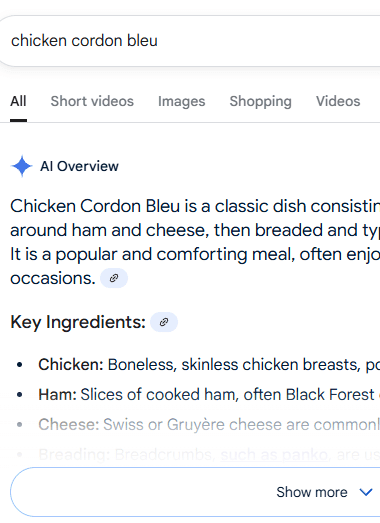
At this time, for me, AI Overviews is not showing up for recipe queries that use the word “recipe” on either desktop or mobile devices. Queries that use the keyword “recipe” or “recipes” still show the regular recipe rich results regardless of device used.

However, queries that have a recipe intent but don’t contain the “recipe” keyword variants do trigger recipe queries.

Recipe Intent Screenshot

Image shows the keyword phrase

Keyword phrases that contain the word “recipe” trigger the normal recipe rich results.

Recipe Keyword Phrase

Image shows keyword phrase

Keyword phrases that are about recipes but aren’t specifically requesting a recipe tend to trigger AI Overviews. So it’s not really showing AI Overviews for recipe queries, just for queries that are about food and have a latent recipe intent.

Not Showing Up In Mobile Search

The keyword phrases that trigger recipe AI Overviews on desktop do not appear to trigger them on mobile devices. For example, the query Cordon Bleu triggers AIO on the desktop but won’t trigger it on a mobile device.

Keyword Phrase On Mobile Device

Image showing that the keyword phrase

The keyword phrase Tom Critchlow shared (healthy dinner ideas) that triggered an AI Overviews on desktop fails to do the same thing on a mobile device.

Mobile Device Results For Query: Healthy Dinner Ideas

Screenshot shows a normal

So it could be that recipe intent queries have rolled out to desktop users but not yet to mobile devices.

Reduced Traffic To Recipe Bloggers

Recipe bloggers may begin to see reduced levels of traffic from desktop devices. This trend may accelerate as more people begin to rely on chatbots like ChatGPT and Claude for recipes.

ChatGPT Shows Recipes For Recipe Queries

Screenshot shows a query for

Chatbots are trained to output plausible responses so users may not be able to tell the difference between an authentic recipe and an authentic-sounding recipe. Speaking from personal experience using chatbots for recipes, I find them to be unreliable sources for authentic recipes but that’s probably something that the average home cook won’t notice because the synthetic recipes generally satisfy expectations.

Featured Image by Shutterstock/New Africa

Google CEO Sundar Pichai Discusses Fate Of The Human-Created Web via @sejournal, @martinibuster

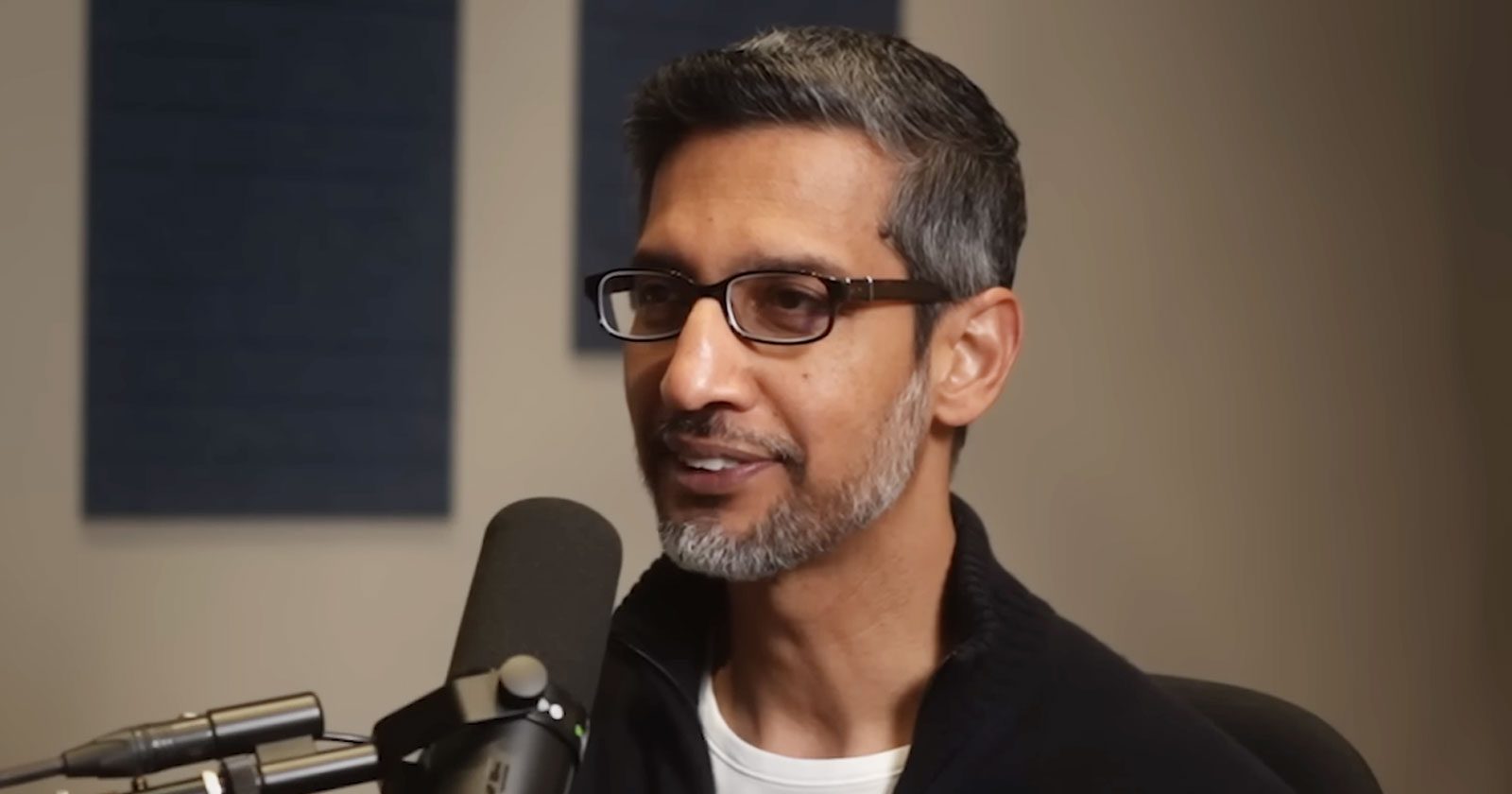
Google’s CEO, Sundar Pichai, responded to concerns about the impact of recent changes in Search and was repeatedly asked to clarify his position on the web ecosystem and how it fits into what he calls the next chapter of search. Pichai’s responses were given in the context of a recent interview on the Lex Fridman podcast.

Google CEO’s Commitment To Web Ecosystem Challenged

Lex Fridman challenged Pichai on whether Google will continue sending users to the human-created web. Pichai responded that supporting the web ecosystem is something he feels deeply about.

Fridman said:

“And the idea that AI mode will still take you to the web, to the human-created web?”

Pichai responded:

“Yes, that’s going to be a core design principle for us.”

Fridman followed up by noting that he’s been asking more questions from Google’s AI Overviews and AI Mode and exploring but he still wants to end up on the “human-created web.”

Pichai responded:

“It helps us deliver higher quality referrals, right? You know where people are like they have a much higher likelihood of finding what they’re looking for. They’re exploring. They’re curious. Their intent is getting satisfied more… That’s what all our metrics show.”

The interviewer added:

“It makes the humans that create the web nervous. The journalists are getting they’ve already been nervous.”

Sundar Pichai answered:

“Look, I think news and journalism will play an important role, you know, in the future we’re pretty committed to it, right? And so I think making sure that ecosystem… In fact, I think we’ll be able to differentiate ourselves as a company over time because of our commitment there. So it’s something I think you know I definitely value a lot and as we are designing we’ll continue prioritizing approaches.”

AI Is The Next Chapter Of Search?

Pichai mentioned that user metrics of AI search are “encouraging” and referred to it as the “next chapter of search,” underlining that AI Search is an inevitability and is not going away.

Search technologies have consistently been in a steady state of change. The strongest effects were visible in the 2004 Florida update, the 2012 Penguin links update, the 2018 Medic update, and the more recent series of helpful content updates, all of which brought massive changes to search rankings. None of those changes are as ambitious and consequential as what the human-created web is facing with Google’s AI Overviews and AI Mode.

Speaking as someone who has been a part of search marketing for over 25 years, I believe Pichai may be understating the situation by calling it the next chapter in search. It may well be that Google AI Search is an entirely new book.

Search Is Evolving To More Context

Lex Fridman remarked on how Google was legendary for its simple layout and the ten blue links, saying that Google is starting to “mess with that” and that surely there must have been battles within Google about that.

Pichai subtly corrected Fridman’s suggestion that Google was moving away from the ten blue links, which hasn’t been a thing for nearly 15 years by stating that the shift to mobile is the reason why Google shifted away from ten blue links, evolving along with the pace of technological advancements and user’s expectations for answers, not links.

Pichai emphasized that Google remains the “front page of the Internet” as Fridman put it, because of their commitment to making it easier for users to explore the web, only with more context.

Pichai answered:

“Look… in some ways when mobile came… people wanted answers to more questions, so we’re …constantly evolving it. But you’re right, this moment, …that evolution, because underlying technology is becoming much more capable. You can have AI give a lot of context.

But one of our important design goals though, is when you come to Google search. You’re going to get a lot of context. But you’re going to go and find a lot of things out on the web. So that will be true in AI mode. In AI overviews and so on.

But I think to our earlier conversation, we are still giving you access to links, but think of the AI as a layer which is giving you context summary. Maybe in AI mode you can have a dialogue with it back and forth on your journey.

But through it all, you’re kind of learning what’s out there in the world. So those core principles don’t change, but I think AI mode allows us to push… we have our best models there, models which are using search as a deep tool.

Really, for every query you’re asking, fanning out doing multiple searches, assembling that knowledge in a way so you can go and consume what you want to and that’s how we think about it.”

Advertising In AI Mode

Something that isn’t immediately apparent is that Google treats advertising as a form of content that is relevant to users. Advertising is not seen as an intrusion but as something relevant to users within a context of their interests.

Fridman next asked him about advertising in AI Mode. Pichai responded that they are currently focusing on getting the “organic experience” right but he also turned to the concept of context.

Pichai’s response:

“Two things.

Early part of AI mode will obviously focus more on the organic experience to make sure we are getting it right. I think the fundamental value of ads are it enables access to deploy the services to billions of people.

Second is, the reason we’ve always taken ads seriously is we view ads as commercial information, but it’s still information. And so we bring the same quality metrics to it.

I think with AI mode, to our earlier conversation, I think AI itself will help us over time, figure out the best way to do it.

Given we are giving context around everything, I think it will give us more opportunities to also explain, okay, here’s some commercial information. Like today, as a podcaster, you do it at certain spots and you probably figure out what’s best in your podcast.

There are aspects of that, but I think the underlying need of people value commercial information. Businesses are trying to connect to users. All that doesn’t change in an AI moment. But look, we will rethink it.”

Will AI Mode Replace Everything?

Lex Fridman asked if Pichai sees a time where AI Mode will become the interface through which the Internet is filtered, asking if there’s a future where it completely replaces the current combination of AI Overviews and ten blue links.

Pichai answered:

“Our current plan is AI Mode is going to be there as a separate tab for people who really want to experience that, but it’s not yet at the level where our main search pages, but as features work, we’ll keep migrating it to the main page. And so you can view it as a continuum. AI model offer you the bleeding edge experience. But things that work will keep overflowing to AI Overviews in the main experience.”

Takeaways

The questions posed by Lex Fridman echo the fears and negative sentiment felt by many publishers about Google’s evolution to providing answers to queries instead of links to the open web.

Sundar Pichai repeatedly stated that Google intends to keep sending users to the human-created web, explaining that AI provides more context that encourages users to explore topics on the web in greater depth.

Those statements, however, are undermined by Google’s delay in enabling web publishers to accurately track referrals from AI Overviews and AI Mode. This creates the impression that publishers are an afterthought and feeds web publisher skepticism about Google’s commitment to the human-created web. While it’s refreshing to hear Google’s CEO emphatically declare his concern for the web ecosystem, I believe it will take more positive actions from Google to overcome web publishers’ negative outlook on the current state of AI search.

Google Outage Disrupts Lens, Discover, & Voice Search Results via @sejournal, @MattGSouthern

Google has confirmed an ongoing disruption that is preventing some results from appearing in Google Lens, Discover, and Voice Search.

According to the company’s Search Status Dashboard, the incident began on June 12 at 1:00 p.m. Pacific Time. A follow-up entry posted at 1:16 p.m. states:

“There’s an ongoing issue with serving Google Lens, Discover, and Voice Search results that’s affecting some users. We’re working on identifying the root cause. The next update will be within 12 hours.”

At press time, the disruption is still marked as “Incident affecting Serving,” meaning the underlying services remain online but are not consistently delivering results.

Why This Matters

Google Lens, the Discover feed, and Voice Search collectively drive significant traffic to publishers, ecommerce catalogs, and local businesses.

When any of these surfaces go dark or return incomplete results, sites that rely on them can experience abrupt drops in impressions and clicks.

What To Do Next

Check for sudden drops in Discover, image, or voice traffic starting around 1:00 p.m. PT. If you see a temporary decline that matches the time on Google’s dashboard, this is likely due to the outage, not a ranking change.

Share Google’s official dashboard notice with website stakeholders. Mention that there will be another update from Google in 12 hours and explain that performance should return to normal once the service is back up.

When Will Service Be Restored?

Google hasn’t offered an estimated time of full resolution, committing only to provide another status update within 12 hours of the 1:16 p.m. post.

Historically, incidents affecting a limited number of users have been fixed within hours, although larger issues can take longer to resolve.

Until Google publishes its next update, the safest assumption is that Lens, Discover, and Voice Search services will remain unpredictable.

The core web search experience is currently listed as “Available,” so blue-link ranking checks and traditional query troubleshooting can proceed as usual.


Featured Image: Roman Samborskyi/Shutterstock