DeepSeek And Its Impact On The Generative AI Global Race via @sejournal, @AlliBerry3

Since launching to the public on Jan. 20, 2025, Chinese startup DeepSeek’s open-source AI-powered chatbot has taken the tech world by storm.

As the top free app by downloads in the U.S. Apple app store since Jan. 26 – with 16 million app downloads in its first 18 days (ChatGPT had 9 million in the same timeframe) – DeepSeek’s performance and accompanying search feature is at least on par with OpenAI’s ChatGPT for a fraction of the cost.

Its launch led U.S.-based AI technology company, Nvidia, to the greatest drop in market value for a U.S. company in U.S. stock market history. That’s quite an entrance!

U.S. tech analysts and investors seem to all fear that the U.S. is falling behind in the generative AI global race.

This may be warranted considering how quickly and cost-effectively DeepSeek was able to get R1 developed and out the door.

DeepSeek utilizes reinforcement learning, meaning the model learns complex reasoning behaviors through reinforcement without supervised fine-tuning, which allows it to save significant computational resources.

But, is DeepSeek really going to emerge as the leader in AI? And what are the implications for this development for the future of search? Let’s dive in.

What Has Happened Since DeepSeek Launched?

While U.S. tech companies were humbled by the speed and claimed cost efficiency of this launch, DeepSeek’s arrival has not been without controversy.

A lot of questions lurk, ranging from suspected intellectual property violations to security, data privacy, Chinese censorship, and the true cost of its technology.

Legal Issues For Copyright And Data Protection

OpenAI and Microsoft are investigating whether DeepSeek used OpenAI’s API to integrate their AI models into DeepSeek’s own models.

OpenAI claims it has evidence of DeepSeek distilling the outputs of OpenAI to build a rival model, which is against OpenAI’s terms of service, but likely not against the law.

Distillation allows for the transfer of knowledge of a large pre-trained model into a smaller model, which enables the smaller model to achieve comparable performance to the large one while reducing costs.

This is more than a little ironic given the lawsuits against OpenAI for ignoring other site’s terms of service and using their copyrighted internet data to train its systems.

There are also questions about where user data is stored and how it is processed, given that DeepSeek is a Chinese-based startup.

For anyone handling customer information and payment details, integrating a tool like DeepSeek that stores data in a foreign jurisdiction could violate data protection laws and expose sensitive information to unauthorized access.

Given that DeepSeek has yet to provide its privacy policies, industry experts and security researchers advise using extreme caution with sensitive information in DeepSeek.

DeepSeek Security Breach

Wiz Research, a company specializing in cloud security, announced it was able to hack DeepSeek and expose security risks with relative ease on Jan. 29.

It found a publicly accessible database belonging to DeepSeek, which allowed it full control over database operations and access to user data and API keys.

Wiz alerted the DeepSeek team, and they took immediate action to secure the data. However, it is unclear who else accessed or downloaded the data before it was secured.

While it’s not uncommon for startups to move fast and make mistakes, this is a particularly large mistake and shows DeepSeek’s lack of focus on cybersecurity so far.

National Security Concerns Similar To TikTok

There are national security concerns about DeepSeek’s data collection policies reminiscent of fears about TikTok, which saw a similar rise in global prominence out of Chinese-based company ByteDance.

The U.S. government briefly banned TikTok in January 2025, which came out of concerns about how the company was collecting data about users. There were also fears that the Chinese government could use the platform to influence the public in the U.S.

A few incidents in the last several years that initiated that fear include TikTok employees utilizing location data from the app to track reporters to find a source of leaked information, and TikTok employees being reported to have plans to track specific U.S. citizens.

While TikTok is active in the U.S. right now, its future is unconfirmed.

For similar reasons to the TikTok concerns, a number of governments around the world, including Australia and Italy, are already working to ban DeepSeek from government systems and devices. The U.S. is also considering a ban on DeepSeek.

Chinese Censorship

Regardless of whether you run DeepSeek locally or in its app, DeepSeek’s censorship is present for queries deemed sensitive by the Chinese government, according to a Wired investigation.

However, because it is open source, there are ways of getting around the censorship, but it’s difficult.

Doing so would require running on your own servers using modified versions of the publicly available DeepSeek code, which means you’d need access to several highly advanced GPUs to run the most powerful version of R1.

Questions About Cost

Much has been written about the cost of building DeepSeek. Initial claims by DeepSeek were that it took under $6 million to build based on the rental price of Nvidia’s GPUs.

However, a report from SemiAnalysis, a semiconductor research and consulting firm, has since argued that DeepSeek’s hardware spend was higher than $500 million, along with additional R&D costs.

For context, OpenAI lost about $5 billion in 2024 and anticipates it will lose more than $11 billion in 2025. Even if DeepSeek did cost $500 million or more, it still cut costs compared to what leading competitors are spending.

So, how did they cut costs?

Before DeepSeek came along, the leading AI technologies were built on neural networks, which are mathematical systems that learn skills by analyzing huge amounts of data. This requires large amounts of computing power.

Specialized computer chips called graphics processing units (GPUs) are an effective way to do this kind of data analysis. This is how chipmaker Nvidia grew to prominence (and also had a huge fall in market value on the day DeepSeek launched).

GPUs cost around $40,000 and require considerable electricity, which is why leading AI technologies like OpenAI’s ChatGPT were so expensive to build.

Sending data between chips can also require more energy than running the chips themselves.

DeepSeek was able to reduce costs, most notably by using a method called “mixture of experts.”

Instead of creating one neural network that learned data patterns on the internet, they split the system into many neural networks and launched smaller “expert” systems paired with a “generalist” system, reducing the amount of data needed to travel between GPU chips.

The Implications Of Being Open Source

DeepSeek-R1 is as “open-source” as any LLM has been thus far, which means anyone can download, use, or modify its code.

Similar to Meta’s Llama, the code and technical explanations are shared, enabling developers and organizations to utilize the model for their own business needs, but the training data is not fully disclosed.

Many believe DeepSeek is a big step toward democratizing AI, allowing smaller companies and developers to build on DeepSeek-R1 and achieve greater AI feats faster.

This could lead to more innovation in places with more limited access to the tech needed to build AI solutions.

But, critics fear that open-source models can expose security vulnerabilities that could be exploited, which we’ve already seen in DeepSeek’s first weeks in the public.

DeepSeek And The Future of SEO

So, what does this all really mean for search professionals? The way I see it, DeepSeek is just the next splashy AI chatbot with search capabilities in the rapidly changing world of SEO.

It’s important to understand that while tools like DeepSeek and ChatGPT use advanced natural language processing (NLP) and machine learning, they still simply provide answers to real questions that real people ask.

Their responses heavily focus on semantic understanding, intent matching, and contextual analysis, but they ultimately serve the same core user need.

While we have years of experience testing optimization tactics on more established search engines like Google, we’re still at the beginning stages of understanding optimization for generative AI chatbots.

Final Thoughts

Whether DeepSeek will stick and grow in prominence remains to be seen.

Obviously, if other governments follow Australia, Italy, and potentially the U.S. to ban DeepSeek, that would limit its potential for growth.

And much as DeepSeek rose to prominence rapidly by providing a blueprint for others and significantly lowering costs, a new market-moving AI could always be just around the corner.

Regardless of what happens with DeepSeek, we are at the beginning of a very rapid period of innovation in AI technology.

As SEO professionals, we need to be prepared to test a surge of new platforms and reverse engineer how they arrive at their responses to user queries.

More Resources:


Featured Image: Phonlamai Photo/Shutterstock
Why Google’s 4th Quarter Results Raise Questions for SEO & PPC via @sejournal, @martinibuster

Few professions can match a digital marketer’s perspective on what Google’s fourth-quarter results mean for SEO and online advertising. I asked six search marketers, each with over 20 years of experience in all areas of search for insights into what those results mean. What they shared indicates what SEO and advertising professionals should be paying attention to in 2025.

The six digital marketers who were separately interviewed all suggested that four general trends may be impacting Google search and advertising performance:

  1. Shifting User Behavior
  2. Changes To Google Search
  3. Google’s Not Immune To Competition
  4. Wider Economic & Market Conditions

Shifting User Behavior & Rising Competition

Although I interviewed each search marketer individually, they all agreed that user search habits were trending away from traditional search and migrating to AI and social platforms, indicating that Google is no longer immune to competitive pressure in both search and advertising.

Benu Aggarwal of Silicon Valley-based Milestone, Inc. (LinkedIn Profile) referenced the staggering investments in AI infrastructure as tangible proof of an ongoing shift in how people access information across consumer and business use cases.

“A lot of traffic is moving to LLMs such as ChatGPT, Perplexity (and Google’s Gemini). This is evidenced by Alphabet’s investments in AI, particularly in making compute inexpensive. They’re not alone, Meta, OpenAI, Nvidia, AWS, others are all investing in AI compute to support the surging demand.”

Michael Bonfils, of Digital International Group, (LinkedIn profile) shared that OpenAI was the leading disruptor to Google’s search platform, followed by a generational shift away from search toward visual social media platforms.

Michael said:

“I’ve been saying this since November 30, 2022 that this thing that OpenAI has just released has the potential to disrupt the intent of search users on Google, making it faster and more responsive with no ad disruptions and filtering out forum comments And the timing couldn’t be worse when you have an entire generation (Z/Alpha) who have moved to TikTok/IG for their search results.”

Chuck Price of Measurable SEO (LinkedIn profile) contributing additional nuance to the observation of user platform shift:

“Platform migration pressures play a role. Behavioral shifts toward visual/search hybrids (TikTok, Instagram) and answer-engine interfaces (Perplexity) suggest Google’s monopoly on search touchpoints is eroding, particularly among Gen Z and technical audiences.”

Duane Forrester, SVP, Search INDEXR.ai and formerly of Bing and Yext (LinkedIn profile) noted that the consumer journey is increasingly beginning somewhere other than Google Search:

“Search starts are down as consumers move to social platforms. Revenue is being impacted.

This is going to be our new normal in the search industry. With younger generations now aging and their habits being different, it’s natural to see them shift behavior from traditional search into new directions.

If you thought search engines were a forever thing, you were wrong. Reliance without diversification was always a recipe for disaster. This formula remains consistent. Change is also consistent and as people shift behavior, you better, too.”

Changes To Google Search

The fact that people are using other platforms for shopping ideas, inspiration and information gathering may be signs that Google’s search dominance is increasingly vulnerable to competition. That’s something that was unthinkable as recently as five years ago.

There were multiple changes to how search results are presented in Google Search, with the most notable being that AI Overviews and other search features reduced the need to click through to an answer. This trend to show answers and not links, often referred to as “zero-click” search results, is an ongoing trend that was previously limited to informational search queries.

The complaints from some SEOs about zero-click search results that initially greeted the introduction of Featured Snippets were arguably overstated. Informational searches that require one-dimensional answers (spelling, name of a person, etc.) don’t lead to meaningful traffic (for the website or the user). The traffic from Featured Snippets becomes very meaningful when people have a reason to dig deeper to learn more about a product, movie, a celebrity or a topic.

But Google AI Overviews (AIO) completely destroyed that useful tradeoff with the Internet ecosystem. The comprehensiveness of AIOs reduce the need to click to a website because they show the answer to the current question and enable users to view summaries to answers Google anticipated follow-up questions (read about Google’s Information Gain Patent).

While the complaints about zero-click search results for featured snippets were overstated, Google’s AIO and expanded layouts virtually eliminate the need to click through to websites. This not only disrupts the web ecosystem but may also introduce unanticipated shifts in search advertising trends.

Everett Sizemore, of eSizemore search marketing consultancy (LinkedIn Profile) offered his opinion on how changes to Google Search and external pressures are affecting Google’s earnings:

“The slowdown in Google’s growth doesn’t surprise me for several reasons.

First, what used to be a rumor of competition has grown into a measurable threat. According to Statcounter Global Statistics, Google’s global search market share dipped below 90% for the last three months of 2024. That hasn’t happened since 2015.

And those numbers likely don’t even account for the rising wave of AI-driven search alternatives like Perplexity and GPTSearch, the latter of which is conservatively projected to capture at least 1% of the search market by year’s end. Among younger users, the shift will likely be even more dramatic.

Second, Google’s search results pages (SERPs) are an absolute mess. Too many cluttered, disparate features have turned the once-streamlined UX into a Frankenstein-like disaster.

Remember those bloated Yahoo Search pages from the late ’90s? The ones Google originally disrupted with its clean, white background and ten blue links? Well, we’ve come full circle—back to the chaotic, overstuffed experience we were trying to escape in the first place. Frankly, it looks like someone puked up a bunch of widgets onto the page.

Google isn’t disappearing anytime soon, but its hold on search is weakening—one earnings quarter at a time.”

Google Is No Longer Immune To Competition

Chuck Price, founder of search consultancy Measurable SEO (LinkedIn profile), called attention to how multiple trends may be contributing to an erosion of search dominance and its concomitant effect on search advertising, putting some of the blame on the zero-click paradigm:

“The main takeaway, as I see it, is that the 0.2% YoY deficit doesn’t tell the full story.

What’s surprising for me in the Alphabet earnings report is the relative stability of search revenue, 12.5% growth versus 12.7% YoY. This seems counterintuitive, when considering how the SERPs have evolved over the past year with expanded answer boxes, AI-generated summaries and entity-driven knowledge panels. All of these features reduce the need to click on an ad or click through to a website.

Did Google’s advertising algorithms manipulate pricing to get that close? If one were to look at the YoY click data, I strongly suspect the deficit is far worse.”

Google is under pressure from ChatGPT Search, Perplexity AI and other AI search engines which introduce entirely new platforms that replace the 25+ year old Search Engine Paradigm. Google is competing platform to platform with AIO and their Gemini search assistant. Michael Bonfils suggested that those events have forced Google into a difficult position with limited options:

“They have reached a damned if I do damned if I don’t situation. They are either going to make the experience better for the user, worse for the publisher/advertiser or vice versa.”

Wider Economic And Advertising Pressure

Gabriella Sannino, founder of international marketing and SEO company Level343 (LinkedIn profile) shared a wider perspective of trends to interpret what Google’s fourth quarter results means for the search marketing community. Her answer, reflecting 20 years experience in all areas of digital marketing, included search advertiser sentiment and the worldwide economic situation.

Gabriella answered:

“When you look at the big picture and then the results, I don’t think the slower growth is entirely because of major SERP changes. I think it’s a mix of factors causing buyer behavior shifts:

First, ad and marketing budgets often get cut first when times get uncomfortable. So, slower growth may just be reflecting the sign of the times rather than anything Google’s done.

Second, ongoing privacy changes can affect ads in ways that have nothing to do with Google. Browser privacy settings can make ads less targeted or reduce how well they can be measured. Consequently, advertisers get less data for conversion improvements, retargeting, and ad optimization.

Third, you can’t review the advertising situation in isolation. The competition for ad dollars from TikTok, Amazon ads, Microsoft Advertising (especially with the AI-driven Bing hype), and so on must also be considered. A multi-channel mix means some of Google’s revenue goes bye-bye to other platforms.

Many businesses have tighter budgets, so ad ROI is under more scrutiny. And, there are many disillusioned business owners realizing that Google is changing too frequently to put their entire budget on it. AIOs were a real sign that things were changing, again. I wouldn’t be surprised if Google starts playing with ad space there fairly soon.”

Google’s Not In A Downward Spiral

Our panelist of search marketers interpret the fourth quarter results as signaling that Google is no longer immune from competition and is vulnerable to losing traffic to AI and social platforms as consumers increasingly begin their shopping and informational journeys outside of traditional search.

Google’s search results are perceived as cluttered and unstable because of constant changes to SERP layouts triggered by an increasing amount of keyword phrases. This may contribute to a sense of uncertainty. Nobody observed that Google is in a downward spiral. But the combination of the instability, changes in user behavior, and gains by other platforms are trends to look out for in 2025.

Stepping back for an overall view shows that continuing global economic issues and the attractiveness of advertising across multiple channels may be contributing to a shift in marketing spend. The search marketers I interviewed, who collectively have over 120 years of experience, hinted at concerns about deeper challenges in Google’s core businesses, with one search marketer questioning if there’s more paid search instability than is apparent in the most recent quarterly results.

Google Sitelinks Algorithm Bug Shows Wrong Links via @sejournal, @martinibuster

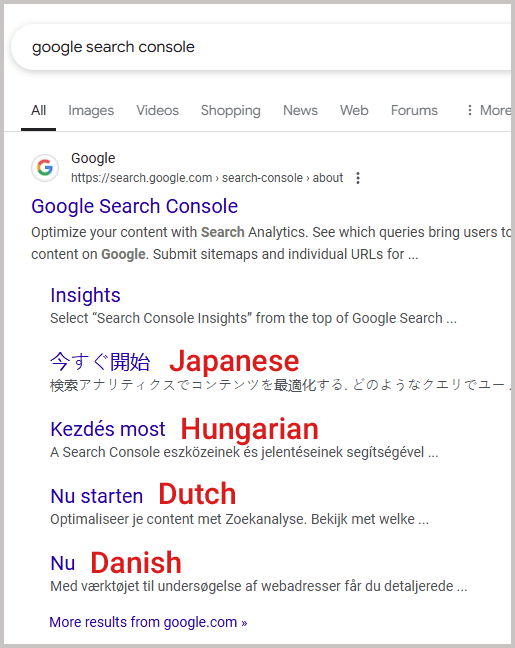
Google’s search algorithms are showing multiple languages in the sitelinks for Google Search Console. Regardless of whether this is new or not, it may give an idea of how the underlying algorithm evaluates a website for sitelinks.

Sitelinks Are Supposed To Be Helpful

Sitelinks is a Google Search feature that shows links to different areas of a website when a user does a search for a brand name. Google supposedly analyze a website’s site structure and links to pages that users will find the most useful, which is helpful. Google’s documentation doesn’t get into details of what that analysis analyzes but I suspect that Google notes which sections of a site users tend to search for, inbound links, and site architecture (internal linking) then uses that information to generate the sitelinks feature.

There may be a bug in how Google is showing sitelinks for Google Search Console though.

A search for Google Search Console shows sitelinks in multiple languages:

  • Japanese
  • Hungarian
  • Dutch
  • Danish

Screenshot Of Google Sitelinks Bug

I searched using the domains of other websites and didn’t see the same effect. It’s unclear how long this has been happening but it’s interesting from an SEO perspective. The reason it’s interesting is because whatever analysis Google is using to determine sitelinks is causing this weird search result.

Hat tip to web developer and search marketing expert Brenda Malone (LinkedIn profile) for spotting this!

WordPress SEO Myths Busted: What You Really Need To Know via @sejournal, @cshel

WordPress powers over 40% of websites globally – and why would it not? It is relatively easy to use and has expansive options when it comes to plugins and pre-built themes.

But even though WordPress has been in active development and use for more than 20 years, misconceptions about WordPress SEO are rampant and many site owners are confused about what truly drives rankings.

Because I can’t respond to every single misconception that pops up on X (Twitter) or Reddit, I would like to clear up some of the confusion by busting the more pervasive myths and sharing actionable insights based on my experience.

Whether you’re an old pro or running your first site, I hope you leave with clarity and confidence in your WordPress SEO strategy.

Myth #1: WordPress Is Going Away Or Shutting Down

The Reality: Despite the current public debate about governance, I *assure* you – WordPress isn’t going anywhere.

It remains a robust, community-driven platform with a massive global user base.

WordPress’ open-source nature makes it incredibly flexible and free to use, but open-source also means that discussions about its future direction happen publicly and, sometimes, loudly.

Here’s what you need to know:

  • WordPress Isn’t Going Away Anytime Soon: The core functionality of WordPress remains stable and widely supported. The infrastructure is backed by millions of contributors, developers, and users.
  • What If There’s a Fork? Forks happen in open-source projects more often than you might think. Some are a bigger deal than others. If you’ve heard this mentioned and it made you nervous because you don’t really know what it means, please be assured there is no reason for panic. A fork happens when developers create a new version by branching off from the original project. While this sounds dramatic, forks typically prioritize compatibility to retain users. Most plugins will remain compatible in the early stages, and developers often create tools to make transitions seamless.
  • The Bottom Line: There’s no immediate reason to leave WordPress. Any major changes will take time, and you’ll have plenty of notice. Whether the ecosystem stays unified or forks, your investment in WordPress remains secure.

Focus on what matters: a solid SEO strategy, fast performance, and user-centric content. These fundamentals will serve you well no matter what.

Myth #2: WordPress Is SEO-Friendly By Default

The Reality: WordPress gives you a strong foundation, but it’s not set-it-and-forget-it. Even out of the box, there are configurations to set.

Some SEO needs may require a plugin if your theme doesn’t offer built-in support and you’re not comfortable modifying the code yourself.

Once you’ve got all of the configurations set, and you’ve set up your plugins and configured those, there will still be on-page and content SEO that is done as you’re writing the content.

You can’t install WordPress and then stop thinking about SEO forever.

  • Permalinks And Metadata: I always update permalinks to create clean, descriptive URLs. Titles, meta descriptions, and alt text for images need to be provided and optimized, too.
  • Plugins Are Helpful, Not Magical: I use Yoast to handle metadata defaults and sitemaps efficiently, but even the best plugin is only as good as the strategy behind it. Anything can be misconfigured, so make sure you understand the settings you’re being asked to define.
  • Content Structure Matters: High-quality content and a logical site architecture remain crucial.
  • Themes Can Make or Break SEO: A poorly coded theme can undo the built-in SEO advantages WordPress provides. Many users choose WordPress for the variety of prebuilt themes, but picking one that supports your SEO efforts is critical. A bad theme can tank your rankings – and that’s not WordPress’s fault.

Myth #3: An SEO Plugin Will Guarantee High Rankings

The Reality: SEO plugins are like a compass – they point the way, but you still have to do the hiking.

  • Know The Basics: Plugins can’t replace good keyword research or content strategy. Are you targeting keywords just because they have high search volume, or because they’re terms your users are actually searching for? Most sites make money on conversions, not raw traffic, so attracting the right traffic is essential.
  • Answer User Questions: Do you know what questions your users are asking? Is your content helping them make decisions, use your product, or solve their problems? If not, your content strategy needs work – and that’s not WordPress’s fault.
  • Use Suggestions Wisely: Just because a plugin gives you a green light doesn’t mean your content will automatically rank. Think of the green light as a progress indicator, not a guarantee of success. I use these recommendations as helpful guidelines, but they don’t replace solid market research or a content strategy tailored to your audience. Without that foundation, you could end up with a grammatically correct, SEO-optimized article about a topic no one cares about – or one that blends into an already saturated space. That’s not the plugin’s fault; it’s a reminder that SEO tools support your efforts but can’t create demand or originality for you.

Ultimately, there’s no magic SEO bullet – not in plugins, not in content management systems, and certainly not in shortcuts.

Myth #4: Performance And Speed Don’t Matter That Much

The Reality: Core Web Vitals are an indication of performance, and page speed itself significantly affects user experience and the ability of bots and crawlers to access your site.

But this doesn’t mean hitting specific scores will guarantee a top ranking. Instead, it’s about ensuring your site provides a great experience while optimizing speed and performance.

  • Stay In Control With Manual Updates: Running manual updates ensures you’re not reliant on automatic processes, which can sometimes fail or get delayed. Knowing how to handle updates helps you prevent vulnerabilities from outdated plugins or themes.
  • Remove Unused Plugins And Themes: Unused plugins and themes can create security risks, even if they’re inactive. Regularly cleaning your site minimizes potential attack vectors and keeps your installation lightweight.
  • Run Performance Audits: Audits can help identify performance bottlenecks, detect plugins or scripts that slow down your site, and catch issues before they affect user experience. SEO isn’t set-it-and-forget-it; monitoring your site’s health is crucial for staying competitive.

Myth #5: Content-Length Is More Important Than Quality

The Reality: Search engines care about providing accurate, useful answers and user satisfaction, not arbitrary word counts. It’s baffling that this myth still persists today.

Does this mean that you should stop doing long-form content? No. This means that different types of answers and information naturally call for different amounts of content.

The point is to provide as much quantity (number of words) as is necessary to accomplish the mission. Extra word count for the sake of extra word count is counterproductive.

  • Intent First: I focus on answering user questions directly. There is zero need to add filler details and backstories just to increase the word count. Provide information if the information is necessary and useful to the reader. If your reader is looking for details on how to fix their bicycle chain, they do not need a history lesson on the invention of the bicycle.
  • Avoid Fluff: Write enough to cover the topic thoroughly, but avoid padding your content for length. Even if you’re not adding unnecessary details and information to your article, make sure you avoid fluffing out the sentences to increase word count, too. When I say “fluffing,” I mean taking a sentence that can be perfectly expressed in five words and expanding it to 25 words unnecessarily. For example: “The cat sat quietly” becomes “The small, furry feline creature chose to sit still in an unmoving manner on the comfortable spot by the window.”

Myth #6: Backlinks Are All You Need For SEO Success

The Reality: Backlinks help, but they’re not a magic SEO bullet, just as I mentioned earlier.

It’s like getting glowing recommendations for a restaurant that serves bad food – those referrals won’t save it from bad reviews if the dining experience is poor.

  • Balance Your Efforts: Link-building should be paired with strong technical SEO and high-quality content.
  • Don’t Neglect User Experience: Sites that are hard to navigate or slow to load will struggle, even with strong backlinks.
  • Content Matters: Backlinks can’t compensate for irrelevant or low-value content.
  • Technical SEO Is Critical: Technical SEO plays a vital role in making backlinks work for your site. If search engines can’t easily crawl and index your pages because of poor technical structure, those backlinks won’t be able to pass authority effectively or improve your rankings.

Key Takeaways For WordPress SEO In 2025

SEO has evolved dramatically over the past year, especially with the rise of AI-driven search results, pulling from authoritative sites that provide real value and context.

With Google facing competition from AI-powered engines like Bing’s integration with OpenAI, it’s more important than ever to expand your approach and adapt to the shifting landscape.

1. Ongoing Maintenance Beats Default Settings

  • Regular Auditing Is Essential: Even with WordPress’s built-in features, active maintenance is key. Periodically review your SEO settings, content structure, and performance to ensure your site remains optimized.
  • Understand Plugin Limitations: Plugins offer great guidance but are not a replacement for thoughtful strategy. Pay attention to plugin settings and adapt them to your goals rather than relying solely on default configurations.

2. Make Use Of WordPress Plugins Thoughtfully

  • Enhance Content Optimization: You can certainly use plugins for guidance and to manage some of the technical SEO jobs, but no plugin can do *all* the work, especially when it comes to content. Content can be optimized, but optimized content that isn’t adding value or providing useful information still isn’t going to perform well.
  • Simplify Tasks: AI enhancements are all the rage in WordPress plugins and themes, but don’t let the AI make decisions without your oversight and input – strategy is still a human task.

3. Don’t Rely Solely On Google

  • Broaden Search Strategy: Pay attention to Bing’s integration with AI-powered tools and other emerging engines.
  • New Search Experiences: Be ready to adapt as search engines experiment with interfaces and AI.

4. Prioritize Security And Updates

  • Update Regularly: Keep plugins, themes, and core files updated to avoid vulnerabilities.
  • Remove Unnecessary Plugins: Keep your plugin directory clean to reduce security risks.

To Sum It Up

WordPress remains a powerful tool, but success requires adaptability.

Don’t let internal debates distract you from building a fast, secure, user-friendly site. Focus on proven strategies, stay flexible, and be ready for emerging SEO trends.

Whether it’s Google, Bing, or the next big thing, you’ll be ready. Audit your site’s speed, usability, and content strategy today.

Use plugins and tools to simplify optimization – but never forget the human touch in your SEO strategy.

More Resources:


Featured Image: JuIsIst/Shutterstock

Google Confirms Business Profile Reviews Outage via @sejournal, @martinibuster

Google confirmed an outage in business profile reviews that has resulted in missing reviews for many local business profiles and is working toward fixing the problem.

Google Business Profile

Google Business Profiles are a way for local businesses to add their business to Google and have it show up in local search and Google Maps. It also allows businesses to manage how their site shows up in search, enabling Google to show accurate information about hours, website, contact information, images and reviews.

The reviews is a feature that allows users to share their experiences with businesses. It’s a useful way for businesses to increase earnings through positive word of mouth.

GBP Reviews Outage

Google Business Profile reviews have gone missing, which is bad news for businesses because of how influential reviews are for building trust.

A Googler acknowledged the outage and committed to updating the community about fixes to the system. She did however ask businesses to read their guidelines about reviews, which could be seen as implying that some businesses with missing reviews may have had reviews removed for a reason.

She wrote:

“GBP Review Count Known Issue Update

Known Issue
We’re aware of an issue affecting some Google Business Profiles, causing some profiles to show lower-than-actual review counts due to a display issue. The reviews themselves have not actually been removed. We’re working hard to resolve this and restore accurate review counts as quickly as possible. We appreciate your patience and will share updates on this thread as they become available.

Before reporting missing reviews, please note that there are several reasons why reviews may be removed from maps. Usually, missing reviews are removed for policy violations like spam or inappropriate content.

Read more about our Review policy guidelines here before proceeding. You can also refer to the Help Center Article for more information.”

This is a developing story, this article will be updated with additional information once it becomes available.

Featured Image by Shutterstock/The Image Party

Google’s Advice on Fixing Unwanted Indexed URLs via @sejournal, @martinibuster

An SEO posted details about a site audit in which he critiqued the use of a rel=canonical for controlling what pages are indexed on a site. The SEO proposed using noindex to get the pages dropped from Google’s index and then adding the individual URLs to robots.txt. Google’s John Mueller suggested a solution that goes in a different direction.

Site Audit Reveals Indexed Add To Cart URLs

An SEO audit uncovered that over half of the client’s 1.43k indexed pages were paginated and “add to shopping cart” URLs (the kind with question marks at the end of them). Google ignored the rel=canonical link attributes and indexed the pages, which illustrated the point that rel=canonical is just a hint and not a directive. Paginated in this case just means the dynamically generated URLs related to when a site visitor orders a page by brand or size or whatever (this is usually referred to as faceted navigation).

The add to shopping cart URLs  looked like this:

example.com/product/page-5/?add-to-cart=example

The client had implemented a rel=canonical link attribute to tell Google that another URL was the correct URL to index.

The SEO’s solution:

“How I plan on fixing this is to no-index all these pages and once that’s done block them in the robots.txt”

SEO Decisions Depend On Details

One of the most tired and boring SEO dad jokes is “it depends.” But saying “it depends” is no joke when it’s followed by what something depends on and that’s the crucial detail that John Mueller added to a LinkedIn discussion that already had 83 responses to it.

The original discussion, by an SEO who’d just finished an audit, addresses the technical challenges associated with controlling what gets crawled and indexed by Google and why rel=canonical is not an unreliable solution because it is a suggestion and not a directive.

A directive is a command that Google is obligated to follow, like a meta noindex rule. A rel=canonical link attribute is not a directive, it’s treated as a hint for Google to use for deciding what to index.

The problem that the original post described was about managing a high number of dynamically generated posts that were slipping into Google’s index.

John Mueller On Dealing With Unwanted Indexed URLs

Mueller’s take on the problem was to suggest the importance of reviewing the URLs for patterns that may give a clue as to why unwanted URLs are getting indexed and then applying a more granular (specific) solution.

He advised:

“You seem to have a lot of comments here already, so my 2 cents are more as a random bystander…

– I’d review the URLs for patterns and look at specifics, rather than to treat this as a random list of URLs that you want canonicalized. These are not random, using a generic solution won’t be optimal for any site – ideally you’d do something specific for this particular situation. Aka “it depends”.

– In particular, you seem to have a lot of ‘add to cart’ URLs – you can just block these with the URL pattern via robots.txt. You don’t need to canonicalize them, they should ideally not be crawled during a normal crawl (it messes up your metrics too).

– There’s some amount of pagination, filtering in URL parameters too – check out our documentation on options for that.

– For more technical rabbit holes, check out https://search-off-the-record.libsyn.com/handling-dupes-same-same-or-different “

Why Was Google Indexing URLs With Query Parameters?

A topic raised by multiple people in the LinkedIn discussion is the problem of Google indexing shopping cart URLs (add to shopping cart URLs). No answers were provided but it may be something particular to the shopping cart platform and solving that may be limited to the above described solutions.

Read John Mueller’s advice here.

Up-To-Date Trends, AI-Driven Workflows, and Smarter Data Strategies for Q2 via @sejournal, @CallRail

In the fast-paced world of PPC advertising, marketers are constantly seeking ways to streamline their workflows and improve performance.

Managing PPC campaigns efficiently requires a delicate balancing act of multiple tasks:

  • Analyzing data.
  • Optimizing bid strategies.
  • Testing creatives.
  • Reporting performance.
  • And so much more.

While AI and machine learning have been around in PPC for years, a new wave of AI tools for streamlining productivity and workflows has made its way into the PPC scene.

Whether it’s automating repetitive tasks, enhancing audience targeting, or analyzing vast datasets, AI tools are reshaping how PPC professionals work.

Who doesn’t want to save time doing repetitive, busy work tasks?

In this article, we’ll explore several unconventional ways AI tools can help PPC marketers save time, increase efficiency, and make smarter decisions.

Using AI To Automate Data Interpretation And Trend Insights

PPC campaigns can generate enormous amounts of data that need to be consistently analyzed and interpreted.

AI tools outside of the standard Google and Microsoft Ads platforms can help streamline this process by helping with tasks like:

  • Quickly summarizing key trends.
  • Look for patterns in performance data.
  • Identify any data anomalies for further analysis.

These insights can enable marketers to move from data to action faster.

Using AI Tools For Trend Identification And Insights

If you’d rather not manually sift through reports identifying changes in performance metrics changes, you can actually feed campaign data into ChatGPT (or similar AI tools) to receive summaries that highlight performance trends.

For example, they can help identify seasonal changes in performance or pinpoint potential issues, such as a sudden dip in conversion rate.

Say you run 20 different campaigns in Google Ads and start to see a significant drop in conversion rates from the platform. It can be daunting to immediately pinpoint the cause of the issue.

By processing raw performance data from your campaigns, these AI tools can quickly analyze the data and provide insight into not only where the problem(s) can lie, but also glean insights as to why performance has shifted, like:

  • Ad fatigue.
  • Increased competition.
  • A shift in consumer behavior.

Using AI tools in this capacity helps marketers cut down on analysis time while helping to identify core issues faster, allowing for quicker optimization.

This automation saves hours of manual work, enabling you to focus on more strategic decision-making instead of spending time analyzing large datasets.

Enhancing Competitor Analysis And Strategy Development

Keeping up with competitors is crucial in the PPC landscape, but the task at hand can be time-consuming and complex.

AI tools simplify this process by providing insights into competitors’ strategies, allowing you to stay one step ahead.

There are plenty of tools to help drive competitor insights, whether in the Google Ads platform, third-party tools, or AI tools.

If you’re looking to take the analysis a step further, you can input reports from other competitive analysis tools into ChatGPT (or a similar tool) to receive a quick summary that highlights a competitor’s recent actions.

For example, this could include information like:

  • Shifts in bidding strategies.
  • Introduction of new ad copies.
  • Keywords being targeted.

Based on this data, the AI tools can suggest ways to adjust your own campaigns or suggest counter-strategies to stay competitive.

By automating competitor analysis tasks, you can gain valuable insights faster, which allows for quicker, more informed decision-making and strategic actions.

Simplifying Multi-Account And Cross-Platform Reporting

Managing campaigns across multiple platforms – whether it’s Google Ads, Microsoft Ads, Meta, or others – means compiling huge data sets from different sources.

Trying to put together a compelling, holistic story about your marketing campaigns can take up a lot of time as you navigate from platform to platform.

This is where the power of AI tools can come in to help aggregate reports and create cohesive summaries.

Streamlining Cross-Platform Reporting

Multi-channel reporting is often a daunting task, especially when managing accounts across Google, Microsoft, and social platforms.

By inputting performance data from these platforms into ChatGPT, marketers can receive a single, unified report that summarizes key performance indicators (KPIs) across channels.

For example, say you manage several campaigns across Google Ads, Microsoft Ads, and Meta Ads.

Instead of switching between dashboards and manually pulling data, you can input the performance metrics from each platform into your AI tool of choice.

The tool can summarize the top-performing platforms, highlight underperforming campaigns, and suggest where to reallocate budgets to maximize ROI.

AI’s ability to consolidate multi-channel data helps reduce reporting time, enabling marketers to spend more time optimizing campaigns and less time on administrative tasks.

Keyword Research And Expansion With AI

Keyword research is at the core of every PPC strategy, and expanding keyword lists can be labor-intensive.

AI tools can make the process more efficient by identifying relevant keywords, negative keywords, and keyword variations that are often missed in traditional tools.

While tools like the Google Keyword Planner are great at providing keyword recommendations, AI tools can take it a step further.

They can generate items like long-tail keyword variations and help identify opportunities for new targeting strategies.

Additionally, they can analyze an existing keyword list and suggest related keywords that reflect user intent or emerging trends.

For example, say you manage PPC campaigns for an ecommerce retailer. You input a list of current top-performing keywords with your latest KPI performance data into your AI tool of choice.

From there, the tool can generate suggestions for new long-tail keywords that may have lower volume, but higher intent to purchase.

Additionally, you can ask the tool to suggest negative keywords to eliminate irrelevant traffic, which improves both relevance and cost efficiency.

To really kick this into high gear, you can then ask the tool to format these new keywords and negative keywords into a format that allows you to upload them into Google Ads Editor, saving you hours of manual work adding each one individually.

Using AI tools beyond the ad platforms can help marketers discover new opportunities faster, ensuring more comprehensive targeting with minimal manual effort.

AI-Assisted Testing And Creative Optimization

There’s no debate that A/B testing is critical to campaign optimization, but interpreting results and making decisions about the next steps is where most people fall flat.

Using AI tools to streamline this process can aid you in analyzing test data and suggest optimizations based on performance.

Say you want to test two different versions of a headline in a PPC campaign. You can upload your test performance data into an AI tool for analysis.

Not only will it summarize which headline performed better, but it goes a step further to help answer why one headline outperformed the other.

By providing insights into which elements contributed to success, it can save you time in the long run and help keep those driving factors top of mind for the next test.

AI For PPC Budget Allocation And Forecasting

Effective budget management is essential for optimizing PPC performance.

The ad platforms are great at automating tasks like changing daily budgets based on scripts, but what about strategic budget allocation decisions?

Using AI tools to assist budget allocation across campaigns or platforms by forecasting potential outcomes based on past performance data can streamline the process of deciding where to invest – and when.

For example, a retail client has an upcoming holiday sale and they want to know if they can expect a higher return than last year’s sale.

Inputting last year’s campaign performance into AI tools like ChatGPT can help analyze performance, while also taking into consideration current market trends.

The output could be to suggest how much of the budget should be allocated to high-performing keywords or certain product categories.

It can also provide a forecast of expected returns based on historical data, current CPC trends, and consumer behavior trends to help you make informed budget decisions ahead of time.

AI-driven budget forecasting helps ensure that resources are allocated to the right areas, reducing wasted spend and improving overall campaign performance.

Automating Market Trend Exploration And Forecasting

Market trends can shift quickly, and staying ahead of these changes is key to successful PPC campaigns.

AI tools can analyze search trends, consumer behavior, and historical campaign data to predict future shifts in demand and help marketers prepare.

For instance, AI tools can identify trends in consumer searches in real time, helping you adjust your campaign strategies proactively.

For example, you manage Google Ads campaigns for a fitness brand, and you’re noticing a seasonal uptick in searches for [home workout equipment].

By using AI tools to analyze Google Trends data, you can forecast how that demand will continue to rise or fall in the coming months, and even if certain geographical areas are driving the high demand.

This allows you to adjust bids based on location, increase overall budgets if necessary to help capture demand, and create relevant ad copy that speaks directly to the emerging trend.

Conclusion

AI is revolutionizing PPC workflows, allowing marketers to work smarter, not harder.

Whether you’re leveraging Google Ads’ AI capabilities, like Gemini’s conversational ad creation or integrating third-party tools for deeper insights, AI is becoming indispensable in managing and optimizing PPC campaigns.

From automating bid management and audience targeting to optimizing ad creatives and providing actionable insights, AI offers opportunities to boost efficiency without sacrificing effectiveness.

As AI tools continue to evolve, those who embrace these technologies will find themselves better equipped to deliver superior results, whether managing in-house campaigns or serving clients.

By integrating both Google’s AI features and powerful third-party tools, you can unlock new levels of performance, save time on manual tasks, and focus on strategy and innovation.

More resources:


Featured Image: 3rdtimeluckystudio/Shutterstock

Mastering SERP Analysis: A Step-By-Step Guide To Understanding Search Engine Results Pages via @sejournal, @AdamHeitzman

Understanding search engine results pages (SERPs) is critical for anyone serious about increasing their website’s visibility.

Search engines use SERPs to display results for user queries, and the primary goal for SERP analysis is understanding why certain pages earn top rankings and what elements contribute to their success.

Analyzing these pages can unlock valuable insights into ranking factors, search intent, and what content types perform best.

Conducting SERP analysis helps you develop content strategies that align with search engine preferences and user expectations.

In this comprehensive guide, we’ll explain the fundamentals of SERP analysis, why it matters, and how you can master it to improve your SEO strategy.

Understanding SERP Features

Today’s search results pages are more complex, featuring many elements beyond the traditional organic blue links. Here are the key SERP features you need to know:

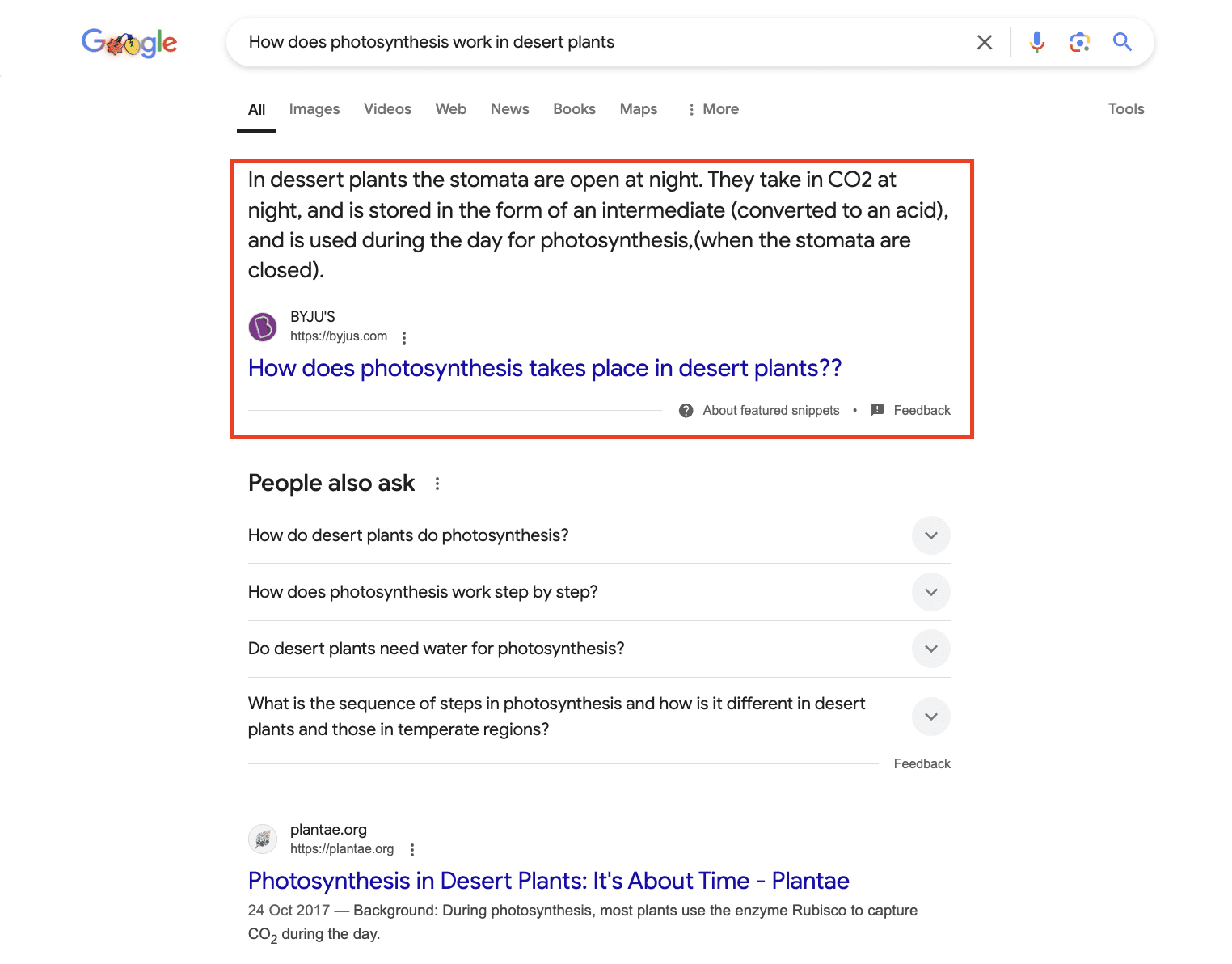
Featured Snippets

Position zero results that provide immediate answers to queries, typically in the form of paragraphs, lists, or tables.

These snippets are extracted directly from top-ranking pages and appear above organic results.

Screenshot from search for [How does photosynthesis work in desert plants], Google, January 2025Screenshot from search for [How does photosynthesis work in desert plants], Google, January 2025

AI Overview/Search Generative Experience (SGE)

Google’s AI-generated summaries synthesize information from multiple sources to provide comprehensive answers.

These appear at the top of results and often include citation links to source material.

Screenshot from search for [ai overviews], Google, January 2025Screenshot from search for [ai overviews], Google, January 2025

Rich Snippets

Enhanced search listings that display additional information through structured data, such as:

  • Star ratings.
  • Product prices.
  • Recipe details.
  • Event information.
  • Review counts.
  • Author information.
Screenshot from search for [chocolate chip cookie recipe], Google, January 2025Screenshot from search for [chocolate chip cookie recipe], Google, January 2025

Knowledge Panels

These are information boxes appearing on the right side of desktop searches, displaying key facts about entities like:

  • Businesses.
  • People.
  • Places.
  • Organizations.
  • Products.
Screenshot from search for [HigherVisibility], Google, January 2025Screenshot from search for [HigherVisibility], Google, January 2025

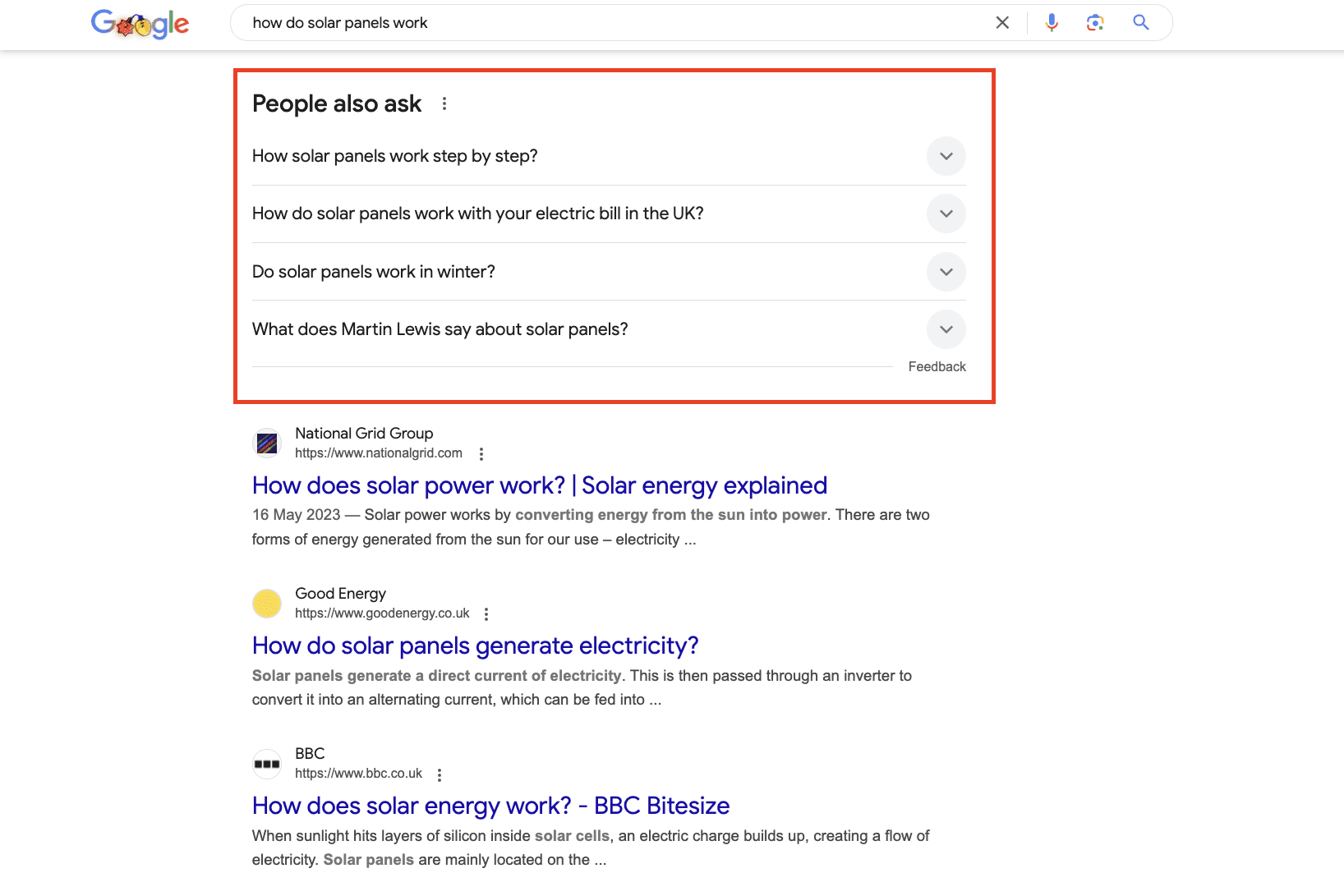
People Also Ask (PAA) Boxes

Expandable sections showing related questions and answers, helping users explore topics in greater depth.

Screenshot from search for [how do solar panels work], Google, January 2025

Local Packs

Groups of three local business listings with maps, particularly prominent for location-based queries.

Screenshot from search for [pizza near me], Google, January 2025Screenshot from search for [pizza near me], Google, January 2025

Shopping/Product Features

  • Product Carousels: Horizontal scrolling product listings with images and prices.
  • Shopping Knowledge Panels: Detailed product information with purchasing options.
  • Merchant Listings: Comparison shopping results from multiple retailers.
Screenshot from search for [wireless headphones], Google, January 2025Screenshot from search for [wireless headphones], Google, January 2025

Visual Features

  • Image Packs: Grid layouts of relevant images.
  • Video Carousels: Scrollable video results, often from YouTube.
  • Visual Stories: Web stories in a mobile-friendly format.

News And Editorial Features

  • Top Stories Boxes: Recent news articles.
  • Publisher Carousel: News from specific publications.
  • Perspectives Carousel: Opinion pieces and editorials.
Screenshot from Google News, January 2025

Why Does SERP Analysis Matter?

SERP analysis is a cornerstone of any SEO strategy because it provides actionable insights about your competition, audience preferences, and search engine ranking factors.

Here’s why it’s so important:

1. Understanding Search Intent

Search intent is the motivation behind a user’s query.

For example, a user might want to learn how to complete a specific task, compare different products or services, or make a purchase.

Analyzing the top-ranking pages for a keyword is the best way to infer the search intent behind that term. This is because search engine algorithms are fine-tuned to surface content that best matches what users expect to see.

So, if most of the results for a given keyword are tutorial-based articles, it’s safe to assume that users searching for that keyword are looking for step-by-step instructions or educational content.

Meanwhile, if the results consist primarily of product pages or reviews, the intent is likely transactional, with users looking to make a purchase or compare options before buying.

Further reading: How People Search: Understanding User Intent

2. Uncovering Competitor Strategies

Studying top results helps you identify what your competitors are doing right.

This includes the depth and structure of their content, their use of multimedia formats like videos or infographics, keyword optimization tactics, and the strength of their backlink profiles.

By closely examining these factors, you can uncover patterns in the strategies across competitors that drive their success.

What’s more, SERP analysis helps you pinpoint gaps in your competitors’ strategies – such as overlooked topics, under-optimized keywords, or weak content in high-ranking positions – giving you opportunities to create more comprehensive, engaging, and authoritative content that outperforms them.

Further reading: SEO Competitive Analysis: The Definitive Guide

3. Identifying Keyword Opportunities

Not all keywords are equally competitive.

SERP analysis can help you find low-hanging fruit – keywords with manageable competition that still attract significant search volume.

By identifying these overlooked or underserved keywords, you can create targeted content to capture untapped traffic and build authority.

These opportunities are especially valuable for smaller websites or those just beginning to build domain authority.

They allow you to focus your efforts on achievable wins while steadily growing your traffic and credibility.

Further reading: Keyword Research: An In-Depth Beginner’s Guide

4. Optimizing For SERP Features

Appearing in SERP features (as we discussed earlier) can significantly increase your visibility and click-through rates.

Because even if you don’t achieve the highest rankings, your site can still claim some valuable SERP real estate and capture user attention.

SERP analysis helps you identify which features appear for your target keywords and what type of content Google pulls into them.

For example, featured snippets often prioritize concise, well-structured answers, while PAA boxes highlight responses to commonly searched follow-up questions.

By tailoring your content to match the requirements of these features – whether it’s using clear formatting, answering common questions, or implementing structured data – you can boost your chances of appearing in these prominent positions, ultimately driving more traffic to your site.

How To Conduct SERP Analysis In 4 Steps

1. Identify Your Target Keywords

Start by choosing the keywords you want to target.

The goal here isn’t just to pick any search terms that are relevant to your business.

Remember, not all keywords offer the same value – some are highly competitive, while others may not attract enough search traffic to be worthwhile.

Instead, focus on keywords that are:

Aligned With Your Audience’s Interests

Look for terms that reflect the type of content your target audience will likely find valuable, whether it’s solutions to their problems, product recommendations, or in-depth information on a particular topic.

Promote Your Business Goals

Focus on terms that match your immediate business objectives, such as building brand awareness, generating leads, or directing traffic to specific product pages.

Not Too Competitive

Avoid going after highly competitive keywords dominated by well-established brands unless you have the resources to compete.

Instead, look for long-tail keywords or niche terms that give you a better chance at standing out.

Attract Search Volume

As a rule, keywords with high search volumes tend to be the hardest to rank for.

That said, you don’t need to aim for the highest-volume keywords to see results.

Instead, focus on keywords with moderate search volume that are still relevant to your audience and achievable for your domain authority.

2. Analyze The SERP Landscape

When examining search results, consider:

Desktop Vs. Mobile Differences:

  • Feature placement variations.
  • Mobile-specific elements like scrolling carousels.
  • Different click behaviors and user patterns.

Location And Personalization Impact:

  • How results vary by geographic location.
  • Personalized elements based on search history.
  • Language and regional preferences.

SERP Feature Opportunities:

  • Which features appear for your target keywords.
  • Requirements for earning specific SERP features.
  • Competition level for each feature type.

3. Evaluate Top-Ranking Pages

Next, you’ll need to examine the top-performing content in a little more depth.

The goal is to figure out what makes these pages rank so highly so you can reverse-engineer their success and apply similar strategies to your own content.

Here are some things to consider:

  • Content Quality: Evaluate the depth, relevance, and clarity of the content. Is it comprehensive, engaging, and well-structured? Does it fully address user intent, or are there areas where it falls short?
  • SEO Best Practices: Check title tags, meta descriptions, and header structures. Pay attention to how keywords are incorporated naturally throughout the page.
  • Multimedia Usage: Notice if the pages include videos, images, charts, or infographics. These elements enhance the user experience and often signal higher-quality content to search engines.

So, if you find that the top pages for your keyword average 2,000+ words, cover multiple subtopics, and include custom visuals and quotes from industry experts, creating a 500-word blog post probably won’t cut it.

To compete, you’ll need to create a more detailed, engaging resource that provides value users can’t get elsewhere.

This leads us to the final step.

4. Look For Content Gaps And Opportunities

Here, the goal is to find opportunities to differentiate yourself by looking at where existing top-ranking content falls short.

Ask yourself:

  • Are there questions users might have that the current results don’t fully answer?
  • Could you provide more up-to-date statistics, original research, or unique case studies?
  • Are there related keywords or subtopics that competitors overlook?

For example, if top-ranking pages lack practical examples, recent data, exclusive quotes from industry leaders, or high-quality visuals, incorporating these elements will help give you an edge over your competitors.

This step is all about going above and beyond the quality of existing content. By filling these gaps, you’ll provide a more valuable reading experience for users.

Final Thoughts

SERP analysis has evolved beyond simply studying organic rankings. Success requires understanding the full spectrum of SERP features and how they interact with user intent and behavior patterns.

By implementing the strategies outlined in this guide and staying current with new SERP features as they emerge, you’ll be better positioned to capture valuable SERP real estate and drive meaningful traffic to your site.

Remember to regularly review and update your SERP analysis approach as search engines continue to evolve and introduce new features that can impact your visibility and performance.

More Resources:


Featured Image: Gorodenkoff/Shutterstock

Google’s Q4 Earnings Point To An AI-Focused Future via @sejournal, @MattGSouthern

Alphabet Inc., Google’s parent company, reported strong fourth-quarter results for fiscal 2024, primarily driven by its commitment to AI.

Alphabet announced revenues of $96.5 billion for Q4 2024, up 12% from last year.

Google Services, including Search and YouTube ads, grew by 10% to $84.1 billion.

Google Cloud increased revenues by 30% to $12.0 billion as more businesses adopted its AI services.

Operating income rose by 31%, and net income increased by 28% to $26.5 billion.

AI-Driven Growth

CEO Sundar Pichai highlighted the company’s AI achievements and recent launches during the earnings call.

Pichai said:

“Q4 was a strong quarter driven by our leadership in AI and momentum across the business. We’re making dramatic progress across compute, model capabilities, and in driving efficiencies. We’re rapidly shipping product improvements, and seeing terrific momentum with consumer and developer usage.”

Infrastructure Investments

Alphabet is investing heavily in its infrastructure, launching new data centers and subsea cable projects to improve global connectivity.

Pichai stated:

“We broke ground on 11 new Cloud regions and data center campuses in places like South Carolina, Indiana, Missouri, and around the world. We also announced plans for seven new subsea cable projects, strengthening global connectivity.”

These efforts will support the growth of AI services, as data centers now provide nearly four times more computing power for the same energy.

Implications for Search and Marketing

Google reported that its AI-powered search features are gaining traction. AI Overviews are now available in more than 100 countries.

Circle to Search, available on over 200 million Android devices, is popular among younger users, who now use it for more than 10% of their searches.

SEO professionals and digital marketers should brace for further changes, as Pichai declared that “2025 is going to be one of the biggest years for Search innovation yet.”

The company’s $75 billion capital expenditure plan for 2025 suggests significant investments in search technology and AI capabilities.

Looking Ahead

Google’s Q4 results highlight its focus on AI. Overall revenue increased 12%, and the cloud business grew 30%. Profits increased as well, with operating income rising 31%.

The company’s investments in data centers and undersea cables will support global AI growth.

New AI features, such as Search Overviews and Circle to Search, are changing user behavior, so SEO teams should prepare for more changes in 2025.

Keep an eye on Google’s $75 billion spending plan to expand AI technology.


Featured Image: Dennis Diatel/Shutterstock