Turning Insights into Action: Benchmarking & Strategic SEO via @sejournal, @Conductor

SEO is not just about optimizing for search engine rankings. It’s also about understanding your audience’s needs and providing solutions through your website or landing page.

Google alone processes over 100 billion searches a month. So, if you get your strategy right, the potential to reach new customers through search is immense.

But here’s the catch: Search algorithms are always changing. The recent introduction of generative AI directly in search has shaken up how users interact with search engines.

What that means for SEO is that you can’t just set it and forget it – your SEO strategy needs to adapt to these changes to stay competitive.

You need to regularly analyze and course-correct to ensure you’re taking advantage of the latest best practices and strategies.

In this guide, we’ll walk you through the steps for creating an effective SEO strategy that aligns with both search engine algorithms and user expectations.

1. Align SEO With Business Goals & Define KPIs

It’s crucial to align your SEO strategy with your overall business goals and define the key performance indicators (KPIs) that will help you measure success.

Knowing where you want to go and how you’ll measure progress ensures that your SEO efforts are focused and effective.

Your SEO goals should support your business objectives, whether that’s increasing brand awareness, driving more traffic, generating leads, or boosting sales.

During this planning phase, you’ll want to define your KPIs.

This is how you’ll measure the success of your implementations and figure out what’s working for you and where you need to make adjustments.

Some of the SEO KPIs you should be tracking are:

  • Visibility in search (segmented by search features such as AI Overviews, featured snippets, Local Packs, etc.).
  • Traffic from search (organic traffic).
  • Keyword rankings.
  • Branded searches.
  • Quality backlinks.
  • New and returning users.
  • Leads and conversions.
  • ROI from organic channel.
  • Pages per session.
  • Average engagement time on page and bounce rate. (Bounce rate is not a universal metric for everyone, but is 100% dependent upon the events you set up).
  • Core Web Vitals.
  • Crawl errors.

Keep in mind that these are internal SEO KPIs that you can track in analytics.

Higher-level executives may be more interested in overall business impact, such as SEO-supported attribution and how SEO contributes to the customer journey.

It’s also important to convey that SEO is a long-term strategy that may take time to show significant results.

2. Set Realistic Expectations

One of the most common mistakes people unfamiliar with SEO make is expecting overnight results.

SEO is not a direct response style of marketing, and not all SEO strategies result in an immediate outcome.

Because of the variables involved with competition, inbound links, and the content itself, it’s nearly impossible to provide a definite timeframe.

You need to go into the process with an understanding that SEO takes time, and the more competitive the keywords you’re going after, the longer it will take to climb to the top.

This needs to be conveyed to stakeholders from the start to ensure expectations are realistic and to establish consistent, accurate data that earns trust.

SEO can be part of the entire customer journey.

Someone might find your site via organic search, then later see a paid ad, and finally make a purchase. Or they might see an ad first, then search for your brand and find you organically.

This is where multi-touch attribution comes into play. Using multi-touch attribution tracking tools like Triple Whale can help you understand how different channels contribute to conversions.

3. Conduct SEO Audit

Now that you’ve aligned your SEO strategy with your business goals and set the right expectations, it’s time to understand where you currently stand.

You’ll want to begin by performing an SEO audit.

An SEO audit serves as the roadmap that will guide you throughout the entire optimization process and allows you to benchmark against your current site.

You need to examine a variety of aspects, including:

  • Domain name, age, history, etc.
  • On-page SEO factors like headlines, keyword & topical targeting, and user engagement.
  • Content organization, content quality, and the quality of your images (no one trusts stock photography).
  • Duplicate content.
  • Backlink profile quality.
  • Website architecture.
  • Technical SEO factors like sitemaps, image optimization, and robots.txt.
  • Implementation of hreflang tags for multilingual sites.

For a step-by-step guide on how to perform this audit, we have an excellent series that will guide you through it.

Once you have a clear understanding of your current SEO status, it’s time to plan your timeframe and allocate budgets and resources.

This is yet another area of life where you get what you pay for. If you’re looking for fast and cheap, you’re not going to get the results you would by investing more time and money.

Obviously, your budget and timeframe will depend on your company’s unique situation, but if you want good results, be prepared to invest accordingly.

For an idea of how much you should be spending, consult this article.

4. Perform Keyword Research

Search engine rankings are determined by an algorithm that evaluates a variety of factors to decide how well a website answers a particular search query. And a huge part of that is the use of keywords.

From single words to complex phrases, keywords tell search engines what your content is about. But adding keywords isn’t quite as simple as just plugging in the name of the product or service you want to sell.

You need to do research to ensure keyword optimization and avoid cannibalization, and that means considering the following:

Search Intent

Words often have multiple meanings, which makes it crucial to consider search intent, so you don’t attract an audience that was searching for something else.

For example, if you sell hats, ranking highly for ‘bowler’ will attract users looking for 10-pin bowling in the U.S., or in the UK about cricket and not someone shopping for a bowler hat.

Relevant Keywords

Once you’ve identified the search intent of your target audience, you can determine which keywords are relevant to them.

By aligning your keywords with search intent, you can produce relevant content and increase your chances of ranking higher in SERPs. Besides ranking high, it will also improve user satisfaction and increase conversion rate.

Keyword Research Tools

The brainstorming process is a great place to start keyword research, but to ensure you’re attracting the right audience and proving your value to search engines, you should utilize a research tool.

They can provide valuable data, such as search volume and competition level, and suggest related keywords you might not have considered.

Search Volume

By using keyword research tools, one of the most important metrics to look for is the search volume.

Ideally, you should target relevant keywords with the highest search volumes. However, it is important to assess the competition around that search term.

If you are going to compete with large and well-established brands and you are just starting, perhaps it is a better idea to choose long-tail keywords with less search volume but less competition.

Long-Tail Keywords

These are specific search terms consisting of more than one word.

They tend to be longer and are more likely to be used by people with specific stages in the conversion funnel, helping you reach users who are ready to convert.

An example of this would be [vegetarian restaurants in San Antonio], which would most likely be used by someone with a craving for a plant-based meal.

Lastly, remember that tools provide aggregate data of the same search terms with measurable search volumes, which they obtain from different data providers.

Often, there are long-tail searches that users perform, which are the same but formulated differently, and tools may report them as zero search volume due to negligible search volumes.

This phenomenon is likely to increase as highly intelligent AI assistants are integrated into mobile phones, and users are more likely to perform unique voice searches on the same issue.

If a certain problem is relevant to your specific industry and you know it, but tools report zero search volume, it is worth covering it and offering a solution.

You may find you have decent and highly targeted traffic that converts.

5. Define Your Most Valuable Pages

Every team needs an MVP, and in the case of your website, that’s your most valuable pages.

These pages are the ones that do the bulk of the heavy lifting for you.

For non-ecommerce sites, these are usually things like your home page, your services pages, or any pages with demos or other offers.

These pages are also likely MVPs for ecommerce sites, but will also be joined by category and/or product-level pages.

To find which pages are your site’s most important ones, you should consider what your organization is known for.

What verticals do you compete in? What pain points do you solve? Define these or add more based on the high-level keywords you came up with in the previous step.

Once you’ve identified the category and product pages that bring in the most visitors, you’ll be able to focus your strategy on improving them and increasing your organic traffic.

Read more about how to find your MVPs here.

6. Keep Content Up To Date

Your MVP pages become stale over time while search engines aim to surface for users the most relevant and up-to-date content.

Content decay is a natural process; you should set up a process to keep content up to date constantly.

Here is an example from one of the websites I work on, showing how it looks and highlighting the importance of updating outdated content.

An example of content decay: updating content helped regain organic traffic.An example of content decay: updating content helped regain organic traffic.

Please note that you should refrain from using automatic updates with AI chatbots, as it is one of the most dangerous, spammy SEO tactics that can result in a complete loss of organic traffic.

Read our guide to learn content decay strategies you can implement to keep your organic traffic growing.

7. Optimize For User Experience

Don’t overlook the importance of how your site is structured, both technically and in terms of how users interface with it.

The best content and keyword strategy in the world won’t lead to a single sale if your site is constantly broken or is so frustrating to use that people close your page in disappointment.

You should carefully consider your site’s architecture and user experiences to ensure people are taking the desired actions.

With mobile traffic being 62.15% of total web traffic (and 77% of retail website traffic), optimizing for mobile is even more critical.

Read our guide UX & SEO Guide to learn more.

8. Conduct A Competitive Analysis

If you didn’t have any competition, there would be no need for SEO. But as long as other companies are manufacturing refrigerators, Frigidaire needs to find ways to differentiate itself.

You need to have an idea of what others in your industry are doing so you can position yourself for the best results.

You need to figure out where you’re being outranked and find ways to turn the tables.

You should know which keywords are most competitive and where you have opportunities by performing content gap analysis.

You should understand your competitor’s backlinking and site structure so that you can optimize your own site for the best possible search ranking.

And remember, AI chatbots are your competitor, too, where users can get answers directly without visiting a website.

This means that some of the traffic you might have received in the past could now be staying in the chatbot.

To compete, you need to offer something AI can’t: unique insights, personal experiences, and authoritative content that stands out.

Consider how AI presents information and find ways to differentiate your content. Focus on building your brand authority and providing value that AI chatbots can’t replicate.

Learn more about how to perform this analysis and develop a template for it by reading this piece.

9. Establishing Brand Authority And Link Building

All the points we covered so far are essential for success in SEO, but they are not enough.

You can achieve success by merely improving your website, and if you aim for your brand to exist only in Google Search, you will likely not be able to rank and achieve success.

That is why you need to work on your brand marketing tirelessly in order to build your brand authority, which, in turn, helps you earn natural backlinks as a recognized and trustworthy source.

It’s not such an easy thing to get right, and that is where most companies struggle and why SEO is hard.

To build brand authority, you need the following steps:

  • Build an email newsletter list.
  • Share valuable research and insights others want to link to.
  • Attend conferences relevant to your field and sponsor them if you have enough resources.
  • Seek opportunities for interviews or speak at conferences.
  • Host webinars or live sessions to share knowledge and interact with your audience in real time.
  • Participate in online discussions with your industry community on different platforms such as Linkedin, Twitter, Reddit, or other platforms specific to your industry.
  • Collaborate with experts in your industry to contribute to your content.
  • Invite influencers to try your products or services and share their experiences.
  • Offer effective support to your customers.

Even if you get unlinked brand mentions, it is a step forward in building brand awareness.

Think of for a moment if one reads your unlinked brand mention on a reputable website (or on a TV show) and performs a Google search to find your brand.

That could be considered as a branded search which is a ranking factor. It is important to note unlinked mentions are not a ranking factor as there is much misinformation out there, but when one performs a branded search on Google.

Of course, you can go ahead and try to convert an unlinked mention to a link, and it is always one of the natural ways to build a link.

However, in the age of AI, another benefit of unlinked brand mentions is that chatbots – which are trained on content across the web – may surface your brand name to users when they perform tasks or research.

10. Integrate SEO Into Your Workflows

SEO doesn’t exist in a vacuum – it impacts many other parts of your organization, including marketing, sales, and IT.

If you’re looking for the budget to perform SEO, you may find some of your employees are already well-qualified to help.

For example, your sales team probably knows which products people are most interested in.

Enlisting them in your SEO strategy development will help with lead generation and finding new targets who are already qualified.

Similarly, SEO can tell your marketing team what types of content resonate best, so they can fine-tune their campaigns. And your copywriters and graphic designers can develop the type of content that will help you shoot up the rankings.

Your IT team probably already has control over your website.

Your SEO strategy should be designed around their expertise, to ensure website design and structure, development cycles, data structure, and core principles are all aligned.

Evaluate your existing software, technology, and personnel, as there’s a good chance you have some of the pieces already in place.

If you need to scale production up, you may find the budget already in place in existing departments.

These are just a few ways to integrate SEO into your existing workflows.

If you’re an external SEO agency or consultant, it’s crucial to establish strong communication channels with the company’s personnel who are responsible for implementing SEO recommendations and making decisions.

Read our guide on best practices for establishing effective communication between SEO teams in enterprise companies.

11. Align Your SEO Strategy With Your Customer Funnel

At the end of the day, sales are the name of the game. Without customers, there’s no revenue, and that means no business.

To aid in the sales process, your SEO strategy should align with your customer funnel.

Sometimes described as the customer journey, your sales funnel is a summation of the touchpoints customers have with your company as they go from awareness to post-purchase.

SEO fits neatly with every stage of this cycle:

  • Awareness: In the modern world, many customers first hear about your business online through a Google search, for example. Well-written blog posts are a great way to increase your awareness and increase your brand recognition.
  • Interest: This is where customers start doing research. And what better place to do research than your website? In-depth guides and ebooks will be a great match for satisfying users’ interests.
  • Decision: The customer wants to buy and is deciding between you and the competition. Case studies or testimonials could be the thing that sways them.
  • Purchase: Having a search engine-optimized point of sale makes it easy for people to buy, and optimized product pages are what can move the needle.
  • Post-purchase: Once you’ve acquired customers, think of ways to retain them by publishing support articles or offering loyalty programs.

12. Report And Measure

Finally, you need to define what success looks like for each KPI measure and report the progress you’re making.

There are a variety of both paid and free tools available that you can use to measure and track conversions, and compare them weekly, monthly, or by another timeframe of your choosing.

Simply find one that works for your budget and needs.

For a guide on how to create impactful reports that generate quality insights, read our guide here.

Conclusion

No one ever said SEO was easy, at least not anyone who has done it. But it’s a vital part of any modern organization’s business plan.

However, with a solid strategy, a willingness to learn, and a little old-fashioned elbow grease, even a complete beginner can send their website to the top of the SERP.

In this piece, we’ve given you 12 steps to take to get your SEO strategy off the ground. But of course, this is just the start.

You need a unique plan that will work for your industry and your needs.

Luckily, Search Engine Journal can help with this, too.

Download our ebook on SEO strategy with a full-year blueprint for an easy-to-follow 12-month plan you can use to develop a solid strategy, track your progress, and adjust to changing situations.

More resources:


Featured Image: Ingenious buddy/Shutterstock

Marketing & SEO Conference Value Is More Than Information via @sejournal, @rollerblader

If you’ve attended a marketing conference and felt like everything was below your knowledge level or that your questions weren’t answered, there’s a good reason for that.

Not everyone is advanced, and not everyone is a beginner.

National conferences ensure that the speakers cater to the majority of the group rather than specific individuals at higher and lower levels, with the exception of pre-show workshops and beginner-level tracks.

Pro-tip: Ask questions during the Q&A and at the show. The speaker can and will likely answer your advanced-level question and provide a solution. They do know the answers, but they may not present them because they are too advanced for the show, including on advanced tracks. If you don’t ask, you won’t get an answer. Don’t be afraid. It is literally why you are there and why they are on stage.

Information isn’t the only reason to go to a show. If you’re beginning your career, yes and absolutely. If you’re mid-level or advanced, there’s a lot more you will gain by going to conferences, even if it isn’t information. And that’s what this post is about.

The three headers are in a specific order, as one leads to the next.

One of the most valuable assets I gained from attending conferences is being able to get solutions in a matter of minutes or days, rather than researching for weeks and hoping to find answers.

Builds Your Network For Job And Income Security

The first and largest benefit of conferences is that you’ll build your network of peers. For marketers, this includes in-house professionals, agencies, and vendors.

When you build trust with these people, bonds are formed – and those bonds carry you through the rough times.

They also lead to increased compensation and new titles as opportunities become available at your own and at different companies.

One of my first conferences was around 2005 or 2006 at Commission Junction University (CJU). The rep there liked what I had to say, saw the information shared at two dinners and a networking event, and took note of it.

When I got back to my office in Washington DC, CJU offered me a job, either remote or in Santa Barbara. I stayed at my current company, but I still talk to a few people I met there, almost 20 years later.

Next was the Affiliate Summit West in 2006 at Bally’s in Las Vegas.

I already knew multiple industry people from a forum called ABestWeb.com, but the conference introduced us all at an unofficial event at the dueling piano bar – and I’m still working with some of these people today.

If I hadn’t gone, these specific people may not have promoted the affiliate programs we managed. Affiliates get pitched daily, and the in-person aspect makes a huge difference on who they work with and who they do not.

As an agency owner, if I hadn’t met the affiliates, merchants, solution providers, and competing agencies, they wouldn’t be sending my agency SEO, conversion, and affiliate management leads.

If I hadn’t gone to these two shows above, my career network would not have been built, and I would not have the access I have today, including writing for SEJ.

More importantly, when things go bad, the people in this group always help in any way they can. This includes sending contracts to each other, sharing job openings, or trying to take on new business so we can hire each other if the bond is strong.

Local Groups And Communities Lead To Better Marketing

National shows like Pubcon, Affiliate Summit, SMX, etc. lead me to meeting local groups like SEMPDX, the Duluth Chamber of Commerce and AimClear, DFWSEM, Houston’s marketing group, Raleigh Tech Triangle, among others – all of which have local annual shows and/or monthly meetups.

Being able to explore and speak at local groups gave me career opportunities and information I’d never have learned if speaking and attending national shows never happened.

Local Cultures And Customs

Engaging even just for a week lets me better target and market for local SEO, affiliate, and paid media.

By being a tourist, I got to know landmarks, what it is like to be at them, and most importantly, the ones that matter most to the locals as they are the ones answering my questions about what to do and why.

Their slang and recommendations help you speak their language and reference their communities using their own words vs. one person’s opinion.

Show Size Means Better Networking

When there are fewer people attending, you get more time to actually learn what others do.

There’s less of a feeling of rushing and hustling and more of a calm atmosphere in which to engage with each other.

These bonds are equally as strong as the long-term ones, and if the speakers and brands you want to meet are there, you get more time to actually say hi vs. a handshake.

This goes a long way with relationship building.

Less Expensive And More Networking

The cost of the local shows is a lot less than a national show because they’re less expensive to put on.

The quality of speakers and information is equal, if not better, and can be customized for the audience members.

I just presented in Portland and used examples of what to do based on the companies attending so they could leave with actionable items.

At Zenith in Duluth and Barbados SEO, you had some of the most sought-after SEO professionals in the world at a fraction of the normal cost, including Lily Ray, Michael Icon King, Aleyda Solis, Purna Virji, Andrew Shotland, and Cindy Krum.

I also got to meet new people and learn new things from like Isa Lavahun and Apurva Bose.

The cost of a ticket is a fraction of the national shows, but the speaker quality was the same (if not higher).

I mentioned the networking and bonds from these local shows above. Here’s one of many examples of how local shows lead to international relationships.

At a local State of Search conference, Arsen Rabinovich and I were both speaking and met for the first time. He invited me out for pizza (my favorite food), and we bonded.

A couple of years later, he forced me to sit at a blackjack table (I hate card games), and that was when I met the other players, who included Aleyda Solis (Spain), Dawn Anderson (England), Lily Ray (NYC).

If I hadn’t been at that State of Search, I wouldn’t have had the next opportunity (or that really good pizza), and each of these people has impacted my career and speaking at different points in time now.

Getting Answers To Difficult And Impossible Questions

Once the relationships were built and people trusted me, I found myself being invited to private communities hosted on custom URLs, on Facebook, etc.

This is where the most value came from, as I attended marketing conferences. These groups are carefully vetted, and where you can get detailed answers with actual data based on actual experience.

We all encounter situations we don’t have answers to and that we cannot ask publicly – whether it is an NDA or your company prohibits sharing problems outside of the organization.

These groups are where you can ask and share as much as you are able, and others will respond with what they did or how they solved the issue.

If nobody has solved the issue before, people in the groups often look for solutions or run tests on their own websites and platforms to see if they can replicate the problem and then fix it.

When I didn’t have a software solution for other channels, someone else in these groups did.

The added benefit of being in the private group is these people won’t say the actual issues they have with the products publicly, but they go into detail on what to avoid and the reasons why.

It helped me avoid pitfalls when my clients were about to invest in new tools and tech stacks.

One of the most valuable assets I gained from attending conferences is being able to get solutions in a matter of minutes or days, rather than researching for weeks and hoping to find answers.

If I didn’t go to the big ones and wasn’t invited to speak at them, I wouldn’t have met these local groups from around the country and the world.

If I didn’t attend those, I wouldn’t have been able to market as effectively locally which impacts both local and national marketing campaigns.

Most importantly, I wouldn’t have access to the communities and groups that help me solve problems.

Attending Conferences Helped Me Build Essential Relationships

Conferences, whether they’re marketing, human resources, IT, or even houseware and photography shows, have more value than a bit of information in a session.

It’s the network you build, the relationships you form, and the power they add to your career, financial, and mental well-being.

If I didn’t get out of my comfort zone and begin attending, speaking at, and in some cases exhibiting at these shows, life would be a lot harder.

I still have struggles just like everyone, but I have a network and community to help me through them, thanks to attending conferences.

More resources:


Featured Image: Jacob Lund/Shutterstock

Global SEO: How To Strategize For Multinational Businesses via @sejournal, @TaylorDanRW

A lot of multinational SEO campaigns fall down when the strategy is just to target a set of keywords, set up hreflang, and create content.

Understanding local customs, language, and consumer behavior is crucial for market penetration and creating brand resonance.

Creating a multinational SEO strategy doesn’t mean just doing international SEO.

Multinational SEO means taking into consideration cultural norms, understanding your target market from a user and competition standpoint, understanding purchasing power, buying cycles, and market-specific legalities.

With SEO facing new challenges like AI and increased multi-modal user behaviors, our international strategies need also to start to take into account wider data points and information in the overall business marketing mix.

5Cs Framework For Multinational SEO

There are a number of different models and frameworks you can use when developing your multinational national SEO strategy, but a relatively stable framework that requires wider business participation is the 5C analysis.

This framework helps product marketers identify their product’s unique selling points and understand what they can learn about their business, products/services, and potential market fit.

Company

When working with wider business stakeholders, you need to examine the offering portfolio, evaluate it against competitors, find differentiations, and determine how it best meets customer needs and reduces their friction points.

During this process, you will also identify areas where competitor products have an advantage over yours.

This also includes assessing any innovation or improvements necessary to stay competitive. You also need to consider the brand identity and reputation – how the company is perceived in the target market.

Sometimes perception is formed by variables outside of your direct control, and can even stem to political attitudes towards the company’s country of origin, or negative actions of competitors in the marketplace.

Customers

Analyzing customer buying behavior and their decision-making processes is crucial for understanding how consumers approach purchasing products or services.

This involves looking at how customers research, evaluate, and ultimately choose from various options.

Having a deep understanding of these behaviors enables businesses to refine their marketing strategies to better align with customer needs.

Sometimes, customer preferences come from historic marketing and advertising campaigns that shape markets. Good examples of this are the Ploughman’s Lunch in the UK and KFC as a Christmas tradition in Japan.

Competitors

Identifying key competitors is essential for gaining a clear understanding of the market landscape.

This process involves recognizing the major players targeting the same customer base and assessing their market share, growth potential, and competitive advantages.

Competitors can be classified into four main types:

  • Direct.
  • Indirect.
  • Potential.
  • Replacement.

The different types can influence a company’s market position and overall strategy.

A good example of these competitor types in action could be oat milk.

As an oat milk brand entering the U.S. market, you would have direct competitors such as Oatly, Planet Oat, and Minor Figures.

Your indirect competitors would be classic dairy milk brands like Dannon and Kirkland.

Your potential competitors would then be brands that offer similar products and are entering the oat milk market as a portfolio extension, such as Milkadamia and Chobani, and brands that offer other non-animal-based products to the same audiences.

Finally, your replacement competitors would be other non-dairy milk brands such as Malibu Mylk and Flax USA.

The realization you will come to from this phase of the 5C framework is the understanding that only a percentage of your possible Total Addressable Market (TAM) is directly looking for your exact product, but there are other products that also meet the same needs, albeit to different lengths and in different ways.

Collaborators

Several factors come in when making a full evaluation of how something is positioned within the market.

Channels of sales, online and physical presence, distribution method, relationship with its suppliers, price, and marketing strategy are variables relating to an item’s performance within the market.

The way a product is distributed speaks to how it reaches its end consumer.

Are there exclusive agreements with specific distributors, or is the product available through a variety of third-party channels?

Understanding the distribution network helps assess how well the product is actually supplied to multiple markets and regions.

A more diversified model of distribution may result in deeper market penetration, while exclusive partnerships could provide higher margins.

Another key component to understand is if there are any existing importers or resellers of your products and services in the target market.

Climate

Climate can be covered by using the PEST framework.

A PEST analysis helps businesses assess political, economic, social, and technological factors that influence their environment.

This approach gives companies a clearer view of external challenges and opportunities.

 Political Examples

  • Data privacy regulations.
  • Import/export regulations and taxes.
Economic Examples

  • Currency exchange rates.
  • Local purchasing power.
Social Examples

  • Level of digital adoption.
  • Cultural preferences and trust in digital shopping/payment methods.
Technological Examples

  • Cloud service adoption rates.
  • General infrastructure (courier services, internet capabilities).

Analyzing market trends further helps identify emerging opportunities or threats.

For instance, businesses can leverage the rise of ecommerce or address sustainability demands by adapting their offerings.

Understanding how economic conditions impact purchasing power enables companies to predict demand better and make strategy adjustments.

Purchasing power refers to the ability of individuals or groups to buy goods and services influenced by income, prices, and inflation. Understanding it is crucial for entering new markets.

Higher purchasing power indicates greater spending ability, making a market more attractive. Low purchasing power markets can pose risks if consumers cannot afford the product.

Defining “Organic Success”

Every market has its special characteristics, and the application of global success metrics on the mistaken premise that markets are all alike will often result in distortion.

Success metrics need to be able to adapt to the peculiar features of each market.

Trying to compare one market to another, and holding the same SEO KPIs and success metrics can be like comparing apples to pears.

Success Definition And Understanding User Path To Purchase

The understanding of the user’s path to making a purchase or completing a lead is crucial.

Buying cycles may be different in different regions; hence, the user’s behavior may not follow the same path across all territories.

These differences need to be recognized when defining success. What works in one market may not work in another. The buying cycle may be longer or more convoluted in some markets than others.

A user in one region may go through a quick decison-making process, while another takes longer and involves more touchpoints. This has to be factored into how you measure campaign success.

Multi-Modal Search Differences

In some markets, users may also use different search engines or platforms.

They’ll use multi-modal platforms – in other words, a combination of social media, search engines, and video platforms – to discover new information.

It is also important to understand which platforms over-index your target audience and which under-index them in certain regions.

For example, a business selling multiple fashion and apparel products will find that the audience for “Christmas Jumper” over-indexes on TikTok and Facebook, but the audience for “Christmas Dress” over-indexes on TikTok and Instagram (ahead of Facebook).

Given the surge in AI-related products across a number of platforms, such as Meta AI, understanding how your target segments research and discover products alters your definitions of organic success.

More resources:


Featured Image: jannoon028/Shutterstock

6 SEO Practices You Need To Stop Right Now via @sejournal, @martinibuster

Some SEO practices haven’t kept pace with changes in search engines and may now be self-defeating, leading to content that fails to rank. Here are six SEO practices that hinder ranking and suggestions for more effective approaches.

1. Redundant SEO Practices

The word redundant means no longer effective, not necessary, superfluous. The following are three redundant SEO practices.

A. Expired Domains

For example, some SEOs think that buying expired domains is a relatively new thing but it’s actually well over  twenty years old. Old school SEOs stopped buying them in 2003 when Google figured out how to reset the PageRank on expired domains. Everyone holding expired domains at that time experienced it when they stopped working.

This is the announcement in 2003 about Google’s handling of expired domains:

“Hey, the index is going to be coming out real soon, so I wanted to give people some idea of what to expect for this index. Of course it’s bigger and deeper (yay!), but we’ve also put more of a focus on algorithmic improvements for spam issues. One resulting improvement with this index is better handling of expired domains–the authority for a domain will be reset when a domain expires, even though dangling links to the expired domain are still out on the web. We’ll be rolling this change in over the next few months starting with this index.”

In 2005 Google became domain name registrar #895 in order to gain access to domain name registration information in order to “increase the quality” of the search results. Becoming a domain name registrar gave them real-time access to when domain names were registered, who registered them and what web hosting address they were pointing to.

It’s surprising to relatively newbie SEOs when I say that Google has a handle on expired domains but it’s not news to those of us who were the very first SEOs in history to buy them. Buying expired domains for ranking purposes is an example of a redundant SEO practice.

B. Google And Paid Links

Another example are paid links. I know for a fact that some paid links will push a site to rank better and this has been the case  for many years and still is. But, those rankings are temporary. Most sites generally don’t get a manual action, they just stop ranking.

A likely reason is that Google’s infrastructure and algorithms can neutralize the PageRank flowing from  paid links thereby allowing the site to rank where it’s supposed to rank without disrupting their business by penalizing their site. That wasn’t always the case.

The recent HCU updates are a blood bath. But the 2012 Google Penguin algorithm update was cataclysmic on a scale several orders larger than what many are experiencing today. It affected big brand sites, affiliate sites and everything in between. Thousands and thousands of websites lost their rankings, nobody was spared.

The paid link business never returned to the mainstream status it formerly enjoyed when so-called white hats endorsed paid links based on the rationalization that paid links weren’t bad because they’re “advertising.”  Wishful thinking.

Insiders at the paid link sellers informed me that a significant amount of paid links didn’t work because Google was able to unravel the link networks.  As early as 2005 Google was using statistical analysis to identify unnatural link patterns. In 2006 Google applied for a patent on a process that used a Reduced Link Graph as a way to map out the link relationships of websites, which included identifying link spam networks.

If you understand the risk, have at it. Most people who aren’t interested in burning a domain and building another one should avoid it. Paid links is another form of redundant SEO.

C. Robots Index, Follow

The epitome of redundant SEO is the use of “follow, index” in the meta robots tag.

This is why index, follow is redundant:

  • Indexing pages and following links are Googlebot’s default mode. Telling it to do that is redundant, like telling yourself to breathe.
  • Meta robots tags are directives. Googlebot can’t be forced to index content and follow links.
  • Google’s Robots Meta documentation only lists nofollow and noindex as valid directives.
  • “index” and “follow” are ignored because you can’t use a directive to force a search engine to follow or index a page.
  • Leaving those values there is a bad look in terms of competence.

Validation:

Google’s Special Tags documentation specifically says that those tags aren’t needed because crawling and indexing are the default behavior.

“The default values are index, follow and don’t need to be specified.”

Here’s the part that’s a head scratcher. Some WordPress SEO plugins add the “index, follow” robots meta tag by default. So if you use one of these SEO plugins, it’s not your fault if “index, follow” is on your web page. SEO plugin makers should know better.

2. Scraping Google’s Search Features

I’m not saying to avoid using Google’s search features for research. That’s fine. What this is about is using that data verbatim “because it’s what Google likes.”  I’ve audited many sites that were hit by Google’s recent updates that exact match these keywords across their entire website and while that’s not the only thing wrong with the content, I feel that it generates a signal that the site was made for search engines, something that Google warns about.

Scraping Google’s search features like People Also Ask and People Also Search For can be a way to get related topics to write about. But in my opinion it’s probably not a good idea to exact match those keywords across the entire website or in an entire web page.

It feels like keyword spamming and building web pages for search engines, two negative signals that Google says it uses.

3. Questionable Keyword Use

Many SEO strategies begin with keyword research and end with adding keywords to content. That’s an old school way of content planning that ignores the fact that Google is a natural language search engine.

If the content is about the keyword, then yes, put your keywords in there. Use the headings for describing what the content is about and titles to say what the page is about. Because Google is a natural language search engine it should recognize your phrasing as meaning what a reader is asking about. That’s what the BERT is about, understanding what a user means.

The decades old practice of regarding headings and titles as a dumping ground for keywords is deeply ingrained. It’s something I encourage you to take some time to think about because a hard focus on keywords can become an example of SEO that gets in the way of SEO.

4. Copy Your Competitors But Do It Better?

A commonly accepted SEO tactic is to analyze the competitors top-ranked content, then use the insights about that content to create the exact same content but better. On the surface it sounds reasonable but it doesn’t take much thinking to recognize the absurdity of a strategy predicated on copying someone else’s content but “do it better.” And then people ask why Google discovers their content but declines to index it.

Don’t overthink it. Overthinking leads to unnecessary things like the whole author bio EEEAT thing the industry recently cycled through.  Just use your expertise, use your experience, use your knowledge to create content that you know will satisfy readers  satisfied  and make them buy more stuff.

5. Adding More Content Because Google

When a publisher acts on the belief that ‘this is what Google likes,’ they’re almost certainly headed in the wrong direction. One example is a misinterpretation of Google’s Information Gain patent which they think means Google ranks sites that contain more content on related topics than what’s already in the search results.

That’s a poor understanding of the patent but more to the point, doing what’s in a patent is generally naïve because ranking is a multi-system process, focusing on one thing will not generally be enough to get a site to the top.

The context of the Information Gain Patent is about ranking web pages in AI Chatbots. The invention of the patent, what makes it new, is that it’s about anticipating what the next natural language question will be and then having those ready to show in the AI search results or showing those additional results after the original answers.

The key point about that patent is that it’s about anticipating what the next question will be in a series of questions. So if you ask an AI chatbot how to build a bird house, the next question the AI Search can anticipate is what kind of wood to use. That’s what information gain is about. Identifying what the next question may be and then ranking another page that answers that additional question.

The patent is not about ranking web pages in the regular organic search results. That’s a misinterpretation caused by cherry picking sentences out of context.

Publishing content that’s aligned with your knowledge, experience and your understanding of what users need is a best practice. That’s what expertise and experience is all about.

6. Basing Decisions On Research Of Millions Of Google Search Results

One of the longtime bad practices in SEO, going back decades, is the one where some SEO does a study of millions of search results and then draws conclusions about factors in isolation. Drawing  conclusions about links, word counts, structured data, and 3rd party domain rating metrics ignores the fact that there are multiple systems at work to rank web pages, including some systems that completely re-rank the search results.

Here’s why SEO “research studies” should be ignored:

A. Isolating one factor in a “study” of millions of search results ignores the reality that pages are ranked due to many signals and systems working together.

B. Examining millions of search results overlooks the ranking influence of natural language-based analysis by systems like BERT and the influence they have on the interpretation of queries and web documents.

C. Search results studies present their conclusions as if Google still ranks ten blue links. Search features with images, videos, featured snippets, shopping results are generally ignored by these correlation studies, making them more obsolete than at any other time in SEO history.

It’s time the SEO industry considers sticking a fork in search results correlations then snapping the handle off.

SEO Is Subjective

SEO is subjective. Everyone has an opinion. It’s up to you to decide what is reasonable for you.

Featured Image by Shutterstock/Roman Samborskyi

Meta Takes Step To Replace Google Index In AI Search via @sejournal, @martinibuster

Meta is reportedly developing a search engine index for its AI chatbot to reduce reliance on Google for AI-generated summaries of current events. Meta AI appears to be evolving to the next stage of becoming a fully independent AI search engine.

Meta-ExternalAgent

Meta has been crawling the Internet since at least this past summer from a user agent called, Meta-ExternalAgent. There have been multiple reports in various forums about excessive amounts of crawling with one person on Hacker News reporting having received 50,000 hits by the bot. A post in the WebmasterWorld bot crawling forum notes that although the documentation for Meta-ExternalAgent says it respects robots.txt it wouldn’t have made a difference because the bot never visited the file.

It may be that the bot wasn’t fully ready earlier this year and that it’s poor behavior has settled down.

The purpose of the bot is to summarize search results and according to the results it’s to reduce reliance on Google and Bing for search results.

Is This A Challenge To Google?

It may be possible that this is indeed a the prelude to a challenge to Google (and other search engines) in AI search. The information at this time supports that this is about creating a search index to complement their Meta AI. As reported in The Verge, Meta is crawling sites for search summaries to be used within the Meta AI Chatbot:

“The search engine would reportedly provide AI-generated search summaries of current events within the Meta AI chatbot.”

The Meta AI chatbot looks like a search engine and it’s clear that it’s still using Google’s search index.

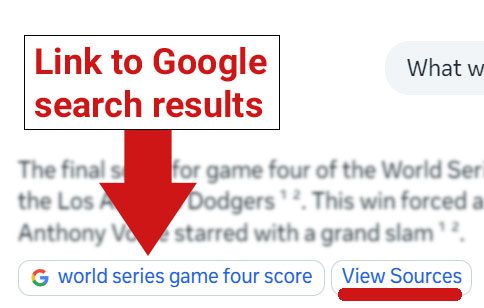
For example, a search t Meta AI about the recent game four of the World Series showed a summary with an accurate answer that had a link to Google.

Screenshot Of Meta AI With Link To Google Search

Here’s a close up showing the link to Google search results and a link to the sources:

Screenshot Of Close-Up Of Meta AI Results

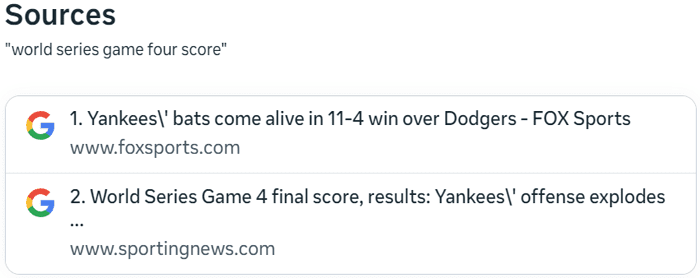
Clicking on the View Sources button spawns a popup with links to Google Search.

Screenshot Of Meta AI View Sources Pop-Up

Read the original reports:

A report was posted in The Verge, based on another reported published on The Information.

See also:

Featured Image by Shutterstock/Skorzewiak

The SEO Agency Guide To Efficient WordPress Hosting & Management via @sejournal, @kinsta

This post was sponsored by Kinsta. The opinions expressed in this article are the sponsor’s own.

Managing client sites can quickly become costly in terms of time, money, and expertise, especially as your agency grows.

You’re constantly busy fixing slow WordPress performance, handling downtime, or regularly updating and backing up ecommerce sites and small blogs.

The solution to these challenges might lie in fully managed hosting for WordPress sites.

Opting for a fully managed hosting provider that specializes in WordPress and understands agency needs can save you both time and money. By making the switch, you can focus on what truly matters: serving your current clients and driving new business into your sales funnel.

WordPress Worries & How To Keep Clients Happy

For SEO agencies managing multiple client sites, ensuring consistently fast performance across the board is essential. Websites with poor performance metrics are more likely to see a dip in traffic, increased bounce rates, and lost conversion opportunities.

Managed hosting, especially hosting that specializes and is optimized for WordPress, offers agencies a way to deliver high-speed, well-performing sites without constantly battling technical issues.

Clients expect seamless performance, but handling these technical requirements for numerous websites can be a time-consuming process. While WordPress is versatile and user-friendly, it does come with performance challenges.

SEO agencies must deal with frequent updates, plugin management, security vulnerabilities, and optimization issues.

Challenges like bloated themes, inefficient plugins, and poor hosting infrastructure can lead to slow load times. You also need to ensure that client WordPress sites are secured against malware and hackers, which requires regular monitoring and updates.

With managed hosting, many of these tasks are automated, significantly reducing the workload on your team.

Managed hosting for WordPress simplifies the process by providing a full suite of performance, security, and maintenance services.

Instead of spending valuable time on manual updates, backups, and troubleshooting, you can rely on your hosting provider to handle these tasks automatically, resulting in reduced downtime, improved site performance, and a more efficient use of resources.

Ultimately, you can focus your energy on SEO strategies that drive results for your clients.

Basics Of Managed Hosting For WordPress

Managed hosting providers like Kinsta take care of all the technical aspects of running WordPress websites, including performance optimization, security, updates, backups, and server management.

We take over the responsibilities ensure the platform runs smoothly and securely without the constant need for manual intervention.

Kinsta also eliminates common performance bottlenecks in WordPress include slow-loading themes, outdated plugins, inefficient database queries, and suboptimal server configurations.

Key Benefits Of Efficient Managed Hosting For SEO

1. Performance & Speed

Core Web Vitals, Google’s user experience metrics, play a significant role in determining search rankings. Managed hosting improves metrics like LCP, FID, and CLS by offering high-performance servers and built-in caching solutions.

CDNs reduce latency by serving your website’s static files from servers closest to the user, significantly improving load times.

Kinsta, for example, uses Google Cloud’s premium tier network and C2 virtual machines, ensuring the fastest possible load times for WordPress sites. We also provide integrated CDN services, along with advanced caching configurations, which ensure that even resource-heavy WordPress sites load quickly.

And the benefits are instantly noticeable.

Before the switch, Torro Media faced performance issues, frequent downtimes, and difficulties scaling their websites to handle traffic growth. These issues negatively affected their clients’ user experience and SEO results.

After migrating to Kinsta, Torro Media saw noteable improvements:

  • Faster website performance – Site load times significantly improved, contributing to better SEO rankings and overall user experience.
  • Reduced downtime – Kinsta’s reliable infrastructure ensured that Torro Media’s websites experienced minimal downtime, keeping client websites accessible.
  • Expert support – Our support team helped Torro Media resolve technical issues efficiently, allowing the agency to focus on growth rather than troubleshooting.

As a result, Torro was able to scale its operations and deliver better results for its clients.

2. WP-Specific Security

Security is a critical component of managed hosting. Platforms like Kinsta offer automatic security patches, malware scanning, and firewalls tailored specifically for WordPress.

These features are vital to protecting your clients’ sites from cyber threats, which, if left unchecked, can lead to ranking drops due to blacklisting by search engines.

Downtime and security breaches negatively impact SEO. Google devalues sites that experience frequent downtime or security vulnerabilities.

Managed hosting providers minimize these risks by maintaining secure, stable environments with 24/7 monitoring, helping ensure that your clients’ sites remain online and safe from attacks.

3. Automatic Backups & Recovery

Automatic daily backups are a standard feature of managed hosting, protecting against data loss due to server crashes or website errors. For agencies, this means peace of mind, knowing that they can restore their clients’ sites quickly in case of a problem. The ability to quickly recover from an issue helps maintain SEO rankings, as prolonged downtime can hurt search performance.

Managed hosting providers often include advanced tools such as one-click restore points and robust disaster recovery systems. Additionally, having specialized support means that you have access to experts who understand WordPress and can help troubleshoot complex issues that affect performance and SEO.

Importance Of An Agency-Focused Managed WordPress Hosting Provider

For SEO agencies, uptime guarantees are essential to maintaining site availability. Managed hosting providers, like Kinsta, who specialize in serving agencies, offer a 99.9% uptime SLA and multiple data center locations, ensuring that websites remain accessible to users across the globe.

Scalability and flexibility matter, too. As your agency grows, your clients’ hosting needs may evolve. Managed hosting platforms designed for agencies offer scalability, allowing you to easily add resources as your client portfolio expands.

With scalable solutions, you can handle traffic surges without worrying about site downtime or slowdowns.

Agency Dashboard - Managed Hosting for WordPress

1. The Right Dashboards

A user-friendly dashboard is crucial for managing multiple client sites efficiently. Kinsta’s MyKinsta dashboard, for example, allows agencies to monitor performance, uptime, and traffic across all sites in one centralized location, providing full visibility into each client’s website performance.

Hosting dashboards like Kinsta’s MyKinsta provide real-time insights into key performance metrics such as server response times, resource usage, and traffic spikes. These metrics are essential for ensuring that sites remain optimized for SEO.

2. Balance Costs With Performance Benefits

For agencies, managing hosting costs is always a consideration. While managed hosting may come with a higher price tag than traditional shared hosting, the benefits, such as faster performance, reduced downtime, and enhanced security, translate into better client results and long-term cost savings.

Kinsta offers flexible pricing based on traffic, resources, and features, making it easier for agencies to align their hosting solutions with client budgets.

By automating tasks like backups, updates, and security management, managed hosting allows agencies to significantly reduce the time and resources spent on day-to-day maintenance. This frees up your team to focus on delivering SEO results, ultimately improving efficiency and client satisfaction.

Don’t think it makes that big of a difference? Think again.

After migrating to Kinsta, 5Tales experienced:

  • Improved site speed – Load times dropped by over 50%, which enhanced user experience and SEO performance.
  • Better support – Kinsta’s specialized support team helped troubleshoot issues quickly and provided expert-level advice.
  • Streamlined management – With our user-friendly dashboard and automated features, 5Tales reduced the time spent on maintenance and troubleshooting.

Overall, 5Tales saw an increase in both client satisfaction and SEO rankings after moving to Kinsta.

3. Managed Hosting & Page Speed Optimization

Tools like Kinsta’s Application Performance Monitoring (APM) provide detailed insights into website performance, helping agencies identify slow-loading elements and optimize them. This level of transparency enables faster troubleshooting and more precise optimization efforts, which are critical for maintaining fast page speeds.

It’s also easy to integrate managed hosting platforms with your existing tech stack. Kinsta works seamlessly with SEO tools like Google Analytics, DebugBear, and others, allowing agencies to track site performance, analyze traffic patterns, and ensure sites are running at peak efficiency.

Conclusion

Managed hosting is not just a convenience. It’s a critical component of success for SEO agencies managing WordPress sites.

By leveraging the performance, security, and time-saving benefits of a managed hosting provider like Kinsta, agencies can improve client results, enhance their relationships, and streamline their operations.

When it comes to SEO, every second counts. A fast, secure, and well-maintained website will always perform better in search rankings. For agencies looking to deliver maximum value to their clients, investing in managed hosting is a smart, long-term decision.

Ready to make the switch?

Kinsta offers a guarantee of no-shared hosting, 99.99% uptime guarantee, and 24/7/365 support, so we’re here when you need us. Plus, we makes it easy, effortless, and free to move to Kinsta.

Our team of migration experts have experience switching from all web hosts. And when you make the switch to Kinsta, we’ll give you up to $10,000 in free hosting to ensure you avoid paying double hosting bills.


Image Credits

Featured Image: Image by Kinsta. Used with permission.

In-Post Image: Images by Kinsta. Used with permission.

Google Q3 Report: AI Drives Growth Across Search, Cloud, & YouTube via @sejournal, @MattGSouthern

Alphabet Inc. reported its third-quarter earnings, with revenues reaching $88.3 billion, a 15% increase from last year.

The Google parent company’s operating margin expanded to 32% from 27.8% year-over-year, while net income rose 34% to $26.3 billion.

During the earnings call, the company highlighted the growing role of AI across its products and services.

Google Cloud revenue increased 35% to $11.4 billion, while YouTube surpassed $50 billion in combined advertising and subscription revenue over the past four quarters.

Several operational changes occurred during the quarter, including the reorganization of Google’s AI teams and the expansion of AI features across its products.

The company also reported improvements in AI infrastructure efficiency and increased deployment of AI-powered search capabilities.

Highlights

AI

CEO Sundar Pichai emphasized how AI transforms the search experience, telling investors that “new AI features are expanding what people can search for and how they search for it.”

Google’s AI infrastructure investments are yielding efficiency gains. According to Pichai, over a quarter of all new code at Google is now generated by AI and then reviewed by engineers, accelerating development cycles.

Google has reduced AI Overview query costs by 90% over 18 months while doubling the Gemini model size. These improvements extend across seven Google products, each serving over 2 billion monthly users.

Cloud

The Google Cloud division reported operating income of $1.95 billion, marking an increase from $266 million in the same quarter last year.

Company leadership attributed this growth to increased adoption of AI infrastructure and generative AI solutions among enterprise customers.

In an organizational move, Google announced it will transfer its Gemini consumer AI team to Google DeepMind, signaling a deeper integration of AI development across the company.

YouTube

YouTube achieved a notable milestone: its combined advertising and subscription revenues exceeded $50 billion over the past four quarters.

YouTube ads revenue grew to $8.9 billion in Q3, while the broader Google subscriptions, platforms, and devices segment reached $10.7 billion.

Financials

  • Net income increased 34% to $26.3 billion
  • Operating margin expanded to 32% from 27.8% last year
  • Earnings per share rose 37% to $2.12
  • Total Google Services revenue grew 13% to $76.5 billion

What This Means

Google’s Q3 results point to shifts in search that SEO professionals and businesses need to watch.

With AI Overviews now reaching over 1 billion monthly users, we’re seeing changes in search behavior.

According to CEO Sundar Pichai, users are submitting longer and more complex queries, exploring more websites, and increasing their search activity as they become familiar with AI features.

For publishers, the priorities are clear: create content that addresses complex queries and monitor how AI Overviews affect traffic patterns.

We can expect further advancements across services with Google’s heavy investment in AI. The key will be staying agile and continually testing new features as they roll out.


Featured Image: QubixStudio/Shutterstock

Google Loses €2.4B Battle Against Small Business Founders via @sejournal, @MattGSouthern

A British couple’s legal battle against Google’s search practices has concluded.

Europe’s highest court upheld a €2.4 billion fine against Google, marking a victory for small businesses in the digital marketplace.

Background

Shivaun and Adam Raff launched Foundem, a price comparison website, in June 2006.

On launch day, Google’s automated spam filters hit the site, pushing it deep into search results and cutting off its primary traffic source.

“Google essentially disappeared us from the internet,” says Shivaun Raff.

The search penalties remained in place despite Foundem later being recognized by Channel 5’s The Gadget Show as the UK’s best price comparison website.

From Complaint To Major Investigation

After two years of unanswered appeals to Google, the Raffs took their case to regulators.

Their complaint led to a European Commission investigation in 2010, which revealed similar issues affecting approximately 20 other comparison shopping services, including Kelkoo, Trivago, and Yelp.

The investigation concluded in 2017 with the Commission ruling that Google had illegally promoted its comparison shopping service while demoting competitors, resulting in the €2.4 billion fine.

Here’s a summary of what happened next.

Timeline: From Initial Fine to Final Ruling (2017-2024)

2017

  • European Commission issues €2.4 billion fine against Google
  • Google implements changes to its shopping search results
  • Google files initial appeal against the ruling

2021

  • General Court of the European Union upholds the fine
  • Google launches second appeal to the European Court of Justice

2024 March

  • European Commission launches new investigation under Digital Markets Act
  • Probe examines whether Google continues to favor its services in search results

September

  • European Court of Justice rejects Google’s final appeal A fine of €2.4 billion is definitively upheld
  • Marks the end of main legal battle after 15 years

The seven-year legal process highlights the challenges small businesses face in seeking remedies for anti-competitive practices, despite having clear evidence.

Google’s Response

Google maintains its 2017 compliance changes resolved the issues.

A company spokesperson stated:

“The changes we made have worked successfully for more than seven years, generating billions of clicks for more than 800 comparison shopping services.”

What’s Next?

While the September 2024 ruling validates the Raffs’ claims, it comes too late for Foundem, which closed in 2016.

In March 2024, the European Commission launched a new investigation into Google’s current practices under the Digital Markets Act.

The Raffs are now pursuing a civil damages claim against Google, scheduled for 2026.

Why This Matters

This ruling confirms that Google’s search rankings can be subject to regulatory oversight and legal challenges.

The case has already influenced new digital marketplace regulations, including the EU’s Digital Markets Act.

Although Foundem’s story concluded with the company’s closure in 2016, the legal precedent it set will endure.


Featured Image: Pictrider/Shutterstock

Transformation Complete: Google’s New AI Shopping Experience Verticalizes Search via @sejournal, @Kevin_Indig

While everyone is looking at AI Overviews, Google launched a personalized shopping experience to build a foothold in the vertical that’s the least sensitive to LLM disruption.

AI could revive personalization and bring it to other areas of Google as well.

The new SERP layout shakes up ecommerce SEO by making Google the new category page and shifting the focus to product pages.

[…] today, we’re introducing a transformed Google Shopping — rebuilt from the ground up with AI. We’ve paired the 45 billion product listings in Google’s Shopping Graph with Gemini models to transform the online shopping experience with a new, personalized shopping home, which is rolling out in the U.S. over the coming weeks, starting today. 

Users can try the new experience out on shopping.google.com or the shopping tab. I see this as a test that could replace the default experience for shopping queries.

In reality, shopping SERPs have been transforming for a while. I wrote about it back in December 2023 in Ecommerce Shifts:

Google’s metamorphosis into a shopping marketplace is complete. Two ingredients were missing: product filters that turn pure search pages into ecommerce search pages and direct checkout. Those ingredients have now been added, and the cake has been baked.

In the same article, I highlighted why:

Reality is that Google had few options. Amazon had been eating their lunch with a growing ad business that hits Google where it hurts: ecommerce. Shopping is lucrative in part because conversions and returns are easier to measure than in industries like SaaS.

Two things changed since I published the article that explains the urgency of Google pushing into shopping:

  1. Google rolled AI Overviews out. In Phoenix, I outlined how often Google tried to personalize the search results without much success, but AI has a chance to make it work.
  2. TikTok has stepped into the ring with Amazon, encouraging merchants to livestream and advertise. Everyone was looking at TikTok as a search competitor to Google when former head of search Prabhakar Raghavan publicly mentioned that “nearly half of Gen Z is using Instagram and TikTok for search instead of Google,” but we missed how aggressively TikTok was pushing into ecommerce. If Google competes harder with Amazon and Amazon competes against TikTok, then TikTok is a stronger competitor to Google than originally assumed.

LLMs and AI Overviews likely disrupt informational searches by making many clicks obsolete, but ecommerce search is still alive and kicking and one of the main contributors to revenue growth.

The exact impact of personalized, AI-based shopping Search will take a few more months to assess. But it makes a change in how Google:

  1. Looks for different verticals.
  2. Looks for different geos.
  3. Looks for different users.
  4. Aggregates websites.

Google’s Verticalization

Image Credit: Kevin Indig

Different queries trigger different experiences on Google across shopping, travel, local and information.

Search for [mens shoes], and you get a shopping marketplace. Search for [best flight between chicago and nyc], and you get a flight booking engine. Et cetera. Et cetera.

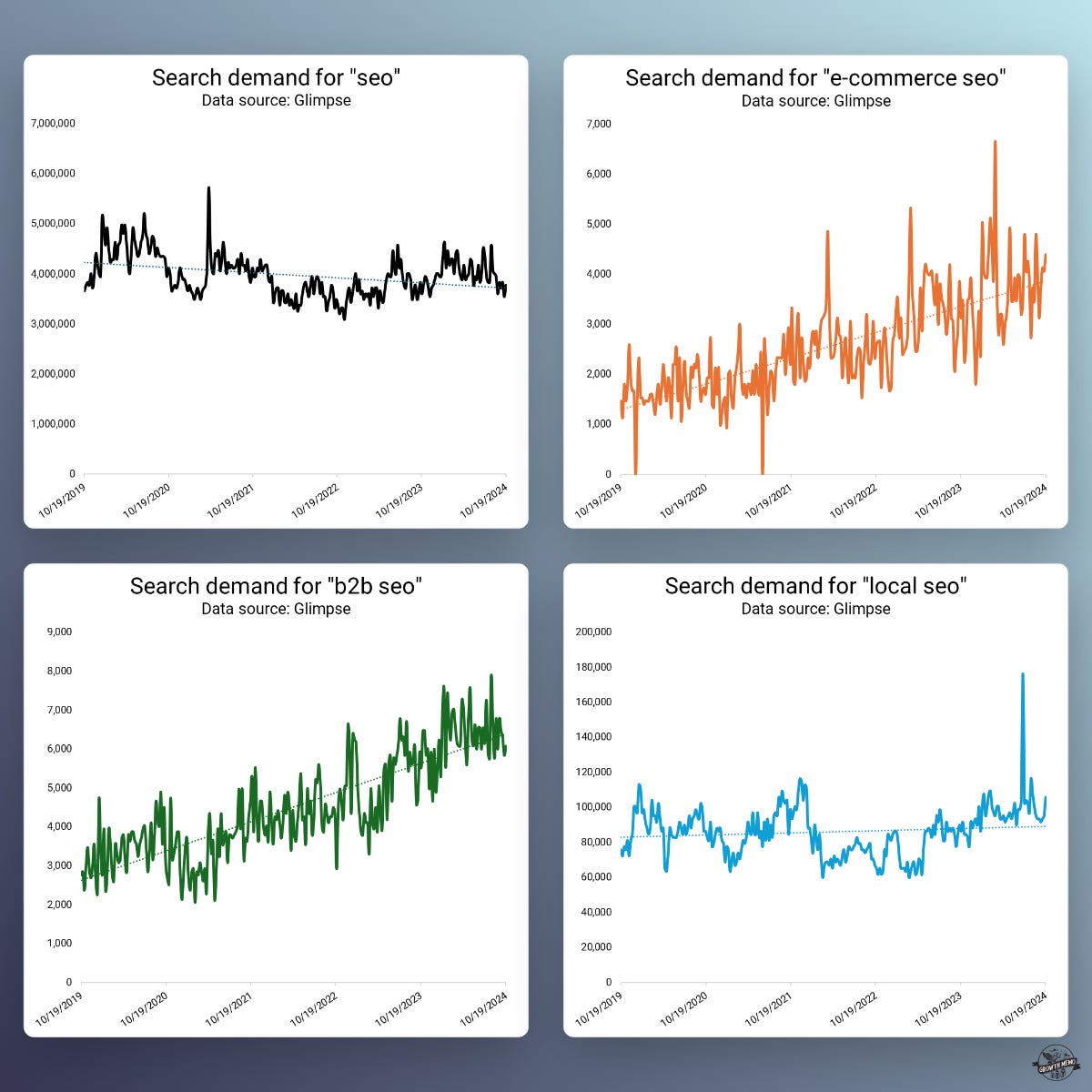
Google’s search demand for verticalized SEO reflects the trend: Searches for [seo] are flat while demand for verticalization, e.g., “B2B SEO,” is growing.

So, why do we still generalize SEO? There is no one SEO. There are many different types of SEO based on which vertical we talk about.

With different Google experiences grows the need to specialize skills by vertical. Ecommerce SEO, for example, centers around free listings and feed optimization in Google’s Merchant Center.

Our tools and insights are still far behind. There is no tool to run split tests for free listings in Merchant Center, but several tools handle feed optimization and experimentation for paid results.

Even worse, most companies still measure organic positions for success in ecommerce, but free listings show up above position 1 almost half of the time. Trend: growing.

Google’s Localization

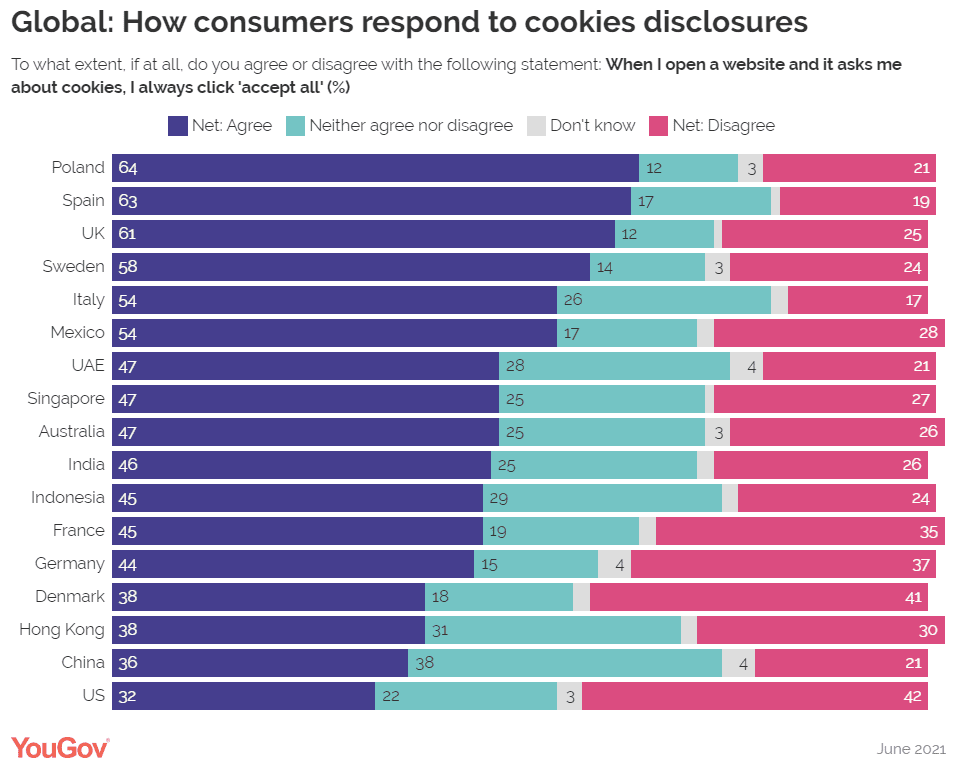
Source: YouGov

Google’s experience in the EU is already different for verticals like travel.

From 2 Internets:

Regulation splits the internet experience, aka Search, into a European and American version with stark differences. While Big Tech companies face complexity, Search players have an opportunity to compare SERP Features and AI Overviews in both internet versions and better understand their impact.

AI Overviews have not yet rolled out in EU markets, and it’s unclear if they will.

Since the new shopping experience heavily leans on AI Overviews, I am equally skeptical that it will come to the EU, especially with the strong personalization layer.

Personalization under the Digital Marketing Act (DMA) is not forbidden, but GDPR mandates that users consent to it.

YouGov surveyed thousands of people across 17 countries and found vast discrepancies in consent.

Google will almost certainly “burry” consent in its general terms of service, which no one reads. It will be up to legislators to evaluate whether that’s sufficient.

Just like AIOs, the non-personalized shopping experience in the EU might serve as a comparison for the U.S. and other countries to understand the impact of Google’s new experience better.

Google’s Personalization

Image Credit: Kevin Indig

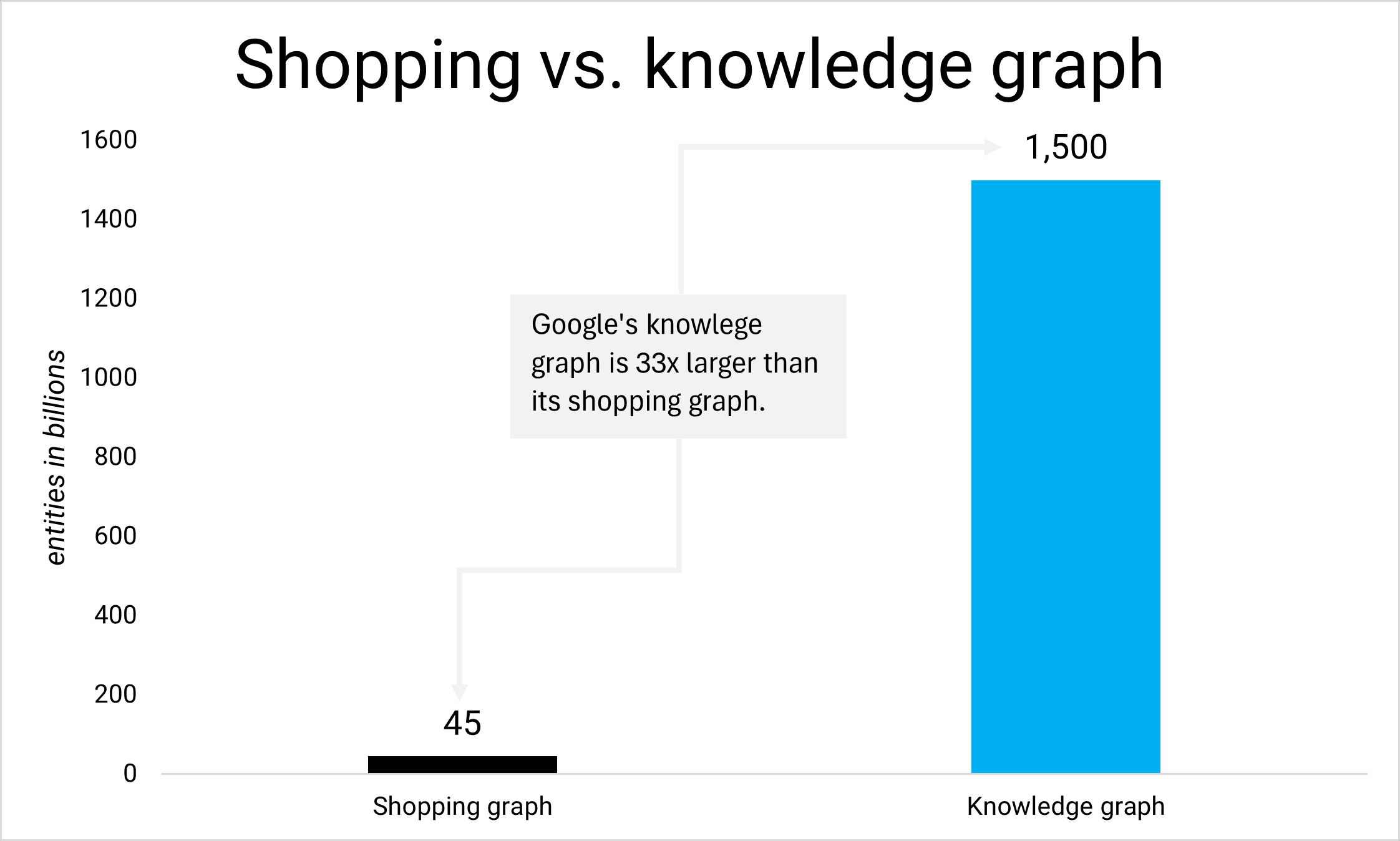
Google personalizes the new shopping experience based on user behavior and matches it with its vast shopping graph that covers over 45 billion entities.

Note that 45 billion entities include product variations, reviews, brands, categories, and more.

However, the Shopping Graph looks like a dwarf compared to Google’s knowledge graph with over 1.5 trillion entities.

If personalization is a question of graph size and AI capabilities, it’s only a matter of time until non-shopping results are more personalized.

Personalization also makes sense in the context that AI can answer long questions much better than Google’s old semantic search ever could, so Google might as well personalize results based on behavior.

Google also uses YouTube as a source to personalize shopping. I wonder: why not for regular Search as well? ~25% of queries show videos, and most of those are from YouTube.

Google could easily prefer videos from YouTube channels you subscribe to in the regular search results, as an example.

The challenge of personalization for marketers is optimizing for a uniform search experience.

When our experiences differ significantly, our data does as well, which means we’re losing a whole layer of insights to work with.

The result is that we need to rely more on aggregate data, post-purchase surveys and market research, like in the good ‘ol days.

Google’s Aggregation

Free product listing click-through rates, according to Johannes Beus (link) Image Credit: Kevin Indig

The big question, of course, is how this new experience impacts organic clicks. Can websites still get clicks? We don’t know for sure until more data rolls in.

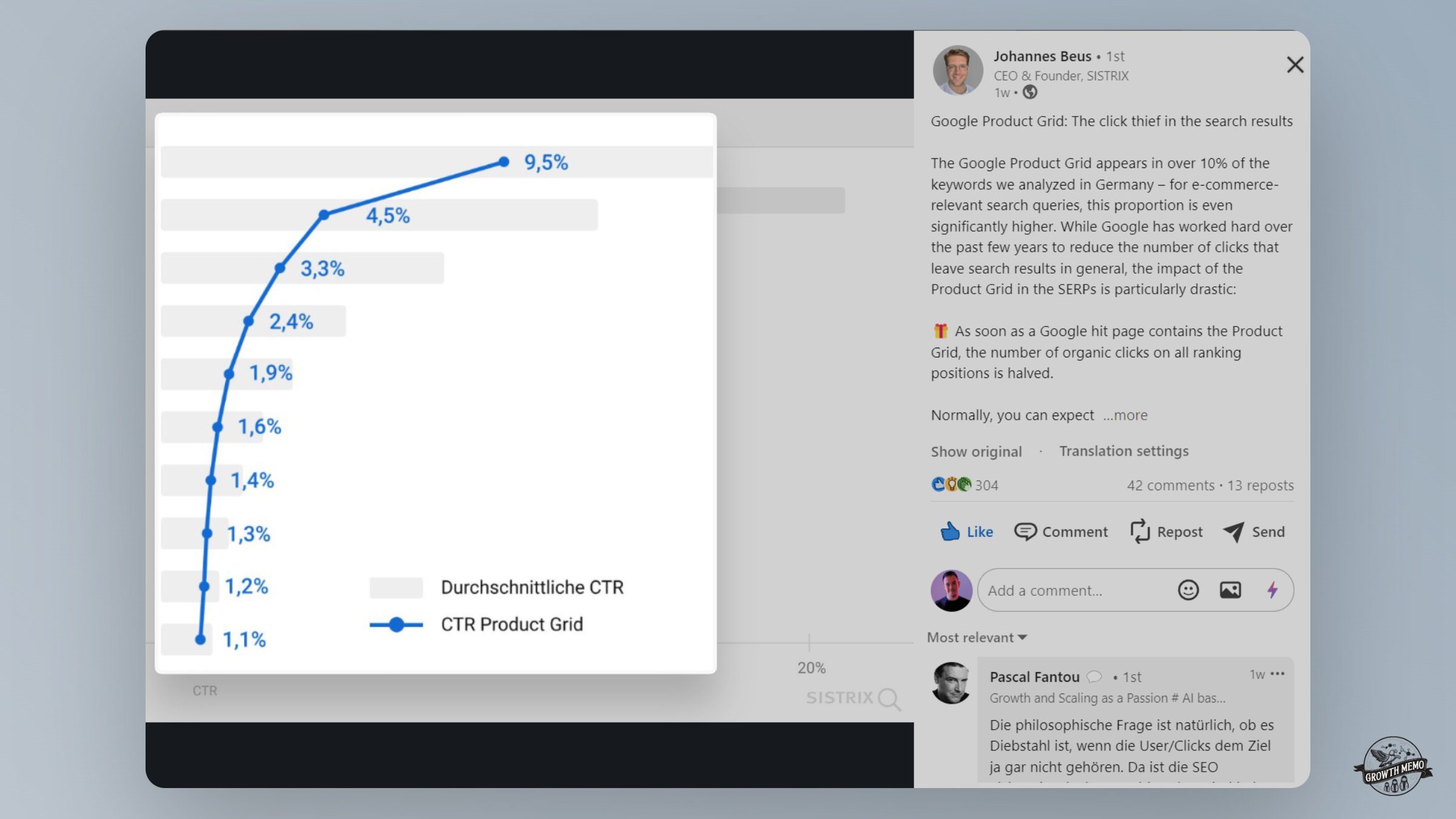
One reference point comes from Johannes Beus (Founder/CEO of Sistrix), who found that Free Listings cut clicks on organic results in half, e.g., position 1 drops from ~21% on average to 9.5%.

But based on the layout and my experience with layout changes in the past, I will say that I don’t see a threat here. I see a change.

Google’s new layout for shopping SERPs, the one it has been using for a year now, is essentially a category page that lists products from online stores. As a result, the focus of ecommerce SEO shifts from category to product page optimization.

Where I do see a negative impact is for sites that provide price comparison, tracking, or discounts. Chrome has been tracking price changes for over a year.

We know shoppers always want low prices, and the new Google Shopping not only includes deal-finding tools like price comparison, price insights and price tracking throughout, but also a new dedicated and personalized deals page where you can browse deals for you — just click the “Deals” link at the top of your page to explore.

We know Google uses Chrome data for ranking due to leaked documents and court trials.

I wouldn’t be shocked to hear that Google also uses Chrome data to inform the shopping graph and product recommendation in the personalized shopping experience.

If so, separating Chrome from Google in the context of the antitrust trial would also impact its personalization capabilities.

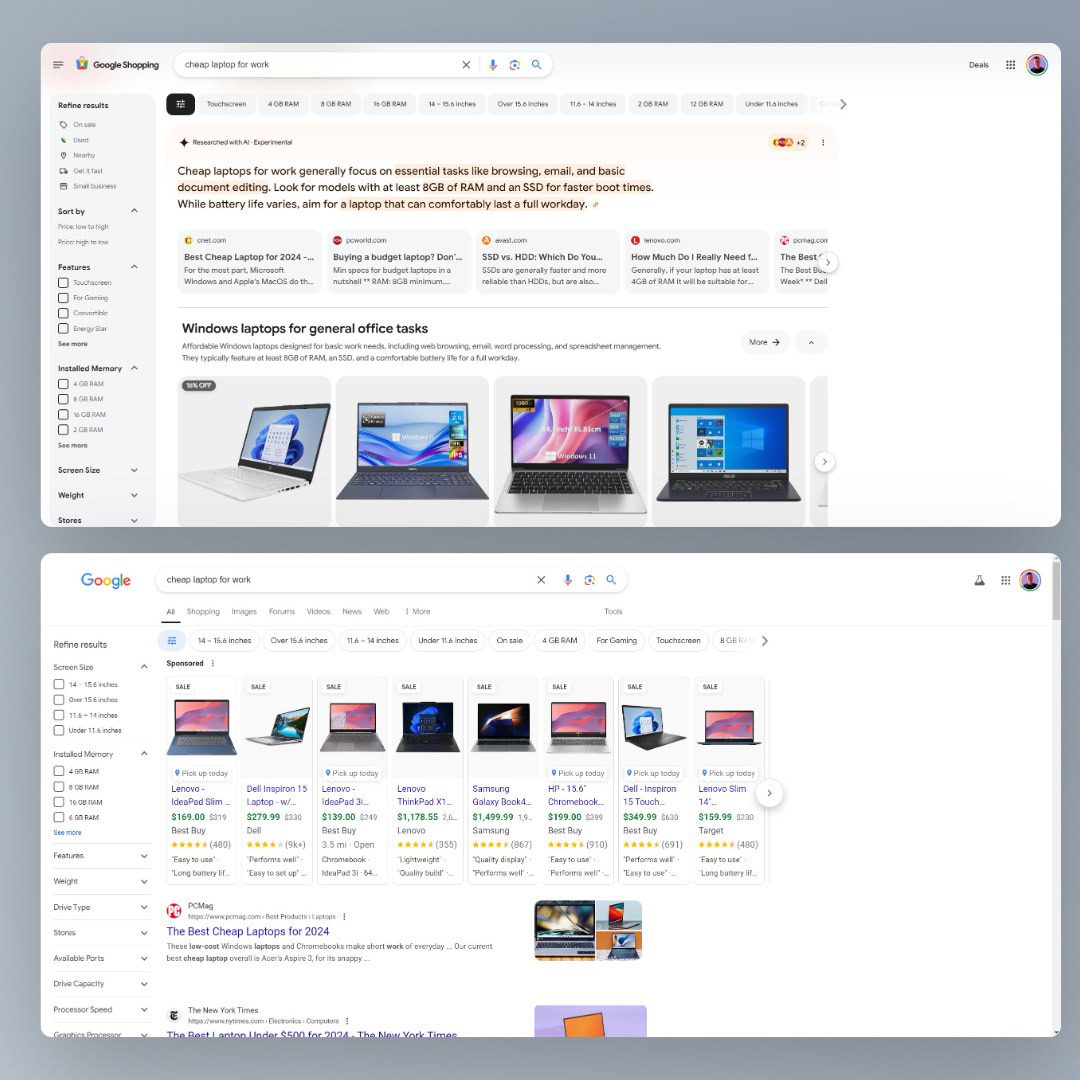
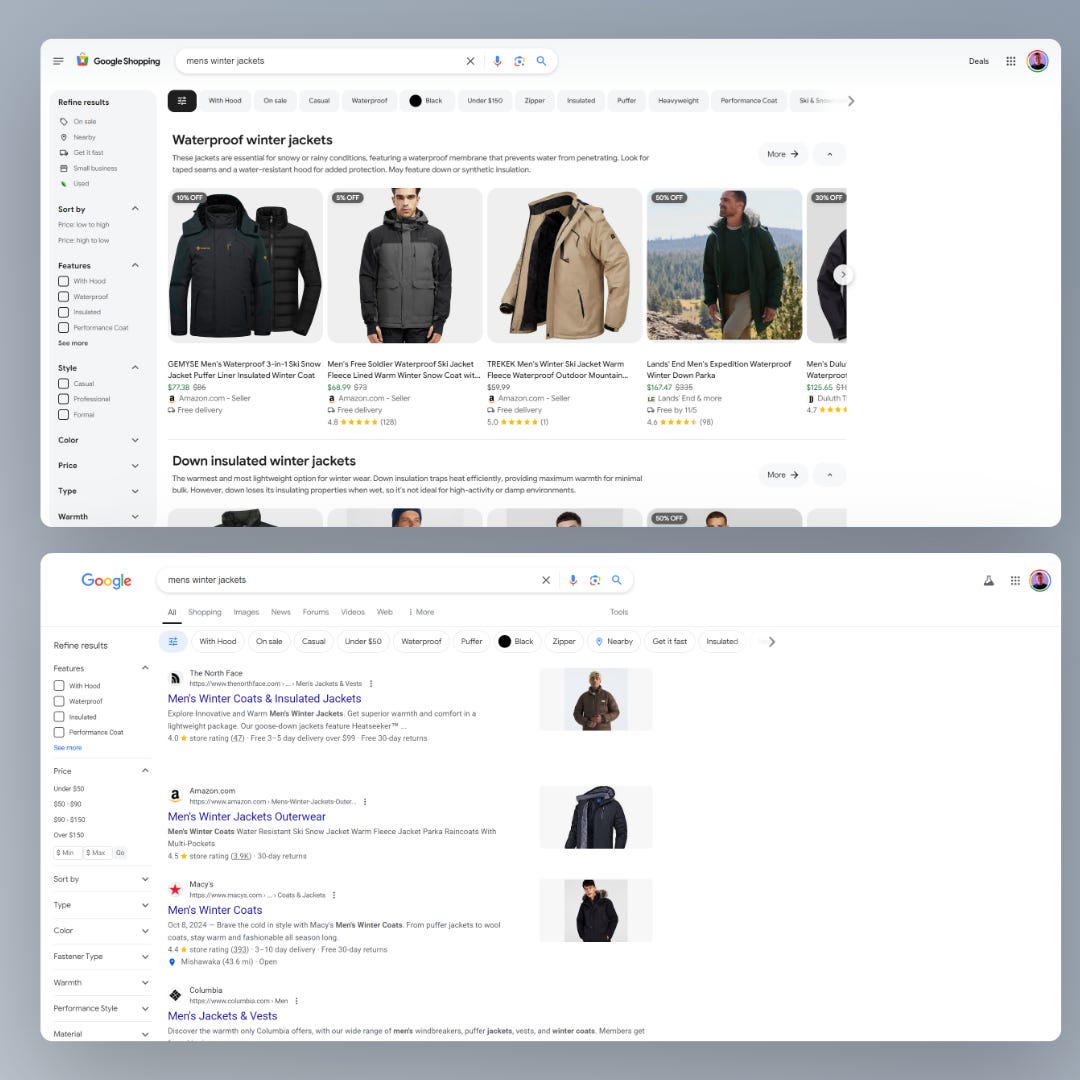
Above: “shopping tab” with Google’s new shopping experience; below: “all” tab (Image Credit: Kevin Indig)
Image Credit: Kevin Indig

One improvement from the new experience is that editorial content doesn’t have to fight with product or category pages over positions anymore.

The layout constantly changes, but it seems some queries highlight links to editorial articles about products (like “cheap laptop for work”), others (like “mens winter jackets”) don’t.

At least, there seems to be a lifeline for publishers in ecommerce.

Boost your skills with Growth Memo’s weekly expert insights. Subscribe for Free!


Google Shopping’s getting a big transformation

TikTok Tries to Woo American Shoppers, One Livestream at a Time

Critical SERP Features of Google’s shopping marketplace

Mozcast: Google SERP Features

Shopping insights & price tracking in Chrome


Featured Image: Paulo Bobita/Search Engine Journal

Core Web Vitals Documentation Updated via @sejournal, @martinibuster

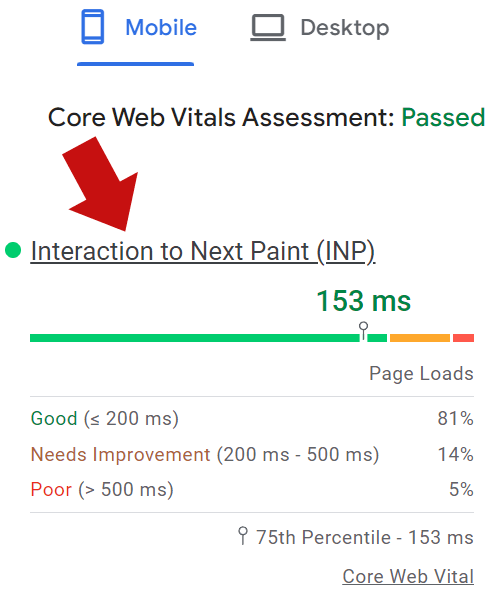
The official documentation for how Core Web Vitals are scored was recently updated with new insights into how Interaction to Next Paint (INP) scoring thresholds were chosen and offers a better understanding of Interaction To Next Paint.

Interaction to Next Paint (INP)

Interaction to Next Paint (INP) is a relatively new metric, officially becoming a Core Web Vitals in the Spring of 2024. It’s a metric of how long it takes a site to respond to interactions like clicks, taps, and when users press on a keyboard (actual or onscreen).

The official Web.dev documentation defines it:

“INP observes the latency of all interactions a user has made with the page, and reports a single value which all (or nearly all) interactions were beneath. A low INP means the page was consistently able to respond quickly to all—or the vast majority—of user interactions.”

INP measures the latency of all the interactions on the page, which is different than the now retired First Input Delay metric which only measured the delay of the first interaction. INP is considered a better measurement than INP because it provides a more accurate idea of the actual user experience is.

INP Core Web Vitals Score Thresholds

The main change to the documentation is to provide an explanation for the speed performance thresholds that show poor, needs improvement and good.

One of the choices made for deciding the scoring was how to handle scoring because it’s easier to achieve high INP scores on a desktop versus a mobile device because external factors like network speed and device capabilities heavily favor desktop environments.

But the user experience is not device dependent so rather that create different thresholds for different kinds of devices they settled on one metric that is based on mobile devices.

The new documentation explains:

“Mobile and desktop usage typically have very different characteristics as to device capabilities and network reliability. This heavily impacts the “achievability” criteria and so suggests we should consider separate thresholds for each.

However, users’ expectations of a good or poor experience is not dependent on device, even if the achievability criteria is. For this reason the Core Web Vitals recommended thresholds are not segregated by device and the same threshold is used for both. This also has the added benefit of making the thresholds simpler to understand.
Additionally, devices don’t always fit nicely into one category. Should this be based on device form factor, processing power, or network conditions? Having the same thresholds has the side benefit of avoiding that complexity.

The more constrained nature of mobile devices means that most of the thresholds are therefore set based on mobile achievability. They more likely represent mobile thresholds—rather than a true joint threshold across all device types. However, given that mobile is often the majority of traffic for most sites, this is less of a concern.”

These are scores Chrome settled on:

  • Scores of under 200 ms (milliseconds) were chosen to represent a “good” score.
  • Scores between 200 ms – 500 ms represent a “needs improvement” score.
  • Performance of over 500 ms represent a “poor” score.

Screenshot Of An Interaction To Next Paint Score

Interaction To Next Paint (INP) Core Web Vitals Score

Lower End Devices Were Considered

Chrome was focused on choosing achievable metrics. That’s why the thresholds for INP had to be realistic for lower end mobile devices because so many of them are used to access the Internet.

They explained:

“We also spent extra attention looking at achievability of passing INP for lower-end mobile devices, where those formed a high proportion of visits to sites. This further confirmed the suitability of a 200 ms threshold.

Taking into consideration the 100 ms threshold supported by research into the quality of experience and the achievability criteria, we conclude that 200 ms is a reasonable threshold for good experiences”

Most Popular Sites Influenced INP Thresholds

Another interesting insight in the new documentation is that achievability of the scores in the real world were another consideration for the INP scoring metrics, measured in milliseconds (ms). They examined the performance of the top 10,000 websites because they made up the vast majority of website visits in order to dial in the right threshold for poor scores.

What they discovered is that the top 10,000 websites struggled to achieve performance scores of 300 ms. The CrUX data that reports real-world user experience showed that 55% of visits to the most popular sites were at the 300 ms threshold. That meant that the Chrome team had to choose a higher millisecond score that was achieveable by the most popular sites.

The new documentation explains:

“When we look at the top 10,000 sites—which form the vast majority of internet browsing—we see a more complex picture emerge…

On mobile, a 300 ms “poor” threshold would classify the majority of popular sites as “poor” stretching our achievability criteria, while 500 ms fits better in the range of 10-30% of sites. It should also be noted that the 200 ms “good” threshold is also tougher for these sites, but with 23% of sites still passing this on mobile this still passes our 10% minimum pass rate criteria.

For this reason we conclude a 200 ms is a reasonable “good” threshold for most sites, and greater than 500 ms is a reasonable “poor” threshold.”

Barry Pollard, a Web Performance Developer Advocate on Google Chrome who is a co-author of the documentation, added a comment to a discussion on LinkedIn that offers more background information:

“We’ve made amazing strides on INP in the last year. Much more than we could have hoped for. But less than 200ms is going to be very tough on low-end mobile devices for some time. While high-end mobile devices are absolute power horses now, the low-end is not increasing at anywhere near that rate…”

A Deeper Understanding Of INP Scores

The new documentation offers a better understanding of how Chrome chooses achievable metrics and takes some of the mystery out of the relatively new INP Core Web Vital metric.

Read the updated documentation:

How the Core Web Vitals metrics thresholds were defined

Featured Image by Shutterstock/Vectorslab