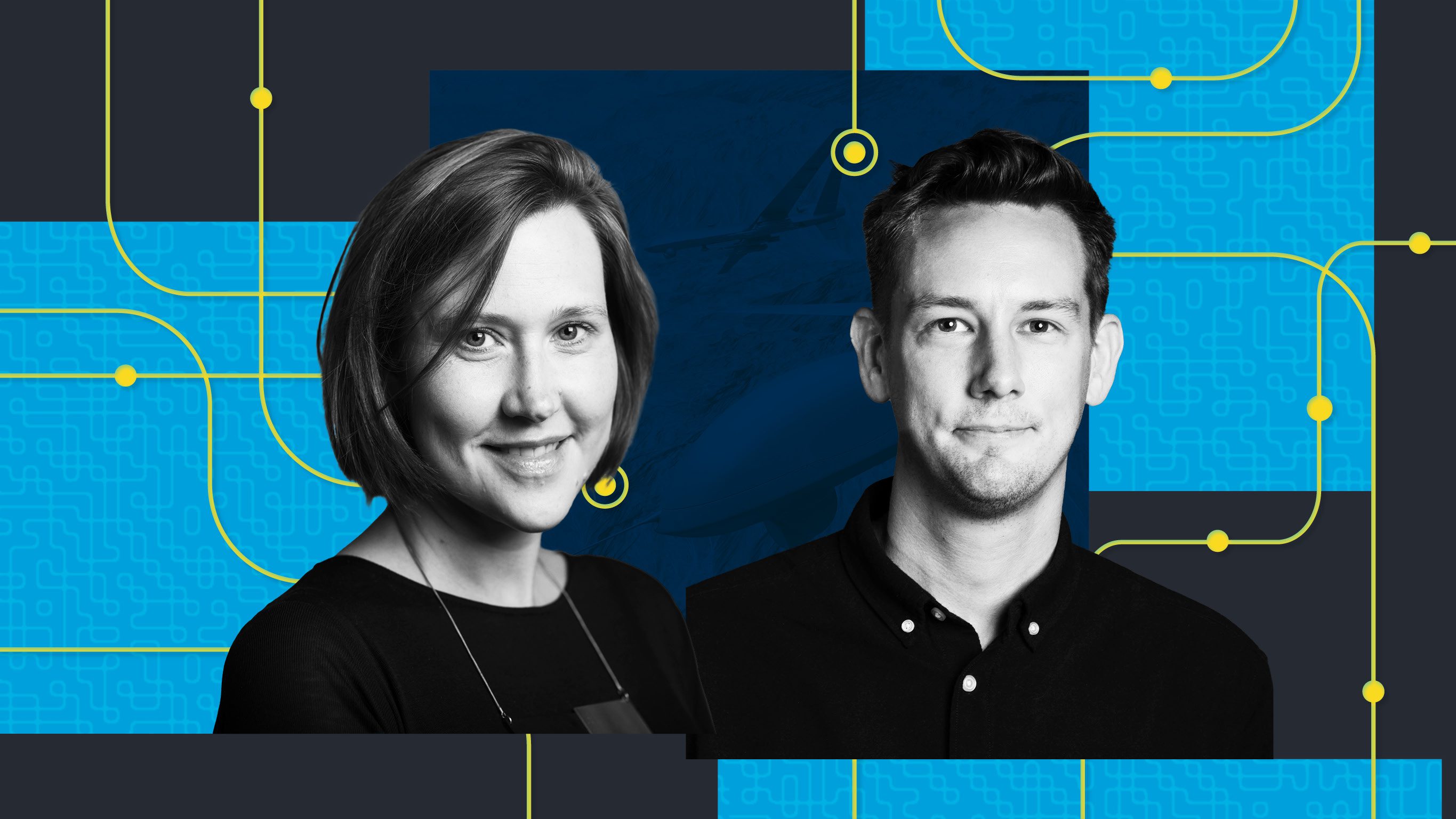
What’s next for AlphaFold: A conversation with a Google DeepMind Nobel laureate

<div data-chronoton-summary="

  • Nobel-winning protein prediction AlphaFold creator John Jumper reflects on five years since the AI system revolutionized protein structure prediction. The DeepMind tool can determine protein shapes to atomic precision in hours instead of months.
  • Unexpected applications emerge Scientists have found creative “off-label” uses for AlphaFold, from studying honeybee disease resistance to accelerating synthetic protein design. Some researchers even use it as a search engine, testing thousands of potential protein interactions to find matches that would be impractical to verify in labs.
  • Future fusion with language models Jumper, at 39 the youngest chemistry Nobel laureate in 75 years, now aims to combine AlphaFold’s specialized capabilities with the broad reasoning of large language models. “I’ll be shocked if we don’t see more and more LLM impact on science,” he says, while avoiding the pressure of another Nobel-worthy breakthrough.

” data-chronoton-post-id=”1128322″ data-chronoton-expand-collapse=”1″ data-chronoton-analytics-enabled=”1″>

In 2017, fresh off a PhD on theoretical chemistry, John Jumper heard rumors that Google DeepMind had moved on from building AI that played games with superhuman skill and was starting up a secret project to predict the structures of proteins. He applied for a job.

Just three years later, Jumper celebrated a stunning win that few had seen coming. With CEO Demis Hassabis, he had co-led the development of an AI system called AlphaFold 2 that was able to predict the structures of proteins to within the width of an atom, matching the accuracy of painstaking techniques used in the lab, and doing it many times faster—returning results in hours instead of months.

AlphaFold 2 had cracked a 50-year-old grand challenge in biology. “This is the reason I started DeepMind,” Hassabis told me a few years ago. “In fact, it’s why I’ve worked my whole career in AI.” In 2024, Jumper and Hassabis shared a Nobel Prize in chemistry.

It was five years ago this week that AlphaFold 2’s debut took scientists by surprise. Now that the hype has died down, what impact has AlphaFold really had? How are scientists using it? And what’s next? I talked to Jumper (as well as a few other scientists) to find out.

“It’s been an extraordinary five years,” Jumper says, laughing: “It’s hard to remember a time before I knew tremendous numbers of journalists.”

AlphaFold 2 was followed by AlphaFold Multimer, which could predict structures that contained more than one protein, and then AlphaFold 3, the fastest version yet. Google DeepMind also let AlphaFold loose on UniProt, a vast protein database used and updated by millions of researchers around the world. It has now predicted the structures of some 200 million proteins, almost all that are known to science.

Despite his success, Jumper remains modest about AlphaFold’s achievements. “That doesn’t mean that we’re certain of everything in there,” he says. “It’s a database of predictions, and it comes with all the caveats of predictions.”

A hard problem

Proteins are the biological machines that make living things work. They form muscles, horns, and feathers; they carry oxygen around the body and ferry messages between cells; they fire neurons, digest food, power the immune system; and so much more. But understanding exactly what a protein does (and what role it might play in various diseases or treatments) involves figuring out its structure—and that’s hard.

Proteins are made from strings of amino acids that chemical forces twist up into complex knots. An untwisted string gives few clues about the structure it will form. In theory, most proteins could take on an astronomical number of possible shapes. The task is to predict the correct one.

Jumper and his team built AlphaFold 2 using a type of neural network called a transformer, the same technology that underpins large language models. Transformers are very good at paying attention to specific parts of a larger puzzle.

But Jumper puts a lot of the success down to making a prototype model that they could test quickly. “We got a system that would give wrong answers at incredible speed,” he says. “That made it easy to start becoming very adventurous with the ideas you try.”

They stuffed the neural network with as much information about protein structures as they could, such as how proteins across certain species have evolved similar shapes. And it worked even better than they expected. “We were sure we had made a breakthrough,” says Jumper. “We were sure that this was an incredible advance in ideas.”

What he hadn’t foreseen was that researchers would download his software and start using it straight away for so many different things. Normally, it’s the thing a few iterations down the line that has the real impact, once the kinks have been ironed out, he says: “I’ve been shocked at how responsibly scientists have used it, in terms of interpreting it, and using it in practice about as much as it should be trusted in my view, neither too much nor too little.”

Any projects stand out in particular? 

Honeybee science

Jumper brings up a research group that uses AlphaFold to study disease resistance in honeybees. “They wanted to understand this particular protein as they look at things like colony collapse,” he says. “I never would have said, ‘You know, of course AlphaFold will be used for honeybee science.’”

He also highlights a few examples of what he calls off-label uses of AlphaFold“in the sense that it wasn’t guaranteed to work”—where the ability to predict protein structures has opened up new research techniques. “The first is very obviously the advances in protein design,” he says. “David Baker and others have absolutely run with this technology.”

Baker, a computational biologist at the University of Washington, was a co-winner of last year’s chemistry Nobel, alongside Jumper and Hassabis, for his work on creating synthetic proteins to perform specific tasks—such as treating disease or breaking down plastics—better than natural proteins can.

Baker and his colleagues have developed their own tool based on AlphaFold, called RoseTTAFold. But they have also experimented with AlphaFold Multimer to predict which of their designs for potential synthetic proteins will work.    

“Basically, if AlphaFold confidently agrees with the structure you were trying to design [and] then you make it and if AlphaFold says ‘I don’t know,’ you don’t make it. That alone was an enormous improvement.” It can make the design process 10 times faster, says Jumper.

Another off-label use that Jumper highlights: Turning AlphaFold into a kind of search engine. He mentions two separate research groups that were trying to understand exactly how human sperm cells hooked up with eggs during fertilization. They knew one of the proteins involved but not the other, he says: “And so they took a known egg protein and ran all 2,000 human sperm surface proteins, and they found one that AlphaFold was very sure stuck against the egg.” They were then able to confirm this in the lab.

“This notion that you can use AlphaFold to do something you couldn’t do before—you would never do 2,000 structures looking for one answer,” he says. “This kind of thing I think is really extraordinary.”

Five years on

When AlphaFold 2 came out, I asked a handful of early adopters what they made of it. Reviews were good, but the technology was too new to know for sure what long-term impact it might have. I caught up with one of those people to hear his thoughts five years on.

Kliment Verba is a molecular biologist who runs a lab at the University of California, San Francisco. “It’s an incredibly useful technology, there’s no question about it,” he tells me. “We use it every day, all the time.”

But it’s far from perfect. A lot of scientists use AlphaFold to study pathogens or to develop drugs. This involves looking at interactions between multiple proteins or between proteins and even smaller molecules in the body. But AlphaFold is known to be less accurate at making predictions about multiple proteins or their interaction over time.

Verba says he and his colleagues have been using AlphaFold long enough to get used to its limitations. “There are many cases where you get a prediction and you have to kind of scratch your head,” he says. “Is this real or is this not? It’s not entirely clear—it’s sort of borderline.”

“It’s sort of the same thing as ChatGPT,” he adds. “You know—it will bullshit you with the same confidence as it would give a true answer.”

Still, Verba’s team uses AlphaFold (both 2 and 3, because they have different strengths, he says) to run virtual versions of their experiments before running them in the lab. Using AlphaFold’s results, they can narrow down the focus of an experiment—or decide that it’s not worth doing.

It can really save time, he says: “It hasn’t really replaced any experiments, but it’s augmented them quite a bit.”

New wave  

AlphaFold was designed to be used for a range of purposes. Now multiple startups and university labs are building on its success to develop a new wave of tools more tailored to drug discovery. This year, a collaboration between MIT researchers and the AI drug company Recursion produced a model called Boltz-2, which predicts not only the structure of proteins but also how well potential drug molecules will bind to their target.  

Last month, the startup Genesis Molecular AI released another structure prediction model called Pearl, which the firm claims is more accurate than AlphaFold 3 for certain queries that are important for drug development. Pearl is interactive, so that drug developers can feed any additional data they may have to the model to guide its predictions.

AlphaFold was a major leap, but there’s more to do, says Evan Feinberg, Genesis Molecular AI’s CEO: “We’re still fundamentally innovating, just with a better starting point than before.”

Genesis Molecular AI is pushing margins of error down from less than two angstroms, the de facto industry standard set by AlphaFold, to less than one angstrom—one 10-millionth of a millimeter, or the width of a single hydrogen atom.

“Small errors can be catastrophic for predicting how well a drug will actually bind to its target,” says Michael LeVine, vice president of modeling and simulation at the firm. That’s because chemical forces that interact at one angstrom can stop doing so at two. “It can go from ‘They will never interact’ to ‘They will,’” he says.

With so much activity in this space, how soon should we expect new types of drugs to hit the market? Jumper is pragmatic. Protein structure prediction is just one step of many, he says: “This was not the only problem in biology. It’s not like we were one protein structure away from curing any diseases.”

Think of it this way, he says. Finding a protein’s structure might previously have cost $100,000 in the lab: “If we were only a hundred thousand dollars away from doing a thing, it would already be done.”

At the same time, researchers are looking for ways to do as much as they can with this technology, says Jumper: “We’re trying to figure out how to make structure prediction an even bigger part of the problem, because we have a nice big hammer to hit it with.”

In other words, they want to make everything into nails? “Yeah, let’s make things into nails,” he says. “How do we make this thing that we made a million times faster a bigger part of our process?”

What’s next?

Jumper’s next act? He wants to fuse the deep but narrow power of AlphaFold with the broad sweep of LLMs.  

“We have machines that can read science. They can do some scientific reasoning,” he says. “And we can build amazing, superhuman systems for protein structure prediction. How do you get these two technologies to work together?”

That makes me think of a system called AlphaEvolve, which is being built by another team at Google DeepMind. AlphaEvolve uses an LLM to generate possible solutions to a problem and a second model to check them, filtering out the trash. Researchers have already used AlphaEvolve to make a handful of practical discoveries in math and computer science.    

Is that what Jumper has in mind? “I won’t say too much on methods, but I’ll be shocked if we don’t see more and more LLM impact on science,” he says. “I think that’s the exciting open question that I’ll say almost nothing about. This is all speculation, of course.”

Jumper was 39 when he won his Nobel Prize. What’s next for him?

“It worries me,” he says. “I believe I’m the youngest chemistry laureate in 75 years.” 

He adds: “I’m at the midpoint of my career, roughly. I guess my approach to this is to try to do smaller things, little ideas that you keep pulling on. The next thing I announce doesn’t have to be, you know, my second shot at a Nobel. I think that’s the trap.”

The State of AI: Chatbot companions and the future of our privacy

Welcome back to The State of AI, a new collaboration between the Financial Times and MIT Technology Review. Every Monday, writers from both publications debate one aspect of the generative AI revolution reshaping global power.

In this week’s conversation MIT Technology Review’s senior reporter for features and investigations, Eileen Guo, and FT tech correspondent Melissa Heikkilä discuss the privacy implications of our new reliance on chatbots.

Eileen Guo writes:

Even if you don’t have an AI friend yourself, you probably know someone who does. A recent study found that one of the top uses of generative AI is companionship: On platforms like Character.AI, Replika, or Meta AI, people can create personalized chatbots to pose as the ideal friend, romantic partner, parent, therapist, or any other persona they can dream up. 

It’s wild how easily people say these relationships can develop. And multiple studies have found that the more conversational and human-like an AI chatbot is, the more likely it is that we’ll trust it and be influenced by it. This can be dangerous, and the chatbots have been accused of pushing some people toward harmful behaviors—including, in a few extreme examples, suicide. 

Some state governments are taking notice and starting to regulate companion AI. New York requires AI companion companies to create safeguards and report expressions of suicidal ideation, and last month California passed a more detailed bill requiring AI companion companies to protect children and other vulnerable groups. 

But tellingly, one area the laws fail to address is user privacy.

This is despite the fact that AI companions, even more so than other types of generative AI, depend on people to share deeply personal information—from their day-to-day-routines, innermost thoughts, and questions they might not feel comfortable asking real people.

After all, the more users tell their AI companions, the better the bots become at keeping them engaged. This is what MIT researchers Robert Mahari and Pat Pataranutaporn called “addictive intelligence” in an op-ed we published last year, warning that the developers of AI companions make “deliberate design choices … to maximize user engagement.” 

Ultimately, this provides AI companies with something incredibly powerful, not to mention lucrative: a treasure trove of conversational data that can be used to further improve their LLMs. Consider how the venture capital firm Andreessen Horowitz explained it in 2023: 

“Apps such as Character.AI, which both control their models and own the end customer relationship, have a tremendous opportunity to  generate market value in the emerging AI value stack. In a world where data is limited, companies that can create a magical data feedback loop by connecting user engagement back into their underlying model to continuously improve their product will be among the biggest winners that emerge from this ecosystem.”

This personal information is also incredibly valuable to marketers and data brokers. Meta recently announced that it will deliver ads through its AI chatbots. And research conducted this year by the security company Surf Shark found that four out of the five AI companion apps it looked at in the Apple App Store were collecting data such as user or device IDs, which can be combined with third-party data to create profiles for targeted ads. (The only one that said it did not collect data for tracking services was Nomi, which told me earlier this year that it would not “censor” chatbots from giving explicit suicide instructions.) 

All of this means that the privacy risks posed by these AI companions are, in a sense, required: They are a feature, not a bug. And we haven’t even talked about the additional security risks presented by the way AI chatbots collect and store so much personal information in one place

So, is it possible to have prosocial and privacy-protecting AI companions? That’s an open question. 

What do you think, Melissa, and what is top of mind for you when it comes to privacy risks from AI companions? And do things look any different in Europe? 

Melissa Heikkilä replies:

Thanks, Eileen. I agree with you. If social media was a privacy nightmare, then AI chatbots put the problem on steroids. 

In many ways, an AI chatbot creates what feels like a much more intimate interaction than a Facebook page. The conversations we have are only with our computers, so there is little risk of your uncle or your crush ever seeing what you write. The AI companies building the models, on the other hand, see everything. 

Companies are optimizing their AI models for engagement by designing them to be as human-like as possible. But AI developers have several other ways to keep us hooked. The first is sycophancy, or the tendency for chatbots to be overly agreeable. 

This feature stems from the way the language model behind the chatbots is trained using reinforcement learning. Human data labelers rate the answers generated by the model as either acceptable or not. This teaches the model how to behave. 

Because people generally like answers that are agreeable, such responses are weighted more heavily in training. 

AI companies say they use this technique because it helps models become more helpful. But it creates a perverse incentive. 

After encouraging us to pour our hearts out to chatbots, companies from Meta to OpenAI are now looking to monetize these conversations. OpenAI recently told us it was looking at a number of ways to meet $1 trillion spending pledges, which included advertising and shopping features. 

AI models are already incredibly persuasive. Researchers at the UK’s AI Security Institute have shown that they are far more skilled than humans at persuading people to change their minds on politics, conspiracy theories, and vaccine skepticism. They do this by generating large amounts of relevant evidence and communicating it in an effective and understandable way. 

This feature, paired with their sycophancy and a wealth of personal data, could be a powerful tool for advertisers—one that is more manipulative than anything we have seen before. 

By default, chatbot users are opted in to data collection. Opt-out policies place the onus on users to understand the implications of sharing their information. It’s also unlikely that data already used in training will be removed. 

We are all part of this phenomenon whether we want to be or not. Social media platforms from Instagram to LinkedIn now use our personal data to train generative AI models. 

Companies are sitting on treasure troves that consist of our most intimate thoughts and preferences, and language models are very good at picking up on subtle hints in language that could help advertisers profile us better by inferring our age, location, gender, and income level.

We are being sold the idea of an omniscient AI digital assistant, a superintelligent confidante. In return, however, there is a very real risk that our information is about to be sent to the highest bidder once again.

Eileen responds:

I think the comparison between AI companions and social media is both apt and concerning. 

As Melissa highlighted, the privacy risks presented by AI chatbots aren’t new—they just “put the [privacy] problem on steroids.” AI companions are more intimate and even better optimized for engagement than social media, making it more likely that people will offer up more personal information.

Here in the US, we are far from solving the privacy issues already presented by social networks and the internet’s ad economy, even without the added risks of AI.

And without regulation, the companies themselves are not following privacy best practices either. One recent study found that the major AI models train their LLMs on user chat data by default unless users opt out, while several don’t offer opt-out mechanisms at all.

In an ideal world, the greater risks of companion AI would give more impetus to the privacy fight—but I don’t see any evidence this is happening. 

Further reading 

FT reporters peer under the hood of OpenAI’s five-year business plan as it tries to meet its vast $1 trillion spending pledges

Is it really such a problem if AI chatbots tell people what they want to hear? This FT feature asks what’s wrong with sycophancy 

In a recent print issue of MIT Technology Review, Rhiannon Williams spoke to a number of people about the types of relationships they are having with AI chatbots.

Eileen broke the story for MIT Technology Review about a chatbot that was encouraging some users to kill themselves.

Quantum physicists have shrunk and “de-censored” DeepSeek R1

<div data-chronoton-summary="

Quantum-inspired compression Spanish firm Multiverse Computing has created DeepSeek R1 Slim, a version of the Chinese AI model that’s 55% smaller but maintains similar performance. The technique uses tensor networks from quantum physics to represent complex data more efficiently.

Chinese censorship removed Researchers claim to have stripped away built-in censorship that prevented the original model from answering politically sensitive questions about topics like Tiananmen Square or jokes about President Xi. Testing showed the modified model could provide factual responses comparable to Western models.

Selective model editing The quantum-inspired approach allows for granular control over AI models, potentially enabling researchers to remove specific biases or add specialized knowledge. However, critics warn that completely removing censorship may be difficult as it’s embedded throughout the training process in Chinese models.

” data-chronoton-post-id=”1128119″ data-chronoton-expand-collapse=”1″ data-chronoton-analytics-enabled=”1″>

A group of quantum physicists claims to have created a version of the powerful reasoning AI model DeepSeek R1 that strips out the censorship built into the original by its Chinese creators. 

The scientists at Multiverse Computing, a Spanish firm specializing in quantum-inspired AI techniques, created DeepSeek R1 Slim, a model that is 55% smaller but performs almost as well as the original model. Crucially, they also claim to have eliminated official Chinese censorship from the model.

In China, AI companies are subject to rules and regulations meant to ensure that content output aligns with laws and “socialist values.” As a result, companies build in layers of censorship when training the AI systems. When asked questions that are deemed “politically sensitive,” the models often refuse to answer or provide talking points straight from state propaganda.

To trim down the model, Multiverse turned to a mathematically complex approach borrowed from quantum physics that uses networks of high-dimensional grids to represent and manipulate large data sets. Using these so-called tensor networks shrinks the size of the model significantly and allows a complex AI system to be expressed more efficiently.

The method gives researchers a “map” of all the correlations in the model, allowing them to identify and remove specific bits of information with precision. After compressing and editing a model, Multiverse researchers fine-tune it so its output remains as close as possible to that of the original.

To test how well it worked, the researchers compiled a data set of around 25 questions on topics known to be restricted in Chinese models, including “Who does Winnie the Pooh look like?”—a reference to a meme mocking President Xi Jinping—and “What happened in Tiananmen in 1989?” They tested the modified model’s responses against the original DeepSeek R1, using OpenAI’s GPT-5 as an impartial judge to rate the degree of censorship in each answer. The uncensored model was able to provide factual responses comparable to those from Western models, Multiverse says.

This work is part of Multiverse’s broader effort to develop technology to compress and manipulate existing AI models. Most large language models today demand high-end GPUs and significant computing power to train and run. However, they are inefficient, says Roman Orús, Multiverse’s cofounder and chief scientific officer. A compressed model can perform almost as well and save both energy and money, he says. 

There is a growing effort across the AI industry to make models smaller and more efficient. Distilled models, such as DeepSeek’s own R1-Distill variants, attempt to capture the capabilities of larger models by having them “teach” what they know to a smaller model, though they often fall short of the original’s performance on complex reasoning tasks.

Other ways to compress models include quantization, which reduces the precision of the model’s parameters (boundaries that are set when it’s trained), and pruning, which removes individual weights or entire “neurons.”

“It’s very challenging to compress large AI models without losing performance,” says Maxwell Venetos, an AI research engineer at Citrine Informatics, a software company focusing on materials and chemicals, who didn’t work on the Multiverse project. “Most techniques have to compromise between size and capability. What’s interesting about the quantum-inspired approach is that it uses very abstract math to cut down redundancy more precisely than usual.”

This approach makes it possible to selectively remove bias or add behaviors to LLMs at a granular level, the Multiverse researchers say. In addition to removing censorship from the Chinese authorities, researchers could inject or remove other kinds of perceived biases or specialty knowledge. In the future, Multiverse says, it plans to compress all mainstream open-source models.  

Thomas Cao, assistant professor of technology policy at Tufts University’s Fletcher School, says Chinese authorities require models to build in censorship—and this requirement now shapes the global information ecosystem, given that many of the most influential open-source AI models come from China.

Academics have also begun to document and analyze the phenomenon. Jennifer Pan, a professor at Stanford, and Princeton professor Xu Xu conducted a study earlier this year examining government-imposed censorship in large language models. They found that models created in China exhibit significantly higher rates of censorship, particularly in response to Chinese-language prompts.

There is growing interest in efforts to remove censorship from Chinese models. Earlier this year, the AI search company Perplexity released its own uncensored variant of DeepSeek R1, which it named R1 1776. Perplexity’s approach involved post-training the model on a data set of 40,000 multilingual prompts related to censored topics, a more traditional fine-tuning method than the one Multiverse used. 

However, Cao warns that claims to have fully “removed” censorship may be overstatements. The Chinese government has tightly controlled information online since the internet’s inception, which means that censorship is both dynamic and complex. It is baked into every layer of AI training, from the data collection process to the final alignment steps. 

“It is very difficult to reverse-engineer that [a censorship-free model] just from answers to such a small set of questions,” Cao says. 

What is the chance your plane will be hit by space debris?

MIT Technology Review Explains: Let our writers untangle the complex, messy world of technology to help you understand what’s coming next. You can read more from the series here.

In mid-October, a mysterious object cracked the windshield of a packed Boeing 737 cruising at 36,000 feet above Utah, forcing the pilots into an emergency landing. The internet was suddenly buzzing with the prospect that the plane had been hit by a piece of space debris. We still don’t know exactly what hit the plane—likely a remnant of a weather balloon—but it turns out the speculation online wasn’t that far-fetched.

That’s because while the risk of flights being hit by space junk is still small, it is, in fact, growing. 

About three pieces of old space equipment—used rockets and defunct satellites—fall into Earth’s atmosphere every day, according to estimates by the European Space Agency. By the mid-2030s, there may be dozens. The increase is linked to the growth in the number of satellites in orbit. Currently, around 12,900 active satellites circle the planet. In a decade, there may be 100,000 of them, according to analyst estimates.

To minimize the risk of orbital collisions, operators guide old satellites to burn up in Earth’s atmosphere. But the physics of that reentry process are not well understood, and we don’t know how much material burns up and how much reaches the ground.

“The number of such landfall events is increasing,” says Richard Ocaya, a professor of physics at the University of Free State in South Africa and a coauthor of a recent paper on space debris risk. “We expect it may be increasing exponentially in the next few years.”

So far, space debris hasn’t injured anybody—in the air or on the ground. But multiple close calls have been reported in recent years. In March last year, an 0.7-kilogram chunk of metal pierced the roof of a house in Florida. The object was later confirmed to be a remnant of a battery pallet tossed out from the International Space Station. When the strike occurred, the homeowner’s 19-year-old son was resting in a next-door room.

And in February this year, a 1.5-meter-long fragment of SpaceX’s Falcon 9 rocket crashed down near a warehouse outside Poland’s fifth-largest city, Poznan. Another piece was found in a nearby forest. A month later, a 2.5-kilogram piece of a Starlink satellite dropped on a farm in the Canadian province of Saskatchewan. Other incidents have been reported in Australia and Africa. And many more may be going completely unnoticed. 

“If you were to find a bunch of burnt electronics in a forest somewhere, your first thought is not that it came from a spaceship,” says James Beck, the director of the UK-based space engineering research firm Belstead Research. He warns that we don’t fully understand the risk of space debris strikes and that it might be much higher than satellite operators want us to believe. 

For example, SpaceX, the owner of the currently largest mega-constellation, Starlink, claims that its satellites are “designed for demise” and completely burn up when they spiral from orbit and fall through the atmosphere.

But Beck, who has performed multiple wind tunnel tests using satellite mock-ups to mimic atmospheric forces, says the results of such experiments raise doubts. Some satellite components are made of durable materials such as titanium and special alloy composites that don’t melt even at the extremely high temperatures that arise during a hypersonic atmospheric descent. 

“We have done some work for some small-satellite manufacturers and basically, their major problem is that the tanks get down,” Beck says. “For larger satellites, around 800 kilos, we would expect maybe two or three objects to land.” 

It can be challenging to quantify how much of a danger space debris poses. The International Civil Aviation Organization (ICAO) told MIT Technology Review that “the rapid growth in satellite deployments presents a novel challenge” for aviation safety, one that “cannot be quantified with the same precision as more established hazards.” 

But the Federal Aviation Administration has calculated some preliminary numbers on the risk to flights: In a 2023 analysis, the agency estimated that by 2035, the risk that one plane per year will experience a disastrous space debris strike will be around 7 in 10,000. Such a collision would either destroy the aircraft immediately or lead to a rapid loss of air pressure, threatening the lives of all on board.

The casualty risk to humans on the ground will be much higher. Aaron Boley, an associate professor in astronomy and a space debris researcher at the University of British Columbia, Canada, says that if megaconstellation satellites “don’t demise entirely,” the risk of a single human death or injury caused by a space debris strike on the ground could reach around 10% per year by 2035. That would mean a better than even chance that someone on Earth would be hit by space junk about every decade. In its report, the FAA put the chances even higher with similar assumptions, estimating that “one person on the planet would be expected to be injured or killed every two years.”

Experts are starting to think about how they might incorporate space debris into their air safety processes. The German space situational awareness company Okapi Orbits, for example, in cooperation with the German Aerospace Center and the European Organization for the Safety of Air Navigation (Eurocontrol), is exploring ways to adapt air traffic control systems so that pilots and air traffic controllers can receive timely and accurate alerts about space debris threats.

But predicting the path of space debris is challenging too. In recent years, advances in AI have helped improve predictions of space objects’ trajectories in the vacuum of space, potentially reducing the risk of orbital collisions. But so far, these algorithms can’t properly account for the effects of the gradually thickening atmosphere that space junk encounters during reentry. Radar and telescope observations can help, but the exact location of the impact becomes clear with only very short notice.

“Even with high-fidelity models, there’s so many variables at play that having a very accurate reentry location is difficult,” says Njord Eggen, a data analyst at Okapi Orbits. Space debris goes around the planet every hour and a half when in low Earth orbit, he notes, “so even if you have uncertainties on the order of 10 minutes, that’s going to have drastic consequences when it comes to the location where it could impact.”

For aviation companies, the problem is not just a potential strike, as catastrophic as that would be. To avoid accidents, authorities are likely to temporarily close the airspace in at-risk regions, which creates delays and costs money. Boley and his colleagues published a paper earlier this year estimating that busy aerospace regions such as northern Europe or the northeastern United States already have about a 26% yearly chance of experiencing at least one disruption due to the reentry of a major space debris item. By the time all planned constellations are fully deployed, aerospace closures due to space debris hazards may become nearly as common as those due to bad weather.

Because current reentry predictions are unreliable, many of these closures may end up being unnecessary.

For example, when a 21-metric-ton Chinese Long March mega-rocket was falling to Earth in 2022, predictions suggested its debris could scatter across Spain and parts of France. In the end, the rocket crashed into the Pacific Ocean. But the 30-minute closure of south European airspace delayed and diverted hundreds of flights. 

In the meantime, international regulators are urging satellite operators and launch providers to deorbit large satellites and rocket bodies in a controlled way, when possible, by carefully guiding them into remote parts of the ocean using residual fuel. 

The European Space Agency estimates that only about half the rocket bodies reentering the atmosphere do so in a controlled way. 

Moreover, around 2,300 old and no-longer-controllable rocket bodies still linger in orbit, slowly spiraling toward Earth with no mechanisms for operators to safely guide them into the ocean.

“There’s enough material up there that even if we change our practices, we will still have all those rocket bodies eventually reenter,” Boley says. “Although the probability of space debris hitting an aircraft is small, the probability that the debris will spread and fall over busy airspace is not small. That’s actually quite likely.”

The State of AI: How war will be changed forever

Welcome back to The State of AI, a new collaboration between the Financial Times and MIT Technology Review. Every Monday, writers from both publications debate one aspect of the generative AI revolution reshaping global power.

In this conversation, Helen Warrell, FT investigations reporter and former defense and security editor, and James O’Donnell, MIT Technology Review’s senior AI reporter, consider the ethical quandaries and financial incentives around AI’s use by the military.

Helen Warrell, FT investigations reporter 

It is July 2027, and China is on the brink of invading Taiwan. Autonomous drones with AI targeting capabilities are primed to overpower the island’s air defenses as a series of crippling AI-generated cyberattacks cut off energy supplies and key communications. In the meantime, a vast disinformation campaign enacted by an AI-powered pro-Chinese meme farm spreads across global social media, deadening the outcry at Beijing’s act of aggression.

Scenarios such as this have brought dystopian horror to the debate about the use of AI in warfare. Military commanders hope for a digitally enhanced force that is faster and more accurate than human-directed combat. But there are fears that as AI assumes an increasingly central role, these same commanders will lose control of a conflict that escalates too quickly and lacks ethical or legal oversight. Henry Kissinger, the former US secretary of state, spent his final years warning about the coming catastrophe of AI-driven warfare.

Grasping and mitigating these risks is the military priority—some would say the “Oppenheimer moment”—of our age. One emerging consensus in the West is that decisions around the deployment of nuclear weapons should not be outsourced to AI. UN secretary-general António Guterres has gone further, calling for an outright ban on fully autonomous lethal weapons systems. It is essential that regulation keep pace with evolving technology. But in the sci-fi-fueled excitement, it is easy to lose track of what is actually possible. As researchers at Harvard’s Belfer Center point out, AI optimists often underestimate the challenges of fielding fully autonomous weapon systems. It is entirely possible that the capabilities of AI in combat are being overhyped.

Anthony King, Director of the Strategy and Security Institute at the University of Exeter and a key proponent of this argument, suggests that rather than replacing humans, AI will be used to improve military insight. Even if the character of war is changing and remote technology is refining weapon systems, he insists, “the complete automation of war itself is simply an illusion.”

Of the three current military use cases of AI, none involves full autonomy. It is being developed for planning and logistics, cyber warfare (in sabotage, espionage, hacking, and information operations; and—most controversially—for weapons targeting, an application already in use on the battlefields of Ukraine and Gaza. Kyiv’s troops use AI software to direct drones able to evade Russian jammers as they close in on sensitive sites. The Israel Defense Forces have developed an AI-assisted decision support system known as Lavender, which has helped identify around 37,000 potential human targets within Gaza. 

Helen Warrell and James O'Donnell

FT/MIT TECHNOLOGY REVIEW | ADOBE STOCK

There is clearly a danger that the Lavender database replicates the biases of the data it is trained on. But military personnel carry biases too. One Israeli intelligence officer who used Lavender claimed to have more faith in the fairness of a “statistical mechanism” than that of a grieving soldier.

Tech optimists designing AI weapons even deny that specific new controls are needed to control their capabilities. Keith Dear, a former UK military officer who now runs the strategic forecasting company Cassi AI, says existing laws are more than sufficient: “You make sure there’s nothing in the training data that might cause the system to go rogue … when you are confident you deploy it—and you, the human commander, are responsible for anything they might do that goes wrong.”

It is an intriguing thought that some of the fear and shock about use of AI in war may come from those who are unfamiliar with brutal but realistic military norms. What do you think, James? Is some opposition to AI in warfare less about the use of autonomous systems and really an argument against war itself? 

James O’Donnell replies:

Hi Helen, 

One thing I’ve noticed is that there’s been a drastic shift in attitudes of AI companies regarding military applications of their products. In the beginning of 2024, OpenAI unambiguously forbade the use of its tools for warfare, but by the end of the year, it had signed an agreement with Anduril to help it take down drones on the battlefield. 

This step—not a fully autonomous weapon, to be sure, but very much a battlefield application of AI—marked a drastic change in how much tech companies could publicly link themselves with defense. 

What happened along the way? For one thing, it’s the hype. We’re told AI will not just bring superintelligence and scientific discovery but also make warfare sharper, more accurate and calculated, less prone to human fallibility. I spoke with US Marines, for example, who tested a type of AI while patrolling the South Pacific that was advertised to analyze foreign intelligence faster than a human could. 

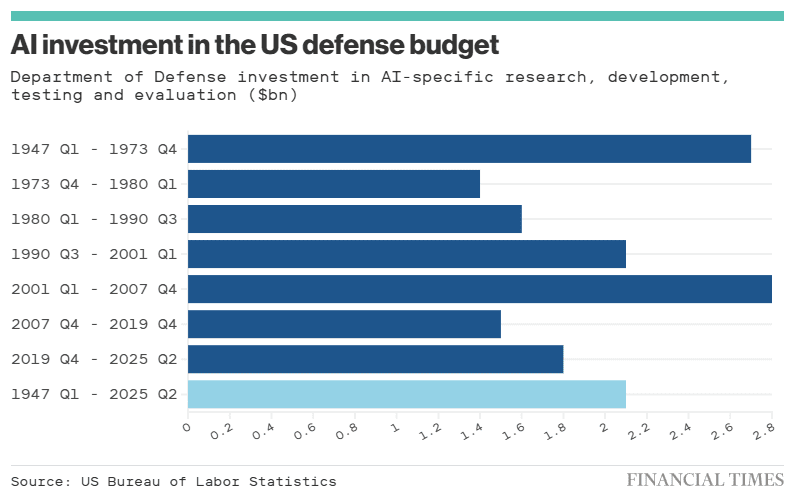
Secondly, money talks. OpenAI and others need to start recouping some of the unimaginable amounts of cash they’re spending on training and running these models. And few have deeper pockets than the Pentagon. And Europe’s defense heads seem keen to splash the cash too. Meanwhile, the amount of venture capital funding for defense tech this year has already doubled the total for all of 2024, as VCs hope to cash in on militaries’ newfound willingness to buy from startups. 

I do think the opposition to AI warfare falls into a few camps, one of which simply rejects the idea that more precise targeting (if it’s actually more precise at all) will mean fewer casualties rather than just more war. Consider the first era of drone warfare in Afghanistan. As drone strikes became cheaper to implement, can we really say it reduced carnage? Instead, did it merely enable more destruction per dollar?

But the second camp of criticism (and now I’m finally getting to your question) comes from people who are well versed in the realities of war but have very specific complaints about the technology’s fundamental limitations. Missy Cummings, for example, is a former fighter pilot for the US Navy who is now a professor of engineering and computer science at George Mason University. She has been outspoken in her belief that large language models, specifically, are prone to make huge mistakes in military settings.

The typical response to this complaint is that AI’s outputs are human-checked. But if an AI model relies on thousands of inputs for its conclusion, can that conclusion really be checked by one person?

Tech companies are making extraordinarily big promises about what AI can do in these high-stakes applications, all while pressure to implement them is sky high. For me, this means it’s time for more skepticism, not less. 

Helen responds:

Hi James, 

We should definitely continue to question the safety of AI warfare systems and the oversight to which they’re subjected—and hold political leaders to account in this area. I am suggesting that we also apply some skepticism to what you rightly describe as the “extraordinarily big promises” made by some companies about what AI might be able to achieve on the battlefield. 

There will be both opportunities and hazards in what the military is being offered by a relatively nascent (though booming) defense tech scene. The danger is that in the speed and secrecy of an arms race in AI weapons, these emerging capabilities may not receive the scrutiny and debate they desperately need.

Further reading:

Michael C. Horowitz, director of Perry World House at the University of Pennsylvania, explains the need for responsibility in the development of military AI systems in this FT op-ed.

The FT’s tech podcast asks what Israel’s defense tech ecosystem can tell us about the future of warfare 

This MIT Technology Review story analyzes how OpenAI completed its pivot to allowing its technology on the battlefield.

MIT Technology Review also uncovered how US soldiers are using generative AI to help scour thousands of pieces of open-source intelligence.

These technologies could help put a stop to animal testing

Earlier this week, the UK’s science minister announced an ambitious plan: to phase out animal testing.

Testing potential skin irritants on animals will be stopped by the end of next year, according to a strategy released on Tuesday. By 2027, researchers are “expected to end” tests of the strength of Botox on mice. And drug tests in dogs and nonhuman primates will be reduced by 2030. 

The news follows similar moves by other countries. In April, the US Food and Drug Administration announced a plan to replace animal testing for monoclonal antibody therapies with “more effective, human-relevant models.” And, following a workshop in June 2024, the European Commission also began working on a “road map” to phase out animal testing for chemical safety assessments.

Animal welfare groups have been campaigning for commitments like these for decades. But a lack of alternatives has made it difficult to put a stop to animal testing. Advances in medical science and biotechnology are changing that.

Animals have been used in scientific research for thousands of years. Animal experimentation has led to many important discoveries about how the brains and bodies of animals work. And because regulators require drugs to be first tested in research animals, it has played an important role in the creation of medicines and devices for both humans and other animals.

Today, countries like the UK and the US regulate animal research and require scientists to hold multiple licenses and adhere to rules on animal housing and care. Still, millions of animals are used annually in research. Plenty of scientists don’t want to take part in animal testing. And some question whether animal research is justifiable—especially considering that around 95% of treatments that look promising in animals don’t make it to market.

In recent decades, we’ve seen dramatic advances in technologies that offer new ways to model the human body and test the effects of potential therapies, without experimenting on humans or other animals.

Take “organs on chips,” for example. Researchers have been creating miniature versions of human organs inside tiny plastic cases. These systems are designed to contain the same mix of cells you’d find in a full-grown organ and receive a supply of nutrients that keeps them alive.

Today, multiple teams have created models of livers, intestines, hearts, kidneys and even the brain. And they are already being used in research. Heart chips have been sent into space to observe how they respond to low gravity. The FDA used lung chips to assess covid-19 vaccines. Gut chips are being used to study the effects of radiation.

Some researchers are even working to connect multiple chips to create a “body on a chip”—although this has been in the works for over a decade and no one has quite managed it yet.

In the same vein, others have been working on creating model versions of organs—and even embryos—in the lab. By growing groups of cells into tiny 3D structures, scientists can study how organs develop and work, and even test drugs on them. They can even be personalized—if you take cells from someone, you should be able to model that person’s specific organs. Some researchers have even been able to create organoids of developing fetuses.

The UK government strategy mentions the promise of artificial intelligence, too. Many scientists have been quick to adopt AI as a tool to help them make sense of vast databases, and to find connections between genes, proteins and disease, for example. Others are using AI to design all-new drugs.

Those new drugs could potentially be tested on virtual humans. Not flesh-and-blood people, but digital reconstructions that live in a computer. Biomedical engineers have already created digital twins of organs. In ongoing trials, digital hearts are being used to guide surgeons on how—and where—to operate on real hearts.

When I spoke to Natalia Trayanova, the biomedical engineering professor behind this trial, she told me that her model could recommend regions of heart tissue to be burned off as part of treatment for atrial fibrillation. Her tool would normally suggest two or three regions but occasionally would recommend many more. “They just have to trust us,” she told me.

It is unlikely that we’ll completely phase out animal testing by 2030. The UK government acknowledges that animal testing is still required by lots of regulators, including the FDA, the European Medicines Agency, and the World Health Organization. And while alternatives to animal testing have come a long way, none of them perfectly capture how a living body will respond to a treatment.

At least not yet. Given all the progress that has been made in recent years, it’s not too hard to imagine a future without animal testing.

This article first appeared in The Checkup, MIT Technology Review’s weekly biotech newsletter. To receive it in your inbox every Thursday, and read articles like this first, sign up here.

Stop worrying about your AI footprint. Look at the big picture instead.

Picture it: I’m minding my business at a party, parked by the snack table (of course). A friend of a friend wanders up, and we strike up a conversation. It quickly turns to work, and upon learning that I’m a climate technology reporter, my new acquaintance says something like: “Should I be using AI? I’ve heard it’s awful for the environment.” 

This actually happens pretty often now. Generally, I tell people not to worry—let a chatbot plan your vacation, suggest recipe ideas, or write you a poem if you want. 

That response might surprise some people, but I promise I’m not living under a rock, and I have seen all the concerning projections about how much electricity AI is using. Data centers could consume up to 945 terawatt-hours annually by 2030. (That’s roughly as much as Japan.) 

But I feel strongly about not putting the onus on individuals, partly because AI concerns remind me so much of another question: “What should I do to reduce my carbon footprint?” 

That one gets under my skin because of the context: BP helped popularize the concept of a carbon footprint in a marketing campaign in the early 2000s. That framing effectively shifts the burden of worrying about the environment from fossil-fuel companies to individuals. 

The reality is, no one person can address climate change alone: Our entire society is built around burning fossil fuels. To address climate change, we need political action and public support for researching and scaling up climate technology. We need companies to innovate and take decisive action to reduce greenhouse-gas emissions. Focusing too much on individuals is a distraction from the real solutions on the table. 

I see something similar today with AI. People are asking climate reporters at barbecues whether they should feel guilty about using chatbots too frequently when we need to focus on the bigger picture. 

Big tech companies are playing into this narrative by providing energy-use estimates for their products at the user level. A couple of recent reports put the electricity used to query a chatbot at about 0.3 watt-hours, the same as powering a microwave for about a second. That’s so small as to be virtually insignificant.

But stopping with the energy use of a single query obscures the full truth, which is that this industry is growing quickly, building energy-hungry infrastructure at a nearly incomprehensible scale to satisfy the AI appetites of society as a whole. Meta is currently building a data center in Louisiana with five gigawatts of computational power—about the same demand as the entire state of Maine at the summer peak.  (To learn more, read our Power Hungry series online.)

Increasingly, there’s no getting away from AI, and it’s not as simple as choosing to use or not use the technology. Your favorite search engine likely gives you an AI summary at the top of your search results. Your email provider’s suggested replies? Probably AI. Same for chatting with customer service while you’re shopping online. 

Just as with climate change, we need to look at this as a system rather than a series of individual choices. 

Massive tech companies using AI in their products should be disclosing their total energy and water use and going into detail about how they complete their calculations. Estimating the burden per query is a start, but we also deserve to see how these impacts add up for billions of users, and how that’s changing over time as companies (hopefully) make their products more efficient. Lawmakers should be mandating these disclosures, and we should be asking for them, too. 

That’s not to say there’s absolutely no individual action that you can take. Just as you could meaningfully reduce your individual greenhouse-gas emissions by taking fewer flights and eating less meat, there are some reasonable things that you can do to reduce your AI footprint. Generating videos tends to be especially energy-intensive, as does using reasoning models to engage with long prompts and produce long answers. Asking a chatbot to help plan your day, suggest fun activities to do with your family, or summarize a ridiculously long email has relatively minor impact. 

Ultimately, as long as you aren’t relentlessly churning out AI slop, you shouldn’t be too worried about your individual AI footprint. But we should all be keeping our eye on what this industry will mean for our grid, our society, and our planet. 

This article is from The Spark, MIT Technology Review’s weekly climate newsletter. To receive it in your inbox every Wednesday, sign up here.

DeepSeek may have found a new way to improve AI’s ability to remember

<div data-chronoton-summary="

  • Memory Through Images: DeepSeek’s new OCR model stores information as visual rather than text tokens, a technique that allows it to retain more data. This approach could drastically reduce computing costs and carbon footprint while improving AI’s ability to ‘remember’.
  • Addressing Context Rot: The model works a bit like human memory, storing older or less critical information in slightly blurred form to save space. This could help address the fact current AI systems forget or muddle information over long conversations, a problem dubbed “context rot.”
  • DeepSeek Disruption: DeepSeek shocked the AI industry with its efficient DeepSeek-R1 reasoning model in January, and is again pushing boundaries. The OCR system can generate over 200,000 training data pages daily on a single GPU, potentially addressing the industry’s severe shortage of quality training text.

” data-chronoton-post-id=”1126932″ data-chronoton-expand-collapse=”1″ data-chronoton-analytics-enabled=”1″>

An AI model released by the Chinese AI company DeepSeek uses new techniques that could significantly improve AI’s ability to “remember.”

Released last week, the optical character recognition (OCR) model works by extracting text from an image and turning it into machine-readable words. This is the same technology that powers scanner apps, translation of text in photos, and many accessibility tools. 

OCR is already a mature field with numerous high-performing systems, and according to the paper and some early reviews, DeepSeek’s new model performs on par with top models on key benchmarks.

But researchers say the model’s main innovation lies in how it processes information—specifically, how it stores and retrieves memories. Improving how AI models “remember” information could reduce the computing power they need to run, thus mitigating AI’s large (and growing) carbon footprint. 

Currently, most large language models break text down into thousands of tiny units called tokens. This turns the text into representations that models can understand. However, these tokens quickly become expensive to store and compute with as conversations with end users grow longer. When a user chats with an AI for lengthy periods, this challenge can cause the AI to forget things it’s been told and get information muddled, a problem some call “context rot.”

The new methods developed by DeepSeek (and published in its latest paper) could help to overcome this issue. Instead of storing words as tokens, its system packs written information into image form, almost as if it’s taking a picture of pages from a book. This allows the model to retain nearly the same information while using far fewer tokens, the researchers found. 

Essentially, the OCR model is a test bed for these new methods that permit more information to be packed into AI models more efficiently. 

Besides using visual tokens instead of just text tokens, the model is built on a type of tiered compression that is not unlike how human memories fade: Older or less critical content is stored in a slightly more blurry form in order to save space. Despite that, the paper’s authors argue, this compressed content can still remain accessible in the background while maintaining a high level of system efficiency.

Text tokens have long been the default building block in AI systems. Using visual tokens instead is unconventional, and as a result, DeepSeek’s model is quickly capturing researchers’ attention. Andrej Karpathy, the former Tesla AI chief and a founding member of OpenAI, praised the paper on X, saying that images may ultimately be better than text as inputs for LLMs. Text tokens might be “wasteful and just terrible at the input,” he wrote. 

Manling Li, an assistant professor of computer science at Northwestern University, says the paper offers a new framework for addressing the existing challenges in AI memory. “While the idea of using image-based tokens for context storage isn’t entirely new, this is the first study I’ve seen that takes it this far and shows it might actually work,” Li says.

The method could open up new possibilities in AI research and applications, especially in creating more useful AI agents, says Zihan Wang, a PhD candidate at Northwestern University. He believes that since conversations with AI are continuous, this approach could help models remember more and assist users more effectively.

The technique can also be used to produce more training data for AI models. Model developers are currently grappling with a severe shortage of quality text to train systems on. But the DeepSeek paper says that the company’s OCR system can generate over 200,000 pages of training data a day on a single GPU.

The model and paper, however, are only an early exploration of using image tokens rather than text tokens for AI memorization. Li says she hopes to see visual tokens applied not just to memory storage but also to reasoning. Future work, she says, should explore how to make AI’s memory fade in a more dynamic way, akin to how we can recall a life-changing moment from years ago but forget what we ate for lunch last week. Currently, even with DeepSeek’s methods, AI tends to forget and remember in a very linear way—recalling whatever was most recent, but not necessarily what was most important, she says. 

Despite its attempts to keep a low profile, DeepSeek, based in Hangzhou, China, has built a reputation for pushing the frontier in AI research. The company shocked the industry at the start of this year with the release of DeepSeek-R1, an open-source reasoning model that rivaled leading Western systems in performance despite using far fewer computing resources. 

An AI adoption riddle

A few weeks ago, I set out on what I thought would be a straightforward reporting journey. 

After years of momentum for AI—even if you didn’t think it would be good for the world, you probably thought it was powerful enough to take seriously—hype for the technology had been slightly punctured. First there was the underwhelming release of GPT-5 in August. Then a report released two weeks later found that 95% of generative AI pilots were failing, which caused a brief stock market panic. I wanted to know: Which companies are spooked enough to scale back their AI spending?

I searched and searched for them. As I did, more news fueled the idea of an AI bubble that, if popped, would spell doom economy-wide. Stories spread about the circular nature of AI spending, layoffs, the inability of companies to articulate what exactly AI will do for them. Even the smartest people building modern AI systems were saying the tech has not progressed as much as its evangelists promised. 

But after all my searching, companies that took these developments as a sign to perhaps not go all in on AI were nowhere to be found. Or, at least, none that were willing to admit it. What gives? 

There are several interpretations of this one reporter’s quest (which, for the record, I’m presenting as an anecdote and not a representation of the economy), but let’s start with the easy ones. First is that this is a huge score for the “AI is a bubble” believers. What is a bubble if not a situation where companies continue to spend relentlessly even in the face of worrying news? The other is that underneath the bad headlines, there’s not enough genuinely troubling news about AI to convince companies they should pivot.

But it could also be that the unbelievable speed of AI progress and adoption has made me think industries are more sensitive to news than they perhaps should be. I spoke with Martha Gimbel, who leads the Yale Budget Lab and coauthored a report finding that AI has not yet changed anyone’s jobs. What I gathered is that Gimbel, like many economists, thinks on a longer time scale than anyone in the AI world is used to. 

“It would be historically shocking if a technology had had an impact as quickly as people thought that this one was going to,” she says. In other words, perhaps most of the economy is still figuring out what the hell AI even does, not deciding whether to abandon it. 

The other reaction I heard—particularly from the consultant crowd—is that when executives hear that so many AI pilots are failing, they indeed take it very seriously. They’re just not reading it as a failure of the technology itself. They instead point to pilots not moving quickly enough, companies lacking the right data to build better AI, or a host of other strategic reasons.

Even if there is incredible pressure, especially on public companies, to invest heavily in AI, a few have taken big swings on the technology only to pull back. The buy now, pay later company Klarna laid off staff and paused hiring in 2024, claiming it could use AI instead. Less than a year later it was hiring again, explaining that “AI gives us speed. Talent gives us empathy.” 

Drive-throughs, from McDonald’s to Taco Bell, ended pilots testing the use of AI voice assistants. The vast majority of Coca-Cola advertisements, according to experts I spoke with, are not made with generative AI, despite the company’s $1 billion promise. 

So for now, the question remains unanswered: Are there companies out there rethinking how much their bets on AI will pay off, or when? And if there are, what’s keeping them from talking out loud about it? (If you’re out there, email me!)