

How AI Content Sleuths SEO Gaps
At the fringes of advertising abritage and search engine optimization, some content teams are generating thousands of mediocre articles in quest of rankings.
This brute force approach is addressing a challenge with modern organic search.
Optimizing a page for prominent rankings has never been easy. But 2025 has been, for many news publishers, a perfect storm of zero-click searches and a migration to generative AI platforms. Some outlets have experienced more than a 50% drop in search traffic.
Consider three recent headlines.
- “AI Has Upended the Search Game. Marketers Are Scrambling to Catch Up.” — The Wall Street Journal, May 8, 2025.
- “Forget SEO, The Hot New Thing is ‘AEO’” — Business Insider, May 12, 2025.
- “News Sites Are Getting Crushed by Google’s New AI Tools” — The Wall Street Journal, June 10, 2025.
Why So Hard?
Traffic from organic search results is declining owing to artificial intelligence and changes in user behavior.
For example, some folks now search on AI chatbots (behavior), and the search engines produce AI Overviews (evolution). Together, chat interfaces and AI search results are compressing search query responses into zero-click answers.
Nonstop algorithm changes are having an impact, too. As a consequence, Core Web Vitals, structured data markup, and Google’s E‑E‑A‑T (Experience, Expertise, Authoritativeness, Trustworthiness) are now essential.
Finally, there is the competition. The rise of AI writing tools has led to a massive surge of cookie-cutter content online, targeting seeminglly every conceivable keyword phrase. More on this in a moment.
SERP ranks don’t mean what they used to. For example, ranking in the top five for an important topic or keyword was once a huge win. In 2025, however, there is likely to be an AI Overview that satisfies the searcher (without having to click).
These and other SEO challenges breed uncertainty with traditional publishers and content marketers. Which content topics will drive site traffic?
The unlikely answer to this question, at least for some folks, is to create more low-quality, AI-generated content.
Arbitrage
Arbitrage is the practice of profiting on the price difference of an identical or similar asset in different markets.
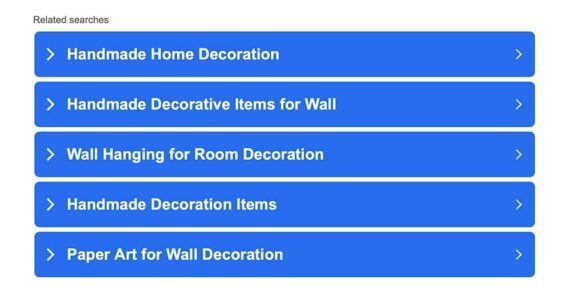
Google Ads’ “Related Search on Content” (RSOC) is a form of advertising that displays search terms on a web page. Some arbitrageurs use RSOC to profit.
The arbitrage starts with a content site, and works like this:
- A website owner lists several related keywords on an AI-generated article page.
- The keywords link to search results on the same website.
- At the top of those site-search results are Google’s RSOC ads with high-value keywords.
- The business earns an advertising revenue share when visitors click the ads.
Advertising arbitrage with ROSC starts with a lightweight article page to encourage a “Related searches” click.
Next, the business buys relatively low-value-keyword ads on Google Search to drive traffic to its AI article page, encouraging users to click on related search options, thereby earning money on the difference between ad cost and ad revenue.
Arbitrageurs use AI to generate thousands of middling articles they can drive traffic to. And oddly, these pages sometimes rank in the top 100 spots.
SEO Topic Signal
Scouring SERPs for opportunities, a few niche content agencies noticed what the arbitrageurs were doing.
Here were AI pages built not to answer a need — in fact, providing so little information that a visitor would click a related search term — but to identify a topic signal.
In response, these agencies are also generating numerous subpar articles to find ranking opportunities.
One such agency explained it this way. Creating a quality blog post for a client might cost $1,500, considering research, composition, graphics, and other expenses. And there is no guarantee the article will rank well.
Instead, the agency creates 60 AI-generated, human-edited articles on related topics. All reside on the client’s blog, although not featured.
Finally, they wait. If it creeps into the top 100 organic search rankings, as reported by Semrush or Ahrefs, an article receives royal treatment. A human author rewrites it, places it in a topic cluster, and features it on the blog.
Application
For marketers, the lesson is not to flood the web with cheap AI articles. Rather, it is to recognize that finding ranking opportunities can be a process of discovery.

The B2B SEO Trap: Why High-Intent Visibility Can Still Underperform via @sejournal, @coreydmorris
In B2B SEO, typically, the ultimate goal is to attract high-intent searchers who convert into qualified leads.
But, not all high-intent visibility translates to sales-ready traffic, especially in long sales cycles or complex buying journeys.
As we get deeper into an era of diminishing importance of keywords that translate directly into attributable clicks, a focus on quality of traffic is as important as ever.
Don’t get me wrong. Quality has long been a critical component and key performance indicator (KPI) in the sense that most of us know our conversion rates and stages of the funnel someone might be in related to intent with B2B and lead generation.
However, now, as much as ever, we have to scrutinize intent and the traffic quality even more.
When SEO teams over-prioritize high-intent visibility and focus under the false assumption that intent equals urgency, we can find that we’re not getting the conversions or leads that we expect.
In this article, I’m unpacking seven ways to help go deeper with mapping visibility to actual funnel stages, differentiating decision-makers vs. influencers, and building SEO content that nurtures, qualifies, and educates before the handoff to sales.
1. The Myth: “If It’s A Bottom-Of-Funnel Topic, The Traffic Is Ready To Convert”
While we may think about our website, our content, and analytics data in customer journeys and conversion funnels, our target audience doesn’t.
Maybe my nerdy search brain thinks that way when I’m consuming content on a website I’m interested in, but most of the world doesn’t.
There are too many variables that impact someone’s conversion decision to fully unpack here. I can personally tell you that a couple of times, I filled out forms while lying on the floor next to one of my kids in bed, falling asleep.
And, other times, I sat with a tab open on my giant desktop work monitor for months before eventually finding that tab again and filling out the form.
Those are two extreme examples, but as more possible ways to be found (e.g., AI search) enter play, we’re going to see myriad behaviors and paths that we couldn’t have anticipated just a few years ago.
Things are not going to make sense in a simple way, and what might seem like a home run conversion will be frustrating when you dig into the data, and things that might have felt like top of funnel that convert quickly will be equally (but pleasantly) surprising as well.
2. B2B Searchers Are Often Researching, Comparing, Or Gathering Info, Not Buying
Beyond the intent challenges and varying entry points and sources I noted above, we have a hand to play at times as well in how and where someone converts.
Our best converting content can still be standing in the way of getting the actual conversion. Just like the head scratchers that we might find when someone converts quickly without seemingly spending much time on the site or in “research” mode.
With more answers being given within search engines and large language models (LLMs), a lot of the research is done before someone gets to our site.
That being said, whether our content is helping inform AI, getting us found off-site, or to do the traditional education work on our site, we have to understand that, even on what might seem like a high intent page, someone might still be in research and information gathering mode.
They might be seeking pricing (if we disclose it) or building their own deck of us, plus competitors, to help with their own decisions for buying or outreach.
When we make too many assumptions, put someone on a singular navigation path, or take away options, we risk losing the opportunity for them to continue their research journey.
We’ve got to find a balance between prominent calls-to-action (CTAs) and long-form content so there’s more flexibility for the user based on what their intent is in that visitor or session that we worked so hard to get.
3. How To Differentiate Between User Intent And Sales-Readiness
I’ve talked a lot about intent already. What I haven’t unpacked is how sales-ready someone is.
Our brand story, content, and user experience can be persuasive and do the job of getting a form submission or phone call.
However, if someone isn’t “sales-ready,” they likely are going to consume everything up to the point of a conversion action, then leave. They may come back often up to that point and leave.
This might lead us to think there’s something wrong with the form, or the CTA, or the content itself. Sure, that could be the case and should be validated. But, it could also be that they simply aren’t ready to buy.
As an agency owner, I also operate a B2B business that relies on lead generation. I can personally validate that while we have received a lot of seemingly bottom-of-the-funnel traffic, my team has been told by prospects that they were ready to buy, but not ready to talk to anyone, as they were told to slow down the process or await a final budget approval before reaching out.
It’s frustrating, but that’s seemingly the nature of the world economically these past couple of years (probably not a “hot take”).
4. Why One-Size-Fits-All CTAs (E.g., “Request A Quote”) Often Fail In B2B
I admit that I’ve been guilty of slapping the one-size-fits-all, generic CTA in the footer or sidebar of all pages of a site.
As I noted earlier, we need to expect the unexpected with matching intent to content and funnel levels. We should definitely review and evaluate our CTAs.
In line with my note above about someone possibly being close to a conversion but not sales-ready, if we have other areas of value we can provide like additional content they can subscribe to or ways to engage with us to get further acquainted (ex: webinars, Q&As, etc), that don’t involve a direct sales process, then we can further engage with them and stay in front of them in a way that is welcome based on where they are right now.
5. Using Content To Build Trust And Qualification, Not Just Capture Form Fills
When we rush someone to a form submission and they’re not ready to buy, not prepared for the sales process, or qualified, we often get feedback from sales about discrepancies related to marketing qualified leads (MQLs) vs. sales qualified leads (SQLs) or how leads are accepted by sales.
Wasting time on sales internally, while frustrating, someone who wasn’t prepared for (or qualified for) the process is a loss for both sides.
Building trust through quality content, differentiation, setting expectations on what happens after the form submission, and other trust signals like transparency of pricing can go a long way to ensuring higher rates of conversions to customers.
Don’t forget that quality trumps quantity if we look at additional metrics and KPIs in our marketing-to-revenue process.
6. How To Structure B2B Content Around Intent Clusters, Not Just Funnel Stages
If you aren’t convinced yet from what I’ve shared about how user behavior can differ from what we might expect or predict, then maybe thinking about content specifically will help.
In the zero-click searches and AI search push that has taken focus away from specific keyword and has put it more on visibility, one piece consistently is important: the content you create.
In topics, clusters, or however you want to think about how the content is organized on your website, you still need to focus on how it is presented to the user.
Starting with the user intent and mapped to where they are in the funnel, then working backwards, we can see where we have gaps in content and what we need to support answering all questions possible and moving the prospect forward in the process.
This will serve you well for search engines today and LLMs and AI-generated search results today and tomorrow.
While we used to (and in some cases still approach it today) as topics driven by keywords, I’m advocating for thinking about topics in how someone might be moving through a customer journey.
What questions are they asking at the phase they are in? Have we anticipated everything? Have we accidentally assumed too much about their knowledge or their sales-readiness?
We’re not going to be able to think of everything. Much like long-tail keywords and queries, we can see people doing a lot more research and probing in AI research.
My company got a lead from ChatGPT a few months ago, and we could see that they visited our site seven times from ChatGPT in the process before eventually filling out our form. This is not user behavior that we would have planned for or anticipated just a few years ago.
7. Creating SEO Content For Both Decision-Makers And Gatekeepers
We can’t control who comes to our website. Humans aren’t as blockable as robots and web crawlers. However, we don’t need to be worried about those who might not be the ultimate prospect or decision-maker.
Whether you’re seeing traffic from AI engines, search engines, or those that never convert and seem like unqualified human visitors, I encourage you to still work on building your authority position, be helpful with your content, and to know that you might be helping get critical information to gatekeepers (human or systems) that go further upstream to a human who is a decision-maker.
Whether you’re educating the search committee for a Request for Proposal (RFP) process, an assistant or intern doing field research, or something automated trying to learn so it can feed good info to a decision-maker, it isn’t wasted effort, even though narrow thinking and reviewing of conversion metrics at the bottom of the funnel may make it seem that way.
Final Thoughts
Customer journeys, funnel thinking, search intent, and how it all works together in generating conversions and leads for B2B focuses can be complex and hard to track. It is getting even harder.
That doesn’t mean that we should give up or try to force everyone through a narrow funnel or one-size-fits-all approach.
We can’t predict all the ways that our content will be understood, consumed, and engaged with.
What we can do is be helpful, leverage a strong brand, be transparent, and do everything we can to present users (and other sources) with a complete picture of our products, services, and how we are the right fit (or not) for our website visitors.
Leveraging our moments of visibility to generate quality traffic, but understanding that the bottom of the funnel isn’t a slam dunk to convert, and what it all can mean, can go a long way for engaging and re-engaging bottom of the funnel traffic to get every conversion we deserve.
More Resources:
Featured Image: vittaya pinpan/Shutterstock

Quality Audiences: Why Lower Traffic Might Be Better via @sejournal, @rio_seo
There once was a time when digital marketers chased traffic.
The more traffic a website attracted, the more marketers felt satisfied and closer to attaining their goals.
But, this once golden metric is no longer a tell-tale sign of success.
Gone are the days of forecasting growth solely on the number of visitors coming to a website.
Today, lower traffic might actually be better than driving a plethora of unqualified, uninterested leads to your website.
Undoubtedly, consumer search behavior looks much different than it once did. AI is stealing click-throughs, third-party cookies are essentially disappearing, and audiences give more thought to whether to click through to a website.
Quality over quantity is the name of the game, and marketers are now shifting their focus towards driving better traffic rather than more traffic.
In this post, we’ll dissect why less traffic might be “more” and better for your business, how to shift your content marketing strategy to attract high-quality visitors, and share actionable insights for driving business results with your target audience.
The Traffic Trap: Why More Isn’t Always Better
At first thought, a high volume of traffic sounds ideal. The thought of hundreds of thousands of visitors flooding your site and purchasing your products or services would be a dream. But, that’s unfortunately not reality in most cases.
It’s a vanity metric that looks impressive in presentations but doesn’t necessarily move the needle when it comes to sales.
According to a recent study, the average website conversion rate across 14 different industries is a dismal 3.3%. That means for every 1,000 visitors, fewer than 25 of those will actually convert. And, depending on your sector, your conversion rate might be even lower.
Additionally, consider if your content isn’t optimized for the right keywords. You could be attracting traffic with zero intention or motivation to convert.
In this case, these searchers are likely to bounce once they realize what you’re selling, they have no interest in buying.
The numbers may look inflated, but if the quality is lacking, those numbers are meaningless.
At the end of the day, sales and revenue are the ultimate goals for any business. Drawing in the right audience leads you closer to that goal, even if the numbers aren’t legendary.
Because here’s an uncomfortable truth: Traffic is easy to obtain; quality traffic is hard.
AI Has Forever Changed The Search Landscape
There’s been much discussion around the impact of AI in the search landscape, and even some of the most seasoned SEOs are scratching their heads, wondering what to do.
Google’s rollout of AI Overviews and the rising use of ChatGPT and other generative AI tools have significantly altered the way users search for products and services.
Searchers no longer need to click through on a website to get the information they need. Instead, they’re receiving AI-generated summaries that often answer their question right away.
This has resulted in businesses across the board seeing a notable decrease in traffic. Even top-ranking content that’s been thriving in the search engine results pages (SERPs) for years has taken a hit.
Bustle, the entertainment and lifestyle site, saw search traffic behave erratically last spring, around the time AI summaries were introduced. Some stories surged to 150,000-300,000 views, while most others barely cracked 1,000.
In turn, SEOs and content marketers are being forced to face a new reality – what many are referring to as “zero-click search 2.0.”
But, just as we have done with all the previous major changes in the search landscapes, the good news is we’ll live and we’ll adapt.
It takes a mindset shift, where instead of relying on high-ranking content to drive traffic, the new goal must be to create valuable, intent-focused content that targets long-tail queries, offers helpful information, solves a problem, and is well-written (which means not relying on AI to fully draft content for you).
Subject matter experts are in higher demand than ever before as relevance and trust become more paramount than ever before.
The Power Of Qualified Traffic
When we talk about qualified traffic, it’s important to clearly define what exactly this means, as it can have divergent definitions.
For the purposes of this post, quality audiences include searchers who:
- Match and align with your target personas and demographic.
- Arrive with specific intent (ready to make a purchase or are further along in the sales journey).
- Engage meaningfully with your content (visiting multiple pages on your site, higher dwell times).
- Often find you through word-of-mouth, email, referrals, reviews, or targeted search.
- Use long-tail queries to help them solve a problem they’re facing.
Now, think about the content you’re creating and what’s in your pipeline.
If you’re drafting generic blog posts, surface-level articles, or are relying entirely on AI to draft your content for you, you may be attracting visitors, but you likely aren’t motivating buyers.
The same can be said for advertising efforts that cast too wide of a net. The result? An influx of searchers that may have no intention of converting and no interest in your business.
Your traffic count may look great, but there’s no success behind drawing in these visitors.
Consider that an email marketing provider found that email marketing has an average return on investment (ROI) of $36 for every $1 spent.
It’s well known and documented that email marketing tends to be one of the highest drivers of ROI.
The reason for this is that your email audience is usually pre-qualified and opted in to receive communication from you. They know your business and what you sell, and are therefore more likely to take action.
Similarly, referral traffic and direct traffic often yield higher conversion rates than social media or display ads.
Getting the right people to your site is essential, and the tactics that accomplish this should be your primary focus.
Quality Content = Better Business Outcomes
There’s a reason why nearly half of technology companies say their content marketing budgets will grow this year. Because content works – when it’s done right.
Content shouldn’t be created to cast a wider net. It should be created with intentionality to grow your brand recognition, build trust with your audience, and offer the type of value that keeps people coming back.
Here’s how quality, helpful content focused on the right audience and pain points pays off:
1. Higher Conversion Rates
Personalized content is a powerful driver of consumer behavior.
In fact, 76% of people say tailored content influences their decision to consider a brand, and 78% say it makes them more likely to buy again.
This statistic highlights the need for content that’s personalized and targeted to searchers’ needs.
Content that speaks to a specific persona or pain point is more likely to convert than a pointless listicle that’s stuffed with basic information.
2. Improved Customer Lifetime Value (CLV)
You don’t want your customers to be one and done. Instead, you want them to come back to you any time the need arises. You want to be the brand they choose and trust over your competitors.
When you draft content that is deeply relevant, helps users understand your products, educates them on all your services, or guides them towards making a more informed decision, they’re likely to keep returning for more.
3. Lower Customer Acquisition Costs (CAC)
No salesperson wants to sit through a multi-year process, anxiously awaiting the day a prospect may or may not decide to move forward.
Targeted content and lower funnel content attract qualified leads that lead to shorter sales cycles and lower the cost to acquire a new customer.
This empowers sales teams to focus on closing rather than convincing, educating, or determining if a prospect is worth their while.
4. Stronger Brand Equity
When customers find your content to be valuable, they’re more likely to share your content with their followers on social media and refer you to their friends.
Bridging the gap between awareness and consideration means building trust and drafting insightful, research-backed content.
This is why content drafting can’t be left solely to AI but should be left in the hands of skilled human writers who’ve consulted subject matter experts to deliver the highest value content possible.
Content Quality Indicators
As aforementioned, traffic alone isn’t enough to measure the quality of your content. There are numerous signals that can help you assess whether your content is working.
A few key metrics content marketers should assess when evaluating the strength of their content marketing efforts include:
- Bounce Rate: The bigger the bounce rate, the bigger the concern. According to Siege Media, a good bounce rate for a blog is 70%, with the average being 80%. Anything more, and there is likely a fatal flaw between content and audience expectations that should be examined.
- Scroll Depth: Similar to bounce rate, it’s unhelpful if your browsers aren’t scrolling down enough to potentially become buyers. This could suggest myriad issues, such as your call to action (CTA) being too far down on the page or your content not resonating with your target audience.
- Time on Page: Are customers coming to your website but leaving shortly after? Short sessions on your website may imply low engagement, or your content simply isn’t relevant to the audience. This is often the case when your keywords don’t align with search intent, which raises the importance of thorough keyword research.
- Conversion Pathways: Each of your website pages likely has the goal of getting people to take action, whether that’s filling out a form, requesting a demo, or purchasing a product. If people aren’t clicking your CTAs, it’s important to assess what the problem is. Perhaps your CTA is the wrong color or doesn’t use compelling language. A/B testing can help you assess where the real problem lies.
These metrics help you understand not just how many people arrived, but how many stayed and why.
The Go-To Content Marketing Strategy To Drive Qualified Traffic
It’s time for a mind shift for content marketers. We’re not abandoning growth, and we’re not neglecting traffic, but we’re being more intentional about our goals.
More traffic doesn’t mean more sales. It’s time to redefine our strategies to secure success and highlight content marketing as a value-add. Here’s the new playbook for driving qualified traffic:
1. Redefine What Success Looks Like
Success looks different today than it did even a few years ago. Today, success is contingent on attracting quality leads, keeping people on your website, assessing the time to conversion, and digging into your content engagement rates.
We’re also looking at any red flags in user experience, such as long page load times, CTAs that are too far down, and intrusive ads popping up.
2. Segment Your Audience
Your target audience is likely diverse, which means they inherently have different needs and preferences.
To ensure your content hits the mark, it’s crucial to segment your audience appropriately by buyer personas, new versus returning users, behavioral signals, age, and more to ensure your content lands.
For example, a Gen Z customer searching for a financial services business will want vastly different information than a Boomer, who may be looking for information about retirement or estate planning.
3. Align Content With The Funnel
Content must be created for all stages of the funnel.
For example, a first-time buyer will likely want more awareness-level content, whereas someone at the decision stage likely wants to read case studies or product reviews.
Audit your existing content to ensure you have a healthy mix of content at each stage of the funnel, including:
- Top of Funnel (ToFu): Awareness content that builds trust and captures attention (but should still target a specific persona).
- Middle of Funnel (MoFu): Educational content that helps users compare solutions, such as whitepapers, ebooks, product one-pagers, and more.
- Bottom of Funnel (BoFu): Case studies, reviews and testimonials, product demos, and more.
4. Invest In First-Party Data
Knowing who’s interested in your business can help you reach the right people at the right time.
First-party data is invaluable, and can be sourced through email subscribers, webinar attendees, and form fills.
These are the people your business wants to develop relationships with, and can do so through drip campaigns, feedback loops, and tailored content offers.
5. Optimize For Intent, Not Just Keywords
Informational keywords can be helpful, but they often aren’t going to lead to quick conversions.
It can be helpful to focus on human-centered SEO, long-tail keywords (which usually are specific and solve a problem), and other types of intent-based keywords.
Leverage third-party tools like Semrush, Ahrefs, or MarketMuse to uncover the why behind searches, how competitive search terms are, and how often they’re searched for.
Quality Will Win The Future Of Content Marketing
In a digital-first era that’s rife with competition, it’s necessary to differentiate your business from others.
While your competitors may be generating content quickly and at scale using AI, your brand can gain a competitive edge by doubling down on authenticity and building human-first content.
Lower traffic may be getting your business down, but it’s important to remember that doesn’t necessarily translate to lower value. In fact, for many brands, trimming the fat and focusing on quality audiences only leads to greater wins.
The next time you’re analyzing your data and notice a dip in traffic, there’s no need to get into panic mode. Ask yourself:
- Did the right people visit?
- Is our content useful?
- Are these visitors driving growth?
After all, traffic is just a number.
More Resources:
Featured Image: Roman Samborskyi/Shutterstock

How AI Search Can Drive Sales & Boost Conversions [Webinar] via @sejournal, @brentcsutoras
AI search has completely changed the way customers make decisions. If you’re still just tracking data instead of driving sales from AI search, you are missing out.
Join Bart Góralewicz, Co-Founder of ZipTie.dev, on September 3, 2025, for an insightful webinar on how to map customer journeys in AI search and turn those insights into measurable sales.
What you will learn:
Why attend:
Brands that win in AI search are not just watching their metrics. They are understanding how customers discover and decide to buy. This session will give you the tools to drive higher conversions and grow revenue with AI search.
Register now to learn practical strategies you can apply right away. Can’t attend live? No problem! Sign up, and we will send you the recording.

New Books to Gear Up for Peak Season Selling
The end of summer signals the beginning of fall and peak season planning for merchants. From entrepreneurial inspiration to employee motivation, these recent titles can help start the process.
Catching Cheats: Everyday Forensics to Unmask Business Fraud
Catching Cheats
by Erik Lie
Lie is a finance professor whose research exposing manipulation of stock options by inside executives led to a series by The Wall Street Journal, earning a Pulitzer Prize for Public Service in 2007. His forthcoming book uses the stories of fraudsters such as Bernie Madoff to show how data analysis can identify financial cheating. Reviewers call it “real-world ‘CSI’” and “eye-opening.”
You Already Know: The Science of Mastering Your Intuition

You Already Know
by Laura Huang
Knowing when to trust your gut is essential to success. Business professor and thought leader Huang provides practical, science-based exercises to help readers recognize and cultivate those eureka moments to make better decisions and achieve their goals.
Designing Momentum: A Blueprint for Transforming Everyday Moments into Massive Success

Designing Momentum
by Brant Menswar
Menswar, a top motivational speaker and consultant, aims to provide readers with “a practical blueprint for transforming ordinary moments into extraordinary opportunities for growth and success” using a systematic framework developed from his personal experience.
Pioneers: 8 Principles of Business Longevity from Immigrant Entrepreneurs

Pioneers
by Neri Karra Sillaman
Many immigrants have built lasting, successful businesses despite starting with little money and no connections. The author combines in-depth research and real-world case studies to create an inspiring guide that has earned raves from luminaries such as authors Melanie Robbins and Adam Grant.
Stakeholder Whispering: Uncover What People Need before They Ask

Stakeholder Whispering
by Bill Shander
Starting from the premise that people don’t know what they need, Shander demonstrates how to see beyond what customers and others request to understand what they really need. The author is a business communications practitioner with decades of experience transforming data into compelling visual and interactive experiences for international companies and government agencies.
Sell to the Rich: The Insider’s Handbook to Selling Luxury

Sell to the Rich
by Jeffrey Shaw
If you’re looking to break into the luxury market, this book promises to help by offering strategies for cultivating brand loyalty and building trust with wealthy clients, drawing on the author’s experience serving these clients.
Employee Understanding: A Three-Pillar Framework
Employee Understanding
by Annette Franz
Most CEOs agree that engaging and retaining employees is a top challenge. For ecommerce businesses, employees are typically the key to a compelling customer experience. Franz reminds readers that providing an excellent experience for employees leads to stellar experiences for clients and customers.
Wild Courage: Go after What You Want and Get It

Wild Courage
by Jenny Wood
Best-selling authors Seth Godin, Daniel Pink, Tiago Forte, and Gretchen Rubin are raving about career coach and former Google executive Jenny Wood’s inspirational new guide to getting what you want in your personal and professional life.
Using AI for Marketing: How to Harness the Transformative Power of AI

Using AI for Marketing
by David Berkowitz
Digital marketer Berkowitz cuts through the hype about artificial intelligence to offer a practical guide to using this powerful new technology to boost marketing creativity, strategy, and results. As the founder of the AI Marketers Guild, he understands how marketers work and provides real-world examples of AI’s real-world possibilities.
The Experimentation Machine: Finding Product-Market Fit in the Age of AI

Experimentation Machine
by Jeffrey J. Bussgang
Bussgang is a Harvard Business School professor, venture capitalist, and author of two books on entrepreneurship and VC. His third title shows founders how to design and run experiments and scale operations with time-tested techniques and the latest technology.
Identity Marketing: How to Create Loyal, Lifelong Fans and a Legendary Brand

Identity Marketing
by Veronica Romney
Romney, an experienced marketer and host of the weekly Rainmaker podcast, argues that in today’s changing marketing environment, “be this” is a more powerful marketing message than “buy this.”

Ahrefs Launches Tracker Comparing ChatGPT & Google Referral Traffic via @sejournal, @MattGSouthern
Ahrefs released a public dashboard that tracks how much referral traffic websites receive from Google Search versus ChatGPT, with monthly updates.
The first dataset covers three complete months across 44,421 sites connected to Ahrefs’ free Web Analytics tool.
The Early Numbers
For July, the dashboard reports Google at 41.9% of total web traffic across the cohort and ChatGPT at 0.19%.
Month over month, Google grew 1.4% and ChatGPT grew 5.3%.
The prior month showed the reverse pattern: Google +6.8% and ChatGPT +1.6%. These swings show growth rates can vary by month even as Google’s share remains far larger. Ahrefs Traffic Analysis
The dashboard states:
“ChatGPT is growing 3.8x faster than Google.”
It adds:
“With 5.3% monthly growth vs Google’s 1.4% in the latest month, AI-powered search continues to evolve rapidly.”
And:
“ChatGPT now drives measurable referral traffic to websites, representing a new channel that didn’t exist 2 years ago.”
How The Data Is Collected
To keep the time series comparable, the tracker includes only sites that appear in all months. As the page explains:
“Our analysis tracks sites that appear in all months, ensuring statistically significant and reliable growth metrics.”
The page also lists the last update timestamp and confirms monthly updates.
Important Caveats
The dashboard measures referral traffic that arrives with a referrer.
Some AI systems and in-app browsers add noreferrer or otherwise strip referrers, which can undercount AI-originating visits.
Ahrefs has documented this analytics blind spot when measuring AI assistants and Google’s AI Mode. Keep that limitation in mind when comparing “AI search” activity to traditional search.
Scope matters too. The cohort is limited to sites using Ahrefs Web Analytics. Earlier Ahrefs research across different samples found AI referrals around 0.17% of the average site’s traffic, which is directionally consistent with the 0.19% shown here.
Looking Ahead
Google still sends the overwhelming share of visits in this dataset, and that reality should anchor your priorities. At the same time, ChatGPT’s July growth suggests an emerging, measurable channel you can evaluate with real data.
Use the tracker to watch how both lines move over time and adjust your testing accordingly.
Featured Image: JRdes/Shutterstock
WordPress Contact Form 7 Redirection Plugin Vulnerability Hits 300k Sites via @sejournal, @martinibuster
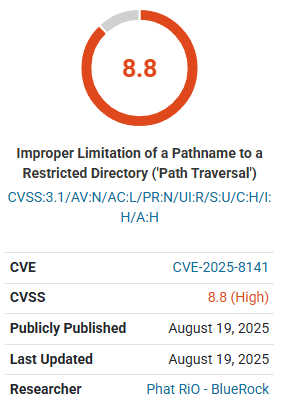
A vulnerability advisory was issued for a WordPress Contact Form 7 add-on plugin that enables unauthenticated attackers to “easily” launch a remote code execution. The vulnerability is rated high (8.8/10) on the CVSS threat severity scale.
Screenshot from Wordfence advisory showing 8.8 CVSS severity ratingRedirection for Contact Form 7 plugin
The vulnerability affects the Redirection for Contact Form 7 WordPress plugin, which is installed on over 300,000 websites. The plugin extends the functionality of the popular Contact Form 7 plugin. It enables a website publisher not only to redirect a user to another page but also to store the information in a database, send email notifications, and block spammy form submissions.
The vulnerability arises in a plugin function. WordPress functions are PHP code snippets that provide specific functionalities. The specific function that contains the flaw is called the delete_associated_files function. That function contains an insufficient file path validation flaw, which means it does not validate what a user can input into the function that deletes files. This flaw enables an attacker to specify a path to a file to be deleted.
Thus, an attacker can specify a path (such as ../../wp-config.php) and delete a critical file like wp-config.php, clearing the way for a remote code execution (RCE) attack. An RCE attack is a type of exploit that enables an attacker to execute malicious code remotely (from anywhere on the Internet) and gain control of the website.
The Wordfence advisory explains:
“This makes it possible for unauthenticated attackers to delete arbitrary files on the server, which can easily lead to remote code execution when the right file is deleted (such as wp-config.php).”
The vulnerability affects all versions of the plugin up to and including version 3.2.4. Users of the affected plugin are advised to update the plugin to the latest version.
Featured Image by Shutterstock/Everyonephoto Studio

Breaking Down Optmyzr’s Study on Amazon’s Exit from Google Ads via @sejournal, @brookeosmundson
Just under one month ago, on July 23, 2025, Amazon vanished from Google Shopping ads overnight.
No trial, no warning, no phased retreat. One of the biggest advertisers on the platform simply stepped back, leaving a noticeable gap in auctions.
For many retailers, this shift opened the door to new opportunities. It’s tempting to think they would breathe easier: less competition, lower costs, more conversions.
But as Fred Vallaeys puts it, the reality is more nuanced: “more volume, less value.”
Optmyzr’s study eludes that those opportunities since Amazon’s exit didn’t always translate into stronger performance. Read on to further explore Optmyzr’s findings on the great Amazon exit.
Key Findings from Optmyzr’s Study on Amazon Leaving Google Ads
Optmyzr compared performance across two matched weeks: July 23-29, 2025 vs. July 16-22, 2025.
They made sure to exclude Prime Day and matching days to isolate the effect of Amazon’s exit.
The findings were significant in major metric categories, including:
- Impressions +5%
- Clicks +7.8%
- Cost -1%
- Avg. CPC -8.3%
This first set of pre-click metrics looked promising for many retailers. But what about conversions?
That data told another story:
- Conversion volume stayed flat
- Conversion Value -5.5%
- Conversion Rate -7.2%
- ROAS -4.4%
What does this mean? Ads got cheaper and drew more clicks as a result of Amazon leaving Google Ads. But overall, it brough in less value to retailers.
The ‘Volume Trap’ Defined
Why did conversions fall even as traffic increased? The answer lies in expectations.
Amazon‑seeking shoppers clicked competitor ads but still expected Amazon-level pricing, quick shipping, and seamless service.
When most brands couldn’t meet that bar, conversions and value slipped. That’s the classic “volume trap”: traffic that looks good on the surface but doesn’t deliver the bottom-line results.
Vallaeys elaborated more on the volume trap, explaining why it happens and how to escape the volume trap.
The volume trap happens when advertisers get excited about more traffic but don’t stop to ask whether those clicks are truly valuable. Driving incremental volume is often not difficult (especially if you’re willing to accept lower-value traffic) but the real question is whether that traffic can actually convert profitably.
When Amazon exited Google Ads, we observed shoppers clicking on competitor ads for the same products but then bouncing back to Amazon. Why? Because Amazon has built unmatched trust with consumers: fast Prime shipping, predictable pricing, and a familiar checkout experience. That shows us that you can’t just replace the clicks and expect the same outcome. If your value proposition doesn’t align with what consumers expect, you may see more traffic but not more revenue.
To escape this trap, advertisers need to reframe their strategy. Instead of chasing short-term click growth, they should focus on positioning themselves differently. That might mean emphasizing local sourcing, higher-quality products, or a more personal experience. These are factors that Amazon can’t replicate. It also means looking beyond the immediate conversion. Even if you don’t win the sale today, you can start building a relationship that leads to long-term customer loyalty.
The real key is shifting the mindset: don’t just measure success by volume. Measure it by the value of the relationships you create.
To summarize the volume trap, what Optmyzr showed in their study is that more clicks don’t automatically equal more revenue. If you can’t compete with Amazon-like qualities (price, shipping, etc.), lean into what makes your offer unique and build relationships that pay off in the long run.
Which Categories Gained and Which Struggled After Amazon’s Exit
Not every category reacted the same way. Some thrived, while others got stuck in the volume trap:
- Electronics: The standout success story. Clicks +11.5%, Conversions +81.3%, Conversion Value +10.9%, ROAS +7.1%, and all with lower CPCs.
- Home & Garden: Traffic surged (+13.1%), but Conversion Value dropped 7.5%, ROAS -7.7%. More volume, but less value per sale.
- Sporting Goods: Conversions rose 20.7%, but value declined nearly 10%. Shoppers likely bought lower-priced items or held back because they couldn’t find Amazon-level deals.
- Health & Beauty: Conversions increased 14.6%, but conversion value essentially flat (+0.3%), ROAS up only slightly. Gains were masked by low-value purchases.
- Tools & Hardware, Apparel & Accessories, Arts & Entertainment, Furniture, Vehicles & Parts: All showed some version of the volume trap: modest increases in clicks or conversions, but declining value and ROAS.
What This Means for Advertisers Managing Google Shopping Campaigns
Optmyzr’s data showed what happened when Amazon suddenly stepped out of the picture: cheaper clicks, more traffic, but ultimately lower value.
That’s the data side of the story.
Where marketers need to lean in is interpreting what that really means for account management.
Optmzyr’s takeaways give some practical perspectives for advertisers to think about.
- Volume doesn’t always equal victory. More clicks might look great on the surface, but if those shoppers aren’t buying (or if they’re buying lower-ticket items), the net impact on your business can be negative. This isn’t something Optmyzr explicitly called out, but it’s the natural next step in interpreting their findings.
- Category context is critical when evaluating success. Optmyzr highlighted Electronics as a category that saw improved conversions and ROAS. Why? Because those retailers could match or even surpass Amazon on fulfillment, trust, and pricing. If you’re in a category where you can’t deliver the same level of convenience, you’re more likely to see the opposite effect.
- Measure what matters to your business. The study found that impressions, clicks, and traffic volume all increased. But the metrics that matter (conversion value and ROAS) told a different story. That’s the reminder for advertisers: make sure your optimizations focus on value, not vanity metrics.
- Differentiate of risk being forgotten. If you can’t compete with Amazon on price or logistics, your advantage has to come from somewhere else. That could be curated products, specialty expertise, or building a stronger brand identity.
How to Communicate these Changes to Leadership
Major changes in the SERPs can cause some knee-jerk reactions to advertisers.
But once you have those changes under control, how do you explain this fundamental shift to leadership?
Vallaeys offered his take and recommendations on how PPC managers can craft the conversation.
When talking to executives, the key is to frame the story in business outcomes, not marketing jargon. Most C-suite leaders don’t care about CPCs, impression share, or auction dynamics. But they absolutely care about revenue, profit, and the quality of customers being acquired.
So, instead of saying ‘our clicks went up but our ROAS went down,’ you might say: ‘We gained more traffic after Amazon left the auction, but much of that traffic didn’t convert as profitably because customers expected Amazon-level pricing and delivery that we couldn’t match.’ That ties the marketing story directly to financial outcomes they already think about every day.
It also helps to remind executives that these dynamics aren’t random: they’ve experienced the same challenges competing against Amazon before. If you didn’t have the lowest price or fastest shipping then, those factors don’t magically go away just because Amazon paused ads. This makes it easier for them to understand why extra clicks don’t necessarily mean extra profit.
By anchoring the conversation in the language of business value rather than marketing metrics, PPC pros can build credibility and keep executives aligned on realistic expectations.
So don’t talk about CPCs, but talk about revenue and profit. The C-suite cares about business outcomes, not auction mechanics.
Will Amazon Return to Google Ads Soon?
Since Amazon has left Google Ads so abruptly, it begs the question: will they be returning anytime soon?
I asked Vallaeys on his perspective of the possibility. He stated:
It’s impossible to know exactly how long Amazon will stay out of Google Ads, but we can make some educated guesses. One possibility is that they’re testing incrementality: pausing ads to see how much business Google truly drives versus organic or other channels. Another is operational: after a strong Prime Day, they may be letting inventory rebalance before reinvesting. Given the timing, it would be surprising if they didn’t return for the holiday season, especially Black Friday and Cyber Monday, when they typically maximize their marketing push.
If and when Amazon comes back, advertisers should focus on fundamentals. That means managing budgets carefully to make sure spend is allocated to the areas with the highest potential, and leaning on smart bidding to ensure that the clicks you do buy are meeting profitability targets. Performance monitoring and conversion tracking need to be absolutely solid so automated systems have the right data to optimize against.
To sum up, there’s no way to truly know what Amazon’s next move on Google will be (or won’t be). But, advertisers and retailers alike can use this opportunity to give a renowned focus on the basics of advertising.
Lessons Beyond the Traffic Spike
Amazon’s sudden exit from Google Shopping ads shattered the comfortable assumption that less competition equals better returns.
What followed wasn’t universal lift. It was more like a complicated shuffle, where brands saw more traffic but not necessarily more profit.
Use this moment as a reminder: measure what matters. Traffic and impressions are only valuable insofar as they drive conversions worth your cost.
In some categories, you can meet Amazon head-on (like Electronics). At most, you’d be wiser to double down on what makes your business unique, and invest in customers who value your story, service, and specialization, not just a bargain.
You can read Optmyzr’s full study here.

Google: Why CrUX & Search Console Don’t Match On Core Web Vitals via @sejournal, @MattGSouthern
Google’s Barry Pollard recently explained why website owners see different Core Web Vitals scores in Chrome User Experience Report (CrUX) versus Google Search Console.
The short answer: both tools can be correct because they measure different things.
Pollard addressed the issue on Bluesky after questions about sites showing 90% “good” page loads in CrUX but only 50% “good” URLs in Search Console. His explanation can help you decide which metrics matter for your SEO work.
CrUX vs. Search Console
CrUX and Search Console measure performance differently.
CrUX counts page views and reflects how real Chrome users experience your site across visits. Every visit is a data point. If one person hits your homepage ten times, that’s ten experiences counted.
In Pollard’s words:
“Most CrUX data is measured by ‘page views’.”
He added:
“Users can visit a single page many times, or multiple pages once. 90% of your ‘page views’ may be the home page.”
Search Console works differently. It evaluates individual URLs and groups similar pages, giving you a template-level view of page health across the site. It’s a different lens on the same underlying field data sourced from CrUX.
Google’s documentation confirms: CrUX is the official Web Vitals field dataset, and the Core Web Vitals report in Search Console is derived from it and presented at the URL/group level.
Why Both Metrics Matter
Should you focus on page views or individual pages? That depends on your goals.
Pollard puts the choice on you:
“Should you care about ‘page views’ or ‘pages’? Well that’s up to you!”
High-traffic pages affect more people, so they often deserve first priority. They also tend to run faster because they get more attention and caching.
But don’t ignore slower pages. As Pollard suggested:
“Maybe they’d be visited more if not so slow?”
The best approach uses both views. Keep popular pages fast for current visitors, and improve slower sections to raise overall site quality and discoverability.
Action plan
When CrUX looks good but Search Console shows many problem URLs, it usually means your most-visited pages are fine while long-tail sections need work. That’s useful direction, not a conflict.
Start with the pages that drive the most sessions and revenue, then work through other templates so URL-level health catches up. As you assess changes, always check what each tool is counting and over which time window.
Looking ahead
Don’t panic when the numbers don’t align. They’re showing you different views of the same reality: user experiences (CrUX) and page health by URL/group (Search Console). Use both to guide your roadmap and reporting.