The Bank Secrecy Act is failing everyone. It’s time to rethink financial surveillance.

The US is on the brink of enacting rules for digital assets, with growing bipartisan momentum to modernize our financial system. But amid all the talk about innovation and global competitiveness, one issue has been glaringly absent: financial privacy. As we build the digital infrastructure of the 21st century, we need to talk about not just what’s possible but what’s acceptable. That means confronting the expanding surveillance powers quietly embedded in our financial system, which today can track nearly every transaction without a warrant.

Many Americans may associate financial surveillance with authoritarian regimes. Yet because of a Nixon-era law called the Bank Secrecy Act (BSA) and the digitization of finance over the past half-century, financial privacy is under increasingly serious threat here at home. Most Americans don’t realize they live under an expansive surveillance regime that likely violates their constitutional rights. Every purchase, deposit, and transaction, from the smallest Venmo payment for a coffee to a large hospital bill, creates a data point in a system that watches you—even if you’ve done nothing wrong.

As a former federal prosecutor, I care deeply about giving law enforcement the tools it needs to keep us safe. But the status quo doesn’t make us safer. It creates a false sense of security while quietly and permanently eroding the constitutional rights of millions of Americans.

When Congress enacted the BSA in 1970, cash was king and organized crime was the target. The law created a scheme whereby, ever since, banks have been required to keep certain records on their customers and turn them over to law enforcement upon request. Unlike a search warrant, which must be issued by a judge or magistrate upon a showing of probable cause that a crime was committed and that specific evidence of that crime exists in the place to be searched, this power is exercised with no checks or balances. A prosecutor can “cut a subpoena”—demanding all your bank records for the past 10 years—with no judicial oversight or limitation on scope, and at no cost to the government. The burden falls entirely on the bank. In contrast, a proper search warrant must be narrowly tailored, with probable cause and judicial authorization.

In United States v. Miller (1976), the Supreme Court upheld the BSA, reasoning that citizens have no “legitimate expectation of privacy” about information shared with third parties, like banks. Thus began the third-party doctrine, enabling law enforcement to access financial records without a warrant. The BSA has been amended several times over the years (most notoriously in 2001 as a part of the Patriot Act), imposing an ever-growing list of recordkeeping obligations on an ever-growing list of financial institutions. Today, it is virtually inescapable for everyday Americans.

In the 1970s, when the BSA was enacted, banking and noncash payments were conducted predominantly through physical means: writing checks, visiting bank branches, and using passbooks. For cash transactions, the BSA required reporting of transactions over the kingly sum of $10,000, a figure that was not pegged to inflation and remains the same today. And given the nature of banking services and the technology available at the time, individuals conducted just a handful of noncash payments per month. Today, consumers make at least one payment or banking transaction a day, and just an estimated 16% of those are in cash

Meanwhile, emerging technologies further expand the footprint of financial data. Add to this the massive pools of personal information already collected by technology platforms—location history, search activity, communications metadata—and you create a world where financial surveillance can be linked to virtually every aspect of your identity, movement, and behavior.

Nor does the BSA actually appear to be effective at achieving its aims. In fiscal year 2024, financial institutions filed about 4.7 million Suspicious Activity Reports (SARs) and over 20 million currency transaction reports. Instead of stopping major crime, the system floods law enforcement with low-value information, overwhelming agents and obscuring real threats. Mass surveillance often reduces effectiveness by drowning law enforcement in noise. But while it doesn’t stop hackers, the BSA creates a trove of permanent info on everyone.

Worse still, the incentives are misaligned and asymmetrical. To avoid liability, financial institutions are required to report anything remotely suspicious. If they fail to file a SAR, they risk serious penalties—even indictment. But they face no consequences for overreporting. The vast overcollection of data is the unsurprising result. These practices, developed under regulations, require clearer guardrails so that executive branch actors can more safely outsource surveillance duties to private institutions.

But courts have recognized that constitutional privacy must evolve alongside technology. In 2012, the Supreme Court ruled in United States v. Jones that attaching a GPS tracker to a vehicle for prolonged surveillance constituted a search restricted by the Fourth Amendment. Justice Sonia Sotomayor, in a notable concurrence, argued that the third-party doctrine was ill suited to an era when individuals “reveal a great deal of information about themselves to third parties” merely by participating in daily life.

This legal evolution continued in 2018, when the Supreme Court held in Carpenter v. United States that accessing historical cell-phone location records held by a third party required a warrant, recognizing that “seismic shifts in digital technology” necessitate stronger protections and warning that “the fact that such information is gathered by a third party does not make it any less deserving of Fourth Amendment protection.”

The logic of Carpenter applies directly to the mass of financial records being collected today. Just as tracking a person’s phone over time reveals the “whole of their physical movements,” tracking a person’s financial life exposes travel, daily patterns, medical treatments, political affiliations, and personal associations. In many ways, because of the velocity and digital nature of today’s digital payments, financial data is among the most personal and revealing data there is—and therefore deserves the highest level of constitutional protection.

Though Miller remains formally intact, the writing is on the wall: Indiscriminate financial surveillance such as what we have today is fundamentally at odds with the Fourth Amendment in the digital age.

Technological innovations over the past several decades have brought incredible convenience to economic life. Now our privacy standards must catch up. With Congress considering landmark legislation on digital assets, it’s an important moment to consider what kind of financial system we want—not just in terms of efficiency and access, but in terms of freedom. Rather than striking down the BSA in its entirety, policymakers should narrow its reach, particularly around the bulk collection and warrantless sharing of Americans’ financial data.

Financial surveillance shouldn’t be the price of participation in modern life. The systems we build now will shape what freedom looks like for the next century. It’s time to treat financial privacy like what it is: a cornerstone of democracy, and a right worth fighting for.

Katie Haun is the CEO and founder of Haun Ventures, a venture capital firm focused on frontier technologies. She is a former federal prosecutor who created the US Justice Department’s first cryptocurrency task force. She led investigations into the Mt. Gox hack and the corrupt agents on the Silk Road task force. She clerked for US Supreme Court Justice Anthony Kennedy and is an honors graduate of Stanford Law School.

The Download: Introducing the Power issue

This is today’s edition of The Download, our weekday newsletter that provides a daily dose of what’s going on in the world of technology.

Introducing: the Power issue

Energy is power. Those who can produce it, especially lots of it, get to exert authority in all sorts of ways. 

The world is increasingly powered by both tangible electricity and intangible intelligence. Plus billionaires. The latest issue of MIT Technology Review explores those intersections, in all their forms. 

Here’s just a taster of what you can expect from our latest issue:

+ Are we ready to hand AI agents the keys? We’re starting to give AI agents real autonomy, and we’re not prepared for what could happen next. Read the full story.

+ In Nebraska, a publicly owned electricity distribution system is an effective lens through which to examine the grid of the near future.

+ Cases of cancer, heart disease, and respiratory illnesses are on the rise in the area surrounding Puerto Rico’s only coal-fired power station. So why has it just been given permission to stay open for at least another seven years? Read the full story.

+ How AI is shaking up urban planning and helping make cities better.

+ Tech billionaires are making a risky bet with humanity’s future. They say they want to save humanity by creating superintelligent AI—but a new book argues that they’re steering humanity in a dangerous direction.

The Bank Secrecy Act is failing everyone. It’s time to rethink financial surveillance.

—Katie Haun is the CEO and founder of Haun Ventures, a venture capital firm focused on frontier technologies.

The US is on the brink of enacting rules for digital assets, with growing bipartisan momentum to modernize its financial system. But amid all the talk about innovation and global competitiveness, one issue has been glaringly absent: financial privacy.

As we build the digital infrastructure of the 21st century, we need to talk about not just what’s possible but what’s acceptable. That means confronting the expanding surveillance powers quietly embedded in our financial system, which today can track nearly every transaction without a warrant. Read the full story.

The must-reads

I’ve combed the internet to find you today’s most fun/important/scary/fascinating stories about technology.

1 Copyrighted books are fair use for AI training
According to a federal court in the US. (WP $)
+ The court compared the way AI learns to how humans consume books. (WSJ $)
+ But pirating is still illegal, apparently. (404 Media)

2 Recruiters are drowning in AI-generated résumés
Fake identities, agent-led applications, and identical résumés abound. (NYT $)

3 Extreme heat in the US is a growing threat
Alaska recently issued its first-ever heat advisory. (Vox)
+ And the heatwave is only going to intensify. (The Guardian)
+ Here’s how much heat your body can take. (MIT Technology Review)

4 Big Balls no longer works for DOGE
One of the department’s most prominent hires has resigned. (Wired $)
+ What will he do next? (NYT $)
+ DOGE’s tech takeover threatens the safety and stability of our critical data. (MIT Technology Review)

5 One of America’s best hackers is a bot
It’s the first time an AI has topped a hacking leaderboard by reputation. (Bloomberg $)
+ Cyberattacks by AI agents are coming. (MIT Technology Review)

6 Way fewer people are dying of heart attacks in the US
But deaths from chronic heart conditions are on the up. (New Scientist $)

7 TikTok’s moderators have had enough
Groups are unionizing across the world to push for better treatment. (Rest of World)
+ How an undercover content moderator polices the metaverse. (MIT Technology Review)

8 Donald Trump’s social media use is even more erratic than usual
He keeps signing off “thank you for your attention to this matter!” (The Atlantic $)
+ He’s also misspelling his name as ‘Donakd.’ (Fast Company $)

9 Finally, a use for your old smartphone
It could have a second life as a teeny tiny data center. (IEEE Spectrum)

10 AI models don’t understand Gen Alpha slang
Let him cook! (404 Media)
+ That’s not stopping youngsters from using models as advisors, though. (Fast Company $)

Quote of the day

“Humans are wired to bond, and when we feel seen and soothed—even by a machine—we connect.”

—Psychiatrist Nina Vasan explains why humans may end up falling in love with AI systems to the Wall Street Journal.

One more thing

How Wi-Fi sensing became usable tech

Wi-Fi sensing is a tantalizing concept: that the same routers bringing you the internet could also detect your movements. But, as a way to monitor health, it’s mostly been eclipsed by other technologies, like ultra-wideband radar. 

Despite that, Wi-Fi sensing hasn’t gone away. Instead, it has quietly become available in millions of homes, supported by leading internet service providers, smart-home companies, and chip manufacturers. 

Soon it could be invisibly monitoring our day-to-day movements for all sorts of surprising—and sometimes alarming—purposes. Read the full story

—Meg Duff

We can still have nice things

A place for comfort, fun and distraction to brighten up your day. (Got any ideas? Drop me a line or skeet ’em at me.)

+  How to keep your cool in a heatwave.
+ Roblox fans can’t get enough of, err, gardening.
+ Kate Moss, you are the reigning queen of festival fashion.
+ A couple of intrepid brown bears managed to escape from a wildlife park in the UK—to consume a week’s worth of honey 🐻🍯

Google’s new AI will help researchers understand how our genes work

When scientists first sequenced the human genome in 2003, they revealed the full set of DNA instructions that make a person. But we still didn’t know what all those 3 billion genetic letters actually do. 

Now Google’s DeepMind division says it’s made a leap in trying to understand the code with AlphaGenome, an AI model that predicts what effects small changes in DNA will have on an array of molecular processes, such as whether a gene’s activity will go up or down. It’s just the sort of question biologists regularly assess in lab experiments.

“We have, for the first time, created a single model that unifies many different challenges that come with understanding the genome,” says Pushmeet Kohli, a vice president for research at DeepMind.

Five years ago, the Google AI division released AlphaFold, a technology for predicting the 3D shape of proteins. That work was honored with a Nobel Prize last year and spawned a drug-discovery spinout, Isomorphic Labs, and a boom of companies that hope AI will be able to propose new drugs.

AlphaGenome is an attempt to further smooth biologists’ work by answering basic questions about how changing DNA letters alters gene activity and, eventually, how genetic mutations affect our health. 

“We have these 3 billion letters of DNA that make up a human genome, but every person is slightly different, and we don’t fully understand what those differences do,” says Caleb Lareau, a computational biologist at Memorial Sloan Kettering Cancer Center who has had early access to AlphaGenome. “This is the most powerful tool to date to model that.”

Google says AlphaGenome will be free for noncommercial users and plans to release full details of the model in the future. According to Kohli, the company is exploring ways to “enable use of this model by commercial entities” such as biotech companies. 

Lareau says AlphaGenome will allow certain types of experiments now done in the lab to be carried out virtually, on a computer. For instance, studies of people who’ve donated their DNA for research often turn up thousands of genetic differences, each slightly raising or lowering the chance a person gets a disease such as Alzheimer’s.

Lareau says DeepMind’s software could be used to quickly make predictions about how each of those variants works at a molecular level, something that would otherwise require time-consuming lab experiments. “You’ll get this list of gene variants, but then I want to understand which of those are actually doing something, and where can I intervene,” he says. “This system pushes us closer to a good first guess about what any variant will be doing when we observe it in a human.”

Don’t expect AlphaGenome to predict very much about individual people, however. It offers clues to nitty-gritty molecular details of gene activity, not 23andMe-type revelations of a person’s traits or ancestry. 

“We haven’t designed or validated AlphaGenome for personal genome prediction, a known challenge for AI models,” Google said in a statement.

Underlying the AI system is the so-called transformer architecture invented at Google that also powers large language models like GPT-4. This one was trained on troves of experimental data produced by public scientific projects.

Lareau says the system will not broadly change how his lab works day to day but could permit new types of research. For instance, sometimes doctors encounter patients with ultra-rare cancers, bristling with unfamiliar mutations. AlphaGenome could suggest which of those mutations are really causing the root problem, possibly pointing to a treatment.

“A hallmark of cancer is that specific mutations in DNA make the wrong genes express in the wrong context,” says Julien Gagneur, a professor of computational medicine at the Technical University of Munich. “This type of tool is instrumental in narrowing down which ones mess up proper gene expression.” 

The same approach could apply to patients with rare genetic disease, many of whom never learn the source of their condition, even if their DNA has been decoded. “We can obtain their genomes, but we are clueless as to which genetic alterations cause the disease,” says Gagneur. He thinks AlphaGenome could give medical scientists a new way to diagnose such cases. 

Eventually, some researchers aspire to use AI to design entire genomes from the ground up and create new life forms. Others think the models will be used to create a fully virtual laboratory for drug studies. “My dream would be to simulate a virtual cell,” Demis Hassabis, CEO of Google DeepMind, said this year. 

Kohli calls AlphaGenome a “milestone” on the road to that kind of system. “AlphaGenome may not model the whole cell in its entirety … but it’s starting to sort of shed light on the broader semantics of DNA,” he says.

Attribution Models for Ecommerce

My company helps merchants analyze and optimize marketing data. Clients’ most frequent questions involve attribution. What’s the source of truth? What drove the purchase? What prompted the visit to my site?

Let’s start with attribution tracking in Google Analytics.

Google Analytics

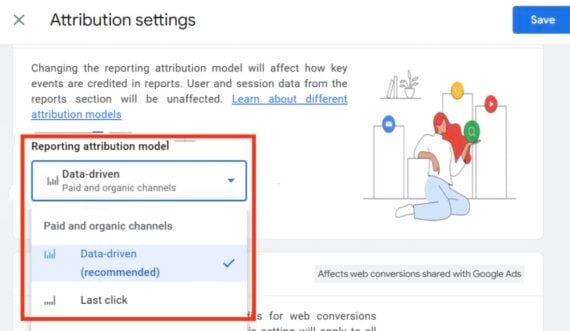
Google Analytics 4 now offers just two methods for attributing conversions:

  • “Data-driven” uses machine learning to distribute attribution across multiple sources based on users’ previous behavior, excluding direct traffic, although it appears to skew toward Google-owned channels.

Google Analytics 4 offers two methods for attributing conversions: “Data-driven” and “Last click.”

GA4 offers multiple attribution windows, depending on a business’s sales cycle. Some products require no research and are typically purchased in minutes. Others are complex and need much consideration. I typically set the window at 30, 60, or 90 days.

Rarely does an ecommerce platform’s conversion attribution reports match Google Analytics. Here’s why.

  • Technical errors, such as incorrect installation of pixels on Google or Meta ads, and mistakes with UTM parameters.
  • Privacy rules and regulations complicate tracking. Examples include the E.U.’s GDPR and cookie restrictions.
  • Non-digital promotions, such as ads on TV, print, radio, and billboards, do not appear in GA4.
  • Multiple touches. A consumer may see a product or brand offline, search for it on Google, click on a paid listing, and then abandon the journey. Later, the product may appear in the shopper’s Instagram feed, prompting the conversion. No attribution scenario can pinpoint the source(s), as it varies by shopper.
  • Repeat purchases. Some returning customers go directly to a website, while others respond to ads.

Despite the differences, Google Analytics remains the most-used attribution tool. It’s free, with an ecosystem of users, consultants, and resources. It’s a good choice for advertisers on Google-owned platforms, although it also captures referrals from other sources.

Other Methods

Still, merchants have other attribution options.

Ecommerce platforms. Shopify, for example, offers multiple attribution models — last click, last non-direct click, and first click — and multiple windows. Most platforms, including Shopify, show just one source per sale. Merchants with few marketing channels and single touchpoints can usually rely on their platform’s reporting.

Third-party tools. Segment, Adobe Analytics, and others utilize regression models for multi-touch attribution, similar to GA4’s Data-driven method of assigning a value to each source by channel or campaign. Third-party tools do the math but cost money. They are not as accurate as one would hope, in my experience.

Marketing platforms. Most marketing channels offer built-in reporting for performance tracking on that platform. Advertisers can monitor, for example, the creative, body text, and audience targeting. But in-platform reports are not ideal when contrasting, say, Google versus Meta.

Simplified approach. An easy-to-implement method is to compare daily sales from your ecommerce platform with GA4’s Data-Driven conversion attribution reports. Then assess GA4’s values to establish the source of truth. Apply over- or under-reporting in GA4 as a percentage to arrive at a return on investment per channel. Perhaps a TV ad or a brand campaign generated a sales boost. Neither would appear in GA4. While not exact, this simplified approach can provide a more accurate reflection of a channel’s impact on revenue.

Here’s an example. My firm just analyzed sales attributions for an ecommerce health food client. We found (i) a strong sales correlation with both Google Ads and email marketing, (ii) a moderate correlation with Instagram ads, and (iii) a weak to non-existent correlation with sales and TikTok Ads. However, we did see success with retargeting ads on TikTok.

No Perfect Model

I know of no perfect conversion attribution platform or technique. The purchase journeys of modern shoppers are too complex and varied. But we can consistently gauge the impact of a channel or campaign by establishing the right process for a merchant’s products, marketing tactics, and tech setup.

Google’s ‘srsltid’ Parameter Appears In Organic URLs, Creating Confusion via @sejournal, @MattGSouthern

Google’s srsltid parameter, originally meant for product tracking, is now showing on blog pages and homepages, creating confusion among SEO pros.

Per a recent Reddit thread, people are seeing the parameter attached not just to product pages, but also to blog posts, category listings, and homepages.

Google Search Advocate John Mueller responded saying, “it doesn’t cause any problems for search.”  However, it may still raise more questions than it answers.

Here’s what you need to know.

What Is the srsltid Parameter Supposed to Do?

The srsltid parameter is part of Merchant Center auto-tagging. It’s designed to help merchants track conversions from organic listings connected to their product feeds.

When enabled, the parameter is appended to URLs shown in search results, allowing for better attribution of downstream behavior.

A post on Google’s Search Central community forum clarifies that these URLs aren’t indexed.

As Product Expert Barry Hunter (not affiliated with Google) explained:

“The URLs with srsltid are NOT really indexed. The param is added dynamically at runtime. That’s why they don’t show as indexed in Search Console… but they may appear in search results.”

While it’s true the URLs aren’t indexed, they’re showing up in indexed pages reported by third-party tools.

Why SEO Pros Are Confused

Despite Google’s assurances, the real-world impact of srsltid is causing confusion for these reasons:

  • Inflated URL counts: Tools often treat URLs with unique parameters as separate pages. This inflates site page counts and can obscure crawl reports or site audits.
  • Data fragmentation: Without filtering, analytics platforms like GA4 split traffic between canonical and parameterized URLs, making it harder to measure performance accurately.
  • Loss of visibility in Search Console: As documented in a study by Oncrawl, sites saw clicks and impressions for srsltid URLs drop to zero around September, even though those pages still appeared in search results.
  • Unexpected reach: The parameter is appearing on pages beyond product listings, including static pages, blogs, and category hubs.

Oncrawl’s analysis also found that Googlebot crawled 0.14% of pages with the srsltid parameter, suggesting minimal crawling impact.

Can Anything Be Done?

Google hasn’t indicated any rollback or revision to how srsltid works in organic results. But you do have a few options depending on how you’re affected.

Option 1: Disable Auto-Tagging

You can turn off Merchant Center auto-tagging by navigating to Tools and settings > Conversion settings > Automatic tagging. Switching to UTM parameters can provide greater control over traffic attribution.

Option 2: Keep Auto-Tagging, Filter Accordingly

If you need to keep auto-tagging active:

  • Ensure all affected pages have correct canonical tags.
  • Configure caching systems to ignore srsltid as a cache key.
  • Update your analytics filters to exclude or consolidate srsltid traffic.

Blocking the parameter in robots.txt won’t prevent the URLs from appearing in search results, as they’re added dynamically and not crawled directly.

What This Means

The srsltid parameter may not affect rankings, but its indirect impact on analytics and reporting is being felt.

When performance reporting shifts without explanation, SEO pros need to provide answers. Understanding how srsltid functions work, and how it doesn’t, helps mitigate confusion.

Staying informed, filtering correctly, and communicating with stakeholders are the best options for navigating this issue.


Featured Image: Roman Samborskyi/Shutterstock

The 30 Most-Subscribed YouTube Individuals (Q2 2025) via @sejournal, @theshelleywalsh

In Q2 2025, MrBeast has retained his top spot as the most-subscribed YouTube individual on the social media platform.

After MrBeast overtook PewDiePie in late 2022 to shake up the top-most subscribed on YouTube leaderboard, there has been even more movement in the second quarter of 2025.

At the beginning of YouTube, it was a long journey for individuals to reach 100 million subscribers, but now MrBeast is the first individual YouTuber to crack 200 million subscribers.

On YouTube, way back in 2006, Judson Laipply was the first recorded individual to have the most subscribers, with mere thousands.

In the same year, Brookers was the first channel and individual to reach 10,000 subscribers – and that was a big deal.

Today, MrBeast is the most-subscribed individual, just above T-Series – an Indian record label and film studio that was once the number one most-subscribed channel on YouTube.

T-Series was the first channel to reach 100 million subscribers in 2019 and the first to reach 200 million in 2021.

While T-Series held twice as many subscribers as the top individual YouTuber last year, it has now been overtaken by the most popular content creator.

Being an influencer is big business.

Who Is The No. 1 Most Subscribed YouTuber?

As of June 2025, MrBeast is the most-subscribed YouTuber, with 399 million subscribers.

Kid-friendly content channel Like Nastya is now the second most-subscribed YouTube individual with 128 million subscribers.

PewDiePie has retained third place with 110 million.

The Top 30 Most-Subscribed YouTubers, June 2025

Channel Videos Language Subscribers (In Millions)
1 MrBeast 874 English 399
2 Like Nastya 952 English 128
3 PewDiePie 4,820 English 110
4 김프로KIMPRO 3,200 Korean 106
5 Alan’s Universe 1,370 English 92.7
6 A4 1,000 Russian 80.8
7 Justin Bieber 249 English 75.4
8 UR · Cristiano 102 European Portuguese 75.2
9 KL BRO Biju Rithvik 3,100 Hindi 72.8
10 Mark Rober 212 English 68.5
11 Fede Vigevani 1,510 Spanish 67.3
12 Topper Guild 1,170 English 65.8
13 EminemMusic 198 English 65
14 Alejo Igoa 1,190 Spanish 64.5
15 ISSEI / いっせい 3,630 Japanese 61.5
16 Taylor Swift 285 English 61
17 PANDA BOI 1,180 Multilingual 58.6
18 Zhong 1,950 English 58.3
19 Marshmello 534 English 57.9
20 Acharya Prashant 13,700 Hindi 56.7
21 Ed Sheeran 607 English 56.4
22 Mikecrack 2,120 Spanish 56.4
23 Ariana Grande 229 English 56.1
24 Billie Eilish 161 English 55.8
25 Bispo Bruno Leonardo 7,530 Portuguese 55.5
26 Jess No Limit 2,680 Indonesian 54.2
27 JuegaGerman 2,310 Spanish 53.4
28 Alfredo Larin 1,900 Spanish 52.8
29 LUCCAS TOON – LUCCAS NETO 3,200 Portugese 52.1
30 BETER BÖCÜK 1,900 Turkish 51.5

*Data Sources (SocialBlade, YouTube), June 2025

Please note that this is a list of the most subscribed individuals, not the most subscribed channels. It excludes “brand” channels that don’t focus on an individual personality, artist, or influencer.

Who Are The Top 10 Most-Subscribed YouTubers?

The list of the top 30 most-subscribed individuals features many successful music artists but has a majority of native YouTube influencers.

With the channel becoming an integral part of marketing and distribution for music artists, it’s no surprise that top artists feature highly.

Justin Bieber, the top individual artist, leveraged YouTube from an early age to gain mainstream attention on his own terms.

MrBeast has over 323.6 million more subscribers than Bieber, which highlights just how much attention the channel can achieve – and that, today, being a YouTube influencer is the same as being a traditional celebrity.

To get a better understanding of who all the influencers are, we’ve included a summary of the top 10 most-subscribed YouTuber influencers below.

1. MrBeast

U.S.-based Jimmy Donaldson started MrBeast as MrBeast6000 in 2012 when he was only 13.

He also holds five other channels, including Beast Reacts, MrBeast 2, Beast Philanthropy, and MrBeast 3 (inactive). MrBeast Gaming also sits in the top 100, with just under 47.5 million subscribers.

MrBeast’s early videos include counting to 10,000 non-stop (a 44-hour stunt), which quickly went viral but is now best known for videos that involve elaborate stunts, charity donations, or cash giveaways.

In one video, he gave away $1 million and has done several big philanthropic stunts, such as “I Built 100 Wells in Africa” and “I Rescued 100 Abandoned Dogs.”

When reaching the 200-million subscriber milestone in October 2023, MrBeast took to X (Twitter) to say how stunned his 13-year-old self would be and that he planned to continue making content for decades.

When he reached 300 million subscribers in July 2024, he posted on X (Twitter) to say he remembered freaking out when he hit 300 subscribers 11 years ago.

In his usual philanthropic style, he also gave away a private island for his 100-million subscriber milestone, which is probably part of the reason he originally took the top position from PewDiePie in December 2022.

Jimmy Donaldson’s channel brings in between $600 and $ 700 million a year, but his mother is the person who looks after his bank accounts.

He still resides in his hometown of Greenville, North Carolina, and employs many local people in the production of his videos.

2. Like Nastya

Anastasia Sergeyevna Radzinskaya is the only individual child YouTuber on the list. She was born in January 2014 and is the youngest influencer with the most followers, now overtaking PewDiePie by 18 million to take the No. 2 spot.

It’s worth noting that another channel, Vlad and Niki, is very popular with 140 million subscribers – but as a duo rather than an individual, they aren’t included in this list. Despite being featured in last year’s rankings, Ryan’s World has now fallen out of the rankings.

Although Radzinskaya was born in Russia, she has since moved to the U.S., and her videos are produced in English. The channel is for children and covers educational entertainment and vlogging.

Some of her success is down to the channel being dubbed in several languages, enabling her to reach a wide audience.

Radzinskaya’s parents help her manage the Like Nastya channel, but she is the face and star of the show.

3. PewDiePie

PewDiePie, otherwise known as Felix Arvid Ulf Kjellberg, held the most-subscribed position on YouTube for nearly 10 years until 2022. He was the original YouTube influencer who crossed over from online to be famous offline.

Swedish Kjellberg registered PewDiePie in 2010, and started out with play-by-plays of video games – a genre known as “Let’s Play.” It only took three years for him to be the most-subscribed channel on YouTube, and he was the highest-earning YouTuber in 2016.

Alongside “Let’s Play” content, PewDiePie has also experimented with comedy, commentary, music, and shows.

Following the rising success of his channel, Kjellberg also released his own game and published a book.

In 2022, his content shifted more towards lifestyle content after moving to Japan, with another shift in 2023 as he became a father. These changes to the types of videos PewDiePie produces could be the reason for his slightly waning subscriber count.

4. 김프로KIMPRO

KIMPRO (real name: Kim Dong-jun) is a South Korean content creator who is best known for his comedic and financial content. His two sisters often appear as guest stars in his videos.

His channel exploded in popularity in recent years, thanks primarily to his comedy clips. Meanwhile, his TikTok account, kimpro828, gained a massive following of 4.3 million followers in recent years.

He started in August 2022, which makes these numbers all the more impressive. Using special effects, viewers are drawn to his mix of viral recreations, including mukbangs, vlogs, challenges, and video reactions.

Though all of his content is in Korean, his relatable comedy has earned him a large and loyal subscriber base. His success demonstrates that niche content, particularly when made entertaining, can compete with the gaming and music genres on YouTube.

5. Alan’s Universe

Alan Chikin Chow is an American content creator, actor, and producer who became famous for his simple yet comedic sketches and bold storytelling.

His channel, “Alan’s Universe,” is a high school collective series. His videos feature himself and his classmates as recurring main characters, facing bullies and winning with the power of love. This theme has resonated with younger audiences.

His success has been largely driven by YouTube Shorts, where his high-quality production and positive energy align well with viewer expectations.

Alan has also appeared in TV shows and commercial ads, and he continues to bridge the gap between social media and traditional entertainment.

He has partnered up with streaming platform, Roku, and his series has been available since March 24, 2025, bringing his universe to new platforms and broader audiences.

6. A4

Belarusian content creator Vladislav Andreyevich Bumaga, known online as Vlad A4 or simply A4, holds the position of one of the most popular Russian-speaking YouTubers.

He created his channel back in 2014, with A4 being a play on his last name, Bumaga, meaning “paper.”

In 2016, he released a video called “24 Hours in a Trampoline Centre,” which took his subscriber count from 200,000 to his first 1 million.

Now, with just over 80.8 million subscribers, he continues to upload a wide variety of challenges and vlog content featuring his friends, as well as promoting his branded products.

7. Justin Bieber

Canadian Justin Bieber is the musical artist with the most followers on YouTube. He joined YouTube in 2007 and, after coming second in a local singing competition, began posting himself performing song covers.

After his channel started to grow, he got the attention of his now manager and his record label. In 2008, he signed a recording contract.

Bieber continued to focus on his YouTube channel and growing his followers, known as “Beliebers.”

This most likely contributed to his early and continued success. He continues to post videos on YouTube alongside his music videos and promotional content, although his last upload was now over two years ago.

8. UR · Cristiano

No surprises here – Cristiano Ronaldo was already the most legendary footballer possibly of all time, way before YouTube.

Being very social savvy, he has cultivated a massive following across social platforms, and YouTube is no exception.

His channel features a mix of personal highlights, behind-the-scenes training footage, interviews, commentaries, and sponsored content. Additionally, his collaboration with the number one most subscribed YouTuber, Mr. Beast, amassed 59 million views.

While he is not a traditional vlogger or influencer, Ronaldo’s global fan base ensures that any content he posts gets millions of views.

As a newcomer in this top 10 list, he demonstrates the power of celebrity, and that in itself can drive subscriber numbers, even with infrequent uploads.

9. KL BRO Biju Rithvik

KL BRO Biju Rithvik is an Indian content creator from Kerala, featuring his daily life. The channel features family-friendly short films and skits.

They are a family-centered content that features relatable and silly moments, resonating with a wide audience in India.

The rise of YouTube Shorts in India has played a significant role in its massive growth, with each Short amassing millions of views. YouTube CEO Neal Mohan notes the milestone for Shorts in India:

“YouTube is number one in reach and watch time in India. And we just passed a huge milestone. Shorts, which we first launched in India, now have trillions of views here.”

10. Mark Rober

Science can be fun and suitable for everyone, as former NASA engineer turned YouTuber Mark Rober proves with his spot on this top 10 list.

As the current founder of Crunchlabs, a STEM subscription box and learning platform for kids and adults. His science-focused videos do combine education with entertainment.

From jumping on a moving train (a la Tom Cruise) and building his own indoor rollercoaster to glitterbombs for car thieves, each video documents and explains how the engineering works.

Not to mention, every project is unique, with a step-by-step process that makes it accessible for aspirants to do the same.

With high-quality production, he says he leans heavily on his community to support his initiatives. Back in 2019, he partnered up with MrBeast for his #TeamTrees project to help raise $20 million for 20 million trees.

Why YouTubers Are Significantly Influential For Online Marketers

Achieving a most-subscribed status on YouTube cements you as an influencer and enables you to make serious income.

Not only can YouTubers earn from ads on the videos, but they are also in demand as brand ambassadors for product placements, product reviews, and product collaborations.

Mere mentions of products and brands by an influencer can drive traffic and sales for brands.

Smart influencers use the exposure to diversify into many mainstream areas of collaboration and business to supplement their income and ensure longevity.

Much like top-level sports stars have always been in demand as brand ambassadors, influencers can be used for brand alignment.

Influencer marketing doesn’t have to be just for the big brands; influencers with only a few thousand engaged followers can help spread messages.

And for smaller brands, elevated exposure on social media can be a major benefit.

More Resources:


Featured Image: Roman Samborskyi/Shutterstock

Query Fan-Out via @sejournal, @Kevin_Indig

Boost your skills with Growth Memo’s weekly expert insights. Subscribe for free!

Today’s Memo is all about query fan-out – a foundational concept behind AI Mode that’s quietly rewriting the rules of SEO.

You’ve probably heard the term. Maybe you’ve seen it in Google’s AI Mode announcementAleyda Solis’ write-up, or Mike King’s deep dive.

But why is it really that revolutionary? And how does it impact the way we approach search strategy going forward? You might already be “optimizing” for it and not even be aware!

That’s what we’re digging into today.

Plus: I’ve built an intent classifier tool for premium subscribers to help you group prompts and questions by user intent in seconds – coming later this week (still need to iron out a few kinks).

In this issue, we’ll cover:

  • What query fan-out is.
  • How it powers AI Mode, Deep Search, and conversational search.
  • Why optimizing for “one query, one answer” is no longer enough.
  • Tactical ways to align your content ecosystem with fan-out behavior.

Let’s get into it.

Image Credit: Kevin Indig

What Is Query Fan-Out And Why Are You Hearing So Much About It Right Now?

Query fan-out is how Google’s AI Mode takes a single search and expands it into many related questions behind the scenes.

It can pull in a wider range of content that might answer more of your true intent, not just your exact words.

You’re hearing about it now because Google’s new AI Overviews and “AI Mode” rely on this process, which could change what content shows up in “search” results.

Query fan-out isn’t just another marketing buzzword. It’s how AI Mode works.

It’s crucial to start understanding this concept because it’s very likely that AI Mode will become the default search experience over the next few years. (I expect it will be once Google figures out how to monetize it appropriately.)

This is why I think AI Mode could become the search standard:

On the Lex Fridman podcast, Sundar Pichai said AI Mode will slowly creep more into the main search experience:

Lex Fridman: “Do you see a trajectory in the possible future where AI Mode completely replaces the 10 blue links plus AI Overview?”

Sundar Pichai: “Our current plan is AI Mode is going to be there as a separate tab for people who really want to experience that, but it’s not yet at the level there, our main search pages. But as features work, we will keep migrating it to the main page, and so you can view it as a continuum.”

He also said that pointing at the web is a main design principle:

Lex Fridman: “And the idea that AI mode will still take you to the web to human-created web?”

Sundar Pichai: “Yes, that’s going to be a core design principle for us.”

However, if AI Overviews are any indication, you shouldn’t expect much traffic to come through AI Mode results. CTR losses can top 50%.

And according to Semrush and Ahrefs, ~15% of queries show AI Overviews.

But the actual number is likely much higher, since we’re not accounting for the ultra-long-tail, conversational-style prompts that searchers are using more and more.

Even though AI Mode covers only a bit over 1% of queries right now – as mentioned in The New Normal – it’s likely going to be the natural extension of every AI Overview.

Understanding Query Fan-Out To Better Optimize Your Content Just Makes Sense

Important note here: I don’t want to pretend that I know how to “optimize” for query fan-out.

And query fan-out is a concept, not a practice or tactic for optimization.

With that in mind, understanding how query fan-out works is important because people are using longer prompts to conversationally search.

And therefore, in conversational search, a single prompt covers many user intents.

Let’s take a look at this example from Deep SEO:

Deep Search performs tens to hundreds of searches to compile a report. I’ve tried prompts for purchase decisions. When I asked for “the best hybrid family car with 7 seats in the price range of $50,000 to $80,000”, Deep Research browsed through 41 search results and reasoned its way through the content.
[…]

The report took 10 minutes to put together but probably saved a human hours of research and at least 41 clicks. Clicks that could’ve gone to Google ads.

In my search for a hybrid family car, the Deep Search function understood multiple search journeys, multiple intents, and synthesized what would have been multiple pages of classic SEO results into one piece of content.

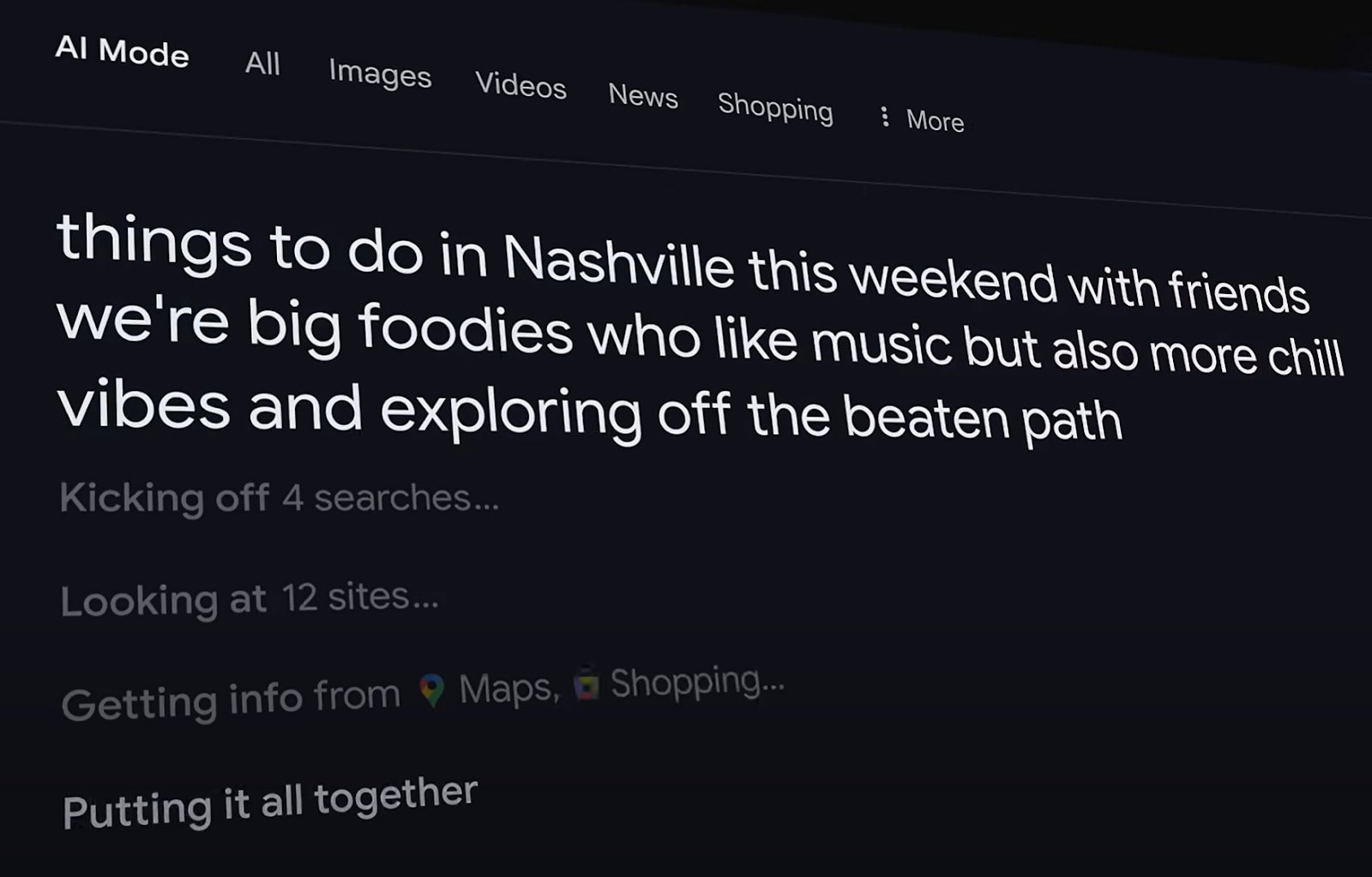
And check out this example from Google’s own marketing material:

Image Credit: Kevin Indig

This Deep Search kicked off four searches, but I’ve seen examples of 30 and more.

This is exactly why understanding query fan-out is important.

AI-based conversational search is no longer matching a single query to a single result.

It’s fanning out into dozens of related searches, intents, and content types to synthesize an answer that bypasses traditional SEO pathways entirely.

The Mechanics Behind Query Fan-out

Here’s my understanding of how query fan-out works based on the wonderful research by Mike King, as well as Google’s announcement and documentation:

  1. In classic Search, Google returns one ranked list for a query. In AI Mode, Gemini explodes your prompt into a swarm of sub-queries – each aimed at a different facet of what you might really care about. Example: “Best sneakers for walking” turns into best sneakers for men, walking shoes for trails, shoes for humid weather, sock-liner durability in walking shoes, and so on.
  2. Those sub-queries fire simultaneously into the live web index, the Knowledge Graph, Shopping graph, Maps, YouTube, etc. The system is basically running a distributed computing job on your behalf.
  3. Instead of treating a web page as one big answer, AI Mode lifts the most relevant passages, tables, or images from each source. Think “needle-picking” rather than “stack-ranking.” So, rather than a search engine saying “this whole page is the best match,” it’s more like “this sentence from site A, that chart from site B, and this paragraph from site C” are the most relevant parts.
  4. Google keeps a running “session memory” – a user embedding distilled from your past searches, location, and preferences. That vector nudges which sub-queries get generated and how answers are framed.
  5. If the first batch doesn’t fill every gap, the model loops and issues more granular sub-queries, pulls new passages, and stitches them into the draft until coverage looks complete. All this in a few seconds.
  6. Finally, Gemini fuses everything into one answer and matches it to citations. Deep Search (“AI Mode on steroids”) can run hundreds of these sub-queries and spit out a fully cited report in minutes.

Keep in mind, entities are the backbone of how Google understands and expands meaning. And they’re central to how query fan out works.

Take a query like “how to reduce anxiety naturally.” Google doesn’t just match this phrase to pages with that exact wording.

Instead, it identifies entities like “anxiety,” “natural remedies,” “sleep,” “exercise,” and “diet.”

From there, query fan-out kicks in and might generate related sub-queries, refining based on prior searches of the user:

  • “Does magnesium help with anxiety?”
  • “Breathing techniques for stress”
  • “Best herbal teas for calming nerves”
  • “How sleep affects anxiety levels”

These aren’t just keyword rewrites. They’re semantically and contextually related ideas built from known entities and their relationships.

So, if your content doesn’t go beyond the primary query to cover supporting entity relationships, you risk being invisible in the new AI-driven SERP.

Entity coverage is what enables your content to show up across that full semantic spread.

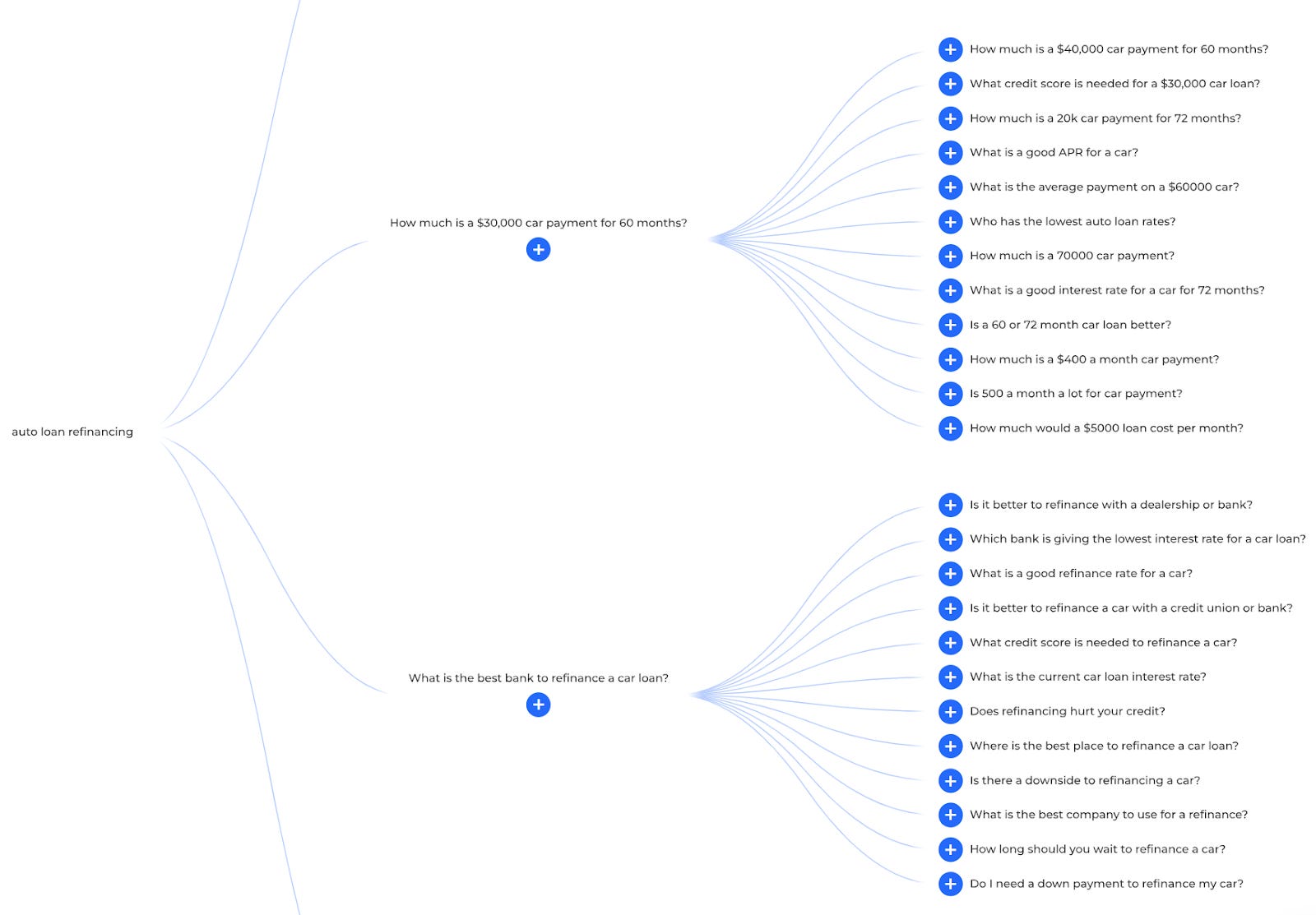
Here’s a good way to visualize this is the relationship between questions, topics, and entity expansion (from alsoasked.com):

Image Credit: Kevin Indig

If this all reminds you strongly of the concept of user intent, your instincts are well-tuned.

Even though query fan-out sounds cool and looks innovative, there is little difference to how we should already be targeting topics instead of keywords via entity-rich content. (And we all should’ve been doing this for a while now.)

Interjection from Amanda here: I’d argue that this kind of process (or a similar one) has been going on behind the scenes in classic SEO results for a while … although, unfortunately, I don’t have concrete proof. Just strong pattern recognition from spending way too much time in the SERPs testing things out. 😆

Back in 2018-2019, I noticed this pattern happening often with in-depth, entity-rich content pieces ranking – and performing well – for multiple related intents in search. The more entity-rich a content piece was, and the more the content tackled the “next natural need” of the searcher, the more engagement + dwell time increased while also concluding the search journey…

And the more the content did those things, the more the content was visible to our target audience in classic rankings … and the longer it held that visibility or ranking despite algorithm changes or competitor content updates.

Implementable SEO Moves Related To Query Fan-Out Mechanics

When you keep query fan-out in mind, there are a few practical steps you can take to shape your content and optimization work more effectively.

But before you give it a scan, I need to reiterate what was mentioned earlier: I’m not going to claim I have a clear-cut way to “optimize” for Google’s AI Mode query fan-out process – it’s just too new.

Instead, this list will help you optimize your content ecosystem to fully address the multifaceted needs behind your target user’s search goal.

Because optimizing for conversational search starts with one simple shift: addressing searcher needs from multiple angles and making sure they can find those multiple angles across your site … not just one query at a time.

1. Passage-first authoring.

  • Write in 40-60-word blocks, each answering one micro-question.
  • Lead with the answer, then detail – mirrors how AI selects snippets.

2. Semantically-rich headings.

  • Avoid generic headings and subheadings (“Overview”). Embed entities and modifiers the AI may spin into sub-queries (e.g., “Battery life of EV SUVs in winter”).

3. Outbound credibility hooks.

  • Cite peer-reviewed, governmental, or high-authority sources; Google’s LLM favors passages that have citations and sources for grounding claims.

4. Clustered architecture.

  • Build hub pages that summarize and deep-link to spokes. Fan-out often surfaces mixed-depth URLs; tight clusters raise the odds that a sibling page is chosen.

5. Contextual jump links (“fraggles” or “anchor links”).

  • For long-form, use internal jump links within body copy, not just in the TOC. These help LLMs and search bots zero in on the most relevant entities, sections, and micro-answers across the page. They also improve UX. (Credit to Cindy Krum’s “fraggles” concept.)

6. Freshness pings.

  • Update time-sensitive stats often. Even a minor line edit plus a new date encourages recrawl and qualifies the page for “live web” sub-queries.

How To Optimize For Intent Coverage – A Key Component Of Query Fan-Out

Google’s AI Mode and the query fan-out process mirror how humans think – breaking a question into parts and piecing together the best information to solve a need.

People don’t search in a silo – when they search, they’re searching from a perspective, a history, and with emotions and multiple questions/concerns attached.

But as an industry, we have long focused on single queries, intents, or topic clusters to guide our optimization. Sure, this is useful, but it’s a narrow lens.

And it overlooks the bigger picture: Optimizing your content ecosystem to fully address the broader, multi-faceted needs behind a person’s goal.

We know Google’s AI Mode draws from:

  • Related queries.
  • Related user intents.
  • Related and connected entities.
  • Reformatting/rephrasing of the prompt.
  • Comparison.
  • Personalization: Search history, emails, etc.

So, here’s my step-by-step (unproven) concept:

  1. Prompts are questions.
  2. But just covering questions is not enough, we need to create content for their underlying user intent.
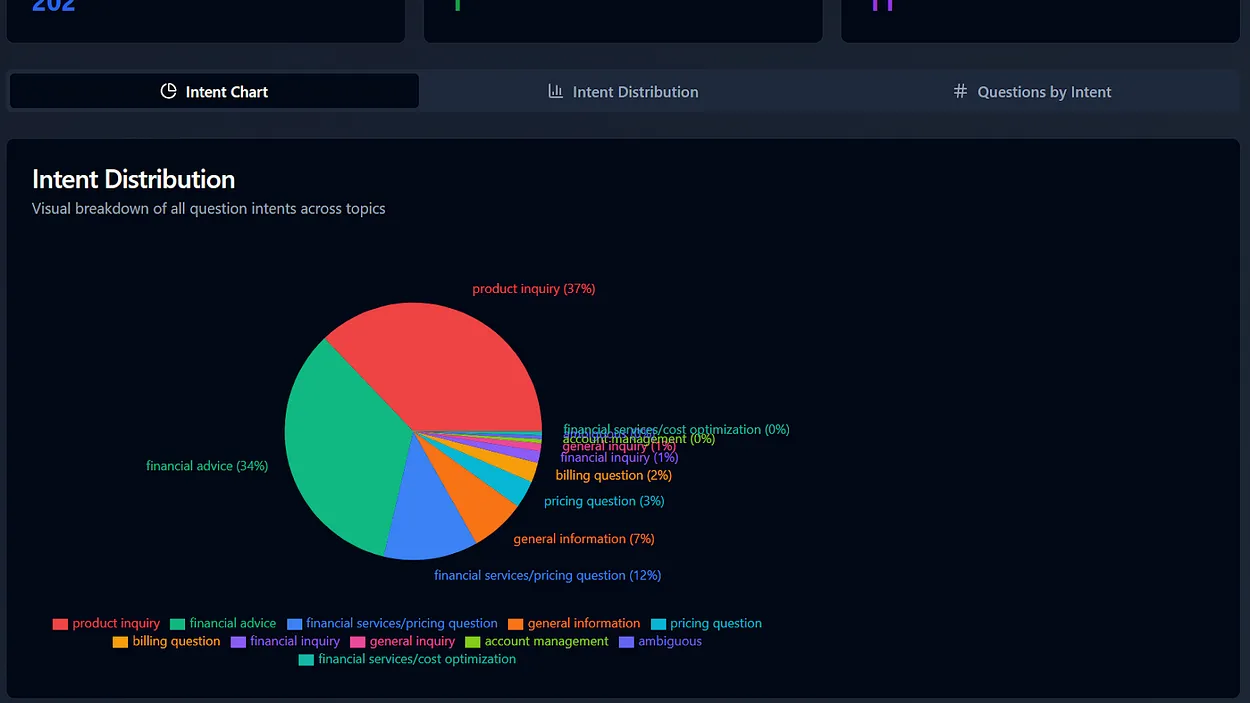
  3. If we can classify a large number of questions around a topic, we can increase our chances of being visible when AI Mode fans out.

Here’s a step-by-step guide:

  1. Collect questions for a topic from:
    • Customer interviews (the best source, in my experience).
    • Semrush’s Keyword Magic Tool.
    • Ahrefs’ Keyword Ideas.
    • Reddit (e.g., via Gummysearch).
    • YouTube (VidIQ).
    • Mike King’s excellent Qforia tool.
  2. Group your collection of questions by user intents.
  3. Match each intent to a piece of content or specific passage on your site.
  4. Use search tools and test actual conversations with LLMs to see who ranks at the top for the intent.
  5. Compare your content/passage against the top-referred content pieces.
  6. Ensure your content is entity-rich and includes those sweet, sweet information gainz.

Not only do paid subscribers get more content, more data, and more insights, but they also get the intent classifier tool I built to help save you some time on this work I’ve listed out above (coming to premium subscribers later this week).

If you’ve been doing SEO pre-AI-search era, it’s likely you’ve already been doing some version of this work.

The key thing to remember is to group questions and queries by intent – and optimize for intents across your core topics.

Think through what would’ve been a “search journey” or “content journey” for your user in classic search, and recognize that’s now happening all at once in one chat session.

The biggest mindset shift you’ll likely need to make is thinking about queries as prompts vs. searches.

And those prompts? They’re inputted by users in a variety of ways or semantic structures. That’s why an understanding of entities plays a key part.

But before you jump, I need to emphasize a core factor to creating content with query fan-out in mind: Make sure you do the work to take your collected questions that you plan on targeting and group them by intent.

This is a crucial first step.

To help you do that, I’ve created an intent classifier tool that premium subscribers will get in their inbox later this week. It’s simple to use, and you can drop your collected list of questions to group by intent in a matter of minutes.


Featured Image: Paulo Bobita/Search Engine Journal

Demand Gen Vs. Lead Gen: What Every CMO Needs To Know via @sejournal, @brookeosmundson

In boardrooms and Slack threads alike, “demand generation” and “lead generation” are often used interchangeably, sometimes even by marketers themselves.

But for CMOs making six- and seven-figure budget decisions, lumping the two together is a costly mistake.

On the surface, both strategies aim to generate revenue. But the approach, intent, and impact of each are fundamentally different.

Understanding these differences isn’t just marketing semantics. It’s a strategic imperative.

Whether you’re scaling a SaaS company, leading an enterprise rebrand, or trying to make sense of declining pipeline velocity, the way you approach demand and lead gen can either fuel long-term growth or lock you into a hamster wheel of short-term wins.

Let’s unpack what each of these approaches actually looks like, where they work best, and how to decide which path (or combination of them) is right for your team.

What Demand Generation Really Means

Demand generation isn’t just a top-of-funnel tactic. It’s a full-funnel strategy designed to create awareness, spark interest, and ultimately build desire for your solution, oftentimes before the buyer even knows they need it.

It prioritizes visibility, trust, and education over form-fills and gated assets.

So, what isn’t demand generation?

Demand gen isn’t about chasing contact details.

It’s about shaping buying decisions before the buyer ever enters a sales process.

This strategy leans heavily on value-driven content, community building, media exposure, and delivering information that builds brand affinity over time.

Examples of some commonly used demand generation tactics include:

  • Publishing ungated thought leadership content on LinkedIn.
  • Creating category awareness through podcasts and video series.
  • Investing in brand advertising or influencer partnerships.
  • Running product demos on YouTube or TikTok with no call-to-action (CTA).

In demand generation, you’re not asking for the sale. You’re creating an environment where the sale becomes inevitable.

What Lead Generation Actually Delivers

Lead generation is all about conversions, and not in the philosophical sense.

It’s measurable, trackable, and often deeply tied to sales-qualified metrics. You offer something (a whitepaper, webinar, trial) in exchange for something (a name, email, job title).

The focus here is less on brand building and more on pipeline development. It’s tactical, efficient, and often short-term.

That doesn’t make it “bad,” but it does mean you’ll need a strong nurturing process and sales alignment to make it effective.

Common lead generation tactics include:

  • Gated content downloads (ebooks, whitepapers, checklists).
  • Paid search with conversion-focused landing pages.
  • Webinar registrations.
  • Cold outreach from purchased lists.

Opposite of demand gen tactics, lead gen tactics are a bit easier to measure. They’re also easier to misuse.

If you’re not aligning on what constitutes a “qualified lead,” you might end up with a pile of marketing qualified leads (MQLs) that sales ignores.

Key Differences Between Them That Actually Matter

While the two approaches might feel similar in campaign execution, the intent and measurement couldn’t be more different.

Element Demand Generation Lead Generation
Primary Goal Build interest & educate the market Capture contact info for nurturing & sales
Buyer Stage Early to mid-funnel Mid to late-funnel
KPIs Brand engagement, direct traffic, pipeline contribution Form fills, cost-per-lead (CPL), MQL to SQL conversion
Channel Mix Social content, podcast, YouTube, native ads Paid search, lead forms, email, retargeting
Attribution Window Long-Term (30+ days) Short-term (<30 days>

If you’re measuring demand gen with the same key performance indicators (KPIs) as lead gen, you’re setting yourself up for disappointment.

These strategies operate on different timelines and serve different roles in the buyer journey.

The Cost Of Getting It Wrong

Let’s say you’re in the B2B SaaS space, and your board wants more pipeline, fast. So, you crank up spend on paid search and run gated ebook campaigns.

You get thousands of leads … and sales team closes almost none of them.

Why?

Because those leads weren’t ready to buy. They downloaded an asset, not because they were in-market, but because they were curious. That’s not a sales-qualified lead; it’s a reader.

On the flip side, if you only focus on brand and never collect contact info or move people into a nurture stream, your pipeline may dry up altogether.

Misalignment here causes poor return on investment (ROI), frustrated sales teams, and confusion at the executive level.

And CMOs? You’re the one who gets held accountable.

Signs You Need To Shift Toward Demand Gen

If you’re stuck in the “more leads, less revenue” loop, demand gen might be the missing piece.

Watch for these tell-tale signs:

  • Sales team is constantly complaining about low-quality leads.
  • Your brand has low share of voice in your category.
  • You’re over-reliant on bottom-of-funnel paid channels.
  • Organic pipeline growth is stagnating.
  • You’re optimizing cost-per-lead (CPL) while customer acquisition cost (CAC) keeps rising.

In these cases, shifting some of your focus (and budget) toward demand gen can help you break the cycle.

It doesn’t mean you stop generating leads. It means you start warming the market, so the leads that come through are higher intent and closer to revenue.

When Lead Generation Still Makes Sense

Lead gen isn’t dead. It just needs context.

For mature markets or lower-cost products with short sales cycles, lead gen can still be incredibly efficient.

It’s also useful when:

  • You have strong sales enablement and fast lead response times.
  • Your brand is already well-known and trusted.
  • You have clear, relevant offers with direct value.
  • You’re testing new messaging or audiences with measurable KPIs.

If your team excels at lead nurturing and you’re using lead gen to support (not substitute) long-term demand creation, it can drive fast, measurable results.

Just don’t treat it as a long-term growth strategy in isolation.

Why You Shouldn’t Just Pick One

This isn’t a zero-sum game. The smartest CMOs know how to balance both.

Think of demand gen as fueling interest, and lead gen as capturing it. The two should work in tandem.

Start with demand creation: educate, build trust, and generate awareness in the market. Then, as interest builds, use lead gen strategies to convert that attention into a measurable pipeline.

If you’re only doing one, you’re either leaving money on the table or burning through it too fast.

Rethinking KPIs And Attribution

Here’s where many CMOs get tripped up: trying to measure demand generation with lead generation metrics.

Demand generation is more about contribution to the pipeline, not generating immediate conversions.

For demand gen metrics, you’ll want to take a look at:

  • Direct traffic increases.
  • Organic branded search volume.
  • Sales velocity from known accounts.
  • CRM-sourced opportunities influenced by top-of-funnel touchpoints.

Meanwhile, lead gen metrics like CPL and MQL-to-SQL rates are better used in a supplementary way, not as the only measure of success.

And let’s be honest: Attribution will never be perfect. As CMOs, don’t expect your marketing teams to attribute each effort with 100% accuracy. You’d be setting them, and yourself, up for failure in the long run.

Buyers today might see a LinkedIn post, hear a podcast, and Google your brand three weeks later. That journey doesn’t show up in a neat linear model.

So, rather than obsessing over pixel-perfect attribution, focus on momentum. Is pipeline velocity improving? Is your CAC going down over time? Are more of the right buyers coming inbound?

Those are the real signals you should be looking for to understand if your demand gen and lead gen efforts are working.

What CMOs Should Do Next

This isn’t about choosing sides on which strategy to focus on. It’s about choosing alignment on how the two will operate together.

If you’re stuck on which to prioritize, ask yourself the following questions:

  • Are we educating the market, or just capturing the existing intent?
  • Is our sales team enabled to follow up on the leads that we’re generating?
  • Do we have the patience (and buy-in) to invest in both brand and content?
  • Are we tracking the right metrics for our business, or just the easy ones?

Start there. Then, audit your current marketing mix.

You might find that 80% of your spend is on lead generation efforts, but 80% of your growth comes from demand generation channels.

Chasing short-term tactics only squeezes out who’s currently in your marketing funnel.

You need to build a system that creates both interest and intent.

Smart Growth Doesn’t Follow A Form Fill

The most effective marketing strategies don’t live behind a gate. They live in conversations, videos, buyer communities, and the minds of decision-makers before they ever hit your website.

That’s what demand gen does best: It plants the seed between prospective customers and your brand.

Lead gen has its role, but without demand gen, it’s like harvesting from a field you never watered.

For today’s CMOs, the real challenge isn’t picking one over the other. It’s learning how to weave them together into a strategy that works for your audience, your sales team, and your business goals.

Because real growth rarely starts with a form fill, but it can end with one.

More Resources:


Featured Image: ra2 studio/Shutterstock

From MIT to low Earth orbit

Not everyone can point to the specific moment that set them on their life’s course. But for me, there’s no question: It happened in 1982, when I was a junior at MIT, in the Infinite Corridor. In those pre-internet days, it was where we got the scoop about everything that was happening on campus. One day, as I was racing to the chemistry labs, a poster caught my eye.

As I remember it, the poster showed a smiling woman in a flight suit, holding a helmet by her side. I recognized her immediately: Sally Ride, one of America’s first group of female astronauts. It had just been announced that she would be part of the crew for one of the upcoming space shuttle flights, making her the first American woman in space. And while she was visiting Lincoln Lab for training, she would be giving a speech and attending a reception hosted by the Association of MIT Alumnae. A woman speaker was still a novelty at MIT in those days. But a woman astronaut? I knew this was one event I had to attend. 

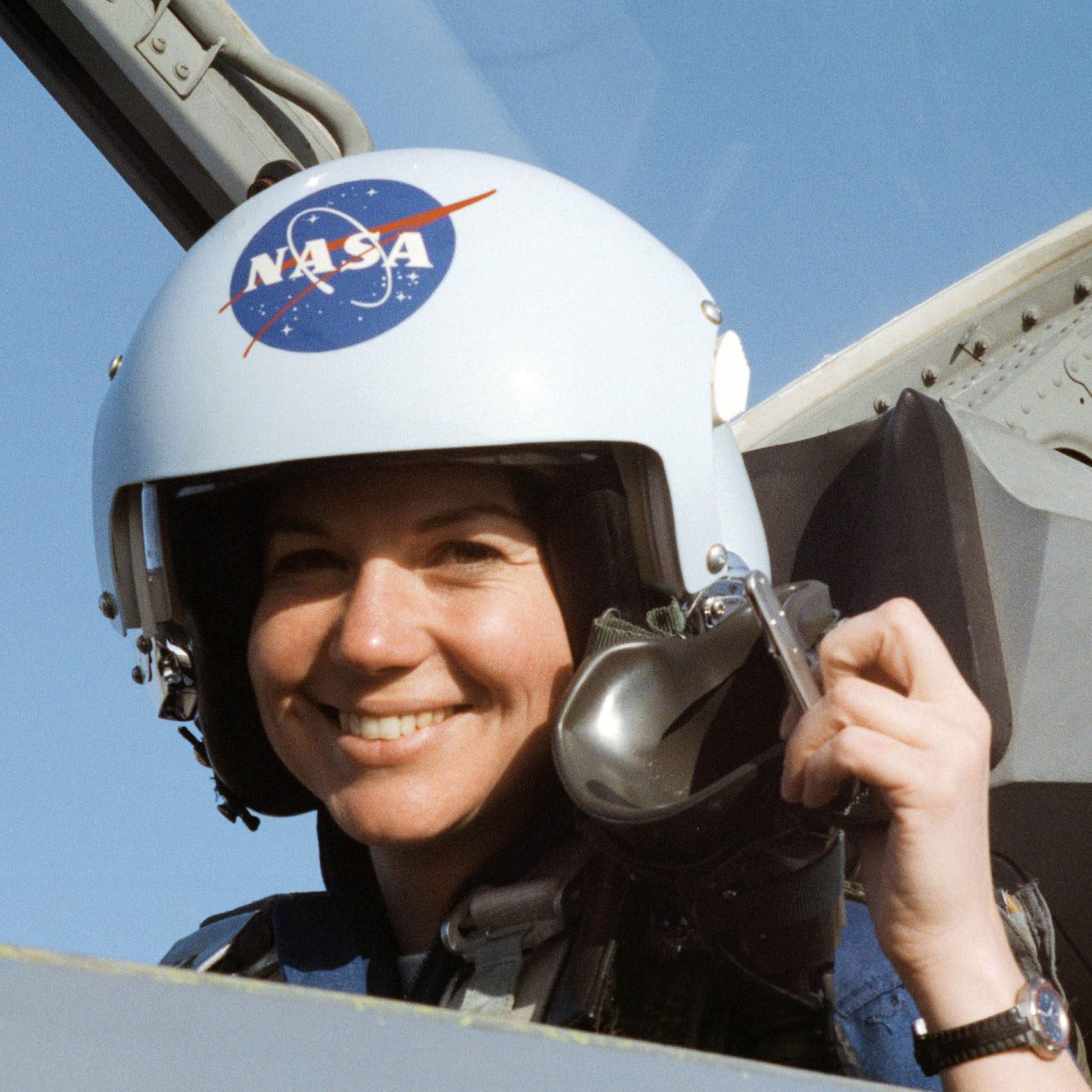
Coleman sits in the rear seat of a supersonic T-38 jet for pilot training as a newly minted NASA astronaut candidate in 1992. “When a chemist gets to fly a T-38, she will always be smiling,” she says.
NASA

On the day of Sally Ride’s talk, I hurried into 10-250, the large lecture hall beneath the Great Dome that is the emblem of MIT. Sandy Yulke, the chair of the Association of MIT Alumnae, was already introducing Sally. Sally. Just a first name. As if she were one of us. I slid into an empty seat just a few rows back as Sandy talked about how proud she was to welcome the soon-to-be first American woman in space. And Sally was standing there, right where our professors stood every day. A woman. And an astronaut. 

When I was growing up in the 1960s and ’70s, the image I’d had of astronauts—or any kind of explorer, for that matter—could not have been further from the figure before me that day. And I’m not just talking about images I saw in the media—I had one much closer to home. My dad—James Joseph Coleman, known as JJ—was a career naval officer who ultimately led the Experimental Diving Unit. A legend among Navy divers, he had also been a project officer for the Sealab program that built the first underwater habitats, allowing men—and it was all men at the time—to live and work in the deep seas for extended periods. The spirit of exploration, the desire to understand fascinating and challenging environments, seemed normal to me. But because none of the explorers I saw looked like me, it didn’t occur to me that I could be one. My dad worked in a male-dominated world where I’m sure very few of his colleagues imagined that people like me might belong too.

By the time I got to MIT, in 1979, only six women had been selected as NASA astronauts. But seeing Sally Ride on the stage that day turned a possibility into a reality—a reality that could include me. Instead of being larger than life, she was surprisingly real and relatable: a young, bright-eyed woman, with wavy brown hair kind of like mine, wearing a blue flight suit and black boots. She seemed a little shy, looking down at her hands as she was introduced and applauded. 

Sally was obviously passionate about her scientific work—she was an accomplished astrophysicist—but she also had this amazing job where she flew jets, practiced spacewalking, and was part of a crew with a mission. Both scientist and adventurer, she was accomplishing something that no American woman ever had—and, in the process, opening the door for the rest of us. As I listened to her speak that day, an utterly unexpected idea popped into my head: Maybe I—Cady Coleman—could have that job. 

If you can see it, you can be it. Representation doesn’t fix everything, but it changes, on a visceral level, the menu of options that you feel you can reach for. No matter how many people tell us we can be whatever we want to be—and my mother told me that from the moment I was old enough to understand—some of us need more than words. Representation matters. A lot. We are enormously influenced by the signals that we get from our surroundings. What do people expect of us? What models do we have? What limitations do we internalize without knowing it? In her quiet, matter-of-fact way, Sally Ride shattered assumptions I didn’t know I’d taken on. Like so many people at MIT, I was an explorer at heart. What if I could explore in space as well as in the lab? 

Becoming an astronaut

No one just becomes an astronaut. Every astronaut is something else first. At MIT, I had fallen in love with organic chemistry and was determined to become a research chemist, hoping to use science to improve people’s lives. Because I attended MIT on an ROTC scholarship, I was commissioned as a second lieutenant in the US Air Force upon graduation, but I was given permission to get my doctorate in polymer science and engineering from UMass Amherst before serving. I was then stationed at Wright-Patterson Air Force Base, where I worked on new materials for airplanes and consulted on NASA’s Long Duration Exposure Facility experiment. I also set endurance and tolerance records as a volunteer test subject in the centrifuge at the aeromedical laboratory, testing new equipment.

But the ideas that Sally Ride had sparked were never far from my mind, and when NASA put out a call for new astronauts in 1991, I applied—along with 2,053 others. I was among the 500 who got our references checked, and then one of about 90 invited to Houston for an intense weeklong interview and physical. In 1992, after months of suspense, I got the fateful phone call asking, “Would you still like to come and work with us at NASA?” Thrilled beyond words, I felt a kind of validation I’d never experienced before and have never forgotten.

Four months later, I reported for duty at the Johnson Space Center. Knowing that years of rigorous training lay ahead before I might launch into space on a mission, I couldn’t wait to dive in.

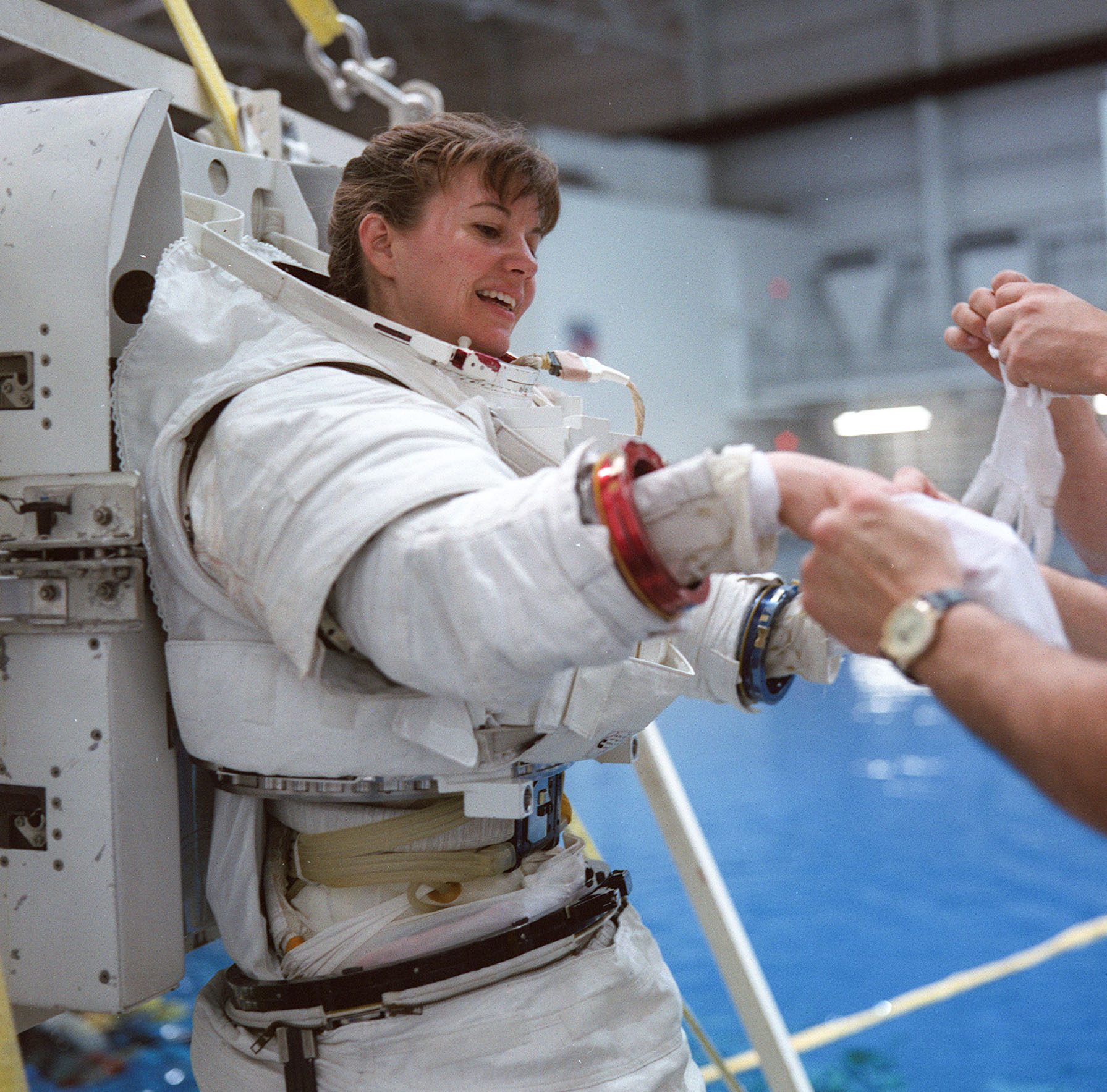
That training turned out to be a wild ride. Within days of our arrival in Houston, we ASCANs (NASA-speak for astronaut candidates) headed to Fairchild Air Force Base in Washington state for land survival training. We practiced navigation skills and shelter building. Knots were tied. Food was scavenged. Worms were eaten. Tired, grubby people made hard decisions together. Rules were broken. Fun was had. And, importantly, we got to know one another. Water survival skills were next—we learned to disconnect from our parachutes, climb into a raft, and make the most of the supplies we had in case we had to eject from a jet or the space shuttle. 

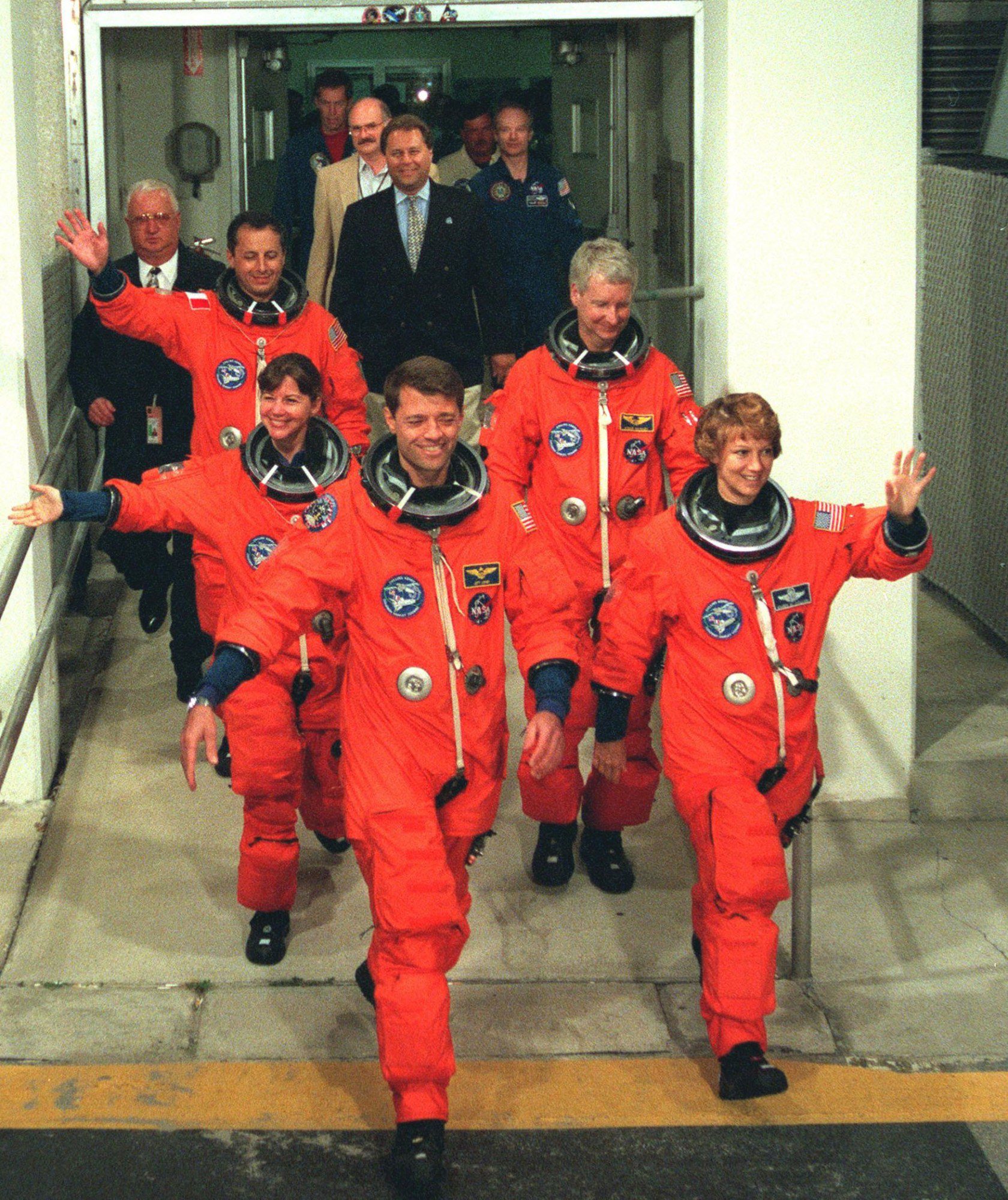
Coleman and the rest of the STS-93 crew head to Launch Pad 39-B for their second attempt at liftoff on the space shuttle Columbia. With this mission, Eileen M. Collins (front row, right) would become the first woman to serve as commander of a shuttle mission.
NASA

Back in Houston, we learned about each of the shuttle systems, studying the function of every switch and circuit breaker. (For perspective, the condensed manual for the space shuttle is five inches thick.) The rule of thumb was that if something was important, then we probably had three, so we’d still be okay if two of them broke. We worked together in simulators (sims) to practice the normal procedures and learn how to react when the systems malfunctioned. For launch sims, even those normal procedures were an adventure, because the sim would shake, pitch, and roll just as the real shuttle could be expected to on launch day. We learned the basics of robotics, spacewalking, and rendezvous (how to dock with another spacecraft without colliding), and we spent time at the gym, often after hours, so we’d be in shape to work in heavy space suits. 

Our training spanned everything from classes in how to use—and fix—the toilet in space to collecting meteorites in Antarctica, living in an underwater habitat, and learning to fly the T-38, an amazing high-performance acrobatic jet used to train Air Force pilots. (On our first training flight, we got to fly faster than the speed of sound.) All of this helped us develop an operational mindset—one geared to making decisions and solving problems in high-speed, high-pressure, real-risk ­situations that can’t be simulated, like the ones we might encounter in space. 

Mission: It’s not about you, but it depends on you

Each time a crew of astronauts goes to space, we call it a mission. It’s an honor to be selected for a mission, and an acknowledgment that you bring skills thatwillmake it successful. Being part of a mission means you are part of something that’s bigger than yourself, but at the same time, the role you play is essential. It’s a strange paradox: It’s not about you, but it depends on you. On each of my missions, that sense of purpose brought us together, bridging our personal differences and disagreements and allowing us to achieve things we might never have thought possible. A crew typically spends at least a year, if not a few years, training together before the actual launch, and that shared mission connects us throughout.

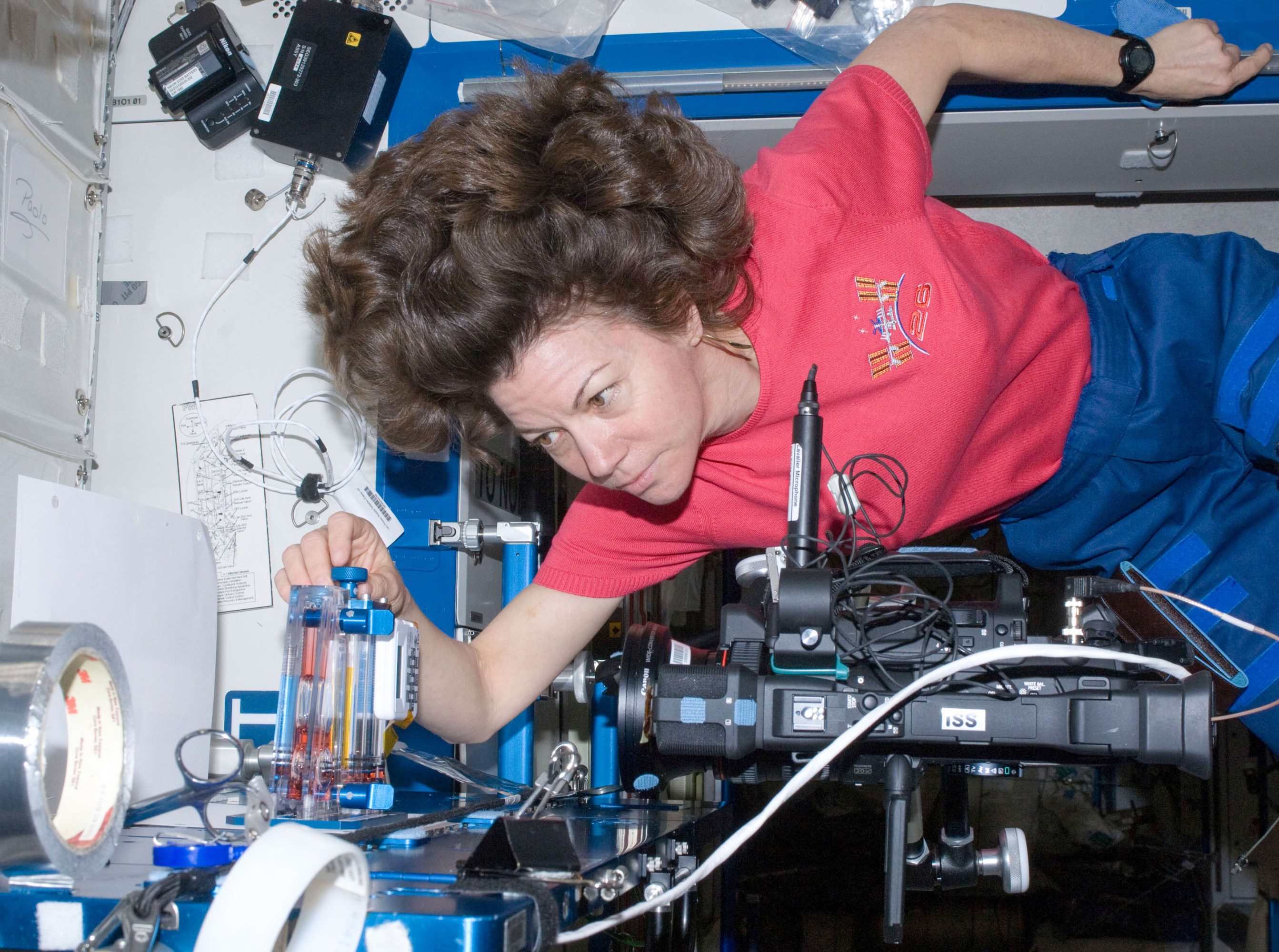
In 1993, I got word that I’d been assigned to my first mission aboard the space shuttle. As a mission specialist on STS-73, I would put my background as a research scientist to use byperforming 30 experiments in microgravity. These experiments, which included growing potatoes inside a locker (just like Matt Damon in The Martian), using sound to manipulate large liquid droplets, and growing protein crystals, would advance our understanding of science, medicine, and engineering and help pave the way for the International Space Station laboratory.

While training for STS-73, I got a call from an astronaut I greatly admired: Colonel Eileen Collins. One of the first female test pilots, she would become the first woman to pilot the space shuttle in 1995, when the STS-63 mission launched. Collins had invited some of her heroes—the seven surviving members of the Mercury 13—to attend the launch, and she was calling to ask me to help host them. The Mercury 13 were a group of 13 women who in the early 1960s had received personal letters from the head of life sciences at NASA asking them to be part of a privately funded program to include women as astronauts. They had accepted the challenge and undergone the same grueling physical tests required of NASA’s first astronauts. Although the women performed as well as or better than the Mercury 7 astronauts on the selection tests, which many of them had made sacrifices even to pursue, the program was abruptly shut down just days before they were scheduled to start the next phase of testing. It would be almost two decades before NASA selected its first female astronauts. 

Never had I felt more acutely aware of being part of that lineage of brave and boundary-breaking women than I did that day, standing among those pioneers, watching Eileen make history. I can’t know what the Mercury 13 were thinking as they watched Eileen’s launch, but I sensed that they knew how much it meant to Eileen to be carrying their legacy with her in the pilot seat of that space shuttle.

Missions and malfunctions

Acouple of years after I had added my name to the still-too-short list of women who had flown in space, Eileen called again. This time she told me that I would be joining her on her next mission, ­STS-93, scheduled to launch in July 1999. Our Mercury 13 heroes would attend that launch too, and Eileen would be making history once again, this time as NASA’s first female space shuttle commander. I would be the lead mission specialist for delivering the shuttle’s precious payload, the Chandra X-ray Observatory, to orbit. I’d also be one of the EVA (extravehicular activity) crew members, if any spacewalking repairs were needed.  

Our mission to launch the world’s most powerful x-ray telescope would change the world of astrophysics. With eight times the resolution of its predecessors and the ability to observe sources that were fainter by a factor of more than 20, Chandra was designed to detect x-rays from exploding stars, black holes, clusters of galaxies, and other high-energy sources throughout the universe. Because cosmic x-rays are absorbed by our atmosphere, we can’t study them from Earth, so an x-ray telescope must operate from well above our atmosphere. Chandra wouldlaunch into low Earth orbit on the shuttle and then require additional propulsion to achieve its final orbit, a third of the way to the moon.

I was thrilled by the idea that my team and I would be launching a telescope whose work would continue long after we were back on Earth. Preparation for launch was intense. As Chandra’s shepherd, I needed to be able to perform what we called the deploy sequence in my sleep. And I had to have a close relationship with the folks at the Chandra Mission Control, which was separate from NASA Mission Control, and make sure the two groups were working together. In a very real sense, Chandra represented the future of astrophysics—a window that promised a deeper understanding of the universe. When the moment came for the telescope to be deployed, all of this would be, quite literally, in my hands.

But first it was in the hands of the launch team at the Kennedy Space Center, whose job it was to get us off the ground and into orbit. And we almost didn’t make it.

Our first launch attempt was aborted eight seconds before liftoff. There we were, waiting for the solid rocket boosters to ignite and the bolts holding us to the launchpad to explode. Instead, we heard “Abort for a hydrogen leak” from Launch Control. Later it was revealed that a faulty sensor had been the issue.  

For our second attempt, we were confidently told we were “one hundred percent GO for weather.” In other words, there was not even a hint of bad weather to delay us. And then there were lightning strikes at the launchpad. Really.

For our third launch attempt, under a bright moon on a cool, clear night, we strapped in and the countdown began. This time I was determined I wouldn’t take anything for granted—even in those final 30 seconds after control switched over to the shuttle’s internal computers. Even when the engines kicked in and I felt the twang of the nose tipping forward and then back. Only when the solid rockets ignited did I let myself believe that we were actually heading back to space. As a seasoned second-time flyer, I kept my excitement contained, but inside I was whooping and hollering. And then, as Columbia rolled to the heads-down position just seconds after liftoff, my joyful inner celebration was drowned out by an angry alert tone and Eileen’s voice on the radio:

Houston: Columbia is in the roll and we have a fuel cell pH number one.

Almost immediately, we got a response from the flight controllers in Houston: 

Columbia, Houston: We’d like AC bus sensors to OFF. We see a transient short on AC1.

It was incomprehensible to be hearing these words less than 30 seconds into our actual flight. An electrical short had taken out two of our six main engine controllers.

My first thought: We know how to deal with this. We did it last week in the simulator. But we weren’t in the simulator anymore. This was a real, no-shit emergency. After we returned to Earth we realized just how close we’d come to several actual life-or-death situations. No matter how much you train for just such a moment, you can’t really anticipate what it will mean to find yourself in one. I was relieved that it wasn’t long before I heard the steady voice of Jeff Ashby, our pilot, confirming that he had successfully flipped the bus sensor switches, reducing our exposure to the potential catastrophe of additional engine shutdowns.

An image of the Space Shuttle taking off.
The Space Shuttle Columbia lifted off from Kennedy Space Center on July 23, 1999, for a five-day mission that would include releasing the Chandra X-ray Observatory.
NASA

We were still headed to space, but with the loss of some of our backup capabilities, we were vulnerable. We carefully monitored the milestones that would tell us which options we still had. I tried not to hold my breath as the shuttle continued to climb and we listened for updates from Houston:

Columbia, Houston: Two Engine Ben. Translation: We could lose an engine and still safely abort the mission and make it to our transatlantic landing site in Ben Guerir, Morocco.

Columbia, Houston: Negative return. Translation: We were too far along to perform an RTLS (return to launch site) and head back to Florida.

Then finally, the call we’d been wishing and waiting for: 

Columbia, Houston: PRESS TO MECO. Translation: We would make it to orbit and main engine cutoff even if one of our engines failed in the next few minutes.

Now, assured of a safe orbit as we hurtled through space, we could turn our attention to our mission: sending Chandra off to its new home.

An electrical short is a serious problem. After our mission landed, the shuttle fleet would be grounded for months after inspections revealed multiple cases of wire chafing on the other shuttles. Some would call us lucky, but listening to the audio from our cockpit and from Mission Control, I credit the well-trained teams that worked their way patiently through multiple failures catalyzed by the short and by a separate, equally dangerous issue: a slow leak in one of our three engines used during launch. 

Our STS-93 launch would go down in the history books as the most dangerous ascent of the shuttle program that didn’t result in an accident. Even in the midst of it, my sense of mission helped anchor me.

The Chandra X-ray Observatory was deployed from the space shuttle Columbia’s payload bay on July 23, 1999, just a few hours after the shuttle’s arrival in Earth orbit.
NASA

The plan in 1999 had been that Chandra would last five years. But as of this writing, Chandra is 25 and still sending valuable data back from space. Each year, on its “birthday,” the crew from STS-93 and the teams who worked on the ground connect via email, or in person for the big ones. We’ll always share a bond from that mission and its continuing legacy. And what a legacy it is. Young astronomers who were still toddlers when I pulled that deploy switch are now making discoveries based on the data it’s produced. Chandra is responsible for almost everything that we now know about black holes, and it’s still advancing our understanding of the universe by giant leaps. But these are difficult times. Sadly, budget cuts proposed in 2025 would eliminate Chandra, with no replacements planned. 

Suiting up and making change 

People often wonder what would possess any sane person to strap themself on top of a rocket. And by now you’re probably wondering why, after the harrowing malfunctions during the STS-93 launch, I was eager not only to return to space again but to spend six months living and working aboard the International Space Station. It comes back to mission. I don’t consider myself to be braver than most people, though I may be more optimistic than many. I take the risks associated with my job because I believe in what we’re doing together, and I trust my crew and our team to do all that’s humanly possible to keep us safe.

But the odds were stacked against me in my quest to serve on the space station. 

The world of space exploration, like so many others, is slow to change. Long-standing inequities were still evident when I joined NASA in 1992, and many endured during my time there. But it can be difficult to know when to fight for change at the outset and when to adapt to unfair circumstances to get your foot in the door.

The first trained astronauts tended to be tall, athletic, and male—and the biases and assumptions that led to that preference were built into our equipment, especially our space suits. Our one-piece orange “pumpkin suits” worn for launching and landing weren’t designed for people with boobs or hips, so many of us wound up in baggy suits that made fitting a parachute harness tricky and uncomfortable. But fit issues with our 300-pound white spacewalking suits proved to be a much bigger problem, especially for the smaller-framed astronauts—including some men. 

The bulky EVA suits, which allow astronauts who venture outside a spacecraft to breathe and communicate while regulating our temperature and protecting us from radiation, are essentially human-shaped spaceships. But while they came in small, medium, large, and extra-large, those suits were designed for (male) astronauts of the Apollo era with no thought to how they might work for different body types. Given that ill-fitting equipment would affect performance, astronauts like me—who weren’t shaped like Neil Armstrong, Buzz Aldrin, and their compatriots—were often negatively prejudged before we even started training. As a result, NASA failed for years to leverage the skills of many members of the astronaut corps who physically didn’t fit an institutional template that hadn’t been redesigned for half a century.

Spacewalk training was the most physically difficult thing I did as an astronaut. Training in that way-too-large space suit made it even harder, forcing me to find ways to optimize my ability to function.  

As she prepares to head into the pool for EVA training, Coleman dons glove liners. Next, the bottom of her suit will be attached to the top and her gloves will be attached at the wrist ring, locked, and tested for a solid seal. Coleman qualified as a spacewalker for all of her missions, even when that required doing so in a medium suit that was much too big.
NASA

We practice spacewalking underwater in an enormous swimming pool. If the suit is too big for you—as even the small was for me—the extra volume of air inside drags you up to the surface when you’re trying to work underwater. It’s a profound physical disadvantage. 

Though the fit of the small spacewalking suit wasn’t great, I persevered and adapted, training for many years in that suit with above-average spacewalking grades. And I was chosen to serve as a spacewalker for both of my shuttle missions, should the need arise. Not long before my first mission, Tom Akers, one of the experienced spacewalkers, came up to me and said, “Cady, I can see that you have a real aptitude for spacewalking and also a head that thinks like a spacewalker.” But then he told me that to cut costs, NASA had decided not to use the small suits on the space station. “People are going to look at you and think you’re too small, but I think someone like you could learn to function inside a medium suit,” he said. “So my advice is this: If you are interested in flying on the space station, then when someone asks you what size suit you wear, you tell them a medium will be no problem.” 

Sure enough, after my second shuttle flight, NASA announced that the small suit would be eliminated. I’ve never forgotten the wording of the rationale: “We’ve looked ahead at the manifest, and we have all of the spacewalkers that we need.” Implied was that they wouldn’t miss the smaller astronauts—not a bit. 

I think people might not have understood at the time what it meant to get rid of those small space suits. You could not live and work on the space station unless you were space-suit qualified. And because NASA was about to shut down the shuttle program, soon missions to the space station would be the only ones there were. NASA’s decision to eliminate the small suit effectively grounded more than a third of female astronauts. It also meant that few women would have the experience needed to serve in positions where they could have a say in important decisions about everything from prioritizing missions and choosing crews to making changes in NASA’s culture.    

To me, eliminating the small space suit indicated that the organization didn’t understand the value of having teams whose members contribute a wide range of experiences and viewpoints. When team members are too much alike—in background, ways of thinking and seeing the world, and, yes, gender—the teams are often less effective at finding innovative solutions to complex problems. 

Determined to contribute to the important scientific work being done on the space station, I had no choice but to qualify in the medium suit. But it would be a tall order because for the instructors, the gear is seldom at fault. You just need to get used to it, understand it better, or practice more. I did all three—but it wasn’t enough. So I also adapted everywhere I could, and I recruited a lot of great help. Kathy Thornton, one of the first female spacewalkers, recommended that I buy a waterskiing vest at Walmart to wear inside the suit. The space-suit team was horrified at the thought of using nonregulation materials, but it got them thinking. Together, we settled on having me wear a large girdle—left over from the Apollo guys—and stuffing it with NASA-approved foam to center me in the suit. This kept the air pockets more evenly distributed and allowed me to practice the required tasks, showing that I could work effectively in a medium.

By adapting, which sometimes means staying silent, you may perpetuate a discriminatory system. But if I’d tried to speak the truth from day one, I’d never have made it to the day when I was taken seriously enough to start conversations about the importance of providing all astronauts with equipment that fits. I needed to launch those discussions from a place of strength, where I could be heard and make a difference.

How best to catalyze change is always a personal decision. Sometimes drawing a line in the sand is the most effective strategy. Other times, you have to master the ill-fitting equipment before you get a chance to redesign it. Qualifying in the too-large suit was my only option if I wanted to fly on the International Space Station, since every flight to the ISS needed two spacewalkers and a backup spacewalker—and there were only three seats in the space capsule. The alternative would have been waiting at least 11 years for the newer spacecraft, which would have a fourth seat. I had to play by the unfair rules in order to get to a point where I could change those rules.

With grit and a lot of support from others, I did end up qualifying in the medium suit. And in 2010, I set off for the International Space Station, serving as the lead robotics and science officer for Expedition 26/27 as I traveled 63,345,600 miles in 2,544 orbits over 159 days in space.

Coleman conducts the Capillary Flow Experiment on the International Space Station to study the behavior of liquids at interfaces in microgravity.
NASA/PAOLO NESPOLI

Today, efforts are underway to redesign NASA’s space suits to fit the full range of sizes represented in the astronaut corps. Because of the work I put in to make it possible for a wider range of people to excel as spacewalkers, NASA hung a portrait of me in the row of space-suit photos outside the women’s locker room. And I’m proud to know that my colleagues—women and men—are continuing the work of making change at NASA. Every change has been hard won. The numbers matter. The astronaut corps is now 40% women. Given that, it is harder to make decisions with the potential to leave women out. When a female NASA astronaut walks on the moon for the first time, she will do so in a redesigned space suit. I hope it fits her like a glove.

The crew of spaceship Earth

Contributing to an important mission is a privilege. But who gets to contribute is as important to mission success as it is to the individuals who want to play a part. I can’t emphasize enough how much our incredibly complex NASA missions have benefited from the broad range of people involved. Bringing together people of different backgrounds and skills, with different ways of seeing the world and unique perspectives on opportunities and problems, is what makes space exploration possible.

At the White House Science Fair in 2016, Coleman sits with the “Supergirls” Junior FIRST Lego League Team from Girl Scout Troop 411 in Tulsa, Oklahoma, as they await the arrival of President Barack Obama
NASA/JOEL KOWSKY

Sharing space, to me, means including more people—both in the privilege of going to space and in so many of our endeavors here on Earth. When I applied to be an astronaut, very few women had orbited our planet. Today, that number has grown to 82 of 633 human beings in total, and newer NASA astronaut classes have averaged 50% women. Spaceflight is making progress in terms of including people with a wider range of backgrounds, fields of expertise, and physical abilities. But we have a long way to go. And the same is true in countless fields—the barriers that we struggle with in space exploration seem to be ubiquitous in the working world.

As a planet, we’re facing enormous challenges, in areas from climate change to public health to how to sustainably power our endeavors. If there’s one thing I learned above all else from my time in space, it’s that we’re all sharing Earth. No one else is coming to solve our complex problems. And we won’t find solutions with teams of people who share too much in common. We need everyone to contribute where they can, and so we need to create systems, environments, and equipment that make that possible. And we need to be sure that those making contributions are visible, so they can serve as models for future generations. Our job now is to make sure everyone gets enough support to acquire the skills that we—all of us—need to build collaborative teams and solve problems both on Earth and in space. 

It’s worth repeating: We’re all sharing Earth. Looking down from space, you see very few borders separating humans from one another. You understand—not as an abstract ideal but as a visceral, obvious reality—that we are one family sharing a precious, life-supporting home. It’s so clear from up there that we are all the crew of “Spaceship Earth.” I believe that sharing that perspective, bringing it to life, will help more people see that our differences matter less than what binds us together, and motivate us to combine our efforts to tackle the challenges affecting all of us.


In her 24 years at NASA, Cady Coleman ’83, a scientist, musician, and mother of two, flew on two space shuttle missions and began her 159-day mission aboard the International Space Station the day after turning 50. Today, as a public speaker and consultant, she shares her insights on leadership and teamwork gleaned from the high-stakes world of space exploration.

Sharing Space cover

This excerpt is adapted from her book, Sharing Space: An Astronaut’s Guide to Mission, Wonder, and Making Change, published by Viking, an imprint of Penguin Random House. © 2024 by Catherine Coleman.  

Travels with Rambax

KAOLACK, Senegal – The MIT students have just finished dinner and are crumpling soda cans into trash bins when they get the summons: “Grab your drums, grab your drums, grab your drums …” 

It is time for the tanibeer, a nighttime drum and dance party, in Kaolack, a town amid salt plains and peanut farms located 220 kilometers southeast of Dakar, Senegal’s capital. For the members of Rambax MIT, the Institute’s Senegalese drumming ensemble, the excitement is palpable as they fetch their drums and make their way up the road. Their destination is a small field on the family land of their director, Lamine Touré, who comes from a long line of griots, the musicians and oral historians of the Wolof people.

Lamine Touré, director of Rambax MIT, leads drum practice in Grand Mbao
NIKO ODHIAMBO ’25

Touré, a Senegalese master drummer and an MIT lecturer in world music, cofounded Rambax in 2001 with Patricia Tang, an associate professor and ethnomusicologist who specializes in West African music. It began as an extracurricular group to teach students and other members of the MIT community the art of sabar, a vibrant West African drumming and dance tradition. Today, Rambax is a credit-bearing class (21M.460) enrolling as many as 50 students a semester, and its ensemble’s performances draw audiences from MIT and the wider Boston community.  

During Independent Activities Period (IAP), 16 members of the ensemble joined Touré and Tang on a two-week study tour in Senegal, the birthplace of the music that inspires Rambax. In addition to performing, the students attended drumming classes and dance workshops taught by expert Senegalese drummers, and they experienced sabar drumming within its traditional and cultural context in Dakar and Kaolack.

A sabar celebration, known as a tanibeer when held at night, is a lavish display of dance music, a great neighborhood carnival.

“Rambax is unique,” says Touré, whose family of prominent griot percussionists had him drumming from the age of four. Traveling to Senegal allowed the students to experience the cultural significance of the music—and Touré says their Senegalese audiences were really impressed with their playing.

Poster for the tanibeer in Kaolack, Senegal, featuring Rambax MIT.
COURTESY OF RAMBAX

A sabar celebration, also known as a tanibeer when held at night, is a lavish display of dance music: a great neighborhood carnival, jammed with lights, blaring speakers, griots, costumed dancers, drums and drums and ever more drums, and—of course—dancing.

On the night of the Rambax tanibeer in January, the sky is clear and chilly breezes waft across the field, where throngs of people, some dressed in colorful Senegalese traditional garb, gather under fluorescent lights perched on lampposts, chatting and gesticulating while waiting to watch the performance.

As the MIT students walk in, wearing their bright yellow, green, and red knee-length dashikis, the crowd erupts into applause. 

Standing in front of his hometown audience, long dark dreadlocks spilling to his shoulders, Touré takes a microphone and introduces the ensemble in his native Wolof. He explains that his students are lovers of African music and, under his tutelage at MIT, have been learning the art of sabar. He pauses for a moment and leans in close to start conducting. 

Then Rambax begins to play.

Local musicians join MIT students as they play their sabar drums at the Grand Mbao practice session.
NIKO ODHIAMBO ’25

The audience cheers and dances, forming a large circle in front of the musicians. Before long, women take turns at the center of the circle, matching the energetic rhythms of the drumming in the exuberant hip twists, arm swings, jumps, and impossibly high knee kicks of sabar dancing. The high-spirited drumming and dancing continue until the early hours of the morning.   

The tanibeer is a chance for Touré “to show what he’s been teaching his American students and that they can really play sabar quite well,” says Tang, who serves as a faculty advisor to Rambax. “And that’s often a surprise to the Senegalese audience.” 

Senegalese drummers Sadda Sene, Mbaye Ndiaga Seck, and Pa Ali Konte load drums onto the Rambax van after drum practice.
PATRICIA TANG
Drum practice on the beach in Grand Mbao.
COURTESY OF RAMBAX

Among the 16 Rambax members on the Senegal trip is Autumn Geil ’21, a researcher and PhD student in the department of mechanical engineering. Initially drawn to music through choir and opera singing in high school, she had never heard of sabar drumming before discovering Rambax through a friend as an undergrad. She joined and has been a member of the ensemble, which she calls “just so incredible,” ever since. 

Rambax MIT students
Eri-ife Olayinka ’25 and Kaelyn Dunnell ’25 by the sea in Grand Mbao.
NIKO ODHIAMBO ’25

For Geil, practicing sabar with custodians of the tradition in Senegal is an opportunity to “observe and learn from the drummers to improve my skills for future performances.” 

Baran Mensah ’24, a Ghanian master’s student in mechanical engineering who minored in music as an undergrad, also joined Rambax after a friend recommended it. He sees it as a way to tap into his African roots while at MIT but says it’s also “a gateway to learn about Senegalese art, music, and culture.” Until the tour, he notes, “I really didn’t know much about my country’s West African neighbor.”   

“Coming on this trip allows us to take a step back, to learn about people and cultures, making us more effective communicators.”

Autumn Geil ’21

Eri-ife Olayinka ’25, a computation and cognition major who took Rambax classes for two semesters, says she finds the learning environment supportive and the cultural insights provided by Touré and Tang rewarding. “You see yourself getting better, becoming comfortable with playing in the class,” she says. After completing the classes to satisfy her art requirements, Olayinka stayed on in the drumming ensemble. “I genuinely enjoy being in Rambax—it’s such a cool thing we get to do as a group,” she says.

Sabar artists Badara Faye, Mbaye Ndiaga Seck, and Pa Ali Konte take the mic at a tanibeer in Grand Mbao
NIKO ODHIAMBO ’25

Visiting Kaolack is more than an opportunity for Rambax members to glimpse the culture that gave rise to sabar. With horse-drawn wagons clip-clopping through its rugged terrain but also massive solar farms, Kaolack is a city where old meets new. Witnessing those contrasts—and getting to perform and to immerse themselves in the performances of local musicians—helps the students enhance what Geil calls the “human connection skills” that all scientists and technologists need. 

“It’s really important for people in STEM to make space for art and music,” she says. “Coming on this trip allows us to take a step back, to learn about people and cultures, making us more effective communicators of our technology.” 

Grad student Natalie Huang ’24 and local musician Badara Faye dance at a tanibeer in Grand Mbao.
NIKO ODHIAMBO ’25
Rambax members watch Sengalese dancers and drummers at the tanibeer in Kaolack.
NIKO ODHIAMBO ’25
Grad student Tina Chen ’24, Neha Basu ’25, Pa Ali Konte, Monique Brewster ’10, and grad student Sandra Huffman ’20, SM ’21, drum at the tanibeer in Kaolack.
PATRICIA TANG

Rambax MIT plays at the tanibeer in Kaolack.
COURTESY OF RAMBAX

Back inside Touré’s family compound, Tang invites the students to gather around so she can introduce them to Touré’s mother, Marie Sow, and his sisters and aunts. Sow showers them with good wishes and they bask in the glow.

It’s important for Rambax members to know the history and culture of the people behind the music they practice, says Tang. “We really want the students to have this sort of cultural immersion—live in a Senegalese house like the Senegalese people do, hang out with Senegalese drummers, and really get a sense of what it’s like in Senegal.”

Abdullahi Tsanni, SM ’23, a former MIT Technology Review fellow, is a science writer based in Dakar, Senegal, who specializes in narrative features.