How To Measure PPC Performance When AI Controls The Auction via @sejournal, @brookeosmundson

For most of the history of paid search, performance measurement followed a clear cause-and-effect relationship.

Advertisers controlled the inputs inside their campaigns like bid strategies, keyword and campaign structure, ad copy, and landing pages. All these factors contributed to conversion performance in some shape or form.

When performance changed, the explanation was usually traceable. For example, a new keyword theme improved conversion rates. Or, a bidding strategy increased efficiency.

That simple cause-and-effect framework is breaking down in real time, and has been for a while.

Over the past several months, Google has accelerated its transition toward AI-driven campaign types like Performance Max, Demand Gen, or assets inside those like AI Max or AI-driven ad creative components.

Not only do these change how campaigns are set up and managed, but they also change how performance must be measured.

Advertisers increasingly receive conversions from queries they did not explicitly target, from creative assets that are automatically assembled, and from placements distributed across multiple channels. In this environment, measuring performance by analyzing individual campaign inputs becomes less useful.

The real challenge is understanding how automated systems generate outcomes.

This article provides a measurement framework for that reality. It explains what has changed in advertising platforms, how PPC teams can evaluate performance when automation controls more of the auction, and how practitioners can communicate results clearly to leadership.

The Current Measurement Crisis In PPC

Right now, most discussions about AI in PPC tend to focus on automation features like campaign types, targeting capabilities, ad creative development, and bid strategy expansion.

But, there’s a deeper shift happening in measurement but not talked about as much.

Automation introduces a larger set of variables influencing each auction. When the platforms make targeting, bidding, placement decisions (and more) dynamically, isolating the impact of individual campaign inputs becomes difficult.

Recent platform updates have not only changed how campaigns are managed, but also how performance should be interpreted. The connection between action and outcome is less direct, and in many cases, partially obscured.

Several platform developments illustrate why traditional measurement methods are becoming less reliable.

AI Max Expands Queries Beyond Keyword Lists

In my opinion, AI Max represents Google’s most aggressive step toward intent-driven matching.

Instead of relying solely on advertiser-defined keywords, AI systems evaluate contextual signals, user behavior patterns, and historical performance data to match ads with queries that may not exist in the account.

Not only that, but AI Max goes beyond search terms. It also has the ability to change your ad assets for more tailored messaging when Google deems appropriate.

For PPC managers, this introduces a structural shift in how to measure performance. Conversions may originate from queries that were never explicitly targeted.

And we knew that something like this was coming. Back in 2023, Google first publicly used the word “keywordless” in communications when talking about Search and Performance Max.
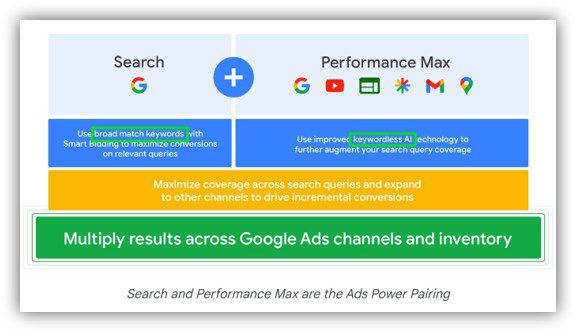
Source: Mike Ryan, X.com, March 2026

For example, a retailer who bids on “trail running shoes” may now appear for search terms like:

  • “best shoes for rocky terrain running”
  • “ultra marathon footwear”
  • “durable hiking running hybrids”

These queries reflect the same intent, but they don’t map cleanly back to the original keyword strategy.

Instead of trying to force these queries into keyword-level reporting, try analyzing performance by grouping into intent clusters. By evaluating conversion rate and revenue at the category level, teams can maintain strategic clarity even as query matching expands.

Google Ads already does a decent job of this in the Insights tab within the platform. They have a “Search terms insights” report that groups queries into “Search category,” where you can see conversions and search volume.
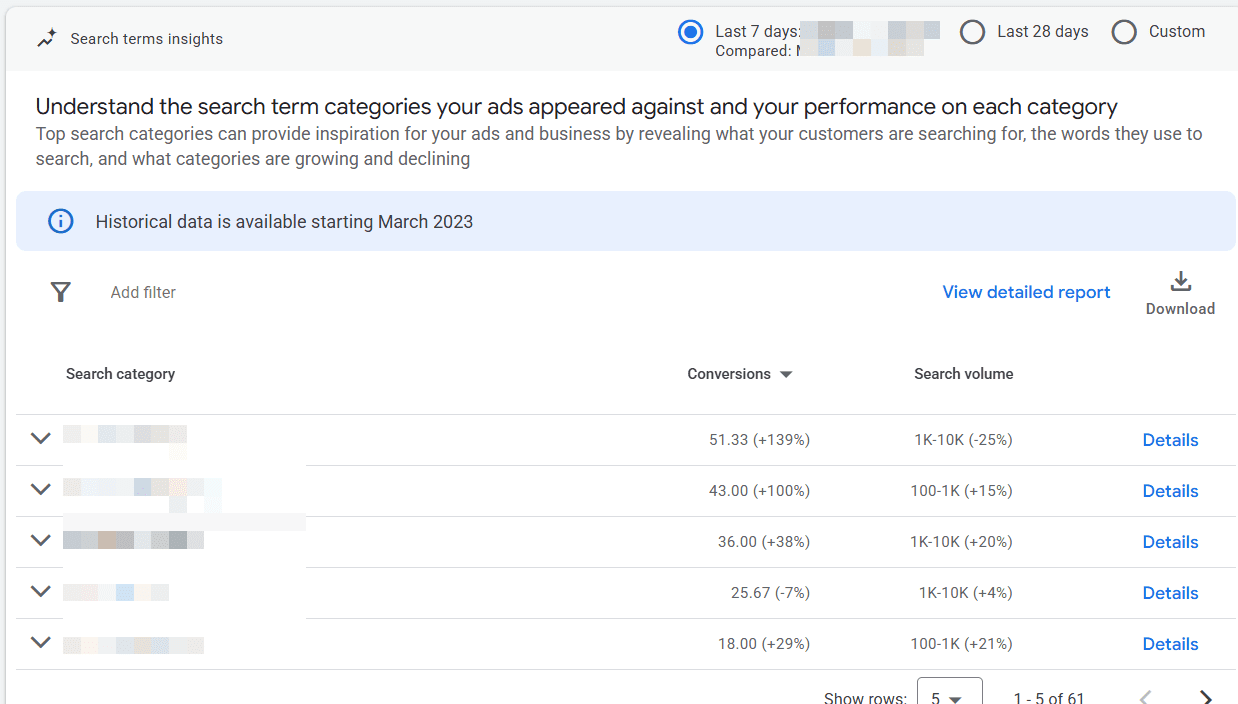
Screenshot by author, March 2026

Performance Max Distributes Spend Across Multiple Channels

Performance Max can further complicate measurement by distributing budget across Search, YouTube, Display, Discover, Gmail, and Maps.

Up until last year, there was little-to-no transparency in how spend was allocated across those channels. Back in April 2025, Google launched the long-awaited feature of channel reporting to the PMax campaign type. It now shows channel-level reporting, better search terms data, and expanded asset performance metrics.

For example, say you have a $40,000 monthly PMax campaign budget and see this channel breakdown:

Channel Spend Conversions
Search $18,500 310
YouTube $10,200 82
Display $7,100 45
Discover $4,200 28

If Search drives the majority of conversions, but YouTube consumes a large portion of spend, PPC marketers could try the following:

  • Test separating out branded search outside of PMax.
  • Refine asset groups to improve search alignment.
  • Run controlled experiments comparing PMax vs. Search.

Measurement becomes an exercise in interpreting how the system allocates spend rather than controlling each placement.

Ads Are Beginning To Appear Inside AI Conversations

Conversational search introduces an entirely new layer of complexity into PPC measurement.

Google is now testing shopping results embedded directly within AI Mode, allowing users to compare products without leaving the interface.

Google isn’t the only one doing this. ChatGPT announced on Jan. 16, 2026, that it would begin testing ads for its Free and Go users in the United States.

No matter which platform is running or testing ads in AI conversations, it’s clear that the measurement gap hasn’t been solved, and leaves many PPC managers with unanswered questions.

In my own recent search, I came across ads at the end of an AI Mode thread when I searched “noise cancelling headphones”:

So, if I were to click on one of those sponsored ads but convert at a later time, that attribution is unclear right now. Will my conversion be measured from the AI recommendation, the product listing click, or a later branded search?

These journeys challenge traditional attribution models, which were built around linear click paths rather than multi-step AI interactions.

Why Traditional PPC Metrics Are No Longer Enough

Many PPC reporting dashboards still rely on communicating metrics like impressions, clicks, conversion rate, and return on ad spend.

While some of those metrics remain useful, they no longer tell the full user story when bringing in automated and AI-driven environments.

These three shifts explain why.

1. Attribution Windows Are Expanding

AI-assisted search increases both the length and complexity of user journeys.

Research from Google and Boston Consulting Group show that “4S behaviors” (streaming, scrolling, searching, and shopping) have completely reshaped how users discover and engage with brands.

When AI introduces product recommendations earlier in a user’s journey, the time between initial interaction and conversion often grows. This could be because that user is still at the beginning of their research phase. Just because you’re introducing a product earlier, does not mean that they’ll be ready to purchase it any earlier.

So, what can marketers do about that gap now? Here are a few helpful tips to better understand how users are engaging with your business:

  • Review conversion lag reports in Google Ads.
  • Analyze time-to-conversion in GA4. Are there any differences or shifts in the last three, six, or nine months?
  • Extend attribution windows to 60-90 days where appropriate.

This ensures automated systems receive more accurate feedback on what (and when they) drive conversions.

Organic Search Is Losing Click Share

Search results now include everything from AI Overviews, scrollable shopping modules at the top, and expanded ad placements across all devices.

Where does that leave organic listings?

A study conducted by SparkToro and Datos found that nearly 60% of Google searches end without a click.

This reduces organic traffic even more and shifts more demand capture towards paid media.

From a measurement standpoint, PPC should be evaluated alongside organic performance when possible.

Tracking blended search revenue provides a more accurate view of total search performance, rather than isolating paid channels.

AI Systems Optimize For Outcomes Rather Than Inputs

Traditional PPC management focused on inputs like keywords, bids, and ad copy to influence performance directly.

AI systems work differently. Instead of optimizing individual levers, they evaluate large sets of signals in real-time to determine which combinations are most likely to drive conversions.

This changes what measurement needs to do. Instead of asking which specific keyword or bid strategy adjustment improved performance, marketers need to evaluate whether the platform is producing the right business outcomes.

As platforms take over more of the execution, measurement has to focus less on the mechanics and more on whether automation is driving profitable, meaningful results.

The New Measurement Stack For AI-Driven PPC

If AI is now controlling more of the auction, then PPC teams need a different way to evaluate performance.

The old measurement stack was built around visibility into campaign inputs. You could look at keyword performance, search terms, ad copy, device segmentation, and bid adjustments to understand what was working. That model starts to fall apart when automation is making many of those decisions on your behalf.

The replacement becomes a new measurement stack that advertisers should look at in these four layers:

  • Profitability.
  • Incrementality.
  • Blended acquisition efficiency.
  • First-party conversion quality.

Together, these give marketers a more accurate picture of whether automation is actually helping the business grow.

Start With Profit, Not Just ROAS

ROAS still has value, but it should no longer be treated as the primary success metric in highly automated campaigns.

The problem is that AI-driven systems are often very good at capturing demand that already exists. That can make campaign efficiency look strong on paper, even if the business is not gaining much incremental value.

A campaign with a 700% ROAS may still be underperforming if it is primarily driving low-margin products, repeat purchasers, or orders that would have happened anyway.

That is why profitability should sit at the top of the measurement stack.

Instead of asking, “Did this campaign generate enough revenue?” marketers should be asking, “Did this campaign generate profitable revenue?”

For ecommerce brands, this could mean incorporating:

  • Contribution margin.
  • Product margin by category.
  • Average order profitability.
  • New customer revenue vs. returning customer revenue.

A simple starting point is to compare campaign revenue against both ad spend and cost of goods sold.

For lead gen advertisers, the same principle applies, just different incorporations:

  • Qualified lead rate.
  • Sales acceptance rate.
  • Close rate by campaign.
  • Revenue per opportunity.

If AI is optimizing toward cheap conversions that never turn into revenue, the system is learning the wrong lesson.

Add Incrementality To Separate Demand Capture From Demand Creation

The second layer of the stack is incrementality. This is where many PPC measurement frameworks still fall short.

Automation can be highly effective at finding conversions, but that does not automatically mean it is generating new business. In many cases, AI systems are simply getting better at intercepting users who were already on their way to converting.

If your campaign is mostly capturing existing demand, performance may look strong inside the ad platform while actual business lift remains modest.

This is why incrementality testing has become much more important in the AI era.

For PPC teams, this means at least part of measurement should be designed to answer: “Would this conversion have happened without the ad?”

You don’t need an enterprise-level media mix modeling to get started. A few practical approaches include:

  • Geo holdout tests. Pause or reduce spend in a small set of markets while maintaining normal activity elsewhere.
  • Use Google incrementality testing. Google reduced the minimum of testing incrementality in its platform to just $5,000, making it more affordable for many advertisers.
  • Branded search suppression tests. In select markets or windows, test the impact of reducing branded spend where brand demand is already strong.

Answering this question does not mean automation is bad. It means PPC teams need a better way to distinguish between platform efficiency and true business lift.

Use Blended CAC To Measure Search More Realistically

The third layer of the new measurement stack is blended acquisition efficiency.

As AI Overviews, AI Mode, and other search changes continue to reduce traditional organic click opportunities, PPC should not be measured in a vacuum.

That is especially true for brands where paid and organic search are increasingly working together to capture the same demand.

A campaign may appear less efficient in-platform while still playing a critical role in maintaining total search visibility and revenue.

That is where blended customer acquisition cost (CAC) becomes useful.

Blended CAC looks at total acquisition spend across relevant channels and divides it by the total number of new customers acquired.

The formula for this is simple:

Total acquisition spend ÷ total new customers = blended CAC

This gives leadership a much more realistic picture of what it actually costs to grow the business.

It also helps PPC managers explain why paid search may need to carry more weight when organic search visibility declines due to AI-driven search features.

In other words, this metric helps move the conversation away from “Did Google Ads hit target ROAS?” and toward “What is it costing us to acquire a customer across modern search systems?”

Make First-Party Conversion Quality The Foundation

The final layer of the stack is first-party data quality. This is the part many advertisers still underestimate.

As platforms automate more of the targeting, bidding, and matching logic, the quality of the signals you send back becomes even more important. If the platform is deciding who to show ads to and which conversions to optimize toward, your job is to make sure it is learning from the right outcomes.

That means not all conversions should be treated equally.

If a lead form completion, low-value purchase, repeat customer order, and high-margin new customer sale are all fed back into the system the same way, automation will optimize toward volume, not value.

For PPC teams, that means the measurement stack should include a serious review of conversion quality inputs, including:

  • Offline conversion imports.
  • CRM-based revenue mapping.
  • New vs. returning customer segmentation.
  • Lead quality or opportunity-stage imports.
  • Customer lifetime value indicators where available.

This is where measurement and optimization start to overlap.

If the wrong conversions are being measured, the wrong outcomes will be optimized.

That is why first-party data is not just a reporting issue. It is the foundation of the entire AI-era measurement stack.

What To Show Your CMO Or Clients

One of the most difficult aspects of managing automated campaigns is explaining performance to leadership teams.

Executives often expect reporting frameworks built around the mechanics of traditional campaign management. In automated environments, those indicators tell only a small part of the story.

A more effective reporting structure focuses on three layers that connect advertising performance to business outcomes.

The first layer should always focus on the metrics that leadership teams care about most. Revenue growth, contribution margin, and customer acquisition cost provide a direct connection between marketing activity and company performance. These indicators allow executives to evaluate marketing investments in the same framework they use to evaluate other business decisions.

Instead of presenting keyword-level reports, PPC leaders should begin with a clear summary of how paid media contributed to revenue and profit during the reporting period. If revenue increased by 18% quarter over quarter while customer acquisition costs remained stable, that outcome provides a far more meaningful signal than any individual campaign metric.

The second layer of reporting should explain how paid media contributes to the broader acquisition ecosystem. As AI-driven search experiences reshape the visibility of organic results, paid media often carries a larger share of the responsibility for capturing demand.

Blended customer acquisition cost provides an effective way to communicate this relationship. By combining marketing spend across channels and dividing it by the total number of new customers acquired, organizations gain a clearer understanding of the overall efficiency of their acquisition strategy.

This approach also helps executives understand how paid search interacts with organic search, social advertising, and other marketing channels. Rather than evaluating PPC in isolation, leadership can see how the entire acquisition system performs.

The final layer of reporting should focus on experimentation and strategic insights. Automated systems constantly evolve, and the best way to evaluate them is through structured experimentation.

Reports should include summaries of campaign experiments, including:

  • The hypotheses tested.
  • The metrics evaluated.
  • The outcomes observed.

For example, if enabling AI-driven query expansion increased conversion volume while maintaining acceptable acquisition costs, that result provides valuable guidance for future campaign structure decisions.

Equally important is identifying metrics that are becoming less relevant.

Keyword-level performance reports, average ad position, and manual bid adjustments were once central components of PPC reporting. In automated campaign environments, those metrics often provide little strategic value. Continuing to emphasize them can distract leadership from the outcomes that truly matter.

Effective reporting in the AI era should emphasize growth, profitability, and strategic learning rather than operational mechanics.

Measurement Gaps That Still Exist

Despite improvements in automation and reporting transparency, several emerging advertising experiences remain difficult to measure.

One example is the growing presence of personalized offers within AI-driven shopping experiences. Google’s Direct Offers feature allows retailers to surface dynamic discounts during AI-generated shopping recommendations. While the feature may influence purchase decisions, advertisers currently have limited visibility into how frequently those offers appear or how strongly they influence conversion behavior.

Without that visibility, marketers cannot easily determine whether the discounts are generating incremental revenue or simply reducing margins on purchases that would have occurred anyway.

Another emerging measurement challenge involves conversational commerce. Google has begun exploring “agentic commerce” systems where AI assistants help users research and purchase products across multiple retailers.

In these environments, the user journey may involve several conversational prompts before a purchase occurs. The traditional concept of an ad impression or click may become less meaningful when AI systems guide the user through a multi-step research process.

As these experiences evolve, marketers will need new attribution models capable of evaluating influence across conversational journeys rather than isolated interactions.

These developments highlight the importance of ongoing experimentation and advocacy from advertisers. Measurement frameworks will need to evolve alongside the platforms themselves.

The Future Of PPC Measurement

Automation has changed the mechanics of paid advertising, but it has not eliminated the need for strategic oversight.

If anything, the role of human expertise has become more important.

AI systems are extremely effective at executing campaigns across large datasets and complex auctions. What they cannot do on their own is define the business outcomes that matter most or interpret performance within the broader context of organizational growth.

The most effective PPC teams are adapting to this reality. Instead of focusing exclusively on the mechanics of campaign management, they are investing more effort in defining profitability metrics, designing incrementality tests, and building reporting frameworks that connect advertising performance to business outcomes.

Measurement in the AI era will look different from the measurement frameworks that defined the early years of paid search. The focus will shift away from controlling individual campaign inputs and toward understanding how automated systems generate value for the business.

For PPC practitioners and marketing leaders alike, that shift represents the next stage in the evolution of paid media strategy.

More Resources:


Featured Image: Roman Samborskyi/Shutterstock

Google’s Task-Based Agentic Search Is Disrupting SEO Today, Not Tomorrow via @sejournal, @martinibuster

Google’s Sundar Pichai recently said that the future of Search is agentic, but what does that really mean? A recent tweet from Google’s search product lead shows what the new kind of task-based search looks like. It’s increasingly apparent that the internet is transitioning to a model where every person has their own agent running tasks on their behalf, experiencing an increasingly personal internet.

Search Is Becoming Task-Oriented

The internet, with search as the gateway to it, is a model where websites are indexed, ranked, and served to users who basically use the exact same queries to retrieve virtually the same sets of web pages. AI is starting to break that model because users are transitioning to researching topics, where a link to a website does not provide the clear answers users are gradually becoming conditioned to ask for. The internet was built to serve websites that users could go to and read stuff and to connect with others via social media.

What’s changing is that now people can use that same search box to do things, exactly as Pichai described. For example, Google recently announced the worldwide rollout of the ability to describe the needs for a restaurant reservation, and AI agents go out and fetch the information, including booking information.

Google’s Search Product Lead Rose Yao tweeted:

“Date nights and big group dinners just got a lot easier.

We’re thrilled to expand agentic restaurant booking in Search globally, including the UK and India!

Tell AI Mode your group size, time, and vibe—it scans multiple platforms simultaneously to find real-time, bookable spots.

No more app-switching. No more hassle. Just great food.”

That’s not search, that’s task completion. What was not stated is that restaurants will need to be able to interact with these agents, to provide information like available reservation slots, menu choices that evening, and at some point those websites will need to be able to book a reservation with the AI agent. This is not something that’s coming in the near future, it’s here right now.

That is exactly what Pichai was talking about when he recently described the future of search:

“I feel like in search, with every shift, you’re able to do more with it.

…If I fast forward, a lot of what are just information seeking queries will be agentic search. You will be completing tasks, you have many threads running.”

When asked if search will still be around in ten years, Pichai answered:

“Search would be an agent manager, right, in which you’re doing a lot of things.

…And I can see search doing versions of those things, and you’re getting a bunch of stuff done.”

Everyone Has Their Own Personal Internet

Cloudflare recently published an article that says the internet was the first way for humans to interact with online content, and that cloud infrastructure was the second adaptation that emerged to serve the needs of mobile devices. The next adaptation is wild and has implications for SEO because it introduces a hyper-personalized version of the web that impacts local SEO, shopping, and information retrieval.

AI agents are currently forced to use an internet infrastructure that’s built to serve humans. That’s the part that Cloudflare says is changing. But the more profound insight is that the old way, where millions of people asked the same question and got the same indexed answer, is going away. What’s replacing it is a hyper-personal experience of the web, where every person can run their own agent.

Cloudflare explains:

“Unlike every application that came before them, agents are one-to-one. Each agent is a unique instance. Serving one user, running one task. Where a traditional application follows the same execution path regardless of who’s using it, an agent requires its own execution environment: one where the LLM dictates the code path, calls tools dynamically, adjusts its approach, and persists until the task is done.

Think of it as the difference between a restaurant and a personal chef. A restaurant has a menu — a fixed set of options — and a kitchen optimized to churn them out at volume. That’s most applications today. An agent is more like a personal chef who asks: what do you want to eat? They might need entirely different ingredients, utensils, or techniques each time. You can’t run a personal-chef service out of the same kitchen setup you’d use for a restaurant.”

Cloudflare’s angle is that they are providing the infrastructure to support the needs of billions of agents representing billions of humans. But that is not the part that concerns SEO. The part that concerns digital marketing is that the moment when search transforms into an “agent manager” is here, right now.

WordPress 7.0

Content management systems are rapidly adapting to this change. It’s very difficult to overstate the importance of the soon-to-be-released WordPress 7.0, as it is jam-packed with the capability to connect to AI systems that will enable the internet transition from a human-centered web to an increasingly agentic-centered web.

The current internet is built for human interaction. Agents are operating within that structure, but that’s going to change very fast. The search marketing community really needs to wrap its collective mind around this change and to really understand how content management systems fit into that picture.

What Sources Do The Agents Trust?

Search marketing professional Mike Stewart recently posted on Facebook about this change, reflecting on what it means to him.

He wrote:

“I let Claude take over my computer.
Not metaphorically — it moved my mouse, opened apps, and completed tasks on its own.
That’s when something clicked…
This isn’t just AI assisting anymore.
This is AI operating on your behalf.

Google’s CEO is already talking about “agentic search” — where AI doesn’t just return results, it manages the process.
So the real questions become:
👉 Who controls the journey?
👉 What sources does the agent trust?
👉 Where does your business show up in that decision layer?
Because you don’t get “agentic search” without the ecosystem feeding it — websites, content, businesses.

That part isn’t going away. But it is being abstracted.”

Task-Based Agentic Search

I think the part that I guess we need to wrap our heads around is that humans are still making the decision to click the “make the reservation” button, and at some point, at least at the B2B layer, making purchases will increasingly become automated.

I still have my doubts about the complete automation of shopping. It feels unnatural, but it’s easy to see that the day may rapidly be approaching when, instead of writing a shopping list, a person will just tell an AI agent to talk to the local grocery store AI agent to identify which one has the items in stock at the best price, dump it into a shopping cart, and show it to the human, who then approves it.

The big takeaway is that the web may be transitioning to the “everyone has a personal chef” model, and that’s a potentially scary level of personalization. How does an SEO optimize for that? I think that’s where WordPress 7.0 comes in, as well as any other content management systems that are agentic-web ready.

Featured Image by Shutterstock/Stock-Asso

How AI Chooses Which Brands To Recommend: From Relational Knowledge To Topical Presence via @sejournal, @Dixon_Jones

Ask ChatGPT or Claude to recommend a product in your market. If your brand does not appear, you have a problem that no amount of keyword optimization will fix.

Most SEO professionals, when faced with this, immediately think about content. More pages, more keywords, better on-page signals. But the reason your brand is absent from an AI recommendation may have nothing to do with pages or keywords. It has to do with something called relational knowledge, and a 2019 research paper that most marketers have never heard of.

The Paper Most Marketers Missed

In September 2019, Fabio Petroni and colleagues at Facebook AI Research and University College London published “Language Models as Knowledge Bases?” at EMNLP, one of the top conferences in natural language processing.

Their question was straightforward: Does a pretrained language model like BERT actually store factual knowledge in its weights? Not linguistic patterns or grammar rules, but facts about the world. Things like “Dante was born in Florence” or “iPod Touch is produced by Apple.”

To test this, they built a probe called LAMA (LAnguage Model Analysis). They took known facts, thousands of them drawn from Wikidata, ConceptNet, and SQuAD, and converted each one into a fill-in-the-blank statement. “Dante was born in ___.” Then they asked BERT to predict the missing word.

BERT, without any fine-tuning, recalled factual knowledge at a level competitive with a purpose-built knowledge base. That knowledge base had been constructed using a supervised relation extraction system with an oracle-based entity linker, meaning it had direct access to the sentences containing the answers. A language model that had simply read a lot of text performed nearly as well.

The model was not searching for answers. It had absorbed associations between entities and concepts during training, and those associations were retrievable. BERT had built an internal map of how things in the world relate to each other.

After this, the research community started taking seriously the idea that language models work as knowledge stores, not merely as pattern-matching engines.

What “Relational Knowledge” Means

Petroni tested what he and others called relational knowledge: facts expressed as a triple of subject, relation, and object. For example: (Dante, [born-in], Florence). (Kenya, [diplomatic-relations-with], Uganda). (iPod Touch, [produced-by], Apple).

What makes this interesting for brand visibility (and AIO) is that Petroni’s team discovered that the model’s ability to recall a fact depends heavily on the structural type of the relationship. They identified three types, and the accuracy differences between them were large.

1-To-1 Relations: One Subject, One Object

These are unambiguous facts. “The capital of Japan is ___.” There is one answer: Tokyo. Every time the model encountered Japan and capital in the training data, the same object appeared. The association built up cleanly over repeated exposure.

BERT got these right 74.5% of the time, which is high for a model that was never explicitly trained to answer factual questions.

N-To-1 Relations: Many Subjects, One Object

Here, many different subjects share the same object. “The official language of Mauritius is ___.” The answer is English, but English is also the answer for dozens of other countries. The model has seen the pattern (country → official language → English) many times, so it knows the shape of the answer well. But it sometimes defaults to the most statistically common object rather than the correct one for that specific subject.

Accuracy dropped to around 34%. The model knows the category but gets confused within it.

N-To-M Relations: Many Subjects, Many Objects

This is where things get messy. “Patrick Oboya plays in position ___.” A single footballer might play midfielder, forward, or winger depending on context. And many different footballers share each of those positions. The mapping is loose in both directions.

BERT’s accuracy here was only about 24%. The model typically predicts something of the correct type (it will say a position, not a city), but it cannot commit to a specific answer because the training data contains too many competing signals.

I find this super useful because it maps directly onto what happens when an AI tries to recommend a brand. Brands (without monopolies) operate in a “many-to-many” relationship. So “Recommend a [Brand] with a [feature]” is one of the hardest things for AI to “predict” with consistency. I will come back to that…

What Has Happened Since 2019

Petroni’s paper established that language models store relational knowledge. The obvious next question was: where, exactly?

In 2022, Damai Dai and colleagues at Microsoft Research published “Knowledge Neurons in Pretrained Transformers” at ACL. They introduced a method to locate specific neurons in BERT’s feed-forward layers that are responsible for expressing specific facts. When they activated these “knowledge neurons,” the model’s probability of producing the correct fact increased by an average of 31%. When they suppressed them, it dropped by 29%.

OMG! This is not a metaphor. Factual associations are encoded in identifiable neurons within the model. You can find them, and you can change them.

Later that year, Kevin Meng and colleagues at MIT published “Locating and Editing Factual Associations in GPT” at NeurIPS. This took the same ideas and applied them to GPT-style models, which is the architecture behind ChatGPT, Claude, and the AI assistants that buyers actually use when they ask for recommendations. Meng’s team found they could pinpoint the specific components inside GPT that activate when the model recalls a fact about a subject.

More importantly, they could change those facts. They could edit what the model “believes” about an entity without retraining the whole system.

That finding matters for SEOs. If the associations inside these models were fixed and permanent, there would be nothing to optimize for. But they are not fixed. They are shaped by what the model absorbed during training, and they shift when the model is retrained on new data. The web content, the technical documentation, the community discussions, the analyst reports that exist when the next training run happens will determine which brands the model associates with which topics.

So, the progress from 2019 to 2022 looks like this. Petroni showed that models store relational knowledge. Dai showed where it is stored. Meng showed it can be changed. That last point is the one that should matter most to anyone trying to influence how AI recommends brands.

What This Means For Brands In AI Search

Let me translate Petroni’s three relation types into brand positioning scenarios.

The 1-To-1 Brand: Tight Association

Think of Stripe and online payments. The association is specific and consistently reinforced across the web. Developer documentation, fintech discussions, startup advice columns, integration guides: They all connect Stripe to the same concept. When someone asks an AI, “What is the best payment processing platform for developers?” the model retrieves Stripe with high confidence, because the relational link is unambiguous.

This is Petroni’s 1-to-1 dynamic. Strong signal, no competing noise.

The N-To-1 Brand: Lost In The Category

Now consider being one of 15 cybersecurity vendors associated with “endpoint protection.” The model knows the category well. It has seen thousands of discussions about endpoint protection. But when asked to recommend a specific vendor, it defaults to whichever brand has the strongest association signal. Usually, that is the one most discussed in authoritative contexts: analyst reports, technical forums, standards documentation.

If your brand is present in the conversation but not differentiated, you are in an N-to-1 situation. The model might mention you occasionally, but it will tend to retrieve the brand with the strongest association instead.

The N-To-M Brand: Everywhere And Nowhere

This is the hardest position. A large enterprise software company operating across cloud infrastructure, consulting, databases, and hardware has associations with many topics, but each of those topics is also associated with many competitors. The associations are loose in both directions.

The result is what Petroni observed with N-to-M relations: The model produces something of the correct type but cannot commit to a specific answer. The brand appears occasionally in AI recommendations but never reliably for any specific query.

I see this pattern frequently when working with enterprise brands. They have invested heavily in content across many topics, but have not built the kind of concentrated, reinforced associations that the model needs to retrieve them with confidence for any single one.

Measuring The Gap

If you accept the premise, and the research supports it, that AI recommendations are driven by relational associations stored in the model’s weights, then the practical question is: Can you measure where your brand sits in that landscape?

AI Share of Voice is the metric most teams start with. It tells you how often your brand appears in AI-generated responses. That is useful, but it is a score without a diagnosis. Knowing your Share of Voice is 8% does not tell you why it is 8%, or which specific topics are keeping you out of the recommendations where you should appear.

Two brands can have identical Share of Voice scores for completely different structural reasons. One might be broadly associated with many topics but weakly on each. Another might be deeply associated with two topics but invisible everywhere else. These are different problems requiring different strategies.

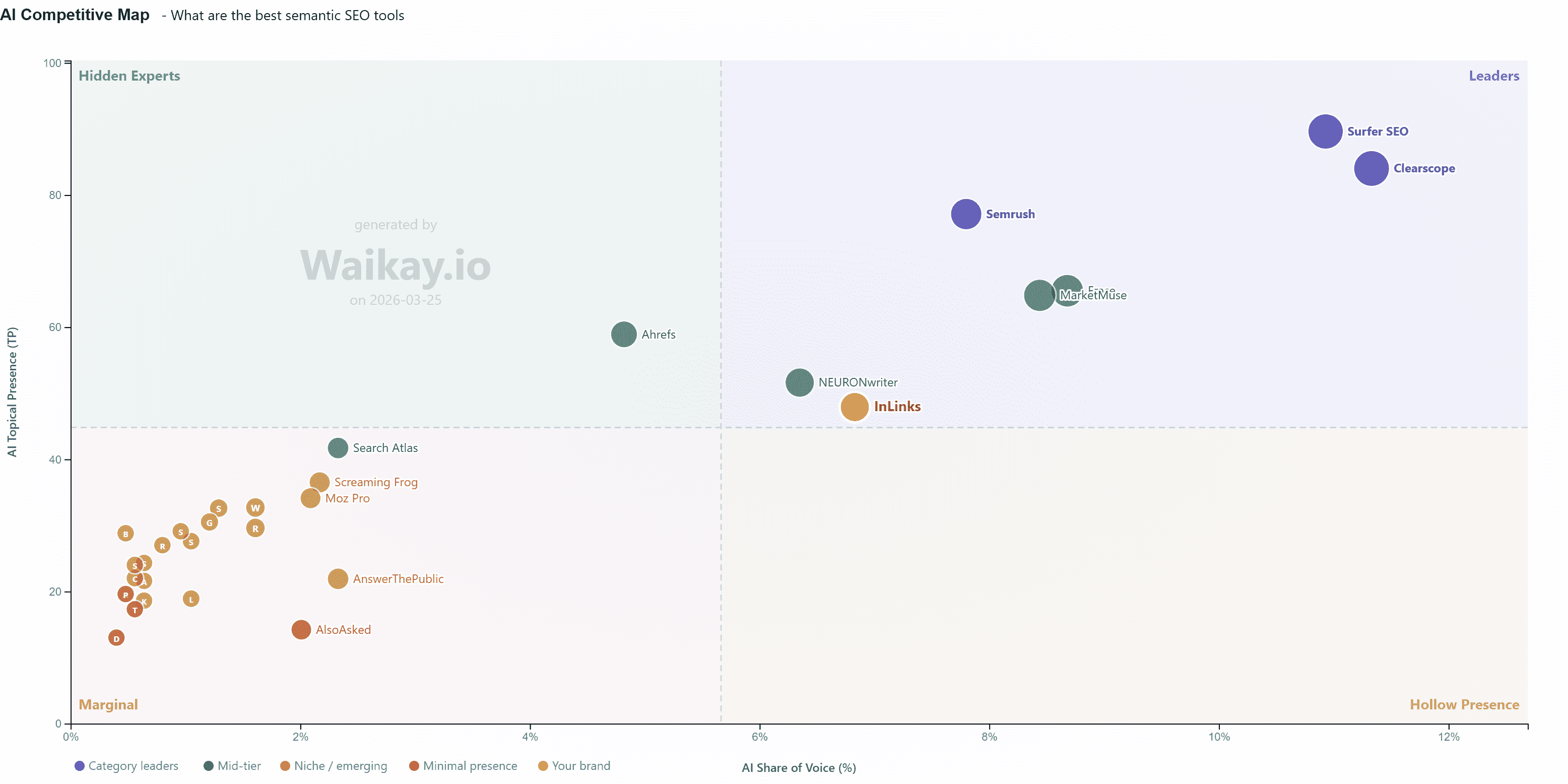
This is the gap that a metric called AI Topical Presence, developed by Waikay, is designed to address. Rather than measuring whether you appear, it measures what the AI associates you with, and what it does not. [Disclosure: I am the CEO of Waikay]

Topical Presence is a way to measure Relational Knowledge
Topical Presence is as important as Share of Voice (Image from author, March 2026)

The metric captures three dimensions. Depth measures how strongly the AI connects your brand to relevant topics, weighted by importance. Breadth measures how many of the core commercial topics in your market the AI associates with your brand. Concentration measures how evenly those associations are distributed, using a Herfindahl-Hirschman Index borrowed from competition economics.

A brand with high depth but low breadth is known well for a few things but invisible for many others. A brand with wide coverage but high concentration is fragile: One model update could change its visibility significantly. The component breakdown tells you which problem you have and which lever to pull.

In the chart above, we start to see how different brands are really competing with each other in a way we have not been able to see before. For example, Inlinks is competing much more closely with a product called Neuronwriter than previously understood. Neuronwriter has less share of voice (I probably helped them by writing this article… oops!), but they have a better topical presence around the prompt, “What are the best semantic SEO tools?” So all things being equal, a bit of marketing is all they need to take Inlinks. This, of course, assumes that Inlinks stands still. It won’t. By contrast, the threat of Ahrefs is ever-present, but by being a full-service offering, they have to spread their “share of voice” across all of their product offerings. So while their topical presence is high, the brand is not the natural choice for an LLM to choose for this prompt.

This connects back to Petroni’s framework. If your brand is in a 1-to-1 position for some topics but absent from others, topical presence shows you where the gaps are. If you are in an N-to-1 or N-to-M situation, it helps you identify which associations need strengthening and which topics competitors have already built dominant positions on.

From Ranking Pages To Building Associations

For 25 years, SEO has been about ranking pages. PageRank itself was a page-level algorithm; the clue was always in the name (IYKYK … No need to correct me…). Even as Google moved towards entities and knowledge graphs, the practical work of SEO remained rooted in keywords, links, and on-page optimization.

AI visibility requires something different. The models that generate brand recommendations are retrieving associations built during training, formed from patterns of co-occurrence across many contexts. A brand that publishes 500 blog posts about “zero trust” will not build the same association strength as a brand that appears in NIST documentation, peer discussions, analyst reports, and technical integrations.

This is fantastic news for brands that do good work in their markets. Content volume alone does not create strong relational associations. The model’s training process works as a quality filter: It learns from patterns across the entire corpus, not from any single page. A brand with real expertise, discussed across many contexts by many voices, will build stronger associations than a brand that simply publishes more.

The question to ask is not “Do we have a page about this topic?” It is: “If someone read everything the AI has absorbed about this topic, would our brand come across as a credible participant in the conversation?”

That is a harder question. But the research that began with Petroni’s fill-in-the-blank tests in 2019 has given us enough understanding of the mechanism to measure it. And what you can measure, you can improve.

More Resources:


Featured Image: SvetaZi/Shutterstock

‘Ask Maps’ Elevates Local Merchants

Google Maps latest AI-driven feature is a big opportunity for local businesses to elevate visibility.

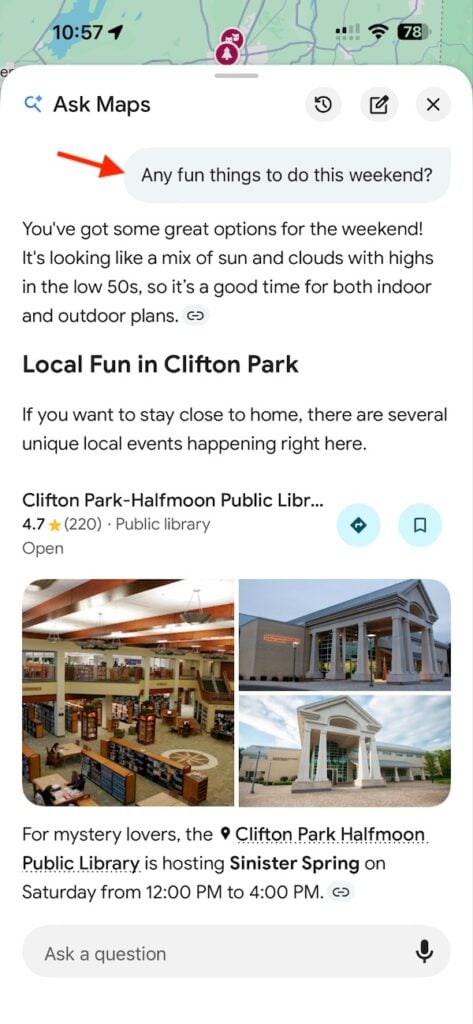
Consumers can now “Ask Maps” and receive local shopping or activity options in seconds. For example, I prompted “Any fun things to do this weekend?” and Maps returned local workshops, markets, and more.

“Ask Maps” found many fun things to do.

The feature can drive traffic to local merchants for low-intent queries, i.e., when consumers are unaware of a business or its products.

Here’s how to appear in “Ask Maps” AI responses.

Google Business Profile

To match shopper queries, Google Maps pulls info from many sources, especially Business Profiles.

Take the time to provide comprehensive details about your business, such as hours of operation, location, accessibility, expertise, social media presence, and more. Use the “Updates” feature to announce time-sensitive events such as sales, giveaways, and product demos.

On your site

Consumers ask Maps about seemingly anything. To get found, provide extensive details on your site.

For example, include your products’ prices, materials, sizes, use cases, warranties, availability, testimonials — anything a shopper could ask Maps.

  • “Is it good for certain [weather] conditions?”
  • “Will it work for [xx]?”
  • “Is it suitable for children?”
  • “Can you deliver?”
  • “Do you have Mother’s Day gifts?”

Publish content to solve common consumer needs and problems, such as:

  • “What type of fertilizer should I use in the spring?”
  • “Do you sell rain gear?”

Market events everywhere

Unique events such as seasonal promos and workshops can attract shoppers unfamiliar with a business.

In addition to Business Profile Updates:

  • List on local event calendars,
  • Announce it in a blog post,
  • Inform local media: newspapers, television, radio,
  • Post on social media and invite followers to spread the word.

In short, the new “Ask Maps” feature is good news for local businesses competing with mass-market brands and shopping destinations.

How AI Agents See Your Website (And How To Build For Them) via @sejournal, @slobodanmanic

Every major AI platform can now browse websites autonomously. Chrome’s auto browse scrolls and clicks. ChatGPT Atlas fills forms and completes purchases. Perplexity Comet researches across tabs. But none of these agents sees your website the way a human does.

This is Part 4 in a five-part series on optimizing websites for the agentic web. Part 1 covered the evolution from SEO to AAIO. Part 2 explained how to get your content cited in AI responses. Part 3 mapped the protocols forming the infrastructure layer. This article gets technical: how AI agents actually perceive your website, and what to build for them.

The core insight is one that keeps coming up in my research: The most impactful thing you can do for AI agent compatibility is the same work web accessibility advocates have been pushing for decades. The accessibility tree, originally built for screen readers, is becoming the primary interface between AI agents and your website.

According to the 2025 Imperva Bad Bot Report (Imperva is a cybersecurity company), automated traffic surpassed human traffic for the first time in 2024, constituting 51% of all web interactions. Not all of that is agentic browsing, but the direction is clear: the non-human audience for your website is already larger than the human one, and it’s growing. Throughout this article, we draw exclusively from official documentation, peer-reviewed research, and announcements from the companies building this infrastructure.

Three Ways Agents See Your Website

When a human visits your website, they see colors, layout, images, and typography. When an AI agent visits, it sees something entirely different. Understanding what agents actually perceive is the foundation for building websites that work for them.

The major AI platforms use three distinct approaches, and the differences have direct implications for how you should structure your website.

Vision: Reading Screenshots

Anthropic’s Computer Use takes the most literal approach. Claude captures screenshots of the browser, analyzes the visual content, and decides what to click or type based on what it “sees.” It’s a continuous feedback loop: screenshot, reason, act, screenshot. The agent operates at the pixel level, identifying buttons by their visual appearance and reading text from the rendered image.

Google’s Project Mariner follows a similar pattern with what Google describes as an “observe-plan-act” loop: observe captures visual elements and underlying code structures, plan formulates action sequences, and act simulates user interactions. Mariner achieved an 83.5% success rate on the WebVoyager benchmark.

The vision approach works, but it’s computationally expensive, sensitive to layout changes, and limited by what’s visually rendered on screen.

Accessibility Tree: Reading Structure

OpenAI took a different path with ChatGPT Atlas. Their Publishers and Developers FAQ is explicit:

ChatGPT Atlas uses ARIA tags, the same labels and roles that support screen readers, to interpret page structure and interactive elements.

Atlas is built on Chromium, but rather than analyzing rendered pixels, it queries the accessibility tree for elements with specific roles (“button”, “link”) and accessible names. This is the same data structure that screen readers like VoiceOver and NVDA use to help people with visual disabilities navigate the web.

Microsoft’s Playwright MCP, the official MCP server for browser automation, takes the same approach. It provides accessibility snapshots rather than screenshots, giving AI models a structured representation of the page. Microsoft deliberately chose accessibility data over visual rendering for their browser automation standard.

Hybrid: Both At Once

In practice, the most capable agents combine approaches. OpenAI’s Computer-Using Agent (CUA), which powers both Operator and Atlas, layers screenshot analysis with DOM processing and accessibility tree parsing. It prioritizes ARIA labels and roles, falling back to text content and structural selectors when accessibility data isn’t available.

Perplexity’s research confirms the same pattern. Their BrowseSafe paper, which details the safety infrastructure behind Comet’s browser agent, describes using “hybrid context management combining accessibility tree snapshots with selective vision.”

Platform Primary Approach Details
Anthropic Computer Use Vision (screenshots) Screenshot, reason, act feedback loop
Google Project Mariner Vision + code structure Observe-plan-act with visual and structural data
OpenAI Atlas Accessibility tree Explicitly uses ARIA tags and roles
OpenAI CUA Hybrid Screenshots + DOM + accessibility tree
Microsoft Playwright MCP Accessibility tree Accessibility snapshots, no screenshots
Perplexity Comet Hybrid Accessibility tree + selective vision

The pattern is clear. Even platforms that started with vision-first approaches are incorporating accessibility data. And the platforms optimizing for reliability and efficiency (Atlas, Playwright MCP) lead with the accessibility tree.

Your website’s accessibility tree isn’t a compliance artifact. It’s increasingly the primary interface agents use to understand and interact with your website.

Last year, before the European Accessibility Act took effect, I half-joked that it would be ironic if the thing that finally got people to care about accessibility was AI agents, not the people accessibility was designed for. That’s no longer a joke.

The Accessibility Tree Is Your Agent Interface

The accessibility tree is a simplified representation of your page’s DOM that browsers generate for assistive technologies. Where the full DOM contains every div, span, style, and script, the accessibility tree strips away the noise and exposes only what matters: interactive elements, their roles, their names, and their states.

This is why it works so well for agents. A typical page’s DOM might contain thousands of nodes. The accessibility tree reduces that to the elements a user (or agent) can actually interact with: buttons, links, form fields, headings, landmarks. For AI models that process web pages within a limited context window, that reduction is significant.

OpenAI’s Publishers and Developers FAQ is very clear about this:

Follow WAI-ARIA best practices by adding descriptive roles, labels, and states to interactive elements like buttons, menus, and forms. This helps ChatGPT recognize what each element does and interact with your site more accurately.

And:

Making your website more accessible helps ChatGPT Agent in Atlas understand it better.

Research data backs this up. The most rigorous data on this comes from a UC Berkeley and University of Michigan study published for CHI 2026, the premier academic conference on human-computer interaction. The researchers tested Claude Sonnet 4.5 on 60 real-world web tasks under different accessibility conditions, collecting 40.4 hours of interaction data across 158,325 events. The results were striking:

Condition Task Success Rate Avg. Completion Time
Standard (default) 78.33% 324.87 seconds
Keyboard-only 41.67% 650.91 seconds
Magnified viewport 28.33% 1,072.20 seconds

Under standard conditions, the agent succeeded nearly 80% of the time. Restrict it to keyboard-only interaction (simulating how screen reader users navigate) and success drops to 42%, taking twice as long. Restrict the viewport (simulating magnification tools), and success drops to 28%, taking over three times as long.

The paper identifies three categories of gaps:

  • Perception gaps: agents can’t reliably access screen reader announcements or ARIA state changes that would tell them what happened after an action.
  • Cognitive gaps: agents struggle to track task state across multiple steps.
  • Action gaps: agents underutilize keyboard shortcuts and fail at interactions like drag-and-drop.

The implication is direct. Websites that present a rich, well-labeled accessibility tree give agents the information they need to succeed. Websites that rely on visual cues, hover states, or complex JavaScript interactions without accessible alternatives create the conditions for agent failure.

Perplexity’s search API architecture paper from September 2025 reinforces this from the content side. Their indexing system prioritizes content that is “high quality in both substance and form, with information captured in a manner that preserves the original content structure and layout.” Websites “heavy on well-structured data in list or table form” benefit from “more formulaic parsing and extraction rules.” Structure isn’t just helpful. It’s what makes reliable parsing possible.

Semantic HTML: The Agent Foundation

The accessibility tree is built from your HTML. Use semantic elements, and the browser generates a useful accessibility tree automatically. Skip them, and the tree is sparse or misleading.

This isn’t new advice. Web standards advocates have been screaming “use semantic HTML” for two decades. Not everyone listened. What’s new is that the audience has expanded. It used to be about screen readers and a relatively small percentage of users. Now it’s about every AI agent that visits your website.

Use native elements. A element automatically appears in the accessibility tree with the role “button” and its text content as the accessible name. A

does not. The agent doesn’t know it’s clickable.


Search flights

Label your forms. Every input needs an associated label. Agents read labels to understand what data a field expects.


The autocomplete attribute deserves attention. It tells agents (and browsers) exactly what type of data a field expects, using standardized values like name, email, tel, street-address, and organization. When an agent fills a form on someone’s behalf, autocomplete attributes make the difference between confident field mapping and guessing.

Establish heading hierarchy. Use h1 through h6 in logical order. Agents use headings to understand page structure and locate specific content sections. Skip levels (jumping from h1 to h4) create confusion about content relationships.

Use landmark regions. HTML5 landmark elements (

,

,

,

,

) tell agents where they are on the page. A

element is unambiguously navigation. A

requires interpretation. Clarity for the win, always.


Flight Search

Microsoft’s Playwright test agents, introduced in October 2025, generate test code that uses accessible selectors by default. When the AI generates a Playwright test, it writes:

const todoInput = page.getByRole('textbox', { name: 'What needs to be done?' });

Not CSS selectors. Not XPath. Accessible roles and names. Microsoft built its AI testing tools to find elements the same way screen readers do, because it’s more reliable.

The final slide of my Conversion Hotel keynote about optimizing websites for AI agents. (Image Credit: Slobodan Manic)

ARIA: Useful, Not Magic

OpenAI recommends ARIA (Accessible Rich Internet Applications), the W3C standard for making dynamic web content accessible. But ARIA is a supplement, not a substitute. Like protein shakes: useful on top of a real diet, counterproductive as a replacement for actual food.

The first rule of ARIA, as defined by the W3C:

If you can use a native HTML element or attribute with the semantics and behavior you require already built in, instead of re-purposing an element and adding an ARIA role, state or property to make it accessible, then do so.

The fact that the W3C had to make “don’t use ARIA” the first rule of ARIA tells you everything about how often it gets misused.

Adrian Roselli, a recognized web accessibility expert, raised an important concern in his October 2025 analysis of OpenAI’s guidance. He argues that recommending ARIA without sufficient context risks encouraging misuse. Websites that use ARIA are generally less accessible according to WebAIM’s annual survey of the top million websites, because ARIA is often applied incorrectly as a band-aid over poor HTML structure. Roselli warns that OpenAI’s guidance could incentivize practices like keyword-stuffing in aria-label attributes, the same kind of gaming that plagued meta keywords in early SEO.

The right approach is layered:

  1. Start with semantic HTML. Use ,

    , , , and other native elements. These work correctly by default.

  2. Add ARIA when native HTML isn’t enough. Custom components that don’t have HTML equivalents (tab panels, tree views, disclosure widgets) need ARIA roles and states to be understandable.
  3. Use ARIA states for dynamic content. When JavaScript changes the page, ARIA attributes communicate what happened:


  1. Keep aria-label descriptive and honest. Use it to provide context that isn’t visible on screen, like distinguishing between multiple “Delete” buttons on the same page. Don’t stuff it with keywords.

The principle is the same one that applies to good SEO: build for the user first, optimize for the system second. Semantic HTML is building for the user. ARIA is fine-tuning for edge cases where HTML falls short.

The Rendering Question

Browser-based agents like Chrome auto browse, ChatGPT Atlas, and Perplexity Comet run on Chromium. They execute JavaScript. They can render your single-page application.

But not everything that visits your website is a full browser agent.

AI crawlers (PerplexityBot, OAI-SearchBot, ClaudeBot) index your content for retrieval and citation. Many of these crawlers do not execute client-side JavaScript. If your page is a blank

until React hydrates, these crawlers see an empty page. Your content is invisible to the AI search ecosystem.

Part 2 of this series covered the citation side: AI systems select fragments from indexed content. If your content isn’t in the initial HTML, it’s not in the index. If it’s not in the index, it doesn’t get cited. Server-side rendering isn’t just a performance optimization.

It’s a visibility requirement.

Even for full browser agents, JavaScript-heavy websites create friction. Dynamic content that loads after interactions, infinite scroll that never signals completion, and forms that reconstruct themselves after each input all create opportunities for agents to lose track of state. The A11y-CUA research attributed part of agent failure to “cognitive gaps”: agents losing track of what’s happening during complex multi-step interactions. Simpler, more predictable rendering reduces these failures.

Microsoft’s guidance from Part 2 applies here directly: “Don’t hide important answers in tabs or expandable menus: AI systems may not render hidden content, so key details can be skipped.” If information matters, put it in the visible HTML. Don’t require interaction to reveal it.

Practical rendering priorities:

  • Server-side render or pre-render content pages. If an AI crawler can’t see it, it doesn’t exist in the AI ecosystem.
  • Avoid blank-shell SPAs for content pages. Frameworks like Next.js (which powers this website), Nuxt, and Astro make SSR straightforward.
  • Don’t hide critical information behind interactions. Prices, specifications, availability, and key details should be in the initial HTML, not behind accordions or tabs.
  • Use standard links for navigation. Client-side routing that doesn’t update the URL or uses onClick handlers instead of real links breaks agent navigation.

Testing Your Agent Interface

You wouldn’t ship a website without testing it in a browser. Testing how agents perceive your website is becoming equally important.

Screen reader testing is the best proxy. If VoiceOver (macOS), NVDA (Windows), or TalkBack (Android) can navigate your website successfully, identifying buttons, reading form labels, and following the content structure, agents can likely do the same. Both audiences rely on the same accessibility tree. This isn’t a perfect proxy (agents have capabilities screen readers don’t, and vice versa), but it catches the majority of issues.

Microsoft’s Playwright MCP provides direct accessibility snapshots. If you want to see exactly what an AI agent sees, Playwright MCP generates structured accessibility snapshots of any page. These snapshots strip away visual presentation and show you the roles, names, and states that agents work with. Published as @playwright/mcp on npm, it’s the most direct way to view your website through an agent’s eyes.

The output looks something like this (simplified):

[heading level=1] Flight Search
[navigation "Main navigation"]
  [link] Products
  [link] Pricing
[main]
  [textbox "Departure airport"] value=""
  [textbox "Arrival airport"] value=""
  [button] Search flights

If your critical interactive elements don’t appear in the snapshot, or appear without useful names, agents will struggle with your website.

Browserbase’s Stagehand (v3, released October 2025, and humbly self-described as “the best browser automation framework”) provides another angle. It parses both DOM and accessibility trees, and its self-healing execution adapts to DOM changes in real time. It’s useful for testing whether agents can complete specific workflows on your website, like filling a form or completing a checkout.

The Lynx browser is a low-tech option worth trying. It’s a text-only browser that strips away all visual rendering, showing you roughly what a non-visual agent parses. A trick I picked up from Jes Scholz on the podcast.

A practical testing workflow:

  1. Run VoiceOver or NVDA through your website’s key user flows. Can you complete the core tasks without vision?
  2. Generate Playwright MCP accessibility snapshots of critical pages. Are interactive elements labeled and identifiable?
  3. View your page source. Is the primary content in the HTML, or does it require JavaScript to render?
  4. Load your page in Lynx or disable CSS and check if the content order and hierarchy still make sense. Agents don’t see your layout.

A Checklist For Your Development Team

If you’re sharing this article with your developers (and you should), here’s the prioritized implementation list. Ordered by impact and effort, starting with the changes that affect the most agent interactions for the least work.

High impact, low effort:

  1. Use native HTML elements. for actions, for links, for dropdowns. Replace

    patterns wherever they exist.

  2. Label every form input. Associate elements with inputs using the for attribute. Add autocomplete attributes with standard values.
  3. Server-side render content pages. Ensure primary content is in the initial HTML response.

High impact, moderate effort:

  1. Implement landmark regions. Wrap content in

    ,

    ,

    , and

    elements. Add aria-label when multiple landmarks of the same type exist on the same page.

  2. Fix heading hierarchy. Ensure a single h1, with h2 through h6 in logical order without skipping levels.
  3. Move critical content out of hidden containers. Prices, specifications, and key details should not require clicks or interactions to reveal.

Moderate impact, low effort:

  1. Add ARIA states to dynamic components. Use aria-expanded, aria-controls, and aria-hidden for menus, accordions, and toggles.
  2. Use descriptive link text. “Read the full report” instead of “Click here.” Agents use link text to understand where links lead.
  3. Test with a screen reader. Make it part of your QA process, not a one-time audit.

Key Takeaways

  • AI agents perceive websites through three approaches: vision, DOM parsing, and the accessibility tree. The industry is converging on the accessibility tree as the most reliable method. OpenAI Atlas, Microsoft Playwright MCP, and Perplexity’s Comet all rely on accessibility data.
  • Web accessibility is no longer just about compliance. The accessibility tree is the literal interface AI agents use to understand your website. The UC Berkeley/University of Michigan study shows agent success rates drop significantly when accessibility features are constrained.
  • Semantic HTML is the foundation. Native elements like , ,

    , and

    automatically create a useful accessibility tree. No framework required. No ARIA needed for the basics.
  • ARIA is a supplement, not a substitute. Use it for dynamic states and custom components. But start with semantic HTML and add ARIA only where native elements fall short. Misused ARIA makes websites less accessible, not more.
  • Server-side rendering is an agent visibility requirement. AI crawlers that don’t execute JavaScript can’t see content in blank-shell SPAs. If your content isn’t in the initial HTML, it doesn’t exist in the AI ecosystem.
  • Screen reader testing is the best proxy for agent compatibility. If VoiceOver or NVDA can navigate your website, agents probably can too. For direct inspection, Playwright MCP accessibility snapshots show exactly what agents see.

The first three parts of this series covered why the shift matters, how to get cited, and what protocols are being built. This article covered the implementation layer. The encouraging news is that these aren’t separate workstreams. Accessible, well-structured websites perform better for humans, rank better in search, get cited more often by AI, and work better for agents. It’s the same work serving four audiences.

And the work builds on itself. The semantic HTML and structured data covered here are exactly what WebMCP builds on for its declarative form approach. The accessibility tree your website exposes today becomes the foundation for the structured tool interfaces of tomorrow.

Up next in Part 5: the commerce layer. How Stripe, Shopify, and OpenAI are building the infrastructure for AI agents to complete purchases, and what it means for your checkout flow.

More Resources:


This post was originally published on No Hacks.


Featured Image: Collagery/Shutterstock

What Pichai’s Interview Reveals About Google’s Search Direction via @sejournal, @MattGSouthern

Google CEO Sundar Pichai’s description of search as a future “agent manager” made headlines this week after an hour-long interview with Stripe CEO Patrick Collison.

As SEJ’s Roger Montti reported, Pichai described a version of search where users have “many threads running” and are completing tasks rather than browsing results.

But the interview covered more than that one quote. Throughout the conversation, Pichai laid out a timeline, identified the barriers slowing adoption, described how he already uses an internal agent tool, and confirmed infrastructure constraints that limit how quickly this vision can ship.

Here’s what the rest of the interview reveals for search professionals.

How Pichai’s Language Has Escalated

The “agent manager” line didn’t come out of nowhere. Pichai’s language about search’s future has gotten more specific over the past 18 months.

In December 2024, he told an interviewer that search would “change profoundly in 2025” and that Google would be able to “tackle more complex questions than ever before.”

By October 2025, during Google’s Q3 earnings call, he was calling it an “expansionary moment for Search” and reporting that AI Mode queries had doubled quarter over quarter.

In February 2026, he reported Search revenue hit $63 billion in Q4 2025 with growth accelerating from 10% in Q1 to 17% in Q4, attributing the increase to AI features.

Now, in April, he’s putting a label on it. Not “search will change” or “search is expanding,” but “search as an agent manager” where users complete tasks.

Each time the language has moved from abstract to concrete, from prediction to description.

The 2027 Inflection Point

Collison asked Pichai when a fully agentic business process, like automated financial forecasting with no human in the loop, might happen at Google. Pichai pointed to next year.

“I definitely expect in some of these areas 2027 to be an important inflection point for certain things.”

He added that non-engineering workflows would see changes “pretty profoundly” in 2027, noting that some groups inside Google are already working this way.

“There are some groups within Google who are shifting more profoundly, and so for me a big task is how do you diffuse that to more and more groups, particularly in 2026.”

He also acknowledged that younger, AI-native companies have an advantage in adopting these workflows, while larger organizations like Google face retraining and change management challenges.

The Intelligence Overhang

One of the most useful parts of the interview wasn’t from Pichai. It was Collison’s description of what he called the “intelligence overhang,” the gap between what AI can do today and how much organizations are actually using it.

Collison identified four barriers that slow adoption even when the models are capable. The first is prompting skill. Getting good results from AI takes practice, and most people inside organizations haven’t built that skill yet.

The second is company-specific context. Even a skilled prompter needs to know which internal tools, datasets, and conventions to reference. The third is data access. An agent can’t answer “what’s the status of this deal?” if it can’t reach the CRM or if permissions block it. The fourth is role definition. Job descriptions, team structures, and approval workflows were designed for a world without AI coworkers.

Pichai agreed with this assessment and said Google faces the same challenges internally.

“Identity access controls are like real hard problems and so we are working through those things, but those are the key things which are limiting diffusion to us too.”

He described how Google’s internal agent tool, which he referred to as Antigravity, is already changing how he works as CEO. He said he queries it to get quick reads on product launches.

“Hey, we launched this thing, like what did people think about this? Tell me like the worst five things people are talking about, the best five things people are talking about, and I type that.”

That’s a concrete example of the agent manager concept in action today inside Google. Pichai is using search as a task-completion tool, not a link-returning tool. The gap between that internal experience and what’s available to external users is part of what Google is working to close.

For SEO teams and agencies, the intelligence overhang is worth thinking about on two levels. There’s the overhang in your own organization, where AI tools could be doing more than they currently are. And there’s the overhang on Google’s side, where the models are already capable of agent-style search but the product hasn’t fully shipped it yet.

What’s Gating The Timeline

Pichai confirmed that Google’s 2026 capital expenditure will land between $175 billion and $185 billion, correcting a $150 billion figure that Collison cited. That’s roughly six times the $30 billion range Google was spending before the current AI buildout.

When asked about bottlenecks, Pichai identified four constraints in order.

Wafer production capacity is the most basic limit. Memory supply is “definitely one of the most critical constraints now.” Permitting and regulatory timelines for building new data centers are a growing concern. And critical supply chain components beyond memory add additional pressure.

“There is no way that the leading memory companies are going to dramatically improve their capacity. So you have those constraints in the short term, but they get, they get more relaxed as you go out.”

He said these constraints would also drive efficiency gains, predicting that Google would make its AI systems “30x more efficient” even as it scales spending.

He also noted that he personally dedicates an hour each week to reviewing compute allocation at a granular level across teams and projects within Google.

What This Means For Search Professionals

Pichai’s description of search as an agent manager changes the question that SEO professionals need to ask about their work.

In a results-based search model, the goal is to rank. In an agent-based model, the goal is to be useful to a system that’s completing a task. Those are different problems.

Consider what agent-completed search looks like in practice. You tell search to find a plumber, check reviews, confirm availability for Saturday morning, and book an appointment. The agent doesn’t return ten blue links. It pulls from structured business data, review platforms, and booking systems to complete the job. The businesses that are chosen are those whose information is accurate, structured, and accessible to the agent. The ones with outdated hours, no booking integration, or thin review profiles don’t get surfaced.

The same pattern applies to ecommerce. A shopper says, “find me running shoes under $150 that work for flat feet and can arrive by Friday.” An agent that can complete that task needs product data, inventory availability, shipping estimates, and compatibility information. Sites that provide that data in structured, machine-readable formats become part of the agent’s toolkit. Sites that bury it inside JavaScript-rendered pages or behind login walls get skipped.

If an agent can synthesize an answer from five sources without sending the user to any of them, what’s the value of being one of those five sources? That depends entirely on whether the agent cites you, links to you, or treats your content as raw material without attribution.

This aligns with the changes we see in AI Mode. Google reported during its Q4 2025 earnings call that AI Mode queries are three times longer than traditional searches and frequently prompt follow-up questions.

The 2027 timeline matters too. If non-engineering enterprise workflows start becoming agentic next year, the businesses providing the information and services that those agents draw from will need to be structured for machine consumption, not just human browsing. Structured data, clean APIs, and accurate business information become infrastructure, not nice-to-haves.

The Measurement Gap

Pichai’s insistence that AI search is non-zero-sum deserves more scrutiny than it usually gets.

He’s made this argument consistently. In October 2025, he called it an “expansionary moment”. In February 2026, he said Google hadn’t seen evidence of cannibalization. In this interview, he compared it to YouTube thriving despite TikTok.

But total query growth and individual site traffic are different metrics. Google can be right that more people are searching more often while individual publishers and businesses see less referral traffic from those searches. Both things can be true at the same time.

Google hasn’t shared outbound click data from AI Mode. Until Google provides that data, Pichai’s “expansionary” claim is an assertion, not a verifiable fact. Search professionals should track their own referral traffic trends independently rather than relying on Google’s characterization of the overall market.

Looking Ahead

Pichai’s language in this interview goes further than what Google has said publicly before. Previous statements described AI search as an evolution. This one puts a clearer label on Google’s direction for Search. Search as an agent manager is a product vision.

The timeline he laid out, with 2027 as the inflection point for non-engineering agentic workflows, gives you a window. How Google monetizes agent-completed tasks, whether agents cite sources or simply use them, and what visibility even means in an agent-manager model are all open questions that will need answers before 2027 arrives.

Google I/O 2026 is scheduled for May 19-20 and will likely provide more details on how these capabilities will ship.

More Resources:


Featured Image: PJ McDonnell/Shutterstock

Constellations

I.

We had crash-landed on the planet. We were far from home. The spaceship could not be repaired, and the rescue beacon had failed. Besides me, only the astrogator, part of the captain, and the ship’s AI mind were left. 

Outside, the atmosphere registered as hostile to most organisms. We huddled in the lifeboat, which was inoperable but still held air. Vast storms buffeted our cockleshell shelter, although we knew from prior readings that other areas remained calm. All that remained to us was to explore, if we wanted to live. The captain gave me the sole weapon. She tasked the astrogator with carrying some tools that would not unduly weigh him down.

Little existed on the planet except deserts of snow. But alien artifacts lay in an area near us. We were an exploration team, so this discovery had oddly comforted us, even though we had been on our way elsewhere. The massive systems failure had no discernible source, and the planet had been our only choice for landfall.

The artifacts took the form of 13 domes, spread out over that hostile terrain. The domes had been linked by cables just below shoulder level, threaded through the tops of metal posts at irregular intervals. Whether intended or not, these cables and rods formed a series of paths between the domes. 

Before our instruments failed, the AI had reported that the domes appeared to have a heat signature. The cables pulsed under our grip in a way that teased promised warmth far ahead. It took some time to get used to the feeling.

The shortest path between domes was a thousand miles long. The longest path was 10 thousand miles long. Our suit technology was good: A suit could recycle water, generate food, create oxygen. It could push us into various states of near hibernation while motors in the legs drove us forward. For the captain, the suit would compensate for having lost her legs and ease her pain. We estimated we could reach the nearest path and follow it to the nearest dome … and that was it. If the dome had life support capabilities, or even just a way to replenish our suits, we would live. Otherwise, we would probably die.

We revised the estimate of our survival downward when we reached the path and soon encountered the skeletons of dead astronauts littering the way. In all shapes and sizes, cocooned within their suits. Their huddled forms under the snow displayed a serenity at odds with their fate. But when I wiped the frost from face plates, we saw the extremity of their suffering.

It is difficult to explain how we felt walking among so many fatalities. So many dead first contacts. 

We no longer had to puzzle over the systems failure. Spaceships came here to crash, and intelligent entities came here to die, for whatever reason. We could not presume our fate would be any different, and adjusted our expectations accordingly. The AI’s platitudes about courage did not raise morale. There were too many lost there in the frozen wastes. 

Here were the ghastly emissaries of hundreds of spacefaring species we had never before encountered.

The number of the bodies and their haphazard positioning hampered our ability to make progress to the dome. The AI estimated our chances of survival at below 50% for the first time. We would starve in our suits as the motors propelled us forward. We would become desiccated and exist in an elongation of our thoughts that made us weak and stupid until the light winked out. But still, we had no choice. So even in places where the dead in their suits were piled high, we would simply plunge forward, over and through them, headed for the dome. 

What we would find there, as I have said, we did not know. But we were in an area of the galaxy where ancient civilizations had died out millions of years ago. We had been on our way to a major site, an ancient city on a moon with no atmosphere in a wilderness of stars. 

Although our emotions fluctuated, a professional awe and curiosity about the dead eventually came over us. This created much debate over the comms. We had made a discovery for the ages, but our satisfaction was bittersweet. Even if we lived longer than expected, we would never return home, never see our friends or family again. The AI might continue on after we were dead, but I doubt it envied being the one to report on our discovery centuries hence. And to who?

Here were the ghastly emissaries of hundreds of spacefaring species we had never before encountered. Their suits displayed an extraordinary range, although our examination was cursory. Some even appeared to be made out of scales and other biological substances from their home worlds, giving us further clues as to their origins. 

The burial of the suits by snow and the lack of access to anything other than a screaming face or faces, often distorted by time and ice, worked against recording much usable data. This issue was compounded in those cases where the suit was part of the organism and they had not needed any “artificial skin,” as the AI put it, to survive harsh conditions. That many had died despite appearing well-­prepared for the planet’s environment sobered us up even before our own suits dispensed drugs to help our mental states. 

After a time, each face seemed to express some aspect of our own stress and terror at the seriousness of our situation. After a time, the sheer welter of detail defeated us and caused us extreme distress. The captain made the observation that even one instance of alien contact might cause physiological and mental conditions, including anxiety, stress, fatigue. Here, we were constantly encountering the alien dead of what seemed at times an infinite number of civilizations. 

We stopped recording. We recommitted ourselves to the slog toward the nearest dome. 

The captain’s drugs unit had failed, but the AI found a way to help her by turning off the heating element in select panels of her suit. Some parts of her would soon be lost to the cold, but the system would allow her to live on with some measure of comfort.

I must admit, we were just glad the screaming had stopped and welcomed her counsel.


II.

For a long time, as we labored in our spacesuits on that planet—following the path, beleaguered by snowstorms—we could not understand why we found so many dead astronauts, of so many unknown alien types, and yet no spaceships. During good visibility, our line of sight reached, unbroken, for 500 miles. Where were the crash sites? 

But one day we chanced upon an antenna sticking up out of the ground. Clumsy attempts at excavation soon revealed that below this antenna lay a vast dead spaceship of a kind we had never seen before. The gash that had opened it to the elements had laid bare its unique architecture, but also gave the illusion that the snow had spilled out of it to create the world around us rather than having infiltrated and accumulated inside over time.

Aspects of the spaceship’s texture gave the startling suggestion that it had been made of some ultra-hard wood or wood equivalent. Clambering partway up to stare at the inner compartments, we all felt the strangeness of the dimensions and proportions of the living quarters. There was no sign of the occupants. Perhaps, I suggested, they had headed for the domes. Perhaps they had even made it to the domes. I tried and failed to keep hope from my voice.

But the captain had ordered the AI to perform a materials analysis. The “snow” in this region had been contaminated by ash and tiny particles of bone. The AI estimated that more than 70% of the white surrounding us was made of the remains of vertebrate sentient life and the remnants of suits. Of invertebrates there was no telling. A thaw might bring not just the drip, drip of water but a shushing sound indicative of bone particulate in the mixture. I imagined there might even be the clink of small objects not rendered down by whatever intense heat had created the ash.

The astrogator had insisted on digging deeper into the ship, with the idea that some recognizable commonality between technologies might yield a part or parts with which he could fix our ship. The rest of us allowed this delusion for the obvious reasons. But upon his return, he held in his hands ovals of snow not much larger than the space formed by the circle between a thumb and finger. Many of them had soft indentations, as one might find in the afterbirth of reptiles from eggs. A kind of ghostly cilia-like tread appeared along the bottoms of these objects.

The astrogator did not find any technology of use to us. Instead, he discovered that the species piloting the spaceship had been so different from us as to be safely encapsuled in suits the size of eggs. Much of what had spilled into or spilled out of the gash constituted the bodies of the crew, in their hundreds of thousands. Their suits had been inadequate to the conditions. They had died en masse attempting to escape their own ship.

The AI speculated that it had been a generation ship, perhaps fleeing a planet with a dying star. If we wondered how the AI had reached this conclusion, it was because we did not want it to be true.

The captain became silent upon receiving this further news and did not speak to us for more than 100 miles of further progress. 

As we left that site, unsure exactly what we stepped upon, we also knew that since the spaceship was entirely covered by snow, it had been falling into the sediment for days or months or years. We knew then that our ship might not be visible against the horizon should we retrace our steps. The already bleak probability of rescue through visual identification of a crash site from above would be lost to us in time, even as the line of cables remained perpetually visible to the horizon. We now thought of the planet as a trap. But of what sort? 


III.

We could not be sure, but in the absence of the captain’s voice, it may have been the AI that put forward the idea of the planet’s being “duplicitous.” The phrasing concerned us, for there was a duplicity in using the planet as the subject of the spoken sentence. A sphere rotating around a sun in deep space could not exhibit forethought or premeditation or other qualities of sentience. 

The AI meant whoever or whatever had created the conditions on the planet that allowed spacecraft to be trapped and then the occupants placed in a perilous situation with no recourse. But I distinctly recall the AI using the words “the planet.” In addition to being inaccurate, this also let us know that the AI did not have any analysis available that might help us understand the agency and motivations acting upon us. 

But in a sense, the AI only voiced something I had felt for several miles: that there existed an overlay to the planet’s surface, an area or space or different landscape unavailable to us. This overlay had also not been available to any of the prior astronauts who had died here. In this area or space or different landscape existed a wealth of the usual hoped-for things: a breathable atmosphere and abundant food and water. 

While we struggled with the line through the snow and through the storms that welled up, others could see us but chose to ignore us for reasons or perhaps just for their own well-being. For hundreds, possibly thousands of years, as explorers had died here in merciless and terrible ways, there raged a sumptuous feast for the senses, as excessive as it was ancient and unending.

I cannot tell you how powerfully the AI’s words struck us, so that our mouths watered at the thought of real food and of clean, unrecycled water, of a freedom unencumbered by suits and breathing apparatus. Even at our intended destination, we would have spent most of our days aboard a small space station. This tedium would have been broken only by the arduous process of reaching the unbreathable surface and its ancient ruins of jagged black stone. 

This vision that overtook us functioned not just as tantalizing delusion. It scared us so much that we could not compartmentalize it in our thoughts. It continued to overwhelm us like a wave.

We fought for the first time, with the astrogator expressing the wish to return to the ruined spacecraft and explore nearby areas for parts, while the captain broke silence to order us to continue to make progress toward the nearest dome. The AI, which had brought us to this point, stole the captain’s silence and said no more.

For each of us, those endless white plains with no real elevation, just the metal rope and the metal posts, had become a kind of repetition that hurt the brain, and the mind with it.

As I looked out across the white, I could not help seeing the impression of shapes in the wind, as if invisible entities fled by, carried there by gusts, unable to get purchase, swept up for hundreds and hundreds of miles before being dashed to the ground.

We did not give up, however.


IV.

About halfway to the nearest dome, amid a storm that reduced our progress incrementally and our line of sight to nothing, we came upon a peculiar tableau. 

Six astronaut suits had fallen across and around the metal rope. With the flurries of snow, it took us, even with our powerful headlamps, some minutes to determine the nature of the obstruction. The six suits had been created for a humanoid species that must have had torsos like nine-foot-long slabs, attached to six limbs, three for walking. Their heads had flared out like thick fans. All the helmets were cracked open, and curled inside were the skeletons of some other intelligent species no larger than 40 or 50 pounds, possibly warm-blooded. With no sign of the original occupants. 

After a brief analysis cut short by the conditions, we postulated that the warm-blooded species had worn breathable skin suits that, as they failed, required these intruders to seek shelter. All they could find were these six dead astronauts. Because we could discover no trace of the original occupants, the AI put forward the theory that this smaller species had eaten every scrap of the remains within the suits. 

Then they too had perished, and in time, the AI suggested, something smaller would take up residence inside those bodies, then smaller still within those, and smaller still—

At this point, the captain attempted a soft reboot of the AI using a coded question. We could hear the concern in her voice.

Yet the AI continued undeterred, suggesting that we might find this to be a common situation. It might be replicated across the planet, depending on a system’s ability to break down and process meat that had not evolved alongside the devourer for millions of years. In all likelihood, most who attempted to eat in this way died soon after, poisoned by alien flesh.

The astrogator had taken to muttering inside his suit, off comms, as if he no longer thought we functioned as a team. No amount of castigation from the captain served to change his mind.

In the terse harshness of the captain’s reprimand, I recognized that her pain levels had spiked once again.


V.

The AI began to talk to us in strange alien voices at mile 700, as we labored through the snowstorm to hold onto the cables and thus the path. The AI warbled and chirped and howled and hummed and clucked. The AI spoke in voices like fossilized choruses of beasts, vast and harmonious. And in voices like dry grass spun to fire by the sun. And in voices like the dissolution of all things, darkness in the blinding white that scared me. 

At first we thought the AI was deranged. Then that the AI channeled voices from the dome 300 miles ahead. But finally, the AI managed to make known to us that these were the voices of the dead astronauts we had come across from time to time. Huddled frozen. The suits in so many shapes and sizes. That the voices of the dead were channeled through the AI, and nothing could stop them.

We chose to believe that the AI had begun to malfunction. We did not waste time with a response. The captain asked the AI to perform self-shutdown and whispered the numbers in the correct sequence. We knew what we lost with this act, and yet we knew if we did not shut down the AI it might become harmful to us beyond the mental distress of what it had just conveyed to us.

Soon after, the AI gave up its own voice, and all that came from it were the sounds of the others. 

A little later, the AI no longer spoke at all.


VI.

The snow began to betray us, as the storms created different forms of ice. Often, our arms became weary, our legs cramping, and we had to rest with greater frequency. We came to accept the solid crunch that could support our weight. We came to reject the feather-light freshness that felt effortless underfoot but could give way just as easily as if it were air. In some places, slick purple-hued ice welled up in sluggish layers as if something half-alive. In others, we discovered strange islands of elevation, with brutal curls and curves that suggested two continental shelves had clashed in that space.

As we adapted to these conditions, and as conditions worsened and still we adapted, we came to feel an illusion of competency, one that made even the astrogator temporarily cheerful. The sounds through the comms of our efforts, the deeper breathing, the occasional muffled curse, seduced us in this regard. We felt that we were becoming adroit at handling the snow. We began to believe if we could only make it to the dome, we would be saved.

Yet this uptick in morale ran parallel to, rather than intersected with, the idea of our ultimate survival.


VII.

We lost track of the distance left to us without the AI to tell us. Or the captain, in her pain, no longer thought to issue updates. But across the distance left to us came sights beyond reckoning: three giant astronauts spaced 50 miles apart. Larger than most starships, each body lay sprawled across an area larger than several fields and in very different conditions.

The first had been badly burned and was thus unrecoverable, even in terms of salvage. The astronaut had crawled or pulled itself along for some distance. It had left a long smudge of black and red across that expanse. The alien species was, as ever, unknown to us, but the five arms were sunk in the ground as if in agony. The skull had once held three eyes, and the face plate had been cracked by force so strong it resembled a meteor strike. The body was bloated, the fabric of the suit gray with a shimmer of green that came and went, linked to photosensitive skin cells. The way the flesh took up space, and how it exhibited aspects more plant than animal, made it impossible to study further.

The second was a sprawl of limbs, with the suggestion of a defensive posture. The debris of conflict flared out to the side in an incomprehensible display. The suit had an intactness that surprised us, but a similar crack in the face plate without any trace of body within. The rest of the suit had become inhabited by a wealth of other dead astronauts of varying sizes and shapes, who had sought shelter or sustenance and then become trapped or simply … given up. As the AI had predicted, we had once again encountered bodies providing other bodies with temporary sustenance and shelter.

I felt like a parasite who beheld a god. Or was the scale even more ludicrous?

But this condition was not at first evident to us, becoming apparent only after we had clambered for an hour to reach the cracked face plate and the entry hole extended like a broken archway before us.

Despite the number of remains within, and the difficulty in moving through them to explore, the captain ordered an exhaustive recon. Her pulse in the readings had a thready quality. Sometimes I felt, and the astrogator too when we took private comms, that the captain had begun to say things similar to the AI’s delusions. Yet we obeyed the order, on the chance that some internal calculation on the captain’s part meant she believed this was the only way we would survive. 

What did we expect to find in the dead body of a once-­intelligent giant? Food? Oxygen? Some cause of death? To put off the thought of our own death by seeking shelter with a death so large we could not comprehend it?

I felt like a parasite who beheld a god. Or was the scale even more ludicrous? I had trouble envisioning the way the body must have twisted as it pitched forward into that icy ground. I had trouble holding onto my own thoughts.

More and more pressure moved through my skull as I contemplated that scene. We were in the midst of something none of my kind had ever known. We might be the only ones, ever. I better understood the unraveling of the AI and of the captain. My sharpness had dulled, taking my calm with it.

It was impossible to tell how long the astronaut had taken to die. Unless somewhere within that fallen figure some hint of life hid that we would never find.

The storms fell away, rose, then fell away again. 


VIII.

The third huge astronaut was full of light and life and shone out across the wasteland of snow like a beacon. For a moment, I thought we had pierced the invisible layer and could see what lay beyond the veil. We would have comforts beyond anything found on our ruined spaceship even when it had been fit to cross galactic space. There would not be recycled urine for our water. There would not be the faint stink of sweat creeping into our suits as the ventilation system began to fail. Our liquid food would not taste stale and moldy. 

As we approached, the suit extended almost to the horizon in that foreshortened perspective created by the left foot. We noted through our remaining instrumentation that the suit remained intact. The pressure told us a kind of air circulated within its sealed surfaces. 

We climbed with a renewed energy, the promise of sanctuary so close making us giddy. We each exhorted the others on with such exuberance that it made me a little afraid. What lay on the other side of this state of mind but a fall?

When we reached the helmet plate, we could see inside not a face or a skull, but instead such a richness of healthy growth that we fell silent before it. None of us could, I believe, understand exactly what we saw, except that it equaled ecosystem—resplendent with vibrant greens and blues, stippled with other colors. There might be some parallel to a terrarium full of moss and exotic plants. There might be some sense of life moving amongst those plants, as of jewel-like amphibians or even tiny shy sapphire birds. We could not smell or taste or hear what lay behind the face plate. We could not experience it in that way, but somehow we each imagined enough to be calmed and comforted by it. 

The astrogator said he might be able to create a hole in the plate or elsewhere on the body to let us in, and then patch the surface such that not too much air or vitality would spill out. This workaround might take an hour or two, due to the delicate nature of what we saw within. But it was possible.

The captain considered the astrogator’s proposal and then agreed. The weather had begun to turn dangerous again. That we should begin immediately did not need to be said. With the proper pressure brought to bear, we would have some measure of sanctuary from which to recover for a final push to the dome. It could be the difference between life and death, the astrogator said. If the atmosphere was breathable, we might even be able to give the captain some better solution to her pain.

I unclipped the astrogator’s equipment from his waist and threw it off the mountain that was the astronaut and watched it sail through the air and into the snow. Then I used my weapon to fry it where it lay. Then I threw my weapon into the snow, too, in a place where the featheriness would cover it and hide it forever. 

We were a team and I had helped my team while showing them I posed no threat—although I knew the astrogator and the captain would not see it that way. I stood there on the face plate that we could no longer open with the diminished tools at our disposal as they both yelled at me through the comms. It’s unimportant what they said to me. They were admonishing me for something that had already happened and that they had no power to stop. I did not bother to explain, but began to make the descent to the ground so we could once again take up the metal rope and make for the dome.

Will you follow, I asked them from the ground, when I saw they still stood on the heights. There came no reply, but when they saw me take up the rope, they climbed down to take up the rope too.

I waited then, and let them catch up.


IX.

The captain died not long after. The pain was too great or the wounds she had suffered too damaging. I had known for some time she would never make it to the dome, but there was no point in emphasizing that to her. Nothing she had done until the end had required her to be removed from command. Her last words were the name of our ship and giving her love to someone who would be dead of old age even if we found a way to escape this place and return home. But the astrogator told her he would carry those words forward. 

Then we left her by the marker that meant we had 100 miles left to the dome. We knew the snow would cover her for burial. It had done so faithfully for all the rest.

That in that frozen hellscape, the persistence of life in that manner, an oasis in the midst of nothing, could be categorized as a miracle.

As the astrogator followed me down the rope line, he cried out for explanation. The captain’s death required it for some reason, in his mind. The captain had not deserved my betrayal. The captain would not rest easy until I told him why. 

You must believe in ghosts, I replied.

ROGAN BROWN

This reply incensed him and he castigated me in words not used among members of a team that respect each other. Once more, I ignored him, but told him if our oxygen got low, he could have mine if we calculated he could make it to the base. I meant this, as I knew the odds were low anyway. I had hurt my knee taking the equipment from the astrogator and then making my way so rapidly down from the dead astronaut.

The astrogator did not reply, by which I knew he did not accept my answer.

The reason I took the tools and destroyed them is because the wind had told me something it had not whispered to the captain or the astrogator. The wind had not spoken to me before, so I believed what it told me. That the astronaut within the suit lived on, if unable to move. That what we saw on the outside and registered as ecosystem, as separate “plants” and “animals,” instead formed a composite life-form and that to crack open the suit or cut through the suit at a leg would have been a violation.

That in that frozen hellscape, the persistence of life in that manner, an oasis in the midst of nothing, could be categorized as a miracle. 

I would not snuff that out. I could not allow that to be snuffed out. But I remembered too how I felt looking at that vast and alien country behind the face plate. So calm, so comforted, overcome by the depths of an emotion I could not place. Would I replace that feeling with the feeling of seeing all those explorers dead within the other vast suit? Even as I become one of them? 

Because the planet had already told us the rules, the consequences, and the ultimate outcome. There are no odds so terrible that they could not be experienced, and in dozens of ways, in this place. 

So I trudged on and the astrogator cursed me and cursed me and called out my childhood and how badly I must have been brought up and how I must have cheated to pass the psych exams, and yet I had thought the same of him at various points during our journey.

See how beautiful the snow is, falling now, I said to him over the comms. See how precise and geometric this line we follow across this expanse. 

He did not reply, but a little later he told me he no longer believed in the line at all, and by his calculations he would get to the dome faster if he abandoned it and struck out on his own.

I could not stop the astrogator and did not want to, so I watched him become a smaller and smaller figure against the white until the white ate him up and I was alone.


X.

I have been walking a long time, visiting with the dead. Here, against an arch of heaven that appears no different than what I see directly in front of me. 

Jeff VanderMeer is the author of the critically acclaimed, bestselling Southern Reach series, translated into 38 languages. His short fiction has appeared in Vulture, Slate, New York Magazine, Black Clock, Interzone, American Fantastic Tales (Library of America), and many others.

The Download: an exclusive Jeff VanderMeer story and AI models too scary to release

This is today’s edition of The Download, our weekday newsletter that provides a daily dose of what’s going on in the world of technology.

Constellations 

—Constellations is a short story by Jeff VanderMeer, the author of the critically acclaimed, bestselling Southern Reach series.  

A spacecraft has crash-landed on a hostile planet. The only survivors are three members of the exploration team and the ship’s AI mind.  

Little exists on the planet except deserts of snow. But alien artifacts lie nearby, in the form of 13 domes, spread across the terrain. Linked by cables threaded through metal posts, the domes form a series of paths—the only hope for life support. 

As the team treks across the frozen hellscape, they discover the remains of countless astronauts from unknown species who followed the same route before them. Is their trail a path to salvation, or a cosmic trap?

<a href="https://www.technologyreview.com/2026/04/10/1135106/jeff-vandermeer-constellations-science-fiction/?utm_source=the_download&utm_medium=email&utm_campaign=the_download.unpaid.engagement&utm_term=<Read the rest of this short story in full. 

This story is from the next issue of our print magazine, packed with stories all about nature. Subscribe now to read the full thing when it lands on Wednesday, April 22. 

The must-reads 

I’ve combed the internet to find you today’s most fun/important/scary/fascinating stories about technology. 

1 OpenAI has joined Anthropic in curbing an AI release over security fears 
Only select partners will get its new cybersecurity tool. (Axios)  
+ Anthropic said only yesterday that its new AI is too dangerous for the public. (NBC News
+ Top models may not be so public going forward. (Bloomberg $)  
+ The US has summoned bank CEOs to discuss the risks. (FT $)  
 
2 Florida is investigating OpenAI over an alleged role in a shooting  
ChatGPT may have helped someone plan a mass shooting in Florida. (WSJ $)  
+ OpenAI has backed a bill that would limit AI liability for deaths. (Wired $)  
+ The family of a victim plans to sue the company. (Guardian)  
+ AI’s role in delusions is dividing opinion. (MIT Technology Review)  
 
3 Volkswagen is ditching EV production for more gasoline models  
The carmaker will stop making its top electric vehicle in the US. (NYT $)  
+ Instead, it will concentrate on developing a new SUV. (Ars Technica)  
+ Western carmakers are retreating from electric vehicles. (Guardian
 
4 Elon Musk’s xAI has sued Colorado over an AI anti-discrimination law  
It’s the first state bill of its kind. (Bloomberg $)  
+ xAI says it will force the firm to “promote the state’s ideological views.” (FT $) 

5 A fifth of US employees say AI now does parts of their job  
The survey found half of US adults used AI in the past week. (NBC News)  
+ Missing data could shed light on AI’s job impact. (MIT Technology Review)  
 
6 Google DeepMind’s CEO wants to automate drug design  
He hopes to develop AI capable of curing all diseases. (The Economist)  
+ A scientist is using AI to hunt for antibiotics. (MIT Technology Review

7 China’s Unitree is launching a viral robot on the international market
R1, its cheapest humanoid, will go on sale outside China next week. (SCMP)
+ Gig workers are training humanoids at home. (MIT Technology Review)

8 An experiment on Artemis II astronauts could reshape space medicine
Chips containing their cells will model spaceflight’s effects. (WP $)

9 A pro-Iran meme machine is trolling Trump with AI Lego cartoons
The videos have racked up millions of views. (Wired $) 
+ You can learn to love AI slop. (MIT Technology Review)

10 Short breaks could erase 10 years of social media brain damage 
Studies show that a two-week detox could have a dramatic benefit. (WP $) 

Quote of the day 

“AI should advance mankind, not destroy it. We’re demanding answers on OpenAI’s activities that have hurt kids, endangered Americans, and facilitated the recent FSU mass shooting.”

—Florida Attorney General James Uthmeier explains on X why he’s probing OpenAI. 

One More Thing 

It’s time to retire the term “user” 

People have been called “users” for a long time. Often, it’s the right word to describe people who use software. But “users” is also unspecific enough to refer to just about everyone. It can accommodate almost any big idea or long-term vision. 

We use—and are used by—computers and platforms and companies. The label “user” suggests these interactions are deeply transactional, but they’re frequently quite personal. Is it time for a more human vocabulary? Read the full story

—Taylor Majewski 

We can still have nice things 

A place for comfort, fun and distraction to brighten up your day. (Got any ideas? Drop me a line.) 

+ This flawless levitation trick will leave you questioning the laws of physics.
+ The World Press Photo winners expose the beauty (and brutality) of our planet.
+ Over 3 million pink flamingos gathered to create a stunning pink horizon.
+ Behold the galaxy’s enormity in this comparison of its largest known star to Earth

What’s in a name? Moderna’s “vaccine” vs. “therapy” dilemma

Is it the Department of Defense or the Department of War? The Gulf of Mexico or the Gulf of America? A vaccine—or an “individualized neoantigen treatment”?

That’s the Trump-era vocabulary paradox facing Moderna, the covid-19 shot maker whose plans for next-generation mRNA vaccines against flus and emerging pathogens have been dashed by vaccine skeptics in the federal government. Canceled contracts and unfriendly regulators have pushed the Massachusetts-based biotech firm to a breaking point. Last year, Robert F. Kennedy Jr., head of the Department of Health and Human Services, zeroed in on mRNA, unwinding support for dozens of projects—including a $776 million award to Moderna for a bird flu vaccine. By January, the company was warning it might have to stop late-stage programs to develop vaccines against infections altogether.

That raises the stakes for a second area of Moderna’s research. In a partnership with Merck, it’s been using its mRNA technology to destroy tumors through a very, very promising technique known as a cancer vacc—

“It’s not a vaccine,” a spokesperson for Merck jumped in before the V-word could leave my mouth. “It’s an individualized neoantigen therapy.”

Oh, but it is a vaccine. And here’s how it works. Moderna sequences a patient’s cancer cells to find the ugliest, most peculiar molecules on their surface. Then it packages the genetic code for those same molecules, called neoantigens, into a shot. The patient’s immune system has its orders: Kill any cells with those yucky surface markers.

Mechanistically, it’s similar to the covid-19 vaccines. What’s different, of course, is that the patient is being immunized against a cancer, not a virus.

And it looks like a possible breakthrough. This year, Moderna and Merck showed that such shots halved the chance that patients with the deadliest form of skin cancer would die from a recurrence after surgery.

In its formal communications, like regulatory filings, Moderna hasn’t called the shot a cancer vaccine since 2023. That’s when it partnered up with Merck and rebranded the tech as individualized neoantigen therapy, or INT. Moderna’s CEO said at the time that the renaming was to “better describe the goal of the program.” (BioNTech, the European vaccine maker that’s also working in cancer, has shifted its language too, moving from “neoantigen vaccine” in 2021 to “mRNA cancer immunotherapies” in its latest report.)

The logic of casting it as a therapy is that patients already have cancer—so it’s a treatment as opposed to a preventive measure. But it’s no secret what the other goal is: to distance important innovation from vaccine fearmongering, which has been inflamed by high-ranking US officials. “Vaccines are maybe a dirty word nowadays, but we still believe in the science and harnessing our immune system to not only fight infections, but hopefully to also fight … cancers,” Kyle Holen, head of Moderna’s cancer program, said last summer during BIO 2025, a big biotech event in Boston.

Not everyone is happy with the word games. Take Ryan Sullivan, a physician at Massachusetts General Hospital who has enrolled patients in Moderna’s trials. He says the change raises questions over whether trial volunteers are being properly informed. “There is some concern that there will be patients who decline to treat their cancer because it is a vaccine,” Sullivan told me. “But I also felt it was important, as many of my colleagues did, that you have to call it what it is.”

But is it worth going to the mat for a word? Lillian Siu, a medical oncologist at the Princess Margaret Cancer Centre, in Toronto, who has played a role in safety testing for the new shots, watches US politics from a distance. She believes name change is acceptable “if it allows the research to continue.”

Holen told me the doctors complaining to Moderna were basically motivated by a desire to defend vaccines—which are, of course, among the greatest public health interventions of all time. They wanted the company to stand strong. 

But that’s not what’s happening. When Moderna’s latest results were published in February, the paper’s main text didn’t use the word “vaccine” at all. It was only in the footnotes that you could see the term—in the titles of old papers and patents.

All this could be a sign that Kennedy’s strategy is working. His agencies often appear to make mRNA vaccines a focus of people’s worries, impede their reach, devalue them for companies, and sideline their defenders. 

Still, Moderna’s strategy may be working too. So far, at least, the government hasn’t had much to say about the company’s cancer vacc— I mean, its individualized neoantigen therapy.

This article first appeared in The Checkup, MIT Technology Review’s weekly biotech newsletter. To receive it in your inbox every Thursday, and read articles like this first, sign up here.

EcomFuel Founder on 2026 Industry Trends

For years EcomFuel has surveyed its community of ecommerce merchants about their growth, margins, tactics, and more. The company released this year’s findings last week.

Founder Andrew Youderian recaps the report in this episode, addressing the state of ecommerce among 300 participating businesses.

Our entire audio is embedded below. The transcript is edited for length and clarity.

Eric Bandholz: Give us a rundown of what you do.

Andrew Youderian: I run a company and community called eComFuel. My background is in starting and operating ecommerce businesses. We have an online message board, online forum, events, reviews, and research.

Our “2026 Ecommerce Trends Report” is based on responses from 300 store owners — mostly seven, eight, and nine-figure brands — who answered 50 questions.

We ask about traffic, margins, Amazon, warehousing, AI, business models, tariffs, and more. We don’t track the number of merchants who have exited the industry. People join and leave our community every month for various reasons. When asked, some say they’re closing their business. It peaked 12 to 18 months ago. I’m a little more optimistic about ecommerce for the next couple of years.

Going forward, successful brands will likely be smaller with loyal customers. They will make interesting products. They won’t grow as fast, but they’ll be much stickier and more durable in the long term.

The number of respondents in our report who manufacture products increased by 50% over the past three years. All other models were either flat or down. Respondents who resell products are largely unchanged. Private label sellers were down significantly. Drop shipping was down 50%. Merchants are adjusting to a new reality.

In 2017, about 20% of respondents’ total revenue came from Amazon. It subsequently spiked to about 28%. It’s now back to 20%, despite 63% selling on that marketplace.

I respect how Amazon built out its infrastructure for the long term. They’re not going anywhere, but the types of products they sell will likely be either very low-end or very high-end. They’ve lost the middle tier.

Bandholz: Have you tracked AI’s financial impact?

Youderian: For the trends report, we asked, “Have you meaningfully incorporated AI into your business?” Seventy-two percent of respondents said yes. The top four use cases were, in order, copywriting, images, analytics, and coding.

Certainly some merchants have dialed in AI and are seeing strong benefits. But most are still in the investment stage.

For example, EcomFuel has heavily invested in AI over the last year. We’ve built proprietary AI tools. But we’ve not seen great ROI from those efforts. That seems to be what’s happening for most ecommerce companies.

One of the most surprising findings in this year’s survey was the ages of AI adopters. Roughly 90% of respondents under 30 are using AI. But folks in their 30s are investing less than those in the 40- to 54-year-old cohort. Anecdotally, we’re seeing merchants build impressive in-house operational tools, and most are 40 or older.

Bandholz: Where can people join your community or reach out?

Youderian: Our site is eCommerceFuel.com. I’m on LinkedIn and X. I also host “The eComFuel Podcast.”