How Google Ads Fits into AI Overviews and AI Mode

“Marketing Live” is Google’s annual virtual event showcasing new products, formats, and tips. This year’s program took place last month, when Google announced over 40 updates to Ads, YouTube, and data measurement, all of which were mostly AI-driven.

I will focus this post on changes to Google Ads within AI Overviews and AI Mode.

AI Overviews, AI Mode

AI Overviews is Google’s generative AI feature that answers queries entirely in search results. Google introduced the feature in 2024. AI Overviews summarizes solutions from across the web and occasionally cites those sources for further research. For example, searching “how to clean an oven” could trigger an AI Overview that includes a list of external sites with bullets, videos, and other formats.

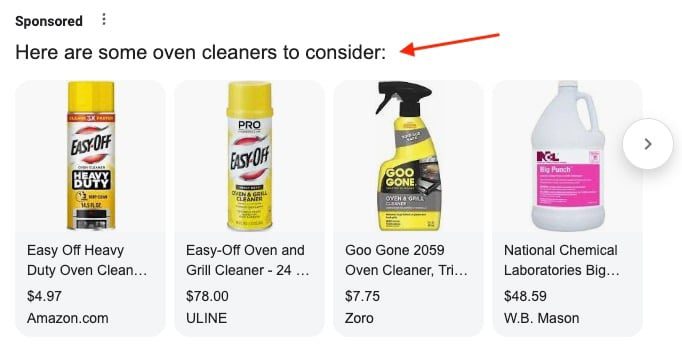
To date, AI Overviews have summarized mostly organic listings. At last month’s Marketing Live, Google announced that Overviews would show more ads. For instance, a “how to clean an oven” search could trigger ads for cleaning products.

Screenshot of Google Shopping ads in AI Overviews

A search for “how to clean an oven” could trigger Shopping ads in AI Overviews. Image from Google.

AI Mode extends Overviews to anticipate searchers’ intent and likely follow-up questions beyond the initial query. Google refers to these additional responses as “fan-out” results.

Google increasingly generates search results based on users’ intent, not their keywords. AI Overviews and AI Mode follow this trend.

AI for paid search

At Marketing Live, Google execs stated that both Overviews and AI Mode can include ads. Searchers’ intent triggers those ads, not keywords alone. I’ve repeatedly addressed this evolution. Google continues to promote broad match keywords with campaign types that lessen reliance on keywords, viewing such words and phrases as broad themes.

For example, Google’s newly created AI Max for Search campaign type (i) requires only broad match keywords, (ii) generates dynamic ad copy, and (iii) selects an advertiser’s landing page likely to yield the best performance.

Google’s AI aims to answer searchers’ needs. Advertisers can help by providing audience signals such as first-party data and custom segments.

Site content

Engaging, quality website content has always driven conversions. It’s now more important than ever for paid search because Google displays the text in the ads.

A Google Ads setting in most campaign types allows it to automatically create assets based on the content from (i) landing pages, (ii) the site’s domain, and (iii) existing ads.

The setting is optional, but advertisers should opt in to take full advantage of AI.

Most advertisers already focus on organic search optimization and produce quality content. There’s no need to reinvent the wheel.

The presentations at Marketing Live reinforced our understanding that ads in Google are dynamic. Advertisers still need to write compelling copy, but AI will tailor those ads to each user. The stronger the site content, the better the ads.

Google Removes Robots.txt Guidance For Blocking Auto-Translated Pages via @sejournal, @MattGSouthern

Google removes robots.txt guidance for blocking auto-translated pages. This change aligns Google’s technical documents with its spam policies.

  • Google removed guidance advising websites to block auto-translated pages via robots.txt.
  • This aligns with Google’s policies that judge content by user value, not creation method.
  • Use meta tags like “noindex” for low-quality translations instead of sitewide exclusions.
Is Google About To Bury Your Website? [Webinar] via @sejournal, @lorenbaker

The new AI Mode is rewriting the rules of search. Are you ready?

Google’s AI-generated answers are starting to dominate the SERPs, pushing traditional results further down the page. If your business relies on organic traffic, you can’t afford to ignore this shift.

Join us on June 25, 2025, for an expert-led webinar sponsored by Conductor. Get actionable strategies from Nick Gallagher, SEO Lead at Conductor, to help you adapt fast and stay ahead of the curve.

What you’ll learn:

  • Spot the queries most likely to trigger AI Overviews.
  • Identify industries seeing the biggest changes in traffic.
  • Audit which brands are being highlighted in AI answers.
  • Update your SEO game plan to stay visible.
  • Track and interpret shifts in traffic and performance metrics.

Why this matters now:

Traditional SEO tactics are no longer enough. Understanding how AI Mode works and knowing how to respond could be the difference between steady growth and a sharp drop in traffic.

Don’t let AI Mode catch you off guard.

Register today to secure your spot. Can’t make it live? Sign up anyway, and we’ll send you the full recording.

Paid Media Reporting For Ecommerce: Navigating Attribution Across Paid

Global advertising expenditure has surpassed the $1 trillion mark for the first time.

Digital advertising continues to dominate this growth, with digital channels encompassing search and social media forecast to account for 72.9% of total ad revenue by the end of the year.

From a platform perspective, Google, Meta, Amazon, and Alibaba are expected to capture more than half of global ad revenues this year.

In-house and agency-side paid media teams are working harder than ever to grow ecommerce businesses efficiently, and the amount of data being used day-to-day (even hour-to-hour) is enormous.

With this growth and investment, something is clearly working, and given that brands can map new/returning audiences to their advertising funnel and serve ads across billions of auctions, it’s a lever that millions of businesses pull.

However, with budgets being split across channels (search, social, out-of-home, etc) and brands using CRM data, analytics platforms, third-party attribution tools, and more to define their “source of truth,” fragmentation begins to appear with reporting. Only 32% of executives feel they fully capitalize on their performance marketing data for this reason.

With data being spread across several sources, ad platforms having different attribution models, and the C-suite likely asking, “Which source of truth is correct?”, reporting paid media performance for ecommerce isn’t the most straightforward task.

This post digs into key performance indicators, platform attribution & modeling, business goals, and how to bring it all together for a holistic view of your advertising efficacy.

Key Performance Indicators (KPIs)

To begin navigating paid media reporting, it starts with the KPIs that each account optimizes towards and how this feeds into channel performance.

Each of these has purpose, benefits, limitations, and practical use cases that should be viewed through a lens of attribution unique to each platform.

Short-Term Performance

Return On Ad Spend (ROAS)

  • Definition: revenue/cost.

This metric measures the revenue generated for every dollar spent on advertising.

If your total ad cost was $1,000 and you drove $18,500 revenue, your ROAS would be 18.5.

  • Benefits: Direct measure of advertising efficiency and helps provide a snapshot of campaign profitability.
  • Limitations: Does not account for customer acquisition costs (CACs), margin, LTV, returns, shipping, etc.

Cost Per Acquisition (CPA)

  • Definition: cost/sales or leads.

This metric shows the average cost to generate a sale (or lead, depending on the goal, e.g., an ecommerce brand could be measuring using CPA to sign up new customers for an event).

For example, if your total ad cost was $5,000 and you drove 180 sales, your CPA would be $ 27.77.

  • Benefits: Easy to monitor over time and helps assess efficiency.
  • Limitations: Neglects revenue, customer acquisition cost, margin, LTV, etc., and treats all sales equally regardless of value.

Cost Of Sale (CoS)

  • Definition: total ad spend/revenue.

This metric measures what % of revenue is spent on advertising.

Say a brand spends $20,000 on Meta Ads and generates £100,000 in revenue, their resulting CoS would be 20%.

  • Benefits: Useful for margin-sensitive businesses and marketplaces where prices and/or Average Order Value (AOV) are volatile.
  • Limitations: Can mask unprofitable sales (in some scenarios) if margin, returns, shipping, etc., are not considered.

Mid-Term Efficiency

Customer Acquisition Cost (CAC)

  • Definition: total marketing costs spent on acquiring new customers/total number of new customers.
  • Detailed definition: total marketing costs spent on acquiring new customers + wages + software costs + agency/consultancy fees + overheads/total number of new customers.

This metric may reflect either marketing costs associated with driving new customer acquisition or a holistic view of all costs associated with acquiring new customers.

Let’s say a business has a CAC of $175 and an AOV of $58, they will need each new customer to repeat purchase ~3x to make acquisition profitable.

  • Benefits: Holistic view of acquisition cost, ideal for longer-term profitability analysis for paid media investment.
  • Limitations: Not always the most suitable for channel-specific reporting (think account structuring, audiences, etc.), and can be a lagging metric as it doesn’t reflect short-term changes in performance like ROAS or CPA would.

Marketing Efficiency Ratio (MER)

  • Definition: Sometimes referred to as blended ROAS, MER is calculated by dividing total revenue/total ad spend across all channels.

This metric shows how efficiently your total ad spend is converting into revenue, regardless of the channel.

Where MER is especially useful is when brands are active on multiple ad networks, all of which contribute in some way to the final sale, and where siloed platform attribution is inconsistent.

  • Benefits: Captures topline performance from a transactional perspective and simplifies multi-channel reporting.
  • Limitations: Neglects exactly where the sales and revenue came from and obscures channel efficiency, especially important for search, social, etc.

Long-Term Strategic

Customer Lifetime Value (CLV Or CLTV)

  • Definition: This metric estimates the total net revenue a customer brings over their relationship with a brand.

Used alongside CAC, this metric is essential for understanding the true value of both acquisition and retention, which is important for almost all ecommerce models, and especially important for brands looking to capitalize on repeat purchases and subscription-based models.

  • Benefits: Builds a foundation for tying performance marketing to long-term outcomes while helping give room to CAC targets across valuable customer segments.
  • Limitations: Takes a fair amount of work to get set up and maintain, in addition to requiring a clean cohort and repeat purchase data. Additionally, when brands introduce new products/services, it can be hard to forecast accurate CLV numbers, and it will take time.

So, which one should you be reporting on for your ecommerce brand?

Speaking from experience, there isn’t a right or wrong answer, nor is there a blueprint for which KPIs you should be reporting on.

Having a multifaceted approach will enable more informed decision making, combining short-, medium-, and long-term KPIs to form a holistic model for measuring performance that feeds into your reports.

However, even after choosing your KPIs, different attribution models across advertising platforms add another layer of complexity, as does the ever-evolving customer journey involving multiple touchpoints across devices, channels, etc.

The Ad Platforms

Each ad platform handles attribution and tracking differently.

Take Google Ads, for example, the default model is Data-Driven Attribution (DDA), and when using the Google Ads pixel, only paid channels receive credit.

Then, with a GA4 integration to Google Ads, both paid and organic are eligible to receive credit for sales.

Click-through windows, value, count, etc, can all be customised to provide a view of performance that feeds into your Google Ads campaigns.

Using the Google Ads pixel, say a user clicks a shopping ad, then a search ad, and then returns via organic to make the purchase, 40% of the credit could go to shopping, and 60% to the search ad.

With the GA4 integrated conversion, shopping could receive 30%, search 40%, and organic visit 30%, resulting in 70% of the value being attributed back to the campaigns in-platform.

Now, comparing this to Meta Ads, which uses a seven-day click and one-day view attribution window by default, when a user converts within this time frame, 100% of the credit will be attributed to Meta.

This is why the narrative for conversion tracking on Meta is one of overrepresentation, with brands seeing inflated revenue numbers vs. other channels, even more so with loose audience targeting, where campaign types such as ASC can serve assets to audiences who have already interacted with your brand.

Then, when you dig into third-party analytics, the comparisons between Google Ads, Meta Ads, Pinterest Ads, etc., are almost the complete opposite.

So, what should this data be used for, and how does it factor into the bigger picture?

In-platform metrics are best viewed as directional.

They help optimize within the walls of that specific platform to identify high-performing audiences, auctions, creatives, and placements, but they rarely reflect the true incremental value of paid media to your business.

The data in Google, Meta, Pinterest, etc. is a platform-specific lens on performance, and the goal shouldn’t be to pick one or ignore these metrics.

It should be to interpret these for what they are and how they play into the overarching strategy.

The Bigger Picture

KPIs such as ROAS and CPA offer immediate insights but provide a fragmented view of paid media performance.

To gain a comprehensive understanding, brands must combine medium- to long-term KPIs with broader modeling and tests that account for the multifaceted nature of performance marketing, while considering how complex customer journeys are in this day and age.

Marketing Mix Modeling (MMM)

Introduced in the 1950s, MMM is a statistical analysis that evaluates the effectiveness of marketing channels over time.

By analyzing historical data, MMM helps advertisers understand how different marketing activities contribute to sales and can guide budget allocation.

A 2024 Nielsen study found that 30% of global marketers cite MMM as their preferred method of measuring holistic ROI.

The very short version of how to get started with MMM includes:

  1. Collecting aggregated data (roughly speaking, at least two years of weekly data across all channels, mapped out with every possible variable (e.g., pricing, promotions, weather, social trends, etc.)
  2. Defining the dependent variable, which for ecommerce will be sales or revenue.
  3. Run regression modeling to isolate the contribution of each variable to sales (adjusting for overlaps, lags, etc.)
  4. Analyze, optimize, and report on the coefficients to understand the relative impact and ROI of your paid media activity as whole.

Unlike platform attribution, this doesn’t rely on user-level tracking, which is especially useful with privacy restrictions now and in the future.

From a tactical standpoint, your chosen KPIs will still lead campaign optimizations for your day-to-day management, but at a macro level, MMM will determine where to invest your budget and why.

Incrementality Testing

Instead of relying on attribution models, this uses controlled experiments to isolate the impact of your paid media campaigns on actual business outcomes.

This kind of testing aims to answer the question, “Would these sales have happened without the paid media investment?”.

This involves:

  1. Defining an objective or independent variable (e.g., sales, revenue, etc.)
  2. Creating test and control groups. This could be by audience or geography – one will be exposed to the campaigns and the other will not.
  3. Run the experiment while keeping all conditions equal across both groups.
  4. Compare the outcomes, analyze performance, and calculate the impact.

This isn’t one that’s run every week, but from a strategic point of view, these tests help to validate the actual performance of paid media and direct where and what spend should be allocated across ad platforms.

Operational Factors

These are equally as important (if not more) for ecommerce reporting and absolutely need to be considered when setting KPIs and beginning to think about modeling, testing, etc.

  • Product margin.
  • AOV variability.
  • Shipping costs.
  • Returns rates.
  • Repeat rates.
  • Discounting and promotions.
  • Cancelled and/or failed payments.
  • Stock availability.
  • Attribute availability (e.g., size, color, model).
  • Pixels and tracking.

Without considering these factors, brands will use inaccurate data from the get-go.

Think about the impact of buy now, pay later. Providers such as Klarna or Clearpay can lead to higher return rates, as bundle buying and impulsive purchases become more accessible.

Without considering operational factors, using this example and a basic in-platform ROAS, brands would be optimizing toward incorrect checkout data with higher AOV’s and no consideration of returns, restocking, etc.

Ultimately, building a true picture of paid media performance means stepping beyond the platform KPIs and metrics to consider all factors involved and how best to model the data to uncover not just “what” is happening, but “why” it is and how this impacts the wider business.

Bringing It All Together

No single tool or model tells the full story.

You’ll need to compare platform data, internal analytics, and external modeling to build a more reliable view of performance.

The first step is getting watertight KPIs nailed down that consider every possible operational factor so you know the platforms are being fed the correct data, and if you need to modify these based on platform nuances due to differing attribution models, do it.

Once these are nailed down, find a model that you trust and that will show you the holistic impact of your paid media spend on overall business performance.

You could explore the use of third-party attribution tools that aim to blend data together, but even with these, you’ll still require clear and accurate KPIs and reliable tracking.

Then, when it comes to the visual side of reporting, the world is your oyster.

Looker Studio, Tableau, and Datorama are among the long list of well-known platforms, and with most brands using three to four business intelligence tools and 67% of analysts relying on multiple dashboards, don’t stress if you can’t get everything under one lens.

When all of this is executed and made into a priority over the short-term ebbs and flows of paid media performance, this is the point where connecting media spend to profit begins.

More Resources:


Featured Image: Surasak_Ch/Shutterstock

Google AI Mode: First Thoughts & Survival Strategies

The new AI Mode tab in Google’s results, currently only active in the U.S., enables users to get an AI-generated answer to their query.

You can ask a detailed question in AI Mode, and Google will provide a summarized answer.

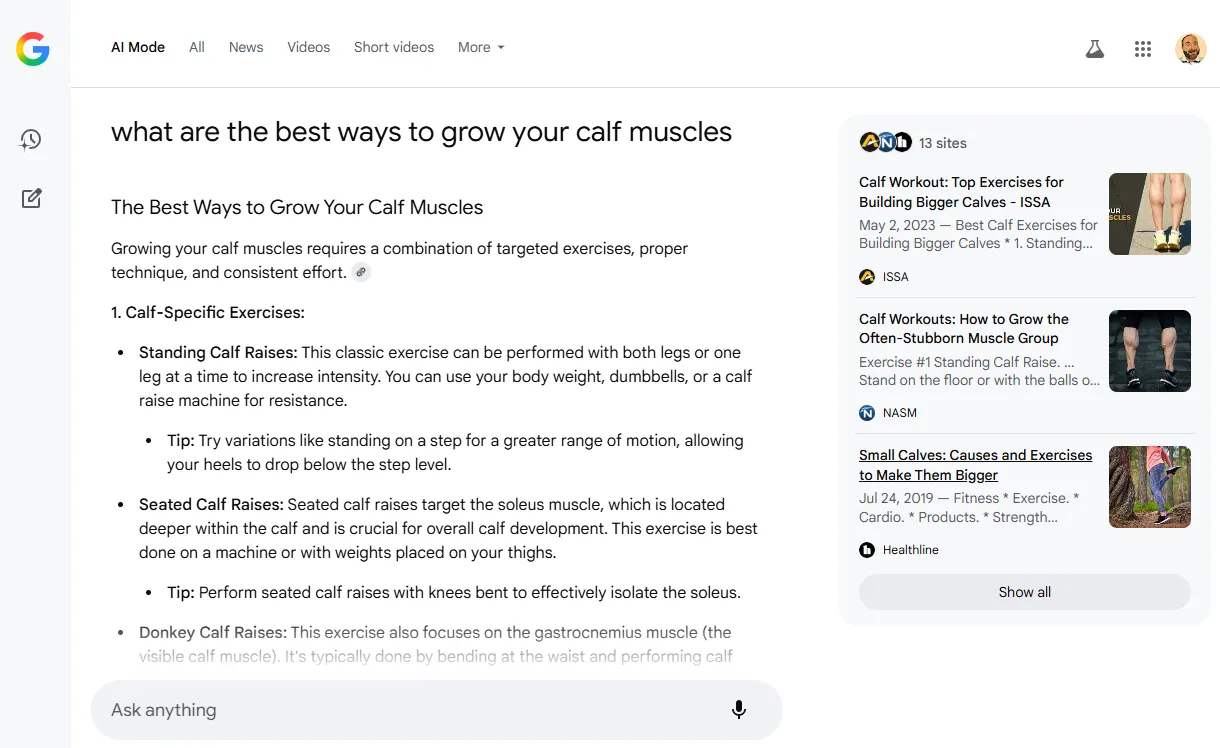
Google AI Mode answer for the question “what are the best ways to grow your calf muscles”Google AI Mode answer for the question [what are the best ways to grow your calf muscles], providing a detailed summary of exercises and tips (Image Credit: Barry Adams)

Google explains how it generates these answers in some recently published documentation.

The critical process is what Google calls a “query fan-out” technique, where many related queries are performed in the background.

The results from these related queries are collected, summarized, and integrated into the AI-generated response to provide more detail, accuracy, and usefulness.

Having played with AI Mode since its launch, I have to admit it’s pretty good. I get useful answers, often with detailed explanations that give me the information I am looking for. It also means I have less need to click through to cited source websites.

I have to admit that, in many cases, I find myself reluctant to click on a source webpage, even when I want additional information. It’s simpler to ask AI Mode a follow-up question rather than click to a webpage.

Much of the web has become quite challenging to navigate. Clicking on an unknown website for the first time means having to brave a potential gauntlet of cookie-consent forms, email signup pop-ups, app install overlays, autoplay videos, and a barrage of intrusive ads.

The content you came to the page for is frequently hidden behind several barriers-to-entry that the average user will only persist with if they really want to read that content.

And then in many cases, the content isn’t actually there, or is incomplete and not quite what the user was looking for.

AI Mode removes that friction. You get most of the content directly in the AI-generated answer.

You can still click to a webpage, but often it’s easier to simply ask the AI a more specific follow-up question. No need to brave unusable website experiences and risk incomplete content after all.

AI Mode & News

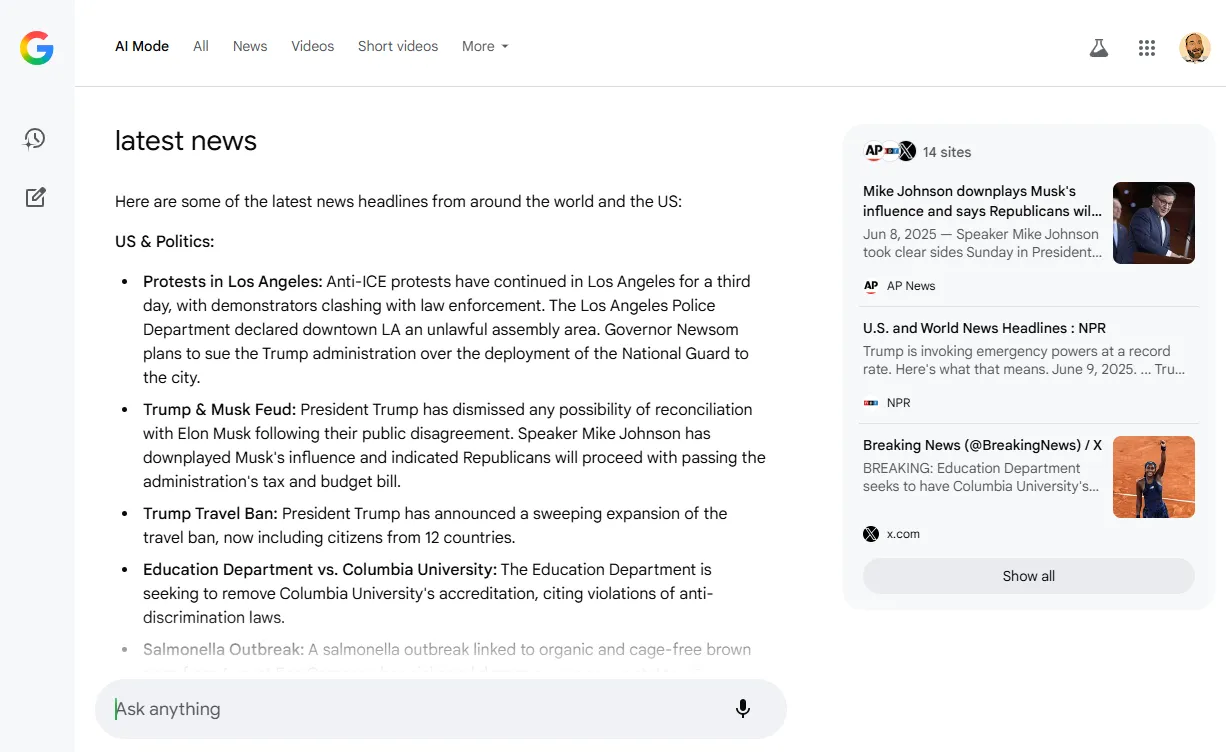
Contrary to AI Overviews, AI Mode will provide summaries for almost any query, including news-specific queries:

AI Mode answer for the ‘latest news’ queryAI Mode answer for the [latest news] query (Image Credit: Barry Adams)

Playing with AI Mode, I’ve seen some answers to news-specific queries that don’t even cite news sources, but link only to Wikipedia.

For contrast, the regular Google SERP for the same query features a rich Top Stories box with seven news stories.

With these types of results in AI Mode, the shelf life of news is reduced even further.

Where in search, you can rely on a Top Stories news box to persist for a few days after a major news event, in AI Mode, news sources can be rapidly replaced by Wikipedia links. This further reduces the traffic potential to news publishers.

A Google SERP for ‘who won roland garros 2025’ with a rich Top Stories box vs the AI Mode answer linking only to Wikipedia A Google SERP for [who won roland garros 2025] with a rich Top Stories box vs. the AI Mode answer linking only to Wikipedia (Image Credit: Barry Adams)

There is some uncertainty about AI Mode’s traffic impact. I’ve seen examples of AI Mode answers that provide direct links to webpages in-line with the response, which could help drive clicks.

Google is certainly not done experimenting with AI Mode. We haven’t seen the final product yet, and because it’s an experimental feature that most users aren’t engaged with (see below), there’s not much data on CTR.

As an educated guess, the click-through rate from AI Mode answers to their cited sources is expected to be at least as low, and probably lower, as the CTR from AI Overviews.

This means publishers could potentially see their traffic from Google search decline by 50% or more.

AI Mode User Adoption

The good news is that user adoption of AI Mode appears to be low.

The latest data from Similarweb shows that after an initial growth, usage of the AI Mode tab on Google.com in the U.S. has slightly dipped and now sits at just over 1%.

This makes it about half as popular as the News tab, which is not a particularly popular tab within Google’s search results to begin with.

It could be that Google’s users are satisfied with AI Overviews and don’t need expanded answers in AI Mode, or that Google hasn’t given enough visual emphasis to AI Mode to drive a lot of usage.

I suspect that Google may try to make AI Mode more prominent, with perhaps allowing users to click from an AI Overview into AI Mode (the same way you can click from a Top Stories box to the News tab), or integrate it more prominently into their default SERP.

When user adoption of AI Mode increases, the impact will be keenly felt by publishers. Google’s CEO has reiterated their commitment to sending traffic to the web, but the reality appears to contradict that.

In some of their newest documentation about AI, Google strongly hints at diminished traffic and encourages publishers to “[c]onsider looking at various indicators of conversion on your site, be it sales, signups, a more engaged audience, or information lookups about your business.”.

AI Mode Survival Strategies

Broad adoption of AI Mode, whatever form that may take, can have several impactful consequences for web publishers.

Worst case scenario, most Google search traffic to websites will disappear. If AI Mode becomes the new default Google result, expect to see a collapse of clicks from search results to websites.

Focusing heavily on optimizing for visibility in AI answers will not save your traffic, as the CTR for cited sources is likely to be very low.

In my view, publishers have roughly three strategies for survival:

1. Google Discover

Google’s Discover feed may soften the blow somewhat, especially with the rollout onto desktop Chrome browsers.

Expanded presence of Discover on all devices with a Chrome browser gives more opportunities for publishers to be visible and drive traffic.

However, a reliance on Discover as a traffic source can encourage bad habits. Disregarding Discover’s inherent volatility, the unfortunate truth is that clickbait headlines and cheap churnalism do well in the Discover feed.

Reducing reliance on search in favor of Discover is not a strategy that lends itself well to quality journalism.

There’s a real risk that, in order to survive a search apocalypse, publishers will chase after Discover clicks at any cost. I doubt this will result in a victory for content quality.

2. Traffic & Revenue Diversification

Publishers need to grow traffic and income from more channels than just search. Due to Google’s enormous monopoly in search, diversified traffic acquisition has been a challenge.

Google is the gatekeeper of most of the web’s traffic, so of course we’ve been focused on maximising that channel.

With the risk of a greatly diminished traffic potential from Google search, other channels need to pick up the slack.

We already mentioned Discover and its risks, but there are more opportunities for publishing brands to drive readers and growth.

Paywalls seem inevitable for many publishers. While I’m a fan of freemium models, publishers will have to decide for themselves what kind of subscription model they want to implement.

A key consideration is whether your output is objectively worth paying for. This is a question few publishers can honestly answer, so unbiased external opinions will be required to make the right business decision.

Podcasts have become a cornerstone of many publishers’ audience strategies, and for good reason. They’re easy to produce, and you don’t need that many subscribers to make a podcast economically feasible.

Another content format that can drive meaningful growth is video, especially short-form video that has multiplatform potential (YouTube, TikTok, Instagram, Discover).

Email newsletters are a popular channel, and I suspect this will only grow. The way many journalists have managed to grow loyal audiences on Substack is testament to this channel’s potential.

And while social media hasn’t been a key traffic driver for many years, it can still send significant visitor numbers. Don’t sleep on those Facebook open graph headlines (also valuable for Discover).

3. Direct Brand Visits

The third strategy, and probably the most important one, is to build a strong publishing brand that is actively sought out by your audience.

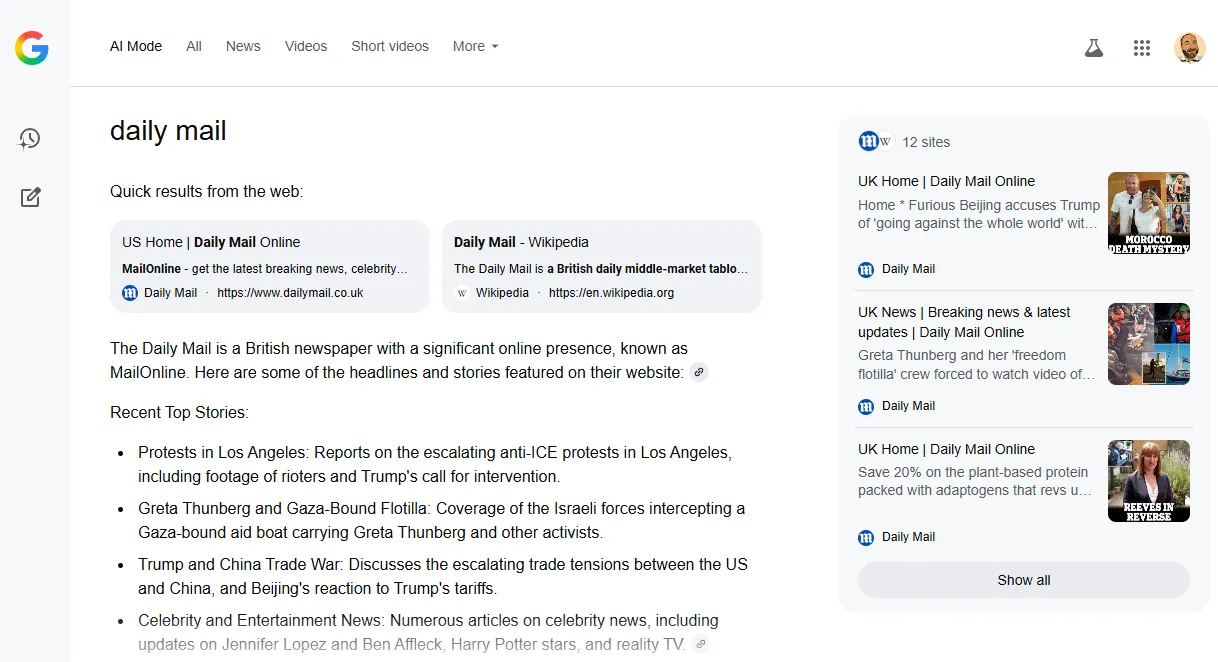
No matter the features that Google or any other tech intermediary rolls out, when someone wants to visit your website, they will come to you directly. Not even Google’s AI Mode would prevent you from visiting a site you specifically ask for.

A brand search for ‘daily mail’ in Google AI Mode provides a link to the site’s homepage at the top of the response (Image credit: Barry AdamA brand search for [daily mail] in Google AI Mode provides a link to the site’s homepage at the top of the response (Image credit: Barry Adams)

Brand strength translates into audience loyalty.

A recognizable publisher will find it easier to convince its readers to install their dedicated app, subscribe to their newsletters, watch their videos, and listen to their podcasts.

A strong brand presence on the web is also, ironically, a cornerstone of AI visibility optimization.

LLMs are, after all, regurgitators of the web’s content, so if your brand is mentioned frequently on the web (i.e., in LLMs’ training data), you are more likely to be cited as a source in LLM-generated answers.

Exactly how to build a strong online publishing brand is the real question. Without going into specifics, I’ll repeat what I’ve said many times before: You need to have something that people are willing to actively seek out.

If you’re just another publisher writing the same news that others are also writing, without anything that makes you unique and worthwhile, you’re going to have a very bad time. The worst thing you can be as a publisher is forgettable.

There is a risk here, too. In an effort to cater to a specific target segment, a publisher could fall victim to “audience capture“: Feeding your audience what they want to hear rather than what’s true. We already see many examples of this, to the detriment of factual journalism.

It’s a dangerous pitfall that even the biggest news brands find difficult to navigate.

Optimizing For AI

In my previous article, I wrote a bit about how to optimize for AI Overviews.

I’ll expand on this in future articles with more tips, both technical and editorial, for optimizing for AI visibility.

More Resources:  


This post was originally published on SEO For Google News.


Featured Image: BestForBest/Shutterstock

The Pentagon is gutting the team that tests AI and weapons systems

The Trump administration’s chainsaw approach to federal spending lives on, even as Elon Musk turns on the president. On May 28, Secretary of Defense Pete Hegseth announced he’d be gutting a key office at the Department of Defense responsible for testing and evaluating the safety of weapons and AI systems.

As part of a string of moves aimed at “reducing bloated bureaucracy and wasteful spending in favor of increased lethality,” Hegseth cut the size of the Office of the Director of Operational Test and Evaluation in half. The group was established in the 1980s—following orders from Congress—after criticisms that the Pentagon was fielding weapons and systems that didn’t perform as safely or effectively as advertised. Hegseth is reducing the agency’s staff to about 45, down from 94, and firing and replacing its director. He gave the office just seven days to implement the changes.

It is a significant overhaul of a department that in 40 years has never before been placed so squarely on the chopping block. Here’s how today’s defense tech companies, which have fostered close connections to the Trump administration, stand to gain, and why safety testing might suffer as a result. 

The Operational Test and Evaluation office is “the last gate before a technology gets to the field,” says Missy Cummings, a former fighter pilot for the US Navy who is now a professor of engineering and computer science at George Mason University. Though the military can do small experiments with new systems without running it by the office, it has to test anything that gets fielded at scale.

“In a bipartisan way—up until now—everybody has seen it’s working to help reduce waste, fraud, and abuse,” she says. That’s because it provides an independent check on companies’ and contractors’ claims about how well their technology works. It also aims to expose the systems to more rigorous safety testing.

The gutting comes at a particularly pivotal time for AI and military adoption: The Pentagon is experimenting with putting AI into everything, mainstream companies like OpenAI are now more comfortable working with the military, and defense giants like Anduril are winning big contracts to launch AI systems (last Thursday, Anduril announced a whopping $2.5 billion funding round, doubling its valuation to over $30 billion). 

Hegseth claims his cuts will “make testing and fielding weapons more efficient,” saving $300 million. But Cummings is concerned that they are paving a way to faster adoption while increasing the chances that new systems won’t be as safe or effective as promised. “The firings in DOTE send a clear message that all perceived obstacles for companies favored by Trump are going to be removed,” she says.

Anduril and Anthropic, which have launched AI applications for military use, did not respond to my questions about whether they pushed for or approve of the cuts. A representative for OpenAI said that the company was not involved in lobbying for the restructuring. 

“The cuts make me nervous,” says Mark Cancian, a senior advisor at the Center for Strategic and International Studies who previously worked at the Pentagon in collaboration with the testing office. “It’s not that we’ll go from effective to ineffective, but you might not catch some of the problems that would surface in combat without this testing step.”

It’s hard to say precisely how the cuts will affect the office’s ability to test systems, and Cancian admits that those responsible for getting new technologies out onto the battlefield sometimes complain that it can really slow down adoption. But still, he says, the office frequently uncovers errors that weren’t previously caught.

It’s an especially important step, Cancian says, whenever the military is adopting a new type of technology like generative AI. Systems that might perform well in a lab setting almost always encounter new challenges in more realistic scenarios, and the Operational Test and Evaluation group is where that rubber meets the road.

So what to make of all this? It’s true that the military was experimenting with artificial intelligence long before the current AI boom, particularly with computer vision for drone feeds, and defense tech companies have been winning big contracts for this push across multiple presidential administrations. But this era is different. The Pentagon is announcing ambitious pilots specifically for large language models, a relatively nascent technology that by its very nature produces hallucinations and errors, and it appears eager to put much-hyped AI into everything. The key independent group dedicated to evaluating the accuracy of these new and complex systems now only has half the staff to do it. I’m not sure that’s a win for anyone.

This story originally appeared in The Algorithm, our weekly newsletter on AI. To get stories like this in your inbox first, sign up here.

IBM aims to build the world’s first large-scale, error-corrected quantum computer by 2028

IBM announced detailed plans today to build an error-corrected quantum computer with significantly more computational capability than existing machines by 2028. It hopes to make the computer available to users via the cloud by 2029. 

The proposed machine, named Starling, will consist of a network of modules, each of which contains a set of chips, housed within a new data center in Poughkeepsie, New York. “We’ve already started building the space,” says Jay Gambetta, vice president of IBM’s quantum initiative.

IBM claims Starling will be a leap forward in quantum computing. In particular, the company aims for it to be the first large-scale machine to implement error correction. If Starling achieves this, IBM will have solved arguably the biggest technical hurdle facing the industry today to beat competitors including Google, Amazon Web Services, and smaller startups such as Boston-based QuEra and PsiQuantum of Palo Alto, California. 

IBM, along with the rest of the industry, has years of work ahead. But Gambetta thinks it has an edge because it has all the building blocks to build error correction capabilities in a large-scale machine. That means improvements in everything from algorithm development to chip packaging. “We’ve cracked the code for quantum error correction, and now we’ve moved from science to engineering,” he says. 

Correcting errors in a quantum computer has been an engineering challenge, owing to the unique way the machines crunch numbers. Whereas classical computers encode information in the form of bits, or binary 1 and 0, quantum computers instead use qubits, which can represent “superpositions” of both values at once. IBM builds qubits made of tiny superconducting circuits, kept near absolute zero, in an interconnected layout on chips. Other companies have built qubits out of other materials, including neutral atoms, ions, and photons.

Quantum computers sometimes commit errors, such as when the hardware operates on one qubit but accidentally also alters a neighboring qubit that should not be involved in the computation. These errors add up over time. Without error correction, quantum computers cannot accurately perform the complex algorithms that are expected to be the source of their scientific or commercial value, such as extremely precise chemistry simulations for discovering new materials and pharmaceutical drugs. 

But error correction requires significant hardware overhead. Instead of encoding a single unit of information in a single “physical” qubit, error correction algorithms encode a unit of information in a constellation of physical qubits, referred to collectively as a “logical qubit.”

Currently, quantum computing researchers are competing to develop the best error correction scheme. Google’s surface code algorithm, while effective at correcting errors, requires on the order of 100 qubits to store a single logical qubit in memory. AWS’s Ocelot quantum computer uses a more efficient error correction scheme that requires nine physical qubits per logical qubit in memory. (The overhead is higher for qubits performing computations for storing data.) IBM’s error correction algorithm, known as a low-density parity check code, will make it possible to use 12 physical qubits per logical qubit in memory, a ratio comparable to AWS’s. 

One distinguishing characteristic of Starling’s design will be its anticipated ability to diagnose errors, known as decoding, in real time. Decoding involves determining whether a measured signal from the quantum computer corresponds to an error. IBM has developed a decoding algorithm that can be quickly executed by a type of conventional chip known as an FPGA. This work bolsters the “credibility” of IBM’s error correction method, says Neil Gillespie of the UK-based quantum computing startup Riverlane. 

However, other error correction schemes and hardware designs aren’t out of the running yet. “It’s still not clear what the winning architecture is going to be,” says Gillespie. 

IBM intends Starling to be able to perform computational tasks beyond the capability of classical computers. Starling will have 200 logical qubits, which will be constructed using the company’s chips. It should be able to perform 100 million logical operations consecutively with accuracy; existing quantum computers can do so for only a few thousand. 

The system will demonstrate error correction at a much larger scale than anything done before, claims Gambetta. Previous error correction demonstrations, such as those done by Google and Amazon, involve a single logical qubit, built from a single chip. Gambetta calls them “gadget experiments,” saying “They’re small-scale.” 

Still, it’s unclear whether Starling will be able to solve practical problems. Some experts think that you need a billion error-corrected logical operations to execute any useful algorithm. Starling represents “an interesting stepping-stone regime,” says Wolfgang Pfaff, a physicist at the University of Illinois Urbana-Champaign. “But it’s unlikely that this will generate economic value.” (Pfaff, who studies quantum computing hardware, has received research funding from IBM but is not involved with Starling.) 

The timeline for Starling looks feasible, according to Pfaff. The design is “based in experimental and engineering reality,” he says. “They’ve come up with something that looks pretty compelling.” But building a quantum computer is hard, and it’s possible that IBM will encounter delays due to unforeseen technical complications. “This is the first time someone’s doing this,” he says of making a large-scale error-corrected quantum computer.

IBM’s road map involves first building smaller machines before Starling. This year, it plans to demonstrate that error-corrected information can be stored robustly in a chip called Loon. Next year the company will build Kookaburra, a module that can both store information and perform computations. By the end of 2027, it plans to connect two Kookaburra-type modules together into a larger quantum computer, Cockatoo. After demonstrating that successfully, the next step is to scale up and connect around 100 modules to create Starling.

This strategy, says Pfaff, reflects the industry’s recent embrace of “modularity” when scaling up quantum computers—networking multiple modules together to create a larger quantum computer rather than laying out qubits on a single chip, as researchers did in earlier designs. 

IBM is also looking beyond 2029. After Starling, it plans to build another, Blue Jay. (“I like birds,” says Gambetta.) Blue Jay will contain 2000 logical qubits and is expected to be capable of a billion logical operations.

The Download: IBM’s quantum computer, and cuts to military AI testing

This is today’s edition of The Download, our weekday newsletter that provides a daily dose of what’s going on in the world of technology.

IBM aims to build the world’s first large-scale, error-corrected quantum computer by 2028

The news: IBM announced detailed plans today to build an error-corrected quantum computer with significantly more computational capability than existing machines by 2028. It hopes to make the computer available to users via the cloud by 2029.

What is it? The proposed machine, named Starling, will consist of a network of modules, each of which contains a set of chips, housed within a new data center in Poughkeepsie, New York.

Why it matters: IBM claims Starling will be a leap forward in quantum computing. In particular, the company aims for it to be the first large-scale machine to implement error correction. If Starling achieves this, IBM will have solved arguably the biggest technical hurdle facing the industry today. Read the full story.

—Sophia Chen

The Pentagon is gutting the team that tests AI and weapons systems

The Trump administration’s chainsaw approach to federal spending lives on, even as Elon Musk turns on the president. 

As part of a string of moves, Secretary of Defense Pete Hegseth has cut the size of the Office of the Director of Operational Test and Evaluation in half. The group was established in the 1980s after criticisms that the Pentagon was fielding weapons and systems that didn’t perform as safely or effectively as advertised. Hegseth is reducing the agency’s staff to about 45, down from 94, and firing and replacing its director. 

It is a significant overhaul of a department that in 40 years has never before been placed so squarely on the chopping block. Here’s how defense tech companies stand to gain (and the rest of us may stand to lose).

—James O’Donnell

This story originally appeared in The Algorithm, our weekly newsletter on AI. To get stories like this in your inbox first, sign up here.

The must-reads

I’ve combed the internet to find you today’s most fun/important/scary/fascinating stories about technology.

1 Conspiracy theories are spreading about the LA protests
Misleading photos and videos are circulating on social media. (NYT $)
+ Donald Trump has vowed to send 700 Marines to the city. (The Guardian)
+ Waymo has paused its service in downtown LA after its vehicles were set alight. (LA Times $)

2 RFK Jr has fired an entire CDC panel of vaccine experts
The anti-vaccine advocate accused them of conflicts of interest. (Ars Technica)
+ He claims that their replacements will “exercise independent judgment.” (WSJ $)
+ RFK Jr is interested in using a toxic bleach solution to treat ailments. (Wired $)
+ How measuring vaccine hesitancy could help health professionals tackle it. (MIT Technology Review)

3 A new covid variant is spreading across Europe and the US
While it’s considered low risk, ‘Nimbus’ appears to be more infectious. (Wired $)

4 White House security cautioned against installing Starlink internet
But Elon Musk’s team ignored them and fitted the service in the complex anyway. (WP $)
+ Trump isn’t planning on getting rid of it, though. (Bloomberg $)

5 Developers are underwhelmed by Apple’s AI efforts
Its WWDC announcements haven’t been met with much enthusiasm. (WSJ $)
+ The company is opening up its AI models to developers for the first time. (FT $)
+ Where’s the overhauled, AI-powered Siri we were promised? (TechCrunch)

6 Meta is assembling a new AI research lab
Researchers will be tasked with beating its rivals to achieve superintelligence. (Bloomberg $)
+ There’s no doubt that Meta is feeling the heat right now. (The Information $)

7 Vulnerable minors are increasingly becoming radicalized online
The sad case of Rhianan Rudd illustrates the ease of access to extremist material. (FT $)

8 Our nerves may play a central role in how cancer spreads
Researchers believe they may help tumors to grow. (New Scientist $)
+ Why it’s so hard to use AI to diagnose cancer. (MIT Technology Review)

9 An end is in sight for the video game actors’ strike
Major labels have reached a tentative deal with the SAG-AFTRA. (Variety $)
+ How Meta and AI companies recruited striking actors to train AI. (MIT Technology Review)

10 The UK is planning a robotaxi trial next next
Many years behind other countries. (FT $)

Quote of the day

“At the end of the day, what they need to do is deliver on what they presented a year ago.”

—Bob O’Donnell, chief analyst at Technalysis Research, tells Reuters where Apple went wrong with its lacklustre WWDC announcements.

One more thing

The great AI consciousness conundrum

AI consciousness isn’t just a devilishly tricky intellectual puzzle; it’s a morally weighty problem with potentially dire consequences that philosophers, cognitive scientists, and engineers alike are currently grappling with.

Fail to identify a conscious AI, and you might unintentionally subjugate a being whose interests ought to matter. Mistake an unconscious AI for a conscious one, and you risk compromising human safety and happiness for the sake of an unthinking, unfeeling hunk of silicon and code.

Over the past few decades, a small research community has doggedly attacked the question of what consciousness is and how it works. The effort has yielded real progress. And now, with the rapid advance of AI technology, these insights could offer our only guide to the untested, morally fraught waters of artificial consciousness. Read the full story.

—Grace Huckins

We can still have nice things

A place for comfort, fun and distraction to brighten up your day. (Got any ideas? Drop me a line or skeet ’em at me.)

+ Rest in power Sly Stone, truly one of the funky greats.
+ Did you know there’s an Olympics for scaffolding? Well, you do now.
+ Just one man is responsible for some of the greatest film artwork of all time—Drew Struzan.
+ That’s one dramatic pizza maker.

Charts: Global Ecommerce Trends Q1 2025

In February and March 2025, DHL queried 24,000 consumers across 24 countries as to their online shopping habits and preferences. The survey, consisting of 70 questions, required respondents to have made at least one online purchase in the previous three months.

DHL published the results last week in the 78-page “2025 E-Commerce Trends Report,” its fourth such annual study.

Most respondents shop far more than once every three months. Fifty-eight percent browse for goods and services online at least twice weekly.

Per the DHL study, 91% of respondents now use their smartphones to shop, utilizing not only mobile browsers but also retailer apps and voice commands.

Expensive and slow delivery are respondents’ top two online shopping frustrations, followed by weak product descriptions, returns expense, and insufficient product photos.

When asked about their top improvements to online shopping, respondents cited free and fast delivery, free returns, and better product details.

Google Offers Voluntary Buyouts To Core U.S. Teams Amid AI Push via @sejournal, @MattGSouthern

Google is offering voluntary buyouts to employees across several of its core U.S.-based teams, including Search, Ads, engineering, marketing, and research.

The offer provides eligible employees with at least 14 weeks of severance and is available through July 1, according to reporting from The Verge and The Information.

The buyouts are limited to employees in the U.S. who report into Google’s Core Systems division, and exclude staff at DeepMind, Google Cloud, YouTube, and central ad sales.

An Exit Path, Not a Layoff

While Google has conducted layoffs in other departments earlier this year, the current program is being positioned differently.

It’s entirely voluntary and framed as an opportunity for employees to step away if their goals or performance no longer align with Google’s direction.

In a memo obtained by Business Insider, Jen Fitzpatrick, the Senior Vice President of Core Systems, explained the reasoning behind the move:

“The Voluntary Exit Program may be a fit for Core Googlers who aren’t feeling excited about and aligned with Core’s mission and goals, or those who are having difficulty meeting the demands of their role.”

Fitzpatrick added:

“This isn’t about reducing the number of people in Core. We will use this opportunity to create internal mobility and fresh growth opportunities.”

While the message downplays the idea of forced exits, this move bears a resemblance to earlier reorganizations.

In January, Google began with internal reshuffling in its Platforms and Devices division, which later led to confirmed layoffs affecting Pixel, Nest, Android, and Assistant teams. Whether the current buyouts will lead to further cuts remains to be seen.

New Return-to-Office Rules

Alongside the exit program, Google is updating its hybrid work policy.

All U.S.-based Core employees who live within 50 miles of an approved return site are being asked to transfer back to an office and follow the standard three-day in-office schedule.

Fitzpatrick noted that while remote flexibility is still supported, in-person presence is viewed as critical to collaboration and innovation.

Fitzpatrick wrote:

“When it comes to connection, collaboration, and moving quickly to innovate together, there’s just no substitute for coming together in person.”

These changes are positioned as part of a cultural shift toward spending more time in the office and aligning around shared goals.

Tied to Google’s Broader AI Push

This move comes as Google deploys its AI strategy across multiple business units. Over the past year, the company has:

This shows AI is driving changes both internally and externally.

Fitzpatrick’s memo opens by framing the current moment as a “transformational” shift for Google:

“AI is reshaping everything—our products, our tools, the way we work, how we innovate, and so on.”

Looking Ahead

While Google insists this isn’t about cutting jobs, the voluntary exit program and mandatory RTO policies make a couple of things clear. Google is fine-tuning who builds its products and how they do it.

Google wants its teams engaged, in-office, and ready to build the next generation of AI-driven tools.

For marketers and SEO professionals, this restructuring could foreshadow faster product rollouts, rapidly evolving search experiences, and continued automation in advertising tools.


Featured Image: Roman Samborskyi/Shutterstock