ChatGPT Leads AI Search Race While Google & Others Slip, Data Shows via @sejournal, @MattGSouthern

ChatGPT leads the AI search race with an 80.1% market share, according to fresh data from Similarweb.

Over the last six months, OpenAI’s tool has maintained a strong lead despite ups and downs.

Meanwhile, traditional search engines are struggling to grow as AI tools reshape how people find information online.

AI Search Market Share: Today’s Picture

The latest numbers show ChatGPT’s market share rebounding to 80.1%, up from 77.6% a month ago.

Here’s how the competition stacks up:

  • DeepSeek: 6.5% (down from 7.6% last month)
  • Google’s AI tools: 5.6% (up slightly from 5.5% last month)
  • Perplexity: 1.5% (down from 1.9% last month)
  • Grok: 2.6% (down from 3.2% last month)

These numbers are part of Similarweb’s bigger “AI Global” report (PDF link).

Traditional Search Engines Losing Ground

The most important finding may be that traditional search engines aren’t growing:

  • Google: -2% year-over-year
  • Bing: -18% year-over-year (a big drop from +18% in January)
  • Yahoo: -11% year-over-year
  • DuckDuckGo: -6% year-over-year
  • Baidu: -12% year-over-year

Traditional search shows a steady decline of -1% to -2% compared to last year. It’s important to note, however, that Google has seven times the user base of ChatGPT.

Which AI Categories Are Growing Fastest

While AI is changing search, some AI categories are growing faster than others:

  • DevOps & Code Completion: +103% (over 12 weeks)
  • General AI tools: +34%
  • Music Generation: +12%
  • Voice Generation: +8%

On the other hand, some AI areas are shrinking, including Writing and content Generation (-12 %), Customer Support (11%), and Legal AI (70%).

Beyond Search: Other Affected Industries

AI’s impact goes beyond just search engines. Other digital sectors facing big changes include:

  • EdTech: -28% year-over-year (with Chegg down 66% and CourseHero down 69%)
  • Website Builders: -13% year-over-year
  • Freelance Platforms: -19% year-over-year

Design platforms are still growing at +10% year over year, suggesting that AI might be helping rather than replacing these services.

What This Means

Traditional SEO still matters, but it isn’t enough. As traditional search traffic drops, you need to branch out.

Similarweb’s data shows consistent negative growth for traditional search engines alongside ChatGPT’s dominant market position, indicating a significant shift in information discovery patterns.

The takeaway for search marketers is to adapt to AI-driven search while keeping up with practices that work in traditional search. This balanced approach will be key to success in 2025 and beyond.


Featured Image: Fajri Mulia Hidayat/Shutterstock

How to optimize content for AI LLM comprehension using Yoast’s tools

As AI-driven search engines rewrite the rules of content visibility, one thing is clear: optimization isn’t dead — it’s evolving. Large language models (LLMs) like ChatGPT, Google’s Gemini, and Perplexity AI don’t just retrieve web pages; they synthesize answers. And your content? It only gets included if it’s clear, relevant, and easy to extract. The good news? If you’re already using the Yoast SEO plugin, you have some of the most critical tools for this new era baked right into your workflow.

Table of contents

Learn how to structure content for AI

In this post, I’ll walk through how LLMs evaluate and extract content — and how Yoast SEO’s content analysis features, particularly the Flesch Reading Ease score and green light checks, can help you structure your writing for AI retrieval, not just human readers.

And more importantly, I want to clarify a common misconception: Yoast SEO isn’t about “chasing green lights.” It’s about helping you become a better, clearer communicator. Green lights aren’t the end goal—they’re indicators that you’re aligning your content with the kinds of clarity and structure that serve both readers and AI systems. In a world where LLMs decide what gets surfaced and summarized, being a better writer is your best competitive advantage.

Even if AI search doesn’t dominate your vertical today, it will. The best time to prepare was years ago. The second-best time is right now. Consider this your SEO shade tree: start planting.

What AI search wants from your content

Forget rankings — AI search is about retrievability and clarity. LLMs ingest and parse content based on:

  • Literal surface-level term matching (yes, keywords still matter)
  • Structural formatting cues like headings, lists, and bullet points
  • Clarity of ideas — one idea per paragraph, one purpose per section
  • Prompt alignment — using the same terminology your audience would use

Even the smartest LLM will skip your content if it’s overly complex, meandering, or fails to mention the query terms directly. That means no more hiding your key points in paragraph five. No more cute, clever intros that never get to the point. The models are pulling excerpts, not reading for nuance.

This is where Yoast SEO shines. Its features, often seen as basic hygiene, are perfectly aligned with what makes content usable by AI.

The Flesch Reading Ease score is more important than ever

In a world of AI Overviews and synthesized summaries, readability is a superpower.

The Flesch Reading Ease score — included in the Yoast SEO content analysis — doesn’t just help human readers skim your content. It helps machines parse and interpret it.

LLMs prefer:

  • Shorter sentences
  • Simple phrasing
  • One idea per paragraph

These are the exact factors the Flesch score evaluates. So when Yoast flags your content as difficult to read, it’s not nitpicking — it’s showing you what might keep your article out of an AI Overview.

Pro tip: When possible, aim for a Flesch score above 60, especially for top-of-funnel or FAQ-style content you want to be quoted or summarized.

And let’s be clear: this doesn’t mean your content has to be simplistic or dumbed down. It just needs to be accessible. Plainspoken, not generic. Direct, not dull. Think of it as writing for a global audience — or a machine that doesn’t have time for interpretive poetry.

You can find the Flesch reading score in Yoast SEO Insights in your sidebar — this is the score for the post you are reading now

Don’t ignore those green lights (Even when you think you know better)

I’ll be honest: I’ve been one of the worst offenders when it comes to ignoring those green lights. I like long sentences. I enjoy prose that meanders a little if it means delivering a point with style. And I’ve spent enough of my career writing professionally that being told how to write by a plugin occasionally rubbed me the wrong way.

But here’s the thing I’ve come to accept: it’s not that the plugin is trying to replace your voice or artistry. It’s that it’s trying to ensure your work can be understood, parsed, and surfaced—especially by machines.

It is absolutely still possible to create highly visible content that doesn’t earn a green light for sentence structure or reading ease. I’ve done it. But those pieces need to be intentional. They need to be structured so that the core ideas—the “meat” of the argument—aren’t buried in the longest paragraph of the article or expressed only in dense, lyrical blocks of text.

If you want to break the rules, fine. But make sure you know where the lines are before you step over them. The art is still welcome—it just has to be thoughtfully placed.

Yoast’s content checks aren’t arbitrary — they’re aligned with how both humans and machines understand text. In fact, many of the green-light criteria align shockingly well with what LLMs are known to favor:

  • Subheadings every 300 words = easier segmentation and extraction
  • Introductory paragraph present = good for AI frontloading
  • Paragraph length = one idea per chunk, which is LLM-friendly
  • Sentence length limits = fewer chances for parsing failure

In other words: the green light checklist is not just “SEO best practice.” It’s an LLM comprehension checklist in disguise.

And while experienced writers might feel tempted to override these warnings with “but this sounds better to me,” it’s worth considering how much clearer your writing becomes when you follow them. Especially when writing for an audience that might include an algorithm.

an example of the Yoast SEO sidebar showing three overall green traffic lights for a post
Not every traffic light for individual checks has to be green — just make sure the overall lights are

Structuring for LLMs: A Yoast-assisted framework

If you want your content to get pulled into AI-generated answers, try this simple structure — and let Yoast SEO help enforce it:

  1. Start with a TL;DR or definition: Use short, declarative sentences. Bonus if you can bold the key phrase or structure it as a definition. LLMs love to latch onto clear, answer-style content.
  2. Use subheadings to divide your points: Make sure each section answers one specific question or explains one concept. Headings serve as cues for both readers and models.
  3. Use bulleted or numbered lists: Yoast SEO will warn you if a list is too long without proper formatting. LLMs love well-structured lists because they can be directly extracted.
  4. Echo the query language: Use the exact phrases people search for. This helps the AI match your content to user prompts. Literal matching still matters.
  5. End with a clear summary or CTA: AI often pulls from intros or conclusions. Don’t waste them. Reinforce your main point and point readers toward next steps.

Even if you’re writing complex thought leadership content, this structure ensures your brilliance is actually understood and surfaced.

You don’t need Schema if your structure is clear — but it helps

Structured data is still valuable, especially for establishing context and disambiguating entities. But Yoast SEO users should remember: if your page is poorly written or confusing, schema won’t save it.

LLMs cite content that is:

  • Logically segmented
  • Written in plain, direct language
  • Free of interruptions, overlays, or unrelated diversions

Yoast SEO helps you get there — not just with schema tools, but with live readability feedback during writing.

It’s also worth noting that while structured data might support AI understanding, it’s the structure of the writing that matters most for inclusion in AI responses. LLMs pull paragraphs and list items, not rich snippets. If you want to be quoted, you have to be quotable.

TL;DR: Use Yoast SEO to make your content AI-ready

In the age of AI search, optimization means:

  • Writing like a human, formatting like a machine
  • Saying things plainly
  • Echoing how people phrase questions
  • Structuring content so it can be lifted and used

Yoast SEO’s content analysis isn’t just a checklist — it’s an AI visibility strategy. That little green light might be your ticket to being the source LLMs choose to summarize.

Don’t fall into the trap of writing for the plugin. Use the plugin to write better for people and machines. That shift in mindset makes all the difference.

And as LLMs continue to power more and more of the search experience, from Google AI Overviews to tools like ChatGPT Browse, that visibility is worth more than position #1 ever was. Start now. You’ll be glad you did.

Factors To Consider When Implementing Schema Markup At Scale via @sejournal, @marthavanberkel

Organizations adopting schema markup at scale often see a boost in non-branded search queries, signaling broader topic authority and improved discoverability.

It has also become a powerful answer to a pressing executive question: “What are we doing about generative AI?” One smart answer is, “We’re implementing schema markup.”

In March 2025, Fabrice Canel, principal program manager at Bing, confirmed that Microsoft uses structured data to support how its large language models (LLMs) interpret web content.

Just a day later, at Google’s Search Central Live event in New York, Google structured data engineer Ryan Levering shared that schema markup plays a critical role in grounding and scaling Google’s own generative AI systems.

“A lot of our systems run much better with structured data,” he noted, adding that “it’s computationally cheaper than extracting it.”

This is unsurprising to hear since schema markup, when done semantically, creates a knowledge graph, a structured framework of organizing information that connects concepts, entities, and their relationships.

A 2023 study by Data.world found that enterprise knowledge graphs improved LLM response accuracy by up to 300%, underscoring the value structured data brings to AI initiatives.

With Google continuing to dominate both search and AI – most recently launching Gemini 2.5 in March 2025, which topped the LMArena leaderboard – the intersection between structured data and AI is only growing more critical.

With that in mind, let’s explore the four key factors to consider when implementing schema markup at scale.

1. Establish Your Goal For Implementing Schema Markup

Before you invest in doing schema markup at scale, let’s explore the business outcomes you can achieve with the different schema markup implementations.

There are three different levels of schema markup complexity:

  1. Basic schema markup.
  2. Internal and external linked schema markup.
  3. Full representation of your content with a content knowledge graph.
Level Of Schema Markup Outcome Strategy
Basic Schema Markup Rich results with higher click-through rates. Implement schema markup for required properties.
Internal and external linked entities within schema markup Increase in non-branded queries.

Entities can be fully understood by AI and search engines.

Define key entities within the page and add them to your schema markup. Link entities within the website and to external knowledge bases for clarity.
Content knowledge graph: A full representation of your content as a content knowledge graph. Content is fully understood in context.

A reusable semantic data layer that enables accurate inferencing and supports LLMs.

Define all important elements of a page using the Schema.org vocabulary and elaborate entity linking to enable accurate extraction of facts about your brand.

Basic Schema Markup

Basic schema markup is when you choose to optimize a page specifically to achieve a rich result.

You look at the minimum required properties from Google’s Documentation and add them to the markup on your page.

The benefits of basic schema markup come from being eligible for a rich result. Achieving this enhanced search result can help your page stand out on the search engine results page (SERP), and it typically yields a higher click-through rate.

Internal And External Linked Entities Within The Schema Markup

Building on your basic schema markup, you can use the Schema.org vocabulary to clarify the entities on your website and how they connect with each other.

An entity refers to a single, unique, well-defined, and distinguishable thing or idea. Examples of an entity on your website include your organization, employees, products, services, blog articles, etc.

You can clarify a topic by linking an entity mentioned on your page to a corresponding external entity definition on Wikidata, Wikipedia, or Google’s knowledge graph.

This enables search engines to clearly understand the entity mentioned on your website, which results in measurable increases in non-branded queries related to that entity or topic.

You can also provide context on how entities on your site are connected by using the appropriate property to link your entity and its identifier.

For example, if you had a page that outlined your product geared toward women, you would use external entity linking to clarify that the audience is women.

If the page also lists related products or services, your schema markup would be used to point to where those related products and services are defined on your site.

When you do this, you provide a holistic and complete view of the content on your page.

With these internal and external entities fully defined, AI and search engines can understand and contextualize your entities accurately.

Full Representation Of Your Content As A Content Knowledge Graph

The final level of schema markup involves using Schema.org to define all page content. This creates a content knowledge graph, which is the most strategic use case of schema markup and has the greatest potential impact on the business.

The benefit of building a content knowledge graph lies in providing an accurate semantic data layer to both search engines and AI to fully understand your brand and the content on your website.

By defining the relationships between things on the website, you give them what they need to get accurate, clear answers.

In addition to how search engines use this robust schema markup, internal AI initiatives can use it to accelerate training on your web data.

Now that you have decided what kind of schema markup you need to achieve your business goals, let’s talk about the role cross-functional stakeholders play in helping you do schema markup at scale.

2. Cross-Departmental Collaboration And Buy-In

The SEO team often initiates Schema markup. They define the strategy, map Schema.org types to key pages, and validate the markup to ensure it’s indexed by search engines.

However, while SEO professionals may lead the charge, schema markup is not just an SEO task.

Successful schema markup implementation at scale requires alignment across multiple departments that can all derive business results from this strategy.

To maximize the value of your schema markup strategy, consider these key stakeholders before you get started:

Content Team

Whether it’s your core content team, lines of business, or a center of excellence, the teams who own the content on the website play a critical role.

Your schema markup is only as good as the content on the page. If you want to achieve a rich result and gain visibility for a specific entity, you need to ensure your page has the required content to make it eligible for this result.

Help your content team understand the value of structured data and how it helps them achieve their goals, so they’ll be motivated to make the content adjustments needed to support your schema markup strategy.

IT Team

No matter how you plan to implement schema markup, whether internally or through a vendor, your IT team’s buy-in is essential.

If you’re working with a vendor, IT will support setting up integrations and enforce security protocols. Their support is critical for enabling deployment while protecting your infrastructure.

If you’re managing schema markup in-house, IT will be responsible for the technical implementation, building advanced capabilities such as entity recognition, and ongoing maintenance.

Without their partnership, scaling and creating an agile, high-value schema markup strategy will be a challenge.

Either way, securing IT’s support early on ensures smoother implementation, stronger data governance, and long-term success.

Executive Team

Your executive leadership team ultimately determines where you should put your dollars to get the best return on investment (ROI).

They want to see the ROI and understand how this strategy helps them prepare for AI, and also stay competitive in the market.

Clear reporting on the outcomes of your structured data efforts will help secure ongoing executive support.

Educating them on how schema markup can help their brand visibility, AI search understanding, and accelerate internal AI initiatives can often help get them on board.

Innovation Team

As mentioned earlier, you can use schema markup to develop a semantic data layer, also known as a content knowledge graph.

This can be useful for your innovation or AI governance team as they could use this data layer to ground their LLMs and accelerate internal AI programs.

Your innovation team will want to understand this potential, especially if AI is a priority on the roadmap.

Pro tip: Communicate early and often. Sharing both the why and the wins will keep cross-functional teams aligned and invested as your schema markup strategy scales.

3. Capability Readiness For Doing Schema Markup At Scale

Now that you know what type of schema markup you want to implement at scale and have the cross-functional team aligned, there are some technical capabilities you need to consider.

When looking to do schema markup at scale, here are key capabilities required from either your IT team or vendor to achieve your desired outcomes.

Basic Schema Markup Capabilities

For basic schema markup for rich results, the capabilities required to implement at scale are the ability to map content to required properties to achieve a rich result and integrate it to show up on page load to be seen by Google. The key factor that simplifies this process is having a well-templated website.

Your team or vendor can map the schema markup and required properties from Google to the appropriate content elements on the page and generate the JSON-LD using these mappings.

Internal And External Entity Linking Capabilities

If you want to do internal and external entity linking within your schema markup at scale, you require more complex capabilities to identify, define, and nest entities within your schema markup.

To identify your internal and external entities and nest them within your schema markup to showcase their relationships, your team or vendor will need the ability to do Named Entity Recognition (NER).

NER extracts named entities and disambiguates the terms.

In addition to extracting proper nouns, you will want the technology to be able to recognize your business terms, your products, people, and events that perhaps aren’t notable yet to warrant a Wikipedia page.

Once the entity is identified, you will need the capability to look up the Entity Definition in a reference knowledge base. This is often done with an API to Wikidata or Google’s knowledge graph.

Now that the entity is defined, you will need the capability to dynamically insert the entity with the appropriate relationship within your schema markup.

To ensure accuracy and completeness on entity identification and relationship mapping, you want controls for the human in the loop to fine-tune matches in your domain.

Full Content Knowledge Graph Representation

For a full representation of your content knowledge graph, which can scale and update dynamically with your content, you will need to add further natural language processing capabilities.

Specifically, your vendor or IT will need to have the ability to identify the semantic relationship between entities in the text (relation extraction) and the ability to identify the concepts within sentences (semantic parsing).

Alternatively, you can do these three functions (NER, relation extraction, and semantic parsing) with a large language model.

LLMs dramatically improve this functionality with some caveats, which include high cost, lack of explainability, and hallucinations.

Once the semantic schema markup is created, your IT or vendor will store the schema markup in a database or knowledge graph and monitor the data to ensure business outcomes.

Finally, depending on the business case, you’ll want the capability to re-use your knowledge graph, so ensure that your knowledge graph data is available to be queried by other tools and systems.

4. The Maintenance Factor

Schema markup isn’t a “set it and forget it” strategy.

Your website content is constantly evolving, especially in enterprise organizations, where different teams may be publishing new content daily.

To remain accurate and effective, your schema markup needs to be dynamic and stay up to date alongside any content changes.

Apart from your website, the broader search landscape is also rapidly shifting.

Between Google’s frequent updates and the growing influence of AI platforms that consume and interpret your content, your schema markup strategy needs to be agile and adaptable.

Consider having someone on your team focused on evolving your schema markup in alignment with business goals and desired outcomes.

Whether it’s an internal resource or a vendor partner, this individual should be adaptable and bear a growth mindset.

They’ll measure the impact of your schema markup, as well as test and measure new strategies (like those mentioned above) to help you thrive in search and AI-driven experiences.

In this ever-changing search landscape, agility is key. The ability to iterate quickly is critical to staying ahead of your competitors in today’s fast-moving digital environment.

Finally, don’t overlook the importance of ongoing monitoring.

Ensuring your markup remains valid and accurate across all key pages is where long-term value is realized.

Many organizations forget this step, but it’s often where the biggest gains in performance and visibility happen.

Schema Markup Is A Business Growth Lever

Schema markup is not just an SEO tactic to achieve rich results. It’s a business growth lever that can drive discoverability, support AI readiness, and fuel long-term business growth.

Depending on the business outcome your organization is targeting – whether it’s improved search visibility, AI initiatives, deeper content intelligence, or all of the above – different factors will take priority.

That’s why CMOs and digital leaders must treat structured data as a core component of their marketing and digital transformation strategy and carefully consider how they will scale it for the best outcomes.

More Resources:


Featured Image: Just Life/Shutterstock

Internal Silos Are An Overlooked Problem That Can Hurt Search Performance via @sejournal, @coreydmorris

Sometimes, SEO success isn’t about technical factors, content, or backlinks – or even about adapting to the changes prompted by AI.

Many times, companies unknowingly have their SEO investments or efforts sabotaged by internal silos.

At best, silos can cause slow implementation and, at worst, missed opportunities and budget that is wasted on the effort overall.

I admit: There were times, two decades ago, when I was doing SEO for over a dozen clients, that I enjoyed the level of control that I had over content, technical factors, website updates, and more. Clients were fine handing off these tasks, which gave me more direct influence on rankings, traffic, and conversions.

Today, though, I’m good with the fact that SEO requires multiple disciplines and a much bigger focus on the end user rather than the search engine itself.

One of the biggest barriers to SEO success today is internal silos which can impact strategy, integration, speed, and focus that can negatively impact the return on investment (ROI).

I’m going to unpack five specific silos that I see often within organizations of varying sizes and focus on helping you improve SEO collaboration to see your efforts and investments through to success.

1. Compartmentalization Of Strategy

For a number of reasons, SEO can be put into a silo or looked at as a tactic and not a channel within the broader mix of digital marketing, or marketing overall for a company or organization.

It can be an extra “hat” that someone wears. Or, you can have a habit of looking at it as if you’re going to apply SEO to something.

When SEO is something you ‘apply’ to something, a tactic, or a split focus, it isn’t going to work well or often.

To be effective, it requires a strategic and goal-driven approach. There is too much complexity to it for it to be applied to something at the end or sprinkled into things.

SEO strategy development is critical and should be directly linked to broader digital marketing and overall marketing strategy so it is efficient, results-focused, and given a proper level of investment with an expectation of return on that investment.

2. Lack Of Channel Integration

In larger teams with larger agency partners, and even with a single person wearing multiple hats, digital marketing channels can find their ways into silos.

Whether it is a lack of integration of paid search with SEO or broader issues of not connecting other digital channels with similar goals, customer journeys, or funnels, we can find more hidden silos.

Paid search is a good example here, as both SEO and PPC focus on attracting the same audience – searchers who land on a search engine results page.

The real estate is a little different on that page, and the targeting might be as well. Still, if we’re not sharing research, analytics, content, and insights, then we’re likely duplicating efforts somewhere and creating strategies and tactics in parallel that could be done more effectively in an integrated way.

More broadly, other digital marketing channels like email marketing and social media which are pointing prospects and customers to the website have overlapping needs and efficiency opportunities as well when we blow up the silos and walls between them.

3. Content Strategy Disconnect

I tell someone weekly that content is fuel for the digital marketing channels and platforms we engage with.

A content strategy that is siloed is one of the biggest challenges in an organization.

Back in the day, I would make content decisions and work with SEO copywriters to create content just for SEO needs and purposes.

Social media emerged and did the same. Email marketing was already doing it, too.

I learned quickly how we could all work together from a higher level strategy not to just find new levels of efficiency and cost effectiveness, but also to make sure we were consistent and on-brand in messaging so we weren’t wasting our efforts with inconsistent voice, tone, offers, and value propositions in front of our target audiences.

A unified content strategy is crucial for creating content once, on brand, and aligned with the overall marketing goals.

It then provides the specific formats and needs for various channels, such as SEO, to ensure proper prioritization and maximize effectiveness.

4. Data Isolation

When living daily life “in the weeds,” or deep in the details of subject matter, it is easy to look at the specific metrics and key performance indicators (KPIs) that matter at that level.

Organic traffic performance might be what you’re evaluating or are graded on if you’re an SEO. On the other side, if you’re a CMO, you might be handed a report or linked to a dashboard showing very detailed SEO results.

Does your organization have integrated data? Can you see top-level digital marketing metrics and drill all the way down to SEO results? Can you ladder up from SEO to the ultimate impact it is having on digital marketing ROI?

One of the biggest frustrations I hear from executives and business owners is that they struggle to connect the dots between the SEO reporting they’re seeing and the company’s bottom line. That’s a problem.

If a CFO or someone unfamiliar with SEO is trying to make the connection, then you have a data isolation problem and need to better integrate your data across channels, teams, and functions to map digital marketing performance to business outcomes.

5. Web Development Bottleneck

If those responsible for SEO aren’t also responsible for website development and updates, then this can be a very real silo for you and maybe not one that is all that hidden.

Early in my career, working with a national restaurant chain, I had a set of recommendations and needs to move the brand forward in each local market.

I had the unique content for each location ready, along with a dynamic system for implementing it from a database (before open-source CMS platforms were a thing).

It was estimated to take three days for the development team to complete the update. After a few months of pulling it all together, we encountered a roadblock.

The client’s IT team wasn’t able to get to it for six months! They were in the middle of a core system update for their restaurants and couldn’t spare a minute to address it, as they didn’t have the budget or infrastructure to allow an outside entity into their environment.

I can tell you countless stories of in-house resources and third-party resources that are similarly booked up, aren’t read into the impact, or aren’t prioritized around the needs of SEO strategies and goals. This is an important silo to break down.

Wrapping Up

Maybe you feel like your SEO efforts are hitting on all cylinders. I hope that’s the case.

The insights I unpacked in this article are simply a set of important reminders or things to be mindful of and make sure don’t become silos and roadblocks in your organization.

Maybe something here struck a nerve or hit directly on what you’re experiencing. If that’s you, then please don’t give up.

I have talked with many CMOs, marketing directors, business owners, and others over the years who were convinced that SEO doesn’t work and that it isn’t for them.

While in some edge cases that’s true, I often dig a level or two deeper to find hidden silos or barriers that were challenges from the start that weren’t addressed and were the root cause holding them back.

More Resources:


Featured Image: Pixel-Shot/Shutterstock
Why the humanoid workforce is running late

On Thursday I watched Daniela Rus, one of the world’s top experts on AI-powered robots, address a packed room at a Boston robotics expo. Rus spent a portion of her talk busting the notion that giant fleets of humanoids are already making themselves useful in manufacturing and warehouses around the world. 

That might come as a surprise. For years AI has made it faster to train robots, and investors have responded feverishly. Figure AI, a startup that aims to build general-purpose humanoid robots for both homes and industry, is looking at a $1.5 billion funding round (more on Figure shortly), and there are commercial experiments with humanoids at Amazon and auto manufacturers. Bank of America predicts wider adoption of these robots around the corner, with a billion humanoids at work by 2050.

But Rus and many others I spoke with at the expo suggest that this hype just doesn’t add up.

Humanoids “are mostly not intelligent,” she said. Rus showed a video of herself speaking to an advanced humanoid that smoothly followed her instruction to pick up a watering can and water a nearby plant. It was impressive. But when she asked it to “water” her friend, the robot did not consider that humans don’t need watering like plants and moved to douse the person. “These robots lack common sense,” she said. 

I also spoke with Pras Velagapudi, the chief technology officer of Agility Robotics, who detailed physical limitations the company has to overcome too. To be strong, a humanoid needs a lot of power and a big battery. The stronger you make it and the heavier it is, the less time it can run without charging, and the more you need to worry about safety. A robot like this is also complex to manufacture.

Some impressive humanoid demos don’t overcome these core constraints as much as they display other impressive features: nimble robotic hands, for instance, or the ability to converse with people via a large language model. But these capabilities don’t necessarily translate well to the jobs that humanoids are supposed to be taking over (it’s more useful to program a long list of detailed instructions for a robot to follow than to speak to it, for example). 

This is not to say fleets of humanoids won’t ever join our workplaces, but rather that the adoption of the technology will likely be drawn out, industry specific, and slow. It’s related to what I wrote about last week: To people who consider AI a “normal” technology, rather than a utopian or dystopian one, this all makes sense. The technology that succeeds in an isolated lab setting will appear very different from the one that gets commercially adopted at scale. 

All of this sets the scene for what happened with one of the biggest names in robotics last week. Figure AI has raised a tremendous amount of investment for its humanoids, and founder Brett Adcock claimed on X in March that the company was the “most sought-after private stock in the secondary market.” Its most publicized work is with BMW, and Adcock has shown videos of Figure’s robots working to move parts for the automaker, saying that the partnership took just 12 months to launch. Adcock and Figure have generally not responded to media requests and don’t make the rounds at typical robot trade shows. 

In April, Fortune published an article quoting a spokesperson from BMW, alleging that the pair’s partnership involves fewer robots at a smaller scale than Figure has implied. On April 25, Adcock posted on LinkedIn that “Figure’s litigation counsel will aggressively pursue all available legal remedies—including, but not limited to, defamation claims—to correct the publication’s blatant misstatements.” The author of the Fortune article did not respond to my request for comment, and a representative for Adcock and Figure declined to say what parts of the article were inaccurate. The representative pointed me to Adcock’s statement, which lacks details. 

The specifics of Figure aside, I think this conflict is quite indicative of the tech moment we’re in. A frenzied venture capital market—buoyed by messages like the statement from Nvidia CEO Jensen Huang that “physical AI” is the future—is betting that humanoids will create the largest market for robotics the field has ever seen, and that someday they will essentially be capable of most physical work. 

But achieving that means passing countless hurdles. We’ll need safety regulations for humans working alongside humanoids that don’t even exist yet. Deploying such robots successfully in one industry, like automotive, may not lead to success in others. We’ll have to hope that AI will solve lots of problems along the way. These are all tll things that roboticists have reason to be skeptical about. 

Roboticists, from what I’ve seen, are normally a patient bunch. The first Roomba launched more than a decade after its conception, and it took more than 50 years to go from the first robotic arm ever to the millionth in production. Venture capitalists, on the other hand, are not known for such patience. 

Perhaps that’s why Bank of America’s new prediction of widespread humanoid adoption was met with enthusiasm by investors but enormous skepticism by roboticists. Aaron Prather, a director at the robotics standards organization ASTM, said on Thursday that the projections were “wildly off-base.” 

As we’ve covered before, humanoid hype is a cycle: One slick video raises the expectations of investors, which then incentivizes competitors to make even slicker videos. This makes it quite hard for anyone—a tech journalist, say—to peel back the curtain and find out how much impact humanoids are poised to have on the workforce. But I’ll do my darndest.

This story originally appeared in The Algorithm, our weekly newsletter on AI. To get stories like this in your inbox first, sign up here.

The Download: a longevity influencer’s new religion, and humanoid robots’ shortcomings

This is today’s edition of The Download, our weekday newsletter that provides a daily dose of what’s going on in the world of technology.

Bryan Johnson wants to start a new religion in which “the body is God”

Bryan Johnson is on a mission to not die. The 47-year-old multimillionaire has already applied his slogan “Don’t Die” to events, merchandise, and a Netflix documentary. Now he’s founding a Don’t Die religion.

Johnson, who famously spends millions of dollars on scans, tests, supplements, and a lifestyle routine designed to slow or reverse the aging process, has enjoyed extensive media coverage, and a huge social media following. For many people, he has become the face of the longevity field.

I sat down with Johnson at an event for people interested in longevity in Berkeley, California, in late April to hear more about the key concern underpinning his Don’t Die mission: ensuring AI is aligned with preserving human existence. Read the full story.

—Jessica Hamzelou

Why the humanoid workforce is running late

Last week I watched Daniela Rus, one of the world’s top experts on AI-powered robots, address a packed room at a Boston robotics expo. Rus spent a portion of her talk busting the notion that giant fleets of humanoids are already making themselves useful in manufacturing and warehouses around the world. 

That might come as a surprise. For years AI has made it faster to train robots, and investors have responded feverishly. Figure AI, a startup that aims to build general-purpose humanoid robots for both homes and industry, is looking at a $1.5 billion funding round, and there are commercial experiments with humanoids at Amazon and auto manufacturers. Bank of America predicts wider adoption of these robots around the corner, with a billion humanoids at work by 2050.

But Rus and many others I spoke with at the expo suggest that this hype just doesn’t add up. Read the full story.

—James O’Donnell

This story originally appeared in The Algorithm, our weekly newsletter on AI. To get stories like this in your inbox first, sign up here.

The must-reads

I’ve combed the internet to find you today’s most fun/important/scary/fascinating stories about technology.

1 OpenAI is abandoning its plans to become a for-profit company
Following a legal battle with Elon Musk and meetings with lawmakers. (WP $)
+ But major stakeholder Microsoft is still negotiating the details. (Bloomberg $)
+ Musk is proceeding with the lawsuit, too. (Reuters)

2 Donald Trump’s green energy crackdown may hurt America’s AI ambitions
Reliable energy is getting harder for the country’s data center industry to come by. (FT $)+ Meanwhile, China is still accessing banned Nvidia chips. (Economist $)
+ Should we be moving data centers to space? (MIT Technology Review)

3 US border protection wants to photograph everyone entering in a vehicle
And it’s asking tech companies to pitch facial recognition tools to do just that. (Wired $)
+ The US wants to use facial recognition to identify migrant children as they age. (MIT Technology Review)

4 ChatGPT is fueling vulnerable users’ spiritual delusions
Leaving family and friends unsure of how best to help them. (Rolling Stone $)
+ Chatbots’ hallucinations appear to be worsening. (NYT $)
+ An AI chatbot told a user how to kill himself—but the company doesn’t want to “censor” it. (MIT Technology Review)

5 US companies might find it harder to raise money from overseas investors 
Trump’s tariffs are biting, even for Big Tech. (The Information $)
+ The dollar is in freefall. (Economist $)
+ Sweeping tariffs could threaten the US manufacturing rebound. (MIT Technology Review)

6 Waymo is ramping up its robotaxi production
Its new factory in Arizona will build more than 2,000 new vehicles. (TechCrunch)
+ Tesla plans to roll out its robotaxi service in Austin next month. (Insider $)

7 Elon Musk’s neighbors aren’t happy
Residents of the Texan cul-de-sac are fed up with his entourage’s frequent comings and goings. (NYT $)
+ People living next to crypto mining facilities are also suffering. (The Guardian)

8  Food-scanning apps are changing how consumers shop
But critics say their nutrition and additives results are often wrong. (WSJ $)

9 We’re living in the Community Notes era of the internet
For better or worse. (The Atlantic $)
+ How to fix the internet. (MIT Technology Review)

10 Social media is fixated on “recession indicators” 📉
Even though we’re not actually in one. At least, not yet. (CNN)

Quote of the day

“This changes nothing. The founding mission remains betrayed.”

—Marc Toberoff, Elon Musk’s lead counsel in his legal case against OpenAI, is not convinced by the changes the startup is making to its structure, the Wall Street Journal reports.

One more thing

How did life begin?

How life begins is one of the biggest and hardest questions in science. All we know is that something happened on Earth more than 3.5 billion years ago, and it may well have occurred on many other worlds in the universe as well.

We know how complex the environment was on primordial Earth, with chemicals, metals, minerals, gases and waters all blasted around by winds and volcanic eruptions. But we don’t know exactly what did the trick.

Now, a few researchers are harnessing artificial intelligence to zero in on the winning conditions. The hope is that machine learning tools will help devise a universal theory of the origins of life—one that applies not just on Earth but on any other world. Read the full story.

—Michael Marshall

We can still have nice things

A place for comfort, fun and distraction to brighten up your day. (Got any ideas? Drop me a line or skeet ’em at me.)

+ If you’re the kind of person who always gets stuck on video game puzzles, these hints and tips might help.
+ This artichoke is so good, fraudsters grow counterfeit versions.
+ Meet the men bringing TikTok’s favorite romantasy novels to life.
+ Did you know that the ancient Egyptians were astute astronomers? 🌌

Books on Tariffs and Trade Wars

These 10 books by academics, regulators, journalists, and business practitioners can help ecommerce merchants understand contradictory news stories about international trade and how it affects their businesses.

Why Politicians Lie About Trade . . . And What You Need to Know About It

Cover of Why Politicians Lie About Trade

Why Politicians Lie About Trade

by Dmitry Grozoubinksi

The Financial Times states, “Despite being an entertaining read, his book is no joke,” and includes it on its list of “Five books to boost your understanding of tariffs and trade wars.” Avoiding technical and academic language and adding a generous dose of humor, Grozoubinski uses engaging case studies to explain how global trade works and how trade policy affects what most people care about. The author is a former Australia trade negotiator and executive director of the Geneva Trade Platform, a nonprofit policy hub.

No Trade Is Free: Changing Course, Taking on China, and Helping America’s Workers

Cover of No Trade Is Free

No Trade Is Free

by Robert Lighthizer

“No one gives up anything valuable for nothing,” asserts the author, who served as U.S. Trade Representative in President Trump’s first administration and as deputy under President Reagan. He provides an insider’s account for merchants and business managers looking to understand how trade negotiations work and how the current administration’s policy views developed. The book is another entry in the Financial Times’ tariffs and trade wars list.

The World for Sale: Money, Power, and the Traders Who Barter the Earth’s Resources

Cover of The World for Sale

The World for Sale

by Javier Blas and Jack Farchy

Trade in commodities such as fuels, foods, and metals plays a crucial role in global finance, yet often occurs far from the public eye. Two Bloomberg journalists provide a well-written, well-researched, and eye-opening account of how commodities traders operate and how they influence global politics. Reviewers agree that it reads like a thriller.

International Trade: What Everyone Needs to Know®

Cover of International Trade

International Trade

by Anne O. Krueger

Krueger has been the World Bank’s chief economist, a top executive at the International Monetary Fund, and a senior professor at Stanford and Johns Hopkins. In the book, she uses a non-technical, question-and-answer format to address the fundamentals of trade and global economics.

International Trade and FDI: An Advanced Introduction to Regulation and Facilitation

Cover of International Trade and FDI

International Trade and FDI

by Warnock Davies and Clive G. Chen

The authors combine their academic, consulting, and operational expertise to create a reference handbook for business owners, managers, executives, consultants, and others involved in international trade or investment. The book covers tariffs and other barriers to trade; global entities such as the General Agreement on Tariffs and Trade and the World Trade Organization; and more — with plenty of examples.

The Globalization Myth: Why Regions Matter

Cover of The Globalization Myth

The Globalization Myth

by Shannon K. O’Neil

O’Neil, a senior fellow at the Council on Foreign Relations, contends that the biggest economic trend of the last half-century isn’t globalization, but a shift towards regionalization that centers on three hubs: Europe, Asia, and the Americas. She advocates for change in American economic policy.

Good Economics for Hard Times

Cover of Good Economics for Hard Times

Good Economics for Hard Times

by Abhijit V. Banerjee and Esther Duflo

The winners of the 2019 Nobel Prize in economics offer “a treasure trove of insight” (The Economist) into today’s critical economic issues, including growth, globalization, disruptive technologies, trade, migration, inequality, employment, and more. According to The Wall Street Journal, the book is “a masterly tour of the current evidence on critical policy questions.”

Trade Is Not a Four-Letter Word: How Six Everyday Products Make the Case for Trade

Cover of Trade Is Not a Four-Letter Word

Trade Is Not a Four-Letter Word

by Fred P. Hochberg

What do a taco salad, the Honda Odyssey, a banana, an iPhone, a college degree, and the HBO series Game of Thrones have in common? They are six products Hochberg uses to illustrate how trade and economic policies affect everyday life. The author’s bona fides include leading the U.S. Export-Import Bank and the U.S. Small Business Administration, and his stewardship of Lillian Vernon, his family’s iconic direct-marketing business, where he increased revenue fortyfold.

Trade Wars Are Class Wars

Cover of Trade Wars Are Class Wars

Trade Wars Are Class Wars

by Matthew C. Klein and Michael Pettis

The subtitle, “How rising inequality distorts the global economy and threatens international peace,” hints at the authors’ point of view. The fact that the book made several prestigious best lists and snagged the Lionel Gelber Prize, which honors “the world’s best non-fiction book in English on foreign affairs,” suggests it’s an opinion worth reading. It’s also in the Financial Times’ “five books” list. Pettis is a noted economist and China expert, whose previous book, “The Great Rebalancing,” was published in 2014. Klein writes on economics for Barron’s.

Clashing Over Commerce: A History of U.S. Trade Policy

Cover of Clashing Over Commerce

Clashing Over Commerce

by Douglas A. Irwin

As long as the U.S. has existed, politicians have debated whether the U.S. should be open to commerce with other nations or try to protect its domestic industries from foreign competition. Irwin, a professor of economics whose research is popular, provides a thorough (860-page) history of U.S. trade policy. Reviewers call it “definitive,” “scholarly,” “readable,” “timely,” “useful,” “magisterial,” a “magnum opus,” and an instant classic. Irwin also wrote “Free Trade Under Fire,” which one critic asserted “successfully parries nearly all arguments leveled against free trade by its critics in an engaging style,” in a more manageable 366 pages.

WordPress WooCommerce Bug Causing Sites To Crash via @sejournal, @martinibuster

A WordPress bug is causing WooCommerce sites to display a fatal error, crashing ecommerce sites. The problem originates from a single line of code. A workaround has been created. The WooCommerce team is aware of the issue and is working on issuing a permanent fix in the form of a patch.

WooCommerce Sites Crashing

Someone posted about the error at the WordPress.org support forums and others with the same problem replied that they were experiencing the same thing. Most of those responding reported that they had not recently done anything to their sites, that they had crashed all of a sudden.

The person who initially reported the bug offered a workaround for getting websites back up and running, an edit of a single line of code in the BlockPatterns.php file, which is a WooCommerce file.

The file is located here:

wp-content/plugins/woocommerce/src/Blocks/BlockPatterns.php

Others reported receiving the same fatal error message:

“Uncaught Error: strpos(): Argument #1 ($haystack) must be of type string, null given in /var/www/site/data/www/site.com.br/wp-content/plugins/woocommerce/src/Blocks/BlockPatterns.php on line 251”

One of the commenters on the discussion posted:

“Same issue here.

It occurred in version 9.8.2, and upgrading to 9.8.3 didn’t resolve it. Downgrading to 9.7.1 didn’t help either.

The problem happened without any interaction with plugins or recent updates. Replacing the code at line 251 worked as a temporary workaround.

We’ll need to find a more stable solution until the WooCommerce team releases an official patch.”

Others reported that they received the error after updating their plugins but that rolling back the update didn’t solve the problem, while others reported that they hadn’t done anything prior to experiencing the crash.

Someone from WooCommerce support responded to say that the WooCommerce team is aware of the problem and are working to address it:

“Thank you for reporting this. It’s a known issue, and a temporary workaround has been shared here: https://github.com/woocommerce/woocommerce/issues/57760#issuecomment-2854510504

You can track progress and updates on the GitHub thread: https://github.com/woocommerce/woocommerce/issues/57760, as the team is aware and actively addressing it.”

Discussion On GitHub

The official WooCommerce GitHub repository has this note:

“Some sites might see a fatal error around class BlockPatterns.php, with the website not loading. This was due a bad response from Woo pattern repository. A fix was deployed to the repository but certain sites might still have a bad cache value.”

They also wrote:

“The issue has been fixed from the cache source side but certain sites were left with a bad cache value, we will be releasing patch updates to fix that.”

Featured Image by Shutterstock/Kues

Testing Google’s Post-AIO Traffic Claims via @sejournal, @Kevin_Indig

Last week, in Part 1 (find it here), we examined whether Google’s AI Overviews are actually changing how people use Search.

The data revealed that while users visit Google more frequently with AI Overviews, they:

  1. Spend less time per visit.
  2. Aren’t crafting significantly longer or more complex queries.

Now we turn to an even more consequential question for the web ecosystem:

Is Google delivering its promise to “grow traffic to the ecosystem” through AI Overviews?

This claim has been repeated by Alphabet CEO Sundar Pichai in multiple forums:

  • “In general, we find it’s both overall increasing usage, and when we look at it year on year, we have been able to grow traffic to the ecosystem.”1
  • “People are using it to Search in entirely new ways … and getting back the best the web has to offer.”2

For website owners, publishers, and content creators, this is the million-dollar question.

Plus, if AI Overviews truly drive more traffic to the web, they represent an evolution of Search.

But if they don’t drive more traffic to the web, they potentially represent a significant disruption to the relationship between Google and the open web.

Let’s examine what the data actually shows about traffic patterns before and after the introduction of AI Overviews.

As a reminder, I partnered with Similarweb to analyze over 5 billion search queries across multiple markets. And here’s what this data set includes:

  • Over 5 billion search queries and 20 million websites.
  • Average time on site, searches per session, and visits per user on Google.com – both in total and comparing the UK, U.S., and Germany.
  • A comparison of keywords with and without AI Overviews that analyzes searches per session, average time spent on Google, and zero-click share.
  • Page views and time spent on Google.com for keywords showing AI Overviews vs. keywords without AI Overviews.
  • Average query length for the UK, US, and Germany.

Claim: We Have Been Able To Grow Traffic To The Ecosystem

Data from my analysis shows this claim is not correct.

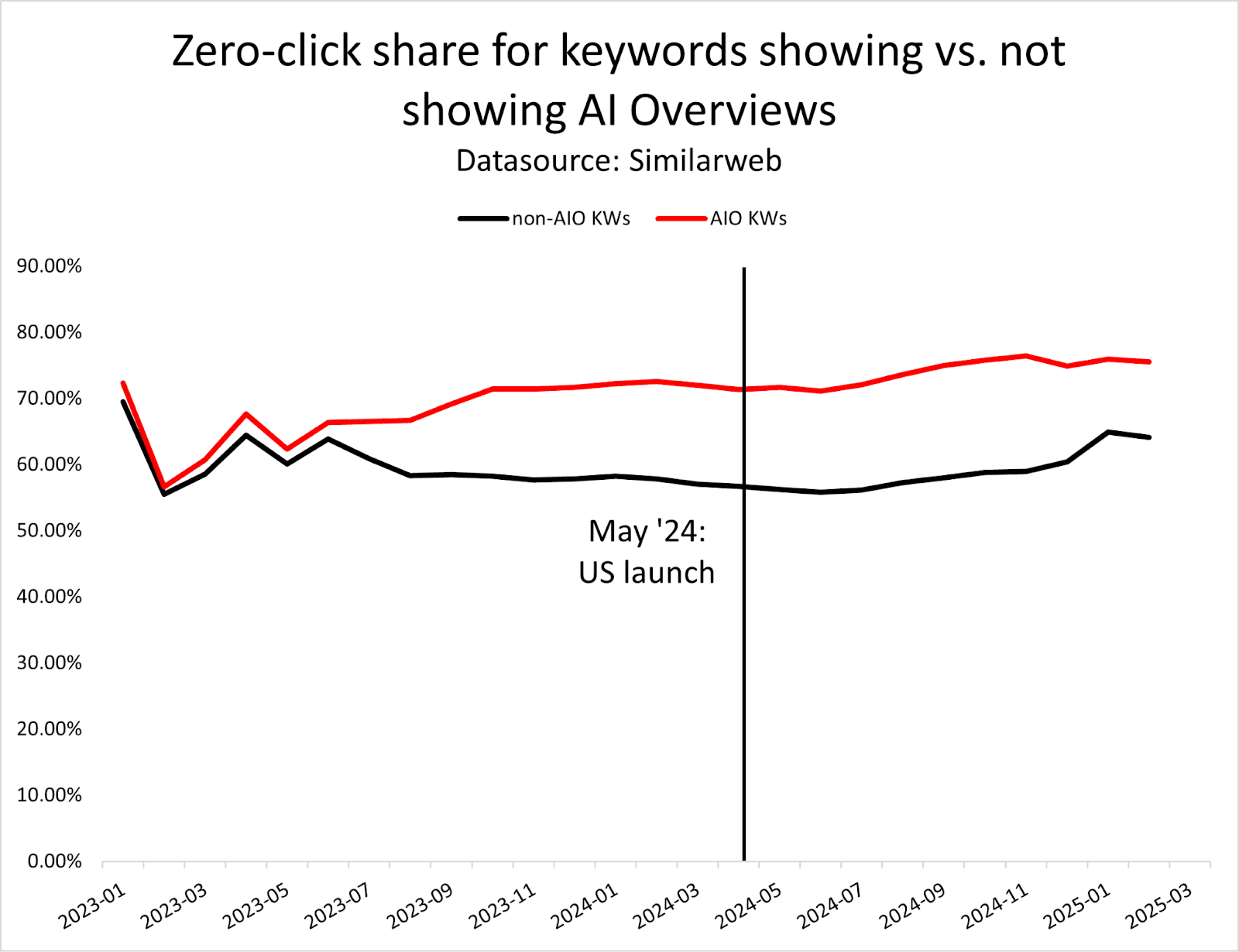
In fact, my study reveals AIOs raise zero-click share from 72% → 76%.

Users who leave Google do engage more, as mentioned in Part 1, but a larger share of queries never “get back to the web.”

Image Credit: Kevin Indig

It’s important to pause here.

Look at how many keywords (60% at the lowest point, shown by the black line above) lead to zero-click searches, even when Google doesn’t show an AI Overview.

Many keywords that grew in zero-clicks after AI Overviews officially launched in May 2024 also had zero-clicks before the launch.

But after the rollout, we see a clear increase in zero-clicks for AIO keywords and a plateau in November 2024 at 76% (up from 71.4% in April 2024).

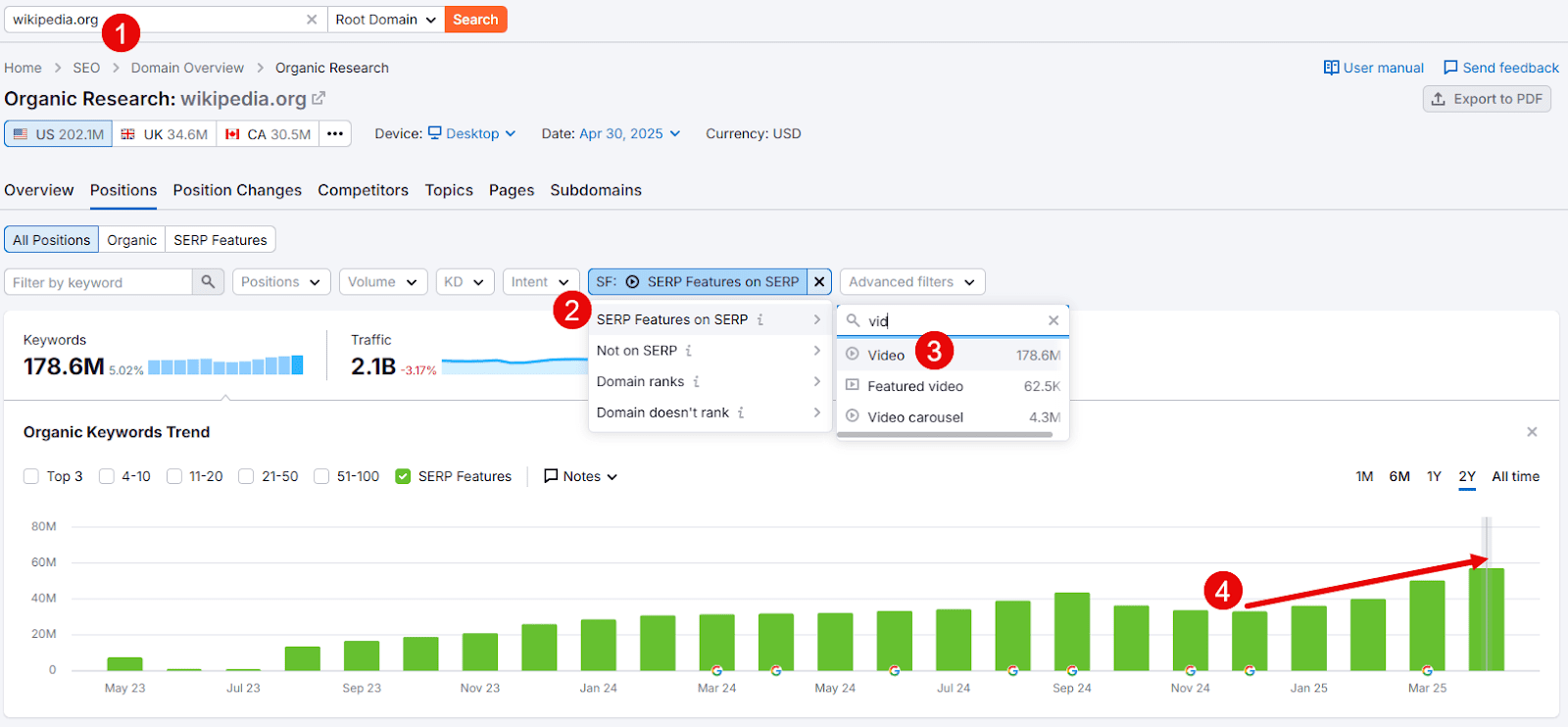
The share of zero-clicks also grew for non-AIO keywords, which can be explained by SERP Features like Featured Snippets.

For example, Semrush shows a clear upward trend for the number of videos that show up for terms Wikipedia, one of the largest sites on the web, ranks for.

Image Credit: Kevin Indig

As a result of more SERP features, the gap in zero-click share between keywords showing AIOs vs. not showing AIOs has closed from 15.4% in May 2024 to 11.4% in February 2025.

Here’s another example that challenges Pichai and the Google team’s claims:

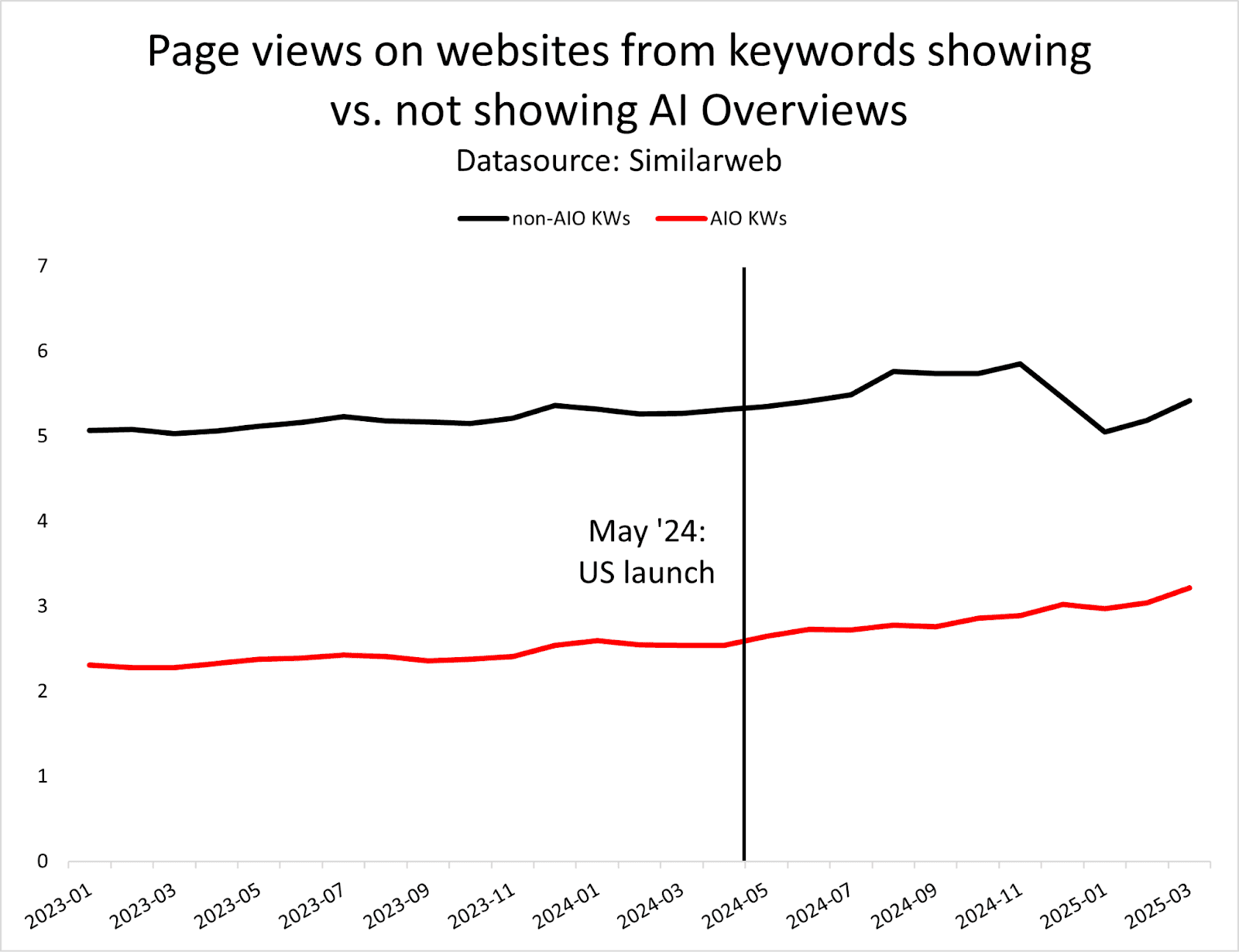
Search queries without AI Overviews result in twice as many pageviews as those with AI Overviews.

In that sense, AIOs send less traffic to the ecosystem overall, and it leads to fewer pageviews. This is a death blow for publishers who rely on ad impression volume.

To be fair, one could argue in favor of Pichai’s point here in that pageviews from AIO keywords have grown 21.5% since the rollout in May 2024, compared to just 1.3% growth for keywords without AI Overviews during the same period (until November ‘24, after which they drop).

So, you could look at that trend and say, “Pageviews from AIO queries have grown,” but that omits a lot of important context.

Image Credit: Kevin Indig

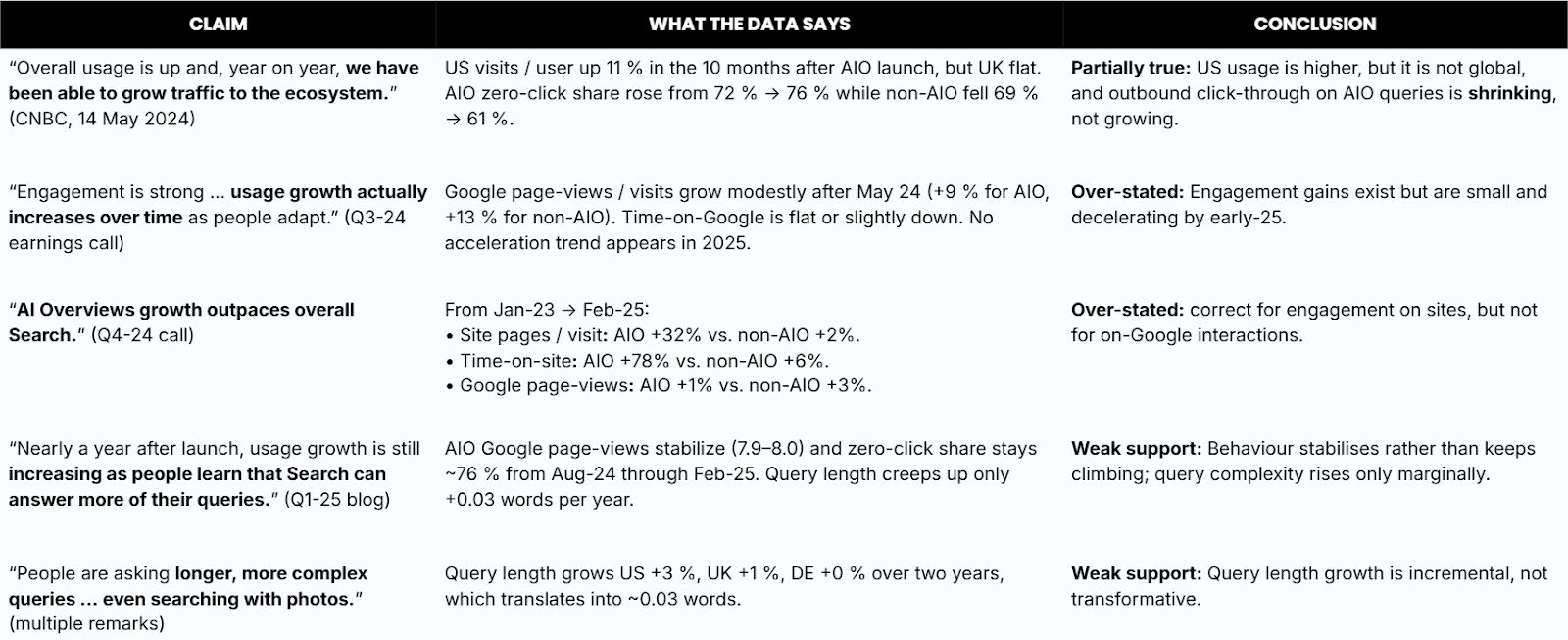
Verdict: These Claims Aren’t Telling The Full Truth – At Best

In Part 1, I came to the following conclusion:

When we examine the data closely, a clear pattern emerges: Google’s claims about AI Overviews fundamentally changing how we search are largely overstated.

Yes, users visit Google more frequently, but they’re spending less time per visit and not crafting significantly longer or more complex queries. This suggests AI Overviews are creating a “quick answer” behavior pattern rather than deeper engagement with search.

And Part 2 of my analysis confirms that pattern.

Yes, queries are creeping longer, and AIO-derived clicks are high-quality.

However, zero-click growth contradicts the claim that AIO consistently sends more traffic “back to the web.”

Image Credit: Kevin Indig

The rise in query length is incremental – not a wholesale shift to “entirely new” behavior – and increased zero-click resolution means many searches stop at Google rather than reaching “the best the web has to offer.”

Make sure to subscribe because next week, I’m publishing the first-ever AIO usability study to complement the quantitative data I’ve published over the last five months with qualitative insights.

Let me tell you … this will change your model of Search and LLM optimization.

Boost your skills with Growth Memo’s weekly expert insights. Subscribe for free!


1 CNBC Exclusive: CNBC Transcript: Alphabet CEO Sundar Pichai Speaks with CNBC’s Deirdre Bosa on “Closing Bell: Overtime” Today

2 Google I/O 2024: An I/O for a new generation


Featured Image: Paulo Bobita/Search Engine Journal

It’s Official: Google Launches AI Max for Search Campaigns via @sejournal, @brookeosmundson

Google Ads has announced a major update to Search campaigns. The new AI Max campaign setting will roll out globally in beta starting later this month.

Per Google’s announcement, advertisers who enable AI Max in their Search campaigns can expect stronger performance through improved query matching, dynamic creative, and better control features.

According to Google, early testing shows advertisers see an average 14% more conversions or conversion value at a similar CPA or ROAS. Campaigns still using mostly exact or phrase match keywords see even greater uplifts, around 27%.

This update follows months of closed beta testing with large brands already reporting positive results.

Let’s take a deeper look at what AI Max brings and why it matters to paid search marketers.

What is AI Max for Search Campaigns?

If you’ve been hearing the term “Search Max” in the wild lately, the official name for it is AI Max for Search.

AI Max is not a new campaign type. Instead, it’s a one-click upgrade available within existing Search campaign settings.

Once activated, it layers in three core enhancements:

  • Search term matching: Uses AI to extend keyword matching into relevant, high-performing queries your current keywords might miss.

  • Text customization: Rebrands the former Automatically Created Assets (ACA) tool. Dynamically generates new headlines and descriptions based on your landing pages, existing ads, and keywords.

  • Final URL expansion: Sends users to the most relevant pages on your site based on query intent.

Advertisers can opt out of text customization or final URL expansion at the campaign level, and opt out of search term matching at the ad group level. However, Google recommends using all three together for maximum performance.

AI Max is designed to complement, not replace, keyword match types. If a user’s search exactly matches a keyword in your campaign, that will always take priority.

Why is Google Introducing AI Max?

Search behavior is changing fast. As Google integrates more AI-powered experiences like AI Overviews and Google Lens into Search, people are using more complex, conversational, and even visual queries.

Advertisers have also voiced concerns about losing transparency and control as campaign automation expands.

AI Max aims to address both.

  • Advertisers keep access to existing Search reports and controls while layering in new targeting and creative tools.
  • More granular reporting is rolling out, including search terms by asset and improved URL parameters for detailed tracking.

Essentially, it’s Google’s answer to increasing demand for flexible automation, but with guardrails in place for marketers.

Are There Controls For Brand Safety?

Google added several controls to address a frequent advertiser concern: automation overreaching into irrelevant or risky placements.

Here’s what’s included with the AI Max for Search rollout:

  • Brand controls: Choose which brands your ads appear alongside (or exclude specific brands).
  • Location of interest controls: Target based on user geo intent at the ad group level (great for multi-location businesses).
  • Creative asset controls: Remove generated assets or block them entirely if they don’t meet brand guidelines.

One note of caution: as of now, AI-generated assets will go live before advertisers have the chance to review them.

Advertisers will need to monitor and react quickly to any compliance issues.

Are There Updates Coming to Reporting?

While AI Max integrates into existing Search reporting, the functionality is bringing new insights:

  • Search terms reporting will now show associated headlines and URLs.
  • Asset reports will measure performance not just by impressions, but by spend and conversions.
  • A new URL parameter will offer deeper visibility into search queries and performance across match types.

These reporting improvements will start in the Google Ads online interface as the feature rolls out.

Support for API, Report Editor, and Desktop Editor access is slated for later in 2025.

How Does AI Max Compare to Performance Max or Dynamic Search Ads?

Many marketers are asking how AI Max fits alongside other Google campaign types.

Here’s the current landscape of differences or overlap between other campaign types:

  • Performance Max and AI Max for Search may be eligible for the same Search auctions. However, if a user’s search query exactly matches a keyword in your Search campaign, Search will always take priority.
  • Dynamic Search Ads (DSA) remain available. AI Max is not a direct replacement, though it does overlap in some areas like final URL expansion and keywordless matching.
  • Optimized Targeting for audiences could be seen as a similar concept to AI Max’s query expansion, but applied to audiences rather than keywords.

Additionally, AI Max for Search can be A/B tested against traditional Search setups using drafts and experiments. More customized testing tools are in development.

Who is AI Max Not Ideal For?

While AI Max offers clear benefits to trying out, this new setting may not suit every advertiser verticals.

If you’re an advertiser or a brand with the following scenarios, I’d recommend using caution when testing out AI Max for Search.

  • Advertisers with strict creative guidelines or sensitive content policies.
  • Brands needing pinning for ad assets (since final URL expansion does not support pinning).
  • Businesses with websites that change frequently, making automated creative risky or inaccurate.

For industries like legal or healthcare, where lead quality and content compliance are crucial, AI Max may require careful testing before wide adoption.

What This Means for Search Marketers

AI Max represents a significant shift in how Google Search campaigns can scale.

It brings the adaptive reach and creative flexibility of Performance Max without requiring a new campaign type or sacrificing keyword control.

For advertisers already embracing broad match and automated bidding, AI Max may feel like a natural progression.

For those still relying on exact and phrase match keywords, it offers an opportunity to expand cautiously while maintaining key controls.

The rollout also signals Google’s direction: automation will continue to evolve, but advertiser input and oversight remain essential.

Marketers who test AI Max thoughtfully by balancing automation with strategy are likely to gain a competitive edge as search behavior grows more complex.