ChatGPT now recommends products directly in search results. The feature has no ads (so far). Hence any ecommerce business can presumably gain visibility for free.
The recommendations follow from relevant prompts with clear shopping intent. ChatGPT provides info on each product it recommends, including (i) customer ratings from multiple sources, (ii) pricing from multiple sellers, and (iii) explanations of its selections.
Here’s how to expose your products to ChatGPT.
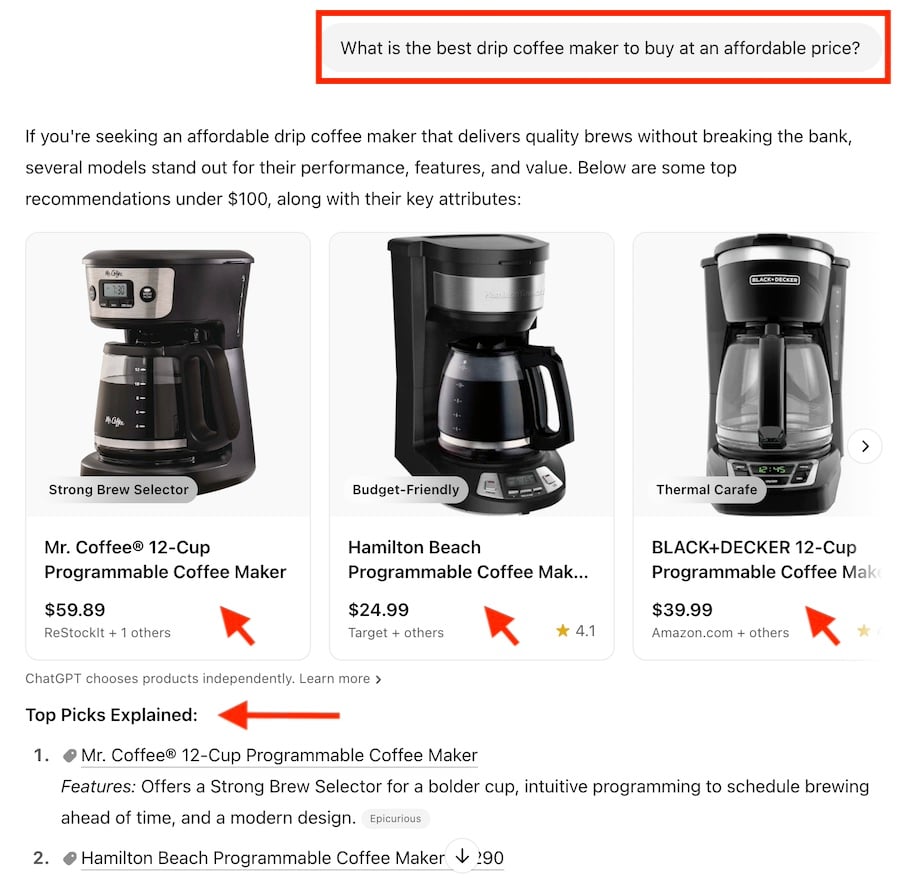
A prompt on ChatGPT for “drip coffee makers” produced multiple recommendations with images, sources, ratings, and a “Top Picks Explained” section. Click image to enlarge.
Get in the Database
In a post titled “Help ChatGPT discover your products,” OpenAI states it is considering a product feed submission feature (likely similar to Google Shopping) and provides a form to receive notifications when it’s live.
Ecommerce businesses should sign up now to become early adopters — before other (bigger) brands.
The post also reminds merchants to ensure OpenAI’s crawler can access their sites. Some content management systems and plugins block OpenAI bots by default. Check your robots.txt file to ensure it doesn’t block “OAI-SearchBot.” Log file analyzers from Screaming Frog and others can confirm the bot is crawling your site.
ChatGPT supports structured data markup from Schema.org. Thus including detailed product schema will likely increase your chances of being recommended. Searchers’ purchase intent prompts are often very specific with dimensions, colors, and similar.
In a related post, ChatGPT states it will recommend products based in part on the user’s prompt history. Using its memory feature, ChatGPT might know, for example, the searcher’s color and style preferences and will recommend products accordingly.
Searchers’ purchase intent prompts typically seek specific features. A detailed product schema with many facets (colors, sizes, dimensions, warranty, styles, compatibility, etcetera) will increase the likelihood of a recommendation.
Monitor External Product Reviews
In the same related post, ChatGPT states it relies on multiple public sources when displaying product reviews and ratings. While testing, I’ve seen ratings from Target, Amazon, Wired, Business Insider, and others.
Keep an eye on ratings and reviews to encourage ChatGPT’s recommendations. I’ve yet to see a ChatGPT recommendation with bad reviews. Some platforms (Better Business Bureau) often lean towards negative reviews, while others (Facebook) are typically positive (e.g., Facebook).
Shopper Approved can help improve your product ratings by adding positive reviews from your site to external platforms as needed.
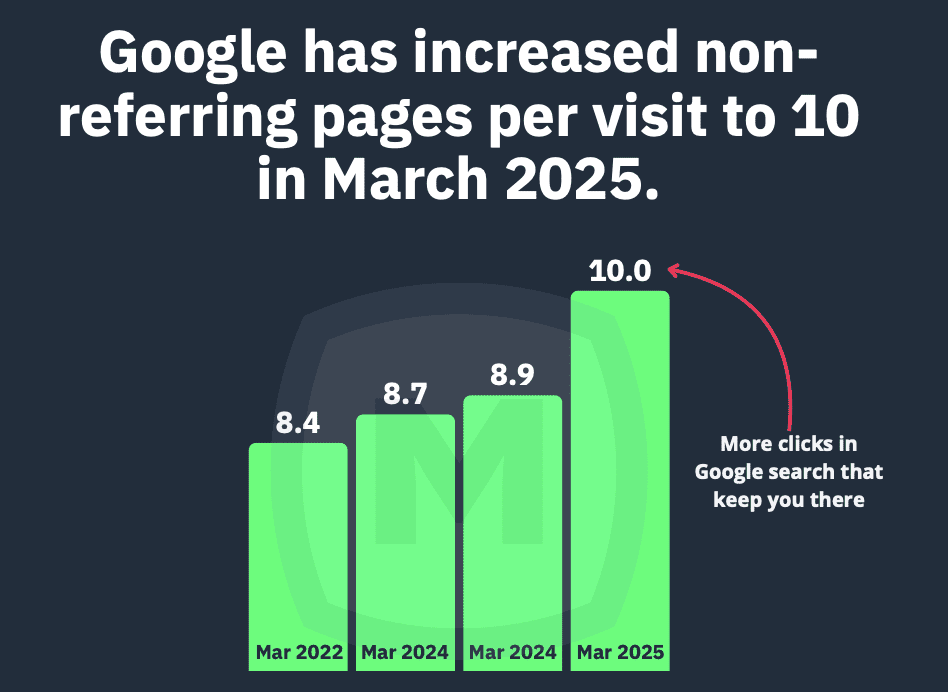
New data shows Google keeps users on its site longer. Visitors now make 10 clicks on Google’s site before leaving for another website.
This finding comes from a 13-month study comparing Google and ChatGPT traffic patterns.
Google Keeps Users In, ChatGPT Sends Them Out
Tyler Einberger of Momentic analyzed Similarweb data showing that Google’s “pages per visit” metric has climbed to 10 as of March, a big jump from before.
Image Credit: Momentic.
What does this mean? Users spend more clicks on Google’s search results than on other websites.
“Increasing ‘Pages per Visit’ for Google.com is an indicator that users are spending more clicks within Google’s search results (SERPs). Since most SERP interactions—like interacting with SERP features, paging, refining searches, or clicking images—change the URL but keep visitors on Google’s domain.”
Google still sends the most overall traffic to external websites.
Google generated 175.5 million outgoing visits in March compared to ChatGPT’s 57.6 million. This represents a 66.4% increase for Google compared to last year.
The Efficiency Gap
ChatGPT is more efficient at sending people to other websites.
The numbers tell the story:
ChatGPT generates 1.4 external website visits per user
Google produces just 0.6 visits per user
This means ChatGPT users are 2.3 times more likely to visit external websites than Google users, even though Google’s audience is about 6.8 times larger.
The SERP Retention Strategy
Google’s increasing in-platform clicks match its strategy of expanding search features. These features provide immediate answers without requiring users to visit other websites.
Google is succeeding at two goals:
Remaining the web’s primary traffic source
Keeping users on Google’s properties longer
While Google sent more outgoing traffic in early 2025, its audience barely grew. This shows a complex relationship between keeping users and referring them elsewhere.
What This Means
For SEO pros and marketers, this trend creates new challenges and opportunities:
With users spending more time on Google’s interfaces, capturing attention in the first screen view matters more than ever.
Focus on appearing in featured snippets, knowledge panels, and other SERP elements to maintain visibility as traditional organic clicks become harder to get.
Consider ChatGPT and other AI platforms as additional traffic sources since they refer more visitors per user.
Users now interact with multiple SERP features before clicking a website, requiring better attribution models and content strategies.
The Broader AI Search Market
While Google and ChatGPT lead the conversation, other AI search platforms are growing fast.
Perplexity grew 110.7% month-over-month in March. Grok grew 48.1% and Claude grew 23%.
These newer platforms could change current traffic patterns as they gain users, though the report doesn’t analyze their referral efficiency in detail.
Google remains the biggest traffic source overall. However, its growing “walled garden” approach means marketers should watch these trends and diversify where their traffic comes from.
A major update to Google’s Search Quality Raters Guidelines (QRG) clarifies and expands on multiple forms of deception that Google wants its quality raters to identify. This change continues the trend of refining the guidelines so that quality raters become better at spotting increasingly granular forms of quality issues.
TL/DR
Authenticity should be the core principle for any SEO and content strategy.
Quality Guidelines Section 4.5.3
Section 4.5.3 has essentially been rewritten to be clearer and easier to understand but most importantly it has been expanded to cover more kinds of deception. One can speculate that the quality raters weren’t overlooking certain kinds of website deception and that these changes are addressing that shortcoming. This could also signal that Google’s algorithms may in the near future become more adept at spotting the described kinds of deception.
The change in the heading of section 4.5.3 reflects the scope of the changes, with greater detail over the original version.
The section title changed from this:
4.5.3 Deceptive Page Purpose and Deceptive MC Design
To this:
“4.5.3 Deceptive Page Purpose, Deceptive Information about the Website, Deceptive Design”
The entire section was lightly rewritten and reorganized for greater clarity. It’s not necessarily a new policy but rather a more detailed and nuanced version of it, with a few parts that are brand new.
Deceptive Purpose
The following is a new paragraph about deceptive purpose:
“Deceptive purpose:
● A webpage with deliberately inaccurate information to promote products in order to make money from clicks on monetized links. Examples include a product recommendation page on a website falsely impersonating a celebrity blog, or a product recommendation based on a false claim of personal, independent testing when no such testing was conducted.”
Google very likely has algorithmic signals and processes to detect and remove sites with these kinds of deceptive content. While one wouldn’t expect that a little faking would be enough to result in a sudden drop in rankings, why take the chance? It’s always the safest approach to focus on authenticity.
To be clear, the focus of this section isn’t just about putting fake information on a website but rather it’s about deceptive purpose. The opposite of a deceptive purpose is a purpose rooted in authenticity, with authentic intent.
Deceptive EEAT Content
There is now a brand new section that is about fake EEAT (Expertise, Experience, Authoritativeness, and Trustworthiness) content on a website. A lot of SEOs talk about adding EEAT to their web pages but the fact is that EEAT is not something that one adds to a website. EEAT is a quality of a website that’s inherent in the overall experience of researching a site, learning about a site, and in the process of consuming the content, which can result in signals that site visitors may generate about a website.
Here’s the guidance about fake EEAT content:
“● A webpage or website with deceptive business information. For example, a website may claim to have a physical “brick and mortar” store but in fact only exists online. While there is nothing wrong with being an online business, claiming to have a physical “brick and mortar” (e.g. fake photo, fake physical store address) is deceptive.
● A webpage or website with “fake” owner or content creator profiles. For example, AI generated content with made up “author” profiles (AI generated images or deceptive creator descriptions) in order to make it appear that the content is written by people.
● Factually inaccurate and deceptive information about creator expertise. For example, an author or creator profile inaccurately claims to have credentials or expertise (e.g. the content creator claims falsely to be a medical professional) to make the content appear more trustworthy than it is.”
Deceptive Content, Buttons, And Links
The new quality raters guidelines also goes after sites that use deceptive practices to get users to take actions they didn’t intend to. This is an extreme level of deception that shouldn’t be a concern to any normal site.
The following are additions to the section about deceptive design:
“● Pages with deceptively designed buttons or links . For example, buttons or links on pop ups, interstitials or on the page are designed to look like they do one thing (such as close a pop up) but in fact have a different result which most people would not expect, e.g. download an app.
● Pages with a misleading title or a title that has nothing to do with the content on the page. People who come to the page expecting content related to the title will feel tricked or deceived.”
Takeaways
There are three important takeaways from the updates to section 4.5.3 of Google’s Search Quality Raters Guidelines:
1. Expanded Definition Of Deceptive Purpose
Section 4.5.3 now explicitly includes new examples of deceptive page intent, such as fake endorsements or falsified product testing.
The revision emphasizes that deceptive purpose goes beyond misinformation—it includes misleading motivations behind the content.
2. Focus On Deceptive EEAT Content
A new subsection addresses deceptive representations of EEAT, including:
Fake business details (e.g. pretending to have a physical store).
Made-up author profiles or AI-generated personas.
False claims of creator expertise, such as unearned professional credentials.
3. Deceptive Design and UI Practices
The raters guidelines calls attention to manipulative interface elements, such as:
Buttons that pretend to close popups but trigger downloads instead.
Misleading page titles that don’t match the content.
Google’s January 2025 update to the Search Quality Raters Guidelines significantly expands how raters should identify deceptive web content. The update clarifies deceptive practices involving page purpose, false EEAT (Expertise, Experience, Authoritativeness, Trustworthiness) content, and misleading design elements. The purpose of the update is to help raters to better recognize manipulation that could mislead users or inflate rankings and could indicate the kinds of low quality that Google is focusing on.
Paid search is self-serving and fast to deploy. But as simple as it appears, the reality is much more complex.
The perceived ease of activation paints a picture that this channel is a silver bullet when brands look to enter new markets.
It’s as easy as piecing together an automated campaign such as Performance Max, changing the target location, and letting Google do the hard work, isn’t it?
This couldn’t be further from the truth, and from managing Paid Search for over 15 years, I can vouch for this firsthand.
PPC can play a key role in market expansion, but it’s not a market entry strategy, which it can often get confused with.
This post explores how paid search fits into a go-to-market strategy and what brands need to consider when launching in a new market, from media modeling to localization, brand building, and more.
Full-Funnel Media Planning Is Essential
Roughly speaking, paid search can be deployed in a new market within a short time frame.
Brand can liaise with in-house teams/PPC agencies, start the ball rolling, and then activate campaigns in a new locale in a fraction of the time it would take to even begin planning a full-funnel strategy.
For example, say you’re a U.S.-based ecommerce brand that sells luxury skincare and wants to break into the UK, without any brand demand in this market.
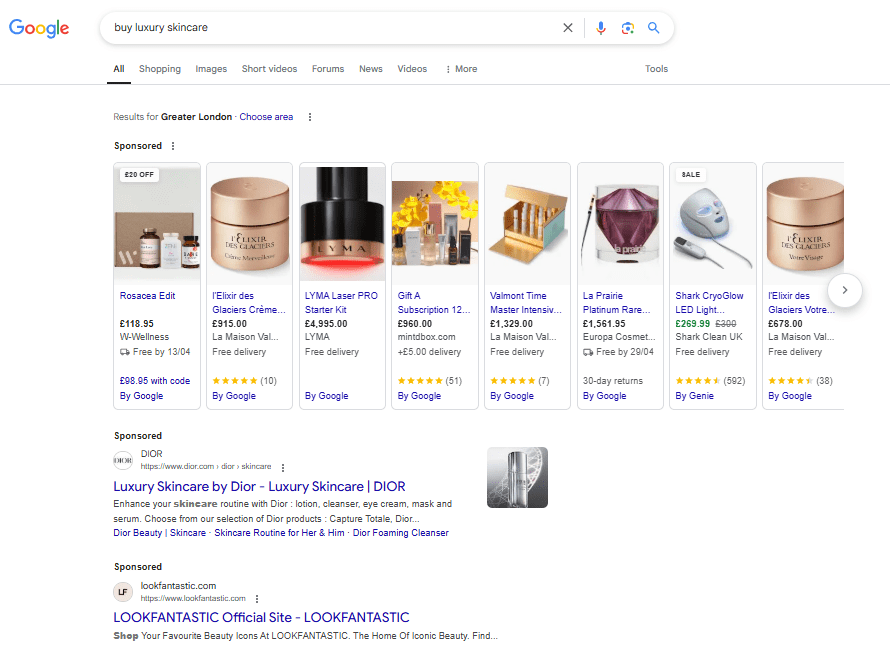
You build out Google Ads search and shopping campaigns and enter auctions for a wealth of generic queries, such as:
Screenshot from search for [buy luxury skincare], Google, April 2025
You’ll drive traffic to the site for relevant queries and might start to build momentum with sales. However, if the campaigns were to be paused, so would the entire presence of your brand in this market.
With full-funnel media buying, brands look at the full customer journey, of which different brands have a different mix of budgeting across each stage (lower, middle, and upper funnel, for example).
McKinsey defines full-funnel marketing as “an approach that combines the power of both brand building and performance marketing through linked teams, measurement systems, and key performance indicators (KPIs).”
Outside of the context of launching into a new market, this approach to media buying is essential, and PPC sits within the mix of lower, middle, and upper funnel advertising strategies.
The split of the budget across the funnel will vary by brand. Les Binet and Peter Field argue that the most effective strategies adopt a 60/40 split of long-term brand building and short-term activation.
When you’re launching into a new market, the split could look a whole lot different as you’ll need to build brand awareness from scratch. Over time, it will move the needle over to performance-based campaigns as part of a wider media mix.
Have A Robust Measurement Strategy In Place
Take the example of a U.S.-based luxury skincare brand expanding into the UK.
After the initial test period, simply looking at PPC performance through engagement or sales metrics isn’t enough to determine whether the expansion succeeded.
PPC campaigns influence more than just immediate clicks and conversions.
Depending on the strategy, they can contribute to brand awareness, drive offline actions, and more.
For instance, a search ad might not result in an immediate online purchase but could lead a customer to visit a physical store or make a purchase at a later time. When the only presence in a new market is via paid search, conversion rates could be considerably lower than those in established markets.
Taking this into account, a brand can’t expect to answer “how did the market expansion go?” based on a narrow sample of data from one channel, especially when that channel isn’t part of a broader go-to-market media strategy.
It’s crucial to measure PPC’s impact beyond platform-specific metrics, and incorporating a holistic approach to measurement is essential.
One tactic to use is Media Mix Modelling (MMM). This allows marketers to capture these indirect effects, ensuring a more accurate assessment of PPC’s role in the overall marketing strategy.
MMM is used by 53% of U.S. marketers, and 30% believe it is the best model for identifying drivers of business value as it doesn’t rely on user-level data, making it effective at viewing the impact of paid media on the bottom line.
If it’s a simple PPC activation or a full-funnel go-to-market media strategy, the importance of having a framework for measuring performance holistically is key, as this lays the groundwork for understanding the successes and failures when expanding into a new market.
Research Market-Specific Nuances And Adapt
When entering a new market, it’s not just your media plan that needs to adapt; it’s also your understanding of the consumer.
Even in an increasingly connected world, buying behaviors remain deeply influenced by local culture, habits, and expectations.
Studies have shown that organizations with high cultural intelligence see a 30% increase in their market penetration compared to their competitors.
Brands must consider:
Cultural Differences
Nearly 75% of UK shoppers say their purchasing is influenced by local culture, yet 75% of consumers in India feel that global brands offer better quality products compared to the local market.
Understanding what problems users prioritize, what features matter, and how consumers approach purchases is essential when piecing together a PPC plan and the backbone for a full go-to-market strategy.
A one-size-fits-all approach won’t cut it, and even though there may be search demand for the products/services you sell, this doesn’t mean you can simply activate and watch the sales roll in (in most cases).
This is both a strategic and tactical consideration, from the first day of planning which markets you are going to target, to the types of phrases used within your ad copy.
Longer Consideration And Research
One-third of consumers globally spend more time researching purchase decisions online than ever before.
When you layer in the nuances of a brand entering a new market, the need for a robust go-to-market strategy vs. a simple activation on PPC is crucial.
With the consideration process being longer than ever, brands need to understand and adapt to market-specific purchasing behavior, and this should run through everything involved within digital.
From the messaging used in ads to forecasting out purchase paths, to then determine when an expected return on ad spend can be accurately reported.
Local Digital Ecosystems
Digital behavior differs massively between markets. Assuming that one country will respond the same to your PPC campaigns as another is short-sighted.
Take China, for example. Google and Meta are blocked, and brands will have to look for alternative routes for activating PPC, such as Baidu.
Running search ads follows a similar blueprint, but the research, planning, build, etc., will require a bespoke approach.
Another consideration is payment methods.
India, for example, favors wallets like PayTM, while 15% of the entire Klarna market resides in Germany.
Context aside, these factors play a key role in building a thorough digital expansion plan, which incorporates PPC, as without these, brands will be scratching their heads to uncover why PPC metrics look a certain way.
The Key To Making PPC Work In New Markets Isn’t PPC
Launching PPC in a new market might seem straightforward. From a resource perspective and context aside, it doesn’t demand a great deal of time to get up and running.
This is where Google Ads shines, as brands can enter a new market with just a few clicks and begin driving traffic.
However, driving the traffic is part of the bigger picture with digital market expansion, and there’s a wealth of factors that need to be considered to give brands the best chance at success.
Consumers place significant importance on elements such as star ratings, the number of reviews, and the credibility of those reviews.
PPC can (and will) exist in isolation for many brands, and even the most well-built, researched, and curated campaigns can fall short when activating in a new market.
To stand the best chance of success, brands must consider the full digital ecosystem, from how they apportion budget across the funnel, how they display shipping fees on their site, and how best to go about building trust signals from launch.
PPC can drive visibility and traffic, but it’s everything around it that matters most, and brands who consider and act on all of these factors are the ones who succeed.
The reality of working in B2B today is that tried-and-tested tactics are no longer as effective for engaging buyers.
Buyers are independent, defensive, and prefer independent research before reaching out to sales, only when they are absolutely ready to do so.
Part of the reason for this is due to the increase in size of buying groups, the average of which now spans approximately 11 individuals.
These buying groups have their own complex purchasing processes – 70% of which take place in the dark and often anonymously before they reach out to sales.
When these buyers are ready, 84% of the deals go to the vendor on their day-one list.
This new buying behavior, where self-discovery predominates, highlights the urgency of evolving old tactics and embracing buyer-led strategies that meet buyers on their own terms, where they are.
This includes moving away from traditional lead generation in favor of evergreen, always-on buyer enablement practices based on buyer intelligence.
In this article, I will share five buyer enablement strategies based on successful demand programs that elevated our clients’ engagement metrics and resulted in sustainable buyer relationships.
5 Proven Demand Strategies To Enable Buyers
1. Identify Your Buyers Precisely
Identifying your buyer starts with recognizing that most B2B buying groups are made up of multiple stakeholders – as many as 15 individuals or more – each with distinct concerns and decision-making power, according to our own Q4 2024 market research.
To effectively engage these groups, you need detailed buying group personas that define key revenue leaders and influencers.
Referencing existing buyer personas at large accounts is a helpful starting point, while first-party data and other sources like client relationship management (CRM) insights, client interviews, website behavior analytics, and industry reports will provide you with a more comprehensive view of their needs, goals, and preferences.
Identifying intent signals is equally important for modern account-based marketing (ABM) strategies. These behavioral cues suggest when a prospect or buying group is actively researching solutions and may be in-market to buy.
Key buying group intent signals include:
Multiple website visitors from the same organization.
Consumption of solution-specific content.
Engagement across multiple channels.
Webinar or event attendance.
And many more.
Predictive tools, competitive research, and technographic data can further enrich these insights.
By integrating real-time intent signals into your ABM programs, you can dynamically adjust campaigns to align with the evolving needs of buying groups and their individual members.
Rather than relying solely on static personas, dynamic ABM leverages intent data to better understand each persona’s immediate pain points, preferred channels, and buying triggers.
This approach ensures that you reach the right personas, within the right accounts, with the right message at the right moment, ultimately driving greater engagement, pipeline velocity, and revenue impact.
2. Be A Partner To Your Buyers
We are seeing a trend of more and more buyers (as many as 58% according to our Q4 2024 market research) seeking the proven expertise of consultants and subject matter experts to inform and de-risk their decisions. This trend is closely associated with the increase in the length of buying cycles.
To compete effectively, marketers ought to adjust their engagement to offer integration and consultation, effectively establishing their brand as a committed partner that supports its buyers and meets their needs. This, in turn, translates to demand.
This brand-to-demand-to-revenue strategy relies on early engagement to establish trust and build a brand presence before buyers are actively looking.
The brand experience you present should carry across multiple touchpoints to engage all stakeholders within the buying group, emphasising your position as a trusted source.
Examples of early brand-to-demand tactics include:
Identifying the most suitable channels for generating awareness of your unique value proposition (UVP).
Sponsoring events to engage qualified prospects with just-in-time information.
Adopting a multithreaded nurturing approach.
Promoting curated content hubs to facilitate buyer research and self-discovery, customized per persona.
Offering webinars, workshops, or roundtables.
Providing buying group influencers with data to make an internal case, such as product specification sheets, decks, and guides.
Establishing a vendor-partner relationship is critically important when nurturing defensive buyers because it reduces risk, builds trust, and enhances buyer confidence – all of which are top priorities for today’s cautious, efficiency-driven buying groups.
This also helps buyers feel reassured that they are investing in solutions that are well-supported, credible, and aligned with other trusted vendors in their partner ecosystem.
3. Focus On Buyer-Led Content
Nurturing and enabling buying groups calls for buyer-led content strategies that speak directly to active buyers, buying groups, and accounts.
Creating content hubs to enable buyer research is one of the most powerful moves you can make today, especially for large buying groups in complex industries.
Content hubs designed to support in-depth research empower buyers to make informed decisions with more confidence.
These content libraries also establish your brand as a reputable, expert source of information.
It is important to align content hubs to individual buying journey stages so buyers can self-serve information.
Below is an example of what that looks like:
Awareness stage: industry reports, tactical guides, thought leadership focused on how-tos.
Consideration stage: product overviews, case studies, webcasts.
Micro-targeting buyers with relevant, behavior-driven content is great for creating seamless, value-added experiences that drive preference and loyalty, ultimately enabling buying groups to confidently choose your solution.
To achieve competitive displacement, ensure your content is visible and discoverable throughout the buyer’s journey.
This can be achieved through SEO, AI/Generative Engine Optimization (AEO/GEO), and by leveraging omnichannel engagement tied to real-time behavior to deliver personalized messaging that resonates at every touchpoint.
You can also use intent-driven targeting to engage accounts already researching similar topics.
4. Continuously Optimize With Demand Intelligence
Nurturing and enabling buying groups is not a one-time effort, but an ongoing optimization process.
Success depends on continuously updating intelligence across buyers, buying groups, and accounts to stay aligned with evolving needs and behaviors.
Measuring the impact of your buyer enablement tactics can be done in several ways:
Buying group activation metrics, such as the number of roles and stakeholders engaged.
Deal acceleration metrics, such as sales cycle length and conversion rate.
Feedback loops with both buyers and sales teams.
By measuring and optimizing at every stage, organizations can identify what is working, adjust strategies in real time, and eliminate inefficiencies.
Essentially, they can successfully self-educate without talking to sales, which aligns with modern B2B buyer expectations.
Continuous optimization also turns good programs into great ones, driving stronger results and building lasting buyer trust.
This approach not only strengthens engagement, but also ensures that every marketing dollar is working harder, helping you maximize the impact of your spend.
5. Enable Sales Teams For Success
To truly nurture and enable buying groups, organizations must equip their sales teams with the right strategies, including the tools, insights, and approaches that support more informed and impactful outreach to buyers.
This starts with personalized messaging tailored to each account and buying group, and continues with follow-up that reflects the needs and behaviors of individual buying group members.
A key part of this approach is helping sales teams engage buyers at the right pace.
Acting as trusted consultants, sales teams can guide buyers through their journey with a buyer-centric mindset that clearly communicates the unique value of your organization.
Achieving this requires strong alignment and collaboration across marketing, sales, and the broader organization – everyone must rally behind a shared North Star focused on enabling the buyer first and foremost.
Best practices for achieving organizational alignment include:
Collaborating to define the ideal buying experience.
Setting joint revenue and buyer engagement targets.
Regularly refreshing sales outreach strategies.
Detailed mapping of each buying group and member, including pain points and interests.
Activating multi-threaded account strategies.
By prioritizing buyer enablement and supporting sales teams with the right approach, organizations create a seamless experience that builds trust, accelerates deal cycles, and drives better long-term outcomes.
The Importance Of Evolving Alongside Your Buyers
Buyer purchasing behavior has changed unequivocally. Buying groups are expected to remain cautious, with buyer journeys expected to lengthen even more.
To thrive in this environment, organizations must prioritize brand-to-demand and value-focused solutions, using their expertise to solve buying group challenges – all the while enabling self-service options whenever possible.
It is time to meet buyers where they are, which means evolving the playbook and closing the door to old ways of thinking.
Key Takeaways
Buying groups and long sales cycles are the new reality: Today’s buyers prefer to self-educate, making it essential to shift toward buyer-led strategies that meet them where they are – on their terms. This requires moving beyond traditional lead generation and embracing buyer enablement approaches powered by real intent signals.
Buyers and how they buy have changed: B2B purchases now involve up to 15 stakeholders or more, each with their own priorities and influence. To engage them effectively, build detailed buying group personas and identify intent signals that reveal when prospects are actively exploring solutions.
Buyer enablement does not end; it evolves: By optimizing at every stage, organizations can fine-tune strategies in real time, enabling better and consistent outcomes.
Google’s Search Liaison explained limitations in Google’s ability to return web pages from a prior date, also noting that date-based advanced search operators are still in beta. He provided one method for doing this but omitted discussing an older, simpler method that almost accomplishes the same thing.
How To Find Articles By Older Published Date
The person asking the question understood how to find articles published from the previous year, month, and twenty four hours. But didn’t know how to find articles published before a specific date.
The post on Bluesky asked:
“Is there a way to search for articles OLDER than a certain date?
I know advanced search can guarantee in the past year, month, 24h, but I want to specifically be able to find articles published BEFORE X historical event happened, and I can’t find a way to filter. Help?”
Search Liaison posted this way to do it which can be difficult to memorize if you’re a busy person:
“We have before: and after: operators that are still in beta. You must provide year-month-day dates or only a year. You can combine both. For example:
In my opinion it’s a lot easier to just use Google’s search tools:
Tools > Any Time > Custom Range
From there you just set whatever time range that you want, nothing to memorize. However, you can’t search before a certain date, you have to set the starting date and ending date you’re searching for.
Caveat About Time-Based Search
Search Liaison shared an interesting insight about how the advanced search operators for time work:
“Just keep in mind it can be difficult for us to know the exact date of a document for a variety of reasons. There’s no standard way that all site owners use to indicate a publishing or republishing date. Some provide no dates at all on web pages. Some might not indicate if an older page is updated.”
Takeaways:
The time-based advanced search operators are still in beta, which means that Google is testing to see how many people find it useful. Google might at some time in the future remove the search operators if it’s not popular or useful.
The other takeaway is that it’s hard for Google to know the exact date that a document is published.
Amazon’s marketplace requires some form of a product identifier for nearly every category. Whether it’s baby toys or industrial bolts, sellers need a Universal Product Code (UPC) or, similarly, a Global Trade Item Number (GTIN).
Yet some items have no such identifier and require an “exemption” from Amazon.
GTIN
GS1, a global standards organization, developed the GTIN to identify products. The identifier encompasses several worldwide formats, including the familiar UPC (GTIN-12) in the United States and Canada. In Europe, merchants use the European Article Number (EAN), technically GTIN-13.
The GTIN standards identify any trade item (product or service) priced, ordered, or invoiced. Hence GTINs help Amazon and the merchants selling in its marketplace keep track of inventory and manage orders.
Term
Stands For
Digits
Region
GTIN
Global Trade Item Number
8, 12, 13, or 14
Global
UPC
Universal Product Code
12
U.S., Canada
EAN
European Article Number
13 (usually) or 8
Europe
Identifying Products
For resellers offering products from prominent consumer brands, listing a product on Amazon is as simple as looking up the GTIN or copying the UPC number from the item’s barcode.
There are, however, many products that don’t have an obvious barcode or identifier. Here are some examples.
Print-on-demand products. T-shirts are perhaps the best example. Services such as Printful and Gooten are excellent sources of quality shirts with crisp printing, but they don’t have UPCs.
Private label items. Some small brands, including in-house manufacturers, may not have a GTIN.
Handmade merchandise. Artisans creating anything from leather belts to home-sown bibs may not have UPCs.
Parts or accessories. Replacement parts, components, and accessories may not come with individual GTINs. An example is a generic phone case.
Bundled or items in a multipack. Most major brands have a GTIN-14 or similar for multipack, but some smaller companies with bundled products do not, despite Amazon’s guidelines.
For those and other numberless products, Amazon marketplace sellers have two options: obtain a GTIN or get an exemption from Amazon.
GTIN Exemption
Amazon often awards exemptions for categories with private-label, handmade, or similar products.
The process is straightforward. Create a listing in Amazon Seller Central, select “I don’t have a product ID,” and click “Next.” An “Apply” button will appear for products requiring a GTIN exemption.
If the product category is restricted, the seller will need double approval: an authorization to sell and a separate GTIN exemption.
Brands with existing GTINs cannot apply for an exemption for other like-branded items.
Exemption approval typically requires excellent documentation, as follows.
Clear photographs. Amazon wants detailed product and packaging photos, not illustrations or markups. These pictures should show the item and packaging from each side, but will not appear in product listings.
No GTIN. There cannot be (i) any barcode or identifier on the item or package or (ii) a GTIN associated with the product. Amazon has an exhaustive list of registered GTINs and will check.
Consistent branding. The brand name on the GTIN exemption form must exactly match the packaging and product. And the packaging must permanently show the brand name or logo.
Proper category. Ensure the product category for the GTIN exemption is correct. An error will almost guarantee a rejection.
According to its support, Amazon usually approves or rejects an exemption request within two days. Merchants who have obtained an exception often recommend waiting an additional day afterward before building those product listings, allowing Amazon’s systems to reflect the status.
Amazon’s notification of denied GTIN exemptions may state why. For example, the product and packaging photographs might not demonstrate the absence of a GTIN or may belong to a brand requiring a UPC.
Sellers with denied exemptions can reapply after updating or clarifying the initial culprits.
Finally, if all else fails, a company can purchase a UPC for about $30, plus an annual fee.
Most pigs in the US are confined to factory farms where they can be afflicted by a nasty respiratory virus that kills piglets. The illness is called porcine reproductive and respiratory syndrome, or PRRS.
A few years ago, a British company called Genus set out to design pigs immune to this germ using CRISPR gene editing. Not only did they succeed, but its pigs are now poised to enter the food chain following approval of the animals this week by the U.S. Food and Drug Administration.
The pigs will join a veryshort list of gene-modified animals that you can eat.It’s a short list because such animals are expensive to create, face regulatory barriers, and don’t always pay off. For instance, the US took about 20 years to approve a transgenic salmon with an extra gene that let it grow faster. But by early this year its creator, AquaBounty, had sold off all its fish farms and had only four employees—none of them selling fish.
Regulations have eased since then, especially around gene editing, which tinkers with an animal’s own DNA rather than adding to it from another species, as is the case with the salmon and many GMO crops.
What’s certain is that the pig project was technically impressive and scientifically clever. Genus edited pig embryos to remove the receptor that the PRRS virus uses to enter cells. No receptor means no infection.
According to Matt Culbertson, chief operating office of the Pig Improvement Company, a Genus subsidiary, the pigs appear entirely immune to more than 99% of the known versions of the PRRS virus, although there is one rare subtype that may break through the protection.
This project is scientifically similar to the work that led to the infamous CRISPR babies born in China in 2018. In that case a scientist named He Jiankui edited twin girls to be resistant to HIV, also by trying to remove a receptor gene when they were just embryos in a dish.
That experiment on humans was widely decried as misguided. But pigs are a different story. The ethical concerns about experimenting are less serious, and the benefits of changing the genomes can be measured in dollars and cents. It’s going to save a lot of money if pigs are immune to the PRRS virus, which spreads quite easily, causing losses of $300 million a year or more in the US alone.
Globally, people get animal protein mostly from chickens, with pigs and cattle in second and third place. A 2023 report estimated that pigs account for 34% of all meat that’s eaten. Of the billion pigs in the world, about half are in China; the US comes in a distant second, with 80 million.
Recently, there’s been a lot of fairly silly news about genetically modified animals. A company called Colossal Biosciences used gene editing to modify wolves in ways it claimed made them resemble an extinct species, the dire wolf. And then there’s the L.A. Project, an effort run by biohackers who say they’ll make glow-in-the-dark rabbits and have a stretch goal of creating a horse with a horn—that’s right, a unicorn.
Both those projects are more about showmanship than usefulness. But they’re demonstrations of the growing power scientists have to modify mammals, thanks principally to new gene-editing tools combined with DNA sequencing that lets them peer into animals’ DNA.
Stopping viruses is a much better use of CRISPR. And research is ongoing to make pigs—as well as other livestock—invulnerable to other infections, including African swine fever and influenza. While PRRS doesn’t infect humans, pig and bird flus can. But if herds and flocks could be changed to resist those infections, that could cut the chances of the type of spillover that can occasionally cause dangerous pandemics.
There’s a chance the Genus pigs could turn out to be the most financially valuable genetically modified animal ever created—the first CRISPR hit product to reach the food system. After the approval, the company’s stock value jumped up by a couple of hundred million dollars on the London Stock Exchange.
But there is still a way to go before gene-edited bacon appears on shelves in the US. Before it makes its sales pitch to pig farms, Genus says, it needs to also gain approval in Mexico, Canada, Japan and China which are big export markets for American pork.
Culbertson says gene-edited pork could appear in the US market sometime next year. He says the company does not think pork chops or other meat will need to carry any label identifying it as bioengineered. “We aren’t aware of any labelling requirement,” Culbertson says.
This article is from The Checkup, MIT Technology Review’s weekly health and biotech newsletter. To receive it in your inbox every Thursday, sign up here.
This is today’s edition of The Download, our weekday newsletter that provides a daily dose of what’s going on in the world of technology.
A senior State Department official demanded records of communications with journalists, European officials, and Trump critics
A previously unreported document distributed by senior US State Department official Darren Beattie reveals a sweeping effort to uncover all communications between the staff of a small government office focused on online disinformation and a lengthy list of public and private figures—many of whom are longtime targets of the political right.
The document, originally shared in person with roughly a dozen State Department employees in early March, requested staff emails and other records with or about a host of individuals and organizations that track or write about foreign disinformation—including Atlantic journalist Anne Applebaum, former US cybersecurity official Christopher Krebs, and the Stanford Internet Observatory—or have criticized President Donald Trump and his allies, such as the conservative anti-Trump commentator Bill Kristol.
The broad requests for unredacted information felt like a “witch hunt,” one official says—one that could put the privacy and security of numerous individuals and organizations at risk. Read the full story.
—Eileen Guo
The US has approved CRISPR pigs for food
Most pigs in the US are confined to factory farms where they can be afflicted by a nasty respiratory virus that kills piglets. The illness is called porcine reproductive and respiratory syndrome, or PRRS.
A few years ago, a British company called Genus set out to design pigs immune to this germ using CRISPR gene editing. Not only did they succeed, but its pigs are now poised to enter the food chain following approval of the animals this week by the U.S. Food and Drug Administration. Read the full story.
—Antonio Regalado
This article is from The Checkup, MIT Technology Review’s weekly health and biotech newsletter. To receive it in your inbox every Thursday, sign up here.
The must-reads
I’ve combed the internet to find you today’s most fun/important/scary/fascinating stories about technology.
1 The US has closed a China tariff loophole The costs of plenty of goods are likely to shoot up in response. (NYT $) + But China is still extremely dependent on US-made car chips. (WSJ $) + Chinese retail giant Temu is pivoting its business model. (Bloomberg $) + Sweeping tariffs could threaten the US manufacturing rebound. (MIT Technology Review)
2 DOGE’s future is looking uncertain It’s fallen far short of its goal to slash $2 trillion in spending. (WP $)+ No more late-night ice cream for Elon Musk. (CNBC) + DOGE’s tech takeover threatens the safety and stability of our critical data. (MIT Technology Review)
3 Microsoft is hiking the price of its Xbox games console By a whopping 27% in the US. (The Guardian) + Apple estimates that the tariffs will add $900 million to its costs. (WP $) + But Apple isn’t announcing any price increases (yet.) (TechCrunch) + Here’s what is—and isn’t—getting pricier under the tariffs. (Vox)
4 Tech giants have been accused of deliberately distorting AI rankings A new study claims they’re making untrue claims about the best models. (New Scientist $) + It accuses benchmark organisation LM Arena of unfair practices. (TechCrunch) + The site’s operators refute the findings, saying its conclusions are wrong. (Ars Technica)
5 Europe wants to replicate America’s military-industrial complex And US contractors are likely to benefit. (WSJ $) + US soldiers may finally be able to repair their own equipment. (404 Media) + Generative AI is learning to spy for the US military. (MIT Technology Review)
6 Elon Musk’s lawsuit against OpenAI will move forward A judge rejected OpenAI’s attempt to dismiss the case. (FT $)
7 What a post-4Chan internet looks like What was once contained to a tiny corner of the web is now commonplace. (New Yorker $) + How to fix the internet. (MIT Technology Review)
8 How North Korea infiltrates the US Fully remote coders are not who they appear to be. (Wired $)
9 You no longer need a password to open a new Microsoft account The company’s gone passkey-first. (The Verge)
10 Fecal transplants are a possible way to treat gut disease And the approach is becoming more mainstream. (Undark) + How bugs and chemicals in your poo could give away exactly what you’ve eaten. (MIT Technology Review)
Quote of the day
“What about the next Taylor Swift?”
—US District Court Judge Vince Chhabria questions how powerful musical AI tools will affect up-and-coming musicians during Meta’s copyright court battle, Wired reports.
One more thing
Your boss is watching
Working today—whether in an office, a warehouse, or your car—can mean constant electronic surveillance with little transparency, and potentially with livelihood-ending consequences if your productivity flags.
But what matters even more than the effects of this ubiquitous monitoring on privacy may be how all that data is shifting the relationships between workers and managers, companies and their workforce.
We are in the midst of a shift in work and workplace relationships as significant as the Second Industrial Revolution of the late 19th and early 20th centuries. And new policies and protections may be necessary to correct the balance of power. Read the full story.
—Rebecca Ackermann
We can still have nice things
A place for comfort, fun and distraction to brighten up your day. (Got any ideas? Drop me a line or skeet ’em at me.)
For $60, Bob DeMars’s company, Blind Barrel, will ship a package of four craft-distilled whiskey samples, unmarked, with a tasting glass. Recipients can then try them and guess the whiskey type, age, and proof.
It’s a game using Blind Barrel’s app, preferably with friends. Participants can purchase entire bottles at discounted prices.
Bob launched the business in 2021 from his base in California. In our recent conversation, he addressed the company’s growth, marketing tactics, legalities, and more.
Our entire audio is embedded below. The transcript is edited for length and clarity.
Eric Bandholz: Tell us what you do.
Bob DeMars: I’m the founder and CEO of Blind Barrels, a whiskey-tasting experience. Subscribers receive unlabeled samples and, using our gamified app, try to guess the type of whiskey, its age, and proof. It’s fun and interactive, but what keeps members around is the exclusive access we provide.
We feature small American craft distilleries and offer special barrel picks at competitive prices — like a bottle from Still Austin, normally $80–$110, available to members for $75.
It’s a subscription starting at $59.99 for one quarter or $49.99 per quarter annually. We ship curated lineups to U.S. customers only in March, June, September, and December. We chose quarterly because creating these blind tasting lineups — sourcing, bottling, legalities — is complex.
It’s tightly regulated. Quarterly curation helps us manage inventory — each lineup is limited, high-quality, and intentionally sourced.
Bandholz: Can you sell to consumers in all U.S. states?
DeMars: We’re limited. Some states are too restrictive. For example, we don’t ship to Utah. We can ship to Hawaii and Alaska, but it costs $60 to send a $2 item, so it’s not feasible. It also depends on our fulfillment partners. Having the right ones is key for both sample kits and full bottles.
A big challenge is the distribution system. Many craft whiskeys we feature are only distributed in their home states. After Prohibition ended in 1933, the U.S. implemented a unique three-tier system: producers must sell to distributors, who then sell to retailers, and only then to consumers. This setup doesn’t exist anywhere else worldwide and creates a stranglehold on access.
As a retailer, we sell to end users. We need the craft brands to get their products into at least one distributor in a compliant state. From there, our fulfillment partners can legally ship to most other states. It’s a complex process, but we’ve figured out how to navigate it.
Bandholz: Do you include big whiskey brands?
DeMars: We don’t feature the big guys — there’s nothing special about including a Jim Beam or Maker’s Mark in a tasting lineup. Even something like Johnnie Walker Blue is mass-produced. The big brands dominate through distribution. That’s why you see the same bottles in every bar and liquor store.
Craft producers, on the other hand, make some of the best whiskey in the country, but no one outside their region knows they exist. Our goal is to spotlight those hidden gems.
We don’t select brands — we select whiskeys. We build every lineup through blind tastings. No brand can buy its way in, and we don’t charge marketing fees. If your whiskey is in our lineup, it’s outstanding.
Craft distillers drive innovation. They’ve pioneered barrel finishes and experimental mash bills — recipes — and the big brands are starting to follow. Craft is where the creativity lives.
Bandholz: What are your shipping and product costs?
DeMars: Our boxes cost about $2, and the glass bottles, landed with shipping, are about $2.50. I called seemingly every vendor in the country to get those rates.
Even then, we pay slightly above cost for whiskey because it has to move through the three-tier system. So between the whiskey, bottles, caps, and shipping, our margins are roughly 50%.
The first kit we ship is basically breakeven — we don’t make or lose money. Profit comes from retention. We were profitable in our first year, but reinvested everything into site optimization and marketing.
When we launched, our website purchase conversion rate was just 0.6%. After tweaks, we hit 1.6%, and then I brought in an expert — we’re now at 3%.
The real game-changer has been low churn. The industry average for alcohol subscriptions is 10–12%; we’re under 3.5%. That loyalty saved us when conversions were low.
People share the kits with friends, especially now that we’ve gamified the experience. It creates viral momentum. Great whiskey is meant to be shared.
Bandholz: How do you acquire customers?
DeMars: We have multiple tactics. I didn’t raise much outside capital — I put in most of the funds myself because this was a risky model.
One of our first breaks came from a prominent Southern California FM radio host who joined as an advisor. He talked about us on-air, and suddenly 50% of our first few hundred members came from those mentions. That gave us enough cash flow to start testing marketing.
Now, our main acquisition channels are email and Google and Meta ads. We don’t use SMS much yet but plan to test it. Father’s Day and Christmas are big for us. We’ve grown revenue by around 25% per quarter.
I’ve bootstrapped everything. I didn’t take a salary until we hit 2,500 members. I managed all advertising and social content at first. I’m a filmmaker, so that helped. Meta ads can be tricky for alcohol brands.
For example, Meta doesn’t allow targeting consumers by age using Advantage+. We’re on our fifth marketing team, and they finally get it. They understand the brand, and I no longer have to carry the whole creative load.