How BNPL Impacts Ecommerce Profits

Buy-now-pay-later options offer shoppers a convenient, flexible, and often low-cost way to finance purchases, but merchants may pay relatively steep transaction fees.

BNPL is popular, and customers likely spend more when it is available. The downside to merchants is the cost, typically a 2% to 8% fee for BNPL transactions versus roughly 3% for payment cards alone.

With fees as high as 8%, store owners must ask whether the additional sales from BNPL are worthwhile. The short answer is probably “yes,” although reminiscing and math will make it more clear.

Free Shipping

Fast and free shipping has become a staple of the ecommerce industry. For some online segments, such as fashion and toys, free shipping is a competitive requirement and an ante to participate. Yet years ago, merchants worried that shipping costs would break them.

The free shipping dilemma was simple: Customers loved it. A shopper was more likely to buy if shipping was free. The challenge for merchants was ensuring the additional revenue covered the expense.

Today, almost no seller worries about free shipping. Merchants adjusted prices. Distribution and warehousing models became decentralized, moving products close to customers. Ecommerce thrived.

BNPL presents a similar problem. It boosts gross revenue but at a cost.

BNPL Lift

One way to measure BNPL’s impact on profit is to compare the increase in sales to the relatively higher transaction fees.

Imagine an online store with sales of $100,000 per month before it adds a BNPL option.

  • Revenue: $100,000
  • Credit card fees (3%): $3,000
  • Net revenue after fees: $97,000

The shop nets 97% of the gross revenue without considering the cost of goods sold, overhead, advertising, et cetera.

Next, let’s assume that adding BNPL improves top-line revenue by 20% (to $120,000) and prompts some buyers to switch to BNPL so that only 70% of sales come from payment cards and 30% from BNPL.

We need to calculate the total blended fee. First, we know payment cards cost 3% of $84,000 (70% of $120,000), which is $2,520.

For a 6% BNPL fee, the shop would pay $2,160 on $36,000 (30% of $120,000) in sales. Thus, the total fees paid for the improved $120,000 would total $4,680, making the blended fee 3.9%.

  • Revenue: $120,000
  • Blended fees (3.9%): $4,680
  • Net revenue after fees: $115,320

In short, net revenue was $97,000 without BNPL and $115,320 with it — 97% and 96.1%, respectively, of gross revenue.

BNPL Impact

A slight decrease in net revenue percentage might be well worth it for a nominal increase of $18,320 ($115,320 – $97,000).

The real bottom line is that BNPL is here to stay. Merchants must understand how it impacts profit. The BNPL dilemma is similar to free shipping years ago. Merchants have a track record of adapting to succeed.

Branding Is More Than a Logo

This “Ecommerce Conversations” episode continues my masterclass series on entrepreneurship. Last week I addressed tactics to increase ecommerce profits amid a slump for many businesses.

This week I focus on branding. Most people think of branding as logos or design elements. But those items are components, not the essence. A brand is synonymous with a company’s mission and purpose.

My full audio narration is embedded below. The transcript is edited for clarity and length.

Mission

A founder’s outlook drives the brand. What does she or he want to achieve? For me, it’s freedom — creating my own path. If unsure, reflect on why you exist and your purpose in life. Then shape your business around it.

A common struggle of entrepreneurs is feeling trapped in a business they don’t love. That happens when there’s no mission. My mission at Beardbrand is to help men live the life of their dreams through grooming. We want men to feel proud of the person in the mirror. When a man invests in himself, he gains the confidence to better his family and community  — making the world a more loving place.

Values

Core values are essential. Beardbrand’s are freedom, hunger, and trust. I prefer single-word values because they’re easier to remember. If you can’t recall your core values, they don’t exist. At Beardbrand, everyone knows our core values because they are clear and concise.

We boiled ours down to three concepts working in harmony. For instance, too much freedom might reduce trust, while too much hunger could limit freedom. These checks and balances are critical for us. However, a fast-growing startup might focus on hunger to survive and conquer a market. Core values should reflect personal beliefs extended into business.

Core values guide decisions amid uncertainty. For instance, we look for vendors that share our worldview. Our best relationships have been with companies that align with our values.

Communication

Communication should be consistent across an entire company — internal discussions, customer interactions, ads, emails, and websites. Many people default to formal, grammatically correct language, thinking it’s the right way. But, to me, it’s boring and lifeless.

Communication should have passion, character, and conviction. There’s often a tendency to play it safe, especially when advised by lawyers. However, playing it safe isn’t always the right approach. Sometimes, breaking the rules — such as using informal or edgy language — can make your brand stand out without alienating an audience.

Customer support should be human. Too often, support teams attempt to defuse situations by being robotic, which worsens the problem. Human interactions help resolve issues with greater ease.

At Beardbrand, we talk to our customers the way we talk to friends. We avoid formal language because authenticity is key to building trust, one of our core values.

Customer support must align with the type of product you offer. A premium product demands top-tier support, while a lower-priced item might not.

Many brands overlook typography, a form of communication. Fonts can tell a lot about a brand and how much it cares about design. Most smaller brands stick to safe fonts like Arial or Helvetica, which makes them blend in with everyone else.

Others will shape your brand if you aren’t intentional with fonts, logos, colors, and photography.

Fonts can create consistency. Without consistency, your brand’s identity can become unclear, leading to mixed messages.

Impact

A brand is an extension of its founders and staff and how they want to impact the world. Philip Jackson, the founder of Future Commerce, says commerce is culture. Companies that succeed know this.

Entrepreneurs make the world a better place through their businesses. Branding reflects that mission. It’s more than a logo.

Google Provides Timeline To Improve Publishers’ Search Visibility via @sejournal, @MattGSouthern

Google has publicly committed to December 31 as a deadline for improving how independent publishers appear in search results.

This timeline emerged during an exchange on X between Danny Sullivan, Google’s Search Liaison, and several concerned publishers.

A Turning Point for Independent Publishers?

The exchange began with Jonathan Jones sharing notes from a discussion where Google addressed concerns about independent content creators.

According to Jones’ post, Sullivan acknowledged Google’s need to “reward sites better” and expressed interest in helping “smaller independent sites to succeed.”

What made this conversation notable was publisher Nate Hake’s push for accountability, which resulted in Google providing a deadline. Something Google typically avoids when discussing ranking improvements.

“Can we take that to mean ‘December 31, 2025’ (if not before)?” Hake asked directly.

“Yes,” responded Google’s Search Liaison, adding the caveat that “this doesn’t mean all sites will go back up to wherever they were if they are down from a previous peak.”

Long-Standing Frustrations Come to a Head

The exchange highlighted the tension between Google and independent publishers, which have seen their search visibility decline in recent years.

“Honestly, everything you are saying sounds exactly like what you said when we visited Google HQ in October,” Hake wrote. “Same words, same inaction.”

Hake then detailed what he claims Google has done since October: “reduced independent publisher visibility even more” while continuing “to preference Reddit, Quora, and the 16 VC-backed media companies.”

Others joined the conversation, expressing similar frustrations with Google’s communication style. Mordy Oberstein characterized Google’s guidance as “ethereal” and “anything but concrete and consistent,” noting that publishers need more precise models of “what good sites look like.”

Google’s Response: Gradual Improvements, Not a Single Update

In response to these criticisms, Sullivan explained that improvements would be incremental rather than delivered in one major update:

“There’s no specific date because there’s no one specific thing that the teams are working on to improve. There are multiple things, because search has multiple things that are involved in ranking.”

He added:

“There have been some changes already launched with that goal. Some sites may have benefited from them; others might not, but that’s also because the sites themselves are all different.”

Sullivan acknowledged the need for better guidance, stating:

“I’d like to see us do a better job with guidance and documentation focused on content issues to add to our existing stuff that’s primarily about technical issues.”

Why This Matters

Many publishers have reported traffic declines following recent Google updates, with some claiming visibility has dropped despite maintaining high-quality content.

As Google’s March Core Update continues to roll out, publishers are anxious to see if it will resolve their ranking issues.

Some websites might notice changes with this update. However, we can expect improvements for more publishers by December.

Sullivan’s commitment is a small but notable victory for those who have pushed for greater transparency and accountability from Google.

Google Search Central Live NYC: Insights On SEO For AI Overviews via @sejournal, @martinibuster

Danny Sullivan, Google’s Search Liaison, shared insights about AI Overviews, explaining how predictive summaries, grounding links, and the query fan-out technique work together to shape AI-generated search results.

Optimizing For AIO

Danny Sullivan shared insights into how AI Overviews are generated, helping explain why Google may link to websites that don’t match the typical search results. While the links can differ, he emphasized that the fundamentals of search optimization remain unchanged.

This is what Danny Sullivan said, based on my notes:

“The core fundamental things haven’t really changed. If you’re doing things that are making you successful on search, those sorts of things should transfer into some of the things that you see in the generative AI kind of summaries.”

Google Explains Why AIO Results Are Different

One of the main takeaways from this part of Danny’s presentation was his explanation of why Google AIO search results are different. This is the clearest explanation of why the AIO search results are different, every SEO and publisher needs to know this.

He introduced two concepts to familiarize yourself with in order to better understand AIO search results.

  1. Predictive Summaries
  2. Grounding Links

Predictive Summaries

Danny solved the mystery behind AIO search results that show content and links that are different from what organic search results show, which makes it harder to understand how to optimize for that kind of AI search results.

He shared that the reason for that kind of AIO is something called predictive summaries. Predictive summaries show answers to a search query but also try to predict related variations of what a user will also want to see. This sounds a lot like Google’s patent about Information Gain. Information Gain is about predicting the next question that a searcher may ask after reading the answer to their present question. Information gain is a patent that is strictly to the context of AI Search and AI Assistants.

Here is what he said, according to my notes:

“One thing I think that people find really confusing sometimes is that they’ll do a query and especially you’ll see …these are the top 10 results, but I don’t see them in the AIO, what’s going on?

And it’s like, yeah, the query in the search box is the same query, but the model that’s going out there to try to understand what to show is kind of an overview, going beyond just the top 10 results. It’s understanding a lot of results and it’s understanding a lot of variations that you might kind of get and so that it’s coming back and it’s trying to provide its predictive summary of what the query is related to.”

Grounding Links

Sullivan also revealed that “grounding links” are another reason why AIO search results are different from the regular organic search results. An AIO search result is a summary of a topic that includes facts about multiple subtopics. The purpose of grounding is to anchor the entire summary to verifiable information from the web ecosystem.

In the context of AIO, grounding is the process of confirming the factual authenticity of the AI summaries so that a searcher can click to read about any subtopic discussed in the answer summary provided by AIO. This is the second reason why the links in AIO show a variety not normally seen in the organic search results.

One way to look at this is that the links are more contextual than the regular ten blue links of the organic search results. These contextual links are also referred to as qualified clicks or qualified links, links that are hyper-specific and more relevant in general than organic search results.

Danny appears to say that the grounding links are created from searches that are related to the initial search query, but are not the same. Like, if you want to explain how a conventional automobile runs, you need information about the powertrain which is made up of a gas combustion engine, a transmission, the axles and so on. Answering a complex question requires grounding from a wide array of information sources.

According to my notes, this is how Danny Sullivan explained it:

“And then on top of that, it’s then also trying to bring in the grounding links. And those grounding links, because it kind of comes from a broader set aren’t just going to match. The queries are going to be different and the overall set is going to be different.

Which is why it’s a great opportunity for diversity and whatever our query thing is that we say, but that’s why you can see different things that are showing there.”

Don’t Mess Up Your Rankings

Sullivan cautioned about trying to rank for both the organic and the different parts of the AIO summaries, saying that it’s likely to “mess things up” because “it doesn’t really work like that.”

Query Fan-Out Technique

Danny Sullivan also touched on the topic of AI Mode, saying that right now it’s not really something to optimize for because it’s still in Google Labs and it’s very likely to change and be something different if it ever gets out of Google Labs.

But he did say that AI Mode uses something called a query fan-out technique.

He said:

“…one of the things they talk about is like ‘we use an advanced query fan out technique with multiple related queries in it…’ And it’s basically that what I said before.

You issued a query. You try to understand the variations and things that are related. which by the way is not that much different to how search works at the moment even when you didn’t have the AI elements to it. Because when you would issue a query now we try to understand synonyms, we try to understand the meaning of the entire query. If it’s a sentence, we try to match it in all sorts of different ways …because sometimes it just brings you better results.”

Takeaways:

Google Search Liaison, aka Danny Sullivan, encouraged the use of the core SEO fundamentals, saying that they are still relevant for ranking. Danny explained why the links in AI Overviews can sometimes differ significantly from those in the organic search results, introducing three concepts that help understand AIO search results better.

Three concepts related to AIO search results to understand:

  1. Predictive Summaries
  2. Grounding Links
  3. Query Fan-Out Technique
Google Business Profile Suspensions Rise, But Appeals Are Delayed

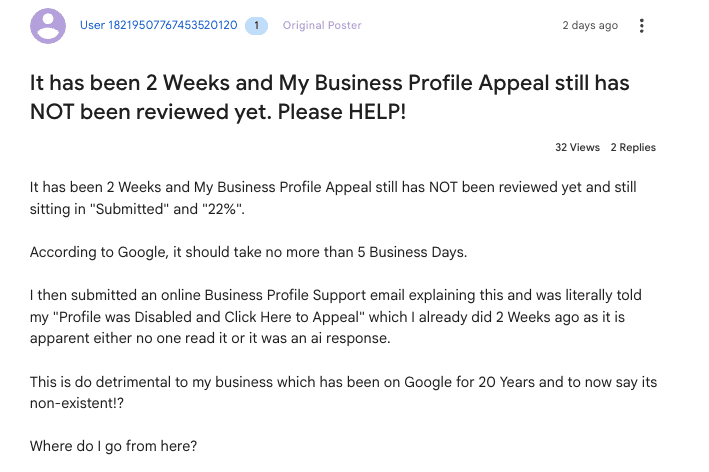
Google Business Profile (GBP) suspensions have steadily risen since January, and as they increase, appeal resolution times have grown significantly – from about five days to nearly five weeks.

As a Platinum Product Expert in the Google Business Profile Support Forums, I help small businesses navigate Google’s GBP platform.

For many of these SMBs, Google is a primary lead driver, and when their listing goes south due to a suspension, life can get very hard.

Image from author, March 2025

What We Know

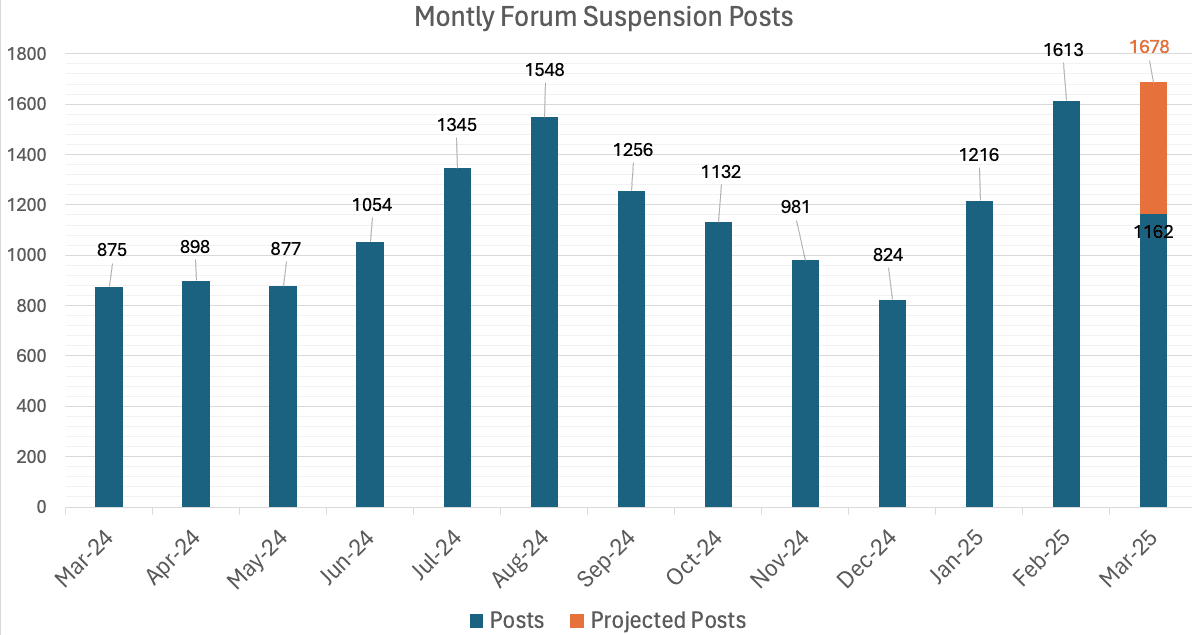
We noticed in February that forum complaints about suspensions reached their highest level since last August.

Users typically try support first but when frustrated, a subset of them find their way to the forums to see what their next steps are.

The forums provide a canary-in-the-coal-mine function allowing outside observers to understand problems that Google Business Profiles are currently experiencing.

Based on the current daily average posting rate, we estimate that March’s suspension-related posts will surpass February’s total. (Image from author, March 2025)

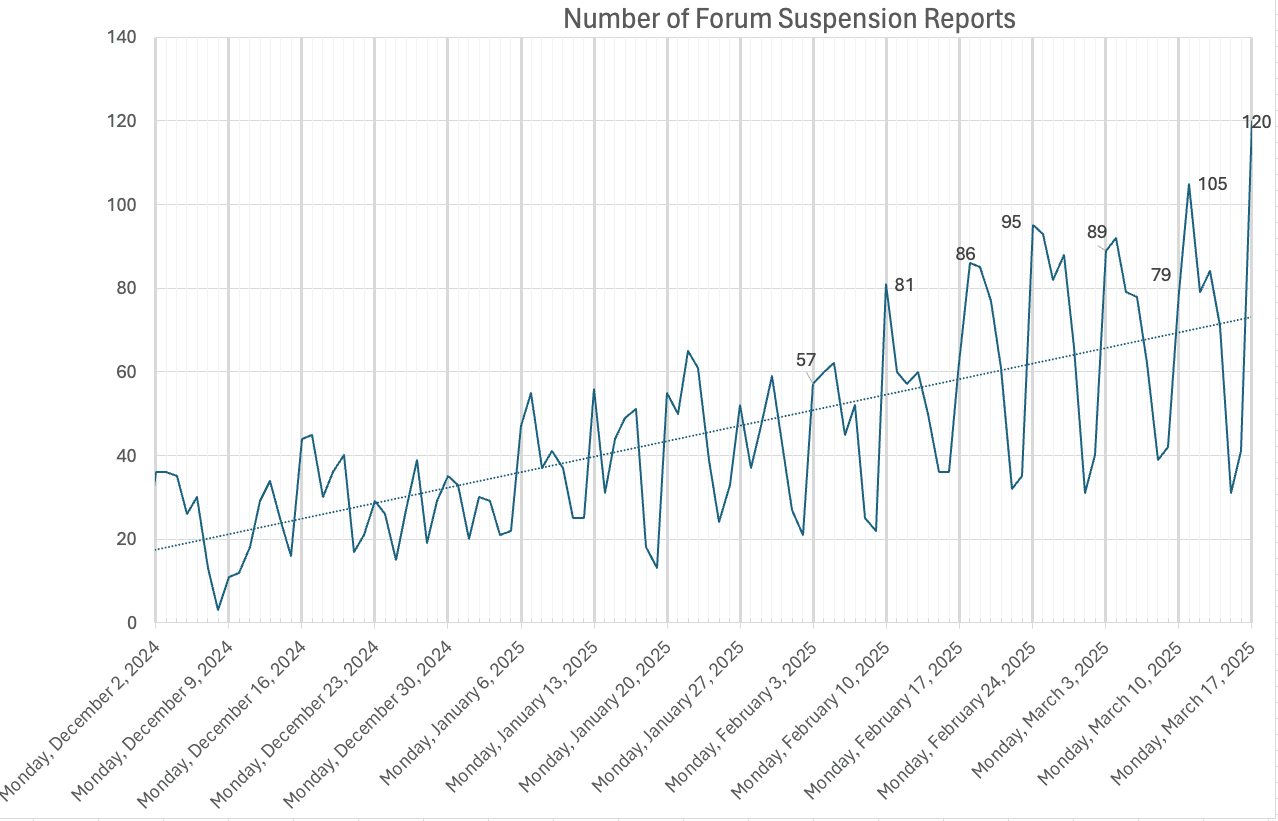
The weekly influx of these posts has not slowed. In fact, it’s accelerating.

Posts peak on either Mondays or Tuesdays, when business owners return to the office to deal with their suspensions and appeals.

You can see in the following chart that these daily high points and weekly totals continue to increase.

Image from author, March 2025

Why It’s Happening

Many others, who are managing local profiles, report an uptick in suspensions. The exact reason for this increase remains unclear.

As usual, Google has provided no explanation, despite overwhelming demand on both support channels and the forum.

When Google updates the algo, perhaps to increase trust in its listings, suspensions seem to be triggered – even when the user makes even minor changes to the profile.

Unfortunately, we do not yet know which attributes Google is finding unacceptable.

Google staffs their support for the “typical” level of suspensions. Appeals of those suspensions are handled by humans, and a suspension increase can cause the staff to get further and further behind.

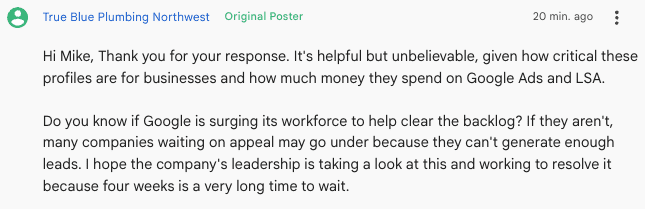
These delays contribute to some of the “noise” we are seeing in the forum. At this point, the appeal process is taking somewhere on the order of 4 weeks or more, not the ~5 days noted by Google.

Image from author, March 2025

Bulk & API Accounts Also Impacted

GBP Bulk and API accounts – where a single corporate account can add new locations in bulk, with minimal additional verification or change information – have been impacted as well.

Several bulk and API account managers report that individual listings within bulk and API accounts now require manual re-verification even after minor edits, creating massive headaches for the corporate marketing teams trying to re-verify a listing in Peoria.

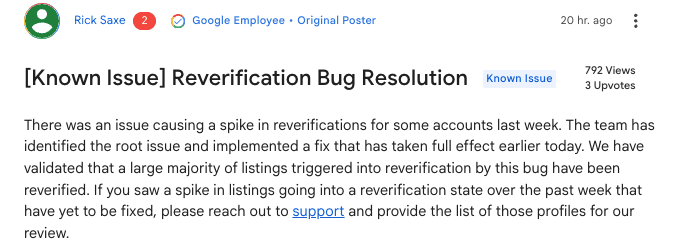
Late yesterday, Google confirmed the re-verification issues in a statement on the forum.

Our research indicates that the problem started much earlier than last week, and we are not convinced that the problem is yet solved.

Image from author, March 2025

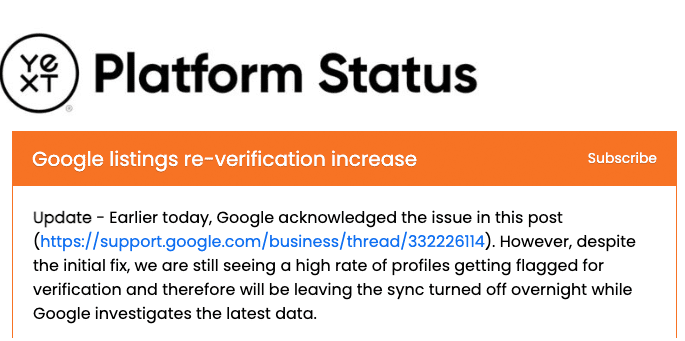
However, Yext was reporting continuing issues on their system update page.

Image from author, March 2025

Don’t Make Changes

We strongly advise not making any changes to your listing at this time.

It appears Google does not yet have a handle on whatever is causing the increase in suspensions and re-verifications.

It obviously doesn’t have a handle on dealing with the large number of appeals. Thus, if your listing gets suspended, you will experience significant delays in getting reinstated.

We recommend you pause making any changes to your individual, API-managed, and bulk listings, at least until Google clarifies the issues or, more importantly, until support addresses the appeals backlog.

More Resources:


Featured Image: voronaman/Shutterstock

Q2 SEO & AI Update: How To Track & Optimize AI Search Performance [Webinar] via @sejournal, @hethr_campbell

Are you ready to ensure your SEO tools deliver the most accurate, real-time data in 2025 and beyond?

With the constant evolution of Google’s search algorithms, staying ahead requires not just adapting to changes but anticipating them. Join us on March 27, 2025, for our in-depth webinar, “Q2 SEO & AI Update: How To Track & Optimize AI Search Performance,” where we’ll explore how SEO professionals and B2B companies can effectively navigate these changes.

In this session, you’ll learn:

  • SERP Data Accuracy: Why precise SERP data is essential for SEO success and strategic decision-making.
  • AI-Driven Search Impact: How AI is changing SEO tracking and the adaptive strategies you need to employ.
  • Evaluating SEO Data Providers: Key factors for assessing the reliability and long-term viability of your data sources.

Exclusive Insights from Industry Experts

Gain insights from Bright Data’s top specialists, who will share actionable strategies that you can implement immediately to keep your data accurate and powerful using APIs. Prepare for an enlightening discussion on adapting your strategies to leverage AI for enhanced SEO visibility.

Live Q&A: Get Your Questions Answered

The webinar concludes with a LIVE Q&A session, allowing you to ask our hosts about specific challenges and opportunities in optimizing for AI-enhanced SERPs.

Don’t Miss Out!

Prepare yourself for the future of SEO data collection and strategy with this powerful new webinar. Embrace the tools and knowledge necessary to dominate the new landscape of AI-driven search results.

Can’t attend live? No worries—register anyway, and we’ll send you the recording to ensure you don’t miss out on these crucial insights.

12 Of The Most Engaged Brands On Instagram via @sejournal, @donutcaramel13

For many verticals, Instagram should be an essential part of their digital marketing strategy to help grow their audience and their brand. With over 2 billion monthly active users, Instagram is a strong social media channel where brands can connect with their audience.

However, when building your following on Instagram, don’t fall into the trap of chasing numbers. Engagement counts.

Engagement is a much better measure of your brand’s impact. It tells us how well your content was received, how active your audience is, and how those interactions translate to conversions or loyalty.

We reviewed the engagement rates for some of the top brands on Instagram to see who is engaging their customers and not just shouting into a void.

To achieve engagement, the brands below aren’t just posting randomly or frequently – they’re leveraging storytelling, jumping on timely trends, and cultivating communities.

By the end of this article, you’ll have actionable insights and inspiration that could help your marketing team rethink how to connect with your customers on Instagram.

Note, the following brands are grouped by theme and not ordered by engagement rate*.

12 Brands & Their Winning Strategies On Instagram

Storytelling & Brand Identity

1. Nike (@nike)

  • Followers: Approximately 302 million.
  • Engagement Rate: 0.03% (While this seems low, this measurement is “average” given its massive number of followers, and the same goes for the big brands listed below.)
  • Average Likes: 103,000.
  • Target Audience: Millennials and Gen Z, aspiring athletes from all generations.

Nike’s bio – “You can’t win. So win.”– sets the tone for its entire Instagram presence, mixing in high black-and-white images and motivational quotes. Their Instagram posts feel like a tough but encouraging coach, pushing followers to strive for more.

This is all exemplified in their recent post: Nike teamed up with Grammy-award-winning rapper Doechii to voice their new mantra, featuring powerful women in various sports challenging what they’re told they can’t do and breaking free from societal expectations.

Meanwhile, high-energy neon colors bring sneaker shots to life. Nike is doing an awesome job inspiring its audience with its motivational content.

The flood of comments are jam-packed with flame emojis, trophies, and applause hands –  clearly shows the deep connection they’ve built with their audience. Their powerful messaging truly resonates and hits the mark.

2. McDonald’s (@mcdonalds)

  • Followers: 5.3 million.
  • Engagement Rate: 0.93%.
  • Average Likes: 49,000.
  • Target Audience: Fast-food lovers, Gen Z, Millennials, and nostalgia-driven consumers.

McDonald’s Instagram takes audiences straight back to the ’90s with its use of bright, bold colors, disposable camera-style photos, and the return of McDonaldLand characters.

Its strategy blends product promotion with collaborations with culturally relevant brands, like the Pokémon Happy Meal, to appeal to Millennials.

It also taps into present trends, using pop culture memes related to their fast-food staples, such as one referencing the iconic Kendrick vs. Drake rap battle.

Creating user-centric content – like polls, memes, quizzes, and teasers – for established brands like McDonald’s goes a long way.

With only 360 posts, it has an engagement rate of 0.93% in followers in the past month, averaging 882 comments per post.

This success isn’t just due to its fame but because it consistently produces simple yet engaging content that resonates with Gen Z and Millennials. Fast food brands can take a cue from McDonald’s.

User-Generated Content (UGC) & Community Building

3. GoPro (@gopro)

  • Followers: 20.8 million.
  • Engagement Rate: 0.07%
  • Average Likes: 14,800.
  • Target Audience: Adventure seekers, extreme sports athletes, and content creators.

It’s easy to see why GoPro has 20 million followers – their account is filled with immersive, adrenaline-pumping POV shots. But that’s not all.

By showcasing real user experience through UGC and contest giveaways, like its #GoProLineOfTheWinter winners’ post, the brand is engaging its audience of GoPro users and thrill-seekers while offering a clear demonstration of the product in action. And that is a strategy you can replicate for your product.

The blend of pro tips to sleek product shots, seamlessly tying in dynamic POV footage and photos from users against stunning landscapes drive genuine engagement with its audience – they’re genuinely excited, as shown in this product post of Go Pro Hero13 that received 8,000 comments.

Social media managers should remember to collaborate with, not against, their fans, rewarding their efforts and keeping corporate branding to a minimum.

4. Shopify (@shopify)

  • Followers: 1.6 million.
  • Engagement Rate: 0.08%
  • Average Likes: 1,012.
  • Target Audience: Ecommerce entrepreneurs, online business owners, and small business startups.

Shopify’s strategic use of blue, green, and yellow neon accents enhances its visually appealing feed. With carousel tutorials and reels featuring entrepreneurs, it caters to online shop owners who are short on time or frustrated potential business owners who lack motivation to finally open up shop.

The brand’s content is brief, educational, and conversational, like this post about their bundles’ feature, which generated over a thousand comments. It also regularly addresses topics that resonate with its audience, such as restocking issues, cart abandonment, and influencer collaborations.

Similar platforms could benefit from emulating Shopify’s optimistic branding on Instagram so that users are enticed to demo their products. Takeaway: clearly upbeat messaging not only attracts users to try your product but also builds a community of hopeful business owners.

5. Zendesk (@zendesk)

  • Followers: 46,000.
  • Engagement Rate: 0.36%
  • Average Likes: 160.
  • Target Audience: Customer service professionals/teams, small- to medium-sized businesses.

Zendesk’s Instagram feels like a small, welcoming community of customer service professionals. Each post feature a white text overlays that clearly introduce the topic, from customer success advice to thoughtful discussions on AI integration.

For example, posts about the “perfect service customer voice” or “ideal hold music” are conversational and approachable, helping build rapport with support professionals rather than focusing solely on product specs.

This approach fosters authentic connections and conversations, which could eventually lead to conversions, making its customer support-focused feed both useful and genuine.

SaaS brands would do well to take this humanized approach so they can demystify their technology while provide a safe space for their users, in this case, customer service pros and SMBs.

Humor & Relatable Content

6. Liquid Death (@liquiddeath)

  • Followers: 5.1 million.
  • Engagement Rate: 0.24%
  • Average Likes: 11,932.
  • Target Audience: Millennials, Gen Z, alternative lifestyle consumers.

Definitely standing out from the crowd, Liquid Death feels more like a heavy metal band than a beverage company.

While it may seem like an alcohol brand at first glance, its non-alcoholic drinks carve out a unique niche as an alternative to mainstream alcohol and sugary iced teas.

On Instagram, the brand embraces edgy aesthetics, featuring metallic gold accents, dark colors, and bold typefaces.

Its brash, in-your-face marketing strategy drives engagement – evidenced by its collaboration with The Deep (from Amazon’s The Boys), which racked up 24,000 comments.

Since launching in 2019 in the highly competitive F&B space, Liquid Death has skyrocketed in popularity thanks to its clever, viral marketing – amassing millions of views on TikTok and tens of thousands on YouTube  – proof that unconventional approaches can engage and create new communities, too.

For marketers building new brands or even existing ones, this is proof that unconventional strategies can work, especially when tailored for specific social media platforms.

The key is ensuring brand identity translates seamlessly across channels without sacrificing originality, so don’t be afraid to brainstorm “refreshing” ideas with your marketing team.

7. Duolingo (@duolingo)

  • Followers: 4.2 million.
  • Engagement Rate: 7.14%
  • Average Likes: 316,000.
  • Target Audience: Foreign language students, meme lovers, and Gen Z.

Educational technology need not be boring, and Duolingo’s Instagram page is anything but. It has capitalized on how users have a love-hate relationship with Duo, its ubiquitous green owl mascot, and its endless reminders to take their next language lesson. And so it has ‘killed’ er, announced the bird is dead.

With posts full of Gen Z/Millennial humor and commentary on current trends, it manages to keep a very high engagement rate (the highest on this list as seen above and a whopping 265% increase in followers in the past month), and yet still reminds everyone to use the app and continue the learning process.

According to Meme Marketing: Generation Z Consumer Behavior on Social Media,

Successful and viral memes should match their interests and values, such as entertainment, informative, trendrelevant, and reflect the unique characteristics of techoriented, innovative, curious Generation Z.”

Social media managers of EdTech should learn to speak the slang of their target audience on Instagram as it works. Overall, playful content with cultural memes and trending events mixed with education connects with younger, digital natives – use memes to your advantage to increase your brand awareness.

8. Ryanair (@ryanair)

  • Followers: 1.6 million.
  • Engagement Rate: 0.16%
  • Average Likes: 2,500.
  • Target Audience: Budget travelers, frequent flyers, and meme culture enthusiasts.

Ryanair’s Instagram bio reads, “Catch flights, not feelings with Europe’s favorite airline.” It perfectly sums up its brand and sets the tone for the entire page – meaning it is not afraid to poke fun at its audience.

It posts hilarious short videos, and every post to the left on its grid features a relatable flying meme in its signature royal blue branded template.

Once in a while, it mixes in stunning bird’s-eye shots of exotic locales. It also caters directly to budget travelers with frequent flight deals and announcements.

Budget travel apps and sites should take note: Knowing your target audience and tailoring your messaging, whether funny or serious, is key. They switch between funny and practical content without losing their brand personality.

Ryanair’s Instagram works because it has mastered content that resonates with budget travelers who just want to be entertained and at the same time, pick up useful travel info.

Influencer & Partnership Strategies

9. Vans (@vans)

  • Followers: 16 million.
  • Engagement Rate: 0.06%
  • Average Likes: 10,000.
  • Target Audience: Skateboarders, streetwear fans, and music culture enthusiasts.

Vans appeals to various groups of people around the world as a lifestyle choice instead of just a shoe brand.

Loyal fans flock to its page to check if old favorites have been restocked. Fashion brands managers, you should take note of showcasing your brand as a lifestyle for and in order for this strategy to work, carefully choose collaborations that represent their target audience.

Its success on Instagram is partly due to strategic collaborations with musicians like The Paranoyds and rising club DJs for the brand’s Premium Old Skool Music Collection, which features a bold leopard print.

It also collaborates on shoe designs with skaters, surfers, and athletes, like the Skate Old Skool 36+ featuring Olympic athlete Zion Wright.

Vans mixes grainy, quirky product shots with lifestyle imagery and behind-the-scenes takes that make viewers feel like they’re part of the club.

It has done this over the past decade, yet this strategy still works to engage people subconsciously, with seemingly low-effort content, but the charm takes some effort to pull off.

10. Red Bull (@redbull)

  • Followers: 26 million.
  • Engagement Rate: 0.33%
  • Average Likes: 85,000.
  • Target Audience: Extreme sports fans, adventure seekers, and adrenaline junkies.

As expected from the world-famous energy drink, Red Bull’s Instagram is packed with adrenaline.

Case in point: multi-gold-winning bike athlete David Godziek riding on top of a moving train! This is just another day for the brand, as it has featured Adam Snosler jumping his snowmobile over a bus.

Red Bull’s Instagram showcases jaw-dropping feats by legendary athletes doing the seemingly impossible, with nearly every post being a collaboration.

Like Vans, Red Bull highlights a wide range of sports and stunts – on foot, two wheels, or four – and is also well-known for its F1 team, Oracle Red Bull Racing, with some posts dedicated to pushing speed boundaries.

This strategy ties in perfectly with Red Bull’s unique selling point and sparks engagement from fans, who fill the comments with witty jokes, like in this skydiving post.

Between these stunt posts, it mixes in product updates, like new flavors or pop quizzes. It’s a great example of sticking to what works, showcasing what your product is known for, and expanding your talent network to appeal to an energetic audience.

Stunning Visuals & Interactive Content

11. The Sill (@thesill)

  • Followers: 734 million.
  • Engagement Rate: 0.08%
  • Average Likes: 551.
  • Target Audience: Houseplant lovers, home decor enthusiasts, and young professionals.

Like their logo, The Sill’s Instagram page feels balanced, featuring eye-catching florals, lush greenery, and elegant, cozy home gardens.

Its branding is strong across the board, with posts highlighting its online shop – like this carousel of a red-and-pink pigmented plant shaped like a heart as part of its Valentine’s Day offering. Scroll past the first image and you’ll see multiple close up slots of violet-tinged leaves and flowers – it simulates receiving a bouquet of flowers and admiring them individually, making it creative.

How do you want your brand to come across? What do you want your customers to feel when they check out your page – energized or relaxed?

Every picture on The Sill evokes warmth, sunshine, and various shades of green.

To ensure customers enjoy visiting their page, social media managers of small brands should prioritize high-quality visuals over stock images. Don’t scrimp on the budget for creative shoots. Invest in them and over time, your Instagram page can evoke a soothing atmosphere, too.

Especially for B2Cs, whatever your brand sells, showcasing it beautifully on Instagram with a mix of close-ups, overviews, and short videos is key to maintaining engagement and awareness.

12. National Geographic (@natgeo)

  • Followers: 279 million.
  • Engagement Rate: 0.03%
  • Average Likes: 84,500.
  • Target Audience: Nature lovers, photographers, and educational content consumers.

Wildlife content takes the spotlight on National Geographic’s Instagram, with every other post featuring fun facts about animals, the environment, or notable figures.

For example, this post about first-documented encounter with a deep sea fish: the black seadevil is accompanied by detailed scientific descriptions. The same goes for this listicle of five fun fact about female samurai, featuring colorful drawings and well-placed image captions with arrows to help accessibility.

While lengthy, it effectively engages users in the comments section, who share their knowledge and opinions about the subject.

This works because Nat Geo’s audience enjoys exploring and learning about the world. There’s no need to brand every post, but the subtle use of a yellow rectangle and yellow font helps viewers recognize the brand.

Media and publishing companies can thrive on social media, using it not just for entertainment but also as an educational platform for consumers who may not watch TV.

Continue adapting your documentaries, interviews, and more into digestible formats on social media. Make every post as accessible as you can for viewers of all ages and grow your page into an educational hub where people foster learning from each other in the comments section.

Level Up Your Instagram Strategy This 2025

While you can emulate these brands above, true engagement will always come from your brand’s authenticity.

Maintain authenticity by being clear with your brand identity and values.

Engaging content is possible in any niche, whether B2B SaaS, multinational food & beverage, travel, or education.

Even topics that Gen Z might find boring can be turned into bite-sized, entertaining formats, and austere-sounding brands can still humanize their content by partnering with the right influencer.

Staying in tune with trends, including key U.S. holidays and events, and short-form video formats, whilst layering in your brand identity and messaging can help.

When done right, creating content that resonates with your audience will result in genuine interactions and thoughtful engagement.

*All stats above are taken from Social Blade but the engagement rate has different benchmarks depending on the industry, so the order is not a comparable measure for all the engagement rates above. According to the 2024 Social Media Industry Benchmark Report from Rival IQ, 0.43% is the median engagement raacross all industries.

More Resources:


Featured Image: Roman Samborskyi/Shutterstock

The elephant in the room for energy tech? Uncertainty.

At a conference dedicated to energy technology that I attended this week, I noticed an outward attitude of optimism and excitement. But it’s hard to miss the current of uncertainty just underneath. 

The ARPA-E Energy Innovation Summit, held this year just outside Washington, DC, gathers some of the most cutting-edge innovators working on everything from next-generation batteries to plants that can mine for metals. Researchers whose projects have received funding from ARPA-E—part of the US Department of Energy that gives money to high-risk research in energy—gather to show their results and mingle with each other, investors, and nosy journalists like yours truly. (For more on a few of the coolest things I saw, check out this story.)

This year, though, there was an elephant in the room, and it’s the current state of the US federal government. Or maybe it’s climate change? In any case, the vibes were weird. 

The last time I was at this conference, two years ago, climate change was a constant refrain on stage and in conversations. The central question was undoubtedly: How do we decarbonize, generate energy, and run our lives without relying on polluting fossil fuels? 

This time around, I didn’t hear the phrase “climate change” once during the opening session, which included speeches from US Secretary of Energy Chris Wright and acting ARPA-E director Daniel Cunningham. The focus was on American energy dominance—on how we can get our hands on more, more, more energy to meet growing demand. 

Last week, Wright spoke at an energy conference in Houston and had a lot to say about climate, calling climate change a “side effect of building the modern world” and climate policies irrational and quasi-religious, and he said that when it came to climate action, the cure had become worse than the disease

I was anticipating similar talking points at the summit, but this week, climate change hardly got a mention.

What I noticed in Wright’s speech and in the choice of programming throughout the conference is that some technologies appear to be among the favored, and others are decidedly less prominent. Nuclear power and fusion were definitely on the “in” list. There was a nuclear panel in the opening session, and in his remarks Wright called out companies like Commonwealth Fusion Systems and Zap Energy. He also praised small modular reactors

Renewables, including wind and solar, were mentioned only in the context of their inconsistency—Wright dwelled on that, rather than on other facts I’d argue are just as important, like that they are among the cheapest methods of generating electricity today. 

In any case, Wright seemed appropriately hyped about energy, given his role in the administration. “Call me biased, but I think there’s no more impactful place to work in than energy,” he said during his opening remarks on the first morning of the summit. He sang the praises of energy innovation, calling it a tool to drive progress, and outlined his long career in the field. 

This all comes after a chaotic couple of months for the federal government that are undoubtedly affecting the industry. Mass layoffs have hit federal agencies, including the Department of Energy. President Donald Trump very quickly tried to freeze spending from the Inflation Reduction Act, which includes tax credits and other support for EVs and power plants. 

As I walked around the showcase and chatted with experts over coffee, I heard a range of reactions to the opening session and feelings about this moment for the energy sector. 

People working in industries the Trump administration seems to favor, like nuclear energy, tended to be more positive. Some in academia who rely on federal grants to fund their work were particularly nervous about what comes next. One researcher refused to talk to me when I said I was a journalist. In response to my questions about why they weren’t able to discuss the technology on display at their booth, another member on the same project said only that it’s a wild time.

Making progress on energy technology doesn’t require that we all agree on exactly why we’re doing it. But in a moment when we need all the low-carbon technologies we can get to address climate change—a problem scientists overwhelmingly agree is a threat to our planet—I find it frustrating that politics can create such a chilling effect in some sectors. 

At the conference, I listened to smart researchers talk about their work. I saw fascinating products and demonstrations, and I’m still optimistic about where energy can go. But I also worry that uncertainty about the future of research and government support for emerging technologies will leave some valuable innovations in the dust. 

This article is from The Spark, MIT Technology Review’s weekly climate newsletter. To receive it in your inbox every Wednesday, sign up here.

The Download: the future of energy, and chatting about chatbots

This is today’s edition of The Download, our weekday newsletter that provides a daily dose of what’s going on in the world of technology.

4 technologies that could power the future of energy

Where can you find lasers, electric guitars, and racks full of novel batteries, all in the same giant room? This week, the answer was the 2025 ARPA-E Energy Innovation Summit just outside Washington, DC.

Energy innovation can take many forms, and the variety in energy research was on display at the summit. ARPA-E, part of the US Department of Energy, provides funding for high-risk, high-reward research projects. The summit gathers projects the agency has funded, along with investors, policymakers, and journalists.

Hundreds of projects were exhibited in a massive hall during the conference, featuring demonstrations and research results. Here are four of the most interesting innovations MIT Technology Review spotted on site. Read the full story.

—Casey Crownhart

If you’re interested in hearing more about what Casey learnt from the ARPA-E Energy Innovation Summit, check out the latest edition of The Spark, our weekly climate and energy newsletter. Sign up to receive it in your inbox every Wednesday.

Join us today to chat about chatbots

Chatbots are changing how we connect to each other and ourselves. But are these changes for the better, and how should they be monitored and regulated?

To learn more, join me for a live Roundtable session today at 12pm ET. I’ll be chatting with MIT Technology Review editor Rachel Courtland and senior reporter Eileen Guo, and we’ll be unpacking the landscape around chatbots. Register to ensure you don’t miss out!

The must-reads

I’ve combed the internet to find you today’s most fun/important/scary/fascinating stories about technology.

1 A French scientist was denied US entry over anti-Donald Trump messages 
US authorities claimed the exchanges criticising the Trump administration’s research policy qualified as terrorism. (Le Monde)
+ France’s research minister is a high-profile critic of Trump policy. (The Guardian)
+ Customs and Border Protection is cracking down at airports across the US. (The Verge)

2 RFK Jr wants to let bird flu spread through poultry farms
Experts warn that this approach isn’t just dangerous—it won’t work. (Scientific American $)
+ A bird flu outbreak has been confirmed in Scotland. (BBC)
+ How the US is preparing for a potential bird flu pandemic. (MIT Technology Review)

3 Clearview AI tried to buy millions of mugshots for its databases
But negotiations between the facial recognition company and an intelligence firm broke down. (404 Media)

4 Top US graduates are desperate to work for Chinese AI startups
DeepSeek’s success has sparked major interest in firms outside America. (Bloomberg $)
+ Four Chinese AI startups to watch beyond DeepSeek. (MIT Technology Review)

5 Reddit has become a lifeline for US federal workers
Unpaid moderators are working around the clock to help answer urgent questions. (NYT $)
+ The only two democrats on the board of the FTC have been fired. (Vox)
+ Elon Musk, DOGE, and the Evil Housekeeper Problem. (MIT Technology Review)

6 The European Commission is targeting Apple and Google
It’s proceeding with regulatory action, despite the risk of retaliation from Trump. (FT $)
+ It has accused Alphabet of favoring its own services in search results. (The Information $)
+ Meta’s AI chatbot is finally launching in Europe after all. (The Verge)

7 AI agents could spell bad news for shopping apps
DoorDash and Uber could suffer if humans outsource their ordering to bots. (The Information $)
+ Dunzo was a major delivery success story in India. So what happened? (Rest of World)
+ Your most important customer may be AI. (MIT Technology Review)

8 This startup is making concrete using CO2
It combines the gas with a byproduct from coal power plants to make lower carbon concrete. (Fast Company $)
+ How electricity could help tackle a surprising climate villain. (MIT Technology Review)

9 This robot dog has a functional digital nervous system
And will be taught to walk by a real human dog trainer, not an algorithm. (Reuters)

10 Dark matter could be getting weaker
If it’s true, it holds major implications for our understanding of the universe. (Quanta Magazine)
+ Are we alone in the universe? (MIT Technology Review)

Quote of the day

“The corrupting influence of billionaires in law enforcement is an issue that affects all of us.”

—Alvaro Bedoya, a former commissioner at the Federal Trade Commission, speaks out after being fired by Donald Trump, the Verge reports.

The big story

The arrhythmia of our current age

October 2025

Arrhythmia means the heart beats, but not in proper time—a critical rhythm of life suddenly going rogue and unpredictable. It’s frightening to experience, but what if it’s also a good metaphor for our current times? That a pulse once seemingly so steady is now less sure. 

Perhaps this wobbliness might be extrapolated into a broader sense of life in the 2020s. 

Maybe you feel it, too—that the world seems to have skipped more than a beat or two as demagogues rant and democracy shudders, hurricanes rage, and glaciers dissolve. We can’t stop watching tiny screens where influencers pitch products we don’t need alongside news about senseless wars that destroy, murder, and maim tens-of-thousands. 

All the resulting anxiety has been hard on our hearts—literally and metaphorically. Read the full story.

—David Ewing Duncan

We can still have nice things

A place for comfort, fun and distraction to brighten up your day. (Got any ideas? Drop me a line or skeet ’em at me.)

+ Now that David Lynch is no longer with us, who is the flagbearer for transcendental meditation?+ Who doesn’t love a little mindless comedy—especially when Leslie Nielsen is involved.
+ China’s pets are seriously pampered ($)
+ The world’s oldest known cerapodan dinosaur, which were massive herbivores, has been discovered in Morocco.