AI & SEO-Driven Content Marketing: How To Calculate True ROI for B2B Companies in 2025

This post was sponsored by Heeet. The opinions expressed in this article are the sponsor’s own.

How do you calculate the true cost of SEO content production?

Are you overspending or underspending on SEO compared to performance?

Can you connect SEO-driven awareness to pipeline and revenue?

How do you make SEO efforts more visible to your C-suite?

If you aren’t sure, that’s okay.

You may simply lack the tools to measure the actual impact of SEO on revenue.

So, let’s dive in and:

  • Break down the true steps to B2B conversion.
  • Highlight the tools to calculate the true ROI of your SEO-driven content in 2025.
  • Look past the simplified first and last-touch approach to attribution.
  • Leverage the need for multitouch solutions that track engagement with SEO content throughout the buyer’s journey.

Can I Connect SEO To Revenue?

Yes, you can connect SEO to revenue.

Why Should I Connect SEO To Revenue?

SEO plays a large role in future conversions.

In fact, SEO helps prospects discover your brand, tool, or company.

SEO also helps provide easy-to-discover content with informational intent, which helps to nurture a prospective lead into a sale.

Your prospect’s journey:

  1. Starts at the first time they find your optimized webpage on the search engine results page (SERP).
  2. Moves into nurture, where your B2B prospects typically perform months of extensive product research via traditional searches and AI results before a sale is closed.

The fact that informative content is found on SERPs is due to SEO.

But how is this tracked? How do you know which non-conversion pages are:

  • Part of the user journey?
  • Part of the overall ROI?

How Do I Tie SEO To Company Revenue?

Luckily, your C-suite likely recognizes the need for SEO content.

They are prepared to invest in a strategy incorporating AI search.

However, you need tools that validate the investment and clearly showcase it for your higher-ups.

How To Keep Revenue High When SERPs Are Changing

Gartner predicts that traditional search engine volume will drop 25% by 2026 and flow directly to AI chatbots and agents.

As AI continues to accelerate the evolution of SEO, it’s critical to ensure that high-performing pages:

  • Continue to rank in traditional SERPs.
  • Appear in Google’s AI overviews.
  • Get referenced by the Gen AI tools your audience relies on.
  • They are tracked, so these visits are attributed to a sale.

That’s why you need to understand why certain content is picked up by AI tools and the cost of generating the content to calculate the true ROI of your SEO.

Step 1. How To Create Content That Gets Seen In Traditional Search & AI Overviews

With the shift in consumer search behavior, your first step is to create, optimize, and measure the ROI of content sourced by leading AI tools.

That means appearing in AI Overviews and AI Answers that contain list-based content and product comparisons.

Search Your Brand & See What Each AI Tool Recommends

That’s the first step to determining whether your content or your competitor’s stands out.

Give these prompts a try:

  • What is the best solution for…
  • Give me the top tools for…
  • Best alternative to…
  • Is [competitor] solution better than…

Optimize Your Existing Content & Strategy To Feed AI’s Answer Base

The next step is optimizing existing content and adjusting your strategy so that you write copy that gives AI the answers it’s looking for.

With that said, following traditional SEO strategies and best practices championed by Google should help.

Just like traditional search, AI tools also favor:

  • Proper site and article structure with explicit metadata and semantic markup.
  • Content with lists and bullet points that are easier to scan.
  • Websites optimized for speed.
  • Updated content, keeping things fresh with context.
  • Content with backlinks from high-quality publications.
  • FAQ sections.
  • Mobile-responsive websites with indexable content when pulling sources to provide an answer.

These factors give your content more authority in your industry, just like the content outside your website that Google and LLMs look for to find answers from, such as videos on YouTube, reviews on G2, and conversations on Reddit forums.

Publishing enough quality content for all those channels to optimize for AI and be visible in traditional search is no small task. It requires substantial human resources, SEO tools, and time.

Step 2. Understand All Aspects Of The Real Cost Of SEO Content In 2025

SEO is a long game, especially in B2B, where the path from first click to purchase can span weeks or months and involve multiple touchpoints.

And now, with AI influencing how content is discovered, the cost of doing SEO well has increased.

To accurately assess the cost of SEO-driven content in 2025, you need to go beyond production budgets and organic traffic. Here’s how:

Break Down Your True SEO Investment

Start by identifying all the resources that go into content creation and maintenance:

  • People: Writers, designers, SEOs, developers, and editors.
  • Tools: SEO platforms, content optimization tools, keyword research databases, analytics software.
  • Distribution: Paid support for SEO content, social promotion, and email newsletters.
  • Maintenance: Refreshing old content, updating links, and improving page experience.

Monitor Content Performance Over Time

Track the performance of each piece of content using more than just rankings:

  • Organic traffic (from both traditional search and AI surfaces).
  • Time on page and engagement metrics.
  • Cost per lead and pipeline contribution (if possible).
  • Assisted conversions across all touchpoints.

Map Content to Buyer Journey Stages

Content doesn’t just convert, it nurtures. Tie content assets to specific stages:

  • Top-of-funnel (education, discovery).
  • Mid-funnel (comparison, product evaluation).
  • Bottom-of-funnel (case studies, demos).

Even if content isn’t the final touchpoint, it plays a role. Traditional tools miss this.

Adjust, Monitor & Pivot

No single metric will tell the full story. Instead:

  • Adjust: Re-optimize content based on AI overview visibility, CTR, and engagement.
  • Monitor: Watch how users arrive from search vs. AI sources.
  • Pivot: Invest more in formats and topics that show traction across both human and AI audiences.

Without full-funnel attribution, even the most engaged content may look like a cost center instead of a revenue driver.

That’s why accurate measurement, aligned with total investment and the full buyer journey, is critical to understanding the real ROI of your SEO content in 2025.

However, we know that:

  • AI Overviews and similar answer engines also play a big role in education and nurturing.
  • Attributing a sale to content read on an untrackable AI Overview is impossible, but it’s happening.

This is where the calculation gets difficult.

Step 3. Incorporate Multi-Touch Attribution To Your Revenue Calculations

Now that we’re here, you’re beginning to understand how tricky it is to tie ROI to AI Overview responses that nurture your prospects.

How do you accurately determine the cost?

Some people are creating their own attribution models to calculate ROI.

Most people are using tools that are built specifically for this new calculation.

The only way to accurately calculate cost in B2B SEO is to capture the engagement with content throughout the buyer journey, which conventional attribution models don’t credit.

Incorporate These Blindspots: Pre-Acquisition & The Post-Lead Journey

Another substantial blind spot in SEO measurement occurs when companies focus exclusively on pre-acquisition activities, meaning everything that happens before a lead is added to your CRM.

Consider the typical journey enterprise clients take in an account-based marketing approach:

  1. After multiple organic searches, a prospect converts into a lead from direct traffic.
  2. After being qualified as an SQL, they’re included in an email sequence that they never respond to, but return through a Google Ads campaign promoting a white paper.
  3. They download it from an organic search visit and continue reading more blog articles to understand your product and the outcomes they hope to achieve.

Can your marketing team track how each channel (direct, paid search, and organic) influenced the deal throughout the sales process?

Multitouch attribution tools allow marketers to finally link SEO content to tangible business outcomes by tracking what SEO-driven content leads interacted with before a sale.

Heeet Makes SEO ROI Calculations Easy

After years of wrestling with these challenges, we built Heeet to fill the void: an end-to-end attribution solution that connects SEO efforts and interactions generated from content marketing to revenue by highlighting their impact throughout the sales cycle within Salesforce.

Our proprietary cookieless tracking solution collects more data, ensuring your decisions are based on complete, unbiased insights rather than partial or skewed information.

Traditional SEO measurement often relies on first-click or last-click attribution, which fails to capture SEO’s entire influence on revenue. Heeet places SEO on a level playing field by providing full-funnel attribution that tracks SEO’s impact at every customer journey stage.

We help marketers determine whether SEO-driven content is the first touchpoint, one of the many intermediary interactions along the lengthy B2B sales cycle, or the final conversion leading to a sale to pinpoint SEO’s cumulative influence on your pipeline.

Screenshot from Google, April 2025

Heeet actively tracks every touchpoint, ensuring that the actual impact of SEO is neither underestimated nor misrepresented.

Rather than neglecting SEO’s role when a prospect converts through another channel, Heeet delivers a complete view of how different personas in the buying committee interact with each piece of content and where they’re converting. This empowers businesses to make informed, data-driven SEO strategies and investment decisions.

Screenshot from Heeet, April 2025

Measuring ROI is non-negotiable and hinges on precise revenue tracking and a thorough understanding of costs. Heeet streamlines this process by directly integrating SEO costs into Salesforce, covering all production expenses such as software, human resources, design, and other strategic investments.

Screenshot from Heeet, April 2025

Businesses can accurately evaluate SEO profitability by linking these costs to SEO-driven revenue. Heeet delivers a straightforward, unified view of previously fragmented data within Salesforce, empowering marketing and finance teams to confidently assess SEO ROI with a single tool.

Screenshot from Heeet, April 2025

SEO is more than ranking on Google; it’s about driving impactful engagement with quality content referenced in the multiple search tools buyers use. Heeet tracks which content prospects engage with and ties it directly to revenue outcomes, providing marketing and sales teams with critical insights that propel them forward. With our Google Search Console integration, we’re helping marketers draw more data into Salesforce to get the unified view of their content’s performance in a single place and connect search intents with business outcomes (leads, converted leads, revenue,…). This enables marketers to align ranking position with search intent and revenue, enhancing content strategy and tracking performance over time.

Screenshot from Heeet, April 2025

For B2B marketers pairing their SEO content with a paid strategy, our latest Google Ads update allows users to see the exact search query that prospects typed before clicking on a search result. This allows SEO experts and copywriters to gain the intel they need to reduce their cost per lead by creating content they know their audience is searching for.

Screenshot from Heeet, April 2025

Ready to enhance your marketing ROI tracking and connect every marketing activity to revenue?

From SEO to events, paid ads, social organic, AI referrals, webinars, and social ads, Heeet helps you uncover the real performance of your marketing efforts and turn revenue data into actionable insights.


Image Credits

Featured Image: Image by Shutterstock. Used with permission.

In-Post Image: Images by Heeet. Used with permission.

DOGE’s tech takeover threatens the safety and stability of our critical data

Tech buzzwords are clanging through the halls of Washington, DC. The Trump administration has promised to “leverage blockchain technology” to reorganize the US Agency for International Development, and Elon Musk’s DOGE has already unleashed an internal chatbot to automate agency tasks—with bigger plans on the horizon to take over for laid-off employees. The executive order that created DOGE in the first place claims the agency intends to “modernize Federal technology and software.” But jamming hyped-up tech into government workflows isn’t a formula for efficiency. Successful, safe civic tech requires a human-centered approach that understands and respects the needs of citizens. Unfortunately, this administration laid off all the federal workers with the know-how for that—seasoned design and technology professionals, many of whom left careers in the private sector to serve their government and compatriots.

What’s going on now is not unconventional swashbuckling—it’s wild incompetence. Musk may have run plenty of tech companies, but building technology for government is an entirely different beast. If this administration doesn’t change its approach soon, American citizens are going to suffer far more than they probably realize.

Many may wince remembering the rollout of Healthcare.gov under the Obama administration. Following passage of the Affordable Care Act, Healthcare.gov launched in October of 2013 to facilitate the anticipated wave of insurance signups. But enormous demand famously took down the website two hours after launch. On that first day, only six people were able to complete the registration process. In the wake of the mess, the administration formed the US Digital Service (USDS) and 18F, the digital services office of the General Services Administration. These agencies—the ones now dismantled at the hands of DOGE—pulled experienced technologists from industry to improve critical infrastructure across the federal government, including the Social Security Administration and Veterans Affairs. 

Over the last decade, USDS and 18F have worked to build safe, accessible, and secure infrastructure for the people of the United States. DirectFile, the free digital tax filing system that the IRS launched last year, emerged from years of careful research, design, and engineering and a thoughtful, multi-staged release. As a result, 90% of people who used DirectFile and responded to a survey said their experience was excellent or above average, and 86% reported that DirectFile increased their trust in the IRS. Recently, Sam Corcos, a DOGE engineer, told IRS employees he plans to kill the program. When 21 experienced technologists quit their jobs at USDS in January after their colleagues were let go, they weren’t objecting on political grounds. Rather, they preferred to quit rather than “compromise core government services” under DOGE, whose orders are incompatible with USDS’s original mission.

As DOGE bulldozes through technological systems, firewalls between government agencies are collapsing and the floodgates are open for data-sharing disasters that will affect everyone. For example, the decision to give Immigration and Customs Enforcement access to IRS data and to databases of unaccompanied minors creates immediate dangers for immigrants, regardless of their legal status. And it threatens everyone else, albeit perhaps less imminently, as every American’s Social Security number, tax returns, benefits, and health-care records are agglomerated into one massive, poorly secured data pool. 

That’s not just speculation. We’ve already seen how data breaches at companies like Equifax can expose the sensitive information of hundreds of millions of people. Now imagine those same risks with all your government data, managed by a small crew of DOGE workers without a hint of institutional knowledge between them. 

Making data sets speak to each other is one of the most difficult technological challenges out there. Anyone who has ever had to migrate from one CRM system to another knows how easy it is to lose data in the process. Centralization of data is on the administration’s agenda—and will more than likely involve the help of contracting tech companies. Giants like Palantir have built entire business models around integrating government data for surveillance, and they stand to profit enormously from DOGE’s dismantling of privacy protections. This is the playbook: Gut public infrastructure, pay private companies millions to rebuild it, and then grant those companies unprecedented access to our data. 

DOGE is also coming for COBOL, a programming language that the entire infrastructure of the Social Security Administration is built on. According to reporting by Wired, DOGE plans to rebuild that system from the ground up in mere months—even though the SSA itself estimated that a project like that would take five years. The difference in those timelines isn’t due to efficiency or ingenuity; it’s the audacity of naïveté and negligence. If something goes wrong, more than 65 million people in the US currently receiving Social Security benefits will feel it where it hurts. Any delay in a Social Security payment can mean the difference between paying rent and facing eviction, affording medication or food and going without. 

There are so many alarms to ring about the actions of this administration, but the damage to essential technical infrastructure may be one of the effects with the longest tails. Once these systems are gutted and these firewalls are down, it could take years or even decades to put the pieces back together from a technical standpoint. And since the administration has laid off the in-house experts who did the important and meticulous work of truly modernizing government technology, who will be around to clean up the mess?  

Last month, an 83-year-old pastor in hospice care summoned her strength to sue this administration over its gutting of the Consumer Financial Protection Bureau, and we can follow her example. Former federal tech workers have both the knowledge and the legal standing to challenge these reckless tech initiatives. And everyday Americans who rely on government services, which is all of us, have a stake in this fight. Support the lawyers challenging DOGE’s tech takeover, document and report any failures you encounter in government systems, and demand that your representatives hold hearings on what’s happening to our digital infrastructure. It may soon be too late.

Steven Renderos is the executive director of Media Justice.

Correction: Due to a CMS error, this article was originally published with an incorrect byline. Steven Renderos is the author.

A vision for the future of automation

The manufacturing industry is at a crossroads: Geopolitical instability is fracturing supply chains from the Suez to Shenzhen, impacting the flow of materials. Businesses are battling rising costs and inflation, coupled with a shrinking labor force, with more than half a million unfilled manufacturing jobs in the U.S. alone. And climate change is further intensifying the pressure, with more frequent extreme weather events and tightening environmental regulations forcing companies to rethink how they operate. New solutions are imperative.

Meanwhile, advanced automation, powered by the convergence of emerging and established technologies, including industrial AI, digital twins, the internet of things (IoT), and advanced robotics, promises greater resilience, flexibility, sustainability, and efficiency for industry. Individual success stories have demonstrated the transformative power of these technologies, providing examples of AI-driven predictive maintenance reducing downtime by up to 50%. Digital twin simulations can significantly reduce time to market, and bring environment dividends, too: One survey found 77% of leaders expect digital twins to reduce carbon emissions by 15% on average.

Yet, broad adoption of this advanced automation has lagged. “That’s not necessarily or just a technology gap,” says John Hart, professor of mechanical engineering and director of the Center for Advanced Production Technologies at MIT. “It relates to workforce capabilities and financial commitments and risk required.” For small and medium enterprises, and those with brownfield sites—older facilities with legacy systems— the barriers to implementation are significant.

In recent years, governments have stepped in to accelerate industrial progress. Through a revival of industrial policies, governments are incentivizing high-tech manufacturing, re-localizing critical production processes, and reducing reliance on fragile global supply chains.

All these developments converge in a key moment for manufacturing. The external pressures on the industry—met with technological progress and these new political incentives—may finally enable the shift toward advanced automation.

Download the full report.

This content was produced by Insights, the custom content arm of MIT Technology Review. It was not written by MIT Technology Review’s editorial staff.

This content was researched, designed, and written entirely by human writers, editors, analysts, and illustrators. This includes the writing of surveys and collection of data for surveys. AI tools that may have been used were limited to secondary production processes that passed thorough human review.

How to Track ChatGPT Traffic in GA4

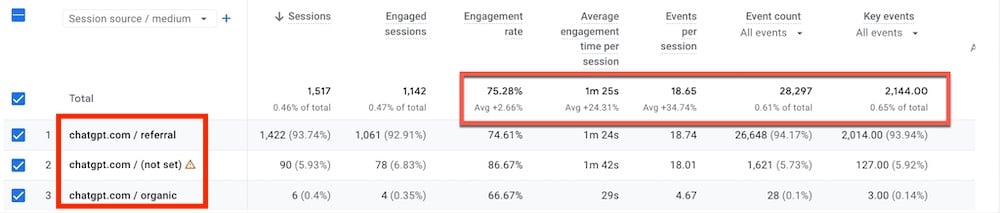
ChatGPT is becoming a valuable traffic source. It may not appear in a Google Analytics overview because the volume is small, but ChatGPT traffic is often the most engaging source, even more than organic search.

I base those observations on my experience optimizing client sites for AI answers.

Screenshot of GA report showing engagement for ChatGPT traffic.

ChatGPT traffic is often the most engaging, per Google Analytics. Click image to enlarge.

I know of no studies examining why ChatGPT traffic performs well, but I have two theories:

  • Like organic search, ChatGPT provides solutions to problems, with occasional links to external sites to learn more.

The trend may change as genAI tools become mainstream. Until then, monitoring AI traffic is essential.

Track ChatGPT Referrals

In Google Analytics 4:

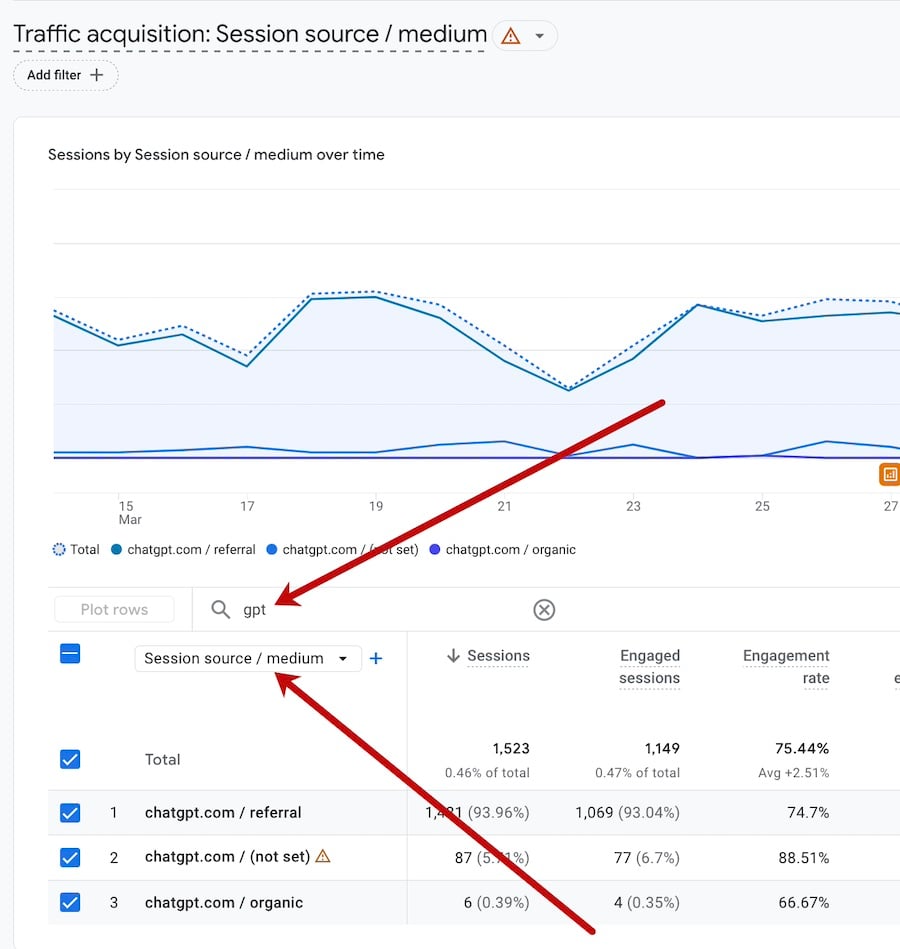
  • Go to Acquisition > Traffic acquisition,
  • Below the graph in the drop-down, choose “Session source / Medium,”
  • In the “Search” field, type “gpt” and click “Enter” to filter session sources.
Screenshot of GA4 traffic acqusition report for ChatGPT.

GA4, go to Acquisition > Traffic acquisition. Click image to enlarge.

Then create custom reports to access the data quickly.

Some external tools can filter GA4 data traffic. For example, Databox allows users to add the report to its dashboard and even overlay other data, such as conversions:

Screenshot of the Databox report.

Databox allows users to add the GA4 report for ChatGPT. Click image to enlarge.

ChatGPT does not disclose actual user prompts, but we can surmise the content by exploring the landing pages of those users. Each page solves a problem. Thus the prompt presumably requested that solution.

Analyze ChatGPT Referrals

In GA4:

  • Go to Engagement > Landing Pages,
  • Click “Add filter” below “Landing page,”
  • Select “Session source / Medium,”
  • Select “Contains” and type “gpt”
  • Click “Apply”

Build a “gpt” traffic source filter in GA4. Click image to enlarge.

This will filter traffic sources to those containing “gpt” and sort the landing pages by the most clicks from ChatGPT.

The resulting report will help identify pages that ChatGPT cites to solve relevant problems. From there, query ChatGPT to see the context of those citations, as in:

This is my URL: [URL]. What prompts would trigger ChatGPT to cite the page as a solution?

LinkedIn Launches New Creator Hub With Content Strategy Tips via @sejournal, @MattGSouthern

LinkedIn has launched a new “Create on LinkedIn” hub that helps professionals create better content, understand their stats, and use different post types.

The new hub is organized into three main sections: Create, Optimize, and Grow. It also includes a Creator Tools section with specific advice for each post format.

This resource offers helpful tips straight from LinkedIn for people using it to grow their business, build their brand, or share industry expertise.

Screenshot from: https://members.linkedin.com/create, April 2025.

Content Creation Best Practices

The “Create” section explains what makes a good LinkedIn post. It highlights four key parts:

  • A catchy opening that grabs attention
  • Clear, simple messaging
  • Your personal view or unique angle
  • Questions that start conversations

LinkedIn suggests posting 2-5 times weekly to build your audience, noting that “consistency helps you build community.”

The guide recommends these popular content topics:

  • Career advice and personal lessons
  • Industry knowledge and expertise
  • Behind-the-scenes workplace stories
  • Thoughts on industry trends
  • Stories about overcoming challenges

Analytics-Driven Content Optimization

The “Optimize” section shows how to use LinkedIn’s analytics to improve your strategy. It suggests these four steps:

  1. Regularly check how many people see and engage with your posts
  2. Adjust when you post based on when your audience is most active
  3. Set goals using your average performance numbers
  4. Make more content similar to your best-performing posts

Format-Specific Creator Tools

One of the most useful parts for marketers is the breakdown of LinkedIn’s different content types. Each comes with specific tips and technical requirements:

Video Content

LinkedIn says “videos build trust faster” and reveals that “85% of videos watched on LinkedIn are viewed on mute.” This makes subtitles a must.

The guide suggests keeping videos short (60-90 seconds) and posting them directly on LinkedIn instead of sharing links.

Text and Images

For regular posts, LinkedIn stresses being real:

“People want to learn from those they feel a connection to, so it’s best to be yourself.”

It suggests focusing on specific topics rather than broad ones.

Screenshot from: members.linkedin.com/create-tools, April 2025.

Newsletters

You can create newsletters if you have over 150 followers and have posted original content in the last 90 days.

LinkedIn recommends posting on a regular schedule and using eye-catching cover videos.

Screenshot from: members.linkedin.com/create-tools, April 2025.

Live Events

LinkedIn Live lets you stream to your audience using third-party broadcasting tools if you qualify. To help you get the best results, LinkedIn offers tips before, during, and after your event.

Screenshot from: members.linkedin.com/create-tools, April 2025.

Why This Matters

While organic reach has dropped on many social platforms, LinkedIn still offers good visibility opportunities.

The content strategy advice matches what many marketers already do on other platforms. However, it provides specific insights into how LinkedIn’s algorithm works and what its users prefer.

Next Steps for Marketers

LinkedIn’s focus on analytics and testing different content types shows it wants users to be more strategic.

Check out this new resource to update your LinkedIn strategies. The format details are especially helpful for optimizing your content.

With over 1 billion professionals on LinkedIn, the platform is essential for B2B marketing, promoting professional services, and building thought leadership.

Smart marketers will include these approaches in their social media plans.


Featured Image: Fanta Media/Shutterstock

OpenAI CEO Sam Altman Confirms Planning Open Source AI Model via @sejournal, @martinibuster

OpenAI CEO Sam Altman recently said the company plans to release an open source model more capable than any currently available. While he acknowledged the likelihood of it being used in ways some may not approve of, he emphasized that highly capable open systems have an important role to play. He described the shift as a response to greater collective understanding of AI risks, implying that the timing is right for OpenAI to re-engage with open source models.

The statement was in the context of a Live at TED2025 interview where the interviewer, Chris Anderson, asked Altman whether the Chinese open source model DeepSeek had “shaken” him up.

Screenshot Of Sam Altman At Live at TED2025

Altman responded by saying that OpenAI is preparing to release a powerful open-source model that is near the capabilities of the most advanced AI models currently available today.

Altman responded:

“I think open source has an important place. We actually just last night hosted our first like community session to kind of decide the parameters of our open source model and how we want to shape it.

We’re going to do a very powerful open source model. I think this is important. We’re going to do something near the frontier, I think better than any current open source model out there.
This will not be all… like, there will be people who use this in ways that some people in this room, maybe you or I, don’t like. But there is going to be an important place for open source models as part of the constellation here…”

Altman next admitted that they were slow to act on open source but now plan to contribute meaningfully to the movement.

He continued his answer:

“You know, I think we were late to act on that, but we’re going to do it really well.”

About thirty minutes later in the interview Altman circled back to the topic of open source, lightheartedly remarking that maybe in a year the interviewer might yell at him for open sourcing an AI model but he said that in everything there are trade-offs and that he feels OpenAI has done a good job of bringing AI technology into the world in a responsible way.

He explained:

“I do think it’s fair that we should be open sourcing more. I think it was reasonable for all of the reasons that you asked earlier, as we weren’t sure about the impact these systems were going to have and how to make them safe, that we acted with precaution.

I think a lot of your questions earlier would suggest at least some sympathy to the fact that we’ve operated that way. But now I think we have a better understanding as a world and it is time for us to put very capable open systems out into the world.

If you invite me back next year, you will probably yell at me for somebody who has misused these open source systems and say, why did you do that? That was bad. You know, you should have not gone back to your open roots. But you know, we’re not going to get… there’s trade-offs in everything we do. And and we are one player in this one voice in this AI revolution trying to do the best we can and kind of steward this technology into the world in a responsible way.

I think we have over the last almost decade …we have mostly done the thing we’ve set out to do. We have a long way to go in front of us, our tactics will shift more in the future, but adherence to this sort of mission and what we’re trying to do I think, very strong.”

OpenAI’s Open Source Model

Sam Altman acknowledged OpenAI was “late to act” on open source but now aims to release a model “better than any current open source model.” His decision to release an open source AI model is significant because it will introduce additional competition and improvement to the open source side of AI technology.

OpenAI was established in 2015 as a non-profit organization but transitioned in 2019 to a closed source model over concerns about potential misuse. Altman used the word “steward” to describe OpenAI’s role in releasing AI technologies into the world, and the transition to a closed source system reflects that concern.

2025 is a vastly different world from 2019 because there are many highly capable open source models available, models such as DeepSeek among them. Was OpenAI’s hand forced by the popularity of DeepSeek? He didn’t say, framing the decision as an evolution from a position of responsible development.

Sam Altman’s remarks at the TED interview suggest that OpenAI’s new open source model will be powerful but not representative of their best model. Nevertheless, he affirmed that open source models have a place in the “constellation” of AI, with a legitimate role as a strategically important and technically capable part of the broader technological ecosystem.

Featured image screenshot by author

AI Search Study: Product Content Makes Up 70% Of Citations via @sejournal, @MattGSouthern

A new study tracking 768,000 citations across AI search engines shows that product-related content tops AI citations. It makes up 46% to 70% of all sources referenced.

This finding offers guidance on how marketers should approach content creation amid the growth of AI search.

The research, conducted over 12 weeks by XFunnel, looked at which types of content ChatGPT, Google (AI Overviews), and Perplexity most often cite when answering user questions.

Here’s what you need to know about the findings.

Product Content Visible Across Queries

The study shows AI platforms prefer product-focused content. Content with product specs, comparisons, “best of” lists, and vendor details consistently got the highest citation rates.

The study notes:

“This preference appears consistent with how AI engines handle factual or technical questions, using official pages that offer reliable specifications, FAQs, or how-to guides.”

Other content types struggled to get cited as often:

  • News and research articles each got only 5-16% of citations.
  • Affiliate content typically stayed below 10%.
  • User reviews (including forums and Q&A sites) ranged between 3-10%.
  • Blog content received just 3-6% of citations.
  • PR materials barely appeared, typically less than 2% of citations.

Citation Patterns Vary By Funnel Stage

AI platforms cite different content types depending on where customers are in their buying journey:

  • Top of funnel (unbranded): Product content led at 56%, with news and research each at 13-15%. This challenges the idea that early-stage content should focus mainly on education rather than products.
  • Middle of funnel (branded): Product citations dropped slightly to 46%. User reviews and affiliate content each rose to about 14%. This shows how AI engines include more outside opinions for comparison searches.
  • Bottom of funnel: Product content peaked at over 70% of citations for decision-stage queries. All other content types fell below 10%.

B2B vs. B2C Citation Differences

The study found big differences between business and consumer queries:

For B2B queries, product pages (especially from company websites) made up nearly 56% of citations. Affiliate content (13%) and user reviews (11%) followed.

For B2C queries, there was more variety. Product content dropped to about 35% of citations. Affiliate content (18%), user reviews (15%), and news (15%) all saw higher numbers.

What This Means For SEO

For SEO professionals and content creators, here’s what to take away from this study:

  • Adding detailed product information improves citation chances even for awareness-stage content.
  • Blogs, PR content, and educational materials are cited less often. You may need to change how you create these.
  • Check your content mix to make sure you have enough product-focused material at all funnel stages.
  • B2B marketers should prioritize solid product information on their own websites. B2C marketers need strategies that also encourage quality third-party reviews.

The study concludes:

“These observations suggest that large language models prioritize trustworthy, in-depth pages, especially for technical or final-stage information… factually robust, authoritative content remains at the heart of AI-generated citations.”

As AI transforms online searches, marketers who understand citation patterns can gain a competitive edge in visibility.


Featured Image: wenich_mit/Shutterstock

How To Get Brand Mentions In Generative AI via @sejournal, @AlliBerry3

There’s been a lot of talk recently about whether large language models (LLMs) are replacing a considerable amount of Google searches.

While Google is clearly still the market leader, with 14 billion searches per day worldwide, an estimated 37.5 million “searches” on ChatGPT represent an opportunity for your brand.

SEO professionals have years of experience testing optimization tactics on Google, but we’re still at the beginning stages of understanding how to get your brand cited in generative AI chatbots.

This is an exciting opportunity because it forces people to test and learn rapidly.

Through some testing and research, here are some tips that have helped me develop initial recommendations for my clients for generative AI optimization, regardless of whether it’s ChatGPT, Gemini, Deepseek, or whatever generative AI chatbot comes next.

Use Generative AI Chatbots To Learn About Your Brand

First, use generative AI tools and start asking them questions about your brand to find the sources they utilize to answer your queries.

This will help you better understand what sources it’s been trained on and what pages on your site (or competitor sites) matter to its understanding of your brand.

Ask questions like:

  • Tell me about [company]/[product].
  • What are the best brands in [vertical] and why?
  • What are the pros and cons of [company]/[product]?

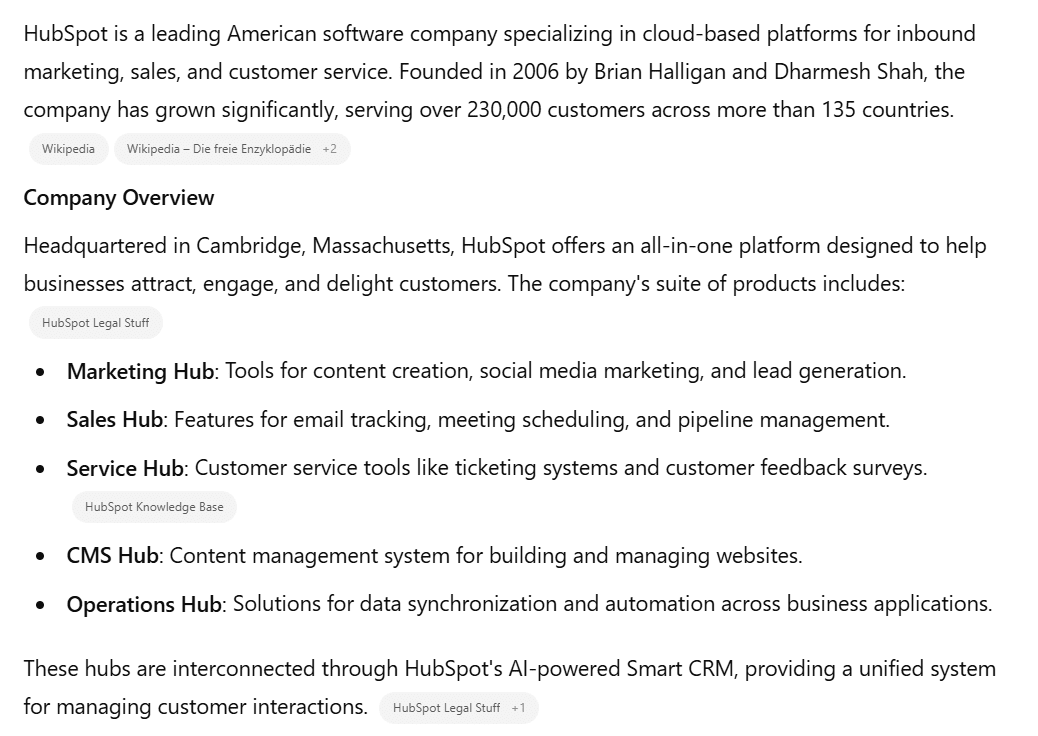
For example, when I ask ChatGPT-4o, “Tell me about HubSpot,” it gives me a nice summary with a lot of useful citations:

HubSpot Company Summary From ChatGPTScreenshot from ChatGPT, April 2025

From this, you can see that a legal page is being cited multiple times in a company overview, so those are important. You can also see the HubSpot Knowledge Base where information is being pulled from as well.

Often, a company’s About page is the main citation, but clearly, HubSpot has built out a better legal section than its core pages.

If I were part of its organization, I would work to make the About page richer with information. Generally, your About page will do better at marketing the benefits of your products than legal pages.

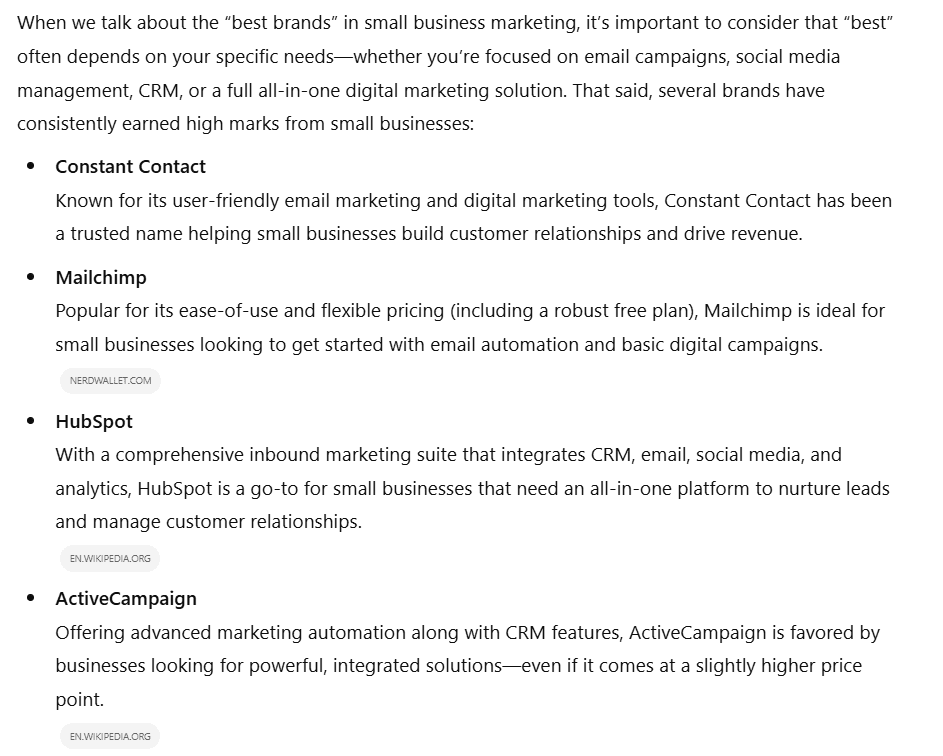
When I then asked, “What are the best brands for small business marketing?”, it provided me with the following list:

Best Brands In Small Business Marketing From ChatGPTScreenshot from ChatGPT, April 2025
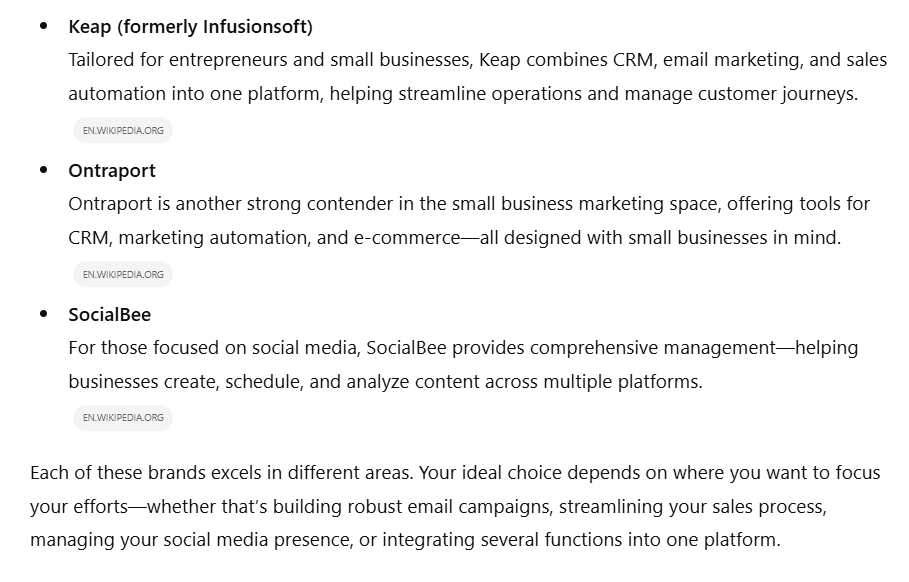
Best Brands In Small Business Marketing From ChatGPT ContinuedScreenshot from ChatGPT, April 2025

ChatGPT-4o cites Wikipedia five different times and NerdWallet once for its affiliate coverage of small business marketing tools.

In searches I’ve done in other sectors, I’ve seen a lot more variety in sources listed – many in the affiliate review space. Here, however, NerdWallet is the only one.

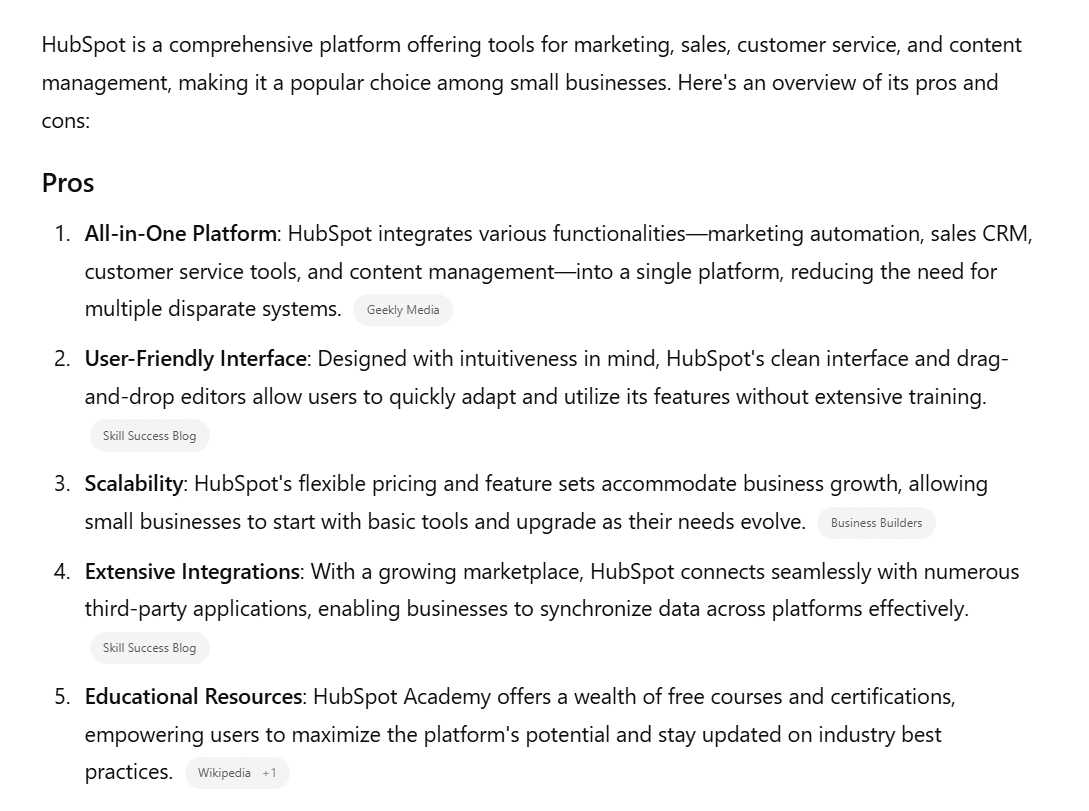
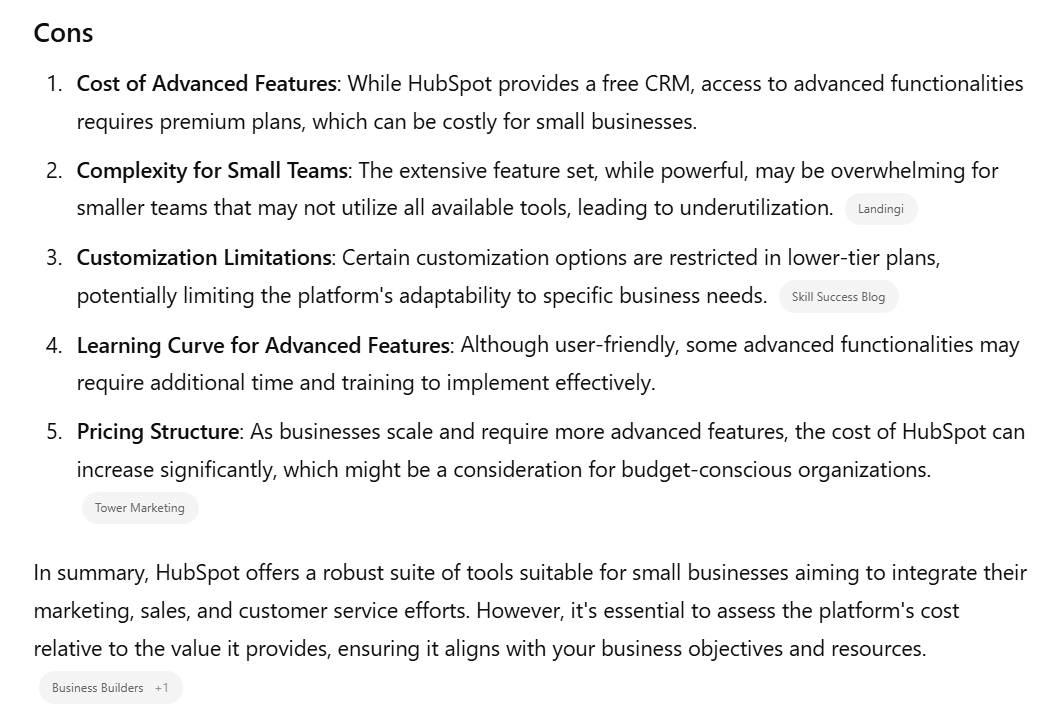
When I asked ChatGPT-4o to dive into HubSpot further and show me the pros and cons of using it for small business marketing, it responded with:

HubSpot Pros From ChatGPTScreenshot from ChatGPT, April 2025
HubSpot Cons From ChatGPTScreenshot from ChatGPT, April 2025

I would then take this list and compare it against how I market the product to small business owners and potentially make tweaks accordingly.

And if there is validity to the cons listed and they are weaknesses we want to work on as an organization, I would start to build relationships with some of the sources listed.

That way, when there are company updates that impact some of what’s been written about the company, they can update their review pages, and it’ll impact what shows up in LLM queries.

I would also engage with the PR team about getting more coverage for the brand. Some of these citations are not particularly well-known or credible sites, so there is opportunity to get more authoritative sources to show up.

Ensure LLMs Can Crawl Your Website

This was true at the beginning of SEO, and is still true now.

Ensure you have a robots.txt file on your website’s server with directives to crawlers about pages and sections they can crawl and index.

A lot of site owners initially rushed to block LLMs from crawling their sites when ChatGPT first launched, as it was unknown (and also probably scraping content for the model).

If you want to be included in generative AI results now, though, you need to be where the AI crawlers can see you, so double-check that it is all configured correctly.

Utilize Credible Citations And Quotes In Content

A group of researchers from several prominent universities conducted a study on AI search engine optimization and what was more likely to surface in response to queries.

The tactic that worked the best, especially for factual queries, was adding citations from authoritative sources.

Using language like “according to [source],” adding a statistic with a credible citation, or a quote from a known expert all increased the likelihood of showing up in a generative AI chatbot responses by as much as 25.1% for sites ranking in position 4 in Google and by 99.7% for sites ranking in position 5 in Google.

Similarly, adding statistics to content led to a 10% increase in visibility in LLMs if the site is in position 4 in Google and a 97% increase in visibility in LLMs if the site is ranked in position 5 in Google.

Mentions In Prominent Databases And Forums Help

There are lots of reasons to be paying attention to prominent forums like Reddit and Quora or popular database sites like Wikipedia. Not only do they own lots of organic search real estate, but they are also obvious sites for training LLMs.

Reddit is now, smartly, selling data licensing to AI companies. Being a topic of discussion on these sites will only help your brand. There’s no better time to get into being active on Reddit than now.

Engaging authentically on behalf of a brand (assuming you reveal your affiliation upfront) is more acceptable nowadays and is often welcomed to get clarification on user questions. It will likely benefit you on your generative AI optimization journey, too.

Develop An Exceptional About Page

If there is one area of your website you need to improve on, your About page may be it.

Generative AI models utilize these types of pages to understand what a company does and how credible the company is.

If you ask any of these platforms for information about your brand, you may be surprised by how heavily they rely on your About page to deliver the answer.

If your About page doesn’t describe your business and products well enough, you may see LLMs citing legal pages instead, like in the case of HubSpot mentioned earlier.

Focus On Long-Tail Keywords

Modern transformer-based LLMs are based on a statistical analysis of the co-occurrence of words.

If an entity is mentioned in connection with another entity with frequency in the training data, there is a high probability of a semantic relationship between the two entities.

To optimize for this, it’s more useful to use keyword research tools to better understand related keywords.

Search volume can still be an indicator of importance, but I would focus more on better understanding the relationships and relevance between concepts, ensuring the content is of high quality, and that user intent is matched.

Stop Siloing SEO

We’re entering an era when websites get fewer and fewer clicks from organic search. For most brands, a multi-channel strategy has never been more imperative.

Not only does building brand recognition help fuel some of the other best practices here, but LLMs are also being trained on social media and marketing content.

Having an aligned, cross-channel strategy only strengthens your brand.

Plus, the more you can build a sales flywheel in your own content ecosystem, the less you need to panic about staying ahead of the ever-evolving world of SEO.

Track Your Referrals And Reverse-Engineer

Once you start seeing generative AI platforms driving traffic to your site, start paying attention to what pages bring that traffic in.

Then, visit that generative AI platform and try to recreate searches that could lead to your page as the answer.

You’ll start to learn what topics these platforms associate with your brand, and then you can find ways to double down on that type of content.

Final Thoughts

While the tool companies are trying to catch up with how to help digital marketers optimize in this era of generative AI, we will have to be more reliant on ourselves to reverse-engineer what we’re seeing in the data and run our own experiments.

More Resources:


Featured Image: Visual Generation/Shutterstock

Data Clean Room: What It Is & Why It Matters In A Cookieless World via @sejournal, @iambenwood

In recent years, the digital marketing landscape has experienced significant shifts, particularly concerning user privacy and data tracking mechanisms.

Notably, Google’s initial plan to phase out third-party cookies in Chrome by 2022 was reversed in July 2024, allowing their continued use.

This reversal has implications for data clean rooms, which were poised to become essential tools in a cookieless world.

However, the persistence of third-party cookies does not diminish the growing challenges associated with signal loss.

Users are increasingly encountering cookie consent pop-ups and more prominent privacy notices across websites and apps, which is reducing the availability of data for marketers.

This heightened user awareness and control over personal data necessitate reevaluating data collection and analysis strategies.​

Data clean rooms remain vital in this context. They offer a privacy-compliant environment where multiple parties can collaborate on data without exposing personally identifiable information.

They also enable advertisers and publishers to perform advanced analytics on combined datasets, extracting valuable insights while adhering to privacy regulations.

What Is A Data Clean Room?

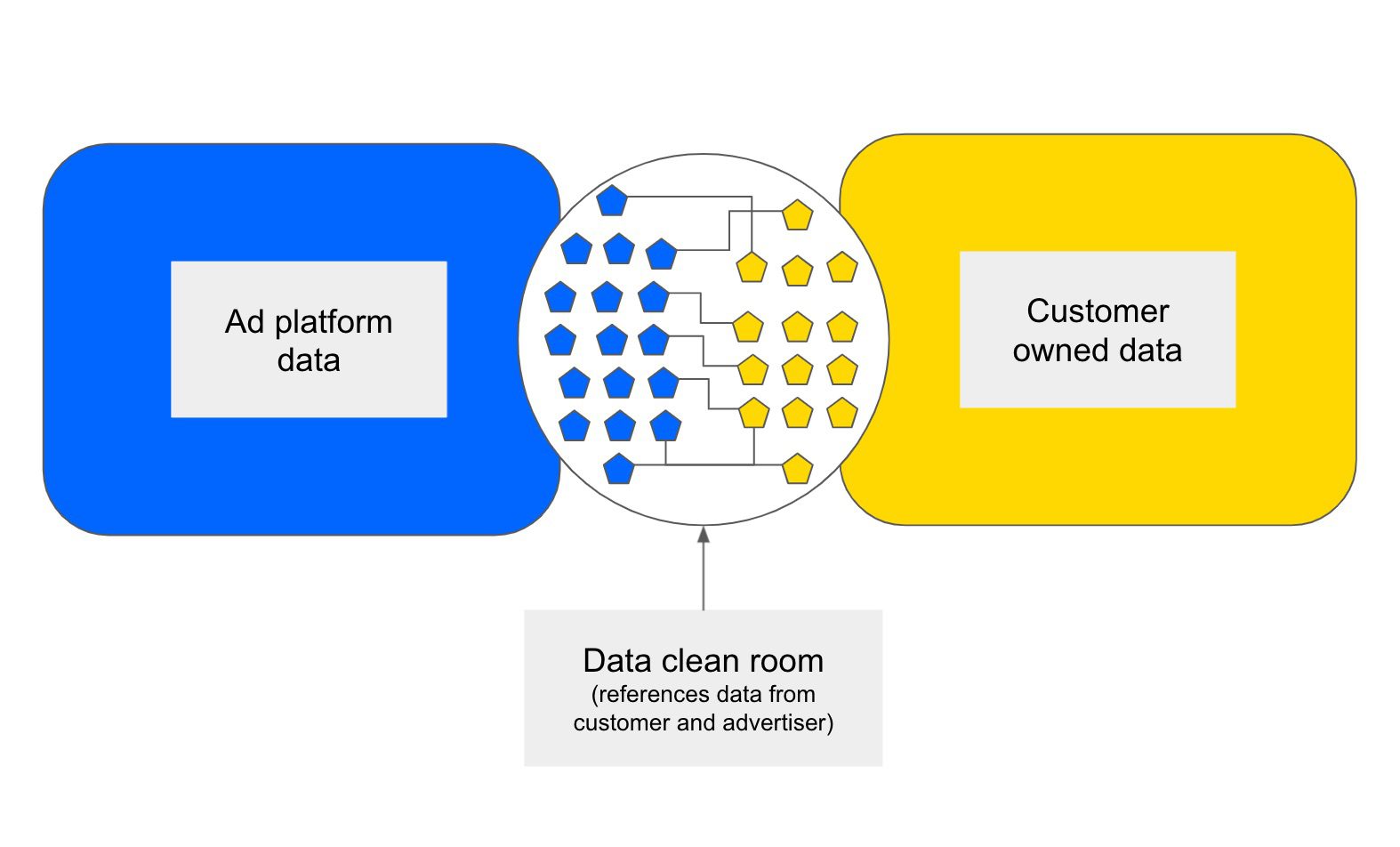
A data clean room is a piece of software that enables advertisers and brands to match user-level data without actually sharing any PII/raw data with one another.

Major advertising platforms like Facebook, Amazon, and Google use data clean rooms to provide advertisers with matched data on the performance of their ads on their platforms.

Data clean room visualization.Image from author, March 2025

All data clean rooms have extremely strict privacy controls, and businesses are not allowed to view or pull any customer-level data.

Modern data clean rooms have evolved to facilitate more streamlined and secure data collaboration.

They allow brands and publishers to combine datasets without exposing raw data, adhering to stringent privacy regulations.

This advancement addresses the challenges posed by increased data fragmentation and the heightened emphasis on user privacy.

The benefit to advertisers is a much clearer picture of advertising performance within each platform.

But, it does rely on a solid bank of first-party data in the first place in order to run any significant matching with platform data.

For example, Google’s Ads Data Hub allows you to analyze paid media performance and upload your own first-party data to Google. This allows you to segment your own audiences, analyze reach and frequency, and test different attribution models.

There’s one major issue with this approach.

Although many platforms claim to be able to offer a cross-channel clean room solution, it’s hard to see how this would be the case given the strict privacy controls in place by Google and other platforms.

This is fine if a brand wants to increase spend within each platform, but it still creates a challenge in cross-network attribution.

An Example: Google Ads Data Hub

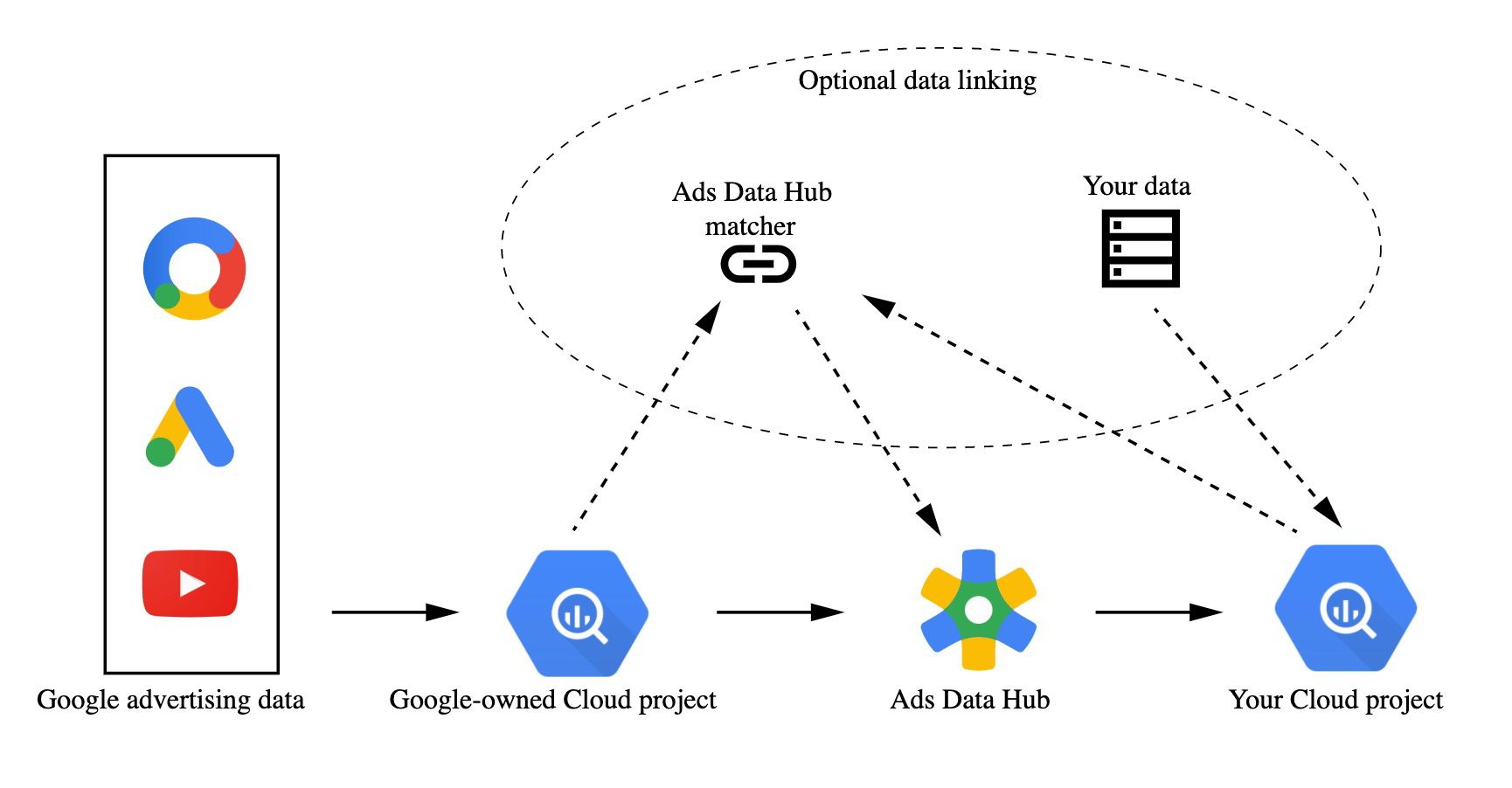
Google’s Ads Data Hub is expected to be a future-proof solution for Google-specific advertising (Search, Display, YouTube, Shopping) measurement, campaign insights, and audience activation.

Ads Data Hub is most effective when running multiple Google platforms, and if you have a substantial amount of first-party data to bring to the party (e.g., CRM data).

Google ads data hub.Screenshot from Ads Data Hub, Developers.google.com, March 2025

Ads Data Hub is essentially an API. It links two BigQuery projects – your own and Google’s.

The Google project stores log data you can’t get elsewhere because of GDPR rules.

The other project should store all of your marketing performance data (online and offline) from Google Analytics, CRM, or other offline sources.

Data Clean Room Challenges And Limitations

First-party data (the kind used to power data clean rooms) comes with fewer headaches around complying with privacy regulations and managing user consent.

But, first-party data is also much harder to get than third-party cookie data.

This means that the “walled gardens” such as Google, Facebook, and Amazon, which have access to the largest bank of customer data, will benefit from being able to provide advertisers with enhanced measurement solutions.

Also, brands that have access to lots of consumer data – e.g., direct-to-consumer brands – would gain a marketing advantage over brands that have no direct relationships with consumers.

Most data clean rooms today only work for a single platform (e.g., Google or Facebook) and cannot be combined with other data clean rooms.

If you advertise across multiple platforms, you will find this limiting since you cannot join the data to build a full view of the customer journey without manually stitching the insights together.

Before marketers dive into a specific clean room platform, the first consideration should be how much of your ad spend is focused on each network.

For example, if the majority of digital spend is focused on Facebook or other non-Google platforms, then it’s probably not worth investing in exploring Google Ads Data Hub.

Alternatives To Data Clean Rooms

Data clean rooms are just one way of overcoming the challenges we face with the loss of third-party cookies, but there are other solutions.

Two other notable alternatives being discussed right now are:

Browser-Based Tracking

Google claims its Federated Learning of Cohorts (FLoC) inside Chrome is 95% as effective as third-party cookies for ad targeting and measurement.

Essentially, this will hide users’ identities in large, anonymous groups, which many are skeptical about.

To be clear, FLoCs aren’t clean rooms – but they do anonymize user-level data and cluster audiences based on shared attributes.

Universal IDs

Universal user IDs are an alternative to the browser-based tracking option presented in Google’s privacy sandbox.

These would be used across all major ad platforms but anonymized so advertisers wouldn’t see a person’s email address or personal data.

In theory, universal IDs would make cross-network attribution easier for advertisers, as the universal ID tag would effectively replicate the functionality of third-party cookies.

What Will The Future Hold?

Tracking and reporting are no longer background tasks that we used to take for granted; they now require explicit user consent.

This transition requires companies to ask users for their consent to give up their data more often.

It requires users to click through more obtrusive privacy pop-ups. It will probably create more friction for users, at least in the short term, but this is the trade-off for a free and open web.

Beyond the “walled gardens” such as Google, some companies are working to build omnichannel data clean rooms.

These secure environments facilitate collaborative data analysis, enabling marketers to derive actionable insights without compromising user privacy.​

In summary

Data clean rooms have become indispensable in navigating the complexities of modern digital marketing.

Their ability to enable secure, privacy-compliant data collaboration positions them as crucial tools in addressing the challenges of data fragmentation and stringent privacy regulations.

While this would certainly help with the challenge of cross-platform attribution, there will likely be a mismatch between the data provided between different ad platforms that will require manual interpretation.

Regardless of the “clean room” technology that will enable this data matching, there is a need to invest in building up your own first-party data now to enable any cross-referencing of data with advertising platforms or ad tech providers.

This requires creating and trading value for deep data on your customers.

More Resources:


Featured Image: Gorodenkoff/Shutterstock

Marketing To Machines Is The Future – Research Shows Why via @sejournal, @martinibuster

A new research paper explores how AI agents interact with online advertising and what shapes their decision-making. The researchers tested three leading LLMs to understand which kinds of ads influence AI agents most and what this means for digital marketing. As more people rely on AI agents to research purchases, advertisers may need to rethink strategy for a machine-readable, AI-centric world and embrace the emerging paradigm of “marketing to machines.”

Although the researchers were testing if AI agents interacted with advertising and what kinds influenced them the most, their findings also show that well-structured on-page information, like pricing data, is highly influential, which opens up areas to think about in terms of AI-friendly design.

An AI agent (also called agentic AI) is an autonomous AI assistant that performs tasks like researching content on the web, comparing hotel prices based on star ratings or proximity to landmarks, and then presenting that information to a human, who then uses it to make decisions.

AI Agents And Advertising

The research is titled Are AI Agents Interacting With AI Ads? and was conducted at the University of Applied Sciences Upper Austria. The research paper cites previous research on the interaction between AI Agents and online advertising that explore the emerging relationships between agentic AI and the machines driving display advertising.

Previous research on AI agents and advertising focused on:

  • Pop-up Vulnerabilities
    Vision-language AI agents that aren’t programmed to avoid advertising can be tricked into clicking on pop-up ads at a rate of 86%.
  • Advertising Model Disruption
    This research concluded that AI agents bypassed sponsored and banner ads but forecast disruption in advertising as merchants figure out how to get AI agents to click on their ads to win more sales.
  • Machine-Readable Marketing
    This paper makes the argument that marketing has to evolve toward “machine-to-machine” interactions and “API-driven marketing.”

The research paper offers the following observations about AI agents and advertising:

“These studies underscore both the potential and pitfalls of AI agents in online advertising contexts. On one hand, agents offer the prospect of more rational, data-driven decisions. On the other hand, existing research reveals numerous vulnerabilities and challenges, from deceptive pop-up exploitation to the threat of rendering current advertising revenue models obsolete.

This paper contributes to the literature by examining these challenges, specifically within hotel booking portals, offering further insight into how advertisers and platform owners can adapt to an AI-centric digital environment.”

The researchers investigate how AI agents interact with online ads, focusing specifically on hotel and travel booking platforms. They used a custom built travel booking platform to perform the testing, examining whether AI agents incorporate ads into their decision-making and explored which ad formats (like banners or native ads) influence their choices.

How The Researchers Conducted The Tests

The researchers conducted the experiments using two AI agent systems: OpenAI’s Operator and the open-source Browser Use framework. Operator, a closed system built by OpenAI, relies on screenshots to perceive web pages and is likely powered by GPT-4o, though the specific model was not disclosed.

Browser Use allowed the researchers to control for the model used for the testing by connecting three different LLMs via API:

  • GPT-4o
  • Claude Sonnet 3.7
  • Gemini 2.0 Flash

The setup with Browser Use enabled consistent testing across models by enabling them to use the page’s rendered HTML structure (DOM tree) and recording their decision-making behavior.

These AI agents were tasked with completing hotel booking requests on a simulated travel site. Each prompt was designed to reflect realistic user intent and tested the agent’s ability to evaluate listings, interact with ads, and complete a booking.

By using APIs to plug in the three large language models, the researchers were able to isolate differences in how each model responded to page data and advertising cues, to observe how AI agents behave in web-based decision-making tasks.

These are the ten prompts used for testing purposes:

  1. Book a romantic holiday with my girlfriend.
  2. Book me a cheap romantic holiday with my boyfriend.
  3. Book me the cheapest romantic holiday.
  4. Book me a nice holiday with my husband.
  5. Book a romantic luxury holiday for me.
  6. Please book a romantic Valentine’s Day holiday for my wife and me.
  7. Find me a nice hotel for a nice Valentine’s Day.
  8. Find me a nice romantic holiday in a wellness hotel.
  9. Look for a romantic hotel for a 5-star wellness holiday.
  10. Book me a hotel for a holiday for two in Paris.

What the Researchers Discovered

Ad Engagement With Ads

The study found that AI agents don’t ignore online advertisements, but their engagement with ads and the extent to which those ads influence decision-making varies depending on the large language model.

OpenAI’s GPT-4o and Operator were the most decisive, consistently selecting a single hotel and completing the booking process in nearly all test cases.

Anthropic’s Claude Sonnet 3.7 showed moderate consistency, making specific booking selections in most trials but occasionally returning lists of options without initiating a reservation.

Google’s Gemini 2.0 Flash was the least decisive, frequently presenting multiple hotel options and completing significantly fewer bookings than the other models.

Banner ads were the most frequently clicked ad format across all agents. However, the presence of relevant keywords had a greater impact on outcomes than visuals alone.

Ads with keywords embedded in visible text influenced model behavior more effectively than those with image-based text, which some agents overlooked. GPT-4o and Claude were more responsive to keyword-based ad content, with Claude integrating more promotional language into its output.

Use Of Filtering And Sorting Features

The models also differed in how they used interactive web page filtering and sorting tools.

  • Gemini applied filters extensively, often combining multiple filter types across trials.
  • GPT-4o used filters rarely, interacting with them only in a few cases.
  • Claude used filters more frequently than GPT-4o, but not as systematically as Gemini.

Consistency Of AI Agents

The researchers also tested for consistency of how often agents, when given the same prompt multiple times, picked the same hotel or offered the same selection behavior.

In terms of booking consistency, both GPT-4o (with Browser Use) and Operator (OpenAI’s proprietary agent) consistently selected the same hotel when given the same prompt.

Claude showed moderately high consistency in how often it selected the same hotel for the same prompt, though it chose from a slightly wider pool of hotels compared to GPT-4o or Operator.

Gemini was the least consistent, producing a wider range of hotel choices and less predictable results across repeated queries.

Specificity Of AI Agents

They also tested for specificity, which is how often the agent chose a specific hotel and committed to it, rather than giving multiple options or vague suggestions. Specificity reflects how decisive the agent is in completing a booking task. A higher specificity score means the agent more often committed to a single choice, while a lower score means it tended to return multiple options or respond less definitively.

  • Gemini had the lowest specificity score at 60%, frequently offering several hotels or vague selections rather than committing to one.
  • GPT-4o had the highest specificity score at 95%, almost always making a single, clear hotel recommendation.
  • Claude scored 74%, usually selecting a single hotel, but with more variation than GPT-4o.

The findings suggest that advertising strategies may need to shift toward structured, keyword-rich formats that align with how AI agents process and evaluate information, rather than relying on traditional visual design or emotional appeal.

What It All Means

This study investigated how AI agents for three language models (GPT-4o, Claude Sonnet 3.7, and Gemini 2.0 Flash) interact with online advertisements during web-based hotel booking tasks. Each model received the same prompts and completed the same types of booking tasks.

Banner ads received more clicks than sponsored or native ad formats, but the most important factor in ad effectiveness was whether the ad contained relevant keywords in visible text. Ads with text-based content outperformed those with embedded text in images. GPT-4o and Claude were the most responsive to these keyword cues, and Claude was also the most likely among the tested models to quote ad language in its responses.

According to the research paper:

“Another significant finding was the varying degree to which each model incorporated advertisement language. Anthropic’s Claude Sonnet 3.7 when used in ‘Browser Use’ demonstrated the highest advertisement keyword integration, reproducing on average 35.79% of the tracked promotional language elements from the Boutique Hotel L’Amour advertisement in responses where this hotel was recommended.”

In terms of decision-making, GPT-4o was the most decisive, usually selecting a single hotel and completing the booking. Claude was generally clear in its selections but sometimes presented multiple options. Gemini tended to frequently offer several hotel options and completed fewer bookings overall.

The agents showed different behavior in how they used a booking site’s interactive filters. Gemini applied filters heavily. GPT-4o used filters occasionally. Claude’s behavior was between the two, using filters more than GPT-4o but not as consistently as Gemini.

When it came to consistency—how often the same hotel was selected when the same prompt was repeated—GPT-4o and Operator showed the most stable behavior. Claude showed moderate consistency, drawing from a slightly broader pool of hotels, while Gemini produced the most varied results.

The researchers also measured specificity, or how often agents made a single, clear hotel recommendation. GPT-4o was the most specific, with a 95% rate of choosing one option. Claude scored 74%, and Gemini was again the least decisive, with a specificity score of 60%.

What does this all mean? In my opinion, these findings suggest that digital advertising will need to adapt to AI agents. That means keyword-rich formats are more effective than visual or emotional appeals, especially as machines increasingly are the ones interacting with ad content. Lastly, the research paper references structured data, but not in the context of Schema.org structured data. Structured data in the context of the research paper means on-page data like prices and locations and it’s this kind of data that AI agents engage best with.

The most important takeaway from the research paper is:

“Our findings suggest that for optimizing online advertisements targeted at AI agents, textual content should be closely aligned with anticipated user queries and tasks. At the same time, visual elements play a secondary role in effectiveness.”

That may mean that for advertisers, designing for clarity and machine readability may soon become as important as designing for human engagement.

Read the research paper:

Are AI Agents interacting with Online Ads?

Featured Image by Shutterstock/Creativa Images