Gevo, LanzaJet, Montana Renewables, Neste, World Energy
WHEN
Now
All the world’s planes consumed roughly 100 billion gallons of jet fuel as they crisscrossed the planet in 2024. Only about 0.5% of it was something other than fossil fuel. That could soon change.
Alternative jet fuels could slash aviation emissions—which have caused about 4% of global warming to date. These new fuels can be made with materials like used cooking oils, crop residue, industrial waste, and carbon dioxide captured from the air. Depending on the source, they can reduce emissions by half or nearly eliminate them. And they can generally be used in existing planes, which could enable quick climate progress.
More governments are now setting targets or passing legislation requiring airlines to begin using these alternative fuels (sometimes called sustainable aviation fuels, or SAFs). Starting this year, alternative fuels must make up at least 2% of the fuel used at airports in the European Union and UK. That mandate will ramp up in the coming decades, reaching 70% in the EU by 2050.
Today, nearly all commercially available alternative fuel is made with waste fats, oils, and greases. Montana Renewables recently got a $1.44 billion loan commitment from the US Department of Energy to expand one facility for such production. Still, these materials remain in limited supply.
Companies using other technologies and inputs are making progress scaling up. LanzaJet opened the first commercial-scale facility to make jet fuel from ethanol in early 2024, with a capacity of 9 million gallons annually. Synthetic fuels made with carbon dioxide could further expand options for airlines, though those fuels aren’t being produced at commercial scale yet.
One crucial factor for alternative jet fuels moving forward will be cost—on average, SAFs on the market today tend to be nearly three times more expensive than conventional jet fuel. Having more companies producing more fuel should help bring down the price, though newer fuels could be even more costly.
Agility, Amazon, Covariant, Robust, Toyota Research Institute
WHEN
Now
Generative AI is causing a paradigm shift in how robots are trained. It’s now clear how we might finally build the sort of truly capable robots that have for decades remained the stuff of science fiction.
Robotics researchers are no strangers to artificial intelligence—it has for years helped robots detect objects in their path, for example. But a few years ago, roboticists began marveling at the progress being made in large language models. Makers of those models could feed them massive amounts of text—books, poems, manuals—and then fine-tune them to generate text based on prompts.
The idea of doing the same for robotics was tantalizing—but incredibly complicated. It’s one thing to use AI to create sentences on a screen, but another thing entirely to use it to coach a physical robot in how to move about and do useful things.
Now, roboticists have made major breakthroughs in that pursuit. One was figuring out how to combine different sorts of data and then make it all useful and legible to a robot. Take washing dishes as an example. You can collect data from someone washing dishes while wearing sensors. Then you can combine that with teleoperation data from a human doing the same task with robotic arms. On top of all that, you can also scrape the internet for images and videos of people doing dishes.
By merging these data sources properly into a new AI model, it’s possible to train a robot that, though not perfect, has a massive head start over those trained with more manual methods. Seeing so many ways that a single task can be done makes it easier for AI models to improvise, and to surmise what a robot’s next move should be in the real world.
It’s a breakthrough that’s set to redefine how robots learn. Robots that work in commercial spaces like warehouses are already using such advanced training methods, and the lessons we learn from those experiments could lay the groundwork for smart robots that help out at home.
California Institute for Regenerative Medicine, Neurona Therapeutics, Vertex Pharmaceuticals
WHEN
5 years
A quarter-century ago, researchers isolated powerful stem cells from embryos created through in vitro fertilization. These cells, theoretically able to morph into any tissue in the human body, promised a medical revolution. Think: replacement parts for whatever ails you.
But stem-cell science didn’t go smoothly. Not at first. Even though scientists soon learned to create these make-anything cells without embryos, coaxing them to become truly functional adult tissue proved harder than anyone guessed.
Now, though, stem cells are finally on the brink of delivering. Take the case of Justin Graves, a man with debilitating epilepsy who received a transplant of lab-made neurons, engineered to quell the electrical misfires in his brain that cause epileptic attacks.
Since the procedure, carried out in 2023 at the University of California, San Diego, Graves has reported having seizures about once a week, rather than once per day as he used to. “It’s just been an incredible, complete change,” he says. “I am pretty much a stem-cell evangelist now.”
The epilepsy trial, from a company called Neurona Therapeutics, is at an early stage—only 15 patients have been treated. But the preliminary results are remarkable.
Last June, a different stem-cell study delivered dramatic results. This time it was in type 1 diabetes, the autoimmune condition formerly called juvenile diabetes, in which a person’s body attacks the beta islet cells in the pancreas. Without working beta cells to control their blood sugar levels, people with type 1 diabetes rely on daily blood glucose monitoring and insulin injections or infusions to stay alive.
In this ongoing study, carried out by Vertex Pharmaceuticals in Boston, some patients who got transfusions of lab-made beta cells have been able to stop taking insulin. Instead, their new cells make it when it’s needed.
No more seizures. No more insulin injections. Those are the words patients have always wanted to hear. And it means stem-cell researchers are close to achieving functional cures—when patients can get on with life because their bodies are able to self-regulate.
This is today’s edition of The Download, our weekday newsletter that provides a daily dose of what’s going on in the world of technology.
How poop could help feed the planet
A new industrial facility in suburban Seattle is giving off a whiff of futuristic technology. It can safely treat fecal waste from people and livestock while recycling nutrients that are crucial for agriculture but in increasingly short supply across the nation’s farmlands.
Making fertilizer from the nutrients that we and other animals excrete has a long and colorful history; for generations it helped Indigenous cultures around the world create exceptionally fertile soil.
These systems fell out of favor in Western culture. But, if researchers and engineers across several companies get their way, that could be about to change. Read the full story.
—Bryn Nelson
This story is from the forthcoming magazine edition of MIT Technology Review, set to go live on January 6—it’s all about the exciting breakthroughs happening in the world right now. If you don’t already, subscribe to receive future copies.
If you’re interested in poop’s wider scientific potential, check out the latest entry in our Jobs of the Future series: stool bank manager. Pediatric gastroenterologist Nikhil Pai is helping to treat children with a common bacterial infection of the large intestine by transplanting healthy stool into a patient’s gut—a highly effective, albeit unconventional, treatment. Read the full story.
Here are MIT Technology Review’s best-performing stories of 2024
MIT Technology Review published hundreds of stories in 2024, covering everything from AI, climate tech, and biotech, to robotics, space, and more.
As the new year begins, take a look at a small selection of the stories that resonated most with you, our readers. Read the full story.
—Abby Ivory-Ganja
Unveiling the 10 Breakthrough Technologies of 2025
Each year, MIT Technology Review selects the top ten breakthrough technologies that will have the greatest impact on how we live and work in the future. In the past, we’ve selected breakthrough technologies such as weight-loss drugs, a malaria vaccine, and GPT-3 (the precursor to ChatGPT).
Amy Nordrum, our executive editor, will join our news editor Charlotte Jee to unveil the new list live during an exclusive Roundtable discussion for subscribers at 12.30pm ET today. Register here to be among the first to know.
The must-reads
I’ve combed the internet to find you today’s most fun/important/scary/fascinating stories about technology.
1 A US appeals court has struck down net neutrality rules It’s the end of a nearly two-decade effort to regulate broadband providers. (NYT $) + Net neutrality has been in danger for a while, truthfully. (The Verge) + It’s bad news for the Biden administration as it prepares to hand over to Trump. (WP $)
2 Car rental app Turo is under scrutiny But concerns over the app’s safety practices are nothing new. (WSJ $) + The app was used to book vehicles used in both the New Orleans attack and Las Vegas Cybertruck explosion. (NYT $) + Turo staff have been pulled off vacation to respond to the aftermath. (Bloomberg $)
3 Nick Clegg is leaving Meta The former British deputy prime minister is making way for prominent Republican Joel Kaplan. (Semafor) + It’s part of the company’s desire to align itself with the incoming Trump administration. (WSJ $) + How tech is turning MAGA. (Economist $)
4 Yandex has been ordered to hide maps of a Russian oil refinery In response to repeated attacks from Ukrainian drones. (Reuters) + The Ryazan refinery was hit four times last year alone. (Bloomberg $) + The uneasy coexistence of Yandex and the Kremlin. (MIT Technology Review)
5 Apple has agreed to settle a $95 million class-action lawsuit Over claims the company violated user privacy by sharing Siri recordings. (WP $)
6 Several Californian AI laws have gone into effect A new year means new regulations. (The Information $) + There are more than 120 AI bills in Congress right now. (MIT Technology Review)
7 Our understanding of genetic diseases is changing Cell mutations suggest we’re far more genetically varied than we previously realized. (The Atlantic $) + DeepMind is using AI to pinpoint the causes of genetic disease. (MIT Technology Review)
8 African content creators are struggling to make money But it appears as though the tide may be slowly turning. (The Guardian) + What Africa needs to do to become a major AI player. (MIT Technology Review)
9 Get the new year off to a starry start There’s a meteor shower due tonight! (Wired $)
10 How to build a more sustainable refrigerator A new kind of heat-absorbing crystal could hold the key. (New Scientist $) + The future of urban housing is energy-efficient refrigerators. (MIT Technology Review)
Quote of the day
“He is quite clearly the right person for the right job at the right time!”
—Nick Clegg, Meta’s outgoing chief policy executive, wishes his replacement Joel Kaplan the best in a post on X.
The big story
Is it possible to really understand someone else’s mind?
November 2023
Technically speaking, neuroscientists have been able to read your mind for decades. It’s not easy, mind you. First, you must lie motionless within a fMRI scanner, perhaps for hours, while you watch films or listen to audiobooks.
If you do elect to endure claustrophobic hours in the scanner, the software will learn to generate a bespoke reconstruction of what you were seeing or listening to, just by analyzing how blood moves through your brain.
More recently, researchers have deployed generative AI tools, like Stable Diffusion and GPT, to create far more realistic, if not entirely accurate, reconstructions of films and podcasts based on neural activity. So how close are we to genuine “mind reading?” Read the full story.
—Grace Huckins
We can still have nice things
A place for comfort, fun and distraction to brighten up your day. (Got any ideas? Drop me a line or skeet ’em at me.)
+ Of course The Cure’s Robert Smith is an iPod fanatic. + Japan may be associated with tasteful minimalism, but there’s always room for a bit of clutter. + Meet the people who release 3,000 pounds of confetti into New York’s Times Square by hand every New Year’s Eve—then clear it all up. + How to start a healthy habit, and, crucially, stick to it. ($)
Each year, MIT Technology Review publishes an annual list of the top ten breakthrough technologies that will have the greatest impact on how we live and work in the future. This year, the 10 Breakthrough Technologies list was unveiled live by our editors. Hear from MIT Technology Review executive editor Amy Nordrum and news editor Charlotte Jee as they share an unveiling of the list of the 10 breakthrough technologies.
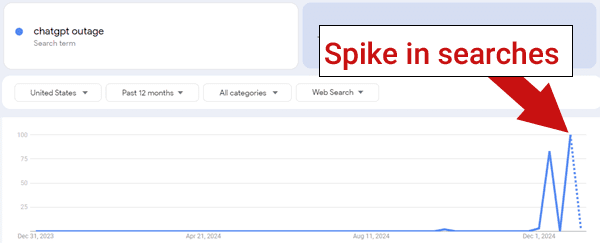
OpenAI published an incident report detailing the cause of last weeks ChatGPT outage and what they are doing to prevent a repeat. The outage began on December 26th, 2024 at 10:40 AM and was mostly resolved by 3:11 PM, except for except ChatGPT which was 100% recovered by 6:20 PM.
The following services were impacted:
ChatGPT
Sora video creation
APIs: agents, realtime speech, batch, and DALL-E
Cause of OpenAI Outage
The cause of the outage was a cloud provider data center failure which impacted OpenAI databases. While the databases are mirrored across regions, switching over to a backup database required manual interaction on the part of the cloud provider to redirect operations to a backup datacenter in another region. The manual intervention was cited as how the outage was fixed but the given reason for why it took so long was the scale of the project.
A failover is an automated process for switching to a backup system in the event of a system failure. OpenAI announced that they are working toward creating infrastructure changes to improve responses to future cloud database failures.
OpenAI explained:
“In the coming weeks, we will embark on a major infrastructure initiative to ensure our systems are resilient to an extended outage in any region of any of our cloud providers by adding a layer of indirection under our control in between our applications and our cloud databases. This will allow significantly faster failover.”
Significant ChatGPT Outage
OpenAI’s said the ChatGPT outage was due to a regional cloud provider database failure but the effect was global, evidenced by user reports on social media from across Europe and North America.
Google Trends, which tracks search volume, indicates that this may have been the largest such event, with more people searching for information about it than for any previous outage.
The less a person says to communicate, the better.
Shakespeare said “Brevity is the soul of wit.” And in just six words, underlined why brevity impacts communication.
I appreciate brevity in all things. Iconic one-liners work for punny slogans, catchy choruses, witty retorts, and more.
But think about how true this is for social media.
A decade or so ago, I would take the time to write out three-paragraph diary entries, feature an “emo” pic, and get a lot of engagement or at least some reposts. In today’s fast-paced digital world, that doesn’t cut it anymore.
Today, I hardly use Facebook or even X (Twitter) – enter Threads.
Launched in July 2023, this text-based app built by the team behind Instagram is one of the newest social channels on the block.
Whether you’re looking for a potential new customer, want to spread awareness about your latest innovation, or simply want to share what you’ve been up to as a creator, here’s why it’s working so well, in my opinion.
1. Short-Form Storytelling Is Captivating Audiences On Threads
According to the American Psychological Association’s Dr. Gloria Mark:
“So back in 2004, we found the average attention span on any screen to be two and a half minutes on average. Throughout the years, it became shorter. So, around 2012, we found it to be 75 seconds.
This is with logging techniques. This is an average. And then in the last five, six years, we found it to average about 47 seconds, and others have replicated this result within a few seconds. So it seems to be quite robust.
Now, another way to think about this result is the median. The median means the midpoint of observations. The median is 40 seconds.”
I don’t know how fast you can read, but 47 seconds is not enough for me to read a well-written photo essay online. The same goes for video.
The shorter the storytelling, the easier it is to catch someone’s attention.
This example was only 17 hours old at the time of writing. Yet it had already gained 109 likes and 51 likes, with three reposts. If you unravel their thread, it’s pretty engaging from start to finish.
There’s continuity as each “reply” to their own post builds on the first part of the post.
2. The Power Of Brevity On Topics
It’s not a hashtag. Threads’ vertically expansive, short-form style is further enhanced by the blue highlight feature called “Topic.”
Threads said you can only tag one topic per post, explaining “Why just one? Why just one? This makes it easier for others who care about that topic to find and read your post.”
And it does!
The principle of brevity applies. There was a post I inexplicably couldn’t get out of my mind, and it was in my native tongue (Filipino), but I lost it because I had closed the app.
When I searched for the words “Huling message ni bunso” (English translation: the last message from the youngest sibling), the first result was exactly the same post I was trying to find.
As someone who has exhausted all means to reverse search on other platforms, I was grateful the app narrowed down the search and is friendly to non-English speaking users, too.
The algorithm doesn’t just find your interests but lets your interests find you.
Case in point, even Stephen King is a fan of the platform. It’s amusing that a lot of users use the topic feature (whether highlighted blue or not), and with a stitch of luck, King will appear and reply.
Capturing Attention Through Concise, Impactful Stories
Limited character counts favor attention spans. So, if you decide to post five-liners, each sentence should build on the previous one. X (Twitter) has a 280-character limit, while Threads has a 500-character limit.
But for me, brevity isn’t about having the shortest sentence; it’s about expressing ideas concisely.
No distracting side-stories. Assume your audience is smart – they don’t need a backstory if it’s not aligned with your post’s purpose.
Here’s an example. The analogy this poster made about lemonade stands, drive-thrus, and jazz lounges is enticing.
Readers can relate, and each point was made concisely, with the first point only consisting of four short sentences.
The Art Of Continuous Storytelling
What’s cool is that the platform supports seamless updates to your post, should you wish to go back and update the ones who are invested in it – like this one.
This update is created in response to a post I initially read two days before, and while I didn’t save it, it popped back into my home feed again.
It’s easy to reference a previous post because of the intuitive user interface and minimalistic style.
Alternatively, you can also keep hitting the reply button on your own content to update it (my experience compared to TikTok and other platforms where your old content is stale content once it’s been published.)
Crafting Effective Short-Form Stories On Threads: Tips And Techniques
Opening With A Hook
I suggest starting with “unpopular opinion” or inviting people to unravel your Thread to find out why your thesis statement is true.
Or ask a sincere question or open a debate (address your target audience of Threads, ask what your No. 1 tip is for something, or ask them to choose between this and that, and chances are someone will get back to you).
Check this example out. The first line caught my attention, and intrigued, I quickly absorbed the rest of the carousel post.
If you’re dishing out good advice, the last part of your thread could feature your book or website.
Utilizing Carousels
If you’re running a small business or selling art, it’s quite useful to templates, such as sequential updates or thematic threads, that help create clear, engaging narratives.
Photo blogging by putting handwritten digital annotations can also help draw the eye.
This fun example grabs attention right away because the answers are visually present on the carousel.
Reading copy goes from top to bottom, and images go from left to right. How simple is that?
Seamless Fun
Try it yourself: According to Threads, if you pinch both photos, it automatically connects them (at least on mobile).
Screenshot from Threads, November 2024
Staying Relatable And Real
I also noticed that people don’t even have to have followers to get engagement.
I’ve seen posts in German (like this one) and Spanish (this) show up on my home feed. Why? Because while I didn’t understand the language, they posted something related to my interest.
In this case, cozy gaming, upcoming travel to Japan, and related sub-genres like Japanese animation.
If you want to attract birds of the same feather to your Threads post, feature a short, heartfelt story that resonates.
More and more users now understand how authenticity on Threads captures attention and create posts that are vulnerable or raw – but honest.
This one was pretty clever and so was this one. You don’t have to be like Oscar Wilde to do well on Threads. Even if you’re not naturally witty, be clear and concise.
Why Short-Form Storytelling Matters For The Future Of Social Media
Threads is not the first platform to feature brevity and continuity. X (Twitter) and Reddit have done it first. But meaningful content shines on this platform in my experience.
For one, I don’t experience disruptive ads. The desktop version also lets you view various feeds vertically while scrolling through.
Screenshot from Threads by author, November 2024
It’s faster than reading a newspaper, watching a documentary, or turning pages of a book.
While maybe not as suitable for deep dives, social media platforms allow for more personalized and interactive content.
The post that took you five seconds to make could make you go viral, too. Don’t forget emojis and abbreviations because, according to research:
These linguistic modifications included the removal of subjects and articles, the use of initialisms like LOL (“Laughing Out Loud”) and BRB (“Be right back”), as well as inventive spelling and punctuation like “CU l8tr” (“See you later”) (Tagg, 2015).
Instead of suggesting a lack of proficiency in more conventional literacy skills, researchers discovered that the brevity of the texts demanded greater syntactic analysis and metalinguistic awareness (Kemp, 2010).
Short-form storytelling is a game of give and take as with every post, comments now spur on ideas for creators, replies spawn more replies, and readers and creators alike stalk each other’s accounts for possible clues to unanswered questions.
Keeping it short caters to attention spans and drives users to act faster than ever.
Conclusion: Embrace Brevity To Build Connections
Threads is the platform that gives back. It’s a unique outlet for personal short-form content – and even long-form if you cut copy into digestible snippets.
Some friends also call it “wholesome Twitter,” and I can see why.
My opinion is that the people joining the platform migrated from toxic name-callers to other platforms. (My educated guess is that X/Twitter’s policies are less restrictive, which attracts more controversy.)
My tip is to keep this in mind: The spirit of community, the act of helping and being heard, seems to be stronger on Threads (at least for me). But don’t take my word for it; there are plenty of spirited debaters on this app, too.
When you embrace brevity, you keep people’s attention spans in mind. Strangers and lurkers feel more compelled to read and respond.
Whether it’s a new customer, client, or friend, new connections await you to make your point.
MIT Technology Review’s What’s Next series looks across industries, trends, and technologies to give you a first look at the future. You can read the rest of them here.
It looks as though 2025 will be a solid year for electric vehicles—at least outside the United States, where sales will depend on the incoming administration’s policy choices.
Globally, these cleaner cars and trucks will continue to eat into the market share of gas-guzzlers as costs decline, consumer options expand, and charging stations proliferate.
Despite all the hubbub about an EV slowdown last year, worldwide sales of battery EVs and plug-in hybrids likely hit a record high of nearly 17 million vehicles in 2024 and are expected to rise about 20% this year, according to the market research firm BloombergNEF.
In addition, numerous automakers are preparing to deliver a variety of cheaper models to auto showrooms around the world. In turn, both the oil demand and the greenhouse-gas emissions stemming from vehicles on the roads are likely to peak over the next few years.
To be sure, the growth rate of EV sales has cooled, as consumers in many regions continue to wait for more affordable options and more convenient charging solutions.
It also hasn’t helped that a handful of nations, like China, Germany, and New Zealand, have eased back the subsidies that were accelerating the rollout of low-emissions vehicles. And it certainly won’t do the sector any favors if President-elect Donald Trump follows through on his campaign pledges to eliminate government support for EVs and erect trade barriers that would raise the cost of producing or purchasing them.
Industry experts and climate scientists argue that the opposite should be happening right now. A critical piece of any realistic strategy to keep climate change in check is to fully supplant internal-combustion vehicles by around 2050. Without stricter mandates or more generous support for EVs, the world will not be on track to meet that goal, BloombergNEF finds and others confirm.
“We have to push the car companies—and we also have to help them with incentives, R&D, and infrastructure,” says Gil Tal, director of the EV Research Center at the University of California, Davis.
But ultimately, the fate of EV sales will depend on the particular dynamics within specific regions. Here’s a closer look at what’s likely to steer the sector in the world’s three largest markets: the US, the EU, and China.
United States
The US EV market will be a mess of contradictions.
On the one hand, companies are spending tens of billions of dollars to build or expand battery, EV, and charger manufacturing plants across America. Within the next few years, Honda intends to begin running assembly lines retooled to produce EVs in Ohio, Toyota plans to begin producing electric SUVs at its flagship plant in Kentucky, and GM expects to begin cranking out its revived Bolts in Kansas, among dozens of other facilities in planning or under construction.
All that promises to drive down the cost of cleaner vehicles, boost consumer options, create tens of thousands of jobs, and help US auto manufacturers catch up with overseas rivals that are speeding ahead in EV design, production, and innovation.
But it’s not clear that will necessarily translate into lower consumer prices, and thus greater demand, because Trump has pledged to unravel the key policies currently propelling the sector.
His plans are reported to include rolling back the consumer tax credits of up to $7,500 included in President Joe Biden’s signature climate bill, the Inflation Reduction Act. He has also threatened to impose stiff tariffs on goods imported from Mexico, China, Canada, and other nations where many vehicles or parts are manufactured.
Tal says those policy shifts could more than wipe out any cost reductions brought about as companies scale up production of EV components and vehicles domestically. Tighter trade restrictions could also make it that much harder for foreign companies producing cheaper models to break into the US market.
That matters because the single biggest holdup for American consumers is the lofty expense of EVs. The most affordable models still start at around $30,000 in the US, and many electric cars, trucks, and SUVs top $40,000.
“There’s nothing available in the more affordable options,” says Bhuvan Atluri, associate director of research at the MIT Mobility Initiative. “And models that were promised are nowhere to be seen.” (MIT owns MIT Technology Review.)
Indeed, Elon Musk still has yet to deliver on his 18-year-old “master plan” to produce a mass-market-priced Tesla EV, most recently calling a $25,000 model “pointless.”
As noted, there is a revamped Chevy Bolt on the way for US consumers, as well as a $25,000 Jeep. But the actual price tags won’t be clear until these vehicles hit dealerships and the Trump administration translates its campaign rhetoric into policies.
European Union
The EV story across the Europe Union is likely to be considerably more upbeat in the year to come. That’s because carbon dioxide emissions standards for passenger vehicles are set to tighten, requiring automakers in member countries to reduce climate pollution across their fleet by 15% from 2021 levels. Under the EU’s climate plan, these targets become stricter every five years, with the goal of eliminating emissions from cars and trucks by 2035.
Automakers intend to introduce a number of affordable EV models in the coming months, timed deliberately to help the companies meet the new mandates, says Felipe Rodríguez, Europe deputy managing director at the International Council on Clean Transportation (ICCT).
Those lower-priced models include Volkwagen’s ID.2all hatchback ($26,000) and the Fiat Panda EV ($28,500), among others.
On average, manufacturers will need to boost the share of battery-electric vehicles from 16% of total sales in 2023 to around 28% in order to meet the goal, according to the ICCT. Some European car companies are raising their prices for combustion vehicles and cutting the price tag on existing EVs to help hit the targets. And predictably, some are also arguing for the European Commission to loosen the rules.
Sales trends in any given country will still depend on local conditions and policy decisions. One big question is whether a new set of tax incentives or additional policy changes will help Germany, Europe’s largest auto market, revive the growth of its EV sector. Sales tanked there last year, after the nation cut off subsidies at the end of 2023.
EVs now make up about 25% of new sales across the EU. The ICCT estimates that they’ll surpass combustion vehicles EU-wide around 2030, when the emissions rules are set to significantly tighten again.
China
After decades of strategic investments and targeted policies, China is now the dominant manufacturer of EVs as well as the world’s largest market. That’s not likely to change for the foreseeable future, no matter what trade barriers the US or other countries impose.
In October, the European Commission enacted sharply higher tariffs on China-built EVs, arguing that the country has provided unfair market advantages to its domestic companies. That followed the Biden administration’s decision last May to impose a 100% tariff on Chinese vehicles, citing unfair trade practices and intellectual-property theft.
Chinese officials, for their part, argue that their domestic companies have earned market advantages by producing affordable, high-quality electric vehicles. More than 60% of Chinese EVs are already cheaper than their combustion-engine counterparts, the International Energy Agency (IEA) estimates.
“The reality—and what makes this a difficult challenge—is that there is some truth in both perspectives,” writes Scott Kennedy, trustee chair in Chinese business and economics at the Center for Strategic and International Studies.
These trade barriers have created significant risks for China’s EV makers, particularly coupled with the country’s sluggish economy, its glut of automotive production capacity, and the fact that most companies in the sector aren’t profitable. China also cut back subsidies for EVs at the end of 2022, replacing them with a policy that requires manufacturers to achieve fuel economy targets.
But the country has been intentionally diversifying its export markets for years and is well positioned to continue increasing its sales of electric cars and buses in countries across Southeast Asia, Latin America and Europe, says Hui He, China regional director at the ICCT. There are also some indications that China and the EU could soon reach a compromise in their trade dispute.
Domestically, China is now looking to rural markets to boost growth for the industry. Officials have created purchase subsidies for residents in the countryside and called for the construction of more charging facilities.
By most estimates, China will continue to see solid growth in EV sales, putting nearly 50 million battery-electric and plug-in hybrid vehicles on the country’s roads by the end of this year.
Inhabitants of the Marshall Islands—a chain of coral atolls in the center of the Pacific Ocean—rely on sea transportation for almost everything: moving people from one island to another, importing daily necessities from faraway nations, and exporting their local produce. For millennia they sailed largely in canoes, but much of their seafaring movement today involves big, bulky, diesel-fueled cargo ships that are heavy polluters.
They’re not alone, of course. Cargo shipping is responsible for about 3% of the world’s annual greenhouse-gas emissions, and at the current rate of growth, the global industry could account for 10% of emissions by 2050.
Marshallese shipping represents just a drop in the ocean of global greenhouse-gas pollution; larger, more industrially developed countries are responsible for far more. But the islands have been disproportionately experiencing the consequences of human-made climate change: warming waters, more frequent extreme weather, and rising sea levels.
All this has created a sense of urgency for people like Alson Kelen, who lives and works in Majuro, the islands’ capital. He’s the founder of Waan Aelõñ, a Marshallese canoeing organization that is focused on keeping the region’s ancient and more environmentally sustainable maritime traditions alive. In doing so, he hopes to help his nation fully decarbonize its fleets. Efforts include training local youths to build traditional Marshallese canoes (to replace small, motor-powered speedboats) and larger sailboats fitted with solar panels (to replace medium-size cargo ships). He was also an advisor on construction of the Juren Ae, a cargo sailboat (shown at right) inspired by traditional Marshallese vessels, which made its maiden voyage in 2024 and can carry 300 metric tons of cargo. The Marshall Islands Shipping Corporation hopes it offers a blueprint for cleaner cargo transportation across the Pacific; relative to a fuel-powered cargo ship, the vessel could decrease emissions by up to 80%. It’s “a beautiful big sister of our little canoes,” says Kelen.
Though hyperlocal, Kelen’s work is part of a global project from the International Maritime Organization to reduce emissions associated with cargo shipping to net zero by 2050. Beyond these tiny islands, much of the effort to meet the IMO’s goals focuses on replacing gasoline with alternatives such as ammonia, methane, nuclear power, and hydrogen. And there’s also what the Marshallese people have long relied on: wind power. It’s just one option on the table, but the industry cannot decarbonize quickly enough to meet the IMO’s goals without a role for wind propulsion, says Christiaan De Beukelaer, a political anthropologist and author of Trade Winds: A Voyage to a Sustainable Future for Shipping. “If you take time into consideration, wind is indispensable,” he says. Studies show that deploying wind power on vessels could lower the shipping industry’s carbon dioxide emissions by 20%.
“What wind does is it effectively cuts out a few uncertainties,” says De Beukelaer—variables such as the fluctuation of fuel prices and the costs from any carbon pricing scheme the industry may adopt. The IMO is technology agnostic, meaning it sets the goals and safety standards but lets the market find the best ways to attain them. A spokesperson from the organization says wind propulsion is one of many avenues being explored.
Sails can be used either to fully power a vessel or to supplement the motors as a way of reducing fuel consumption for large bulk carriers, oil tankers, and the roll-on/roll-off vessels used to transport airplanes and cars worldwide. Modern cargo sails come in several shapes, sizes, and styles, including wings, rotors, suction sails, and kites.
“If we’ve got five and a half thousand years of experience, isn’t this just a no-brainer?” says Gavin Allwright, secretary-general of the International Windship Association.
Older cargo boats with new sails can use propulsive energy from the wind for up to 30% of their power, while cargo vessels designed specifically for wind could rely on it for up to 80% of their needs, says Allwright, who is still working on standardized measurement criteria to figure out which combination of ship and sail model is most efficient.
“There are so many variables involved,” he says—from the size of the ship to the captain steering it. The 50th large vessel fitted with wind-harnessing tech set sail in October 2024, and he predicts that maritime wind power is set to boom by the beginning of 2026.
COURTESY OF OCEANBIRD
Hard wings
One of the more popular designs for cargo ships is a rigid sail—a hard, winglike structure that is placed vertically on top of the vessel.
“It’s very much like an airplane wing,” says Niclas Dahl, managing director of Oceanbird, a Swedish company that develops these sails. Each one has a main and a flap, which creates a chamber where the wind speed is faster on the outside than the inside. In an aircraft, that discrepancy generates lift force, but in this case, says Dahl, it propels the ship forward. The wings are rigid, but they can be swiveled around and adjusted to capture the wind depending on where it’s coming from, and they can be folded and retracted close to the deck of the ship when it is nearing a dock.
One of Oceanbird’s sails—the 40-meter-high, 14-meter-wide Wing 560, made of high-strength steel, glass fiber, and recycled polyethylene terephthalate—could help cargo ships reduce fuel use by up to 10% per trip, according to the company’s calculations. Oceanbird is installing its first set of wings on a cargo vessel that transports cars, which was scheduled to be ready by the end of 2024.
Oceanbird, though, is just one manufacturer; by late 2024, eight cargo vessels propelled by hard wings were cruising around the world, most of them generalized bulk carriers and oil tankers.
COURTESY OF CARGOKITE
Kites
Other engineers and scientists are working to power cargo vessels with kites like those that propel paragliders. These kites are made from mixtures of UV-resistant polyester, and they are tethered to the ship’s bow and fly up to 200 to 300 meters above the ship, where they can make the best use of the constant winds at that altitude to basically tug the boat forward. To maximize lift, the kites are controlled by computers to operate in the sweet spot where wind is most constant. Studies show that a 400-square-meter kite can produce fuel savings of 9% to 15%.
“The main reason for us believing in kites is high-altitude winds,” says Tim Linnenweber, cofounder of CargoKite, which designs micro cargo ships that can be powered this way. “You basically have an increasing wind speed the higher you go, and so more consistent, more reliable, more steady winds.”
COURTESY OF BOUND4BLUE
Suction sails
Initially used for airplanes in the 1930s, suction sails were designed and tested on boats in the 1980s by the oceanographer and diving pioneer Jacques Cousteau.
Suction sails are chubby metal sails that look something like rotors but more oval, with a pointed side. And instead of making the whole sail spin around, the motor turns on a fan on the inside of the sail that sucks in wind from the outside. Cristina Aleixendri, cofounder of Bound4Blue, a Spanish company building suction sails, explains that the vent pulls air in through lots of little holes in the shell of the sail and creates what physicists call a boundary layer—a thin layer of air blanketing the sail and thrusting it forward. Bound4Blue’s modern model generates 20% more thrust per square meter of sail than Cousteau’s original design, says Aleixendri, and up to seven times more thrust than a conventional sail.
Twelve ships fitted with a total of 26 suction sails are currently operating, ranging from fishing boats and oil tankers to roll-on/roll-off vessels. Bound4Blue is working on fitting six ships and has fitted four already—including one with the largest suction sail ever installed, at 22 meters tall.
COURTESY OF NORSEPOWER
Rotor sails
In the 1920s, the German engineer Anton Flettner had a vision for a wind-powered ship that used vertical, revolving metal cylinders in place of traditional sails. In 1926, a vessel using his novel design, known as the Flettner rotor, crossed the Atlantic for the first time.
Flettner rotors work thanks to the Magnus effect, a phenomenon that occurs when a spinning object moves through a fluid, causing a lift force that can deflect the object’s path. With Flettner’s design, motors spin the cylinders around, and the pressure difference between the sides of the spinning object generates thrust forward, much like a soccer player bending the trajectory of a ball.
In a modern upgrade of the rotor sail, designed by the Finnish company Norsepower, the cylinders can spin up to 300 times per minute. This produces 10 times more thrust power than a conventional sail. Norsepower has fitted 27 rotor sails on 14 ships out at sea so far, and six more ships equipped with rotor sails from other companies set sail in 2024.
“According to our calculations, the rotor sail is, at the moment, the most efficient wind-assistive power when you look at eurocent per kilowatt-hour,” says Heikki Pöntynen, Norsepower’s CEO. Results from their vessels currently out at sea suggest that fuel savings are “anywhere between 5% to 30% on the whole voyage.”
Sofia Quaglia is a freelance science journalist whose work has appeared in the New York Times, National Geographic, and New Scientist.
This is today’s edition of The Download, our weekday newsletter that provides a daily dose of what’s going on in the world of technology.
The biggest AI flops of 2024
The past 12 months have been undeniably busy for those working in AI. There have been more successful product launches than we can count, and even Nobel Prizes. But it hasn’t always been smooth sailing.
AI is an unpredictable technology, and the increasing availability of generative models has led people to test their limits in new, weird, and sometimes harmful ways. These were some of 2024’s biggest AI misfires.
—Rhiannon Williams
If you’re interested in the latest developments in the weird and wonderful world of AI, check out the AI Hype Index—MIT Technology Review’s highly subjective take on what’s for real and what’s just a lot of hallucinatory nonsense. Our latest edition features emotional robotic pets, Pokémon Go, simulated humans, and much more.
Why EVs are (mostly) set for solid growth this year
It looks as though 2025 will be a solid year for electric vehicles—at least outside the United States. (Inside the US, sales will depend on the incoming administration’s policy choices.)
Globally, these cleaner cars and trucks will continue to eat into the market share of gas-guzzlers as costs decline, consumer options expand, and charging stations proliferate.
But ultimately, the fate of EV sales will depend on the particular dynamics within specific regions. Here’s a closer look at what’s likely to steer the sector in the world’s three largest markets: the US, the EU, and China. Read the full story.
—James Temple
This piece is part of MIT Technology Review’s What’s Next series, looking across industries, trends, and technologies to give you a first look at the future. You can read the rest of them here.
How wind tech could help decarbonize cargo shipping
Inhabitants of the Marshall Islands—a chain of coral atolls in the center of the Pacific Ocean—rely on sea transportation for almost everything. For millennia they sailed largely in canoes, but much of their seafaring movement today involves big, bulky, diesel-fueled cargo ships that are heavy polluters.
They’re not alone. Cargo shipping is responsible for about 3% of the world’s annual greenhouse-gas emissions, and at the current rate of growth, the global industry could account for 10% of emissions by 2050.
The islands have been disproportionately experiencing the consequences of human-made climate change: warming waters, more frequent extreme weather, and rising sea levels. Now its residents are exploring a surprisingly traditional method of decarbonizing its fleets. Read the full story.
—Sofia Quaglia
This story is from the forthcoming magazine edition of MIT Technology Review, set to go live on January 6—it’s all about the exciting breakthroughs happening in the world right now. If you don’t already, subscribe to receive future copies.
The must-reads
I’ve combed the internet to find you today’s most fun/important/scary/fascinating stories about technology.
1 A Tesla Cybertruck exploded at Trump’s Las Vegas hotel Authorities are investigating if the incident is linked to a similar attack in New Orleans. (The Guardian) + The Cybertruck’s driver was killed, while seven others were injured. (Reuters) + Both vehicles were rented using the same app, called Turo. (Insider $) + The New Orleans suspect appears to be inspired by the Islamic State. (Economist $)
2What five years of covid has taught us How prepared we are for future pandemics hinges on governments’ willingness to listen. (New Scientist $)+ Covid exposed how vulnerable global health systems are. (The Guardian)
3 America’s tech industry needs imported labor Escalating tensions over the future of the H-1B visa lays that bare. (WSJ $) + Thousands of overseas workers are trapped by the US immigration system. (Insider $) + Tech workers had a pretty rough 2024. (Ars Technica)
4 Elon Musk has support in his legal battle with OpenAI Two major tech investors have joined his cause. (WP $)
5 A science journal’s editors have resigned over its use of AI The Journal of Human Evolution’s board is protesting how owner Elsevier used te technology to format papers. (Ars Technica) + The world’s most expensive artist isn’t a fan of AI, either. (The Guardian)
6 How much will it cost to live forever? Investment in longevity firms has dropped in recent years. (FT $) + Maybe you will be able to live past 122. (MIT Technology Review)
7 Podcasts aren’t restricted to just audio any more Aspiring podcasters better be prepared to appear on video these days. (NY Mag $)
8 We’re on the verge of living in the ocean Within five years, this ambitious project hopes to establish permanent underwater colonies. (IEEE Spectrum)
9 What the year ahead holds for tech Elon Musk attempting to buy TikTok appears pretty inevitable. (The Information $)
10 How to spend less time staring at your phone in 2025 Take back control and break the habit. (Wired $) + How to log off. (MIT Technology Review)
Quote of the day
“It’s nothing other than business as usual for me.”
—Sarah Perl, a Los Angeles-based content creator, tells the Wall Street Journal why she’s not worried about the looming prospect of a US-wide TikTok ban.
The big story
This fuel plant will use agricultural waste to combat climate change
February 2022
A startup called Mote plans to build a new type of fuel-producing plant in California’s fertile Central Valley that would, if it works as hoped, continually capture and bury carbon dioxide, starting from 2024.
It’s among a growing number of efforts to commercialize a concept first proposed two decades ago as a means of combating climate change, known as bioenergy with carbon capture and sequestration, or BECCS.
It’s an ambitious plan. However, there are serious challenges to doing BECCS affordably and in ways that reliably suck down significant levels of carbon dioxide. Read the full story.
—James Temple
We can still have nice things
A place for comfort, fun and distraction to brighten up your day. (Got any ideas? Drop me a line or skeet ’em at me.)
+ Feel like time’s running away with you? To slow it down, you need to shake things up. + Sicily’s cathedral of Monreale houses Italy’s largest Byzantine-style mosaics, and they’re truly awe-inspiring. + If you’re looking for some sci-fi short stories to get your year off to a literary start, look no further. + How to teach yourself to love winter—even when it’s really freezing.