Following that, at the recent Microsoft Advertising Partner Pulse meeting*, Microsoft dove deeper into the updates, including results of research, enhanced Copilot ad integration, and optimization best practices for Performance Max campaigns, among others.
These updates mark more steps forward in Microsoft’s effort to refine the AI search experience and integrate the ad platform into conversational search.
They provide businesses with a way to stay ahead in AI technology advancements while effectively managing their Microsoft Ads.
Consumer Perception Of AI Search Results
The updated Microsoft Copilot clearly separates organic content from sponsored ads.
Ads are now integrated into entire conversations during a session, rather than just appearing after the last prompt, aligning with their simplified design.
As Copilot enters its first year, Microsoft has taken a closer look at consumer perceptions of AI-driven conversational search, often referred to as “chat.”
Its latest study reveals a growing trust in chat platforms for search, offering insights into how this technology reshapes user behavior and expectations.
The research focused on U.S. consumers who have experience with a conversational search platform. It found that users view chat as both complementary and, in some cases, superior to traditional search.
Users particularly value the speed and relevance of chat results, finding the results easier to understand compared to sifting through traditional search results.
Key findings:
Trust in Generative AI: 38% of U.S. consumers report being “very trusting” of results from generative AI, while 50% of current Copilot users describe their trust level as “very trusting” or “completely trusting.”
High Engagement Levels: Among Copilot users, 50% engage with the platform multiple times per week, and 16% use it daily. This indicates that many users have moved beyond experimentation and integrated Copilot into their daily routines.
Accuracy Levels: 77% of users believe that chat and traditional search are equally accurate, with 38% finding chat results more precise for their needs.
Microsoft believes this shift marks a fundamental change in how people interact with search technology.
As traditional keyword-based search gives way to conversational queries, users like the more detailed and relevant results.
Consumer Perception Of Ads In Chats
Consumers are becoming more comfortable seeing ads in their chat experiences because the ads feel relevant and personalized.
According to Microsoft, the data shows:
Ad Recall: 38% of users recall seeing ads during their chat sessions.
Positive Sentiment: Of those who remember seeing ads, 75% reported that the ads had no negative impact on their experience. In fact, 42% noted that the ads improved their experience, enhancing their journey by providing useful and relevant information.
Why This Works
The success of ads in chats lies in their alignment with user intent. Chat users perceive these ads as being relevant to their searches.
This hyper-relevant targeting allows ads to blend seamlessly into the chat experience, earning trust and confidence in the results.
The Opportunity For Advertisers
As chat usage grows, so do the opportunities for brands to connect with consumers.
The research shows that a third of chat users already use these platforms to research products or brands they want to purchase. They also use chat beyond just researching products and brands.
Consumers are turning to chat platforms for a variety of tasks, including:
Finding recipes and meal ideas.
Planning trips and finding travel deals (17%).
Searching for gift ideas (19%).
Learning about health conditions.
The variety of use cases presents new opportunities for advertisers to connect with consumers at different stages of their decision-making journeys.
Because the ads are served based on sessions rather than individual queries, they can be more timely and relevant.
PMax Is The Best Performing Ad Format In Copilot
Looking at ad opportunities in Copilot, Microsoft’s data shows that Performance Max (PMax) is the top-performing format.
Ads within Copilot outperform traditional search ads in click-through rates (CTR).
Another critical metric is the rate of “quick click backs,” where users click an ad but quickly return because the landing page content didn’t meet their needs.
Microsoft found that Copilot ads result in fewer quick click backs than traditional search ads.
These performance benefits are attributed to the previously mentioned deeper engagement and conversational context in Copilot.
Responsive Search Ads (RSA): PMax delivers higher engagement compared to standard responsive search ads.
Shopping Campaigns: PMax shopping campaigns drive more conversions than traditional shopping campaigns.
Multimedia Ads: PMax shows with fewer quick click backs and more engaged users.
Microsoft highlights that this higher level performance comes from PMax’s ability to analyze the context of conversations within Copilot, serving more relevant ads.
Best Practices For Optimizing For Copilot In Microsoft Ads
Microsoft Ads recommends three key best practices to help advertisers maximize the potential of Copilot in the Microsoft Ads platform:
Use PMax for Maximum Coverage: PMax integrates assets and optimizes them across various formats, making it a good fit for reach, engagement, and conversions in Copilot.
“Optimize Once, Benefit Twice”: There’s no need to create separate campaigns for Copilot because it is enabled in existing search campaigns. Instead, Microsoft takes your optimized search campaigns and finds opportunities to display them within the Copilot chat experience.
Productivity with New Tools: To further improve campaign management and performance, Microsoft highlights the importance of using its latest tools, Performance Snapshot and Diagnostics, to get AI-powered insights and recommendations for the account.
The better the existing search campaigns are optimized, the better chance those ads will perform well in Copilot. Focusing on efficient search strategies now carries over to ads in Copilot.
Performance Max: Microsoft’s Best Practices For Setup And Optimization
Microsoft shared recommendations on how advertisers can get the most out of PMax, detailing deeper best practices for setup with key levers to drive better performance with advanced AI automation.
Audience Signals: These signals are crucial for directing the AI toward high-value prospects. Use tools like remarketing, custom audiences, and customer match, which provide signals and guidance to the algorithm.
Search Themes: These keyword-based signals provide important context to the AI, improving targeting accuracy and relevance.
Brand Exclusion Lists (Pilot): This feature, currently in testing, lets you exclude branded queries where you don’t want your ads to appear. It’s also useful for strategic targeting, such as avoiding competitor terms or focusing on conquesting opportunities.
With rising consumer trust in generative AI and enhanced ad relevance within chat experiences, businesses have an opportunity to connect with their audience in more meaningful ways.
Microsoft stands firmly behind Performance Max campaigns and their new AI tools to deliver efficiency and engagement in the ad platform.
By exploring these advancements, advertisers have the potential to stay ahead in an evolving AI ads ecosystem.
A judge ruled in WP Engine’s favor in their request for a preliminary injunction against Automattic and Matt Mullenweg. The court agreed that WP Engine will suffer irreparable harm if the injunction is not granted and giving the defendants (Automattic and Mullenweg) 72 hours to return things to the way they were as of September 20th, 2024.
The judge ruled against Mullenweg and Automattic on every argument, granting WP Engine a preliminary injunction. The ruling requires the defendants to restore WP Engine’s access to WordPress.org, regain control of the WordPress.org directory listing for the Advanced Custom Fields (ACF) plugin, and remove a list of WP Engine customers from the domains.csv file linked on the wordpressenginetracker.com website.
There were six parts labeled A – F that outline the judge’s analysis of the case:
A. Success on the Merits
B. Irreparable Harm
C. Balance of Equities
D. Public Interest
E. Bond
F. Scope of Injunction
A. Success on the Merits
On WP Engine’s “claim for tortious interference with contractual relations” the judge ruled:
“Defendants’ arguments in opposition do not compel a different conclusion.
Defendants’ argument that the interference WPEngine alleges consists of acts they had a right to take fares no better.”
B. Irreparable Harm
Mullenweg and Automattic completely failed at defending against WP Engine’s claims of irreparable harm if the injunction isn’t granted. The judge wrote:
“Defendants counter with four arguments. None is persuasive”
C. Balance of Equities
In this part of the ruling the judge had to weigh the impact of the injunction on both parties. The judge found that WP Engine had good reason for obtaining an injunction to prevent further harm and that there would be no impact on Automattic or Mullenweg.
The judge wrote:
“The conduct described at length above – including the termination of WPEngine’s access to WordPress, the interference with the ACF plugin, and the additional burdens imposed on WPEngine’s customers, such as the sign-in pledge – demonstrates that WPEngine has a significant interest in obtaining preliminary injunctive relief.
Defendants’ arguments in opposition do not establish that they will suffer any damage that overrides WPEngine’s interest in obtaining relief. …Requiring Defendants to restore access on those terms while this action proceeds imposes a minimal burden.”
D. Public Interest
This part of the ruling addresses how granting the injunction impacts parties beyond the plaintiff and defendants. The judge concluded that denying the preliminary injunction would cause significant harm.
The court explained:
“Here, the public consequences of withholding injunctive relief are significant. Mullenweg himself acknowledges that ‘[t]oday, more than 40% of all websites run on WordPress.’
…Over two million websites run the ACF plugin Mullenweg allegedly tampered with, and those users rely on the stability of the plugin, and WordPress more broadly, to operate their websites, run their businesses, and go about their day online.
Moreover, the availability of WordPress as open-source software has created a sector for companies to operate at a profit. This includes Mullenweg’s own companies like Automattic and Pressable, and as Mullenweg himself acknowledged in 2017, it also includes WPEngine, which at the time, Mullenweg described as ‘the largest dedicated managed WP host…’
Those who have relied on the WordPress’s stability, and the continuity of support from for-fee service providers who have built businesses around WordPress, should not have to suffer the uncertainty, losses, and increased costs of doing business attendant to the parties’ current dispute.
Defendants’ arguments in opposition do not persuade otherwise.
…Accordingly, the final Winter element – the public interest – weighs in favor of granting preliminary injunctive relief.”
E. Bond
Automattic and Mullenweg argued that WP Engine should be required file a bond of $1.6 million to ensure that they are compensated for potential costs and damages if it’s later found that the preliminary injunction was granted without sufficient basis.
The judge agreed with WP Engine’s argument that reverting to the status quo, to how things were on September 20th, would have no effect.
They wrote:
“WPEngine’s arguments are persuasive. …the Court finds that any harm to Defendants resulting from the issuance of preliminary injunctive relief is unlikely, as it merely requires them to revert to business as usual as of September 20, 2024. Accordingly, the Court declines to require WPEngine to post a bond.”
F. Scope Of Injunction
The court has ordered the defendants, their coworkers, and anyone helping them to stop doing the following things:
Preventing WP Engine, its employees, users, customers, or partners from accessing WordPress.org.
Disrupting WP Engine’s control over or access to plugins or extensions hosted on WordPress.org
Modifying WP Engine plugins on WordPress installations (websites built with WordPress software) through unauthorized auto-migrate or auto-update commands
The court ordered that the defendants take actions within 72 hours to address WP Engine’s claims and restore things to the way they were on September 20, 2024.
Delete the list of WP Engine customers from the WP Engine Tracker website and the GitHub repository.
Restore WP Engine employee login credentials to WordPress.org and login.wordpress.org.
Disable any “technological blocking” like IP blocking, that were set up around September 25, 2024.
Remove the checkbox added on October 8, 2024, at login.wordpress.org, which required users to confirm they were ‘not affiliated with WP Engine in any way, financially or otherwise.’
Restore WP Engine’s control over its Advanced Custom Fields (ACF) plugin directory listing to the way it was on September 20, 2024.
The injunction goes into effect immediately and will remain until the court issues a final judgment after the trial.
A Win For WP Engine And The WordPress Community
Many people agree with the principle that those who profit from WordPress should give back to it. However the overwhelming sentiment on social media has not been supportive of how Mullenweg’s actions against WP Engine. Today a judge agreed with WP Engine and issued a preliminary injunction in their favor.
AI is transforming ecommerce, enabling smarter workflows, automation, and efficiency.
I’m the co-founder of Shop Circle, a leading Shopify app provider. We’ve integrated AI into our daily operations to manage processes and product development and assist our merchants in cutting costs and boosting revenue.
However, not all AI tools are created equal. Some may initially dazzle but lack lasting value. Over the past two years, I’ve tested various AI apps to uncover those that make a difference for our thousands of merchants.
I’ll address our experiences in this article.
AI in Customer Service
Customer service is no longer limited to answering calls and emails; it’s an omnichannel function that tracks customer interactions across platforms, from live chat to social media. This complexity can overwhelm traditional support systems.
AI improves accuracy and automates answers to repetitive questions, such as:
“Where is my order?”
“When will my shipment arrive?”
“Can I return this product?”
Such routine inquiries represent upwards of 80% of interactions. Hence integrating chatbots or AI assistants into customer support workflows lowers costs and frees up resources.
Consider these key benefits:
24/7 availability ensures inquiries are addressed around the clock without additional staffing.
Reduced costs from lower staffing needs — up to 44% — with a 20% increase in customer satisfaction.
Improved onboarding via an AI-driven knowledge base for instant, consistent answers to new customers.
Enhanced efficiency by automating repetitive tasks, allowing human agents to focus on complex inquiries and high-value activities such as customer retention and upselling.
Despite the advantages, AI has limitations. The biggest is nuanced or emotionally charged customer interactions. No AI chatbot can replicate empathy, creativity, or judgment.
To mitigate, many businesses adopt a hybrid model wherein AI handles repetitive tasks such as common questions and order tracking, and human agents deal with complex or sensitive concerns. AI must enhance — not replace — the human element of customer service.
Getting Started
Follow these steps to integrate AI into ecommerce customer support:
Audit customer service workflow. Identify repetitive tasks and common inquiries to automate.
Train your team on how to collaborate with AI tools. A seamless handoff between AI and human agents is critical for positive customer experiences.
Pilot and refine. Start with a small-scale implementation. Gather feedback from customers and team members to tweak and refine.
Maintain a knowledge base. Ensure your AI system has access to an organized and current repository of frequent customer inquiries for accurate responses and recommendations.
AI Success
AI is transforming how ecommerce businesses engage with customers. Success lies in starting small and focusing on AI tools that address customer pain points and business objectives while balancing automation with the human touch.
The result is lower costs, more sales, and happier customers.
TikTok continues to face legal challenges. A U.S. federal appeals court upheld a law requiring China-based ByteDance to divest TikTok in the U.S. by January 19 or face a ban. The deadline may receive a 90-day extension from President Biden, and TikTok plans to appeal the decision to the U.S. Supreme Court.
Still, the social media app remains central to trade tensions between the U.S. and China.
In response to the appeals court decision, TikTok released the following statement:
The Supreme Court has an established historical record of protecting Americans’ right to free speech, and we expect they will do just that on this important constitutional issue. Unfortunately, the TikTok ban was conceived and pushed through based upon inaccurate, flawed and hypothetical information, resulting in outright censorship of the American people. The TikTok ban, unless stopped, will silence the voices of over 170 million Americans here in the U.S. and around the world on January 19, 2025.
Despite the political difficulties, TikTok’s ecommerce efforts in the last year have been impressive. Since the launch of its Shop platform in 2023, TikTok has released a series of tools and partnerships, and the results appear to be gaining momentum.
What follows is a rundown of TikTok’s new and updated commerce tools for merchants, creators, and brands.
TikTok Commerce Tools, Resources
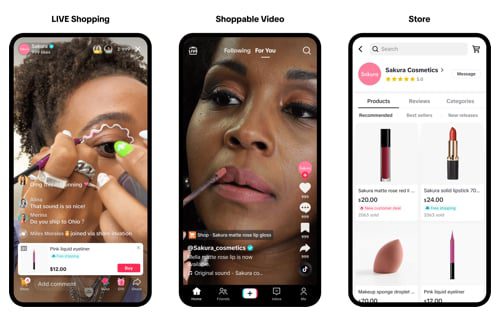
TikTok Shop, launched in the U.S. in September 2023, is an integrated ecommerce platform within the TikTok app, allowing merchants, brands, and creators to sell products via shoppable videos, livestreams, profile pages with product collections, shop tabs with searchable product listings and shoppable content, and affiliate program features.
Sellers can leverage TikTok Shop Ads and, for logistics, Fulfilled by TikTok. TikTok Shop integrates with platforms such as Shopify, WooCommerce, and BigCommerce, as well as multichannel partners such as ChannelAdvisor, Feedonomics, and ChannelEngine.
TikTok Shop Live enables sellers and creators to run livestreams where shoppers can purchase merchandise directly. The number of U.S. TikTok Shop Live sessions hosted each month nearly tripled in 2024, per TikTok, which stated beauty brand founder Stormi Steele (@iamstormisteele) surpassed $2 million in Black Friday 2024 sales, setting a new record for a single live session.
Subscription is a recently expanded feature for live and non-live creators that offers access to exclusive perks, unique experiences, and a members-only community for a monthly fee. Creators can customize their subscription packages in tiers, including private community channels, exclusive content, and custom perks.
Creator Affiliate Program lets creators earn commissions from merchants by sharing preferred products in short videos and livestreams. In addition, TikTok is reportedly letting some creators add product links from third-party affiliate networks (including Amazon, Walmart, Target, Rakuten, and Temu) directly to their posts through a new integration.
Creator Rewards Program lets creators monetize original videos over one minute with an optimized rewards formula focused on four areas: originality, play duration, search value, and audience engagement. Creators must be 18 years old, have at least 10,000 followers, and a minimum of 100,000 views in the last 30 days.
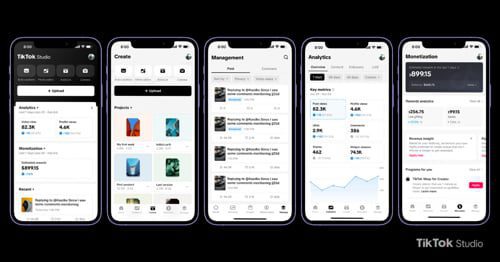
TikTok Studio is a platform to create, edit, upload, manage, and analyze videos. Creators can post to TikTok directly from Studio and use tools such as auto caption, photo editor, and autocut. The monetization module in Studio contains an overview of all platform offerings, personalized recommendations, and growth opportunities.
TikTok Studio
Smart+ automates advertising across targeting, bidding, and creative to optimize cost and performance. Advertisers input their assets, budget, and targeting goals, and Smart+ automatically creates or selects the best creative asset and, utilizing AI-powered TikTok Symphony, chooses the right audience and optimal time. Smart+ includes campaigns for web traffic, catalog ads, app installs, and lead generation.
GMV Max is a new service enabling TikTok Shop merchants to automate advertising campaigns. GMV Max leverages all available creatives automatically (organic videos, affiliate videos, and ads) and deploys them in a single automated campaign, whether it’s promoting an entire shop or select products. Advertisers select the products to promote, define a return-on-investment target, and set the budget.
TikTok One is a new centralized hub for marketers to access creative tools. Brands can access 2 million TikTok creators, production partners, and insights, as well as the Creator Marketplace and Creative Challenge.
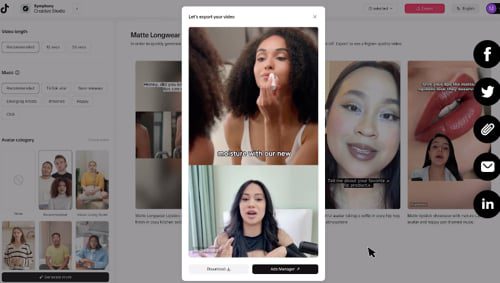
TikTok Symphony is a new AI suite to help marketers scale content development, creativity, and productivity on TikTok. Symphony supports scriptwriting, video production, and asset optimization. Symphony Assistant can summarize trends, create TikTok-native scripts, brainstorm creative concepts, identify creative ideas, and more.
Automattic announced the acquisition of WPAI, a company that creates AI-powered functionalities that make WordPress easier and more efficient to use. The core technologies of the current apps will be integrated into new offerings by Automattic.
WPAI
WPAI released it’s first product, CodeWP in 2022. CodeWP was an AI integrated development environment (IDE) for developers, enabling them to quickly generate code that’s optimized for performance and WordPress standards.
The second app produced by WPAI is AgentWP, released in August 2024. AgentWP was an autonomous AI agent that could proactively take action such as as making design changes. It indexes a website and is able to improve WordPress website workflow from content to code generation.
The technology of both apps will be integrated into WordPress.
According to the announcement by WPAI:
“We are excited to combine forces with Automattic to push the boundaries of how we can apply artificial intelligence to be more impactful on the CMS that powers the majority of the internet,’ says James LePage. ‘By integrating our technology and research with current and future Automattic products, we’ll be able to accelerate towards our goal of making WordPress, the Operating System of the Web, more accessible to everybody.”
Automattic explains:
“WPAI is an AI startup, focused on building AI solutions for WordPress. The brilliant founding team behind it—James LePage, Greg Hunt, and Ovidiu “Ovi” Iulian Galatan—will be joining Automattic to lead the exploration of applied AI as an interaction paradigm for WordPress. They’ll be working on testing, building, and integrating innovative AI solutions into the core ecosystem to redefine how users and developers work with WordPress.”
Google has released FAQ guidance on its site reputation abuse policy.
The update covers important points about managing third-party content and recovery processes.
Breaking Down Third-Party Content Rules
Google wants to clarify what counts as a violation. Using third-party content is not a problem in itself.
A violation happens when that content is used to take advantage of a site’s existing rankings.
Google explains:
“Having third-party content alone is not a violation of the site reputation abuse policy. It’s only a violation if the content is being published in an attempt to abuse search rankings by taking advantage of the host site’s ranking signals.”
This is especially important for publishers using:
Freelance writers
White-label services
External content creators
User-generated content
Google defines third-party content as:
“Content created by a separate entity than the host site,” including “users of that site, freelancers, white-label services, content created by people not employed directly by the host site.”
Recovery Options: What Works & What Doesn’t
Publishers who want to fix manual actions now have clear instructions on what to do with their content:
What Not to Do:
Don’t move content to subdirectories or subdomains.
Don’t redirect URLs that have received penalties.
Don’t just move content without proper documentation.
As stated in the FAQ:
“Moving content to a subdirectory or subdomain within the same site’s domain name: This doesn’t resolve the underlying issue and may be viewed as an attempt to circumvent our spam policy, which may lead to broader actions against a site in Google Search.”
However, Google notes that:
“Moving content to a new domain: This is far less likely to be an issue if the new domain has no established reputation and you follow our spam policies.”
What to Do:
Move content to new domains that do not have a good reputation.
Use “noindex” tags and make proper reconsideration requests.
Apply “nofollow” attributes for any necessary cross-linking.
Affiliate Content Gets Green Light
Good news for publishers: Google confirmed that affiliate content is not affected by this policy.
The documentation clarifies:
“The policy is not about targeting affiliate content… Affiliate links marked appropriately aren’t considered site reputation abuse.”
To comply, publishers must properly mark their affiliate links. This means you can continue to earn money through legitimate strategies while following the new rules.
Technical Implementation Guidelines
For websites under manual action, Google has outlined important technical requirements:
Using a noindex tag alone will not remove the penalty automatically.
You must submit reconsideration requests through Search Console.
You need to document all steps taken to fix the issues.
The documentation reads:
“You still need to reply to the manual action in Search Console and explain that the content has been noindexed. We recommend doing this rather than letting the manual action remain against your site.”
The guidance also addresses linking practices:
“If you link from the old site to the new site, make use of the nofollow attribute for those links on the old site.”
Forward-Looking Implications
This FAQ release shows that Google is improving how it communicates policy changes.
The clarifications arrive at a crucial time as publishers work to align their strategies with Google’s evolving standards while maintaining sustainable businesses.
The first commercial power plant had only 59 customers when Thomas Edison built it in 1882.
Eighteen years later, access to electricity had already expanded to 3.8 million U.S. Americans (5% of households).1 From there, power grid access grew exponentially:
8% in 1907.
35% in 1920.
68% in 1929.
We stand at the doorstep of a comparable technology: AI.
ChatGPT is the second fastest-growing consumer product.
Capital expenditures of hyperscalers could exceed $300 billion in 2025.2
AI already makes consultants, writers, and financial experts more efficient.
A joint report by Semrush and Statista found that 1 in 10 U.S. internet users go to gen AI for search first before exploring search engines.
But when is the right time for B2B companies to invest in AI chatbot visibility?
For companies with limited resources, investing in technology too early can be a costly distraction (pets.com). Being too late can cost even more (Kodak).
B2B is a particularly interesting case for three reasons:
AI chatbots answer a lot of information queries directly that used to bring traffic from Google. Ecommerce, for example, is different because searches either start on Amazon directly or shopping is natively integrated (see Perplexity shopping or Google’s new experience).
I analyzed referral traffic from the biggest AI chatbots to six B2B companies with a combined traffic volume of over 1 million monthly visits.
The data shows an average of 0.14% when comparing AI chatbot referrals to organic visits. That’s one referral for every 714 organic visits. Peanuts.
But in the next three years, AI chatbot referral traffic could make up over 35% of organic traffic. As a result, companies would do well to develop playbooks for growing visibility now to benefit from first-mover advantages.
How Much Traffic Do AI Chatbots Send?
Image Credit: Kevin Indig
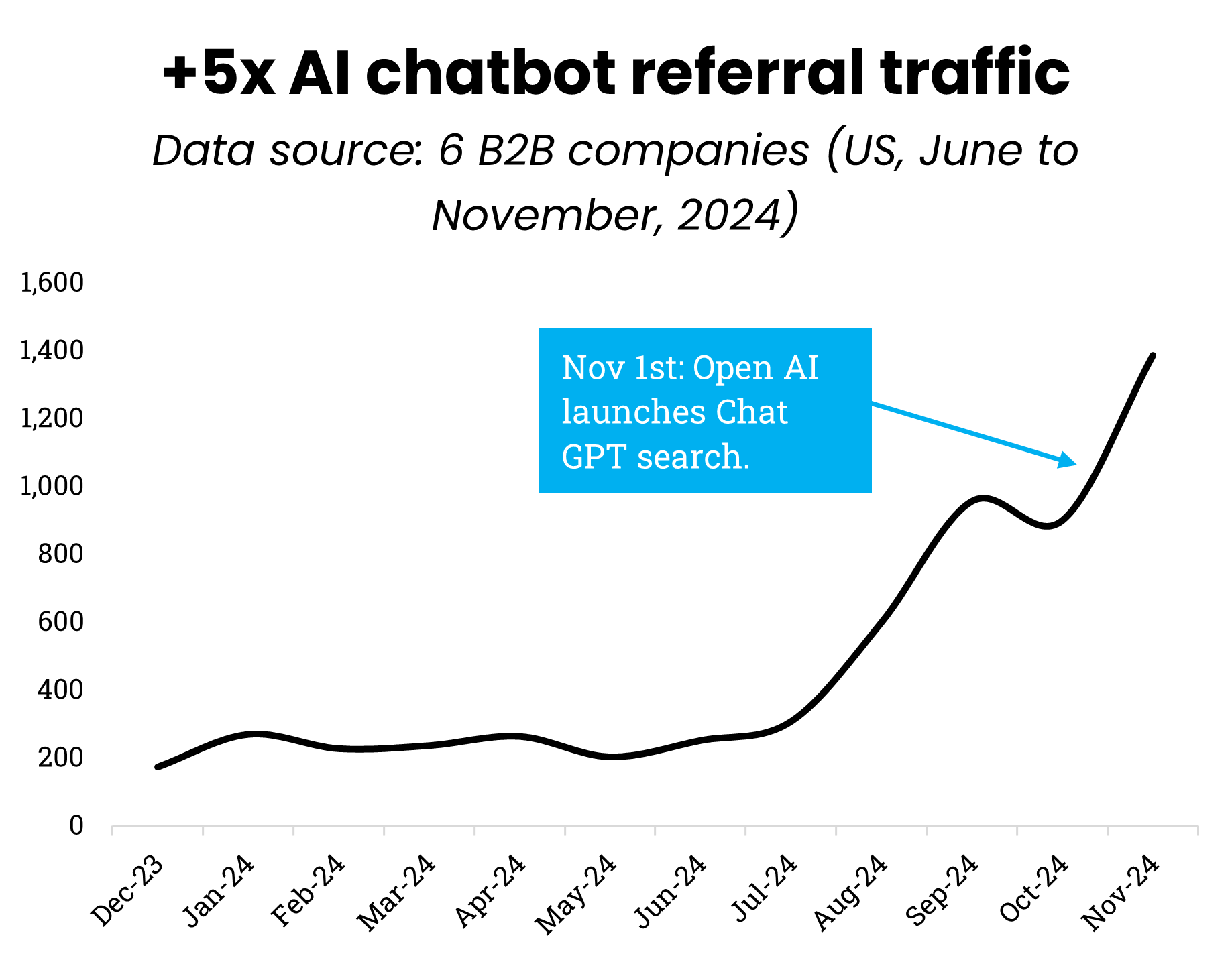
In my case study of six B2B companies, referral traffic from AI chatbots has grown from an average of 250 visits per month in the first half of 2024 to over 1,300 in November (+5x).
The drivers are growing usage of AI chatbots, more links to sources, and OpenAI’s introduction of its AI search engine, ChatGPT Search.
Image Credit: Kevin Indig
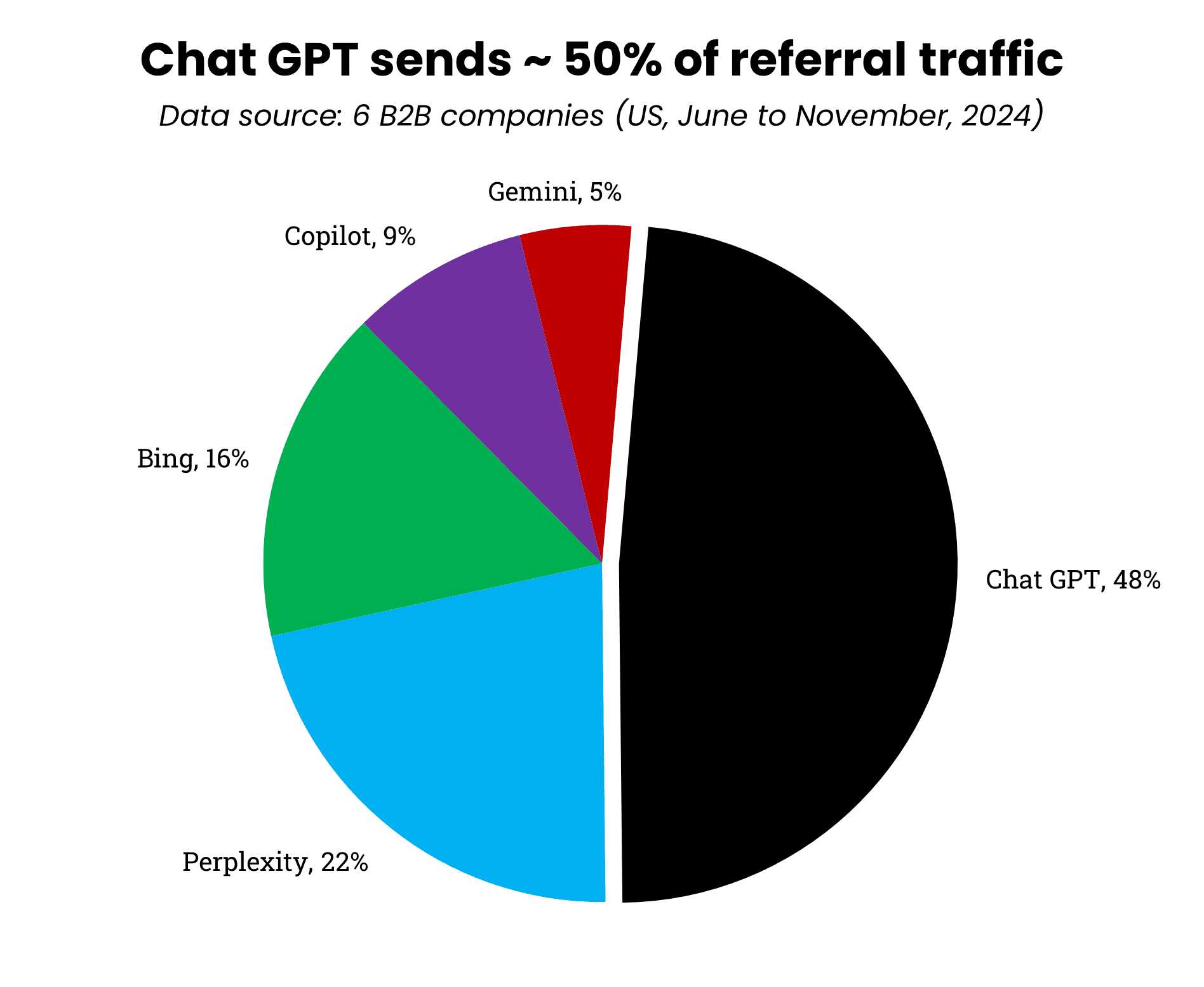
Almost unsurprisingly, ChatGPT sends the most referral traffic, with almost 50%.
Perplexity comes in 2nd at 21.7%.
Gemini sits in a surprisingly distant fifth place.
Even Bing and Copilot send more traffic, even though Gemini was built by search monopoly Google. It’s unclear whether usage or design is responsible for Gemini’s low referral traffic.
Even though AI chatbot referral traffic is growing rapidly, it makes up only 0.34% in comparison to organic traffic.
For some companies, it’s as low as 0.09%, and for others, it’s as high as 0.9%. It’s easy to dismiss referral traffic from AI chatbots because of their miniscule size.
Every smart manager would categorize such a small customer acquisition channel as a distraction. And yet, it’s a mistake.
Referral traffic from AI chatbots grows at a staggering monthly average of 25.6%.
As humans, we’re inherently bad at understanding compound growth because most of our environment is linear (distance, time, etc.).
An annual growth rate of 7% seems harmless until you realize it doubles growth in 10 years.
Only 14% of U.S. Americans have tried ChatGPT.3 They’re early adopters.
Over 170 million more could join the trend in the next years (assuming 334 million Americans minus ~35% for age), which should skyrocket referral traffic even more. And that’s just the U.S.
On the flipside, organic traffic is flat to down for many B2B companies. In my sample set, organic traffic grew only 1.1x between January and November on average.
Image Credit: Kevin Indig
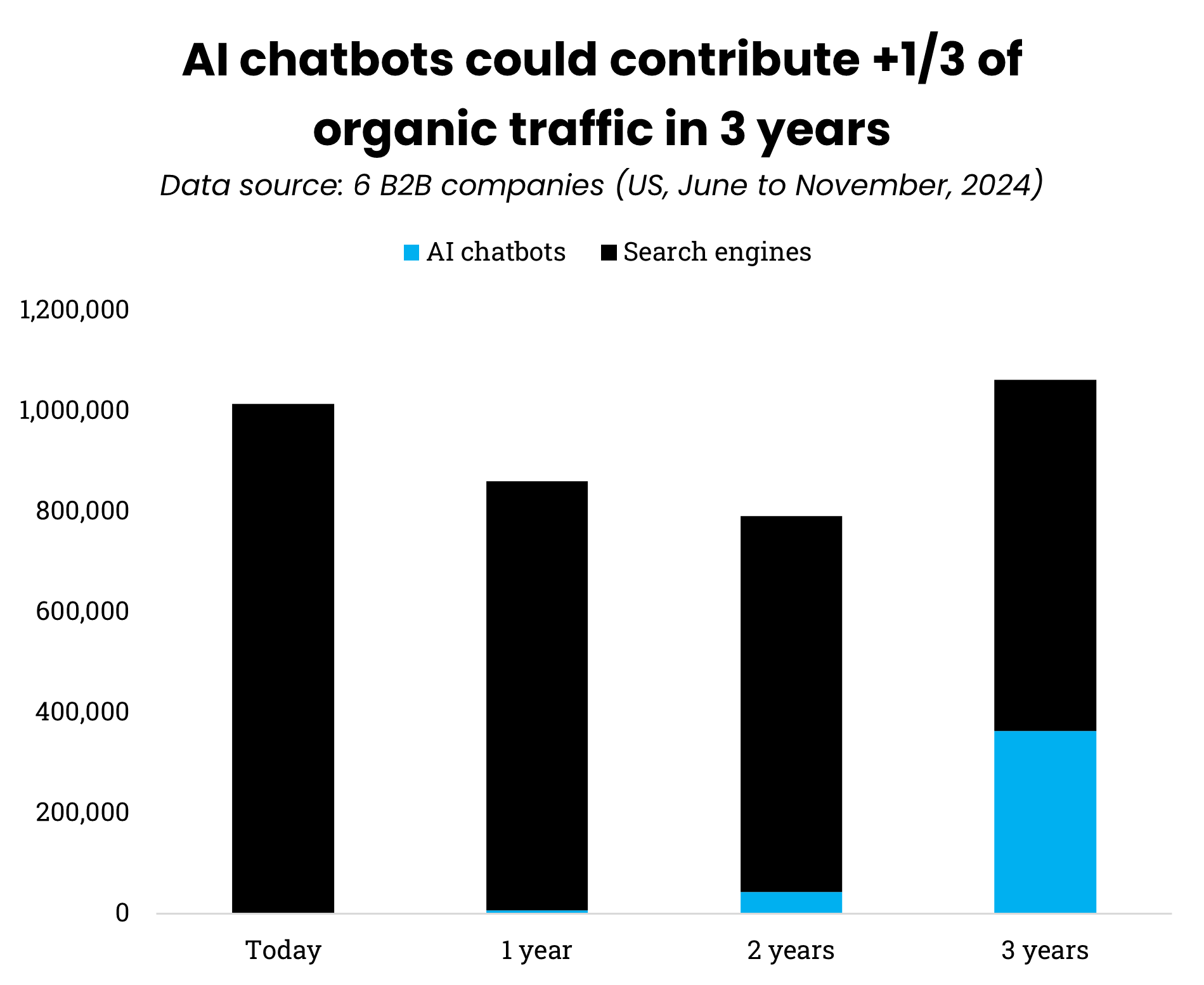
When considering constant growth rates, over one-third of organic traffic could come from AI Chatbots in three years.
In the sum total, AI chatbot referrals would make up over 34% of traffic. Two companies in my set of six are projected to get more than double as much traffic from AI chatbots than from search engines.
Referral to organic traffic ratio projections:
Today: 0.14% (January – November).
In a year: 0.79%.
In two years: 5.7%.
In three years: 52%.
Note that we don’t yet know whether AI chatbots cannibalize search engine usage one-to-one or whether we’ll do both.
I have a hunch it’s going to be the latter because AI adoption will happen in phases, and overall usage could increase because LLMs are so capable.
That’s also why my projection chart has a higher total as AI chatbot adoption grows in year 3, which means more potential traffic for B2B companies instead of less.
Of course, this is a small case study of only six B2B companies, and growth rates likely won’t stay constant.
Most projections are wrong, but this exercise helps to put in perspective how quickly the status quo can change.
Implications
My advice is clear: Don’t bank on steam engines. Bank on the power grid.
AI chatbots show early signs of compound growth that could become significantly faster than we can intuitively grok.
Here is what I tell my (B2B) clients:
Monitor LLM crawlers, referral traffic, and conversions by landing page to figure out which content gets crawled and performs well in AI chatbots.
Track your keywords as questions with a house-made, API-based tracking system or proprietary LLM tracking tools. Monitor visibility ChatGPT, Perplexity, Copilot/Bing, and Gemini because we don’t yet know whether “AI chatbot optimization” will lead to the same results for all chatbots, similar to how SEO is very similar for Google and Bing or whether they will reward different approaches.
Test net-new content and content adjustments to provide better answers in AI chatbots. Now is the time to write the playbook.
Keep doing classic SEO since AI chatbots still lean heavily on their results to ground answers.
We love to say that SEO is always changing, and 2024 proved that true. There’s hardly been a year more challenging and exciting than that. But as we’re heading into 2025, we’re sure we have not seen the last of it. With everyone banking on AI, search, and the search industry are set for another sea change. In this post, we hear from twelve seasoned SEO experts for their insights on the future and how you can prepare.
Table of contents
A look back at SEO in 2024
2024 was a year with many newsworthy developments. We won’t review everything here, as that would need a book, but maybe someone will make a documentary about life as an SEO in 2024. Or maybe life at Google, as the search giant was central to almost all the big news.
Google deemed a monopoly
Let’s start with the biggest: Google faced a significant legal ruling when a federal judge declared it a monopoly in August. This landmark antitrust case found that Google’s dominance in the search engine market violated antitrust laws. Since then, there have been many discussions about potential regulatory changes and impacts on the broader search and tech industry. Currently, it looks like the DOJ will ask Google to sell off Chrome, among other things.
Google launched AI Overviews
In May, Google launched AI Overviews during its I/O event. This new feature uses AI to generate concise summaries in search results, aiming to make searches more efficient and user-friendly. This integration marked a significant advancement in using AI within search engines. AI Overviews are now available in most markets, but not the EU.
Google search documents leak
Around the same time, a massive leak of Google’s search API documentation occurred, revealing over 2,500 pages of internal documents. Although the leaked documents do not contain the algorithm’s secret recipe, they provide valuable insights into Google’s inner workings.
Core updates keeping everyone up at night
Throughout the year, Google’s core updates led to significant swings in search rankings and notable traffic changes for many websites. For many of us, it remains an ongoing challenge to adapt to evolving algorithms quickly.
Keep up to date with the Yoast newsletter SEO is ever-changing. It can be hard to keep up with the latest changes and decide what’s best to focus on. But as a Yoast newsletter subscriber, you no longer need to worry! You’ll receive weekly emails with practical SEO tips and insights to help you quickly improve your site.
Additionally, in March, Google banned Parasite SEO, a practice that exploits high-authority domains for quick ranking. Google uses this ban to improve search quality and eliminate manipulative practices within its search ecosystem. This policy affected major sites like Time, Forbes, CNN, and the Wall Street Journal, as they were penalized for not adhering to Google’s guidelines.
OpenAI launches ChatGPT Search
In non-Google news, OpenAI introduced a search feature within ChatGPT in October, which was another groundbreaking development. This addition allows users to access up-to-date web information directly through the chatbot. As a result, OpenAI became a direct competitor to traditional search engines and offered a new way to find information online.
These were just some of the big events that happened in 2024. SEO is one of the most dynamic industries — never a dull moment! But this also means that you must stay informed and be able to adapt to a rapidly changing environment.
We’ve asked several trusted experts for their insights into what’s happening next in SEO in 2025. We’ll present their answers in themes, starting with the biggest one: the role of AI in SEO.
AI’s role in SEO
Artificial Intelligence is reshaping how businesses and professionals approach SEO. As AI tools become more advanced, they offer both opportunities and challenges.
Content generation and strategy
Arnout Hellemans (independent SEO consultant) believes AI will “massively” transform SEO strategies. However, he says, “The issue is that search engines will leave loads more content out of the index because it’s generic content already there.”
This means businesses must focus on creating unique and valuable content rather than relying solely on AI-generated text. AI can help keep content updated and assist in research, but human oversight remains critical. Hellemans suggests that while AI advances rapidly, “human oversight and rewriting is still really needed.” This balance ensures content remains relevant and engaging.
Streamlining content creation
Lily Ray (VP, SEO Strategy & Research at Amsive) points out that AI can make content creation much more efficient: “More and more companies will find ways to integrate AI into their content creation and optimization strategies. Outside of using AI to generate content, AI can create major efficiencies that streamline the content creation, such as analyzing and summarizing data, producing insights and text content at scale; generating metadata and structured data, and much more. While mass-producing AI content on a large scale can present SEO risks in some cases, using AI creatively and intelligently can dramatically speed up and improve the content ideation and creation process.”
Using AI for more than just content creation
Lily’s colleague Johnny Herge added that content writers will start using AI tools to do more than just produce content. “A new way many SEOs will succeed in 2025 is by using AI to help with the final product besides the copy itself. Coding is made infinitely easier with AI. Using AI will allow writers to make data analytics scripts or scripts that organize data and pull insights that would have previously required a writer to have a different skillset entirely. This likely will lead to writers being able to put forward much further quantifiable insights. ”
Kevin Indig (independent consultant) agrees: “AI + no-code offers SEO and other marketers powerful new workflows around building systems instead of working on single campaigns. I expect us to see many more examples of “systemization” next year, which will lead to smaller SEO teams with larger impact.”
AI and SEO tools will improve
As AI and SEO tools evolve, they will become much smarter. They don’t just identify issues but suggest fixes, making them incredibly valuable. As Kyle Risley (Senior SEO Lead at Shopify) says, “SEO tools will evolve to be more proactive, shifting from merely identifying issues to offering comprehensive solutions. For small businesses with limited time and resources, these recommendations can help improve site quality, even without specialized SEO knowledge. Instead of simply noting “Your title tag is too short,” tools will suggest “Your title tag is too short. Click here to implement a better one.”
AI agents and AI brandbuilding
Jes Scholz (independent Growth Marketing Consultant and SEO Futurist) says, “AI agents will be all the hype, but very few SEOs will actually change their strategy. Only the bold will have the buy-in to take tactics to the cutting edge. But this will be needed as LLM-powered surfaces (AI Overviews, ChatGPT, etc.) start slowly but steadily eating into traditional search. Quick win AI visibility tactics, like best of listicles, will rise and fall like the meta keyword tag of old. Brand building on popular RAGd platforms will likely emerge as a dependable strategy. But no matter what, now is the time you can win the HoM/CMO/CEOs attention.”
Google’s AI Overviews will evolve
Kevin Indig also comments on the evolution of Google’s AI Overviews: “I expect AIOs to morph into other formats next year, similar to how they contain products in shopping. Right now, they look like Featured Snippets, but I expect Google to keep iterating. I also expect them to roll AIOs out even further to monetizable queries, widening the gap between what’s measurable and what’s happening in the search results even more.”
Mark Williams-Cook(SEO Director at Candour) adds: “We’ve long seen the trend of Google trying to keep searchers on their SERP, and with their recent announcement they have reduced the cost of generating AIOs by 90%, I think it’s obvious we’re only going to see more of them. However, AI in the form of LLMs does open new doors, especially with content creation, without falling into the no-value trap of having AI write your content for you.”
Yoast SEO expert insights for 2025
Carolyn Shelby – Principal SEO at Yoast
The balancing act of SEO professionals In 2025, the big shift in SEO will be balancing diversified visibility with unified messaging. As AI-powered platforms, alternative search engines, and social discovery tools like TikTok, ChatGPT Search, and even Reddit increasingly influence how users find information, businesses can no longer rely solely on Google to drive traffic. Success will come from creating a consistent, authoritative presence across these fragmented ecosystems.
SEO professionals will need to ensure brand messaging remains cohesive and trustworthy across all channels while adapting to each platform’s unique requirements. Structured data, multimedia content, and a deep understanding of user intent will become critical to connecting the dots between platforms and maintaining a seamless user experience. In 2025, SEO will evolve into an integrated marketing discipline where visibility and messaging work hand in hand to build lasting trust and engagement.
Adapting to zero-click searches
The rise of zero-click searches is changing how businesses approach SEO. Getting clicks can be harder as users find answers directly on search result pages.
Maintaining visibility
Arnout Hellemans suggests that you “start looking at other platforms (both search engines and AI interfaces) and try to understand how you can be included in their answers (think Claude, ChatGPT, Bing, Brave search engine). By doing this, you can ensure your business remains visible even when traditional clicks decrease.”
Building a brand following
Building a strong brand presence is essential. Arnout advises businesses to focus on “proper marketing, such as building a following or fans. Visibility will start shifting away from Google; I think this is where we will find plenty of opportunities.” Engaging with your audience on social media and other platforms helps maintain interest and loyalty, even if users don’t click through to your site directly.
Leveraging AI and alternative channels
Kyle Risley says, “As clicks become harder to come by in organic search, there are pretty much two options for organic acquisition: hang on to as much of your remaining click share as you can and activate new traffic acquisition channels.” This could mean looking at channels like TikTok and YouTube. These platforms are gaining traction as starting points for user journeys. Businesses can create engaging content on these channels to reach new audiences and drive traffic.
Becoming a source for AI Overviews
Gus Pergolia (Senior SEO Product Manager at Indeed) notes that being a source in AI Overviews can be more relevant than getting clicks: “Imagine searches displaying a brand’s blog as a source (e.g. software listicles). If one of the players is the main source for AI Overviews, they’ve more control over the message vs competitors. Could they change the wording to say better things about them?
“I’d guess many people will see an AI answer mentioning a few brands and what’s being said about them, and later, they will move to each brand’s website to evaluate their options. That specific search was a zero-click, but there’s a new one happening directly to your company’s website.”
“It’s interesting that clicks will decrease, but since AI Overviews are a RAG (AI answers validate with sources), many pages will still have a reason to exist since they’ll validate the AI answer. This is intent-dependent. Many informational, common-knowledge queries won’t require new articles or have a brand impact.”
Reddit is not going away; make use of it
Kevin Indig doesn’t expect Reddit’s growth to slow: “Searchers want connection and a non-commercialized space. I expect Google to improve at showing Reddit posts that are not outdated or thin. The implication is that domains must compete for one less spot since Reddit takes up many top spots in the search results. On the other hand, it becomes a valuable pool of audience insights and engagement. Brands that develop a playbook to grow their visibility on Reddit have a chance to improve their sentiment and create loyal customers.”
Expand your data tracking
Aleyda Solis expects that tracking pixels, SERP features, and clicks vs. no-clicks will become fundamental: “Start monitoring your overall SERP visibility and click behavior: Your SERP features shifts — AI overviews included — pixel visibility from the top, as well as clicks (and no-clicks) shifts per content type and SERP feature, to focus your SEO strategy accordingly.”
Yoast SEO expert insights for 2025
Alex Moss – Principal SEO at Yoast
The evolving role of the SEO: It’s more than just “SEO” As an SEO professional, I’ve witnessed a dramatic shift in our field, particularly in 2024. While the traditional “SEO” title remains, it has become an increasingly outdated term. Our role is expanding, becoming more multifaceted, and demanding a broader skillset. We’re no longer solely focused on optimizing for Google; we’re becoming Discovery Optimization Experts responsible for ensuring brands are found across the entire digital landscape.
Several factors drive this shift, including the rise of AI-powered search engines like ChatGPT and Perplexity and the growing importance of platforms like TikTok and Reddit as legitimate discovery channels.
Furthermore, the perception of SEO as purely a marketing function is misguided. SEOs bring a unique understanding of the digital ecosystem far beyond traditional marketing. We should be more involved in high-level business decisions that shape a company’s online presence, influencing everything from website design to content strategy to product development.
The future of SEO is exciting, but our value still tends to be underrated. Our skillset will need to expand further yet again, practicing through experimentation.
The rising importance of video content
Video content is becoming a key component of SEO strategies. Its engaging nature offers a unique way to connect with audiences.
Video-first approach
Mark Williams-Cook says, “I expect we’ll see many smaller businesses take a ‘top-down’ approach with content now, meaning they will go video first – and I think this is really smart. Video content is cheap, fast to make, and a natural way to pull real insight out of people. With the tooling we have now, it’s easy to automatically produce transcripts, which in turn, LLMs can rewrite into a more traditional ‘article’ style. This approach means you’ll get the video to share over multiple platforms, which is not only hard for AI to replicate but how a lot of people prefer to engage in content.”
Google’s focus on video content
Lily Ray confirms that “video content is increasingly essential, as Google prominently features YouTube and sometimes TikTok across various surfaces, like Search, Discover, Google News, the Video tab, Short Videos, and more. Site owners should be well-versed in changes to how Google indexes video content and expands their text content into visual formats.”
“As it relates to video indexing, Google now requires that a video be the focus of an indexed watch page for the video to get indexed (“Google indexes videos only from indexed watch pages.”) Using YouTube to host the video is another way to ensure that the video is indexed, but be sure to use VideoObject structured data to “connect” your watch page to the YouTube video for the watch page to get video rich features in search results.”
Interactive engagement
Gareth Hoyle emphasizes that “video will also continue to gain importance due to its interactive nature and engagement. AI video will continue to grow, but like the EEAT signals above, curated and well-engaged real video will help businesses showcase themselves to Google’s algorithm and their current and potential new customers.”
E-commerce SEO shifts
The landscape of e-commerce SEO is evolving, particularly with changes in how Google handles shopping queries. Businesses need to adapt to these shifts to stay competitive.
Google Shopping tab focus
Kevin Indig expects “the new Shopping Tab experience to become the default experience for shopping queries. As we’ve seen before, Google often tests a new experience in the shopping tab and then moves it to the main tab. The implication is that e-commerce SEO becomes more about optimizing product pages as Google becomes the new category page.”
Optimizing product pages
As Google will likely integrate more e-commerce features directly into search results, businesses must optimize their product listings. With the emphasis on product pages, businesses should ensure that these pages are detailed and informative. This includes high-quality images, detailed product descriptions, customer reviews, and clear pricing information. Structured data markup can enhance how products appear in search results, increasing visibility and click-through rates.
Product feed accuracy
Accurate and organized product feeds are crucial. Kyle Risley highlights the importance of having “well-organized and error-free product feeds” as search engines increase the visibility of organic product listings. This requires regularly updating product information and ensuring consistency across platforms.
Adapting to new channels
As consumers begin their shopping journeys on platforms like TikTok and YouTube, businesses should consider expanding their presence on these channels. Creating engaging product videos and leveraging social commerce features can attract new customers and drive traffic.
Sign up for our monthly SEO news webinar Prepare for the SEO challenges of 2025 with insights from industry experts. Join our free monthly installments of the SEO Update by Yoast to learn strategies that drive results. Reserve your spot today.
Today, brand authority is vital if you want to perform well in search results. As search engines evolve, they will develop new ways of determining how valuable your brand is. Building a good — human — brand is one of the best ways to stand out from the crowd.
Targeting branded queries
Aleyda Solis emphasizes that it’s all about brand optimization: “Brand optimization becomes key. It’s clear that Google wants to feature real, authoritative brands at the top of the SERPs, which is also helpful for increasing CTR and optimizing conversions. Grow your brand authority by understanding your company brand positioning and considering it in your SEO strategy: Target your branded queries, specify your brand details with structured data, optimize your knowledge panel details, etc.”
Focusing on EEAT
Gareth Hoyle highlights the importance of EEAT (Experience, Expertise, Authoritativeness, Trustworthiness) referenced content: “As Google continues to improve its ability to weed out low-level, auto-produced AI content, EEAT-referenced content will become increasingly important and visible as Google increases trust based on what it knows about the author rather than just the words on the page. I am sure it will be an ongoing battle as spammers and content sites continue to churn out page after page of content, but the personal brand will help the cream rise to the top.”
Local SEO trends
Local SEO is essential for small and medium-sized businesses attracting nearby customers. As we move into 2025, businesses should focus on a few key areas.
Google Business Profile optimization
Keeping an updated and complete Google Business Profile is essential. Freelance SEO expert Arnout Hellemans emphasizes that a “regularly updated Google Business Profile and a fully completed profile will be extremely important.” This means ensuring that all business information is accurate and up-to-date. Regularly adding new photos, responding to customer questions, and posting updates can make your business more appealing to local searchers.
The power of reviews
Customer reviews significantly impact local search rankings. According to Arnout, reviews with the “right sentiment,” particularly those discussing “the services received and results,” are crucial. Encourage satisfied customers to leave positive reviews, highlighting their experiences with your services. Responding to positive and negative reviews shows that you value customer feedback and are committed to improving your business.
User experience (UX) enhancements
Improving user experience is key to boosting SEO performance. A smooth and intuitive website keeps visitors engaged and encourages them to explore more.
Form validation and friction reduction
Arnout Hellemans highlights the importance of “proper form validation on lead forms and checkout.” Ensuring that forms work correctly and are easy to use can prevent user frustration. Make sure users can easily fill out and submit forms without errors.
Removing distractions is also crucial. Arnout advises focusing on “the removal of distractions like pop-ups on every page.” Pop-ups can be annoying and disrupt the browsing experience. Limiting their use or ensuring they’re relevant and easy to close can help maintain user attention.
Leveraging SEO communities
Joining SEO communities can be a game-changer for businesses and professionals looking to enhance their knowledge and network. These communities offer support, insights, and opportunities that can drive growth.
Growth of global SEO communities
Jo Juliana Turnbull (Founder and Marketing Consultant at Turn Global) mentions that by 2025, there will be “the growth of global SEO and digital communities.” This growth is particularly beneficial for smaller brands aiming to build authority. Being part of a community provides access to shared experiences and advice from peers facing similar challenges.
Support and learning opportunities
SEO can often feel isolating, especially in smaller companies where one person handles most of the SEO tasks. Jo Juliana notes that these communities help individuals who “look for external support” as they navigate frequent updates and changes in SEO. Participating in events, webinars, and online forums provides valuable learning opportunities and informs members about the latest trends and techniques.
Building networks and careers
Being active in an SEO community can also open doors to career opportunities. Networking with other professionals can lead to collaborations, job offers, and new projects. Jo Juliana points out that people join communities to “feel and be supported,” learn from one another, and advance their careers.
Conclusion to SEO in 2025
As we move into 2025, staying on top of SEO developments is more important than ever. The events of 2024 have shown us how quickly the landscape can change, from legal rulings and algorithm leaks to shifts in digital strategies. These changes underscore the need for you to remain agile and informed.
Join our monthly SEO news webinar to keep up with these changes and gain deeper insights. Alex and Carolyn — our resident SEO experts — talk you through all the latest developments. It’s a great opportunity to stay informed about the latest trends and strategies. Please sign up today and learn how to navigate SEO in 2025. Let’s continue to learn and adapt together.
Would you happen to have any thoughts about SEO in 2025 to share? Please comment on this post!
Edwin is an experienced strategic content specialist. Before joining Yoast, he worked for a top-tier web design magazine, where he developed a keen understanding of how to create great content.
Are you or your clients struggling to build trust and stand out in a crowded marketplace? Do you know what truly drives consumers to choose one business over another? Are you leveraging reviews effectively to enhance conversions?
If these questions resonate with you, then you’re in the right place.
In today’s digital-first world, consumers increasingly rely on reviews to guide their choices, making trust a vital currency in the success of local businesses.
As reviews shape perceptions and influence buying decisions, a poor reputation has become the number one driver of weak SEO and marketing performance. But it doesn’t have to be that way—we’ve got the tools and insights to help your business or agency turn the tide.
Exclusive Insights from GatherUp’s November 2024 Survey
Join us for an exclusive event where we’ll unveil groundbreaking findings from GatherUp’s November 2024 survey of over 1,200 Americans, revealing how attitudes toward reviews are reshaping the buyer’s journey. This fresh data provides a unique window into the critical role of reviews and their growing influence on consumer trust and behavior.
What You’ll Learn
During this session, we’ll take a deep dive into strategies that agencies and SEO professionals can use to drive trust and credibility. We’ll uncover where consumers are searching for reviews, why certain platforms dominate, and how elements like recency, detail, and personalization contribute to a compelling online reputation.
Key Topics We’ll Explore:
Understanding Consumer Trust: Gain insights into the review traits that consumers value most—such as authenticity, responsiveness, and depth—and how these factors can directly influence conversions.
Winning Across Review Platforms: Explore the platforms where consumers are turning for reviews and identify the rising stars reshaping the review landscape.
Responding to Reviews with Impact: Learn how strategic responses can transform even negative feedback into opportunities for customer retention and loyalty.
Navigating the Ethical Challenges of Review Management
Beyond actionable insights, we’ll also tackle critical ethical considerations in review management, including:
The role of AI in review responses and how to balance automation with authenticity.
The risks of review gating and how to navigate this practice ethically.
Effective strategies for combating review spam while maintaining consumer trust.
Agencies looking to help their clients build trust and improve local SEO through effective review management strategies.
SEO Experts aiming to stay ahead of trends in consumer behavior and learn how to leverage reviews to boost visibility and conversions.
Local business owners eager to understand how reviews impact their online reputation and how to respond effectively to drive loyalty and growth.
Reputation management professionals tasked with monitoring and managing online reviews to safeguard and enhance brand trust.
This presentation will provide actionable insights for anyone involved in building trust, credibility, and a strong local presence through effective review and reputation strategies.
LIVE Q&A
We’re also featuring a LIVE Q&A session with our presenters following the main presentation, giving you the chance to dive deeper into how you can use reviews to build your credibility and get tailored advice for your unique situations.
And don’t worry if you can’t join us live—simply save your seat, and we’ll send you a recording after the event so you won’t miss a thing.
Don’t Miss This Opportunity!
This is your chance to gain a competitive edge in building consumer trust and reputation. Save your seat today and take the first step toward a stronger, trust-driven strategy!