Google’s AI Overviews Slammed By News Publishers via @sejournal, @MattGSouthern

Since its U.S. launch in May, Google’s AI Overviews feature has created controversy among news publishers.

The generative search tool attempts to directly answer queries by synthesizing information from web sources into AI-generated overviews.

While offering users a new level of convenience, AI Overviews has been criticized for factual inaccuracies, lack of transparency in sourcing content, and disincentivizing clicks to original articles.

Despite an initial scale-back, Google has doubled down – releasing Overviews in six more countries and additional languages in August.

Background on AI Overviews

Google introduced AI Overviews as an experimental opt-in feature that has since been rolled out to general search results.

Instead of listing links to webpages, AI Overviews aim to provide a complete answer using natural language.

Many publishers are concerned that AI Overviews could cannibalize their organic search traffic by satisfying user queries without requiring a click-through.

There are also complaints that Google is repackaging and republishing content without attribution or revenue sharing.

Audience Directors Speak Out

In interviews with the Nieman Journalism Lab at Harvard, seven leading audience strategy experts shared their perspectives on adapting to the AI Overviews disruption.

Veronica de Souza of New York Public Radio emphasized reducing reliance on Google by building direct audience relationships through owned channels like apps and newsletters.

Souza states:

“We’ve doubled down on converting people to our O&O (owned-and-operated) platforms like our app and newsletters…More transparency about which categories of search queries surface AI Overviews would be a good start.”

Washington Post’s Bryan Flaherty raised concerns about misinformation risks and lack of performance data insights from Google.

Flaherty states:

“If Google loses users due to the quality issues in its results and AI Overviews, users could continue to turn to non-traditional search platforms that don’t have as direct a tie back to sites, like YouTube and TikTok, which will have an impact on traffic.”

Vermont Public’s Mike Dougherty pointed out the lack of clear citations to original sources in Overviews.

Dougherty states:

“This product could so easily put clickable citations into or above the text. It could even write, ‘According to [publisher],…’ the way one news outlet might credit another.”

Scott Brodbeck of Local News Now remained optimistic that quality journalism can outcompete brief AI summaries.

Brodbeck states:

“If you as a news publisher cannot out-compete a brief AI-written summary, I think you have a big problem that’s not just being caused by Google and AI.”

Marat Gaziev of IGN advocated for deeper symbiosis between Google and reputable information providers to uphold accuracy standards.

Gaziev states:

“RAG requires a deep and symbiotic relationship with content publishers and the media industry to ensure that only credible sources are utilized during retrieval and augmentation.”

YESEO founder Ryan Restivo warned about potential carbon impacts from the heavy computing power required at scale.

Restivo states:

“The biggest problem, in my opinion, is the competition entering this space…The amount of compute needed to produce these at scale is hurting our environment.”

LA Times’ Seth Liss speculated Google may eventually prioritize generating answers over linking to external sites.

Liss states:

“If Google decides its best way forward is to keep all of those readers on its own site, there will be a lot of sites that have to figure out other ways to find new audiences.”

Measured Optimism

While most publishers interviewed by Nieman Journalism Lab expressed reservations, some took a more optimistic view.

The consensus is that high-quality, in-depth journalism will draw readers to visit publisher websites for full context beyond a brief AI summary.

There’s also hope that Google will find mutually beneficial ways to incorporate publisher content without usurping it entirely.

The Path Forward

As the search evolves, publishers are exploring strategies to adapt – from re-investing in email newsletters and mobile apps to developing AI-focused SEO best practices.

The debate highlights a challenge all publishers share – how to remain discoverable and generate traffic/revenue when search engines can directly answer queries themselves.


Featured Image: Marco Lazzarini/Shutterstock

Survey Shows Ecommerce Strategies For 2024 Holiday Season via @sejournal, @martinibuster

WooCommerce survey offers insights into the strategies that online retailers are using to prepare for Black Friday and Cyber Monday (BFCM) and why it’s important to be proactive.

Online Sales Is Most Important Sales Channel

One of the important takeaways from the survey is that 76% of respondents confirmed that their online sales are the primary revenue channel during the holidays, highlighting the importance of a high performance website that’s optimized for sales.

46% of stores answered that up to 30% of their annual sales volume happens during a combination of the BFCM and holiday period, while 24% answered that over 30% of sales occurred during that period. 8% of stores reported that over 50% were accounted for during the BFCM and holiday season.

Top Merchants Prepare Early

Interestingly, almost 20% prepare for BFCM three to over six months ahead of time, although most merchants tend to prepare closer to the holiday season. Online stores with revenues of $250K or more were 12% likelier to prepare ahead of time, with 34% preparing 3- 6 months in advance.

This is the breakdown of how early merchants are preparing:

  • 26% prepare 1 to 4 weeks ahead
  • 27% prepare 1 to 3 months ahead
  • 13% prepared 3 to 6 months ahead
  • 4% prepare 6+ months ahead

Strategies Merchants Plan To Use

Many online merchants are planning for a strong holiday season, with 26% of stores increasing inventory as a main part of their strategy.

The top strategies reported by merchants are:

  • Increase inventory
  • Marketing
  • Promotions
  • Website optimization

Email outreach was reported by 29% of merchants to be their most effective marketing channel. The next top marketing channel is organic search at 25%. Content marketing was reported by 6% and the balance is social, and search ads.

34% of merchants plan to change alter their strategies in the following ways:

  • 26% will add new products.
  • 24% are making marketing enhancements.
  • 16% are making website improvements.
  • 10% are focusing on early sales.
  • 9% are offering special discounts.

Changes to customer engagement, social media, and inventory management round out the list of changes.

Takeaway:

It’s important to understand what other merchants are doing to prepare for the competitive BFCM shopping season and to make sure that you or your clients are considering all available opportunities to make take a greater share of the sales and not leaving anything behind due to a lack of planning.

Read the report by WooCommerce:

WooCommerce Black Friday Trends

Featured Image by Shutterstock/Red Vector

How To Set A Winning Data Strategy For Value-Based Bidding via @sejournal, @adsliaison

Value-based bidding is only as successful as the inputs you provide. It’s not just about having data; it’s about having the right data.

In last week’s article of this value-based bidding series, we looked at how to determine whether this strategy will be a good fit for your business.

Now, we’re going to dig into the steps needed to ensure you’ve got the right data foundation for value-based bidding to be effective in this second video of our series.

Once you’ve got your data foundation established, the other key piece is telling Google what your goals are. You need to set clear goals so that Google’s AI knows what to aim for.

It may sound a bit daunting at first, but with a few steps, you can ensure your value-based bidding campaigns are firing on all cylinders.

Step 1: Tighten Up Your Tracking

The first order of business is to make sure your Google Tag or Google Tag Manager is properly installed and configured across your website.

This little snippet of code is responsible for measuring crucial information about user interactions, particularly those important lead form submissions to be used as your initial conversion action.

Step 2: Share Offline Conversion Data

Not all valuable customer interactions happen online.

Phone calls and other offline conversion events are often just as important in your lead generation efforts.

Each stage of the offline sales cycle – lead, marketing qualified lead, sales qualified lead, closed deal, etc. – has a certain value for your business.

Sharing this offline conversion event data back into your campaigns helps drive your value-based bidding strategy to find more of the conversions you value most.

Enhanced Conversions for Leads: Now, let’s dive a bit deeper. The most durable method for sharing offline sales conversion data is enhanced conversions for leads.

Enhanced conversions for leads allows you to attribute offline conversions back to your Google Ads campaigns. When a user submits a form on your site, it sends back hashed lead information that you specify, such as an email address.

You then store that lead in your CRM or database, and when that lead converts or completes a further action, you upload that hashed lead information for Google to match it back to the ad that drove the lead (auto-tagging is required).

If you’re currently using offline conversion import (OCI) to bring in your offline data, we recommend transitioning to enhanced conversions for leads for several reasons: It’s privacy-safe and can provide more accurate measurement, supports cross-device conversions and engaged-view conversions, and is easier to implement because you don’t need to make any modifications to your lead forms or CRM systems to receive a GCLID.

You can implement enhanced conversions for lead using the Google tag or with Google Tag Manager – more on making this switch here.

Google Ads Data Manager: Google Ads Data Manager is designed to make it easier to import and activate your offline conversion and first party-data in one central location.

You’ll find “Data manager” under the Tools icon in your Google Ads account. This is where you can connect your first-party data sources, such as BigQuery, Google Cloud, HTTPS, HubSpot, Snowflake, Google Sheets and more via a direct partner connection or Zapier.

Note, if you don’t see your preferred data source listed among the featured products, be sure to click “Search all” to find more options.

Configure your data sources to ensure that all your conversion data, regardless of where it originates, is feeding into Google’s AI.

You can also access and configure your Google tag from Data Manager.

Step 3: Use Data-Driven Attribution

As you know, the customer journey is rarely linear. People might visit your website several times from various sources and interact with your brand on multiple channels before finally submitting a lead, signing up for your newsletter, or becoming a customer.

A data-driven attribution model takes all of these touchpoints into account, assigning credit to each interaction based on its actual contribution to the conversion.

It looks at conversions from your website and Google Analytics from Search, Shopping, YouTube, Display and Demand Gen ads, and determines which keywords, ads and campaigns have the most impact on your goals.

The benefit of this approach to attribution, especially when using value-based bidding strategies, is that it gives Google’s AI a more nuanced understanding of what’s driving results than a last-click or other static attribution model.

This means the system can make better-informed decisions about where and how to allocate your ad spend to find more conversion value based on your goals.

Setting The Right Goals

Now that you’ve got the right data flowing in, it’s time to tell Google’s AI what to focus on.

While you can – and should – track a variety of actions within Google Ads, when it comes to bid optimization, it’s important to choose a single, primary goal and focus on one single stage of the customer journey.

Ideally, your primary goal should be the action that’s closest to the end of the customer journey where you have sufficient conversion volume.

You’ll want to make sure this action occurs at least 15 times per month at the account level so that Google’s AI has enough data to work with.

Additionally, the shorter the conversion delay (the time between an ad click and the conversion), the better.

That doesn’t mean that if you have a long sales cycle and relatively low closed-deal conversion volume you can’t use value-based bidding.

You’ll just need to look at other actions your potential customers take that have more volume and a shorter conversion delay. This could be a lead form submission, a product demo request, a free trial sign-up, etc.

Keep The Data Fresh

Lastly, you want to be sure to upload your conversion data to Google Ads frequently, preferably on a daily basis.

This ensures that Google AI always has the most up-to-date information, allowing it to make the most accurate predictions and optimizations.

Again, you can upload this data by connecting your sources in Data Manager or the Google Ads API.

What’s Next

We’ve covered a lot of ground, from ensuring you’re capturing the right data to setting clear goals for Google’s AI.

Next week, we’ll get into actually assigning values to your conversions, a crucial step in maximizing the return on your ad spend and bidding to value.

More resources: 


Featured Image: BestForBest/Shutterstock

Boost Your Conversions: Transform Your Landing Pages In Just 14 Days via @sejournal, @unbounce

This post was sponsored by Unbounce. The opinions expressed in this article are the sponsor’s own.

Your landing pages serve as pivotal points for converting visitors into customers. However, too many websites don’t focus on the first impression and lose crucial moments to engage and convert their audience.

Crafting a compelling landing page isn’t just about aesthetics—it’s about strategically guiding your audience towards taking action.

Landing pages must hit it out of the park right away. They must match the interests and expectations of the users, provide a good and valuable experience, and clear next steps.

The following eight strategies can help you improve landing pages and focus on the KPIs that matter to drive performance. The right targeting, approach, and execution convert more visitors into leads and customers.

For a faster pace, implement the strategies below with the help of a 14-day free trial with Unbounce to quickly transform your landing pages and ramp up conversions.

Mameraman/Shutterstock, August 2024

Building an Effective Landing Page: Key Elements and Strategies

1. Set Clear Goals

  • Define what you want to achieve with your landing pages: Whether it’s lead generation, sales, or webinar sign-ups, having clear goals will guide your design and content decisions.
  • Understand your audience: Tailor the content, design, and offer to the specific needs and preferences of your target audience. Use language that resonates with them and addresses their pain points.
  • Segmentation: If possible, segment your audience and create different landing pages for each segment to better address their specific needs.

2. Provide A Clear Value Proposition

  • Make the offer front and center: Your landing page should clearly communicate what you offer and why it matters to your audience. Learn how to craft compelling value propositions with insights from Unbounce’s guide on effective messaging.
  • Clearly state what your Unique Selling Point (USP) is. Clearly communicate what makes your offer unique and why the visitor should care. Show how you can address any pain points of your audience. Your value proposition should be prominently displayed, usually in the headline and subheadline.
  • Benefits over features: Focus on the benefits your product or service provides rather than just listing features. Explain how it solves a problem or fulfills a need for the user.

3. Build Visual Appeal

  • Engage your visitors with visually appealing content: Incorporate relevant images or videos that resonate with your target audience. Use professionally designed templates that are suited for your audience. Customize them to match your brand’s aesthetics and messaging.
  • Clean layout: Keep the design simple, with a clear visual hierarchy that guides the visitor’s attention toward the CTA. Avoid clutter and unnecessary distractions.
  • Mobile-friendly design: Ensure the landing page is mobile-friendly and looks great on all devices. With a significant portion of traffic coming from mobile, responsiveness is crucial.

4. Optimize Load Time

  • Fast loading speed: Ensure your landing page loads quickly. A slow page can lead to high bounce rates, especially on mobile devices. Use tools like Google PageSpeed Insights to optimize load times.
  • Minimal scripts and heavy elements: Avoid heavy scripts, large images, or unnecessary elements that can slow down the page.
  • Responsive design: Ensure your landing page is optimized for all devices. A responsive design enhances user experience, reduces bounce rates, and boosts conversion rates. This includes ensuring that your landing page is optimized for phones, tablets, and all desktop browsers.

5. Write A Compelling Call-To-Action (CTA)

  • Guide visitors towards taking the desired action with a clear and prominent CTA button.
  • Use language that is compelling and time-sensitive: This adds urgency to your CTA, such as “start, today, now”. Be specific with your CTA and spell out exactly what the value proposition is, like “Start your 14-day free trial today”.
  • Consider the design and placement of your CTA: It should be prominently displayed, before the fold so it’s at a person’s eye line when they land on your page. Also, try using contrasting colors to draw attention.

6. Perform A/B Testing for Optimization

  • Continuous testing: Regularly A/B test different elements of your landing page, such as headlines, CTAs, images, and forms, to determine what works best. If you’d like more tips on how to conduct effective A/B tests, check out this step-by-step guide.
  • Data-driven decisions: Use analytics and user behavior data (e.g., heatmaps, session recordings) to inform your decisions and continuously optimize the landing page.

7. Build Trust And Credibility

  • Social proof: Include testimonials, customer reviews, case studies, or trust badges to build credibility. Showcasing well-known clients or partnerships can also enhance trust.
  • Transparency: Provide clear information about what visitors can expect after converting (e.g., what happens after they sign up). If applicable, mention any guarantees or refund policies.

8. Ensure Compliance And Security

  • GDPR and privacy compliance: If you’re collecting personal data, ensure your landing page complies with GDPR or other relevant privacy laws. Include a clear privacy policy and obtain consent where necessary.
  • Secure connection: Use HTTPS to secure data transmission and give visitors confidence that their information is protected.

Creating a high-performing landing page involves thoughtful attention to every detail that impacts user experience and conversion rates. By focusing on a compelling value proposition, a strong and clear CTA, trust-building elements, and ongoing optimization, you can develop a landing page that not only captures attention but also drives meaningful results.

Implementing these best practices will position your brand as a leader in the industry, ensuring that your landing page effectively converts visitors and meets your business goals.

How To Choose the Best Landing Page Provider

When looking to create a landing page we recommend choosing a platform that specializes in landing pages, so you get the best-in-class tool. Ideally, you are looking for a tool that can empower you or your marketers to create and optimize high-converting landing pages quickly and effortlessly without the need for developers or designers. Here are the must-haves from a landing page builder that will elevate your digital marketing strategy:

  • Drag-and-drop builder: Look for a landing page provider that offers the option to customize landing pages to align with your brand identity without any coding skills required. This allows you to set up your landing page quickly and efficiently.
  • A/B testing: Find a tool that allows you to experiment with variations to find the highest performing designs and content. This, in turn, allows you to increase your conversion rates.
  • Templates: You want the choice of access to professionally designed templates tailored to various industries and goals for quick deployment.
  • Integration: Choose a tool that offers seamless integration with your marketing tools.
  • Tailored content: Find a landing page builder that allows you to create dynamic content based on your audience to build authentic connections and increase conversions.

Unbounce.com, August 2024

Expert Insights: Why Unbounce Is Essential

  • Speed and efficiency: With Unbounce’s user-friendly, drag-and-drop interface you can quickly launch landing pages, saving valuable time and resources. This allows you to focus on other critical aspects of your business. (You can also include custom code, if you prefer.)
  • Conversion-centric design: Unbounce has 100+ templates designed with conversion principles in mind, ensuring that your landing pages are both attractive and effective.
  • A/B testing: Unbounce offers seamless, built-in A/B testing so you can make data-driven optimization decisions with confidence.
  • Advanced targeting and personalization: Unbounce offers dynamic text replacement to deliver personalized experiences to your visitors, enhancing their likelihood to convert.
  • AI-powered traffic optimization: Unbounce’s Smart Traffic automatically directs visitors to where they’re most likely to convert, based on data from over two billion conversions.
  • Seamless integration: With dozens of integrations, including Hubspot, Mailchimp, and Salesforce, and thousands more available through Zapier, your worlds can talk to each other at the click of a button.

Free trial: Take advantage of the Unbounce 14-day free trial so you can test out the platform and see how you can transform your visitors’ journey into a positive and higher-converting experience today.

    Real Success Stories With Unbounce

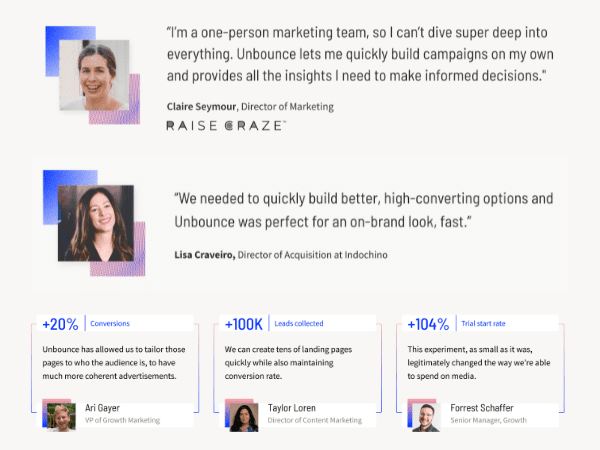
    Businesses like Going and Webistry have leveraged Unbounce to achieve remarkable results in conversions and customer acquisition. Learn more about their success stories here.

    Screenshots from unbounce.com, August 2024

    Elevate Your Marketing Game With Unbounce

    In the competitive realm of digital marketing, having the right tools is essential. Unbounce equips you with the expertise and resources to build landing pages that deliver results. Take the first step towards maximizing your marketing efforts with Unbounce’s proven solutions. Sign up today for a 14-day free trial and transform your digital presence.

    Your journey to higher conversions and business growth starts now. Unbounce’s 14-day free trial offers you a risk-free opportunity to explore the platform and see first-hand how it can benefit your business.

    By the end of this trial, you will have created, tested, and optimized landing pages that drive results. You’ll gain valuable insights into your audience’s behavior and preferences, allowing you to make informed decisions, refine your marketing strategies, and increase your ROI

    Final Thoughts

    In the competitive world of digital marketing, having the right tools can make all the difference. Unbounce gives you the expertise, resources, and insights you need to build high-converting landing pages that propel your business forward. Don’t miss out on this opportunity to elevate your marketing game.

    Sign up for the Unbounce 14-day free trial today and take the first step towards unlocking your business potential.


    Image Credits

    Featured Image: Image by Unbounce. Used with permission.

    In-Post Images: Images by Unbounce. Used with permission

    What this futuristic Olympics video says about the state of generative AI

    The Olympic Games in Paris just finished last month and the Paralympics are still underway, so the 2028 Summer Olympics in Los Angeles feel like a lifetime from now. But the prospect of watching the games in his home city has Josh Kahn, a filmmaker in the sports entertainment world who has worked in content creation for both LeBron James and the Chicago Bulls, thinking even further into the future: What might an LA Olympics in the year 3028 look like?

    It’s the perfect type of creative exercise for AI video generation, which came into the mainstream with the debut of OpenAI’s Sora earlier this year. By typing prompts into generators like Runway or Synthesia, users can generate fairly high-definition video in minutes. It’s fast and cheap, and it presents few technical obstacles compared with traditional creation techniques like CGI or animation. Even if every frame isn’t perfect—distortions like hands with six fingers or objects that disappear are common—there are, at least in theory, a host of commercial applications. Ad agencies, companies, and content creators could use the technology to create videos quickly and cheaply.  

    Kahn, who has been toying with AI video tools for some time, used the latest version of Runway to dream up what the Olympics of the future could look like, entering a new prompt in the model for each shot. The video is just over one minute long and features sweeping aerial views of a futuristic version of LA where sea levels have risen sharply, leaving the city crammed right up to the coastline. A football stadium sits perched on top of a skyscraper, while a dome in the middle of the harbor contains courts for beach volleyball. 

    The video, which was shared exclusively with MIT Technology Review, is meant less as a road map for the city and more as a demonstration of what’s possible now with AI.

    “We were watching the Olympics and the amount of care that goes into the cultural storytelling of the host city,” Kahn says. “There’s a culture of imagination and storytelling in Los Angeles that has kind of set the tone for the rest of the world. Wouldn’t it be cool if we could showcase what the Olympics would look like if they returned to LA 1,000 years from now?”

    More than anything, the video shows what a boon the generative technology may be for creators. However, it also indicates what’s holding it back. Though Kahn declined to share his prompts for the shots or specify how many prompts it took to get each take right, he did caution that anyone wishing to create good content with AI must be comfortable with trial and error. Particularly challenging in his futuristic project was getting the AI model to think outside the box in terms of architecture. A stadium hovering above water, for example, is not something most AI models have seen many examples of in their training data. 

    With each shot requiring a new set of prompts, it’s also hard to instill a sense of continuity throughout a video. The color, angle of the sun, and shapes of buildings are difficult for a video generation model to keep consistent. The video also lacks any close-ups of people, which Kahn says AI models still tend to struggle with. 

    “These technologies are always better on large-scale things right now as opposed to really nuanced human interaction,” he says. For this reason, Kahn imagines that early filmmaking applications of generative video might be for wide shots of landscapes or crowds. 

    Alex Mashrabov, an AI video expert who left his role as director of generative AI at Snap last year to found a new AI video company called Higgsfield AI, agrees on the current failures and flaws of AI video. He also points out that good dialogue-heavy content is hard to produce with AI, as it tends to hinge upon subtle facial expressions and body language. 

    Some content creators may be reluctant to adopt generative video simply because of the amount of time required to prompt the models again and again to get the end result right.

    “Typically, the success rate is one out of 20,” Mashrabov says, but it’s not uncommon to need 50 or 100 attempts. 

    For many purposes, though, that’s good enough. Mashrabov says he’s seen an uptick in AI-generated video advertisements from massive suppliers like Temu. In goods-producing countries like China, video generators are in high demand to quickly make in-your-face video ads for particular products. Even if an AI model might require lots of prompts to yield a usable ad, filming it with real people, cameras, and equipment might be 100 times more expensive. Applications like this might be the first use of generative video at scale as the technology slowly improves, he says. 

    “Although I think this is a very long path, I’m very confident there are low-hanging fruits,” Mashrabov says. “We’re figuring out the genres where generative AI is already good today.”

    Coming soon: Our 2024 list of Innovators Under 35

    To tackle complex global problems such as preventing disease and mitigating climate change, we’re going to need new ideas from our brightest minds. Every year, MIT Technology Review identifies a new class of Innovators Under 35 taking on these and other challenges. 

    On September 10, we will honor the 2024 class of Innovators Under 35. These 35 researchers and entrepreneurs are rising stars in their fields pursuing ambitious projects: One is unraveling the mysteries of how our immune system works, while another is engineering microbes to someday replace chemical pesticides.

    Each is doing groundbreaking work to advance one of five areas: materials science, biotechnology, robotics, artificial intelligence, or climate and energy. Some have found clever ways to integrate these disciplines. One innovator, for example, enlists tiny robots to reduce the amount of antibiotics required to treat infections.

    MIT Technology Review has published its Innovators Under 35 list since 1999. The first edition was created for our 100th anniversary and was meant to give readers a glimpse into the future, by highlighting what some of the world’s most talented young scientists are working on today.

    This year, we’re celebrating our 125th anniversary and honoring this 25th class of innovators with the same goal in mind. (Note: The 2024 list will be made available exclusively to subscribers. If you’re not a subscriber, you can sign up here.)

    Keep an eye on The Download newsletter next week for our announcement of the new class. You can also meet some of them at EmTech MIT, which will take place on September 30 and October 1 on MIT’s campus in Cambridge, Massachusetts.

    If you can’t wait until then, we’ll reveal our Innovator of the Year during a live broadcast on LinkedIn on Monday, September 9. This person stood out for using their ingenuity to address a power imbalance in the tech sector (and that’s the only hint you get). They’ll join me on screen to talk about their work and share what’s next for their research.

    23 Recommerce Platforms and Marketplaces

    Recommerce is the practice of selling used, refurbished, or overstocked products. Recommerce (“reverse commerce”) can help a business build inventory circularity and provide a secondhand market for customers while enhancing sustainability and lowering the carbon footprint.

    Here is a list of recommerce platforms and marketplaces for merchants. There are marketplaces to resell used and excess goods and platforms to build and integrate resale sites, reverse logistics solutions, trade-in programs, and more.

    Recommerce Platforms and Marketplaces

    Vestiaire Collective is a secondhand platform with a mission to transform the fashion industry for a more sustainable future. Vestiarire says its marketplace hosts over 12,000 brands and 5 million live listings, with more than 35,000 items added daily. Vestiaire has permanently banned fast fashion brands from the platform. There are no selling fees when listing the most popular brands.

    Home page of Vestiaire Collective

    Vestiaire Collective

    Depop, a subsidiary of Etsy, is a peer-to-peer marketplace for secondhand and vintage fashion. Users can shop and follow friends and influencers on trends and styles. Price negotiation is a feature of Depop with its “make offer” option to streamline the process away from direct messaging. A potential buyer submits an offer, and a seller has 24 hours to accept or decline. There is no listing fee for sellers in the U.S. and U.K. Buyers pay a marketplace fee on each purchase.

    RealReal, launched in 2011, is a marketplace for authenticated luxury resale and consignment. It has 13 retail locations in the U.S. and an online marketplace with more than 37 million members. RealReal authenticates and prices consigned items; sellers can earn up to 85% of the selling price. The company has launched sustainability partnerships with luxury brands Stella McCartney, Burberry, and Gucci to support biodiversity and reforestation.

    Arrive Recommerce offers a comprehensive recommerce solution, including a branded resale experience, warehousing, seamless partner integrations, and partner support. Its mission is to help brands reduce waste and minimize environmental impact by converting returns and excess inventory into profitable, fully-branded resale channels. It also offers operators options for utilizing its warehouse management software and integrating APIs at scale.

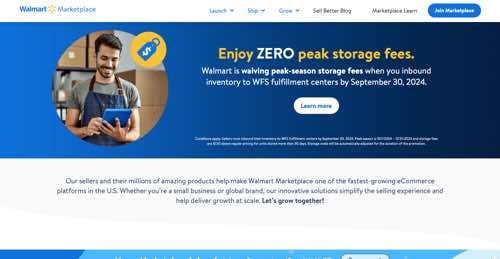
    Walmart Marketplace is expanding its range of collectibles and pre-owned merchandise by introducing Resold at Walmart, a digital destination for pre-owned items. In the Collector shop, sellers can now enable preorders to build customer anticipation for drops, with pre-owned conditions for collectibles.

    Web page for Walmart Marketplace

    Walmart Marketplace

    Goat, launched in 2015, is a popular marketplace for new and used premium sneakers and luxury apparel and accessories. The platform authenticates products and verifies delivery. Sellers complete a verification process (to prevent fake accounts).

    Grailed is a curated fashion marketplace primarily for menswear. With help from its community, Grailed ensures all items are authentic. Every transaction through Grailed with PayPal is eligible for a full refund. Grailed has no listing fee and a 9% commission on sales. It’s owned by Goat Group, owner of the Goat marketplace for premium sneakers.

    Vinted is a Lithuania-based marketplace for secondhand items, mainly clothing and accessories. The marketplace operates in 21 countries and has over 65 million registered users. There are no selling fees; buyers pay a protection fee of 3% to 8% of each purchase.

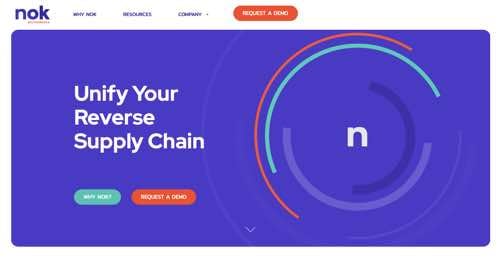
    Nok Recommerce is a circular operating system for reverse logistics and multichannel recommerce. Sellers can launch a branded D2C storefront and link to an existing ecommerce store. Nok manages buildout, product fulfillment, and dynamic pricing optimization.

    Home page for Nok Recommerce

    Nok Recommerce

    Reboxed is a marketplace for buying and selling used tech gear. It recently launched ReboxedOS for used consumer electronics. Reboxed is a circularity-as-a-service that allows businesses to integrate resale, trade-in, and recycling programs without investing in infrastructure.

    Reverse.supply provides fashion brands and marketplaces with a circular retail solution or their own products. Using its software platform, brands can integrate a secondhand store and trade-in portal into existing sales channels. Reverse.supply provides technical and operational services, such as price management, refurbishment, product data creation, and fulfillment.

    Rebag, founded in 2014, is a marketplace for buying, selling, and trading luxury accessories, such as handbags, fine jewelry, watches, and small leather goods. Sellers can consign, trade, or accept a buy-out on items. All items are vetted, and payout amounts are pre-approved. Commission rates start at 8%.

    ThredUp is a resale-as-a-service provider that enables brands to run clean-out programs and online resale shops for consumers. Brands can offer customers clean-out kits to turn their gently used clothing and accessories into an on-site shopping credit. ThredUp integrates with ecommerce sites so consumers can easily shop a brand’s secondhand products. ThredUp handles the processing, from inbound inspection and processing to single-SKU pricing and order fulfillment. Brand partners include Gap, J.Crew, Toms, and SoulCycle.

    Home page of ThredUp

    ThredUp

    Fashionphile is a seller of pre-owned luxury handbags and accessories and the exclusive recommerce partner of Neiman Marcus. To sellers, Fashionphile offers full buy-outs on nearly every product, with immediate payments after the item arrives and is authenticated. Fashionphile offers free shipping and free returns. It also provides a reserve luxury layaway to buy in installments.

    Treet is a resale solution that helps brands drive revenue and acquire customers while minimizing the carbon footprint. Brands can launch a tailored peer-to-peer or take-back resale experience in less than a week. Treet says it empowers resale for more than 120 D2C brands.

    SnapWrite helps brands and retailers create product content from images, providing a digital identity to enable resale. SnapWrite’s image visualization technology creates a proprietary database of processed items, allowing resellers to trace previously owned and vintage products with original data via a permanent link.

    Reflaunt is a concierge resale service for luxury brands and retailers. Merchants using Reflaunt can help customers resell items and drive repeat purchases with a branded resale service and an instant-reward take-back program.

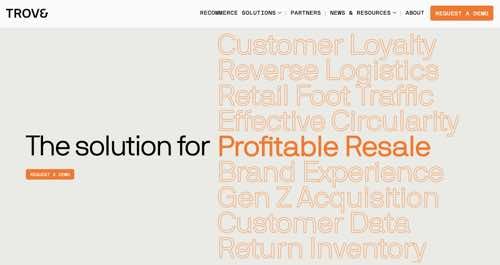
    Trove provides branded resale at scale with services that include trade-in programs, integrated storefronts, true-to-brand commerce, reverse logistics, dynamic pricing, customer-management integration, customer-experience support and integration, and secondary market insights. Merchants can sell used and new items together on their current ecommerce site. For Shopify-based sellers, Trove offers a quick-launching app to bring resale inventory into the site experience. Trove powers the resale sites for Lululemon, Patagonia, Levi’s, and Nordstrom.

    Home page of Trove

    Trove

    Archive helps brands launch customized resale programs to build circularity into their business models and control their secondhand market. Archive offers custom peer-to-peer storefronts, in-store and mail-in take-back programs, and brand second-life programs for owned inventory (i.e., samples, damaged items, returns). Archive also integrates with repair, upcycling, and recycling partners and nonprofits for clothing donations. Brand partners include The North Face, New Balance, Hanna Andersson, and Oscar de la Renta.

    Poshmark is a social peer-to-peer marketplace for new and secondhand goods for women, men, kids, pets, homes, and more. The marketplace has more than 130 million registered users across the U.S. and Canada, with more than 300 million items sold, per Poshmark. For sellers, Poshmark features easy listings, virtual shopping parties, PoshPost for pre-paid and pre-addressed shipping labels, and Posh Protect for buyers. All orders of $500 or more are eligible for Posh Authenticate. Poshmark also features Posh Shows, a live-streaming feature for social shopping.

    Mercari is a Japan-based ecommerce company that owns the Mercari marketplace app to buy and sell new or used items. More than 350,000 items are added to Mercari daily, the company says. In the U.S., Mercari collaborates with USPS, UPS, and FedEx to let sellers print shipping labels. Sellers can also use Mercari Local for nearby delivery. There is no charge to sellers for listing or selling an item. Buyers are charged a payment processing fee.

    Facebook Marketplace, launched in 2016, has become one of the most popular sites for buying, selling, and trading items locally or far away. As part of the Facebook social network, Marketplace buyers and sellers have profiles with ratings that make them more trustworthy. Messaging is built-in on Facebook, making communication easy. Eligible buyers on Facebook receive purchase protection.

    eBay is a marketplace to connect buyers and sellers. Launched in 1995, eBay is now in more than 190 markets globally, with 132 million active buyers and approximately 2.1 billion live listings. eBay’s first sale was a pre-owned laser pointer — recommerce is central to the company’s sustainability goals. eBay continues to invest in recommerce technologies, including authentication tools and AI-based fraud detection. eBay Ventures has invested in Sideline Swap, a marketplace for new and used sports equipment, and The Volte, a peer-to-peer platform for luxury dress sharing.


    Web page of eBay

    eBay

    Tips for Internal and External Page Links

    Google’s original ranking algorithm relied on inbound links to gauge a page’s quality. Links remain critical for organic rankings despite suggestions otherwise. Common questions include tactics for internal links, the value of outbound external links, and strategies for anchor text.

    Certainly I can share my experiences as a 15-year search optimizer, but guidance from Google representatives is helpful. Here are those answers.

    Internal Links

    Internal links play a huge role in rankings in two ways:

    • Importance. The number of internal links pointing to a page signal to Google its relative importance.
    • Content. The anchor text of internal links and surrounding copy help Google understand the linked page’s purpose and relevancy.

    There’s no maximum number of internal outbound links on a page, although Google likely values links in navigation and footers less than in the body. The text surrounding such contextual links — in articles, product descriptions, and categories — signals relevancy.

    Thus an effective strategy includes:

    • Links from a product’s description to an article on how to use it,
    • Links from blog posts to relevant products and categories,
    • Links from product categories to buyers’ guides.

    Too many links?

    Ecommerce owners often add many internal links to, for example, related articles, products, and categories, as well as cross-sells and upsells (“frequently bought together”).

    So how many links are too many?

    Google’s answer is there is no limit. Responding to a LinkedIn query, Google’s John Mueller stated, “Nobody at Google counts the links or the words on your blog posts.”

    Other Google representatives have said more or less the same. But leaked documentation earlier this year suggests Googlebot may not crawl longer pages to the end. We don’t know Googlebot’s maximum page length, but the leak suggests links at the bottom of long articles could be ignored.

    Over-optimization?

    Should site owners fret about using exact-match keywords for internal anchor text? Per Google, the answer is “no.” There’s no such thing as over-optimizing internal links.

    Use whatever anchor text you choose. Keep in mind, though, that relevant contextual links are likely more effective for rankings, even if you can use a well-optimized anchor. For example, linking to a running-shoe product page is likely more effective from an article about running than from one about car repair.

    External Links

    Google has long stated that outbound external links do not improve a page’s rankings or trust, even when linking to .gov (government) or .edu (education) sites.

    I cannot confirm this either way, although one university study last year found generative AI engines (e.g., ChatGPT, Claude, Gemini) cited an article more often when it included links to those trusted sources.

    Since Google search now uses gen AI technology, it is safe to assume that links to trusted sources may be helpful for rankings, especially if they benefit humans, too.

    Google Quietly Cancels Google Trends Subscriptions via @sejournal, @martinibuster

    Google emailed users to communicate that it is ending the Google Trends subscriptions for trend alerts, warning that the program will no longer be available beginning on October 29, 2024 and that all existing alerts will end.

    Google Trends is popular with many users, especially those who are digital marketers.

    Aleyda Solis posted about it on X (formerly Twitter):

    Can Still Make A Copy

    The email stated that users can still obtain a copy of their data from the Google Trends subscription page before the 29th.

    Google Trends Users Disappointed

    A discussion on Reddit showed that many users were disappointed that the service was ending.

    One Redditor commented:

    “It’s really disappointing to see Google shutting down yet another useful feature. It feels like they used to be all about rolling out innovative tools that made our lives easier – I’ve used quite a few of them over the years. But lately, it seems like they’re closing these services one by one.”

    Another Redditor commented that the unreliability of Google’s services is what stops them from using Google Gemini because they don’t want to rely on a service that can’t be depended to be around in the near future.

    Full Text Of Email

    This is the text of the email sent to subscribers:

    “We’re writing to let you know about some upcoming changes to Google Trends subscriptions.

    As of 29 October 2024, Google Trends trend notifications will no longer be supported and existing alerts will no longer be sent. In addition, creating new trend alerts using the subscription page will no longer be possible.

    You can still copy your subscriptions from the Google Trends subscription page before 29 October 2024, if you wish to keep a record of them.

    We understand this change may affect how you stay updated on trends. While email subscriptions will no longer be supported, there are alternative ways to access trending information:

    Homepage Newsletter: Visit the Google Trends homepage to sign up for our daily newsletter and receive the latest trends in your inbox.

    RSS Feed: Subscribe to the RSS feed for real-time updates on trending topics. We hope these alternatives will help you continue to discover insights on Google Trends.”

    Read the discussion on on Reddit:

    Google Trends email subscriptions will terminate as of 29 October 2024

    Featured Image by Shutterstock/Cast Of Thousands

    Google’s August Core Update Rollout Completed via @sejournal, @MattGSouthern

    Google has announced the completion of its August core update. Website owners and SEO professionals can now fully assess the update’s impact on search performance.

    The August core update, launched on August 15, is part of Google’s ongoing effort to improve the quality and usefulness of its search engine.

    Gradual, Extended Rollout

    Unlike typical day-to-day updates, core updates require an extended rollout. For the August update, Google indicated it could take up to a month to finish.

    With its completion confirmed, now is the time to analyze the data and identify any significant ranking shifts.

    “You’d really need to wait until the core update finishes rolling out to make any call about its effect,” John Mueller, Google’s Senior Search Analyst, stated in a LinkedIn discussion last month. “If you want to compare before vs after, waiting for it to be finished is important.”

    Mueller also noted that it’s normal for search rankings to fluctuate during the rollout process, cautioning against drawing conclusions.

    Measuring Content Quality

    Throughout the rollout period, Google reiterated that core updates are intended to better match search results with content that provides users genuine value and relevance.

    The company has maintained that sites focused predominantly on search engine optimization rather than helping users are likelier to experience negative ranking impacts.

    To help affected sites, Google recently updated its guidance on core algorithm updates, providing clearer recommendations for pinpointing and addressing significant ranking drops using tools like Search Console.

    Refined Advice For Recovery

    The revised core update documentation emphasizes substantive content improvements over quick remedies.

    It encourages thorough self-auditing against Google’s quality guidelines, stressing meaningful changes aligned with user needs rather than deleting underperforming pages outright.

    The updated guidance states

    “Things to keep in mind when making changes [include] prioritizing substantive, user-centric improvements rather than quick fixes. Removing content should be a last resort…suggesting it was created for search engines rather than users.”

    Additionally, Google’s refreshed advice sets realistic expectations that regaining lost rankings may require waiting for future core updates even after enhancements are implemented.

    AI Overviews Also Impacted

    In a related development, Mueller confirmed that Google’s AI-generated overviews displayed in some search results are also influenced by core algorithm updates, tying the experimental AI features more directly to the core ranking systems.

    “These [AI overviews] are a part of search, and core updates affect search, so yes,” Mueller stated when asked if the overviews are subject to core update changes.

    Looking Ahead

    While disruptive, Google maintains these core updates are necessary to continually refine how its systems prioritize the most useful information for search queries.

    Publishers should focus content strategies on meeting user needs rather than pursuing SEO in isolation. As AI-generated overviews become further intertwined with core ranking systems, demonstrating true value may be more critical than ever.


    Featured Image: Longfin Media/Shutterstock