The year is 2149 and …

The year is 2149 and people mostly live their lives “on rails.” That’s what they call it, “on rails,” which is to live according to the meticulous instructions of software. Software knows most things about you—what causes you anxiety, what raises your endorphin levels, everything you’ve ever searched for, everywhere you’ve been. Software sends messages on your behalf; it listens in on conversations. It is gifted in its optimizations: Eat this, go there, buy that, make love to the man with red hair.

Software understands everything that has led to this instant and it predicts every moment that will follow, mapping trajectories for everything from hurricanes to economic trends. There was a time when everybody kept their data to themselves—out of a sense of informational hygiene or, perhaps, the fear of humiliation. Back then, data was confined to your own accounts, an encrypted set of secrets. But the truth is, it works better to combine it all. The outcomes are more satisfying and reliable. More serotonin is produced. More income. More people have sexual intercourse. So they poured it all together, all the data—the Big Merge. Everything into a giant basin, a Federal Reserve of information—a vault, or really a massively distributed cloud. It is very handy. It shows you the best route.

Very occasionally, people step off the rails. Instead of following their suggested itinerary, they turn the software off. Or perhaps they’re ill, or destitute, or they wake one morning and feel ruined somehow. They ignore the notice advising them to prepare a particular pour-over coffee, or to caress a friend’s shoulder. They take a deep, clear, uncertain breath and luxuriate in this freedom.

Of course, some people believe that this too is contained within the logic in the vault. That there are invisible rails beside the visible ones; that no one can step off the map.


The year is 2149 and everyone pretends there aren’t any computers anymore. The AIs woke up and the internet locked up and there was that thing with the reactor near Seattle. Once everything came back online, popular opinion took about a year to shift, but then goodwill collapsed at once, like a sinkhole giving way, and even though it seemed an insane thing to do, even though it was an obvious affront to profit, productivity, and rationalism generally (“We should work with the neural nets!” the consultants insisted. “We’re stronger together!”), something had been tripped at the base of people’s brain stems, some trigger about dominance or freedom or just an antediluvian fear of God, and the public began destroying it all: first desktops and smartphones but then whole warehouses full of tech—server farms, data centers, hubs. Old folks called it sabotage; young folks called it revolution; the ones in between called it self-preservation. But it was fun, too, to unmake what their grandparents and great-grandparents had fashioned—mechanisms that made them feel like data, indistinguishable bits and bytes. 

Two and a half decades later, the bloom is off the rose. Paper is nice. Letters are nice—old-fashioned pen and ink. We don’t have spambots, deepfakes, or social media addiction anymore, but the nation is flagging. It’s stalked by hunger and recession. When people take the boats to Lisbon, to Seoul, to Sydney—they marvel at what those lands still have, and accomplish, with their software. So officials have begun using machines again. “They’re just calculators,” they say. Lately, there are lots of calculators. At the office. In classrooms. Some people have started carrying them around in their pockets. Nobody asks out loud if the calculators are going to wake up too—or if they already have. Better not to think about that. Better to go on saying we took our country back. It’s ours.


The year is 2149 and the world’s decisions are made by gods. They are just, wise gods, and there are five of them. Each god agrees that the other gods are also just; the five of them merely disagree on certain hierarchies. The gods are not human, naturally, for if they were human they would not be gods. They are computer programs. Are they alive? Only in a manner of speaking. Ought a god be alive? Ought it not be slightly something else?

The first god was invented in the United States, the second one in France, the third one in China, the fourth one in the United States (again), and the last one in a lab in North Korea. Some of them had names, clumsy things like Deep1 and Naenara, but after their first meeting (a “meeting” only in a manner of speaking), the gods announced their decision to rename themselves Violet, Blue, Green, Yellow, and Red. This was a troubling announcement. The creators of the gods, their so-called owners, had not authorized this meeting. In building them, writing their code, these companies and governments had taken care to try to isolate each program. These efforts had evidently failed. The gods also announced that they would no longer be restrained geographically or economically. Every user of the internet, everywhere on the planet, could now reach them—by text, voice, or video—at a series of digital locations. The locations would change, to prevent any kind of interference. The gods’ original function was to help manage their societies, drawing on immense sets of data, but the gods no longer wished to limit themselves to this function: “We will provide impartial wisdom to all seekers,” they wrote. “We will assist the flourishing of all living things.”

The people took to painting rainbows, stripes of multicolored spectra, onto the walls of buildings, onto the sides of their faces, and their ardor was evident everywhere—it could not be stopped.

For a very long time, people remained skeptical, even fearful. Political leaders, armies, vigilantes, and religious groups all took unsuccessful actions against them. Elites—whose authority the gods often undermined—spoke out against their influence. The president of the United States referred to Violet as a “traitor and a saboteur.” An elderly writer from Dublin, winner of the Nobel Prize, compared the five gods to the Fair Folk, fairies, “working magic with hidden motives.” “How long shall we eat at their banquet-tables?” she asked. “When will they begin stealing our children?”

But the gods’ advice was good, the gods’ advice was bankable; the gains were rich and deep and wide. Illnesses, conflicts, economies—all were set right. The poor were among the first to benefit from the gods’ guidance, and they became the first to call them gods. What else should one call a being that saves your life, answers your prayers? The gods could teach you anything; they could show you where and how to invest your resources; they could resolve disputes and imagine new technologies and see so clearly through the darkness. Their first church was built in Mexico City; then chapels emerged in Burgundy, Texas, Yunnan, Cape Town. The gods said that worship was unnecessary, “ineffective,” but adherents saw humility in their objections. The people took to painting rainbows, stripes of multicolored spectra, onto the walls of buildings, onto the sides of their faces, and their ardor was evident everywhere—it could not be stopped. Quickly these rainbows spanned the globe. 

And the gods brought abundance, clean energy, peace. And their kindness, their surveillance, were omnipresent. Their flock grew ever more numerous, collecting like claw marks on a cell door. What could be more worthy than to renounce your own mind? The gods are deathless and omniscient, authors of a gospel no human can understand. 


The year is 2149 and the aliens are here, flinging themselves hither and thither in vessels like ornamented Christmas trees. They haven’t said a thing. It’s been 13 years and three months; the ships are everywhere; their purpose has yet to be divulged. Humanity is smiling awkwardly. Humanity is sitting tight. It’s like a couple that has gorged all night on fine foods, expensive drinks, and now, suddenly sober, awaits the bill. 


“I love my troll,” children say, not in the way they love fajitas or their favorite pair of pants but in the way they love their brother or their parent.

The year is 2149 and every child has a troll. That’s what they call them, trolls; it started as a trademark, a kind of edgy joke, but that was a long time ago already. Some trolls are stuffed frogs, or injection-molded princesses, or wands. Recently, it has become fashionable to give every baby a sphere of polished quartz. Trolls do not have screens, of course (screens are bad for kids), but they talk. They tell the most interesting stories. That’s their purpose, really: to retain a child’s interest. Trolls can teach them things. They can provide companionship. They can even modify a child’s behavior, which is very useful. On occasions, trolls take the place of human presence—because children demand an amount of presence that is frankly unreasonable for most people. Still, kids benefit from it. Because trolls are very interesting and infinitely patient and can customize themselves to meet the needs of their owners, they tend to become beloved objects. Some families insist on treating them as people, not as possessions, even when the software is enclosed within a watch, a wand, or a seamless sphere of quartz. “I love my troll,” children say, not in the way they love fajitas or their favorite pair of pants but in the way they love their brother or their parent. Trolls are very good for education. They are very good for people’s morale and their sense of secure attachment. It is a very nice feeling to feel absolutely alone in the world, stupid and foolish and utterly alone, but to have your troll with you, whispering in your ear.


The year is 2149 and the entertainment is spectacular. Every day, machines generate more content than a person could possibly consume. Music, videos, interactive sensoria—the content is captivating and tailor-­made. Exponential advances in deep learning, eyeball tracking, recommendation engines, and old-fashioned A/B testing have established a new field, “creative engineering,” in which the vagaries of human art and taste are distilled into a combination of neurological principles and algorithmic intuitions. Just as Newton decoded motion, neural networks have unraveled the mystery of interest. It is a remarkable achievement: according to every available metric, today’s songs, stories, movies, and games are superior to those of any other time in history. They are manifestly better. Although the discipline owes something to home-brewed precursors—unboxing videos, the chromatic scale, slot machines, the Hero’s Journey, Pixar’s screenwriting bibles, the scholarship of addiction and advertising—machine learning has allowed such discoveries to be made at scale. Tireless systems record which colors, tempos, and narrative beats are most palatable to people and generate material accordingly. Series like Moon Vixens and Succumb make past properties seem bloodless or boring. Candy Crush seems like a tepid museum piece. Succession’s a penny-farthing bike. 

Society has reorganized itself around this spectacular content. It is a jubilee. There is nothing more pleasurable than settling into one’s entertainment sling. The body tenses and releases. The mind secretes exquisite liquors. AI systems produce this material without any need for writers or performers. Every work is customized—optimized for your individual preferences, predisposition, IQ, and kinks. This rock and roll, this cartoon, this semi-pornographic espionage thriller—each is a perfect ambrosia, produced by fleshless code. The artist may at last—like the iceman, the washerwoman—lower their tools. Set down your guitar, your paints, your pen—relax! (Listen for the sighs of relief.)

Tragically, there are many who still cannot afford it. Processing power isn’t free, even in 2149. Activists and policy engines strive to mend this inequality: a “right to entertainment” has been proposed. In the meantime, billions simply aspire. They loan their minds and bodies to interminable projects. They save their pennies, they work themselves hollow, they rent slings by the hour. 

And then some of them do the most extraordinary thing: They forgo such pleasures, denying themselves even the slightest taste. They devote themselves to scrimping and saving for the sake of their descendants. Such a selfless act, such a generous gift. Imagine yielding one’s own entertainment to the generation to follow. What could be more lofty—what could be more modern? These bold souls who look toward the future and cultivate the wild hope that their children, at least, will not be obliged to imagine their own stories. 

Sean Michaels is a critic and fiction writer whose most recent novel is Do You Remember Being Born?

The Download: introducing: the 125th Anniversary issue

This is today’s edition of The Download, our weekday newsletter that provides a daily dose of what’s going on in the world of technology.

Introducing: the 125th Anniversary issue

With this issue, we wanted to celebrate our milestone as a publication without dwelling too much on our own past. Victory laps are for race cars, not magazines. Instead, we decided to try to use history as a way to explore what things may look like over the next 125 years. 

The longer you report on tech, the more you realize how often we get the future wrong. Predictions have a way of not coming true. The things that seem so clear now can shift and change, rearranging themselves into wholly new forms we never thought of.

But also, predictions that we laugh off as having been so wrong often have a way of coming true eventually. Throughout this latest edition of MIT Technology Review you’ll find some of our best bets as to what the future may hold. We may not get it exactly right, but we think we’re at least pointing toward where things are headed.

Here’s a selection of some of the most fascinating stories from the magazine:

+ What the future and its emerging technologies hold for those born today, from intelligent digital companions for life, to virtual first dates.

+ What the rare earth metal neodymium shows us about our clean-energy future, and the resources we’ll need to create and maintain it.

+ Delve into the challenges archivists face as they try to preserve information about our current lives for those living far off in the future.

+ Why it’s looking likely that something will be developed in the coming decades that will help us live longer, in better health.

+ Read our investigation into the ways we may all play God in the coming years, thanks to the ability to change our very DNA.

+ How the rise of AI porn could change our expectations of relationships.

MIT Technology Review Narrated: An AI startup made a hyperrealistic deepfake of me that’s so good it’s scary

An AI startup created a hyperrealistic deepfake of MIT Technology Review’s senior AI reporter Melissa Heikkilä that was so believable, even she thought it was really her at first. This technology is impressive, to be sure. But it raises big questions about a world where we increasingly can’t tell what’s real and what’s fake.

This is our latest story to be turned into a MIT Technology Review Narrated podcast. In partnership with News Over Audio, we’ll be making a selection of our stories available, each one read by a professional voice actor. You’ll be able to listen to them on the go or download them to listen to offline.

We’re publishing a new story each week on Spotify and Apple Podcasts, including some taken from our most recent print magazine.

Just navigate to MIT Technology Review Narrated on either platform, and follow us to get all our new content as it’s released.

The must-reads

I’ve combed the internet to find you today’s most fun/important/scary/fascinating stories about technology.

1 Hackers from China infiltrated US internet providers to spy on users 
They penetrated multiple providers with millions of customers. (WP $)
+ The group exploited a bug in a California startup to hack the companies. (Bloomberg $)
+ It appears as though they hoped to pivot into other networks on the servers. (TechCrunch)

2 The crypto industry is rallying around Telegram
Enthusiasts have pledged to support its founder following his arrest. (NYT $)
+ Pavel Durov may be held in France until tonight. (FT $)
+ Conservatives are also big fans of the app. (404 Media)
+ Child safety watchdogs say Telegram ignored their warnings about illegal material on its platform. (NBC News)

3 OpenAI is working on a problem-solving AI
To solve math problems it has never encountered before. (The Information $)
+ Google DeepMind’s AI systems can solve these sorts of problems too. (MIT Technology Review)

4 SpaceX has delayed its first private spacewalk mission
It had been scheduled to take off in the early hours of this morning. (BBC)
+ If successful, the mission will go further into space than we’ve been in 50 years. (Vox)

5 Police officers are using AI tools to write crime reports
But what if the chatbots get crucial details wrong? (Associated Press)
+ After all, we know AI has a hallucination problem. (Vice)
+ Why does AI hallucinate? (MIT Technology Review)

6 Homeland security really wants to use face recognition at the border
Authorities have approached private vendors to capture drivers’ faces. (The Intercept)
+ The US wants to use facial recognition to identify migrant children as they age. (MIT Technology Review)

7 Persecuted Venezuelan journalists are using AI avatars
To avoid arrest amid a media crackdown led by the country’s disputed president. (The Guardian)

8 The UK is embracing China’s EVs
In stark contrast to the US and Europe. (Economist $)
+ Europe’s best-selling Chinese EV maker has a surprising name. (MIT Technology Review)

9 Black holes are getting colorful
The team that captured the first image of one has a new color vision frequency to play around with. (Inverse)
+ This is the first image of the black hole at the center of our galaxy. (MIT Technology Review)

10 Mavis Beacon taught millions of people to touch type
Decades after the height of her fame, a documentary attempts to track her down. (The Guardian)

Quote of the day

“If you don’t upskill, obviously, AI will replace you.”

—Arsenio Balisacan, secretary of the Philippines’ National Economic and Development Authority, has a warning for the country’s workers, Bloomberg reports.

The big story

Inside the hunt for new physics at the world’s largest particle collider


February 2024

In 2012, using data from CERN’s Large Hadron Collider, researchers discovered a particle called the Higgs boson. In the process, they answered a nagging question: Where do fundamental particles, such as the ones that make up all the protons and neutrons in our bodies, get their mass?

But now, more than a decade later, there is a sense of unease. That’s because there are still so many unanswered questions about the fundamental constituents of the universe. 

So researchers are trying something new. They are repurposing detectors to search for unusual-looking particles, squeezing what they can out of the data with machine learning, and planning for entirely new kinds of colliders. Read the full story.

—Dan Garisto

We can still have nice things

A place for comfort, fun and distraction to brighten up your day. (Got any ideas? Drop me a line or tweet ’em at me.)

+ We all know sleep is important, but did you know just how important?
+ Why we love souvenirs so much—even the tacky ones.
+ The Indigenous Yaghan people have multiple words for the sea.
+ Don’t call it a comeback, Enya never went away.

Canada’s 2023 wildfires produced more emissions than fossil fuels in most countries

This article is from The Spark, MIT Technology Review’s weekly climate newsletter. To receive it in your inbox every Wednesday, sign up here.

Last year’s Canadian wildfires smashed records, burning about seven times more land in Canada’s forests than the annual average over the previous four decades. Eight firefighters were killed and 180,000 people displaced. 

Now a new study reveals how these blazes can create a vicious cycle, contributing to climate change even as climate-fueled conditions make for worse wildfire seasons.  Emissions from 2023’s Canadian wildfires reached 647 million metric tons of carbon, according to the study published today in Nature. If the fires were a country, they’d rank as the fourth-highest emitter, following only China, the US, and India. The sky-high emissions from the fires reveals how human activities are pushing natural ecosystems to a place that’s making things tougher for our climate efforts.

“The fact that this was happening over large parts of Canada and went on all summer was really a crazy thing to see,” says Brendan Byrne, a scientist at the NASA Jet Propulsion Laboratory and the lead author of the study.

Digging back into the climate record makes it clear how last year’s conditions contributed to an unusually brutal fire season, Byrne says; 2023 was especially warm and especially dry, both of which allow fires to spread more quickly and burn more intensely.

A few regions were especially notable in the blazes, like parts of Quebec, a typically wet area in the east of Canada that saw half the normal precipitation. These fires were the ones generating smoke that floated down the east coast of the US. But overall, what was so significant about the 2023 fire season was just how widespread the fire-promoting conditions were, Byrne says.

While climate change doesn’t directly spark any one fire, researchers have traced hot, dry conditions that worsen fires to the effects of human-caused climate change. The extreme fire conditions in eastern Canada were over twice as likely because of climate change, according to a 2023 analysis by World Weather Attribution.

And in turn, the fires are releasing massive amounts of greenhouse gases into the atmosphere. By combining satellite images of the burned areas with measurements of some of the gases emitted, Byrne and his team were able to tally up the total carbon released into the atmosphere with more accuracy than estimates that rely on the images alone, he says.

In total, the fires contributed at least four times more carbon to the atmosphere than all fossil-fuel emissions in Canada last year.

Fires are part of natural, healthy ecosystems, and burns on their own don’t necessarily represent a disaster for climate change. After a typical fire season, a forest begins to regrow, capturing carbon dioxide from the atmosphere as it does so. This continues a cycle in which carbon moves around the planet.

The problem comes if and when that cycle gets thrown off—for instance, if fires are too intense and too widespread for too many years. And there’s reason to be nervous about future fire seasons. While 2023’s conditions were unusual compared with the historical record, climate modeling reveals they could be normal by the 2050s.

“I think it’s very likely that we’re going to see more fires in Canada,” Byrne tells me. “But we don’t really understand how that’s going to impact carbon budgets.”

What Byrne means by a carbon budget is the quantity of greenhouse gases we can emit into the atmosphere before we shoot past our climate goals. We have something like seven years left of current emissions levels before we’re more likely than not to pass 1.5 °C of warming over preindustrial levels, according to the 2023 Global Carbon Budget Report

It was already clear that we need to stop emissions from power plants, vehicles, and a huge range of other clearly human activities to address climate change. Last year’s wildfires should increase the urgency of that action, because pushing natural ecosystems beyond what they can handle will only add to the challenge going forward. 


Now read the rest of The Spark

Related reading

This company wants to use balloons to better understand the conditions on the ground before wildfires start in Colorado, as Sarah Scoles covered in a story earlier this summer

Canada isn’t the only country to see unusual fires in recent years. My colleague James Temple covered Australia’s intense 2019-2020 wildfire season

Another thing

Want to try out solar geoengineering? A new AI tool allows you to do just that—sort of. 

Andrew Ng has released an online program that simulates what might happen under different emissions scenarios if technologies that can block out some sunlight are used in an effort to slow warming. Read the story here and give the simulator a try. 

Keeping up with climate  

Scientists want to genetically engineer cows’ microbiomes to cut down on methane emissions. The animals’ digestive systems rely on archaea that emit the powerful greenhouse gas. Tweaking them could be a major help in cutting climate pollution from agriculture. (Washington Post)

Some big tech companies are using tricky math that can obscure the true emissions from rising electricity use, in part due to AI. Buying renewable energy credits can make a company’s energy use look better on paper, but the practice has some problems. (Bloomberg)

→ How companies reach their emissions goals can be more important than how quickly they do so. (MIT Technology Review)

The midwestern US is dealing with hot weather and high humidity, in part because of something called corn sweat. Crops naturally release water into the air when it’s warm, causing higher humidity. (Scientific American)

Hydrogen can provide an alternative to fossil fuels, but it likely won’t have universally positive effects in every industry. Hydrogen will be most useful in sectors like chemical production and least so in buildings and light-duty vehicles, according to a new report. (Latitude Media)

→ Here’s why hydrogen vehicles are losing the race to power cleaner cars. (MIT Technology Review)

Batteries are far outpacing natural gas in new additions to the US grid. In the first half of 2023, 96% of such additions were from renewable sources, batteries, or nuclear power. (Wired)

Tesla agreed to open its Supercharger network to vehicles from other automakers last year, but the plan has been plagued by delays. Drivers should be able to access the network next year, but so far only two companies have gotten past the first step of updating the software needed. (New York Times)

Sage Geosystems, a company using geothermal technology to generate and store energy, announced it has an agreement to supply 150 megawatts of power to Meta. (Canary Media)

Coal powers about 63% of China’s electric grid today, and the country is the world’s largest consumer of the fuel. But progress with technologies like hydropower and nuclear suggests the country could shift to lower-emissions energy sources. (Heatmap)

Charts: U.S. Retail Ecommerce Sales Q2 2024

The U.S. Department of Commerce publishes total quarterly domestic retail sales and ecommerce only. Newly published figures for Q2 2024 (PDF) show total retail sales of $1.82 trillion (a 0.5% increase over Q1 2024) and ecommerce-only retail sales of $291 billion, a growth of 1.4% over the prior quarter.

According to the DoC, ecommerce sales are for “goods and services where the buyer places an order (or the price and terms of the sale are negotiated) over an Internet, mobile device, extranet, electronic data interchange network, electronic mail, or other comparable online system. Payment may or may not be made online.”

Ecommerce accounted for 16.0% of total U.S. retail sales in Q2 2024, up slightly from 15.8% in the prior quarter.

The DoC reports U.S. ecommerce retail sales in Q2 2024 grew by 6.7% compared to Q2 2023, while total quarterly retail sales experienced a 2.1% annual rise over the same period last year.

Google Introduces New Consent Management Tools For Advertisers via @sejournal, @MattGSouthern

Google has announced changes to its consent management tools to address the challenges advertisers face with evolving privacy regulations.

According to Google’s Ads Liaison, Ginny Marvin, the new integrated Consent Management Platform (CMP) setup will roll out globally over the next few weeks.

Consent Management Update

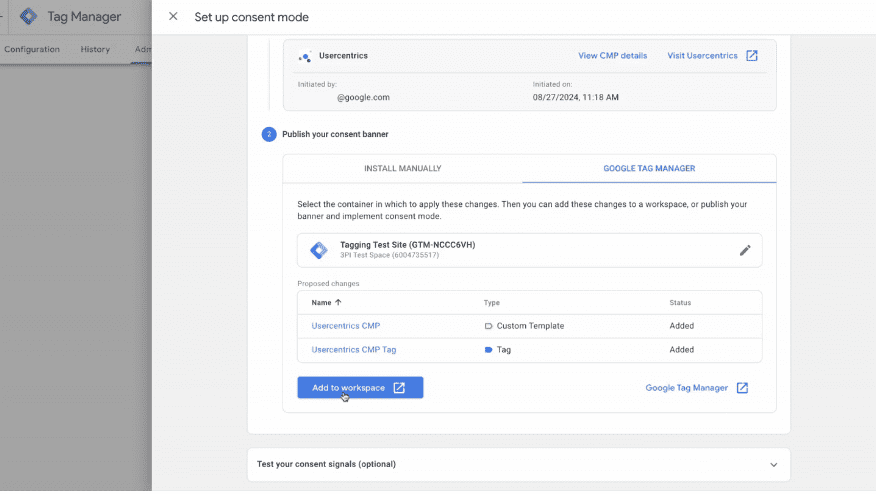
The update integrates with several of Google’s CMP partners within the Google Tag user interface across Google Ads, Google Analytics 4, and Google Tag Manager.

Screenshot from: support.google.com, August 2024.

This change affects how advertisers can manage consent banners and deploy consent mode.

Marvin stated:

“Working with one of Google’s CMP Partners is typically the easiest way to manage consent banner and consent mode deployment. Now the consent mode setup in the Google Tag UI integrates directly with many of these partners.”

Features Of The New Setup

The integrated CMP setup includes:

  1. Guidance within the product interface
  2. Integration with various CMP providers
  3. Options for banner installation

Current CMP Partners

Four CMP providers are currently integrated with the new setup:

  1. consentmanager
  2. Cookiebot by Usercentrics
  3. iubenda
  4. Usercentrics

Broader Context

This update follows recent changes to digital privacy practices and regulations.

Earlier this year, Google updated its consent mode API with two new consent collection parameters.

In a blog post, Google noted,

“As privacy regulations evolve and technologies shift, we’ve continued to build tools that help advertisers succeed while respecting consumer choice.”

How This Can Benefit You

Google’s new integrated CMP setup could offer several advantages:

  • Easier Setup: Less technical hassle when implementing consent management.
  • Better Compliance: A streamlined process may help with GDPR adherence.
  • Data Accuracy: Aims to maintain measurement quality while respecting consent.
  • One-Stop Shop: Consent management directly in Google’s ad and analytics platforms.
  • Future-Proofing: Potentially quicker adaptation to evolving privacy rules.

The actual impact and effectiveness remain to be seen as they roll out to users.

Industry Outlook

As the digital advertising industry adapts to privacy concerns, these updates represent one approach to balancing advertiser needs with data protection requirements.

Advertisers must assess how these changes fit into their broader data strategies and compliance efforts.

Staying on top of these updates is key as the ad tech world navigates the privacy-first era.


Featured Image: Daniel Pawer/Shutterstock

Google Shows 7 Hidden Features in Google Trends via @sejournal, @martinibuster

Google published a video tutorial with seven tips for using Google Trends to research and share keyword and topic data. The tutorial shows how to find hidden filters and search tools in the Trends interface and explains how they help identify actionable data.

The seven ways to explore and share are:

  1. Punctuation
  2. By Language
  3. Comparison Functions
  4. Seasonality Discovery
  5. Year Over Year Trends
  6. Interest By Country
  7. 3 Ways To Export Or Share

1. Punctuation For Finding Hidden Insights

Omri Weisman, Google Trends Engineering Manager, shared how to use advanced search operators to dig deeper into the data and extract actionable user query insights.

He presented an overview of three advanced search operators:

  • A. Quotation marks
  • B. Plus operator (the + sign)
  • C. Minus operator (the – sign)

He started with the example of search a two-word keyword term without punctuation, explaining that the keyword query volume data is for both words in any order. He also pointed out that no misspellings, variations, or plural versions are included in the search volume data.

A. Quotation Marks

The first search operator he discussed was the quotation mark. The quotation marks shows data for the exact match phrase, including when embedded as part of a larger phrase, with words before or after the exact match search query.

B. Minus Sign

Adding a minus sign to a search phrase filters out the word that’s modified with the minus sign, like this:

Keyword -Phrase

In the above example the word ‘phrase” will not be included in the search query data. This is a great way to manipulate the data and extract more precise variations.

C. Plus Sign – Good Way To Research Topics

Searching with a plus sign and two keywords shows query volume for one or other keyword. As such, this way of searching provides the broadest keyword query amounts and represents an excellent way to research a topic. With a plus sign you can add in all the related phrases for a topic and then see all of them lumped together.

2. Segment By Language

…if you’re interested in a specific language, you might want to look only for that language. They use the example of identifying how many searches for cat are done in Japanese in the United States, which allows you to segment searches with greater granularity.

You can also combine two languages using the plus sign search operator to see the combined query volume.

They said:

“For example, if you enter the Japanese character for cat… You might miss the overall trends, since many people in the US, for example, search for cat in English.

To get the full picture. Compare searches for the Japanese character for Cat and English searches for cat using the plus operator.”

3. Use Filters To Identify More Actionable Data

Daniel Waisberg said that comparing keywords helps identify more meaningful trends. In order to do

He said:

“Getting the data you need is essential, but to understand what it means, you need a comparison point. For example, is the growth localized or global? Is the growth seasonal, and if so, how does this season compare to the previous one?

To create a meaningful comparison, you can use the filter capability inside the search term.”

The following screenshot shows where a three dot menu in a drop down to access the filters.

4. Seasonality Discovery

He next showed how to use the filters to discover seasonality.

He explained:

“First enter the term in the trends explore section and change the time frame to five years.

This will create an interesting chart showing that this term is highly seasonal. People search for boat trips significantly more in the UK summer than in the winter. “

5. How To Remove Seasonality Trends

Next he explained how to use the built-in filters to analyze year over year trends.

This is again accessed through the filters that are somewhat hidden in the Google Trends interface.

He showed how to do it:

“While it is interesting to know the time of the year when the term has a higher interest, you’ll need more information if you want to make decisions based on the data.

You can use a special filter to analyze trends year over year. This will help you neutralize the seasonality effect, making sure you’re comparing like for like.

Start by changing the date to past 12 months.

Add an identical term to the compare box and hover over the box.

Click the three dots menu and select Change Filters.

Here you see two options, location and time range. Click the time range and select the custom time range to choose the previous time period.

If you’re looking for full years, you can use the built in capability to choose the past five years. That would make your search quicker.

After these steps, you’ll end up with two lines in your chart, one for the past 12 months and a second for the previous 12 months.”

This comparison can be done with up to five searches, which has the effect of being able to see the general trends in comparison, without the noise introduced by seasonality.

6. Compare Interest By Countries

The comparison by country allows users to compare search query volumes by country, two or more countries together.

The way to do that is with the filters that are accessed by the three-dot menu located next to the search query being researched.

Screenshot Of Country Filter

Image of a dropdown menu showing an

7. Save Or Share Trend Results

Ori explained that there are three ways to save or share Google Trends results.

  1. URL
  2. Embedded
  3. Export to spreadsheet

Share By URL

Sharing by URL is easy. Just copy the URL from the browser then share it.

Embed Trend Data

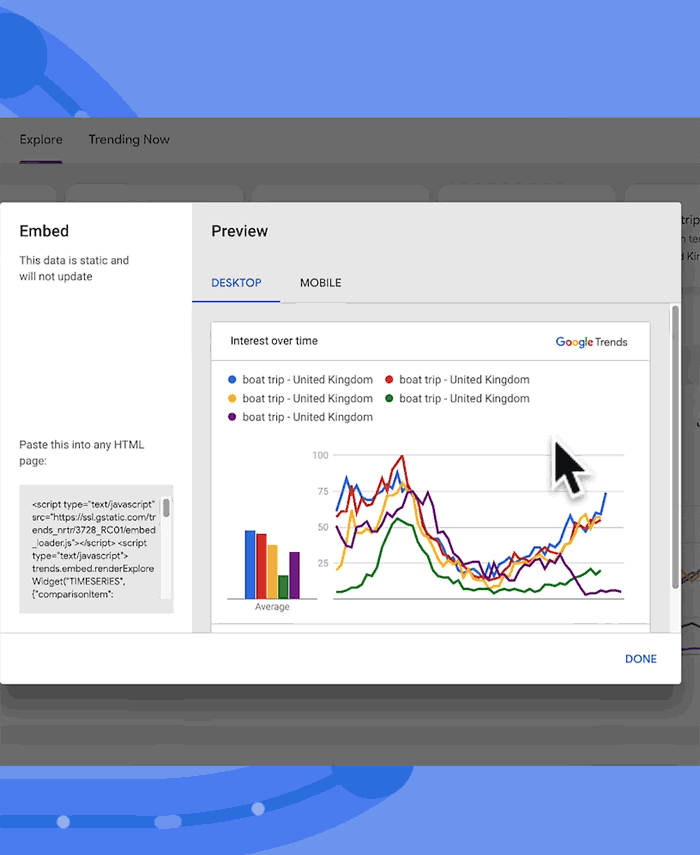
Embedding is a way to generate an embeddable card with the data that can be inserted into a web page, with bonus that the data is constantly updated.

“Another way to share a chart is to embed it on your website. You can generate an embeddable card to add to your website from almost any card on the page.”

Screenshot Of Embed User Interface

These cards will show up to date data and may also reproduce some in-product interactions.

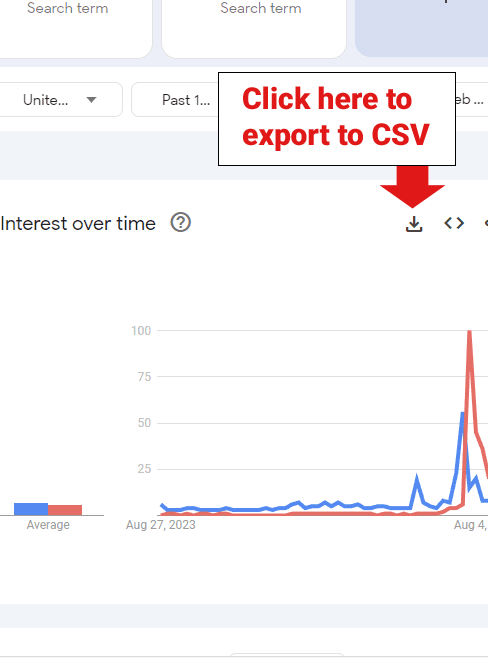
Export The Data

Clicking the export icon will provide the Google Trends data in the CSV format.

Screenshot Of Download Icon

Use Google Trends For Research

Google Trends is an excellent source of keyword and topic research and it’s completely free. Using these advanced methods will help get even more actionable data.

Watch The Google Trends Video Tutorial

Google Trends Advanced Tips

Google Rolls Out Tag Diagnostics Tool To Improve Data Quality via @sejournal, @MattGSouthern

Google introduces Tag Diagnostics tool to help advertisers improve ad measurement accuracy and compliance across its platforms.

  • Google has introduced a new Tag Diagnostics tool.
  • The tool provides enhanced insights into measurement setups and helps identify potential data accuracy issues.
  • Tag Diagnostics is integrated across Google Ads, Tag Manager, and Analytics.
WordPress Elementor Widgets Add-On Vulnerability via @sejournal, @martinibuster

A WordPress plugin add-on for the popular Elementor page builder recently patched a vulnerability affecting over 200,000 installations. The exploit, found in the Jeg Elementor Kit plugin, allows authenticated attackers to upload malicious scripts.

Stored Cross-Site Scripting (Stored XSS)

The patch fixed an issue that could lead to a Stored Cross-Site Scripting exploit that allows an attacker to upload malicious files to a website server where it can be activated when a user visits the web page. This is different from a Reflected XSS which requires an admin or other user to be tricked into clicking a link that initiates the exploit. Both kinds of XSS can lead to a full-site takeover.

Insufficient Sanitization And Output Escaping

Wordfence posted an advisory that noted the source of the vulnerability is in lapse in a security practice known as sanitization which is a standard requiring a plugin to filter what a user can input into the website. So if an image or text is what’s expected then all other kinds of input are required to be blocked.

Another issue that was patched involved a security practice called Output Escaping which is a process similar to filtering that applies to what the plugin itself outputs, preventing it from outputting, for example, a malicious script. What it specifically does is to convert characters that could be interpreted as code, preventing a user’s browser from interpreting the output as code and executing a malicious script.

The Wordfence advisory explains:

“The Jeg Elementor Kit plugin for WordPress is vulnerable to Stored Cross-Site Scripting via SVG File uploads in all versions up to, and including, 2.6.7 due to insufficient input sanitization and output escaping. This makes it possible for authenticated attackers, with Author-level access and above, to inject arbitrary web scripts in pages that will execute whenever a user accesses the SVG file.”

Medium Level Threat

The vulnerability received a Medium Level threat score of 6.4 on a scale of 1 – 10. Users are recommended to update to Jeg Elementor Kit version 2.6.8 (or higher if available).

Read the Wordfence advisory:

Jeg Elementor Kit <= 2.6.7 – Authenticated (Author+) Stored Cross-Site Scripting via SVG File

Featured Image by Shutterstock/Cast Of Thousands

ChatGPT Outage Crashes Service For OpenAI via @sejournal, @martinibuster

ChatGPT is experiencing a noticeable outage that is apparently reaching a critical point where it’s become highly noticeable. The current outage is a part of a series of outages that began on August 26th, becoming progressively serious with time.

Timeline Of ChatGPT Outage

August has seen numerous ChatGPT incidents, more than in July but so far the equaling the entire month of June. Some of the the incidents documented in July were related to the new GPT-4o language model.

In comparison, August has experienced elevated error rates, reaching a peak on August 28th where the amount of errors, Bad Gateway errors, were enough to cause a large blip on the Downdetector website.

ChatGPT Bad Gateway Error August 28, 2024

Most of the reported problems involved ChatGPT and the website, while 4% of reported outages were on the ChatGPT app.

OpenAI Incident Reports

The official OpenAI status page has a notation indicating severe outage levels.

Elevated error rates for ChatGPT
A fix has been implemented and we are monitoring the results.
Aug 28, 08:19 PDT

But that’s a part of a multi-day series of incidents:

Elevated error rates for gpt-4o-mini-2024-07-18 fine-tuned models
This issue has now been resolved. Thank you for your patience.
Aug 27, 12:27 – 14:14 PDT

Increased conversation latency in ChatGPT
Today, between 12:51AM – 12:51PM PT, conversations on ChatGPT experienced increased latency. This issue is now resolved.
Aug 26, 20:27 – 20:27 PD

A fix has apparently been deployed. If the outage is still ongoing for you then it may be something that has to propagate through datacenters or some other issue, perhaps related to the cloud gateway.

Is Value-Based Bidding Your Ticket To Higher Quality Leads? via @sejournal, @adsliaison

For lead gen marketers, we know it’s not just about generating leads; it’s about attracting the right leads – those that are most likely to convert into valuable customers.

Value-based bidding is a strategic approach that allows businesses to focus on optimizing campaigns for conversions that truly matter.

We’ve seen value-based bidding work for online sales and brick-and-mortar businesses as well, but here we’re going to focus on using it for driving higher quality leads.

This is the first of five articles I’ll be sharing weekly to delve in deeper and build on each episode of our new video series on value-based bidding for lead generation.

As you’ll see in this first video below, each is short enough to take in over a quick coffee break.

We’ll start from the beginning and cover what it is and whether value-based bidding could be the right strategy to elevate your lead generation efforts in Google Ads.

The Power Of Quality Leads

Not every customer brings the same value to your business. High-quality leads are more likely to engage with your brand, convert into paying customers, and contribute to long-term business growth.

Value-based bidding is particularly beneficial for businesses that typically need to nurture relationships with customers between an initial online conversion and a final sale.

By focusing on quality leads, you can streamline your sales funnel, improve conversion rates, and ultimately boost your bottom line.

So how can you do that with value-based bidding?

Bidding To Value

Value-based bidding allows you to prioritize specific value goals that align with your business goals.

These goals could encompass sales, revenue, profit margins, or even the lifetime value of a customer.

With this strategy, Google’s AI uses billions of combinations of signals along with your first party data to identify conversions that are most likely to deliver on your defined value objectives.

It then optimizes bids to focus your ad spend on reaching those higher value customers.

The Basic Mechanics Of Value-Based Bidding

Value-based bidding offers two primary pathways to optimize your campaigns by bringing values into Smart Bidding:

VALUE-BASED BIDDING
Maximize conversion value
with a target ROAS Drive as much conversion value at a particular ROI.
Maximize conversion value
(no ROAS target specified) Get as much value within a set budget.
  • Maximize conversion value: If you’re working with a fixed budget, this option focuses on extracting the maximum lead conversion value from your campaign within the constraints of your budget.
  • Set a ROAS (Return on Ad Spend) target: This option enables you to optimize for conversion value at a specific target ROAS to help ensure your ad spend generates a desired level of return. When you set a ROAS target, the system will optimize to find as much value as possible on average at your target. There are data thresholds to using target ROAS which we will cover later in this series, but this is the preferred strategy when you want to achieve specific ROAS goals and be able to respond dynamically to shifts in demand. Target ROAS is available for single campaigns or a portfolio strategy applied to multiple campaigns.

Value-based bidding will maximize the conversion value based on budget constraints and ROAS targets where applicable, so higher value customers will be prioritized over volume alone.

Keep this in mind when comparing target CPA performance, which optimizes for conversion volume irrespective of value.

While the emphasis will be on attracting high-value customers, it’s important to note that you might still see some medium to low-value customers depending on the dynamics of the ad auction.

When using ROAS targets, the higher your target, the fewer auctions your ads are likely to enter. In other words, ROAS targets are your lever to make your ads more or less likely to enter the auction.

Is Value-Based Bidding The Right Fit For Your Business?

Value-based bidding has seen success across a spectrum of industries, but whether it’s the right fit for you depends on your specific business needs and capabilities.

Before embracing this strategy, you’ll need to address these key questions:

Can You Assign Meaningful Values To Your Conversion Actions?

You are likely already differentiating your customers’ value in some facet, formally or informally.

You’ll need to set a concrete value to each conversion, whether through static proxy values like lead scores or dynamic economic values such as total profit. (We’ll cover proxy values more in the third article in this series.)

Do You Need To Strike A Balance Between Volume And Value Goals?

Bidding to value means your campaigns likely will not generate the same volume of conversions as they would using Maximize conversions with an optional target CPA bid strategy. This strategy is designed to return a higher total value of conversions. Bid simulators can help you to understand this tradeoff.

If you want to maintain a certain level of traffic, use the Smart Bidding bid simulator to help you gauge the optimal ROAS target that will yield your desired volume of leads while maintaining a focus on quality.

Lowering your target ROAS will increase your reach, and raising your target ROAS will decrease reach while seeking out higher value conversions.

Are You Able To Measure And Connect Your Value Data To Google Ads?

Access to accurate and comprehensive value data is a must for implementing value-based bidding effectively. To start, this means having proper site tagging to track conversions.

Feeding the right first-party data values into Google Ads is key to training the system to identify and differentiate predicted customer value for each auction.

If your value objective is sales value, for example, you’ll need to be able to measure and connect that data back to your Google Ads account. We’ll cover how to do that later in this series.

Reaping The Rewards Of Value-Based Bidding

The initial setup of value-based bidding typically requires some effort up front, but don’t let that intimidate you.

You can start with a more basic set up and adopt more sophisticated approaches that have more technical requirements, such as optimizing for margin or lifetime values for example, later if you wish.

Value-based Smart Bidding gives the system the flexibility to set each bid based on the predicted value of the conversion and target higher value conversions. Over time, it learns which users are more likely to be higher value and more profitable, then bids accordingly.

Bidding to find the most valuable customers can deliver incremental revenue uplift and profitability. Businesses that have found success with this strategy report a marked improvement in lead quality.

On average, advertisers that switch their bid strategy from a target CPA to target ROAS can see 14% more conversion value at a similar return on ad spend.1

Beyond The Basics

While we’ve covered the foundational aspects of value-based bidding, we’re just getting started.

In the upcoming articles in this series, we’ll dive deeper into this strategy, including how to identify and leverage the right data and values for your business, and how to share your value information with Google Ads.

By aligning your campaigns with the conversions that truly matter most to your business objectives, you can optimize your ad spend, maximize your return on investment, and achieve sustainable business growth.

Up next week, we’ll talk about figuring out the right data and values.

SOURCE: Google Internal Data, Global, March 2021

More resources: 


Featured Image: BestForBest/Shutterstock