The number of channels, networks, platforms, websites, technical factors, content needs, and the constant changes by search engines make it a very dynamic and ever-changing layer of overall marketing plans and strategies.
I have a lot of stories about brands who tried things and quit, convinced that it didn’t work for their company.
There are also stories of brands who were convinced it would eventually work and poured hundreds of thousands of dollars into it, hoping it would eventually pay off.
The number of variables and factors to success within digital marketing, ranging from having the right people to the right environment, is high enough.
Maybe your biggest challenges aren’t your personal, team, or department’s obstacles. Maybe they are outside of digital marketing.
No matter your situation – whether you’re eager to invest in digital marketing strategies and channels or are already investing and not getting the expected return – your problem might not be in the channels themselves or the disciplines of SEO and PPC.
You might have jumped to a phase of the digital marketing process without getting through some important prerequisites related to target audience definition, product/service development, brand strategy, and sales operations.
Without the right infrastructure or foundation in place, you might need to pause efforts or at least take a step back and evaluate your gaps to ensure that your digital marketing and search strategy is aligned with your company’s core essence and ongoing customer relationships.
I’ll unpack five hidden, or sometimes just hard to navigate, non-digital marketing aspects that can impact your digital marketing ROI.
1. Stakeholders Who Don’t Define The Target Audience
It goes without saying that at a base level, to do digital marketing – and especially SEO and PPC – you have to have an identified target audience.
In some cases, I have been handed a wealth of persona data, research data about prospects and customers, customer interviews, and intelligence to craft my search marketing strategy and plan.
Whatever the organization’s starting point and sophistication, if you ask some basic questions about the target audience to stakeholders responsible for product/service development, sales, finance, customer service, or even field technicians and get inconsistent or incomplete answers, then you have a yellow flag at best and possibly a red flag.
Even if you can target some people who were mentioned by some stakeholders and get them to convert, down the line, you may have issues with them getting all the way to a customer.
If you’re a search marketer or digital marketer focused on a specific channel, it typically isn’t your job to make corporate decisions on who to target or why.
However big or small your organization is, you will experience some of the same issues if you don’t have well-defined, consistent definitions of who your target audience is.
2. Clients Who Think They Have No Competitors
I’ve been down some interesting roads with clients who have brand-new products. It is always exciting to hear about a new idea, service, or product that someone invented.
I have been involved in or cheered on many product and service launches, some of which have created brand-new markets or disrupted entire industries.
Those are groundbreaking moments – and in some cases, the product or service was described as having no competitors.
That can be an issue if you can’t at least figure out who might be the right target or what competitors are selling something (even if different or inferior) when it comes to translating to audiences and targeting.
I can’t count the number of times a client has told me they have no competitors. I take them at their word and know that they are right about the product or service.
However, when it comes to other brands already in their industry or adjacent spaces, there’s always someone showing up for a Google search or eating up display inventory somewhere.
Or, if you’re the only one, then you need to go back to the target audience item that I noted previously, as you haven’t found a real audience but have one that is hypothetical and doesn’t know about the problem you’re solving.
Getting your product or service dialed in, defined, and consistently understood by your full organization is critical.
If you’re marketing to the wrong audiences, focusing on the wrong features or benefits, or using the wrong set of competitors as your reference points, your digital marketing results might drive some activity but suffer from not achieving the desired ROI.
3. A Lack Of Brand Strategy To Guide You
Knowing your audience and your product/service is important when it comes to your targeting, competitor research, and being on the same page to maximize who you can reach and convert.
However, in the absence of a brand strategy and guidance, you might find that you sound just like everyone else in the space or you have an audience of none.
Brand strategy is important – not just the visual identity or voice and tone, but knowing what is truly distinctive about the product, distilled down into messaging that will resonate with the target audience.
In my experience, that is a great blend of common language and knowledge so we can target our audience, but also unique storytelling, messaging, and aspects that set our products/services apart.
Whether you’re starting with a robust brand strategy with information handed to you or have to work through it on the fly, it is important; otherwise, you risk being inconsistent, off-brand, or lost in the crowd while spending a lot of ad dollars and labor to ultimately just blend in.
4. Not Knowing How The Product Is Being Sold
I won’t use this space to discuss all the exhaustive sales versus marketing battles or misalignments that happen. I’m going to assume you have a great relationship with sales.
Or, at the least, that any differences can be reconciled through some workshopping and hard work to get on the same page – all topics for a different article, book, or training.
What you do need to know is how the team is selling your product or service. (For fully ecommerce, DTC, or zero touch sales process firms, then you can skip to the next section and double the impact of it.)
That might mean getting deep into how they use CRM, demos, sales scripts, what language they use, and all things related to their sales process.
Knowing all that, then digging deep into what a good lead is, a bad lead, qualification criteria, and how organized they are will help you tremendously.
Maybe there’s a sophisticated sales operation, maybe not.
In either case, knowing how products/services are sold, what language is used, what the process is, and how a digital marketing conversion becomes an actual customer can be really valuable for upstream targeting and messaging in your campaigns.
5. Not Having Insight Into Customer Service
A definite hidden issue in digital marketing ROI that isn’t typically in the marketing team’s responsibilities is customer service.
That includes everything from communication during the time products or services are being delivered, to every touchpoint someone might have with your brand.
Customer lifetime value is big to most companies I’ve worked with. It is much cheaper to have someone come back and continue to buy versus the cost of marketing to acquire a new customer.
Beyond that, the value in customer affinity due to referrals, word of mouth, and reviews they leave is important – even for businesses that have a high frequency of customers who only need them once in their lives.
Knowing what makes for a “good” customer, the type that has lifetime value, gives positive reviews, and who you can use for helpful information to target more people just like them, the easier it will make your job.
When customer service teams don’t have a lot of information, aren’t equipped, or are getting a lot of complaints, you can dig into the function itself, the product/service, the brand, or even the target audience who is buying and gain some valuable insights to help optimize not just your marketing, but broader business aspects that are outside of digital marketing yet impact your ROI.
Non-Digital Factors Can Help You Find An A-Ha Moment
Whether you’re someone in a digital marketing role accountable to ROI or oversee it at any level, knowing the full picture of what can impact success is important.
So long ago that I don’t want to mention the year, I was able to do a lot in SEO by myself and not have as many variables.
I’m not here to say the old days were better, though. I’m a big fan of getting things right, being distinctive as a brand, and being the right option for our target customers.
When we are the best for them, they find us, and they have an amazing experience, it is an authentic connection and we can celebrate the successes that come with it.
If you’re struggling with any missing info, not getting the conversions you expect, or aren’t making it through to meaningful ROI, before giving up or giving in, go back to the non-digital marketing factors and see if there’s an “ah ha” or something you can dig deeper into.
This installment of our weekly rundown includes new merchant tools for AI-powered search, shipping, fraud prevention, payments, rewards, B2B and D2C services, and group messaging.
Got an ecommerce product release? Email releases@practicalecommerce.com.
New Tools for Merchants: August 20, 2024
Pivotree announces strategic partnership with Shopify.Pivotree, an ecommerce developer and consultancy, has announced a partnership with Shopify to assist in migrating enterprise customers to the Shopify platform. Combining Pivotree’s expertise in architecting advanced digital solutions with Shopify’s enterprise commerce platform, the collaboration will deliver scalable solutions to both B2B and D2C markets.
Pivotree
ShipEngine for Platforms launches in the U.K.ShipEngine, a shipping API, has launched ShipEngine for Platforms in the U.K., allowing ecommerce platforms to embed pre-integrated shipping components directly into their software. Ecommerce platforms can provide merchants a shipping experience blended into their product workflows without the need for custom software development. ShipEngine for Platforms is powered by ShipEngine Elements, providing address validation, rate shopping, shipping service selection, and label printing directly into systems.
ClearSale unveils retail fraud prevention tools.ClearSale, a business intelligence and risk prevention platform, has released a portfolio of fraud prevention tools for digital retail. The Preventative Intel suite introduces three solutions — Instant Decision, Automatic Decision, and Complete Decision – offering tools to prevent, combat, and protect against fraud. According to ClearSale, Instant Decision operates in real time. Automatic Decision identifies fraud while delivering accurate decisions and notifications. Complete Decision auto-approves valid orders, blocks fraud, and flags suspicious orders.
Ecommerce search provider GroupBy launches Enrich AI.GroupBy, a provider of AI-first search and product discovery for B2C and B2B retail, has launched Enrich AI, a product data enrichment platform. Leveraging generative AI algorithms and GroupBy’s retail expertise, Enrich AI helps retailers create rich shopping experiences with enhanced product data. By automating complex data enrichment tasks, Enrich AI extracts, standardizes, and enriches product data based on attributes, descriptions, and images at scale, making it easier to manage catalogs.
GroupBy
Moneris extends partnership with Wix for an all-in-one payment service.Moneris, a Canada-based provider of tools for mobile, online, and in-store commerce, has partnered with Wix to introduce Moneris Total Commerce, an omnichannel point-of-sale solution. Merchants purchase the hardware, which includes a Moneris Go smart terminal and a tablet, plug in the device, and log in to their Wix account. The release follows Moneris’s partnership with Wix to introduce Moneris Online, an all-in-one ecommerce platform.
Klarna launches personal accounts and cashback rewards. Klarna, the buy-now-pay-later provider, has launched two products for everyday spending. The first, Klarna Balance, allows consumers to store money in a Klarna account from a bank account, cashback rewards, or refunds. The second, Cashback, rewards consumers who shop in the Klarna app. Shoppers earn a percentage of purchases at participating retailers, and the money is stored in their Klarna Balance account.
Customer support platform Zendesk launches Relay for bulk messaging.Zendesk, an AI-powered customer support platform, has launched Relay, a messaging app for WhatsApp and SMS. Relay allows companies to connect with customers at scale using outbound messages in WhatsApp and manage all those conversations natively in Zendesk. Companies can use dynamic content and targeted audience data to tailor messages for specific customer segments. Administrators can create custom message templates directly within Zendesk and submit them for Meta’s approval.
Zendesk Relay
Inmar Post-Purchase Solutions partners with FedEx Office to expand return drop-off locations.Inmar Post-Purchase Solutions has announced the addition of 2,000 return drop-offs at FedEx Office locations across the contiguous U.S. Inmar Post-Purchase Solutions provides ecommerce returns solutions, enabling retailers and brands to offer a frictionless returns experience. This partnership streamlines returns for customers, merchants, and brands, providing a label-less, package-less experience at FedEx Office. Inmar Post-Purchase Solutions is a joint venture between Inmar (a data and analytics firm) and Doddle (a logistics service).
Zip, a digital financial services platform, partners with Stripe in the U.S.Zip, a digital financial services company, has announced its integration as a payment method for U.S. merchants using Stripe. Eligible merchants can enable Zip as a payment method with a single click. Merchants leveraging Stripe’s checkout interfaces, such as Payment Element and Checkout, can enable Zip with no code from their Stripe Dashboard. Zip is available to merchants in Australia and coming to U.S. merchants later this year.
Resecurity introduces AI-powered fraud prevention.Resecurity, a cybersecurity and risk management provider, has launched an AI-driven fraud prevention platform for ecommerce sites, marketplaces, banking, and more. According to the company, the platform utilizes AI algorithms to monitor transactions and user activities, detecting fraudulent actions such as account takeovers, payment fraud, and identity theft. Additionally, the platform enables marketplaces to spot fraudulent listings, fake reviews, and unauthorized transactions, preserving marketplace integrity and protecting buyers and sellers.
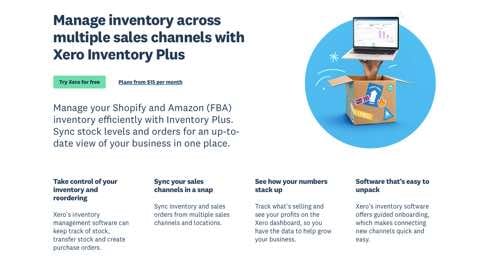
Xero releases inventory management software. Xero, a small-business accounting platform, has launched Inventory Plus management software for U.S. businesses. Inventory Plus helps businesses manage inventory across multiple locations and sales channels, including Fulfillment by Amazon.
I’ve addressed AI-driven tools that convert text into images, video, and audio. But equally handy are tools that do the opposite: generate text from images. The benefits include:
Accessibility for visually impaired users,
Enhanced search engine optimization by adding alt text,
Time-saving social media captions,
Translated languages for text within images,
Editable text from screenshots and scanned documents.
Here are my seven go-to image-to-text tools.
Accessibility and SEO
Hugging Face’s Image-to-Text. AI’s understanding of images is helpful but new and imperfect. Image-to-Text from Hugging Face provides short, AI-powered descriptions of an image. Upload an image, and the tool will describe it. Image-to-Text offers free and premium versions starting at $9 per month.
Image-to-Text provides short descriptions, such as “a young girl sitting at a table writing on a piece of paper.”
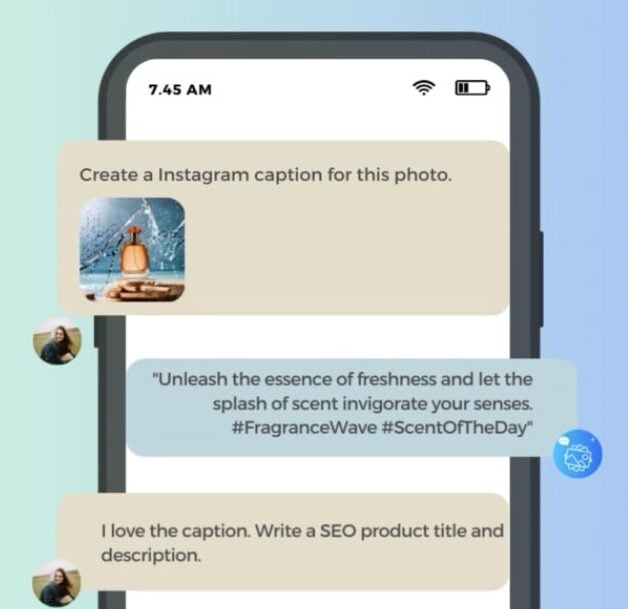
ChatPhoto is a premium iOS app that creates descriptions from photos. It includes AI chat functionality to dialog about any image uploaded from a camera. Ask about words in a picture or prompt it to create more detailed descriptions, Instagram captions, or product specs. The app supports multiple languages and costs $14.99 per month for unlimited chats.
ChatPhoto creates descriptions from photos and includes AI chat functionality.
Social Media Captions
CaptionItis a freemium phone app that creates captions for social media. Upload a photo and choose the caption’s style. CaptionIt will then generate captions based on those settings and the photo. The tool has increased my productivity and improved my captions. CaptionIt’s free version is limited. The (much) more robust Pro version is $1.99 per month.
Translation
Google Translate is a popular and free web-based tool to translate text alone or on images. The tool detects text (typed or handwritten) on any image and produces that image translated into the chosen language or as text alone. Translate is built into Google’s Search app.
Google Translate can detect and translate text (even handwritten) on the image.
Extracting Text
Text extraction tools are not new. Many screen readers include them. Yet AI increases accuracy for accessibility, alt tags, video scripts, and more.
Nanonets free text-from-image browser tool can process any image in seconds — up to 30 MB — into a downloadable text file. The tool can also extract handwritten text but with inconsistent results in my testing. Nanonets also offers a free Google Chrome extension.
Google Lens is a free mobile app alternative to Nanonets. It, too, is built into the Search app. Allow the app access to your photos, choose an image, and then navigate Text > Select all > Copy text.
Image to Text Converterextracts text from screenshots. It is free and requires no registration.
For excessive text on images, consider extracting and then pasting it into ChatGPT for a summary.
Meta is rolling out ad platform upgrades for Facebook and Instagram.
The updates, coming in the next few months, focus on boosting performance and customization through AI-powered campaign optimization.
New Features For Precise Value Definition
Meta is rolling out a new “Conversion Value Rules” tool to give advertisers more flexibility.
This feature lets you adjust the value of different customer actions or groups to your business within a single campaign.
Let’s say you know some customers tend to spend way more over time. Now, you can tell the system to bid higher for those folks without setting up a separate campaign.
Incremental Attribution Model
Meta plans to introduce a new optional attribution setting later this year. This feature will focus on what it terms “incremental conversions.”
Instead of maximizing the total number of attributed conversions, this new model aims to optimize ad delivery for conversions likely to occur only because of ad exposure.
In other words, the model identifies and targets potential customers who wouldn’t have converted without seeing the advertisement.
Initial tests of this feature have yielded positive results. Advertisers participating in these trials have observed an average increase of over 20% in incremental conversions.
Enhanced Analytics Integration
Meta is launching direct connections with external analytics platforms, starting now and continuing through 2025. They’re kicking off with Google Analytics and Northbeam and plan to add Triple Whale and Adobe later.
These connections let businesses share combined campaign data from different channels with Meta’s ad system. The goal is to give advertisers a complete picture of how their campaigns perform across various platforms.
By getting this broader data set, Meta expects to fine-tune its AI models and help advertisers run more effective campaigns.
Cross-Publisher Journey Optimization
Meta is using what it’s learned from its early connections with analytics tools to update its ad system. These changes consider how customers interact with ads across different platforms before purchasing.
Early tests of this update have been positive. On average, third-party analytics tools show a 30% increase in conversions attributed to Meta ads. However, advertisers might see higher costs per thousand impressions (CPMs).
Right now, this update is being applied to campaigns that aim to increase the number or value of conversions under the sales objective. Meta plans to extend this to other campaign objectives soon.
Google Analytics Integration: What It Means
The Google Analytics connection is big news for industry folks, as it could offer the following benefits:
Unified view of Meta ads and overall site performance
Better multi-touch attribution
Insights to refine SEO strategy based on paid social impact
Smarter budget decisions between paid social and SEO
Easier reporting
Cross-channel optimization opportunities
This integration blurs the lines between paid social, organic social, and SEO, offering a more holistic view of digital marketing efforts.
Why This Matters
As privacy changes shake up digital advertising, Meta’s updates address the need for more accurate, valuable insights.
The move towards AI-driven features and cross-channel integration marks a new era in ad sophistication.
To make the most of these updates, review your Meta ad strategy and clearly define your customer journey and value metrics.
Stay tuned for the rollout, and be ready to test these new features as they become available.
Even if you’re a new or experienced business owner, you can’t ignore the impact of social media on your business. It’s great for marketing, brand awareness, and SEO. But it’s quite a hassle to keep track of your social media accounts, website, blog, and your product(s). To save you time and money, we’ll be looking at what benefits your SEO the most: an organic social media strategy or using social media ads?
First, what is an organic social media strategy? Well, it’s the opposite of using social media ads—something you have to pay for. An organic strategy means you use free/unpaid methods of creating and sharing content on social media platforms to build an engaged audience.
In other words, you regularly post high-quality content on your social media accounts. Plus, another important part of an organic strategy is engaging with your audience through, for example, comments.
Long-term benefits
There are a lot of long-term benefits from having an organic strategy. If you post consistently for a long time, you’ll usually get sustained engagement and traffic from your posts. Which, in turn, can lead to higher search engine rankings.
Authenticity and engagement
Another benefit is the authenticity of your content—which is becoming increasingly more important nowadays. People want to know if they can trust your brand. By regularly posting authentic content and engaging with your audience, you’ll be able to boost your brand reputation and indirectly boost your SEO.
So how does engagement boost your SEO? Well, likes, shares, and comments can influence your SEO by signaling that your content is relevant and popular. Plus, now that Google shows social media content in their search results more often, it can only be a good thing to have great engagement metrics.
The disadvantages of organic social media
It takes some time
To see the benefits of an organic social media strategy, you have to post consistently over a long period of time. This can also be a disadvantage, however. Sometimes you want to launch a new brand or product, and you don’t want to post about it for months before you catch people’s attention.
Even though you do get results with an organic strategy, it can take months to see significant results. So you need to have patience!
Consistency is important
It’s a key component, in fact. For an effective organic strategy, you need to continuously and consistently put in the effort to maintain your brand’s visibility and engagement. This means you need to stay on top of your feed and regularly brainstorm what might be interesting content for your audience. Which does take time and effort.
What are social media ads?
Social media ads are pretty straightforward. They’re paid advertisements that you can run on social media platforms like Meta (which includes Facebook and Instagram), X and YouTube. It’s also good to know that there are various advertisement types, such as display ads, video ads, sponsored posts, etc. Depending on your goal and audience, you choose one of these.
Example of display ad
As we just mentioned, social media ads are paid advertisements. The costs, however, can vary, depending on your audience, the type of ad, and the duration of your campaign. That’s why some campaigns might be more expensive than others!
Example of sponsored post
The SEO advantages of paid social media
Quick results
As opposed to an organic strategy, ads can generate immediate traffic and engagement to your site. This could indirectly improve your SEO because your engagement metrics will increase.
Plus, if you’re promoting high-quality content, then people are more likely to share it, like it, and link to it. Which is all very valuable for your SEO.
Reach your target audience
Ads also make it relatively easy to reach your target audience. When you set up an ad, you can fill in precise information that will allow you to reach people from a certain demographic, with certain interests and behaviors.
If those people like the content you’ve boosted, they might even follow your account. That would be the ideal situation, since they will now also see your organic posts.
The disadvantages of paid social media
Costs
This is a no-brainer since it’s in the name, but it’s still worth mentioning. Paying for ads can get quite expensive. Especially if this is your social media strategy, and you don’t have an organic strategy.
If that’s the case, you’ll have to continuously invest in social media ads to maintain your brand’s visibility.
Short-term impact
Ads only run for a limited time. If your campaign is over and your ad isn’t promoted anymore, then your traffic and engagement from that ad will drop. In other words, there are no lasting SEO benefits from paid ads.
Ad fatigue
Yep, it’s a thing! Seeing an ad too often can desensitize people. In other words: people get bored from seeing the same ad and they stop paying attention. Which means your ad will become less effective. Have you ever seen a TV ad so many times that you get tired of it? It’s the same thing. Ad fatigue.
Overall impact on SEO: organic versus paid
We’ve talked about the SEO advantages to both strategies, but let’s briefly summarize.
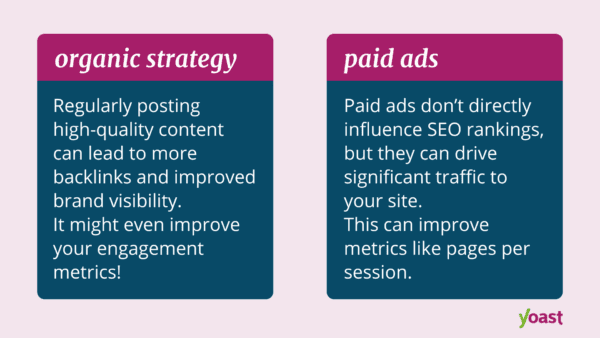
Having an organic social media strategy means you regularly post high-quality content, which can lead to more backlinks and improved brand visibility. It might even improve your engagement metrics!
Using paid ads will not directly influence your SEO ranking. However, ads can drive significant traffic to your site, which in turn can improve metrics like pages per session.
Which strategy is better?
As always, the answer fully depends on your goals and how much you’re willing to invest into your social media strategy, be it time or money or both. To maximize the impact of your social media on your SEO however, we would recommend using both strategies.
Why? Because you can use ads to boost new or high-value content to reach your target audience. Once the initial buzz of an ad has died down, you can keep people interested with your organic posts.
Tip: utilize analytics
Most social media platforms offer you insight into the performance of your organic and paid posts. Use this to check which posts are resonating with your audience and which aren’t. If you combine this data with your website’s analytics, you’ll be able to easily adjust your strategy, so you can focus on what works best.
Conclusion
Both organic and paid strategies have their advantages. An organic social media strategy will result in slow and steady growth with lasting benefits for your business. However, this will take a lot of time before you see any results. On the other hand, using paid ads will give you quick results and allows you to target the exact audience that you want to reach. But paid ads can get expensive, so they might be more useful for immediate traffic boosts or announcing a new product or service to your audience.
That’s why it might be in your best interest to combine both, so you’ll have the benefits of building a connection with your audience while also boosting your growth with paid ads.
Sabrina is the Social Media Specialist at Yoast. She’s responsible for creating and curating engaging content to enhance Yoasts’ brand presence across various social platforms.
Google’s Gary Illyes recently highlighted a recurring SEO problem on LinkedIn, echoing concerns he’d previously voiced on a Google podcast.
The issue? URL parameters cause search engines difficulties when they’re crawling websites.
This problem is especially challenging for big sites and online stores. When different parameters are added to a URL, it can result in numerous unique web addresses that all lead to the same content.
This can impede search engines, reducing their efficiency in crawling and indexing sites properly.
The URL Parameter Conundrum
In both the podcast and LinkedIn post, Illyes explains that URLs can accommodate infinite parameters, each creating a distinct URL even if they all point to the same content.
“An interesting quirk of URLs is that you can add an infinite (I call BS) number of URL parameters to the URL path, and by that essentially forming new resources. The new URLs don’t have to map to different content on the server even, each new URL might just serve the same content as the parameter-less URL, yet they’re all distinct URLs. A good example for this is the cache busting URL parameter on JavaScript references: it doesn’t change the content, but it will force caches to refresh.”
He provided an example of how a simple URL like “/path/file” can expand to “/path/file?param1=a” and “/path/file?param1=a¶m2=b“, all potentially serving identical content.
“Each [is] a different URL, all the same content,” Illyes noted.
Accidental URL Expansion & Its Consequences
Search engines can sometimes find and try to crawl non-existent pages on your site, which Illyes calls “fake URLs.”
These can pop up due to things like poorly coded relative links. What starts as a normal-sized site with around 1,000 pages could balloon to a million phantom URLs.
This explosion of fake pages can cause serious problems. Search engine crawlers might hit your servers hard, trying to crawl all these non-existent pages.
This can overwhelm your server resources and potentially crash your site. Plus, it wastes the search engine’s crawl budget on useless pages instead of your content.
In the end, your pages might not get crawled and indexed properly, which could hurt your search rankings.
Illyes states:
“Sometimes you might create these new fake URLs accidentally, exploding your URL space from a balmy 1000 URLs to a scorching 1 million, exciting crawlers that in turn hammer your servers unexpectedly, melting pipes and whistles left and right. Bad relative links are one relatively common cause. But robotstxt is your friend in this case.”
E-commerce Sites Most Affected
The LinkedIn post didn’t specifically call out online stores, but the podcast discussion clarified that this issue is a big deal for ecommerce platforms.
These websites typically use URL parameters to handle product tracking, filtering, and sorting.
As a result, you might see several different URLs pointing to the same product page, with each URL variant representing color choices, size options, or where the customer came from.
Mitigating The Issue
Illyes consistently recommends using robots.txt to tackle this issue.
On the podcast, Illyes highlighted possible fixes, such as:
Creating systems to spot duplicate URLs
Better ways for site owners to tell search engines about their URL structure
Using robots.txt in smarter ways to guide search engine bots
The Deprecated URL Parameters Tool
In the podcast discussion, Illyes touched on Google’s past attempts to address this issue, including the now-deprecated URL Parameters tool in Search Console.
This tool allowed websites to indicate which parameters were important and which could be ignored.
When asked on LinkedIn about potentially bringing back this tool, Illyes was skeptical about its practical effectiveness.
He stated, “In theory yes. in practice no,” explaining that the tool suffered from the same issues as robots.txt, namely that “people couldn’t for their dear life figure out how to manage their own parameters.”
Implications for SEO and Web Development
This ongoing discussion from Google has several implications for SEO and web development:
Crawl Budget: For large sites, managing URL parameters can help conserve crawl budget, ensuring that important pages are crawled and indexed.
Site Architecture: Developers may need to reconsider how they structure URLs, particularly for large e-commerce sites with numerous product variations.
Faceted Navigation: E-commerce sites using faceted navigation should be mindful of how this impacts URL structure and crawlability.
Canonical Tags: Canonical tags help Google understand which URL version should be considered primary.
Why This Matters
Google is discussing URL parameter issues across multiple channels, which indicates a genuine concern for search quality.
For industry experts, staying informed on these technical aspects is essential for maintaining search visibility.
While Google works on solutions, proactive URL management and effective crawler guidance are recommended.
Strategy is the most misunderstood topic in the SEO world and likely the most impactful one. Just search for “SEO strategy” and notice that almost every article is about tactics. I get it. Tactics are sexier.
HOWEVER, focusing on tactics without a strategy increases your risk of:
Prioritizing the wrong tactics.
Losing market share to newcomers.
Missing critical opportunities and threats.
Doing what others are doing instead of doing it better.
Not getting buy-in for SEO from decision-makers or clients.
Heart disease.
Okay, the last one might not be true. But the others are. I’ve seen it many times. It’s ugly.
In an environment of aggressive algorithm updates, fewer clicks due to AI Overviews and more SERP real estate taken by forums, you cannot afford to take those risks. And yet, everyone does. I’m no exception: After spending the last two years crafting SEO strategies for companies like Ramp, Reddit, Nextdoor, and Hims, I realized the article that previously occupied this URL was too tactical – and completely rewrote it.
I’ve seen the difference between no and elegant strategy. Good SEO strategies embody a framework that seizes the opportunity of change, focuses on leverage, and beautifully stacks tactics in a logical structure.
To bring strategy to the forefront of SEO, I’m sharing with you:
A crisp definition of what strategy is and how it works.
The 5-question framework I’ve been using to develop SEO strategies.
Countless notes from books and practical experience I’ve taken over many years1
What An SEO Strategy Actually Is
Short definition: An SEO strategy defines how to overcome critical challenges by leveraging competitive advantages.
After years of not really getting it, I located the best definition of a business strategy in Richard Rummelt’s book “Good Strategy, Bad Strategy”. He explains that the kernel of strategy holds three parts:
A diagnosis of key challenges to overcome
Guiding policies that define how to overcome the challenges
Coherent actions that implement policies
A myriad of strong examples convinced me that this is the framework to go – and to apply to SEO. I’m rewording Rummelt’s framework to make it more colorful and approachable:
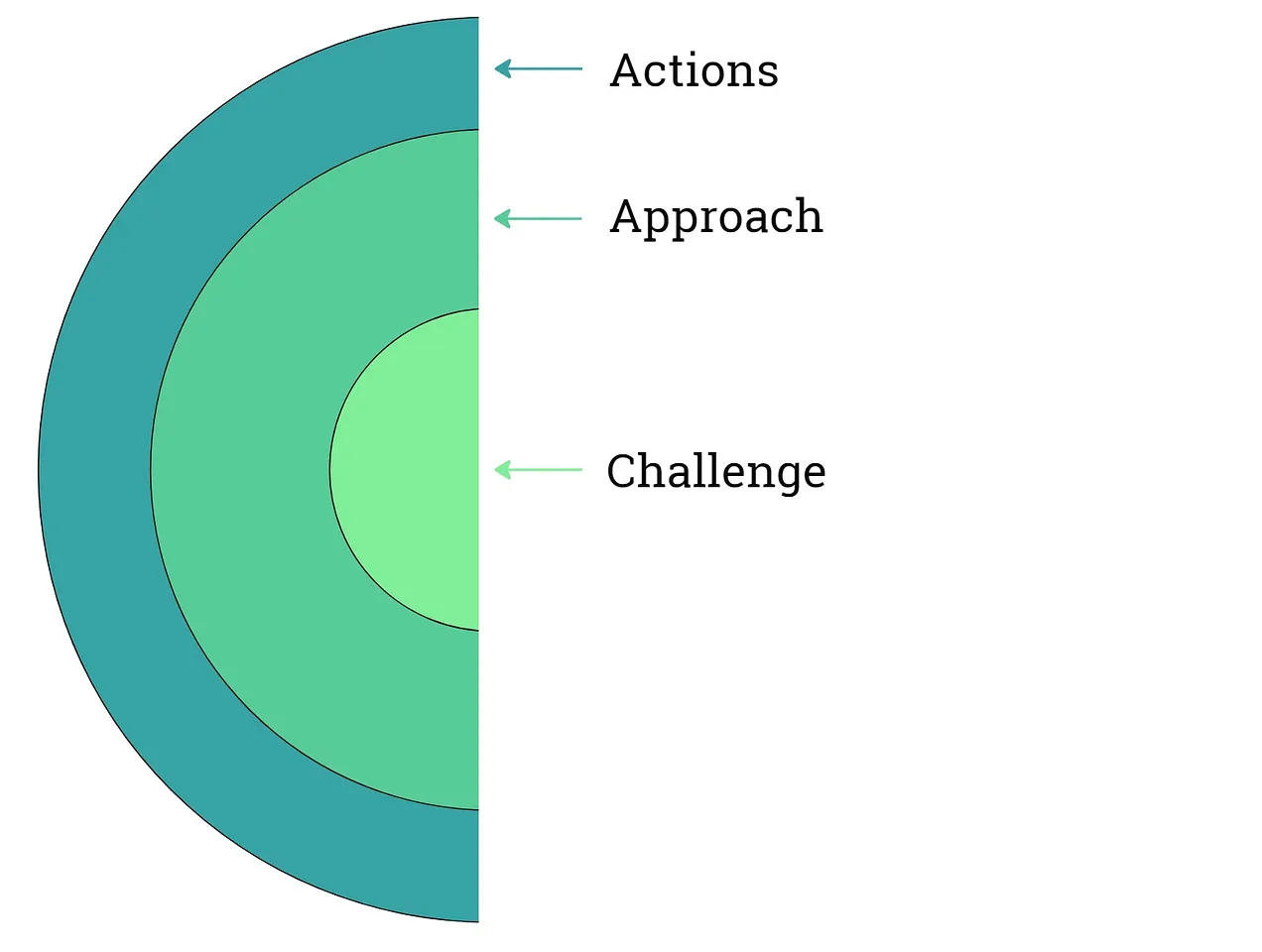
Challenge
Approach
Actions
The SEO strategy kernel (Image Credit: Kevin Indig)
Long definition: An SEO strategy clearly defines the Challenge a company must overcome through deep analysis. It concludes the direction in which the company needs to move to overcome that challenge in a framework called the Approach. Lastly, an SEO strategy defines specific Actions that must be taken to implement the Approach and overcome the Challenge. The Challenge remains constant, but the Approach can adjust, and Actions can change completely based on new information.
In his book “Originals”, Adam Grant even mentions that flexibility towards actions can be a strength:
Teams that evaluated their strategies at the midpoint were 80 percent more effective than teams that had the conversation at the start. […] This is one of the reasons that halftimes can be so influential in basketball and football: They allow coaches to intervene when teams are most amenable to new strategies.
You can tell a strategy is well thought-out based on four indicators:
Layers: elements build on top of each other
Exploit: maximization of a competitive advantage
Simplicity: focus on overcoming the core challenge
Change: capitalization of change in technology, competitors, consumer behavior and other areas
Boost your skills with Growth Memo’s weekly expert insights. Subscribe for free!
Challenge
The Challenge stands in the way of achieving your goals and embodies the “why” behind what you do. A strategy’s job is to find and solve the core challenge.
Defining the challenge is the most important part of a good SEO strategy because it’s the base for the direction and future actions. If you get this wrong, you waste a lot of time and money. To avoid failure, you need to invest in researching your market position, customers and competitors to understand the problems, their causes, and the ecosystems in which they occur.
Example: You aim to “win” the pet food SEO space but face established incumbents with more resources. After doing the research, you come to the conclusion that incumbents have outsized authority and relevance for pet food product names and category keywords.
Approach
The Approach is the “what” you do to overcome the core challenge. It’s a framework that sets the direction of your actions by exploiting your current advantages and exploring new ones. Getting the approach wrong means you lose focus and work on actions that don’t help you overcome the core challenge.
The Approach is an unambiguous list of the areas in which you invest and which you do not. Defining what you’re not going to do is equally as important as what you’re going to do because every strategy is a choice. That’s why my framework is called the 5 Choices. Without making hard choices, you likely don’t focus enough.
The Approach outlines your strategy risks, i.e., where the execution of your approach could go wrong. Every choice bears risk. By getting ahead of them, you minimize your chances of failing.
Critical: the approach needs to be differentiated. You need to do things differently (competitive advantage or asymmetry). You cannot expect to do the same things as your competitors and beat them. That’s just a way to end up in attrition warfare and obsession with operational efficiency. Differentiation creates greater value, prices and margins.
Sources of competitive advantages can be:
Focus.
Reputation.
Network effects.
Stronger tools/automation/systems.
Being the first to do or notice something.
A resource your competitors don’t have access to.
Example: To overcome the core challenge in the pet food space, you decide to leverage your strength of inhouse experts (say, you have a bunch of vets on staff). You invest in writing pet food guides instead of focusing on category and product landing pages. Traffic to the guides is funneled to landing pages where you sell your product.
Actions
Actions are “how” you implement the approach to overcome the core challenge. This is where it gets more tactical. But instead of picking “cool tricks” or “shiny objects”, your actions need to align with the approach and challenge. You know you’re there when your actions reinforce each other.
Example: Actions you could take to focus on pet food guides are publishing 100 pieces of content with detailed content briefs over the next 3 months, define a regular content refresh cadence and syndication to 10 industry magazines. You also create a video for each guide and position your site as a source of expert guidance from field practitioners.
Notice how you could have taken a different approach to solving the core challenge, like focusing on category and product landing pages. However, this approach would’ve likely not solved your core challenge because you know that strong incumbents already have a stronghold in that area. So, you need to do something different that plays into your strengths.
SEO Strategy Examples From Instacart, Substack, And Adobe
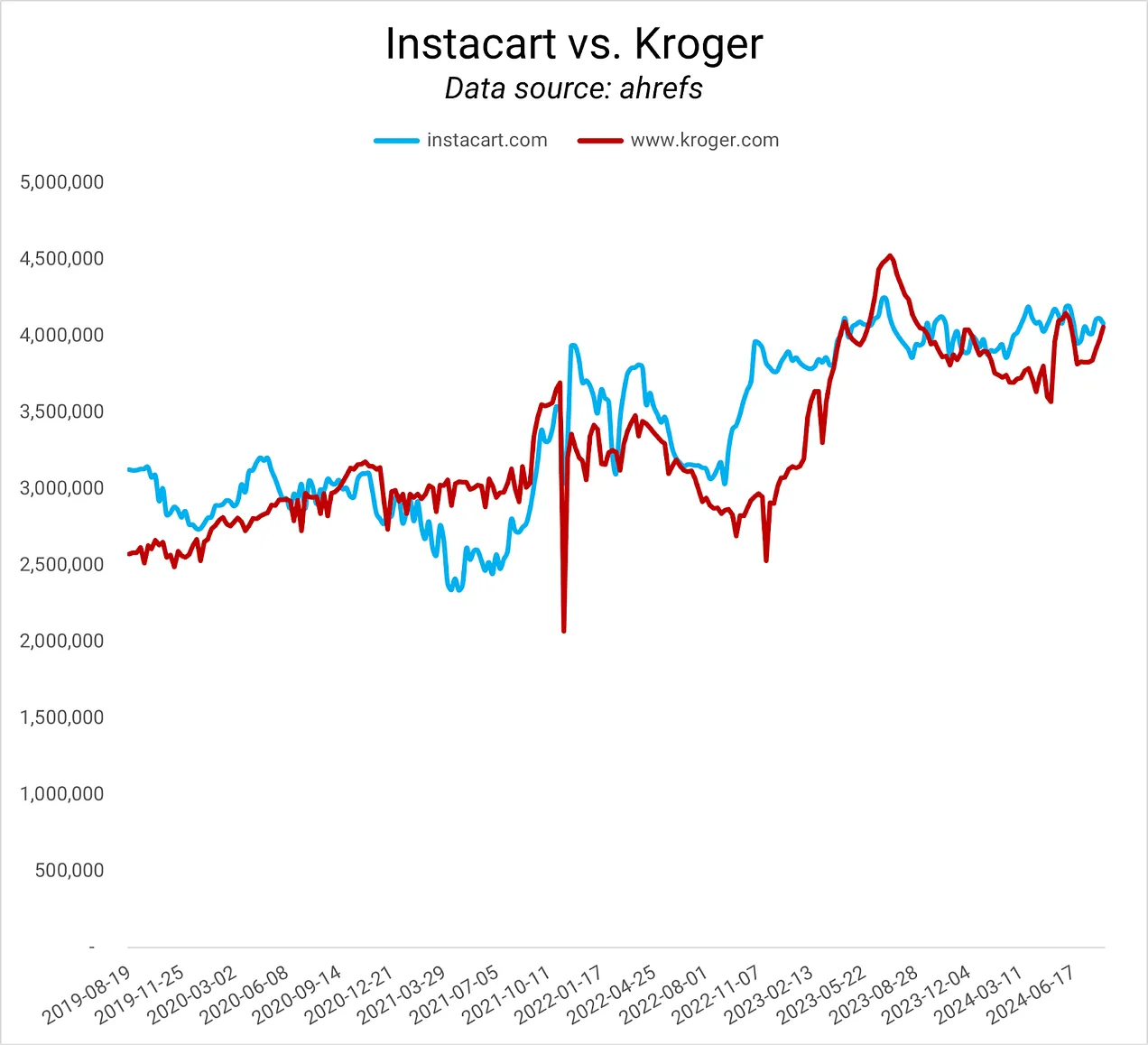
Instacart is a marketplace aggregator connecting buyers with supermarkets (read the full case study). Even though the company has been around since 2012, it encountered a defining moment when the COVID-19 pandemic broke out and consumers ordered groceries online.
Challenge: Win the grocery market during the pandemic amid strong competition
Approach: Target grocery and near-me keywords
Actions: Build dedicated landing pages with rich snippet enhancements
Instacart’s approach was to capitalize on the trend as an aggregator instead of a supermarket chain. They tried to differentiate with inspirational editorial content but missed an opportunity to gain more visibility with recipes. Competitor Kroger regained the lead in 2022, and incumbent Costco is still far ahead.
Image Credit: Kevin Indig
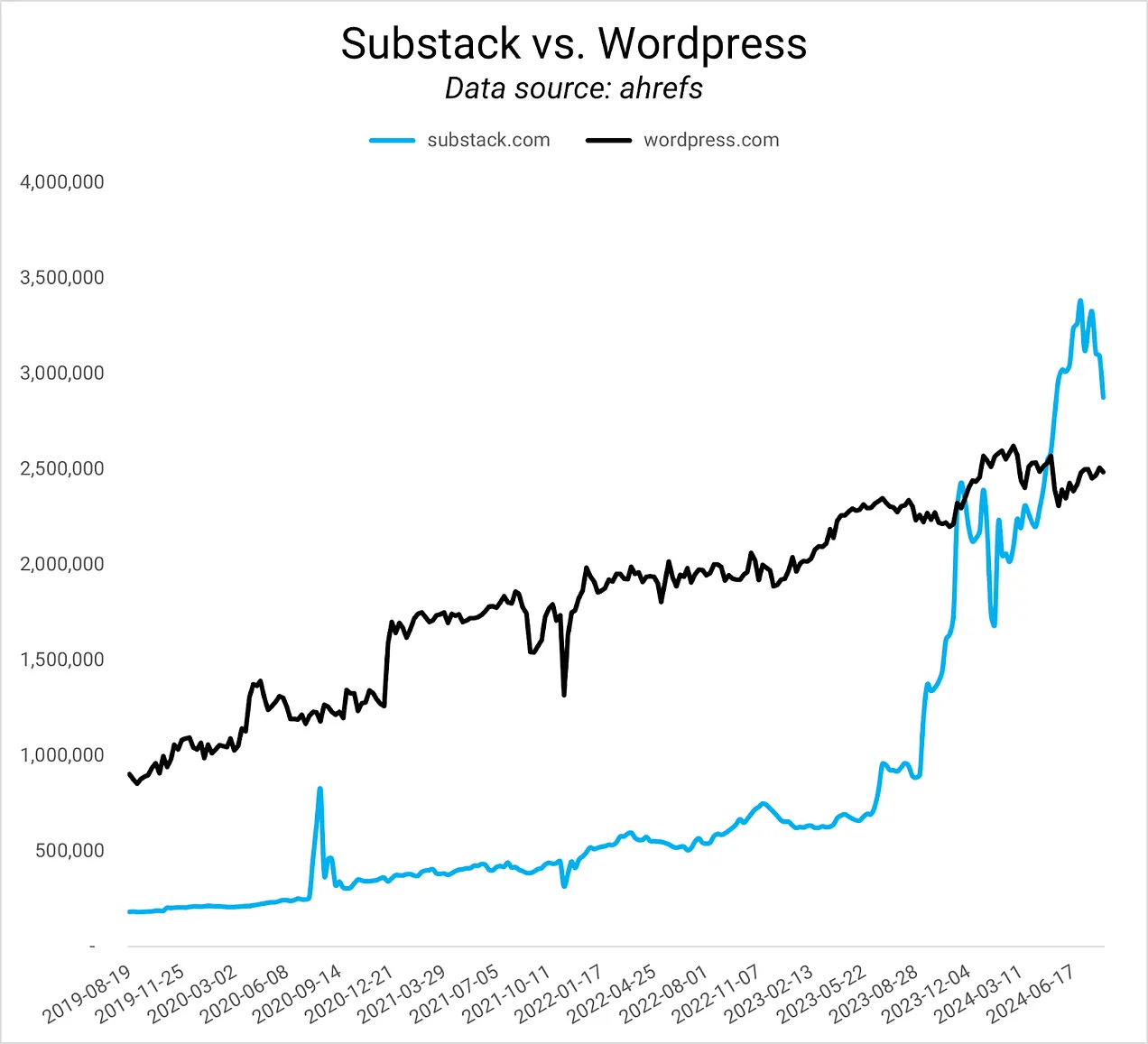
Substack is a newsletter and blog hosting platform (read the case study) for journalists and writers.
Challenge: Host a critical mass of high-quality writers on its platform.
Approach: Drive more traffic to publications by making the platform more Search-friendly.
Actions: Indexable profile pages, optimized URLs, internal link modules and topical landing pages that serve as discovery hubs for newsletters to users and search engines.
Substack was able to catch up to WordPress in 2024 but is still far behind Medium, which had strong traffic declines between early 2021 and mid-2023.
Image Credit: Kevin Indig
Adobe is a legendary software solution for designers and marketers (read the case study). After many years of strong growth from editorial content and lead-gen tools, organic traffic plateaued, and competitor Canva grabbed more traffic share.
Challenge: Break through the traffic plateau.
Approach: Launch a stock photo platform to address a new user intent.
Actions: Optimize stock photos and landing pages.
Image Credit: Kevin Indig
Adobe was able to recapture the top spot in organic traffic in 2024 after years of falling behind.
Tesla needed to build fewer cars and was able to refine its EV approach by targeting the luxury segment.
Premium cars made it easier to finance R&D.
Tesla established its brand and got many eyeballs by tapping into scarcity. Additional stunts, like designing the Roadster “to beat a gasoline sports car like a Porsche or Ferrari in a head to head showdown”, helped to build desire.
From there, the company always planned to go down-market and build cheaper models. Today, Tesla has 50% market share.2
Simple and effective.
Don’t Mistake Tactics For Strategy
In my work as an inhouse leader and external advisor, I consistently come across four misunderstandings of SEO strategy:
1/ A strategy is not a set of tactics. As I explain in my free course Crafting a Winning SEO Strategy, “tactics are not defensible because they can be copied.” But for some reason, almost every article on the web about SEO strategy is all tactics and no strategy. Tactics are part of a strategy, but they are not the strategy.
I will never forget an executive at a renowned company saying, “This looks like we’re doing a bunch of stuff to me,” when I presented my “strategy”. The problem: I didn’t present the context (Challenge & Approach) in which the tactics make sense. And they didn’t. After taking a couple steps back, I re-evaluated my approach and presented a strategy that got us to win.
2/ A strategy is not a roadmap. A roadmap is a plan that defines which tactics are prioritized when and who executes them. Strategies lay out the playing field and how to win.
The following artifacts are plans, not strategies:
Topic roadmaps
Editorial calendars
Content requirements
Technical audits
Annual goals
etc.
3/ A strategy is not a goal. The strategy explains how to achieve a goal, but it doesn’t stop there. And a strategy is certainly not a number. Strategies lay out the decisions that have to be made to achieve a goal and how to make them.
4/ A strategy is not operational efficiency. Tactics, roadmaps and goals can be part of a strategy, but operational efficiency is a way to run an organization. I get the excitement to work on operational efficiency because it’s impactful and actionable.
When you confuse operational efficiency with strategy, you ultimately end up in an attrition game because you try to do what everyone else does better. The problem is that you won’t be able to catch up to incumbents who are lightyears ahead. The way out is a differentiated strategy.
The 5 Choices Of An SEO Strategy
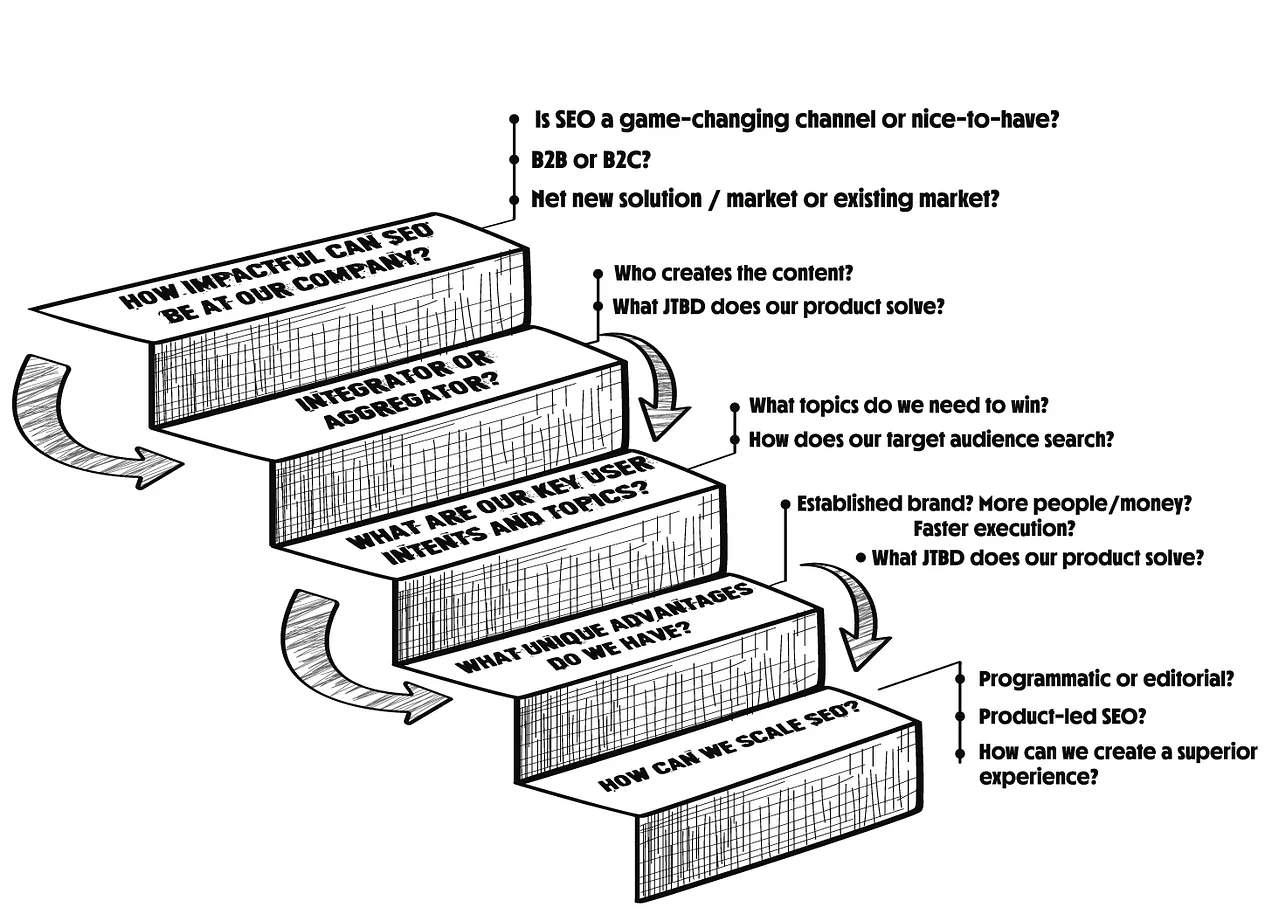
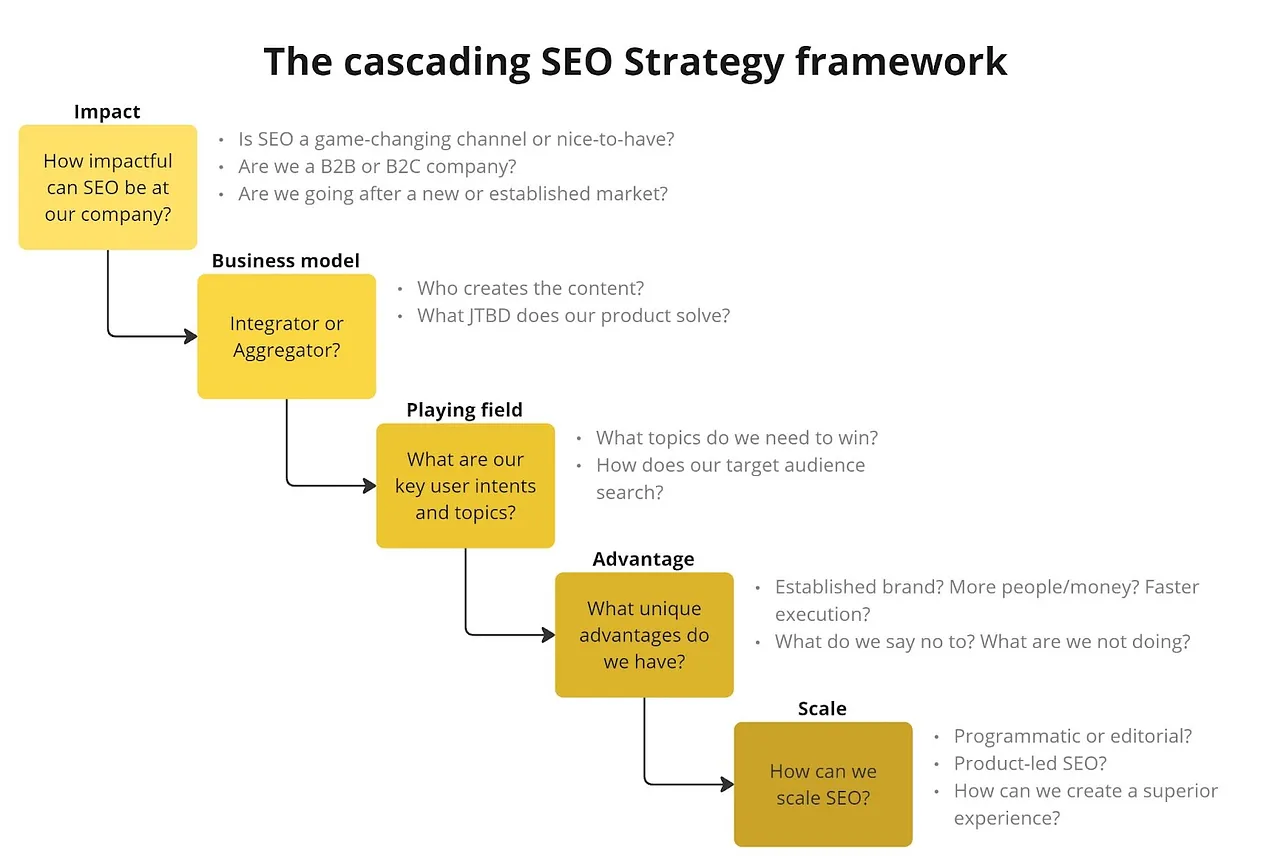
So many SEOs fall back to tactics because there is no good SEO strategy framework on the web. My goal with this article is to give you a framework that’s easy to understand and implement so you can build your own strategy. I call it The 5 Choices.
The 5 Choices (Image Credit: Kevin Indig)
The 5 choices are a set of vital decisions you must make to land at a differentiated SEO strategy by carving out your Challenge, Approach and Actions.
1/ How Impactful Can Seo Be At Our Company?
A strategy isn’t worth its bits if it ends up in a Dropbox folder. It must be applied. And to be applied, it must make an impact. If SEO cannot impact the company meaningfully, you likely won’t get enough buy-in and funding to execute a differentiated strategy. Potential impact determines your Challenge.
Measure impact in revenue. For example, the potential or current revenue contribution from SEO or the ability of incremental revenue from SEO with lower ad budgets.
To diagnose the (potential) impact of SEO, see if projected traffic and revenue over the next 6-36 months are meaningful to the company.
Key questions:
Are we a B2B or B2C company?
Are we competing in a net new or established market?
Which channel drives most revenue?
Examples: High impact is when SEO accounts for 20% of the company’s revenue. Low impact is when search volume for key terms doesn’t translate into a meaningful opportunity.
2/ Integrator Or Aggregator?
The next question is whether the company is an SEO Integrator or Aggregator, based on who creates the content. If a company can scale SEO with user-generated content (UGC) or an inventory (e-commerce products, locations, or digital products), it’s an SEO aggregator. If a company creates the content “itself” with inhouse or freelance writers, it’s an SEO Integrator.
The difference is critical because each type scales SEO in its own way and has different levers in its arsenal, leading to distinct competitive advantages and approaches. Your type defines your Approach.
Key questions:
Who creates the content?
What JTBD does our product solve?
Can we scale into aggregator plays as an Integrator or vice versa?
Examples: Instacart aggregates supermarkets and groceries, while Substack aggregates articles. Adobe is an integrator that built an aggregator arm with stock photos.
3/ What Key Intents And Topics Do We Focus On?
Early on, every company needs to focus on a few key user intents and topics to succeed in SEO. Over time, companies tend to fail in SEO when their domain carries too much content for topics they’re not yet known or an authority for. Topics and user intents can only expand with new products or features. Knowing which ones to focus on is a critical constraint for your Challenge and Approach.
Key questions:
What topics align with our product(s), and which do we need to win?
How does our target audience search?
To find key topics, look for which use cases best describe your product. Follow the jobs-to-be-done your product solves to find which user intents you can satisfy.
Examples: Airbnb targets people who search for activities and stays in cities (user intent) across core topics, such as short-term rentals, trips, and experiences. Adobe started as web design software and branched out into video and audio engineering, documents, marketing and e-commerce.
4/ What Unique Advantage(s) Do We Have?
Knowing your advantage is critical so you can fully lean into it. Sometimes hard to find, every company has at least one advantage based on its positioning, resources and product/market fit that determines how a company could combat a problem (Approach).
One part of leaning into your strengths is being clear about what you won’t do. Boundaries create focus and can be turned into strengths. Companies win by leveraging strengths, not fixing weaknesses.
The good-to-great companies did not focus principally on what to do to become great; they focused equally on what not to do and what to stop doing.
Key questions:
Where do we have an advantage?
Do we have an established brand, more people/money, or faster execution?
What do we say no to? What are we not doing?
To find advantages, look for inflexible structures competitors have to defend. Every strategic choice is a commitment that a competitor can position themselves against.
Examples: In my deep dive into the company Course Hero, I describe how its main competitor, Studocu, chose to compete by focusing on international markets before tackling the US. That is a very distinct strategic choice based on Studocu’s competitive advantage, the fact that Course Hero has established itself in the US, and
5/ How Can We Scale SEO?
There is no sustained impact without scale, whether you build more landing pages or hire more writers. Good strategies have force multipliers that compound returns over time with synergetic Actions.
Key questions:
Programmatic or editorial?
Product-led SEO?
How can we create a superior experience?
To find scale mechanics, look for ways to create more high-quality pages on your domain and optimize your existing pages.
Examples: Local services aggregator Angi, for example, scales by consolidating its acquired companies into one domain and expanding editorial content with a large team.
How To Build An SEO Strategy Step By Step
Building your strategy is a 3 step process:
Research/analyze.
Document.
Communicate.
Research/analyze
Your goal is to develop a razor-sharp understanding of the problem(s) you’re facing and to decide which one is the key problem based on thorough research:
Audit your customers, market and competitors.
Compare your assets, resources, and growth with competitors.
Identify the gap between your current performance and goal.
Use the 5x Why method for root cause analysis.
Document
Your strategy can be a written document or slide deck. The format itself is less important than compressing all the research and analysis into key paragraphs or slides.
Explain your reasoning in detail in the appendix or a separate document so that key partners understand where you’re coming from and why you come to your conclusions.
Communicate
The right way to communicate your strategy is with key partners first, ideally in person or virtually, and then with the broader company. Beat the drum on your strategy as often as you can with people at the forefront of execution. It takes a lot of repetition for the strategy to sink in, especially with larger companies.
Your strategy must be easy to understand. If it takes you 30 minutes and 100 slides to understand what the strategy is, you’re on the wrong track. Equally, if not every one of your employees can say what the strategy is, it’s likely not comprehensive enough.
First, you need clarity of the strategy for yourself, then you need to communicate it. – Bob Iger
The key to getting there is not to pick a simple strategy but to compress the hard work into its essence. A good example is how CEO Bob Iger simplified his strategy:
Invest most of Disney’s resources into creativity
Use technology to tell stories and reach people
Grow globally
Conclusion: Strategy Is The Key To Powerful Tactics
In Growth Memo Premium, I dissect the strategies of Nike, The New York Times, Redfin, IBM and other successful companies. Each succeeds with a differentiated SEO strategy that leads them to either dominate their industry or challenge incumbents.
A strong strategy aligns the whole organization toward a core challenge. It puts tactics into context and creates synergies between them, which means you’re getting more impact out of them than if you started with tactics and backed up into strategy.
I’ll leave you with these provocative questions:
What is a change you could leverage?
Which strength have you underplayed?
Do you have strong alignment between actions and approach?
Do you know what the core challenge is you’re facing?
Is your approach different from what others are doing?
Small businesses face the ongoing challenge of standing out in crowded marketplaces, both online and off.
One strategy that has gained significant traction in recent years is leveraging prominent, trusted local influencers to help boost online authority and visibility and grow the business.
This approach enables businesses to tap into established community voices, build trust, and reach specific local audiences through value-added partnerships.
Understanding Local Influencer Marketing
Local influencer marketing involves partnering with people who have significant followings and/or influence within a specific geographic area or community.
These influencers may not have millions of followers like national or global influencers, but their impact on local consumers’ searching and buying decisions can be substantial.
According to a 2023 study by Influencer Marketing Hub, 82% of marketers plan to dedicate a budget to influencer marketing. While this statistic covers influencer marketing in general, the trend is increasingly relevant for local businesses as well.
Why Local Influencers Matter For Your Local Businesses
Targeted Local Reach
Local influencers have an audience that is likely to be in the same area as your business.
This means your marketing efforts are focused on potential customers who can actually visit your physical location or use your local services.
It reduces wasted exposure to audiences outside your service area, making your marketing much more efficient and cost-effective.
Authenticity
Local influencers are often seen as more relatable and trustworthy by their followers. They’re part of the community and understand local challenges, needs, preferences, and culture.
This authenticity can lead to higher engagement rates and more genuine interest in your business.
Their recommendations often come across as personal endorsements rather than paid advertisements, though their support should be clearly indicated as paid/sponsored if this is the case.
Cost-Effectiveness
Partnering with local influencers is generally more affordable than working with larger, national-level influencers, who are used to charging a premium.
Most small businesses have limited marketing budgets, putting those larger influencers out of reach. You can often negotiate deals with locals involving product exchanges or experiences rather than large cash payments.
As noted, the ROI of these types of “paid” relationships can be higher due to the targeted nature of the audience and the influencer’s local credibility.
Increased Local Visibility
Local influencer partnerships can boost a business’s presence in local search results and social media.
When influencers provide backlinks to your content, tag your business on social media, or use location-based hashtags, it can improve your local SEO by transferring some of their established authority and “localness” to you.
This increased visibility can lead to more foot traffic, website or social media visits, and, ultimately, sales.
Timely Communications
Local influencers are often the first to know about and share local trends because part of their job includes being engaged and aware.
Partnering with them can help small businesses quickly adapt their offerings or marketing to new trends and customer needs.
Community Engagement
Local influencers can help businesses connect more deeply with the local community.
They can facilitate meaningful interactions, promote local events, and help your business become a more integral part of the community fabric.
This can lead to increased customer loyalty and word-of-mouth marketing, both online and off, beyond just the influencer’s followers.
Cross-Promotion Opportunities
A local influencer may already have existing relationships with like-minded businesses and be able to make valuable, trust-backed introductions for cross-promotion.
These types of relationships can be positioned as a win-win for all local parties and the community in general.
Further, local community engagement is another signal to Google of your business’s localness and can influence your online authority relative to your competitors, who may not be as engaged.
This trust factor is pronounced at the local level, where influencers are naturally viewed as neighbors and contributing members of the community.
Identifying The Right Local Influencers
Finding the right local influencers is crucial for the success of your campaign. Here are some best practices:
Define your target audience: Understand who your ideal customers are (demographics and psychographics), what types of local influencers they’re likely to follow, and in which channels. Many influencers appeal to specific niches, so be sure to determine whether or not they will reach your target.
Use social listening tools: Utilize social media listening tools or hire someone to identify local hashtags and active influencer voices in your community.
Check engagement rates: Look beyond follower counts and pay attention to how active an influencer’s accounts are. An influencer with 500-1000 engaged local followers is likely more valuable than one with 50,000 passive followers. A Rock Content study quoted by TechJury.net found micro-influencers account for 91% of engagement posts. Much higher than their larger counterparts.
Assess content quality: Ensure the influencer’s content style and values align with your business and brand. Be sure to research the influencer’s past activity and other local relationships they may have maintained.
Verify local presence: Confirm the influencer is genuinely active and influential in your specific locale. Review the influencer’s follower list, looking for friends you may have in common. Ask a few of your customers if they are familiar with the influencer.
Approaching Local Influencers
Once you’ve identified potential local influencers, the next step is to approach them to propose a partnership:
Engage authentically: You can start by following them on social media, liking/sharing their content, leaving thoughtful comments, and tagging them in your relevant posts. In other words, try to build a relationship before pitching a collaboration.
Personalize your outreach: When you do reach out, make it clear why you chose them specifically. Reference specific content you feel would resonate with your audience, and be sure to highlight the importance of local involvement.
Offer value: Clearly articulate what’s in the proposed relationship for them. This could be monetary compensation, free products/services, or exclusive experiences your business can offer.
Be clear about expectations: Outline what you’re looking for in the collaboration, but also be open to their ideas; this should be a mutually beneficial relationship, after all.
Start small: Consider starting with a small project to test the waters before committing to a larger campaign.
Ask for references and/or results: Professional influencers should be able to provide references to other local businesses they’ve worked with. You can also ask them to provide details on results they’ve delivered to other businesses in terms of new followers, website traffic, or actual sales.
Respect their audience: Remember, local influencers have likely taken significant time to build trust with their followers, which is why you should want to work with them. Be sure to respect this relationship and avoid pushing for them to endorse overly promotional content. They will likely let you know in any case, but it’s better not to start off a relationship on the wrong foot.
Case Studies: Local Influencer Success Stories
A Gardening Supply Company Partners With A Local Gardener
A local family-owned gardening store collaborates with a prominent local gardener with 5,000 followers across Instagram, Facebook, and YouTube for a series of DIY gardening tutorial videos featuring their products and services.
Results:
Increase in website traffic from social media and organic search to key product and service pages.
Growth in email newsletter sign-ups.
Boost in sales of products featured in tutorials.
Key Takeaway: Educational content from a trusted local source drives both engagement and sales.
A Butcher Partners With A Local Foodie On A Charity BBQ
A new local butcher with three well-established competitors partners with a local food influencer with 15,000+ highly engaged followers on Instagram, Facebook, and TikTok to promote and host a charity BBQ at his location.
The event is very well attended and the butcher receives positive feedback from several attendees, as well as charity organizers.
Results:
Increase in website traffic and online purchases originating from social media and organic search.
Significant growth of the butcher’s social media following.
Single-day in-store sales record.
A new partnership formed with the local charity, and a link to the butcher’s website from the charity’s site.
Key Takeaway: Community engagement via a known and trusted influencer boosts visibility, traffic, and sales.
Best Practices For Local Influencer Campaigns
Having identified influencers, here are some recommendations for running a successful campaign.
Set Clear Goals
Define what success looks like for your campaign. Is it increased foot traffic, online sales, or brand awareness? Setting specific, measurable goals is critical for evaluating the success of your campaign.
For example, a local bookstore might set a goal to increase website traffic by 20% and online sales by 5% during a three-month-long campaign with a local book reviewer. This can easily be tracked via Google Analytics.
Allow Creative Freedom
While it’s important to have guidelines, you should enable influencers to have some creative control. Their authentic, trusted voice and approach are what resonates with their audience. Overly scripted content can come across as contrived and may not perform as well.
Example: A local yoga studio partnering with a fitness influencer might provide key points about their classes and facilities but allow the influencer to create content in their own style, whether that’s a day-in-the-life TikTok video or a series of yoga and personal wellness stories on Instagram.
Tip: Consider providing a creative brief with your key messages and any mandatory elements, but encourage the influencer to present these in a way that feels natural to them.
Leverage Multiple Platforms
Don’t limit yourself or your influencer to just one social media platform. A multi-channel and content-type approach can maximize reach and cater to different audience preferences.
Tip: Consider each platform’s strengths and how they align with the goals you’ve defined. Instagram or TikTok might be great for entertaining/visual impact, while YouTube could be better for more detailed product demos and information.
Foster Long-Term Relationships
Instead of one-off posts, consider ongoing partnerships with influencers who truly align with your brand messaging. This can lead to more authentic content and stronger audience trust over time.
Example: A local pet store might partner with a popular dog trainer for a monthly “Ask the Trainer” Instagram series, creating an ongoing valuable resource for local pet owners.
Tip: Start with a smaller project and, if it’s successful, propose a longer-term and more involved campaign. This approach will enable both sides to ensure there’s a good fit before committing to a lengthy partnership.
Measure And Adjust
Use unique tracking links, promo codes, and analytics tools to measure the impact of your campaigns and adjust your strategy accordingly. Unique links and codes are particularly important if you start working with more than one influencer, as you’ll want to understand which is delivering the best results.
This data-driven approach will enable you to refine your campaigns over time. Set up regular check-ins to review campaign performance with your partner.
Be prepared to pivot your strategy if certain approaches aren’t yielding the desired results. Taking a data-driven approach will no doubt impress your partner and solidify your relationship.
Comply With Regulations
Ensure all sponsored content is clearly disclosed according to FTC or other regulatory guidelines. This maintains trust with the audience and avoids potential legal issues. Provide your influencer partners with clear guidelines on how to disclose partnerships within the context of campaigns.
The FTC recommends disclosures are clear, conspicuous, and not buried in a string of hashtags. Example: An influencer posting about a local fitness apparel store should include clear language like “#ad” or “Sponsored by [Store Name]” in a prominent place in their post.
Remember, the key is to balance authenticity while also achieving your desired marketing goals. Regular evaluation and adjustment of your strategy will help ensure long-term success in your local influencer marketing efforts.
Challenges And How To Overcome Them
All digital marketing campaigns come with some challenges and there are some which will be specific to local businesses.
These should not, however, deter business owners from testing this potentially powerful approach.
Limited pool of influencers: In smaller locales, you might find a limited number of available or suitable influencers. If this is the case, expand your definition of influence to include local community leaders, business owners, or even enthusiastic customers. This may mean results will take a little longer to achieve.
Measuring ROI: It can be challenging to directly attribute sales and revenue to influencer campaigns. As noted, use unique promo codes and tracked links, custom landing pages, or in-store surveys to track your partner’s impact. You may also ask them to share the stats they obtain from social media or their website.
Maintaining authenticity: There’s a risk of the partnership feeling forced or inauthentic. Always focus on building genuine relationships with influencers and enable them, wherever possible, to speak in their own voice.
Budget constraints: Small businesses often have limited marketing budgets. Many small influencers are well aware and will consider non-monetary compensation like product exchanges or exclusive experiences. For others, this is actually their preference and perhaps why they became an influencer in the first place; to get cool stuff for free.
The Future Of Local Influencer Marketing
Local influencer marketing is likely to grow as a potentially lucrative option for local business owners.
EMARKETER’s July 2023 forecast predicts influencer marketing spending will reach $5.89 billion in the US by 2024, with a significant portion of this growth happening at the local level.
As consumers increasingly seek authentic, trusted, community-based reviews and recommendations, local influencers are positioned to play an even more crucial role in small business marketing strategies.
Conclusion
Utilizing local influencers for digital marketing success offers small businesses a powerful way to connect with their community, build trust, and drive growth.
By carefully identifying the right influencers, approaching them thoughtfully, and creating authentic partnerships, businesses can tap into the power of local influence to achieve key marketing goals.
Remember, success lies in authenticity, mutually realized value, and a solid understanding of your local market/audience.
Start small, measure your results, and be prepared to adapt your strategy as you learn what works best for your unique business and community.
This post was sponsored by SERPs. The opinions expressed in this article are the sponsor’s own.
Providing SEO services to businesses with numerous locations can be challenging without a refined process. Multi-location SEO can be a drain on efficiency, impacting your ability to take on bigger projects or more clients.
However, delivering high-quality, Google-compliant SEO at scale doesn’t have to be difficult.
The secret is applying just enough automation where it counts to complement the real human work and knowledge of your agency. One highly effective strategy is leveraging AI for geo-targeted landing page creation – streamlining repetitive tasks and allowing you to do more with fewer resources.
With the right approach, you can achieve impactful local SEO at scale, ensuring better outcomes for your clients and sustainable growth for your business.
Not sure how to start? SERPs offers geo page automation tools and customized support to help you integrate white-hat landing page automation into your local SEO workflows.
This article covers four ways to enhance your multi-location service packages using AI and automation with tools like SERPs.
Build Standard Operating Procedures For Each Local SEO Client
Automation needs guardrails to ensure effective results and compliance with Google’s best practices. White-hat programmatic SEO requires planning, but this upfront work ensures a successful campaign that delivers the ROI your clients are looking for.
The first step is to develop a deep understanding of your client’s brand, ideal customer profiles (ICP), and current content strategy. This research gives you the keywords, emotional hooks, benefits, and features to guide the automation process.
This ensures that the landing pages your automated system creates are effective and also compliant with each brand’s style guide, voice, and marketing messaging.
When you use SERPs’ premium local SEO software, their team of experts will assist you by performing a full review of a domain of your choice. They will help you identify gaps in your clients’ strategy and website, as well as in your current SEO process.
Using this knowledge, you can build an SOP for all your current clients and future onboarding operations. A swift and insightful onboarding process will distinguish your agency from its competitors and set your campaigns up for success.
Use Human Assets To Seed AI Landing Page Creation
Before the algorithms generate new pages, develop high-quality seed content that they can draw from.
This is key to keeping the process white-hat and the outputs high-quality. Your team’s expertise shines during this stage because the better the seed content, the better the results of the campaign.
Think about how automated assets work in Google Ads. The AI tools take existing assets from a website and use them to generate new content to optimize ads. Your process will work similarly. The more you give the algorithms to work with, the better they’ll be able to optimize new pages.
They provide tools and strategies to streamline the production of geographically targeted landing pages. Your team provides the exceptional creative assets your clients already love you for.
This partnership of creativity and process leverages your expertise and knowledge of your clients to develop effective white-hat automation.
Apply Automated Landing Page Creation Using Consistent SOPs
Once you’ve established guidelines and developed seed content, apply AI tools to create landing pages for each geolocation your client wants to target.
To ensure that the new landing pages follow the necessary guidelines, place specific variables on your seed pages. This directs the AI where to apply variable content and ensures that critical messaging remains consistent across all of the new geo pages.
You maintain control of the quality standards because the AI isn’t creating the bulk of the original content. The purpose of the software is to allow your team to execute necessary optimization tasks automatically.
This is the ideal combination of expert human touch and automated workflow. It improves your capacity to deliver results at scale while also improving outcomes for your clients.
The results speak for themselves. SERPs has a number of testimonials and case studies you can review attesting to the effectiveness of this approach. Combining expertise and automation in this way is safe and efficient. Your customers will love the results, and so will ranking algorithms.
Apply Local Knowledge & Expertise To SEO Content
Different communities have different needs. Ask your clients about particular communities and locations they want to focus on.
High-priority pages will benefit from any insights you can gather about the needs of local customers. In addition to any information your client has, you can use reviews, questions, and local demographics to refine the messaging of individual pages once they’ve been created.
Local knowledge takes landing pages a step further in meeting Google’s quality standards. Identify any priority locations early in the client’s campaign so you can note which landing pages may require an additional touch after creation.
The best use of local SEO automation is in combination with your skills and knowledge as a marketer. Premium service and efficiency with automation don’t have to be mutually exclusive. Providing exceptional local SEO pages at scale while reducing the impact on your team improves both your service offerings and your ROI on those services.
Your Human Insight + AI Automation = Better Services & Bigger Profit Margins
Effective local SEO at scale can be achieved through best practices that prioritize human insight, efficient SOPs, and judicious use of automation.
The best way to think about AI is as a force multiplier to your efficiency. You must start with research, insights, and content created by humans to ensure high-quality outputs and white hat processes.
Then, apply AI to quickly execute landing page creation tasks according to specific variables.
The power of creating exceptional geo-targeted landing pages at scale is in freeing your team to do more of their best work and fewer monotonous tasks.
Deliver optimized local SEO landing pages with high-quality assets and content with SERPs.com. Increase traffic and revenue for your clients with fewer resources and a higher ROI on your services.