From Meta CTO to climate tech investor: Mike Schroepfer on his big pivot

As the pandemic locked down cities in early 2020, Mike Schroepfer, then the chief technology officer of Meta, found himself with more free time than he’d ever had in his career. 

In quiet moments that would have been filled with work travel, social events, or his children’s school activities, he reflected on how well humanity can pull together in the face of an acute crisis—implementing public health measures, mass-producing tests, and turbocharging the development of vaccines. 

But the experience also reinforced his view that we are particularly bad at addressing slow-motion catastrophes like climate change, where the risks are grave and growing but mostly looming in the distance. 

As he learned more about global warming, Schroepfer came to believe he had a role to play: By leveraging his technical expertise and financial resources, he could accelerate essential research and help society develop the understanding and tools we may need to avoid or prepare for the escalating dangers.

As the threat of climate change consumed more and more of his time, he decided in 2021 to step down from his CTO role and dedicate himself to addressing the challenge through both philanthropic and for-profit efforts. (He remains a senior fellow at Meta.)

I’m willing to take a lot of risks that these things just don’t work and that people make fun of me for wasting my money, and I’m willing to stick it out and keep trying. 

Mike Schroepfer

In May 2023, he announced Gigascale Capital, a venture fund backing early-stage climate tech companies, including startups working to commercialize fusion, cut landfill emissions, and reduce methane pollution from cattle. That summer, he also launched Carbon to Sea, a $50 million nonprofit effort to accelerate research on ocean alkalinity enhancement (OAE), a means of drawing down more planet-warming carbon dioxide into the oceans by adding substances like olivine, basalt, or lime.

This year, as MIT Technology Review first reported, he launched Outlier Projects, which is donating grants to research groups working in three areas: removing greenhouse gas from the air, preventing glaciers from collapsing, and exploring the contentious idea of solar geoengineering, a catch-all term for a variety of ways that we might be able to cool the planet by casting more heat back into space.

Last week, Schroepfer sat down with MIT Technology Review in his offices at Gigascale Capital, in downtown Palo Alto, California, to discuss his approach to the problem, why he’s willing to spend money on controversial climate interventions, and what AI and the presidential election could mean for progress on clean energy.

This interview has been edited for length and clarity.


Is there a unifying philosophy across your climate efforts? 

The foundation is that when you get a set of people and you get them all pointed in the same direction, and they wake up every morning and say “We’re going to go solve this problem and nothing else matters,” it’s often surprising what they can get done. 

I think the other unifying theme, which also unifies my career, is: Technology is the only thing I have seen that removes constraints. 

I just saw this again and again and again at Meta, where we would reduce cost, improve efficiency, develop a new technology, and then a thing that was a hard constraint before just got removed. 

Through the proper development and deployment of technology, we can remove either-or decisions and move to the world I want to move to, which is a yes-and decision. 

How do we bring the standard of living of 8 billion people up to those of the West and have a planet that my children can live on? That’s really the question, and the only answer I can see is technology.

There are a variety of potential approaches to ocean carbon removal—everything from sinking kelp, which doesn’t seem to be working that well, to iron fertilization and other things. So why enhanced ocean alkalinity? Why was that the one where you said, let’s dive deep?

In reading about all the different approaches, it stood out as the most likely, the most scalable, the most cost effective, and the most permanent, yet the least well understood.

And so it was super high impact if it works, but we need to know more. 

I had no prior bias to this. I like kelp. I like all these things. I’m not a one-solution sort of person. I want as many things to work as possible. 

As an engineer, my reading of technological deployment is that the relatively elegant, simple solutions end up being the ones that scale. And OAE is about as simple as it gets. 

Let’s switch gears to a touchy topic: solar geoengineering. Why did you decide that was an important area where you wanted to support research

We did a broad search for problems that are defined as high impact, high scientific uncertainty. Those are the ones that I think fit what we’re comfortable with and good at. And as we did that search, the two—besides carbon removal—that came out were solar radiation management (SRM) and glacier stabilization.

SRM felt like an orthogonal solution because it is a way to make rapid cooling if we need to—if this becomes a humanitarian crisis.

We’re already losing lives due to heat, but it’s going to get to the point where people aren’t going to tolerate it, and the question is: What do you do at that point? 

Humans are good in a crisis, but it felt like, hey, we ought to get started now. To really start doing the rigorous work to understand “Does this work? Is it effective? What are the safety concerns?” while we’re not in a crisis moment, so that we’re prepared.

You mentioned glacier restoration as well. Why was that a problem you wanted to contribute to?

Assume we solve every other problem. We remove all the carbon, we electrify everything. We’ve still got a sea-level-rise problem, mostly because of glaciers that are moving. 

One of the approaches is to simply pump water out of the bottom of the glacier to remove the lubrication layer that’s causing them to move. We have glaciers with boreholes already in them that are highly instrumented, and they’re already moving. So dropping a pump in there and pumping out water is a very, very, very low-risk activity that starts to answer some basic questions, like: Does this work at all? Would it be feasible? Would it be overwhelmingly impossible because of energy or cost needs?

Whatever approach you take to it, we’re talking about a massive infrastructure project that’s just gonna be incredibly costly. On the other hand, if the Thwaites Glacier (sometimes called the Doomsday Glacier) does slide into the sea, then every city around the world, plus every low-lying nation, has to do these massive infrastructure projects.

Can we pull together as a global society to address this thing in the most efficient way, or are we just going to leave everyone to deal with it on their own? 

This is where I think people underweight the power of the prototype or the power of the proof of concept.

We can talk theoretically. I can bring scientists over and they can say, “I’ve got a big spreadsheet which explains to you how expensive this is going to be.”

I don’t know. Maybe they’re right. Maybe they’re not. Instead, let’s get on a plane. And let me show you. It was moving this fast. We did this. It’s now moving this fast. Here’s the pump. We’re pumping water out. 

glacier near Brown Station
The Thwaites Glacier.
KARI SCAMBOS/NSIDC

I think a lot of what my role in the world is to do is to get us to there. I’m willing to take a lot of risks that these things just don’t work and that people make fun of me for wasting my money, and I’m willing to stick it out and keep trying. 

What I hope I do is put a bunch of proof points on the board, so that when the time comes that we need to start making decisions about these things, we’re not starting from scratch—we’re starting from a running start.

And you think that just having a greater amount of certainty and clarity—in terms of what the risks are, and how viable these solutions are, and what they will cost, and how we do it—can change the dynamics …

I think it does.

… where suddenly you could see nations pulling together in a way where it’s hard to imagine when there’s so much uncertainty? 

Yeah. Or it goes the other way, where you decide, “Hey, we’ve had all these crazy ideas, and none of them are going to work, so we got to do something else.” 

But as you say, the alternatives are moving lots of people or building big seawalls, and those are going to get pretty overwhelming pretty quickly. 

My career has been putting tools in the toolbox. My job was to stock that toolbox such that when we needed it, we were ready to go. And I’m applying that same approach here, which is just like, “Hey, what are the things that I can help push forward in some way so that if we need them, or if we need to understand them, we’re a lot further along than we are today?” Right? 

We’ve mostly talked about your philanthropic efforts so far, but you also set up Gigascale Capital, a venture fund. How does your investment strategy and approach differ from that of a traditional tech venture firm? For instance, are you investing over longer time horizons than the standard five to 10 years? 

We’re here to prove that if you pick the right climate tech companies with the right founders, that can be an amazing business. They’re disrupting trillion-dollar industries, and so you ought to be able to get good returns on that. And that’s what’s going to be required to get a bunch of people to open up their checkbooks and really spend the trillions of dollars we need a year to solve these problems.

So we look for companies with—we’ve jokingly called it at times the “green discount.”

Those trends are freight trains that are going down the hill and are pretty hard to stop.

Mike Schroepfer

Like, “Hey, this is a better product. [whispers] By the way, it’s better for the environment.” Sort of the little asterisk if you read the fine print at the bottom. 

The starting point is, the consumer wants it because it provides a lot of benefits; enterprise wants it because it’s cheaper. That is the selling point of all the products we back. And then it also happens to be a lot lower carbon, or zero carbon, compared to whatever alternative it’s displacing.

Your mentioning the green discount reminds me of Bill Gates’s green premium (the Microsoft cofounder’s thesis that it takes heavy investments in climate tech to reduce their cost premium relative to polluting products over time). There are some products, like green steel and green cement, where the alternatives are more expensive. Does that mean that you’re not investing in those areas, or is it just that you would with the hope that eventually they’ll be able to get those costs down?

Technology takes time to incubate, so no new technology out of the gate is better, faster, cheaper. But in the life cycle of the company, in five to 10 years—I have to believe, at scale, you can be cost competitive or have a cost advantage versus the alternatives. So that means that, yeah, we only invest in things that we think can either be cost competitive or have some other co-benefit that is a decision maker.

This is why I very cleanly separated philanthropic work where it’s like, “I get nothing out of this—we’re gonna send money away and hope public good, papers, knowledge gets created.” 

And the venture fund is “Nope, this is the capitalistic endeavor to prove to people that if you smartly choose the right solutions, you can make money and fund the low-carbon economy.” That is the bet we’re making.

Given your recent job leading tech and AI efforts at Meta, I’m curious about your thinking about the potential tension between AI energy consumption that’s very much in the news right now and clean energy and climate goals. What do you think companies will need to do to stay on track with their own climate commitments as data centers’ energy demands rise?

Two thoughts on this.

AI is a foundational technology that can enable a lot of benefits for us moving forward. Part of why I still have an affiliation with Meta is because a lot of the work I do there is on Llama, our open-source model, which is allowing that technology to be used by lots of different people in the industry. 

I think foundational technology being open is one of the ways in which humanity moves forward faster and gets more people into prosperity, which is what I care about. 

In terms of energy consumption, I start with let’s get AI as fast as we can, because I think it is good. 

In my time at Meta, we many, many times had multiple-orders-of-magnitude improvements in efficiency or power use. 

So I think the industry right now is trying to build the best thing they can, and that consumes a lot of power and energy. I think if we get to a point where that’s a huge problem and we need to really optimize it from an efficiency standpoint, there are a lot of levers to pull there.

Schroepfer also spoke with MIT Technology Review’s James Temple about his climate philanthropy and investments during the ClimateTech conference last year. You can now watch the full interview above.

And AI or no AI, if you want to electrify everything and remove all fossil fuels, we just have a tremendous amount of clean energy we need to bring on the grid, right? That problem exists whether you have AI or not. So I think it’s a little bit of an over-highlighted sideshow to the real game, which is: How do we get tens of gigawatts of clean energy onto the grid as fast as possible every year? How do we get more solar, more wind, more storage? Can we bring fusion online?

To me, these are the humanitarian game-changers; it is the sort of unlock for a lot of other things.

I hate to get political here, but in light of these recent Supreme Court decisions about federal agency powers, I am curious what you think a Trump win in November might mean for climate and clean energy progress.

The short answer is, I’m not sure. 

Okay, then maybe it’s the same answer to my next question, which is: What do you think it might mean for financial opportunities in the sector, to the degree that Trump has said he would try to roll back Inflation Reduction Act incentives for EVs and other things? Do you think it could weaken the case for private investment into some of these areas?

This goes back to when you asked, What do we believe? What do we invest in? 

Basically, it has to start with the business case: My product is better or cheaper. I think that investment case is durable regardless. I think these things like the IRA can accelerate things and make things easier, but if you remove them, I don’t think that eliminates the fundamental advantages some of these technologies have. 

The exciting thing about this world is that an electric powertrain on a vehicle is fundamentally much more efficient than a gas power train—like 3 to 4X more efficient. So I should be able to build a product that is very cost advantaged to these petrol-burning things. There’s a bunch of issues with the scale and customer adoption and things like that, but the fundamentals are in my favor. 

And I think we see this trend happening in a lot of things. Solar is the cheapest form of energy generation we’ve ever had, and that’s going to continue as we massively increase manufacturing capacity. Batteries have gone down an unbelievable cost curve. And each year, we’re making more batteries than we’ve ever made before.

One of my favorite things is Wright’s Law: this idea that as you double the scale of your production, you generally see a decrease in cost. It varies from product to product, but for batteries, it’s about 20% or so every time we double the production.

If my product gets cheaper by about 5% to 10% a year, at some point I’m gonna win. Those trends are freight trains that are going down the hill and are pretty hard to stop.

The Download: the future of CRISPR babies, and investing in climate tech

This is today’s edition of The Download, our weekday newsletter that provides a daily dose of what’s going on in the world of technology.

Controversial CRISPR scientist promises “no more gene-edited babies” until society comes around

He Jiankui, the Chinese biophysicist whose controversial 2018 experiment led to the birth of three gene-edited children, says he’s returned to work on the concept of altering the DNA of people at conception, but with a difference. 

This time around, he says, he will restrict his research to animals and nonviable human embryos. He will not try to create a pregnancy, at least until society comes to accept his vision for “genetic vaccines” against common diseases.

During an exclusive subscribers-only live interview with MIT Technology Review last week, He defended his past research and revealed he only has one regret. Read more about what he had to say.

—Antonio Regalado

From Meta CTO to climate tech investor: Mike Schroepfer on his big pivot

The more Mike Schroepfer learned more about global warming in 2020, the more he came to believe he had a role to play. By leveraging his technical expertise and financial resources, the then chief technology officer of Meta could accelerate essential research and help us prepare for the escalating dangers.

As the threat of climate change consumed more and more of his time, he decided to step down from his CTO role in 2021. He has since launched several new climate tech initiatives, including one exploring the contentious idea of solar geoengineering.

Last week, Schroepfer sat down with MIT Technology Review to discuss his approach to the problem, why he’s willing to spend money on controversial climate interventions, and what AI and the presidential election could mean for progress on clean energy. Read the full story.

—James Temple

The must-reads

I’ve combed the internet to find you today’s most fun/important/scary/fascinating stories about technology.

1 Elon Musk shared an edited video of Kamala Harris on X  
In an apparent violation of the company’s own rules on sharing synthetic media. (WSJ $)
+ Musk failed to disclose that the video had been altered. (NYT $)
+ Harris’ campaign accused Musk of spreading ‘manipulated lies.’ (The Guardian)
+ An AI startup made a hyperrealistic deepfake of me that’s so good it’s scary. (MIT Technology Review)

2 Apple has pushed back the launch of its AI features
Apple Intelligence will no longer roll out in September as originally planned. (Bloomberg $)
+ Hopefully this’ll give Apple more time to catch bugs. (The Information $)
+ Apple is promising personalized AI in a private cloud. Here’s how that will work. (MIT Technology Review)

3 The Democrats are seeking to build bridges with the crypto industry
Relations have been rocky in the past few years, to say the least. (FT $)
+ Donald Trump has already made a major play for the bitcoin faithful. (Wired $)
+ So much so, Trump-themed memecoins are back. (NYT $)

4 France’s internet cables have been severed
It’s the latest attack on the country’s infrastructure during the Olympics. (Bloomberg $)
+ The French train system was targeted last week. (Vox)

5 We may have just made an important alien discovery
Unfortunately, we’ll have to wait until 2040 to be sure. (The Atlantic $)

6 Plug-and-play solar panels are all the rage in Germany
The lightweight panels are making it easy for civilians to generate their own electricity. (NYT $)
+ Offshore wind farms are on the rise, too. (Hakai Magazine)
+ The race to get next-generation solar technology on the market. (MIT Technology Review)

7 China is keen to mine the ocean floor
The country is desperate to find new sources of critical minerals. (Economist $)
+ This startup uses AI to seek out metals deep in the ground. (WSJ $)
+ These deep-sea “potatoes” could be the future of mining for renewable energy. (MIT Technology Review)

8 Specialized dating apps are thriving
Tinder and Bumble are out, Grindr and Feeld are in. (FT $)

9 It’s time to embrace ‘underconsumption core’
Gen Z shoppers are turning their backs on unnecessary consumerism. (Insider $)

10 Silicon Valley startups are inviting founders to roast them
Blunt feedback can be the best way to avoid expensive future pitfalls—if you can hack it. (WP $)

Quote of the day

“It’s not just about posting a coconut meme — it’s about making the conversation about abortion.”

—Danielle Butterfield, the executive director of political action committee Priorities USA, explains to the New York Times how Kamala Harris should handle her burgeoning online fandom.

The big story

This fuel plant will use agricultural waste to combat climate change

February 2022

A startup called Mote plans to build a new type of fuel-producing plant in California’s fertile Central Valley that would, if it works as hoped, continually capture and bury carbon dioxide, starting from 2024.

It’s among a growing number of efforts to commercialize a concept first proposed two decades ago as a means of combating climate change, known as bioenergy with carbon capture and sequestration, or BECCS.

It’s an ambitious plan. However, there are serious challenges to doing BECCS affordably and in ways that reliably suck down significant levels of carbon dioxide. Read the full story

—James Temple

We can still have nice things

A place for comfort, fun and distraction to brighten up your day. (Got any ideas? Drop me a line or tweet ’em at me.)

+ Hundreds of Kate Bush fans gathered to recreate her iconic Wuthering Heights dance this weekend—check out the dance itself here.
+ Andy Morton’s got the right idea—he’s tried 50,000 kinds of beer (thanks Jess!)
+ The Netherlands’ Bosch Parade looks suitably surreal.
+ These pancakes look delicious. 🥞

The Right Way to Pass PageRank

PageRank is a component of Google’s search algorithm that assigns a value to web pages based on the number and quality of inbound links. The term is sometimes called “link equity.”

Google offers many tools to manage PageRank. Some transfer equity from one page to the next; others prevent it. All the tools are requests to Google, not directives.

Here is how to use the tools correctly

301 Redirects

A 301 redirect is Google’s strongest signal for passing link equity. In 2013, Matt Cutts (then head of Google’s webspam team) confirmed that 301 redirects pass most PageRank to a destination page but not all. In 2016, Google’s Gary Illyes tweeted that 301 and 302 redirects retain all PageRank.

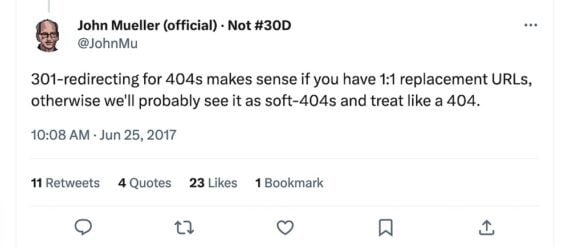
However, Google has repeatedly stated that 301 redirects may pass no link equity for anything other than 1:1 URL replacements, such as redesigns or replatforms. If the destination page differs from the original, Google may treat it as a soft 404 (i.e., a 200 OK response code for a nonexistent page) and pass no link equity. Google’s John Mueller tweeted as much in 2017.

Screenshot of John Mueller's tweet

In a 2017 tweet, Google’s John Mueller stated 301s are best for 1:1 URL replacements.

Rel=”canonical” Tag

Rel=”canonical” is a link tag to inform search engines of the original content URL without redirecting users to it. It is often used for content syndication or internal duplicate content.

Rel=”canonical” passes PageRank to the original page. But like 301 redirects, Google may ignore it and choose a representative URL based on other signals.

Nofollow Attribute

Search optimizers use the nofollow link attribute to prevent the passing of PageRank, such as for links from sponsored posts and ads. It used to be a strong directive to Google, but, like 301s and canonical tags, it is now a request.

Still, websites should include either rel=nofollow or rel=sponsored attributes for paid or affiliate links. Similarly, seek the removal of links from low-grade or spammy sites to yours, even if nofollowed.

However, nofollow meta tags (versus link attributes) apply to an entire page and are strictly honored by Google. So no equity will pass from links pointing to your site from pages with the following nofollow in the header code:


Disavow Files

Search optimizers use disavow files to prevent PageRank from passing to their sites from spammy ones. Disavow is a request to Google and is best used only if the site has received a manual link-related penalty.

Ecommerce M&A Stabilizing, Advisor Says

The market for ecommerce businesses looks to be stabilizing this year, according to Mark Daoust, founder of Quiet Light, a brokerage and advisory firm.

“On the buy side, it feels as if things have stabilized somewhat — maybe not in a great place, but stabilized,” Daoust said in a video interview this month. “We’re not seeing as many fits and starts as before.”

Last year saw a market mismatch of either not enough sellers or not enough buyers. Now, buyers are active but more cautious, with the average time to complete a deal extending to 150 days from 110 days in 2021.

Mark Daoust

Mark Daoust

“Buyers are more sensitive to issues within the business than they were in the past,” Daoust said. “The dominant issue now is a lot more businesses have declining trends. As one of my brokers put it, we’re listing a lot of businesses that need things to be fixed.”

Buyer’s Market

Daoust forecasts steady acquisitions into the fall and a chance for real improvement in 2025. That assumes businesses stop bleeding and sellers adjust their expectations to what is now a buyer’s market. That said, a higher percentage of deals are falling apart during due diligence.

“A buyer isn’t going to acquire a business that’s fatally ill,” Daoust said. “When they’re evaluating something with declining trends, buyers ask, ‘Is it going to be stable in the long term? Can I fix this? Can I return this to profitability?’ If so, it’s a great buy and a good deal for buyers. This is a great opportunity for buyers to purchase some of these businesses at lower valuations.”

It would help if interest rates were lower, making capital less costly, but Daoust has seen a number of buyers with loans from the U.S. Small Business Administration to fund their transactions, albeit at high rates, upwards of 13%.

Moreover, for the right deal, buyers are willing to take chances with private lending or rates upwards of 20%.

Regardless, deal activity should also pick up post-election, no matter who wins.

“Republican, Democrat. It doesn’t really matter. The market loosens up pretty quickly after,” he said. “I would expect the same here.”

Buyers increasingly seek multiple revenue channels beyond Amazon. Shopify, Walmart, Target, and TikTok are all solid platforms for sales.

“You can build a good business outside of Amazon. We’re seeing more merchants expand to physical retail stores,” Daoust said. Social media is also becoming very relevant. “The TikTok Shops we’re seeing look very promising.”

Artificial intelligence may be a game-changer. Businesses will need to reassess search engine optimization and determine how to optimize for AI, Daoust said.

“From a business owner standpoint, I’m thinking, ‘How can I utilize it?’” Daoust said. “A client came to us saying we were recommended by ChatGPT. I thought, whoa, this is now something we need to look at.”

Getty Images Updated Generative AI Pushes Boundaries Of What’s Possible via @sejournal, @martinibuster

Getty Images announced an updated AI model for their image generator that generates images faster and with a higher quality. The changes benefit users of Generative AI by Getty Images and also Generative AI by iStock.

Fully Licensed High Quality Images

The Getty AI generated images are trained on their own content which means that all generated images can be fully licensed and commercial use is indemnified which means that users can license the images without ethical worries about how the AI models were trained.

High Quality Image Generation And Modification

A benefit of the updated Generative AI By Getty is that both generated images and existing stock images can be edited and modified by the AI. An image can easily be extended horizontally or vertically, individual elements can be added or removed, including the entire background of the image.

This solves so many problems for publishers who are looking for images with specific qualities in them because now they can more easily edit images to make them fit their exact needs – without having to use an expensive image editing software or SaaS.

These are some of the features users can take advantage of:

  • Industry-leading generation speed: Image generation speeds set to reach around 6 seconds, doubling the performance of the previous model, putting it at the forefront of the industry.
  • Advanced 4K generation detail: Enhanced detail and fidelity in generated images, with advanced upscaling and increased 4K generation detail.
  • Expanded support and adherence for more detailed prompts: Higher level of detail prompts results in images that more closely match the descriptions provided in the text prompt.
  • Longer prompts: Supports more complex and longer prompts, up to 250 words.
  • Advanced camera controls: Greater control over output using shot type and depth of field.”

Create Your Own AI Model

Enterprise level customers have the ability to fine-tune their own AI image generator models by training with their own images. This means that customers can create AI generated images based on their products, models and other image assets that are exclusive and proprietary to the users.

Getty Images Democratizes High Quality Images

Getty’s announcement represents a milestone in the business of stock images, enabling both pro and enthusiast level users to create and modify images at a level that was unthinkable only a few years ago.

Read more at:

Generate AI images and modify iStock imagery with ease

Featured Image by Shutterstock/rafapress

Why WordPress 6.6.1 Was Flagged For Trojan Malware via @sejournal, @martinibuster

Multiple user reports have surfaced warning that the latest version of WordPress is triggering trojan alerts and at least one person reported that a web host locked down a website because of the file. What really happened turned into a learning experience.

Antivirus Flags Trojan In Official WordPress 6.6.1 Download

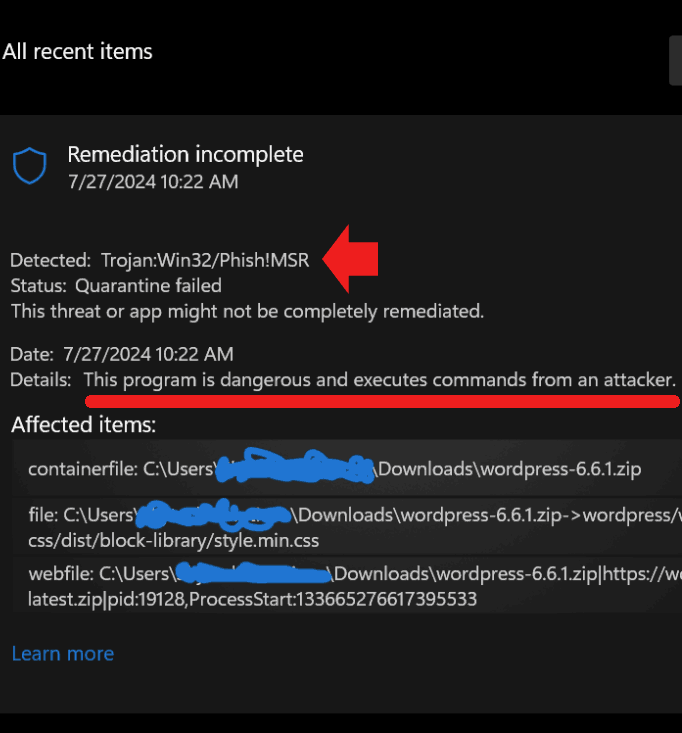
The first report was filed in the official WordPress.org help forums where a user reported that the native antivirus in Windows 11 (Windows Defender) flagged the WordPress zip file they had downloaded from WordPress contained a trojan.

This is the text of the original post:

“Windows Defender shows that the latest wordpress-6.6.1zip has Trojan:Win32/Phish!MSR virus when i try downloading from the official wp site

it shows the same virus notification when updating from within the WordPress dashboard of my site

Is this a false positive?”

They also posted screenshots of the trojan warning that listed the status as “Quarantine failed” and that WordPress zip file of version 6.6.1 “is dangerous and executes commands from an attacker.”

Screenshot Of Windows Defender Warning

Screenshot of alert to a Trojan virus file in WordPress 6.6.1

Someone else affirmed that they were also having the same issue, noting that a string of code within one of the CSS files (style code that governs the look of a website, including colors) was the culprit that was triggering the warning.

They posted:

“I am experiencing the same issue. It seems to occur with the file wp-includescssdistblock-librarystyle.min.css. It appears that a specific string in the CSS file is being detected as a Trojan virus. I would like to allow it, but I think I should wait for an official response before doing so. Is there anyone who can provide an official answer?”

Unexpected “Solution”

A false positive is generally a result that tests as positive when it’s not actually a positive for whatever is being tested for. WordPress users soon began to suspect that the Windows Defender trojan virus alert was a false positive.

An official WordPress GitHub ticket was filed where the cause was identified as an insecure URL (http versus https) that’s referenced from within the CSS style sheet. A URL is not commonly considered a part of a CSS file so that may be why Windows Defender flagged this specific CSS file as containing a trojan.

Here’s the part where things went off in an unexpected direction. Someone opened another WordPress GitHub ticket to document a proposed fix for the insecure URL, which should have been the end of the story but it ended up leading to a discovery about what was really going on.

The insecure URL that needed fixing was this one:

http://www.w3.org/2000/svg

So the person who opened the ticket updated the file with a version that contained a link to the HTTPS version which should have been the end of the story but for a nuance that was overlooked.

The (‘insecure’) URL is not a link to a source of files (and therefore not insecure) but rather an identifier that defines the scope of the Scalable Vector Graphics (SVG) language within XML.

So the problem ultimately ended up not being about something wrong with the code in WordPress 6.6.1 but rather an issue with Windows Defender that failed to properly identify an “XML namespace” instead of mistakenly flagging it as a URL linking to downloadable files.

Takeaway

The false positive trojan file alert by Windows Defender and subsequent discussion was a learning moment for many people (including myself!) about a relatively arcane bit of coding knowledge regarding the XML namespace for SVG files.

Read the original report:

Virus Issue :wordpress-6.6.1.zip shows a virus from windows defender

Cracking Open The Local SEO Bucket: Expert Strategies To Shape Success via @sejournal, @hethr_campbell

Are your local SEO efforts yielding the results you expected?

This is the perfect time to get a closer look at the strategies that drive real impact in local search rankings and user experience for the big brands. 

Local SEO isn’t just about appearing in local search results; it’s about ensuring your brand is visible, relevant, and engaging to your community. In our upcoming webinar, we’ll break down five key strategies that can significantly boost your local visibility and drive more foot traffic to your business.

On July 24, join industry expert Matt Coghlan, Director of SEO Partnerships at Uberall as he shares practical insights and proven tactics that have led to success for big brands like KFC.

Get actionable tips to help navigate the dynamic landscape of local SEO in 5 core areas:

  1. Discovery: Learn how to ensure your business is easily found by local customers.
  2. Relevance: Discover how to make your business stand out by personalizing your content and SEO strategies to meet local search goals.
  3. Experience: Improve user experience to keep visitors engaged and satisfied.
  4. Engagement: Boost engagement through reviews, social media, and local content.
  5. Conversions: Convert local traffic into paying customers with effective CTAs and optimized landing pages.

We will also delve into:

  • KFC’s Proven Strategies: Gain insights into how KFC enhanced their local SEO to drive significant results.
  • Quick Visibility Wins: Learn tactics that can immediately boost your online presence.
  • Adapting to Changes: Understand the recent shifts in local search and how to adjust your strategies accordingly.

Whether you’re a seasoned SEO professional or just starting out, this webinar is packed with info that will help you master the dynamics of local SEO.

Stay until the end for a live Q&A session where you can get your specific questions answered by our expert.

Can’t make it to the live session? No worries! Register now, and we’ll send you the recording so you won’t miss out.

Strengthen your local SEO game, enhance your digital presence, and drive impactful results for your business. Sign up today!

Google May Rely Less On Hreflang, Shift To Auto Language Detection via @sejournal, @MattGSouthern

In the latest episode of Google’s “Search Off The Record” podcast, a member of the Search Relations team suggested that Google may be moving towards automatically detecting language versions of web pages, potentially reducing the need for manual hreflang annotations.

Google’s Stance On Automatic Language Detection

Gary Illyes, a Google analyst, believes that search engines should rely less on annotations like hreflang and more on automatically learned signals.

Illyes stated during the podcast:

“Ultimately, I would want less and less annotations, site annotations, and more automatically learned things.”

He argued that this approach is more reliable than the current system of manual annotations.

Illyes elaborated on the existing capabilities of Google’s systems:

“Almost ten years ago, we could already do that, and this was what, almost ten years ago.”

Illyes emphasized the potential for improvement in this area:

“If, almost ten years ago, we could already do that quite reliably, then why would we not be able to do it now.”

The Current State Of Hreflang Implementation

The discussion also touched on the current state of hreflang implementation.

According to data cited in the podcast, only about 9% of websites currently use hreflang annotations on their home pages.

This relatively low adoption rate might be a factor in Google’s consideration of alternative methods for detecting language and regional targeting.

Potential Challenges & Overrides

While advocating for automatic detection, Illyes acknowledged that website owners should be able to override automatic detections if necessary.

He conceded, “I think we should have overrides,” recognizing the need for manual control in some situations.

The Future Of Multilingual SEO

While no official changes have been announced, this discussion provides insight into the potential future direction of Google’s approach to multilingual and multi-regional websites.

Stay tuned for any official updates from Google on this topic.

What This Means For You

This potential shift in Google’s language detection and targeting approach could have significant implications for website owners and SEO professionals.

It could reduce the technical burden of implementing hreflang annotations, particularly for large websites with multiple language versions.

The top takeaways from this discussion include the following:

  1. It’s advisable to continue following Google’s current guidelines on implementing hreflang annotations.
  2. Ensure that your multilingual content is high-quality and accurately translated. This will likely remain crucial regardless of how Google detects language versions.
  3. While no immediate changes are planned, be ready to adapt your SEO strategy if Google moves towards more automatic language detection.
  4. If you’re planning a new multilingual site or restructuring an existing one, consider a clear and logical structure that makes language versions obvious, as this may help with automatic detection.

Remember, while automation may increase, having a solid understanding of international SEO principles will remain valuable for optimizing your global web presence.

Listen to the full podcast episode below:

Google Insights: Can Incorrect Hreflang Tags Hurt SEO? via @sejournal, @MattGSouthern

In a recent episode of Google’s Search Off The Record podcast, Gary Illyes, a Google’s Search Relations team member, addressed concerns about incorrect hreflang implementation and its potential impact on SEO.

Hreflang Errors: Less Problematic Than Expected?

During the discussion, Illyes was asked about the consequences of mismatched hreflang annotations and actual page content.

Specifically, he addressed scenarios where a page might be incorrectly labeled as one language while containing content in another.

Illyes stated:

“As far as I remember, I worked on the parsing implementation plus the promotion implementation of hreflang, and back then, it didn’t cause problems.”

However, he also noted that his direct experience with this was from around 2016, adding the following:

“That’s a few years back… since then, we changed so many things that I would have to check whether it causes problems.”

Language Demotion & Country Promotion

Providing further context, Illyes explained Google’s approach to language and country relevance:

“When I spelled out LDCP, I said the language demotion country promotion. So, for example, if someone is searching in German and your page is in English, then you would get a negative demotion in the search results.”

This suggests that while incorrect hreflang implementation might not directly cause problems, the actual language of the content still plays a vital role in search relevance.

Exceptions To Language Matching

Interestingly, Illyes pointed out that there are exceptions to strict language matching:

“It’s less relevant to the query to the person unless you are searching for something like ‘how do you spell banana’… Because then it doesn’t really matter… well no it does… it still matters but… because you’re searching for something in English, so we would think okay you want some page that explains how to spell banana in English, not German.”

What This Means For You

Understanding how Google handles hreflang and language mismatches can help inform international SEO strategies.

While Google’s systems appear to be somewhat forgiving of hreflang errors, the actual language of the content remains a key factor in search relevance.

Here are the top takeaways:

  1. While incorrect hreflang implementation may not directly penalize your site, it’s still best practice to ensure your annotations accurately reflect your content.
  2. The actual language of your content appears to be more important than hreflang annotations for search relevance.
  3. For specific queries, like spelling or language-learning topics, Google may be more flexible in presenting content in various languages.

As Illyes noted, Google’s systems have changed over time. Continue to monitor official Google documentation and announcements for the most up-to-date best practices in international SEO.

Listen to the full podcast episode below:


Featured Image: Longfin Media/Shutterstock

Google Hints Lowering SEO Value Of Country Code Top-Level Domains via @sejournal, @MattGSouthern

In a recent episode of Google’s Search Off The Record podcast, the company’s Search Relations team hinted at potential changes in how country-code top-level domains (ccTLDs) are valued for SEO.

This revelation came during a discussion on internationalization and hreflang implementation.

The Fading Importance Of ccTLDs

Gary Illyes, a senior member of Google’s Search Relations team, suggested that the localization boost traditionally associated with ccTLDs may soon be over.

Illyes stated:

“I think eventually, like in years’ time, that [ccTLD benefit] will also fade away.”

He explained that ccTLDs are becoming less reliable indicators of a website’s geographic target audience.

Creative Use Of ccTLDs For Branding

According to Illyes, the primary reason for this shift is the creative use of ccTLDs for branding purposes rather than geographic targeting.

He elaborated:

“Think about the all the funny domain names that you can buy nowadays like the .ai. I think that’s Antigua or something… It doesn’t say anything anymore about the country… it doesn’t mean that the content is for the country.”

Illyes further explained the historical context and why this change is occurring:

“One of the main algorithms that do the whole localization thing… is called something like LDCP – language demotion country promotion. So basically if you have like a .de, then for users in Germany you would get like a slight boost with your .de domain name. But nowadays, with .co or whatever .de, which doesn’t relate to Germany anymore, it doesn’t really make sense for us to like automatically apply that little boost because it’s ambiguous what the target is.”

The Impact On SEO Strategies

This change in perspective could have implications for international SEO strategies.

Traditionally, many businesses have invested in ccTLDs to gain a perceived advantage in local search results.

If Google stops using ccTLDs as a strong signal for geographic relevance, this could alter how companies approach their domain strategy for different markets.

Marketing Value Of ccTLDs

However, Illyes also noted that from a marketing perspective, there might still be some value in purchasing ccTLDs:

“I think from a marketing perspective there’s still some value in buying the ccTLDs and if I… if I were to run some… like a new business, then I would try to buy the country TLDs when I can, when like it’s monetarily feasible, but I would not worry too much about it.”

What This Means For You

As search engines become more capable of understanding content and context, traditional signals like ccTLDs may carry less weight.

This could lead to a more level playing field for websites, regardless of their domain extension.

Here are some top takeaways:

  1. If you’ve invested heavily in country-specific domains for SEO purposes, it may be time to reassess this strategy.
  2. Should the importance of ccTLDs decrease, proper implementation of hreflang tags becomes crucial for indicating language and regional targeting.
  3. While the SEO benefits may diminish, ccTLDs can still have branding and marketing value.
  4. Watch for official announcements or changes in Google’s documentation regarding using ccTLDs and international SEO best practices.

While no immediate changes were announced, this discussion provides valuable insight into the potential future direction of international SEO.

Listen to the full podcast episode below: