IVF alone can’t save us from a looming fertility crisis

This article first appeared in The Checkup, MIT Technology Review’s weekly biotech newsletter. To receive it in your inbox every Thursday, and read articles like this first, sign up here. 

I’ve just learned that July 11 is World Population Day. There are over 8 billion of us on the planet, and there’ll probably be 8.5 billion of us by 2030. We’re continually warned about the perils of overpopulation and the impact we humans are having on our planet. So it seems a bit counterintuitive to worry that, actually, we’re not reproducing enough.

But plenty of scientists are incredibly worried about just that. Improvements in health care and sanitation are helping us all lead longer lives. But we’re not having enough children to support us as we age. Fertility rates are falling in almost every country.

But wait! We have technologies to solve this problem! IVF is helping to bring more children into the world than ever, and it can help compensate for the fertility problems faced by older parents! Unfortunately, things aren’t quite so simple. Research suggests that these technologies can only take us so far. If we want to make real progress, we also need to work on gender equality.

Researchers tend to look at fertility in terms of how many children the average woman has in her lifetime. To maintain a stable population, this figure, known as the total fertility rate (TFR), needs to be around 2.1.

But this figure has been falling over the last 50 years. In Europe, for example, women born in 1939 had a TFR of 2.3—but the figure has dropped to 1.7 for women born in 1981 (who are 42 or 43 years old by now). “We can summarize [the last 50 years] in three words: ‘declining,’ ‘late,’ and ‘childlessness,’” Gianpiero Dalla Zuanna, a professor of demography at the University of Padua in Italy, told an audience at the annual meeting of the European Society of Human Reproduction and Embryology earlier this week.

There are a lot of reasons behind this decline. Around one in six people is affected by infertility, and globally, many people aren’t having as many children as they would like. On the other hand, more people are choosing to live child-free. Others are delaying starting a family, perhaps because they face soaring living costs and have been unable to afford their own homes. Some hesitate to have children because they are concerned about the future. With the ongoing threat of global wars and climate change, who can blame them? 

There are financial as well as social consequences to this fertility crisis. We’re already seeing fewer young people supporting a greater number of older ones. And it’s not sustainable.

“Europe today has 10% of the population, 20% of gross domestic product, and 50% of the welfare expense of the world,” Dalla Zuanna said at the meeting. Twenty years from now, there will be 20% fewer people of reproductive age than there are today, he warned.

It’s not just Europe that will be affected. The global TFR in 2021 was 2.2—less than half the figure in 1950, when it was 4.8. By one recent estimate, the global fertility rate is declining at a rate of 1.1% per year. Some countries are facing especially steep declines: In 2021, the TFR in South Korea was just 0.8—well below the 2.1 needed to maintain the population. If this decline continues, we can expect the global TFR to hit 1.83 by 2050 and 1.59 by 2100.

So what’s the solution? Fertility technologies like IVF and egg freezing have been touted as one potential remedy. More people than ever are using these technologies to conceive. An IVF baby is born somewhere in the world every 35 seconds. And IVF can indeed help us overcome some fertility issues, including those that can arise for people starting a family after the age of 35. IVF is already involved in 5% to 10% of births in high-income countries. “IVF has got to be our solution, you would think,” said Georgina Chambers, who directs the National Perinatal Epidemiology and Statistics Unit at UNSW Sydney in Australia, in another talk at ESHRE.

Unfortunately, technology is unlikely to solve the fertility crisis anytime soon, as Chambers’s own research shows. A handful of studies suggest that the use of assisted reproductive technologies (ART) can only increase the total fertility rate of a country by around 1% to 5%. The US sits at the lower end of this scale—it is estimated that in 2020, the use of ART increased the fertility rate by about 1.3%. In Australia, however, ART boosted the fertility rate by 5%.

Why the difference? It all comes down to accessibility. IVF can be prohibitively expensive in the US—without insurance covering the cost, a single IVF cycle can cost around half a person’s annual disposable income. Compare that to Australia, where would-be parents get plenty of government support, and an IVF cycle costs just 6% of the average annual disposable income.

In another study, Chambers and her colleagues have found that ART can help restore fertility to some extent in women who try to have children later in life. It’s difficult to be precise here, because it’s hard to tell whether some of the births that followed IVF would have happened eventually without the technology.

Either way, IVF and other fertility technologies are not a cure-all. And overselling them as such risks encouraging people to further delay starting a family, says Chambers. There are other ways to address the fertility crisis.

Dalla Zuanna and his colleague Maria Castiglioni believe that countries with low fertility rates, like their home country Italy, need to boost the number of people of reproductive age. “The only possibility [of achieving this] in the next 20 years is to increase immigration,” Castiglioni told an audience at ESHRE.

Several countries have used “pronatalist” policies to encourage people to have children. Some involve financial incentives: Families in Japan are eligible for one-off payments and monthly allowances for each child,as part of a scheme that was recently extended. Australia has implemented a similar “baby bonus.”

“These don’t work,” Chambers said. “They can affect the timing and spacing of births, but they are short-lived. And they are coercive: They negatively affect gender equity and reproductive and sexual rights.”

But family-friendly policies can work. In the past, the fall in fertility rates was linked to women’s increasing participation in the workforce. That’s not the case anymore. Today, higher female employment rates are linked to higher fertility rates, according to Chambers. “Fertility rises when women combine work and family life on an equal footing with men,” she said at the meeting. Gender equality, along with policies that support access to child care and parental leave, can have a much bigger impact.

These policies won’t solve all our problems. But we need to acknowledge that technology alone won’t solve the fertility crisis. And if the solution involves improving gender equality, surely that’s a win-win.


Now read the rest of The Checkup

Read more from MIT Technology Review’s archive:

My colleague Antonio Regalado discussed how reproductive technology might affect population decline with Martin Varsavsky, director of the Prelude Fertility network of clinics, in a roundtable on the future of families earlier this year.

There are new fertility technologies on the horizon. I wrote about the race to generate lab-grown sperm and eggs from adult skin cells, for example. Scientists have already created artificial eggs and sperm from mouse cells and used them to create mouse pups. Artificial human sex cells are next.

Advances like these could transform the way we understand parenthood. Some researchers believe we’re not far being able to create babies with multiple genetic parents or none at all, as I wrote in a previous edition of The Checkup.

Elizabeth Carr was America’s first IVF baby when she was born in 1981. Now she works at a company that offers genetic tests for embryos, enabling parents to choose those with the highest health scores.

Some people are already concerned about maintaining human populations beyond planet Earth. The Dutch entrepreneur Egbert Edelbroek wants to try IVF in space. “Humanity needs a backup plan,” he told Scott Solomon in October last year. “If you want to be a sustainable species, you want to be a multiplanetary species.”

We have another roundtable discussion coming up with Antonio later this month. You can join him for a discussion about CRISPR and the future of gene editing. “CRISPR Babies: Six years later” takes place on Thursday, July 25, and is a subscriber-only online event. You can register for free.

From around the web

When a Bitcoin mining facility moved into the Granbury area in Texas, local residents started complaining of strange new health problems. They believe the noisy facility might be linked to their migraines, panic attacks, heart palpitations, chest pain, and hypertension. (Time)

In the spring of 1997, 20 volunteers agreed to share their DNA for the Human Genome Project, an ambitious effort to publish a reference human genome. They were told researchers expected that “no more than 10% of the eventual DNA sequence will have been obtained from [each person’s] DNA.” But when the draft was published in 2001, nearly 75% of it came from just one person. Ashley Smart reports on the ethical questions surrounding the project. (Undark)

How can you make cultured meat taste more like the real thing? Scientists have developed “flavor scaffolds” that can release a meaty taste when cultured meat is cooked. The resulting product looks like a meaty pink jelly. Bon appétit! (Nature)

Doctors can continue their medical education by taking courses throughout their careers. Some of these are funded by big tobacco companies. They really shouldn’t be, argue these doctors from Stanford and the University of California. (JAMA)

“Skin care = brain care”? Maybe, if you believe the people behind the burgeoning industry of neurocosmetics. (The Atlantic)

AI can make you more creative—but it has limits

Generative AI models have made it simpler and quicker to produce everything from text passages and images to video clips and audio tracks. Texts and media that might have taken years for humans to create can now be generated in seconds.

But while AI’s output can certainly seem creative, do these models actually boost human creativity?  

That’s what two researchers set out to explore in new research published today in Science Advances, studying how people used OpenAI’s large language model GPT-4 to write short stories.

The model was helpful—but only to an extent. They found that while AI improved the output of less creative writers, it made little difference to the quality of the stories produced by writers who were already creative. The stories in which AI had played a part were also more similar to each other than those dreamed up entirely by humans. 

The research adds to the growing body of work investigating how generative AI affects human creativity, suggesting that although access to AI can offer a creative boost to an individual, it reduces creativity in the aggregate. 

To understand generative AI’s effect on humans’ creativity, we first need to determine how creativity is measured. This study used two metrics: novelty and usefulness. Novelty refers to a story’s originality, while usefulness in this context reflects the possibility that each resulting short story could be developed into a book or other publishable work. 

First, the authors recruited 293 people through the research platform Prolific to complete a task designed to measure their inherent creativity. Participants were instructed to provide 10 words that were as different from each other as possible.

Next, the participants were asked to write an eight-sentence story for young adults on one of three topics: an adventure in the jungle, on open seas, or on a different planet. First, though, they were randomly sorted into three groups. The first group had to rely solely on their own ideas, while the second group was given the option to receive a single story idea from GPT-4. The third group could elect to receive up to five story ideas from the AI model.

Of the participants with the option of AI assistance, the vast majority—88.4%—took advantage of it. They were then asked to evaluate how creative they thought their stories were, before a separate group of 600 recruits reviewed their efforts. Each reviewer was shown six stories and asked to give feedback on the stylistic characteristics, novelty, and usefulness of the story.

The researchers found that the writers with the greatest level of access to the AI model were evaluated as showing the most creativity. Of these, the writers who had scored as less creative on the first test benefited the most. 

However, the stories produced by writers who were already creative didn’t get the same boost. “We see this leveling effect where the least creative writers get the biggest benefit,” says Anil Doshi, an assistant professor at the UCL School of Management in the UK, who coauthored the paper. “But we don’t see any kind of respective benefit to be gained from the people who are already inherently creative.”

The findings make sense, given that people who are already creative don’t really need to use AI to be creative, says Tuhin Chakrabarty, a computer science researcher at Columbia University, who specializes in AI and creativity but wasn’t involved in the study. 

There are some potential drawbacks to taking advantage of the model’s help, too. AI-generated stories across the board are similar in terms of semantics and content, Chakrabarty says, and AI-generated writing is full of telltale giveaways, such as very long, exposition-heavy sentences that contain lots of stereotypes.   

“These kinds of idiosyncrasies probably also reduce the overall creativity,” he says. “Good writing is all about showing, not telling. AI is always telling.”

Because stories generated by AI models can only draw from the data that those models have been trained on, those produced in the study were less distinctive than the ideas the human participants came up with entirely on their own. If the publishing industry were to embrace generative AI, the books we read could become more homogenous, because they would all be produced by models trained on the same corpus.

This is why it’s essential to study what AI models can and, crucially, can’t do well as we grapple with what the rapidly evolving technology means for society and the economy, says Oliver Hauser, a professor at the University of Exeter Business School, another coauthor of the study. “Just because technology can be transformative, it doesn’t mean it will be,” he says.

Unlocking secure, private AI with confidential computing

All of a sudden, it seems that AI is everywhere, from executive assistant chatbots to AI code assistants.

But despite the proliferation of AI in the zeitgeist, many organizations are proceeding with caution. This is due to the perception of the security quagmires AI presents. For the emerging technology to reach its full potential, data must be secured through every stage of the AI lifecycle including model training, fine-tuning, and inferencing.

This is where confidential computing comes into play. Vikas Bhatia, head of product for Azure Confidential Computing at Microsoft, explains the significance of this architectural innovation: “AI is being used to provide solutions for a lot of highly sensitive data, whether that’s personal data, company data, or multiparty data,” he says. “Confidential computing is an emerging technology that protects that data when it is in memory and in use. We see a future where model creators who need to protect their IP will leverage confidential computing to safeguard their models and to protect their customer data.”

Understanding confidential computing

“The tech industry has done a great job in ensuring that data stays protected at rest and in transit using encryption,” Bhatia says. “Bad actors can steal a laptop and remove its hard drive but won’t be able to get anything out of it if the data is encrypted by security features like BitLocker. Similarly, nobody can run away with data in the cloud. And data in transit is secure thanks to HTTPS and TLS, which have long been industry standards.”

But data in use, when data is in memory and being operated upon, has typically been harder to secure. Confidential computing addresses this critical gap—what Bhatia calls the “missing third leg of the three-legged data protection stool”—via a hardware-based root of trust.

Essentially, confidential computing ensures the only thing customers need to trust is the data running inside of a trusted execution environment (TEE) and the underlying hardware. “The concept of a TEE is basically an enclave, or I like to use the word ‘box.’ Everything inside that box is trusted, anything outside it is not,” explains Bhatia.

Until recently, confidential computing only worked on central processing units (CPUs). However, NVIDIA has recently brought confidential computing capabilities to the H100 Tensor Core GPU and Microsoft has made this technology available in Azure. This has the potential to protect the entire confidential AI lifecycle—including model weights, training data, and inference workloads.

“Historically, devices such as GPUs were controlled by the host operating system, which, in turn, was controlled by the cloud service provider,” notes Krishnaprasad Hande, Technical Program Manager at Microsoft. “So, in order to meet confidential computing requirements, we needed technological improvements to reduce trust in the host operating system, i.e., its ability to observe or tamper with application workloads when the GPU is assigned to a confidential virtual machine, while retaining sufficient control to monitor and manage the device. NVIDIA and Microsoft have worked together to achieve this.”

Attestation mechanisms are another key component of confidential computing. Attestation allows users to verify the integrity and authenticity of the TEE, and the user code within it, ensuring the environment hasn’t been tampered with. “Customers can validate that trust by running an attestation report themselves against the CPU and the GPU to validate the state of their environment,” says Bhatia.

Additionally, secure key management systems play a critical role in confidential computing ecosystems. “We’ve extended our Azure Key Vault with Managed HSM service which runs inside a TEE,” says Bhatia. “The keys get securely released inside that TEE such that the data can be decrypted.”

Confidential computing use cases and benefits

GPU-accelerated confidential computing has far-reaching implications for AI in enterprise contexts. It also addresses privacy issues that apply to any analysis of sensitive data in the public cloud. This is of particular concern to organizations trying to gain insights from multiparty data while maintaining utmost privacy.

Another of the key advantages of Microsoft’s confidential computing offering is that it requires no code changes on the part of the customer, facilitating seamless adoption. “The confidential computing environment we’re building does not require customers to change a single line of code,” notes Bhatia. “They can redeploy from a non-confidential environment to a confidential environment. It’s as simple as choosing a particular VM size that supports confidential computing capabilities.”

Some industries and use cases that stand to benefit from confidential computing advancements include:

  • Governments and sovereign entities dealing with sensitive data and intellectual property.
  • Healthcare organizations using AI for drug discovery and doctor-patient confidentiality.
  • Banks and financial firms using AI to detect fraud and money laundering through shared analysis without revealing sensitive customer information.
  • Manufacturers optimizing supply chains by securely sharing data with partners.

Further, Bhatia says confidential computing helps facilitate data “clean rooms” for secure analysis in contexts like advertising. “We see a lot of sensitivity around use cases such as advertising and the way customers’ data is being handled and shared with third parties,” he says. “So, in these multiparty computation scenarios, or ‘data clean rooms,’ multiple parties can merge in their data sets, and no single party gets access to the combined data set. Only the code that is authorized will get access.”

The current state—and expected future—of confidential computing

Although large language models (LLMs) have captured attention in recent months, enterprises have found early success with a more scaled-down approach: small language models (SLMs), which are more efficient and less resource-intensive for many use cases. “We can see some targeted SLM models that can run in early confidential GPUs,” notes Bhatia.

This is just the start. Microsoft envisions a future that will support larger models and expanded AI scenarios—a progression that could see AI in the enterprise become less of a boardroom buzzword and more of an everyday reality driving business outcomes. “We’re starting with SLMs and adding in capabilities that allow larger models to run using multiple GPUs and multi-node communication. Over time, [the goal is eventually] for the largest models that the world might come up with could run in a confidential environment,” says Bhatia.

Bringing this to fruition will be a collaborative effort. Partnerships among major players like Microsoft and NVIDIA have already propelled significant advancements, and more are on the horizon. Organizations like the Confidential Computing Consortium will also be instrumental in advancing the underpinning technologies needed to make widespread and secure use of enterprise AI a reality.

“We’re seeing a lot of the critical pieces fall into place right now,” says Bhatia. “We don’t question today why something is HTTPS. That’s the world we’re moving toward [with confidential computing], but it’s not going to happen overnight. It’s certainly a journey, and one that NVIDIA and Microsoft are committed to.”

Microsoft Azure customers can start on this journey today with Azure confidential VMs with NVIDIA H100 GPUs. Learn more here.

This content was produced by Insights, the custom content arm of MIT Technology Review. It was not written by MIT Technology Review’s editorial staff.

Ugly Ads Perform Best, Marketer Says

Barry Hott is a longtime Facebook advertising consultant. He says first reactions to an ad largely determine its performance. He advises merchants to create ugly ads, those that people won’t skip over.

“I’m the Ugly Ads Guy,” he told me.

In our recent conversation, Hott addressed key Facebook ad metrics, budgeting, testing, and, yes, ugly creative. The entire audio of that discussion is embedded below. The transcript is edited for clarity and length.

Eric Brandholz: Who are you?

Barry Hott: I’m a part owner of a performance marketing agency called Adcrate, where we do high-performance ad creative. I also do a lot of consulting through Hott Growth, my own firm. I am a longtime Facebook ad nerd. You might know me as the “Make Ugly Ads” guy.

Brandholz: What can change the performance of an ad?

Hott: I don’t care about cost-per-impression or click-through-rate benchmarks. I’m looking at targeting. Are you allowing the system to target existing customers or recent visitors? Depending on the answer, I’ll look at your data differently.

From a systematic media buying standpoint, it’s about empathizing with the AI, with the machine learning algorithm — understanding how and why it operates in the way it does, how and why it’s incentivized, and how and why it can cheat. The system wants you to spend more money, and it wants to take more credit for more sales.

You can also use third-party attribution tools to help with that. Most people should use one for an extended period to understand how performance tracks outside the platforms.

Brandholz: What’s your take on bid caps on Facebook?

Hott: I have a problem with bid caps on everything and rigid cost caps. That’s not to say I don’t use them. They’re tools to be used in certain ways.

Say an ad is not getting a great cost per purchase, but the system knows it to be getting an overall sales lift. If you set your bid too low or set a cost cap too low, then I fear that the individual ad, if placed in an ad set that has too low of a bid, will never get the chance to spend in a way that it can support the entire ad ecosystem.

I like to have a controlled testing environment where every new concept gets an ad set for organizational purposes and just for letting things battle it out.

Brandholz: What metrics are you looking to hit?

Hott: The first thing to do is look at the best ads in the same environment — targeting, attribution, and settings. Everything stays the same. I need to know my best ads can spend this much and get this cost per purchase. And anything in that range is helpful to me. Anything above that, cost-wise, is useless to me significantly. Below that is killer.

I’ll typically have a testing environment excluding all existing customers and some visitors. That could be one-day visitors up to 30 days. It depends on the account and the business. I want to test ads for cold audiences. As an advertiser and media buyer, I aim to make ads that make sense and work for the broadest, coldest audiences. Many people would say that’s stupid, but if it can work well for those people, it will also work well for my warmer audiences.

Brandholz: How much money do you spend until you give up?

Hott: It’s about getting enough useful data. And that depends on what you’re selling — a $100 item or $1,000. Depending on budgets and your return on ad spend, you’re going to have different tolerances. It’s all going to vary. I’m usually looking for about 20 decent signals at the ad set level — hopefully that’s 20 actual purchases. By that point, I’ll know.

I’ll look at an ad that gets shut down quickly by bids for not spending and hypothesize about it. Why did the ad fail? Can I adjust it? I’d rather spend more time obtaining more data to see if there’s another pocket or placement elsewhere. It’s going to lose money, and I’m okay with that. But I will spend the time analyzing it and learning from it from a creative perspective.

However, if you don’t have time to do that sort of analysis, use rigid bids and cost caps.

Brandholz: What sort of creative produces good results?

Hott: Again, I am the Make Ugly Ads guy. I tell people to focus on making stuff uglier because our brains, as marketers, make prettier stuff. What matters are relatability, relevance, and authenticity. You can do that in a non-ugly way. I wouldn’t recommend it. But you can.

That first reaction is often what matters more than anything. Make something immediately relatable that people will care about. Make something people won’t skip. What will make someone feel uncomfortable?

Brandholz: Where can people follow you?

Hott: Go to Adcrate.co or HottGrowth.com. I’m on X (@binghott) and LinkedIn.

Holistic Search Strategies: Attain Superior Growth & ROI With Organic & Paid Tips via @sejournal, @hethr_campbell

Silos don’t cut it anymore. User journeys are too complex for you to view and track channels separately.

To improve your campaign performance, you need a holistic view of your marketing activities and how they intertwine. This is especially true for organic and paid search strategies. 

You need to be front and center with your ideal customers at multiple touchpoints, including active interactions and passive awareness. An ideal marketing strategy has paid and organic campaigns working in tandem, and it’s becoming harder to succeed without doing both.

If you’re looking to drive quality growth in your own campaigns, iQuanti can help.

Join us live on July 24 as we delve into this intricate relationship between organic and paid search channels. You’ll get actionable insights for measuring success to maximize their combined potential.

You’ll gain a comprehensive, data-driven understanding of how to measure, analyze, and optimize holistic search marketing efforts, ensuring sustainable growth and superior ROI for your business.

You’ll walk away with:

  • Integrated Metrics and KPIs: Learn how to define and track key metrics to capture the performance of your organic and paid search campaigns, so you can make informed strategic decisions that work.
  • Attribution Models: You’ll see firsthand how strong attribution models are crucial to understanding your customers’ journeys, allowing you to identify influential touchpoints and allocate budget effectively for maximum ROI.
  • Optimization Strategies: You’ve gathered data from your campaigns…now what? Take the data and leverage it to further optimize your paid and organic search campaigns, increasing conversions along the way.

Shaubhik Ray, Senior Director of Digital Analytics Solutions at iQuanti is an expert at crafting holistic search strategies to reach more of your ideal audiences at relevant stages in their journeys. Now, he’s ready to share his insights with you.

You’ll walk away equipped with the knowledge and tools necessary to execute a combined organic and paid strategy that improves the performance of each channel.  You’ll gain data-driven insights on how to align a combined strategy with business goals and lead your organization to success.

Sign up now and prepare to maximize the potential of combining your organic and paid campaigns.

At the end of the presentation, you’ll get a chance to ask Shaubhik your burning questions in our live Q&A, so be sure to attend.

And if you can’t make it that day, register here and we’ll send you a recording following the webinar. 

11 Copyscape Alternatives To Check Plagiarism via @sejournal, @annabellenyst

Are you certain that the content you’re publishing on your website is 100% original?

Steering clear of plagiarism is a top priority for content creators, educators, businesses, and others in order to maintain credibility and avoid legal issues – among other things.

While Copyscape has long been one of the most well-known and popular options for plagiarism checking, the range of available tools has expanded significantly, with various features designed to meet people’s unique needs.

In this article, we will cover the basics of plagiarism – what it is, why you should check for it, how to check, and what to do if someone plagiarizes your content – before highlighting some of the top alternatives to Copyscape, helping you keep your content unique and valuable.

What Is Plagiarism? 

Plagiarism is when you use someone else’s work, whether words or ideas, and present it as your own without proper attribution.

Plagiarism can range from directly copying someone’s work to closely paraphrasing something without acknowledging the source. Sometimes, it’s purposeful, while other times, the perpetrator might not even realize they’re doing it.

Regardless of intent, plagiarism is a widespread problem that is difficult to combat – but the first step is detecting it.

Why It’s Important To Check For Plagiarism

The consequences of plagiarism can be severe – you can lose credibility, harm your reputation, and even face legal repercussions.

Here are a few reasons why it’s essential to check for (and avoid) plagiarism:

  • Prevent legal problems. Engaging in plagiarism or copyright infringement can expose you to a range of potential legal issues.
  • Maintain your reputation. Trust is vital. But why should audiences trust you if you’re stealing somebody else’s work? Checking for plagiarism is crucial to preserving your reputation and trust with your audience or customers.
  • Preserve your SEO efforts. Google and other search engines are actively trying to crack down on plagiarism and will penalize any plagiarized content. This can hurt your website’s ranking and visibility.

How You Can Check For Plagiarism

There are a handful of different ways to check for plagiarism, including:

  • Manual checks. This is precisely what it sounds like: manually reviewing content for plagiarism by cross-checking text using search engines and academic databases. If you’re examining a small chunk of text, this can work, but it can get unwieldy fast.
  • Use alerts. It’s possible to create your own plagiarism checker by setting up Google Alerts. Simply enter your content into the search query field and let Google know how frequently you want it to alert you of copied content. While not a totally accurate or complete method, it can be effective at times.
  • Monitoring services. You can use existing tools that help flag unauthorized use of your content. They do so by scanning the internet and leveraging algorithms to detect plagiarized content.
  • Online plagiarism checker tools. Software and tools designed specifically to analyze content and run a comprehensive check for plagiarism.

While checking text for direct plagiarism is one thing, identifying paraphrased content or ideas is much more complicated.

And while we will highlight many useful tools in this article, it’s worth remembering that no tool is perfect.

With the sheer amount of content available and more being produced and published every second, it’s nearly impossible to complete a full check. Hence, why plagiarism is an ongoing issue.

What To Do If Someone Plagiarized Your Content

So, what do you do if you discover that somebody else has plagiarized your content? Here are a few steps you can take:

  • Collect evidence. Take screenshots, make notes, and save any URLs as proof of the offense.
  • Contact the perpetrator. As we mentioned earlier, sometimes, plagiarism can be an innocent mistake. No matter the situation, we recommend contacting the offending party and requesting that they either remove your content or label it with the proper attribution.
  • File a complaint. If that doesn’t work, you can file a Digital Millennium Copyright Act (DMCA) takedown complaint, which will send notice to the service provider (e.g., Google or web hosting companies) to remove the content or face legal liability.
  • Seek legal advice. If the case is particularly egregious, or the above steps fail, you can consider speaking with a legal professional.

Top 11 Plagiarism-Checking Alternative Tools To Copyscape

1. Grammarly

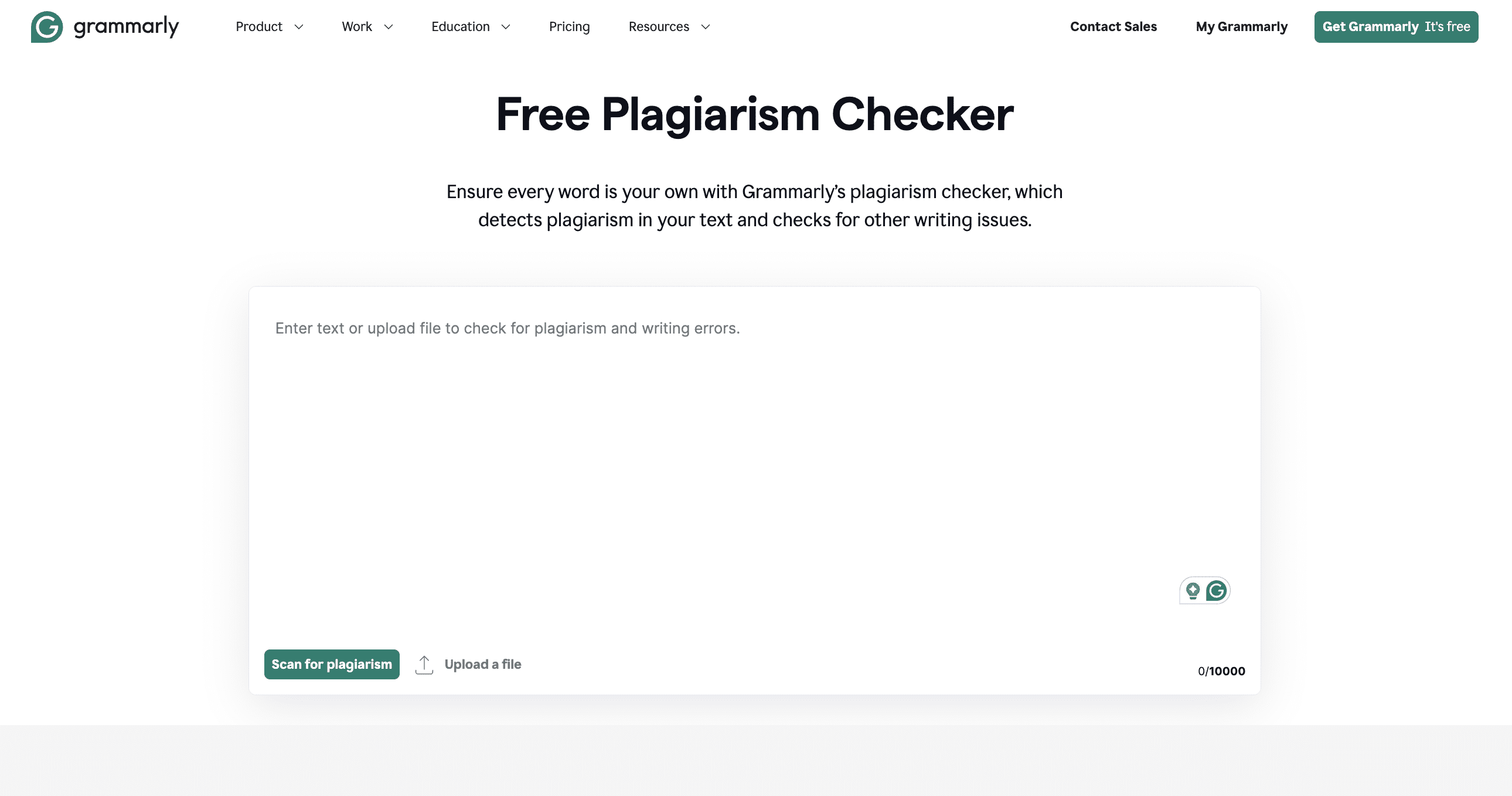
Screenshot of Grammarly's Free Plagiarism Checker page, showing a text box for uploading or pasting text to scan for plagiarism and writing issues. Screenshot from Grammarly.com, June 2024

While most people know Grammarly for its spelling and grammar check capabilities, it also offers a useful plagiarism checker tool.

Grammarly’s free plagiarism checker will compare your text (up to 10,000 characters) against academic databases and billions of webpages, then give you an immediate report that lets you know whether it found any plagiarized content.

As a helpful bonus, it will also flag if it finds problems with grammar, spelling, punctuation, conciseness, readability, word choice, or other writing issues.

If you want to take it a step further, Grammarly offers a Premium version of the tool with more advanced capabilities. The paid version will highlight specific sentences of concern, include source information, give you deeper writing feedback, and even allocate your text an “overall originality score.”

Cost

  • Free version available with limited plagiarism detection as well as basic grammar, spelling, etc. checks.
  • Premium Grammarly membership starts at $12/month and includes advanced plagiarism detection.

2. Plagiarisma

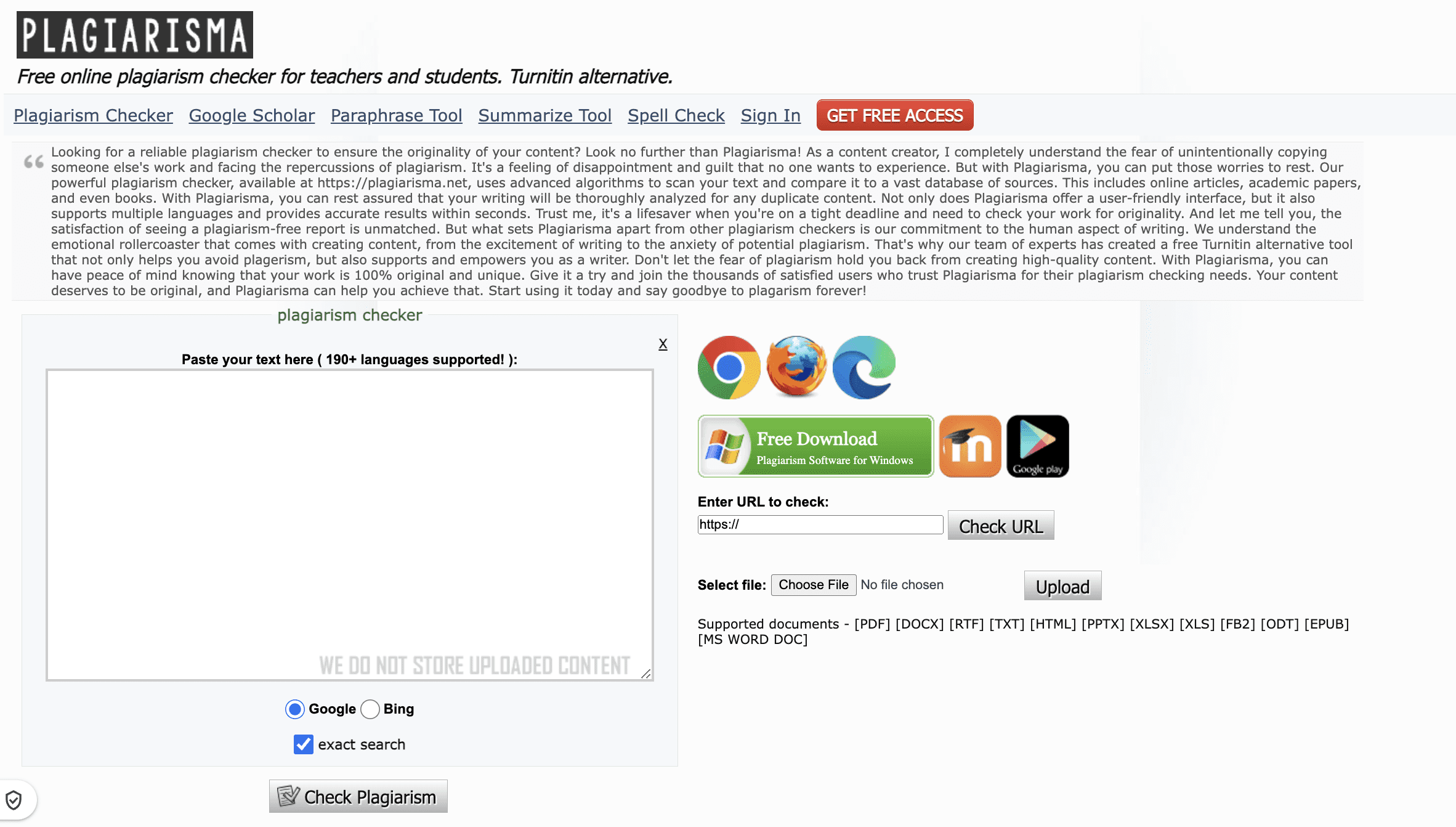
Screenshot of Plagiarisma homepage showing a text box for URL input, file upload options, and various supported languages icons. The page includes detailed information about the tool and highlights its effectiveness.Screenshot from Plagiarisma.net, June 2024

If you’re looking for a plagiarism checker that works in several languages, look no further than Plagiarisma. It supports 190+ languages and offers both free and paid versions.

Users can enter text into Plagiarisma in a variety of ways, including uploading documents, entering URLs, or pasting text directly into the tool. Once you’ve shared your copy, it will check it against sources like books, websites (you can choose between Google and Bing as your search engine of choice), and academic papers.

With the free version, users can run plagiarism checks up to three times in one day. You can also upgrade to a Premium membership for access to more features, including a Synonymizer (which helps you leverage synonyms to recreate sentences), a Similarity Checker (which compares documents for similarity), and unlimited access to plagiarism checks.

Cost

  • Free version with up to three plagiarism checks per day.
  • Premium membership starts at $5/month and offers unlimited plagiarism checks and more advanced features.

3. ProWritingAid

Screenshot from ProWritingAid.com, June 2024

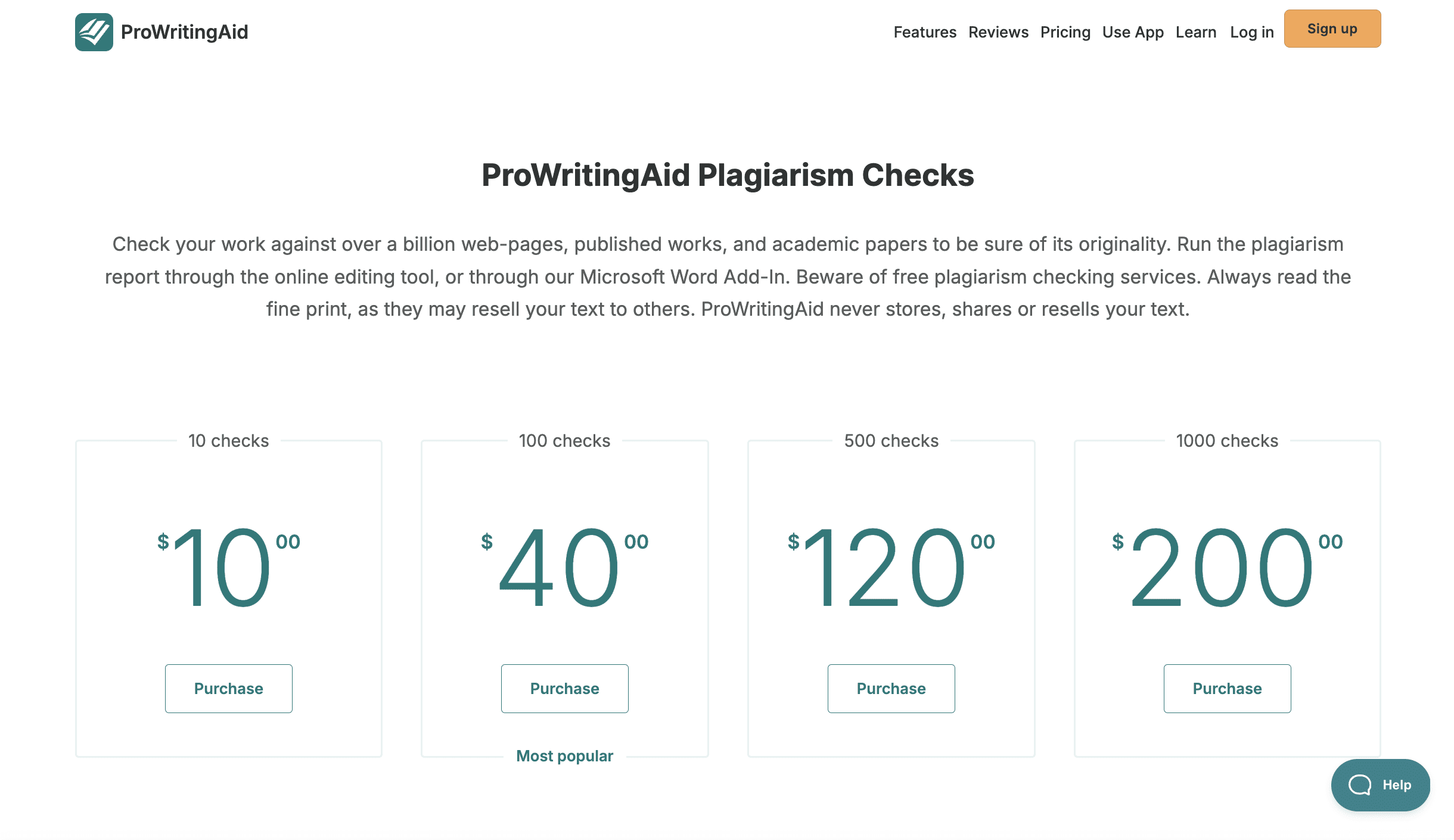
Similar to Grammarly, ProWritingAid is an AI-powered writing assistant tool that analyzes your copy and suggests areas for improvement. It also offers a helpful plagiarism checker – and while there is no free version, it’s still reasonably affordable.

According to ProWritingAid, its plagiarism detection tool can compare your text (up to 2,000 words) against billions of sources, both online and offline, including databases, periodicals, and websites.

It will flag directly copied content and give similarity percentages to show areas needing improved paraphrasing or citation.

You can use ProWritingAid’s online editing tool to conduct your check or leverage its Microsoft Word Add-In.

Unlike some other tools, you pay for ProWritingAid based on the number of checks you want to conduct versus a monthly or yearly subscription – so that is worth noting, and might be a benefit if you only have a specific number of documents you need to look at.

Cost

  • No free version.
  • Pricing starts at $10 for 10 checks, $40 for 100 checks, $120 for 500 checks, and $200 for 1,000 checks.

4. Plagiarism Checker

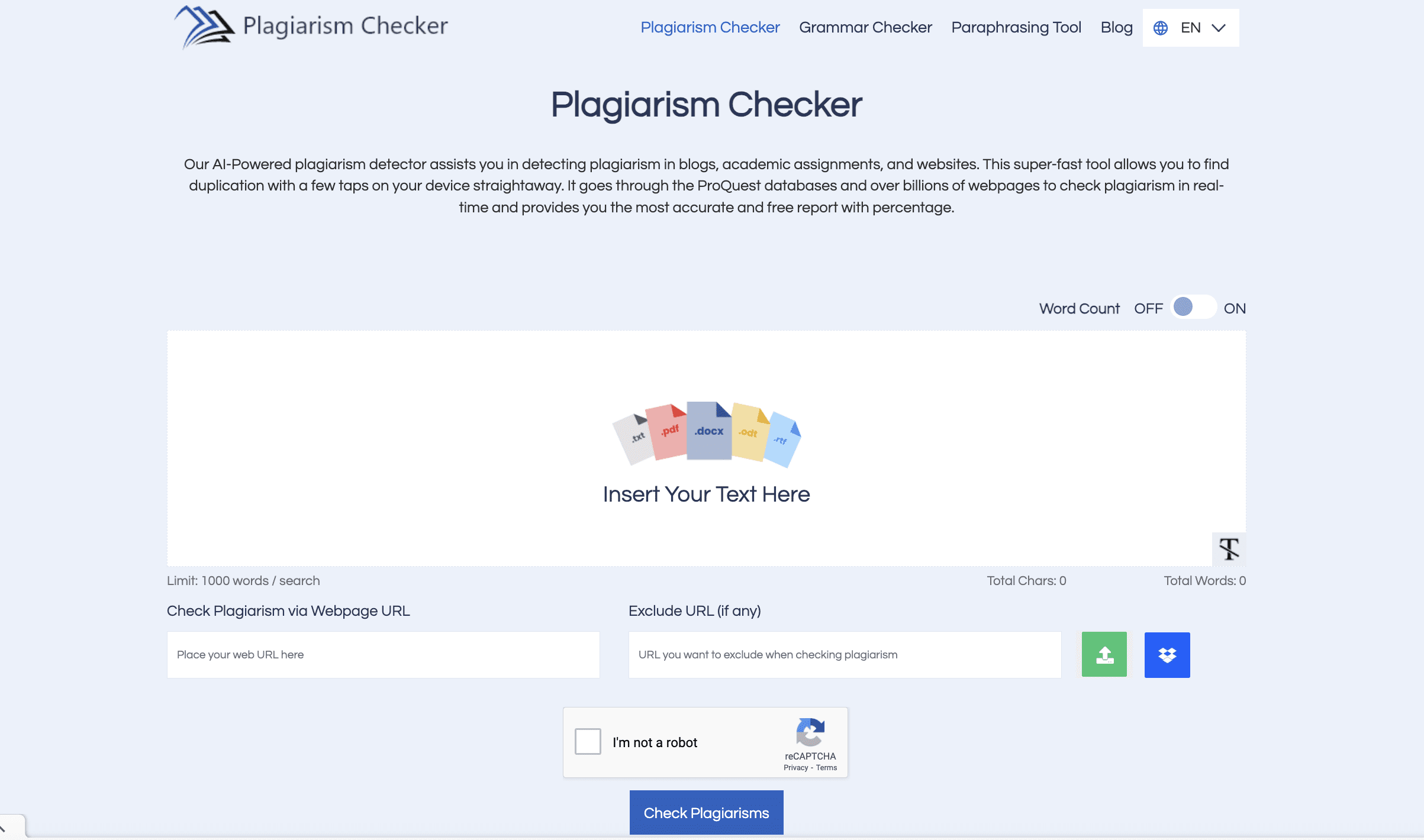
Screenshot of Plagiarism Checker tool showing a text box to insert text, options to check plagiarism via URL, and buttons for grammar checking, paraphrasing, and various other settings.Screenshot from Plagiarism-Checker.me, June 2024

Plagiarism Checker is a fairly straightforward plagiarism detection tool that’s both free and easy to use. If you need a quick and simple option, this is worth checking out.

It boasts a simple user interface and allows users to insert their text directly into the web-based editor, share a URL, or upload a document. You can even denote a URL you want it to exclude, which is a helpful feature if there are particular pages on your site that you want to ignore for now.

Plagiarism Checker scans your text against blogs, websites, and academic papers to detect plagiarism, which it delivers as a percentage. It’s compatible with Mac, Windows, and Android, and supports multiple file formats, including .rtf, .pdf., .docx, .odt, and txt.

Note that there is a limit of 1,000 words per check. The tool also includes a grammar checker and word counter, and you can download the reports it gives you.

Cost

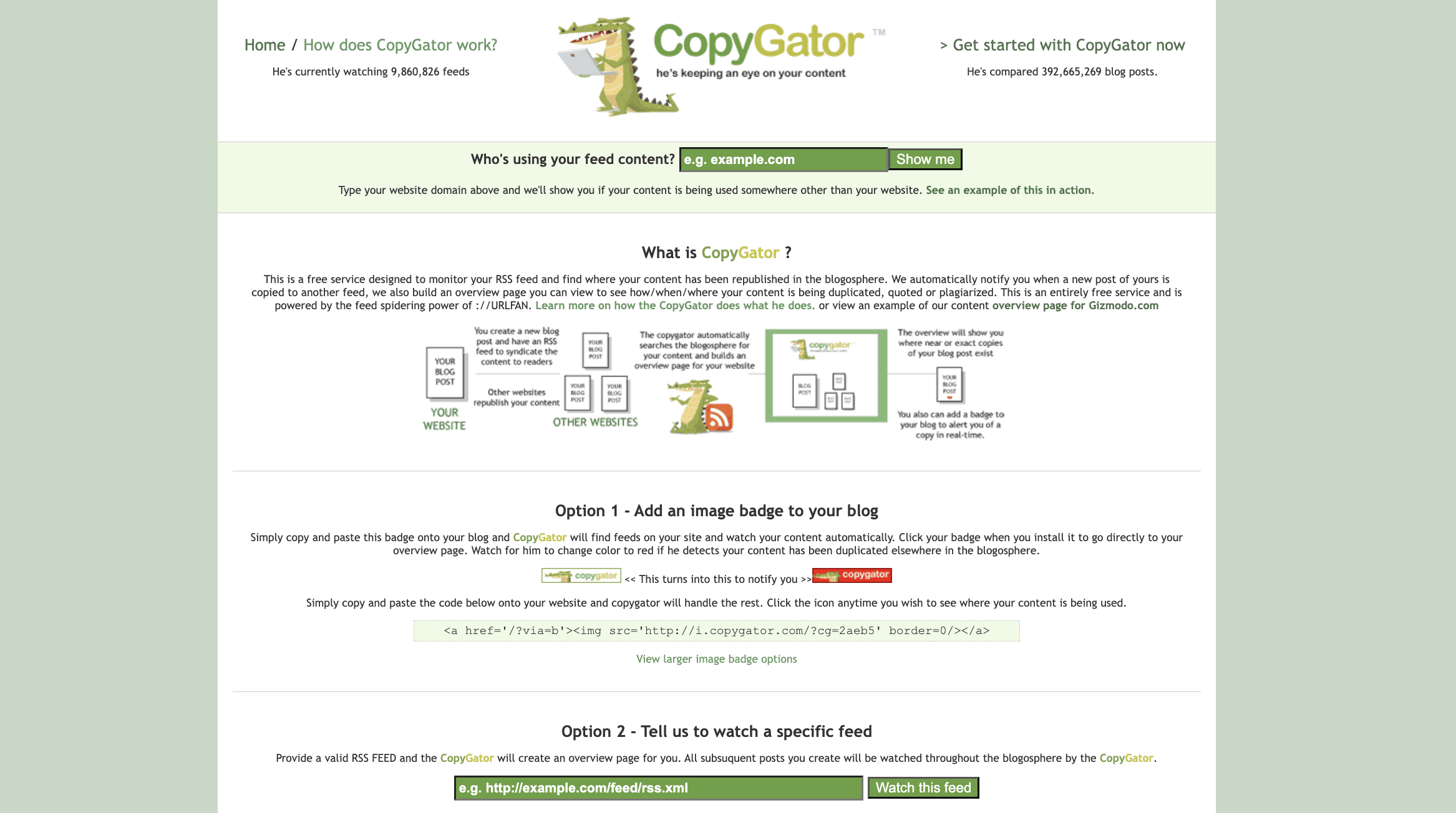
5. CopyGator

Screenshot of CopyGator website explaining how it helps monitor and track content feeds.Screenshot from CopyGator.com, June 2024

CopyGator is a free service designed to help bloggers and content creators monitor and detect duplicate versions of their content on other blogs or websites.

It works by monitoring your website’s RSS feed to see whether content has been republished elsewhere – and automatically notifying you if it finds plagiarism or quotations.

There are two different options for using CopyGator:

  • Image badge: By copying and pasting some code into your site, you can add a CopyGator image badge to your blog that will monitor your feeds for you. When you want to run a check, simply click the badge. If it turns red, CopyGator has detected plagiarized versions of your content.
  • RSS feed: Your other option is to input an RSS feed directly into CopyGator’s tool and ask it to watch the feed. It will create your own custom overview page where you can get updates.

Cost

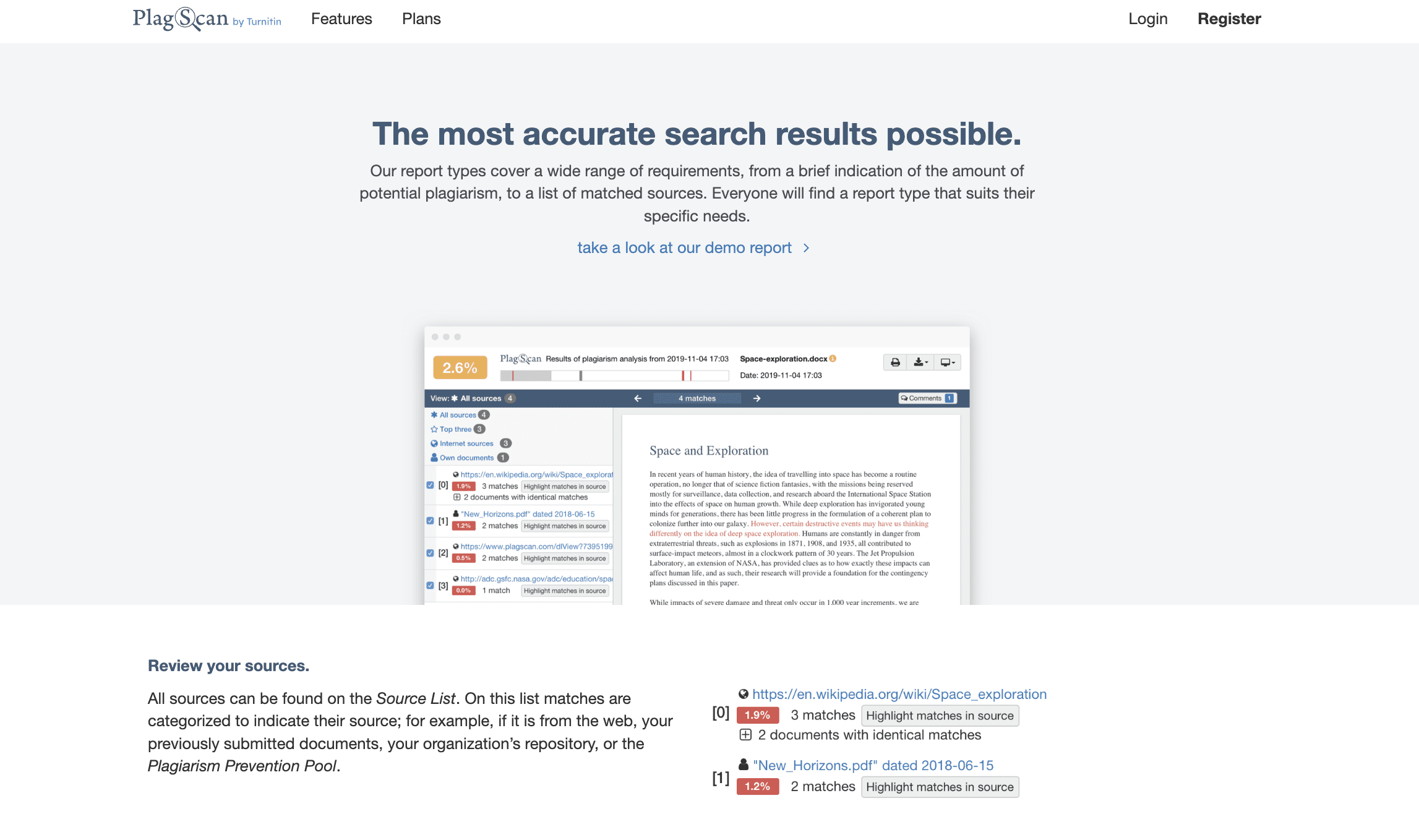
6. PlagScan

Screenshot from PlagScan.com, June 2024

PlagScan is quite a robust plagiarism detection tool most commonly used by academic institutions and professional writers. One thing to note upfront: There is no free version of this tool.

PlagScan compares your text to a massive database of websites, academic resources, and journals to find plagiarism and compiles a report to help you understand the results.

You’ll receive a PlagLevel score, which summarizes the level of duplicate text found within a document, as well as colored highlighting for possible plagiarism:

  • Red for direct matches.
  • Blue for potentially altered copy.
  • Green for correctly cited text.

With PlagScan, you get a list of sources that match your document to help you with proper citation. You can also compare two documents side-by-side to find similarities. It works with most file types, and your data is protected.

Cost

  • No free version.
  • PlagScan uses a prepaid pricing model based on the number of words/pages. Pricing starts at $6.5 for 6,000 words/24 pages.

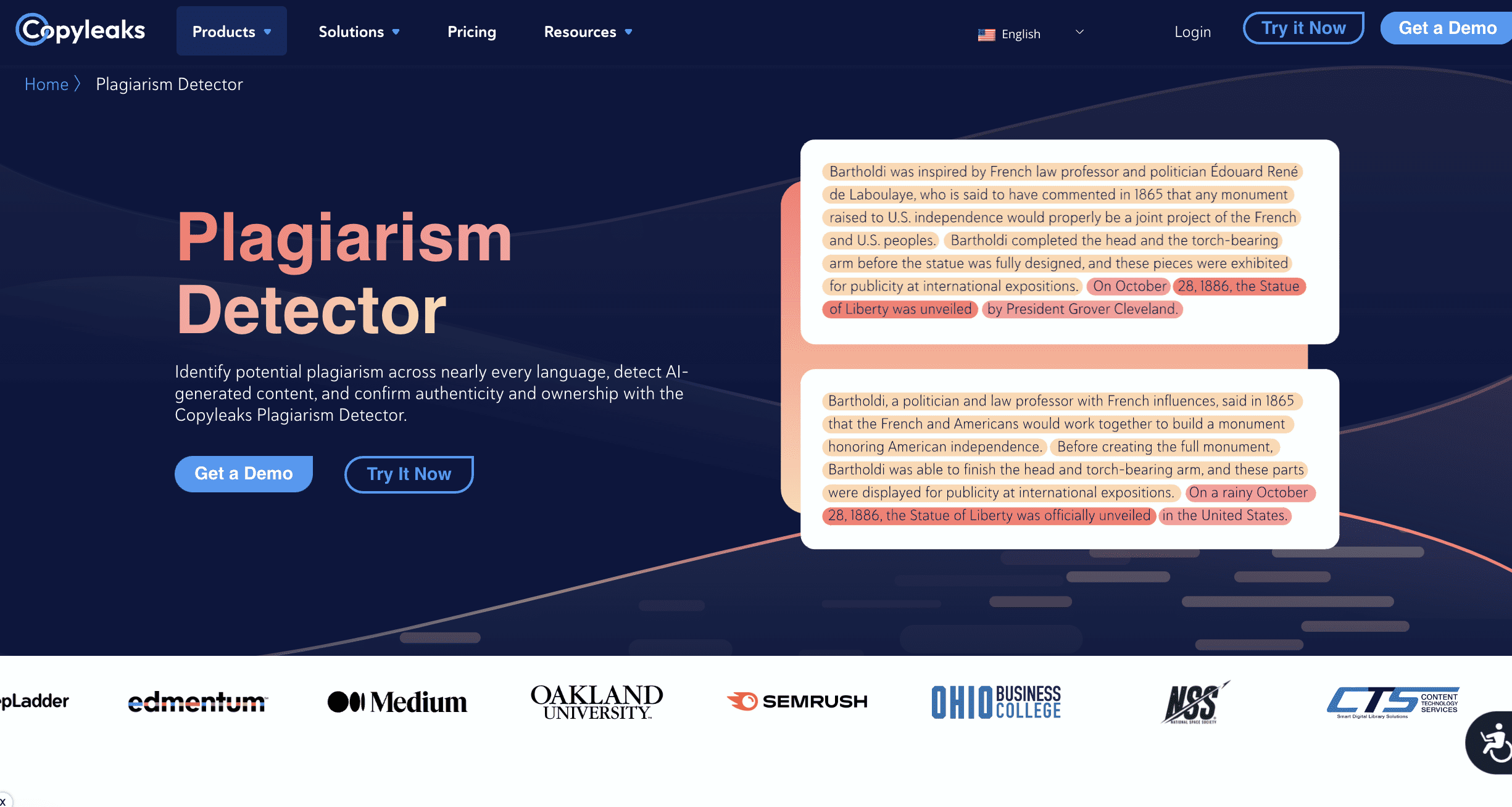
7. CopyLeaks

Screenshot of the CopyLeaks Plagiarism Detector homepage, displaying highlighted text sections within an example showing potential plagiarized content. Various partner logos are visible below the displayed text.Screenshot from CopyLeaks.com, June 2024

CopyLeaks is a more sophisticated plagiarism detection tool than many of the options used on this list, making it a popular choice for businesses, educational institutions, and individuals around the world.

According to CopyLeaks, it uses “advanced AI” to detect instances of plagiarism across over 100 languages, including paraphrasing, plagiarism in programming code, and even AI-generated plagiarism. Each scan checks content against 60 trillion websites, more than 16,000 journals, over 1 million internal documents, and 20+ code data repositories.

The tool has a very user-friendly interface, allowing you to choose from different types of files you might want to scan – text, documents, code, URLs, etc. You can also use the “compare” option to compare two documents or URLs to each other.

Another handy feature within CopyLeaks is the ability to schedule recurring scans so that it will automatically check for duplicate content on a regular basis. It also offers easy and flexible API integration,

Cost

  • Free trial available.
  • Paid plans start at $8.99/month for up to 1,200 credits (equal to 300,000 words). For $13.99/month, you’ll get access to both the plagiarism detection and AI content detection tools in one.

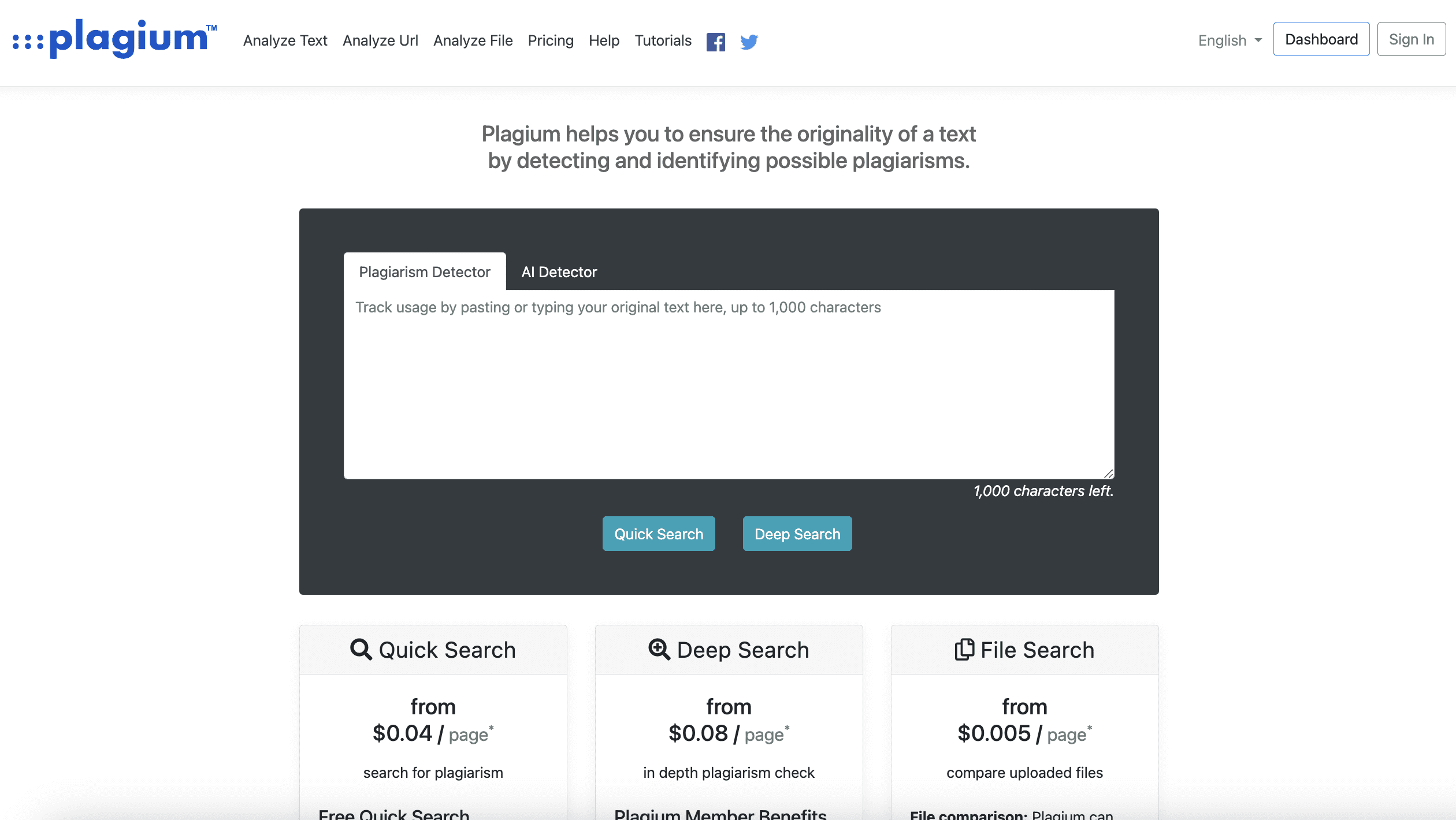
8. Plagium

Screenshot of Plagium's plagiarism detection interface, featuring options for quick search, deep search, and file search with pricing details below. Screenshot from Plagium.com, June 2024

Plagium is a good choice if you’re looking for an easy and cost-effective plagiarism checker. It uses a simple web-based text box and offers both “quick search” and “Deep Search” functions, the latter of which is basically a term for a closer check and the ability to scan large documents.

A quick search is free and allows up to 500 characters – though the website appears to indicate that the number of quick searches is capped. In order to use the Deep Search feature, you’ll need to create an account – and these searches start at $0.08/page using Plagium’s credits system.

As a member, you’re able to upload different types of documents – such as PDFs – and Plagium also integrates with Google Drive and offers a Google Docs Add-on.

Cost

  • Free quick search up to 500 characters.
  • Paid plans start at $9.99/month for over 143,000 characters, with options for prepaid plans if that is more your speed.

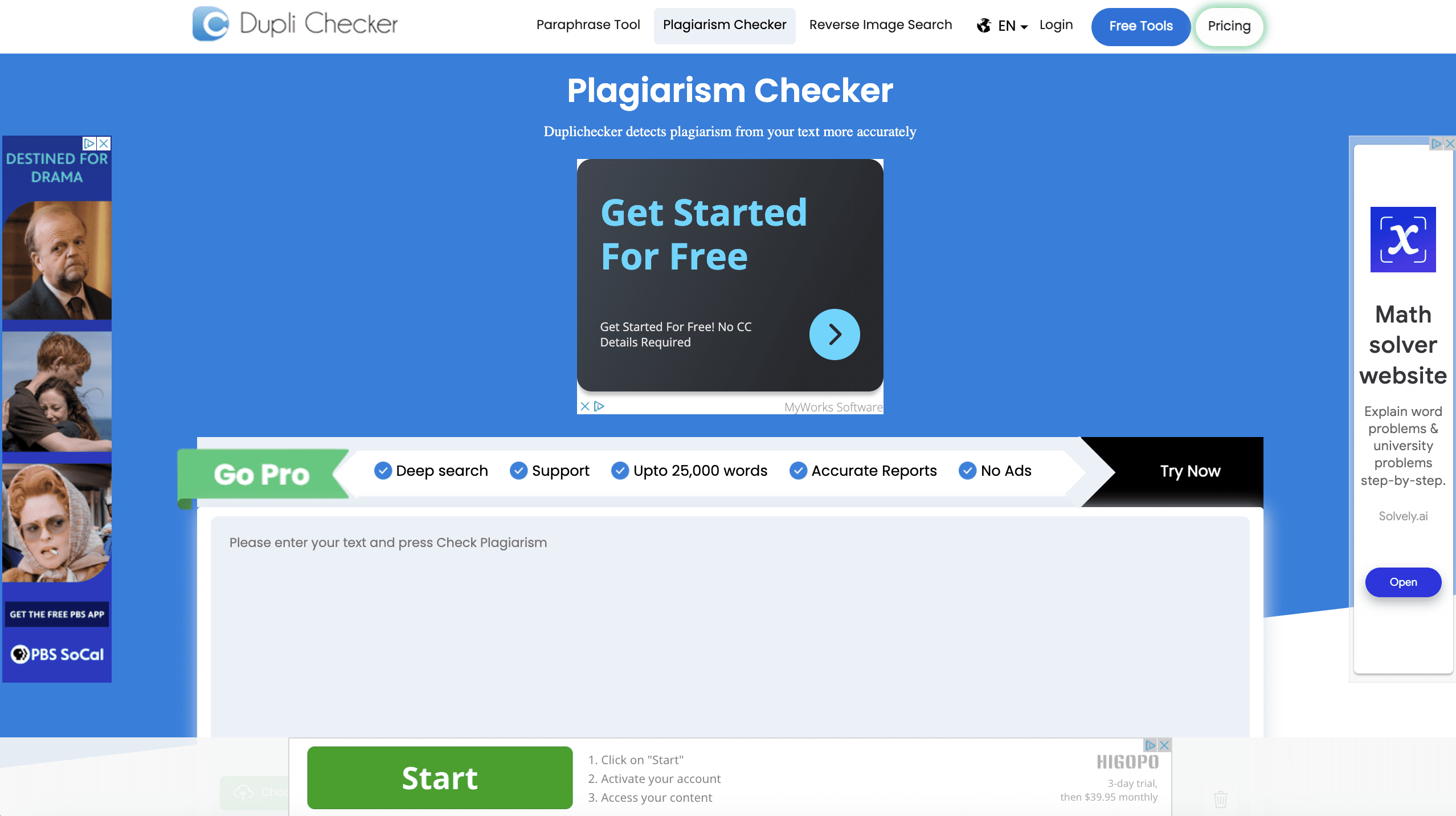
9. Dupli Checker

Screenshot from DupliChecker.com, June 2024

Need a free, easy-to-use plagiarism checker that’s available in up to seven languages and accepts a variety of file formats? Dupli Checker could be for you.

Dupli Checker’s simple interface makes it easy to scan your documents for plagiarism. You can paste directly into the website or upload files from your computer, Dropbox, or Google Drive. Like other tools in this list, you can also share a URL you’d like the tool to check, and up to five URLs you want it to exclude.

The tool promises 100% privacy – meaning it doesn’t save any of your documents – and summarizes your results in a report that highlights duplicate copy, gives you a percentage rating, and offers more features like grammar issues.

Cost

  • Free version with up to 1,000 words per search.
  • Paid plans start at $10/month for increased searches, higher word limits, and other advanced features.

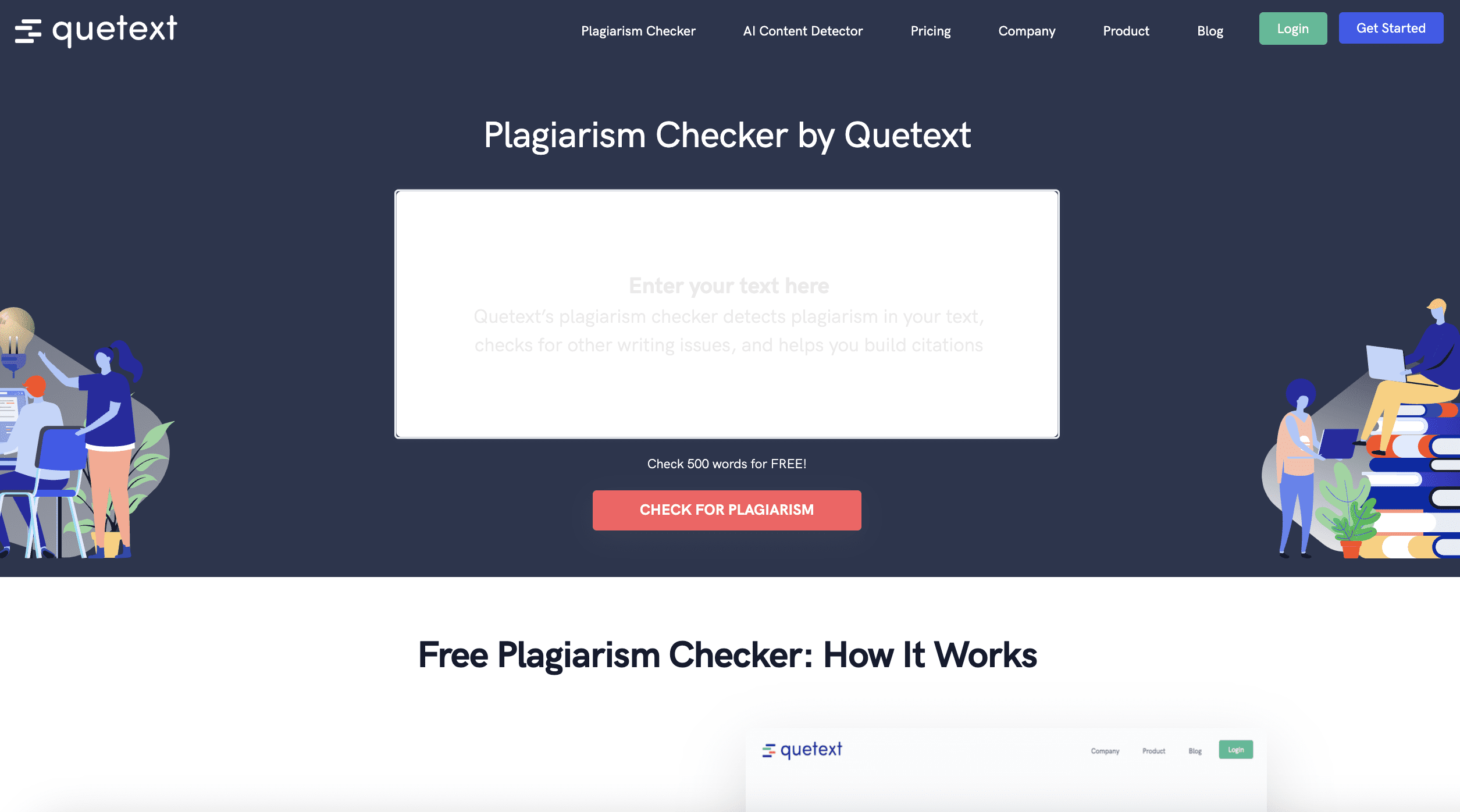
10. Quetext

Screenshot from quetext.com, June 2024

Quetext has become a popular plagiarism detection tool, and for good reason. It’s dependable and user-friendly, with some handy little features to help you spot plagiarism in your documents.

How does it work? You just enter your text into the web-based browser box and click “Check for plagiarism.” Quetext then uses its DeepSearch™ Technology (a machine-learning algorithm) to scan your text against billions of internet sources and spot plagiarism.

It provides you with a report that includes a plagiarism score and both exact matches and near matches to other existing text.

It highlights the latter using its ColorGrade™ feedback feature, which uses different colors to highlight exact match copy vs. “fuzzy” matches (or close matches) – a valuable tool for spotting plagiarism that might have otherwise flown under the radar.

It also offers a “Cite Source” feature, which helps you produce citations across Chicago, MLA, and APA formats.

Cost

  • Free version available, which includes up to 500 words, a website citation generator, and a citation assistant.
  • Paid tiers start at $8.80/month, which includes 100,000 words per month and a range of other advanced features.

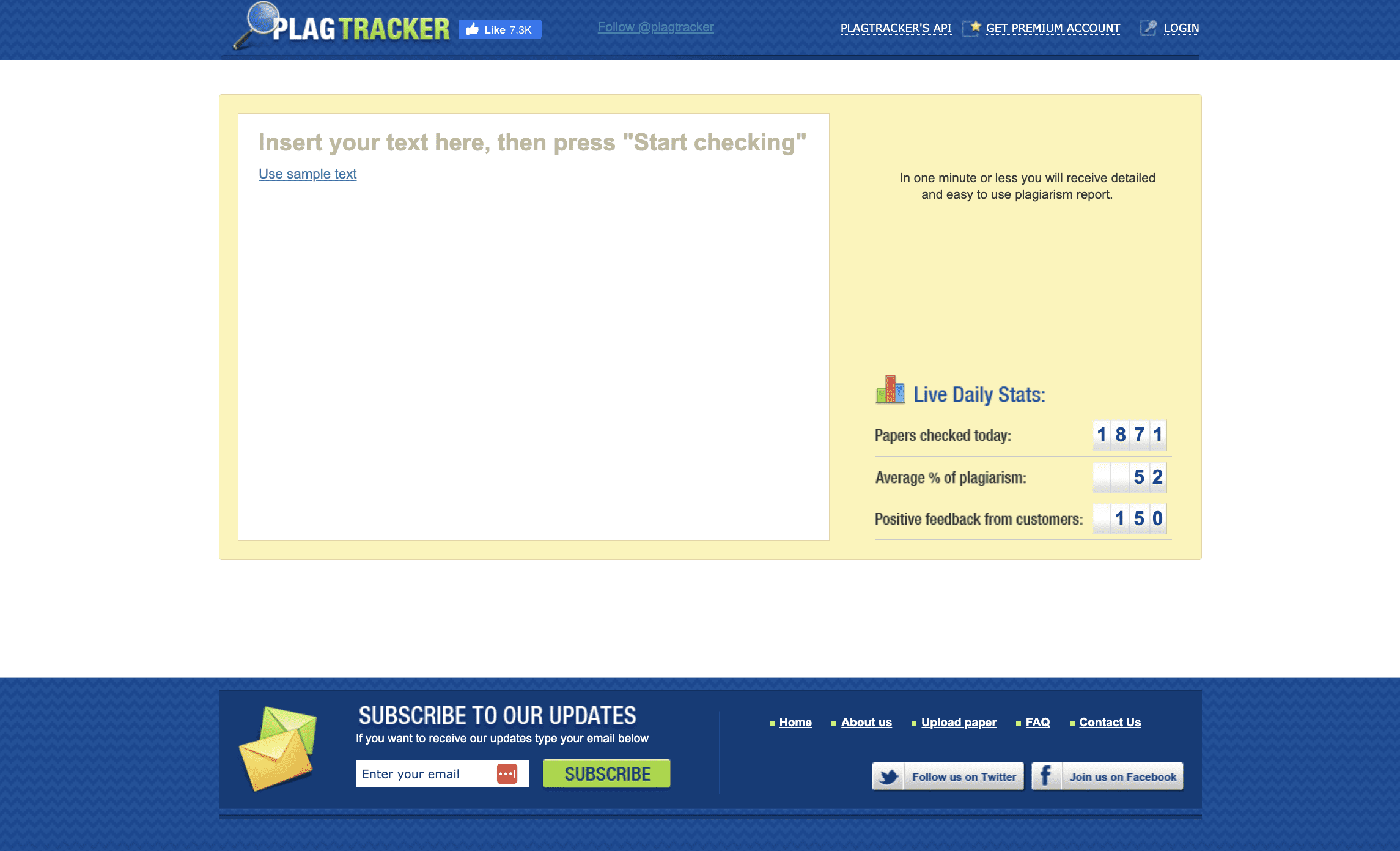
11. PlagTracker

Screenshot from Plagtracker.com, June 2024

PlagTracker is an online, web-based plagiarism detector that bills itself as “the most accurate plagiarism checking service.” The tool lists students, teachers, publishers, and site owners as its intended users, and it checks text against over 14 billion webpages and “more than 20 million academic works.”

Using PlagTracker is pretty straightforward. Users upload a document into the tool, which scans it and then returns a detailed report that shows what percentage of their document is plagiarized and highlights specific sections with sources.

It supports multiple languages –English, German, French, Romanian, Spanish, and Italian – making it a versatile tool. PlagTracker has a 5,000-word limit for free users, though you can pay for a Premium membership for unlimited access.

Cost

  • Free version is available with a 5,000-word limit.
  • Premium subscription starts at $7.49/month for unlimited volume and other advanced features.

The Best Plagiarism Detection Tools On The Market

And there you have it: Copyscape is by no means the only option for plagiarism detection tools.

Those listed above are great alternatives that cater to a wide range of use cases, whether you’re looking for a cheap and easy solution or an all-in-one AI-powered writing assistant.

If you’re a content creator of any kind, you must produce work that’s original and unique – and these tools can help you do just that.

However, always remember that these tools are far from perfect; you should have other checks and balances in place to ensure the quality of your work.

Avoiding plagiarism will protect your credibility and reputation and ultimately drive more traffic to your website. Not to mention, it’ll keep you out of trouble.

More resources: 


Featured Image: VectorMine/Shutterstock

Robot-packed meals are coming to the frozen-food aisle

Advances in artificial intelligence are coming to your freezer, in the form of robot-assembled prepared meals. 

Chef Robotics, a San Francisco–based startup, has launched a system of AI-powered robotic arms that can be quickly programmed with a recipe to dole out accurate portions of everything from tikka masala to pesto tortellini. After experiments with leading brands, including Amy’s Kitchen, the company says its robots have proved their worth and are being rolled out at scale to more production facilities. They are also being offered to new customers in the US and Canada. 

You might think the meals that end up in the grocery store’s frozen aisle, at Starbucks, or on airplanes are robot-packed already, but that’s rarely the case. Workers are often much more flexible than robots and can handle production lines that frequently rotate recipes. Not only that, but certain ingredients, like rice or shredded cheese, are hard to portion out with robotic arms. That means the vast majority of meals from recognizable brands are still typically hand-packed. 

However, advancements from AI have changed the calculus, making robots more useful on production lines, says David Griego, senior director of engineering at Amy’s.

“Before Silicon Valley got involved, the industry was much more about ‘Okay, we’re gonna program—a robot is gonna do this and do this only,’” he says. For a brand with so many different meals, that wasn’t very helpful. But the robots Griego is now able to add to the production line can learn how scooping a portion of peas is different from scooping cauliflower, and they can improve their accuracy for next time. “It’s astounding just how they can adapt to all the different types of ingredients that we use,” he says. Meal-packing robots suddenly make much more financial sense. 

Rather than selling the machines outright, Chef uses a service model, where customers pay a yearly fee that covers maintenance and training. Amy’s currently uses eight systems (each with two robotic arms) spread across two of its plants. One of these systems can now do the work of two to four workers depending on which ingredients are being packed, Griego says. The robots also reduce waste, since they can pack more consistent portions than their human counterparts. One-arm systems typically cost less than $135,000 per year, according to Chef CEO Rajat Bhageria.

With these advantages in mind, Griego imagines the robots handling more and more of the meal assembly process. “I have a vision,” he says, “where the only thing people would do is run the systems.” They’d make sure the hoppers of ingredients and packaging materials were full, for example, and the robots would do the rest. 

Robot chefs have been getting more skilled in recent years thanks to AI, and some companies have promised that burger-flipping and nugget-frying robots can provide cost savings to restaurants. But much of this technology has seen little adoption in the restaurant industry so far, says Bhageria. That’s because fast-casual restaurants often only need one cook running the grill, and if a robot cannot fully replace that person because it still needs supervision, it makes little sense to use it. Packaged meal companies, however, have a larger source of labor costs that they want to bring down: plating and assembly.

“That’s going to be the highest bang for our buck for our customers,” Bhageria says. 

CHEF

The notion that more flexible robots could mean broader adoption in new industries is no surprise, says Lerrel Pinto, who leads the General-Purpose Robotics and AI Lab at New York University and is not involved with Chef or Amy’s Kitchen. 

“A lot of robots deployed in the real world are used in a very repetitive way, where they’re supposed to do the same thing over and over again,” he says. Deep learning has caused a paradigm shift over the past few years, sparking the idea that more generally capable robots might be not only possible but necessary for more widespread adoption. If Chef’s robots can perform without frequent stops for repair or training, they could deliver material savings to food companies and shift how they use human labor, Pinto says: “In the next few years, we will probably see a lot more companies trying to actually deploy these types of learning-based robots in the real world.”

One new challenge the robots have created for Amy’s, Griego says, is maintaining the look of a hand-packed meal when it was assembled by a robot. The company’s cheese enchilada dish in particular was causing trouble: it’s finished with a hand-distributed sprinkling of cheddar on top, but Amy’s panel of examiners said the cheese on the robot-packed dish looked too machine-spread, sending Griego back to the drawing board.

“The first few tests went pretty well,” he says. After a couple of changes, the robots are ready to take over. Amy’s plans to bring them to more of its facilities and train them on a growing list of ingredients, meaning your frozen meals are increasingly likely to be packed by a robot.

Update: This story has been amended to include updating pricing information from Chef.

Google Ads Alters Design, Broad Match, Payments

Google has implemented three significant updates in the past couple of months. The changes impact all advertisers to varying degrees, so it’s essential to understand them and act accordingly.

New Interface

Every few years, Google Ads redesigns the admin interface to make it easier to use and integrate new features. The existing design will disappear on August 30. The most significant change is a single central menu.

Previously, the left-hand navigation was a long menu of options. It was easy to get lost. Users had to scroll to see all options despite having submenus. Plus, the top menu contained options for “Tools and settings,” which included conversion setup and performance features. The categorization was confusing.

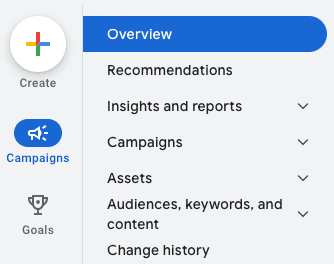
The new menu has five high-level categories, each with multiple options:

  • Campaigns,
  • Goals,
  • Tools,
  • Billing,
  • Admin.

For example, “Campaigns” is the hub for campaign setup, assets, keywords, and more.

Screenshot of new Google Ads admin menu

In the new menu, “Campaigns” is the hub for campaign setup, assets, keywords, and more.

The new menu is cleaner and contains non-management items such as page appearance and notifications. It also includes a more prominent search bar for accessing all pages and campaigns in an account.

Broad Match Queries

Google has emphasized broad match in recent years as it relies on machine learning and AI to target users better. Through my own testing, I’ve found broad match typically produces more revenue, even if its efficiency lags behind phrase and exact match.

One concern with broad-match keywords is potential conflicts with brand keyword goals. For example, if Best Buy bids on the broad-match version of its name, a search for “flat screen tvs” could trigger a brand ad.

Remember that Google takes liberties with query matching. Bidding on a brand name doesn’t mean the query is that term. “Brand inclusions” instructs Google to show ads only when the brand is included. Thus a “Best Buy” brand ad will appear only if the query contains a variation of those two words. Brand inclusions is available for campaigns solely using broad match keywords.

“Brand inclusions” instructs Google to show ads only when the brand is included. Click image to enlarge.

Conversely, regardless of match type, brand exclusions is available across all campaigns. Best Buy can bid on “flat screen tvs” in a non-brand campaign and exclude ads from queries containing “Samsung,” for example. Best Buy could add “Samsung” as a negative keyword, but the brand exclusion covers all variations.

The other query update is for misspellings in negative keywords. Previously, negative keywords had to be exact. “Dinosaur” would apply only to the precise spelling of that word. But now, with the update, it could apply to:

  • “Dionsaur,”
  • “Dinnosaor,”
  • “Denosaur.”

Review search query reports to see if misspellings are converting. If they are, consider adding the misspelled versions as negative keywords.

Payment Method Change

Google has changed its accepted payment methods. Henceforth, only direct bank payments are permissible. Advertisers can no longer pay with credit or debit cards. I’ve received conflicting notification emails for the effective date — either July 31 or August 31. Regardless, advertisers should update their payment method right away —to monthly invoicing or direct debit from bank accounts.

Eliminating credit cards saves Google from incurring processing fees. Yet the change hurts advertisers who will no longer receive credit card points and rewards or a much-needed cash flow buffer.

Reddit Subreddits To Google Search: Maximizing Your Brand’s Impact [Webinar Recap] via @sejournal, @brentcsutoras

Recently, I had the pleasure of hosting a webinar discussing Reddit, its growth, and how it impacts search results.

It’s been quite a while since I covered Reddit as a topic, but I could talk about it all day, and I think it has and is one of the most influential communities around today.

If you missed the presentation and would like to watch it, you can find it on demand here: From Subreddits to Search: Maximizing Your Brand’s Impact on Reddit.

Let’s dive into the key points we covered during the session.

The Current State Of Reddit

Reddit has seen explosive growth recently. Here are some stats that highlight this surge:

Reddit’s growth rate of 37% year-over-year is phenomenal, and it’s now 50% non-US, marking its impressive international expansion.

Why Reddit Has Become So Influential

Reddit is successful because it addresses a significant problem: the oversaturation of low-quality content on the internet.

Traditional search experiences are becoming less effective, and users seek more reliable, conversational answers.

Reddit fills this gap by providing authentic, user-generated content that is trusted by so many searchers today that they actually add [reddit] to the end of their search queries to force Reddit results.

Google has recognized this and has incorporated Reddit into its search results more prominently after the 2022 helpful content update.

Deals with Google and OpenAI underscore Reddit’s value, with Google signing a $60 million deal for real-time content access and training future AI models using Reddit data.

Tips For Having Success On Reddit

1. Understand The Platform

Reddit isn’t just another social media site; it’s a content-sharing platform.

This fundamental distinction is crucial for understanding how to navigate and succeed on Reddit. Unlike traditional social media platforms, Reddit is designed around user-generated subreddits –communities where content is shared and discussed.

Each subreddit is unique, with its own tone, culture, and rules. Think of subreddits as completely separate communities rather than categories of the same community.

The individuality of each subreddit means you must tailor your approach to fit the specific norms and expectations of each community.

On Reddit, the focus is on topics, not individuals. Influencer marketing, as it exists on other platforms, doesn’t translate well here.

While notable figures like Bill Gates participate, it’s their contributions and the topics they discuss that matter, not their personal brand. This topic-centric approach sets Reddit apart from other social media sites.

Anonymity is a core feature of Reddit, encouraging users to speak freely and honestly.

This anonymity fosters open discussion, as seen in subreddits like “/r/AmItheAsshole,” where users seek unbiased opinions on personal situations. Understanding and valuing this anonymity is key to engaging authentically with the Reddit community.

It’s important to distinguish between moderators and admins on Reddit. Moderators are regular users who manage subreddits, while admins are Reddit employees.

Confusing the two can lead to frustration, as moderators don’t have the same powers or responsibilities as admins. Recognize this distinction to better navigate issues and interactions within the platform.

Understanding these fundamental aspects of Reddit is critical for making a strong first impression and achieving success on the platform.

Mistakes can quickly derail your efforts, but with the right approach, Reddit offers a unique and valuable space for content sharing and community engagement.

2. Avoid Spamming

Spamming on Reddit can take many forms, and it’s essential to avoid behaviors that may be perceived as spammy.

Understanding and respecting the community guidelines is crucial for maintaining a positive presence on the platform.

Spam can be defined differently by each subreddit, but common behaviors include:

  • Posting off-topic content.
  • Submitting too frequently, even with good content.
  • Sharing the same content across multiple subreddits.
  • Trying to bypass subreddit rules (such as using redirects to post prohibited links).
  • Posting without engaging in comments.
  • Engaging in excessive self-promotion.

Each subreddit often lists its specific rules and definitions of spam in the sidebar, so make sure to read and follow them.

Additionally, Reddit continuously enhances its spam prevention measures, making it harder to game the system. Key improvements include:

  • AutoMod: Automated moderation scripts that filter submissions based on various parameters like account age and karma.
  • Contributor Quality Tiers: Assessing users based on their overall activity and legitimacy.
  • Ban Evasion Filters: Using AI to detect and prevent users from creating new accounts to bypass bans.

These evolving measures ensure a better community experience by reducing spam and encouraging genuine engagement.

Avoid attempting to game the system, as these improvements make it increasingly difficult – and ultimately, it just doesn’t lead to success.

3. Become A Redditor And Build Karma

Engage authentically by commenting and participating in discussions before starting your own posts. Build karma and learn what works within different communities.

To establish a presence on Reddit, it’s essential to start by becoming an active member of the community. Engage in subreddits that align with your passions, whether it’s growing peppers or discussing “Rick and Morty.”

This involvement helps you understand Reddit’s unique features, language, and community norms. By participating in discussions, you can start building karma – a reputation score based on upvotes and downvotes.

While karma is a simplified measure of your acceptance on Reddit, it’s vital for unlocking certain privileges and ensuring your posts aren’t hidden by automated moderation.

Focus on subreddits with low restrictions to accumulate karma easily. For instance, posting cute pictures in a cat subreddit or offering advice in a subreddit dedicated to questions can help you earn upvotes and interaction.

However, it’s crucial to approach this naturally and avoid trying to game the system, as patterns of inauthentic engagement can lead to bans and negative karma.

Before diving into posting your own content, prioritize commenting on existing posts.

Commenting helps you blend into the community and learn what types of content generate engagement. By focusing on “rising” posts – threads likely to gain significant visibility – you can maximize your exposure and karma.

This strategic approach allows your comments to receive more attention as the post gains popularity.

Starting with comments also offers insights into the community’s interests and opinions, helping you tailor future submissions to better resonate with the audience.

Submitting content places you directly under scrutiny, whereas commenting allows you to learn and experiment while becoming a Redditor.

Take the time to craft thoughtful, well-considered comments, as Reddit users value effort and sincerity.

Even as a brand, adopt a personable tone. Engaging authentically can shift perceptions positively, as seen in successful campaigns like the one we did for TikTok.

By focusing on building karma through comments first and understanding the community dynamics, you set a strong foundation for successful content submissions in the future.

4. Choose Your Subreddits Carefully

When you’re ready to submit content on Reddit, the first step is to identify the subreddits that align with your interests and goals.

Use Reddit’s search functionality to explore relevant subreddits. You can search specific domains by using “site:searchenginejournal.com” to see where your content or similar content is being discussed.

This helps you understand which subreddits have positive engagement with your topics. Additionally, you can research your competitors to see where they are active and successful.

Look for subreddits that address user journeys and questions related to your content, ensuring they match the topics you want to discuss.

Once you’ve identified potential subreddits, evaluate their activity levels. Check both the number of members and the current active users to ensure the subreddit is lively and engaged.

A large member count doesn’t always mean high engagement, so prioritize active subreddits over those with inflated, inactive memberships.

Review each subreddit’s rules meticulously. If the rules don’t align with your content goals – such as restrictions on link submissions – find a more suitable subreddit. Attempting to bypass rules will only harm your efforts.

Observe the subreddit moderators to understand their tone and interaction style. Knowing how moderators behave and what content they support can provide valuable insights into how your submissions might be received.

Since moderators play a crucial role in approving or removing content, aligning with their preferences increases your chances of success.

Finally, assess the overall tone around your topics within the subreddit. Even if a subreddit focuses on a relevant subject, the community might have varying opinions.

Be mindful of these nuances to ensure your content resonates positively with the audience. By carefully selecting and evaluating subreddits, you can effectively position your content for maximum engagement and success.

5. Create Your Own Subreddit

For brands, having a dedicated subreddit can be highly beneficial. It allows you to control the tone and foster in-depth discussions that not only solve your customers’ needs but also enhance your search and AI visibility.

Selecting knowledgeable moderators is crucial. They should understand Reddit culture and handle interactions professionally. Avoid arguing with users or getting defensive, which only incites negative responses.

Establish clear rules and use automated moderation tools to manage your subreddit effectively, ensuring a positive experience even when you’re not online.

Embrace critical comments and engage thoughtfully rather than deleting negative posts or banning users. The community respects genuine engagement and can differentiate between legitimate criticism and trolling.

By responding as a relatable, empathetic person, you can turn potential conflicts into opportunities for positive interaction.

Always approach interactions as if you’re the Redditor who convinced your company to join Reddit, focusing on authentic, helpful communication. This personal touch can significantly enhance your brand’s reputation on the platform.

6. Post The Right Content That Adds Value

Once you found the right subreddit and know where you want to submit content, focus on providing value to the community.

Research thoroughly to understand what topics resonate and where you can contribute your expertise. This will ensure positive engagement and brand interaction.

Support existing discussions by offering solutions or insights, enhancing the conversation with your brand’s unique perspective. Reviewing top content from the past year in your chosen subreddit can help you identify successful topics and understand the community’s interests.

Pay attention to standout users and comments to gauge what works and anticipate reactions.

Engage with moderators by studying their submissions and preferences. Building a rapport with them can significantly influence your content’s success, as they play a crucial role in approving and promoting submissions.

Always consider the needs of the subreddit members. While you have the freedom to post as you like, focusing on what the community wants will lead to greater success.

Again,  avoid the temptation to spam or overpromote your content. Focus on what will really provide value to the community.

Finally, keep in mind the broader impact on search and AI. Reddit’s influence on search engine results is significant, and the platform’s content is increasingly used to train AI models.

Choose content that enhances your brand’s visibility and reputation, ensuring it aligns with how you want your brand and products to be perceived. This strategic approach will maximize your reach and effectiveness on Reddit.

7. Post At The Right Time

Timing is crucial for gaining initial engagement on Reddit. Content typically thrives for about 24 hours, although exceptionally popular content can remain visible longer. The general trend is a rapid decline after the initial 24-hour period, and the initial votes are the most critical for boosting visibility.

Avoid the temptation to game the system by creating multiple accounts to upvote your own content, as this can lead to bans and diminish your credibility. Instead, focus on organic engagement to achieve those vital first votes.

To maximize your reach, consider using tools to analyze the best times for posting in your specific subreddit. Generally, posting between 8 a.m. and 10 a.m. Eastern Time is effective, as it captures a full day of high activity, including both domestic and international users.

8. Stay Engaged After You Submit

After submitting a post on Reddit, it’s crucial to stay engaged. Monitor your post closely for the full 24 hours it’s live.

Engage with comments by voting and responding thoughtfully. Upvote genuine comments and downvote trolls or low-quality contributions to manage comment visibility effectively.

Engage with commenters without being defensive, but don’t feel obligated to respond to every single comment.

Approach interactions naturally, applying common social standards. The goal is to foster a positive, constructive discussion, enhancing your presence on Reddit.

Reddit Is An Invaluable Platform If You Invest The Time And Effort

Reddit is one of the hardest communities to break into. It takes a lot of dedication and sometimes years of experience, but Reddit’s community-driven approach and authentic content make it an invaluable platform for marketers willing to invest the time and effort.

Whether it’s engaging in existing subreddits, creating your own, or running ads, Reddit offers unique opportunities for meaningful connections and impactful marketing.

Thank you to everyone who joined the webinar. It was definitely fun talking about Reddit again. If you have any questions or need help with your brand’s impact on Reddit, feel free to reach out.

A Little Something About Me You Might Not Know…

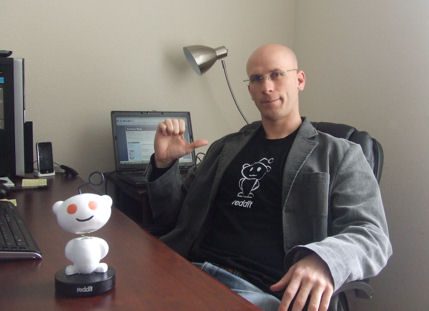
Brent Csutoras - 2007

I’ve been an avid Redditor since 2006. My journey with social media started in San Francisco, where I got involved with companies like Digg, Reddit, and StumbleUpon right as they were taking off.

One of my favorite memories is emailing Alexis Ohanian, Reddit’s co-founder, to tell him how much I loved the site. He responded, we chatted, and before I knew it, we were hanging out.

From tacos to SEO chats, we bonded over our shared passion for Reddit. Fun fact: My son is the first baby Redditor, thanks to Alexis.

More resources: 


Featured Image: Damir Khabirov/Shutterstock