OpenAI’s latest blunder shows the challenges facing Chinese AI models

This story first appeared in China Report, MIT Technology Review’s newsletter about technology in China. Sign up to receive it in your inbox every Tuesday.

Last week’s release of GPT-4o, a new AI “omnimodel” that you can interact with using voice, text, or video, was supposed to be a big moment for OpenAI. But just days later, it feels as if the company is in big trouble. From the resignation of most of its safety team to Scarlett Johansson’s accusation that it replicated her voice for the model against her consent, it’s now in damage-control mode. 

Add to that another thing OpenAI fumbled with GPT-4o: the data it used to train its tokenizer—a tool that helps the model parse and process text more efficiently—is polluted by Chinese spam websites. As a result, the model’s Chinese token library is full of phrases related to pornography and gambling. This could worsen some problems that are common with AI models: hallucinations, poor performance, and misuse. 

I wrote about it on Friday after several researchers and AI industry insiders flagged the problem. They took a look at GPT-4o’s public token library, which has been significantly updated with the new model to improve support of non-English languages, and saw that more than 90 of the 100 longest Chinese tokens in the model are from spam websites. These are phrases like “_free Japanese porn video to watch,” “Beijing race car betting,” and “China welfare lottery every day.”

Anyone who reads Chinese could spot the problem with this list of tokens right away. Some such phrases inevitably slip into training data sets because of how popular adult content is online, but for them to account for 90% of the Chinese language used to train the model? That’s alarming.

“It’s an embarrassing thing to see as a Chinese person. Is that just how the quality of the [Chinese] data is? Is it because of insufficient data cleaning or is the language just like that?” says Zhengyang Geng, a PhD student in computer science at Carnegie Mellon University. 

It could be tempting to draw a conclusion about a language or a culture from the tokens OpenAI chose for GPT-4o. After all, these are selected as commonly seen and significant phrases from the respective languages. There’s an interesting blog post by a Hong Kong–based researcher named Henry Luo, who queried the longest GPT-4o tokens in various different languages and found that they seem to have different themes. While the tokens in Russian reflect language about the government and public institutions, the tokens in Japanese have a lot of different ways to say “thank you.”

But rather than reflecting the differences between cultures or countries, I think this explains more about what kind of training data is readily available online, and the websites OpenAI crawled to feed into GPT-4o.

After I published the story, Victor Shih, a political science professor at the University of California, San Diego, commented on it on X: “When you try not [to] train on Chinese state media content, this is what you get.”

It’s half a joke, and half a serious point about the two biggest problems in training large language models to speak Chinese: the readily available data online reflects either the “official,” sanctioned way of talking about China or the omnipresent spam content that drowns out real conversations.

In fact, among the few long Chinese tokens in GPT-4o that aren’t either pornography or gambling nonsense, two are “socialism with Chinese characteristics” and “People’s Republic of China.” The presence of these phrases suggests that a significant part of the training data actually is from Chinese state media writings, where formal, long expressions are extremely common.

OpenAI has historically been very tight-lipped about the data it uses to train its models, and it probably will never tell us how much of its Chinese training database is state media and how much is spam. (OpenAI didn’t respond to MIT Technology Review’s detailed questions sent on Friday.)

But it is not the only company struggling with this problem. People inside China who work in its AI industry agree there’s a lack of quality Chinese text data sets for training LLMs. One reason is that the Chinese internet used to be, and largely remains, divided up by big companies like Tencent and ByteDance. They own most of the social platforms and aren’t going to share their data with competitors or third parties to train LLMs. 

In fact, this is also why search engines, including Google, kinda suck when it comes to searching in Chinese. Since WeChat content can only be searched on WeChat, and content on Douyin (the Chinese TikTok) can only be searched on Douyin, this data is not accessible to a third-party search engine, let alone an LLM. But these are the platforms where actual human conversations are happening, instead of some spam website that keeps trying to draw you into online gambling.

The lack of quality training data is a much bigger problem than the failure to filter out the porn and general nonsense in GPT-4o’s token-training data. If there isn’t an existing data set, AI companies have to put in significant work to identify, source, and curate their own data sets and filter out inappropriate or biased content. 

It doesn’t seem OpenAI did that, which in fairness makes some sense, given that people in China can’t use its AI models anyway. 

Still, there are many people living outside China who want to use AI services in Chinese. And they deserve a product that works properly as much as speakers of any other language do. 

How can we solve the problem of the lack of good Chinese LLM training data? Tell me your idea at zeyi@technologyreview.com.


Now read the rest of China Report

Catch up with China

1. China launched an anti-dumping investigation into imports of polyoxymethylene copolymer—a widely used plastic in electronics and cars—from the US, the EU, Taiwan, and Japan. It’s widely seen as a response to the new US tariff announced on Chinese EVs. (BBC)

  • Meanwhile, Latin American countries, including Mexico, Chile, and Brazil, have increased tariffs on Chinese-imported steel, testing China’s relationship with the region. (Bloomberg $)

2. China’s solar-industry boom is incentivizing farmers to install solar panels and make some extra cash by selling the electricity they generate. (Associated Press)

3. Hedging against the potential devaluation of the RMB, Chinese buyers are pushing the price of gold to all-time highs. (Financial Times $)

4. The Shanghai government set up a pilot project that allows data to be transferred out of China without going through the much-dreaded security assessments, a move that has been sought by companies like Tesla. (Reuters $)

5. China’s central bank fined seven businesses—including a KFC and branches of state-owned corporations—for rejecting cash payments. The popularization of mobile payment has been a good thing, but the dwindling support for cash is also making life harder for people like the elderly and foreign tourists. (Business Insider $)

6. Alibaba and Baidu are waging an LLM price war in China to attract more users. (Bloomberg $

7. The Chinese government has sanctioned Mike Gallagher, a former Republican congressman who chaired the Select Committee on China and remains a fierce critic of Beijing. (NBC News)

Lost in translation

China’s National Health Commission is exploring the relaxation of stringent rules around human genetic data to boost the biotech industry, according to the Chinese publication Caixin. A regulation enacted in 1998 required any research that involves the use of this data to clear an approval process. And there’s even more scrutiny if the research involves foreign institutions. 

In the early years of human genetic research, the regulation helped prevent the nonconsensual collection of DNA. But as the use of genetic data becomes increasingly important in discovering new treatments, the industry has been complaining about the bureaucracy, which can add an extra two to four months to research projects. Now the government is holding discussions on how to revise the regulation, potentially lifting the approval process for smaller-scale research and more foreign entities, as part of a bid to accelerate the growth of biotech research in China.

One more thing

Did you know that the Beijing Capital International Airport has been employing birds of prey to chase away other birds since 2019? This month, the second generation of Beijing’s birdy employees started their work driving away the migratory birds that could endanger aircraft. The airport even has different kinds of raptors—Eurasian hobbies, Eurasian goshawks, and Eurasian sparrowhawks—to deal with the different bird species that migrate to Beijing at different times.

AI is an energy hog. This is what it means for climate change.

This article is from The Spark, MIT Technology Review’s weekly climate newsletter. To receive it in your inbox every Wednesday, sign up here.

Tech companies keep finding new ways to bring AI into every facet of our lives. AI has taken over my search engine results, and new virtual assistants from Google and OpenAI announced last week are bringing the world eerily close to the 2013 film Her (in more ways than one).

As AI has become more integrated into our world, I’ve gotten a lot of questions about the technology’s rising electricity demand. You may have seen the headlines proclaiming that AI uses as much electricity as small countries, that it’ll usher in a fossil-fuel resurgence, and that it’s already challenging the grid.  

So how worried should we be about AI’s electricity demands? Well, it’s complicated. 

Using AI for certain tasks can come with a significant energy price tag. With some powerful AI models, generating an image can require as much energy as charging up your phone, as my colleague Melissa Heikkilä explained in a story from December. Create 1,000 images with a model like Stable Diffusion XL, and you’ve produced as much carbon dioxide as driving just over four miles in a gas-powered car, according to the researchers Melissa spoke to. 

But while generated images are splashy, there are plenty of AI tasks that don’t use as much energy. For example, creating images is thousands of times more energy-intensive than generating text. And using a smaller model that’s tailored to a specific task, rather than a massive, all-purpose generative model, can be dozens of times more efficient. In any case, generative AI models require energy, and we’re using them a lot. 

Electricity consumption from data centers, AI, and cryptocurrency could reach double 2022 levels by 2026, according to projections from the International Energy Agency. Those technologies together made up roughly 2% of global electricity demand in 2022. Note that these numbers aren’t just for AI—it’s tricky to nail down AI’s specific contribution, so keep that in mind when you see predictions about electricity demand from data centers. 

There’s a wide range of uncertainty in the IEA’s projections, depending on factors like how quickly deployment increases and how efficient computing processes get. On the low end, the sector could require about 160 terawatt-hours of additional electricity by 2026. On the higher end, that number might be 590 TWh. As the report puts it, AI, data centers, and cryptocurrency together are likely adding “at least one Sweden or at most one Germany” to global electricity demand. 

In total, the IEA projects, the world will add about 3,500 TWh of electricity demand over that same period—so while computing is certainly part of the demand crunch, it’s far from the whole story. Electric vehicles and the industrial sector will both be bigger sources of growth in electricity demand than data centers in the European Union, for example. 

Still, some big tech companies are suggesting that AI could get in the way of their climate goals. Microsoft pledged four years ago to bring its greenhouse-gas emissions to zero (or even lower) by the end of the decade. But the company’s recent sustainability report shows that instead, emissions are still ticking up, and some executives point to AI as a reason. “In 2020, we unveiled what we called our carbon moonshot. That was before the explosion in artificial intelligence,” Brad Smith, Microsoft’s president, told Bloomberg Green.

What I found interesting, though, is that it’s not AI’s electricity demand that’s contributing to Microsoft’s rising emissions, at least on paper. The company has agreements in place and buys renewable-energy credits so that electricity needs for all its functions (including AI) are met with renewables. (How much these credits actually help is questionable, but that’s a story for another day.) 

Instead, infrastructure growth could be adding to the uptick in emissions. Microsoft plans to spend $50 billion between July 2023 and June 2024 on expanding data centers to meet demand for AI products, according to the Bloomberg story. Building those data centers requires materials that can be carbon intensive, like steel, cement, and of course chips. 

Some important context to consider in the panic over AI’s energy demand is that while the technology is new, this sort of concern isn’t, as Robinson Meyer laid out in an April story in Heatmap.

Meyer points to estimates from 1999 that information technologies were already accounting for up to 13% of US power demand, and that personal computers and the internet could eat up half the grid’s capacity within the decade. That didn’t end up happening, and even at the time, computing was actually accounting for something like 3% of electricity demand. 

We’ll have to wait and see if doomsday predictions about AI’s energy demand play out. The way I see it, though, AI is probably going to be a small piece of a much bigger story. Ultimately, rising electricity demand from AI is in some ways no different from rising demand from EVs, heat pumps, or factory growth. It’s really how we meet that demand that matters. 

If we build more fossil-fuel plants to meet our growing electricity demand, it’ll come with negative consequences for the climate. But if we use rising electricity demand as a catalyst to lean harder into renewable energy and other low-carbon power sources, and push AI to get more efficient, doing more with less energy, then we can continue to slowly clean up the grid, even as AI continues to expand its reach in our lives. 


Now read the rest of The Spark

Related reading

Check out my colleague Melissa’s story on the carbon footprint of AI from December here

For a closer look at Microsoft’s new sustainability report and the effects of AI, give this Bloomberg Green story from reporters Akshat Rathi and Dina Bass a read. 

Robinson Meyer at Heatmap dug into the context around the AI energy demand in this April piece

Another thing

Missed our event last week on thermal batteries? Good news—the recording is now available for subscribers!

For the latest in our Roundtables series, I spoke with Amy Nordrum, MIT Technology Review executive editor, about how the technology works, who the crucial players are, and what I’m watching for next. Check it out here

Keeping up with climate  

Changing how we generate heat in industry will be crucial to cleaning up that sector in China, according to a new report. Thermal batteries and heat pumps could meet most of the demand. (Axios)

Form Energy is known for its iron-air batteries, which could help unlock cheap energy storage on the grid. Now, the company is working on research to produce green iron. (Canary Media)

The NET Power pilot in Texas is working to generate electricity with natural gas while capturing the vast majority of emissions. But carbon capture technology in power plants is far from proven. (Cipher News)

MIT spinoff Electrified Thermal Solutions is working to bring its thermal battery technology to commercial use. The company’s product is roughly the size of an elevator and can reach temperatures up to 1,800 °C. (Inside Climate News)

Mexico City has seen constant struggles over water. Now groundwater is drying up, and a system of dams and canals may soon be unable to provide water to the city. (New York Times)

Sodium-ion batteries could offer cheap energy storage while avoiding material crunches for metals like lithium, nickel, and cobalt. China has a massive head start, leaving other countries scrambling to catch up. (Latitude Media)

→ Here’s how this abundant material could unlock cheaper energy storage. (MIT Technology Review)

Biochar is made by heating up biomass like wood and plants in low-oxygen environments. It’s a simple approach to carbon removal, but it doesn’t always get as much attention as other carbon removal technologies. (Heatmap)

This startup wants ships to capture their own emissions by bubbling exhaust through seawater and limestone and dumping it into the ocean. Experts caution that some components of the exhaust could harm sea life if they’re not handled properly. (New Scientist)

Splashy breakthroughs are exciting, but people with spinal cord injuries need more

This article first appeared in The Checkup, MIT Technology Review’s weekly biotech newsletter. To receive it in your inbox every Thursday, and read articles like this first, sign up here. 

This week, I wrote about an external stimulator that delivers electrical pulses to the spine to help improve hand and arm function in people who are paralyzed. This isn’t a cure. In many cases the gains were relatively modest. One participant said it increased his typing speed from 23 words a minute to 35. Another participant was newly able to use scissors with his right hand. A third used her left hand to release a seatbelt.

The study didn’t garner as much media attention as previous, much smaller studies that focused on helping people with paralysis walk. Tech that allows people to type slightly faster or put their hair in a ponytail unaided just doesn’t have the same allure. “The image of a paralyzed person getting up and walking is almost biblical,” Charles Liu, director of the Neurorestoration Center at the University of Southern California, once told a reporter. 

For the people who have spinal cord injuries, however, incremental gains can have a huge impact on quality of life. 

So today in The Checkup, let’s talk about this tech and who it serves.

In 2004, Kim Anderson-Erisman, a researcher at Case Western Reserve University, who also happens to be paralyzed, surveyed more than 600 people with spinal cord injuries. Wanting to better understand their priorities, she asked them to consider seven different functions—everything from hand and arm mobility to bowel and bladder function to sexual function. She asked respondents to rank these functions according to how big an impact recovery would have on their quality of life. 

Walking was one of the functions, but it wasn’t the top priority for most people. Most quadriplegics put hand and arm function at the top of the list. For paraplegics, meanwhile, the top priority was sexual function. I interviewed Anderson-Erisman for a story I wrote in 2019 about research on implantable stimulators as a way to help people with spinal cord injuries walk. For many people, “not being able to walk is the easy part of spinal cord injury,” she told me. “[If] you don’t have enough upper-extremity strength or ability to take care of yourself independently, that’s a bigger problem than not being able to walk.” 

One of the research groups I focused on was at the University of Louisville. When I visited in 2019, the team had recently made the news because two people with spinal cord injuries in one of their studies had regained the ability to walk, thanks to an implanted stimulator. “Experimental device helps paralyzed man walk the length of four football fields,” one headline had trumpeted.

But when I visited one of those participants, Jeff Marquis, in his condo in Louisville, I learned that walking was something he could only do in the lab. To walk he needed to hold onto parallel bars supported by other people and wear a harness to catch him if he fell. Even if he had extra help at home, there wasn’t enough room for the apparatus. Instead, he gets around his condo the same way he gets around outside his condo: in a wheelchair. Marquis does stand at home, but even that requires a bulky frame. And the standing he does is only for therapy. “I mostly just watch TV while I’m doing that,” he said.  

That’s not to say the tech has been useless. The implant helped Marquis gain some balance, stamina, and trunk stability. “Trunk stability is kind of underrated in how much easier that makes every other activity I do,” he told me. “That’s the biggest thing that stays with me when I have [the stimulator] turned off.”  

What’s exciting to me about this latest study is that the tech gave the participants skills they could use beyond the lab. And because the stimulator is external, it is likely to be more accessible and vastly cheaper. Yes, the newly enabled movements are small, but if you listen to the palpable excitement of one study participant as he demonstrates how he can move a small ball into a cup, you’ll appreciate that incremental gains are far from insignificant. That’s according to Melanie Reid, one of the participants in the latest trial, who spoke at a press conference last week. “There [are] no miracles in spinal injury, but tiny gains can be life-changing.”


Now read the rest of The Checkup

Read more from MIT Technology Review’s archive

In 2017, we hailed as a breakthrough technology electronic interfaces designed to reverse paralysis by reconnecting the brain and body. Antonio Regalado has the story

An implanted stimulator changed John Mumford’s life, allowing him to once again grasp objects after a spinal cord injury left him paralyzed. But when the company that made the device folded, Mumford was left with few options for keeping the device running. “Limp limbs can be reanimated by technology, but they can be quieted again by basic market economics,” wrote Brian Bergstein in 2015. 

In 2014, Courtney Humphries covered some of the rat research that laid the foundation for the technological developments that have allowed paralyzed people to walk. 

From around the web

Lots of bird flu news this week. A second person in the US has tested positive for the illness after working with infected livestock. (NBC)

The livestock industry, which depends on shipping tens of millions of live animals, provides some ideal conditions for the spread of pathogens, including bird flu. (NYT)

Long read: How the death of a nine-year-old boy in Cambodia triggered a global H5N1 alert. (NYT)

You’ve heard about tracking viruses via wastewater. H5N1 is the first one we’re tracking via store-bought milk. (STAT

The first organ transplants from pigs to humans have not ended well, but scientists are learning valuable lessons about what they need to do better. (Nature

Another long read that’s worth your time: an inside look at just how long 3M knew about the pervasiveness of “forever chemicals.” (New Yorker

Flair.ai Remakes Product Photography

Mickey Friedman co-launched Flair.ai in 2022, a year after graduating from the University of Chicago. The company, which has raised $5 million in seed funding, deploys artificial intelligence to perfect product photos, providing entire virtual scenes and setups.

The process, she says, remakes ecommerce photography by dramatically lowering the cost of photo shoots while improving quality.

In our recent conversation, she addressed the rise of visual AI, the necessity of human intervention, and more. The entire audio is embedded below. The transcript is edited for length and clarity.

Eric Bandholz: Who the heck are you?

Mickey Friedman: I own a company called Flair. We launched in 2023. We’re building an AI tool for product photos, visualizations, and animations. We’re trying to streamline the photo shoot process into an easy-to-use virtual studio at a much lower cost.

We’re a team of five. We’ve onboarded over a million users now.

We start with merchants’ existing product photos. We perform color corrections, preserve the lettering, and provide an entire virtual scene. Brand and text preservation are important to us.

I was early on in the AI art scene. I was interested in marketing and photo shoots, but I was more drawn to the creative process, playing around with AI models to create art. The process in the early days was taking a bit of text and generating images. There’s still a place for that, such as Midjourney. But ecommerce companies want to preserve their brands and assets and control the visual arrangement of their scenes.

Bandholz: How are merchants using your tool thus far?

Friedman: Images for landing pages and organic social posts are very popular. We’re trying to define the creative process of a photo shoot. Many AI tools remove humans from that process, but we want the opposite, where our customers execute whatever vision they have.

Folks who gravitate to Flair are often at the intersection of ecommerce and creativity — an in-house design team or an agency. They understand our platform intuitively.

There’s a lot of storyboarding on Flair. We’ve had customers with a vision of a dream photo shoot they can’t execute because of extensive coordination and cost. Using Flair, they upload the raw product photos to the canvas, find the props they need, and more or less replicate their photo shoot on the platform.

Bandholz: Flair seems poised to scale.

Friedman: It is a very large market. We want every brand in the world to use us in some capacity. Smaller brands with budget constraints could transition photo shoots, while larger brands that can afford photo shoots need better tools.

Regardless, as long as businesses require photo shoots, Flair will hopefully be involved in their workflow. That’s our goal.

We’re branching out into verticals. For fashion brands, we can place a sweater on a virtual human model, for example. For product commercials, we reduce the cost.

We want as much traction as possible with smaller brands. But we will likely move upmarket a bit, although we’ll never be too expensive — way less than $500 a month.

Over time, our AI models will improve, thus improving image quality. Eventually, we will create banner ads. Everything will be AI-generated. My only hope is that humans are at the center of that process. They direct it instead of a black box algorithm.

Bandholz: Where can people sign up for Flair and follow you?

Friedman: The platform is Flair.ai. You can add me on LinkedIn or follow me on X, @mickeyxfriedman.

The 9 Best Content Calendar Templates For 2024 via @sejournal, @donutcaramel13

Marketers take note: If you want to execute a strong, seamless content strategy, you need a content calendar.

Content calendars aren’t just about organizing your upcoming posts; they also help ensure that your content aligns with your strategic goals and maximizes your resources efficiently.

Whether you’re managing multiple social platforms or experimenting with various content types, a content calendar provides you with the blueprint for consistent, impactful content creation.

In this article, we’ve rounded up the top 9 content calendar templates, each designed to streamline content planning and boost productivity.

From simple spreadsheets to more complex solutions, we’ve compiled a range of templates to suit your needs.

Let’s dive in.

What Is A Content Calendar?

Before jumping into the best content calendar templates, let’s start with the basics.

A content calendar is a fundamentally a time-management system tailored for content creation. It helps you organize your workflow into manageable weekly or daily blocks, enabling you to maintain a clear and structured approach to producing content.

It also gives you a bird’s-eye view of your content strategy, allowing you to understand what you have in the pipeline and when and where it will be published.

This way, you can align your content with upcoming events, marketing campaigns, product releases, etc., to ensure each piece of content meets your audience where they are and serves its intended purpose.

A content calendar is an indispensable tool for social media marketers, bloggers, freelancers, and content creators. With a content calendar, you can consistently produce high-quality content, which is key to building an engaged community.

While some people prefer to use specialized software for their content calendar needs, it’s possible to start with something as simple as an Excel sheet.

Here, we’ll highlight some existing content calendar templates that you can easily leverage and adapt to your brand’s needs to get started.

Why Should I Use A Content Calendar?

Whether you’re the only content specialist in your in-house ecommerce company or an agency social media manager, a content calendar makes you better organized with your campaigns.

It’s also a helpful tool for collaborating with multiple teammates, as it can help inform them of what’s needed and when.

Why? At a glance, it’s easy to understand what went live, along with the copy and asset used. Sort your posts by social platform and assign some color coding. Usually, each tab is marked by month.

Because you can see the bigger picture (at least a month in advance), you can map out themes and daily social posts ahead of schedule, plan well-researched infographics with your designer, and track how your posts are doing.

You’re better equipped to craft your message to your target audience, keeping their wants and needs in mind when the seasonal trends come and go.

You can plan around holidays and significant world events, from Valentine’s Day to Pride Month or any national event relevant to your brand values.

(Not to toot our own horn, but we have our own marketing calendar to help you with just that!)

Plus, by planning ahead, you’re less likely to commit a faux pas – as the content will be brainstormed, briefed, approved, and published before crunch time. It’s a protective measure.

Without further ado, here are our picks (most of them are free!).

Top 9 Content Calendar Templates For 2024

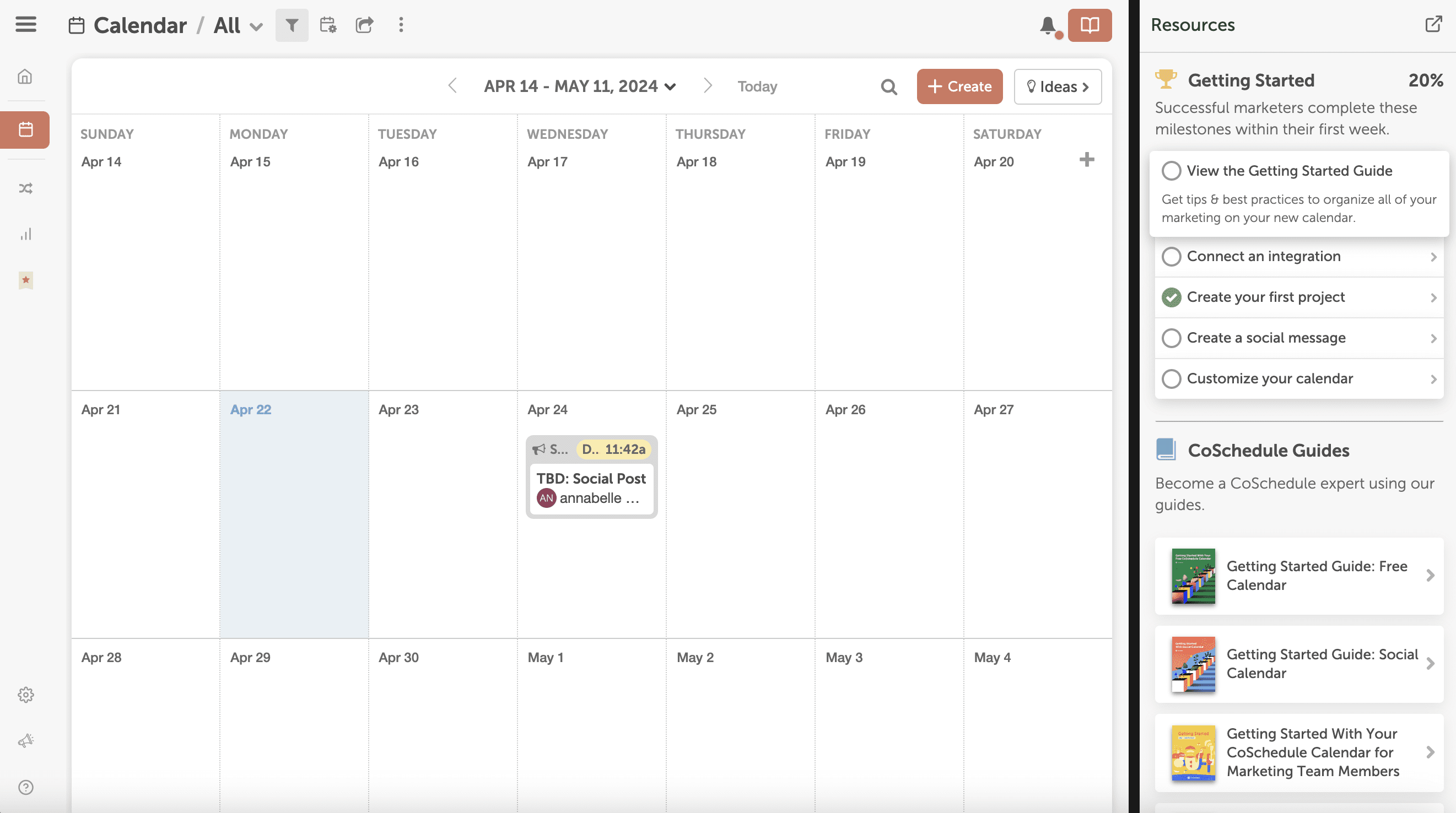
1. CoSchedule Marketing Calendar Template

CoSchedule content calendar interface with various scheduled tasks and events such as marketing projects, social posts, and guide creation.Screenshot from CoSchedule.com, April 2024

If you’re running a WordPress blog, CoSchedule may be your best bet.

It truly shines in content marketing with its user-friendly interface and AI-driven features, such as the AI Social Assistant, which can help you draft social messages to enhance engagement and save time.

The intuitive calendar is easy to use. It has 15 seamless integrations, including WordPress, TikTok, Instagram, Facebook, Mailchimp, and more.

The Bluesky and Google Business Profile integrations can help streamline your content management across different platforms, while functionalities like the TikTok Slideshow Scheduling feature allow for dynamic content creation directly from your calendar interface.

We recommend this one if you manage your blog and social media. It’s a great choice for individual and small to medium-sized marketing teams looking for a straightforward, efficient way to manage their content.

  • Cost: Free plan offers a social calendar with up to three users and two social profiles. Paid options start at $19/month for additional users, social profiles, and more advanced features.

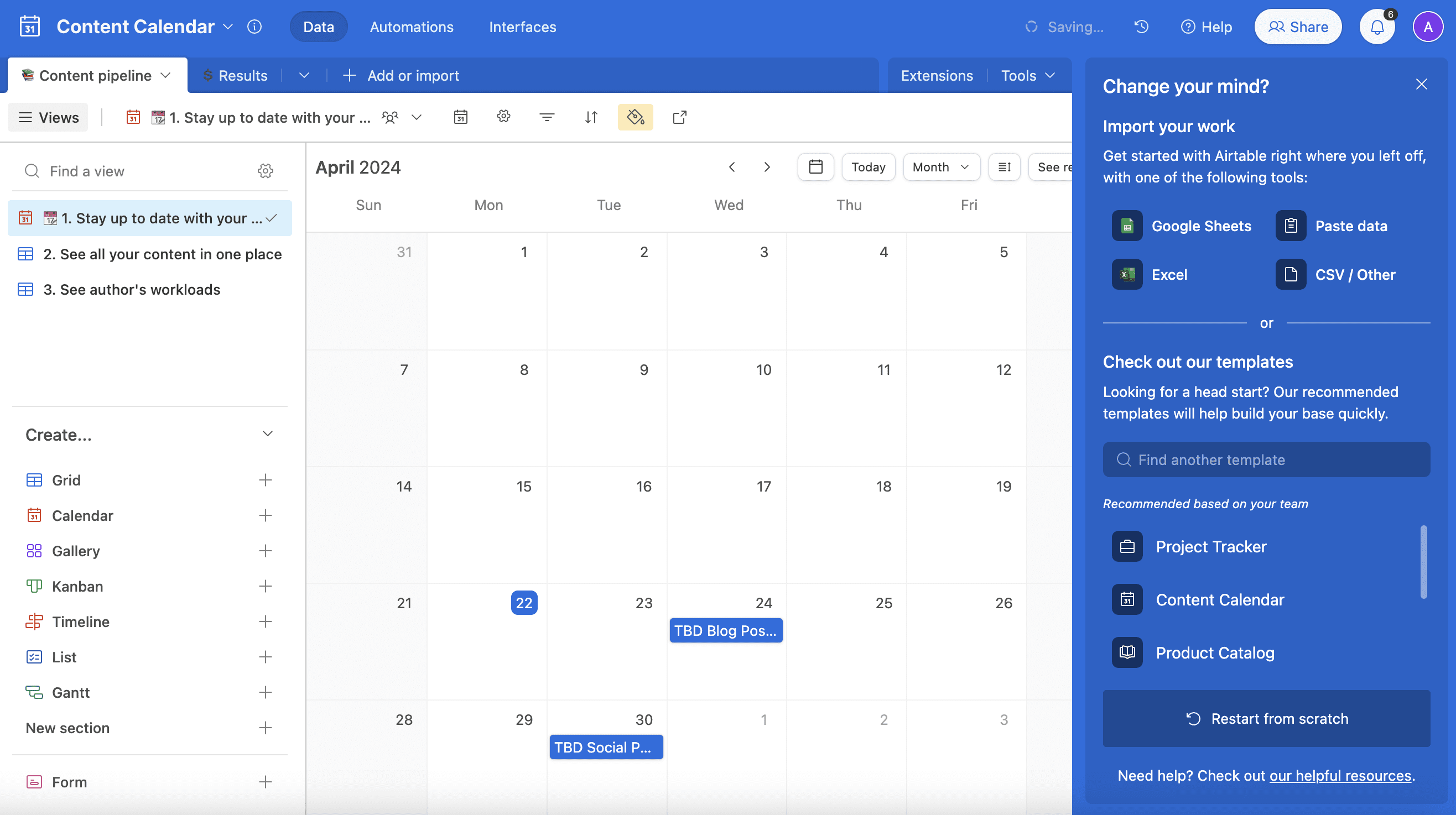
2. Airtable Content Calendar Template

A screenshot displaying an Airtable content calendar interface with content calendar templates for 2024, days of April highlighted, and a task titled Screenshot from Airtable.com, April 2024

If you’re managing a content calendar in Google Sheets, Excel, or CSV files and looking to upgrade, Airtable is an excellent choice.

Airtable simplifies content management with its robust automation features for reminders and task tracking, which are perfect for those who prefer not to juggle complex spreadsheet formulas.

The platform supports multiple data fields for important content management, such as Title, Writer, Due Date, Status, and Image, and allows for easy customization to suit your specific workflow needs.

Airtable’s straightforward content calendar template enables you to manage everything from social media content to blog posts and more, providing a clear overview of author workloads, ideas in the pipeline, and key results essential for any content strategy.

You can assign tasks, track deadlines with multiple calendar views (including a grid, kanban, or calendar format), and send reminders through built-in alerts to make sure everyone is staying on track.

  • Cost: A free version is available; more advanced features are included in the paid plans, which are tailored to team size and specific needs.

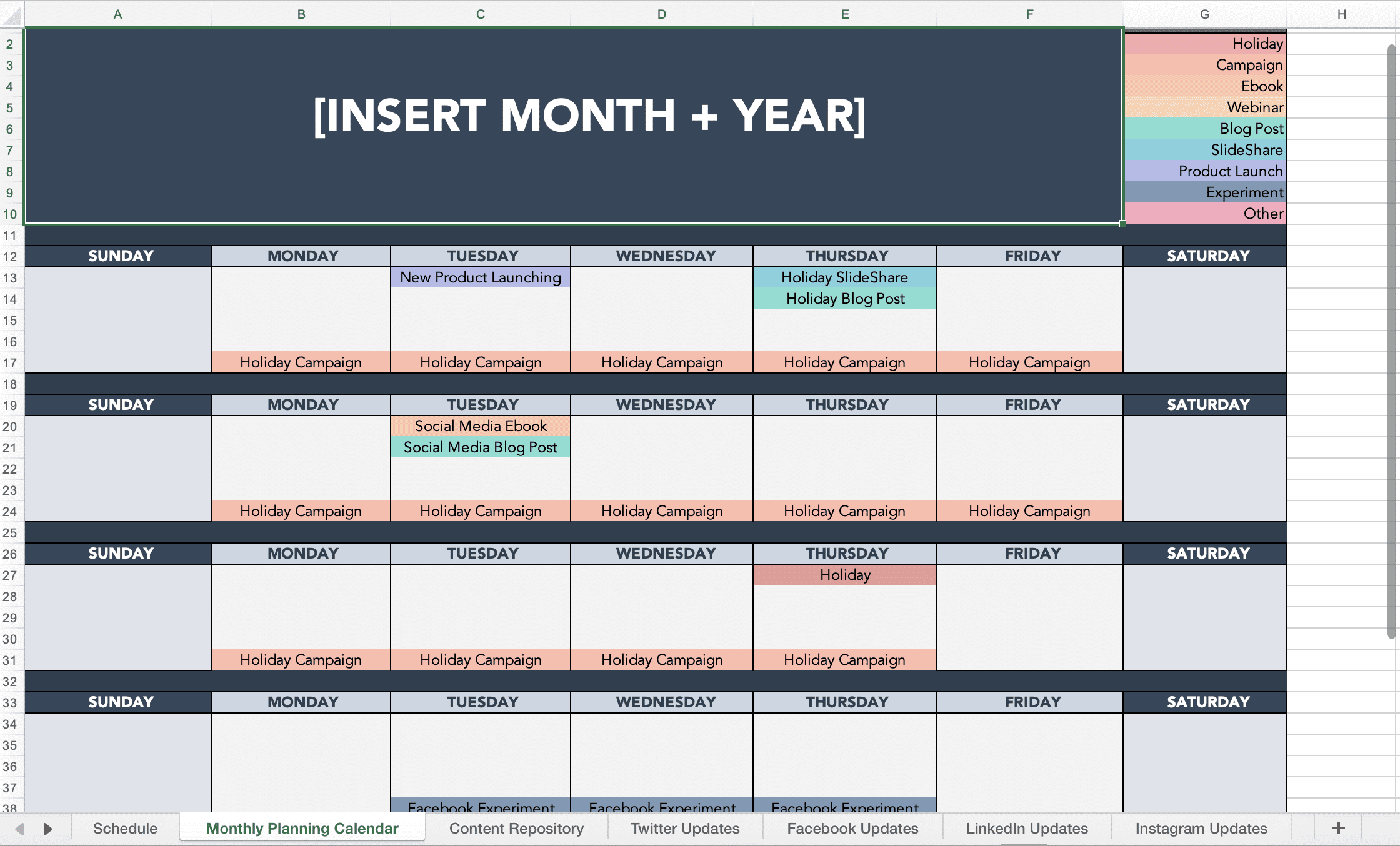
3. HubSpot Social Media Content Calendar Template

Screenshot of HubSpot Social Media Content calendar Template for 2024 filled with events and campaign details such as Screenshot from HubSpot.com, April 2024

Excel geeks, rejoice!

HubSpot’s free Social Media Content Calendar is pretty flexible. Just insert the month + year into the Monthly Planning Calendar tab, and adjust the template to suit your brand.

The template is structured with several tabs dedicated to various platforms, including Facebook, LinkedIn, Instagram, X (Twitter), and Pinterest, ensuring you can manage updates across your social channels with precision.

Each tab is thoughtfully designed, providing examples of how to best engage with your audience on each platform.

There is also a Content Repository tab to help you track all the content you’re producing, which is invaluable for organizing and reusing your existing content.

It even comes with a comprehensive starter guide PDF that helps you understand how to make the most of the template.

It’s more for social media than blog posts, so we recommend this one for social media specialists in startups and in-house social media managers for ecommerce brands – though it could be tailored to fit a variety of needs.

  • Cost: Free – just download the template.

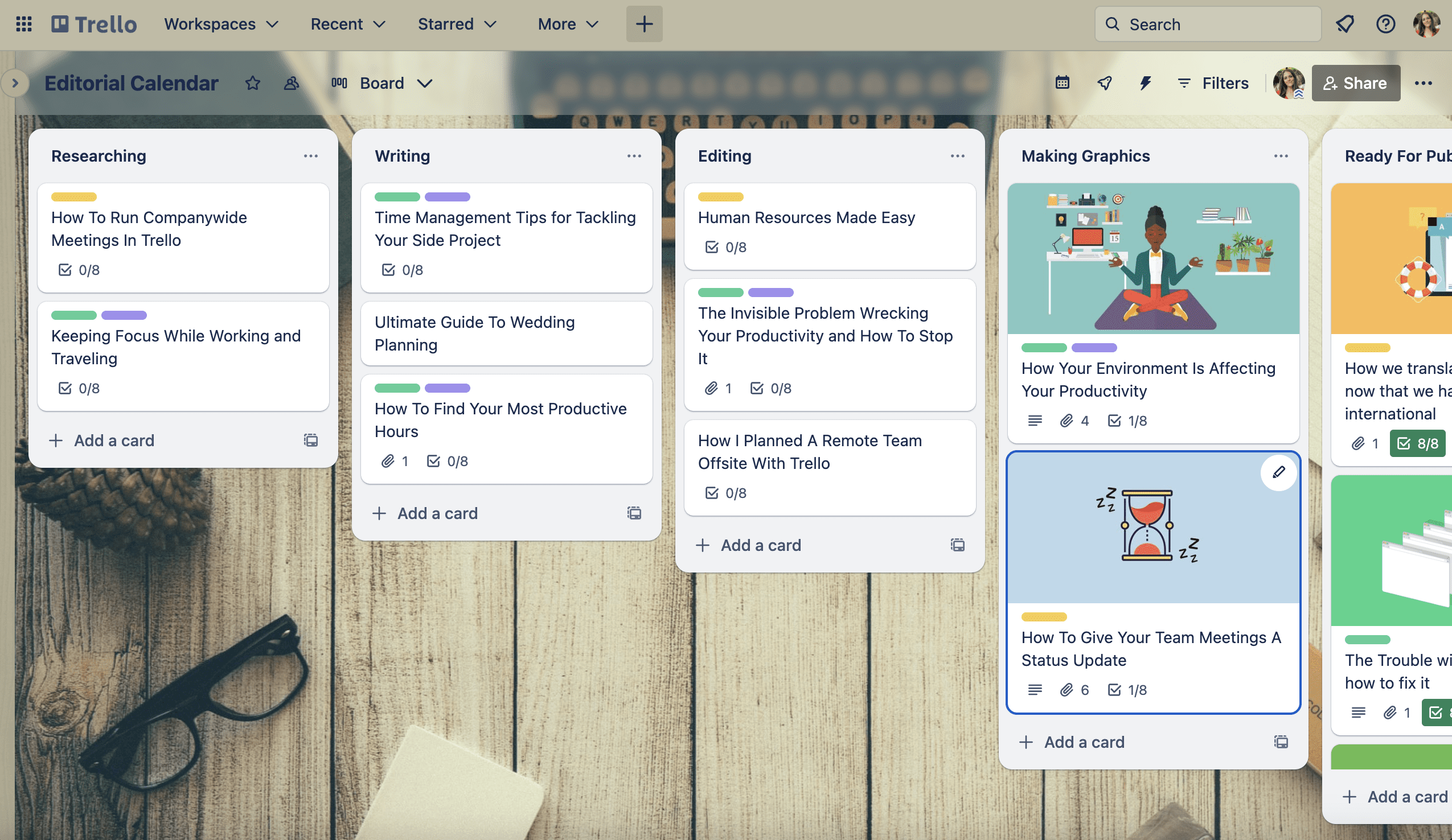
4. Trello Editorial Content Calendar Template

Screenshot from Trello.com, April 2024

A popular project management tool, Trello is an ideal content calendar choice for massive teams already on an Agile framework and using similar products (Jira, Confluence, etc.).

The drag-and-drop functionality is easy to use. One glance, and you know what the task status is.

Trello offers a specialized free editorial content calendar template that’s ideal for seamlessly managing the entire lifecycle of blog posts and social media content.

Using the template, you can visually track each piece of content from conception to publication. You can manage drafts, coordinate illustrations, and attach necessary assets directly to each Trello card dedicated to specific content pieces.

The template enhances team collaboration by enabling you to add editors, designers, and social media managers to cards, ensuring that all stakeholders are kept up-to-date.

You’ll also find checklists to ensure all steps are completed, filterable card labels, and a calendar view to give you a clear perspective on your publishing pipeline, making it a powerful tool for large teams focused on detailed content planning and execution.

  • Cost: Free – sign up and download the template.

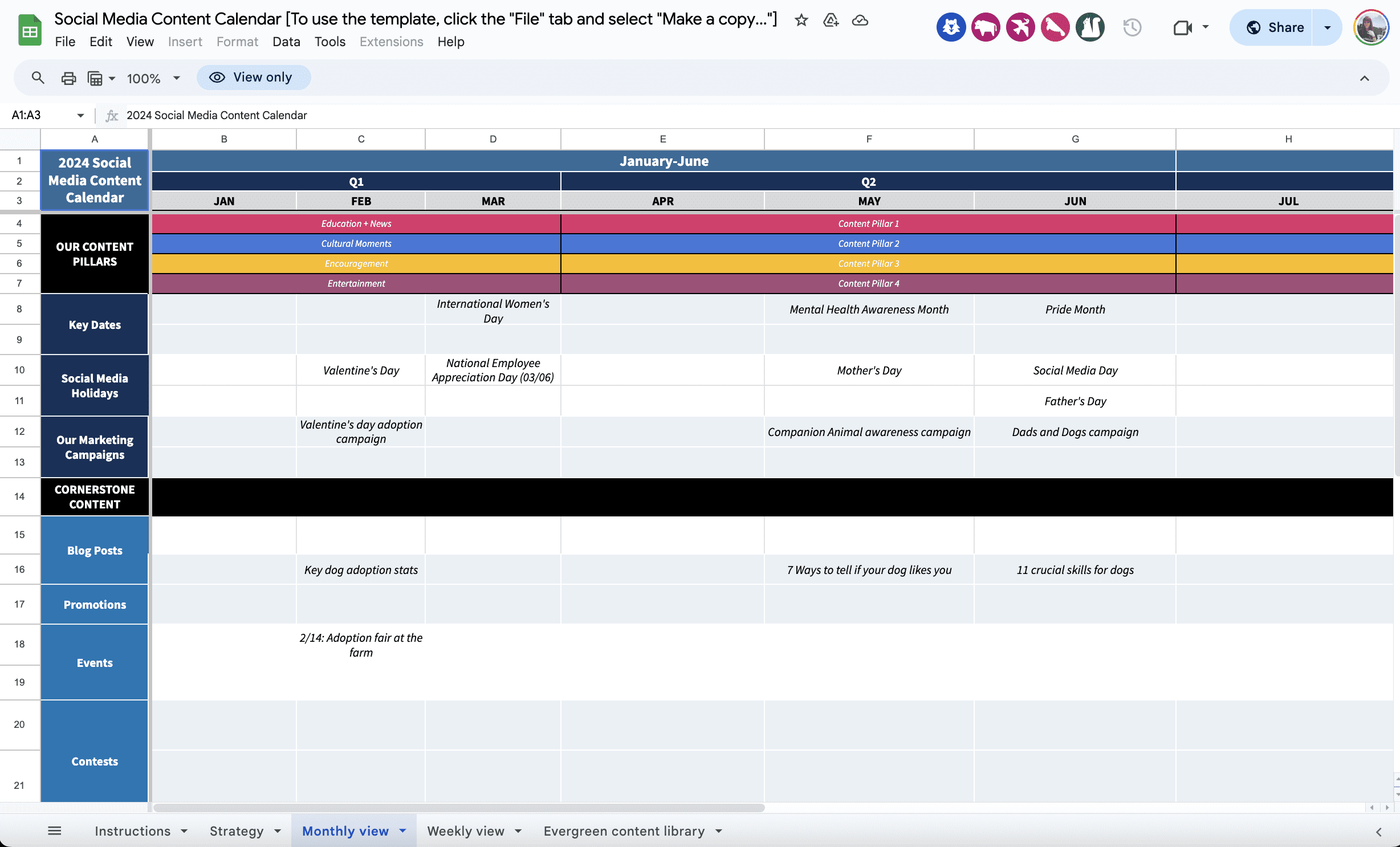
5. Hootsuite Social Media Content Calendar Template

Screenshot of the Hootsuite social media content calendar template digital spreadsheet. The calendar is labeled by months and weeks, with colored bars indicating planned content themes and dates for various social events.Screenshot from Hootsuite.com, April 2024

Similar to HubSpot’s template, Hootsuite has a downloadable, free Google Sheet spreadsheet with five tabs: Instructions, Strategy, Monthly View, Weekly View, and Evergreen Content Library – for Instagram, Facebook, X (Twitter), LinkedIn, and any other platform you might want to add.

The weekly view is a fairly unique feature that you don’t see in every template.

The Instructions tab provides tips on using the template, while the Strategy tab helps you plan your overall strategy – including your business goals, social goals, content pillars, pieces, and tactics. Like HubSpot’s template, Hootsuite’s evergreen content tab enables you to build a library of content to revisit when needed.

It even lists key dates of interest available throughout the year for each month – such as events like Black Friday and Small Business Saturday (USA) – to help you stay on top of important marketing moments.

The simple-to-use template is customizable yet ideal for Excel pros who don’t want to use a paid tool and the extra features that come with it. It’s ideal for businesses of all sizes and is a practical choice for teams looking to optimize their workflows without investing in premium tools.

  • Cost: Free to download by filling out a lead generation form.

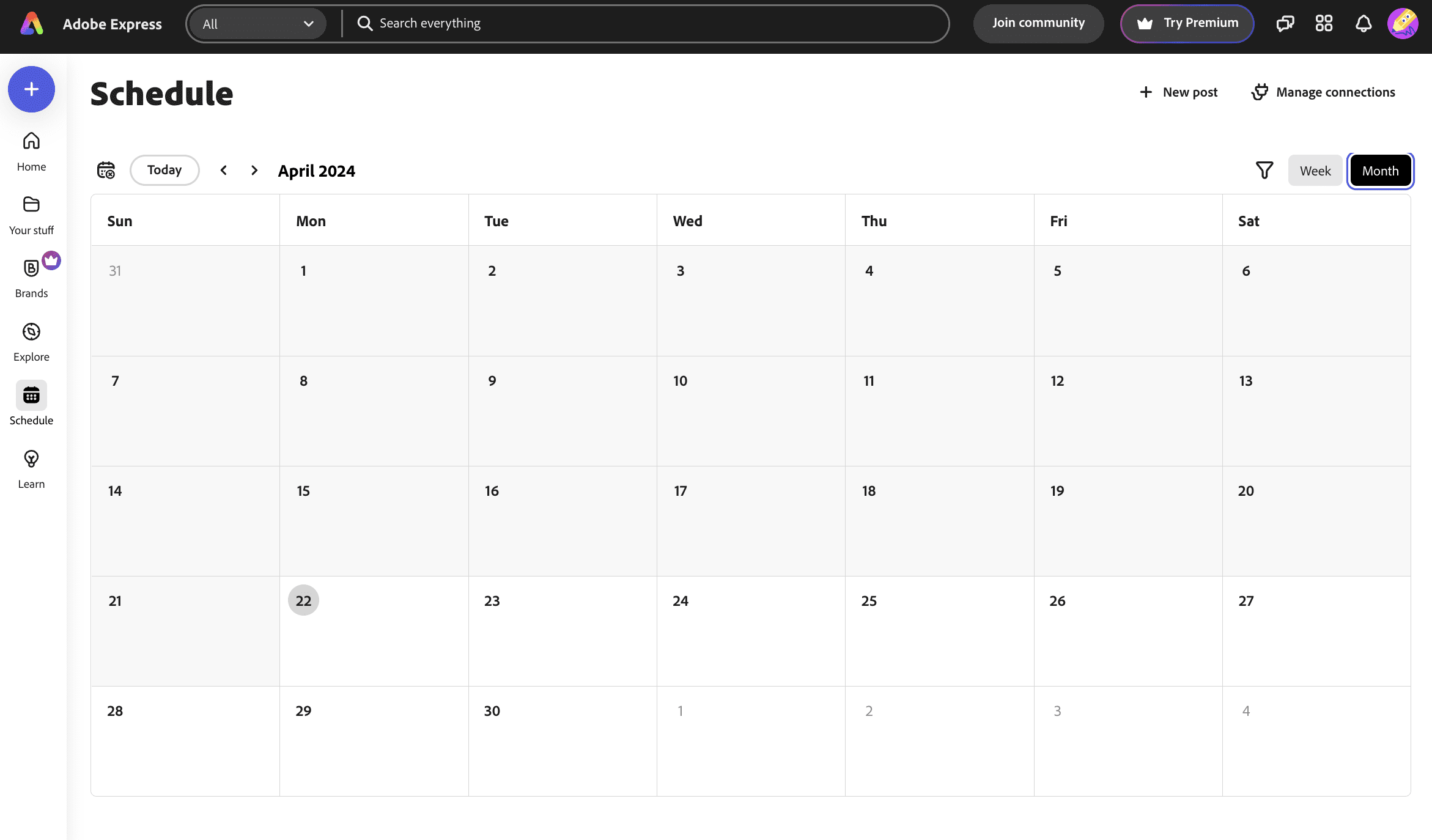
6. Adobe Express Content Scheduler

Digital screen capture showing Adobe Express content calendar template within a user interface, with blank dates and navigational tools visible.Screenshot from Adobe.com, April 2024

Adobe Express’s free content scheduler is a great free tool for taking control of your social media planning and publishing process.

It provides a visually oriented interface where posts are prominently displayed in a large format for easy readability of captions and clear viewing of images.

It also has color-coding and labeling rows to help you stay organized, allowing you to categorize posts and note important campaign details or team communications.

You can connect your social accounts directly to the content scheduler and schedule them in advance or publish them with the click of a button. Users can also save ideas as unscheduled posts, create draft posts, and easily rearrange content using the drag-and-drop functionality.

Adobe Express also offers a plethora of templates and materials to help you create and edit content in-platform.

  • Cost: Free to use, with more advanced features available for those who sign up for Adobe’s Premium and Teams paid tiers.

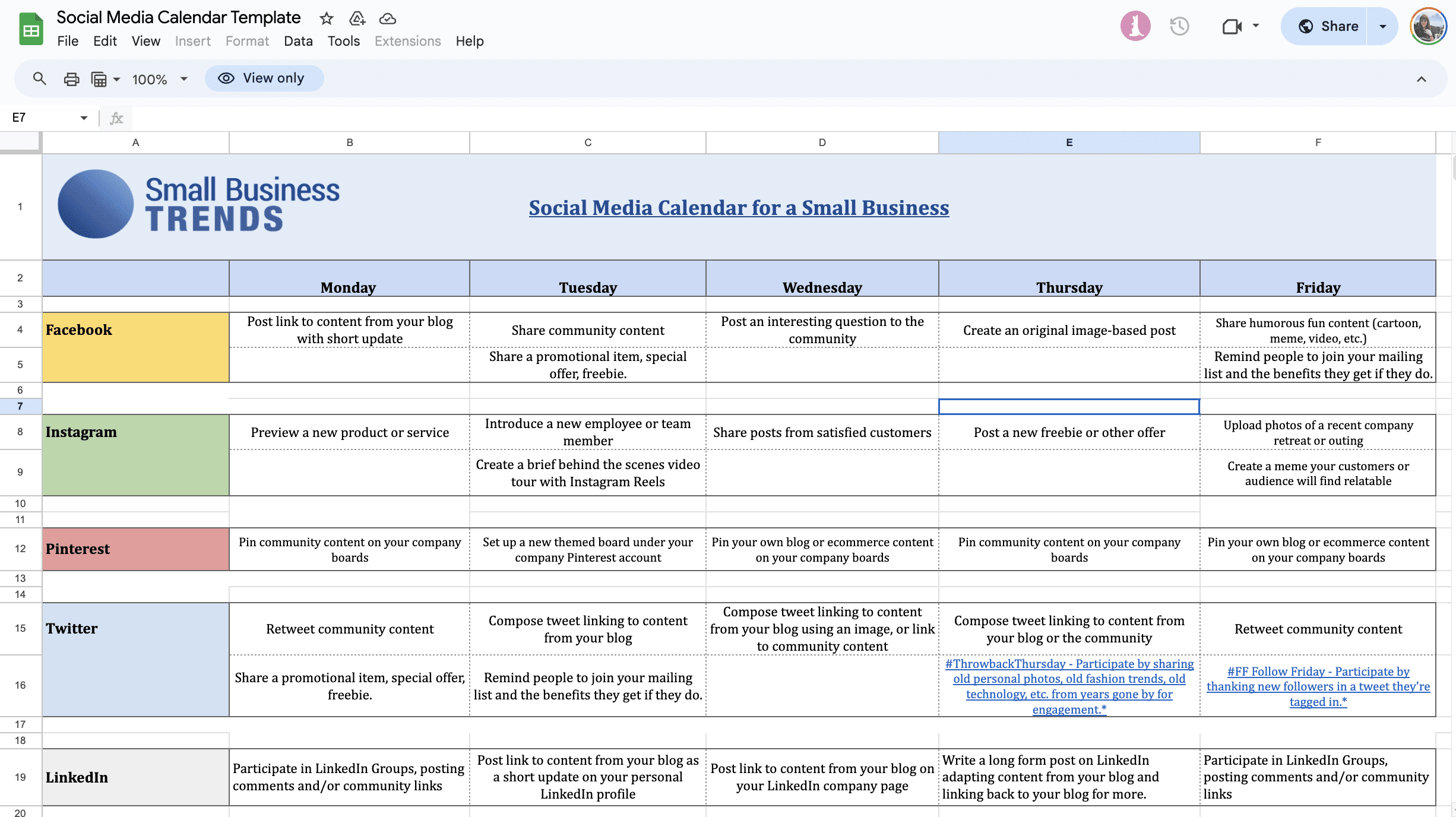
7. Small Business Trends Social Media Calendar Template

Screenshot of the best content calendar spreadsheet for 2024. The layout includes tabs for different platforms like Facebook, Instagram, Pinterest, Twitter, and LinkedIn with detailed daily posting strategies.Screenshot from SmallBizTrends.com, April 2024

The content calendar template from Small Business Trends is tailored specifically for – you guessed it – small businesses!

It draws from the company’s effective marketing strategies to help you streamline your social media and marketing efforts. It is available for download in various formats, including Word, Excel, and PDF, making it customizable for your business’s needs.

The template itself is fairly straightforward. It features a Monday to Friday overview of content across Facebook, Instagram, Pinterest, X (Twitter), LinkedIn, and TikTok, as well as a section for “All Platforms.”

It’s plug-and-play, meaning you would simply enter your plans for each channel, each day (and duplicate them week over week).

What we love about this template is that Small Business Trends offers suggestions throughout for what you might do that day. For example, “Share posts from satisfied customers” on Instagram on Wednesday, or “Have an unveiling of your latest product or service” on TikTok on Monday.

While not exhaustive, it’s a nice touch to help provide inspiration, especially for individuals and small businesses just getting started. We like this template for its simplicity and low learning curve.

  • Cost: Free.

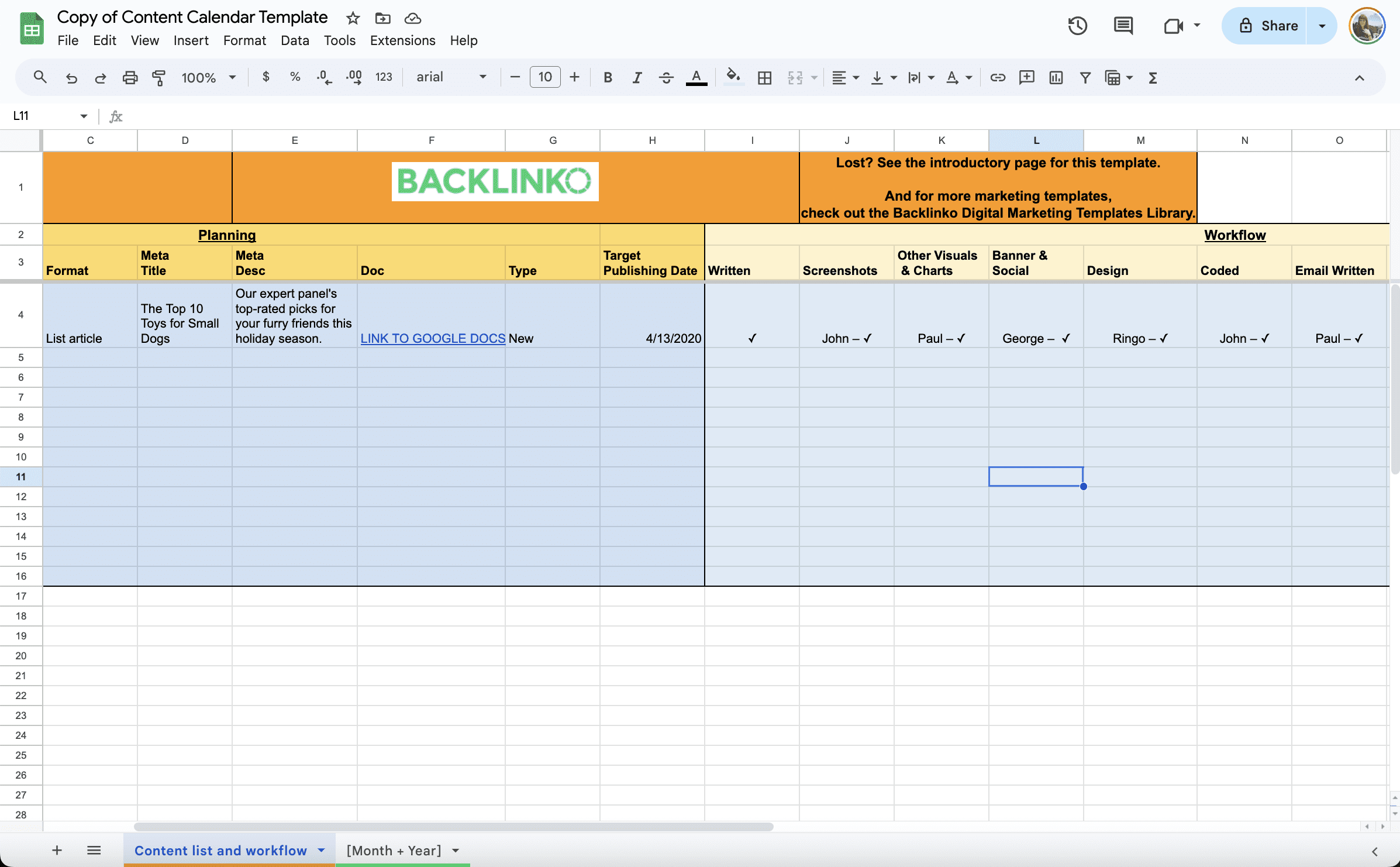
8. Backlinko Content Calendar Template

A screenshot of Backlinko content calendar template spreadsheet featuring columns for date, format, title, main message, tasks, owner, banner, design. Screenshot from Backlinko.com, April 2024

Backlinko offers a versatile, free content calendar template that’s a practical tool for both individuals and small teams looking to enhance their content production efforts.

Available as an Excel spreadsheet or a Google sheet, the template features two main components: a basic monthly calendar view and a more detailed content list and workflow sheet.

The monthly view offers a clean slate for basic scheduling, while the workflow tab is meticulously designed to guide users through the various stages of content creation (from drafting to publishing), making it particularly useful for managing multiple pieces simultaneously.

This is where the real strength of Backlinko’s template lies. The step-by-step guide to content development in the workflow tab covers everything from meta descriptions to design, email marketing, and more, ensuring everyone on your team stays on track with each piece of content.

  • Cost: Free.

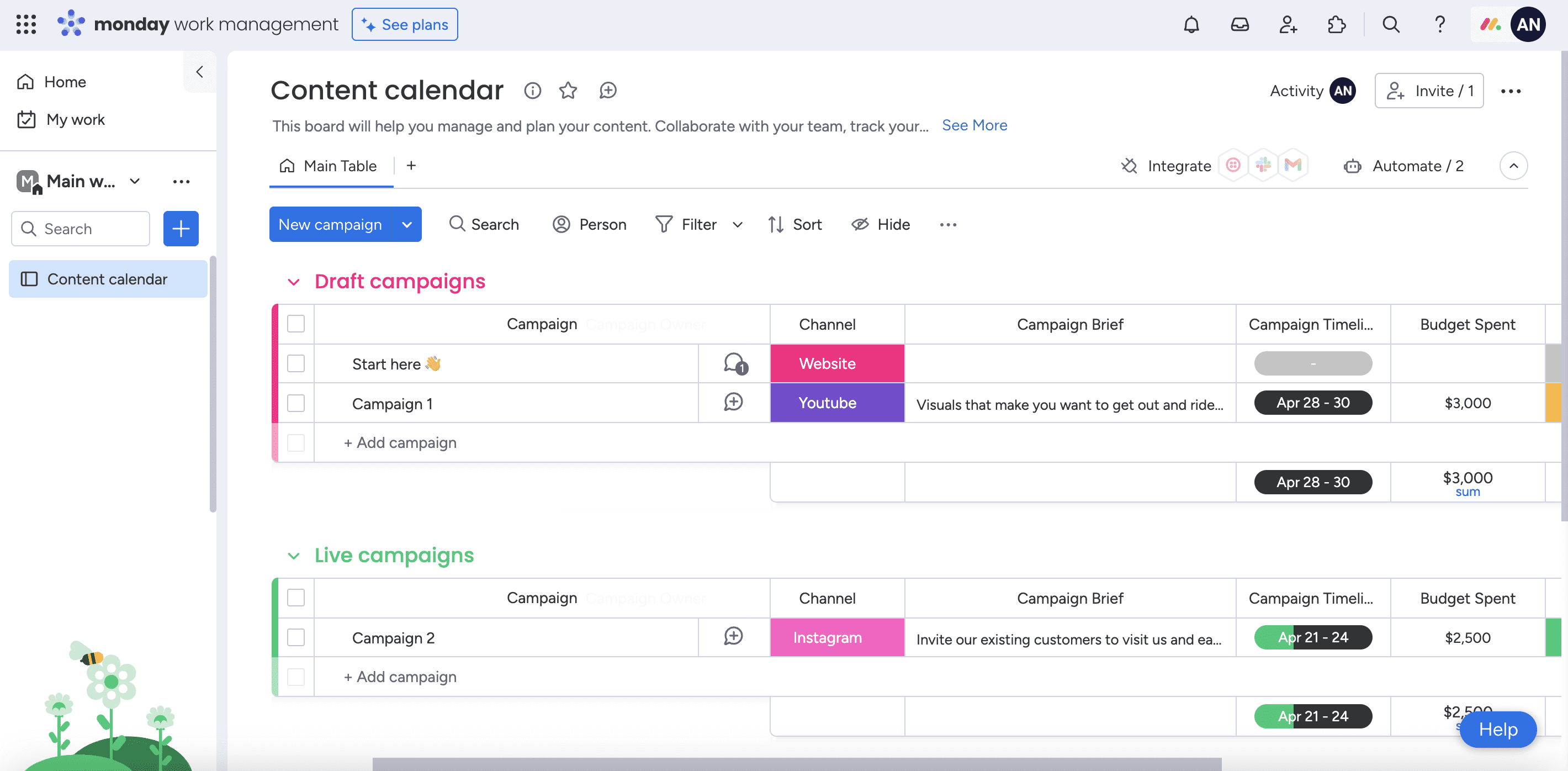
9. Monday.com Content Calendar Template

Screenshot of the Monday.com content calendar template showing different campaign stages and details like channel, campaign brief, timeline, and budget.Screenshot from Monday.com, April 2024

The Monday.com content calendar template is a nice option for teams that want to consolidate their content creation and distribution pipeline.

Simply dive into its versatile dashboard, and customize the template to align perfectly with your team’s operational flow.

Designed to support a ton of content types and phases – from the initial brainstorming to the final publishing stages – Monday.com’s template ensures every piece of content is tracked and managed efficiently across platforms.

It features a centralized content management system that allows users to assign tasks to essential team members such as writers, designers, and editors.

You have multiple viewing options, such as Gantt, calendar, Kanban, and form views. It also allows you to integrate with tools like Google Drive, Adobe Creative Cloud, and Dropbox.

In addition, you can access built-in automation for reminders and notifications to keep everyone on track.

This one is ideal for both small-scale projects and larger content operations, with its focus on efficiency and scalability.

  • Cost: Free – just sign up and get started.

How A Content Calendar Can Improve Your Content Planning

Effective content planning is crucial for elevating your marketing strategy.

If you want to take control of your marketing strategy and create impactful content that resonates with its target audience, a content calendar is for you.

As this article highlights, creating a content calendar doesn’t have to be complicated or arduous – especially when plenty of intuitive and powerful templates are already in place to get you started.

Explore our top picks, find your match, and set the stage for a year of impactful content creation. Happy planning!

More resources:


Featured Image: Andrey_Popov/Shutterstock

What is ‘Crawled – currently not indexed’ in Search Console?

Google Search Console (GSC) is a powerful tool for site owners. It helps you monitor and maintain your site’s presence in the SERPs. One of the common issues you might encounter is the “Crawled — currently not indexed” status. This message means that Google has crawled your page but hasn’t indexed it. As a result, your page won’t appear in search results, which can affect your site’s traffic.

It is important to understand why this happens and how to fix it. Here, we’ll explain the “Crawled — currently not indexed” status and provide tips to help you improve your site’s indexing and visibility.

What is “Crawled – Currently Not Indexed” in GSC?

The “Crawled — currently not indexed” status in Search Console means that Google has crawled your page but has not indexed it. This status indicates that while Google knows your page exists, it hasn’t added it to its search index. As a result, the page won’t appear in the SERPs.

This status can occur for several reasons. It might be due to content quality, technical issues, or even Google’s indexing process. Understanding why this happens is the first step in resolving the issue. By addressing the factors that lead to this status, you can improve your chances of getting your pages indexed and visible in search results.

An example of a site with many Crawled – currently not indexed errors in Google Search Console

But first…

Before we continue, you must understand the crawling and indexing process. In short, before your content can appear in search engine results, it goes through three key stages: crawling, indexing, and ranking.

Crawling

Search engines use automated bots called crawlers or spiders to discover new and updated pages. These bots follow links from known pages to new ones, exploring and recording the web’s content.

Indexing

After crawling, the search engine processes and stores the information it finds. It analyzes the content, keywords, and usability and then adds valuable pages to its index.

Ranking

When a user searches, the search engine retrieves relevant pages from its index and ranks them based on relevance, authority, and user experience. Higher-ranked pages appear at the top of search results, attracting more traffic.

If you have that error message, the process stalls during indexing. For reasons unknown, your content does not move on to the ranking phase.

Reasons why this happens

Many factors can cause the “Crawled – currently not indexed” status in Google Search Console. Google may determine your content isn’t valuable or unique enough to be indexed. Duplicate content or thin content with little value can lead to this status.

Technical problems can also prevent Google from indexing your pages. These issues might include server errors, incorrect robots.txt configuration, or the presence of noindex tags. A poorly organized website can make it difficult for Google to understand and index your content. The lack of a clear hierarchy and insufficient internal linking can contribute to this problem.

Sometimes, Google simply needs more time to index new or recently updated content. This is especially true for new websites or pages. Addressing these factors can improve your chances of getting your pages indexed and appearing in search results.

Google’s changing indexing priorities

There’s another aspect to all of this. Due to the vast amount of content generated daily, Google has become more critical and uses fewer resources to process new pages. With the rise of generative AI, there’s a significant overlap in content, leading Google to be more selective about what it indexes. The recent updates, including the Helpful Content Update and the March 2024 Core Update, reflect this shift.

This means you might mean you need to ask yourself the following question:

Why should Google even index your page?

Given the vast amount of similar content out there, Google needs a compelling reason to index your page. Here’s why your content should stand out:

  • Originality: Unique content that offers new insights or information is more likely to be indexed.
  • Value: Content that genuinely helps or informs users will be prioritized.
  • Quality: Google’s algorithms favor high-quality, well-written content with good structure and readability.

Tips to fix “Crawled – Currently Not Indexed”

Improving content quality, resolving technical issues, and optimizing your website’s structure is essential to address the “Crawled – currently not indexed” status.

Fix your content

Ensure your content is original and provides value to your audience. Avoid duplicate content. Cover topics thoroughly to offer in-depth information that meets user needs. Make your content as engaging and informative as possible.

Make sure your robots.txt file is not blocking Google from crawling your pages. Use Search Console to test your robots.txt file. If you want your pages indexed, verify that they do not have noindex tags. Use the Inspect URL tool in GSC to check. Resolve any 5xx server errors that may prevent Google from accessing your pages. Regularly monitor server logs for issues. Optimize crawling with Yoast SEOs tailored tools.

Improve your site structure

Organize your website with a clear structure, using categories and subcategories to help Google understand the relationships between your pages. Use internal links to connect related content and help Google navigate your site more effectively. Implement breadcrumb navigation to improve site structure and user experience.

Generate an XML sitemap that lists all the important pages on your website. This helps Google discover and crawl your pages more efficiently. Upload the XML sitemap Yoast SEO generates for your site to Search Console. This ensures that Google knows all your pages and can crawl them more easily.

Patience, please

Understand that indexing can take time, especially for new websites. Be patient and monitor your indexing status regularly. Regularly check Google Search Console for any issues related to crawling and indexing. Address any warnings or errors promptly. Keep track of changes you make to your site and monitor their impact on indexing and search visibility.

Additional best practices

Consider these additional SEO best practices to improve your indexing chances and enhance your site’s performance.

Add content regularly to keep your site relevant and valuable. Fresh content can attract more visitors and encourage Google to crawl your site more frequently. In addition, you should periodically review and update older content to ensure it remains accurate and useful.

Try to improve engagement on your site. Engaged users can signal to Google that your content is valuable. Promote your content on social media to increase visibility and drive traffic. Social signals can indirectly influence your SEO.

Ensure your site performs well on mobile devices. Google’s indexing processes work from a mobile perspective, so a good mobile user experience is crucial. Optimize your site’s loading speed. Faster pages provide a better user experience and can improve your search rankings.

Write guest posts for reputable websites in your niche. Quality backlinks from authoritative sites can boost your own site’s credibility. Create valuable content that others want to link to. Natural backlinks can improve your site’s authority and indexing.

Addressing the “Crawled – currently not indexed” status

Addressing the “Crawled – currently not indexed” status in Google Search Console is necessary if you want to improve your site’s visibility. Understanding the reasons behind this status and implementing practical solutions can enhance your chances of getting indexed.

Focus on improving content quality, resolving technical issues, and optimizing your website’s structure. Regularly update your content, engage with users, and monitor your site’s performance. These efforts will help you maintain a solid online presence and ensure your content reaches your audience.

Coming up next!

Noise-canceling headphones use AI to let a single voice through

Modern life is noisy. If you don’t like it, noise-canceling headphones can reduce the sounds in your environment. But they muffle sounds indiscriminately, so you can easily end up missing something you actually want to hear.

A new prototype AI system for such headphones aims to solve this. Called Target Speech Hearing, the system gives users the ability to select a person whose voice will remain audible even when all other sounds are canceled out.

Although the technology is currently a proof of concept, its creators say they are in talks to embed it in popular brands of noise-canceling earbuds and are also working to make it available for hearing aids.

“Listening to specific people is such a fundamental aspect of how we communicate and how we interact in the world with other humans,” says Shyam Gollakota, a professor at the University of Washington, who worked on the project. “But it can get really challenging, even if you don’t have any hearing loss issues, to focus on specific people when it comes to noisy situations.” 

The same researchers previously managed to train a neural network to recognize and filter out certain sounds, such as babies crying, birds tweeting, or alarms ringing. But separating out human voices is a tougher challenge, requiring much more complex neural networks.

That complexity is a problem when AI models need to work in real time in a pair of headphones with limited computing power and battery life. To meet such constraints, the neural networks needed to be small and energy efficient. So the team used an AI compression technique called knowledge distillation. This meant taking a huge AI model that had been trained on millions of voices (the “teacher”) and having it train a much smaller model (the “student”) to imitate its behavior and performance to the same standard.   

The student was then taught to extract the vocal patterns of specific voices from the surrounding noise captured by microphones attached to a pair of commercially available noise-canceling headphones.

To activate the Target Speech Hearing system, the wearer holds down a button on the headphones for several seconds while facing the person to be focused on. During this “enrollment” process, the system captures an audio sample from both headphones and uses this recording to extract the speaker’s vocal characteristics, even when there are other speakers and noises in the vicinity.

These characteristics are fed into a second neural network running on a microcontroller computer connected to the headphones via USB cable. This network runs continuously, keeping the chosen voice separate from those of other people and playing it back to the listener. Once the system has locked onto a speaker, it keeps prioritizing that person’s voice, even if the wearer turns away. The more training data the system gains by focusing on a speaker’s voice, the better its ability to isolate it becomes. 

For now, the system is only able to successfully enroll a targeted speaker whose voice is the only loud one present, but the team aims to make it work even when the loudest voice in a particular direction is not the target speaker.

Singling out a single voice in a loud environment is very tough, says Sefik Emre Eskimez, a senior researcher at Microsoft who works on speech and AI, but who did not work on the research. “I know that companies want to do this,” he says. “If they can achieve it, it opens up lots of applications, particularly in a meeting scenario.”

While speech separation research tends to be more theoretical than practical, this work has clear real-world applications, says Samuele Cornell, a researcher at Carnegie Mellon University’s Language Technologies Institute, who did not work on the research. “I think it’s a step in the right direction,” Cornell says. “It’s a breath of fresh air.”

That viral video showing a head transplant is a fake. But it might be real someday. 

An animated video posted this week has a voice-over that sounds like a late-night TV ad, but the pitch is straight out of the far future. The arms of an octopus-like robotic surgeon swirl, swiftly removing the head of a dying man and placing it onto a young, healthy body. 

This is BrainBridge, the animated video claims—“the world’s first revolutionary concept for a head transplant machine, which uses state-of-the-art robotics and artificial intelligence to conduct complete head and face transplantation.”

First posted on Tuesday, the video has millions of views, more than 24,000 comments on Facebook, and a content warning on TikTok for its grisly depictions of severed heads. A slick BrainBridge website has several job postings, including one for a “neuroscience team leader” and another for a “government relations adviser.” It is all convincing enough for the New York Post to announce that BrainBridge is “a biomedical engineering startup” and that “the company” plans a surgery within eight years. 

We can report that BrainBridge is not a real company—it’s not incorporated anywhere. The video was made by Hashem Al-Ghaili, a Yemeni science communicator and film director who in 2022 made a viral video called “EctoLife,” about artificial wombs, that also left journalists scrambling to determine if it was real or not.

Yet BrainBridge is not merely a provocative work of art. This video is better understood as the first public billboard for a hugely controversial scheme to defeat death that’s recently been gaining attention among some life-extension proponents and entrepreneurs. 

“It’s about recruiting newcomers to join the project,” says Al-Ghaili.

This morning, Al-Ghaili, who lives in Dubai, was up at 5 a.m., tracking the video as its viewership ballooned around social media. “I am monitoring its progress,” he says, but he insists he didn’t make the film for clicks: “Being viral is not the goal. I can be viral anytime. It’s pushing boundaries and testing feasibility.”

The video project was bankrolled in part by Alex Zhavoronkov, the founder of Insilico Medicine, a large AI drug discovery company, who is also a prominent figure in anti-aging research. After Zhavoronkov posted the video on his LinkedIn account, commenters noticed that it is his face on the two bodies shown in the video.

“I can confirm I helped design and fund a few things,” Zhavoronkov told MIT Technology Review in a WhatsApp message, in which he also claimed that “some important and famous people are supporting [it] financially.”

Zhavoronkov declined to name these individuals. He also didn’t respond when asked if the job ads—whose cookie-cutter descriptions of qualifications and responsibilities appear to have been written by an AI—are real roles or make-believe positions.

Aging bypass

What is certain is that head transplantation—or body transplant, as some prefer to call it—is a subject of growing, if speculative, interest in longevity circles, the kind inhabited by biohackers, techno-anarchists, and others on the fringes of biotechnology and the startup scene and who form the most dedicated cadre of extreme life-extensionists.

Many proponents of longer life spans will admit things don’t look good. Anti-aging medicine so far hasn’t achieved any breakthroughs. In fact, as research advances into the molecular details, the problem of death only looks more and more complicated. As we age, our billions of cells gradually succumb to the irreversible effects of entropy. Fixing that may never be possible.

By comparison, putting your head on a young body looks comparatively easy—a way to bypass aging in a single stroke, at least as long as your brain holds out. The idea was strongly endorsed in a technical road map put forward this year by the Longevity Biotech Fellowship, a group espousing radical life extension, which rated “body replacement” as the cheapest, fastest pathway to “solve aging.”  

Will head transplants work? In a crude way, they already have. In the early 1970s, the American neurosurgeon Robert White performed a “cephalic exchange,” cutting off the head of a monkey, placing it on the body of another, and sewing together their circulatory systems. Reports suggest the head remained conscious, and able to see, for a few days before it died.

Most likely, a human head transplant would also be fatal. But even if you lived, you’d be a mind atop a paralyzed body, since exchanging heads means severing the spinal cord. 

Yet head-swapping proponents can point to plausible solutions for that, too—a number of which appear in the BrainBridge video. In Europe, for instance, some paralyzed people have walked again after doctors bridged their spinal injuries with electronics. Other scientists in China are studying growth factors to regrow nerves.

Joined at the neck

As shocking as the video is, BrainBridge is in some ways overly conventional in its thinking. If you want to keep your brain going, why must it be on a human body? You might instead keep the head alive on a heart-lung machine—with an Elon Musk neural implant to let it surf the internet, for as long as it lives. Or consider how doctors hoping to solve the organ shortage have started putting hearts and kidneys from genetically engineered pigs into patients. If you don’t mind having a tail and four legs, maybe your head could be placed onto a pig’s body.

Let’s take it a step further. Why does the body “donor” have to be dead at all? Anatomically, it’s possible to have two heads. There are conjoined twins who share one body. If your spouse were diagnosed with a fatal cancer, you would surely welcome his or her head next to yours, if it allowed their mind to live on. After all, the concept of a “living donor” is widely accepted in transplant medicine already, and married couples are often said to be joined at the hip. Why not at the neck, too?

If the video is an attempt to take the public’s temperature and gauge reactions, it’s been successful. Since it was posted, thousands of commenters have explored the moral dilemmas posed by the procedure. For instance, if someone is left brain dead—say, in a motorcycle accident—surgeons can use their heart, liver, and kidneys to save multiple other people. Would it be ethical to use a body to help only one person?

“The most common question is ‘Where do you get the bodies from?’” says Al-Ghaili. The BrainBridge website answers this question by stating it will source “ethically grown” unconscious bodies from EctoLife, the artificial womb company that is Al-Ghaili’s previous fiction. He also suggests that people undergoing euthanasia because of chronic pain, or even psychiatric problems, could provide an additional supply. 

For the most part, the public seems to hate the idea. On Facebook, a pastor, Matthew. W. Tucker, called the concept “disgusting, immoral, unnecessary, pagan, demonic and outright idiotic,” adding that “they have no idea what they are doing.” A poster from the Middle East apologized for the video, joking that its creator “is one of our psychiatric patients who escaped last night.” “We urge the public to go about [their] business as everything is under control,” this person said.

Al-Ghaili is monitoring the feedback with interest and some concern. “The negativity is huge, to be honest,” he says. “But behind that are the ones who are sending emails. These are people who want to invest, or who are expressing their personal health challenges. These are the ones who matter.”

He says if suitable job applicants appear, the backers of BrainBridge are prepared to fund a small technical feasibility study to see if their idea has legs.

Favorite Books of Ecommerce Pros Q2 2024

With the plethora of ecommerce and technology books — Amazon offers hundreds of new and forthcoming titles for categories such as “starting a business” — it’s tough to isolate the gems.

Curious, I reached out to ecommerce and digital marketing pros, asking, “What books are the most informative, useful, and inspiring?”

More than 30 responded, including founders, owners, sales and marketing executives, and search-engine specialists from industries ranging from precision manufacturing to festival fashions, from Texas to Australia.

In all, they recommended more than 60 books across diverse ecommerce interests, including analytics, global marketing, web design, UX, leadership, personal development, and iconic brands such as Amazon, Zappos, and Nike.

Eight titles were clear favorites, with multiple enthusiastic endorsements.

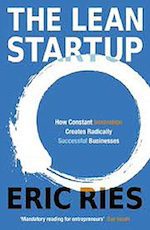
The Lean Startup: How Today’s Entrepreneurs Use Continuous Innovation to Create Radically Successful Businesses by Eric Reis

Cover of The Lean Startup

Lean Startup

Published in 2011, “The Lean Startup” remains a go-to resource for today’s entrepreneurs. A quote highlighted by 20,000 Kindle readers sums up its key message: “Lean thinking defines value as providing benefit to the customer; anything else is waste.” Brian Lim, who founded and operates three online retailers of rave and festival clothing, says Reis’s “validated learning” method of using data for decision-making “reduces the risks associated with launching new products and helps ensure that your business strategies are based on real customer feedback rather than assumptions.”

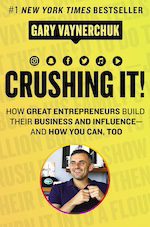
Crushing It! How Great Entrepreneurs Build Their Business and Influence — and How You Can, Too by Gary Vaynerchuk

Cover of Crushing It!

Crushing It!

One recommender, Victor Trasoff-Jilg, vice president of sales at Bombing Science, an online retailer of graffiti and art supplies, calls this “a motivational and practical guide for anyone looking to build their personal brand and leverage it for business success … both inspiring and actionable.” Vaynerchuk’s “Jab, Jab, Jab, Right Hook” also received mentions.

Hooked: How to Build Habit-Forming Products by Nir Eyal

Cover of Hooked

Hooked

Kayden Roberts, chief marketing officer of Camgo, a chat and dating app claiming more than 7 million users worldwide, says Hooked is “especially relevant for e-commerce businesses because it explores how to create a user experience that turns casual visitors into repeat customers… This is essential for e-commerce managers looking to enhance customer loyalty and drive long-term growth.”

SEO 2024: Learn search engine optimization with smart internet marketing strategies by Adam Clarke

Cover of SEO 2024

SEO 2024

Clarke updates his long-running, popular search engine optimization guide yearly. Respondents recommended both the 2022 and 2023 versions. The 2024 edition is now available.

Digital Marketing for Dummies by Ryan Diess and Russ Henneberry

Cover of Digital Marketing for Dummies

Digital Marketing for Dummies

Laviet Joaquin, head of marketing for TP-Link, a worldwide provider of consumer networking equipment, calls this “a must-read for every ecommerce business wanting to boost online visibility“— in other words, all online merchants!

Contagious: Why Things Catch On by Jonah Berger

Cover of Contagious

Contagious

Bonnie Ruan, chief product officer at Beska Mold, a manufacturer of precision machining parts, gives Berger’s book top marks because it “delves into why certain products and ideas become popular, and how you can use these insights to craft marketing strategies that encourage word-of-mouth sharing online.” Berger’s “Invisible Influence: The Hidden Forces that Shape Behavior” also received recommendations.

Influence: The Psychology of Persuasion by Robert Cialdini

Cover of Influence

Influence

This book has been a game-changer for our sales and marketing teams, helping us craft more effective messaging and build stronger relationships with our clients,” says Daniel Meursing, CEO of Premier Staff, an event staffing provider.

E-Commerce Evolved: The Essential Playbook to Build, Grow & Scale a Successful E-Commerce Business by Tanner Larsson

Cover of Ecommerce Evolved

Ecommerce Evolved

Trasoff-Jilg of Bombing Science calls this book “particularly valuable for its in-depth look at creating a sustainable ecommerce operation, not just quick wins.”

Google Confirms: No Algorithmic Actions For Site Reputation Abuse Yet via @sejournal, @MattGSouthern

Google’s Search Liaison, Danny Sullivan, has confirmed that the search engine hasn’t launched algorithmic actions targeting site reputation abuse.

This clarification addresses speculation within the SEO community that recent traffic drops are related to Google’s previously announced policy update.

Sullivan Says No Update Rolled Out

Lily Ray, an SEO professional, shared a screenshot on Twitter showing a significant drop in traffic for the website Groupon starting on May 6.

Ray suggested this was evidence that Google had begun rolling out algorithmic penalties for sites violating the company’s site reputation abuse policy.

However, Sullivan quickly stepped in, stating:

“We have not gone live with algorithmic actions on site reputation abuse. I well imagine when we do, we’ll be very clear about that. Publishers seeing changes and thinking it’s this — it’s not — results change all the time for all types of reasons.”

Sullivan added that when the actions are rolled out, they will only impact specific content, not entire websites.

This is an important distinction, as it suggests that even if a site has some pages manually penalized, the rest of the domain can rank normally.

Background On Google’s Site Reputation Abuse Policy

Earlier this year, Google announced a new policy to combat what it calls “site reputation abuse.”

This refers to situations where third-party content is published on authoritative domains with little oversight or involvement from the host site.

Examples include sponsored posts, advertorials, and partner content that is loosely related to or unrelated to a site’s primary purpose.

Under the new policy, Google is taking manual action against offending pages and plans to incorporate algorithmic detection.

What This Means For Publishers & SEOs

While Google hasn’t launched any algorithmic updates related to site reputation abuse, the manual actions have publishers on high alert.

Those who rely heavily on sponsored content or partner posts to drive traffic should audit their sites and remove any potential policy violations.

Sullivan’s confirmation that algorithmic changes haven’t occurred may provide temporary relief.

Additionally, his statements also serve as a reminder that significant ranking fluctuations can happen at any time due to various factors, not just specific policy rollouts.


FAQ

Will Google’s future algorithmic actions impact entire websites or specific content?

When Google eventually rolls out algorithmic actions for site reputation abuse, these actions will target specific content rather than the entire website.

This means that if certain pages are found to be in violation, only those pages will be affected, allowing other parts of the site to continue ranking normally.

What should publishers and SEOs do in light of Google’s site reputation abuse policy?

Publishers and SEO professionals should audit their sites to identify and remove any content that may violate Google’s site reputation abuse policy.

This includes sponsored posts and partner content that doesn’t align with the site’s primary purpose. Taking these steps can mitigate the risk of manual penalties from Google.

What is the context of the recent traffic drops seen in the SEO community?

Google claims the recent drops for coupon sites aren’t linked to any algorithmic actions for site reputation abuse. Traffic fluctuations can occur for various reasons and aren’t always linked to a specific algorithm update.


Featured Image: sockagphoto/Shutterstock