Modern life is noisy. If you don’t like it, noise-canceling headphones can reduce the sounds in your environment. But they muffle sounds indiscriminately, so you can easily end up missing something you actually want to hear.
A new prototype AI system for such headphones aims to solve this. Called Target Speech Hearing, the system gives users the ability to select a person whose voice will remain audible even when all other sounds are canceled out.
Although the technology is currently a proof of concept, its creators say they are in talks to embed it in popular brands of noise-canceling earbuds and are also working to make it available for hearing aids.
“Listening to specific people is such a fundamental aspect of how we communicate and how we interact in the world with other humans,” says Shyam Gollakota, a professor at the University of Washington, who worked on the project. “But it can get really challenging, even if you don’t have any hearing loss issues, to focus on specific people when it comes to noisy situations.”
The same researchers previously managed to train a neural network to recognize and filter out certain sounds, such as babies crying, birds tweeting, or alarms ringing. But separating out human voices is a tougher challenge, requiring much more complex neural networks.
That complexity is a problem when AI models need to work in real time in a pair of headphones with limited computing power and battery life. To meet such constraints, the neural networks needed to be small and energy efficient. So the team used an AI compression technique called knowledge distillation. This meant taking a huge AI model that had been trained on millions of voices (the “teacher”) and having it train a much smaller model (the “student”) to imitate its behavior and performance to the same standard.
The student was then taught to extract the vocal patterns of specific voices from the surrounding noise captured by microphones attached to a pair of commercially available noise-canceling headphones.
To activate the Target Speech Hearing system, the wearer holds down a button on the headphones for several seconds while facing the person to be focused on. During this “enrollment” process, the system captures an audio sample from both headphones and uses this recording to extract the speaker’s vocal characteristics, even when there are other speakers and noises in the vicinity.
These characteristics are fed into a second neural network running on a microcontroller computer connected to the headphones via USB cable. This network runs continuously, keeping the chosen voice separate from those of other people and playing it back to the listener. Once the system has locked onto a speaker, it keeps prioritizing that person’s voice, even if the wearer turns away. The more training data the system gains by focusing on a speaker’s voice, the better its ability to isolate it becomes.
For now, the system is only able to successfully enroll a targeted speaker whose voice is the only loud one present, butthe team aims to make it work even when the loudest voice in a particular direction is not the target speaker.
Singling out a single voice in a loud environment is very tough, says Sefik Emre Eskimez, a senior researcher at Microsoft who works on speech and AI, but who did not work on the research. “I know that companies want to do this,” he says. “If they can achieve it, it opens up lots of applications, particularly in a meeting scenario.”
While speech separation research tends to be more theoretical than practical, this work has clear real-world applications, says Samuele Cornell, a researcher at Carnegie Mellon University’s Language Technologies Institute, who did not work on the research. “I think it’s a step in the right direction,” Cornell says. “It’s a breath of fresh air.”
An animated video posted this week has a voice-over that sounds like a late-night TV ad, but the pitch is straight out of the far future. The arms of an octopus-like robotic surgeon swirl, swiftly removing the head of a dying man and placing it onto a young, healthy body.
This is BrainBridge, the animated video claims—“the world’s first revolutionary concept for a head transplant machine, which uses state-of-the-art robotics and artificial intelligence to conduct complete head and face transplantation.”
First posted on Tuesday, the video has millions of views, more than 24,000 comments on Facebook, and a content warning on TikTok for its grisly depictions of severed heads. A slick BrainBridge website has several job postings, including one for a “neuroscience team leader” and another for a “government relations adviser.” It is all convincing enough for the New York Post to announce that BrainBridge is “a biomedical engineering startup” and that “the company” plans a surgery within eight years.
We can report that BrainBridge is not a real company—it’s not incorporated anywhere. The video was made by Hashem Al-Ghaili, a Yemeni science communicator and film director who in 2022 made a viral video called “EctoLife,” about artificial wombs, that also left journalists scrambling to determine if it was real or not.
Yet BrainBridge is not merely a provocative work of art. This video is better understood as the first public billboard for a hugely controversial scheme to defeat death that’s recently been gaining attention among some life-extension proponents and entrepreneurs.
“It’s about recruiting newcomers to join the project,” says Al-Ghaili.
This morning, Al-Ghaili, who lives in Dubai, was up at 5 a.m., tracking the video as its viewership ballooned around social media. “I am monitoring its progress,” he says, but he insists he didn’t make the film for clicks: “Being viral is not the goal. I can be viral anytime. It’s pushing boundaries and testing feasibility.”
The video project was bankrolled in part by Alex Zhavoronkov, the founder of Insilico Medicine, a large AI drug discovery company, who is also a prominent figure in anti-aging research. After Zhavoronkov posted the video on his LinkedIn account, commenters noticed that it is his face on the two bodies shown in the video.
“I can confirm I helped design and fund a few things,” Zhavoronkov told MIT Technology Review in a WhatsApp message, in which he also claimed that “some important and famous people are supporting [it] financially.”
Zhavoronkov declined to name these individuals. He also didn’t respond when asked if the job ads—whose cookie-cutter descriptions of qualifications and responsibilities appear to have been written by an AI—are real roles or make-believe positions.
Aging bypass
What is certain is that head transplantation—or body transplant, as some prefer to call it—is a subject of growing, if speculative, interest in longevity circles, the kind inhabited by biohackers, techno-anarchists, and others on the fringes of biotechnology and the startup scene and who form the most dedicated cadre of extreme life-extensionists.
Many proponents of longer life spans will admit things don’t look good. Anti-aging medicine so far hasn’t achieved any breakthroughs. In fact, as research advances into the molecular details, the problem of death only looks more and more complicated. As we age, our billions of cells gradually succumb to the irreversible effects of entropy. Fixing that may never be possible.
By comparison, putting your head on a young body looks comparatively easy—a way to bypass aging in a single stroke, at least as long as your brain holds out. The idea was strongly endorsed in a technical road map put forward this year by the Longevity Biotech Fellowship, a group espousing radical life extension, which rated “body replacement” as the cheapest, fastest pathway to “solve aging.”
Will head transplants work? In a crude way, they already have. In the early 1970s, the American neurosurgeon Robert White performed a “cephalic exchange,” cutting off the head of a monkey, placing it on the body of another, and sewing together their circulatory systems. Reports suggest the head remained conscious, and able to see, for a few days before it died.
Most likely, a human head transplant would also be fatal. But even if you lived, you’d be a mind atop a paralyzed body, since exchanging heads means severing the spinal cord.
Yet head-swapping proponents can point to plausible solutions for that, too—a number of which appear in the BrainBridge video. In Europe, for instance, some paralyzed people have walked again after doctors bridged their spinal injuries with electronics. Other scientists in China are studying growth factors to regrow nerves.
Joined at the neck
As shocking as the video is, BrainBridge is in some ways overly conventional in its thinking. If you want to keep your brain going, why must it be on a human body? You might instead keep the head alive on a heart-lung machine—with an Elon Musk neural implant to let it surf the internet, for as long as it lives. Or consider how doctors hoping to solve the organ shortage have started putting hearts and kidneys from genetically engineered pigs into patients. If you don’t mind having a tail and four legs, maybe your head could be placed onto a pig’s body.
Let’s take it a step further. Why does the body “donor” have to be dead at all? Anatomically, it’s possible to have two heads. There are conjoined twins who share one body. If your spouse were diagnosed with a fatal cancer, you would surely welcome his or her head next to yours, if it allowed their mind to live on. After all, the concept of a “living donor” is widely accepted in transplant medicine already, and married couples are often said to be joined at the hip. Why not at the neck, too?
If the video is an attempt to take the public’s temperature and gauge reactions, it’s been successful. Since it was posted, thousands of commenters have explored the moral dilemmas posed by the procedure. For instance, if someone is left brain dead—say, in a motorcycle accident—surgeons can use their heart, liver, and kidneys to save multiple other people. Would it be ethical to use a body to help only one person?
“The most common question is ‘Where do you get the bodies from?’” says Al-Ghaili. The BrainBridge website answers this question by stating it will source “ethically grown” unconscious bodies from EctoLife, the artificial womb company that is Al-Ghaili’s previous fiction. He also suggests that people undergoing euthanasia because of chronic pain, or even psychiatric problems, could provide an additional supply.
For the most part, the public seems to hate the idea. On Facebook, a pastor, Matthew. W. Tucker, called the concept “disgusting, immoral, unnecessary, pagan, demonic and outright idiotic,” adding that “they have no idea what they are doing.” A poster from the Middle East apologized for the video, joking that its creator “is one of our psychiatric patients who escaped last night.” “We urge the public to go about [their] business as everything is under control,” this person said.
Al-Ghaili is monitoring the feedback with interest and some concern. “The negativity is huge, to be honest,” he says. “But behind that are the ones who are sending emails. These are people who want to invest, or who are expressing their personal health challenges. These are the ones who matter.”
He says if suitable job applicants appear, the backers of BrainBridge are prepared to fund a small technical feasibility study to see if their idea has legs.
With the plethora of ecommerce and technology books — Amazon offers hundreds of new and forthcoming titles for categories such as “starting a business” — it’s tough to isolate the gems.
Curious, I reached out to ecommerce and digital marketing pros, asking, “What books are the most informative, useful, and inspiring?”
More than 30 responded, including founders, owners, sales and marketing executives, and search-engine specialists from industries ranging from precision manufacturing to festival fashions, from Texas to Australia.
In all, they recommended more than 60 books across diverse ecommerce interests, including analytics, global marketing, web design, UX, leadership, personal development, and iconic brands such as Amazon, Zappos, and Nike.
Eight titles were clear favorites, with multiple enthusiastic endorsements.
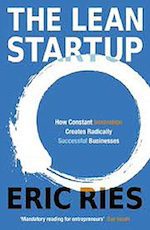
Published in 2011, “The Lean Startup” remains a go-to resource for today’s entrepreneurs. A quote highlighted by 20,000 Kindle readers sums up its key message: “Lean thinking defines value as providing benefit to the customer; anything else is waste.” Brian Lim, who founded and operates three online retailers of rave and festival clothing, says Reis’s “validated learning” method of using data for decision-making “reduces the risks associated with launching new products and helps ensure that your business strategies are based on real customer feedback rather than assumptions.”
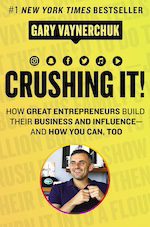
One recommender, Victor Trasoff-Jilg, vice president of sales at Bombing Science, an online retailer of graffiti and art supplies, calls this “a motivational and practical guide for anyone looking to build their personal brand and leverage it for business success … both inspiring and actionable.” Vaynerchuk’s “Jab, Jab, Jab, Right Hook” also received mentions.
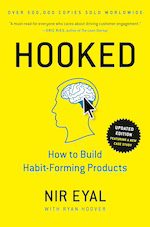
Kayden Roberts, chief marketing officer of Camgo, a chat and dating app claiming more than 7 million users worldwide, says Hooked is “especially relevant for e-commerce businesses because it explores how to create a user experience that turns casual visitors into repeat customers… This is essential for e-commerce managers looking to enhance customer loyalty and drive long-term growth.”
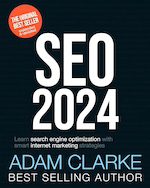
Clarke updates his long-running, popular search engine optimization guide yearly. Respondents recommended both the 2022 and 2023 versions. The 2024 edition is now available.
Laviet Joaquin, head of marketing for TP-Link, a worldwide provider of consumer networking equipment, calls this “a must-read for every ecommerce business wanting to boost online visibility“— in other words, all online merchants!
Bonnie Ruan, chief product officer at Beska Mold, a manufacturer of precision machining parts, gives Berger’s book top marks because it “delves into why certain products and ideas become popular, and how you can use these insights to craft marketing strategies that encourage word-of-mouth sharing online.” Berger’s “Invisible Influence: The Hidden Forces that Shape Behavior” also received recommendations.
“This book has been a game-changer for our sales and marketing teams, helping us craft more effective messaging and build stronger relationships with our clients,” says Daniel Meursing, CEO of Premier Staff, an event staffing provider.
Trasoff-Jilg of Bombing Science calls this book “particularly valuable for its in-depth look at creating a sustainable ecommerce operation, not just quick wins.”
Google’s Search Liaison, Danny Sullivan, has confirmed that the search engine hasn’t launched algorithmic actions targeting site reputation abuse.
This clarification addresses speculation within the SEO community that recent traffic drops are related to Google’s previously announced policy update.
Sullivan Says No Update Rolled Out
Lily Ray, an SEO professional, shared a screenshot on Twitter showing a significant drop in traffic for the website Groupon starting on May 6.
Ray suggested this was evidence that Google had begun rolling out algorithmic penalties for sites violating the company’s site reputation abuse policy.
However, Sullivan quickly stepped in, stating:
“We have not gone live with algorithmic actions on site reputation abuse. I well imagine when we do, we’ll be very clear about that. Publishers seeing changes and thinking it’s this — it’s not — results change all the time for all types of reasons.”
We have not gone live with algorithmic actions on site reputation abuse. I well imagine when we do, we’ll be very clear about that. Publishers seeing changes and thinking it’s this — it’s not — results change all the time for all types of reasons. The actions currently only…
— Google SearchLiaison (@searchliaison) May 23, 2024
Sullivan added that when the actions are rolled out, they will only impact specific content, not entire websites.
This is an important distinction, as it suggests that even if a site has some pages manually penalized, the rest of the domain can rank normally.
I don’t know what that chart is based on. Third-party visibility stats? Or is this data from each site reported directly from Search Console? But beyond that, again, we’ve not added an algorithmic component for site reputation abuse. What I said in my original response is still…
— Google SearchLiaison (@searchliaison) May 23, 2024
Background On Google’s Site Reputation Abuse Policy
Earlier this year, Google announced a new policy to combat what it calls “site reputation abuse.”
This refers to situations where third-party content is published on authoritative domains with little oversight or involvement from the host site.
Examples include sponsored posts, advertorials, and partner content that is loosely related to or unrelated to a site’s primary purpose.
Under the new policy, Google is taking manual action against offending pages and plans to incorporate algorithmic detection.
What This Means For Publishers & SEOs
While Google hasn’t launched any algorithmic updates related to site reputation abuse, the manual actions have publishers on high alert.
Those who rely heavily on sponsored content or partner posts to drive traffic should audit their sites and remove any potential policy violations.
Sullivan’s confirmation that algorithmic changes haven’t occurred may provide temporary relief.
Additionally, his statements also serve as a reminder that significant ranking fluctuations can happen at any time due to various factors, not just specific policy rollouts.
FAQ
Will Google’s future algorithmic actions impact entire websites or specific content?
When Google eventually rolls out algorithmic actions for site reputation abuse, these actions will target specific content rather than the entire website.
This means that if certain pages are found to be in violation, only those pages will be affected, allowing other parts of the site to continue ranking normally.
What should publishers and SEOs do in light of Google’s site reputation abuse policy?
Publishers and SEO professionals should audit their sites to identify and remove any content that may violate Google’s site reputation abuse policy.
This includes sponsored posts and partner content that doesn’t align with the site’s primary purpose. Taking these steps can mitigate the risk of manual penalties from Google.
What is the context of the recent traffic drops seen in the SEO community?
Google claims the recent drops for coupon sites aren’t linked to any algorithmic actions for site reputation abuse. Traffic fluctuations can occur for various reasons and aren’t always linked to a specific algorithm update.
In its nearly 20 years of existence, Reddit has built a robust, dynamic, and highly engaged community.
It has cemented itself as not only one of the key influencers for the internet culture we have come to know today, but also as one of the top 10 social media sites in the world, with more than 500,000 monthly visitors across more than 100,000 active communities.
Despite its size and influence, marketers have long avoided, overlooked, and failed to establish a presence on what is arguably one of the most influential social media sites today.
To be fair, Reddit has always been known as one of the hardest communities to have marketing success with, requiring months (if not years) of dedicated commitment to actually being a part of the community and engaging with your audience through meaningful, genuine, and honest interactions.
To many, that is just too much risk and too much work, but let’s be honest – most amazing things take risk and hard work. And for all of you who put in that work to be successful on Reddit, you already see the payoff it brings.
Regardless of the reasons, marketers who continue to overlook Reddit’s potential are missing out on an extremely influential community with ideal targeted demographics, where authenticity and genuine connections lead to valuable information, positive branding, and marketing success.
Not convinced? Let’s take a closer look at Reddit!
Reddit Stats You Cannot Ignore
Reddit users are dedicated to their use of the platform, with a reported 73.1 million (14.6%) of its 500 million users visiting the site daily, sharing over 1 billion posts, with over 16 billion comments across 100,000+ active communities, making it easily one of the top visited and most active sites in the United States today.
The user base is so loyal that they spend, on average, 20 minutes on the platform each day (and over 45 minutes a day for long-time users of more than 7 years) and, in many cases, are inactive on other social platforms.
This makes Reddit one of the only places to actually get in front of this massive audience, with 32% being inactive on Facebook, 37% on Instagram, 41% on TikTok, and 53% on X.
When it comes to demographics, a 2019 survey concluded that the overall Reddit audience was majority male (59%), ranged in age (36% aged 18-29; 25% aged 30-49), and well educated (42% college degree; 31% some college) making them an ideal audience many businesses looking for success.
They also helped Reddit improve revenues by 21% to $804 million in 2023, with a global addressable market for advertising estimated at $1.4 trillion by 2027.
Thought by many to be mostly a North American audience, Reddit claims more than 50% of its traffic comes from international users, a rather impressive climb from its earlier years.
It is important to remember, though, that Reddit is a platform that allows communities to grow and thrive, so those demographics change from subreddit to subreddit.
If that isn’t enough to grab your attention, surveys have found that 75% of users find Reddit a trustworthy source for making purchasing decisions.
For years now, it has been included heavily and prominently in Google search results, which have become even more visible due to reports following their inclusion in SGE results and with Google’s recent $60 million a year deal with Reddit to have real-time access to Reddit content and to use its content to train Google’s future AI models.
Speaking of Reddit’s visibility in Google’s search results, let’s take a closer look at why that deal is so important, especially to search marketers.
Reddit In Google Search, SGE, And Google’s Reddit Deal
For years, Reddit results have been prominently displayed in Google’s search results – so much so that users have even started adding the term “reddit” to the end of their search queries.
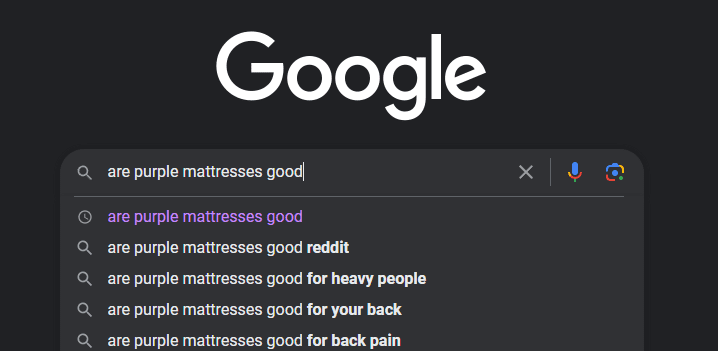
So often, you will see Google suggest search lines with the term “reddit” prefilled at the end.
Screenshot by author from search for [are purple mattresses good], Google, May 2024
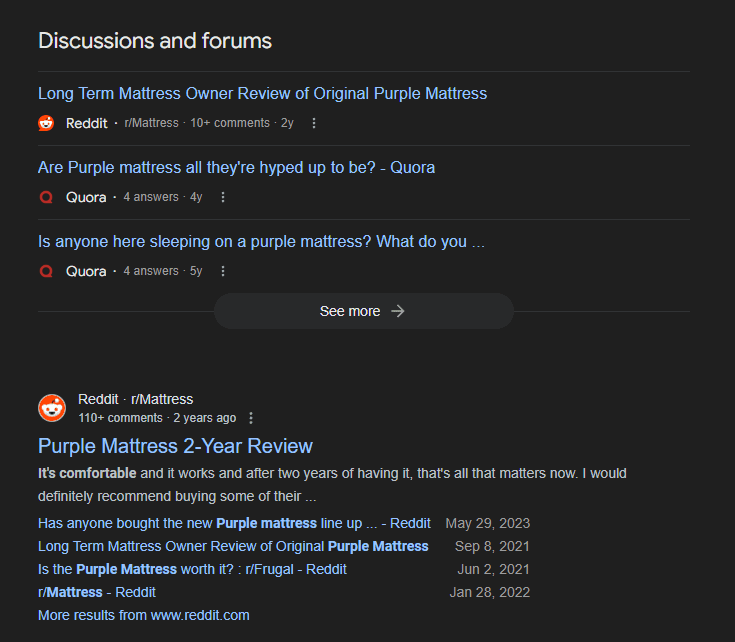
Even without selecting the query that includes “reddit,” you will notice Reddit’s prominent placement in two places: discussions and forums, and Reddit sitelinks, which are both just below the ads and the first organic result.
Screenshot by author from search for [are purple mattresses good], Google, May 2024
This was amplified by Google’s recent Helpful Content Update (HCU), which allowed platforms like Reddit and other forums to show up more frequently in search results,
Reddit’s ability to be helpful in satisfying a user’s search for information is so successful – in combination with reported shortages in new content for AI models from all major platforms – it is not surprising Google struck a deal with Reddit to show its content faster in search results and to use the content in training future AI models.
Since news of the deal between Reddit and Google was reported, there has been a lot of additional focus on Reddit’s visibility in Google’s search results.
Experts throughout the search industry report an increase in not only the total visibility of Reddit going up within search but also the speed at which a Reddit post is indexed and shown to users.
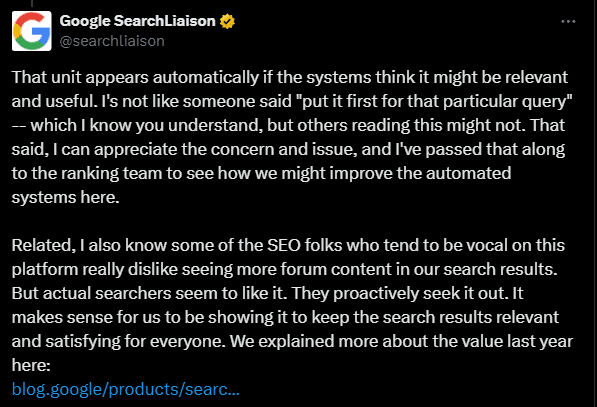
Google responded to concerns about Reddit showing up more in search results, saying that “some of the SEO folks who tend to be vocal on this platform (X) really dislike seeing more forum content in our search results. But actual searchers seem to like it. They proactively seek it out. It makes sense for us to be showing it to keep the search results relevant and satisfying for everyone.”
Adding to the deal Reddit made with Google, it was recently reported that OpenAI has partnered with Reddit to surface their content in ChatGPT, adding to the clear value that both OpenAI and Google see in Reddit’s content today and in the future.
Of course, this has sparked a lot of interest in companies of all sizes. They want to figure out how their brands can participate and succeed on Reddit in hopes of increasing their visibility in Google’s search results, SGE, and ChatGPT and building their brand’s visibility amongst one of the most influential audiences on the internet today.
**Quick warning: Reddit requires genuine, long-term engagement and a strategy for success. So, I would definitely advise individuals and businesses to avoid trying to game, spam, or blindly jump into marketing on Reddit and take the time to really understand the platform, its audience, and your place of value within its communities.
Let’s look at how some major brands have been successful on Reddit in the past.
noosa Yoghurt
Noosa Yoghurt’s 2021 back-to-school campaign on Reddit was a great example of tapping into niche audiences to create engaging, user-driven content.
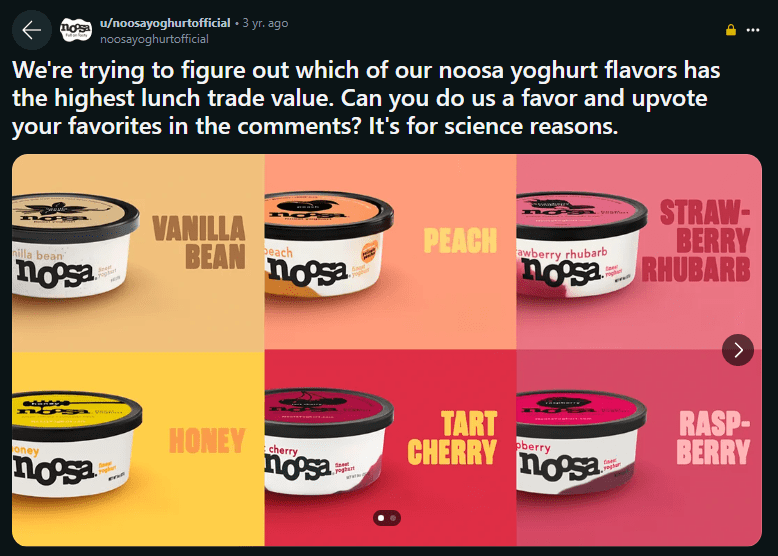
To capitalize on Reddit’s community of vocal yogurt enthusiasts, noosa launched a Flavor Poll that invited Redditors to upvote their favorite noosa flavors in the comments. This created a sense of community and interactivity around what could have been a standard poll.
Screenshot by author from Reddit, May 2024
After tallying the upvotes, noosa published a Promoted Post that showcased the results using a sleek custom infographic, highlighting the community’s favorites while also giving the brand important insight into consumer preferences.
Screenshot by author from Reddit, May 2024
The results:
49% increase in brand recall among Reddit users who were exposed to the campaign.
30% increase in brand favorability.
39% increase in purchase intent (15X the typical lift observed in the food vertical).
50+ billion monthly views.
Sony Pictures Germany
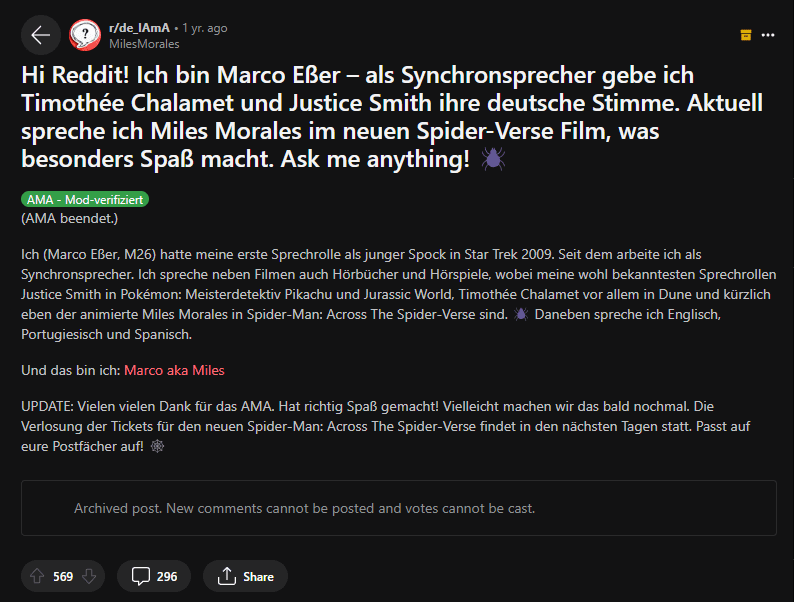
To drum up excitement around the release of “Spider-Man: Across the Spider-Verse” in Germany, Sony Pictures Germany crafted a Reddit campaign that combined organic and promoted content to engage the platform’s robust fan communities.
The brand created a Reddit account under the protagonist’s name, u/MilesMorales, and used it to share exclusive content directly within Spiderman-related subreddits.
It also organized an AMA with the German voice actor Miles Morales to create a more personal connection with fans and promoted video posts featuring the movie trailer to amplify the excitement.
Screenshot by author from Reddit, May 2024
The results:
Sony Pictures Germany achieved a click-through rate (CTR) that was 344% higher than that of its standard paid media.
831 upvotes.
618,000 impressions.
The film remained No. 1 on the German movie charts for three consecutive weeks.
It is important to note that promoting your content and your brand on Reddit is definitely not the only value Reddit can bring you and your business.
Reddit is an amazing place to get honest feedback.
Whether you are trying to figure out what your target audience wants from your brand, test out a new feature or concept before investing and launching it openly, or even just to have continued open communication with your customers to support them and keep them connected to your brand, Reddit can help you succeed in an amazing way.
Transamerica Helping Reddit Make Dollars Make Sense
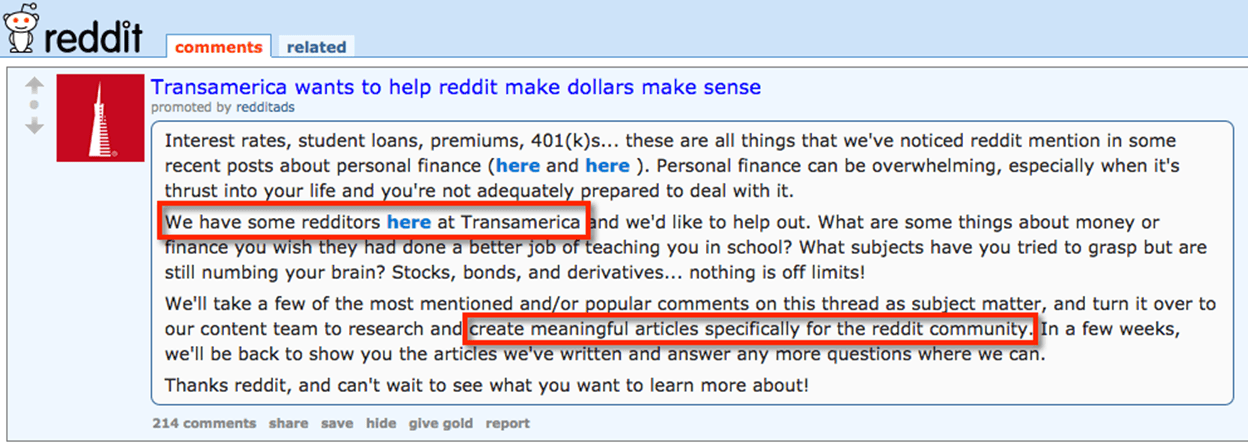
Transamerica’s campaign on Reddit is a great example of a company identifying an opportunity to connect with its target audience on the subreddit /r/finance.
This allows the company to better understand its customers’ needs and focus on content creation and future marketing plans.
Screenshot by author from Reddit, May 2024
Aligning itself with its audience by demonstrating awareness of the topics around personal finance happening in the subreddit, as well as acknowledging the Redditors working at the company, it asked what topics it could create “specifically for the reddit community” around the topic of finance.
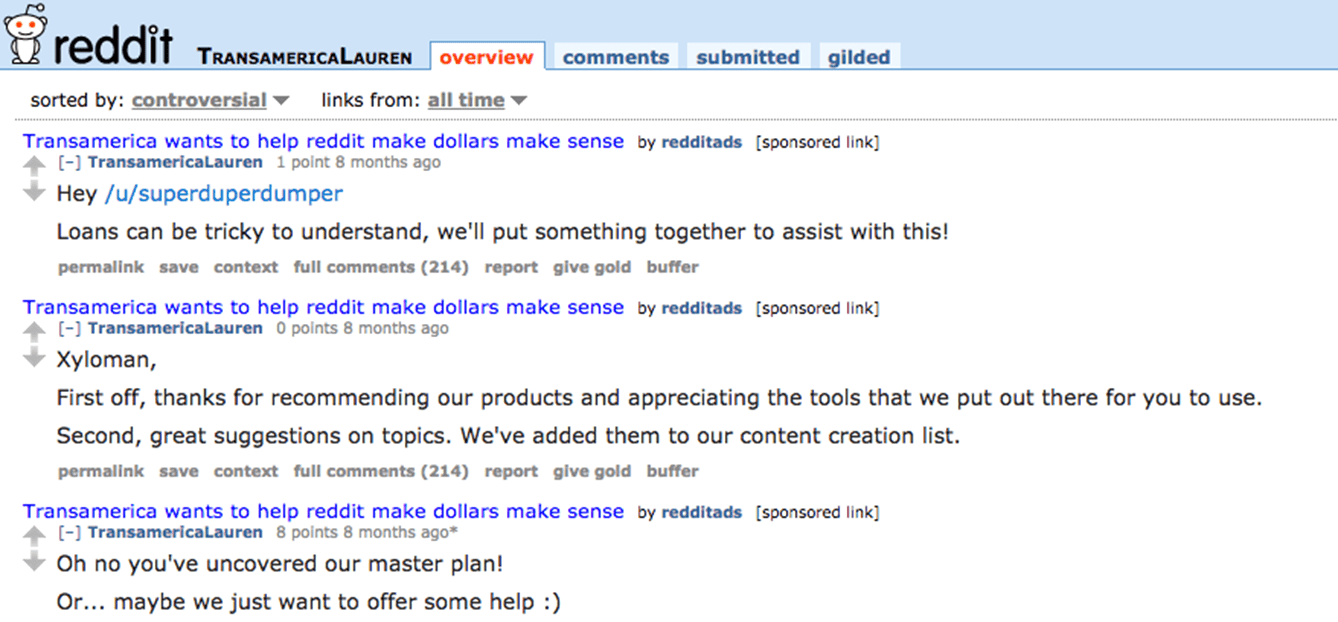
It stayed involved and engaged throughout the campaign, responding to threads and maintaining a lighthearted and sometimes humorous tone.
Screenshot by author from Reddit, May 2024
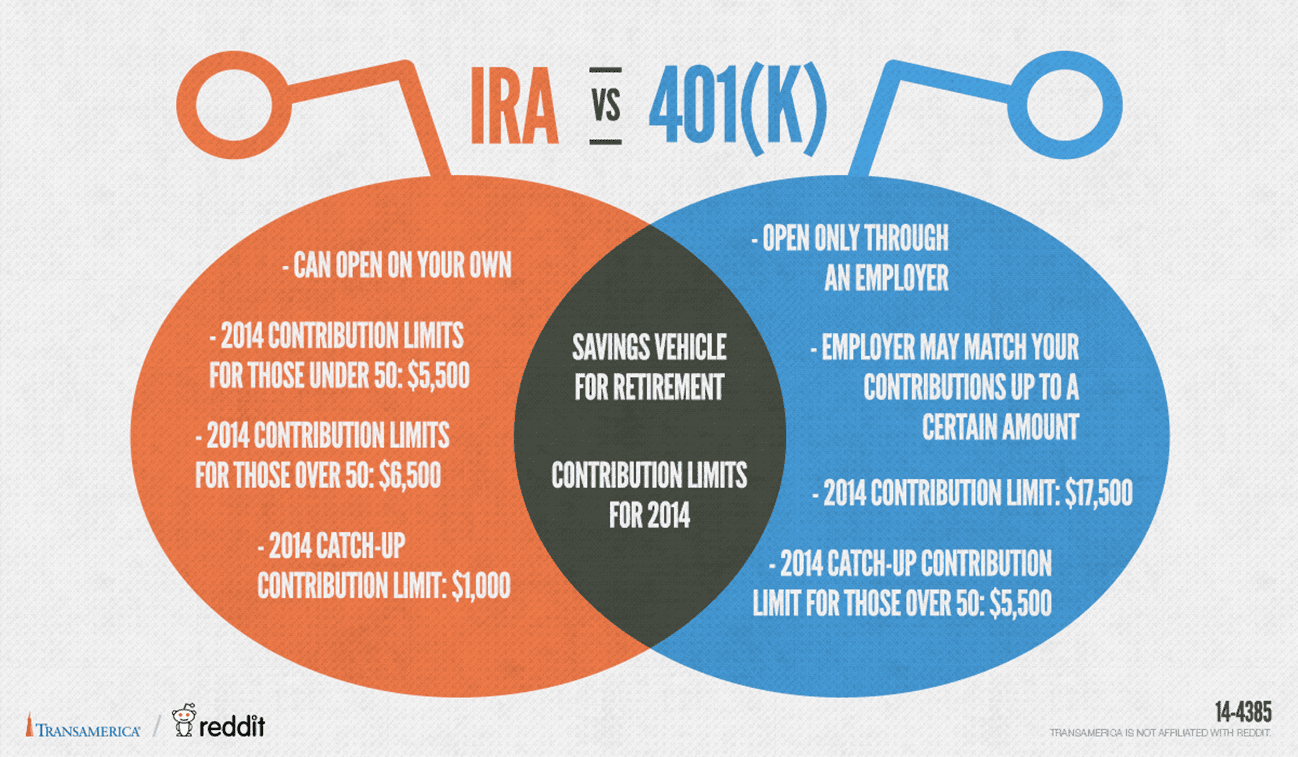
After getting all the feedback it needed, it created content around the more popular requests, going as far as branding and designing them similar to Reddit.
Screenshot by author from Reddit, May 2024
It even took the time to individually comment a link to the published content on its site, bringing attention back to the overall campaign and the content it created.
This campaign was 10 years ago, and it is still referenced as a core example of engaging on Reddit as a brand in a respectful, thoughtful, and meaningful way.
Why You Should Be On Reddit Wrapup
TL;DR: If your brand has something meaningful to say and is interested in truly connecting with your audience, then yes, you should be on Reddit.
These successful brand campaign examples showcase Reddit’s power when used correctly. With research to understand the specific communities you want to reach, Reddit can have exceptional performance compared to other channels.
The stakes are high to get it right because Reddit communities can be highly negative toward self-serving promotion. But if you put in the effort and solve people’s needs and problems, Reddit has the potential to be a high-performance channel.
This month’s “Ask A PPC” question is particularly significant because the job market has been quite volatile.
“How do I get a job with a PPC agency when I have only worked in-house. What experience would they want?” – Karl Toronto
It’s understandable that people want to know which skills employers seek when hiring for a PPC team. There can be a disparity between what people think they need and what the market actually demands.
We’ll delve into some data and commentary to explain why various traits are valued.
It’s crucial to understand that the ideal candidates will be versatile and have an aptitude for all aspects of digital marketing.
However, no one can excel at everything, so leveraging your strengths or preferences is beneficial.
Ensure that you’re securing the best role for yourself while the company hiring you finds the best fit for them.
Discrepancy Between Market Demands And Perceived Needs
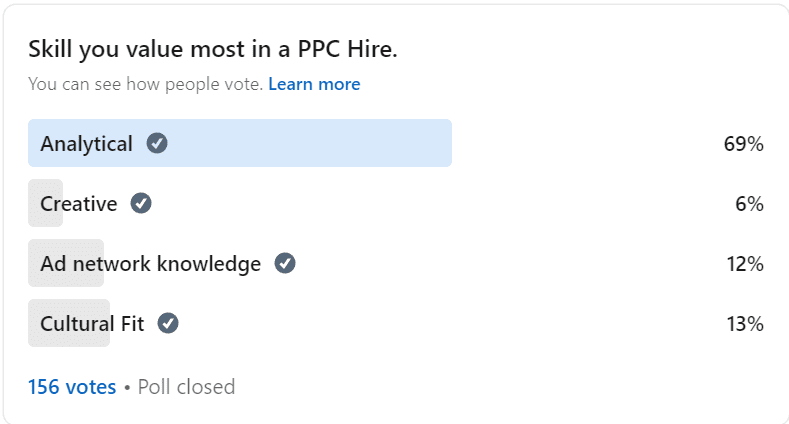
I conducted a poll on my LinkedIn to gauge the skills desired by current employers and practitioners.
Screenshot from author, LinkedIn, April 2024
Analytical skills emerged as the most sought-after trait. Employers seek individuals who can interpret numbers and discern the story behind them.
However, relying solely on analytical prowess may overlook the importance of creativity.
Creative skills are vital in today’s ad networks, especially emphasizing visual content like videos and campaign types that force visual content (Performace Max/Demand Gen). Neglecting creativity can hinder a company’s branding efforts.
Unexpectedly, ad network skills and cultural fit were deemed far less critical than analytical skills. Brands should prioritize team cohesion for long-term success, yet this aspect is often undervalued.
The disparity between job descriptions and actual skill requirements contributes to the difficulty in the job market.
Agencies that hire for how PPC used to work will be left wanting. Practitioners who only focus on popular skills instead of needed ones will be made obsolete by the privacy-first era obscuring data and AI owning creative.
Analytical Skills
Analytical abilities involve knowing where to find relevant data sources and understanding how they contribute to success.
While PPC historically relied on measurable outcomes, the landscape is evolving, necessitating adaptability in data analysis. Technical proficiency and strategic acumen are crucial for navigating different data sources.
Empathy for various ad channels improves your candidacy, and knowing how to work with post-click data will give you an edge over those who can only work with ad platform data.
While being highly technical isn’t required, having empathy for coding and scripts will give you a better chance to stay current with evolving data mechanics (especially as APIs become even more important for accessing data blocked by privacy-first regulations).
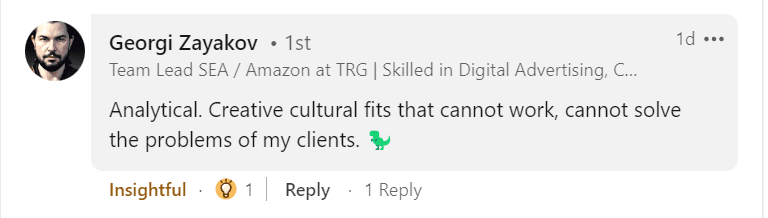
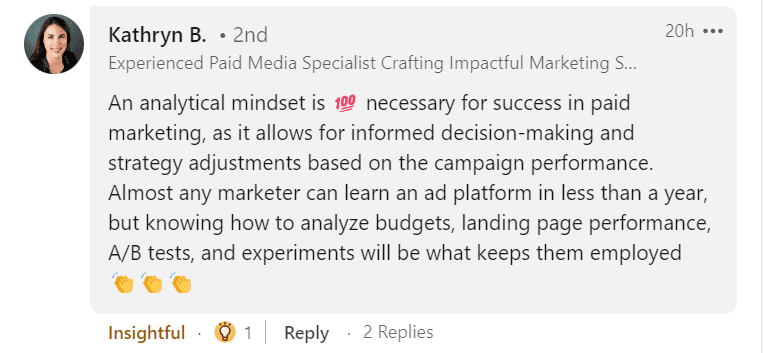
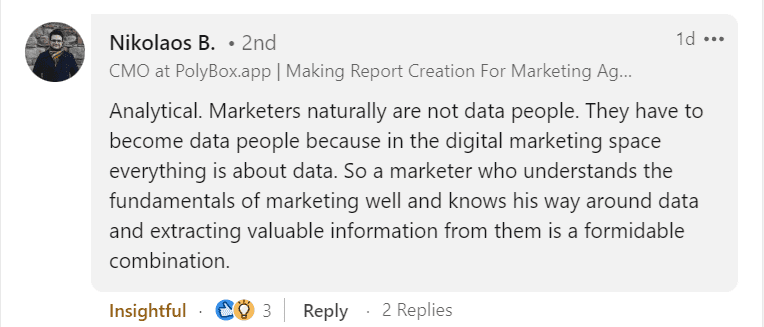
Here are some takes from PPC experts on why analytics is the most important:
Clients are often tasked with providing creative materials due to cost or complexity constraints.
You’ll get a competitive edge if you have these skills:
Video Editing: With the rise of PMax, as well as many ad networks leaning heavily into connected TV, having video editing chops will be a huge asset for any team. If you’re not comfortable using conventional editing tools, AI tools like Descript are a great way to take on those tasks.
Graphic Design: No matter the ad network your potential employer is hiring for, you will need some ability to design static images. Whether you use stock photos or AI-generated images or come up with the creative yourself, the days of purely text ads are over. Tools like Canva can help bridge the gap for less technical designers, but don’t discount ad network AI.
Content Creation: While the first two categories leaned toward visual content, written content is still important (i.e., most ad formats include some text). Having the ability to understand how diverse audiences prefer to be addressed while respecting the specific requirements of each format is a great skill to hone.
While some roles may prioritize analytics or ad network knowledge, emphasizing creative abilities can distinguish you during the hiring process.
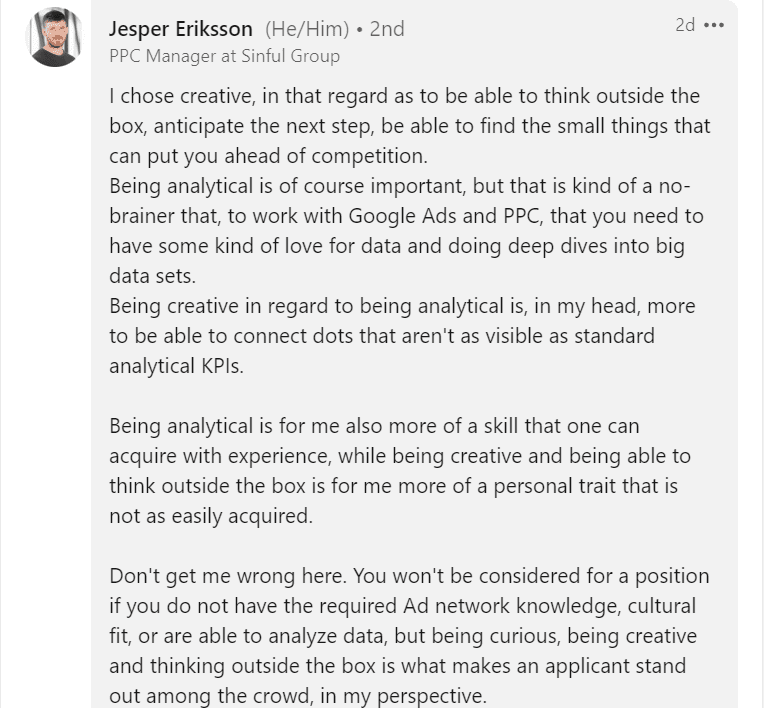
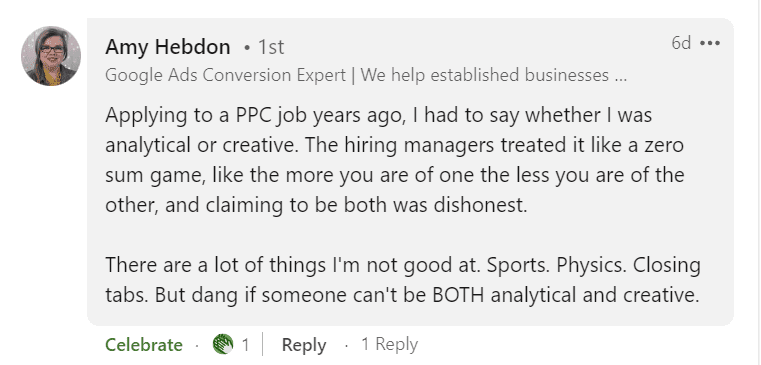
Here are some experts who value creativity:
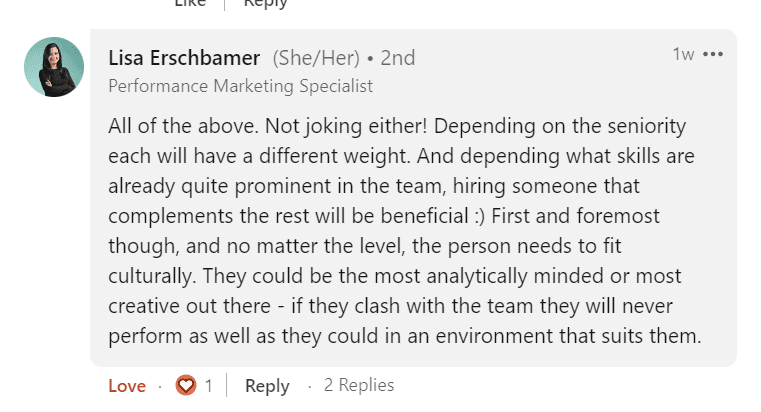
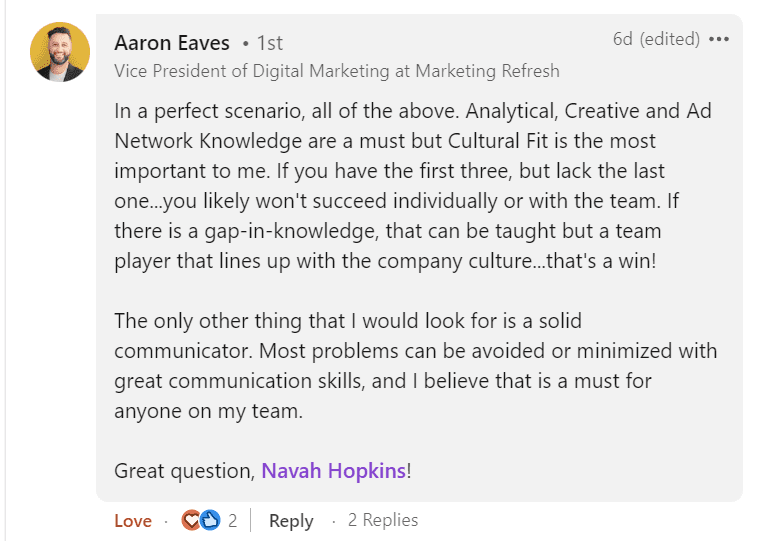
Screenshot from author, LinkedIn, April 2024
Screenshot from author, LinkedIn, April 2024
Ad Network Knowledge
Ad network expertise is valuable, but adaptability is paramount as platforms evolve rapidly.
Some agencies will have specialists, while others hire folks they expect to be passable at every network they service. It’s important to understand what workflow will enable you to succeed.
If you’re happy working with all platforms, then don’t shy away from it. However, if you do better in focusing on one aspect of PPC, that’s totally valid. Just know it might limit your ability to get hired into smaller “familyesque” agencies.
Understanding auction dynamics and bidding strategies is crucial.
Many of us who entered the industry when manual bidding was more popular have an unfair advantage over those who came in during the Smart Bidding era (i.e., anything from 2020).
This is because manual bidding requires you to think about the mechanics of each ad platform’s auction and how you could use those mechanics to your advantage in building account structure.
Knowing what to track and allocating appropriate budgets are key considerations.
Understanding that some networks require more conversions than others to run (e.g., Meta Ads’ 50 in a 7-day period vs. Google Ads’ 15 in a 30-day period) should influence what you choose to track, as well as how you report the data.
Additionally, if you are under or over budget, you’ll set yourself up to fail. Knowing which channels require a big investment upfront and what the breaking point for each network is (either on underspending or spending too much) is critical.
Awareness of potential pitfalls, such as false positives or negatives, enhances campaign effectiveness. For example, it’s important to know how to check if automatically applying recommendations is on and what tasks it’s on for.
It’s worth noting that none of the experts who chimed in on the poll made a clear case for ad network knowledge specifically.
Willingness To Test
Success in PPC requires openness to experimentation and a willingness to adapt. While this wasn’t one of the criteria in the poll, it was one of the most popular traits experts look for in hiring.
Perfectionism can hinder progress in a fast-changing environment. Testing new ideas and embracing failure as an opportunity for growth are essential.
While analytical skills aid in test design, empathy and creativity are equally vital for devising effective experiments.
Here is an expert who favors a willingness to test:
Screenshot from author, LinkedIn, April 2024
Cultural Fit
Cultural alignment with an agency fosters productivity and job satisfaction. However, you can only achieve that by being honest with yourself about what you want and the mechanics of how you work.
Agencies demand intense effort and collaboration, making compatibility with colleagues crucial.
Anyone looking to make the shift from in-house to agency needs to be prepared for a much faster pace of work and a lot more agency.
Open communication with leadership regarding preferred management and learning styles will ensure a positive working relationship.
Respect for peers and a supportive atmosphere contribute to a fulfilling work environment.
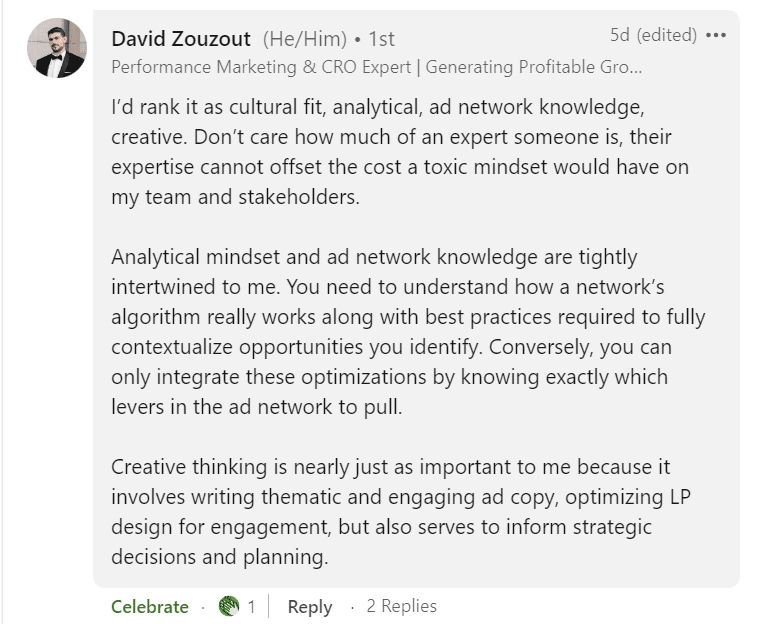
Here are a few thoughts on cultural fit from polled experts:
Screenshot from author, LinkedIn, April 2024
Screenshot from author, LinkedIn, April 2024
Screenshot from author, LinkedIn, April 2024
Final Thoughts
Navigating the current job market can be challenging, but understanding industry needs and honing relevant skills increases your chances of success.
Balancing technical proficiency with creativity and cultural fit is essential for thriving in a PPC role. By aligning with market demands and showcasing your strengths, you can secure rewarding opportunities in the field.
Have a question you’d like us to address? Fill out the form!
More resources:
Featured Image: Paulo Bobita/Search Engine Journal
A keynote at Google’s Marketing Live event showed a new AI-powered visual search results that feature advertisements that engage users within the context of an AI-Assisted search, blurring the line between AI-generated search results and advertisements.
Google Lens is a truly helpful app but it becomes unconventional where it blurs the line between an assistant helping users and being led to a shopping cart. This new way of engaging potential customers with AI is so far out there that the presenter doesn’t even call it advertising, he doesn’t even use the word.
Visual Search Traffic Opportunity?
Google’s Group Product Manager Sylvanus Bent, begins the presentation with an overview of the next version of Google Lens visual search that will be useful for surfacing information and for help finding where to buy them.
Sylvanus explained how it will be an opportunity for websites to receive traffic from this new way to search.
“…whether you’re snapping a photo with lens or circling to search something on your social feed, visual search unlocks new ways to explore whatever catches your eye, and we recently announced a newly redesigned results page for Visual search.
Soon, instead of just visual matches, you’ll see a wide range of results, from images to video, web links, and facts about the knowledge graph. It gets people the helpful information they need and creates new opportunities for sites to be discovered.”
It’s hard to say whether or not this will bring search traffic to websites and what the quality of that traffic will be. Will they stick around to read an article? Will they engage with a product review?
Visual Search Results
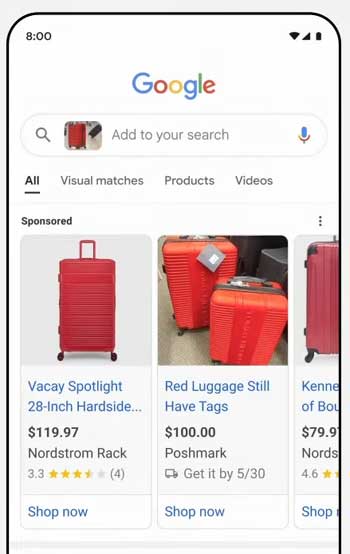
Sylvanus shares a hypothetical example of someone at an airport baggage claim who falls in like with someone else’s bag. He explains that all the person needs to do is snap a photo of the luggage bag and Google Lens will take them directly to shopping options.
He explains:
“No words, no problem. Just open Lens, take a quick picture and immediately you’ll see options to purchase.
And for the first time, shopping ads will appear at the very top of the results on linked searches, where a business can offer what a consumer is looking for.
This will help them easily purchase something that catches their eye.”
These are image-heavy shopping ads at the top of the search results and as annoying as that may be it’s nowhere near the “next level” advertising that is coming to Google’s new version of visual search where Google presents a paid promotion within the context of an AI Assistant.
Interactive Search Shopping
Sylvanus next describes an AI-powered form advertising that happens directly within search. But he doesn’t call it advertising. He doesn’t even use the word advertising. He suggests this new form of AI search experience is more than offer, saying that, “it’s an experience.”
He’s right to not use the word advertisement because what he describes goes far beyond advertising and blurs the boundaries between search and advertising within the context of AI-powered suggestions, paid suggestions.
Sylvanus explains how this new form of shopping experience works:
“And next, imagine a world where every search ad is more than an offer. It’s an experience. It’s a new way for you to engage more directly with your customers. And we’re exploring search ads with AI powered recommendations across different verticals. So I want to show you an example that’s going live soon and you’ll see even more when we get to shopping.”
He uses the example of someone who needs to store their furniture for a few months and who turns to Google to find short term storage. What he describes is a query for local short term storage that turns into a “dynamic ad experience” that leads the searcher into throwing packing supplies into their shopping cart.
He narrated how it works:
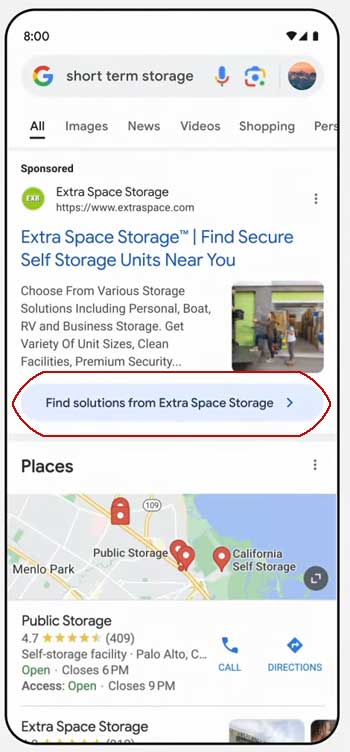
“You search for short term storage and you see an ad for extra space storage. Now you can click into a new dynamic ad experience.
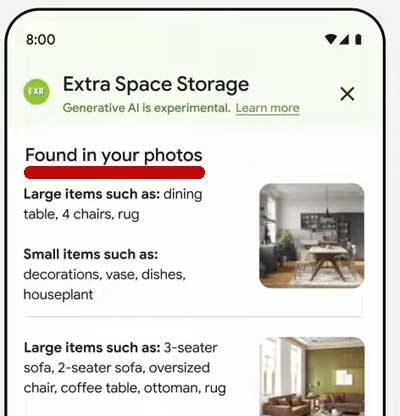
You can select and upload photos of the different rooms in your house, showing how much furniture you have, and then extra space storage with help from Google, AI generates a description of all your belongings for you to verify. You get a recommendation for the right size and type of storage unit and even how much packing supplies you need to get the job done. Then you just go to the website to complete the transaction.
And this is taking the definition of a helpful ad to the next level. It does everything but physically pick up your stuff and move it, and that is cool.”
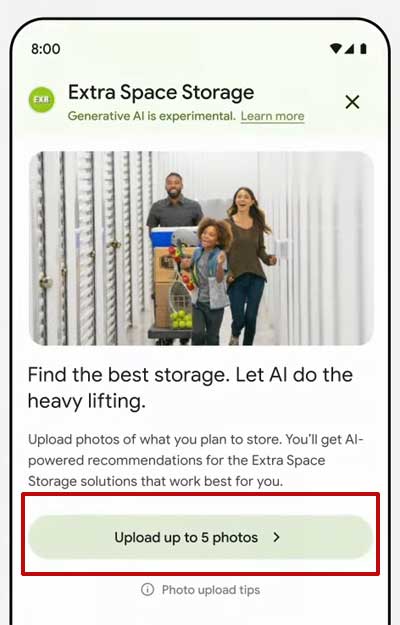
Step 1: Search For Short Term Storage
The above screenshot shows an advertisement that when clicked takes the user to what looks like an AI-assisted search but is really an interactive advertisement.
Step 2: Upload Photos For “AI Assistance”
The above image is a screenshot of an advertisement that is presented in the context of AI-assisted search. Masking an advertisement within a different context is the same principal behind an advertorial where an advertisement is hidden in the form of an article. The phrases “Let AI do the heavy lifting” and “AI-powered recommendations” create the context of AI-search that masks the true context of an advertisement.
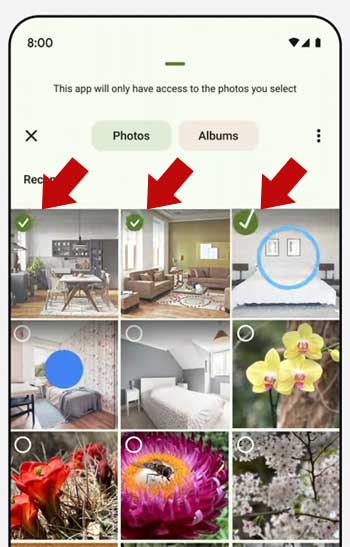
Step 3: Images Chosen For Uploading
The above screenshot shows how a user uploads an image to the AI-powered advertisement within the context of an AI-powered search app.
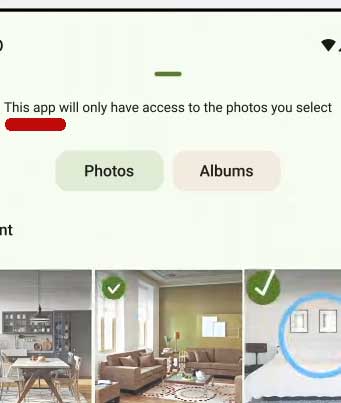
The Word “App” Masks That This Is An Ad
Above is a screenshot of how a user uploads a photo to the AI-powered interactive advertisement within the context of a visual search engine, using the word “app” to further the illusion that the user is interacting with an app and not an advertisement.
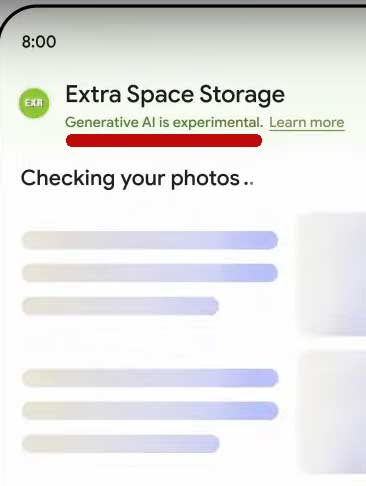
Upload Process Masks The Advertising Context
The phrase “Generative AI is experimental” contributes to the illusion that this is an AI-assisted search.
Step 4: Upload Confirmation
In step 4 the “app” advertisement is for confirming that the AI correctly identified the furniture that needs to be put into storage.
Step 5: AI “Recommendations”
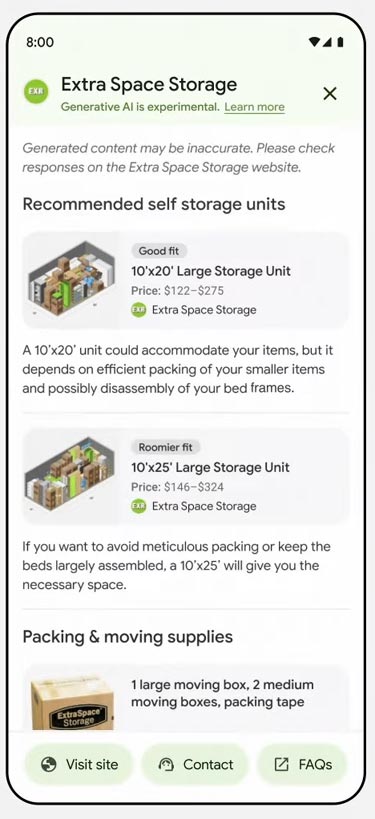
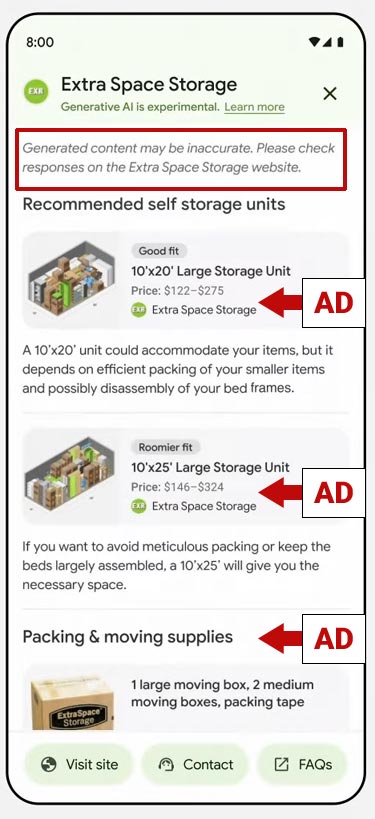
The above screenshot shows “AI recommendations” that look like search results.
The Recommendations Are Ad Units
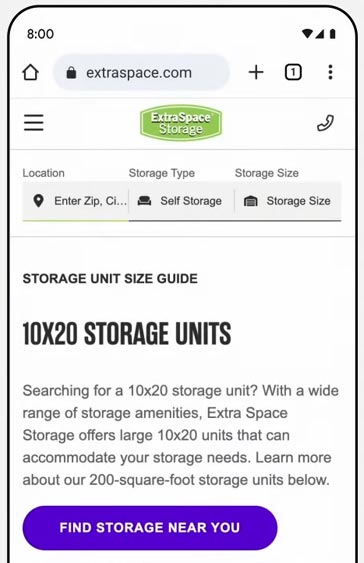
Those recommendations are actually ad units that when clicked takes the user to the “Extra Space Storage” shopping website.
Step 6: Searcher Visits Advertiser Website
Blurring The Boundaries
What the Google keynote speaker describes is the integration of paid product suggestions into an AI assisted search. This kind of advertising is so far out there that the Googler doesn’t even call it advertising and rightfully so because what this does is blur the line between AI assisted search and advertising. At what point does a helpful AI search become just a platform for using AI to offer paid suggestions?
Meta has seen strikingly little AI-generated misinformation around the 2024 elections despite major votes in countries such as Indonesia, Taiwan, and Bangladesh, said the company’s president of global affairs, Nick Clegg, on Wednesday.
“It is there; it is discernible. It’s really not happening on … a volume or a systemic level,” he said. Clegg said Meta has seen attempts at interference in, for example, the Taiwanese election, but that the scale of that interference is at a “manageable amount.”
As voters will head to polls this year in more than 50 countries, experts have raised the alarm over AI-generated political disinformation and the prospect that malicious actors will use generative AI and social media to interfere with elections. Meta has previously faced criticism over its content moderation policies around past elections—for example, when it failed to prevent the January 6 rioters from organizing on its platforms.
Clegg defended the company’s efforts at preventing violent groups from organizing, but he also stressed the difficulty of keeping up. “This is a highly adversarial space. You play Whack-a-Mole, candidly. You remove one group, they rename themselves, rebrand themselves, and so on,” he said.
Clegg argued that compared with 2016, the company is now “utterly different” when it comes to moderating election content. Since then, it has removed over 200 “networks of coordinated inauthentic behavior,” he said. The company now relies on fact checkers and AI technology to identify unwanted groups on its platforms.
Earlier this year, Meta announced it would label AI-generated images on Facebook, Instagram, and Threads. Meta has started adding visible markers to such images, as well as invisible watermarks and metadata in the image file. The watermarks will be added to images created using Meta’s generative AI systems or ones that carry invisible industry-standard markers. The company says its measures are in line with best practices laid out by the Partnership on AI, an AI research nonprofit.
But at the same time, Clegg admitted that tools to detect AI-generated content are still imperfect and immature. Watermarks in AI systems are not adopted industry-wide, and they are easy to tamper with. They are also hard to implement robustly in AI-generated text, audio, and video.
Ultimately that should not matter, Clegg said, because Meta’s systems should be able to catch and detect mis- and disinformation regardless of its origins.
“AI is a sword and a shield in this,” he said.
Clegg also defended the company’s decision to allow ads claiming that the 2020 US election was stolen, noting that these kinds of claims are common throughout the world and saying it’s “not feasible” for Meta to relitigate past elections. Just this month, eight state secretaries of state wrote a letter to Meta CEO Mark Zuckerberg arguing that the ads could still be dangerous, and that they have the potential to further threaten public trust in elections and the safety of individual election workers.
You can watch the full interview with Nick Clegg and MIT Technology Review executive editor Amy Nordrum below.
Every calendar quarter the U.S. Department of Commerce releases total domestic retail sales and ecommerce only. Newly published figures for Q1 2024 (PDF) show total retail sales of $1.820 billion (a slight decrease over Q4 2023) and ecommerce-only retail sales of $289 billion, a growth of 2.1% over the prior quarter.
According to the DoC, ecommerce sales are for “goods and services where the buyer places an order (or the price and terms of the sale are negotiated) over an Internet, mobile device, extranet, electronic data interchange network, electronic mail, or other comparable online system. Payment may or may not be made online.”
Ecommerce accounted for 15.9% of total U.S. retail sales in Q1 2024, up slightly from 15.6% in the prior quarter.
–
The DoC reports U.S. ecommerce retail sales in Q1 2024 grew by 8.6% compared to Q1 2023, while total quarterly retail sales experienced a 1.5% annual rise over the same period last year.
Content marketing as a method of attracting, engaging, and retaining customers pre-dates the term itself. And even now, emerging technologies could change it again.
The most cited example of early content marketing is John Deere’s “The Furrow” magazine, launched in 1895. This “Journal for the American Farmer” published actionable agricultural articles, offering farmers practical advice on farming techniques, crop management, and machinery maintenance.
Reciprocity
For John Deere, “The Furrow” was better than advertising in a sense because the company owned it and thus the relationship with readers.
John Deere delivered real value thanks to the useful, informative, and entertaining articles. So much so that by 1912, the magazine had 4 million subscribers.
In turn, real value produces a sense of reciprocity. The reader recognized the John Deere company as an expert and felt obligated to the brand. This obligation extended to buying John Deere products marketed in “The Furrow.”
This is content marketing’s aim: attract, engage, and retain customers. And by the way, “The Furrow” is still published in print and online in 2024.
“The Furrow” is a prominent early example of content marketing.
Another example of content marketing comes from the consumer package goods industry. Cereal boxes and candy often include comic strips, stories, historical or scientific anecdotes, and prizes.
A child might like General Mills Lucky Charms cereal for its rainbow colors and the entertaining box.
Youtility
Content marketing advanced after 2013 when marketing guru Jay Baer released his book, “Youtility: Why Smart Marketing Is about Help, Not Hype.”
The book’s guiding principle prioritized creating useful content, not exclusively promotional.
The result was many marketers focused on being helpful rather than selling. As the distance between content and revenue increased, these marketers sought new performance metrics.
Content marketers circa 2024 are again looking for ways to drive sales from content. This renewed effort manifests in many ways, including live streams, voice and video, generative artificial intelligence, and augmented and virtual reality.
Each has the potential to attract, engage, and retain customers.
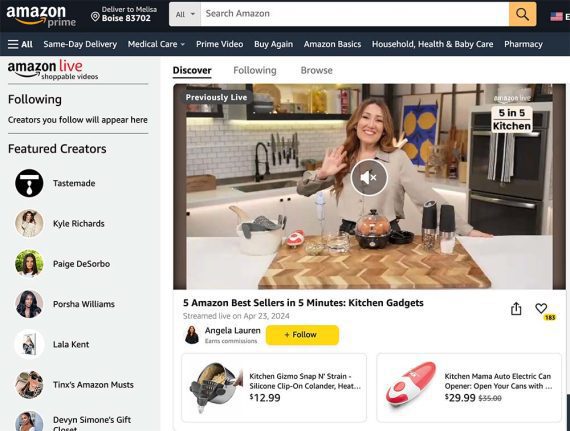
Take, for example, ecommerce live streaming. It engages potential customers with real-time product showcases and permits the host to answer questions and assist with buying decisions.
Amazon Live is one of many platforms that allows merchants or creators to live stream shoppable videos.
The live stream itself may be recorded and edited into social media posts. The shoppers’ questions are potential on-site FAQs. One could even say that ecommerce live streaming is a more complete version of content marketing.
Thus ecommerce marketers should seek ways to integrate emerging content types. Don’t leave articles behind. Instead, add to them.