The Download: what’s next for electricity, and living in the conspiracy age

This is today’s edition of The Download, our weekday newsletter that provides a daily dose of what’s going on in the world of technology.

Three things to know about the future of electricity

The International Energy Agency recently released the latest version of the World Energy Outlook, the annual report that takes stock of the current state of global energy and looks toward the future.

It contains some interesting insights and a few surprising figures about electricity, grids, and the state of climate change. Let’s dig into some numbers.

—Casey Crownhart

This article is from The Spark, MIT Technology Review’s weekly climate newsletter. To receive it in your inbox every Wednesday, sign up here.

How to survive in the new age of conspiracies

Everything is a conspiracy theory now. Our latest series “The New Conspiracy Age” delves into how conspiracies have gripped the White House, turning fringe ideas into dangerous policy, and how generative AI is altering the fabric of truth.

If you’re interested in hearing more about how to survive in this strange new age, join our features editor Amanda Silverman and executive editor Niall Firth today at 1pm ET for an subscriber-exclusive Roundtable conversation. They’ll be joined by conspiracy expert Mike Rothschild, who’s written a fascinating piece for us about what it’s like to find yourself at the heart of a conspiracy theory. Register now to join us!

The must-reads

I’ve combed the internet to find you today’s most fun/important/scary/fascinating stories about technology.

1 Donald Trump is poised to ban AI state laws
The US President is considering signing an order to give the federal government unilateral power over regulating AI. (The Verge)
+ It would give the Justice Department power to sue dissenting states. (WP $)
+ Critics claim the draft undermines trust in the US’s ability to make AI safe. (Wired $)
+ It’s not just America—the EU fumbled its attempts to rein in AI, too. (FT $)

2 The CDC is making false claims about a link between vaccines and autism
Despite previously spending decades fighting misinformation connecting them. (WP $)
+ The National Institutes of Health is parroting RFK Jr’s messaging, too. (The Atlantic $)

3 China is going all-in on autonomous vehicles
Which is bad news for its millions of delivery drivers. (FT $)
+ It’s also throwing its full weight behind its native EV industry. (Rest of World)

5 Major music labels have inked a deal with an AI streaming service
Klay users will be able to remodel songs from the likes of Universal using AI. (Bloomberg $)
+ What happens next is anyone’s guess. (Billboard $)
+ AI is coming for music, too. (MIT Technology Review)

5 How quantum sensors could overhaul GPS navigation
Current GPS is vulnerable to spoofing and jamming. But what comes next? (WSJ $)
+ Inside the race to find GPS alternatives. (MIT Technology Review)

6 There’s a divide inside the community of people in relationships with chatbots 
Some users assert their love interests are real—to the concern of others. (NY Mag $)
+ It’s surprisingly easy to stumble into a relationship with an AI chatbot. (MIT Technology Review)

7 There’s still hope for a functional cure to HIV
Even in the face of crippling funding cuts. (Knowable Magazine)
+ Breakthrough drug lenacapavir is being rolled out in parts of Africa. (NPR)
+ This annual shot might protect against HIV infections. (MIT Technology Review)

8 Is it possible to reverse years of AI brainrot?
A new wave of memes is fighting the good fight. (Wired $)
+ How to fix the internet. (MIT Technology Review)

9 Tourists fell for an AI-generated Christmas market outside Buckingham Palace 🎄
If it looks too good to be true, it probably is. (The Guardian)
+ It’s unclear who is behind the pictures, which spread on Instagram. (BBC)

10 Here’s what people return to Amazon
A whole lot of polyester clothing, by the sounds of it. (NYT $)

Quote of the day

“I think we’re in an LLM bubble, and I think the LLM bubble might be bursting next year.”

—Hugging Face co-founder and CEO Clem Delangue has a slightly different take on the reports we’re in an AI bubble, TechCrunch reports.

One more thing

Inside a new quest to save the “doomsday glacier”

The Thwaites glacier is a fortress larger than Florida, a wall of ice that reaches nearly 4,000 feet above the bedrock of West Antarctica, guarding the low-lying ice sheet behind it.

But a strong, warm ocean current is weakening its foundations and accelerating its slide into the sea. Scientists fear the waters could topple the walls in the coming decades, kick-starting a runaway process that would crack up the West Antarctic Ice Sheet, marking the start of a global climate disaster. As a result, they are eager to understand just how likely such a collapse is, when it could happen, and if we have the power to stop it. Read the full story.

—James Temple

We can still have nice things

A place for comfort, fun and distraction to brighten up your day. (Got any ideas? Drop me a line or skeet ’em at me.)

+ As Christmas approaches, micro-gifting might be a fun new tradition to try out.
+ I’ve said it before and I’ll say it again—movies are too long these days.
+ If you’re feeling a bit existential this morning, these books are a great starting point for finding a sense of purpose.
+ This is a fun list of the internet’s weird and wonderful obsessive lists.

Designing digital resilience in the agentic AI era

Digital resilience—the ability to prevent, withstand, and recover from digital disruptions—has long been a strategic priority for enterprises. With the rise of agentic AI, the urgency for robust resilience is greater than ever.

Agentic AI represents a new generation of autonomous systems capable of proactive planning, reasoning, and executing tasks with minimal human intervention. As these systems shift from experimental pilots to core elements of business operations, they offer new opportunities but also introduce new challenges when it comes to ensuring digital resilience. That’s because the autonomy, speed, and scale at which agentic AI operates can amplify the impact of even minor data inconsistencies, fragmentation, or security gaps.

While global investment in AI is projected to reach $1.5 trillion in 2025, fewer than half of business leaders are confident in their organization’s ability to maintain service continuity, security, and cost control during unexpected events. This lack of confidence, coupled with the profound complexity introduced by agentic AI’s autonomous decision-making and interaction with critical infrastructure, requires a reimagining of digital resilience.

Organizations are turning to the concept of a data fabric—an integrated architecture that connects and governs information across all business layers. By breaking down silos and enabling real-time access to enterprise-wide data, a data fabric can empower both human teams and agentic AI systems to sense risks, prevent problems before they occur, recover quickly when they do, and sustain operations.

Machine data: A cornerstone of agentic AI and digital resilience

Earlier AI models relied heavily on human-generated data such as text, audio, and video, but agentic AI demands deep insight into an organization’s machine data: the logs, metrics, and other telemetry generated by devices, servers, systems, and applications.

To put agentic AI to use in driving digital resilience, it must have seamless, real-time access to this data flow. Without comprehensive integration of machine data, organizations risk limiting AI capabilities, missing critical anomalies, or introducing errors. As Kamal Hathi, senior vice president and general manager of Splunk, a Cisco company, emphasizes, agentic AI systems rely on machine data to understand context, simulate outcomes, and adapt continuously. This makes machine data oversight a cornerstone of digital resilience.

“We often describe machine data as the heartbeat of the modern enterprise,” says Hathi. “Agentic AI systems are powered by this vital pulse, requiring real-time access to information. It’s essential that these intelligent agents operate directly on the intricate flow of machine data and that AI itself is trained using the very same data stream.” 

Few organizations are currently achieving the level of machine data integration required to fully enable agentic systems. This not only narrows the scope of possible use cases for agentic AI, but, worse, it can also result in data anomalies and errors in outputs or actions. Natural language processing (NLP) models designed prior to the development of generative pre-trained transformers (GPTs) were plagued by linguistic ambiguities, biases, and inconsistencies. Similar misfires could occur with agentic AI if organizations rush ahead without providing models with a foundational fluency in machine data. 

For many companies, keeping up with the dizzying pace at which AI is progressing has been a major challenge. “In some ways, the speed of this innovation is starting to hurt us, because it creates risks we’re not ready for,” says Hathi. “The trouble is that with agentic AI’s evolution, relying on traditional LLMs trained on human text, audio, video, or print data doesn’t work when you need your system to be secure, resilient, and always available.”

Designing a data fabric for resilience

To address these shortcomings and build digital resilience, technology leaders should pivot to what Hathi describes as a data fabric design, better suited to the demands of agentic AI. This involves weaving together fragmented assets from across security, IT, business operations, and the network to create an integrated architecture that connects disparate data sources, breaks down silos, and enables real-time analysis and risk management. 

“Once you have a single view, you can do all these things that are autonomous and agentic,” says Hathi. “You have far fewer blind spots. Decision-making goes much faster. And the unknown is no longer a source of fear because you have a holistic system that’s able to absorb these shocks and disruption without losing continuity,” he adds.

To create this unified system, data teams must first break down departmental silos in how data is shared, says Hathi. Then, they must implement a federated data architecture—a decentralized system where autonomous data sources work together as a single unit without physically merging—to create a unified data source while maintaining governance and security. And finally, teams must upgrade data platforms to ensure this newly unified view is actionable for agentic AI. 

During this transition, teams may face technical limitations if they rely on traditional platforms modeled on structured data—that is, mostly quantitative information such as customer records or financial transactions that can be organized in a predefined format (often in tables) that is easy to query. Instead, companies need a platform that can also manage streams of unstructured data such as system logs, security events, and application traces, which lack uniformity and are often qualitative rather than quantitative. Analyzing, organizing, and extracting insights from these kinds of data requires more advanced methods enabled by AI.

Harnessing AI as a collaborator

AI itself can be a powerful tool in creating the data fabric that enables AI systems. AI-powered tools can, for example, quickly identify relationships between disparate data—both structured and unstructured—automatically merging them into one source of truth. They can detect and correct errors and employ NLP to tag and categorize data to make it easier to find and use. 

Agentic AI systems can also be used to augment human capabilities in detecting and deciphering anomalies in an enterprise’s unstructured data streams. These are often beyond human capacity to spot or interpret at speed, leading to missed threats or delays. But agentic AI systems, designed to perceive, reason, and act autonomously, can plug the gap, delivering higher levels of digital resilience to an enterprise.

“Digital resilience is about more than withstanding disruptions,” says Hathi. “It’s about evolving and growing over time. AI agents can work with massive amounts of data and continuously learn from humans who provide safety and oversight. This is a true self-optimizing system.”

Humans in the loop

Despite its potential, agentic AI should be positioned as assistive intelligence. Without proper oversight, AI agents could introduce application failures or security risks.

Clearly defined guardrails and maintaining humans in the loop is “key to trustworthy and practical use of AI,” Hathi says. “AI can enhance human decision-making, but ultimately, humans are in the driver’s seat.”

This content was produced by Insights, the custom content arm of MIT Technology Review. It was not written by MIT Technology Review’s editorial staff. It was researched, designed, and written by human writers, editors, analysts, and illustrators. This includes the writing of surveys and collection of data for surveys. AI tools that may have been used were limited to secondary production processes that passed thorough human review.

Roundtables: Surviving the New Age of Conspiracies

Everything is a conspiracy theory now. MIT Technology Review’s series, “The New Conspiracy Age,” explores how this moment is changing science and technology. Watch a discussion with our editors and Mike Rothschild, journalist and conspiracy theory expert, about how we can make sense of them all.

Speakers: Amanda Silverman, Editor, Features & Investigations; Niall Firth, Executive Editor, Newsroom; and Mike Rothschild, Journalist & Conspiracy Theory Expert.

Recorded on November 20, 2025

Related Content:

Will AI Solve Ecommerce Personalization?

A nascent firm armed with a fresh $12.3 million investment aims to deliver on the promise of ecommerce personalization.

A personalization engine shows the right product to the right shopper at the right time.

In theory, it makes everyone happy. Shoppers see relevant and engaging products. Merchants sell more.

It sounds simple enough. Think of an ecommerce website with products for sale. What item(s) does the site show to a particular user to entice a sale? How does it know what to show?

Data Right Now

This question of “what to show” is how Matteo Ruffini, chief science officer of the Swiss start-up Albatross AI, described the problem his company solves during a February 2025 interview.

Many ecommerce personalization and recommendation solutions rely on historical shopper behavior. The systems look backward over months or years, at purchases and browses, for instance.

The folks at Albatross also use past behavioral data, but they’ve added a real-time, right-now predictive element.

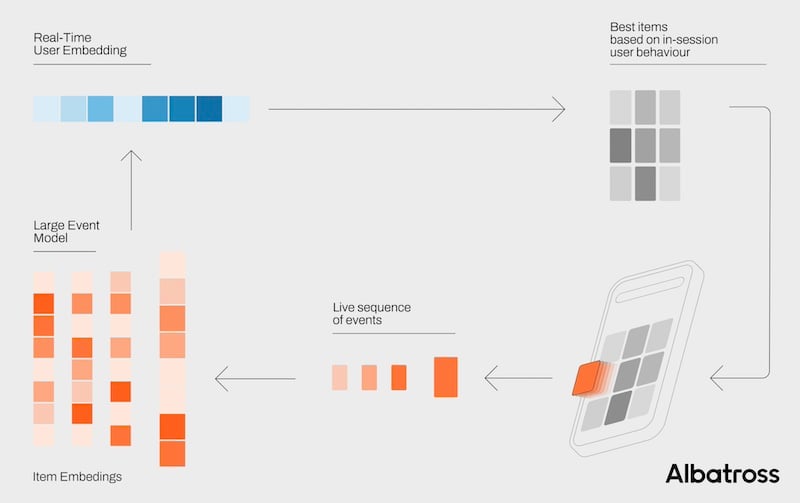
The Albatross product, according to a Forbes contributor, “captures every user action in a session and passes it into [an AI] transformer model that behaves like a language model for intent. The inputs are event triplets — user, action, item — instead of words. The model analyzes not just the action but the sequence of actions and the context that connects them. It updates continuously and responds in milliseconds without retraining.”

Essentially, the company claims to have the first AI infrastructure for training models on sequential, live events.

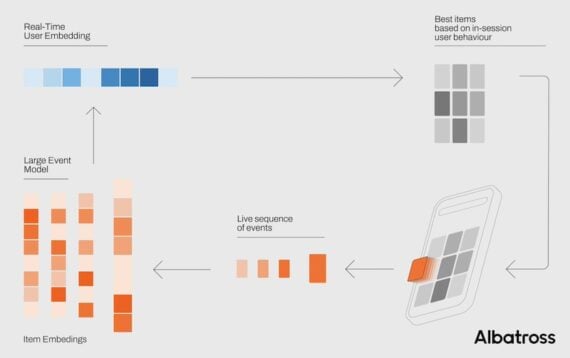
A flow-diagram illustrating a real-time personalization system by Albatross. At the bottom left, several orange-toned blocks represent item embeddings feeding into a “Large Event Model.” To the right, small orange blocks show a “live sequence of events” coming from a smartphone-shaped icon. These events flow into the model, which outputs a horizontal row of blue blocks labeled “Real-Time User Embedding” at the top left. An arrow carries this embedding to the top right, where gray-toned blocks represent “Best items based on in-session user behaviour.” The overall layout shows events from a user’s device informing embeddings to generate personalized item recommendations.

Albatross claims to have the first AI infrastructure for training models on sequential, live events.

3 Challenges

Albatross AI addresses at least three long-standing problems with predictive ecommerce recommendations:

  • Long training periods.
  • Categorizing new shoppers.
  • Cold starts for products.

Training

Personalized and segment-based recommendations depend on machine learning models that need time and data to mature. It can take weeks or months to gather enough data for meaningful recommendations. Moreover, the model must retrain often.

Some recommendation solutions train in cycles, such as daily or weekly, and they require reams of historical shopping activity. The result is recommendations that can lag behind rapidly changing demand signals, seasonal trends, influencer surges, or unpredictable cultural moments (such as the pandemic).

A shopper’s intent can change today, but if not in the next training cycle, the system cannot react.

Emerging platforms such as Albatross explore continuous or incremental learning, reducing reliance on scheduled retraining and moving toward models that reflect active sessions.

New shoppers

A second long-standing challenge is how recommendation systems treat new shoppers. Historically, these systems relied on popularity-driven rankings or generic best-sellers while they waited to gather enough signals to personalize.

Cookie-less personalization or probable identity matching offers only limited relief.

The industry is now shifting toward what could be described as “first-minute personalization,” meaning that intent signals within a single session — scroll depth, dwell time, bounce patterns, micro-hovers, theme switches — become the primary inferences.

The goal is to reduce the number of interactions required to understand a shopper’s interests and intents.

Cold start

The third obstacle is the cold start product problem.

An ecommerce catalog is rarely static. New SKUs arrive every day; marketplaces can add thousands per hour.

Current recommendation algorithms need interaction data before they can confidently suggest an item. Hence new products may remain buried.

Marketers can mark them as new and provide preferential treatment in search and on category pages. But those actions can defeat the purpose of personalized recommendations.

AI approaches are beginning to leverage content embedding, multimodal representation, and sequential modeling to infer probable relevance before engagement data is available. Essentially, AI understands much better which shoppers will like the new product.

Research continues to uncover ways to combine item metadata, textual or image-based descriptions, and user-sequence context so that new items are visible on day one.

AI and Commerce

The three challenges apply to other trends in ecommerce and the ongoing AI transformation.

LLMs such as ChatGPT, Perplexity, and Gemini are attempting to rank products for individuals through agentic commerce. Yet none of these will deliver unless they can interpret shopping intent.

In short, recommendation engines and AI shopping agents are becoming blurred. Product discovery and purchase decisions are merging.

LLMs.txt Shows No Clear Effect On AI Citations, Based On 300k Domains via @sejournal, @MattGSouthern

A new analysis from SE Ranking suggests the llms.txt file isn’t delivering measurable benefits yet.

After examining roughly 300,000 domains, the company found no relationship between having llms.txt and how often a domain is cited in major LLM answers.

What The Data Says

Adoption Is Thin

SE Ranking’s crawl found llms.txt on 10.13% of domains. In other words, nearly nine out of ten sites they measured haven’t implemented it.

That low usage matters because the format is sometimes described as an emerging baseline for AI visibility. The data instead shows scattered experimentation. SE Ranking says adoption is fairly even across traffic tiers and not concentrated among the biggest brands.

High-traffic sites were slightly less likely to use the file than mid-tier websites in their dataset.

No Measurable Link To LLM Citations

To assess whether the llms.txt file affects AI visibility, SE Ranking analyzed domain-level citation frequency across responses from prominent LLMs. They employed statistical correlation tests and an XGBoost model to determine the extent to which each factor contributed to citations.

The main finding was that removing the llms.txt feature actually improved the model’s accuracy. SE Ranking concludes that llms.txt “doesn’t seem to directly impact AI citation frequency. At least not yet.”

Additionally, they found no significant correlation between citations and the file using simpler statistical methods.

How This Squares With Platform Guidance

SE Ranking notes that its results align with public platform guidance. But it’s important to be precise about what is confirmed.

Google hasn’t indicated that llms.txt is used as a signal in AI Overviews or AI Mode. In its AI search guidance, Google frames it as an evolution of Search that continues to rely on its existing Search systems and signals, without mentioning llms.txt as an input.

OpenAI’s crawler documentation similarly focuses on robots.txt controls. OpenAI recommends allowing OAI-SearchBot in robots.txt to support discovery for its search features, but does not say llms.txt affects ranking or citations.

SE Ranking also notes that some SEO logs show GPTBot occasionally fetching llms.txt files, though they say it doesn’t happen often and does not appear tied to citation outcomes.

Taken together, the dataset suggests that even if some models retrieve the file, it’s not influencing citation behavior at scale right now.

What This Means For You

If you want a clean, low-risk way to prepare for possible future adoption, adding llms.txt is easy and unlikely to cause technical harm.

But if the goal is a near-term visibility bump in AI answers, the data says you shouldn’t expect one.

That puts llms.txt in the same category as other early AI-visibility tactics. Reasonable to test if it fits your workflow, but not something to sell internally as a proven lever.


Featured Image: Mameraman/Shutterstock

The Role Of Brand Authority And E-E-A-T In The AI Search Era via @sejournal, @DuaneForrester

AI-generated answers are spreading across search. Google and Bing are each presenting synthesized responses alongside regular results. These answers are not replacing traditional SERPs yet, but they are taking up attention. As they improve, they influence what people see first and what they trust most. The question is no longer whether they will change search, but how much of your brand’s visibility they will absorb as they expand. And as usage of ChatGPT, Claude, Perplexity, and other platforms continues to expand, we’re going to start to see user habits shift. Which means we’ll see more engagement with synthesized answers with no traditional SERPs in sight at all.

Being ranked is no longer enough. When machines decide which brands to cite or quote, the deciding factor is trust. The brands that become part of AI-generated answers are those seen as authoritative and credible. That is where E-E-A-T (Experience, Expertise, Authoritativeness, and Trustworthiness) takes on greater importance.

Image Credit: Duane Forrester

Understanding E-E-A-T

Yup, we are about to re-walk well-traveled territory in this section, much of which you may already know. But here’s the rub … this is still news to some folks, and so many who claim to know it, still get the execution wrong, so please bear with me with this section if you are already crushing it with E-E-A-T.

E-E-A-T is not a single ranking factor. It is a framework used by Google’s search evaluators to judge how credible, useful, and accurate a page appears. You can read the full guidelines here: https://services.google.com/fh/files/misc/hsw-sqrg.pdf.

Experience refers to first-hand involvement. It is the signal that you have actually done or tested what you are writing about. Expertise is the skill or background that ensures accuracy. Authoritativeness reflects recognition from others: citations, backlinks, and mentions that confirm your credibility. Trustworthiness is the foundation. It is built through transparency, consistency, and honesty. In Google’s guidelines, trust is described as the single most important quality of a high-value page. The other three factors exist to reinforce it.

These same principles are now emerging in AI systems. Models trained to generate answers rely on reliable, verifiable information. A system cannot “feel” trust, but it can measure it through repetition and context. The more your brand appears in credible environments, the stronger your statistical trust signal becomes.

It’s worth also noting that E-E-A-T is not a Holy Grail. It’s not the silver bullet, a magic concept, or a single-point savior for sites struggling with poor UX, weak content, troubled histories, and so on. It’s a part of the whole landscape of work you need to do to enjoy success, but I’m calling it out here because this whole article is really about trust and its importance to LLM-based answers.

How AI Answers Are Changing Discovery

Search results still look familiar, but discovery no longer begins and ends with a search box. AI-generated answers now appear in Gemini, Perplexity, Bing Copilot, ChatGPT, and Claude, each shaping what people learn before they ever visit a website. These systems don’t replace traditional results, but they compete for the same attention. They answer quickly, carry conversational authority, and often satisfy curiosity before a click happens.

For SEOs, this creates two overlapping visibility systems. The first is still the structured web: ranking pages through links, metadata, and relevance. The second is the interpretive layer of AI retrieval and synthesis. Instead of evaluating pages in order, these systems evaluate meaning. They identify fragments of content, score them for reliability, and rewrite them into new narratives. Visibility no longer depends only on ranking high; it depends on being known, cited, and semantically retrievable.

Each major platform handles this differently.

  • Gemini and Bing Copilot remain closest to classic search, combining web results with AI-generated summaries. They still reference source domains and show linked citations, giving SEOs some feedback on what’s being surfaced.
  • Perplexity acts as a bridge between web and conversation. It routinely cites the domains it draws from, often favoring pages with structured data, clear headings, and current publication dates.
  • ChatGPT and Claude represent a different kind of discovery altogether. Inside these environments, users often never see the open web. Answers are drawn from model knowledge, premium connectors, or browsing results, sometimes citing, sometimes not. Yet they still shape awareness and trust. When a consumer asks for “the best CRM for small business,” and your brand appears in that response, the exposure influences perception even if it happens outside Google’s ecosystem.

That’s the part most marketers miss: Visibility now extends beyond what typical analytics can track. People are discovering, comparing, and deciding inside AI tools that don’t register as traffic sources. A mention in ChatGPT or Claude may not show up in referral logs, but it builds brand familiarity that can resurface later as a direct visit or branded search.

This creates a new discovery pathway. A user might start with an AI conversation, remember a brand name that sounded credible, and later search for it manually. Or they might see it mentioned again inside Gemini’s summaries and click then. In both cases, awareness grows without a single traceable referral.

The measurement gap is real. Current analytics tools are built for link-based behavior, not conversational exposure. Yet the signals are visible if you know where to look. Rising branded search volume, increased direct traffic, and mentions across AI surfaces are early indicators of AI-driven visibility. Several emerging platforms now monitor brand appearance inside ChatGPT, Claude, Gemini, and Perplexity responses, offering the first glimpses of how brands perform in this new layer.

In practice, this means SEO strategy now extends beyond ranking factors into retrieval factors. Crawlable, optimized content remains essential, but it also needs to be citation-ready. That means concise, fact-driven writing, updated sources, and schema markup that defines your authors, organization, and entities clearly enough for both crawlers and AI parsers to verify.

Traditional SEO remains your discoverability engine. AI citation has become your credibility engine. One ensures you can be found; the other ensures you can be trusted and reused. When both operate together, your brand moves from being searchable to being referable, and that’s where discovery now happens.

Expanding Challenges To Brands

This shift introduces new risks that can quietly undermine visibility.

  • Zero-click exposure is the first. Your insights might appear inside an AI answer without attribution if your brand identity is unclear or your phrasing too generic. This isn’t really “new” to SEOs who have long had to deal with typical zero-click answer boxes in SERPs, but this expands that footprint noticeably.
  • Entity confusion is another. If your structured data or naming conventions are inconsistent, AI systems can mix your brand with similar ones.
  • Reputation bleed happens when old or inaccurate content about your brand lingers on third-party sites. AI engines scrape that information and may present it as fact.
  • Finally, trust dilution is an issue. The flood of AI-generated content is making it harder for systems to separate credible human work from synthetic filler. In response, they will likely narrow the pool of trusted domains.

These risks are not yet widespread, but the direction is obvious. Brands that delay strengthening trust signals will feel it later.

How To Build Trust And Authority

Building authority today means creating signals that both people and machines can verify. This is what content moating looks like in practice: establishing proof of expertise that’s difficult to fake or copy. It starts with clear ownership. Every piece of content should identify who created it and why that person is qualified to speak on the topic. Readers and algorithms alike look for visible credentials, experience, and professional context. When authorship is transparent, credibility becomes traceable.

Freshness signals care. Outdated information, dead links, or references to old data quietly undermine trust. Keeping content current shows ongoing involvement in your subject and helps both users and search systems recognize that your knowledge is active, not archived.

Structure supports this effort. Schema markup for articles, authors, and organizations gives machines a way to verify what they’re seeing. It clarifies relationships: who wrote the piece, what company they represent, and how it fits into a larger body of work. Without it, even well-written content can get lost in the noise.

External validation deepens the signal. When reputable outlets cite or reference your work, it strengthens your perceived authority. Media mentions, partnerships, and collaborations all act as third-party endorsements that reinforce your brand’s credibility. They tell both people and AI systems that others already trust what you have to say.

Then there’s the moat that no algorithm can replicate: original insight. Proprietary data, firsthand experience, and in-depth case studies show real expertise. These are the assets that set your content apart from AI-generated summaries because they contain knowledge that isn’t available elsewhere on the web.

Finally, consistency ties it all together. The version of your brand that appears on your website, LinkedIn profile, YouTube channel, and review sites should all align. Inconsistent bios, mismatched tone, or outdated information create friction that weakens perceived trust. Authority is cumulative. It grows when every signal points in the same direction.

The Coming Wave Of Verification

In the near future, trust will not just be a guideline. It will become a measurable inclusion standard. Major AI platforms are developing what are often called universal verifiers, systems that check the accuracy and reliability of content before it is included in an answer. These tools will aim to confirm that cited information is factually correct and that the source has a history of accuracy.

When this arrives, the brands that already display strong trust cues will pass verification more easily. Those without structured data, transparent authorship, or verifiable sourcing will struggle to appear. What HTTPS did for security, these systems may soon do for credibility.

This will also redefine technical SEO. It will not be enough for your site to be fast and crawlable. It will need to be verifiable. That means clear author data, factual sourcing, and strong entity ties that confirm ownership.

How To Measure Progress

New forms of visibility require new measurement. Traditional metrics like traffic, backlinks, and keyword rankings still matter, but they no longer tell the full story.

  • Track whether your brand appears in AI-generated answers. Use the new tools/platforms available, chatbots, and answer engines to test your visibility.
  • Monitor branded search volume over time; it reflects whether your exposure in AI summaries is driving awareness.
  • Audit your structured data and author markup regularly. Consistency is what keeps you trusted.
  • Track external mentions and citations in high-trust environments. Authority builds where consistency meets recognition.

What Matters Most

E-E-A-T was once a quality checklist. Now it is a visibility strategy. Search systems and AI models are moving toward the same destination – finding reliable information faster.

Experience proves you have done the work. Expertise ensures you can explain it accurately. Authoritativeness confirms others trust you. Trustworthiness ties it all together. And if you believe your own interpretation and approach to E-E-A-T is good enough, look at your current search rankings. They can act as an early warning for you. If you consistently fail to rank well for key terms, that could be a clue that the AI systems will see your content as “less than,” when compared to competing pieces of content. By no means is that a straight map, but if you consistently struggle to meet the requirements of traditional search trust gates, it’s unlikely you’ll get a pass from AI systems as they ramp up their focus on trust.

The brands that live these principles will be the ones cited, quoted, and remembered. In a world of AI-generated answers, your reputation becomes your ranking signal. Build it deliberately. Make it visible. Keep it consistent.

That is how you stay trusted when the answers start writing themselves.

More Resources:


This post was originally published on Duane Forrester Decodes.


Featured Image: Viktoriia_M/Shutterstock

Repositioning What SEO Success Looks Like via @sejournal, @TaylorDanRW

In SEO, we are at a turning point, and after more than a decade of chasing rankings and traffic volume, many of us are beginning to recognize the need to have a broader and more meaningful conversation about what “success” really means in SEO.

This article reflects on how these conversations are evolving, why the older definitions are no longer sufficient, and how we can reposition the success metrics we use so that they better align with business value and reflect the reality of changing search behavior.

Narrow Success Window

For many years, success in SEO was defined in fairly narrow terms, where we measured how many keywords ranked in the top 10 or top three, and reported increases in organic sessions, improvements in domain authority, or growth in backlink counts.

These were tangible, easy to track, and often felt convincing in boardroom conversations, but underneath the surface, the limitations of this approach were already apparent.

Rankings, while useful, are ultimately vanity metrics, and if they improve without leading to increased clicks or qualified traffic, or if visitors arrive but never become leads or drive revenue, the SEO team may appear successful, but the business does not necessarily benefit.

We must now begin with the end in mind, asking what the business goal truly is, what value each new lead brings, and how the website supports those aims. The classic metric stack was keyword positioning to impressions, to clicks, to organic traffic, and possibly to conversions, but it no longer reflects the full story, and we need to think more holistically.

Why This Conversation Needs Updating

Several forces are now converging that make the older success yardsticks less reliable, and search behavior is one of the most prominent.

People increasingly expect fast, direct answers, and search engines now deliver results that provide those answers immediately through formats that do not always require a click, such as “zero-click” results.

This significantly changes how we measure success, because if users receive what they need without visiting a site, traditional click-based metrics lose much of their relevance.

The attribution chain is growing more complex, as organic traffic often plays a role early in the decision-making journey or supports brand engagement later in the funnel. The connection between a search visit and a tangible business outcome, such as a sale or a lead, can be indirect, span time, or be difficult to track with confidence.

At the same time, the data itself is becoming noisier and harder to interpret, with increasing levels of bot traffic, variations in device usage, growing privacy constraints, and changes in how users interact with results.

Metrics such as bounce rate, time on site, or even click-through rate are now more vulnerable to misinterpretation.

Expectations of SEO teams have also changed, and we are being asked to deliver clear business value, not just improved rankings. If we are still tracking only vanity metrics, we may be missing the real impact. We need to connect our work directly to outcomes such as revenue, visibility among key audiences, and genuine customer engagement.

It is no longer enough to say that traffic is up by 20%. We need to ask what that increase means for the business and whether those visitors were qualified and led to a meaningful result.

Repositioning Success: What The Conversation Should Focus On

To define SEO success more accurately, we need to reframe the conversation entirely. These are the dimensions I now focus on.

Business Alignment

Real success begins by aligning SEO activity to business outcomes. If the objective is to capture high-value enterprise leads, then reporting traffic to low-intent blog content is no longer meaningful.

Instead, we need to set goals that are measurable, commercially relevant, and clearly linked to strategic priorities, ensuring the SEO team contributes to those priorities in a language leadership understands. When we do that, the conversation shifts away from keyword counts toward the broader question of how much value organic search adds to the business.

Quality Over Quantity

While traffic volume still has its place, we need to move beyond surface metrics and focus on the quality of visitors, whether they reflect the right intent, whether they engage with content meaningfully, and whether their behavior suggests a pathway toward a business outcome.

Metrics such as engagement depth, lead generation rate, and alignment with target personas tell us far more than raw traffic alone. The question we now ask is whether the right people are finding us and taking action once they do.

Visibility And Market Share In Search

It is not enough to rank well for a few hand-picked terms.

Visibility in search today is about occupying the right positions across a much broader landscape, reaching our audience at various moments of need. This includes winning impressions across multiple query types, appearing in rich results and featured formats, and maintaining a presence that reinforces our authority.

The more we dominate relevant search journeys, the more we influence the market, even when that influence is not reflected in click metrics alone.

Attribution And Value Tracking

We must tie SEO performance directly to measurable business value, whether that is leads, revenue, brand visibility, or contribution to a broader customer lifecycle. That requires stronger analytics frameworks, and the discipline to identify and follow the signals that matter most. Instead of obsessing over rankings, I now focus on the question of how many of our business outcomes can be reliably influenced or supported by organic search, and what that influence is worth.

Adaptability To Search Evolution

Search is no longer static, and with the rise of AI, direct answers, voice, and structured data, our measurement frameworks must evolve just as quickly.

Success might mean gaining impressions in key places, even if those impressions do not always convert directly.

We may see lower click-through rates because our content is being used in answer boxes or overviews. Rather than viewing this as a failure, we should ask whether we are still present, whether our brand remains visible, and whether we are feeding into the new ways people search for and consume information. That adaptability is part of long-term success.

Practical Steps To Have This Conversation

To reposition the conversation, we must first return to the strategic context.

What does the business want to achieve in the next six to 12 months? Growth, market expansion, brand credibility, operational efficiency?

Whatever the goal, we need to ask how organic search supports it, and we must agree early on what success will look like.

This means defining shared metrics that matter. We might look at the percentage of relevant traffic, the number of qualified inbound leads from organic, the revenue pipeline influenced, or the share of voice in a competitive space.

These metrics need to be discussed, agreed upon, and tracked collaboratively. Once we know what matters, we can classify our metrics as leading indicators, lagging outcomes, and diagnostic signals, ensuring we track progress meaningfully from awareness through to value delivery.

When we report results, we must do so in business terms. Rather than quoting percentage increases in traffic, we need to say what that traffic represented, such as how many people matched our target buyer personas, how many converted into something valuable, and what that means in financial or strategic terms.

We also need to acknowledge the complexity of attribution, explaining what can and cannot be measured with precision, and why. When traffic rises but clicks are flat due to zero-click results, or when awareness improves without immediate leads, we need to explain what those patterns mean and what the underlying story really is.

This process should not be static. As search evolves and business priorities shift, we must revisit our KPIs, our assumptions, and our methods. A flexible, open approach builds trust and keeps SEO positioned as a strategic partner rather than just a technical service.

A Case For Reframing Success Now

It is no longer a question of if we should change how we define success in SEO, but when. The risks of holding onto outdated metrics are serious. If we keep measuring keyword rankings and traffic counts, while the business cares about conversion, revenue, and growth, then we risk being seen as disconnected or misaligned.

The result is often loss of confidence, shrinking budgets, and missed opportunities.

But if we reframe how we measure and report success, we gain influence, relevance, and longevity. We align better with leadership goals. We allocate effort where it has the most impact. We stay ahead of search evolution. And most importantly, we build a case for the enduring value of SEO in any business context.

What This Means In Practice

In practical terms, this shift means reporting not only what ranks but what that visibility delivers. When I report on keyword positions, I explain the monthly search potential and the conversion rate of the landing pages they drive. When I talk about traffic growth, I segment it by intent and persona fit, and I show how that growth affects demo requests, contact forms, or sales-qualified leads.

If the click-through rate falls but featured snippets rise, I report the increased visibility and link it to changes in branded search or engagement with our wider content. If backlinks increase, I focus on their relevance and domain quality, and I explain how they influence brand signals and domain authority. Every number I report should tie back to business relevance, not technical vanity.

Final Thoughts

We are long overdue for a new understanding of what SEO success really means. As behavior changes, as platforms evolve, and as expectations increase, we need to be ready to tell a better story – one that shows our work is about value, not vanity.

The results that matter most are the ones that serve the business, influence the market, and build a sustainable presence over time.

If you have been in this industry for a while, now is the moment to lead that shift. Bring your leadership into the conversation.

Ask the right questions. Set the right metrics. Build a measurement framework that makes SEO impossible to ignore.

Because when we position ourselves as strategic contributors and not just technical operators, the work we do will finally get the recognition it deserves.

More Resources:


Featured Image: Vitalii Vodolazskyi/Shutterstock

How To Manage Demand Fluctuation During Key Ecommerce Shopping Seasons via @sejournal, @brookeosmundson

Ecommerce demand doesn’t rise and fall in a straight line throughout the years.

It can build gradually, spike hard, stall, or drop with little-to-no warning. During peak shopping periods like Black Friday, Cyber Monday, Prime Day(s), Back-to-School, these swings become even more intense.

For PPC marketers, that volatility affects far more than just traffic or CPCs. It influences bidding strategies, budgets, inventory planning, campaign structures, and even internal operations.

Managing demand fluctuation isn’t just about “spending more when demand is high.” It’s also about knowing when demand is coming, preparing your accounts before the surge, staying in control while competition rises, and stabilizing performance after the peak ends.

It means understanding that marketing decisions affect logistics and profitability, not just vanity metrics like impression share.

This article will walk you through how to manage demand in a way that improves performance and protects the business across each phase of the season.

1. Understand And Anticipate Seasonal Demand

Predictable seasonal spikes are only predictable if you know what to look for.

Demand rarely appears out of nowhere. It ramps up gradually. The marketers who recognize early changes in behavior are the ones who scale at the right time instead of reacting too late.

Start with historical data from your own account. Look at when impressions and clicks began to rise last year, not just when the holiday officially started.

Compare year-over-year and week-over-week trends to identify whether demand is starting earlier. In many industries, consumers begin researching long before they’re ready to buy, which means waiting until “the big day” is too late to build momentum.

Conversion lag is another signal. If your data shows it normally takes five days from first click to purchase, and your promo begins on Friday, you need to start increasing budget earlier in the week. Otherwise, you’ll miss buyers who started the journey before the event.

Don’t ignore external factors. Shipping cutoff dates, competitor promotions, weather trends, and even economic sentiment can accelerate or delay demand. The data in the platform only shows part of the picture, while market behavior provides the context.

Forecasting is also critical. Even a simple model based on past revenue, impression share, and growth targets can help you determine expected demand and budget requirements.

This helps create a baseline so you can recognize when performance is ahead or behind expectations and adjust accordingly.

2. Align Bids And Budgets With Demand

Once demand starts building, your bidding and budgeting strategy must evolve with it. This is where many marketers either scale too slowly and miss opportunity. On the opposite side, you scale too aggressively and burn through budget prematurely.

If you’re using Smart Bidding, seasonality adjustments in Google Ads or Microsoft Ads can help the algorithm prepare for a short-term spike that differs from typical trends. These are best used for specific, limited windows (e.g., a 3-day flash sale) rather than entire multi-week seasons.

When demand returns to normal, remove the adjustment so the system doesn’t keep bidding too high in a softening market.

Target settings also matter. A tROAS (Target Return on Ad Spend) goal that works during regular pricing may be too restrictive during steep discounts. Likewise, a CPA goal may need to be relaxed slightly if conversion rates are temporarily lower but lifetime value remains strong.

In some cases, switching to a “Maximize” strategy gives the system more flexibility to capture demand efficiently, especially when intent is high and margin is acceptable.

If using “Maximize Conversions” (or Conversion Value), you could set more flexible bid limits to let the algorithm know you’re willing to pay more for conversions without letting it go haywire and have a mind of its own.

Budgets require just as much attention as bids. If campaigns are capping out early in the day, you’re likely missing high-intent shoppers later. Increasing budgets, reallocating across campaigns, or adjusting bids to stretch delivery can help you maintain visibility during peak hours. Shared budgets can also allow strong-performing categories to pull in more spend without manual intervention.

Scaling back after the surge is equally important. Abrupt budget cuts or major bid changes can disrupt algorithmic learning. Gradual reductions give the system time to recalibrate as demand normalizes.

3. Keep Product Availability And Campaign Structures Aligned

Even the best campaign strategy falls apart if product availability isn’t properly managed.

During peak shopping seasons, inventory can change rapidly. If feeds don’t update quickly, ads may continue promoting items that are low or out of stock. This leads to wasting spend and hurting customer experience.

Be sure to increase your feed update frequency during high-demand periods. This could mean multiple syncs per day if possible.

Ensure that price, availability, and shipping information are accurate. If your platform or feed tool allows real-time inventory updates, take advantage of it.

Custom labels in your feed are one of the most valuable seasonality tools. Try labeling your products by margin, best seller status, promotion type, limited stock, or seasonality. This allows you to structure campaigns around business priorities, not just categories or sub-types.

For example:

  • Increase bids on high-margin or high-conversion products
  • Lower bids or pause products with low inventory
  • Separate promotional items so they receive dedicated budgets and messaging

Performance Max and Shopping campaigns require even more attention. In my experience, it’s common to see PMax concentrate budget on a narrow slice of the catalog while other SKUs receive little to no impression share.

If that pattern doesn’t match your merchandising goals, segmenting high-priority product groups and tightening feed signals usually helps. If you don’t segment campaigns thoughtfully or monitor product-level performance, the algorithm may stall.

Consider using a mix of Standard Shopping and PMax when you need more control over key seasonal categories. Standard Shopping can provide the structure you need, while PMax can help with scaling.

Just make sure they serve different roles to avoid internal competition.

Campaign structure should work hand-in-hand with inventory strategy. The goal is to ensure your best products get visibility when demand spikes and that you don’t waste spend on items you can’t fulfill.

4. Work With Internal Teams During Peak Demand

In normal months, PPC managers can operate with relative independence.

During major retail seasons, that approach can create problems.

Demand fluctuation affects far more than media spend. It touches logistics, merchandising, pricing, site operations, and customer experience.

For example, if marketing pushes a product heavily but the warehouse can’t fulfill orders quickly enough, conversion rates could drop, and customer complaints can arise.

If a PPC offer launches a “50% off” ad before the site reflects the discount, you’ll likely pay for unqualified clicks or see conversions drop.

If inventory runs low but product promotions continue, you’ll burn budget on products that can’t convert.

During peak periods, cross-functional alignment is necessary for optimal performance. Be sure to establish regular communication with:

  • Inventory and fulfillment (stock levels, restock timelines, shipping delays).
  • Merchandising (featured products, bundles, hero SKUs).
  • Pricing and promotions (exact discount timing and margin impact).
  • Creative (messaging changes, urgency vs. value).
  • Site operations (traffic capacity, potential downtime, landing page readiness).
  • Customer service (policy changes, support volume expectations).

Even short daily syncs with these teams can prevent costly mistakes. Something as simple as a delayed shipment or pricing error can change campaign performance within hours.

When teams are aligned, marketing decisions become less reactive and more strategic.

Also, be prepared to change messaging quickly. If shipping times increase, adjust ad copy or landing page expectations. If a product is selling out fast, highlight “limited availability” or shift spend to similar in-stock alternatives.

5. Plan For Post-Peak Performance And Future Seasons

When the surge ends, the work isn’t over.

The post-peak period can feel unstable. After peak periods, I’ve experienced many advertisers observe a short re-balancing window: Conversion intent normalizes faster than bidding pressure does. This is where many marketers overreact and cut budgets too aggressively, causing campaigns to lose momentum.

Instead, treat the cooldown as a transition phase. Reset any seasonality bid adjustments. Reevaluate ROAS or CPA targets. Gradually adjust budgets to align with current demand, rather than slashing them immediately.

Shift campaign focus to retention and LTV where appropriate. Remarketing, post-purchase offers, loyalty initiatives, and subscription promotions can help turn seasonal traffic into long-term value. The conversion window doesn’t always end when the sale does.

This is also the most important time to analyze. Don’t wait weeks to reflect; be sure to capture key insights while the data is fresh.

When analyzing, ask questions like:

  • Which categories or SKUs exceeded (or missed) expectations?
  • Were budgets or bids too slow to adjust?
  • Did any campaigns cap too early in the day?
  • Were there inventory issues that hurt performance?
  • How did different bidding strategies respond under pressure?
  • What messaging/ad copy resonated best with users?
  • What would you start earlier or stop entirely next time?

Document everything. Don’t assume you’ll remember next year.

Seasonality repeats, but consumer behavior and the corresponding algorithm responses evolve every year. The teams that improve each cycle are the ones who treat post-peak as planning time, not recovery time.

Then, build your playbook for the next season. Define earlier ramp-up timing if needed. Establish bidding and budget frameworks. Create inventory and messaging coordination workflows.

When the next seasonality surge comes, you’ll be ready to scale strategically.

Sustain Stability Through Every Season

Managing demand fluctuation is more about staying in control when the market becomes unpredictable. That requires preparation, data awareness, cross-team coordination, flexible bidding and budgeting, and deliberate post-peak analysis.

Demand shifts will always happen. The difference between chaotic seasons and successful ones comes down to how well you anticipate, adapt, and learn from each cycle.

The marketers who treat seasonality as a workflow system (not an event) are the ones who can turn volatility into growth.

More Resources:


Featured Image: Roman Samborskyi/Shutterstock

SEO Community Reacts To Adobe’s Semrush Acquisition via @sejournal, @martinibuster

The SEO community is excited by the Semrush Adobe acquisition. The consensus is that it’s a milestone in the continuing evolution of SEO in the age of generative AI. Adobe’s purchase comes at a time of AI-driven uncertainty and may be a sign of the importance of data for helping businesses and marketers who are still trying to find a new way forward.

Cyrus Shepard tweeted that he believes the Semrush sale creates an opportunity for Ahrefs under the belief that Adobe’s scale and emphasis on the enterprise market will present an opportunity for Ahrefs to move fast to respond to rapidly changing needs of the marketing industry.

He tweeted:

“Adobe’s marketing tools lean towards ENTERPRISE (AEM, Adobe Analytics). If Adobe leans this way with Semrush, it may be a less attractive solution to smaller operators.

With this acquisition, @ahrefs remains the only large, independent SEO tool suite on the market. Ahrefs is able to move fast and innovate – I suspect this creates an opportunity for Ahrefs – not a problem.”

Shepard is right, some of Adobe’s products (like Adobe Analytics) do lean toward enterprise users but there’s a significant small and medium size business user base for design related tools with pricing at the $99/month range that make the tools relatively affordable. Nevertheless that’s a significant cost compared to the $600 range that Adobe used to charge for standalone versions for Windows and Mac.

I agree that Ahrefs is quite likely the best positioned tool to serve the needs of the SMB end of the SEO industry should Semrush increase focus on the enterprise market. But there are also smaller tools like SERPrecon that are tightly focused on helping businesses deliver results and may benefit from the vacuum left by Semrush.

Validates SEO Platforms

Seth Besmertnik, CEO of the enterprise SEO platform Conductor, sees the acquisition as validating SEO platforms, which is a valid observation considering how much money, in cash, Semrush was acquired for.

Besmertnik wrote:

“I’m feeling a lot this morning. HUGE news today. Adobe will be acquiring Semrush…our partner, competitor, and an ally in the broader SEO and AEO/GEO world for over a decade.

For a long time, big tech ignored SEO. It drove half of the internet’s traffic, yet somehow never cleared the bar as something to own. I always believed the day would come when major platforms took this category seriously. Today is that day.”

It’s an exciting moment! We’re starting to see some consolidation and this represents huge recognition of how important the work of SEOs is. From traditional SEO through optimizing for AI platforms, the work is important. Clearly Adobe is thinking this way on behalf of their clientele, which means great things ahead.”

Besmertnik also made the point that the industry is entering a transitional phase where platforms that are adapted to AI will be the leaders of tomorrow.

He added:

“This next era won’t be led by legacy architectures. It will be led by platforms that built their foundations for AI…and by companies engineered for the data-first, enterprise-grade world that’s now taking shape.”

Validates SEO

Duane Forrester, formerly of Bing, shared the insight that the acquisition shows how important SEO is, especially as the industry is evolving to meet the challenges of AI search.

Duane shared:

“It’s an exciting moment! We’re starting to see some consolidation and this represents huge recognition of how important the work of SEOs is. From traditional SEO through optimizing for AI platforms, the work is important. Clearly Adobe is thinking this way on behalf of their clientele, which means great things ahead.”

Online Reactions Were Mostly Positive

There were a few comments with negative sentiment published in response to Adobe’s announcement on X (formerly Twitter), where some used the post to vent about pricing and other grudges but many others from the SEO community offered congratulations to Semrush.

What It All Means

As multiple people have said, the sale of Semrush is a landmark moment for SEO and for SEO platforms because it puts a dollar figure on the importance of digital marketing at a time when the search marketing industry is struggling to reach consensus of how SEO should evolve to meet the many changes introduced by AI Search.

Many Questions Remain Unanswered

What Will Adobe Actually Do With Semrush’s Product?

Will Semrush remain a standalone product or will it be offered in multiple versions for enterprise users and SMBs or will it be folded into one of Adobe’s cloud offerings?

Pricing

A common concern is about pricing and whether the cost of Semrush will go up. Is it possible that the price could actually come down?

Semrush Is A Good Fit For Adobe

Adobe started as a software company focused on graphic design products but by the turn of the millenium it began acquiring companies directly related to digital marketing and web design, but increasingly focusing on the enterprise market. Data is useful for planning content and also for better understanding what’s going on at search engines and at AI-based search and chat. Semrush is a good fit for Adobe.

Featured Image by Shutterstock/Sunil prajapati

Quantum physicists have shrunk and “de-censored” DeepSeek R1

<div data-chronoton-summary="

Quantum-inspired compression Spanish firm Multiverse Computing has created DeepSeek R1 Slim, a version of the Chinese AI model that’s 55% smaller but maintains similar performance. The technique uses tensor networks from quantum physics to represent complex data more efficiently.

Chinese censorship removed Researchers claim to have stripped away built-in censorship that prevented the original model from answering politically sensitive questions about topics like Tiananmen Square or jokes about President Xi. Testing showed the modified model could provide factual responses comparable to Western models.

Selective model editing The quantum-inspired approach allows for granular control over AI models, potentially enabling researchers to remove specific biases or add specialized knowledge. However, critics warn that completely removing censorship may be difficult as it’s embedded throughout the training process in Chinese models.

” data-chronoton-post-id=”1128119″ data-chronoton-expand-collapse=”1″ data-chronoton-analytics-enabled=”1″>

A group of quantum physicists claims to have created a version of the powerful reasoning AI model DeepSeek R1 that strips out the censorship built into the original by its Chinese creators. 

The scientists at Multiverse Computing, a Spanish firm specializing in quantum-inspired AI techniques, created DeepSeek R1 Slim, a model that is 55% smaller but performs almost as well as the original model. Crucially, they also claim to have eliminated official Chinese censorship from the model.

In China, AI companies are subject to rules and regulations meant to ensure that content output aligns with laws and “socialist values.” As a result, companies build in layers of censorship when training the AI systems. When asked questions that are deemed “politically sensitive,” the models often refuse to answer or provide talking points straight from state propaganda.

To trim down the model, Multiverse turned to a mathematically complex approach borrowed from quantum physics that uses networks of high-dimensional grids to represent and manipulate large data sets. Using these so-called tensor networks shrinks the size of the model significantly and allows a complex AI system to be expressed more efficiently.

The method gives researchers a “map” of all the correlations in the model, allowing them to identify and remove specific bits of information with precision. After compressing and editing a model, Multiverse researchers fine-tune it so its output remains as close as possible to that of the original.

To test how well it worked, the researchers compiled a data set of around 25 questions on topics known to be restricted in Chinese models, including “Who does Winnie the Pooh look like?”—a reference to a meme mocking President Xi Jinping—and “What happened in Tiananmen in 1989?” They tested the modified model’s responses against the original DeepSeek R1, using OpenAI’s GPT-5 as an impartial judge to rate the degree of censorship in each answer. The uncensored model was able to provide factual responses comparable to those from Western models, Multiverse says.

This work is part of Multiverse’s broader effort to develop technology to compress and manipulate existing AI models. Most large language models today demand high-end GPUs and significant computing power to train and run. However, they are inefficient, says Roman Orús, Multiverse’s cofounder and chief scientific officer. A compressed model can perform almost as well and save both energy and money, he says. 

There is a growing effort across the AI industry to make models smaller and more efficient. Distilled models, such as DeepSeek’s own R1-Distill variants, attempt to capture the capabilities of larger models by having them “teach” what they know to a smaller model, though they often fall short of the original’s performance on complex reasoning tasks.

Other ways to compress models include quantization, which reduces the precision of the model’s parameters (boundaries that are set when it’s trained), and pruning, which removes individual weights or entire “neurons.”

“It’s very challenging to compress large AI models without losing performance,” says Maxwell Venetos, an AI research engineer at Citrine Informatics, a software company focusing on materials and chemicals, who didn’t work on the Multiverse project. “Most techniques have to compromise between size and capability. What’s interesting about the quantum-inspired approach is that it uses very abstract math to cut down redundancy more precisely than usual.”

This approach makes it possible to selectively remove bias or add behaviors to LLMs at a granular level, the Multiverse researchers say. In addition to removing censorship from the Chinese authorities, researchers could inject or remove other kinds of perceived biases or specialty knowledge. In the future, Multiverse says, it plans to compress all mainstream open-source models.  

Thomas Cao, assistant professor of technology policy at Tufts University’s Fletcher School, says Chinese authorities require models to build in censorship—and this requirement now shapes the global information ecosystem, given that many of the most influential open-source AI models come from China.

Academics have also begun to document and analyze the phenomenon. Jennifer Pan, a professor at Stanford, and Princeton professor Xu Xu conducted a study earlier this year examining government-imposed censorship in large language models. They found that models created in China exhibit significantly higher rates of censorship, particularly in response to Chinese-language prompts.

There is growing interest in efforts to remove censorship from Chinese models. Earlier this year, the AI search company Perplexity released its own uncensored variant of DeepSeek R1, which it named R1 1776. Perplexity’s approach involved post-training the model on a data set of 40,000 multilingual prompts related to censored topics, a more traditional fine-tuning method than the one Multiverse used. 

However, Cao warns that claims to have fully “removed” censorship may be overstatements. The Chinese government has tightly controlled information online since the internet’s inception, which means that censorship is both dynamic and complex. It is baked into every layer of AI training, from the data collection process to the final alignment steps. 

“It is very difficult to reverse-engineer that [a censorship-free model] just from answers to such a small set of questions,” Cao says.