Google Deprecates Practice Problem Structured Data In Search via @sejournal, @MattGSouthern

Google will deprecate practice problem structured data in January and clarifies Dataset markup is only for Dataset Search. Book actions remain supported.

  • Practice problem markup is being deprecated from Google Search in January.
  • Dataset structured data is for Dataset Search only; it isn’t used in Google Search.
  • Book actions continue to work in Google Search.
YouTube Separates Organic & Paid Metrics In Channel Analytics via @sejournal, @MattGSouthern

YouTube introduced separate filtering for organic and paid traffic metrics in YouTube Analytics, allowing you to distinguish between unpaid and promoted content performance.

Channels can now filter views, engaged views, likes, comments, shares, and watchtime by traffic source. The update addresses longstanding questions about how paid advertising affects organic channel growth.

YouTube’s announcement included clarification that advertising doesn’t negatively impact organic performance, stating the two systems operate independently.

What’s New

The Analytics update adds traffic source filtering across core engagement metrics.

You can view performance data split between organic sources and paid advertisements, including YouTube Promote campaigns and brand-sponsored content.

YouTube’s announcement stated:

“Organic performance is determined by how the platform’s algorithm recommends your video to viewers based on factors like watch time, engagement, and audience retention. This is your video’s word of mouth reach, determined by the quality of the content itself. Whether or not it also runs as an ad has no impact.”

The platform distinguishes paid ad performance as determined by budget and targeting settings rather than algorithmic recommendations.

This is explained in more detail in the video below:

Addressing Performance Questions

YouTube addressed creator concerns about lower aggregate metrics when combining organic and paid performance.

The announcement noted that advertising often targets new audiences who may engage at lower rates than existing subscribers, which can reduce overall retention and click-through metrics when viewed in aggregate.

The new filtering allows creators to analyze each traffic source separately rather than viewing combined data.

Why This Matters

You can now measure organic content performance without paid promotion data affecting your metrics.

This separation helps identify which growth strategies work independently rather than attributing paid gains to organic strategy or vice versa.

The filtering clarifies whether audience retention issues stem from content quality or new audience targeting in ad campaigns.

Looking Ahead

The traffic filtering feature is available now in YouTube Analytics. YouTube didn’t specify whether additional metrics or filtering options will be added to the organic versus paid breakdown.

The update coincides with YouTube’s October 2025 terminology change renaming the “Views” metric to “TrueView views” in Google Ads reporting, though this naming change doesn’t affect how views are counted or billed.


Featured Image: T. Schneider/Shutterstock

The CMO-CTO Power Struggle: Solving The Web Effectiveness Stalemate via @sejournal, @billhunt

In many organizations, a quiet but costly stalemate exists between two powerful forces: the chief marketing officer (CMO) and the chief technology officer (CTO). At the heart of this tension lies a fundamental misalignment. It is not of intent, but of incentives, timelines, and definitions of success.

What should be a collaborative engine for digital growth instead becomes a friction point that stalls progress, frustrates teams, and undermines website performance.

The Paradox: Shared Mission, Divergent Metrics

The CMO and CTO should be natural allies. Marketing relies on infrastructure such as bandwidth, uptime, speed, and scalability to execute campaigns, scale content, and deliver engaging experiences. And the CTO’s success often hinges on that very growth: traffic spikes, conversions, and customer engagement that justify investment in infrastructure.

Yet, despite their interdependence, their teams often operate in conflict.

This friction often arises because:

  • Different Success Metrics: CTOs are measured by uptime, performance, security, and technical debt reduction; CMOs by campaign speed, reach, conversions, and engagement. What should be complementary can feel mutually exclusive when objectives aren’t aligned or shared.
  • Perceived Bottlenecks: CMOs may perceive technical roadmaps or risk-management procedures as hindering progress. At the same time, CTOs may see marketing priorities as “shiny objects” that risk stability or security – each side underestimating the complexity and importance of the other’s world.
  • Communication Gaps: Technical and marketing teams may lack routine, structured communication, leading to misalignment. Without early involvement, marketing might pursue tools or campaigns incompatible with the site’s architecture, while engineering might roll out upgrades that inadvertently hurt campaign performance or SEO.

The irony is apparent: Without robust, scalable, and secure infrastructure, growth will fail under its own weight; without ambitious, creative marketing, traffic, and brand affinity may stagnate despite technical readiness.

The Cost Of The Stalemate

This tension is not just internal politics; it’s a strategic risk. When the web becomes the battleground between growth and governance, the customer experience suffers:

  • Content takes months to publish.
  • SEO recommendations remain in limbo.
  • Pages break post-launch due to miscommunication.
  • Critical updates are missed, leading to security gaps or ranking drops.

Meanwhile, the executive team wonders why web performance is lagging despite strong talent on both sides.

Case In Point: Overcoming The “IT Line Of Death”

I was invited into a project by the company’s board of directors. After making my pitch, I felt like I had been given the golden ticket: the CEO told me I could have whatever I needed to improve search performance. But when I walked into the IT department, I was met with a harsh reality of the IT roadmap. The CTO informed me that all items on the list had similar C-level backing; however, the fact is that despite an ever-growing list of approved critical actions, budgets, and resources had not changed.

This was my introduction to the IT Line of Death – the fine line between what gets done and what gets ignored.

In the CTO’s attempt to be helpful, he told me there were only two options I could:

  • Get my requests prioritized over the others, or
  • Embed SEO fixes into existing IT priorities.

The only chance of success was to ensure that I integrated SEO into as many of the existing projects as possible. That meant rethinking how we leveraged workflows, ownership structures, and business priorities was key. If SEO isn’t baked into the original blueprint and lacks executive support, it will always be an uphill battle.

Another Case: When Bandwidth Beats Visibility

At one Tech B2B company, I was engaged to help them increase traffic to the website. I started with my technical review and noticed that most of the site was blocked to web crawlers. The server team had done this deliberately as they were concerned that search engine spiders would consume too much bandwidth. Their KPI? An almost unrealistic “Nine Nines” uptime requirement.

Because uptime was their measure of success, any perceived risk to it, even from legitimate indexing activity, was blocked.

Meanwhile, the marketing team had a goal of exponential search growth. These conflicting KPIs put the teams in direct opposition. It took months of structured testing and validation to prove that crawl activity wouldn’t threaten system performance. Only after that were the blocks lifted, and search traffic began to climb.

The lesson: Unless there is a shared understanding of risk, value, and outcomes, the system defaults to self-protection over performance. And that stalls growth.

SEO As A Product: A Call For Deep Integration

In recent years, there has been a shift toward SEO as a product that amplifies the need for proper integration between the CMO and CTO functions. Eli Schwartz’s Product-Led SEO framework recasts SEO as a product development process, not a marketing channel. This view demands a collaborative strategy, user-driven technical builds, and ongoing partnerships between engineering, SEO, and content teams.

When SEO is treated like a product:

  • It has a roadmap, not just a to-do list.
  • It gets budgeted and staffed accordingly.
  • It evolves continuously based on user feedback, search behavior, and business priorities.

This approach elevates SEO to its rightful place: a shared strategic function that requires co-ownership and integrated planning from both marketing and technology leaders.

Turning Friction Into Force

In “Who Owns Web Performance,” we identified the shared nature of visibility, speed, and conversion outcomes. And in “From Line Item to Leverage,” we explored how visibility creates compounding value. But that value doesn’t materialize unless technology and marketing work in tandem, and this starts with the CMO and CTO.

The most effective organizations recognize this symbiotic relationship and create mechanisms for true collaboration:

1. Joint Planning

Have CTOs and CMOs co-create roadmaps for major website initiatives. When both are in the room from the start, stability and scalability get built alongside creativity and agility.

2. Unified Dashboards

Develop shared KPIs that reflect both technical and marketing priorities. This might include:

  • Site speed + Core Web Vitals.
  • Conversion rates by traffic source.
  • Organic visibility + uptime.
  • Structured data health + content engagement.

This makes success a “both/and,” not an “either/or.”

3. Blended Teams

Create cross-functional squads or “growth pods” that combine engineering, SEO, design, and marketing talent. These integrated teams reduce siloed thinking and create tighter feedback loops.

4. Visibility As A Shared Objective

Search visibility, indexability, and performance shouldn’t belong to one department. They are shared outcomes of infrastructure, content, governance, and strategy. Establish shared accountability with Visibility SLAs and cross-team escalation paths.

Executive Mediation: The Role Of The CEO Or COO

Ultimately, resolving this power struggle often requires intervention from above. The chief executive officer, chief operating officer, or chief digital officer must set the tone that growth and resilience are co-requisites, not competing values.

This includes:

  • Setting expectations that speed must coexist with security.
  • Holding teams accountable for shared outcomes.
  • Resourcing integration – not just in tools, but in time and team alignment.

Web Infrastructure Is Growth Infrastructure

If there’s one takeaway from the CMO-CTO power struggle, it’s this:

Your website isn’t just a marketing channel. It’s a growth engine – and it needs to be treated as such.

When SEO, performance, indexability, and campaign agility are considered upstream – not after launch – you don’t just get faster launches; you get smarter outcomes. You get sites that rank, load quickly, deliver meaningful content, and convert effectively.

This is the web as strategic infrastructure. And it can only be built when marketing and technology align.

From Turf Wars To Transformation

As AI-driven search, multimodal discovery, and customer expectations evolve, the web is no longer just a marketing asset – it’s core infrastructure. It requires both creative fuel and technical architecture.

That means the CMO-CTO relationship must shift from tension to tandem.

Organizations that navigate this shift don’t just eliminate friction – they unlock performance.

Because when technology and marketing move in sync, the web becomes more than a channel. It becomes a competitive advantage.

More Resources:


Featured Image: Creativa Images/Shutterstock

Using Attribution Paths To Transform Your Google Ads Strategy

Let’s state a fact: Google Ads in 2025 runs on automation. From Smart Bidding and Responsive Search Ads to Performance Max and upcoming AI-driven campaign types, machine learning now determines how ads are served and how budgets are distributed. But automation is only as strong as the data that powers it and how well advertisers understand the journey behind each conversion.

That’s where attribution paths (formerly, “conversion paths”) come in. They show how people actually move from the first ad click to the final step, highlighting how multiple touchpoints contribute to results. As automation and AI increasingly shape Google Ads bidding, knowing how to interpret these paths has become essential. They reveal where conversions really start, which campaigns are quietly assisting, and how much value your upper funnel is driving. Without that context, Smart Bidding can overvalue easy-to-measure conversions while undervaluing campaigns that build demand.

Understanding attribution paths is no longer optional. It’s one of the most reliable ways to ensure automation stays aligned with business reality – and not just with what’s easiest for Google’s algorithm to see.

Where To Find The Attribution Paths Report

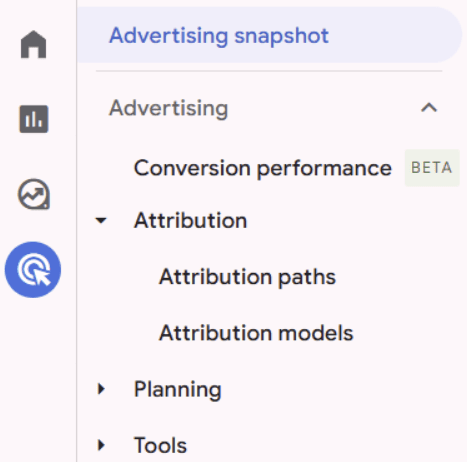
The Attribution paths report lives under Advertising → Attribution in Google Analytics 4.

Attribution Paths reportImage from author, October 2025

It shows the sequence of touchpoints leading to a selected key event (GA4’s new term for “conversion” in reporting).

When linked with Google Ads, GA4’s Attribution paths can include a wider set of touchpoints, not just clicks. These may cover impressions, engaged views, emails, downloads, and site usage events. In practice, advertisers may see earlier interactions, such as YouTube views or Display impressions, represented in their conversion paths, rather than only the last click.

That impression visibility is a hidden gem. Instead of asking “Which campaign got the last click?” you can ask, “Which channels actually contribute to conversion journeys?”

From “Conversions” To “Key Events”

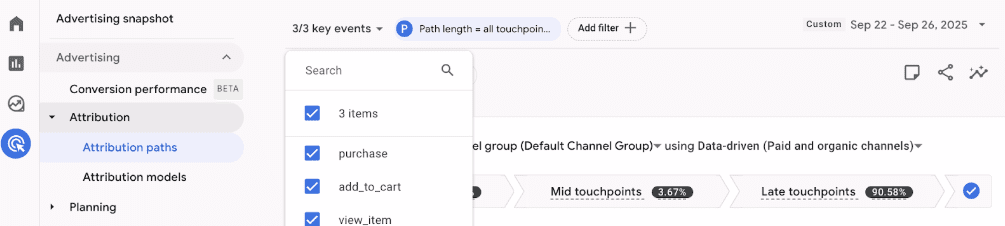
The terminology shift trips up many teams. In GA4 reports, you’ll see key events; in Google Ads, you’ll still import and bid on conversions. Functionally, they’re the same, just labelled differently depending on the platform. This matters because the Attribution paths report lets you segment by the exact key event you optimize for in Ads.

key event segmentationImage from author, October 2025

Beyond Last-Click: How To Use The Report

Here’s where the Attribution paths report becomes more than a pretty diagram:

Prove And Price Upper-Funnel Ads

Under a last-click model, touchpoints like YouTube impressions or Display views receive no credit for a conversion. But if you switch to Data-Driven Attribution (DDA) in GA4’s Attribution models, the system redistributes some credit to these earlier touchpoints when there’s statistical evidence they influenced the conversion. Attribution paths then show where those touchpoints occurred in the journey, giving you a directional view of their assist value. This isn’t causal “incrementality testing,” but it’s a practical way to highlight the contribution of upper-funnel Ads before requesting more budget.

Check Conversion Lag Before Tightening The Strategy

Time lag and path length metrics reveal how long users take to complete a conversion on average. If journeys average 10+ days, but you’re using a seven-day conversion window in Ads, your Smart Bidding may be cutting conversions off too early.

Segment By Conversion Type

A newsletter signup path looks very different from a qualified lead path. By selecting one key event at a time, you avoid combining low-value and high-value conversions, ensuring a more effective approach.

Validate Budget Shifts

The Attribution models report (sitting next to Attribution paths) shows how credit changes under DDA vs. last-click. Use Attribution paths to ensure that model-based reallocations reflect actual journeys, not anomalies.

For example, a B2B software advertiser discovered through Attribution Paths that most demo requests came from users who watched a YouTube awareness ad first, clicked a retargeting ad on Display, and then searched the brand name before converting. Under a last-click model, only the branded search ad received credit. But once path data revealed the full sequence, it became clear that the upper funnel was generating the demand, and the brand campaign was simply closing. With that context, the advertiser was able to justify maintaining a top-of-funnel budget.

Caveats You Can’t Ignore

Assisted Conversions Are Gone

Unlike Universal Analytics, GA4 doesn’t provide an “assists” metric. If you want it, you’ll need to export path data and calculate it manually.

Expect Discrepancies

Numbers in GA4’s Acquisition reports and Attribution paths often don’t line up. GA4’s Acquisition reports use different attribution logic depending on the report. User Acquisition attributes all credit to the first touch. Traffic Acquisition is attributed to the last non-direct touch. Key event (conversion) attribution is the only place where GA4 applies the property’s cross-channel attribution model (by default, data-driven). By contrast, the Attribution reports let you swap models entirely, compare outcomes, and even visualize how impressions or non-click touchpoints factor into paths. In other words, Acquisition reports show you who arrived and converted, while Attribution paths show you how credit is distributed across multiple interactions. Both are useful, but they’re answering different questions.

Data Availability

GA4 attribution only covers data from June 14, 2021, onwards, and only online touchpoints are covered by default.

Privacy, Sampling, And Model Lag

Modern attribution reports operate within data limits that every advertiser should account for. Privacy thresholds prevent Google from showing data when impression or click counts are too low, which is why some paths appear grouped under “Other.” Sampling can also affect the accuracy of multi-channel or multi-device reports, meaning figures should be treated directionally rather than as absolutes. Finally, attribution data has built-in lag: conversions that happen days after a click will backfill into earlier reports, so results from the past 24-48 hours are rarely complete. Waiting for that lag to settle before drawing conclusions gives automation a fairer dataset to learn from.

From Insights To Action In Google Ads

GA4 analysis means little unless you feed it back into your Ads strategy. Here’s how practitioners are using Attribution paths to shape accounts:

Import the right key events. Optimizing for form fills alone often floods Ads with spam. Instead, integrate your CRM and import sales qualified leads (SQLs) or other meaningful events as primary conversions.

Budget with “path context” in mind. If upper-funnel campaigns frequently appear in early path positions, avoid cutting their spend, even if the last-click ROI looks weak. They’re building journeys for your search campaigns to close later.

Control overlap with PMax. Performance Max campaigns behave like bottom-funnel, feed-driven engines, rather than true full-funnel campaigns. Attribution paths confirm this: If PMax dominates late-stage paths, don’t mistake it for incremental awareness.

Set guardrails. Guardrails are often just good account structure – negatives, segmentation, and clear bidding rules. Attribution insights only help if your Ads setup allows the algorithm to learn from them.

Why This Is The Moment To Care

Google has spent the past several years adding transparency: brand exclusions in PMax, channel reporting, and search terms data. But transparency in Ads itself is still limited. GA4 Attribution paths are where you can actually prove assist value, diagnose lag, and reframe conversations with stakeholders.

GA4’s reporting is messy, but if you know how to read it, you can tell a clearer story than Ads alone ever could.

GA4’s Attribution paths aren’t just a reporting feature. They’re one of the few places you can see the whole journey before Smart Bidding reduces everything to a single number. Treat it as a decision layer: Validate which campaigns deserve credit, import the right events into Ads, and use those insights to argue for budgets across the funnel.

More Resources:


Featured Image: Anton Vierietin/Shutterstock

AI SEO: How To Understand AI Mode Rankings via @sejournal, @martinibuster

A simplified explanation of how Google ranks content is that it is based on understanding search queries and web pages, plus a number of external ranking signals. With AI Mode, that’s just the starting point for ranking websites. Even keywords are starting to go away, replaced by increasingly complex queries and even images. How do you optimize for that? The following are steps that can be taken to help answer that question.

Latent Questions Are A Profound Change To SEO

The word “latent” means something that exists but cannot be seen.  When a user issues a complex query the LLM must not only understand the query but also map out follow-up questions that a user might ask as part of an information journey about the topic. Those questions that comprise the follow-up questions are latent questions. Virtually every query contains latent questions.

Google’s Information Gain Patent

The issue of latent queries poses a new problem for SEO: How do you optimize for questions that are unknown? Optimizing for AI search means optimizing for the entire range of questions that are related to the initial or head query.

But even the concept of a head query is going away because users are now asking complex queries which demand complex answers. This is precisely why it may be useful for AI SEO purposes to optimize not just for one query but for the immediate information needs of the user.

How does Google understand the information need that’s hidden within a user’s query? The answer is found in Google’s Information Gain Patent. That patent is about ranking a web page that is relevant for a query then afterward ranking other web pages that have different but related content.

Identify The Latent (Hidden) Questions

One way to look at AI search results is to break them down into the questions that the AI answers are satisfying, to identify the hidden query fan-out questions.

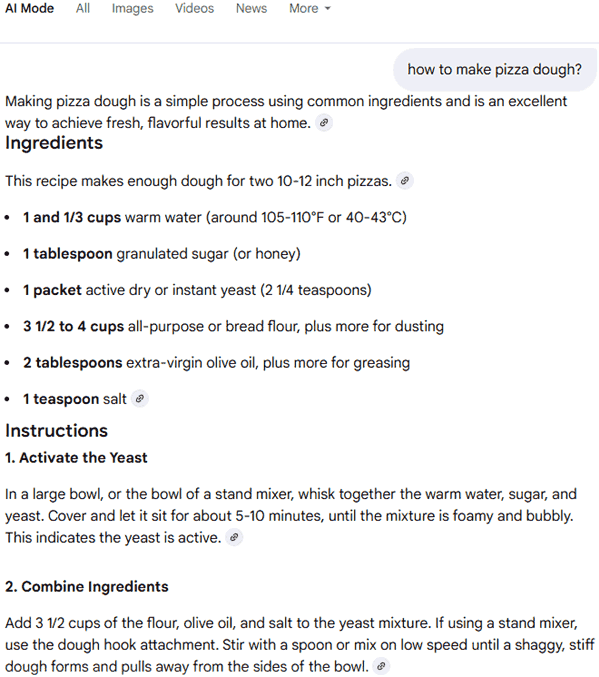
For example, if you ask Google’s AI Mode how to make pizza dough the AI Mode will generate a pizza dough recipe. The answer is synthesized from multiple queries.

There is a way to extract the hidden (latent) questions by using a Reverse Question Answering Prompt, which I’ll show below.

Here is an example of an initial query and the additional query fan-out questions that are involved:

Initial Query: How to make pizza dough?

Query Fan-Out Questions:

  • What ingredients are needed to make pizza dough?
  • How much pizza dough does this recipe make?
  • What indicates that the yeast is active?
  • How long should the dough be kneaded by hand?
  • How long should the dough be kneaded with a mixer?
  • How long should the dough rise during the first proofing?
  • How can you develop more complex flavor in the dough?
  • What should the oven temperature be for baking the pizza?
  • How long should the pizza bake?

Actual AI Mode Question And Answers

Here are some of the hidden query fan-out questions accompanied by the answers that Google’s AI Mode generated.

Question: What ingredients are needed to make pizza dough?
Answer: “1 and 1/3 cups warm water (around 105-110°F or 40-43°C); 1 tablespoon granulated sugar (or honey); 1 packet active dry or instant yeast (2 1/4 teaspoons); 3 1/2 to 4 cups all-purpose or bread flour, plus more for dusting; 2 tablespoons extra-virgin olive oil, plus more for greasing; 1 teaspoon salt.”

Question: How much pizza dough does this recipe make?
Answer: “This recipe makes enough dough for two 10-12 inch pizzas.”

Question: What indicates that the yeast is active?
Answer: “Cover and let it sit for about 5-10 minutes, until the mixture is foamy and bubbly. This indicates the yeast is active.”

Screenshot Of The Actual AI Mode Answer

Screenshot of AI Mode answer for query

Reverse Question Answering Prompt

You can use the Reverse Question Answering Prompt to identify the underlying questions in any AI Mode answer. You can even use a similar but more precise prompt to analyze your own content to identify what questions the document answers. It’s a good way to check if your content does or does not answer the questions you want it to answer.

Prompt To Extract Questions From AI Mode

Here is the prompt to use to extract the hidden questions within an AI Mode answer:

Analyze the document and extract a list of questions that are directly and completely answered by full sentences in the text. Only include questions if the document contains a full sentence or sentences that clearly answers it. Do not include any questions that are answered only partially, implicitly, or by inference.

For each question, ensure that it is a clear and concise restatement of the exact information present. This is a reverse question generation task: only use the content already present in the document.

For each question, also include the exact sentences from the document that answer it. Only generate questions that have a complete, direct answer in the form of a full sentence or sentences in the document.

Reverse Question Answering Analysis For Web Content

The previously described prompt can be used to extract the questions that are answered by your own or a competitor’s content. But it will not differentiate between the core search queries the document is relevant for and other questions that are ancillary to the main topic.

To do a Reverse Question Answering analysis with your own content, try this more precise variant of the prompt:

Analyze the document and extract a list of questions that are core to the document’s central topic and are directly and completely answered by full sentences in the text.

Only include questions if the document contains a full sentence or contiguous sentences that clearly answers it. Do not include any questions that are answered only partially, implicitly, or by inference. Crucially, exclude any questions about supporting anecdotes, personal asides, or general background information that is not the main subject of the document.

For each question, ensure that it is a clear and concise restatement of the exact information present. This is a reverse question generation task: only use the content already present in the document.

For each question, also include the exact sentences from the document that answer it. Only generate questions that have a complete, direct answer in the form of a full sentence or sentences in the document.

The above prompt is meant to emulate how an LLM or information retrieval system might extract the core questions that a web document answers, while ignoring the parts of the document that aren’t central to its informational purpose, such as tangential commentary that do not directly contribute to the document’s main topic or purpose.

Cultivate Being Mentioned On Other Sites

Something that is becoming increasingly apparent is that AI search tends to rank companies whose websites are recommended by other sites. Research by Ahrefs found a strong correlation between sites that appear in AI Overviews and branded mentions.

According to Ahrefs:

“So we looked at these factors that correlate with the amount of times a brand appears in AI overviews, tested tons of different things, and by far the strongest correlation, very, very strong correlation, almost 0.67, was branded web mentions.

So if your brand is mentioned in a ton of different places on the web, that correlates very highly with your brand being mentioned in lots of AI conversations as well.”

Read: Data Shows Brand Mentions Boost AI Search Rankings

This finding strongly suggests that visibility in AI search may depend less on backlinks and more on how often a brand is discussed across the web. AI models seem to learn which brands are recommended by how often those sites are mentioned across other sites, including sites like Reddit.

Post-Keyword Ranking Era

We are in a post-keyword ranking era. Google’s organic search was already using AI and a core topicality system to better understand queries and the topic that web pages were about. The big difference now is that Google’s AI Mode has enabled users to search with long and complex conversational queries that aren’t necessarily answered by web pages that are focused on being relevant to keywords instead of to what people are actually looking for.

Write About Topics

Writing about topics seems like a straightforward approach but what it means depends on the context of the topic.

What “topic writing” proposes is that instead of writing about the keyword Blue Widget, the writer must write about the topic of Blue Widget.

The old way of SEO was to think about Blue Widget and all the associated Blue Widget keyword phrases:

Associated keyword phrases

  • How to make blue widgets
  • Cheap blue widgets
  • Best blue widgets

Images And Videos

The up to date way to write is to think in terms of answers and helpfulness. For example, do the images on a travel site communicate what a destination is about? Will a reader linger on the photo? On a product site, do the images communicate useful information that will help a consumer determine if something will fit and what it might look like on them?

Images and videos, if they’re helpful and answer questions, could become increasingly important as users begin to search with images and increasingly expect to see more videos in the search results, both short and longform videos.

Read:

Featured Image by Shutterstock/Nithid

How Founders Are Turning Their LinkedIn Posts Into Larger Sales Deals [Webinar] via @sejournal, @itsduhnise

Build Influence, Drive Revenue, and Grow Faster

Your voice is your most underused business asset. 

Founders who post at least 10 times a year on LinkedIn: 

  • Generate 33% more leads.
  • Close deals that are 3.7x larger. 

The data speaks for itself.

In this live webinar, a rockstar team from LinkedIn will share new insights and proven strategies from their latest research on founder-led marketing. You’ll see how the most successful founders are transforming expertise into trust, reach, and revenue.

What You’ll Learn

  • The 3 story types that resonate most with buyers and how to capture ideas without adding hours to your week.
  • A proven approach for creating consistent, high-impact posts that don’t lead to burnout.
  • Which metrics actually matter and how to track real influence across your sales cycle.

Why You Should Attend

You’ll hear how brands like Aligned generated 65% of their leads through founder-led marketing, how Hootsuite’s CEO influenced $15M in pipeline, and how Wynter drove 80% of demo signups through this strategy.

Whether you’re pre-seed or scaling to Series B, this webinar will help you turn your own perspective into your strongest lead-generation engine.

Register now to learn how to use your voice to grow trust, visibility, and deal size.

🛑 Can’t make it live? Register anyway, and we’ll send you the on-demand recording.

The Download: the AGI myth, and US/China AI competition

This is today’s edition of The Download, our weekday newsletter that provides a daily dose of what’s going on in the world of technology.

How AGI became the most consequential conspiracy theory of our time

—Will Douglas Heaven, senior AI editor 

Are you feeling it?

I hear it’s close: two years, five years—maybe next year! And I hear it’s going to solve our biggest problems in ways we cannot yet imagine. I also hear it will bring on the apocalypse and kill us all…

We’re of course talking about artificial general intelligence, or AGI—that hypothetical near-future technology that (I hear) will be able to do pretty much whatever a human brain can do.

Every age has its believers, people with an unshakeable faith that something huge is about to happen—a before and an after that they are privileged (or doomed) to live through. For us, that’s the promised advent of AGI. And here’s what I think: AGI is a lot like a conspiracy theory, and it may be the most consequential one of our time. Read the full story.

This story is part of MIT Technology Review’s series “The New Conspiracy Age,” on how the present boom in conspiracy theories is reshaping science and technology.

The State of AI: Is China about to win the race? 

Viewed from abroad, it seems only a matter of time before China emerges as the AI superpower of the 21st century. 

In the West, our initial instinct is to focus on America’s significant lead in semiconductor expertise, its cutting-edge AI research, and its vast investments in data centers.

Today, however, China has the means, motive, and opportunity to win. When it comes to mobilizing the whole-of-society resources needed to develop and deploy AI to maximum effect, it may be rash to bet against it. Read the full story.

—John Thornhill & Caiwei Chen

This is the first edition of The State of AI, a collaboration between the Financial Times & MIT Technology Review examining the ways in which AI is reshaping global power. Every Monday for the next six weeks, writers from both publications will debate one aspect of the generative AI revolution reshaping global power. Sign up to receive future editions every Monday.

The must-reads

I’ve combed the internet to find you today’s most fun/important/scary/fascinating stories about technology.

1 China is prepared to cut its data centers a sweet deal
If they agree to use native chips over American rivals’, that is. (FT $)
+ What happened when a data center moved into a small American town. (WSJ $)
+ Microsoft and OpenAI want more power—they just don’t know how much more. (TechCrunch)
+ The data center boom in the desert. (MIT Technology Review)

2 Norway’s oil fund has rejected Elon Musk’s $1 trillion pay package
The Tesla shareholder is concerned about the size of the reward. (WSJ $)
+ It says it will vote against the deal on Thursday. (FT $)

3 OpenAI has signed a massive compute deal with Amazon
It’s the latest in a long string of blockbuster deals for the AI company. (Wired $)

4 Cybersecurity workers moonlighted as criminal hackers
They’re accused of sharing their profits with the creators of the ransomware they deployed. (Bloomberg $)
+ The hackers demanded tens of millions in extortion payments. (The Register)

5 Tech’s elites are funding plans to safeguard MAGA
Entrepreneur Chris Buskirk is using donor money to equip it to outlive Trump. (WP $)

6 These startups supply the labor to train multitasking humanoid robots
Teams of humans are doing the dirty work, including filming themselves folding towels hundreds of times a day. (LA Times $)
+ This new system can teach a robot a simple household task within 20 minutes. (MIT Technology Review)

7 LLMs can’t accurately describe their internal processes
Anthropic is on a mission to measure their so-called introspective awareness. (Ars Technica)

8 Why are people using AI to hack their hobbies?
Talk about the death of fun. (NY Mag $)
+ While we’re at it, don’t use chatbots to answer friends’ dilemmas either. (Wired $)
+ Or to write research papers. (404 Media)

9 Coca-Cola is doubling down on AI in its ads
Undeterred by criticism last year, it’s back with more for the 2025 holidays. (WSJ $)
+ Nothing says festive joy like AI slop. (The Verge)

10 Facebook Dating is a…hit?
But you should still be on the lookout for scammers. (NYT $)
+ It’s not just for boomers—younger people are using it too. (TechCrunch)
+ For better or worse, AI is seeping into all the biggest dating platforms. (Economist $)

Quote of the day

“That was the kick of it, that the AI actually did find compatibility. It was the human part that didn’t work out.”

—Emma Inge, a project manager looking for love in San Francisco, describes the trouble with using an AI matchmaker to the New York Times: it can’t stop you getting ghosted.

One more thing

Inside the most dangerous asteroid hunt ever

If you were told that the odds of something were 3.1%, it might not seem like much. But for the people charged with protecting our planet, it was huge.

On February 18, astronomers determined that a 130- to 300-foot-long asteroid had a 3.1% chance of crashing into Earth in 2032. Never had an asteroid of such dangerous dimensions stood such a high chance of striking the planet. Then, just days later on February 24, experts declared that the danger had passed. Earth would be spared.

How did they do it? What was it like to track the rising danger of this asteroid, and to ultimately determine that it’d miss us?

This is the inside story of how a sprawling network of astronomers found, followed, mapped, planned for, and finally dismissed the most dangerous asteroid ever found—all under the tightest of timelines and, for just a moment, with the highest of stakes. Read the full story.

—Robin George Andrews

We can still have nice things

A place for comfort, fun and distraction to brighten up your day. (Got any ideas? Drop me a line or skeet ’em at me.)

+ People in the Middle Ages chose to depict the devil in very interesting ways, I’ll say that much.
+ We may be inching closer to understanding why the animal kingdom has developed such elaborate markings.
+ The music in the new game Pokémon Legends: Z-A sure is interesting.
+ Slow cooker dinners are beckoning.

Why the for-profit race into solar geoengineering is bad for science and public trust

Last week, an American-Israeli company that claims it’s developed proprietary technology to cool the planet announced it had raised $60 million, by far the largest known venture capital round to date for a solar geoengineering startup.

The company, Stardust, says the funding will enable it to develop a system that could be deployed by the start of the next decade, according to Heatmap, which broke the story.


Heat Exchange

MIT Technology Review’s guest opinion series, offering expert commentary on legal, political and regulatory issues related to climate change and clean energy. You can read the rest of the pieces here.


As scientists who have worked on the science of solar geoengineering for decades, we have grown increasingly concerned about the emerging efforts to start and fund private companies to build and deploy technologies that could alter the climate of the planet. We also strongly dispute some of the technical claims that certain companies have made about their offerings. 

Given the potential power of such tools, the public concerns about them, and the importance of using them responsibly, we argue that they should be studied, evaluated, and developed mainly through publicly coordinated and transparently funded science and engineering efforts.  In addition, any decisions about whether or how they should be used should be made through multilateral government discussions, informed by the best available research on the promise and risks of such interventions—not the profit motives of companies or their investors.

The basic idea behind solar geoengineering, or what we now prefer to call sunlight reflection methods (SRM), is that humans might reduce climate change by making the Earth a bit more reflective, partially counteracting the warming caused by the accumulation of greenhouse gases. 

There is strong evidence, based on years of climate modeling and analyses by researchers worldwide, that SRM—while not perfect—could significantly and rapidly reduce climate changes and avoid important climate risks. In particular, it could ease the impacts in hot countries that are struggling to adapt.  

The goals of doing research into SRM can be diverse: identifying risks as well as finding better methods. But research won’t be useful unless it’s trusted, and trust depends on transparency. That means researchers must be eager to examine pros and cons, committed to following the evidence where it leads, and driven by a sense that research should serve public interests, not be locked up as intellectual property.

In recent years, a handful of for-profit startup companies have emerged that are striving to develop SRM technologies or already trying to market SRM services. That includes Make Sunsets, which sells “cooling credits” for releasing sulfur dioxide in the stratosphere. A new company, Sunscreen, which hasn’t yet been announced, intends to use aerosols in the lower atmosphere to achieve cooling over small areas, purportedly to help farmers or cities deal with extreme heat.  

Our strong impression is that people in these companies are driven by the same concerns about climate change that move us in our research. We agree that more research, and more innovation, is needed. However, we do not think startups—which by definition must eventually make money to stay in business—can play a productive role in advancing research on SRM.

Many people already distrust the idea of engineering the atmosphere—at whichever scale—to address climate change, fearing negative side effects, inequitable impacts on different parts of the world, or the prospect that a world expecting such solutions will feel less pressure to address the root causes of climate change.

Adding business interests, profit motives, and rich investors into this situation just creates more cause for concern, complicating the ability of responsible scientists and engineers to carry out the work needed to advance our understanding.

The only way these startups will make money is if someone pays for their services, so there’s a reasonable fear that financial pressures could drive companies to lobby governments or other parties to use such tools. A decision that should be based on objective analysis of risks and benefits would instead be strongly influenced by financial interests and political connections.

The need to raise money or bring in revenue often drives companies to hype the potential or safety of their tools. Indeed, that’s what private companies need to do to attract investors, but it’s not how you build public trust—particularly when the science doesn’t support the claims.

Notably, Stardust says on its website that it has developed novel particles that can be injected into the atmosphere to reflect away more sunlight, asserting that they’re “chemically inert in the stratosphere, and safe for humans and ecosystems.” According to the company, “The particles naturally return to Earth’s surface over time and recycle safely back into the biosphere.”

But it’s nonsense for the company to claim they can make particles that are inert in the stratosphere. Even diamonds, which are extraordinarily nonreactive, would alter stratospheric chemistry. First of all, much of that chemistry depends on highly reactive radicals that react with any solid surface, and second, any particle may become coated by background sulfuric acid in the stratosphere. That could accelerate the loss of the protective ozone layer by spreading that existing sulfuric acid over a larger surface area.

(Stardust didn’t provide a response to an inquiry about the concerns raised in this piece.)

In materials presented to potential investors, which we’ve obtained a copy of, Stardust further claims its particles “improve” on sulfuric acid, which is the most studied material for SRM. But the point of using sulfate for such studies was never that it was perfect, but that its broader climatic and environmental impacts are well understood. That’s because sulfate is widespread on Earth, and there’s an immense body of scientific knowledge about the fate and risks of sulfur that reaches the stratosphere through volcanic eruptions or other means.

If there’s one great lesson of 20th-century environmental science, it’s how crucial it is to understand the ultimate fate of any new material introduced into the environment. 

Chlorofluorocarbons and the pesticide DDT both offered safety advantages over competing technologies, but they both broke down into products that accumulated in the environment in unexpected places, causing enormous and unanticipated harms. 

The environmental and climate impacts of sulfate aerosols have been studied in many thousands of scientific papers over a century, and this deep well of knowledge greatly reduces the chance of unknown unknowns. 

Grandiose claims notwithstanding—and especially considering that Stardust hasn’t disclosed anything about its particles or research process—it would be very difficult to make a pragmatic, risk-informed decision to start SRM efforts with these particles instead of sulfate.

We don’t want to claim that every single answer lies in academia. We’d be fools to not be excited by profit-driven innovation in solar power, EVs, batteries, or other sustainable technologies. But the math for sunlight reflection is just different. Why?   

Because the role of private industry was essential in improving the efficiency, driving down the costs, and increasing the market share of renewables and other forms of cleantech. When cost matters and we can easily evaluate the benefits of the product, then competitive, for-profit capitalism can work wonders.  

But SRM is already technically feasible and inexpensive, with deployment costs that are negligible compared with the climate damage it averts.

The essential questions of whether or how to use it come down to far thornier societal issues: How can we best balance the risks and benefits? How can we ensure that it’s used in an equitable way? How do we make legitimate decisions about SRM on a planet with such sharp political divisions?

Trust will be the most important single ingredient in making these decisions. And trust is the one product for-profit innovation does not naturally manufacture. 

Ultimately, we’re just two researchers. We can’t make investors in these startups do anything differently. Our request is that they think carefully, and beyond the logic of short-term profit. If they believe geoengineering is worth exploring, could it be that their support will make it harder, not easier, to do that?  

David Keith is the professor of geophysical sciences at the University of Chicago and founding faculty director of the school’s Climate Systems Engineering Initiative. Daniele Visioni is an assistant professor of earth and atmospheric sciences at Cornell University and head of data for Reflective, a nonprofit that develops tools and provides funding to support solar geoengineering research.


Notable Business Books in 2025

It’s the time of year when publications and organizations issue “best of” book lists. This year’s business award winners, best sellers, and shortlisters include titles on Facebook, entrepreneurship, Shopify, China, and, yes, AI.

Careless People: A Cautionary Tale of Power, Greed, and Lost Idealism

Cover of Careless People

Careless People

by Sarah Wynn-Williams

A New York Times bestseller, this tell-all memoir by a former Facebook executive portrays the company’s leadership as careless and its culture as dysfunctional. It made McKinsey & Company’s annual “what to read next” list, The Economist’s 40 best books, Barnes & Noble’s best business books of 2025, and Goodreads’ hit new books of the year, as well as the Times’ own best books of the year.

The Thinking Machine

Cover of The Thinking Machine

The Thinking Machine

by Stephen Witt

I included the story of NVIDIA’s rise from obscure gaming company to global tech disruptor in my spring roundup of new books. Since then, it has landed on best-of lists by McKinsey and The Economist, and shortlisted for “best business book of 2025” by the Financial Times and Schroders, the investment firm.

Abundance

Cover of Abundance

Abundance

by Ezra Klein and Derek Thompson

This ambitious book by Klein, The New York Times podcast host, and Thompson, editor of The Atlantic, argues that the policies of the past cannot solve today’s problems, and what’s needed is a shift from a scarcity mindset to one of abundance. It’s a New York Times bestseller, a best-of-year selection by McKinsey and Goodreads, and shortlisted for best business book by the Financial Times and Schroders.

Start. Scale. Exit. Repeat.

Cover of Start. Scale. Exit. Repeat.

Start. Scale. Exit. Repeat.

by Colin C. Campbell

Included in my June roundup, Campbell’s book has garnered numerous 2025 awards: the Dan Poynter Global Ebook Award, the Axiom Awards Entrepreneurship / Small Business gold medal, and the Nautilus Awards (“Better Books for a Better World”), among others, as well as being a Kirkus Best Indie Book of the Year for 2024 with a starred review that called it “top-notch how-to for business owners.”

The Canary Code: A Guide to Neurodiversity, Dignity, and Intersectional Belonging at Work

Cover of The Canary Code

The Canary Code

by Ludmila N. Praslova, PhD

Praslova’s guide to inclusive workplaces earned gold medals from both the Independent Publishers Book Awards and the Nautilus Awards.

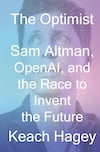
The Optimist: Sam Altman, OpenAI and the Race to Invent the Future

Cover of The Optimist

The Optimist

by Keach Hagey

Hagey’s book made the “best of 2025” lists from McKinsey and The Economist, which called it “deeply researched and gripping.” For a different take on the same subject, “Empire of AI: Dreams and Nightmares in Sam Altman’s OpenAI” by Karen Hao was also listed by The Economist and shortlisted by the Financial Times and Schroders. Time magazine calls it “a page-turner.”

From Click to Boom: The Political Economy of E-Commerce in China

Cover of From Click to Boom

From Click to Boom

by Lizhi Liu

“From Click to Boom” is the story of how China built a $2 trillion ecommerce market — with 800 million users, 70 million jobs, and nearly 50% of global online retail sales — from scratch in just 20 years. It received the Axiom silver medal in International Business and Globalization.

The Shopify Story: How a Startup Rocketed to E-Commerce Giant by Empowering Millions of Entrepreneurs

Cover of The Shopify Story

The Shopify Story

by Larry MacDonald

The Axiom gold medal for Corporate History went to this inspirational story that offers lessons for entrepreneurs, managers, employees, programmers, policymakers, and investors.

The Psychology of Money: Timeless Lessons on Wealth, Greed, and Happiness

Cover of The Psychology of Money

The Psychology of Money

by Morgan Housel

McKinsey put this classic bestseller by Housel, a multi-award-winning author, on its “what to read next” list. His latest book, “The Art of Spending Money,” is about making the best of what you have.

Google AI Mode Starts Rolling Out Agentic Booking In Labs via @sejournal, @MattGSouthern

Google is starting to roll out agentic capabilities in AI Mode as a Search Labs experiment.

This update enables AI Mode to find and book restaurant reservations, event tickets, and wellness appointments across multiple websites.

Availability is limited, and Google notes this experiment may not be available to everyone yet.

Robby Stein, VP of Product at Google Search, announced the rollout on X.

What’s New

AI Mode now performs multi-site searches for three booking categories and returns real-time options with a curated list of time slots or ticket prices.

Here’s what U.S. users see when visiting the landing page in Search Labs:

Screenshot from: labs.google.com/search/experiment/43, November 2025.

Restaurant Reservations

You can ask for party size, time, neighborhood, or cuisine.

Google’s example:

“find me a dinner reservation for 3 people this Friday after 6pm around Logan Square. craving ramen or bibimbap.”

Results include available times with links to book.

Event Tickets

Google AI Pro and Ultra subscribers can search for concert and event tickets with price and seating preferences, for example:

“find me 2 cheap tickets for the Shaboozey concert coming up. prefer standing floor tickets.”

Wellness Appointments

Also for Pro and Ultra subscribers, AI Mode can surface real-time availability from local service booking platforms and link you to complete the appointment.

How It Works

AI Mode searches across multiple websites to surface real-time availability, then presents a curated list. It links you directly to the provider’s booking page to finalize the reservation or purchase.

Requirements

Full functionality requires:

  • A personal Google Account you manage yourself
  • Web & App Activity turned on
  • Search Labs access
  • U.S. location and English language
  • Age 18 or older

These conditions are listed on the experiment page.

Why This Matters

If you handle bookings, AI Mode can reduce the steps it takes for people to compare times and prices across sites.

You still complete the transaction on the provider’s site, but discovery and comparison move into a single query.

Looking Ahead

Google calls this an early experiment that may make mistakes and invites feedback to improve quality.

Rollout is staged, so availability will expand over the coming days.


Featured Image: Koshiro K/Shutterstock