Google Launches Video Generation In Product Studio via @sejournal, @brookeosmundson

Google just announced new AI-powered video creation capabilities in Product Studio today.

With over 50% of the market share shifting to digital video ads, this update makes video creation for brands of all sizes easier to enter the market.

Curious how to get started? Read on for the full update.

Video Generation Capabilities

Within Product Studio, marketers can now transform their current product images into high-quality, dynamic videos.

To get started, you’ll select the product you want featured, and then will choose a video theme.

The AI video generation tool can then customize the video to include specifics like:

  • Enhance images
  • Highlight product attributes
  • Match brand guidelines
  • Add audio
  • Customize headlines
  • Unique product callouts
  • And more.

To make it easier for advertisers, Google said “These videos can be downloaded to use across Ads campaigns, Merchant Center, your website, or other marketing channels.”

Video generation is available in Merchant Center, or the Google and YouTube app within Shopify.

How to Get Started

In order to start generating videos in Merchant Center, you’ll need to have brand information set up within the platform.

This includes your brand colors and logo.

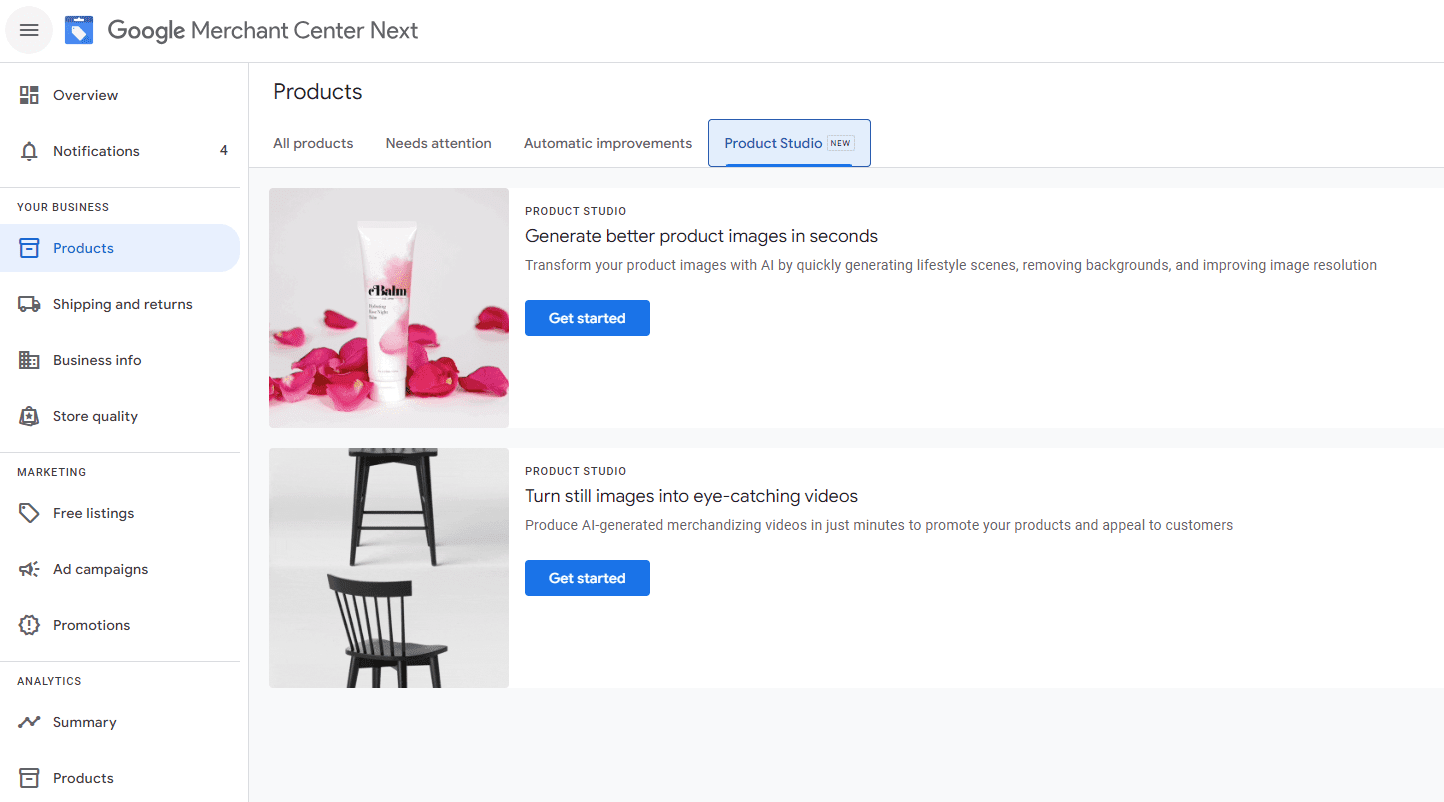
Then, within Merchant Center Next, navigate to the “Products” page, then click “Product Studio.” To choose a product, click “Get started”.

Product Studio within Google Merchant Center Next

From there, select the product you want to generate a new video for.

This is where you’ll select a theme and choose from a variety of the optional add-ons, like a headline or audio tracks.

The video generation can take a few minutes, and then you’ll have the option to generate a high-res video or download a low-res video for easy sharing capabilities.

Summary

As of the announcement, video generation in Product Studio is only available for merchants in the United States.

Google does plan to expand to additional countries in the near future, but no concrete timeline as of yet.

Creating product videos for cross-channel marketing efforts is about to get more streamlined for many advertisers, right in time for the holidays.

The update can save marketers valuable time and resources on creatives, which allows them to shift the focus on other high priority items that may arise during a busy Q4 season.

Microsoft Ads Makes Copilot Advancements via @sejournal, @brookeosmundson

Microsoft Ads made some significant enhancements for ads in Copilot last week.

Not only have they made updates to the Copilot user experience, they’ve integrated more AI features for advertisers within Microsoft Ads.

These updates continue to shape how users interact with Copilot and how advertisers interact with the Microsoft Ads platform.

Let’s take a look at the new updates rolling out.

New Streamlined Experience for Ads in Copilot

Part of the evolution of Microsoft Copilot is aiming to simplify, yet personalize, the user’s digital experience.

The update will now better depict the difference between an organic listing and a sponsored conversation within Copilot.

They’re making that happen by featuring ads in Copilot below the Copilot organic response.

To make the experience more relevant to users, there will be fewer annotations and extensions shown.

Additionally, ads will now be triggered based on the whole conversation within Copilot, not just the last prompt a user gives.

Copilot has released a feature called “ad voice” which will introduce how the ads are relevant and connected to their Copilot conversation. This is shown before an ad blocker to give the user a chance to experience the ads within the conversation.

The updated experience will roll out later this month, starting on copilot.microsoft.com, and then will expand to both iOS and Android apps, along with the experiences in Bing and Microsoft Edge.

New Generative AI Tools in Microsoft Ads Platform

On the other side of Copilot updates, there’s a few new features using Copilot’s AI technologies to help advertisers boost productivity and insights.

Diagnostics Tool

The new Diagnostics feature in Copilot for Microsoft Ads will help lend a hand to advertisers to review items like:

  • Campaign setup
  • Assess overall account health
  • Diagnose where to shift attention or focus to
  • Provide next steps on a diagnosis

This takes place within the Copilot conversation experience and is set to start piloting later this month.

It’s goal is to save advertisers time on day-to-day campaign management so they can spend more time analyzing and optimizing their accounts.

Performance Snapshot

Another new feature within Copilot for Microsoft Ads is the performance snapshot.

Similar to the diagnostics tool, advertisers will use the conversational experience to ask Copilot how their accounts are doing.

They can get insights on items like:

  • Summary of key insights
  • Account or campaign key insights
  • Trends
  • Any anomalies
  • And more.

The performance snapshot will also start piloting later this month, and will gradually roll out to all eligible regions when available.

Summary

Microsoft continues to develop and evolve its solutions from direct feedback from users and advertisers, which is a welcome experience for advertisers alike.

For advertisers already using Microsoft Ads, look for these key features in the upcoming weeks or months.

If you’re not currently using Microsoft Ads, it may be worth testing out a portion of your PPC budget this season to compare how its performance measures up against your Google Ads campaigns.

Executive Director Of WordPress Resigns via @sejournal, @martinibuster

Josepha Haden Chomphosy, Executive Director of the WordPress Project, officially announced her resignation, ending a nine-year tenure. This comes just two weeks after Matt Mullenweg launched a controversial campaign against a managed WordPress host, which responded by filing a federal lawsuit against him and Automattic.

She posted an upbeat notice on her personal blog, reaffirming her belief in the open source community as  positive economic force as well as the importance of strong opinions that are “loosely  held.”

She wrote:

“This week marks my last as the Executive Director of the WordPress project. My time with WordPress has transformed me, both as a leader and an advocate. There’s still more to do in our shared quest to secure a self-sustaining future of the open source project that we all love, and my belief in our global community of contributors remains unchanged.

…I still believe that open source is an idea that can transform generations. I believe in the power of a good-hearted group of people. I believe in the importance of strong opinions, loosely held. And I believe the world will always need the more equitable opportunities that well-maintained open source can provide: access to knowledge and learning, easy-to-join peer and business networks, the amplification of unheard voices, and a chance to tap into economic opportunity for those who weren’t born into it.”

Turmoil At WordPress

The resignation comes amidst the backdrop of a conflict between WordPress co-founder Matt Mullenweg and the managed WordPress web host WP Engine, which has brought unprecedented turmoil within the WordPress community, including a federal lawsuit filed by WP Engine accusing Mullenweg of attempted extortion.

Resignation News Was Leaked

The news about the resignation was leaked on October 2nd by the founder of the WordPress news site WP Tavern (now owned by Matt Mullenweg), who tweeted that he had spoken with Josepha that evening, who announced her resignation.

He posted:

“I spoke with Josepha tonight. I can confirm that she’s no longer at Automattic.

She’s working on a statement for the community. She’s in good spirits despite the turmoil.”

Screenshot Of Deleted Tweet

Josepha tweeted the following response the next day:

“Ok, this is not how I expected that news to come to y’all. I apologize that this is the first many of you heard of it. Please don’t speculate about anything.”

Rocky Period For WordPress

While her resignation was somewhat of an open secret it’s still a significant event because of recent events at WordPress, including the resignations of 8.4% of Automattic employees as a result of an offer of a generous severance package to all employees who no longer wished to work  there.

Read the official announcement:

Thank you, WordPress

Featured Image by Shutterstock/Wirestock Creators

8% Of Automattic Employees Choose To Resign via @sejournal, @martinibuster

WordPress co-founder and Automattic CEO announced today that he offered Automattic employees the chance to resign with a severance pay and a total of 8.4 percent. Mullenweg offered $30,000 or six months of salary, whichever one is higher, with a total of 159 people taking his offer.

Reactions Of Automattic Employees

Given the recent controversies created by Mullenweg, one might be tempted to view the walkout as a vote of no-confidence in Mullenweg. But that would be a mistake because some of the employees announcing their resignations either praised Mullenweg or simply announced their resignation while many others tweeted how happy they are to stay at Automattic.

One former employee tweeted that he was sad about recent developments but also praised Mullenweg and Automattic as an employer.

He shared:

“Today was my last day at Automattic. I spent the last 2 years building large scale ML and generative AI infra and products, and a lot of time on robotics at night and on weekends.

I’m going to spend the next month taking a break, getting married, and visiting family in Australia.

I have some really fun ideas of things to build that I’ve been storing up for a while. Now I get to build them. Get in touch if you’d like to build AI products together.”

Another former employee, Naoko Takano, is a 14 year employee, an organizer of WordCamp conferences in Asia, a full-time WordPress contributor and Open Source Project Manager at Automattic announced on X (formerly Twitter) that today was her last day at Automattic with no additional comment.

She tweeted:

“Today was my last day at Automattic.

I’m actively exploring new career opportunities. If you know of any positions that align with my skills and experience!”

Naoko’s role at at WordPress was working with the global WordPress community to improve contributor experiences through the Five for the Future and Mentorship programs. Five for the Future is an important WordPress program that encourages organizations to donate 5% of their resources back into WordPress. Five for the Future is one of the issues Mullenweg had against WP Engine, asserting that they didn’t donate enough back into the community.

Mullenweg himself was bittersweet to see those employees go, writing in a blog post:

“It was an emotional roller coaster of a week. The day you hire someone you aren’t expecting them to resign or be fired, you’re hoping for a long and mutually beneficial relationship. Every resignation stings a bit.

However now, I feel much lighter. I’m grateful and thankful for all the people who took the offer, and even more excited to work with those who turned down $126M to stay. As the kids say, LFG!”

Read the entire announcement on Mullenweg’s blog:

Automattic Alignment

Featured Image by Shutterstock/sdx15

Google’s AI Overviews Avoid Political Content, New Data Shows via @sejournal, @MattGSouthern

Study reveals Google’s cautious approach to AI-generated content in sensitive search results, varying across health, finance, legal, and political topics.

  • Google shows AI Overviews for 50% of YMYL topics, with legal queries triggering them most often.
  • Health and finance AI Overviews frequently include disclaimers urging users to consult professionals.
  • Google avoids generating AI Overviews for sensitive topics like mental health, elections, and specific medications.
Google Expands Structured Data Support For Product Certifications via @sejournal, @MattGSouthern

Google has announced an update to its Search Central documentation, introducing support for certification markup in product structured data.

This change will take full effect in April and aims to provide more comprehensive and globally relevant product information.

New Certification Markup For Merchant Listings

Google has added Certification markup support for merchant listings in its product structured data documentation.

This addition allows retailers and ecommerce sites to include detailed certification information about their products

Transition From EnergyConsumptionDetails to Certification Type

A key aspect of this update is replacing the EnergyConsumptionDetails type with the more versatile Certification type.

The new type can support a wider range of countries and broader certifications.

Google recommends websites using EnergyConsumptionDetails in their structured data to switch to the Certification type before April.

This will ensure product pages remain optimized for Google’s merchant listing experiences.

Expanded Capabilities & Global Relevance

The move to the Certification type represents an expansion in the types of product certifications that can be communicated through structured data.

While energy efficiency ratings were a primary focus of the EnergyConsumptionDetails type, the new Certification markup can encompass a much wider array of product certifications and standards.

This change is relevant for businesses operating in multiple countries, as it allows for more nuanced and locally applicable certification information to be included

Implementation Guidelines

Google has provided examples in its updated documentation to guide webmasters in implementing the new Certification markup.

These examples include specifying certifications such as CO2 emission classes for vehicles and energy efficiency labels for electronics.

The structured data should be added to product pages using JSON-LD format, with the Certification type nested within the product’s structured data.

Review the full documentation to ensure proper implementation.

Including certification information in structured data could lead to more informative product listings, potentially influencing user click-through rates and purchase decisions.

For consumers, this update means access to more detailed and standardized product information directly in search results, particularly regarding certifications and compliance with various standards.

Next Steps

Website owners and SEO professionals should take the following steps:

  1. Review current use of EnergyConsumptionDetails in product structured data.
  2. Plan for the transition to the Certification type before April.
  3. Implement the new Certification markup on product pages, following Google’s guidelines.
  4. Test the implementation using Google’s Rich Results Test tool.

As with any significant change to structured data implementation, it is advisable to monitor search performance and rich result appearances after making these updates.


Featured Image: lilik ferri yanto/Shutterstock