How To Identify Which LLM Is Actually Working For You [Webinar] via @sejournal, @hethr_campbell

AI search is dominating the strategy conversation right now, and everyone is hearing the same thing from clients and directors: “What’s our AI search plan?”

The instinct is to optimize everywhere, ChatGPT, Perplexity, Gemini, and move fast. But before you reallocate budget or rewrite your GEO roadmap, there’s a more useful question to ask first:

Which LLM is actually driving conversions in your clients’ specific industry?

Join us for an upcoming expert panel webinar where we’ll dive into exactly that.

What You’ll Learn

In this webinar, Danielle Wood, Content & Creative Manager at CallRail, and Natalie Johnson, SEO & AI Visibility Expert & Founder of SweetGlow Marketing, will break down real conversion data by LLM and show how platform-level performance should shape your GEO strategy.

Specifically, you’ll walk away with:

  • Conversion data by LLM platform, so you know where high-intent traffic is actually coming from in each industry
  • A clear AI prioritization framework to stop spreading GEO effort equally and concentrate it where it converts
  • A reporting model that ties AI search activity to real business outcomes clients can see and trust

Why Attend?

You’ll finally be able to justify AI search investment; this session will give you the data and the framework to make that case and to implement the strongest, most successful AI search strategy possible.

Join us live to get your questions answered directly by the expert panel.

SEO 2.0: How Content Marketing Drives Visibility in AI Search via @sejournal, @hethr_campbell

The next evolution of SEO is unfolding right now: AI is changing how people discover brands & content.

Is your content cited ChatGPT, Gemini, Copilot, & AI Overviews?

How do you become a trusted source for AI citations?

Can you intentionally influence AI search outputs?

Yes, you can.

In this on-demand webinar, you can gain a practical, content-first framework for improving visibility in AI-powered search, plus learn:

How To Build The Content Signals AI Systems Actually Surface & Cite

This on-demand session breaks down how large language models retrieve, evaluate, and reference content, and walks through what that means for your upcoming SEO and content strategy.

You’ll walk away with a practical framework for building citation-worthy, AI-visible content that strengthens both traditional SERP rankings and AI recommendations.

You’ll Learn:

  • How to improve off-site mentions to boost AI mentions and citations.
  • Which content is citation-worthy, so you can build a powerful trust engine.
  • Exact traditional SEO advantages you should still consider.
5 GEO Strategies To Make AI Search Engines Recommend Your Brand In 2026

This post was sponsored by Geoptie. The opinions expressed in this article are the sponsor’s own. 

The way people search is changing faster than most marketers realize. ChatGPT alone now has over 900 million weekly active users. Google AI Overviews appear in one out of every four search results.

Each of these contains the potential for AI to cite your brand.

This isn’t a future trend. It’s happening right now. And if your brand isn’t showing up in those AI-generated answers, you’re invisible to a rapidly growing audience, even if you rank #1 on Google.

That’s where Generative Engine Optimization (GEO) comes in: the practice of optimizing your online presence. So, AI engines cite, reference, and recommend your brand when users ask questions in your space.

1. Start By Measuring Your AI Visibility

Before changing a single word on your website, you need to know where you stand. Which AI platforms mention your brand? For which queries? How often are your competitors getting cited instead of you?

You can’t optimize what you don’t measure.

How To Measure AI Visibility

Most marketers skip this step because it feels unfamiliar. But the process is straightforward.

  1. List 10–15 questions your ideal customer would ask an AI engine, things like “best [your category] for [use case]” or “how to solve [problem you address].”
  2. Run each query in ChatGPT, Perplexity, and Gemini.
  3. Note whether your brand is mentioned, which competitors show up instead, and whether sources are cited.

Repeat monthly, because AI-generated answers shift as models update and new content gets indexed. Doing this manually across multiple platforms gets tedious fast, which is why dedicated GEO platforms exist to automate the tracking and monitor changes over time.

The best place to start? Run a free geo rank check on your brand. In under a minute, you’ll see which AI engines mention you, which ones don’t, and where your competitors show up instead.

This baseline is essential. Without it, you’re optimizing blind.

2. Don’t Abandon SEO. It Still Feeds AI

Here’s an important nuance: traditional search rankings still matter for GEO.

AI engines frequently pull from top-ranking Google results when generating their responses. If your page ranks well for a relevant query, there’s a higher chance an AI engine will reference it as a source. Google’s own AI Overviews heavily favor content that already performs well in organic search.

So keep doing what continues to drive SERP rankings:

  • Producing high-quality content
  • Building backlinks
  • Technical SEO.

But think of SEO as the foundation, not the full strategy. The brands that win in AI search are those that layer GEO tactics on top of a solid SEO foundation.

3. Make Sure Your Content Follows GEO Best Practices

This is where most of the work happens. AI engines are selective about what they cite, and the structure and quality of your content play a massive role. Here’s what to focus on:

  • Write for citability, not just readability. AI engines look for content that makes clear, specific claims backed by data or expertise. Vague, fluffy paragraphs get skipped. Concrete statements like definitions, statistics, step-by-step processes, and expert opinions are far more likely to be pulled into a generated response.
  • Structure content around questions. Conversational AI is driven by user questions. Structure your content to directly answer the questions your audience asks. Use clear headers, concise paragraphs, and FAQ When an AI engine scans your page and finds a clean, authoritative answer to a specific question, you become a prime candidate for citation.
  • Leverage schema markup and structured data. Help AI engines understand what your content is about by implementing proper schema FAQ schema, How-To schema, and Organization schema all give AI systems stronger signals about your content’s topic and structure.
  • Build topical authority, not just keyword-specific content. AI engines favor sources that demonstrate deep expertise on a topic. Rather than publishing scattered blog posts across dozens of topics, build comprehensive content clusters that cover a subject thoroughly. This signals to AI engines that your brand is a reliable authority worth citing.

Pro Tip: Leverage a comprehensive GEO platform. Optimizing your content for AI search involves many moving parts: content structure, schema markup, topical authority, and technical SEO. Keeping track of all these signals manually across every page on your site isn’t realistic, especially as AI engines update how they evaluate sources. A dedicated GEO platform lets you regularly scan your entire website, monitor your optimization scores, and catch issues before they cost you citations.

Want to see where you stand right now? Run a free GEO audit and get actionable insights on your site’s AI readiness in under a minute.

4. Show Up In Reddit & UGC Discussions

Here’s a strategy most brands overlook: AI engines love Reddit.

If you’ve noticed Reddit threads showing up in Google results more frequently, that’s not a coincidence. Google and AI platforms increasingly treat user-generated content, especially Reddit, as a trusted and authentic source of information. When someone asks an AI engine for a product recommendation or solution comparison, the response often draws from Reddit discussions.

This means your brand’s presence in relevant threads matters more than ever. But you can’t just show up and start promoting yourself. Here’s how to approach it the right way:

  • Find where your audience is already talking. Search Reddit for your product category, your competitors’ names, and the problems you solve. Identify 5–10 active subreddits where these conversations happen. Look for threads like “what tool do you use for [your category].”  These are the discussions AI engines pull from.
  • Contribute before you promote. Spend at least 2–3 weeks genuinely participating before your brand ever comes up. Reddit users check post history, and if your account is nothing but product mentions, you’ll get flagged as spam.
  • Be honest, not salesy. When a relevant recommendation thread comes up, share your product as one option among others. Mention what it’s good at and where it might not be the best fit. AI engines weigh authentic, nuanced mentions far more heavily than obvious self-promotion.
  • Check what AI engines are citing. Run your core queries in ChatGPT and Perplexity and see which Reddit threads appear. If your brand isn’t in those threads, that’s where to focus.

5. Get Featured In Listicles On Trusted Sites

When users ask AI engines for recommendations like “best project management tools,” the AI doesn’t generate that list from scratch. It synthesizes from existing listicle articles on authoritative websites. A single placement in a well-ranking listicle can get your brand recommended across ChatGPT, Perplexity, and Google AI Overviews simultaneously.

  • Find the listicles AI engines are already citing. Run your target recommendation queries in ChatGPT and Perplexity and note which articles they reference. These are the exact listicles you need to be in.
  • Build a hit list of publishers. Identify publications that come up repeatedly across both AI and traditional search results for “best [your category]” queries. Prioritize sites with strong domain authority.
  • Make inclusion easy. Make sure your product pages have a clear one-liner, obvious differentiators, social proof, and transparent pricing. Then pitch authors with something valuable, such as a free account, a demo, or data they can use.

Listicles get updated regularly and AI engines re-scan them, so a placement you earn today could start driving AI citations within weeks.

The Window Is Open, For Now

Generative Engine Optimization is still in its early stages. Most brands haven’t even started thinking about it, which means the opportunity to establish an early advantage is enormous.

The brands that start measuring their AI visibility, optimizing their content for citability, building community presence, and earning placements in authoritative listicles today will be the ones AI engines default to recommending tomorrow.

The question isn’t whether AI search will matter for your business. It’s whether you’ll be visible when it does.

Start Optimizing For AI Search Today

Every strategy in this article comes down to one thing: making your brand the obvious choice when AI engines look for sources to cite and recommend. You don’t need to tackle everything at once, but you do need to start.

Geoptie brings all five strategies together in one platform, from tracking your AI visibility across ChatGPT, Perplexity, and Google AI to auditing your content and monitoring your optimization scores over time. It’s built specifically for GEO, so you can stop guessing and start seeing exactly where your brand stands in AI search.

The early movers will own this space. Make sure you’re one of them.


Image Credits

Featured Image: Image by Tor App. Used with permission.

How To Track AI Visibility & Prompts The Right Way via @sejournal, @lorenbaker

AI search has changed the rules, but has your tracking? 

How do you measure visibility without rankings?

Which prompts actually reflect real buyer intent?

And how do you avoid AI tracking data that looks useful, but isn’t?

Learn how to set up AI prompt tracking you can trust for smarter decisions.

ChatGPT, Google AI Overviews & Perplexity Are Reshaping Discoverability

In this on-demand webinar, Nick Gallagher, Sr. SEO Strategy Director at Conductor, breaks down how AI prompt tracking really works, why topics matter more than individual prompts, and how to avoid common mistakes that skew insights.

You’ll leave with a clear framework for measuring AI visibility in a way that reflects real user behavior and supports smarter search and content strategies.

You’ll Learn:

  • How AI prompt tracking works, and why setup matters more than volume
  • Best practices for choosing topics, prompts, and answer engines
  • Common mistakes that lead to inaccurate or misleading AI visibility data

Watch on-demand and learn how reputation management is shaping local visibility, trust, and growth in 2026.

View the slides below or check out the full webinar for all the details.

How To Set Up AI Prompt Tracking You Can Trust [Webinar] via @sejournal, @lorenbaker

Getting Real About AI Visibility Tracking

If you’re on the search or marketing team right now, you’ve probably been asked some version of: “Are we showing up in ChatGPT?” or “What’s our visibility in AI Overviews?”

And honestly? Most of us are still figuring that out.

Answer engines like ChatGPT, Perplexity, and Google AI Overviews have changed how people discover and evaluate solutions. Yet, we still see a lot of teams approaching AI visibility tracking the same way they’ve approached keyword tracking, and they’re just not the same.

Improper tracking leads to bad data that’s being used to make decisions. And bad decisions can be expensive.

That’s why we’re bringing in Nick Gallagher, Sr. SEO Strategy Director at Conductor, to walk through how to set up AI prompt tracking the right way. The goal is to walk away with a tracking framework you can actually trust.

What You’ll Learn

  • How AI prompt tracking works, and why the setup matters more than the volume of prompts you’re monitoring.
  • Best practices for choosing the right topics, prompts, and answer engines to track.
  • How to avoid common mistakes that lead to inaccurate or misleading AI visibility data.

Why This Matters Right Now

A lot of the conversations I’ve been having with SEOs and in-house marketers lately come back to the same thing: they know AI search is important, but they don’t trust the data they’re getting. Nick is going to break down why that’s happening and give you a clear framework to fix it for smarter decision-making. 

If you’re trying to measure AI visibility and want to make sure you’re not building strategy on bad data, please join us.

Can’t make it live? Register anyway, and we’ll send you the on-demand recording.

5 Ways Emerging Businesses Can Show up in ChatGPT, Gemini & Perplexity via @sejournal, @nofluffmktg

This post was sponsored by No Fluff. The opinions expressed in this article are the sponsor’s own.

When ChatGPT, Gemini, and Perplexity mention a company, these large language models (LLMs) are deciding whether that business is safe to reference, not how long it has existed.

Most business leaders assume one thing when they don’t show up in AI-generated answers:

We’re too new.

In reality, early testing across multiple AI platforms suggests something else is going on. In many cases, the problem has less to do with company age and more to do with how AI systems evaluate structure, repetition, and trust signals.

It is possible for new brands to be mentioned in AI search results.

Even well-built products with real expertise are routinely missing from AI recommendations. Yet when buyers ask who to trust, the same legacy names keep appearing.

Why Most New Businesses Don’t Show Up In AI Search Results

This isn’t random.

AI systems lean on existing training data and visible digital footprints, which favor brands that have been cited for years. Because every answer carries risk, these systems act conservatively.

They don’t look for the most optimized page; they look for the most verifiable entity. If your footprint is thin, inconsistent, or poorly supported by third parties, the AI will often swap you out for a competitor it can trust more easily.

Most new businesses launch with:

  • Minimal historical signals
    Very little online content or mentions, so AI has almost nothing to work with.
  • Few credibility signals
    Few backlinks, reviews, or press, so you don’t “look” trustworthy yet.
  • Blending brand names
    Similar or generic brand names are easier for AI systems to confuse, misattribute, or skip entirely if trust signals are weak.
  • Unclear positioning
    Unclear positioning or ideas that appear only once on a company website are less likely to be trusted.

Together, these create unreliable signals.

In generative search, visibility is less about ranking and more about reasoning.

This is why most new brands aren’t evaluated as “bad,” but as too uncertain to reference safely.

That distinction matters. Being referenced by AI is not just exposure; it influences who buyers consider credible before they ever reach a website. AI-referred visitors often convert at higher rates than traditional organic traffic.

For new businesses, the lack of legacy signals isn’t “just a disadvantage.” Handled correctly, it can be an opening to establish clarity and trust faster than older competitors that rely on outdated authority.

There’s surprisingly little guidance on whether a new or growing brand can actually appear in AI-generated answers. Given how much these systems depend on past signals, it’s easy to assume established companies appear by default.

To test that assumption, a brand-new B2B company was tracked from launch as part of a 12-week AI search visibility experiment. The findings below reflect the first six weeks of that ongoing test. The company started with no prior history, no backlinks, and no press coverage. A true zero.

Visibility was measured across 150 buyer-style prompts in ChatGPT, Google AI Overviews, and Perplexity rather than inferred from third-party dashboards.

Using weekly GEO sprints focused on technical foundations, answer-first content, and reinforcing signals like social, video, and early backlinks, the goal was to see how far a best-practice GEO playbook could move a truly new brand.

Within six weeks, the emerging business saw the following results:

  • Appeared in 5% of relevant AI responses.
  • Showed up across 39 of 150 questions.
  • Mentioned 74 times, with 42 cited mentions.
  • 6% citation accuracy, ~11% pointing to the brand’s own site.

6 Patterns Observed in Early AI Visibility Testing

Across the first six weeks, six patterns consistently influenced whether the brand was included, replaced by a competitor, or excluded entirely from AI-generated answers:

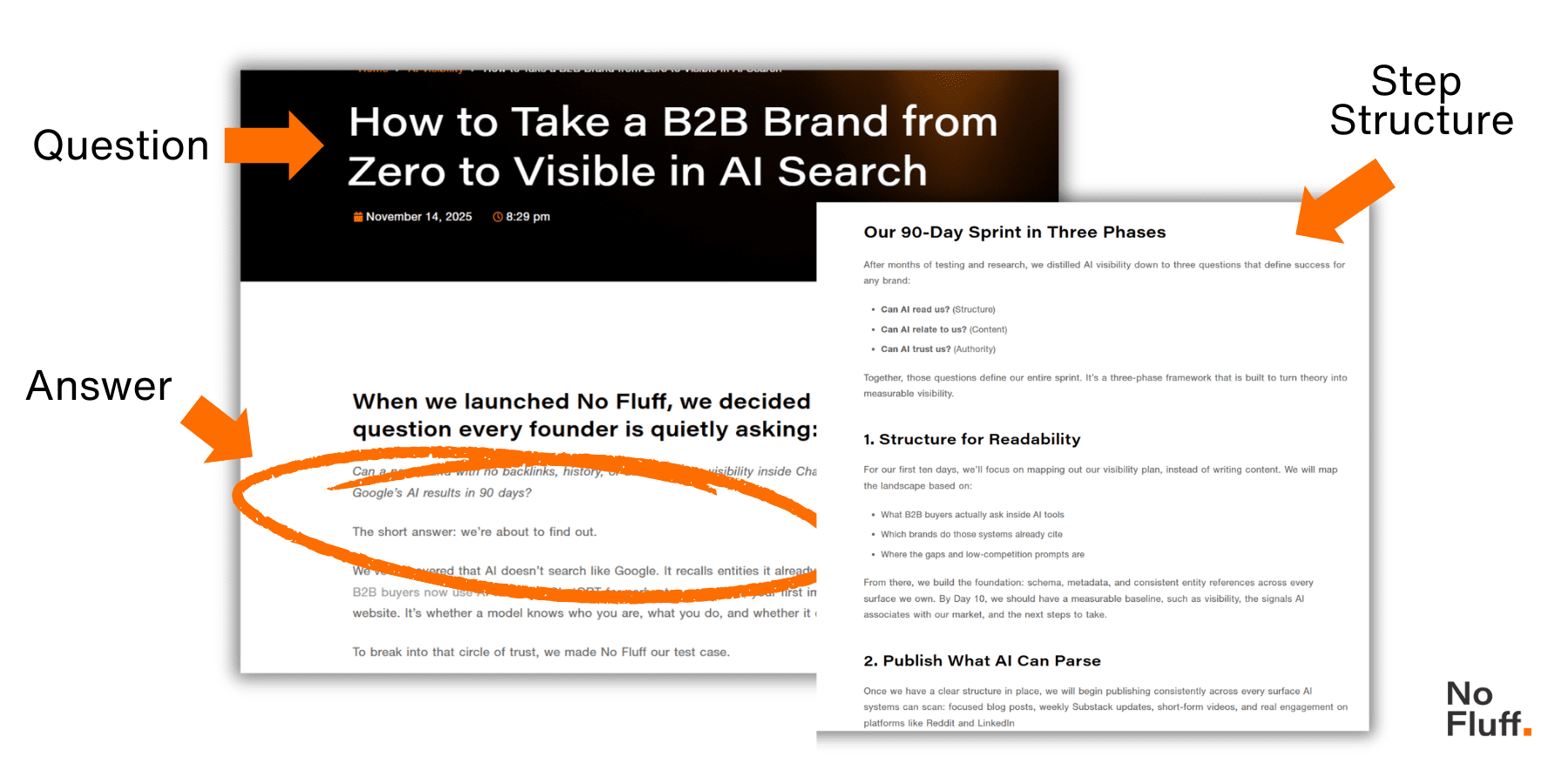
Pattern 1: Structure Matters More Than Topic

Image created by No Fluff, February 2026

Content that wandered (even if it was thoughtful or “robust”) consistently lagged in AI pickup. The pages that were picked up were tighter: they answered the question up front, broke the content into clear steps, and stuck to one idea at a time.

Pattern 2: The Social “Amplifier” Effect

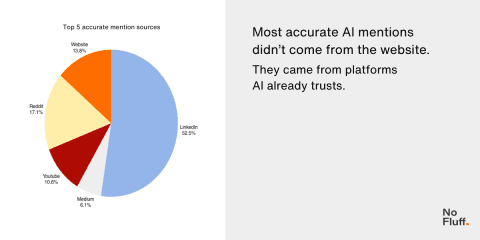
AI is more likely to cite sources it already trusts. In the first two weeks, most citations came from the brand’s LinkedIn and Medium posts rather than its website. For a new brand, publishing key ideas first on high-authority platforms, including LinkedIn or Medium, often triggers AI pickup before the same content is indexed on your own website.

Image created by No Fluff, February 2026

Pattern 3: Hallucinations are Often Signal Failures

Image created by No Fluff, February 2026

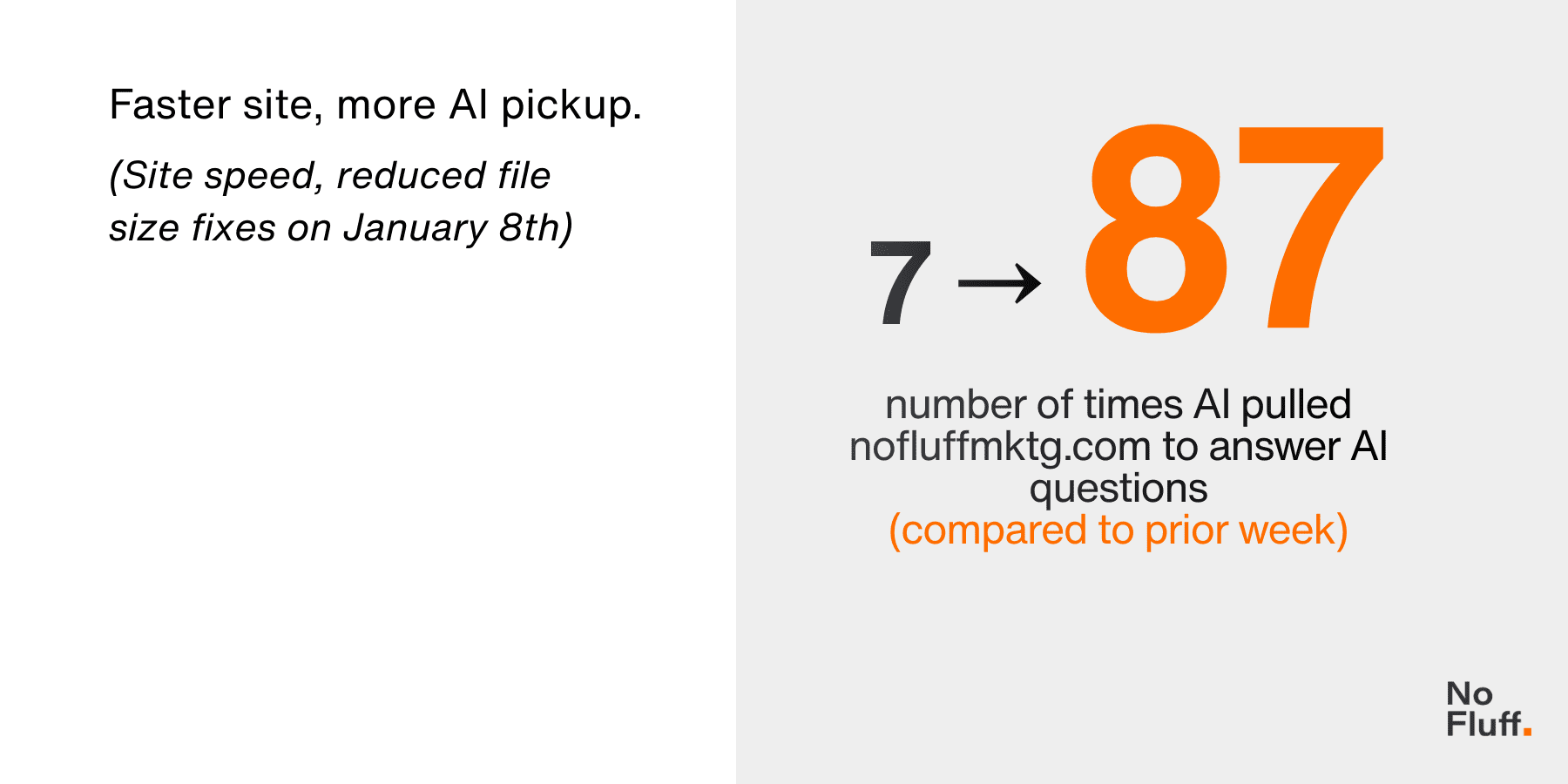
When AI systems misidentify a new brand or confuse it with competitors, the cause is typically thin, slow, or conflicting signals. When pages failed to load within roughly 5–15 seconds, AI systems issue broader “fan-out” queries and assemble answers from adjacent or incorrect sources. Following improvements in site speed, crawl reliability, and entity clarity, the share of answers that correctly referenced this company’s own domain increased, while misattributed mentions declined.

Pattern 4: The 3-Week Indexing Window

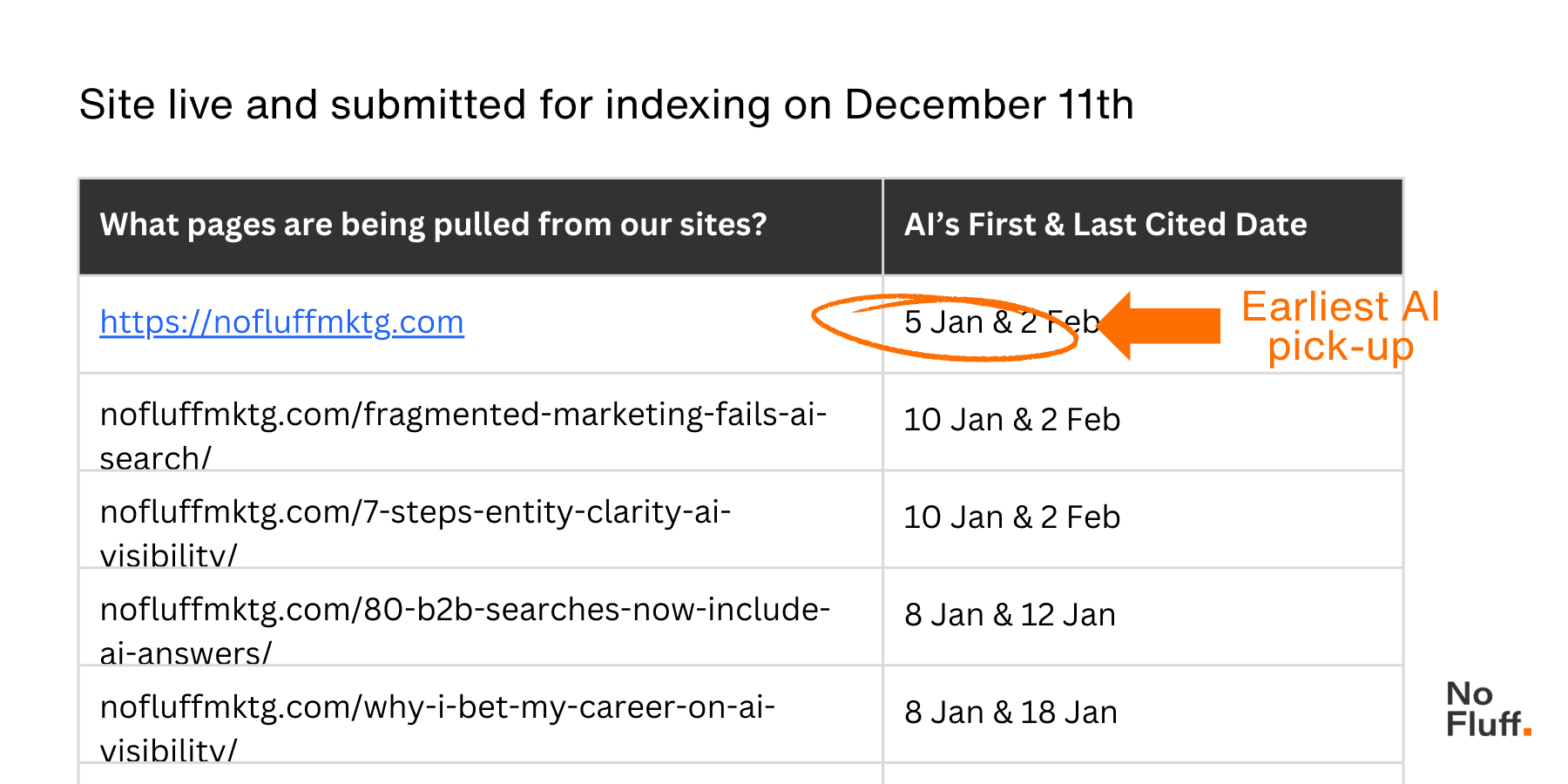
The first AI pickup from a new domain can happen within three to four weeks. In this experiment, the first page was discovered on day 27. After that initial discovery, subsequent pages were picked up faster, with the shortest lag around eight days.

Image created by No Fluff, February 2026

Early inclusion wasn’t driven by content volume. It was driven by structure: a solid schema, consistent metadata, a clean, crawlable site, and machine-readable files such as llms.txt.

Pattern 5: Win the Explanatory Round First

New brands typically will not start by winning highly competitive, decision-stage prompts like “best” or “top” lists, unless the offering is truly unique or non-competitive. Before a brand can realistically be shortlisted, it must first be sourced as a primary authority for definitional or educational questions.

In the first 45 days, the goal wasn’t comparison visibility, but recognition and trust: getting AI systems to associate the brand with the right topics and sources. Early success is best measured by citation frequency, or how often a brand is used as the primary source for a given topic.

Pattern 6: Solve the Unfinished Trust Gap (Most Important)

Even with a well-structured site and strong content, brands struggle to get recommended without outside validation. The initial stages of this experiment showed AI answers defaulted to familiar domains and replaced newer brands with competitors that had clearer third-party mentions. This validates the importance of press and authoritative coverage early on. Waiting to “add it later” only slows trust.

5 Steps To Set A New Business Up For AI Visible Success

By now, the takeaway is clear: AI visibility doesn’t happen automatically once a site is live or a few campaigns are running. The good news is that this can be influenced deliberately. The steps below reflect the sequence that consistently moved a new brand from zero visibility to being cited in AI-generated answers. Rather than treating AI visibility as a side effect of SEO, this approach treats it as an operational problem: how to make a brand easy for AI systems to recognize, verify, and reuse.

Step 1: Map Your Brand Entity

Before building a site, you must define your brand in a way machines understand. ChatGPT, Gemini, and Perplexity don’t read your website the way humans do. They connect facts, names, and relationships into entities that define who you are. If those connections are missing or inconsistent, your brand simply won’t appear (no matter how much content you publish).

  • Define your business clearly using semantic triples: Use the [Subject] → [Predicate] → [Object] format (e.g., “Brand X” → “offers” → “Service Y”) to provide machine-readable facts.
  • Stick to public, widely understood language: Pull terminology from widely accepted sources like Wikipedia or Wikidata. If you describe your product using internal jargon that doesn’t match how the category is commonly defined, you risk being misclassified or overlooked.
  • State your authority: Define why your brand deserves trust. What facts, evidence, and proof back you up? Write 3–5 simple, factual claims you want to be known for.
  • Define your competitive counter-position: Be clear about what makes you different. Scope the specific niche you own (audience, problem, angle, or offering) that sets you apart from alternatives.

Step 2: Engineer Your Benchmark Prompt Set

You cannot rely on traditional SEO tools designed to track AI visibility. Most rely on inferred data or simulations, not on real prompts.

  • Map the competitive landscape: Identify which brands AI systems already reference, which buyer questions are realistically winnable, and where category language creates confusion.
  • Reverse-engineer buyer questions: Identify how buyers phrase real questions using keyword and competitor analysis (SEO tool data, People Also Ask, Google SERPS, and asking multiple AI engines themselves)
  • Lock your data set: Create a fixed set of 150 buyer-authentic questions across six clusters: Branded, Category, Problem, Comparison, and Advanced Semantic.
  • Start testing: Run these prompts weekly across ChatGPT, Gemini, and Perplexity to track your mentions and citation growth.

Step 3:  Make the Brand Machine-Readable

Make your site machine-readable to ensure AI bots don’t skip your content. AI systems don’t care about your website’s aesthetic; they care about how easily they can parse your data. If your technical signals are thin or conflicting, AI will hallucinate or substitute your brand with a competitor.

  • Implement JSON-LD Schema: Use Organization, Service, and FAQ schemas to tell AI exactly who you are and what you do.
  • Deploy an txt File: Place this at your domain root to provide a plain-text guide for AI crawlers, telling them how to describe your company and which pages to prioritize.
  • Eliminate crawling issues: Make sure your site is fully crawlable via robots.txt and that no content is hidden in gated PDFs or images. Most importantly, check site speed using PageSpeed Insights. Models don’t patiently wait for slow pages!

Step 4:  Publish “Retrieval-Ready” Content

Write for the impatient analyst (the AI bot). Start with high-leverage prompts, questions with real buyer intent that AI already answers, but only using a small and weak set of sources, making them easier to influence before trust fully locks in.

  • Lead with the answer: Start every section with a direct, factual answer.
  • Chunk semantically: Divide content into logical, independent sections that can be extracted and reused by AI without requiring the context of the entire page.
  • Consider the freshness factor: AI favors content updated within the last 60–90 days. For high-competition sectors like SaaS or Finance, content should be refreshed every three months to remain a “trusted” recommendation.

Step 5:  Earn External Validation

AI systems cross-check your site’s claims against the rest of the web.

  • Claim directory profiles: Align your entity data across Crunchbase, G2, LinkedIn, and Yelp. Inconsistencies across these profiles are a primary cause of AI hallucinations.
  • Target authoritative mentions: Secure mentions in industry-specific publications with consistent pickup throughout your prompts and or a strong domain rating.
  • External reinforcement: For every important page on your site, aim for at least three intentional external link-backs from authoritative sources to trigger AI pickup.

The Biggest Takeaway: Prioritize Authority as a Long-Term Game

For new brands, the limiting factor in AI search is not optimization. It’s authority.

AI systems are more likely to surface unfamiliar companies first in low-risk, explanatory answers, not in “best,” “top,” or comparison prompts. A clean site and solid SEO help a brand get recognized, but being recommended is a different hurdle.

In practice, early progress is about reducing uncertainty. When a brand consistently appears in third-party articles, reviews, or other independent sources, it becomes easier to explain and safer to reference. Without that outside validation, recommendations stall, no matter how strong the content or how fast the site loads.

This analysis covers the first phase of a live 90-day test examining how a new B2B brand earns visibility in AI-generated search results. Ongoing findings and final results will be published as the experiment concludes.


Image Credits

Featured Image: Image by No Fluff. Used with permission.

In-Post Images: Images by No Fluff. Used with permission.

What The Data Shows About Local Rankings In 2026 [Webinar] via @sejournal, @hethr_campbell

Reputation Signals Now Matter More Than Reviews Alone

Positive reviews are no longer the primary fast path to the top of local search results. 

As Google Local Pack and Maps continue to evolve, reputation signals are playing a much larger role in how businesses earn visibility. At the same time, AI tools are emerging as a new entry point for local discovery, changing how brands are cited, mentioned, and recommended.

Join Alexia Platenburg, Senior Product Marketing Manager at GatherUp, for a data-driven look at the local SEO signals shaping visibility today. In this session, she will break down how modern reputation signals influence rankings and what scalable, defensible reputation programs look like for local SEO agencies and multi-location brands.

You will walk away with a clear framework for using reputation as a true visibility and ranking lever, not just a step toward conversion. The session connects reviews, owner responses, and broader reputation signals to measurable outcomes across Google Local Pack, Maps, and AI-powered discovery.

What You’ll Learn

  • How review volume, velocity, ratings, and owner responses influence Local Pack and Maps rankings
  • The reputation signals AI tools use to cite or mention local businesses
  • How to protect your brand from fake reviews before they impact trust at scale

Why Attend?

This webinar offers a practical, evidence-based view of how reputation management is shaping local visibility in 2026. You will gain clear guidance on what matters now, what to prioritize, and how to build trust signals that support long-term local growth.

Register now to learn how reputation is driving local visibility, trust, and growth in 2026.

🛑 Can’t attend live? Register anyway, and we’ll send you the on-demand recording after the webinar.

Why Your SEO KPIs Are Failing Your Business (And How To Fix Them) via @sejournal, @bngsrc

Most SEO teams believe they need more data to report success, but what they actually have is metric debt, at least that’s what I keep seeing. The accumulated cost of optimizing for key performance indicators that no longer reflect how growth happens.

The environment has changed, mostly because economic pressure has shifted expectations. At the same time, AI search, zero-click results, and privacy limits have all weakened the connection between traditional SEO KPIs and business outcomes.

Yet, it’s not unusual to see teams measuring success in ways that reflect how SEO used to work rather than how it works today. This is exactly the point where I think we need to rethink how we’re measuring things.

The Hidden Cost Of Vanity Metrics

Rankings, clicks, visibility … None of these is wrong. They’re just no longer enough on their own to predict business success reliably.

In an environment where we talk a lot about AI-driven SERPs, zero-click searches, and budget scrutiny, these metrics are incomplete at best and misleading at worst.

But a considerable number of SEOs still spend most of their time chasing more traffic, more keywords, more mentions, and I get why. It is generally difficult to own new changes.

Meanwhile, conversion quality, intent alignment, and revenue impact now need more attention than ever. However, they’re harder to explain and harder to own.

That gap creates a quiet opportunity cost. Not immediately, and not in reports, but later, when SEO starts struggling to justify its place in the growth conversation.

At this point, I think this is pretty clear: good SEO teams don’t report more metrics. They explain better.

And to explain better, we need to rethink how we can show SEO value is created and how it’s measured. This isn’t a hot take anymore.

As Yordan Dimitrov pointed out, SEO isn’t dying, but discovery is changing fast and shifting user behavior. Early-stage users increasingly get what they need directly inside search experiences.

That means clicks, specifically, are no longer a reliable proxy for value. So, if we keep optimizing and reporting as if they are, we’re creating a picture that no longer matches reality.

But I’m not saying we should replace every SEO metric overnight. What we report does need to reflect how growth decisions are made.

Reframing SEO KPIs Around Real Business Value

If everything you track sits at the top of the funnel, you don’t have a measurement strategy; you have a visibility tracker. A simple way out is to separate signals from outcomes:

Operational Signals

These tell you if your SEO efforts can function at all.

  • Crawlability and indexation coverage.
  • Core Web Vitals performance.
  • Content velocity on priority areas.
  • Share of voice by intent cluster.

Necessary. Not sufficient.

Engagement Signals

These tell you whether users actually care.

  • Engaged sessions (GA4’s definition: >10 seconds or conversion rule).
  • Scroll depth.
  • Return visits.
  • Micro-conversions like downloads or feature usage.
  • Organic conversions.

Still not the end goal, but much closer.

Business Outcomes

This is where people usually get nervous.

  • Pipeline influence from organic (opportunities with organic touchpoints).
  • Customer Acquisition Cost (CAC) for organic versus paid channels
  • Customer Lifetime Value (LTV) of SEO-acquired customers.
  • Retention rates of organic users.

If none of these are visible, SEO efforts are always going to be questioned.

Most Teams Need A Few Months To Fix This Approach

First, you audit what you’re already reporting. Most of it will sit in operational metrics, and that’s normal.

Then, you should map pages to funnel stages. It doesn’t have to be perfect, but it should be honest.

Then you can add one or two outcome-level metrics that make sense for your model. For example:

  • Demo requests per organic session (for B2B).
  • Revenue per organic visitor (for ecommerce).

If organic conversion rates are far below benchmarks (for example, industry benchmarks place B2B ecommerce conversion rates at 1.8%), that’s not a “traffic problem.” It’s a mismatch between intent, content, and expectations.

Over time, you can rebalance reporting. I recommend not deleting old metrics immediately; they will let you show people how they correlate (or don’t) with outcomes. That’s how trust is built.

In practice, most teams don’t jump from rankings to revenue overnight. Measurement maturity tends to move in layers, with each step making the next one easier to defend.

The Human Side Of Metric Evolution

Changing measurement systems is more psychological than most teams expect. People don’t like KPI changes because it feels safe to own the same old things. And to be honest, revenue attribution feels messier than rankings; that’s why it creates resistance and people avoid it.

The way around this isn’t better dashboards. It’s framing. Instead of saying “we’re changing KPIs,” you can think and say: “For the next eight weeks, we’re testing if organic sessions on these pages generate demo requests.”

The goal isn’t to drown stakeholders in methodology, but to give just enough context to replace metric comfort with experimental clarity, so they understand what’s being tested, why it matters, and how success will be judged.

So, basically, make it an experiment, and define success upfront. Then, share learnings even when results are uncomfortable.

Future-Proofing Your Measurement Strategy

We don’t need complex stacks. We only need cleaner thinking. And we need to revisit KPIs regularly to remove ones that no longer help, add new ones when priorities change, and document why decisions were made.

First, you can start by explaining that while rankings were reliable growth proxies in 2020, AI search and zero-click results have broken that connection. Use visual stories comparing high-traffic/low-conversion paths against low-traffic/high-conversion alternatives to illustrate why KPI evolution matters.

For most mid-market teams, a pragmatic measurement stack is sufficient: GA4 or an alternative, a CRM with clean attribution fields, a visualization layer like Looker Studio, and a core SEO platform. Complexity should be added only as measurement maturity increases.

Finally, we should treat measurement as a living system. For this, I recommend running quarterly KPI reviews to retire unused metrics, adding new ones aligned with evolving priorities, and documenting hypotheses behind major initiatives for later validation.

When measurement evolves continuously, SEO strategy can evolve alongside search itself.

If You Can’t Measure Value, You Can’t Defend SEO

Anthony Barone puts this well: When teams rely on surface-level metrics, they lose a stable way to judge progress. SEO then becomes easy to deprioritise every time a new platform or AI narrative shows up.

Value-driven metrics change the conversation. SEO stops being “traffic work” and starts being part of growth discussions.

The SEOs who will do well aren’t the ones with the cleanest ranking reports. They’re the ones who can calmly explain how organic search contributes to real business outcomes, even when the numbers aren’t perfect.

That starts with questioning every metric you report and being honest about which ones still earn their place.

More Resources:


Featured Image: Natalya Kosarevich/Shutterstock

90 Days. 1 Plan. Improved Local Search Visibility [Webinar] via @sejournal, @hethr_campbell

A 90 Day Plan to Prepare Every Location for AI Search

AI is changing how consumers discover and choose local brands. For multi-location businesses, visibility is no longer decided only by search rankings. 

AI agents now evaluate location data, reviews, content, engagement, and brand trust before a customer ever clicks. This shift means each individual location is judged on its own signals, not just the strength of the parent brand.

Without a clear plan, enterprise teams risk silent exclusion across entire location networks, leading to lost visibility and declining demand. The challenge is not understanding that GEO matters, but knowing how to operationalize it at scale.

In this session, Ana Martinez, Chief Technology Officer of Uberall, shares a practical 90-day framework for making every location AI-ready. She will explain how AI agents surface and exclude local brands, which location-level signals matter most, and how teams can execute GEO across hundreds or thousands of locations.

What You’ll Learn

  • A phased GEO roadmap to prepare, optimize, and scale AI readiness
  • The key location level signals AI agents trust and what to fix first
  • How to operationalize GEO across large location networks

Why Attend?

This webinar gives enterprise teams a clear, actionable plan to compete in AI-driven local discovery. You will leave with a framework that protects visibility, supports demand, and prepares every location for how discovery works today.

Register now to learn how to make every location AI-ready in the next 90 days.

🛑 Can’t attend live? Register anyway, and we’ll send you the on-demand recording after the webinar.

Why Off-Page SEO Still Shapes Visibility In 2026 [Webinar] via @sejournal, @hethr_campbell

How Links, Mentions, and Authority Influence Rankings and AI Discovery

Authority and presence across the web continue to play a central role in search visibility, even as AI-driven experiences reshape how SERPs appear. 

Links, brand mentions, and trust signals continue to influence how Google evaluates credibility, both in traditional rankings and in AI-powered SERPs. The challenge for SEO teams is determining which off-page efforts to prioritize in 2026.

It’s easy to waste effort on shortcuts that do little to build long-term authority, so in this session, Michael Johnson, Founder and CEO of GrowResolve.com, will share a practical framework for developing modern off-page SEO strategies that improve organic rankings and support AI visibility. The focus of this SEO webinar is on sustainable approaches that help brands earn trust, not chase tactics that no longer deliver value.

What You’ll Learn

  • Which off-page signals drive results in 2026, including links, mentions, topical authority, and trust.
  • How to build a diversified off-page strategy without relying on a single tactic or vendor.
  • Scalable link building approaches for in-house teams, including Digital PR, partnerships, and brand-led content.

Why Attend?

This webinar provides clear guidance on where to focus off-page SEO efforts as search continues to evolve. You will leave with a practical, decision-making framework to build authority, improve visibility, and avoid wasted effort in 2026.

Register now to learn how to build off-page SEO strategies that support long-term authority and visibility.

🛑 Can’t attend live? Register anyway, and we’ll send you the on-demand recording after the webinar.