AI Spam Sites Beat Google’s March 2024 Spam Update via @sejournal, @martinibuster

While honest websites experienced the ups and downs of Google’s March 2024 update, SEOs and recipe bloggers noticed AI spam sites surging to the top of search results. One example as of yesterday ranked for over 217K queries, 14.9K of which rank in the top 10 – and that number has increased a day later. This is what’s going on and how the spammers continue to beat Google.

Surge In March 2024

The site that’s ranking is a subdomain. The main domain has been around since the summer of 2020. The spammy subdomain was first spotted by the Internet Archive on November 30 2022, coincidentally the launch date of ChatGPT. The subdomain was in a half-finished and essentially dormant until March 2024 when it rapidly expanded and immediately began to rank for thousands of search queries.

Wednesday March 20th the site was ranking 14.9k search queries in the top 10. Thursday March 21st the site had 15.6K in the top 10. Even though Google just concluded their spam update, this particular site (and others like it) continue to rank for thousands of search queries and Google appears powerless to stop them.

Food Writer Reacts To AI Spam

A food writer and recipe book author, Robin Donovan (Instagram), called my attention to the AI site, telling me that others in a private Facebook group were livid about AI sites surging for recipe search queries.

It’s super obvious that the content is AI generated, even the images accompanying the articles are 100% AI. So it’s especially hurtful to those with experience, expertise and authoritativeness to see obviously AI content outrank them.

Robin was understandably upset:

“How on earth is this the best content? And meanwhile, bloggers who are professionally trained chefs, recipe developers, cookbook authors, and others with decades of training and experience are watching their sites be decimated with these updates. Sites that they’ve spent years building with well-researched, well-written (human-written!) articles, recipes that have been professionally developed and carefully tested, photographs they have spent hours prepping for and shooting.

They’ve done all the things Google has told them to do for years—write your own content, take your own photos, develop unique, high-quality recipes, be an expert in your subject area and have credentials to show it, don’t try to game the system, be genuine, create HELPFUL content. For what?”

Details About The Spam Sites Look Like

1. Hosted On Squarespace

The spam site is on a subdomain and both the subdomain and the main site are hosted on Squarespace. Why Squarespace? Just a guess but maybe that infrastructure tends to generally appear legit to Google (or it might not play a role).

2. All Images Are Colorful And Simple

All of the images are AI generated, created in a flat colorful style similar to what might be seen in an infographic, indicating that a templated prompt was used to create the thousands of images accompanying the articles.

The images are an important component of the articles. Each article features about seven images that relate to the overall topic of the article. Every article is very colorful. I don’t know if the images are intentionally colorful but the use of strong colors help images stand out in the SERPs and Google Discover when Google displays them.

I uploaded one of the images to ChatGPT and asked it to generate a prompt based on the image to create a new one in the same style.

Here’s an example of an AI generated image in the same style as the AI spam sites:

Example Of An AI Generated Image Used By A Spam Site

AI Spam Sites Beat Google’s March 2024 Spam Update

3. All Articles Follow A Rigid Template

The articles follow a templated structure, which varies depending on the type of article. Article topics range from comparisons, local destination travel, lifestyle, recipes, health benefits of certain foods and so on.

The health related articles follow this exact article structure:

a. Introduction 
Introduces the concept topic being discussed and its relevance to a specific health related topic. The concept topic can be a particular food, a type of diet and so on.

b. Health Benefits
Following the introduction, every discusses the health benefits associated with the concept topic.

c. Fundamentals
This section discusses the basics of the health topic that is being focused on (oral health, diabetes...), the importance of nutrition, and common problems or diseases associated with the health topic.

d. Nutritional Guidance And Key Nutrients

e. Dietary Choices And Impact On Health

f. Tips and Lifestyle Advice

g. Conclusion - A summary of the benefits

4. Underlying Prompt For AI-Generated Articles

I was curious about what a prompt that generates that content would look like so I asked ChatGPT to create one.

This is a generalized prompt that could have been used to create the health and diet articles:

"Write an article exploring the connection between [concept of dietary choice] and [specific health focus], following the template below:

Introduction: Begin by introducing the concept of [concept of dietary choice], its definition, and why it's relevant to [specific health focus]. Discuss its growing popularity and how it aligns with contemporary health and lifestyle trends.
Health Benefits: Elaborate on the general health benefits associated with [concept of dietary choice], focusing on its potential to enhance [specific health focus].
Fundamentals of [Health Topic]: Provide a background on the [specific health focus], including essential anatomy, the significance of nutrition, and prevalent conditions affecting this aspect of health.
Key Nutrients and Their Impact: Detail the crucial nutrients that play a significant role in [specific health focus], including their sources and the health benefits they offer. Highlight the importance of certain vitamins, minerals, and other compounds.
Influence of Dietary Choices: Analyze how specific dietary choices influenced by [concept of dietary choice] can impact [specific health focus], positively or negatively. Recommend beneficial foods and advise against certain types that may harm [specific health focus].
Practical Advice for Diet and Lifestyle: Offer practical suggestions for integrating beneficial foods into one's diet and making lifestyle adjustments to support [specific health focus]. This might include tips on meal preparation, portion control, and balancing different types of foods.
Conclusion: Conclude the article by summarizing how adopting [concept of dietary choice] can contribute to improving [specific health focus]. Emphasize the balance and variety of nutrients this approach provides and its potential benefits beyond [specific health focus].
Ensure the article provides a comprehensive overview that is both informative and engaging, catering to readers interested in understanding the relationship between [concept of dietary choice] and [specific health focus]."

5. Content Tested By AI Checker Tools

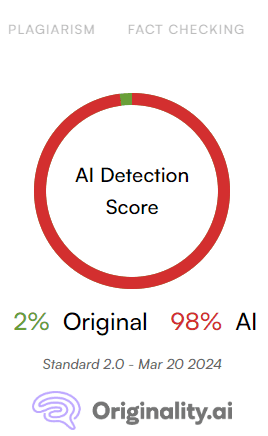
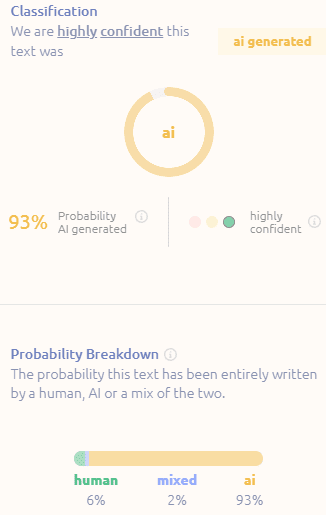
The weird thing about these articles is that every article I tested with GPTZero AI Content Detector scored 100% as AI-generated. The Originality.AI content checker offered similar scores.

Screenshot Of GPTZero Score
AI Spam Sites Beat Google’s March 2024 Spam Update

Screenshot Of Originality.AI Score

AI Spam Sites Beat Google’s March 2024 Spam Update

The Squarespace templates are professional and the articles themselves are in a dry style that is informative but lacks signals of human authorship such as expressions of insight or experience and a complete absence of colloquialisms.  Every article tested failed the AI detection tests.

6. How Do AI Spam Sites Rank?

It’s my hypothesis that the reason these spam sites rank is that they’re taking advantage of a loophole in Google’s algorithms that allows new content to receive an initial boost, what Google’s John Mueller has described as Google testing the website or the webpages out. This happens all the time and excites people when they publish a new site and see it ranking almost right away.

What is happening with this one AI generated website is that it is publishing massive amounts of webpages every day and those pages receive a boost to the top of the search engine results pages (SERPs) for the first 24 to 48 hours. They then begin to slip down the top ten and eventually into the second pages of the SERPs.But by that time there are new pages begining that journey from the initial boost, every day. This is a classic old school strategy known as churn and burn.

John Mueller has commented in the past about why Google ranks new websites at the top of search results.

He explained:

“In particular, with completely new websites, one of the difficulties that we have is we might not have a lot of signals for those websites so we have to make estimates.

And depending on how we make estimates, it can sometimes mean that in the beginning we show this website a little bit more visibly than like it turns out that the signals tell us in the end.

…But that can go both ways. It can go in the direction of like you’re shown very visibly in the beginning.

And it can also be that maybe you’re shown less visibly in the beginning and as we understand your website and how it fits in with the rest of the web then we can kind of adjust that.

…Sometimes it’s also new websites that show up that we try to pick up really quickly.”

7. AI Spam Is A Longstanding Problem With Google

Google has had a long problem with AI generated sites dominating certain search results and this is not the first time that Google has been overwhelmed by spam, particularly for relatively longtail phrases. This one spam site is not alone and is not an outliers. There are many others just like it following the same methods for ranking.

What makes this example noteworthy is that it went live at the same time that Google launched a spam update and it continued ranking at the top of the SERPs for hundreds of thousands of search queries (with 15.6K queries currently in the top 10).

The AI spam site has now popped out on the other side of the spam update and is thumbing it’s nose at Google. It is a humiliating and demoralizing experience for the thousands of  honest and experienced bloggers  who are outranked by content that lacks credibility, experience and authoritativeness- these articles  don’t even list authors.

Featured Image by Shutterstock/ViDI Studio
Google Rolling Out Changes To Shopping Searches In Europe via @sejournal, @MattGSouthern

Google has begun implementing changes to its search results in the European Economic Area (EEA) to comply with the European Union’s recently enacted Digital Markets Act (DMA).

The DMA, which took effect on March 6, aims to promote fair competition in the European digital market by imposing new rules on large technology companies designated as “gatekeepers.”

Independent SEO consultant Brodie Clark shared recent examples of these changes on Twitter, noting the quiet introduction of default ‘Products’ and ‘Product Sites’ tabs featuring organic merchant listing results and focused web pages, respectively.

Previously Announced Search Features

In a February announcement, Google provided an early look at these new search experiences for Europeans.

According to the announcement, these updates are designed to present users with rich and relevant information while improving the visibility of aggregators, suppliers, and businesses.

The new carousel rich result may appear for travel, local, and shopping queries.

Accompanying these changes are dedicated ‘aggregator units’ that include links to aggregator sites across the web.

Compliance Reports Reveal Extent Of Changes

As part of the DMA’s transparency requirements, Google and other “gatekeepers” had to submit detailed compliance reports to the European Commission by March 7, outlining the measures they’ve taken to follow the new rules.

In its report, Google revealed it’s making the following changes to search results in Europe:

  • Removing an unspecified series of features
  • Introducing new features, such as opportunities for third-party vertical search services and direct suppliers
  • Implementing new controls for cross-service exchanges of personal data
  • Developing new Google-wide policy and compliance training
  • Enhancing existing data portability opportunities

Looking Ahead

As Google and other “gatekeepers” continue to adapt their products and services to comply with the DMA, users in the EEA can anticipate further changes in their digital experiences.

The DMA is part of a broader effort by the European Commission to reform the digital landscape and rein in the power of large technology companies.

The coming months will reveal how effective the DMA is in achieving its stated goals.


FAQ

What new features has Google introduced in Europe to conform to the DMA regulations?

Google has introduced several new features in its search results within the European Economic Area (EEA) as a response to the DMA regulations:

  • A ‘Products’ tab and ‘Product Sites’ tab in the search results to promote fair competition and enhance organic merchant visibility.
  • The rollout of carousel rich results, which are likely to appear for searches related to travel, local offerings, and shopping.
  • Dedicated ‘aggregator units’ have been included to direct users to various aggregator websites.

These features are part of a broader set of changes aimed at modifying Google’s services to offer more opportunities for third-party vertical search services and direct suppliers, enhance data protection, and provide greater data portability.

What measures has Google taken to ensure compliance with the DMA’s transparency requirements?

Google has instituted various measures to align with the transparency requirements put forward by the Digital Markets Act:

  • Google has submitted a detailed compliance report to the European Commission, as mandated by the DMA, outlining its actions.
  • It has removed certain unspecified features from its platform to comply with the new rules.
  • New controls for cross-service personal data exchanges have been implemented to strengthen user privacy.
  • Google has developed company-wide policy and compliance training.
  • The company has also worked on enhancing existing data portability opportunities for users.

These actions showcase Google’s efforts to adjust its operational and product practices to meet the DMA’s regulations.


Featured Image: Michael Derrer Fuchs/Shutterstock

SEO Is More Than A Checklist via @sejournal, @coreydmorris

SEO is hard, it is complicated, and it has a lot of different paths that one can take to reach desired outcomes. It also involves a lot of trial and error.

The fact that it has the word “optimization” in it is sometimes lost on those who want a linear path – and maybe pitch or assume that there is one – to get to the results they are seeking.

While there are many widely accepted SEO “best practices” and things that you should do to reach your goals, SEO is much more than just doing a checklist of things.

I want to call out some specific aspects to make sure you aren’t someone who gets less return on investment (ROI) than what you expect when it comes to investing your own time, your team’s time, or any level of investment in time and money with an agency.

SEO is a discipline and marketing channel that can take quite a bit of time to see results.

I believe there are seven things that you need to focus on to avoid a checklist mentality and most wisely spend your investment of time, money, and effort.

Full disclosure: I own an SEO agency. I have friends who lead SEO teams and many amazing agencies take a strategic, high-quality approach to SEO for each of their clients. I’m not writing this article to bash anyone or put anyone down.

1. Set SEO Goals

Sometimes, it is tempting to just jump into “doing” SEO.

Admittedly, it can take time and requires short-term investments of time, resources, and focus to get to the longer-term payoff of reaching your goals.

Goals are important whether you’ve been doing SEO so long that you can’t remember when you started, you’ve just started in the past year, or you’re considering including it in your marketing mix.

No matter where you fall on that spectrum, take time to revisit or work through goal setting for the first time.

Do the research to know what your opportunities are to reach your target audience and what the investment might look like to get there.

Without defined goals, you run the risk of just “doing” SEO and hoping for an outcome.

Even if you have a baseline, start somewhere so that you don’t get to a point down the road where you revisit ROI and find that you didn’t have accountability in the process or that you spent a lot of time with little to show for it.

One of the biggest reasons I see for SEO not working is that there are misaligned expectations driven by inconsistencies in approach due to the lack of proper and objective goals being set.

2. Build A Specific SEO Strategy

Going hand-in-hand with having clearly defined goals is having a defined strategy. I often talk about the challenge of putting tactics ahead of strategy.

I had a client come to me a few years ago who worked with an agency, and each month in their calls, I wondered what the strategy was and who was driving it.

They would go into the meeting, look at keywords and targeting focuses, and bring up things that seemed basic but were “new” ideas that the search marketer would then take and implement in the coming month.

That is a red flag and validation that there was a checklist of sorts and not a bigger-picture strategy in place.

And, no, the strategy can’t be the checklist and the checklist isn’t the strategy.

Yes, a common approach or methodology of working through the range of technical, on-page, and off-page aspects of SEO should be expected.

But how we work with the website tech, shape the content, and build authority and trust is much more robust.

Doing your initial research, making an informed investment with an expectation of return and knowing how it will allow you to reach your goals is important.

If you can’t articulate the strategy, it is probably too complicated or poorly defined. That’s the litmus test that I use.

3. Define & Acquire Resources You Need

Whether you’re a one-person team, have a broader in-house team tasked with SEO, or hire out aspects to freelancers or agencies, you need consistent and defined roles for the resources you need to implement your strategy and reach goals.

That includes covering all of the SEO-specific aspects of technical SEO, content-based SEO aspects, links, local, reporting, and more.

Beyond that – unless you are a unicorn or have one on your team – it will require some other disciplines and subject matter expertise to come to the table with you.

That can include UX designers, writers, web developers, product managers, sales team members, and more.

Getting all resources aligned around your goals, in the know about your strategy, and all working together to implement the SEO strategy is important.

You don’t want to spend half of your desired ROI timeline waiting for others to help or having to iterate on their work more than you planned based on a lack of prioritization or understanding on their end.

4. Build & Document A Plan

I’m a big proponent of planning.

In fact, I might be wearing people out with my obsession with the topic.

Every digital marketing effort needs a well-defined, objective, documented plan.

There are so many shiny objects and distractions. All of the changes to search engines (which have always been a distraction but necessary thing to keep up with) as well as the emergence of AI.

We can’t ignore the changes and new things. We must test them and leverage them.

We also can’t ignore them and fall behind.

Having a defined plan is key to that.

And, no, I’m not contradicting myself here. A plan is different from a checklist.

The plan should restate and detail the goals, articulate the strategy, and include tactics and the measurement plan (more on that later).

Another big area where I see SEO getting off the rails is when there’s no defined plan that is objective.

When it isn’t documented, it can be easy to put off SEO when things get busy. Or, it can be too focused on the checklist and not be connected with strategy. Or, it can even be too rigid without built-in agility and room to test.

5. Measure SEO Results

With all of my focus on goals and ROI, measurement is critical to SEO. I’m going to assume that in your goal setting, you have defined goals that impact your business overall.

While SEO is often defined by rankings, impressions, and website visits, it drives, in most cases, the key metric or most important KPI is conversions.

Whether a conversion is a lead, ecommerce sale, or some other valuable activity for your business or organization, it can be deeper than where some SEO pros are comfortable going.

I admit that early in my career, I was focused on SEO metrics and not as much on the things that I felt I couldn’t control or got messy when talking about that conversion and how it got all the way through to actual revenue for a business.

Being clear on what you’re measuring and how it connects with the goals and knowing in real-time what the performance indicators are will guide good SEO and the level of agility and optimization that you need.

6. Maintain Agility In Processes

Balance is probably a great word to use at this point as I talk about having definitions and plans, and also maintaining agility.

I’m a big believer in phased-out optimization and processes that allow understanding of what actions and variables we implement impact performance.

I’d rather implement something each week than work for six months on a large initiative so I can see how things perform (or don’t).

The nature of optimization is that it never ends. There’s no such thing as a “perfect” site for the search engines or our visitors.

Whether you’re optimizing technical aspects or content, you’re working on making things better.

Better is always relative, and you have to have planned out room for optimization whether you’re doing best practices, strategic items, or leveraging new things like AI.

7. Integrate SEO Efforts With Marketing

SEO performs better when it isn’t siloed and is part of a broader digital marketing mix.

Aside from the broader need for subject matter expertise outside of just SEO talent (noted regarding resources earlier), SEO can greatly benefit from shared insights and integration with paid search, social media, PR, influencer, and other marketing channels.

If you’re in a service-based company and have thought leadership content, that can be leveraged efficiently by multiple channels, including SEO, as either a leader in defining it or being part of the team when it comes to sourcing it.

Making sure SEO is as tightly integrated into the business and marketing goals and efforts as possible will help create efficiencies with resources and level of investment – and ultimately get people on the same page to properly value it and what it can do to drive meaningful ROI for the business or organization.

Conclusion

My hope is that you don’t waste time or money on SEO efforts that are doing “good” things but aren’t ultimately delivering for you.

If you’re in a position where you feel performance isn’t meeting your expectations, I would challenge you to consider if any of the aspects that I detailed are misaligned in your current investment.

I’ll be the first to say that you must have a process and plan to avoid an inconsistent or chaotic approach, but that you should expect to see strategy instead of just tactics.

A checklist could and probably should be included in how things are managed.

However, a checklist or the implementation of SEO best practices by itself will not necessarily get you to the ultimate results you want.

More resources:


Featured Image: Stockbakery/Shutterstock

Google Completes March Spam Update, Core Update Continues via @sejournal, @MattGSouthern

Google has announced the completion of its spam update rollout, which began on March 5, alongside a core update.

The spam update, which took approximately two weeks to deploy fully, targeted scaled content production, expired domain misuse, and authority abuse.

The core update, which incorporates the “Helpful Content” evaluation into the core algorithm, is still ongoing and is expected to take around four total weeks to complete.

Spam Update Rollout Completed

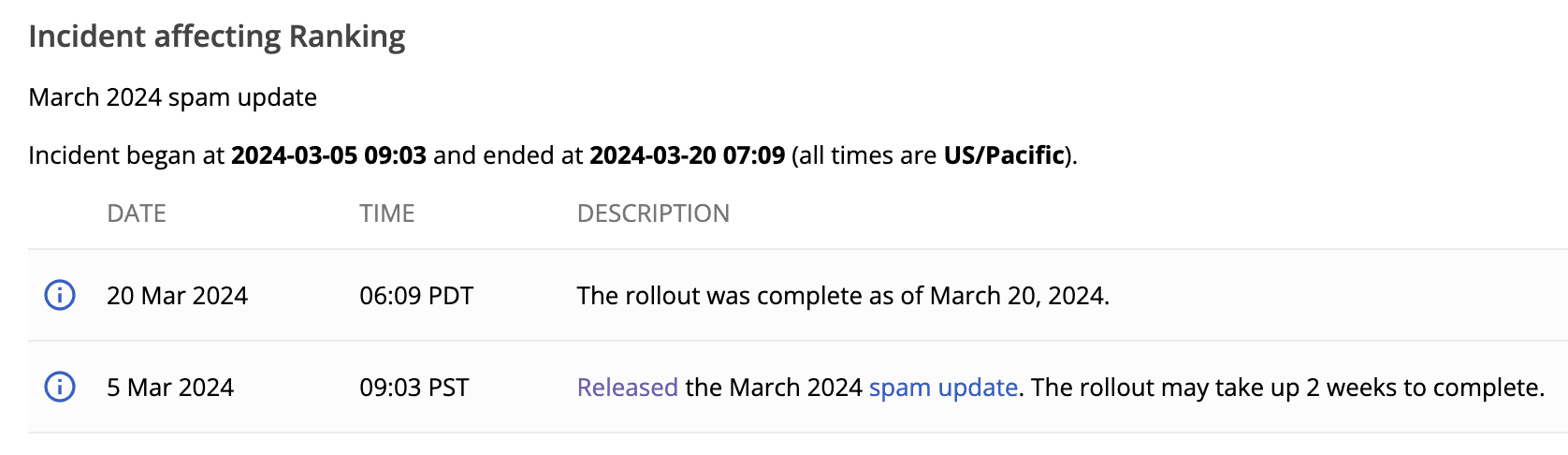
On March 20 at 6:09 PDT, Google confirmed that the spam update rollout had concluded.

The announcement came via an update to Google’s Search Status Dashboard.

Google Completes March Spam Update, Core Update Continues

With this update, Google has implemented three new spam policies targeting scaled content abuse, expired domain abuse, and site reputation abuse.

While the first two policies were immediately enforced, the site reputation abuse policy will be effective starting May.

Impact On Websites & Search Results

The completion of the spam update rollout brings new clarity to the search landscape, as publishers and SEO professionals can now get an idea of the changes’ impact.

Early data from SISTRIX revealed significant gains and losses across various domains, with some websites experiencing a complete removal from Google’s search index.

Following introducing the new spam policies, Google issued numerous manual actions to address pure spam issues.

A study by Originality.ai found that 100% of the deindexed websites showed signs of AI-generated content, with half of the sites having 90-100% of their posts created by AI.

However, these manual actions are separate from algorithmic demotions.

The main difference is that manual actions are carried out by Google’s human reviewers and are accompanied by a notification in Search Console.

In contrast, algorithmic ranking updates, such as the March spam update, happen automatically and do not result in notifications from Google.

A website can be impacted simultaneously by both a manual action and an algorithmic update.

Core Update Still In Progress

While the spam update rollout has concluded, the core update, which began simultaneously, is still in progress.

Google has indicated that the core update will take a few more weeks to complete as it integrates the “Helpful Content” evaluation into the core algorithm.

As the core update continues, SEO professionals and content creators should focus on creating original, high-value content that resonates with their target audience.

Google’s Search Liaison, Danny Sullivan, has urged patience and caution, emphasizing the importance of waiting for the update to be fully completed before making significant changes in response to ranking fluctuations.

Adapting To The New Search Landscape

With the spam update rollout now complete, website owners and content creators can begin to adapt to the new search landscape. This may involve auditing existing content, reworking AI-generated material, and prioritizing human creativity and editorial oversight.

As the SEO community continues to monitor the impact of both updates, it’s clear that Google remains committed to promoting original, high-value content and combating low-quality, spammy material.

The full impact of these updates will become more evident in the coming weeks as the core update completes its rollout and the search results settle into their new patterns.


Featured Image: Bayu Eka Y/Shutterstock

11 Ways That Really Work To Get Backlinks via @sejournal, @rio_seo

If your business isn’t building quality backlinks, you’re not increasing prominence. If you’re not increasing prominence, you’re missing one of the fundamental criteria to rank higher in the search engine results pages (SERPs).

As Google shares, prominence is based on “information that Google has about a business, from across the web, like links, articles, and directories.”

The bottom line is that every business needs quality, white hat backlinks.

White hat backlinks essentially serve as a vote of confidence from a website and tell Google your web page is a trusted resource. The more votes of confidence your web page has, the more prominent it will be seen to be.

White hat backlinks are acquired through ethical means rather than leveraging spam tactics. Yet, obtaining quality backlinks is easier said than done.

If you’re looking to build your white hat backlink strategy, you’re in the right place. This post will share 11 proven strategies that work to get backlinks and boost your SEO strategy.

Let’s dive in and discover the techniques to get quality backlinks for your website.

1. Mine For Broken Links

Broken links negatively impact a user’s experience with a site.

Consider when a user eagerly searching for information clicks a broken link to a site. This likely causes frustration and potentially a lost customer.

Google also continues to prioritize the overall user experience with recent updates.

Broken link building entails finding links to pages that no longer exist and politely reaching out to the website with the broken outbound link to notify them and suggest replacing it with a link to your relevant, high-quality content.

It’s important to understand the difference between dofollow and nofollow links.

Dofollow links are the most valuable for SEO, as they pass link juice from the referring site to your website. These links are seen as endorsements by search engines, indicating that your content is trustworthy and relevant.

Nofollow links have a rel=”nofollow” attribute, which tells search engines not to follow the link or pass any authority. While nofollow links don’t directly impact your SEO, they can still drive traffic to your site and increase your online visibility.

It’s essential to have a healthy mix of both types of backlinks to create a well-rounded backlink profile.

Utilize backlink analysis tools like Ahrefs, Moz, and Semrush to discover broken inbound links to your closest competitors or broken outbound links from prominent industry publications and blogs.

Start with the dofollow links from sites with strong domain authority.

Broken link building takes time and effort, but it can be an easy way to build your backlink profile for sites that prioritize their users’ experiences.

2. Leverage Existing Relationships

Tap into your existing network of partners, suppliers, or satisfied customers.

Reach out to them and propose collaborative projects, testimonials, or case studies that showcase your products or services, providing opportunities for mutual backlinking.

Since you already provide a valuable service to a business, they’ll be more inclined to link back to you, as you’ve already developed a business relationship with them.

Additionally, many businesses already have a partner page to showcase who they do business with.

If they’re not linking to your site already, this should be an easy ask and a quick way to get a credible white hat backlink to your site.

3. Monitor Brand Mentions And Unlinked References

Sometimes, your business may be mentioned, but you aren’t receiving proper credit.

For example, a customer may write a glowing testimonial on a successful blog, or they reference a finding published by your business, but they aren’t linking to your site.

Ask for credit where credit is due. In both instances, you’ve provided a noteworthy service. Ask customers who reference your brand or websites that mention you in any capacity on their sites to provide a backlink.

Also, look for content published on sites that may list your competitors as resources but should have mentioned your relevant brand.

Utilize tools like Google Alerts or Mention to monitor mentions of your brand or your competitors. You’ll receive an email notification whenever a website mentions a designated brand name.

When you come across unlinked references to your website or content, reach out to the site owners and kindly request them to add a backlink for proper attribution or a pertinent inclusion that would benefit their audience.

4. Publish Original Research

Creating high-quality, valuable content is essential for attracting backlinks from authoritative websites. You can become a trusted content-sharing source by leveraging your expertise and original research.

When considering why and when people share content, you must consider the psychology of content sharing.

A recent study found that 94% of respondents said they carefully consider how the information they share will be useful to the recipient.

In the same study, nearly half of the respondents reported sharing content because it allows them to inform others of products they care about and potentially change opinions or encourage actions.

Develop comprehensive guides, research studies, infographics, or industry reports that serve as go-to resources within your niche.

These authoritative assets naturally attract backlinks from websites seeking to provide valuable information to their audience.

Every time a consumer, blog, or business mentions your research, you’ll receive a white hat backlink. The more informative your content is, the more likely it will be shared.

5. Create Engaging Visual Content

Visual content such as infographics, charts, or slideshows attracts attention and shares on social media platforms.

Why is visual content a top priority for marketers? Because it is easily digestible and shareable.

Nearly 41% of marketers said original graphics (e.g., infographics, illustrations) help them reach their marketing goals. And more than 50% of marketers said visual content is very important in their marketing strategy.

Whether you’re creating an infographic or any other type of visual, it’s an easy way to increase the likelihood of your content being shared.

When possible, embed your website’s link within visually appealing content to increase the likelihood of earning backlinks as it gets shared across the web.

6. Publish Ultimate And Step-by-Step Guides

As the name suggests, ultimate guides are the “ultimate” resource on a designated topic.

The word ultimate suggests you have the best, most in-depth current knowledge on the subject, drawing consumers to want to learn more.

A step-by-step guide, in theory, provides an easy way to learn how to do something. Consumers favor ease and simplicity, which a step-by-step guide aims to accomplish.

Both these types of guides can help a business build its backlink profile. For example, if you’ve written an ultimate guide to digital marketing, a writer may reference one of your points in a blog post about affiliate marketing.

Crafting content that offers unique insights, solves problems, or entertains your audience is essential for attracting natural backlinks.

7. Offer Free Valuable Tools Or Resources

Are you a technology company?

Building a free tool or a light version of your solution is an effective way to build quality white hat backlinks, and it can also drive potential leads.

For example, Adobe offers free or “lighter” versions of several of its tools, such as Adobe Acrobat Reader and Adobe Photoshop Express. These allow users to preview the tool’s capabilities and may encourage them to convert to paid users in the future to maximize its software.

Develop free tools, calculators, or templates that provide practical value to your target audience.

Websites and blogs within your industry may naturally link to these resources as references, establishing your website as a go-to destination and earning valuable backlinks in the process.

8. Use Data Aggregators For Citations

A data aggregator, as the name suggests, compiles information from multiple sources, including phone and utility bills, business registration records on government websites, chamber of commerce membership rosters, and other citations for the sole purpose of providing it to search engines.

Local citations help publish your business’s information across the vast search ecosystem.

While the greater majority of searches take place on Google and other popular search engines, these directories also receive traffic – and are another way for consumers to discover your business.

To start, ensure your business is listed on Google Business Profile (formerly Google My Business), Yelp, Facebook, and Apple Maps.

Then, branch out to other general or industry-specific directories. Every directory you’re listed on provides you with a backlink to help you build your backlink profile.

Business owners can provide this information directly to the data aggregators so that they can submit it to other sources on their behalf. In turn, this helps businesses appear in online citations.

Citations may not be as prominent of a search ranking factor as they were in the past; however, their benefits are not completely obsolete, as they can provide hundreds of relevant backlinks to local landing pages.

9. Leverage Public Relations

A public relations plan is a great way to build prominence and authority in your industry. It’s also a surefire way to help build your backlink profile.

Consider content syndication for your press releases and editorial content, which is the process of republishing or distributing content from your website to multiple other news platforms or industry-related websites.

Content syndication often involves partnering with reputable vendors specializing in distributing content across various platforms, websites, and publishers. These vendors have established relationships with news publications and can help amplify your content’s reach.

Each press release or article is an opportunity to add at least one backlink to your content when publishers allow it.

It also establishes your brand as an expert in your industry. The more often you have useful and relevant information to share in your industry, the more you’ll establish yourself as a voice of authority.

Public relations extends to social media, too, where you can share links to content. If users find your content beneficial, they may reshare it, helping you build additional backlinks.

10. Create A Roundup Or “Ask The Experts” Blog Post

Organize expert roundups or interviews featuring prominent figures within your industry.

Ask potential contributors for a short contribution – maybe two to three sentences – to encourage participation.

The less burdensome the ask, the more likely they will want to participate. Asking others for insights around a certain topic can help strengthen your content and add valuable information you may not otherwise have had.

Creating a roundup or an ask-the-experts-style post increases your chances for shareability, too.

When these experts contribute their insights or opinions, they are more than likely to share the content piece with their networks, which will cause the content to reach a wider audience, generating valuable backlinks and exposure for your website.

11. Build Relationships With Influencers And Thought Leaders

Engage with influencers and thought leaders within your industry through social media, forums, or industry events.

Remember to choose influencers whose audience aligns with your target audience. Once you find the right blog niche or influencer to support your brand, send them your product or provide the service free of charge in exchange for a review.

Collaborating with influencers not only helps to generate backlinks but also exposes your brand to a wider audience. When an influencer promotes your content or mentions your brand, their followers are more likely to trust and engage with your website.

Or, if you have a larger budget, you can also pay macro-level influencers to give their honest feedback. Then, have the blog or influencer link back to your product or service.

Additionally, you may provide a blog or influencer with an affiliate link. Whenever a potential customer clicks their affiliate link, they’ll receive a commission.

The commission may come from simply clicking the affiliate link or if the consumer makes a purchase. This link-building endeavor requires more effort on your behalf; however, it also sends higher-quality traffic, which leads to higher conversion rates.

Concluding Thoughts

Cracking Google’s evolving search engine algorithm can be time-consuming and full of trials, tribulations, and errors.

Focusing on backlinks plays a significant role in improving the prominence and relevance of your website in the eyes of search engines.

Acquiring quality backlinks without resorting to paid placement methods is a long-term investment that requires dedication, creativity, and a commitment to providing value to your audience and industry.

By implementing the 12 actionable tactics outlined in this guide, marketing professionals can enhance their website’s authority, brand visibility, and organic search rankings, driving sustainable growth and success in the competitive digital landscape.

More resources: 


Featured Image: one photo/Shutterstock

5 Ways To Leverage Business Coaching To Grow Your Marketing Agency via @sejournal, @jasonhennessey

As the owner of a marketing agency, it can be tempting to try and handle every aspect of your business single-handedly.

After all, your vision and passion are often driving your agency forward.

However, attempting to tackle every challenge alone can quickly lead to burnout and stagnation.

This is where many agency owners bring in their secret weapon: a business coach.

Many of today’s successful entrepreneurs — such as Steve Jobs, Sheryl Sandberg, and Eric Schmidt — were able to take their ventures to the next level with business coaching.

From providing invaluable guidance and accountability to offering fresh perspectives and strategies, a business coach can revolutionize how you operate and scale your agency.

Why Hire A Business Coach?

Many agency owners don’t realize that business growth starts from the inside out.

Rather than a toolbox of “strategies,” you need to re-examine how you perceive success, manage your team, and harness your unique strengths.

The right business coach will help you foster personal growth – then professional growth – to achieve long-term, sustainable results.

A business coach can provide:

  • An objective perspective on your business, providing insight into what is working well and what might be holding you back.
  • First-hand experience, advising you on the best strategies for scaling your team, reaching new revenue milestones, establishing your brand, etc.
  • Accountability, keeping you honest when it comes to your goals and commitments.
  • Skill development, spanning everything from financial planning and hiring to communication and public speaking.
  • A supportive environment for you to vent, navigate challenges, revel in successes, and discuss concerns in your business.

After hiring my business coach, I quickly realized that I needed to shed old habits and open my mind to new ways of running my business.

For example, I realized that losing myself in the day-to-day operations was not sustainable.

My coach advised hiring a COO to manage operations, opening up more time for me, the Visionary, to create our Vivid Vision, and explore new business ventures and speaking opportunities.

1. Lead Your Team With Confidence

As an agency owner, it’s time to shatter the illusion of self-sufficiency and embrace the power of teamwork. Even if you’ve taken the steps to hire contractors or employees, I would bet there are some areas of your business where you’re resisting giving up control.

A business coach will empower you to focus on the things you do best, whether that’s creative thinking, marketing your agency, speaking to clients, building a personal brand, etc.

They will also be honest in identifying areas where you can delegate tasks to team members, allowing you to scale your agency more efficiently.

Consider how much time and money are invested in you getting bogged down by tasks like social media posting, scheduling meetings, responding to emails, etc.

A business coach may advise you on how to hire great talent, lead with confidence, develop a strong company culture, and ultimately achieve better results.

2. Find Your “Trillion Dollar” Idea

Many business owners consider themselves to be visionaries, as it takes creative thinking to come up with a business idea and follow it through to fruition.

But these imaginative qualities can be hard to wrangle when you have too many ideas. A business coach can help you find clarity in the noise.

That might not mean discovering a literal trillion-dollar idea, but at least focusing on the idea (or ideas) that will have the most impact on your business.

That could mean launching a new offer, expanding to a new market, exploring speaking opportunities or brand partnerships, etc.

Shiny object syndrome is often the death of many entrepreneurs; a business coach will help you stay on track with the right ideas.

Beyond that, an experienced business coach will know how to quantify the success (or failure) of your latest venture.

If your efforts aren’t paying off, they can help you shift focus. If your project is gaining traction, they can help you capitalize on that momentum.

3. Avoid “Been There, Done That” Mistakes

It’s important to learn from our mistakes – but many mistakes are avoidable.

The value of working with a business coach is that they have made many mistakes before and can help you avoid preventable challenges.

For example, there is a ton of bad advice out there about how to “scale.” You might assume that, say, launching a digital product is the best next step for your agency.

But a business coach might have already launched a digital product many times over, and can tell you what to do and what not to do during the process – or whether you should scrap the idea completely.

Also, in a personal development sense, they can warn you of the signs of burnout or notice when you are out of alignment with your goals. They’ll help you stay true to your priorities and avoid getting sidetracked on your journey to success.

3. Get Your Finances In Check

Financial management is a common area of avoidance for many business owners.

The truth is that many of us have distorted beliefs about money, as well as general inexperience with how to manage it.

An experienced business coach has likely overcome many of the mental blocks that make managing finances difficult. They’ll have learned the ins and outs of business bookkeeping, financial planning, tax preparation, and when to hire financial services.

Your business coach can help you create a realistic budget and financial plan for your agency.

They might advise on how to forecast future revenue and expenses, set financial goals, and set key performance indicators (KPIs) to measure progress.

They’ll also likely have experience in cash flow management, helping to maintain a healthy influx of revenue to sustain your business.

They might suggest strategies for improving cash flow, such as developing passive income streams, enforcing payment terms with clients, or optimizing your internal processes.

Perhaps most importantly, business coaches can help with financial decision-making. This might mean advising on smart investments, expanding the business, up or downsizing personnel, integrating technology, or taking on debt.

The right coach will empower you to take control of your agency finances.

You’ll feel more prepared to dig into the numbers, incorporate best practices, and make informed decisions that benefit your business.

4. Know When To Trim the Fat

There’s a common trend in the marketing “agency” model of offering a wide, incohesive range of services. The result is a lack of point-of-view on what the agency does best, the audience it serves, and what it achieves for its clients.

Business coaches help agency owners “trim the fat,” so to speak, when it comes to what’s superfluous in the agency.

In other words, there may be several services that are generating little-to-no revenue and are instead causing a distraction in what is the core purpose of your agency.

Even Sheryl Sternberg’s business coach highlights this concept, with the appeal to “[not] fall so deeply in love with your own content that you can’t see that some of it is excess.”

Ultimately, your service offerings are most effective when they are clear, simple, and relevant to your target audience.

For example, perhaps your agency does website design, branding, social media management, and email marketing, but 90% of your revenue comes from websites.

Doubling down on your website design services may allow you to hone your offer, streamline your development process, increase your rates, and scale your new client acquisition system.

5. Expand Your Network Of Winners

One of the benefits of having a business coach that I wasn’t expecting was the networking opportunities.

My executive coach was able to connect me with so many professionals and mentors who ended up helping me and my business. I’ve also formed friendships with other CEOs, and that support has been invaluable.

Your business coach might introduce you to other winners in their network. You might not even realize you need their help.

You’ll be able to tap into a wider pool of talent, mentors, thought leaders, and, yes, even friends.

Again, the illusion of self-sufficiency can be a real killer in your business. Don’t assume that you can or should navigate this journey alone.

Networking with other industry professionals can help you avoid common pitfalls, overcome growing pains in your agency, and step into new opportunities for growth.

Finding The One

While it may seem intimidating to invite an outsider into your inner circle, the benefits of hiring an experienced coach are undeniable.

In hiring my business coach, I’ve gained invaluable insights and support that have allowed me to scale my agency to new heights.

Finding “The One” (i.e., the right coach for you) will look different for everyone. For me, I happened to stumble across a TED talk by someone who challenged the way I saw business success.

I read his books, followed his social media, and set a goal to work with him one day.

That speaker was Cameron Herold, and I’m happy to say that I was able to hire him as my coach. And, man, am I glad that I did.

In the early stages of our coaching journey, he illuminated a fundamental truth: While books provide valuable knowledge, a coach offers the swiftest route to implementation and tangible results.

With his help, we were able to take our agency from $5M to $10M in revenue.

Selecting a coach who is aligned with your specific needs is paramount.

Whether that’s doubling your revenue, scaling a team, fine-tuning your offer, or striking a work-life balance, find someone who has been where you are now and has made it through to the next level.

LinkedIn, Facebook Groups, Instagram, YouTube, and podcasts are great places to find people who are doing amazing things.

As an agency owner, you’ll quickly discover how coaching is an investment that can have significant returns for your business.

More resources:


Featured Image: Ground Picture/Shutterstock

2024 SEO Tools & Tactics To Refresh Your Strategy & Boost Performance via @sejournal, @ahrefs

This post was sponsored by Ahrefs. The opinions expressed in this article are the sponsor’s own.

With AI taking the digital world over, constant Google algorithm changes, and growing competition, how can you shift your strategy to keep up?

Constant changes mean SEO professionals need to find new ways to reach SEO success in 2024.

If you’re looking to not simply survive but thrive amidst these seismic changes, it’s important to keep up with the latest trends and look for new ways to work on SEO.

In this guide, we’ll uncover strategies to help you increase search discoverability, and we’ll introduce the tools you’ll need to implement them effectively.

Some of the most significant improvements you can start making in 2024 include:

  • Knowing how to optimize processes with AI.
  • Mastering technical SEO and website optimization.
  • Executing and measuring your SEO more efficiently.

How AI Capabilities Can Be Applied To SEO

Everyone’s talking about how to best harness the power of Artificial Intelligence (AI) in 2024.


But if there’s one thing you should take away from the AI conversation, it’s this: AI can’t replace humans.

Utilizing AI in 2024 is about striking the perfect balance and finding the synergy between human ingenuity and AI advancements.

Rather than relying solely on AI technology, find ways to use it to enhance your results.

For instance, if you’re a content marketer looking to streamline your process, AI could assist by offering insights, recommendations, and data-driven strategies to elevate the quality and relevance of your content.

How Ahrefs Integrates AI in SEO & Content Marketing Tools

With modern tools, keyword research became a simple and streamlined task. Except for finding good seed keywords to start with.

If you’re familiar with Ahrefs’ Keywords Explorer tool, you’ll be pleased to know that it was improved with a new AI assistant that effortlessly generates keyword suggestions.

You can get AI keyword suggestions directly within the platform, without needing to go back and forth with ChatGPT when doing your keyword research.

And when it comes to content marketing applications for AI, Ahrefs released a number of free AI-powered writing tools. With these tools you can:

  • Input your rough ideas and get an organized, well-structured outline in minutes.
  • Improve the quality, clarity, and readability of a sentence or paragraph with an instant content refresh.
  • Generate optimized meta titles for better search engine visibility.
  • Craft informative, SEO-friendly meta descriptions for your articles quickly and easily.
  • Simplify and summarize your content with precision.
  • Brainstorm variations of ready-to-use, SEO-friendly blog post ideas to drive more traffic to your blog.
  • Generate descriptive alt text for your images to improve accessibility and SEO without a hassle.
  • Get inspiration for your next piece of content by generating a variety of creative ideas.
  • And more!

Stay ahead of the curve and start leveraging AI to your advantage with Ahrefs.

How To Master Website Optimization & Technical SEO

A well-optimized and technically sound website acts as a sturdy foundation, insulating you from the impact of ruthless core updates that search engines may roll out.


With search algorithms becoming increasingly sophisticated, seamless user experience, fast loading times, and adherence to Core Web Vitals have become critical factors in SEO success.

By mastering technical SEO and keeping your site in top-notch condition, you’re not just offering a seamless user experience but also signaling to search engines that your content is reliable and trustworthy. 

This proactive approach helps to ensure your site remains visible and valuable amidst ever-evolving ranking criteria.

With Ahrefs Site Audit tool, you can run a thorough SEO audit to uncover your website’s technical and on-page SEO issues, and find out exactly what’s holding your website back.

Plus, the platform recently added some exciting new features to enhance your analysis efforts.

Here are some key updates you should know about:

  • Core Web Vital (CWV) metrics: Filter your pages by various CWV data points during website recrawls. Visualize CrUX and Lighthouse scores, historical changes, and individual metric performance in the Performance report.
  • Google Data Studio integration: Build personalized reports by blending data from different sources and visualizing everything in the form of reports and dashboards.
  • Search by HTML code and page text: Easily search for specific elements extracted during a crawl, such as Google Analytics IDs or “out of stock” labels.
  • List of issues for a particular URL: Addressing an issue on a specific URL is streamlined with a dedicated tab showcasing all related issues, allowing comprehensive fixes.
  • Links Report in Site Audit Issues: Navigate issues more effectively with an additional links report tab, facilitating in-depth analysis at the links level. For instance, browse and export links related to 404 pages for a thorough understanding.

Easy Way: Use An SEO Plugin To Help Optimize Your Content

Ahrefs also launched a WordPress SEO plugin to further assist in your optimization efforts.

With this new plugin, you can automate content audits and see how each article performs for a chosen target keyword.

The tool also provides recommendations on how you can improve the article for better results.

Here are a few key capabilities:

Ready to get your site in tip-top shape for the year ahead? Check out Ahrefs’ latest offerings today.

How To Execute & Measure Your SEO KPIs More Efficiently

Keeping your website up-to-date with SEO trends is important – but the buck doesn’t stop there.


Staying competitive requires you to keep a vigilant eye on your rival sites as well, dissecting their strategies, and adapting your own accordingly.

Success in SEO isn’t just about visibility; it’s about outperforming your peers.

With Ahrefs, you can use the Site structure report in Site Explorer to quickly see how a competing website is structured, and which parts generate the most organic traffic.

Reassessing the competitive landscape and recalibrating your strategy based on real-time insights are the secrets to staying ahead of the curve.

Site structure is not the only noticeable update to Ahrefs Site Explorer tool. Its overview report has also been updated and is worth exploring.

Not only does it load noticeably faster than the previous version, but you get access to the following new features:

  • New history chart.
  • Comparison mode.
  • Paid traffic data.
  • Year-over-year mode.
  • Google algorithm updates.
  • Calendar report.
  • Site structure report.

Start Ranking Higher & Maximizing Opportunities With Ahrefs Now

In the rapidly evolving SEO landscape, Ahrefs emerges as a strategic ally, providing the tools you need to not only stay afloat but rise to new heights.

From leveraging AI tools intelligently to mastering technical SEO and executing with precision, we’ve dissected the key strategies that will redefine your SEO in 2024 and beyond.

It’s time to embrace change and elevate your search performance.

Start your journey to sustained SEO success with Ahrefs’ vast array of tools and exciting new features.

With their updated usage-based pricing model, you can access the features you need most. Try it today!


Image Credits

Featured Image: Image by Ahrefs. Used with permission.

10 Successful Ways To Improve Your SERP Rankings via @sejournal, @hethr_campbell

Not sure what to focus on to improve your website’s rankings? Wondering which tactics can lead to quick SEO wins?

Instead of optimizing 800+ meta descriptions and calling it a day, there are easy ways you can win the heart of your clients and save time doing it.

Watch our on-demand webinar for an exclusive demonstration from Ahrefs, as they show you 10 quick optimization wins, and how you can achieve them using their tools.

You’ll learn:

  • How to monitor content decay and take action.
  • How to uncover content opportunities and gaps between you and your competitors.
  • How to boost your rankings with internal linking and other link building tactics.
  • How you can prioritize technical issues and resolve critical issues quickly.

Andrei Țiț, Product Marketer at Ahrefs shows how you can prioritize the SEO tasks with the highest impact, and how Ahrefs can help complete them within seconds.

Discover 10 quick and easy SEO wins to boost your site’s rankings.

View the slides below or check out the full webinar for all the details.

Join Us For Our Next Webinar!

2024 Google SERP Features: New Strategies To Gain Visibility

Join us for a deep dive into all things SERP features, what they are, and why they’re important. We’ll also show you how you can snag some for your own business.

Phoenix: LLMs Revive Decade-Old Visions For Search via @sejournal, @Kevin_Indig

No one can perfectly predict the future, but it turns out some are better at it than others.

A study of over 1 million judgments from thousands of people found “super forecasters”: people who have significantly higher success rates at predictions.

What separates super forecasters from lousy forecasters? They change their minds gradually based on new evidence.

“People who are right a lot, they listen a lot, and people who are right a lot, change their mind a lot” is a quote by the man who owns the world’s largest ecommerce economy, the Washington Post, and most wealth on earth.

When people ask me what I’m changing my mind about, I give them two answers: voice and personalization.

The biggest change agent of our times – way bigger than the BlockchAIn – is AI. Large language models (LLMs) have the power to hold voice assistants and personalization to the promises they once made.

Boost your skills with Growth Memo’s weekly expert insights. Subscribe for free!

Don’t Call It A Comeback

The controversial “50% of searches will come from voice by 2020” prediction was blown out of epic proportions and repeated too many times because it made for a good, fear-inducing story.

Reality is that voice assistant devices are not doing so hot. They’re more speaker than assistants.

Investors got scared when Mark Zuckerberg announced to write off $10 billion a year to develop the Multiverse, but no one bats an eye that Amazon is losing the same amount of money on Alexa devices despite having sold 500 million of them.

Apple and Alphabet are in similar boats, boasting almost 100 million Siri and Google Assistant users despite the fact that they’re pre-installed on their vast hardware ecosystem.

In 2020, 54% of U.S. adults 18+ had used voice commands, 24% daily. But the majority of use cases of voice are “play music” and “what’s the weather today?”

My primary voice assistant usage is asking Siri to continue the podcast I’m listening to when I step out of the shower. Commands and searches are two different pairs of shoes.

And yet, there is reason for optimism. Just like LLMs can instantly improve the quality of search boxes, they can make voice assistants actually useful by better understanding user intent and giving more natural answers.

For ad platform giants like Alphabet, Amazon, and Meta, any moment users can’t see ads is a market opportunity.

Shower thoughts and requests are just one small instance. Americans spend an hour per day in their cars, an hour to make food, and half an hour to clean. Just a fraction of that time spent on conversations with AI could unlock significant ad or subscription revenue.

A well-working voice assistant would be an opportunity to not just make more revenue directly but also foster a new app ecosystem and sell more hardware, which Amazon is best positioned to do with their home security and other smart home products.

Just recently, Amazon had to walk away from a $1.7 billion deal to acquire iRobot due to regulatory pressure.

Amazon is already on the train and working on up-leveling Alexa to have better conversations.

Voice assistants need to overcome the challenges of speed and access. Even if an answer only takes a few seconds to generate, the experience doesn’t feel conversational.

Most importantly, the more access to information a voice assistant has, the more it can personalize answers.

The multimodal nature of LLMs could allow voice assistants to see and hear. Multiplied across your phone, computer, doorbell, security cameras, appliances, and cleaning robots, Google’s vision of ambient computing could come to life:

In the mobile era, smartphones changed the world. It’s super useful to have a powerful computer everywhere you are. But it’s even more useful when computing is anywhere you need it, always available to help. Now you heard me talk about this idea with Baratunde, that helpful computing can be all around you — ambient computing. Your devices work together with services and AI, so help is anywhere you want it, and it’s fluid. The technology just fades into the background when you don’t need it. So the devices aren’t the center of the system, you are. That’s our vision for ambient computing.

My Web Or Your Web?

Web personalization is the Blockchain of the early 2010s: a disappointment.

Ten years ago, we believed the future of the web was hyper-tailored websites and search results. But we got filter bubbles and Cambridge Analytica. Patronizable data is hard to collect and scale. Users like free products, but they don’t like the feeling of being tracked.

Google started personalizing search first in beta in 2004, and then globally in 2009. Today, Google personalizes results for a limited amount of queries like “what to watch,” events, previous searches and Discover.

The overall degree is negligible.

In 2013, researchers found that the average degree of personalization in Google Search was 11.7% – of course, varying widely by query and rank. Higher positions, for example, have a higher chance of being personalized than lower positions.

A study from 2019 found that Google personalizes 2/10 results when searching for people and 4/10 for political parties. In other words, not much.

The highest degree of personalization in search goes into Google Suggest: Based on millions of other searches from people just like me, Google suggests query completions that are sometimes plain scary.

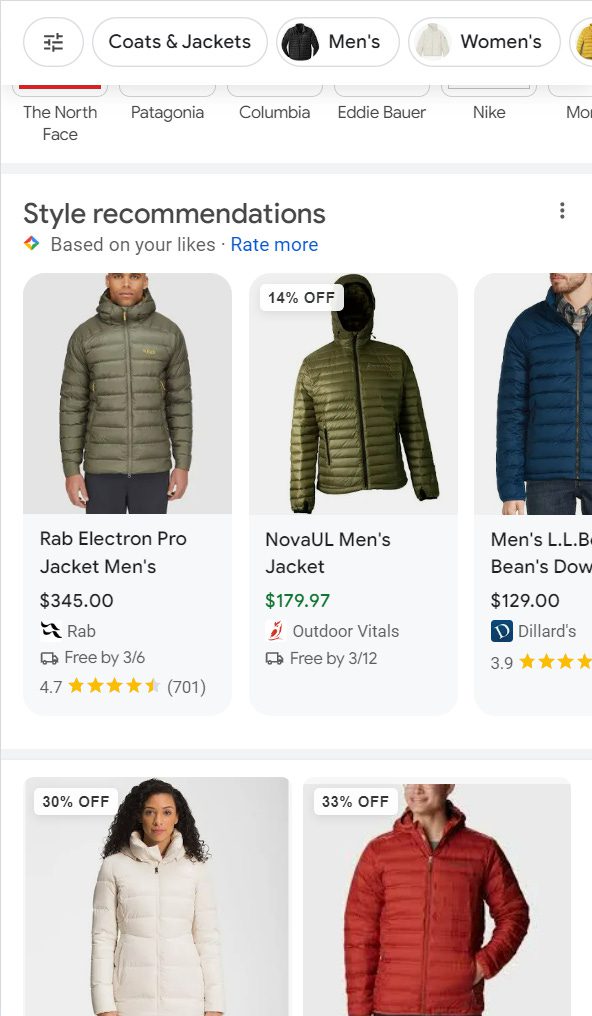
However, Google started to offer more personalization for its search canary: fashion.

Users get custom style recommendations based on their choices and can add brands to favorites to customize their search.

In 2022, Google started customizing shopping search more based on previous purchases.

When you’re shopping on Google, just make your selections once — your preferred department and brands — to see more of each in the future. So if you select the “womens” department and the brand Cuyana, next time you’re shopping for something like a messenger bag, we’ll show you women’s messenger bags from Cuyana and similar brands.

Personalized shopping recommendations are much less scary than political news and easier to monetize because Google can shorten the path to conversion while keeping users in search.

personalized shoppingImage Credit: Kevin Indig

Personalization is most useful in shopping, news, and local, but less for informational searches with a learning intent.

LLMs and machine learning paired with the Shopping graph of over 35 billion data points allow Google to tailor shopping search more than ever before – exactly what Google has been doing over the last months:

When searching for a product, you’ll get a snapshot of noteworthy factors to consider and products that fit the bill. You’ll also get product descriptions that include relevant, up-to-date reviews, ratings, prices and product images. That’s because this new generative AI shopping experience is built on Google’s Shopping Graph, which has more than 35 billion product listings — making it the world’s most comprehensive dataset of constantly-changing products, sellers, brands, reviews and inventory out there. In fact, every hour, more than 1.8 billion listings are refreshed in our Shopping Graph to give people fresh, reliable results.

“Hey Google, Where Is My Data?”

If voice and personalization ever have a chance to make it big, it’s now. Things rarely play out the way you think they do, which would perfectly fit the bill for voice and personalization.

If I’m right – and personalization and voice search do get bigger – the importance of being top of mind before an intent comes up grows even more than today.

On the backend, brands need to convince with superior service, shipping and returns to keep customers. The beauty of personalized shopping search is that once customers are settled on an opinion, it’s hard to get them off.

How would Google personalize results? A combination of first-party data from Google services like Gmail, YouTube, Android & Co., and Topics.

One factor I’m not bullish about is data.

Ever since flooding the SERPs with features like Map Packs, image carousels, shopping carousels, and other carousels, Google hasn’t given marketers much data to understand their impact. I also fear that Google wouldn’t give us data about SGE if it ever rolled out, but that’s another story.

What would change my mind is if I saw how we get the queries and number of searches from current voice devices, but neither Alphabet, Apple, nor Amazon share that data.


How the Best Forecasters Predict Events Such as Election Outcomes

Jeff Bezos

Amazon has sold more than 500 million Alexa-enabled devices, drops 4 new Echo products

Alexa, why are you losing so much money?

Why did Apple’s original HomePod fail? Let’s count the reasons

Roughly 1 in 4 U.S. adults now owns a smart speaker, according to new report

American Driving Survey: 2022

Exploring time spent on cooking, reading, and other activities for National Hobby Month

Average hours per day spent in selected household activities

Amazon is set to supercharge Alexa with generative AI

Measuring Personalization of Web Search

What did you see? A study to measure personalization in Google’s search engine

9 new features and tools for easier shopping on Google

Supercharging Search with generative AI


Featured Image: Lyna ™

Google On Spammy Backlinks & Negative Impact On Rankings via @sejournal, @martinibuster

Google’s John Mueller answered a question on Reddit about what to do about an increase in spammy backlinks that are perceived as having a negative impact on rankings. Mueller’s answer showed what publishers should focus on.

Noticing Spammy Backlinks

The person asking the question said that they had noticed an increase in spammy backlinks and that they associated it with a negative impact on their rankings. They also said that it was affecting their “overall credibility.”

They didn’t elaborate what they meant by “overall credibility” but perhaps they were talking about a third party site metric like Domain Authority.

This is what the person asked:

“I’ve noticed a significant increase in spammy backlinks pointing to my website, and it’s negatively impacting my site’s search engine rankings and overall credibility. Despite my efforts, I’m struggling to effectively remove these spammy backlinks.

Can anyone provide guidance or suggestions on the best practices and tools for removing spammy backlinks and restoring the integrity of my website’s link profile? Any tips or suggestions will be helpful.”

John Mueller Answers Question About Spammy Backlinks

Mueller answered that it’s not necessary to do anything about “spammy backlinks” because Google ignores them. He didn’t even suggest using the Disavow Tool, a tool that tells Google to ignore specific links that a publisher is responsible for.

Mueller responded:

“I’d strongly recommend focusing on other things – Google’s systems are really good at dealing with random spammy links, but – like users – they do get hung up on websites that aren’t awesome. Make your site awesome instead of chasing those links.”

About “Overall Credibility”

Third party metrics don’t offer insights into how Google sees a website. They’re just the opinion of a third party that can be used to measure one site against another.

My background in SEO goes back 25 years to a time when Google used to show a representation of PageRank on Google’s toolbar. I was an authoritative source of information that related data about the quantity of links and whether or not a site was indexed or not indexed. Yet even Google’s own PageRank tool didn’t accurately reflect the ability of a site to rank well.

Majestic’s Topical Trust Flow scores are useful because they communicate the kinds of links flowing to a website and gives an idea of what the backlinks say about a site.

But other than that, a third party “authority” metric is not anything I have ever used and will never use. Many SEOs with longtime experience don’t use those metrics.

Read the Reddit discussion:

Can anyone help me on how to remove spammy backlinks?

Featured Image by Shutterstock/Krakenimages.com