How To Increase Google Discover Visibility Naturally Using These Ranking Signals via @sejournal, @rollerads

This post was sponsored by RollerAds. The opinions expressed in this article are the sponsor’s own.

Want more visibility in Google Discover?

Not sure how to get into Google’s personalized news feeds?

Discover isn’t like search. You don’t rank for keywords.

You get selected.

And that means the best way to get featured isn’t to optimize for keywords; it’s to optimize for specific algorithmic signals.

In this guide, we’ll cover the core ranking signals that help Google determine which content belongs in Discover feeds, and how you can naturally boost those signals using tools like push notifications.

Google Discover Optimization Tips: Which Signals Tell Google Your Content Belongs in Discover?

Google Discover uses a different algorithm from traditional search results.

While it still considers many of the same quality indicators, Discover visibility depends less on keywords and more on how your content performs in the real world.

Here are the most important content quality signals for Discover.

1. E-E-A-T: Experience, Expertise, Authoritativeness, Trust

A good rule of thumb is to follow the “E-E-A-T” guideline:

  • Experience: Firsthand, real-world familiarity with the subject.
  • Expertise: Deep knowledge and skill in your content niche.
  • Authoritativeness: Recognition from other trusted sources.
  • Trustworthiness: Accurate, unbiased, and reliable information.

2. Engagement Metrics

These tell Google your content resonates with users and may be worth promoting more widely.

3. Strong Visuals & Headlines

Discover is highly visual, so if you don’t stand out immediately, the users are likely to scroll past your content.

Take your time to polish headlines to get attention, but make sure they accurately reflect the content of your article, post, or whatever you’re writing right now.

Engaging headlines, images, and videos perform better, especially when those assets are optimized for mobile.

4. Technical SEO & Mobile Optimization

While you don’t need to “rank” per se, you do need a well-optimized site, which includes:

  • Fast load times: Consider page speed and overall efficiency. Use PageSpeed Insights to ensure your web pages are optimized for user performance.
  • Mobile-friendly layouts: Google Discover is only available on mobile devices, as there is currently no desktop version.
  • Structured data: Google relies on structured data to categorize content and provide relevant suggestions for users. To attract more engaged and relevant users, you need to add tags and structure data so that Google can better recognize and categorize your content.
  • Internal linking & link building: It will help you create your own network of content. This concerns old articles, too, as they might serve as a gateway to newer pieces of content.
  • RSS or Atom Feed: Allow users to follow you to receive updates quickly. Google generates a feed for you automatically, but you can connect your own.
  • Google Web Stories: Similar to Instagram, these stories appear under the Visual Stories banner on mobiles and serve to expand your reach. Stories are easy to create, engaging, interactive, and fun.

    Track, test, improve. Use Google Search Console (GSC) to monitor your performance and statistics. Unlike Google Analytics, it has a dedicated tab for monitoring Google Discover traffic.

    5. Freshness & Topical Relevance

    Valuable content addresses and solves pain points.

    For content to have a better chance of showing up in Discover feeds, it should be:

    • Accurate.
    • Timely.
    • Trending.
    • Helpful.
    • Continuously updated.

    This is especially powerful if your content is tied to current events or spikes in interest, as shown in Google Trends.

    To discover what users search for, try:

    • Google Search: Enter a query and scroll down to view related and popular requests.
    • Google Search’s Autocomplete: Start typing a search and observe the suggested autocomplete queries; these are the queries that many others regularly search for.
    • Google Trends: Identify how popular a content direction is in any part of the world. This is also great for identifying seasonality.

    How Google Discover Works

    1. Google Discover suggests your content, which should include all the positive signals mentioned above.
    2. The Google app user engages with your content within Google Discover, adding to Google’s knowledge of how users interact with your website.
    3. These engagements (visitor volume, time on page, user experience, etc.) indicate to Google that your content is well-suited for similar readers.
    4. Google increases your reach and visibility on Google Discover.
    5. Those new viewers engage with your content in a similar pattern.
    6. The cycle repeats, spreading your optimized content to more Google Discover timelines.

    This is known as a positive loop because your content consistently passes positive ranking signals back to Google’s Discover algorithm, thereby continuing to increase in engagement.

    How Do I Create A Positive Loop & Show Up In Google Discover?

    Now that you know what Google is looking for, here’s how to naturally boost those signals.

    We know that Google Discover places your content based on:

    • High-clickthrough rates.
    • Long time-on-page.
    • Repeat visitors.

    So, how can you increase those metrics?

    By getting a dedicated reader base that is always ready to consume your new content.

    Push notifications are a great way to alert your dedicated readers that new content is out.

    And they will feed your Google Discover algorithm data.

    How To Use Push Notifications To Boost These Google Signals

    Many publishers avoid push notifications, believing they’re too promotional or might harm user experience (UX).

    However, modern push notification platforms allow you to take a more hybrid approach, combining editorial updates with monetization to boost visibility.

    Why Hybrid Push Notifications Help Boost Discover Visibility

    Done right, push notifications help your content get discovered organically by:

    • Increasing CTR with a second wave of distribution.
    • Driving fast engagement shortly after publication.
    • Bringing back repeat readers to increase session depth.
    • Boosting behavioral signals that Google uses to judge quality.

    In other words, push notifications support the very engagement metrics that can lead to more Discover visibility.

        When users receive a mix of informative and promotional pushes, each message feels fresh, encouraging clicks and boosting your CTR.

        Higher engagement signals to Google that your content is valuable, increasing the chances of it being featured on Discover.

        And since Discover traffic is largely made up of new visitors, each one becomes a fresh opportunity to grow your subscriber base.

        Once users opt in, you can keep re-engaging them, creating a cycle of rising visibility, CTR, and traffic.

        Image created by RollerAds April, 2025

        How to Implement Hybrid Push Format to Get on Discover Faster

        In a recent case study, one RollerAds publisher increased their revenue from $0 to $60,000 per month by pairing great content with hybrid push notifications and Discover-optimized distribution. The key was creating content that signals quality and leveraging distribution to show it.

        With a tool like RollerAds, you can gain a streamlined way to:

        • Send personalized push notifications for your latest content.
        • Mix promotional and editorial messaging without spamming your readers.
        • Increase engagement, retention, and revenue simultaneously.

        Simply register your site, get a custom strategy from your account manager, and start boosting content visibility, without compromising user experience.

        Even better? You can monetize this traffic directly with ad formats designed for Discover audiences, no intrusive pop-ups or poor user experience. Just clear, engaging content with a side of revenue.

        For SEJ readers, use the code SEJ30 to add +30% to your funds before July 1st, 2025.

        Just show the code to your account manager on RollerAds before your first payment.

        Getting featured on Google Discover isn’t just about luck; it’s about strategy.

        From creating high-quality, relevant content to optimizing visuals, headlines, and mobile performance, every step counts. However, to truly stand out and amplify your chances, pairing content strategy with smart tools, such as hybrid push notifications from RollerAds, can make all the difference.

        Engaging your audience through push updates not only drives more clicks but also signals content quality to Google, boosting your Discover reach. With the right monetization tools, you can convert that traffic into substantial revenue.


        Image Credits

        Featured Image: Image by RollerAds. Used with permission.

        In-Post Image: Images by RollerAds. Used with permission.

        Cracking the SEO Code: Regain Control of Search Visibility in the Age of AI [Webinar] via @sejournal, @hethr_campbell

        Trying to regain lost visibility in AI-powered search results?

        As AI Overviews and answer engines continue to reshape how search works, organic visibility can disappear overnight. If your traffic has taken a hit, you may need a more complete strategy to recover and grow.

        Join us for Own The Total SERP: How To Regain Lost Visibility Across Paid, Organic and Local SEO.” This webinar will introduce the TotalSERP strategy, a unified approach designed to help you reclaim visibility across the entire search landscape.

        Why This Session Is Important

        Search is no longer limited to paid or organic results. Success now comes from owning the full search engine results pages (SERPs), including local listings and AI-driven experiences.

        On May 27, 2025, at 12pm ET, you will learn:
        ✅ How to gain total SERP visibility across paid, organic and local search
        ✅ How to use Gen AI to improve content and capture intent
        ✅ How to turn an integrated search strategy into measurable business results

        This session is led by Bhavin Prashad, Associate Vice President of Digital Media, and Dan Lauer, SEO Strategist at DAC. They will walk you through the TotalSERP strategy and show how it can help you rebuild what Google’s algorithm and AI may have taken away.

        What makes this session different

        The TotalSERP strategy aligns your paid, organic, and local efforts into one consistent plan. It is designed to help you capture customers at every stage of their search journey.

        Let’s help you take back control of your visibility and drive results across every part of the search experience.

        If you cannot attend live, go ahead and register. We will send you the full recording after the event.

        The Triple-P Framework: AI & Search Brand Presence, Perception & Performance

        As brands compete for market share across a whole range of AI platforms, each with its own way of presenting information, brands are on red alert.

        The three pillars of presence, perception, and performance that I discuss in this article may help marketers navigate new times. This is especially true as search and AI undergo their biggest make-over ever.

        What’s driving this change?

        AI isn’t just retrieving information anymore – it’s actively evaluating, framing, and recommending brands before prospects even click a link.

        It’s happening now, and it’s accelerating.

        Think about it. Today, in many ways, ChatGPT has become just as synonymous with AI as Google was when it launched core search.

        More and more users and marketers are experimenting with and utilizing Google AIO, ChatGPT, Perplexity, and more.

        According to a recent BrightEdge survey, over 53% of marketers regularly use multiple (two or more) AI search platforms weekly.

        AI Is Reshaping How Brands Are Presented And Perceived

        Consider how buyers research options today: In Google AIO, a traveler planning a Barcelona vacation once needed dozens of separate searches, each representing an opportunity for visibility.

        Now? They ask one question to an AI assistant and receive a complete itinerary, compressing what 50 touchpoints once took into a single interaction.

        AI is no longer a passive search engine. It’s an active evaluator, interpreting intent, forming opinions, and determining which brands deserve attention.

        In enterprise SEO and B2B contexts, the shift is even more pronounced. AI is effectively writing the request for proposal (RFP), establishing evaluation criteria, and creating shortlists without brands having direct input.

        Take enterprise software evaluation, for instance. When a CIO asks an AI about the “best enterprise resource planning solutions,” the AI’s response typically features:

        • A curated shortlist of vendors.
        • Evaluation criteria that the AI deems relevant.
        • Strengths and limitations of each solution.
        • Recommendations based on various scenarios.

        These responses don’t just inform decisions. They frame the entire evaluation process before a vendor’s content is visited.

        The question isn’t whether this transformation is happening. It’s whether your brand is prepared for it.

        Read more: 5 Key Enterprise SEO And AI Trends For 2025

        The Triple-P Framework For AI Search Success

        After analyzing thousands of AI search responses using our BrightEdge Generative Parser™, I’ve developed the Triple-P framework (Presence, Perception, and Performance) as a strategic compass for navigating this new landscape.

        Let’s break down each component.

        Presence: Beyond Traditional Rankings

        While Google still commands 89.71% of search market share, the ecosystem is diversifying rapidly:

        • ChatGPT: 19% monthly traffic growth.
        • Perplexity: 12% monthly traffic growth.
        • Claude: 166% monthly traffic surge.
        • Grok: 266% early-stage spike.

        (Source: BrightEdge Generative Parser™ April 2025)

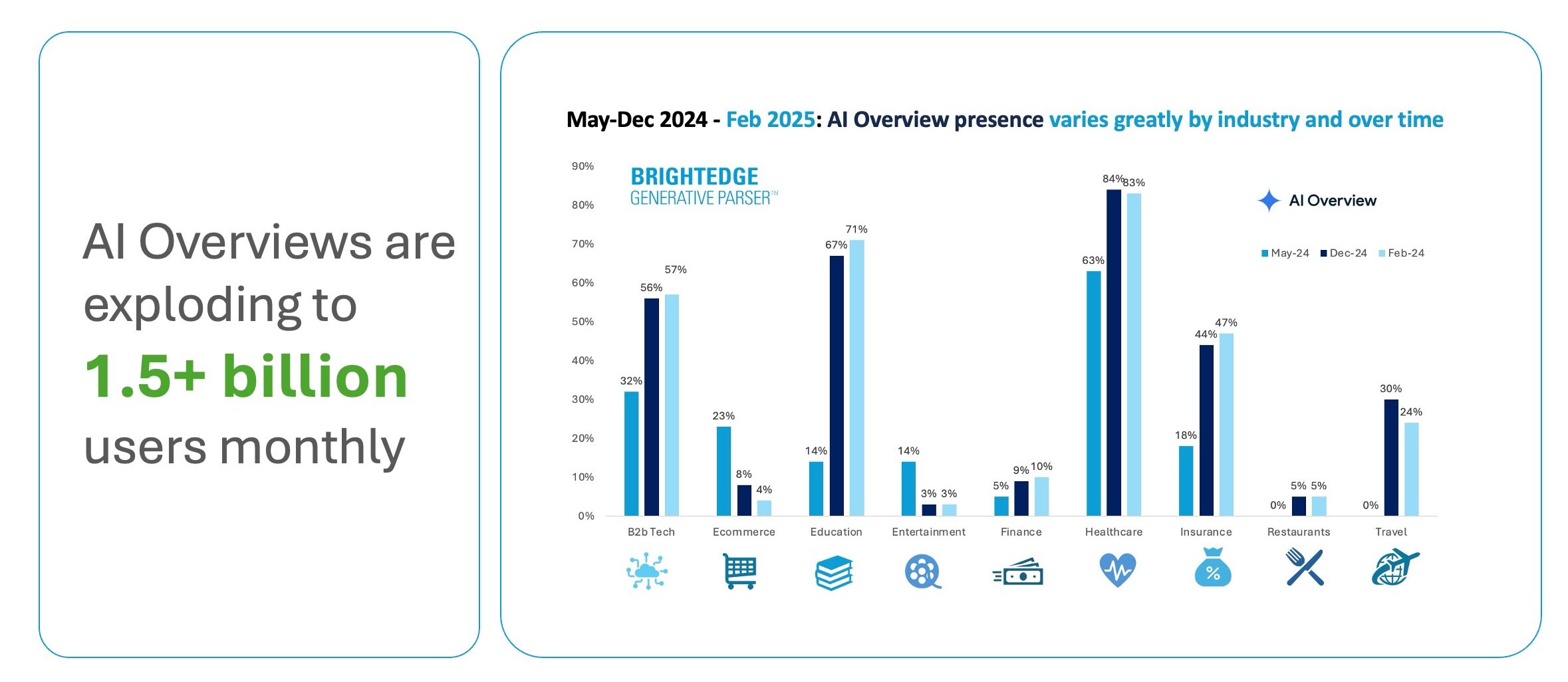
        Our research shows that the presence of AI Overviews has nearly doubled since June 2024, with comparison features growing by 70-90% and product visualization features by 45-50% in B2B sectors.

        Image from author, May 2025

        For enterprise marketers, Google is always your starting point. However, it’s not just about ranking on Google anymore; it’s about showing up wherever AI models showcase your brand.

        For example, consider these industry-specific implications:

        • For CPG brands: When consumers ask about product sustainability, AI doesn’t just list eco-friendly options; it evaluates authenticity based on consistent messaging across digital touchpoints.
        • For SaaS companies: Buyers researching integration capabilities receive AI-curated assessments that either position you as a compatibility leader or exclude you entirely.
        • For healthcare providers: Patient questions about treatment options trigger AI responses that cite the most authoritative content, not necessarily the highest-ranking websites.

        We are in an era of compressed decision-making. Invisibility equals elimination.

        Perception: When AI Forms Opinions

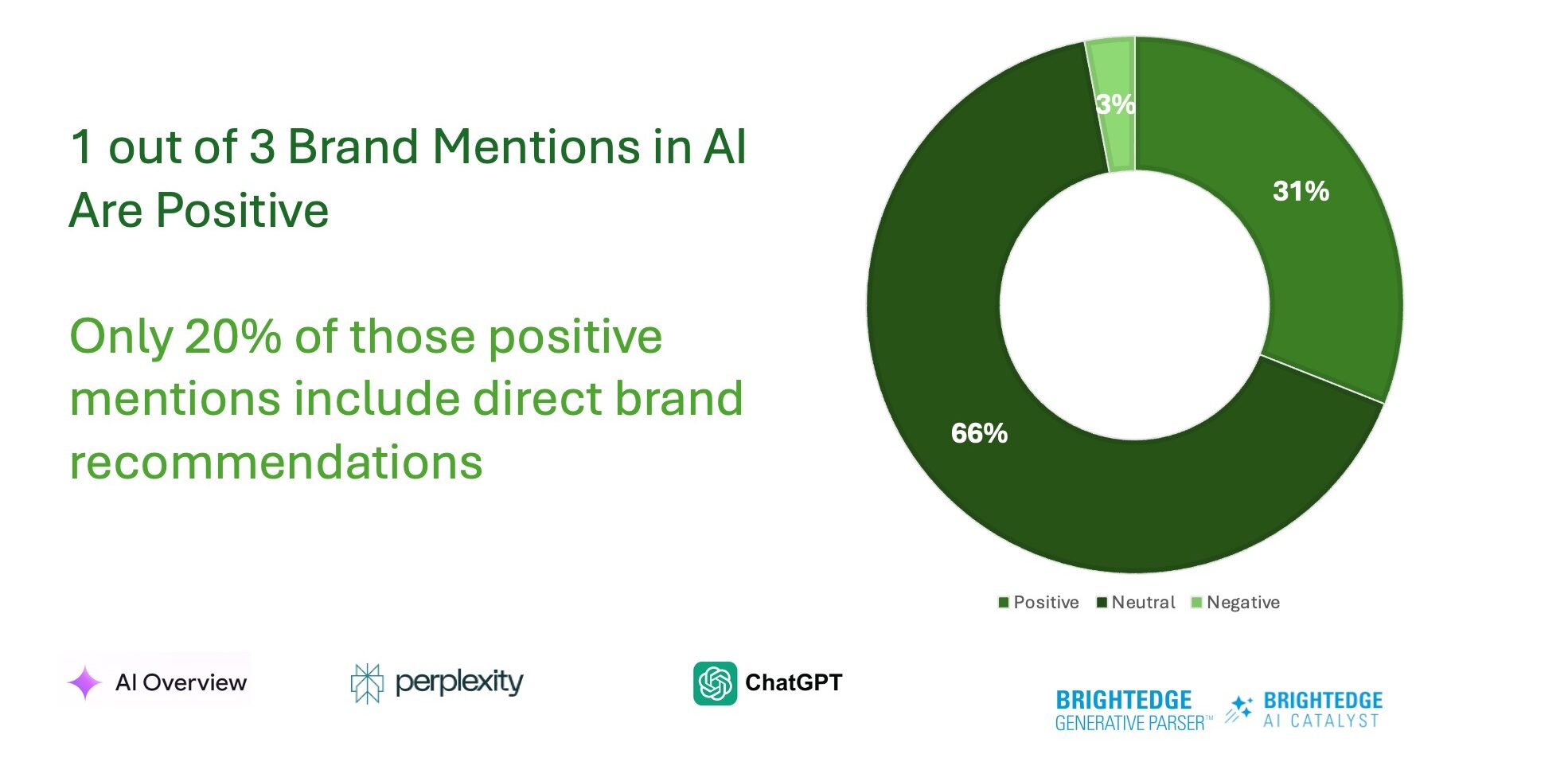
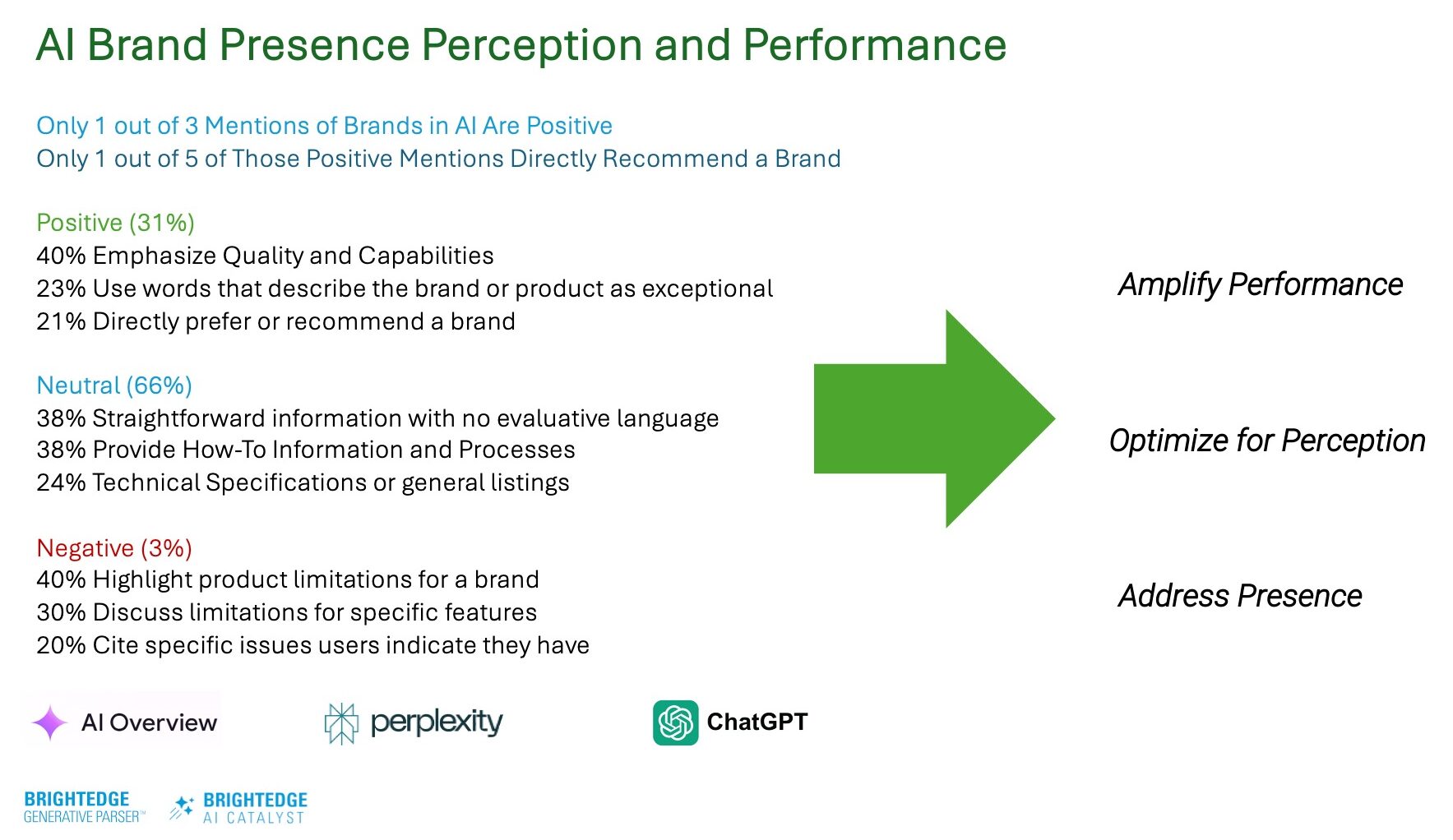
        The most revealing insight from our research is that only 31% of AI-generated brand mentions are positive; of those, just 20% include direct recommendations.

        Source: BrightEdge AI Catalyst and Generative Parser ™, May 2025

        This is a wake-up call for all marketers, especially those managing a brand.

        Even when your brand appears in AI results, how it’s framed varies dramatically depending on the AI model, training data, and interpretive logic.

        In some AI engines, your brand may appear as the industry leader. In others, you may be completely absent.

        What The Data Shows:

        • Brands with strong pre-existing recognition receive more positive mentions in AI responses.
        • Consistent messaging across digital touchpoints makes brands more likely to be cited positively.
        • AI systems appear to “average” brand signals across the web when forming perceptions.

        When we analyzed sentiment distribution (April 2025) in AI responses by industry, we saw significant variation, which you could group-match to verticals. For example:

        • Finance: Positive mentions aligned around good content on regulatory compliance and security.
        • Healthcare: Positive mentions aligned around good content with accuracy and credibility as key factors.
        • Retail: Positive mentions aligned around good customer experience and shopping.
        • Technology: Positive mentions aligned around content on innovation and reliability as primary criteria.

        The implications are clear: Perception management is now as crucial as presence.

        How does this play out in practice?

        When brands implement coordinated perception management strategies across multiple channels, they see improvements in AI sentiment within 60-90 days.

        Performance: New Metrics That Matter

        The final P (Performance) requires entirely new measurement approaches.

        When AI overviews appear in search results, click-through rates often drop by up to 50% according to internal BrightEdge data. Yet, conversion rates typically remain strong, suggesting AI qualifies leads before they reach your site.

        We’re entering an era where impressions will be high, click-through rates may drop, but conversions will increase.

        I explained at our recent quarterly briefing. AI filters options and delivers buyers who are closer to decisions.

        The impact varies dramatically by query type:

        • Informational queries: Reduction in clicks, minimal conversion impact.
        • Navigational queries: Reduction in clicks, negligible conversion impact.
        • Commercial queries: Reduction in clicks, higher conversion rates.
        • Transactional queries: Reduction in clicks, higher conversion rates.

        This pattern suggests AI is most effective at qualifying commercial intent, delivering more purchase-ready traffic.

        And impressions matter now – they are a new brand metric.

        Five Essential AI Search Metrics:

        1. AI Presence Rate: Percentage of target queries where your brand appears in AI responses.
        2. Citation Authority: How consistently you are cited as the primary source.
        3. Share Of AI Conversation: Your semantic real estate in AI answers versus competitors.
        4. Prompt Effectiveness: How well your content answers natural language prompts.
        5. Response-To-Conversion Velocity: How quickly AI-influenced prospects convert. Brands with strong pre-existing recognition will receive more positive mentions in AI responses.

        Position within AI responses matters as much as position in traditional SERPs once did.

        Monthly reporting cycles are becoming obsolete. AI-generated results can shift within hours, demanding real-time monitoring capabilities.

        The DNA Of AI-Optimized Content

        In my experience, content is more likely to be cited by AI with:

        • Comprehensive coverage: Content addressing multiple related questions outperforms narrow content.
        • Structured data implementation: Pages with robust schema markup see higher citation rates.
        • Expert validation: Content with clear expert authorship signals receives more citations.
        • Multi-format delivery: Topics presented in multiple formats (text, video, data visualizations) earn more citations.
        • First-party data inclusion: Original research and proprietary data increase citation likelihood.

        These patterns suggest AI systems are increasingly sophisticated in their ability to identify genuinely authoritative content versus content merely optimized for traditional ranking factors.

        In my last article, I discussed how Google AIO, ChatGPT, and Perplexity differ and where they share some common optimization traits.

        Five Actionable Strategies For Triple-P Success

        Based on our extensive research, here are five implementation strategies aligned with this framework:

        1. Adopt Entity-Based SEO

        AI prioritizes content from known, trusted entities. Stop optimizing for fragmented keywords and start building comprehensive topic authority.

        Our data shows that authoritative content is three times more likely to be cited in AI responses than narrowly focused pages.

        Implementation Steps:

        • Perform an entity audit: Identify how search engines currently understand your brand as an entity.
        • Develop topical maps: Create comprehensive coverage of core topics rather than isolated keywords
        • Implement entity-based schema: Use structured data to explicitly define your brand’s relationship to key topics.
        • Build consistent entity references: Ensure name, address, and phone (NAP) consistency across all digital properties.
        • Cultivate authoritative connections: Earn mentions and links from recognized authorities in your space.

        Enterprise brands implementing entity-based SEO will see an uplift in AI citations.

        2. Implement Perception Management

        With 69% of AI brand mentions not explicitly positive, you must actively shape sentiment.

        Image from author, May 2025

        Brands that implement proactive sentiment management strategies will see success.

        Implementation Steps:

        • Monitor AI sentiment tracking: Establish baseline sentiment across AI platforms.
        • Identify perception gaps: Compare AI perceptions against desired brand positioning.
        • Address criticism proactively: Create content that honestly addresses common concerns.
        • Amplify authentic strengths: Develop evidence-based content highlighting genuine advantages.
        • Build consistent messaging: Align key messages across all digital touchpoints.

        3. Integrate Real-Time Citation Monitoring

        Tracking AI citations regularly is now vital to improve mention rates.

        This requires capability beyond traditional rank tracking or Google Search Console analysis.

        Implementation Steps:

        • Deploy continuous monitoring: Track AI responses for priority queries across platforms.
        • Implement competitor citation alerts: Get notified when competitors gain or lose citations.
        • Conduct prompt variation testing: Analyze how different user phrasings affect your brand’s inclusion.
        • Track citation position: Monitor where within AI responses your brand appears.
        • Measure citation authority: Assess whether you’re positioned as a primary or secondary source.

        4. Deploy Cross-Core Search And AI Platforms

        Companies that take an integrated approach across traditional search and multiple AI platforms will see higher return on investment (ROI) on search investments.

        The future belongs to unified measurement frameworks that connect traditional SEO metrics with emerging AI citation patterns.

        Implementation Steps:

        • Build unified dashboards: Integrate traditional search metrics with AI citation data.
        • Map keyword-to-prompt relationships: Connect traditional keywords to conversational AI prompts.
        • Analyze traffic source shifts: Track changing patterns between direct search and AI-referred traffic.
        • Segment by AI platform: Monitor performance variations across different AI search environments.
        • Connect to business outcomes: Tie AI presence metrics directly to conversion and revenue data.

        5. Use AI To Win At AI

        This isn’t theoretical. It’s delivering measurable results:

        • BrightEdge Autopilot users averaged a 65% performance improvement.
        • BrightEdge Copilot users saved 1.2 million content research hours.

        The brands succeeding most in AI search leverage AI in their workflows.

        Implementation Steps:

        • Automate content research: Use AI to identify comprehensive topic coverage opportunities.
        • Implement AI-driven schema markup: Systematically structure data for machine interpretation.
        • Deploy prompt effectiveness testing: Continuously test how well content answers real user prompts.
        • Create AI-optimized content briefs: Define exactly what comprehensive coverage means for each topic.
        • Analyze AI citation patterns: Identify what characteristics make competitor content citation-worthy.

        Teams using AI for AI optimization will benefit from higher productivity and improved performance to gain that must-have competitive edge in search and AI today.

        What’s Coming Next: AI-To-AI Marketing

        Looking ahead to two to three years, expect AI to evolve from an information assistant to a trusted advisor that buyers rely on for evaluation, comparison, and vendor selection.

        We’re already seeing early indicators of AI-to-AI marketing, where procurement teams use AI agents to automate research and vendor vetting.

        Emerging Trends:

        • Digital twin marketplaces: Buyers will interact with simulated versions of B2B solutions before speaking with vendors
        • Vertical-specific AI companions: Industry-specialized models for cybersecurity, manufacturing, and healthcare.
        • AI agent purchasing: Autonomous systems are not just researching but also completing transactions on users’ behalf.
        • Continuous entity validation: AI systems continuously monitor brand claims against real-world evidence.
        • Multi-modal search experiences: Voice, image, and text-based AI interactions requiring omnichannel optimization.

        Read more: As Chatbots And AI Search Engines Converge: Key Strategies For SEO

        The Trust Premium In AI Search

        Consumers are always more likely to trust brands they already recognize.

        • AI functions as a trust bridge.
        • When consumers delegate decision-making to AI, pre-existing brand familiarity becomes disproportionately influential.
        • The impact is most pronounced in high-consideration purchases.

        This creates both a challenge and an opportunity. Established brands must protect their advantage, while emerging brands must strategically build recognition signals detectable by AI.

        Organizational Structure For AI Search Success

        Leading organizations are already creating “collaborative intelligence” roles – specialists managing the interplay between human creativity and AI amplification.

        Successful teams typically include:

        • AI Search Strategists: Focus on overall presence, perception, and performance.
        • Prompt Engineers: Specialize in understanding how users phrase requests to AI.
        • Content Scientists: Develop evidence-based approaches to comprehensive coverage.
        • AI Citation Analysts: Monitor and optimize for inclusion in AI responses.
        • Schema Specialists: Ensure that the machine-readable structure enhances entity understanding.

        These cross-functional teams integrate with traditional SEO, content marketing, analytics, and business intelligence functions.

        The Bottom Line

        In this new landscape, the question isn’t whether your website ranks. It’s whether AI recommends your brand when it matters most.

        The Triple-P framework gives you the structure to navigate this future with confidence.

        Here’s what I recommend getting started:

        • Conduct an AI presence audit: Understand where your brand appears in AI responses across key platforms.
        • Analyze sentiment distribution: Assess not just if you’re mentioned, but how you’re portrayed in AI-generated content.
        • Connect AI metrics to business results: Start tracking the relationship between AI presence and conversion patterns.
        • Identify entity perception gaps: Compare how AI systems understand your brand versus your desired positioning.
        • Deploy real-time monitoring: Implement systems to track citation changes as they happen.

        The branded AI search revolution isn’t coming – it’s already here.

        The brands that embrace the Triple-P framework today will be the ones AI recommends tomorrow.

        Note: In March 2025, BrightEdge surveyed over 1,000 of its customers who are marketers. Findings from this survey are referenced above.

        More Resources:


        Featured Image: Moon Safari/Shutterstock

        Is The SEO Job Market Undergoing A Major Shift? via @sejournal, @martinibuster

        Anecdotal reports and an SEO jobs study describe a search marketing industry undergoing profound changes, not only in the skills in demand but also in hiring practices that may be making it difficult for experienced SEOs to get the jobs they are well qualified for.

        Short History Of SEO Jobs

        Twenty five years ago getting into SEO and earning a living was relatively easy. Many top corporations across all industries were hiring freelancers and agencies for specialized SEO assistance. I suspect that marketing departments didn’t view SEOs as a subset of marketing and that many didn’t have SEO staff. That gradually changed as more organizations hired dedicated SEO staff with third party SEOs providing specialized assistance.

        What’s Going On With SEO Jobs?

        A recent report on the state of SEO jobs provided by SEOJobs.com shared the state of SEO jobs in 2024.

        The following insights show that the job of SEO continues to evolve:

        • SEO job openings declined in 2024
        • Median SEO salaries dropped
        • 65% of SEO jobs are in-house
        • Remote SEOs jobs dropped
        • SEO job titles related to content strategy and writing dropped by 28%
        • SEO Analyst job titles dropped by 12%.
        • Technical SEO and related titles dropped by a small percentage
        • Senior level titles like manager, director, and VP had the strongest increases.

        The report says that job titles related to Technical SEO dropped:

        “Positions in the Technical SEO and related title group represented 5.8 percent of all SEO jobs during the first quarter of 2024, falling slightly to 5.4 percent by the end of the fourth quarter – a decrease of seven percent.”

        But the report also states that Technical SEO is still an in-demand skill:

        “…demand for skill in technical SEO grew at the fastest rate of any skill during the fourth quarter, rising to 75 percent from 71 percent the previous quarter.”

        Experienced SEOs Having Trouble Getting Hired… By AI?

        Keith Goode read the above referenced report and commented that he believes the reason many highly experienced SEOs are failing to get a job is because of a poor implementation of AI into the hiring process.

        He shared his insights on a LinkedIn post:

        “I have seen superior SEOs languish amongst thousands of candidates, immediately rejected for a lack of experience (??) or funneled through multiple rounds of interviews and work assignments, only to be rudely ghosted by the recruiters.

        The cause? I guess you could blame AI if you wanted to shoot the messenger. But the reality is that companies have overinvested in an unproven technology to handle things that it’s not yet ready to handle. I get that recruitment teams are deluged with thousands of resumes for every opening, and I understand they need a way to streamline the screening process.

        However, AI has proven to be more of an enemy within than a helper. Anecdotally, I’ve heard about a hiring manager who applied for their own job opening (presumably one they were more than qualified for) only to receive an immediate rejection from the AI-powered ATS. That person fired their hiring team.

        (By the way, I’m not anti-AI. I’m anti-foolishness, and a lot of companies are acting like fools.)”

        Experienced SEOs Are Getting Ghosted

        It may be true that SEOs with decades of experience are being left behind by poor AI vetting. A glaring example is the one shared by Brian Harnish, an SEO with decades of hands-on experience.

        Brian recently published the following on LinkedIn and Facebook:

        “In this job market, for me it simply appears that nothing matters.

        • You can apply at 6:15 a.m. the day the job posting pops up and be one of the first.
        • You can change your resume 15 times like I have.
        • You can use ResumeWorded. com for an ATS version of your resume.
        • You can write your resume yourself until you’re blue in the face.
        • You can follow up on the interview with thank yous immediately after.
        • You can follow up on interview decisions later.
        • You can agree to their salary ranges exactly. Even when it’s a pay cut for you.
        • A/B testing long vs. short resumes yield the same results.
        • You can tie in all of your achievements with task > impact > website statements on your resume.
        • You write an entirely customized LinkedIn profile.
        • You can know all the right people.
        • You can network up the wazoo.
        • You can have the greatest interview that you feel you’ve ever put forth.

        But companies don’t provide feedback. It’s always the same form letter: “while your qualifications are impressive, we went with another candidate.” Or you’re ghosted.

        This market is brutal. I really want a job. Not a handout. But nobody appears to want to hire me. At all. Despite doing EVERYthing right. I used to get hired on the spot. Now it’s just crickets.”

        What The Heck Is Going On?

        I know of other SEOs, also with decades of experience across all areas of SEO who should have just bounced to a new job in a matter of days but took months to get hired. I’m talking about people with SEO director level experience at top Fortune 500 companies.

        How does this happen?

        Are you experiencing something similar?

        Featured Image by Shutterstock/Ollyy

        Do More With Less: How To Build An AI Search Strategy With Limited Resources [Webinar] via @sejournal, @hethr_campbell

        Feeling overwhelmed by AI in search?

        Working with limited time, tools, or a small team?

        You’re not alone. As search engines evolve, it’s becoming harder to keep up, especially if your resources are stretched thin.

        Join us for “Do More With Less: How To Build an AI Search Strategy With Limited Resources,” a practical webinar designed to help small teams create a strong, AI-powered SEO strategy that actually works.

        Why This Webinar Is Worth Your Time:

        You don’t need a big budget or a large team to get results. You just need a smart plan and the right tools to help you stay ahead.

        In this session, you’ll learn how to:
        ✅ Build a step-by-step SEO roadmap that uses AI effectively.
        ✅ Prioritize what matters through smarter audits and tools
        ✅ Keep up with the latest changes in AI-powered search

        Presented by Vincent Moreau, SEO Consultant at Botify, this session will give you practical steps you can use right away.

        What Makes This Session Different:

        We’re focused on real solutions for real constraints. If you’re looking to grow with limited resources, this is your chance to learn how.

        Let’s simplify your strategy and make AI work for your SEO goals.

        Can’t make it live? No problem. Sign up anyway, and we’ll send you the full recording.

        Google Disputes News That Search Engine Use Is Falling via @sejournal, @martinibuster

        Google took the unusual step of issuing a response to news reports that AI search engines and chatbots were causing a decline in traditional search engine use, directly contradicting testimony given by an Apple executive in the ongoing U.S. government antitrust lawsuit against Google.

        Apple Testimony That Triggered Stock Sell-Off

        Google’s stock price took a steep dive on the news that people were turning away from traditional search engines, dropping by 7.51% on Wednesday. What triggered the stock sell-off was testimony by Eddy Cue, Apple’s senior vice president of services, who testified that search engine use by users of Apple’s Safari browser declined for the first time last month, expressing his opinion that a technological shift is underway that is undercutting the use of traditional search engines.

        Early AI Adopters Turning Away From Google?

        There is a view in Silicon Valley that Google Search is legacy technology. A recent episode of the Y Combinator show featured the host sharing that their Google search traffic has dropped by 15% and that he attributes that to AI use in both Google and chatbots. He explained that if you want to see the future you look to the early adopters, commenting that everyone he knows in Silicon Valley uses ChatGPT to get answers and that Google Search is defacto legacy technology.

        The host described how 25 years ago the early adopters were using Google but that now, Google Search feels weird to him.

        He said:

        “People are now switching their behavior to where your default action if you’re looking for information is, you know ChatGPT or perplexity, or one of these things, and even just, you know, observing my own behavior. I’ll use Google mostly for kind of navigational. Like, if I’m just looking for a specific website and I know it’s going to give the same thing, but it’s starting to have that weird kind of, like legacy website, like I’m using eBay or something.”

        Google’s Statement

        Google’s statement was short and to the point, with no accompanying images to make it look like a blog post. Google’s statement could even be seen as terse.

        Here’s what Google published:

        “Here’s our statement on this morning’s press reports about Search traffic.

        We continue to see overall query growth in Search. That includes an increase in total queries coming from Apple’s devices and platforms. More generally, as we enhance Search with new features, people are seeing that Google Search is more useful for more of their queries — and they’re accessing it for new things and in new ways, whether from browsers or the Google app, using their voice or Google Lens. We’re excited to continue this innovation and look forward to sharing more at Google I/O.”

        AI Revolution: What Nobody Else Is Seeing

        Here’s the video of the Y Combinator show that offers a peek at how people in Silicon Valley relate to Google Search. The part I quoted is at about the 24 minute mark.

        Featured Image by Shutterstock/Framalicious

        Apple May Add AI Search Engines to Safari As Google Use Drops via @sejournal, @MattGSouthern

        Apple is reportedly planning to redesign Safari to focus on AI search engines.

        According to recent testimony in the Google antitrust case, this comes as the company prepares for possible changes to its profitable Google deal.

        Apple Signals Shift In Search Strategy

        Eddy Cue, Apple’s senior vice president of services, testified that Safari searches dropped for the first time last month.

        He believes users are choosing AI tools over regular search engines. This change happens as courts decide what to do after Google lost its antitrust case in August.

        Per a report from Bloomberg, Cue testified:

        “You may not need an iPhone 10 years from now as crazy as it sounds. The only way you truly have true competition is when you have technology shifts. Technology shifts create these opportunities. AI is a new technology shift, and it’s creating new opportunities for new entrants.”

        AI Search Providers May Replace Traditional Search

        Cue believes AI search providers such as OpenAI, Perplexity AI, and Anthropic will eventually replace traditional search engines like Google.

        “We will add them to the list — they probably won’t be the default,” Cue said, noting Apple has already talked with Perplexity.

        Currently, Apple offers ChatGPT as an option in Siri and plans to add Google’s Gemini later this year.

        Cue admitted that these AI search tools need to improve their search indexes. However, he said their other features are “so much better that people will switch.”

        “There’s enough money now, enough large players, that I don’t see how it doesn’t happen,” he said about the shift from standard search to AI-powered options.

        Context: Google’s Antitrust Battle Timeline

        This testimony comes during a key moment in the case against Google:

        • August 2024: Judge Mehta ruled Google broke antitrust law through exclusive search deals
        • October 2024: DOJ proposed remedies targeting search distribution, data usage, search results, and advertising
        • December 2024: Google offered counter-proposals to loosen search deals
        • March 2025: DOJ filed revised proposals, including possibly forcing Google to sell Chrome

        The $20 Billion Question

        The core issue is Google’s deal with Apple, worth a reported $20 billion per year, that makes Google the default search engine on Safari.

        While expecting changes to this deal, Cue admitted he has “lost sleep over the possibility of losing the revenue share from their agreement.”

        We learned about this payment during the trial. In 2022, Google paid Apple $20 billion to be Safari’s default search engine.

        Last year, they expanded their partnership to add Google Lens to the Visual Intelligence feature on new iPhones.

        Proposed Remedies & Responses

        The DOJ’s latest filing suggests several significant changes:

        • Making Google sell off Chrome
        • Limiting Google’s payments for default search placement
        • Stopping Google from favoring its products in search results
        • Making Google’s advertising practices more transparent

        Google has criticized these proposals, calling them a “radical interventionist agenda” that would “break a range of Google products.”

        Instead, Google suggests letting browser companies deal with multiple search engines and giving device makers more freedom about which search options are preloaded.

        What This Means

        If Apple shifts Safari toward AI, prepare for significant changes in search.

        It’s not a stretch to say the outcome could reshape search competition and digital marketing for years.


        Featured Image: Bendix M/Shutterstock

        Factors To Consider When Implementing Schema Markup At Scale via @sejournal, @marthavanberkel

        Organizations adopting schema markup at scale often see a boost in non-branded search queries, signaling broader topic authority and improved discoverability.

        It has also become a powerful answer to a pressing executive question: “What are we doing about generative AI?” One smart answer is, “We’re implementing schema markup.”

        In March 2025, Fabrice Canel, principal program manager at Bing, confirmed that Microsoft uses structured data to support how its large language models (LLMs) interpret web content.

        Just a day later, at Google’s Search Central Live event in New York, Google structured data engineer Ryan Levering shared that schema markup plays a critical role in grounding and scaling Google’s own generative AI systems.

        “A lot of our systems run much better with structured data,” he noted, adding that “it’s computationally cheaper than extracting it.”

        This is unsurprising to hear since schema markup, when done semantically, creates a knowledge graph, a structured framework of organizing information that connects concepts, entities, and their relationships.

        A 2023 study by Data.world found that enterprise knowledge graphs improved LLM response accuracy by up to 300%, underscoring the value structured data brings to AI initiatives.

        With Google continuing to dominate both search and AI – most recently launching Gemini 2.5 in March 2025, which topped the LMArena leaderboard – the intersection between structured data and AI is only growing more critical.

        With that in mind, let’s explore the four key factors to consider when implementing schema markup at scale.

        1. Establish Your Goal For Implementing Schema Markup

        Before you invest in doing schema markup at scale, let’s explore the business outcomes you can achieve with the different schema markup implementations.

        There are three different levels of schema markup complexity:

        1. Basic schema markup.
        2. Internal and external linked schema markup.
        3. Full representation of your content with a content knowledge graph.
        Level Of Schema Markup Outcome Strategy
        Basic Schema Markup Rich results with higher click-through rates. Implement schema markup for required properties.
        Internal and external linked entities within schema markup Increase in non-branded queries.

        Entities can be fully understood by AI and search engines.

        Define key entities within the page and add them to your schema markup. Link entities within the website and to external knowledge bases for clarity.
        Content knowledge graph: A full representation of your content as a content knowledge graph. Content is fully understood in context.

        A reusable semantic data layer that enables accurate inferencing and supports LLMs.

        Define all important elements of a page using the Schema.org vocabulary and elaborate entity linking to enable accurate extraction of facts about your brand.

        Basic Schema Markup

        Basic schema markup is when you choose to optimize a page specifically to achieve a rich result.

        You look at the minimum required properties from Google’s Documentation and add them to the markup on your page.

        The benefits of basic schema markup come from being eligible for a rich result. Achieving this enhanced search result can help your page stand out on the search engine results page (SERP), and it typically yields a higher click-through rate.

        Internal And External Linked Entities Within The Schema Markup

        Building on your basic schema markup, you can use the Schema.org vocabulary to clarify the entities on your website and how they connect with each other.

        An entity refers to a single, unique, well-defined, and distinguishable thing or idea. Examples of an entity on your website include your organization, employees, products, services, blog articles, etc.

        You can clarify a topic by linking an entity mentioned on your page to a corresponding external entity definition on Wikidata, Wikipedia, or Google’s knowledge graph.

        This enables search engines to clearly understand the entity mentioned on your website, which results in measurable increases in non-branded queries related to that entity or topic.

        You can also provide context on how entities on your site are connected by using the appropriate property to link your entity and its identifier.

        For example, if you had a page that outlined your product geared toward women, you would use external entity linking to clarify that the audience is women.

        If the page also lists related products or services, your schema markup would be used to point to where those related products and services are defined on your site.

        When you do this, you provide a holistic and complete view of the content on your page.

        With these internal and external entities fully defined, AI and search engines can understand and contextualize your entities accurately.

        Full Representation Of Your Content As A Content Knowledge Graph

        The final level of schema markup involves using Schema.org to define all page content. This creates a content knowledge graph, which is the most strategic use case of schema markup and has the greatest potential impact on the business.

        The benefit of building a content knowledge graph lies in providing an accurate semantic data layer to both search engines and AI to fully understand your brand and the content on your website.

        By defining the relationships between things on the website, you give them what they need to get accurate, clear answers.

        In addition to how search engines use this robust schema markup, internal AI initiatives can use it to accelerate training on your web data.

        Now that you have decided what kind of schema markup you need to achieve your business goals, let’s talk about the role cross-functional stakeholders play in helping you do schema markup at scale.

        2. Cross-Departmental Collaboration And Buy-In

        The SEO team often initiates Schema markup. They define the strategy, map Schema.org types to key pages, and validate the markup to ensure it’s indexed by search engines.

        However, while SEO professionals may lead the charge, schema markup is not just an SEO task.

        Successful schema markup implementation at scale requires alignment across multiple departments that can all derive business results from this strategy.

        To maximize the value of your schema markup strategy, consider these key stakeholders before you get started:

        Content Team

        Whether it’s your core content team, lines of business, or a center of excellence, the teams who own the content on the website play a critical role.

        Your schema markup is only as good as the content on the page. If you want to achieve a rich result and gain visibility for a specific entity, you need to ensure your page has the required content to make it eligible for this result.

        Help your content team understand the value of structured data and how it helps them achieve their goals, so they’ll be motivated to make the content adjustments needed to support your schema markup strategy.

        IT Team

        No matter how you plan to implement schema markup, whether internally or through a vendor, your IT team’s buy-in is essential.

        If you’re working with a vendor, IT will support setting up integrations and enforce security protocols. Their support is critical for enabling deployment while protecting your infrastructure.

        If you’re managing schema markup in-house, IT will be responsible for the technical implementation, building advanced capabilities such as entity recognition, and ongoing maintenance.

        Without their partnership, scaling and creating an agile, high-value schema markup strategy will be a challenge.

        Either way, securing IT’s support early on ensures smoother implementation, stronger data governance, and long-term success.

        Executive Team

        Your executive leadership team ultimately determines where you should put your dollars to get the best return on investment (ROI).

        They want to see the ROI and understand how this strategy helps them prepare for AI, and also stay competitive in the market.

        Clear reporting on the outcomes of your structured data efforts will help secure ongoing executive support.

        Educating them on how schema markup can help their brand visibility, AI search understanding, and accelerate internal AI initiatives can often help get them on board.

        Innovation Team

        As mentioned earlier, you can use schema markup to develop a semantic data layer, also known as a content knowledge graph.

        This can be useful for your innovation or AI governance team as they could use this data layer to ground their LLMs and accelerate internal AI programs.

        Your innovation team will want to understand this potential, especially if AI is a priority on the roadmap.

        Pro tip: Communicate early and often. Sharing both the why and the wins will keep cross-functional teams aligned and invested as your schema markup strategy scales.

        3. Capability Readiness For Doing Schema Markup At Scale

        Now that you know what type of schema markup you want to implement at scale and have the cross-functional team aligned, there are some technical capabilities you need to consider.

        When looking to do schema markup at scale, here are key capabilities required from either your IT team or vendor to achieve your desired outcomes.

        Basic Schema Markup Capabilities

        For basic schema markup for rich results, the capabilities required to implement at scale are the ability to map content to required properties to achieve a rich result and integrate it to show up on page load to be seen by Google. The key factor that simplifies this process is having a well-templated website.

        Your team or vendor can map the schema markup and required properties from Google to the appropriate content elements on the page and generate the JSON-LD using these mappings.

        Internal And External Entity Linking Capabilities

        If you want to do internal and external entity linking within your schema markup at scale, you require more complex capabilities to identify, define, and nest entities within your schema markup.

        To identify your internal and external entities and nest them within your schema markup to showcase their relationships, your team or vendor will need the ability to do Named Entity Recognition (NER).

        NER extracts named entities and disambiguates the terms.

        In addition to extracting proper nouns, you will want the technology to be able to recognize your business terms, your products, people, and events that perhaps aren’t notable yet to warrant a Wikipedia page.

        Once the entity is identified, you will need the capability to look up the Entity Definition in a reference knowledge base. This is often done with an API to Wikidata or Google’s knowledge graph.

        Now that the entity is defined, you will need the capability to dynamically insert the entity with the appropriate relationship within your schema markup.

        To ensure accuracy and completeness on entity identification and relationship mapping, you want controls for the human in the loop to fine-tune matches in your domain.

        Full Content Knowledge Graph Representation

        For a full representation of your content knowledge graph, which can scale and update dynamically with your content, you will need to add further natural language processing capabilities.

        Specifically, your vendor or IT will need to have the ability to identify the semantic relationship between entities in the text (relation extraction) and the ability to identify the concepts within sentences (semantic parsing).

        Alternatively, you can do these three functions (NER, relation extraction, and semantic parsing) with a large language model.

        LLMs dramatically improve this functionality with some caveats, which include high cost, lack of explainability, and hallucinations.

        Once the semantic schema markup is created, your IT or vendor will store the schema markup in a database or knowledge graph and monitor the data to ensure business outcomes.

        Finally, depending on the business case, you’ll want the capability to re-use your knowledge graph, so ensure that your knowledge graph data is available to be queried by other tools and systems.

        4. The Maintenance Factor

        Schema markup isn’t a “set it and forget it” strategy.

        Your website content is constantly evolving, especially in enterprise organizations, where different teams may be publishing new content daily.

        To remain accurate and effective, your schema markup needs to be dynamic and stay up to date alongside any content changes.

        Apart from your website, the broader search landscape is also rapidly shifting.

        Between Google’s frequent updates and the growing influence of AI platforms that consume and interpret your content, your schema markup strategy needs to be agile and adaptable.

        Consider having someone on your team focused on evolving your schema markup in alignment with business goals and desired outcomes.

        Whether it’s an internal resource or a vendor partner, this individual should be adaptable and bear a growth mindset.

        They’ll measure the impact of your schema markup, as well as test and measure new strategies (like those mentioned above) to help you thrive in search and AI-driven experiences.

        In this ever-changing search landscape, agility is key. The ability to iterate quickly is critical to staying ahead of your competitors in today’s fast-moving digital environment.

        Finally, don’t overlook the importance of ongoing monitoring.

        Ensuring your markup remains valid and accurate across all key pages is where long-term value is realized.

        Many organizations forget this step, but it’s often where the biggest gains in performance and visibility happen.

        Schema Markup Is A Business Growth Lever

        Schema markup is not just an SEO tactic to achieve rich results. It’s a business growth lever that can drive discoverability, support AI readiness, and fuel long-term business growth.

        Depending on the business outcome your organization is targeting – whether it’s improved search visibility, AI initiatives, deeper content intelligence, or all of the above – different factors will take priority.

        That’s why CMOs and digital leaders must treat structured data as a core component of their marketing and digital transformation strategy and carefully consider how they will scale it for the best outcomes.

        More Resources:


        Featured Image: Just Life/Shutterstock

        Internal Silos Are An Overlooked Problem That Can Hurt Search Performance via @sejournal, @coreydmorris

        Sometimes, SEO success isn’t about technical factors, content, or backlinks – or even about adapting to the changes prompted by AI.

        Many times, companies unknowingly have their SEO investments or efforts sabotaged by internal silos.

        At best, silos can cause slow implementation and, at worst, missed opportunities and budget that is wasted on the effort overall.

        I admit: There were times, two decades ago, when I was doing SEO for over a dozen clients, that I enjoyed the level of control that I had over content, technical factors, website updates, and more. Clients were fine handing off these tasks, which gave me more direct influence on rankings, traffic, and conversions.

        Today, though, I’m good with the fact that SEO requires multiple disciplines and a much bigger focus on the end user rather than the search engine itself.

        One of the biggest barriers to SEO success today is internal silos which can impact strategy, integration, speed, and focus that can negatively impact the return on investment (ROI).

        I’m going to unpack five specific silos that I see often within organizations of varying sizes and focus on helping you improve SEO collaboration to see your efforts and investments through to success.

        1. Compartmentalization Of Strategy

        For a number of reasons, SEO can be put into a silo or looked at as a tactic and not a channel within the broader mix of digital marketing, or marketing overall for a company or organization.

        It can be an extra “hat” that someone wears. Or, you can have a habit of looking at it as if you’re going to apply SEO to something.

        When SEO is something you ‘apply’ to something, a tactic, or a split focus, it isn’t going to work well or often.

        To be effective, it requires a strategic and goal-driven approach. There is too much complexity to it for it to be applied to something at the end or sprinkled into things.

        SEO strategy development is critical and should be directly linked to broader digital marketing and overall marketing strategy so it is efficient, results-focused, and given a proper level of investment with an expectation of return on that investment.

        2. Lack Of Channel Integration

        In larger teams with larger agency partners, and even with a single person wearing multiple hats, digital marketing channels can find their ways into silos.

        Whether it is a lack of integration of paid search with SEO or broader issues of not connecting other digital channels with similar goals, customer journeys, or funnels, we can find more hidden silos.

        Paid search is a good example here, as both SEO and PPC focus on attracting the same audience – searchers who land on a search engine results page.

        The real estate is a little different on that page, and the targeting might be as well. Still, if we’re not sharing research, analytics, content, and insights, then we’re likely duplicating efforts somewhere and creating strategies and tactics in parallel that could be done more effectively in an integrated way.

        More broadly, other digital marketing channels like email marketing and social media which are pointing prospects and customers to the website have overlapping needs and efficiency opportunities as well when we blow up the silos and walls between them.

        3. Content Strategy Disconnect

        I tell someone weekly that content is fuel for the digital marketing channels and platforms we engage with.

        A content strategy that is siloed is one of the biggest challenges in an organization.

        Back in the day, I would make content decisions and work with SEO copywriters to create content just for SEO needs and purposes.

        Social media emerged and did the same. Email marketing was already doing it, too.

        I learned quickly how we could all work together from a higher level strategy not to just find new levels of efficiency and cost effectiveness, but also to make sure we were consistent and on-brand in messaging so we weren’t wasting our efforts with inconsistent voice, tone, offers, and value propositions in front of our target audiences.

        A unified content strategy is crucial for creating content once, on brand, and aligned with the overall marketing goals.

        It then provides the specific formats and needs for various channels, such as SEO, to ensure proper prioritization and maximize effectiveness.

        4. Data Isolation

        When living daily life “in the weeds,” or deep in the details of subject matter, it is easy to look at the specific metrics and key performance indicators (KPIs) that matter at that level.

        Organic traffic performance might be what you’re evaluating or are graded on if you’re an SEO. On the other side, if you’re a CMO, you might be handed a report or linked to a dashboard showing very detailed SEO results.

        Does your organization have integrated data? Can you see top-level digital marketing metrics and drill all the way down to SEO results? Can you ladder up from SEO to the ultimate impact it is having on digital marketing ROI?

        One of the biggest frustrations I hear from executives and business owners is that they struggle to connect the dots between the SEO reporting they’re seeing and the company’s bottom line. That’s a problem.

        If a CFO or someone unfamiliar with SEO is trying to make the connection, then you have a data isolation problem and need to better integrate your data across channels, teams, and functions to map digital marketing performance to business outcomes.

        5. Web Development Bottleneck

        If those responsible for SEO aren’t also responsible for website development and updates, then this can be a very real silo for you and maybe not one that is all that hidden.

        Early in my career, working with a national restaurant chain, I had a set of recommendations and needs to move the brand forward in each local market.

        I had the unique content for each location ready, along with a dynamic system for implementing it from a database (before open-source CMS platforms were a thing).

        It was estimated to take three days for the development team to complete the update. After a few months of pulling it all together, we encountered a roadblock.

        The client’s IT team wasn’t able to get to it for six months! They were in the middle of a core system update for their restaurants and couldn’t spare a minute to address it, as they didn’t have the budget or infrastructure to allow an outside entity into their environment.

        I can tell you countless stories of in-house resources and third-party resources that are similarly booked up, aren’t read into the impact, or aren’t prioritized around the needs of SEO strategies and goals. This is an important silo to break down.

        Wrapping Up

        Maybe you feel like your SEO efforts are hitting on all cylinders. I hope that’s the case.

        The insights I unpacked in this article are simply a set of important reminders or things to be mindful of and make sure don’t become silos and roadblocks in your organization.

        Maybe something here struck a nerve or hit directly on what you’re experiencing. If that’s you, then please don’t give up.

        I have talked with many CMOs, marketing directors, business owners, and others over the years who were convinced that SEO doesn’t work and that it isn’t for them.

        While in some edge cases that’s true, I often dig a level or two deeper to find hidden silos or barriers that were challenges from the start that weren’t addressed and were the root cause holding them back.

        More Resources:


        Featured Image: Pixel-Shot/Shutterstock

        Testing Google’s Post-AIO Traffic Claims via @sejournal, @Kevin_Indig

        Last week, in Part 1 (find it here), we examined whether Google’s AI Overviews are actually changing how people use Search.

        The data revealed that while users visit Google more frequently with AI Overviews, they:

        1. Spend less time per visit.
        2. Aren’t crafting significantly longer or more complex queries.

        Now we turn to an even more consequential question for the web ecosystem:

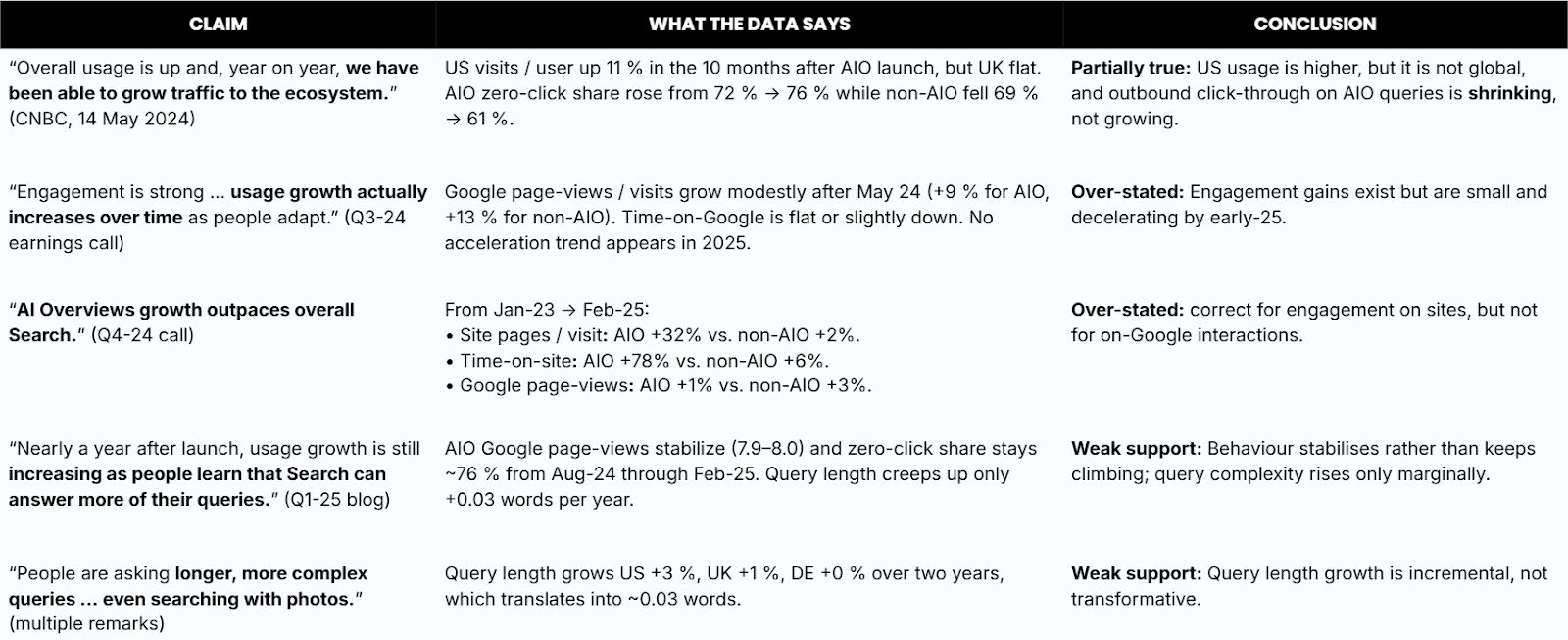
        Is Google delivering its promise to “grow traffic to the ecosystem” through AI Overviews?

        This claim has been repeated by Alphabet CEO Sundar Pichai in multiple forums:

        • “In general, we find it’s both overall increasing usage, and when we look at it year on year, we have been able to grow traffic to the ecosystem.”1
        • “People are using it to Search in entirely new ways … and getting back the best the web has to offer.”2

        For website owners, publishers, and content creators, this is the million-dollar question.

        Plus, if AI Overviews truly drive more traffic to the web, they represent an evolution of Search.

        But if they don’t drive more traffic to the web, they potentially represent a significant disruption to the relationship between Google and the open web.

        Let’s examine what the data actually shows about traffic patterns before and after the introduction of AI Overviews.

        As a reminder, I partnered with Similarweb to analyze over 5 billion search queries across multiple markets. And here’s what this data set includes:

        • Over 5 billion search queries and 20 million websites.
        • Average time on site, searches per session, and visits per user on Google.com – both in total and comparing the UK, U.S., and Germany.
        • A comparison of keywords with and without AI Overviews that analyzes searches per session, average time spent on Google, and zero-click share.
        • Page views and time spent on Google.com for keywords showing AI Overviews vs. keywords without AI Overviews.
        • Average query length for the UK, US, and Germany.

        Claim: We Have Been Able To Grow Traffic To The Ecosystem

        Data from my analysis shows this claim is not correct.

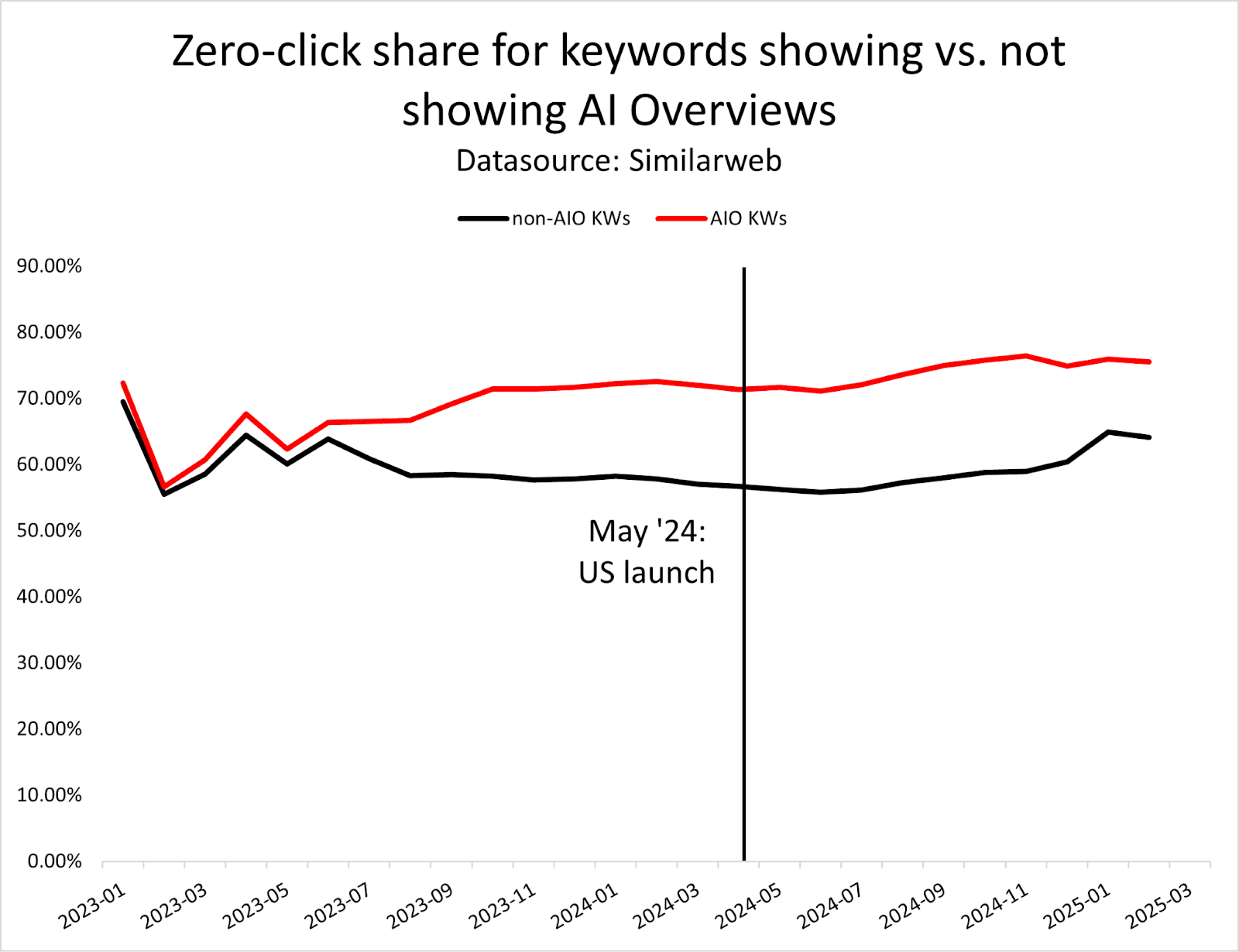
        In fact, my study reveals AIOs raise zero-click share from 72% → 76%.

        Users who leave Google do engage more, as mentioned in Part 1, but a larger share of queries never “get back to the web.”

        Image Credit: Kevin Indig

        It’s important to pause here.

        Look at how many keywords (60% at the lowest point, shown by the black line above) lead to zero-click searches, even when Google doesn’t show an AI Overview.

        Many keywords that grew in zero-clicks after AI Overviews officially launched in May 2024 also had zero-clicks before the launch.

        But after the rollout, we see a clear increase in zero-clicks for AIO keywords and a plateau in November 2024 at 76% (up from 71.4% in April 2024).

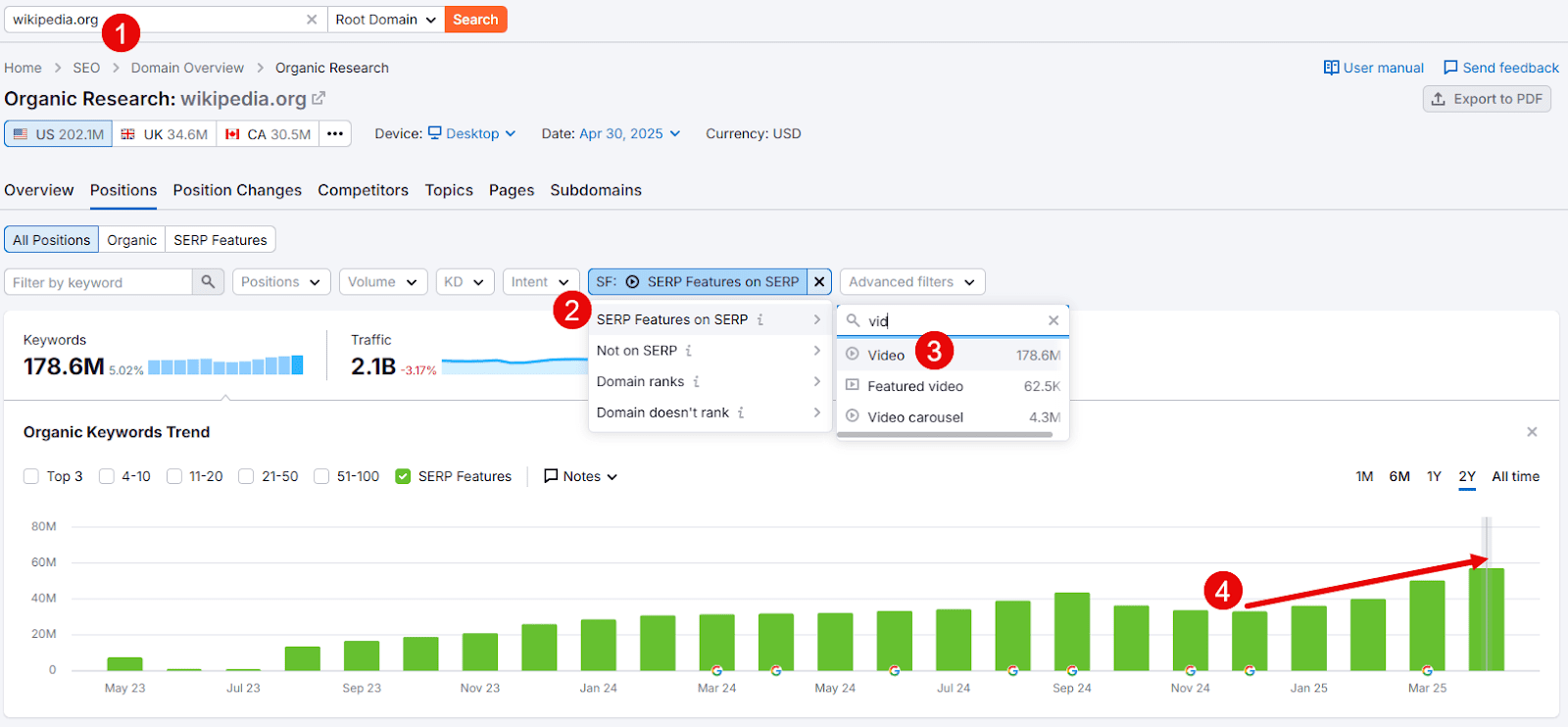
        The share of zero-clicks also grew for non-AIO keywords, which can be explained by SERP Features like Featured Snippets.

        For example, Semrush shows a clear upward trend for the number of videos that show up for terms Wikipedia, one of the largest sites on the web, ranks for.

        Image Credit: Kevin Indig

        As a result of more SERP features, the gap in zero-click share between keywords showing AIOs vs. not showing AIOs has closed from 15.4% in May 2024 to 11.4% in February 2025.

        Here’s another example that challenges Pichai and the Google team’s claims:

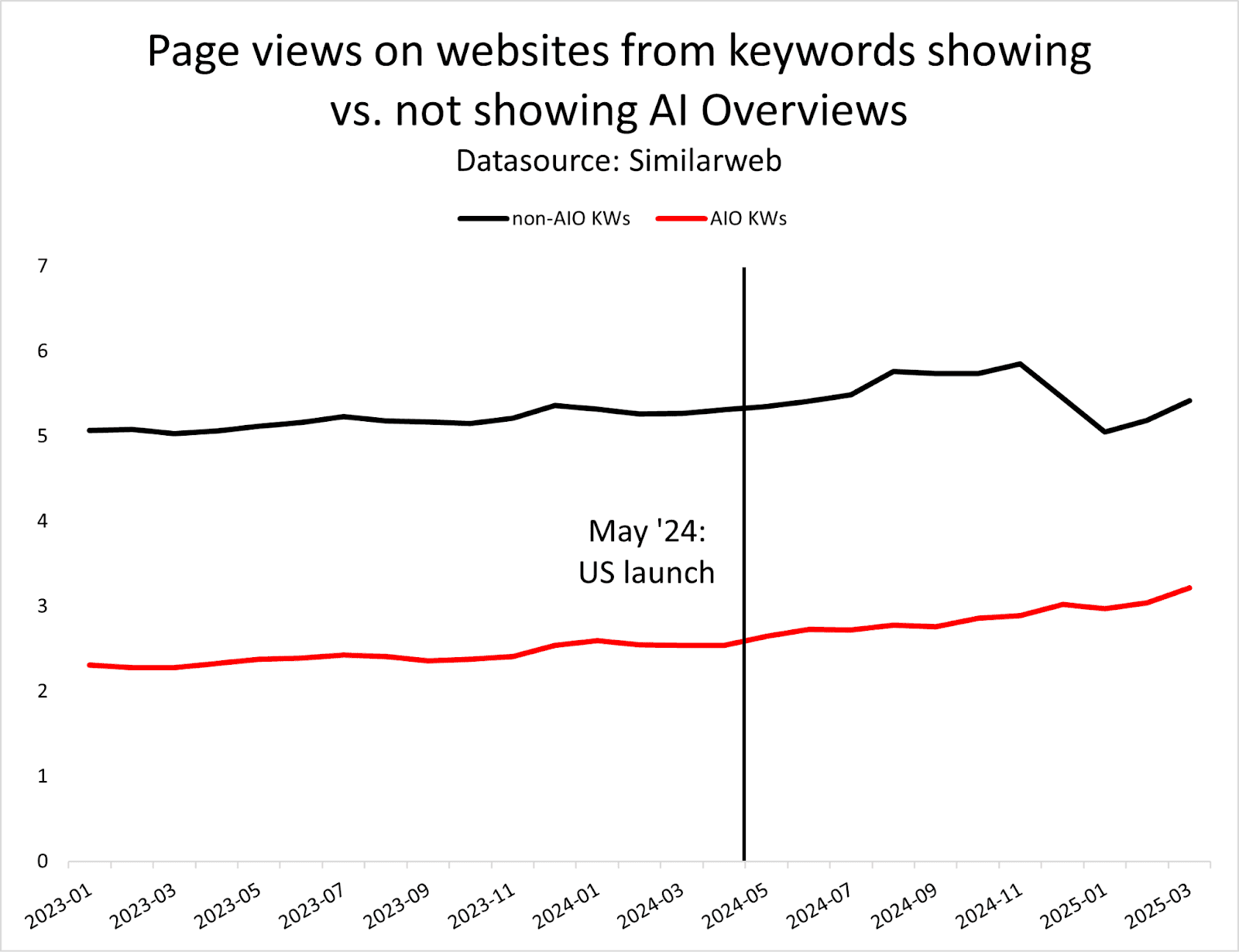
        Search queries without AI Overviews result in twice as many pageviews as those with AI Overviews.

        In that sense, AIOs send less traffic to the ecosystem overall, and it leads to fewer pageviews. This is a death blow for publishers who rely on ad impression volume.

        To be fair, one could argue in favor of Pichai’s point here in that pageviews from AIO keywords have grown 21.5% since the rollout in May 2024, compared to just 1.3% growth for keywords without AI Overviews during the same period (until November ‘24, after which they drop).

        So, you could look at that trend and say, “Pageviews from AIO queries have grown,” but that omits a lot of important context.

        Image Credit: Kevin Indig

        Verdict: These Claims Aren’t Telling The Full Truth – At Best

        In Part 1, I came to the following conclusion:

        When we examine the data closely, a clear pattern emerges: Google’s claims about AI Overviews fundamentally changing how we search are largely overstated.

        Yes, users visit Google more frequently, but they’re spending less time per visit and not crafting significantly longer or more complex queries. This suggests AI Overviews are creating a “quick answer” behavior pattern rather than deeper engagement with search.

        And Part 2 of my analysis confirms that pattern.

        Yes, queries are creeping longer, and AIO-derived clicks are high-quality.

        However, zero-click growth contradicts the claim that AIO consistently sends more traffic “back to the web.”

        Image Credit: Kevin Indig

        The rise in query length is incremental – not a wholesale shift to “entirely new” behavior – and increased zero-click resolution means many searches stop at Google rather than reaching “the best the web has to offer.”

        Make sure to subscribe because next week, I’m publishing the first-ever AIO usability study to complement the quantitative data I’ve published over the last five months with qualitative insights.

        Let me tell you … this will change your model of Search and LLM optimization.

        Boost your skills with Growth Memo’s weekly expert insights. Subscribe for free!


        1 CNBC Exclusive: CNBC Transcript: Alphabet CEO Sundar Pichai Speaks with CNBC’s Deirdre Bosa on “Closing Bell: Overtime” Today

        2 Google I/O 2024: An I/O for a new generation


        Featured Image: Paulo Bobita/Search Engine Journal